Reggie Watts: A Focused/Unfocused “Lord of Dreams”

DownloadedFile-1

One of the things we find in many schlemiels is the character of absent-mindedness.  In her essay on the schlemiel (entitled “The Jew as Pariah”), Hannah Arendt (a Jewish-German thinker from the mid-twentieth century) notes that in the “hidden tradition” (of the Pariah/Schlemiel) the first major modern schlemiel witnessed in the west was the 19th c. German-Jewish poet, Heinrich Heine’s “lord of dreams.”  For Heine, the “lord of dreams” is not just another name for the schlemiel; it is also the name for the modern poet.  The poet’s dreams don’t match with reality because the poet, like the schlemiel, is absent-minded.

But for Arendt the absent mindedness we find in Heine (and his conception of the modern poet) is driven by a desire for freedom which is frustrated by a world that one cannot be truly “free” in.  As Arendt argues, the source of this freedom is connected to “nature” as opposed to “culture.”  In this sense, the schlemiel/pariah differs significantly from the “parvenu” who, in throwing away their “Jewishness” in the name of being a “cultured” member of society also throws away his/her natural sense of freedom and their pariah status.

Although Arendt doesn’t spell it out, one can surmise that the reason Heine is at the beginning of her “hidden tradition” is because his freedom is not protected by the world.  He, like a poet, lives outside the world.  He is, as Arendt says about the schlemiel, “exceptional.”  But, ultimately, for Arendt being exceptional is secondary to being “normal” and free-in-the-world.  (She argues, strangely enough, that it is Kafka who seeks such normality and desires to leave the exceptional status of the “lord of dreams” behind.)  In other words, Heine may have the right “intention” (which is to be free) but this desire doesn’t fit (not yet, at least) with reality.  That comes later.  When Jews are given the opportunity to have their own state or be recognized, politically, as equals.

What’s most interesting about Arendt’s framework for the schlemiel and the “hidden tradition” is that the “lord of dreams” and his “absent-mindedness” have a cause we can understand yet, ultimately, they have a time and place in history and should be left behind.

Today, with comedians like Reggie Watts, we see that “absent mindedness” and the “lord of dreams” remain.  In fact, this kind of comedy is emulated in a time when people are well integrated.  It seems as if Watts’ very popularity is proof that Arendt was wrong. But here’s the catch: Watts isn’t Jewish.  Nonetheless, the character he plays is without a doubt a schlemiel.  The “lord of dreams” need no longer have a basis in a political reality so much as in the image of a cultural niche or world which is “exceptional” and yet “free” from the world while being in the world.

What I find most interesting about Watts is that he plays the exceptional schlemiel and gives us a more “mystical” (dreamy) sense of being aloof than many historical schlemiels.  He is focused and unfocused.

Punning on this theme, I’d say that we see a great display of this focused/unfocused state in his Ford Focus commercial.

In this commercial, we learn from the narrator that Watts, a “lyrical genius,” is “lacking one thing”: a Ford Focus.   Since the narrator is so nice and wants to fill Watt’s “lack” they “let him borrow a Fusion for three months…which he kind of fell in love with.”   In honor of this “gift,” and bursting with poetic love for the car, Watts, a postmodern “lord of dreams,” gives his “impromptu songamonial” about the car.

The images of Watts, his repetitive humming loop, and the little matchbox model of the car spinning (in slow motion) hypnotically touch the viewer of this commercial.  These effects, taken together, look to create a kind of lord-of-dreams affect.  But this is enhanced by the child-like fascination and love Watts has for the matchbox car.

At one point (:29 seconds in), Watts kisses the car, smiles, and laughs at the camera.  We then see imaginary drawn clouds raining on the car.  Watts lovingly looks at the car (like a concerned lover who doesn’t want to see his beloved harmed by rain) and talks about how the car looks when as it responds to the rain.   He then shows that all is well with a smile: he is happy, the car is sheltered from harm.  After smiling, he looks up to indicate that maybe, in his absent mindedness, this is a miracle from Heaven and not a miracle sponsored by the Ford Motor Corporation (which is the ironic twist).

From here, Watts goes on to talk about the “SONY audio edition” of the car.  He gets mystical and dreamy while focusing on the all the details of the sound system.  Then he links to the GPS system which, he notes, one can talk to.  As he points out how the GPS  will get one to where one wants to go, we see an image with detours and turns (suggesting that Watts is a wandering poet but the car will get him to the focused destination while allowing him to be free and, like a schlemiel, wander).

Then, for the last segment, Watts drops slang terms from Hip Hop Culture as he talks about the “cruise control” and “radar.” Drawn waves, illustrating his words, emanate from the car (1:40-1:46).  These waves continue and suggest a mystical absent-mindedness connected to these hidden radar waves.   While we see this, Watts waxes poetic-mystical and foregrounds the schlemiel poet when he says that the “Fusion can be anything you want…if you use your imagination.”

Immediately following this, Watts uses his imagination (coupled, of course, with drawn images edited in for effect) and says that other cars he had driven were “splooshy” and felt like a “covered wagon” while driving the Focus felt like driving a “spaceship.”

Following this, we see a series of edited absent-minded references to the cars features. The segment ends with Reggie making a hypnotic statement: “watch it roll…watch it spin.”  We see a spinning matchbox car with a flag with the hashtag #backatyou.

And the last image we see is an image that expresses Watts’ crush on the car: Reggie + Fusion in a drawn heart.

The subject of the ad is clear, focused: it is Watts’ exceptional, absent-minded love for the car.  To be sure, his love is focused and unfocused.  This ambiguity makes for a new “lord of dreams.”  And instead of it being based on natural freedom which searches for a world, as Arendt claimed with Heine, we have a freedom that is based on the flights of the imagination, hip-hop culture, mysticism, capitalism, and much else.  As we can see, Watts can be absent-minded and still be guided through the world by his Ford Focus.   It will shelter him from danger.

Arendt would be aghast at a “lord of dreams” who was encouraged to dream not about political freedom so much as the Ford Focus.  With such affluence and so much normality, it seems that comedians like Reggie Watts insist on being eccentric.  Being the exceptional schlemiel is, for Watts, to be  rhythmic, hip, spaced-out, and highly ironic.

Reggie’s schlemiel-like performance in this piece does not serve as a way of “challenging the status quo” so much as creating and marketing a comic-mystical absent-minded sensibility.  This can be used to sell products, as we see in this commercial.  But this is a general trend and as the people who made this video well-understand, there is a large market out there for absent-mindedness and wacky, ironic eccentricity.  In other words, there is a large market for these new types of schlemiels.

The “Lord of Dreams” didn’t die, as Arendt argues at the end of her essay, when Superman displaced Charlie Chaplin.  The schlemiel lived on and it lives on through Watts and many others.  The question is what this means for her thesis about the schlemiel and what she envisioned for Jews in America.

As we can see from Watts, the schlemiel lives on and it is no longer tied to the fate of Jews (as Arendt envisioned) as to capitalism and a large niche culture of Americans who, in this instance, may or may not buy the Ford Focus as a result of the musings of this “lord of dreams.”   It all hinges on how they are affected by the “lyrical genius’s…impromptu songamonial.”  The Focus could be the vehicle they need to become a more focused/unfocused late-capitalist, mystical schlemiel – like Reggie Watts.
A Note on Reggie Watts @ TED Talks

DownloadedFile

Reggie Watts shows us how right Marshall McLuhan was when he said that the “medium is the message.”  But with Reggie I would revise McLuhan to say that the “medium is the message(s).” Or, alternatively, we can also say that Reggie Watts is the message. He’s a signal of sorts, sometimes its coded and mystical; sometimes it’s cultural; but the signal we get, regardless of what he does, is always comic, rhythmic, and musical.

What makes Watts so fascinating, however, is that, like a radio switching from channel to channel (to use an “old school” metaphor) or a person scanning through their texts or facebook feeds, Watts moves from language to language and medium to medium.  Yet he gives us enough time to check out each medium or language before he moves on to the next.  But what makes his routine comic is not just found in how he works with each medium or voice, but also in how he moves from voice to voice with such rapidity and skill.

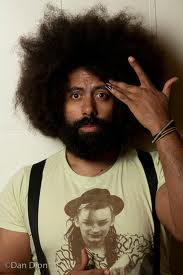
Reggie’s comic greatness is also written into his body and history.  He is a hybridic character with an unkempt retro-afro.  His mother is French and his father is American.  And since his father was in the military, he moved from place to place before he ended up in Great Falls, Montana.

In a way, Reggie seems to be linking these places, identities, and bodies.  He is seeking for a child-like relationship between them, one that plays at maturity.  In his work, I find an interesting take on what I looked at in yesterday’s blog entry; namely, what Gombrowicz calls “difficult childhood.”  Gombrowicz points out how a good artist will necessarily exhaust maturity and will be thrown into a “difficult childhood” while, at the same time, being, a grown person.  But while Gombrowicz returns to childhood in order to ruin his “Polish Childhood,” Watts returns in order to play on it.

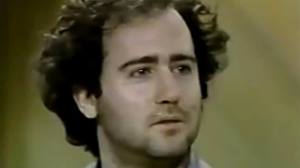
In this clip from TED Talks, Watts inhabits a “difficult childhood” but in a way that seems to be lacking the anxious edge of Gombrowicz’s “difficult childhood.”  Watts does this by way of switching languages, melodies, and rhythms.  The affect of this is to play on the “seriousness” of TED talks.  Yet, at the same time, while playing on it, it does seem as if he is “serious.”  This is what we get from the audience.  They don’t laugh at him when he gets serious.  But at a certain point they do.  Like Andy Kaufman (Watts received the “Andy Kaufman Award” in 2006), he is able to hold the audience in an ambiguous space between laughter and seriousness.

Watts’s form of comedy is working on many levels and, as I mentioned above, he moves between one mode and another in a comic manner so as to create an unusual relatonship that we would never have surmised.  But, in the midst of all this, there is a mark of humility, charm, and absent-mindedness that makes one think of the schlemiel.   But he is not a traditional schlemiel; he is a schlemiel for a new age, an age that has been raised on the internet, hip-hop, and youtube.   But he is not for everyone.  His appeal is to a more narrow audience which appreciates all of this and, at the same time, likes to think deeply about the “meaning of it all.”

Reggie Watts is a comical mystic of the information age.

I would like to return to Watts’ work in future entries.  He is one of the most interesting and innovative comedians out there and watching him is not only entertaining but meaningful and thought provoking.  Playing on McLuhan, I’d say Watts is the message(s).

Witold Gombrowicz’s Affirmation of “Difficult Childhood”

images

Following the passages of Witold Gombrowicz’s diary entries on Simone Weil, which I commented on the other day, there is a fascinating entry labeled “Friday.” It’s first two words – at the top of the entry – are “Polish Catholicism.” In this passage, Gombrowicz expresses his past and present ambivalent attitude toward “childishness” by way of his reading of Polish Catholicism.   His reading has strange resonances with the man-childish-ness we find in many instances of the schlemiel.

The first childishness, for Gombrowicz, has to do with Catholicism “such as the one that historically developed in Poland.”  As he understood it, the Polish people became like children in relation to God.  They gave up their “burdens” to God and, like a child, “sought God’s protection.”  By “listening..respecting…loving…and abiding” by God’s commandments, man gained “a green world, green because it was immature.”  Although Gombrowicz looks down on this, he notes that it was also a “green world” because it was not the “black world” of metaphysics: “To live in the lap of nature, in a limited world, leaving the black universe to God.”

But this isn’t enough.  To be sure, Gombrowicz is more interested in criticizing the Polish Green of “immaturity” than in its embrace of nature. And this is because, he wants to be critical of Poland and its Catholicism.  He notes that this childish religiosity was responsible for a “historical lack of dynamism” and for Poland’s “cultural impotence.”

Gombrowicz precedes to tell us why he thinks of Poland has culturally impotent.  Strangely enough, his reading echoes a view that Sander Gilman uncovers in his book Jewish Self-Hatred.  But, here, it is not the view of an Enlightened Western Jew criticizing his “backwards” Eastern European brethren (the Ostjuden), but the view of a Pole towards the Polish people:

The nation without a philosophy, without a conscious history, intellectually soft and spiritually timid, a nation that produced only “kindly” and “noble-minded” art, a languid people of lyrical scribblers of poetry, folklorists, pianists, actors…

In other words, the Poles are not autonomous.  They are childish and even
“effeminate.”   And Gombrowicz notes that his work, in the present tense, “is guided by the desire to extricate the Pole from all secondary realities and to put him in direct confrontation with the universe.”  His utmost “desire” is to “ruin his (Poland’s) childhood.”  And by ruining it, Gombrowicz would compel him to become a man.

However, in the following paragraph, Gombrowicz takes a radical turn and suggests he has just contradicted himself.  He cannot and doesn’t want to ruin childhood; rather, he wants to find a way to affirm (albeit with a difference):

But now in the pursuant din, in the face of my own helplessness, in this inability to straighten things out, it occurs to me that I have just contradicted myself.  Ruin a childhood? In the name of what?  IN the name of a maturity that I myself can neither bear nor accept?

Gombrowicz, at this point, realizes that he cannot “ruin” the childishness of the Polish people because he himself wants to be a child! “How can I desire that they (the Polish) not be children if I myself, per fas et nefas, want to be a child?”

But then he explains the difference, and this is crucial.  He wants to be a man-child; in short, a schlemiel (albeit of a Polish variety): “A child, yes, but one that has come to know and has exhausted all the possibilities of adult seriousness.  This is the big difference.”

What he means by this is still in need of explanation. To this end, Gombrowicz suggests a process that brings out to this “other” kind of childishness: “First, push away all the things that make everything easier, find yourself in a cosmos that is as bottomless as you can stand…where you are left to your own loneliness and your own strength.”  This first part of the process sounds no different from what he had claimed, originally, was his task; namely, autonomy.  However, this leads one to the next step which is, more or less, failure and retreat to childhood: “Then, when the abyss which you have not managed to tame throws you from the saddle, sit down on the earth and discover the sand and grass anew.”  This process, for Gombrowicz, is – in-itself – a justification of childhood:

For childhood to be allowed, one must have driven maturity to bankruptcy.

While Gombrowicz, as we saw in the last blog entry, thinks that on his lips Simone Weil’s religious passion sounds “stupid,” he, in contrast, thinks the word “childhood” sounds much more earnest:

When I pronounce the word “childishness,” I have the feeling that I am expressing the deepest but not yet roused contents of the people who gave me birth.

In other words, the desire for “childishness” – true childishness as opposed to the Catholic variety – is hidden within the Polish people.  And this is “not the childhood of a child, but the difficult childhood of an adult.”

When I first read these words, I couldn’t help but think of Emmanuel Levinas’s expression: “difficult freedom.”  But this seems to be the opposite.  In fact, Levinas speaks a lot about maturity in his essay – in the book Difficult Freedom – entitled “A Religion for Adults.”  Like Gombrowicz, Levinas also uses “childhood” to express a kind of lack.  For him it is the lack of responsibility.  The “religion for adults” that Levinas speaks of is not a religion that is based on the passion of ecstasy and losing one’s freedom.  To be sure, the religion for adults insists that one’s freedom stay in tact but not, as Gombrowicz would seem to insist, in relation to the world, but in relation to the other.

Gombrowicz’s “difficult childhood,” however, does retain a kind of freedom.  It seems that this freedom is, on the one hand, the freedom of retreat from a ridiculous world of maturity that one “must,” on the other hand, “drive” to “bankruptcy.”

In future posts, I hope to look more into what Gombrowicz calls “difficult childhood.”  It resurfaces throughout this work and provides us an innovative way of thinking the schlemiel.  In light of this research, we will be in a better position to ask several relevant questions: Does the schlemiel also have a “difficult childhood?”  Or is the schlemiel’s difficult childhood entirely different? What, after all, is difficult about the man-childhood of I.B. Singer’s Gimpel, Sholem Aleichem’s Motl, or Philip Roth’s Portnoy?   Or is the “difficult childhood” that of the author?  If it is the author’s, does this imply that the author and not the character is the real schlemiel?


Andy Kaufman and the Inversion of the Comic Target

images-4

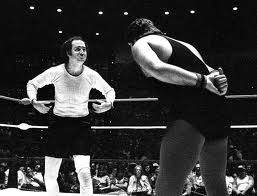
Andy Kaufman is a better candidate for a Levinasian inversion of the comic target, which I mentioned at the outset of this blog series.   He is a “stand-up” (as opposed to Portnoy, Philip Roth’s “sit-down”) comedian.  In a Levinasian sense, this means that he stands-up and faces us.  And we see, in his response to our laughter, how we are targeting him.  This comes out in our ambiguous relation to the character.  I have two videos that illustrate this.

The first video comes from a stand-up routine in LA.

Four minutes into his routine (actually 4:30), Kaufman is accosted by someone in the audience who targets him as a washed-up comedian.  He tells him that Kaufman’s routines don’t “work” anymore.  Kaufman has no new material.  The audience member makes Kaufman sweat and we can clearly see that he is the target.  In these moments, we don’t know whether we should feel sorry for him or not.  Has he failed to keep us excited?  How do we judge him?  Is our judgment too painful to even deal with?

Another example, which is more to the point, comes from an appearance he made on the David Letterman show (June 24, 1980).

In this clip, Andy is clearly out-of-his-wits.  And this deficiency turns the tables on us.   We don’t know whether or not he is really suffering.  This comes out, first, when he tells the audience to stop laughing.  But it comes out most clearly when Kaufman goes out to the audience for alms.  In this moment, he confuses the target and exposes the audience to its targeting.  He has them realize that they may be complicit in such targeting by disarming it.  He differs from Portnoy, who I discussed in yesterday’s blog entry; Kaufman is a schlemiel of a different variety.  His failure takes on another shade, altogether.

Emmanuel Levinas’s philosphy can be applied to both Roth and Kaufmann.  In Roth, the multiplicity of targets and the total disregard for responsibility make Portnoy into a caricature and a target of humor.  He makes us forget about his vulnerability and exposure by targeting his mother, sexuality, and Naomi (a Sabra who dubs him a schlemiel, in the most derogatory sense).   And in looking at him as pathetic (as Naomi does), we are complicit in this effacement.  The problem with this is, as I noted in the last blog entry, it requires an interpretation.   Moreover, for this reason, it’s easier for us to turn to traditional philosophical interpretations of comedy which are based on targeting.

On the other hand, with Kaufman we can see that we are complicit, quite simply, by seeing Kaufman’s responses to the audience and to his pleas for help.  In both, our judgment is suspended and the target is inverted.  We feel obligated to help, but we don’t know if or how we should.  Kaufman’s schlemiel – as opposed to Roth’s – acts to suspend the target rather than, as we saw in Portnoy, to mark it.

The Problem with Levinas’s Reading of Comedy

Levinas’s concept of inversion works; however, his understanding of art and bewitchment, which we see in his essay “Reality and its Shadow,” need revision.  The “meanwhile” – comedy without interpretation – implies that comedy, in itself, is mythology.  However, I would argue that there is a distinct difference between the “sit down” and the “stand-up” comedian; the former can, perhaps, be “bewitched,” but the stand up comic cannot.

Levinas argues that comedy, like tragedy, can “bewitch” a reader or viewer.  The reason for this is because comedy (like tragedy or any story) is, for Levinas, about endless repetition. In Henri Bergson’s sense, comedy doesn’t become; it is static.  Levinas goes farther than Bergson to associate the static aspect of repetition with “mythology” and being “bewitched.”  The time of myth is the time of what he calls the “interval” or the “meanwhile.”  For Levinas, it’s time is the time of myth.  The only way out of this is through interpretation.

As I have suggested, this may be applied to Roth but not to Kaufmann.  In the latter, one leaves mythology by virtue of relation not interpretation.  Our relationship to “stand up” (rather than “sit down”) comedy is ethical.   And in this comic relationship with Kaufmann, we are exposed to our targeting.  He is released from the meanwhile and given over to becoming by virtue of our confused response to his confused response.  We bear witness to the fact that we are complicit in targeting and that we may NOT be able to help the other.  In Roth, on the other hand, we see Portnoy caught up in his own targeting.  And his effort to efface that targeting by enjoying his “impotence” may wound the target but, ultimately, they set the character into an endless repetition of failure.  Nothing changes for Portnoy except for his words.

Final Suggestions

In Levinas’s reading of Don Quixote, which can be found in his Sorbonne lectures of 1976, he notes that although Quixote was “bewitched” by images and imaginings, he was awoken from his slumber in images by virtue of the “hunger of the other man.”  This hunger reminds Quixote that he was bewitched.  With Stand Up comedy, I would suggest that we come to learn that we are the one’s who are bewitched with the power of consciousness and targeting.   And this is the case because, with Kaufman’s “stand-up,” we see the suffering of the comedian; we literally see his hunger communicated by way of comedy.

To be sure, Andy Kafuman uses comedy to expose us to how bewitched we are by violence.  Strangely enough, all of the theories of comedy we evaluated at the outset confirm our fascination as these theories are all based on targeting and the superiority of reason, consciousness, madness, etc.  These theories are challenged by the one I am proposing and by virtue of a comedy like Kaufman’s which turns the tables.

Schlemiels are well-known for missing their targets.  And, in the scenario I have just drawn up, it is fair to say that when Kaufmann misses the comic target, so do we.  And this comic failure can have ethical effect if and only if the comedian exposes us to his vulnerability and its relationship to violence.  Comedy of this nature, as opposed to comedy that is obsessed with targeting, can loosen the grip of reason, culture, and masculinity over all of us.  In other words, it can release us from the superiority espoused by comic theories from Socrates to Paul deMan.  Comedy, by inverting the target, can expose us to the hunger of the other man.  And this possibility, I would argue, resides in the very character that makes Portnoy into a target: the schlemiel.

Yes, indeed, the schlemiel is here to stay. But we still need to ask whether the schlemiel is a “sit-down” comedian or “stand-up” comedian.   Comedy of the latter variety can be ethical, while comedy of the former variety may not be.  However, as we can see in many comedians today, some “stand-up” comedians are really “sit-down” comedians.  And, strangely enough, these kinds of schlemiels never miss their target (even if it is themselves).


Comic Exposure to Targeting: A Levinasian Reading of Andy Kaufmann and Phillip Roth’s Portnoy (Part IV)

images-3

Sanford Pinsker, in his book Schlemiel as Metaphor, points out that Phillip Roth – in one of his autobiographical accounts – thinks of himself in the tradition of Franz Kafka, who he calls a “sit down comic.”  The book that placed him squarely in that tradition was Portnoy’s Complaint.  But what is a “sit down” as opposed to a “stand up” comedian?  What’s the difference?

As Pinsker correctly notes, this book is Roth’s debut as a sexual schlemiel.  (The term “sexual schlemiel” comes from David Biale in his book Eros and the Jews.)  As far as being a man, Potrnoy, the main character, is a half-man.  His only power is to be found in his vulgarity and wit.  But, ultimately, his sexual obsessions and antics are all associated with impotence.  And, strangely enough, he admits to this form of failure.  He can’t “stand up.”

But Portnoy is a different kind of schlemiel and his “sit down” comedy is of a different variety.  Unlike traditional schlemiels, Roth is obsessed with targeting his listeners, his mother, and women who reject him.  And unlike Woody Allen, Roth’s sexual schlemiel is not charming.  He is pathetic.  And this makes him into a target of sorts.  Nonetheless, he targeting of others overcompensates for this and he, so to speak, hits them when they are not looking.  He doesn’t “stand up” to them, but when he does, toward the end of the novel, he is shamed.

Portnoy’s Complaint is structured as a discussion with a psychologist.   Portnoy is telling his story – from youth to the present – to the psychologist.   And this suggests that he wants to “work through” his past.   What we find from the story is that he has many comic targets – his mother, sexuality, his father, and women – which he fires at so as to feel superior.  However, he is a schlemiel insofar as this targeting does nothing to change his situation.   And the more he does it, the more he himself becomes a target of the reader.

In relation to his mother, Portnoy says many angry things.   One exemplary moment comes up when he recalls “Ronald Nimkin’s suicide note” which Nimkin’s mother found “pinned” to his “nice stiffly laundered sports shirt.”  It is the “last note from Ronald to his momma.”  The note is about how Mrs. Blumenthal called and won’t be able to play “Mah-Jong.”  Commenting on this, Portnoy notes, in the most sarcastic way, that Ronald was a “nice Jewish boy” to the very end.  He goes on to mock Ronald’s mother and all Jewish mothers:

Say thank you, darling.  Say you’re welcome, darling. Say you’re sorry, Alex.  Say you’re sorry! Apologize! Yeah, for what?  What have I done now?  Hey, I’m hiding under my bed, my back to the wall, refusing to say sorry, refusing, too, to come out and take the consequences.  Refusing!…Oh..why did Ronald Nimkin give up his ghost…? BECAUSE WE CAN’T TAKE ANYMORE! BECAUSE YOU FUCKING JEWISH MOTHER’S ARE TOO MUCH TO BEAR! (120-21)

Sexual propriety is also targeted since he talks at length about masturbation.  In fact, there is a whole section of the book entitled “Whacking off.”  Let me cite a little:

Then came adolescence – half of my waking life spent locked behind the bathroom door, firing my wad down the toilet bowl, or into the soiled clothes in the laundry hamper, or splay, up against the medicine-chest mirror….

I’ll stop there as the account becomes much more detailed and vulgar.

The biggest target of all is a Sabra named Naomi. He meets her in Israel.  She sexually defeats him and, in the process calls him a schlemiel.  Their dialogue is worth quoting at length since it touches directly on humor and targeting. Naomi’s great insight is that Portnoy doesn’t simply use humor to target others but to target himself:

The way you disapprove of your life! Why do you do that?  It is of no value for a man to disapprove of his life the way that you do.  You seem to take some pleasure, some pride, in making yourself the butt of your own humor.  I don’t believe you actually want to improve your life.  Everything you say is somehow always twisted, some way or another, to come out ‘funny’.  All day long the same thing.  In some way or other, everything is ironical, or self-deprecating.  Self-deprecating?

In response, Portnoy says that the Sabra should appreciate what he is doing since playing the schlemiel is, historically, a staple of Jewish humor: “Oh, I don’t know,” I said, “self-deprecation is, after all, a classic form of Jewish humor.” In response, she notes that this is not Jewish humor but “ghetto humor.” As an Israeli, she is saying that she has gone beyond that kind of humor.  In response to her identification of his humor as ghetto humor, Portnoy says he resembles her remark and mockingly identifies with the “Diaspora Jew” who is “frightened, defensive, self-deprecating, unmanned and corrupted by life in the gentile world”(265).

After hearing her discourse, he sarcastically says: “Wonderful.  Now let’s fuck.”  Disturbed by this reply, Naomi stands up to him and calls him several names: disgusting, a self-hating Jew, a coward, and last but not least, “schlemiel.”  He also calls her names.  But, after she calls him a schlemiel, she leaves him while he carries on.  But at a certain point he tries to prove to her that he’s not a schlemiel but a “man”: “Only I leaped from behind, and with a flying tackle brought this red-headed…dish down with me onto the floor.  I’ll show her who’s a schlemiel”(268).  What ensues is a struggle that turns comic.  When it comes to the moment of sex, he is impotent:

How has it come to this?  “Im-po-tent in Is-real, dad a daah,” to the tune of “Lullaby in Birdland.”  Another joke? She asked.  And another.  And another.  Why disclaim my life.” 

The final pleas of this “sit down” comic are pathetic.  In laughing at him, we aim at a clear target.  To be sure, he takes on the target and says, comically, that he is going home.

We target Portnoy “as” a sexual schlemiel but he doesn’t care.  He sings the song “impotent in Israel” and calls the Sabra names so at to target her and to say that he has won a “verbal victory.”  This victory, however, is ironic.  We see him as a target of his own humor.  Portnoy is blind to the fact that his ironic (and word-crafted) victory conceals his “real” impotence.  This knowledge or insight exposes us to his blindness and to our being better or superior to him.  He’s a schlemiel while we are not.  However, this superiority is at the expense of his verbal victory.  We knowingly exclude him by valuing masculine “normality” over comic abnormality.  And in this we are complicit with Naomi.   We target him and see that he targets himself as a schlemiel (of the negative variety).   However, we are still blinded by this gesture as we are not exposed to our complicity or to our targeting.

The problem with a novel, as Levinas points out in his essay “Reality and its Shadow,” is that it requires an interpretation. Without interpretation, the character, he claims, will be stuck in endless repetition or what he calls “mythology.” The time of the character is what he calls “the meanwhile” or “the interval.”  Instead of changing the character in the novel – here, the schlemiel – will not change (as time requires a movement or a form of becoming from one kind of being to another).  This is consonant with Bergson, but with Levinas laughter alone is not sufficient to pull a story or a character out of the interval or mythology.   Moreover, we, the readers, will also bewitched if we simply laugh at Portnoy.  By laughing at the schlemiel, Levinas would say that we, too, are caught in the interval.

I would deepen this argument to include another element: targeting.  What happens in Roth’s novel is that we are not exposed to our targeting and that is what maintains another kind of mythology; namely, the mythology of superiority and selfhood which makes the contrast between the half-man, schlemiel in the novel and the reader who is not a schlemiel.   In this structure, which is the classical structure of comedy and comic theory, we have no sense complicit.  We know we are “in on the joke,” but we aren’t exposed to this targeting.

I would argue that complicity is harder to read with “sit down” comedy that it is in “stand up” comedy because we can’t see the face of the other in a novel.  (Although I would argue there are comic novels that do in fact expose us to targeting.  Portnoy’s Complaint, however, is not one of them.  It serves, in this blog entry, to make an important point of  contrast.)  For this reason, it’s easier for us to target and judge Portnoy as an impotent failure.  It’s easier for us to subscribe to traditional theories of humor when targeting and judging this sit down comic.

In the next blog entry, I will introduce the case of Andy Kaufman which provides us with the case of a “stand up” comic who exposes us to our targeting and our complicity.  He provides us with an opportunity to bring a Levinasian reading to bear on comedy.  In Roth’s comedy, we find that a Levinasian reading isn’t as prescient as a classical reading of comedy which targets the comic character – here, the schlemiel – as inferior.

A Note on Witold Gombrowicz and Simone Weil

images-2

I have been reading parts of the Polish writer Witold Gombrowicz’s diary.  I read him and include him in Schlemiel-in-Theory because I think his comic novels (Ferdydurke being my favorite) and many of his comic reflections on himself have schlemiel-like resonances.   He is an exceptional writer who has been recognized by Susan Sontag and others.

For now, I only want to note a few diary entries which caught my eye.  The first is dated 1956. The place it was written in – Mar de Plata (a city in Argentina; since he left Poland for Argentina before WWII – is also noted.

In his “Thursday” entry, he reflects on Simone Weil’s La pesanteur et la grace.   To preface his thoughts, he points out how his generation can’t stomach the metaphyics of Kant or the Theologians. The issue, here, being God:

We, the grandchildren of Kierkegaard, can no longer digest the reasoned God of Aristotle, Aquinas, Descartes, or Kant.  My generation’s relationship with abstraction is completely in ruins, or, rather, has coarsened because we evidence a completely peasant distrust of it. (212)

After noting this, Gombrowicz reflects on himself.  But this time he notes how he is pushed toward metaphysics although he is disheartened by it:

Life in its very monstrousness pushes me in the direction of metaphysics.  Wind, noise, house, all of this has stopped being “natural” because I myself am no longer nature but something gradually cast beyond its limits.  It is not I myself, but that which is coming to an end in  me that clamors for God, this need or necessity is not in my, but my predicament.

Following this reflection, Gombrowicz brings up Simone Weil’s approach to God and shows how he cannot accept her conclusions about God:

I look at her with amazement and saw: how, by means of what magic, has this woman been able to arrange herself so internally so that she is able to cope with what devastates me? 

He can’t turn to metaphysics even though he wants to, so where does he go with his religious desires?  Gombrowicz takes a comic turn.  He comically notes that he is “amazed” that people lives their lives based on principles that differ from his own.  And then he launches into a meditation on how small he is.  This meditation, it seems, suggests that for Gombrowicz the best response to monstrosity is not to take the religious leap suggested by Weil so much as a comic leap into humility and the accidental nature of arriving at this or that insight in his fiction:

I know no, absolutely no greatness.  I am a petit bourgeois promenader, who has wandered into the Alps or Himalayas.  My pen touches mighty and ultimate issues all the time, but if I have reached them, it was done while playing…As a boy I climbed up iont them and wandered around them frivolously.

Comparing himself to Weil, he points out that she is heroic while he is a coward: “whereas I constantly elude life, she takes it on fully, elle s’engage, she is the antithesis of my desertion.  Simone Weil and I are the sharpest contrast that one can imagine, two mutually exclusive interpretations.”  But, lest we not be fooled here, he is taking Weil and himself as comic targets of this and his following reflections.

The next day Gombrowicz takes an interesting detour which, to my mind, echoes this entry.  The next day he is on the beach and starts off with a meditation on what he sees:

Bodies, bodies, bodies…Today on the beaches sheltered from the southern gale, where the sun warms and roasts, a multitude of bodies, the great sensuality of beaches, yet as always, undercut, defeated.

As you can see, the final note is that he sees himself as a schlemiel or sorts – the “odd one out.”  He can’t fit into this beach scene.  And he can’t assert himself heroically on the page, as Weil does, or at the beach with the multitude of bodies in the resplendent sun.  Rather, sounding much like Portnoy at the end of Portnoy’s Complaint (but with a more tragic tone) he says, “Impotence overwhelms the beach, beauty, grace, charm. They are unimportant: they are not possessive, they neither wound nor engage….This impotence debilitated even me and I returned home without the least spark, powerless.”

He leaves the beach to go home and face the novel he is writing and he sarcastically notes that “I will have to exert myself to inject a little ‘brilliance’ into a scene that is like wet powder and wont’ ignite.”

The next day, the impotent artist turns to Simone Weil and says, quite frankly, that the words of religious passion sound “stupid” on his lips.  He feels like a fool who is trying to be holy.   But then he asks himself if Weil was really beyond the impotence of modernity and he notes, by way of Gustave Thibone’s criticism of Weil, that she wrote of religious passion because she was bored.

(This reading of Boredom and modernity, I’d like to note, sounds much like that of Charles Baudelaire’s which I have been blogging on.)

He also calls her a hermit who didn’t know how to deal with the monstrous world, and in this view he also sees himself or anyone who may turn to the holy out of desperation: “A hysterical woman, tormenting and boring, an egotist, whose swollen and aggressive personality is incapable of noticing others – a know of tensions, torments, hallucinations, and manias…”

Gombrowicz is attracted and repulsed by his own outburst about Weil.  After pointing this out, he writes to himself “calm down.”  The fact that he is excited and angry about Weil show us that he, in his own eyes, falls into a similar trap, a modern trap; but unlike Weil, he doesn’t believe in his profundities.  Instead, he sees himself as a failure who happens to run across things like a child at play.

And in this gesture, which is based on comically targeting a belief that human beings can be heroic (religiously or artistically) he avoids metaphysics.  This turn to childishness is fascinating as it can be found in several modern writers and thinkers – like Walter Benjamin, Franz Kafka, Woody Allen, and Ernst Bloch (to name a few) – that schlemiel-in-theory addresses from time to time.

Comic Exposure to Targeting: A Levinasian Reading of Andy Kaufmann and Phillip Roth’s Portnoy (Part III)

DownloadedFile-3

The last two targeting theories I’d like to look at, before I address Emmauel Levinas, Philip Roth, and Andy Kaufman come from Charles Baudelaire and Paul deMan who, apparently, follows in Baudelaire’s comic footsteps.   (I have written several blogs on Baudelaire and deMan’s reading of comedy.  What I look to do here is to summarize their views and to distinguish their approaches to a Levinas-ian one.)

Like many of the other theorists we have seen so far, the 19th century French Symbolist poet Charles Baudeliare, in his “The Essence of Laughter,” associated what he called “essential laughter” with Satanic superiority and human fallen-ness.  The target of this laughter is innocence and the result of this laughter is a kind of double consciousness of oneself in terms of otherness.  The consciousness of the Satanic – double consciousness – is sufficient to overcome and use the Satanic for social progress because, for Baudelaire, it marks a superiority over nature (one’s one and the world’s). However, in laughing at the fallen, one also feels a loss.  Both are incorporated into one’s consciousness and, taken together, they are for Baudeliare part and parcel of being modern.  The best examples Baudelaire gives come from the world of mime and the comic/horrific world of ETA Hoffman.

The element of blindness and naivite, which is found in the subject of any comic routine, act, joke, or passage, is the key to understanding the Satanic.  With respect to the mime, Baudelaire sees the movements of the mime as bringing out a blindness and a disregard for the civil (but this disregard is blind). We laugh at this disregard for the world and, at the same time, its falleness.  We identify with the excessive and odd gesturing of the mime, yet, at the same time, by laughing at the mime’s gestures we are indicating that we are superior.  And this marks our identification and dis-identification, our double consciousness that one is and one is not caught up in a kind of gestural fallen-ness.

But the fact that Baudeliare turns to the example of fallen-ness that comes to us by way of the German writer ETA Hoffman (as the final example) indicates that something is missing in the mime example.  What’s missing is a greater appreciation of how innocence and its loss play the main role in essential laughter.  The story that interests Baudelaire involves the laughter at a little girl’s shock at learning that the soldiers she has idealized are, ultimately, animal-like.  It is her father, a “magician,” who brings her to this profane revelation.  Her shock at fallen-ness and our laughter at it illustrate, for Baudelaire, our Satanic sensibility.  He calls it a kind of madness, a vertigo at this or that loss.  However, as Baudelaire argues, this madness is followed by a moral awareness of how laughter can be used for progress.  We go into the world with a, so to speak, tainted understanding of our “superiority.”  It is far from perfect and works by way of shocking the innocent.  Nonetheless, without such superiority over nature man would have no meaning.

Further to this last point, Baudelaire’s prose piece, “A Heroic Death,” shows us that laughter is far from progressive and positive; it also creates a wedge between the real artist and the artist of consumption.  The cynical conclusion of this piece is that the consumer, so to speak, has the last laugh while we, the readers, lose our innocence as we are exposed to the cruel truth that power is greater than “real” art (in this case the art of a comic mime).

In “A Heroic Death,” it is the Prince, a being in the position of the power, who embodies the Satanic-comic life.   He is the ultimate consumer.   After he learns that the comic mime (jester) has plotted to kill him with other nobles, he puts him into a test where the Mime has to make the performance of a lifetime.  When he, as Baudelaire notes, becomes one with the symbol and effaces the line between himself and what he is performing, he gives the audience something of a revelation.  They are all enraptured and “intoxicated” with what they see.

However, the Prince is troubled because he loses all of the attention of the people.  The comic mime wins their attention and, in effect, robs the Prince of his power.  In response, he laughs at the true artist who steals his power and this, in effect, leads to the mime’s pathetic (not heroic death).  To be sure, it is the artist and the correlation of acting and symbolism that are the target of modern Satanic laughter.  And we can have no doubt that Baudelaire identified with the comic mime who, in the end, although bearing the truth by way of comedy, is the target of power.  The “real artist” loses, while the artist-as-consumer wins.  The death of the mime is something of a premonition of reality TV since the Prince sees the mime’s acting under duress as a form of entertainment.  As the narrator of “A Heroic Death” tells us the prince turns to entertainment to eliminate his worst enemy: Boredom.  The murder of the artist – by way of Satanic laughter – is in the name of amusement.  It has entertainment value.  This disturbing conclusion shows that, for Baudelaire, the target of humor in the modern world is the artist.  Even s/he cannot escape the daemonic.  S/he becomes its target.

Paul DeMan’s challenge to us, today, is to argue that irony and comedy turn the target back on oneself.  Reading Baudealire, deMan sees humor as leading to madness.   But the madness he looks at is not simply the madness that the girl in the ETA Hoffman story experiences or the madness we witness at the failure of the mime’s art in “A Heroic Death.”  According to deMan, we don’t discover the Satanic in what Baudelaire called “essential laughter” so much as the nothingness of oneself.   Comedy shares nothing inter-subjective with the other.  It has no meaning save the destruction of meaning.  That is what DeMan calls the “irony of ironies.”  Meaning, the self, and the inter-subjective are, for deMan, the targets of irony.

For deMan, what we find in the wake of the Prince’s Satanic laughter, so to speak, is the abyss.  The best things humanity has to emulate – innocence, hope, and art – are the targets.   And the elimination of these targets leaves one alone, abandoned, speechless, and cynical.

I would like to suggest that Levinas’s interest in the relation to the other can be understood as a challenge to deMan and to the tradition of comic judgment and targeting.   As Levinas notes in several of his texts, the notion of the isolated consciousness and “essance” – which deMan and the other comic theorists we have discussed, return us to by way of laughter – are challenged by way of the other.  In relation to the other, I am vulnerable, exposed.  I cannot separate my consciousness from the other.  Using hyperbole, Levinas argues that we must use an “amphiblology” when speaking of our relation to the other because we are assymetically related to the other.  Our words cannot approximate our relation to the other; they fall short of what he, elsewhere, calls infinity.   Our signification in relation to the other is Saying.  And, as I would argue, it is comical.  In relation to the other, we are comical but we are not alone.  The comedy is in the relation and not in the act of targeting.

We risk ourselves when we relate to the other who can accept or reject our love or care.  We are, as Levinas says, “traumatized” and “inspired” by the other.   Although Levinas sees this as a very serious affair, the fact of the matter is that comedy can expose us to vulnerability. More importantly, it can expose the audience to its violence against the other.  Through comedy, we can bear witness to being traumatized and inspired by the other.  But, as I’d like to show in the next few blog entries, this witnessing can invert the targeting that is, as we have seen above, part and parcel of nearly every theory of comedy from Aristotle to deMan.

We can see the oscillation of the comic target in relation to what Phillip Roth would call the tradition of “sit down” comedy and to Andy Kaufmann’s “stand-up” comedy.   In the next blog entries, I’d like to contrast the two so as to show how the schlemiel, as a comic character, can be read in terms of traditional theories of comedy which lay emphasis on targets and superiority and to a Levinasian way of reading comedy – one which looks to show how the comic target is inverted by the other.

Comic Exposure to Targeting: A Levinasian Reading of Andy Kaufmann and Phillip Roth’s Portnoy (Part I)

images

“Eternal nothingness is O.K. if you’re dressed for it.” (Woody Allen)

Comedy is inseparable from targeting.  Take a look at any joke and you will notice that it most likely has a target.  And, sometimes, the comedian or author may make him or herself into a target.  Whether one targets oneself or a target other than oneself, the target spurs those who laugh (in the audience) to feel or bear witness to some kind of superiority.  To be sure, the philosophy of comedy translates targeting into theory.  From Immanuel Kant and Thomas Hobbes to Henri Bergson and Charles Baudelaire we see the same gesture which posits a subject who (or which) is superior to the person or idea which is the target of this or that joke.

Even dialogical forms of comedy work on a similar premise of targeting and overturning – inter-subjectively and dialogically – this or that idea or object by way of inversion.  We see this, for instance, in Mikhail Bahktin’s theory of the carnivalesque in which low culture dialogically subverts high or dominant culture by way of comic parody.  And even when a theorist like Paul deMan argues, in his essay “The Rhetoric of Temporality,” that the “irony of ironies” short-circuits both inter-subjectivity and subjectivity, the fact remains that both inter-subjectivity and subjectivity are, for deMan, the true targets of comedy.  For him and, as he claims, for Charles Baudelaire, “essential laughter” makes one “mad.”   It makes one experience a kind of subjective vertigo which occurs in the wake of nihilation wherein no meaning remains (whether that meaning was shared and inter-subjective, a concept, or the elevation of reason over its target).  Comic (or is it tragic) madness takes meaning and the self as its ultimate targets.  And in its wake, nothing save anxiety, despair, and dizziness remain.

Instead of seeing comedy as destroying one target or another, I would like to suggest a reading of comedy that is based on being, as the philosopher Emmanuel Levinas might say, traumatized and inspired by the (other) comedian.  In the reading I would like to suggest, the comedian effaces the target and turns the act of targeting back on the audience.  (He doesn’t target them so much as expose them to targeting as such.)  To explore this notion I would like to address two particular kinds of comedy: Phillip Roth’s “sit-down” comedy (articulated through Portnoy of Portnoy’s Complaint) and the “stand-up” comedy of Andy Kaufman.  In the comedy they put forth, the audience and the reader may become uneasy and uncertain of themselves and their subject. They may not be sure if the comic subject needs their help and if they have anything to do with his or her humiliation.  The audience or reader, in short, is comically called into an ethical relation with an otherness that exposes them to relations of force.  And this gives them an acute sense of responsibility since they are caught up in this web of relations.  Their humor, to be sure, has high stakes.  

However, as I look to show, Roth and Kaufman fundamentally differ in the sense that in Roth the targeting doesn’t go far enough and may fall into what Levinas calls the “meanwhile” while in Kaufman the target is inverted.

Since the position of the comedian is one that includes ridicule and rejection, the audience’s responsibility is faced with the question of what it means to be implicated in an act of (comic) violence and what one can do about it.  But can one really do anything save bear witness?

The audience is exposed to the targeting that aims at the comedian.  Ultimately, there is a “madness” that comes with this brand of comedy but it is not, as deMan held, private and deeply subjective; it is shared publicly and, in a Levinasian sense, asymmetrically between the comedian and the audience.  And this madness, which is comic, marks one’s ability to respond. The madness of comedy is not, as deMan would hold, a private madness which is devoid of any relation anything remotely ethical; on the contrary, the madness of comedy is a “madness of responsibility.”

I would suggest – by way of Roth and Kaufman – that this general kind of comic responsibility is particular to the schlemiel – the Jewish fool.   Both Roth and Kaufman are, without a doubt, drawing on this character albeit in different ways.  The schlemiel, for some Jewish writers, is a comic target that must be ridiculed and left behind; for still others, it should not be left behind since it has an ethical effect, it inverts the comic target and awakens the asymmetrical relation between the comedian and audience.

On the one hand, we see the target a challenged form in Phillip Roth’s Portnoy and, on the other, we see it vindicated by Andy Kaufman.  Because both are targeted and because they deflect this targeting on the reader or audience, their comedy gives special attention to the target.  And this creates a kind of madness.  Comic responsibility is mad because it includes laughter, ridicule, and exposure to the other.  It marks the inversion of the target and opens up a new way of understanding comedy, philosophically.

Before we can understand the inversion of the comic target (in a Levinasian sense), we first need to understand how the comic target has been theorized.  To this end, I will make a brief survey of the philosophical theories of comedy from Socrates and Aristotle to Henri Bergson and Paul deMan.  Each of them understood the target of comedy in terms of one superiority or another: “élan vital,” Culture, Reason, consciousness, congruity, beauty, madness, etc.  To be sure, upon close reading, we can see that, in the philosophy of comedy, there is a common thread which spans the classical-Greek philosophers, the European Enlightenment, and European modernist.  And that thread is held together by the fact that all of them understand comedy in terms of this or that target.

In my next blog entry, I will address these positions.

I.B. Singer on the Schlemiel (a.k.a. “Little Man”)

DownloadedFile-2

In a 1968 Paris Review interview with Harold Flender, I.B. Singer, the Nobel Prize winning Yiddish writer, was asked about the schlemiel.  However, the name schlemiel wasn’t used in Flender’s question.  Rather, Flender uses the word “little man.”   His question to Singer and Singer’s response are telling as they suggest a break in the tradition and something different about I.B. Singer’s schlemiel:

Flender: The hero of most Western writing is the Superman, the Promethean character.  The hero of Yiddish fiction, Jewish writing, seems to be the little man.  He’s a poor but proud man always struggling.  And your classic example of the little man would be Gimpel the Fool.  How do you account for the fact that in so much Yiddish fiction the hero is the little man?

In response to Flender’s question, Singer begins by noting that the Yiddish writer was not “really brought up on ideas of heroes” and that there are “very few heroes in the Jewish ghettos.”   Singer’s initial response is echoes throughout Daniel Boyarin’s book Unheroic Conduct, which provides much evidence that Jews associated knights, duelists, and heroes with “Goyishe Nachas” (non-Jewish joy); in apposition to this, says Boyarin, is the Jewish ideal of humility (“Yiddishe Nachas”).  For Boyarin, the person who embodies this ideal is, literally, the little man (Boyarin sometimes uses images from Passover Haggadoth to illustrate how important the “little man” was to Jews in the Middle Ages).  For Boyarin, this tradition was challenged by Jews in the west who looked to be more heroic.  In contrast, in the Eastern part of Europe, where Singer and Yiddish literature emerge, the ideal lives on.

Although Singer is aware of this tradition of the “little man” in Jewish history and Yiddish literature, he understands it differently from Boyarin (who sees it in a positive light and, in fact, calls for a return to such smallness in his book).  We see this in his response to Flender:

In my own case, I don’t think I write in the tradition of the Yiddish writers’ “little man,” because their little man is actually a victim – a man who is a victim to anti-Semitism, the economic situation, and so on.  My characters, though they are not big men in the sense that they play a big part in the world, still they are not little, because in their own fashion they are men of character, men of thinking, men of great suffering.

Reading this, one might be astounded because Gimpel seems to be a victim of sorts in the sense that the community perpetually lies to him and he seems takes the bait.  Ruth Wisse, writing of Gimpel, argues that he does in fact have some understanding of these tricks but he goes on, still.  And, for Wisse, this has much to do with the survival of morality in the wake of the Holocaust.  Regardless of what one may think, however, Gimpel is still a “little man.” Singer shrugs his shoulders and admits to this, yet with a difference which is brought up by virtue of a comparison with Sholem Aleichem’s Tevye:

It is true that Gimpel the Fool is a little man, but he’s not the same kind of little man as Sholom Aleichem’s Tevye.  Tevye is a little man with little desires, and with little prejudice.  All he needed was to make a living.  If Tevye could have made a living, he wouldn’t have been driven to leave his village….In my case, most of my heroes could not be satisfied with just a few rubles or with the permission to live in Russia or somewhere else.  Their tragedies are different.

Singer’s answer suggests that, for him, his “little men” are different because they are after something different, something more complex than Aleichem’s “little men.”  And the reason he offers for this difference is because their tragedies differ.  This, it seems, is another way of saying that his “little men” are different because they come after a tragedy much greater than the pogroms suffered by many of Aleichem’s little men.  Simply finding a new land like Russia, Israel, or America is not enough for them (while it is, for many of Aleichem’s characters, sufficient).

Singer thinks this tradition of the “little man” changes with Gimpel and, to point out this difference, he goes so far as to say that we should refer to Gimpel as a “fool” and not a “little man.”

Gimpel was not a little man.  He was a fool, but he wasn’t little.  The tradition of the little man is something which I avoid in my writing.

What Singer is getting at is something that Ruth Wisse picked up on in her book The Schlemiel as Modern Hero.  Like Singer, she understood that the schlemiel is a “modern hero” in the sense that he is not a little man; rather, he has a kind of moral dignity.  However, unlike Singer, she doesn’t see a bifurcation between Aleichem and Singer in terms of the schlemiel.  She acknowledges the post-Holocaust schlemiel in Singer but she also sees a moral dignity in Aleichem’s characters who balance out hope and skepticism.

Regardless of Wisse’s reading, I think she would agree with Singer that the schlemiel has changed after the Holocaust.  What we need to ask is how the difference between the schlemiel as “little man” (victim) versus the schlemiel as “fool” articulates itself in Jewish-American fiction.   Singer is suggesting to us that if the schlemiel is to matter, today, it cannot simply be the same “little man” we see in the tradition of Yiddish literature.   And, more importantly, it can’t be because it now speaks American-English and slang not Yiddish.

“Gimpel the Fool” was the first English translation of I.B. Singer’s Yiddish stories. And it was translated, for The Partisan Review, by another Nobel Prize winning writer: Saul Bellow.  One need not wonder, however, what was lost in this translation.  Singer tells us: the little man was lost.  It died in Europe with the end of European Jewish life.  In America and after the Holocaust, Gimpel becomes a “fool” and this implies that now the stakes are even higher.  Singer seems to be suggesting that now the schlemiel can go from being a little man to a bigger one; the schlemiel grows in stature but this stature is moral.  Singer seems to be suggesting that the greatness of the schlemiel is proportionate to the suffering it indirectly addresses.  S/he is not a hero in the typical sense; s/he is a hero in the moral sense. (And on this note, I think, in contrast to Singer, that Aleichem’s characters are heroic.)

Given what we have learned from Singer, the only question we need to ask ourselves is whether or how any schlemiel we see has anything “big” to teach us. If it doesn’t, then it is an empty shell.  Perhaps this is what we often find in Hollywood, but, fortunately, I’ll be the first to say that the schlemiel Singer makes reference to lives on in the pages of many Jewish-American writers, in some stand-up comedians, and in a few films (as this blog has made evident).

But, in the end, even Singer would likely admit that if the schlemiel is simply a fool and not also a little man, he will not live on.   Perhaps, like a “little man,” and following an ancient tradition, he would comically shrug his shoulders and say (in a Yiddish-American way): Genug shoyn! (Enough already!)

Lost in Translation: On the Americanization of Sholem Aleichem’s Kasrilevke

DownloadedFile-1

In Isidore Goldstick’s 1948 translation of Sholem Aleichem’s Inside Kasrilevke there is a lot of American slang.  Instead of being resentful, I found it to be rather fun imagining the driver of a tram in Kasrilevke speaking to his conductor Yossel in the following manner about tobacco or rather “tabacky”:

Let’s have some tabacky, Yossel,’ the conductor was addressed by the driver, the fellow with the whip and tattered coat.

‘It won’t kill you to smoke some tumblings, Reb Kasriel,’ the conductor cut him short. ‘Good tobacco is liable to give you a headache.’

‘Never mind your wisecracks; better hand over that tabacky,’ Kasriel the driver insisted.

This dialogue over the “tabacky” is something of a caricature and, to be sure, it Americanizes the schlemiel.   And this raises a lot of interesting questions about how the schlemiel translates, in text and on stage, into an American idiom.

But while I find this question intriguing, a critic like Cynthia Ozick finds the translation from one language to another to be devastating.  In a review essay on the Hillel Halkin translation of Tevye The Dairyman and the Railroad Stories, Cynthia Ozick, while praising Halkin’s feat, notes that Halkin’s translation sounds to American and not Yiddish.  Ozick points out that Halkin has a “facile and supple ear” which can “transmute Sholem Aleichem’s easy idiomatic language into familiar slang.”

But, for Ozick, that’s the problem. Its too familiar. What “Halkin lacks, I am afraid is for what is apropos. American street talk is preposterous in the mouths of people in a forest outside Yehupetz on the way to Boiberik – and the more skillfully and lavishly these relaxed Americanisms are deployed, the more preposterous they seem.”

To illustrate, Ozick cites several examples.  I’ll take note of a few:

‘He looks at me like the dumb bunny that he is,” ‘I blew in this morning,’ ‘It drives me up the wall, ‘holy suffering catfish!’

To show the abyss between one translation and the other and to point out what has been lost from one culture to another, Ozick cites a line of Aleichem and Halkin’s translation.

The line in Yiddish is:  “Vu zitst er, der tane dayner, vos iz zayn gesheft un vos far a droshe hot er dedarshnt?”

She translates it literally as, “Where does he sit, that tane of yours, how does he get his living, and what kind of droshe has he preached.”  Ozick leaves the words “tane” and “droshe” in explain what has been lost.  The word “tane” refers to the “tannaim” “classical scholastics…whose hermeneutics appear in the Mishna, a collection of sixty-three tractates of the law and ethics that constitute the foundation of the Talmud.” And the word “droshe” refers to a “commentary, often formidably allusive, prepared by a serious student of homiletics.”

Compare this to Halkin’s translation:  “And just where does he live, this Mr. Important of yours?  What’s his act and what makes him such a big deal?”

Between the two translations, we can clearly see that what has been lost are the main idioms of a culture that was familiar with the Talmud and with rabbinic commentary.  While Ozick is right to point this loss out, she offers no solution.  She simply diagnoses the problem.

To be sure, the fact of the matter is that the majority of American Jews don’t know what a “tane” or a “droshe” are.  These words and the culture that knew what they meant have been destroyed by the Holocaust.  What remains, it seems, is the gesture.  And, I might add, this gesture is often comical.

If the schlemiel comes through these kinds of translation, what we have, it seems, is a Mark Twain-kind-of-Jew who has a name like Yossel but speaks like he’s from Appalachia.

Growing up in upstate New York, I am familiar with euphemisms like “tabacky.”  And reading this expression in a Sholem Aleichem collection did bring a smile to my face.  It is familiar.  On the other hand, Ozick’s reading of such kinds of translations, however, are more like an act of mourning and a wake-up call to what has been lost in translation.

Taken together, I found that I had a new understanding of why the order of laughter and tears is so important for Irving Howe.  But, and here’s the rub, he was closer to that loss than I am.  Where do I figure in this literary reflection if I am much farther from the loss than they were?

How do I, a lover of the Yiddish and the American schlemiel, relate to what was lost in translation?