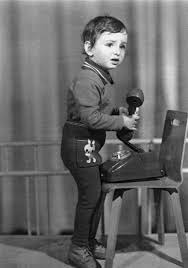
Childishness, knowing itself to be such, is deliverance. (44)
However, here, Bataille tells us that if one takes childishness “seriously,” one will be “enmired.” If one takes childhood seriously, one will turn it into one other habit: “dependent on childishness.” Rather, the right attitude to take with childishness, which, lest we not forget “is deliverance,” is to “laugh at it.” But if one has a “heavy heart,” one cannot. And if one is able to laugh at it, “then ecstasy and madness are within reach.”
But isn’t such laughter a laughter of superiority; that is, the laughter of an adult who looks down at and laughs at childishness?
Anticipating this, Bataille argues that “childishness recognized as such” is the “glory, not the shame of man.” In other words, even though one laughs at, Bataille suggests that such laughter is respectful!
However, Bataille wants to entertain another view on laughter; namely, the view of the English philosopher Thomas Hobbes, who claims that “laughter degrades.” If one takes this view, and Bataille doesn’t reject it, then “one reaches the depths of degradation.” To be sure, Batialle also enjoys this shameful state. And he argues that “nothing is more childish” since it discloses a kind of blindness to the “glory” of man found in childishness. However, it seems as if Bataille embraces both: the glory of childishness and the blindness to that glory which is mired in degradation. He wants both, or so it seems.
Bataille takes his final turn toward childishness by thinking of its limit: death.
The most serious seem to me to be children, who don’t know they are children: they separate me from true children who know it and who laugh at being. (44)
In other words, the most serious at death are children who don’t know they are children (they have a blind spot). And these people “separate me from true children who know it and who laugh at being.” This claim is ironic because Bataille would have us believe that he can’t be one with “true children” who know and laugh in the face of death because there are people out there who don’t know they are children (when they are facing death)!
A child must know, he says, that the “serious exists.” This knowledge is the basis for true child’s laughter which is, as Bataille says, at the “extreme limit.” It is a knowing laughter, a laughter in the face of the “knowledge” that the “serious exists.”
Bataille’s exercise in meditating on childhood is fascinating because by telling himself that those who don’t know cut him off from “true children,” he is suggesting that their blindness prevents him from laughing while knowing that the serious exists. In other words, the very thing that limits him most is the blindness people have in the face of death – the knowledge of this blindness, which is the blindness to their own childishness, is what irks him most and keeps him from completing his own exercise of laughing and becoming childish in the face of death. It is his knowledge of the other’s blindness that keeps him from what he desires most deeply. And, apparently, he can’t seem to get rid of it. No matter how beautiful his formulation of childishness is, it cannot be enacted because these kinds of people and this kind of blindness exists.
What I find most striking about this formulation is the fact that Bataille is ultimately saying that his childish project is a failure because of the other who separates him from “true childishness.” Because of the other’s blindness-to-childishness-in-the-face-of-death, his childish project fails. Deliverance by way of childishness…fails.
How humiliating! It seems that Bataille will never be delivered from the process of becoming a man and perhaps that makes him, in some way, a schlemiel.
When people ask me if one can find any characters like the schlemiel in other traditions, I immediately think of Robert Walser. Indeed, I can think of no better example of the schlemiel than in his fiction. I can also think of no better person to write such fiction since he, too, was a schlemiel, a living schlemiel. He dreamed big but, like a schlemiel, he was unable to keep jobs or make his literary dreams come true. In the end, he was a bachelor schlemiel who lived his last days in a sanitarium. To be sure, Kafka found much in common with Walser: he loved Walser’s way of writing and, like him, he died a bachelor and, in many ways, a schlemiel.
The first novel Walser wrote was entitled Fritz Kocher’s Essays. It was published in 1904. Daimon Searls – who translated the book for New York Review of Books press – points out that it “was a stroke of genius for Walser to launch himself at the reading public in the guise of an ‘impish schoolboy soliloquist’.” Citing Christopher Middleton, he describes the narrator, Fritz Kocher as “a fictional fellow in an old-fashioned frame narrative, dead in his youth and leaving to posterity only a collection of schoolboy writing exercises.” This, according to Searls, this plot “turned out to be the perfect vehicle for Walser’s unique energy, inventions, and oscillant ambiguities”(xv).
Unlike Searls, who uses a frame for reading this which is based on what Matin Heidegger would call an “equipmental” sense of the artwork, I would like to suggest that we see the Walser’s fiction not simply a vehicle for his creativity but as a performance of schlemielkeit (a way-of-being-schlemiel). This performance brings one into a relationship with a character who resists school rules (law) – like Jerry Lewis – by being to submissive to them and, at the same time, admitting to his relation to the law. He is and is not anti-nomian. He doesn’t trash the law; he suspends it. And the narrator does this by acting like a man-child, a schlemiel. Walser does what many Yiddish writers – like Sholom Aleichem do – he plays the schlemiel in such a way that he lives in suspension between childhood and adulthood (between the world and worldlessness).
Since Walser’s book is presented as a book that has survived a child who died before he grew up, and since it is introduced by someone who has put it together and published it, we can say that, in the wake of the child’s death, this book is a fictional initiation into a literary tradition. And the source of this tradition is a schlemiel by the name of Fritz Kocher: a child who speaks on adult things but died before he became an adult. He is suspended in time like many of Aleichem’s schlemiels or I.B. Singer’s Gimpel who will go from village to village trusting people – in hope that one day people will stop lying to and playing tricks on him.
In the quasi introduction of Fritz Kocher’s Essays, the person who decided to save them and share them with the public tells us, immediately, that he is passing on this writing. He tells of how difficult it was for him to get essays from Kocher’s mourning mother:
She was understandably very attached to these pages, which must have been a bittersweet reminder of her son. Only after I promised to have the essays published unchanged, just as her little Fritz had written them, did she finally agree. (3)
As one can see, the person who has saved the essays from oblivion is a very kind person. And, for this reason, the reader may feel safe to “trust” him. After telling us how the mother has agreed, he tells us about how these essays “may seem unboyish in many places, and all to boyish in others”(3). This suggest that sometimes Fritz sounds like a boy and sometimes he sounds like a man: he oscillates between the two poles.
For this reason, we must read Kotcher’s essays with great care since, on the one hand, a “boy can speak words of great wisdom” but, on the other hand, he can also speak “words of great stupidity.” But one cannot simply see stupidity (or childishness) in one part of the text and wisdom (or maturity) in another. No. Rather, they “practically” happen “at the same moment.”
This way of reading him suggests a kind of schlemiel moment – a schlemiel temporality if you will – wherein the reader doesn’t know if what s/he is seeing is wisdom or sheer stupidity.
This is how Robert Walser introduces himself and a new tradition which has fascinating resonances with the Yiddish literary tradition of the schlemiel.
In the beginning of The Schlemiel as Modern Hero, Ruth Wisse points out that for Rabbi Nachman the Simpleton (that is, the schlemiel) acts “as if” good will triumph over evil. In his story, “The Clever Man and the Simple Man,” the thinker looks down on the simpleton as an idiot for being so naïve. The simpleton’s honesty and trust are the object of his ridicule. In many ways, Rabbi Nachman suggests that the simpleton, like many wise men, is a mystic in disguise. And for Rabbi Nachman, as well as for many Yiddish writers who followed in his wake, the schlemiel was a character whose simplicity and trust pose a challenge to the skepticism and deceit of a world that laughs at him. But, in the end, it’s the schlemiel who has the last laugh.
I recently came across an aphorism by Friedrich Nietzsche that contrasts philosophers to mystics. The contrast is brief and Nietzsche spends far more time – as one can imagine – making fun of philosophers. The resonance between Nietzsche and Rabbi Nachman, at least in this aphorism, gives food for thought. But would Nietzsche act “as if” good would triumph over evil, or is his mystic “beyond good and evil” and beyond acting as if “good exists?” Wouldn’t that be too….”stupid” for him?
Nietzsche starts his fifth aphorism by noting that “one regards philosophers half mistrustingly and half mockingly.” Why? It isn’t simply because they are “innocent…fall into error and go stray, in short their childishness and childlikeness.” Rather, it is because they “display insufficient honesty while making a mighty and virtuous noise as soon as the problem of trustfulness” is invoked. In contrast, Nietzsche tells us that “mystics…are more honest and more stupid to them.” In saying this, Nietzsche privileges honesty and stupidity over dishonesty and feigned intelligence.
By acting “as if” they are intelligent and high minded about truth, Nietzsche believes they make themselves laughable and dishonest. Moreover, Nietzsche says they lack the courage to admit that they are acting. Nonetheless, Nietzsche finds this funny. He associates this lack of courage with “tartuffery.” To illustrate, Nietzsche caricatures Immanuel Kant and Baruch Spinoza’s acts of deception so as to make them laughable:
Kant…lures us along the dialectical bypaths which lead, more correctly mislead, to his ‘categorical imperative’ – this spectacle which makes us smile.
Nietzsche tells us that he smiles because he is more “noble” than Kant and can see his “tricks”: “We who are fastidious and find no little amusement in observing the subtle tricks of old moralists and moral-preachers.”
Turning to Spinoza, Nietzsche accuses the Jewish philosopher of making uses of the “hocus-pocus of mathematical form.” Nietzsche puts Spinoza’s “love of wisdom” into scare quotes and sarcastically mimics the rhetoric that goes along with speaking “the truth.” After exhausting this rhetoric, Nietzsche, sickened, calls out Kant and Spinoza for being sick, timid, and vulnerable:
How much personal timidity and vulnerability this masquerade of a sick recluse betrays!
In other words, Nietzsche sees their arguments in the name of morality as the product of sickness. They act “as if” they are defending the truth and this act is, for Nietzsche, worthy of a laughter that looks to purge the sickness of the philosophy in the name of health.
But what does Nietzsche mean by health? Is his health closer to that of the “honest” but “stupid” mystic? Or is health equated with a kind of intelligence that refuses both the philosopher and the mystic?
To be sure, Nietzsche respects the honesty of the mystic more than the philosopher. But he finds more of an identification with the fool than the mystic. In her book Stupidity, Avital Ronell points out that Nietzsche “latches” on to the “buffo” (the Italian word for fool). Writing on Paul DeMan (who, for her, seems to be a successor of Nietzsche) Ronell argues that “transcendental buffoonery rips the system; it is shown to be propelled by a truly transgressive force that is fueled no so much by a romantic abandon as by a will to rise above that which is limited…bound by law and convention”(136). This anti-nomian kind of humor – which can certainly be said to be mystical – wears the mask of the buffo/fool which she calls the “crucial mask of ironic destruction.”
The buffo “disrupts narrative illusion.”
What I find so interesting in all of this is that, unlike the schlemiel, Nietzsche’s fool doesn’t act “as if” good exists. He wouldn’t equate himself with a stupid but honest mystic or fool. Rather, as we can hear in the aphorism, Nietzsche does act “as if” he is superior to all masks which posit the “as if.”
To be sure, schlemiels and mystics aren’t sarcastic. This act, as Ronell suggests, is an intelligent act of “ironic self-destruction.” There isn’t a relationship with the “as if” of goodness, as there is with the schlemiel. Moreover, while the schlemiel is blind to the abyss, Nietzsche is not. The schlemiel doesn’t laugh, Nietzsche does. And this laughter, I would argue, is the laughter of a metaphysics which, through laughter, elevates the subject of laughter beyond the philosopher and the mystic. It is, for Nietzsche, the most “honest” laugh of all because it is beyond good and evil. But it isn’t stupid; it’s critical.
In contrast, the laugh that the schlemiel evokes is sad laughter. It is not beyond good and evil so much as caught between them. Being on the other side of history, Jews couldn’t afford to laugh in the way Nietzsche could. And this is reflected in the schlemiel who, though committed to goodness, fails in a world that disregards the good.
When I went to see The Wolf of Wall Street (2014), I knew there would be comic elements. But I had no idea that Martin Scorsese would draw on and reinterpret the schlemiel by way of the plot and main characters of this film. To be sure, all of the critics of the film thus far have noted that this film is a quasi-critique of capitalism. And, in the end, the tragic overshadows the comic. That’s obvious. But what’s more interesting is how Scorsese pulls it off; namely, by way of drawing the viewer in through a large doses of schlemiel comedy. (And, let’s be clear here. Scorcese is not recognized for the comic element in his films; on the contrary, his use of humor is rarely foregrounded as it is in this film.)
Indeed, it seems Scorsese has done his homework on the schlemiel and schlemiel comedy. Perhaps he has done this through viewing the films of Woody Allen and Judd Apatow. (Before I go into detail about how the schlemiel works in this film, I’d like to foreground the links to Woody Allen.)
Woody Allen, to be sure, is one of the greatest popularizers of the schlemiel in American film. Films such as Bananas, Take the Money and Run, or Annie Hall – to name just a few – are prime examples. Although their work differs in so many ways – and you would be hard put to find a schlemiel in a Scorsese film – Martin Scorsese’s interest in Woody Allen’s work is not a secret.
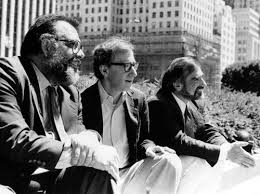
They directed the film New York Stories together and have known of each others work for decades. But they differ in many ways. In this film, for instance, there are a few. Here is a clip of Allen and Scorsese talking about their differing views of New York in New York Stories (Scorsese differentiates his view on New York, through the films Mean Streets and Taxi Driver, to Allen’s, in Manhattan.)
In a telling interview-slash-hosted-discussion by The New York Times in 1997 entitled “The Two Hollywoods,” Lynn Hirshberg begins by noting that they “hardly know each other” but are “contemporaries.” Her interview is great because it shows the dynamic between the two and, at least in the beginning, shows us their shared interest in comedy.
Near the end of the discussion, Allen and Scorsese reflect on the failed (schlemiel) moments in their comedy. Scorsese notes that The King of Comedy, his big attempt at working through the comic genre, was adored by the critics but, at the same time, it was one of his biggest failures. Allen, in contrast, notes that he would rather not pay attention to the success or failure of his films. He notes that he diminishes his sense of failure by way of throwing himself into the film.
The theme and responses to failure in this discussion are interesting because Allen and Scorsese address the core of the schlemiel character and schlemiel comedy by way of their perspectives as filmmakers: failure.
But one of the most interesting moments in the discussion deals with the question of whether or not they like watching their films after they are made. Scorsese says he cannot see his films ever again after they are made because he will get overly emotional while Allen says he has a hard time seeing his films because he will always think of them as not good enough and in need of improvement.
What I find so interesting about this reflection on past films is the fact that though Scorsese may not look at his films again he obviously thinks about how to improve upon his past film ventures. On this note, I think his comment on The King of Comedy is telling. As he notes, the film critics may have liked it (and this pleases him) but it failed at the box office. This is where The Wolf of Wall Street comes to the fore. To be sure, this film is the only other major film since The King of Comedy that utilizes the comic element in such a major way.
Now let’s turn to The Wolf of Wall Street and its uses of the schlemiel.
I’d like to start by way of definition. Hannah Arendt, in her essay, “The Jew as Pariah: A Hidden Tradition,” notes, right off the bat, that “innocence is the hallmark of the schlemiel.” And that it is out of “such innocence that a people’s poets – its “lords of dreams” – are born”(278, The Jewish Writings). The schlemiel, for Arendt, is an outsider who, in his or her innocence, doesn’t fit into society. They are simpletons who aren’t cultured, yet these simpletons speak to the people. Their comedy inheres in the fact that they are blind to certain cultural norms and live in their dreams.
In her line of schlemiels, Arendt includes the German Jewish poet Heinrich Heine, the characters of the Yiddish writer Sholem Aleichem, Rahel Varnhagen, the awkward host of a German Salon in the 19th century, and Charlie Chaplin (who she calls “the little Yid”). Some are “living schlemiels” (as Sander Gilman might say) others are fictional. Regardless, Hannah Arendt and Ruth Wisse see the schlemiel as posting a challenge to either the “political and philosophical status quo” (Ruth Wisse) or to the “political status quo” (Hannah Arendt). The schlemiel, as the innocent lord of dreams, is also a guard against the realization that, in this or that dominant society, one (historically, the Jew) is a loser. As the wisdom goes, it’s better to live in dreams and innocence than in a horrible situation.
What I found so fascinating about Scorsese’s film is that he turns this on its head since the schlemiels in this film – which include Donnie Azoff (Jonah Hill), and Jordon’s group of friends (I didn’t include Jordan Bellfort – played by Leonard DiCaprio – because he goes in and out of being a schlemiel throughout the film). What makes them all schlemiels is not simply the fact that they are innocent dreamers but the fact that they all deal drugs, do drugs, and are outsiders in the 80s and 90s. They don’t know how to make a normal living and live a normal life. In Hannah Arendt’s sense, they are pariahs.
However, the twist is that even after they make money and become successes, they still remain schlemiels. This is a twist because, often times, when a schlemiel becomes a success (say, in Judd Apatow’s Knocked Up or Woody Allen’s Midnight in Paris, too name only two of many films where Allen employs this formula), they become a “man.” Indeed, in The Wolf on Wall Street, drugs and endless parties celebrating the accumulation of exorbitant wealth illustrate a new way of viewing the schlemiel – one, to be sure, I (a schlemiel theorist who runs a blog on the schlemiel and publishes on this character) have never seen.
To be sure, Scorsese is using the schlemiel to show how innocence can go wrong when it is combined with drugs and wealth. Indeed, the first time we see Jonah Hill, who plays the schlemiel in the majority of the films he stars in, he and DiCaprio have a comic-schlemiel-like dialogue which ends behind the restaurant, smoking crack.
Although the combination of drugs and the schlemiel can be seen in many films today – such as Judd Apatow’s Knocked Up, Pineapple Express, and Super Bad – these moments are divorced from anything consequential.
The innocent drug use of marijuana by Apatow’s characters is laughable. But it is not disturbing as it is in Scorsese’s film because, as we all know from recent history, which is alluded to throughout the film, the drug use (of qualudes, crack, and cocaine) of Scorcese’s schlemiels enables them or is based on the exploitation of people and manipulating the market.
Throughout the film, I noticed many people laughing (myself included) yet the laughter was mixed up with moments of disgust. What I like about Scorsese’s tact, here, is that he draws viewers in; but once they are in, he teaches them a lesson and subjects us to an emotional rollercoaster.
Watching this film, I felt as if he was offering a corrective to all of Apatow’s films – on the one hand – and making a nod to Allen’s recent Blue Jasmine – on the other. But what Scorsese does here is something Allen didn’t do in Blue Jasmine; namely, use schlemiels to bring us to the same conclusion about our era and its overly corrupt relationship with wealth.
I find it ironic that Scorsese and not Allen did this; after all, Allen has made use of the schlemiel throughout his career. Nonetheless, what I find in Scorsese is a new way of viewing this character, one which makes it relevant in ways that Judd Apatow or even Woody Allen cannot (or doesn’t want to do; as I argue in two recent book essays about Allen). In lieu of this, I would say that the name of the film is wholly ironic. I wouldn’t say he is a “wolf” on Wall Street so much as a schlemiel in wolf’s clothing. In the end, however, we see the schlemiel turn into a wolf when the drugs and the wealth are taken away. But, by then, it’s too late.
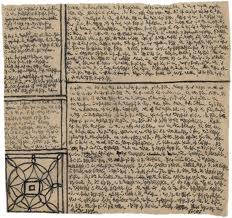
Walter Benjamin paid very close attention to the work and life of Leon Shestov. Shestov was a Russian émigré to Paris whose critical writings on literature and Judaism Benjamin had great respect for. In one of his saddest (and last) letters to Gershom Scholem, written in 1939, Benjamin writes about Kafka’s legacy to his readers by focusing on Leon Shestov’s. To be sure, Benjamin believed Shestov’s lifetime work, Athens and Jerusalemwas a masterpiece. (He often mentions this to Scholem in his letters.) However, he didn’t know how it would fare in the future. In his reflection on its legacy, following Shestov’s death, Benjamin notes how Shestov’s wife, deep in mourning, cannot deal with the question of what to do with his legacy. Benjamin tells us that she lives in an apartment full of Shestov’s work (his manuscripts and unpublished essays). He muses about how one day a housekeeper will likely see that Shestov’s widow has neglected her surroundings and, while cleaning up, will throw away all of Shestov’s writings. To her, they are only pieces of paper.
Benjamin likens this to the fate of Kafka’s work and adds, in addition to this, that Max Brod (the keeper of this legacy) made Kafka into a fool. To be sure, this suggests that Brod and the widow show the futility of passing tradition on. But there is more. What is passed on, by way of Benjamin, is a ruined yet comic kind of tradition. These ruined traditions (of Kafka and Shestov), fails to get properly transmitted, and their fate is comical (in a bittersweet way). In all of this, the failure of tradition is – in a way- redeemed through a comical reflection.
Since Benjamin spoke so highly of Shestov and wrote of him in a tragic-comical manner, I wondered if and how Shestov would regard the comic modality. To this end, I decided to read through his collection of his literary essays entitled Chekhov and Other Essays (these articles were published while he was alive and were translated into English in 1916 – for a London press – and republished in 1966 by the University of Michigan Press).
Many of these literary essays are very serious – they address the work of Dostoevsky, Chekhov, and Tolstoy, but they also address different philosophers. In these essays, Shestov reserves the comical to this or that anecdote. (His reflections, here, seem to have more of an existential tone – one that Sartre and others took to.) However, one essay in particular caught my eye as it addressed the comical. This essay was entitled “Penultimate Words.” Within this essay, the section on Heinrich Heine addresses humor.
Shestov notes, right off the bat, that the German’s misunderstood Heine’s sense of humor:
I think that if the Germans were mistaken and misunderstood Heine, hypertrophied self-love and the power of prejudice is the cause. (119)
With this in view, Shestov explains the meaning of Heine’s humor. He notes how it moves from seriousness to sarcasm:
Heine’s usual method is to begin to speak with perfect seriousness, and to end with biting raillery. Critics and readers, who generally do not guess at the outset what awaits them in the event, have taken the unexpected laughter to their own account, and have become deeply offended.Wounded self-love never forgives; and the Germans could not forgive Heine for his jests. (119)
Shestov tells us that the twist is that Heine’s humor was directed at himself; it was self-deprecating. He wasn’t looking to “attack others”:
And yet Heine but rarely attacked others: most of his mockery is directed against himself. (119)
Drawing on this observation, Shestov says that same thing happened with Gogol. Like Heine, Gogol “confessed that he was describing himself” and was not mocking the Russian people in his fiction. According to Shestov, Gogol wasn’t certain of himself and, for this reason, it was simply not possible for him to contrast himself – as better off – to his fellow-Russians.
On this note, he points out that Heine also had an “inconstancy of opinions”: “He changed his tastes and attachments, and did not always know for certain what he preferred at the moment”(119). He could have “pretended to be consequent and consistent,” but he didn’t.
Rather, he played the fool and said too much:
Heine’s sincerity was really of a different order. He told everything, or nearly everything, of himself. And this was thought so shocking that the sworn custodians of convention and good morals considered themselves wounded in their best and loftiest feelings. It seemed to them that it would be disastrous if Heine were to succeed in acquiring a great literary influence, and in getting a hold upon the minds of his contemporaries. (121)
Shestov points out the hypocrisy that goes with the will-to-preserve culture. The anger of the Germans at Heine’s honesty, humor, and self-deprication was a case in point. In talking too much, he failed publically. But that failure was – more or less – turned into a killing of sorts. Heine was, as the French artist and playwright Antonin Artaud might say, a man “suicided by society.”
Heine’s humor, Shestov tells us, discloses a man who is “divided.” His words are a “mockery of himself.” Out of some of his comic poems and writings, we can hear “Heine’s misplaced laughter”(123). This laughter is “indecent and quite uselessly disconcerting.” Shestov puts Heine’s “sincerity” in quotation marks because Heine was laughing and at the same time embracing the possibility of sincerity.
In addition, Heine laughs “at morality, at philosophy, and at existing religions”(126). In a fascinating turn, Shestov says this may have to do with Heine being a modern Jew who was out-of-place (the odd one out). To be sure, Heine was the popularizer of the schlemiel in Germany. He saw the poet as a schlemiel. Hannah Arendt points this out in her essay “The Jew as Pariah.” And she situates Heine as the first schlemiel in a tradition of schlemiels. (A tradition I am writing about in my book on the schlemiel.)
Reading Shestov and knowing that Benjamin read him lovingly, I wonder if Benjamin came across this gloss on Heinrich Heine and the comic. It would make perfect sense since Benjamin, in one of his last letters to Gershom Scholem, wonders about the “comic aspects of Jewish theology.” There is something very Jewish and very modern in Heine’s failure. It is the same failure that Benjamin comically apprehends in Kafka and Shestov.
And it is the failure of the schlemiel which provides the greatest insights for them as they all realized the degree to which they themselves had failed. And, if anything, the sad laughter Benjamin had when reflecting on Shestov and Kafka was his own. It, strangely enough, gave him hope.
The image of Judaism and Jewishness that comes across to the readers of
Gary Shteyngart’s Absurdistan is disturbing in many ways. Over the last month, I have written several blog entries on Gary Shteyngart’s representation of circumcision (by way of Misha, the main character of Absurdistan). As I point out in many of these blog entries, the description of circumcision and his “mutilated” penis (descriptions that have much resonance with Paul and even Augustine’s most anti-Jewish words) are not, as they say, “good for the Jews.” Although the author may not have intended this, the fact of the matter is that each of these descriptions makes Judaism into a barbaric and primitive kind of religion. But, to be sure, this is what Misha thinks about when he thinks of Judaism.
At the outset of my readings of Absurdistan, I wrote a blog on the Prologue which notes Misha’s description of the “Mountain Jews” he meets in Absurdistan as “pre-historic.”
They are “prehistoric, premammalian even, like some clever miniature dinosaur that once schlepped across the earth, the Haimossaurus.”
As we learn in the Prologue, he doesn’t want to stay with this group of “pre-historic” Jews. He appreciates their hospitality, but he finds it “overwhelming.” He needs air and feels he must leave the Jews for his Latino-African-American girlfriend, in his second home, New York City:
The mountain Jews coddle and cosset me; their hospitality is overwhelming…and yet I yearn to take to the air. To soar across the globe. To land on the corner of 173rd Street and Vyse, where she is waiting for me. (viii)
Ultimately, Jews and his circumcision make him fill ill-at-ease. And while at the outset of the novel he refers himself as a “secular Jew,” later on, toward the end of the novel, Misha refers to himself as a “multicultualist.” In front of other people, he doesn’t seem to like Jews and shows no preference for his “pre-historic” roots; rather, he likes “others”:
“I am not much taken with Judaism,” I announced. “I am a multiculturalist.” Except there was no Russian word for “multiculturalist,” so I had to say, “I am a man who likes others.”(218)
This declaration comes at an odd time in the novel since he is, at this point, asked to get money for the Svani “cause” by way of making an appeal to the Jews for money (224). To this end, he is appointed the “Minster of Multicultural affairs.” The appeal to multiculturalism, he thinks will bring money. However, Misha learns that he must appeal to Israel for money; but to do this, Misha has to act “as if” he wants to do something for the Jews when, in fact, Misha’s not interested in doing anything for them. After all, he’s a “multiculturalist.”
This new task confuses him. When he thinks about what to do, he is thrown into an imaginary conversation with this dead father (who, as I mentioned in other blogs, had prompted him to get his circumcision). His father loved Jewishness and Israel and, as we can see, Misha does not.
In his imaginary conversation, Misha wants his father to see him as an independent man: “Papa! Look at me! Look how fine I’ve grown.” But in his memory, Misha notes that his father was too busy with work and didn’t pay attention to him. Misha remembers how his father had, in a sense, ruined his life. Amongst the things he recalls, we find the circumcision.
How little use he had for me. But then why did you send for me, Papa? Why did you interrupt my life? Why did you have to put me through all this? Why did you have my khui (penis) snipped? I have a religion, too, Papa, only it celebrates the real. (235)
Misha is a man-child looking for his father’s approval. Yet, at the same time, he tries to be independent. For this reason, he tells his father that, like him, he wants to help a people; but not the Jewish people; rather, the Sevo people:
“I want to believe in something, too, Papa,” I said. “Just like you believed in Israel. I want to help the Sevo people. I’m not stupid. I know they’re no good. But they’re better than their neighbors.” (237)
His imaginary conversation inspires him to help the Sevo people. To this end, he drafts up a proposal so as to get money from the Israelis (which he will give to the Sevo people). The irony is that the project is dedicated to the preservation of Jewish identity by way of an appeal to the Holocaust and Holocaust memory.
The project name is: “The Institute for Caspian Holocaust Studies, aka the Museum of Sevo-Jewish Friendship.”
I’ll cite his justification for this project since it will give the reader a sense of how Misha is playing the “identity card”:
The greatest danger facing American Jewry is our people’s eventual assimilation into the welcoming American fold and our subsequent extinction as an organized community. Due to the overabundance of presentable non-Jewish partners in the country as tantalizing diverse and half naked as America, it is becoming difficult if not impossible to convince young Jews to engage in reproductive sex with each other….It is time to turn to the most effective, time-tested, and target-specific arrow in our quiver – the Holocaust. (268)
The irony of all this is that he is not convinced by this argument for Jewish identity but, nonetheless, he makes it so as to solicit money. He isn’t interested in perpetuating Jewish identity, but he acts “as if” he is:
Identity politics are a great boon in our quest for Continuity. Identity is born almost exclusively out of a nation’s travails. For us…this means Holocaust, Holocaust, Holocaust. The twin halves of the broken matzoh will be infused with the spirit of the New Tribalism that is captivating young people across the Western world in angry response to global homogenization.
To be sure, Misha has no interest in this “New Tribalism”; in fact, he’s running away from it. And he would rather assimilate than hang out with the Mountain Jews. For this reason, we can rest assured that Misha must be chuckling when he describes the New Tribalism as a combination of Holocaust Memory and “towering videos of Jewish college boys at fraternity mixers hitting up demure Korean girls, while pretty suburban Jewish maideleh fetishize their urbanized African American counterparts at a Smith Barney softball game. Subtext: six million died and you’re twirling around a bar stool with some hazzar?”(270).
The point of all this is to show how Misha, a “multiculturalist,” sees Jewishness as pre-historic and out of tune with the tide of globalization. However, as I will point out in the next blog entry, he is, in the end, duped by the “Sevo people.” And on his way out, he is saved by the “Mountain Jews.” Nonetheless, he doesn’t want to stay with them. For, as I noted in the outset, they make him uncomfortable.
To be sure, it is Jewishness that makes Misha, the multiculturalist, uneasy. He associates it with his father, with his circumcision, and with a people that wants to preserve itself through the Holocaust industry and guilt. Perhaps we can argue that this is a satire and that Misha needs to get in touch with a Jewishness that he has trashed; however, I haven’t as yet seen any of these readings or heard anything from the author to this tune.
For this reason, it seems as if there is an element of truth for Shtyengart in this reaction to things Jewish. And for those of us who think differently about Jewishness, these types of quips against it may make the character less charming and more troubling.
And the irony of it all is the fact that he is more interested in “other” people preserving their identity and less in his own people’s doing so. And for the strange reason that one kind of preservation is better than the other because one is modern (and not Jewish) while the other is a “pre-historic” and ancient practice. This, it seems, is his major blindspot and may, in fact, be the thing that makes him into a multicultural-schlemiel-of-sorts.
Near the end of Gary Shteyngart’s second novel – Absurdistan – Misha, the main character, reflects on what he learned about America from “Accidental College.” What we find in this account is a description of America as a place where the fine line between childhood and adulthood “has been eroding.” At Accidental College, dreams are greater than all and dreams, for Misha, are the substance of childhood:
At Accidental College, we were taught that our dreams and our beliefs were all that mattered, that the world would eventually sway to our will, fall in step with our goodness, swoon right into our delicate white arms. (230)
The classes Misha took at Accidental College reflect a curriculum that is not so much about preparing one for the adult world as returning one to the state of dreams and childhood. He sees this as a symptom of something larger happening in America in which the fine lines between childhood and adulthood, on the one hand, and the personal and the fantastic, on the other, are effaced:
All over America, the membrane between adulthood and childhood had been eroding, the fantastic and the personal melding into one, adult worries receding into a pink childhood haze. (230)
As support for this claim, Misha notes that he was gone to parties in Brooklyn “where men and women in their mid-thirties would passionately discuss the fine points of the Little Mermaid or the travails of their favorite superhero. Deep inside, we all wished to have communion with that tiny red-haired underwater bitch. We all wanted to soar high above the city…and champion the rights of somebody, anybody”(230).
Misha finishes his meditation on America by likening democracy to “the best Disney cartoon ever made.”
Although Misha often comes across as an out-of-touch fool, this meditation on America, like much else he says, has an element of truth. To be sure, Shteyngart, in much of his work, celebrates the effacement of the fine line between childhood and adulthood. The fact that his parodies of this effacement are mild and silly doesn’t do much to reinstate this line. In fact, I’d say that that’s not what he wants to do. Rather, it seems as if he sees this as a new, ironic norm, which, in many ways, comes to accept the childish aspects of American reality as a fact.
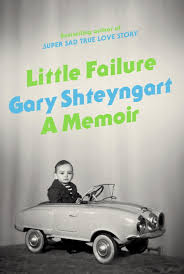
Reading his account, one wonders how much of this description resonates with the author of the new memoir Little Failure. To be sure, Shteyngart no longer goes through characters such as Misha or Vladmir to explore his relationship to America; he goes by way of a reflection on himself. And many of these reflections, as we can see from interviews and excerpts from his memoir, cast him as a man-child.
His “little failure” (as well as the picture for the book) give another shade to the America that Misha saw by way of his education at Accidental College and his experiences in Brooklyn. They may be ironic, but the fact of the matter is that unlike much irony, which looks to wound or destroy its target, this irony is the irony of a kind of acceptance which, ultimately, is ridiculous.
In this irony, America, the land of dreams, becomes literalized. This works well with Sidrah DeKoven Ezrahi’s reflections on America in Booking Passage: Exile and Homecoming in the Modern Jewish Imagination. In her view, America remains a land that is perfect for the diasporic schlemiel. Shteyngart adds to this by showing that its not just a land of dreams it’s a land of perpetual childhood where the line between being an adult and a child is, for all intents and purposes, effaced.
We don’t have to accept these generalizations or descriptions. To be sure, they belong to a certain project. To be sure, the schlemiel need not be seen as a man-child. S/he shuttles back and forth. And her failure is not something silly or childish. This is what great Jewish American novelists like Bernard Malamud and Saul Bellow want to show us.
One that fine line between childhood and adulthood is effaced, however, failure itself will become “little” and silly. When it comes to the schlemiel, we have to take this risk seriously. The problem with characters like Misha is that they seem to have no problem with this, and we see this in his portrayal of American and his American education.
I suggest that the line between the two remain porous, but not effaced. The question of what it means to become mature is at the basis of the question of failure. We need to learn how to articulate this question by way of the schlemiel who is a comic failure. His failures may be comic but let’s hope they don’t become so small as to become childish and silly.
When that happens, the meaning and power of this comic character will be lost.
Ok. Its good to know what someone is doing, but when is too much…too much? And what happens when what he or she is saying is not particularly that insightful?
When it comes to the schlemiel, there is a limit. Every good writer knows that. Overkill doesn’t do the schlemiel well. This is what I fail to see in the Gary Shteyngart’s ad campaign to promote his work. The content of this endless series of faux pas – inside of interviews, a film trailer, the pages of memoir that he sent to the New York Times, endless praise in this or that newspaper, where we see the ironic little immigrant failure foregrounded – is too obvious and cliche. It is overplayed and it actually reduces the schlemiel character to the endless repetition of bad jokes. To be sure, I turn to literature so I don’t have to see all the schlemiel characters that Will Farell, Seth Rogen, and Ben Stiller do so well. I don’t want to find Hollywood in a schlemiel novel (or a schlemiel memoir). And I don’t want to hear the a self-congratulatory and slightly snarky tone that I so often find on the pages of New York Magazine.
When I see all of this, I realize what I don’t like. What I want to see is a schlemiel that is far from New York Hipsterdom and Hollywood comedy. And I have recently found this in the pages of Bernard Malamud’s novel A New Life. What I discovered is that, not too long ago, the American schlemiel was a character who, though comic, was trying to seriously start a “new life.” Shteyngart mimes this process in much of his work.
The life that his characters live or end off with in nearly every novel is, as I pointed out elsewhere “normal” or else lived in yearning of returning to New York. The end is lacking believability because the characters are either too normal or too ridiculous in their life.
In Malamud’s A New Life, the main character Levin is much more believable. His schlemiel character touches deep on the life of the male American Jew. The failures of Levin are not too caricatured. They feel like real failures.
In taking himself as his subject, Shteyngart’s failures are caricatured. They are truly silly. Though animated, they are about as interesting as the next article on your facebook feed.
The ironic line that gives it all away happens when Shteyngart jokingly tells us that:
Inside the little clown was an angry kid trying to get out. Had I been bigger I would have been some kind of bully.
And the punch line:
Thank God for my tiny frame.
What we are left with is a Jew whose body limits his inner anger. He doesn’t have the frame to be a man. The joke is obvious and it makes the Jewish body into a pathetic site of failure.
What’s lost in all this is Levin, Malamud’s schlemiel. When I think of Levin, I don’t think of his body. I think in terms of his desire for something better than what he has experienced in his life. He is a schlemiel because the life he ends up with is new but not in the way he expected. He often makes the wrong choices, but not always. He is not a pathetic failure, nor does he endlessly play on failure. Levin seems to be on, but he’s just a little off. Nonetheless, he does have some minor triumphs. And these are meaningful. The treatment of failure in American life (for a Jew) is much more believable, humbling, and meaningful. Malamud’s schlemiel is someone who I can identify with: his failures, real enough, hit on something common to many American Jews – even I, who was born from a different generation than Malamud, find something more resonant in his schlemiels (something that really is about being a Jew and being a failure).
Shteyngart is my age. We come from the same time, but we come from different countries. And, more importantly, we have a different understanding of the schlemiel.
Though I have spent a lot of time writing on his work, I always felt that this treatment of the Jewish-American schlemiel was missing something. I couldn’t identify with his schlemiels as I could with Roth, Bellow, or Malamud’s. In Levin, Herzog, and Portnoy there is a serious engagement with the link between an American, a Jew, and a schlemiel. Their schlemiels have given me insight into how Jewish schlemiels are locked into different identity-crises: one’s that matter.
The fact that the Jews survives this crisis while at the same time failing gives a deeper shade to the meaning of failure. Shteyngart’s interviews and ads do the opposite. In fact, watching them, I feel as if the schlemiel becomes more and more clichéd and empty. Failure loses all of its content.
When did we ever settle for this? What does it mean that Random House thinks that we can no longer live through the schlemiel like we used to? When did they decide that the schlemiel was utterly meaningless by way of infinite repetition and non-variation?
So, when is too much, too much? When is the praise of the “Little Failure” too much?
Answer: right now.
What we have with this repetition of a certain kind of schlemiel….is the exhaustion of failure….
As far as schlemiel theory goes, I’ve been writing on a variety of the schlemiels this week. The differences between them are suggestive. But, more importantly, I’m seeing that I identify more with one variety rather than another. And the reasons I have for this identification speak most to what I find, today, most important about this character. I hope that my identification resonates with other people since, to my mind, we now have a rare opportunity to understand how important the schlemiel can be – at this historical moment -for prompting thought about what it means to be an American. This thought, as I will argue, engages us in existential questions that are of great urgency.
A few days ago, I wrote a blog post on a trailer that Random House posted on Gary Shteyngart. The point of the blog entry was to address a reading of the trailer made by Slate. The author of the article claimed that the trailer failed miserably in attempting to make a gay joke vis-à-vis Shteyngart’s performance as a gay author with two husbands (played by James Franco and Jonathan Franzen). I felt the repeated characterization of this trailer as the product of “lazy” thinking was a red herring. Instead of presenting an argument it presents that author’s preference for gay jokes told about a James Franco who, in his mind, authentically attempted to embody gayness in a recent celebrity roast. This aside, I felt that the real issue was the characterization of Shteyngart as a schlemiel (a “little failure”) in this trailer for his book by the same name.
To this end, I looked at how the trailer – by way of the schlemiel -offers a critique of success and masculinity. This is what I call the “meaning of failure.” However, the truth of the matter is that the critique is mild. I wouldn’t exactly call it the product of “lazy thinking” so much as a similar concession to a market that filmmakers like Judd Apatow have taken full advantage.
To be sure, Judd Apatow’s schlemiels – in films like Forty Year Old Virgin, Knocked Up, and Super Bad – may be failures but they are all, ultimately, commercial successes. And, in contrast to the schlemiel we see played by Gary Shteyngart, his schlemiels end up, at the end of the film, winning. Regardless, both varieties of schlemiels in Shteyngart’s tailer and Apatow’s films are charming. Their failure doesn’t hit home to hard. It isn’t what I’d call existential. And, ultimately, there is little we can gain from it save for a kind of snarky, comic titillation. This brand of schlemiel comedy can be seen in shows like Big Bang Theory and in nearly every Will Farell film. There is little that can be said about this save for the fact that it simply maintains a status quo and instead of prompting change it creates a new norm in which schlemiels-are-one-of-us. They may not be the likes of James Franco or Jonathan Franzen – “real men” who seek out “truth” and live out the “erotic” – but they are, like all of us, a little deluded by their hopes. Nothing too disturbing is at work, here. No. In the end, all of this schlemiel comedy is feel-good-comedy. Americans can laugh a little at their schlemiel-keit and still feel good about their misperceptions. We can face the day without any anxiety or sadness.
In contrast to these varieties of schlemiel, I was fortunate to have seen the Coen Brothers film Inside Llewyn Davis this week. In this film, we see another variety of schlemiel that, to my mind, deserves more elaboration. As I noted in yesterday’s blog entry, J. Hoberman decided to read the film – and all other Coen Brother’s films – in terms of the schlemiel. His reading of the schlemiel sees this character as the subject of his own demise since he is blind to the things he does and brings on his own bad luck. However, as Hoberman also notes, he is also is the subject of bad luck that is not of his own making. To be sure, one might think he is a shlimazel (the subject of bad luck) since he is hit with so much bad luck (indeed, one of my friends tweeted me that he thought Hoberman was wrong: Llewyn Davis wasn’t a schlemiel, he was a shlimazel.)
The reason I identify more with the Coen Brothers film is because the schlemiel they show us is not of the feel-good type. Davis’s misperceptions, false-hopes, and failures are not laughable in the same way they are with Adam Sandler, Ben Stiller, Seth Rogen et al. Rather, they are painful to watch. And, as I noted, yesterday, what makes him a schlemiel is not so much his charm or this or that redeeming quality so much as the possibility that, at the end of the film, he may have hope. But more to the point, he is a schlemiel because he persists – despite the fact that the odds are against him. But this persistence is permeated with weariness and failure.
The range of identifications we have with Davis is much more complex than any of the feel-good schlemiel films. To be sure, I left the film thinking about myself: my false hopes, failures, my family, and the America that helped to foster my dreams. I didn’t leave any Judd Apatow film with these thoughts. On the contrary, I could go home feeling good about myself.
One of the great insights I left the film with was that we need to look into what is outside Llewyn Davis (outside the schlemiel) so as to understand what is inside him. The Coen Brothers cast him in relation to failed artists, his decaying family, outsiders, and a long-journey from New York City to Chicago and back again. His schlemiel character is defined against this outside which exudes hopelessness, hardness, and decay. His false hopes, in many ways, are a response to this outside. They protect him from being destroyed by this outside. However, this protection is thinned out as the film goes on.
The more weary he grows, the more he realizes that the hopes he had set up for himself were out of tune with what was possible. However, we see that it is not simply his fault. The fact that he actually does make an album shows us that his hopes were nurtured by an industry. But, as we see, this industry could care less about him. And when he arrives in Chicago this hits home. To be sure, his long journey there reminds me of what happens to the main character of James Joyce’s classic story “Araby”: the time the character has to wait before arriving at his destination wears away at his passion so much so that when he arrives he realizes that he was running on false hope.
To be sure, during the trip to and back from Chicago Llewyn shows us a schlemiel who realizes that he has failed on many levels. But the twist is that, though this is the case, he still goes on hoping and being a schlemiel (albeit with reduced hopes).
J. Hoberman, in his review of the film, thinks that this film has resonance with Bruce Jay Friedman’s novel, Stern. But, after seeing the film, I think the better reference is to Bernard Malamud. Ruth Wisse points out that Malamud’s schlemiel’s also fail but they go through an existential process of coming to terms with these failures. Yet, like this film, they still remain schlemiels.
Wisse tells us that Malamud’s “interest” in the schlemiel has “not been sociologically determined. Alone among American writers he has fixed on the Jews as representative man – and on the schlemiel as the representative Jew. His Jewish Everyman is an isolated, displaced loner, American in Italy, Eastern in the West, German refugee in America, bird among bipeds”(110). And there is a challenge to the status quo in his work: “Malamud sees the schlemiel condition as the clearest alternative to the still-dominant religion of success”(111). But the alternative is based on becoming cognizant of one’s failure and delusions: “The character courageous enough to accept his ignomity without being crushed by it is the true hero of Malamud’s opus, while the man playing the Western hero without admitting to his real identity – Jewish, fearful, suffering, loving, un-heroic – is the absolute loser”(111).
Wisse’s final distinction can be applied to the Coen Brother’s Llewyn Davis. Everything he touches “turns to shit,” he is a good musician, but he is not the hero of folk music. By the end of the film he “admits” to this. And we see this in the scene where, after leaving the venue where Bob Dylan is playing (for the first time), he is beat up by the husband of a woman-musician he lashed out at when he – for a moment – threw all his dreams away.
Sitting on the sidewalk and watching the cab drive away, with Dylan playing in the background, Davis, for the first time in the film, smiles. And by doing so, he accepts his “real identity” as a ‘fearful and suffering man” who has no right to take away the dreams of others.
I want to add to this by pointing out that this, in contrast to the possibility of becoming successful with Bob Dylan, is what makes him a schlemiel. He is a schlemiel because he fails, grows bitter, and accepts it. At this moment, what is outside Llweyn Davis goes inside. Still, it is up to us to decide whether or not all of his bad luck is redeemed by the possibility of Dylan.
To be sure, this decision is based on our historical situation and the place of hope and cynicism in our society, today. The brief moment at the end of the film may, for us, be outweighed by the rest of the film and, in that case, Davis may come across as yet another American casualty. On the other hand, this brief moment may come across as a moment of hope. This all depends on how we see ourselves in history. Malamud, it seems, finds the power of freedom – the power to accept one’s bad luck – as the definitive moment. And this, it seems, would be in defiance of history. On the other hand, what might matter most is how we, and not the characters, in this historical moment, have to say about hope and cynicism.
Regardless of how you look at it, the fact of the matter is that this variety of the schlemiel – as opposed to the other varieties I have mentioned above – prompts these questions. To be sure, we need more schlemiels of the Coen Brothers and Bernard Malamud type today. These other schlemiels simply make us feel good about ourselves; in contrast, their schlemiels prompt us to think, become anxious about who we are, and to seriously address the meaning of hope and cynicism in America. The “land of dreams” gives birth to schlemiels, but it also destroys them and enables them to destroy themselves. It also gives them an opportunity to ask questions about existence that, in other countries, are simply not possible.
After having read J. Hoberman’s film review of Inside Llewyn Davis in Tablet, I was excited to see the latest Coen Brothers film. What I found most interesting about the review was the fact that Hoberman uses the schlemiel to interpret the Coen Brothers films in general and this film in particular. But in his reading of the schlemiel in their films, he employs an interesting strategy: he starts by focusing on the Coen Brothers’ desire to “torture” their characters and from there moves to a description of their “victims.” Before I discuss the film and my response to it, I’d like to address Hoberman’s strategy since it seems to suggest something contrary to what Ruth Wisse, who he cites in his article, suggests about the schlemiel: while he focuses on the comic character’s “existential victimization,” Wisse argues that the point of the schlemiel is not just to disclose “existential victimization” so much as its tension with those little things about humanity that give hope. The schlemiel narrowly averts total victimization by way of wit, language, or art. In her own words, the schlemiel may lose in reality but she ultimately wins an “ironic victory” by way of art. But, as Wisse well knew, this victory is not complete. It is marked by the tension between hope and skepticism.
While Hoberman is correct in noting that the main character of the Coen Brothers film is plagued by bad luck, his emphasis on the Coen Brother’s desire to “victimize” their characters and his characterization of the schlemiel as an “existential (read absolute) victim” takes away from this tension. To be sure, if a character is totally hopeless, he or she is not a schlemiel. No matter how minimal, there must be some redeeming quality (either in the character, the characterization, or the tone of the medium). To be sure, the Coen Brothers film tests the limits of the schlemiel and prompts us to ask about why they would do this. What is at stake with this old/new incarnation of the schlemiel? How does it relate to how “we” view ourselves in these trying times?
Hoberman begins his reading of the schlemiel in the Coen Brothers films with a reading of Larry Gopnik, the “Job-like anti-hero” of A Serious Man. He calls Gopnik an “existential victim”:
While most Coen characters could be considered garden variety shmeggeges, Larry Gopnik is something more culturally specific: a schlemiel. A shmeggege is merely a nitwit. The luckless and self-deceiving, well-intentioned but ineffectual schlemiel, defined by the Universal Jewish Encyclopedia as one who “handles a situation in the worst possible manner” is an existential victim—or maybe the embodiment of an existential condition.
Paraphrasing Ruth Wisse and her opus on the schlemiel, The Schlemiel as Modern Hero, he argues that for writers like Sholem Aleichem the Jewish people are a “schlemiel people.” But were he to look closer at Wisse’s book, he would find that though they may be a “schlemiel people,” Aleichem, in Wisse’s view, always maintained that while he saw the Jews as the losers of history, he didn’t see them as “existential” (read absolute) victims. (I want to note, here, that I don’t equate the word “existential” with absolute, but the way Hoberman uses it – vis-à-vis the “existential victim” – one would think that a fatalism is at work. And this is not what the schlemiel is about. His crisis-slash-victimization-by-existence (or history, rather) is informed by his existential condition; however, it is narrowly averted.) In fact, in Aleichem’s novels we find joy juxtaposed with pain. And this is accomplished through wit and art. Both Irving Howe and Ruth Wisse have noted this juxtaposition in their critical analysis on Aleichem.
Hoberman goes on to emphasize the schlemiel’s “existential” (victim) quality in A Serious Man by comparing it to the one of the most bleak American schlemiel novels in the 20th century; namely, Stern by Bruce Jay Friedman:
Abandoned by his wife, betrayed by his colleagues, ignored by his children, confounded by his rabbis, Larry Gopnik could be the most fully fledged schlemiel in American fiction since the eponymous anti-hero of Bruce Jay Friedman’s Stern. Stern, however, was a schlemiel in a gentile world; Gopnik is surrounded by Jews so grotesque that the movie might have been cast by Julius Streicher. (A Serious Man, as outraged Village Voice reviewer Ella Taylor wrote in a memorable rant, was “crowded with fat Jews, aggressive Jews, passive-aggressive Jews, traitor Jews, loser Jews, shyster-Jews, emo-Jews, Jews who slurp their chicken soup, and—passing as sages—a clutch of yellow-toothed, know nothing rabbis.” They are, to say the least, uniformly unlovely.)
This contrast is telling, and I would love to hear more on the meaning of this difference. However, from here Hoberman turns to Inside Llewyn Davis to note that the main character in this film “inspires a sympathy beyond the constraints of his creators’ rote contempt.” If this is the case, wouldn’t Llewyn’s schlemiel character have some redeeming qualities that turn us against the world? While Wisse would see this as a key feature of the schlemiel (in many a Yiddish novel), Hoberman doesn’t – at this point – make too much of the sympathy inspired by this character.
Rather, Hoberman gives much more attention to the character as existential victim:
Every aspect of Llewyn’s life is absurd. He is the universe’s plaything. For much of the movie’s first half, the Coens contrive to have him in futile pursuit of a benefactor’s pet cat while at the same time fending off the escalating fury of a friend and fellow folksinger’s wife (Carey Mulligan) who claims that he’s made her pregnant. Later, Llewyn goes on the road to Chicago with a feline cat and a human one (John Goodman as a hideous jazz junkie hipster), hoping to land a gig at the Gate of Horn or at least get representation from the owner Bud Grossman (F. Murray Abraham). A stand-in for Dylan’s manager Albert Grossman, this imposing figure is singularly unimpressed by Llewyn’s heartfelt and not unoriginal rendition of “The Death of Queen Jane,” crassly remarking only “I don’t see a lot of money here.”
Hope does peep up, however, at the end of the film. But it is minimal. And Hoberman rightly points out that, at the very end of the movie, the appearance of Bob Dylan is kept minimal so as to disclose Llewyn as the schlemiel. Dylan is the “movie’s structuring absence”:
It cannot have been lost on the Coens that it was a Minnesota Jew like themselves who effectively schlemiel-ized an entire movement of earnest idealists. (Who could top the singer’s “Positively 4th Street” kiss-off: I wish that for just one time, you could stand inside my shoes/ You’d know what a drag it is to see you.) Nor could the brothers have failed to see the joke. The magnitude of Dylan’s off-screen success magnifies Davis’ humiliation. Dylan is their movie’s structuring absence: That he is a Jew who is not a schlemiel means he can’t be shown at all.
The last words of Hoberman’s review suggest that the Coen Brothers want to victimize Llewyn Davis by leaving the successful Jew out. We can only read Llewyn Davis’s failure by way of what is “outside” of Llewyn Davis; namely, the “Jew who is not a schlemiel.” This suggests that while Hoberman begins his review with a reading of the schlemiel and Llewyn as the “existential victim” with little to no hope, he reads the schlemiel in terms of the tension between hope and skepticism. The only redeeming quality of the schlemiel is really to be found in our historical understanding that for every Llewyn there is a Bob Dylan.
This last insight is of great interest to me because it suggests that the existence of the schlemiel, today, may be premised on how we understand history. At the end of The Schlemiel as Modern Hero, Ruth Wisse argues that the schlemiel can only exist in a historical time that is an admixture of hope and skepticism. If we live in a time that is totally skeptical or totally optimistic, the schlemiel, in her view, cannot exist.
This brings us to the question of what is “outside” Llewyn Davis. Rather than reading this film (and others) in terms of the Coen Brothers “victimizing” the schlemiel we need to ask why this might appear to be the case for Hoberman..or any of us. To be sure, the Coen Brothers are providing us with a limit case of the schlemiel that is based on how we view ourselves. Although Bob Dylan does emerge at the very end of the movie and although we know that he will emerge after the failure of folk music, we also know that history is not over and that it is not characterized by pure progress.
At one point, Ruth Wisse thought that the historical founding of Israel spelled the end of the schlemiel. But now, in her latest book, she still sees its existence as having some historical use. The Coen Brothers, to my mind, also see history as a part of their film. The film, though framed in the early 1960s, should give us pause to ask whether the schlemiel – as they understand it – exists today.
As I watched the film, I realized that the schlemiel does exist; regardless of the successes of this or that Jew, the economy is slumping and many, like Davis, feel as if everything they touch “turns to shit.” The only redeeming quality of Davis is outside him in the sense that the possibility of success exists. And although Davids is not a Jew, he is an outsider and an “existential victim” by virtue of harsh, American historical reality.
But if we don’t see the historical possibilities around us, then the appearance of Dylan at the end of the film is meaningless. Hoberman suggests –at the end of his review – that Davis will likely go up with Dylan to a life of success. But is this true? Can we read this historical moment in such positive terms? It all depends on how we read what is outside Llewyn Davis. And this is where the genius of the Coen Brothers consists: they teach us that the thin line between being a schlemiel and an absolute victim of harsh American reality is based on our historical circumstances. The power of art is limited by history.
The Yiddish writers, who popularized the schlemiel, knew this too. And they always foregrounded hope against the existential realities of history. But even during the worst pogroms, they still found hope. And many of them, including Sholem Aleichem and even Franz Kafka, saw some kind of hope in America, We live after that hope, after the Holocaust, and after 9/11. Our view of history is obviously different. But, in the end, the presence of the schlemiel depends on how we view the meaning of success in America.
As long as there is a tension with the promise of success in America, the schlemiel will exist. The minimal presence of Bob Dylan against the presence of Llweyn Davis reminds us that the margin between success and failure is growing.
When we compare Llewyn Davis to schlemiels played by Seth Rogen or Ben Stiller you can see that while films by Judd Apatow are popular they are based, ultimately, on the belief that there is lots of hope for the schlemiel and that his failure is laughable. The Coen Brothers, on the other hand, think otherwise. And this is what makes their film and their schlemiel more appealing to me than Apatow’s (which fails to balance hope and skepticism in a realistic and existential manner).
The Coen Brothers realistically look into what is outside Llewyn Davis to understand what is inside him. And our historical situation will determine whether he is a schlemiel or an “existential victim.” In other words: Dylan’s minimal presence at the end may not be enough to make us smile. In that case, our knowledge of what is outside Llewyn Davis may not change a thing.
Let’s hope he’s a schlemiel. If he’s not, America is in trouble.