A Note on Franzlations: The Imaginary Kafka Parables

32-Clowns

Schlemielintheory.com has hosted and posted many blog entries on Franz Kafka.  I have had a guest post by Matthue Roth on his very popular book My First Kafka: Runaways, Rodents, and Giant Bugs, a guest post on Walter Benjamin’s reading of Franz Kafka by Hillel Broder, and more than ten of my own posts on the work of Franz Kafka.   His work, without a doubt, is of great interest to this blog and my book project.  That said, I have recently come across an exceptional book that plays on Franz Kafka’s parables entitled Franzlations: The Imaginary Kafka Parables.  This enchanting book was co-authored by Gary Barwin, Craig Conley, and Hugh Thomas.  Gary Barwin is the author of fifteen books,  which include works of poetry, fiction, and children’s fiction (here’s his blog).  Like Barwin, Craig Conley is an eclectic writer whose books span fiction, mysticism, linguistics, pop culture, folklore, children’s fiction, and grammar.    Hugh Thomas is a Canadian poet who has published a few books of poetry.   In collaboration with each other, they have created a book that speaks to anyone who is interested not just in reading Kafka but in, so to speak, taking his work as the basis for new texts, images, and interpretations that “open” up the text to play and new meaning.   Moreover, this book speaks to people who are well versed in what is called “intertextuality.”  And by this I mean the textual practice of moving between texts which, in effect, offers new meanings (I will return to this below).

But I would argue that since Franzlations also includes images, one text doesn’t simply translate into another; it also translates a text into another image (or rather a set of images which harken back to the early 20th century).  By doing this, this book takes the work of Kafka into a wholly other sphere of meaning with an entirely different register of connotations.  And for someone like myself, who loves textual play, this is doubly exciting.  It brings us into the zone where Walter Benjamin, in his book Berlin Childhood around 1900, wanted to go; namely, to a space where the imagination can be freed by virtue of the play of images, text, and history.  In this space, one becomes like a man-child, interpreting text, images, and history while at the same time playing with them.   This touches on depths by way of traveling across different surfaces.

I’d like to take a look at the interplay between text and text and text and (historical) image to illustrate how these texts open up horizons that I have not experienced in any previous academic readings or fictional plays on Kafka’s novels, short stories, or parables (as in Phillip Roth, Paul Celan, or Aharon Appelfeld’s work– to mention only a few examples of writers who engage in intertextuality with Kafka’s work).

Although there are a number of ways to enter this text, I’d like to suggest reading it (for the first few times) in a linear manner.  Playing on the text, I would like to suggest my own “Franzlation” of this book.  Taking the text as its guide, my reading looks to play on one of the central signifiers in this text: the parable.

To be sure, the meaning of the parable is one of the main concerns of this text.  The Oxford Dictionary defines parable as “a simple story used to illustrate a moral or spiritual lesson, as told by Jesus in the Gospels.”  It comes from the Latin “parabola” which means comparison.   Working with the Latin root, I would like to suggest that Franzlations works not by way of illustrating a “moral or spiritual lesson, as told by Jesus and the Gospels” as a textual-imagistic strategy to compare one text or image to another so as to “reinvent” Kafka’s text.  This comparison has a spatial and a textual dimension, but, instead of illustrating a lesson from the Gospels, it articulates a number of relationships with which all of us are intimately familiar.

We see this in the introduction to the book, which likens such comparison to taking a step to the left; a – so to speak – parabolic step to the edge of a cliff:

We have stepped a few paces to the left in order to reinvent them. Sometimes this means we have walked off a cliff into the empty air.

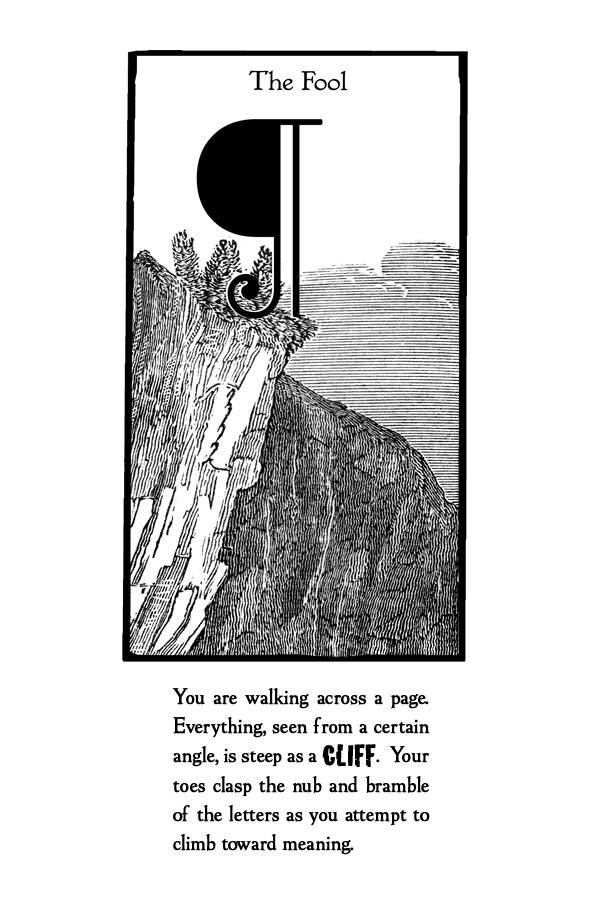
In the body of the text, the Tarot card of the “fool” illustrates this by having a sign on the edge of a cliff; that is, on the edge of an abyss:

28-Walking-Across-a-Page-1

As you can see, the text for this image gives one a spatial coordinate for how one’s eye moves from text to image.  It is self-reflexive in the sense that it is a parable of reading in which the reader “clasps” at meaning as he/she “attempts to climb toward meaning.”  This, let me stress, is likened to the movement of the fool (reader-writer)  since it is a risk that most adult readers wouldn’t venture.

The introduction plays on the fact that when we read we move between things (the “inter” – the between – is located in a few different places).  And this explanation, itself, is a parable since it is a comparison “between” different pairs; one of which is between the reader and these writers:

This, itself, is a parable.

And so it is clear, that at its heart, Franzlations is a collaboration.  Between writers and writings.  Between words and images.  Between readers.  Between the past, the present, and the future.  For it is our belief that new writing is the imaginary future of past writing, even if that writing was never written.

The last words suggest that this book casts forth, for the reader, new, possible relations to a past that may or may not have been written by Kafka.  But I can assure you that as a reader of Kafka, they do include fragments of his aphorisms; but they also play on them and write them in configurations that never appeared in Kafka’s text.  Regardless, as they note in the introduction, “Kafka’s words have been an inspiration for us.”

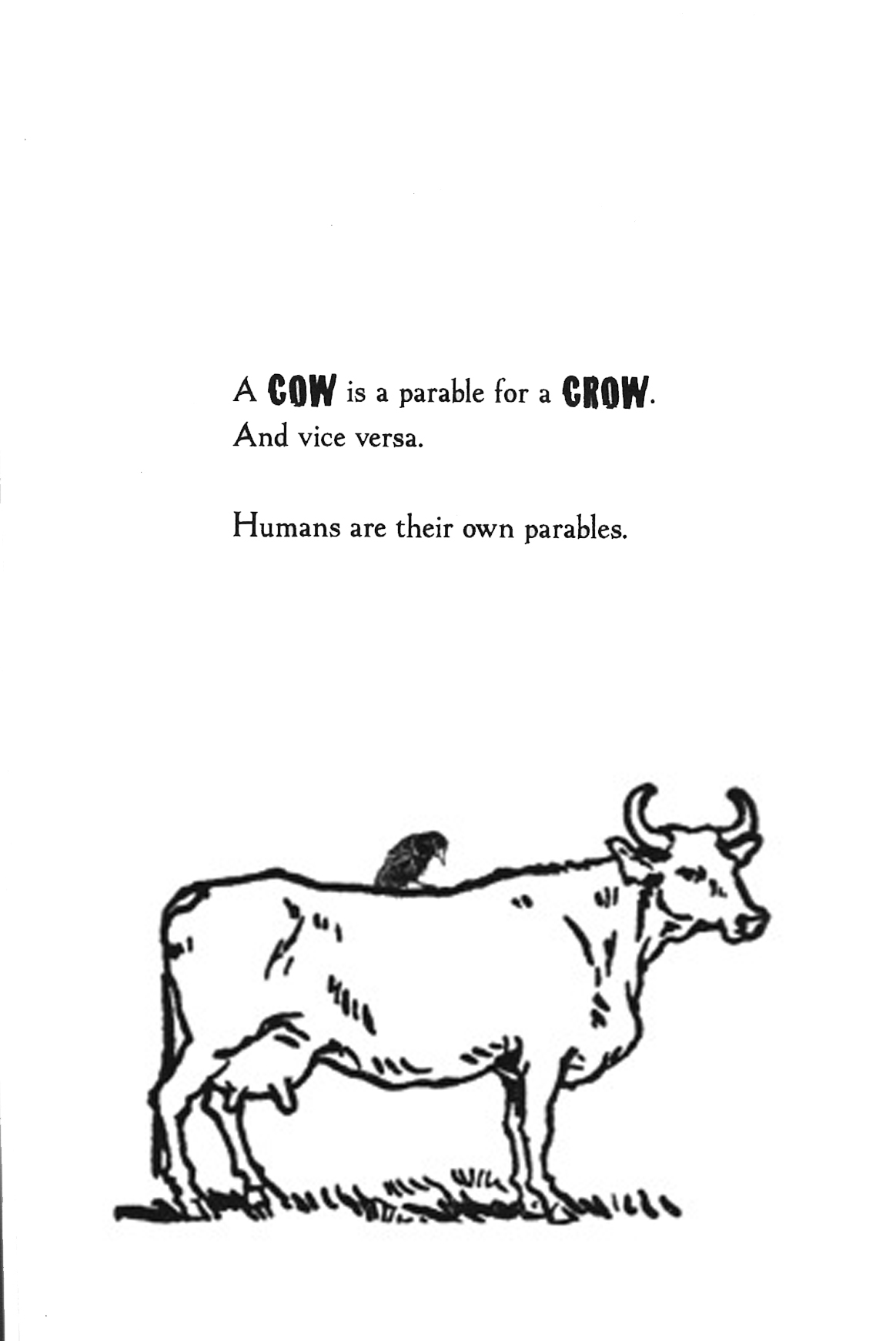
The text/image demonstrates the movement “between” things, images, times, and readers; and between Kafka and their text.  This movement informs what they call the parable.  For instance, in an image of a cow and a crow, they write “A COW is a parable for a CROW.  And vice versa.  Humans are their own parables.  And this suggests that one thing (parable) can be translated by another and that humans are parables of themselves (which suggests, based on this, that they are not themselves but something other).

12-cow-is-crow

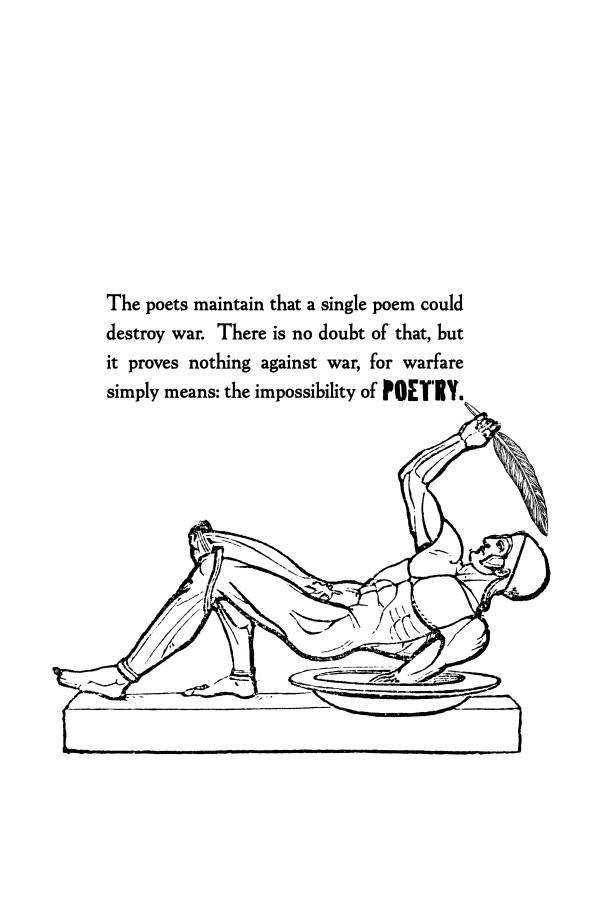
While the reader might see this as a free-for-all which lacks any connection to reality, I would like to suggest taking a look at page 8.  In this image-text, the proposition that “a single poem can destroy war” is tested.  It suggests that war is the impossibility of poetry; and if the work of the between, the parabolic work, is poetry, then this suggests that this book is a challenge to war only insofar as it dwells in the parabolic.  As Emmanuel Levinas notes in his book Totality and Infinity, war dwells in absolutes.  Franzlations, on the contrary, doesn’t deal in absolutes; it deals with the parabolic. As we can see in this image of a naked-man-warrior who is sloping parabolicly with a feather (away from war).

8-Poems-and-War

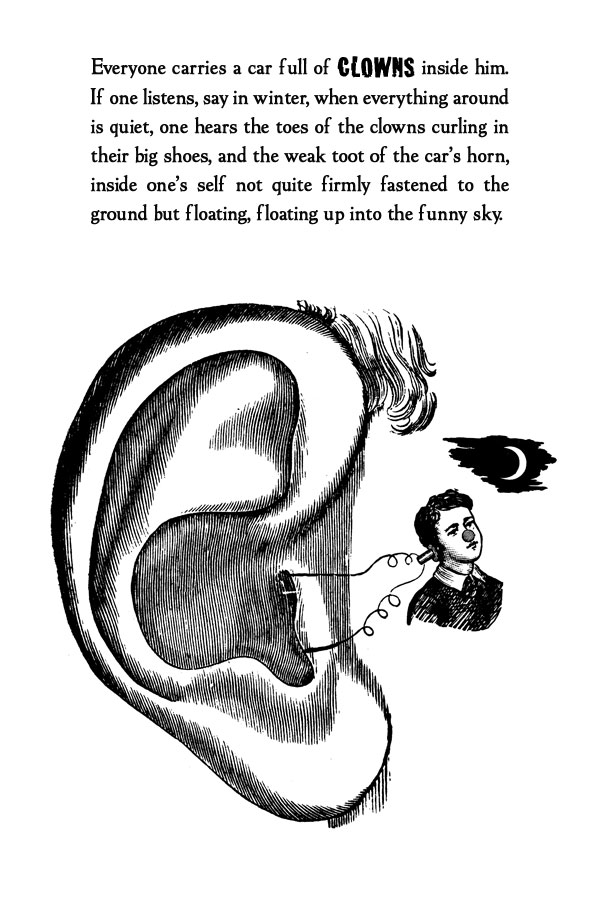
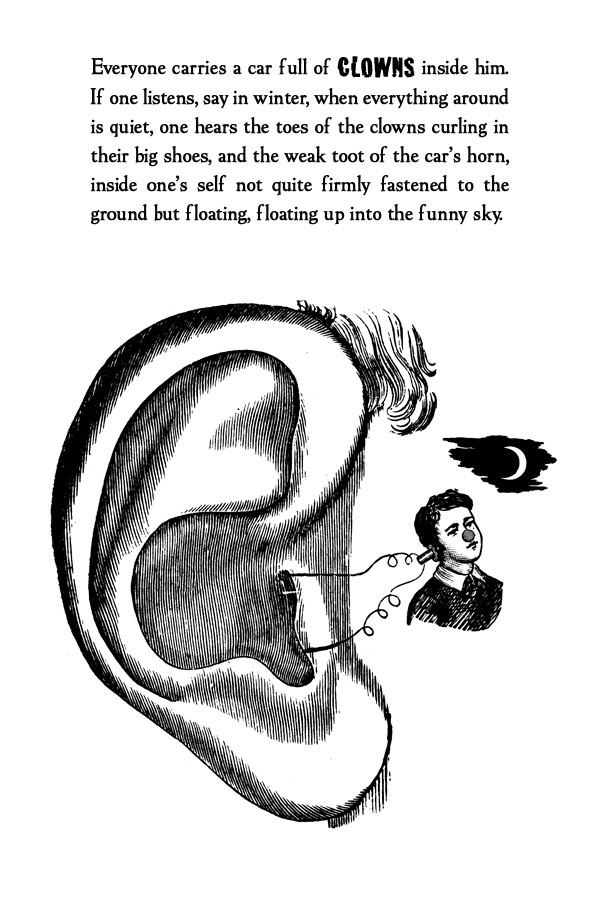
Another major theme in Franzlations is the movement between the serious and the comic.  This movement is of great interest to me and my own schlemiel-project.  The movement suggests that poetry moves between the two.  On page 32 we see such an image/text.  It plays on the initial parable in the book – drawn from Kafka – about hearing a train inside of oneself moving along.  Here, we see a little boy with a clown nose under a crescent moon listening to a large ear.  He is listening to a “car full of clowns inside him.”  But the text takes a serious, poetic note by referencing silence.  If one listens to the clowns, against a deep silence, one can hear “the toes of the clowns curling in their big shoes.” One can also hear the “toot of the car’s horn” as it floats up into the “funny sky.”

32-Clowns

The irony in this piece is that the floating away into the sky is also a melancholic image of loss.  Silence is often associated with the tragic, not the comic.  And the comic sound runs up against tragic silence.  But although the sounds disappear there in the sky, this is not tragic; it is “funny.”  This juxtaposition of the two makes for a depth and a paradox that takes this text out of the zone where textual play is the only thing on the table.

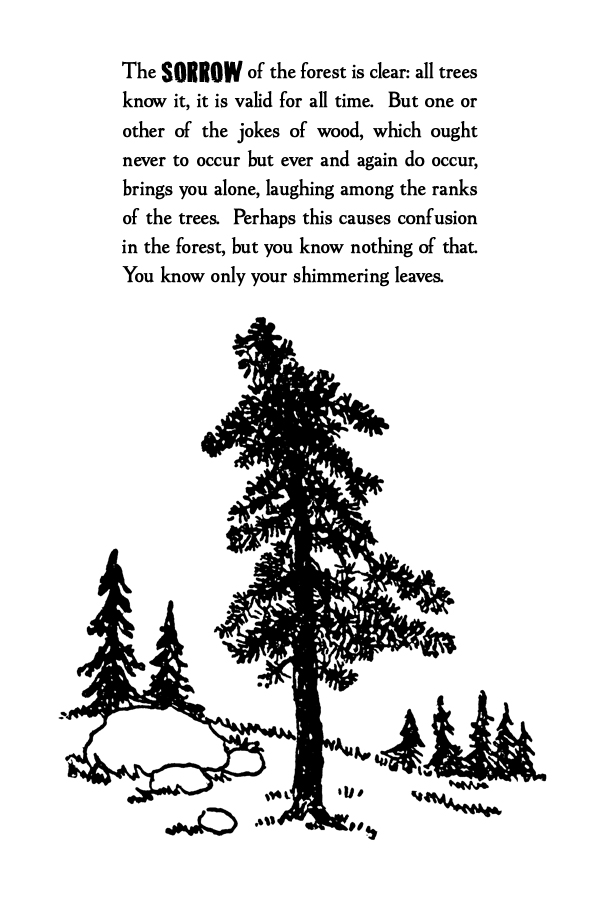
This juxtaposition returns on page 46 where we see an image of a lonesome tree in the foreground.  The text notes the “SORROW” of the forest; but what stands out is not suffering and despair so much as the “jokes of the wood” which “bring you alone, laughing among the ranks of trees.”  It muses that this “perhaps” may cause “confusion in the forest” but “you know nothing of that.  You know only your shimmering leaves.”

46-Sorrow-of-the-Forest

This image speaks to me and my project.  It suggests that the reader is child-like (a man-child/schlemiel of sorts).  Yet, at the same time, it suggests an adult-awareness of sorrow and tragedy. This frission makes for a relation that I ponder often in schlemiel-in-theory.  Namely, the relation between Sancho Panza and Don Quixote (a relation that both Kafka and Benjamin found so much interest).  This awareness takes us into a space between the comic and the tragic which is also the space between childhood and adulthood.

44-Destination

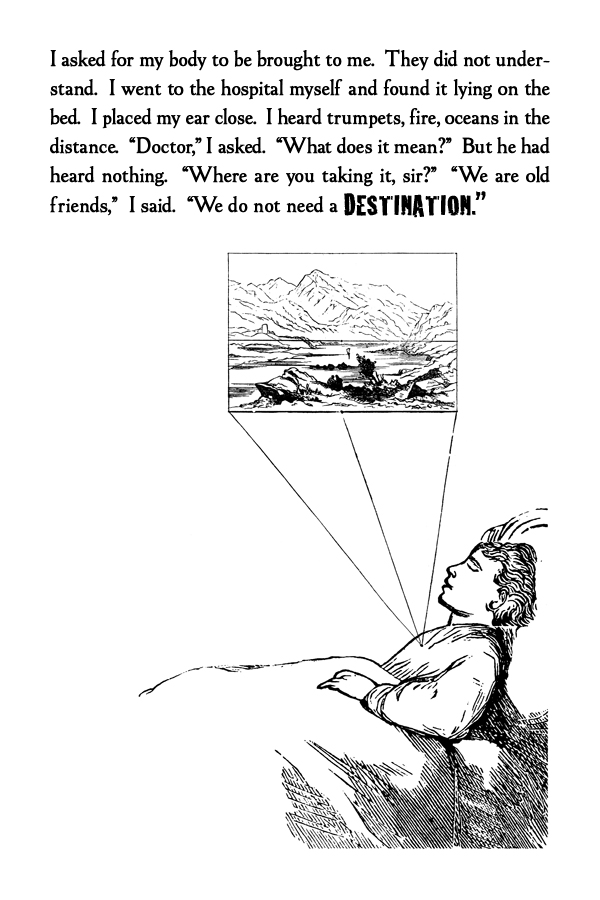
Franzlations, much like Walter Benjamin in his reflections on childhood terror, explores this zone of childhood as it relates to death.  The text-image that brings this out is on page 44.  This image and text play on this relation vis-à-vis a mystical image.  In it we see a boy who appears to be dreaming of a land from the space of his heart.  The text, however, suggests that he may be dead.  It intensifies the claim by speaking in the first person: “I asked for my body to brought to me.  They did not understand.”   The boy speaks to a Doctor about this (which would, of course, be impossible, since he is dead).  The doctor doesn’t hear him. The ensuing dialogue, we can suppose, is with himself.  He will take his body away; but he has no destination for it: “We do not need a DESTINATION.”  This implies that the body can be taken anywhere; this may be an allegory of the dead letter. On the other hand, it may just be a way of addressing death in a way that is steeped in the imagination and the “between” of life and death; dream and reality.

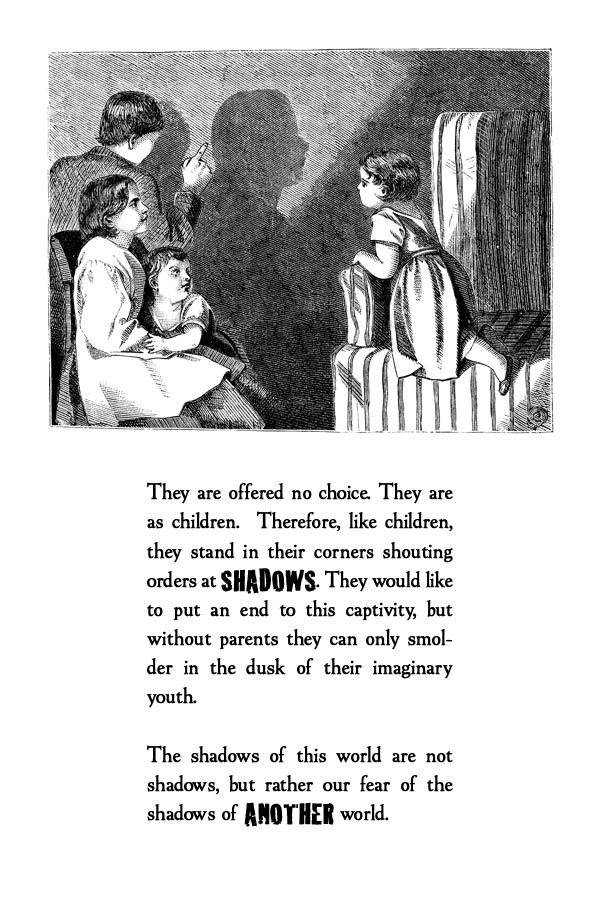
The theme of terrified children and the “other world” is also seen on page 48. The antiquated images that are used for this (and other texts in Franzlations) bring us back to a cultural childhood (in the early 20th and late 19th century) where, it seems, the relation of childhood to death was of interest.  It also helps us to “look back” at ourselves and our relation to death.  Here, “shadows” and “fear” are foregrounded.  When I see this image, I also think of the shadows of words and images and the fear they evoke (as it were, the fear of unknown possibilities).

48-Shadows

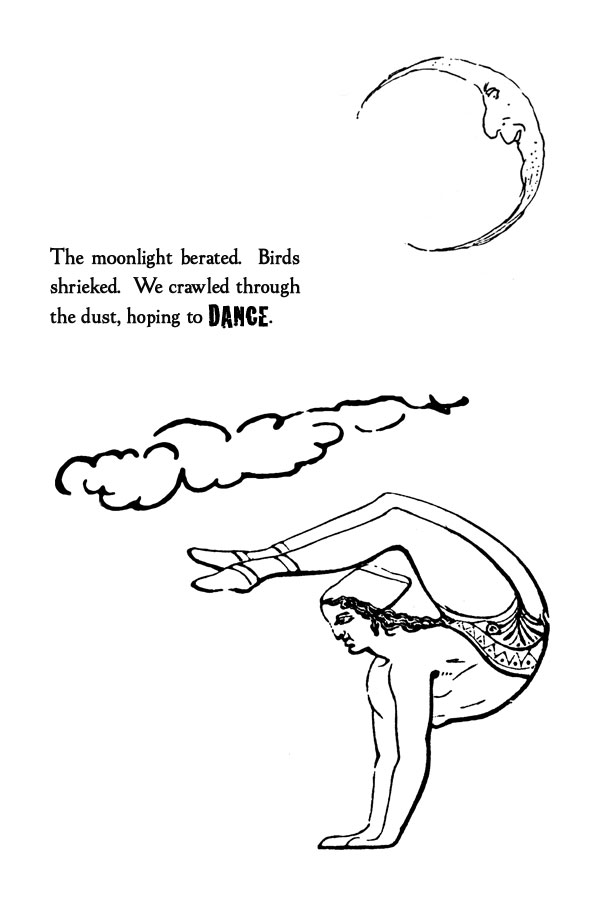
But perhaps there is nothing to fear.   The end of Franzlations offers some comfort by way of offering us – as if we the readers are children – images of a man posing like a crescent moon above him.

78-Hoping-to-Dance

These images are parabolic and remind me of the circus.  The shape of the man is compared to the moon in this image.  But the text tells us that these images emerge out of duress: “Birds shrieked. We crawled through the dust, hoping to DANCE.”

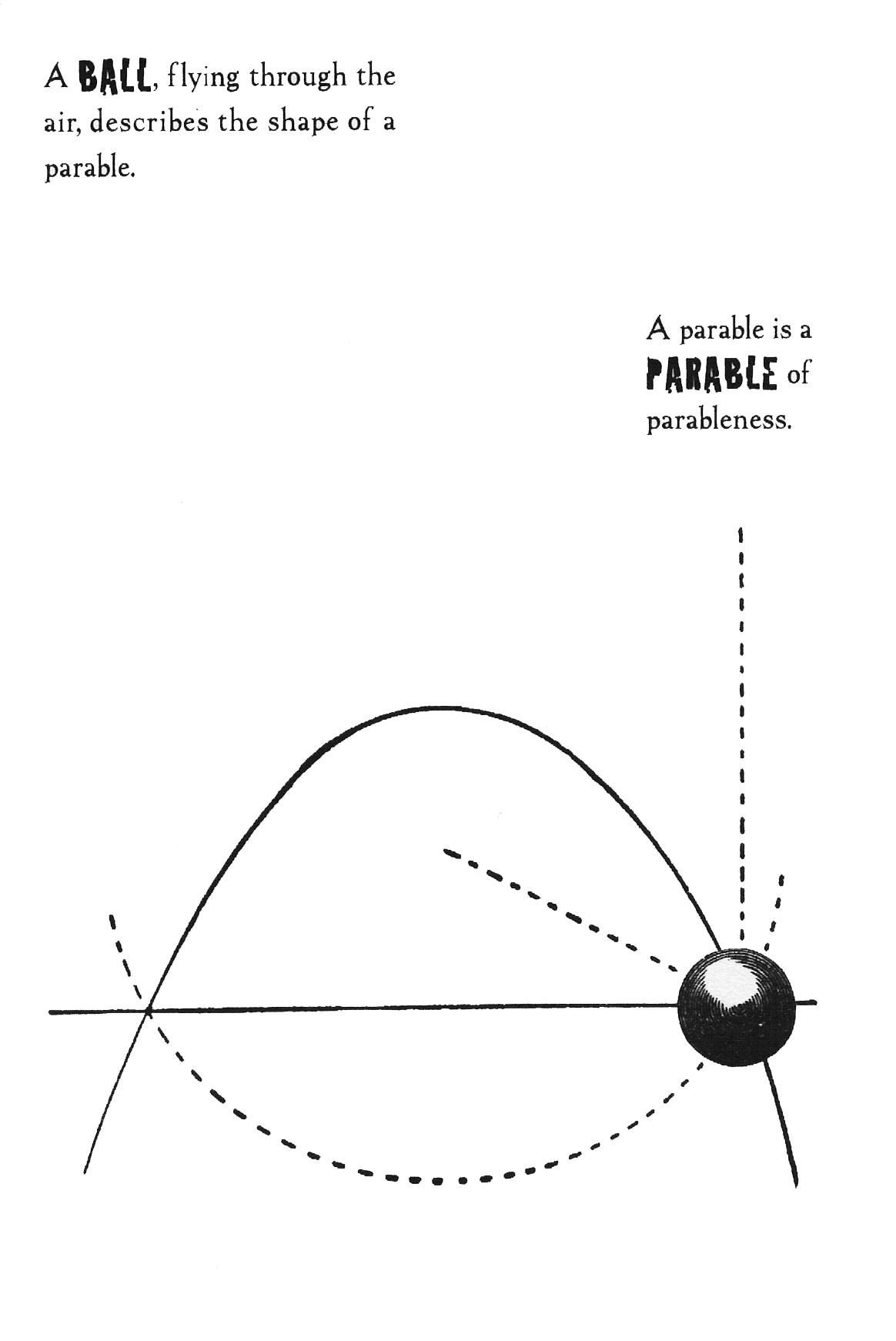
This movement itself may be comforting; like the image of a ball whose movement through space is also parabolic.

83-ball-flying

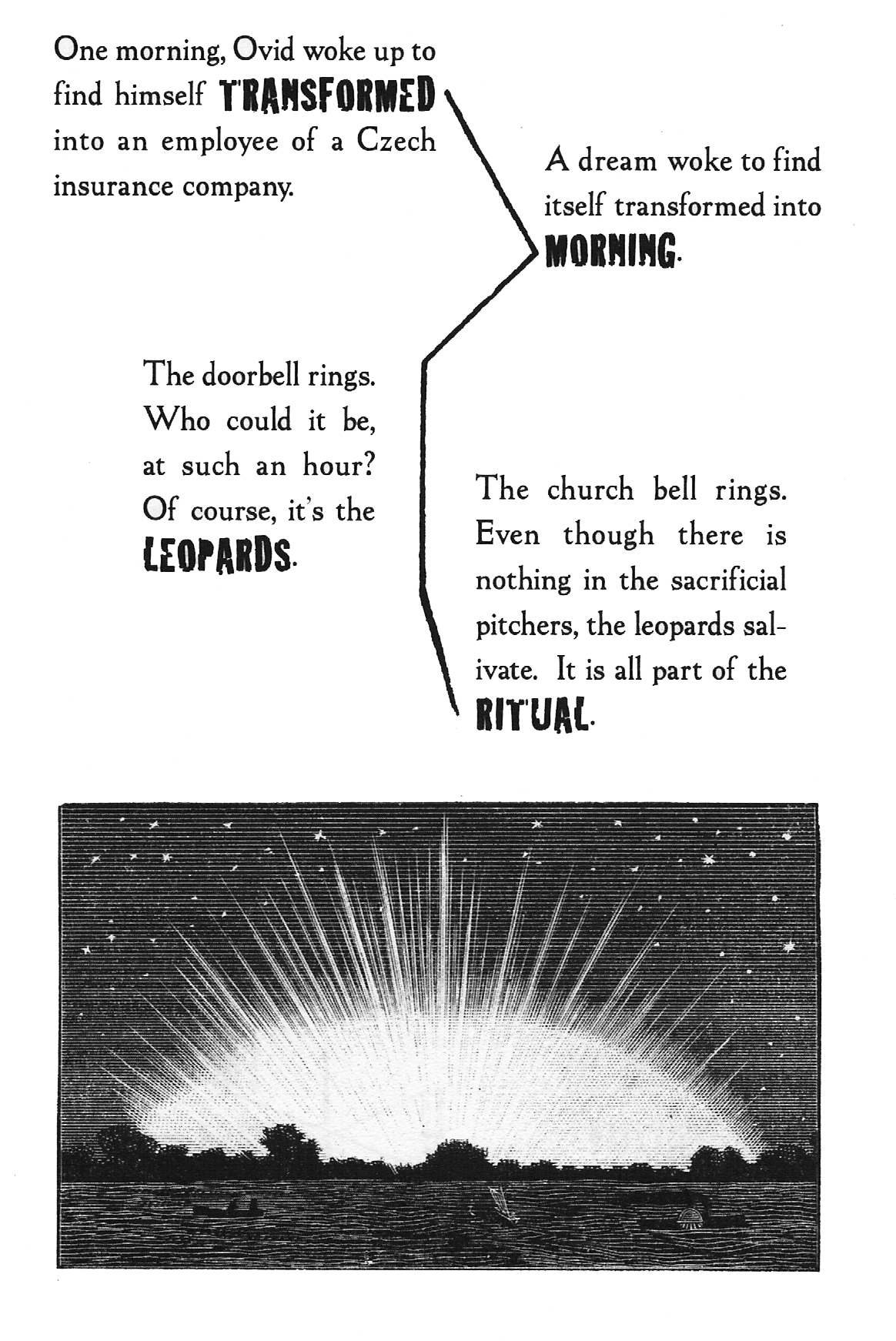
Maybe there is hope at the end of the parabola.  Maybe there is a new morning.  Or is it just the course of the day or of a parabola?  A ritual?

87-ovid

All of these questions are left open for the reader to decide on.  But, in truth, they are well posed. The images and the texts selected give me much food for thought as so much dwells in that arc between one thing and another – especially if that arc spans what is and what could be or between what was and what may be.  These are the thoughts of children…and adults.

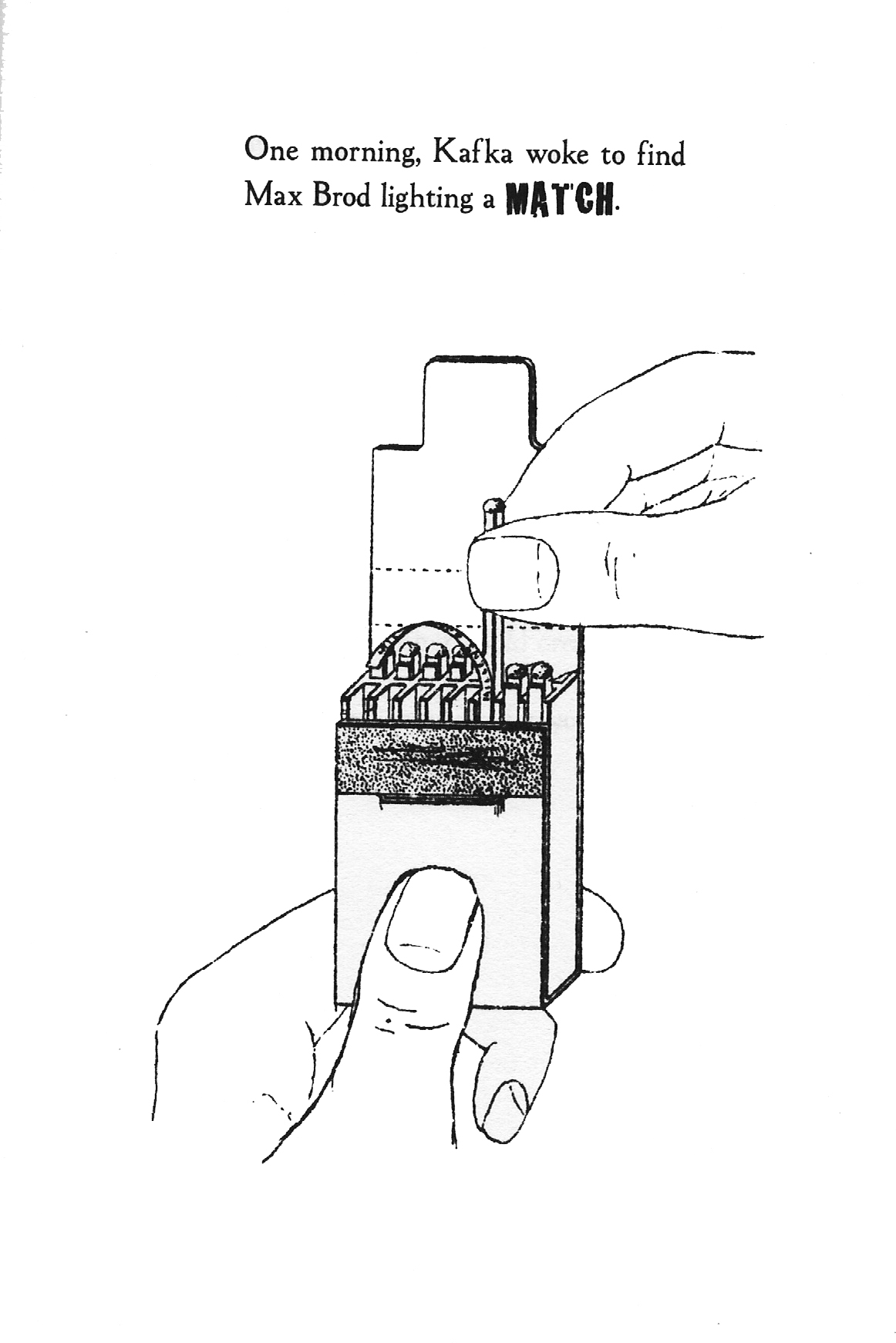
The last image of Franzlations casts a possibility that never happened.  As any scholar of Kafka knows, Kafka wanted his best friend Max Brod to burn all his work.  But he didn’t.  Playing on its task of translation, Franzlations purposefully misreads what actually happened (the texts were not burned and served as the basis for much of Franzlations’s musings).

91-max-brod

Here Kafka (playing on Gregor Samsa of “The Metamorphosis”) wakes up to find Brod lighting a match.  He never did, but let’s take a moment to imagine that he did.  For if he did, we, just like these authors, would have to “invent” another Kafka.  Regardless…. they did invent or rather re-invent him!  And for that, I am very happy: because the way they chose to reinvent Kafka brings us into a space that is made especially for schlemiel-readers (see the “fool” Tarot card above) who travel back and forth between adulthood and childhood, a space that is evoked by way of moving our eyes on a page between text and image, and between the past, present, and imaginary possibilities of the future.

Should Jews be Normal or Exceptional? Hannah Arendt and Gary Shteyngart’s Reading of the Schlemiel and Normality

DownloadedFile-1

Judith Butler has, on many different occasions, pointed out that she is taking on the legacy of Hannah Arendt.  And by this she means Arendt’s legacy vis-à-vis her work on the political.  One of the terms Butler uses in her political vocabulary – which also pops up in her work on sexuality – is “normalization.”  When used by Butler, this term has the most negative connotations imaginable.  If anything, she wants to keep this or that regime, political movement, or discourse in check by making sure that it is not normalized.  Hetero-normativity or any normativity for that matter is problematic for her.  But if one were to critically look into one of the most important essays of her predecessor – namely “The Jew as Pariah” – he or she would notice that at the end of the essay Arendt imagines a movement away from the schlemiel/pariah (the outsider) to the insider.  She points out that Kafka – and she herself – dreamt of living a “normal” life (and that his novels illustrate this fact).  This “normal” life isn’t the life of the “parvenu” which, as she points out in her essay, is in tension with the pariah.  Rather, by normality Arendt believed Jews should – at some point – stop being “exceptional” pariahs.  But what does this mean?  Does it imply that Jews will just be like everyone else?  Is the goal normality?  And what would Butler say about that?

Since Arendt doesn’t properly explain what she means by normality, we can only surmise that she associated the schlemiel (as Zionists did) with Diaspora.  (After all, she did write articles for a Zionist Newspaper in Germany for many years and it is plausible to suppose that her writing and thinking was deeply affected by her journalistic engagement.)   A writer who provides a good contemporary illustration – albeit in fiction – of the transition from the “exceptional” schlemiel to the “normal” man is Gary Shteyngart.  As I pointed out at the beginning of this blog series, Shteyngart ends his debut novel The Russian Debutante’s Notebook with what I call a “dad ending.”  It, like Arendt’s ending, is dad/bad because it effaces the “exceptional” aspect of Jewishness (embodied in the schlemiel) in the name of being an American; that is, normal.   To be sure, Arendt never specifies where one will become normal (she doesn’t mention Israel); however, she hints at America when she says that Charlie Chaplin’s “Great Dictator” (for her, the last schlemiel in the “hidden tradition” of the pariah/schlemiel) is replaced by Superman.  (And that replacement happens in America, not in Israel and not in Europe.)  That said, I’d like to look at how Shteyngart’s “dad ending”(which happens in America), reflect on whether it is the best ending, and show how it addresses a problem that Arendt left hanging in her essay.

As I pointed out in yesterday’s blog entry, Vladmir starts thinking about living a “normal” life by way of an American woman he meets in Prava named Morgan.   She uses the most simple terms to describe the world, which for her is divided into “good” and “bad” people.  She tells Vladmir is good, however, at first, he doesn’t believe it.

The narrator points out that –for all intents and purposes – Vladmir is too sophisticated for this; he is “postmoral”:

Was Vladmir a good person? No.  But he mistreated others only because the world had mistreated him.  Modern justice for the postmorality set. (308)

But the more time he spends thinking about it, he realizes that, in going from a schlemiel to a bad man he has chosen to live an exceptional and abnormal life.    He is a pariah on the run and he wonders if he should remain this way:

Why couldn’t she make this easy for him?  Weren’t his lies and evasions valid enough?  And yet, here she was, Morgan Jenson, a tender but unsettling project, reminding Vladmir of someone he used to be before Mr. Rybakov stumbled into his life…A soft and unsurefooted Vladmir…Mother’s Little Failure.  The man on the run.  (310)

In the wake of her gesture,  he thinks seriously about normality:

Normalcy. What they were doing was inherently normal and right.  The tent (which they were sharing one day) was a special zone in which desire existed as a normal urge…This idea, as clear as the lake glistening outside their tent, cared Vladmir almost to the point of impotence.  (317)

Like Arendt, Vladmir wants to live in the world.  And Morgan is the way into it: not his family, not his new work as a criminal, and not his previous life as a schlemiel.    But his decision to leave is not so clear; in a way, it has to be made for him.

When Morgan meets his boss (The Groundhog) and his boss’s girlfriend at an American restaurant he created, things start changing more dramatically.   Playing on the exceptional kitsch that touches all that the Groundhog does, we learn from the narrator that the name of the restaurant is Road 66 (not Route 66).    After hearing The Groundhog’s story as to how he met his girlfriend – by way of an experience he had at a brothel wherein he heard he grunting and was deeply touched – Morgan, in the most damning terms, tells Vladmir that this man is bad and that Vladmir is caught up in this intrigue:

“He met his girlfriend at a whorehouse!” she was shouting as if that had been the most egregious news of the evening.  “He’s a fucking gangster…And you! And YOU!”(395)

He retorts by pointing out that she has been seeing a political activist named Tomas. To be sure, Morgan has a soft spot for the political and, with Tomas, was planning to blow up a political area in Prava called “The Foot.”  But as the novel comes to an end, she just wants to get it done and leave the country.  Paralleling this, Vladmir also wants to leave.  They both want to return to America.

The straw that breaks Vladmir’s back and spurs him to leave in a flurry is associated with the figure of Skinheads.  Before taking Morgan for dinner with The Groundhog, Vladmir, on an evening out with his American friends, is accosted by a group of Skinheads who take him for a “Turk.” They beat the hell out of him; however, there is little reflection on what this means in terms of the country he has chosen to live in.  The Skinheads return after Vladmir takes Morgan out to Road 66. But this time they are sent by “The Groundhog.”  They are sent because, apparently, Rybakov didn’t get his American citizenship and Vladmir is found to be a traitor.

After being badly beaten, Vladmir goes off to the Hospital.  Meanwhile, the final plan to blow up “the foot” and to get Vladmir out of the country is underway.  The end of the novel is full of action and suspense.  And, like the section of the novel on Jordi and the chase (which was the event that made Vladmir more “masculine” and prompted him to leave America for Europe and a life of crime), this section is intense.  This flight, like that one, is transformational.

The last words of the novel – prior to the Epilogue –end with Vladmir in flight:

He ran – there was not even the time to lie to himself that he would be back.  And lies had always been important to our Vladmir, like childhood friends with whom one never loses an understanding.  (469)

These last words also indicate that Vladmir’s life has been a life of lies.  In contrast, the Epilogue suggests that now, in America, he will live an honest and normal life.  We meet him on his birthday. But in contrast to the first birthday – which the novel begins with – he is not a schlemiel.  In other words, he is not exceptional.  He is normal.  He is married to Morgan, they both have normal jobs (he works for her father), and they have a child on the way.

In America everything is normal:

This is America, where the morning paper lands on the doorstep at precisely 7:30 A.M. – not the whooly dominion (in Prava) Vladmir once ruled.  So he’ll open his eyes and unlock the door.  He’ll put in his ten-hour workday.  He’ll chat up the secretarial pool, etc (476)

In America, he is “free of the fear and madness of…Eastern lands”(476).  Although he carries his memories of being “exceptional” with him, at least – the narrator tells us – he can console himself with the thought that his child will be an American, not an immigrant:

An American in America.  That’s Vladmir Girshkin’s son. (476)

I call this a “dad ending” because that is what it is.  He ends the novel as a dad (rather than a schlemiel or a “bad” man); but it is – ultimately – a bad, Hollywood ending.   Given what was put forth in the first ¾ of the novel; it is odd.  The rush to normality should evoke questions in the reader regarding Vladmir’s identity.  Too much of what he was seems to have been left in the past; his birthday epilogue suggests that he has exchanged the exceptional for the normal; the schlemiel for the everyman.

Over the last decade or so, this formula has been used by Woody Allen,  Judd Apatow, and a few other screenwriters and filmmakers to illustrate a shift away from the schlemiel.  Its odd that Allen started doing this – with his film Anything Else (2003)– around the same time Shteyngart published his debut novel 2002.

Like Arendt, Allen, Shteyngart, and Apatow are all interested in leaving the schlemiel behind – or at least putting him through a process in which he/she goes from being a schlemiel to a normal individual.  Do they illustrate what Arendt claimed Kafka’s novels all point to: a desire for a normal life?  And is this life the “world” that she wanted to be in tune with?

I wonder about Arendt’s turn to the normal, just as I wonder about Shtyengart’s (Apatow and Allen’s turn).  They seem to be taking a German-Jewish reading of the schlemiel to heart. The Eastern European reading of the schlemiel, in contrast, looks to keep the exceptional nature of the schlemiel at the forefront. The reason for this has to do with the fact that they didn’t think a happy ending – with the schlemiel transforming – was the point of this character.  In truth, it has to do with challenging the “status quo” not becoming it.

Although Arendt may have envisioned a world where no one was exceptional and all lived a normal life (and that world may have been in America), the fact remains that she saw normality as the goal.  She had no vision of a perpetual revolt that would be spurred by way of the schlemiel.  For her, it had a historical purpose.  But, apparently, when Jews were given the opportunity to participate in history and politics, its role ended.   Arendt is unclear on this note.  However, she does suggest it in her reading of the schlemiel since it is displaced, in her view, by Superman and has less weight in Kafka’s imagination than the “normal” life.

The question, in all of this, is what is so “exceptional” about the schlemiel.  Arendt uses this term and so does Shteyngart.  And they both define the schlemiel in terms of what they think is exceptional.  And the long and short of it is that what they find exceptional is exile.  They have no need for it, but, in truth, when will it ever end?   Can American Jews end this chapter of history and simply pat themselves on the back?  Perhaps it would be better if there were no epilogue….

The answers to all of these questions, hinge on how we interpret the exceptional nature of the schlemiel: what it is and whether or not it is necessary or desired…today.

Dad Endings: On the Transformation of Vladmir Girshkin from Schlemiel to Bad-Man to Dad-Man – Part II

images-1

Power corrupts. And it corrupts not only those who hold it; it can also corrupt those who are its victims since the victim can become the victimizer.   This is a theme that intrigues Gary Shteyngart whose main character, a Russian-Jewish-Immigrant to America becomes a victim who is given an opportunity to. so to speak, turn the tables.   We see this at work in the middle of The Russian Debutante’s Notebook where the main character, Vladmir, ends up despising young Americans who come to Eastern Europe to “rebel against their parents.”   He initially takes them as the targets of his “ponzi scheme.”

However, at a certain point, he is smart enough to realize that his negative reading of Americans is a misreading.  And the person who brings him to this realization prompts him to go from being an exceptional bad-man to a normal “dad-man.”   This transformation, in many ways, bears an interesting light on Hannah Arendt’s claim that the schlemiel is left behind for the normal man.  The problem with her reading is that there are too many gaps.  Shteyngart, in an odd way, fills many of these gaps in since Vladmir goes from being a schlemiel to a bad-man; and from a bad-man to a normal dad-man.

As I noted in yesterday’s blog entry, Vladmir’s first “victim” is a writer named Perry Cohen.  In the style of a “bad-man,” Vladmir tries to mock – to himself – the juvenile writer he meets in a bar.   But, in the midst of this mockery, there are moments of tenderness when he remembers the poem he wrote on his mother when he was an undergraduate.  But this memory fades in and out – it, like the memory of the feminine, trades places with his new masculine approach to things (wherein he must con people and follow through to his criminal promises to “the Groundhog).

When Vladmir first sees him, he calls Perry the “young Hemmingway across the room.” His first reflections on Perry show us that Vladmir sees himself as “other” than Perry the American-Jew from the Midwest:

Vladmir imagined a background of worried parents, angry transatlantic phone calls, pouches full of law-school applications being dragged through the streets of Prava by exhausted Stolovan postmen. (216)

But, in a few telling moments, we see that Vladmir has a soft spot for this wayward American-Jew who is in conflict with his upbringing.  Vladmir, as we have seen, also has some difficulties (although his are much different).  Regardless, they bond:

And so Cohen told Vladmir of the story of his father.  The two men had known each other for two minutes now; a pen had been transferred from one to the other; ethnic backgrounds had been established; a few sallies had been launched.   What that all it took – the equivalent of two dogs sniffing out each other’s rears – to get the writer Cohen to tell the story of his father?  (217)

But this is short-lived since Vladmir becomes competitive and finds Cohen’s experience of assimilation to be insignificant when compared to his own. This is where the beast comes out:

What do you know of assimilation, spoiled American pig?  Why, I’ll show you…I’ll show you all!  Oh, and the way Cohen had told the story.  Lowering his voice during the bit about the Gipper, trying to sound hurt but brave when recalling his father’s transgressions.  Crocodile tears, my suburban friend.  Your father could be a deforester of forests and a murderer of Hutus, but in the end what determines your fate is the size of your trust fund, the slope of your nose, the quality of your accept. At least his daddy wasn’t accusing him of walking like a Jew.  God damn it! Vladmir could just kill this Cohen! (219)

This pattern of warming up to his more privileged American compatriots and pulling away from them (attraction and repulsion) informs his Jewish-American-Russian identity.  And this comes to the fore when he is in Eastern Europe, not in the USA.  It comes to the fore when he is given an opportunity to make these young Americans into a victim of his “ponzi scheme.”  Its fascinating how Shteyngart evokes and works through Vladmir’s crisis.

By way of Cohen, Vladmir meets several other Americans in Prava who are also “rebelling against their parents” and upbringing.  He is intrigued by the members of the group, and is drawn in by the American girls, their bodies, and their American-ness. But he is also repulsed by it.  By way of parties, drinks, and schmoozing, Vladmir suggest that they all work together to create a literary journal in Prava – Cohen will be the editor.

Meanwhile, Vladmir briefs “The Groundhog” on the progress of his PravaInvest scheme.  But, as the novel goes on, we see that there is a snag.  In relation to Cohen and many other handsome and fit Americans, he feels his body is out of place.  He is vulnerable.  And this vulnerability is foreshadowed when, in his room alone, he remembers his childhood; and, when he rises up from his memory in his Prava apartment, he ties to walk like a “man” rather than as a “Jew.” But he fails:

Vladmir got up from his bed.  He tried walking the way Mother had shown him a few months ago in Westchester.  He straightened his posture until his back hurt. He put his feet together gentile-style…But in the end he found the whole exercise pointless.   If he could survive Soviet kindergarten hobbling Jewishly from humiliation to humiliation to humiliation, then he could surly survive the scrutiny of some Midwestern clown. (246).

When he meets a girl named Morgan, however, this all changes.  In her, he sees someone like himself; someone who is simple and awkward and whose body and appearance are…different.  He can pick on her, but it is not out of spite and jealousy (as it is for Cohen and his ground):

Vladmir had but one thought: Why was her hair past shoulder length, given the present-day urban conventions that demanded shortness, brevity?  Was she, perhaps, a stranger to hipness?  Questions, questions. (265)

As we learn later, what makes Morgan so special is the fact that, unlike her fellow Americans, she is not exceptional nor does she look to be.  She is normal.  And this, at first, troubles Vladmir who the narrator sees, at the outset of the novel, as a cross between P.T. Barnum and V.I. Lenin.

When Morgan says that she “likes him” because he is a “good person,” Valdmir is troubled by this as it challenges his whole revenge project of going from victim to victimizer.  The narrator, to be sure, doesn’t think Vladmir is “good”:

Was Vladmir a good person? No.  But he mistreated others only because the world had mistreated him.  Modern justice for the postmorality set. (308)

But Vladmir, in a schlemiel moment, remembers how he used to be good…before he met Rybakov.  He used to be good when he is was a schlemiel:

Why couldn’t she make this easy for him?  Weren’t his lies and evasions valid enough?  And yet, here she was, Morgan Jenson, a tender but unsettling project, reminding Vladmir of someone he used to be before Mr. Rybakov stumbled into his life…A soft and unsurefooted Vladmir…Mother’s Little Failure.  The man on the run.  (310)

But there is more to the story.  Instead of going back to being a schlemiel, Morgan is simply going to prompt him towards the normal life.  Part VI of the book, entitled “The Trouble With Morgan” goes right to this theme immediately.

By way of Morgan, Vladmir is able to reflect on himself as a Jewish-Russian-American immigrant.  He gets down on himself to a great degree and sees his body against hers while thinking that her body is more “plausible than his, the body of a woman who approached the earth on equal terms”(316).  In contrast, Vladmir sees himself as abnormal: he can’t relate to the “earth on equal terms.”  Rather, like “Fran, Challah, Mohter, Dr. Girshkin, Mr Rybakov,” he had “invested into building a refuge from the world”(316).  In contrast, Morgan has “nothing in particular to run from.”  She has a world; he doesn’t.

These above-mentioned descriptions are uncanny because sound so-much like Arendt’s – regarding the Pariah/schlemiel’s relation to the world.  Like Arendt, Vladmir (and the narrator) take on the project of becoming normal.  The narrator makes this theme explicit:

Normalcy. What they were doing was inherently normal and right.  The tent (which they were sharing one day) was a special zone in which desire existed as a normal urge…This idea, as clear as the lake glistening outside their tent, cared Vladmir almost to the point of impotence.  (317)

The tendency toward “normality” that Vladmir is feeling by way of Morgan will prompt him to go from being a “bad-man” to being normal.  And in the Epilogue, it will prompt him to go through the final phase: from being a bad-man to a dad-man.

In the next blog entry, I will take a look into this “final transformation” and into the implications of this “dad-ending.”  This ending – and the process that leads up to it – gives us a fresh vantage point that can be used in our reading of Hannah Arendt’s periodization of the schlemiel.   When one turns to normality, as she and Vladmir do, is Jewishness (and not just the schlemiel) lost in the process?

Dad Endings: On the Transformation of Vladmir Girshkin from Schlemiel to Bad-Man to Dad-Man – Part I

images-3

What many scholars of Hannah Arendt miss (perhaps because they don’t want to see it) is the fact that “The Jew as Pariah” ends on the note of normality.  Although Arendt devotes much of the essay to discussing the schlemiel (as Pariah), she ends her essay with a discussion of Kafka.  Unlike Heinrich Heine and Charlie Chaplin, who both were committed to the schlemiel, Arendt claims that Kafka was not.  In fact, unlike her readings of Heine and Chaplin, she makes a biographical reading of Kafka’s work and claims that the secret of all of Kafka’s novels (with the exception of Amerika) is the desire for normality.  In other words, at the end of the day Arendt thinks that Kafka, like herself, rejected the schlemiel in the name of normality.  To be sure, she saw the “exceptional” status of the schlemiel (and its constant challenge to the status quo) to ultimately be a problem and normality to be the solution.  With a historical view prominent in her mind – a view that has much resonance with Zionism – Arendt believed that the schlemiel served a historical purpose but it was not the goal so much as a means to a different end.

Since it moves from the schlemiel to, at the end very end, becoming “normal,” the latter half of Gary Shteyngart’s The Russian Debutante’s Notebook, echoes Arendt’s reading of the schlemiel.   To get there, however, Shteyngart adds an extra stage in which the schlemiel becomes a bad-man before he becomes a “dad-man” (that is, a normal American).  I find that the trajectory mapped out by Shtyengart’s novel sheds light on Arendt’s map of the schlemiel’s transformation.  And the light it shines on her model discloses what I have thought all along about it; namely, that her reading of the schlemiel is a bad ending to what she calls a “hidden tradition.”  For in losing the schlemiel, Jews also may lose what is distinctive and “exceptional” about Jewishness.  At the end of Shteyngart’s novel, the loss, however, is not so much about the loss of Jewishness as the beginning of a new, normal life in America as an American father and husband; not as a Russian-American and not as a Jewish-American.  And this, I hold, is a “dad ending.”

But before we can get to this “dad ending” and to the normal life, Shteyngart shows us that Vladmir, the main character, must go through the experience of being “exceptional” (in the powerful and “bad” sense).  To this end, Shteyngart begins the process of transformation by way of an exceptional event: namely, the attempted rape by a powerful drug dealer in Miami named Jordi.  As I pointed out in the last blog-entry, this event prompted Vladmir to become more masculine.  In the midst of his flight, the narrator and the character reflect how Vladmir will no longer be a victim.  He realizes that all of his life, before that point, was about making him a victim:

Everything had changed. His body had been handled by a man whose intent was to hurt….How meager the insults of his childhood by comparison to what had just happened.  All the miserable years of adolescence, the daily drubbing at the hands of parents and peers, had been no more than a dress rehearsal; all those years, it turned out, young Vladmir had been preparing himself for victimhood.  (155)

As I pointed out, he, like the Israeli cab driver who speeds him out of harms way, would associate the schlemiel with the victim.  In the wake of this, he decides to take Rybakov’s advice and flee to Prava in Eastern Europe.  There, Vladmir would meet up with Rybakov’s son “the Groundhog.”  There, Vladmir would become the victimizer rather than the victim.  There, Vladmir will become an exceptional leader (a P.T. Barnum and a V.I. Lenin – the two characters that the narrator associates with Vladmir at the very outset of the novel).

When he arrives in Prava, Vladmir is greeted by an entourage:

Small-arms fire exploded outside.

A dozen car alarms engaged.

A detachment of men, each with a small Kalashnikov at hip level, swiftly parted the Americans into two screaming herds.

The requisite red carpet was rolled out between them.

A convoy of BMWs and armor-plated Range Rovers was assembled in protective formation. 

A crepe banner bearing the curious legend PRAVNAINVEST #1 FINANCIAL CONCERN WELCOME THE GIRSHKIN was unfurled. (188)

Following this grand welcome, Vladmir is introduced to his “new benefactor” (“The Groundhog”).   Although there are many comic moments in this display of power, the comedy is based on the feeling and expression of power. And even the narrator’s descriptions try to make light of it all by paying close attention to the aesthetic aspects of this display in honor of Vladmir:

In an impressive piece of postmodern choreography, twelve car doors were opened simultaneously by twelve lanky Stolovians….Inside, the sober German interiors were violated beyond comprehension with Jersey-style zebra-striped seats and wooly cupholders. (190).

As Valdmir takes this all in, he realizes the opportunity he has to do something he never has done: become a leader.  However, here, he would be the leader of a crime ring (with, of course, the oversight of his benefactor: The Groundhog).  Vladmir takes all of this on when he is asked to speak at the “Biznesmenski” lunch.

At this lunch, Vladmir takes on the role of leading The Groundhog and all of his underlings to greater economic success:

I propose that I single-handedly infiltrate the American community in Prava. Despite my fluent Russian and my tolerance of drink, I can easily double as a first-rate American.  My credentials are impeccable.  I have attended one of the premier liberal-minded colleges in the States and have a profound appreciation for the dress, manners, and outlook of the disaffected young American set.  (201)

They all applaud his plan to rip-off young “disaffected” Americans who come to post-Communist Eastern Europe (in general, and Prava in particular) as a way of rebelling against their parents and wealthy upbringing.  When asked what he needs to accomplish this, he tells them he needs a “certain amount of money per week for drinks, drugs, taxis, whatever it takes to ingratiate myself in the community”(201).  He estimates this will amount to an initial $6000 and, following this,  $2000 a week.  They agree and, floating on this success (a success that we saw at the end of his “curious arc of dreams” – but with a major difference), he gets to work.

To get things underway, Vladmir goes to the area where Americans hang out and there he stumbles across a poet by the name of Perry Cohen.  He introduces himself to Perry as a “novelist-poet-investor.”  And, as he in the midst of talking to Perry, he concocts his scheme to get money from them and to run.

In the next blog entry, I will discuss Vladmir’s relationship with the American community in Prava and how, once he gets to know them, it takes a turn.  Following this, I will 1) show how close Arendt and Shteyngart are in their reading of the schlemiel and its “end”and 2) look into the meaning of Shteyngart’s “dad ending” and how it compares to Arendt’s ending.    


Fleeing America for Eastern Europe and the Schlemiel for Masculinity

images-2

Historically, one will find that one of the founding ideas behind this or that revolution or political movement is the idea that a nation, people, or sex, etc needs to rise up and assert that it will no longer be a victim or slave to this or that system, ideology, or people.  When this movement of “liberation” happens, certain traits that are deemed to have caused this victimhood will be targeted for elimination.  For many of the first Zionists who wanted a new state and for many Jews of Germany who wanted to be accepted as equals, the traits that they found most problematic, the traits that kept them from the state or acceptance could be found in the schlemiel.  For many Jews, the schlemiel represented the parts of the Jewish people that they wanted to leave behind: these parts were, in their view, too “feminine” and too open to victimhood.  Jews, they believed, needed to stand up and reject these traits.  Independence and equality were contingent on rejecting them.  And the “new Jew” or the assimilated German-Jew would be more independent and masculine than the “old Jew” or the “ghetto Jew,” which found its caricature in the schlemiel.  This reading, I would like to stress, differed considerably from the Eastern European reading of the schlemiel.

As I pointed out in yesterday’s blog entry, the reading of the schlemiel as a victim re-emerges in Gary Shteyngart’s The Russian Debutante’s Notebook.  Vladmir, throughout the beginning of the novel plays the schlemiel.  But never once does he or the narrator refer to Vladmir as a “victim.”  And, as readers, we enjoy the dreamy meditations and happenings that we see Vladmir drift in and out of throughout the novel.  His foolishness is charming.  However, the dreams at the end of his story arc, the dreams of money, lead him into a near rape experience.  And this shifts his perspective on himself; the narrator is the one who notes this change:

Everything had changed. His body had been handled by a man whose intent was to hurt….How meager the insults of his childhood by comparison to what had just happened.  All the miserable years of adolescence, the daily drubbing at the hands of parents and peers, had been no more than a dress rehearsal; all those years, it turned out, young Vladmir had been preparing himself for victimhood.  (155)

This implies that the whole novel up to this point is about a character who was “preparing himself for victimhood.”  But now, in the wake of this near-rape experience, Vladmir punches his pursuant (Jordi) and flees the hotel.  And this flight, I aver, is a flight from the feminine to the masculine.  It is also a flight from America to Eastern Europe where Vladmir will now lead a life of crime with a group of other men.  But, as I noted before, his flight, at a certain point, ends; and his transformation is partial.

The tone, writing style, and content of the novel change dramatically as he flees the hotel.  When he leaves, he flags down a taxi that is driven by an Israeli named Ben-Ari (which in Hebrew means “son of a lion”).  Shteyngart’s decision to have a masculine Israeli named Ari pick Ivan up is not by any means arbitrary.  To be sure, it fits into the anti-victimhood theme that he is playing on (after all, as I mentioned above, the concept of the “new Jew” emerged out of the Zionist idea and was embodied, to some extent, in the Sabra ideal).

Ari’s introduction underscores this masculine theme:

The cabdriver, some kind of Middle Eastern pituitary giant…asked if Vladmir’s girlfriend had kicked his ass.  His nameplate read Ben-Ari, or Son of a Lion…(156)

In response to Ben-Ari’s question, Vladmir acts as if he is masculine, enjoys it when he says the word “bitch,” and “commands” Ben-Ari to flee to the airport:

“And I’m leaving the bitch for good,” Vladmir said (given the events of the last hour, it was oddly comforting to appropriate that word – “bitch”).  “To the Fort Lauderdale airport!” he commanded. (156)

As the drive goes on, Vladmir gets a crash course in masculinity by the Israeli cab driver who challenges him to pay the price he has specified or drop him off while compelling him to tell the truth about this or that crime Vladmir may have committed to drive him into this desperate situation.  At a certain point, Vladmir realizes that Jordi, a drug dealer, may be one step ahead of him and will be waiting for him at the airport. This is confirmed when he sees the cab surrounded by the Peach Caddys that, he assumes, are Jordis.  Seeing this, he orders Ben-Ari to change course and go to New York.

This bold move is costly and Ben-Ari makes him pay top dollar for it.  The narrator emphasizes Ben-Ari’s masculine reaction to hearing the news that he must change course:

“Damn!” the Lion shouted.  He hit the wheel in masculine fashion. “Damn, whore, fuck,” he said. (162)

When deciding what to do, we also see “the lion’s” masculinity.  Vladmir gives him the Rolex that Rybakov gave him plus $5,900 dollars.  In other words, all the money he had acquired in “gifts” from Rybakov and the underlings of “The Groundhog” were handed over to Ben-Ari.  His dream of accumulating more money has been smashed.

When they arrive in New York City, his dream is further smashed.  Vladmir ordered Ben-Ari to drop him off at Fran’s house thinking it would be safe.  But when he gets within view of the front door of their apartment building, he notices that Jordi is there waiting. Before Vladmir flees, we see him patting Fran’s father on the back.  At this point, Vladmir makes the snap decision that he must leave the USA for Eastern Europe.  He must join Rybakov’s son “The Groundhog” and his crime ring in Prava.  He wants to leave his victimhood behind and in Prava he looks to be a leader.

When he comes to these realizations, he reflects on how he was an victimized schlemiel and how, unlike the past (and unlike the schlemiel), he has learned from his failures.  He is ready to leave and ready for a change into someone more masculine:

He had failed once again, but this time he had come away all the wiser.  The boundaries, the contours of victimization at the hands of Mother, Girlfriend, and this dough-bellied adopted land of his, were all to clear. He would never suffer like that again.  In fact, he would never be an immigrant agin, nevermore a man who couldn’t measure up to the natives.  From this day forward, he was Vladmir the Expatriate, a title that signified luxury, choice, decadence, frou-frou colonialism.  Or, rather, Vladmir the Repatriate, in his case signifying a homecoming, a foreknowledge, a making amends with history. (179)

There, in Prava, he would be “at home.”  And there he would reclaim some kind of masculinity which he had lost when he left Russia to become an American.  He leaves the immigrant-becoming-American schlemiel experience, which, in his view, made him a victim and a failure.

Faced with this realization, Vladmir flees American for Eastern Europe and the schlemiel for masculinity.  But, as I have suggested before, this flight and its attendant transformation may be incomplete.  Will he be able to leave the schlemiel behind? Can we trust the narrator and subscribe to the same kind of narrative that German Jews and the first Zionists subscribed to when they wished to leave the schlemiel behind by calling the schlemiel a victim?  Can we challenge the narrator and see the schlemiel as something or someone other than a victim?

The answers to these questions, as well as the “curious arc” of Vladmir’s flight and dreams, show us a new kind of schlemiel; one that speaks to our times in a complex and nuanced manner.

…..to be continued….

A Curious Arc: On the “Partial” Transformation of Gary Shteyngart’s Vladmir – Part II

images-2

In the beginning of an extraordinary piece of fiction entitled “A Heroic Death,” the 19th century Parisian poet Charles Baudelaire noted that fools have a curious way of getting themselves in trouble.  For Baudelaire, the reason for this has to do with the fact that fools don’t often think about the consequences of their actions.  They are most likely more interested in a feeling, dream, or imagining that goes hand-in-hand with an intriguing action.  Baudelaire’s observation resonates well with what happens to Vladmir in The Russian Debutante’s Notebook.   Like Baudelaire’s fool, Vladmir dreams a lot about and his situation and, as a result of these dreams, he gets thrown into a crisis.  But unlike many fools who go on in their foolishness despite what happens to them, Vladmir goes through what I call a “partial transformation.”

In yesterday’s blog entry, I cited the passage where the narrator describes the changing dreams of Vladmir.  All of them, taken together, form a “curious arc”:

All in all, Vladmir’s American dreams formed a curious arc.  During adolescence he dreamed of acceptance. In his brief days at college, he dreamed of love.  After college, he dreamed a rather improbable dialectic of love and acceptance.  And now, with love and acceptance finally in the bag, he dreamed of money. What fresh tortures would await him next? (116)

As one can see, Vladmir’s newest dream about money is what gets him in trouble.  This is foreshadowed by the question at the end of the passage: “What fresh tortures would await him next?”

This passage is the preface to Vladmir’s meeting with Rybakov, his Serbian Bodyguard, and the criminal underlings of Rybakov’s son (“The Groundhog”).  After receiving “gifts” from the “groundhog” (which includes “fifty cartons of Dunhill cigarettes” and a “Rolex”) and some money from Rybakov, Vladmir’s wants more.  And, as I noted in yesterday’s blog, he goes to Baobab.

The narrator provides a sketch of Baobab which gives the reader the impression that he doesn’t properly think through things; he’s a schlemiel.  Nonetheless, Vladmir, in his desperation for money, which he can use to pay off his credit card debt and the rent he owes to his ex-girlfriend Challah, he takes Baobab’s tip.

The tip requires Vladmir to go down to Miami and pose as the son of a man named Jordi.  The masquerade is meant to fool a college admissions officer into granting Jordi’s son admission into the college; apparently, the son’s grades and intelligence are the problem and Vladmir is the solution.  When Vladmir expresses worry that he may get caught, Baobab assures him:

“The place is so gargantuan the interviewer will never see the kid again.  Trust me, it’s foolproof, and I don’t even think it’s terribly illegal.  Impersonating a high school kid: not exactly the crime of the century, just a lame thing to do.  But for twenty thousand…”(139)

When Vladmir arrives in Florida, he is picked up by Jordi who is driving a “peach Caddy.”  When we first meet Jordi, we see a man of Spanish (Catalan) descent who “neither sounded nor resembled the drug dealer out of central casting, which Vladmir was expecting with some dread”(141).  To be sure, Vladmir feels relieved by this appearance and trusts Jordy who looks like a “middle-aged Jew with a textile business.”  In other words, Vladmir feels “as if” Jordy is a fellow Jew although he is not.   This imagining takes on greater power the more time he spends with Jordi.

Strangely enough, Vladmir finds nothing peculiar when Jordi tells him that plans have changed:  “My secretary screwed up our reservations, the cow,” he said. “Would you mind splitting the room with me”(144).  Jokingly, Jordi says that it will be like a “slumber party.”  In the innocent and trusting manner of a schlemiel, Vladmir gets excited about the “slumber party.”

Following this, Jordi and Vladmir start drinking.  Jordi asks Vladmir to shave off his goatee and to go outside and get a tan (so as to look more like his son).  Vladmir does so and starts seeing himself as other (namely, as a man-child).  While he is out tanning, he remembers his mother and his childhood.  He starts crying.  At this point, he is at the height of vulnerability.  After his crying, tanning, and drinking, he returns to the hotel room to find Jordi sprawled out on the bed “watching a show about a modeling agency, grunting along as the feeble bon mots flew and negligees slithered on the ground”(148).

This scene becomes more and more sexualized and Vladmir, in his innocence, doesn’t “get it.”  After a day of heavy drinking, Vladmir starts feeling the alcohol:

The sun had long since disappeared when Vladmir felt the full giddy nausea of champagne drunkenness and ordered himself to stop.  He sat down hard on his bed near the balcony and felt it sway a little in all directions.  Something was askew, and it wasn’t just the physical universe reeling from booze. (150)

He can’t quite put his finger on it.  But Jordi helps him out when he says, flat out:

“Hey, correct me if I am wrong,” Jordi said, swinging his feet between the two beds, his trunks tight with the outline of his shaft, twisted and constrained by the elastic, “but you fooled around with Baobab before, right?  I mean, you’ve been with other boys.”(151)

The narrator’s description of Vladmir’s vision and astonishment is akin to a primal scene of horror.  This scene, I aver, marks a major turning point in the novel and in Vladmir’s life.  From this point, Vladmir takes a leap and transforms from a schlemiel into a (partial) “man” on the run.

Vladmir followed the single horrific spot of wetness along the inseam of Jordi’s trunks.  “Who, us? He said, Jumping off the bed, so unsure of the fact that he had spoken the he repeated himself. “Who, us?” (151)

The modulation of “Who, us” – repetitively -works on several levels and evinces a loss of identity and meaning.  Following this moment of loss, Vladmir insists that he is not interested; and when Jordi approaches him and grabs him, he punches him in the face.  This punch transforms him and is the very thing that will send him out of the country and back to Eastern Europe.  Before reflecting on it, the narrator recalls a memory Vladmir has of Fran, about how she was going “to make him into a human being, an indigenous citizen of the world”(152).  This reflection prior to his reflection on the punch makes it explicit that the narrator equates this punch with becoming a “human being” a “citizen of the world.”  The irony, however, is that one doesn’t become a “human being” by virtue of being a gentle cosmopolitan so much as by way of being a “man” who defends himself when being raped:

He had never hit a person before in his life, or heard the crunch of knuckle bone ramming cartilage…Vladmir ran. (153)

To emphasize the shift from the life of a schlemiel to the life of a man on the run, the narrator gives detailed descriptions of Vladmir’s passionate flight from Jordi, the drug dealer.  The “fear gland” kicks in and takes over.   And the story starts shifting into the masculine mode.  To enunciate this change and make it explicit, the following chapter (chapter 16) is entitled “Getting in Wrong” and the first words, “Everything had changed,” mark the transformation I mentioned at the beginning of this blog entry.

To bring this into relief, the narrator makes something of a reading of the schlemiel equating Vladmir-as-Schlemiel with Vladmir-as-Victim:

Everything had changed. His body had been handled by a man whose intent was to hurt….How meager the insults of his childhood by comparison to what had just happened.  All the miserable years of adolescence, the daily drubbing at the hands of parents and peers, had been no more than a dress rehearsal; all those years, it turned out, young Vladmir had been preparing himself for victimhood.  (155)

Although this seems to be a death-toll for the schlemiel and the beginning of something new, I would like to suggest that what happens here is the shedding of one aspect of this character.  It is, as I will show in the next few blogs, a partial transformation.

What I find so interesting about Shteygart’s project is the fact that, for him, the schlemiel’s masculinity is one of his main concerns.  On the one hand, he finds the passivity and masochistic “victimhood” of the character to be deplorable; yet, on the other hand, and as I will show, he doesn’t want to throw the baby out with the bathwater.  Shteyngart is looking to strike a balance between the masculine and the feminine and the basis for making such a balance is contingent on how we interpret the comings and goings of Immigrant-Becoming-American-Schlemiel.  As a part of this becoming, Shteyngart decided that Vladmir should have a shocking experience that challenges the schlemiel’s more effeminate and dreamy nature.  The question is whether becoming an American – for Shteygart -implies becoming more masculine.

Strangely enough, however, he doesn’t become masculine in America.  The process starts in America, but it takes full form in Eastern Europe.  I hope to bring out the irony of this process and to show how the transformation out of the schlemiel into something more masculine may seem full but is actually partial.

And, more importantly, this transformation is spurred by the fact that Vladmir, a schlemiel, ends up getting himself into trouble by virtue of the “curious arc” of his dreams.  This trouble spurs his transformation and, because his life changes as a result, he shares less with the traditional schlemiel and more with Woody Allen’s most recent schlemiels.  But he differs from them too, for his transformation is ultimately partial.

….to be continued…..

A Curious Arc: On the “Partial” Transformation of Gary Shteyngart’s Vladmir – Part I

DownloadedFile

Sometimes schlemiels can go through transformations in the self-same novel, movie, short-story, or comic strip.  We see this, for instance, in several Woody Allen films such as Anything Else (2003), Hollywood Ending (2002), Whatever Works (2009) and Midnight in Paris (2011); we also see this in Judd Apatow’s films Knocked Up (2007) and Super Bad (2007).  However, sometimes a schlemiel may seem to go through a transformation.  In such a scenario, this or that trait of the schlemiel may remain buried only to resurface as a tic, habit, gesture, or memory.   We see this with the main character of Gary Shteyngart’s The Russian Debutante’s Handbook.   The schlemiel who goes through something of a transformation is Vladmir Girshkin, the main character.  But this transition – what I, playing on Shteyngart, call a “curious arc” –  is riddled with remnants of his old-schlemiel-self which bubble up to the surface.

I have written a few blog entries on Gary Shteyngart’s The Russian Debutante’s Handbook.  In these blog entries, I read Vladmir as the “immigrant-becoming-American schlemiel,” as a partner in a comic duo with another character called Rybakov, and as the son of a Jewish mother.    All of these entries address the question as to why we readers might call Vladmir a schlemiel.  But there are a few other instances I’d like to include before showing how Vladmir moves from being a schlemiel to a schemer of sorts.

Already in the novel, one can see that Vladmir is not a typical schlemiel in the sense that he is very successful with women.  He leaves his Jewish girlfriend “Challah” (as in the bread Jews eat on the Sabbath) for a “high-class” gentile named Fran.  She goes to Columbia University, loves things Russian (read exotic), is a hipster, lives the easy life of a New Yorker who has money to spend on “organic toothbrushes” and vegan cuisine, and has parents who are both professors at CUNY.  Her life is easy and when Vladmir enters it he sees an American life he was never familiar with.  In this, to be sure, we see something of a foreshadowing of his transition in his “upward mobility.”  But this movement is fraught with elements of schlemiel-keit.

To begin with, the group of individuals that Fran hangs out with – as well as her parents – are living in a dream bubble of affluence.  Her father has embarked on a “humor studies” project (we see, after his transformation, that Vladmir finds this to be ridiculous), her mother (unlike his) lives a life that has no economic worries whatsoever, and Fran’s friends have leisure time to spend lots of money on food, drinks, and travel. They also have a taste for Russian things, and, for them, Vladmir is the “real thing.”

Vladmir soaks all of this in and feels as if he has “made it.”  But this is an illusion.  Although he moves in with Fran’s family and doesn’t have to pay for room and board, he still works in the Emma Lazurus Society Immigrant Absorption Agency.  And, more importantly, he runs up a huge bill on his credit card because he takes his new found friends for food and drinks on a daily basis.

When he wakes up to this economic crisis, he scrambles to figure out how he can get money so as to pay off his bills and maintain the image of affluence.  This prompts him to do two things that – unbeknownst to him – will lead to his transition from a schlemiel to a schemer of sorts.

First of all, he contacts Rybakov (“the fan man”) who, earlier in the novel, is shown to be a criminal with a sense of humor. And, as I pointed out in one of my blog posts on the novel, Rybakov wants to become an American citizen and has already made offers to bribe Vladmir for it.  Although Vladmir remembers his parents’ admonitions to stay away from criminals, he caves in as a result of his economic crisis.  Vladmir proceeds to call Rybakov and accepts an invitation to join him on a boat ride (on the SS Breshnev) through the harbor.

On the trip, he meets Rybakov’s Serbian bodyguard, Vladko, who carries guns and is dead serious about everything:

A hatch opened, and from the lower deck there emerged, a preternaturally tall, round chested, pink-eyed, near-naked young man, as substantial as anything Serbian myth ever produced. (114)

Together, they travel through the harbor and meet up with a boat of international criminals.  Before they meet up, the narrator reflects on how Vladmir’s American dreams have changed over time:

All in all, Vladmir’s American dreams formed a curious arc.  During adolescence he dreamed of acceptance. In his brief days at college, he dreamed of love.  After college, he dreamed a rather improbable dialectic of love and acceptance.  And now, with love and acceptance finally in the bag, he dreamed of money. What fresh tortures would await him next? (116)

This “curious arc” leads him into trouble and it sends him out of his schlemiel-dreams into harsh reality.   Before meeting up with a sketchy group of criminals in the harbor (a meeting arranged by Rybakov), Vladmir starts feeling his “fear gland” kick in.  (He starts realizing, for the first time, that fear and money go together.)  Not knowing what is ahead of him, he is besides-himself when he hears Vladko ask, indifferently, “What gun do I bring?”

Although Rybakov couches everything in comedy, the fact of the matter is that the undercurrent of his comedy is fear.  And this hits Vladmir who “pretends to play along.”  When he meets the criminals, one of things we notice (as we also see with Vladko) is that their bodies, in contrast to Vladmir’s schlemiel-ish body (his mother says he has hips and walks like a Jew, etc), are intimidating (119).  This contrast, I believe, outlines a distinction which is at the forefront of the novel; namely between the more feminine schlemiel character that Vladmir plays, and the more aggressive male character played by these criminals and others.  Vladmir, as the novel goes on, becomes more masculine.

These criminals give Vladmir a gift from Rybakov’s son “Groudhog”:  “fifty cartons of Dunhill cigarettes” and a “Rolex watch.”   After receiving this gift (which has strings attached; strings that Vladmir doesn’t see), he calculates how much money he can get from all these stolen goods in hope that he can pay off his credit card and the rent money he owes to his previous girlfriend, Challah.  The narrator articulates Vladmir’s naivite:

Bravo! Yes, Vladmir was ready to learn from these people. Maybe he could even introduce them to Fran.  He did a little bow again.  How can I repay your kindness? Indeed.  (121)

Following this, Rybakov has all of the criminals say their “favorite” things about Rybakov.  What ensues is comical, but, as I noted above, it’s undercurrent is fear.  But Vladmir doesn’t get it:  “He had been delighted to just listen to them”(124).

Rybakov also gives him money.

Following this, Vladmir goes back to work and learns that Rybakov has been awarded citizenship.  Inspired by this winning streak, Vladmir starts to dream about getting more money.  He ends up calling his friend Baobab and, knowing that Baobab has his ways of getting money, asks him for a favor.  (Baobab, it must be noted is also a schlemiel; he is the “odd one out” who dresses oddly, follows obscure bands, and often fails with women.)   Baobab tells Valadmir that he has enrolled at CUNY to learn Humor studies with Fran’s father.  Vladmir notes he isn’t funny, but Baobab retorts:

“Real humor is not supposed to be funny,” Baobab said, “It’s supposed to be tragic like the Marx Brothers.  And I’ve found a great professor, Joseph Ruocco. Have you heard of him?  He’s going to be my advisor.  He’s both funny and sad…No, I’m sticking with this Ruocco guy. I’m sticking with reality.”(138)

As we can see from his retort, Baobab doesn’t know that he’s being a schlemiel: he misunderstands the Marx Brothers while truly thinking he is “sticking with reality” vis-à-vis his new career choice.   Regardless, Baobab gives Vladmir a tip which, when followed up, transforms Vladmir from a schlemiel into a schemer and sends him from America to post-Communist Eastern Europe.

I will continue this blog-entry in tomorrow’s blog….

Foolishly Re-turning to Dreams and Places of My Birth

Profile for Academia.edu

A birthday is an event, a happening that unfolds in time.  And today is my birthday.  But instead of dwelling on the day or on time, one of the things I always like to do for my birthday is to get in my car and travel to places in the United States where I went through some kind of transformation or rebirth.  (And one of these places is where I was born and raised, for real: Gloversville, New York. Some authors, like Saul Bellow and Ben Katchor, envision it as a “wild” place.)  But there are so many and these places are scattered all over this country.  So I can’t possibly go to all of them; for this reason, I usually stick to driving to different places in New York State (a state where I grew up and where I received my “higher” education).  I foolishly return to these places hoping that some memory or experience of the transformations that went down in this or that area will – once again – come to life.  By simply walking through the streets, breathing the air, hearing sounds, or smelling this or that thing, I imagine that I will be transported, so to speak, back in time.

But, more often than not, nothing happens. And I end up spending a day in this or that “place of (re)birth” aimlessly drifting around.  Instead of a new beginning, I seem to be caught up in a series of movements out into American spaces that are changing at a rapid pace.   But I’m not disappointed.  Like a schlemiel, I just shrug my shoulders and move on.   My expectations don’t meet with reality, and that’s familiar enough.  But that won’t keep me from imagining things that may or may not happen at this or that place.  Even though I may check myself and say myself that “wherever you go, nothing will happen; don’t imagine too much, you will be disappointed,” I still foolishly like to dream that I am going somewhere that something might happen.  After all, something is bound to happen and perhaps I will learn or experience something transformational in this or that place.

Dreaming about places is something I’m good at.   But, in truth, it’s something a lot of Jews are good at, too.  There is something about dreaming about places that is very Jewish; after all, Jews have (and still do) dream of the end of Exile and the Return to Jerusalem (“next year in Jerusalem”) or Israel.   But, on the other hand, Jews in America are good at dreaming about their past, present, and future experiences.  This dreaminess may come out when Jews speak about their experiences.  And this is where the fictional enterprise becomes larger than life and even place.

In truth, when I really think about it, what I care about more than this or that place is this or that story.  In places where I went to, what was most transformational for me was not the place; rather, it was the fact that I bore witness to this or that great story or I myself crafted a great story (or performance) in this or that place.  This or that story – told with the most unexpected nuances – are what kept the dream alive.  The place, oftentimes, was arbitrary.

I grew up with a storyteller.  On a daily basis, my father would tell stories either to me or to his best friend (David Kaplan z’l) about this or that person, place, thing, or event in time.  But, as I realized at an early age, my father didn’t simply animate the thing or experience and make me want to eat, visit, see, hear, or feel this or that thing he talked about; he also made me acutely aware of the language, gesture, and tone he used to animate these things.   His dreams resided in his performances; and I was often his sole audience.  A smile or a look of astonishment from me or those around him was the key to making his dreams come to life.  These were the places he visited.  And though we traveled around the USA, what I remember most is not the place so much as what my father said in this or that place.

And in this, I aver, he was a schlemiel.  The schlemiel animates the place not vice versa.  And he does this by virtue of his dream-like performances of language and gestures.

In Booking Passage: Exile and Homecoming in the Modern Jewish Imagination, Sidrah DeKoven Ezrahi begins her reflections on the schlemiel by way of a reading of Mendel Mocher Sforim’s Benjamin the III.  Although the plot is based on a journey that the two protagonists are going to make outside of their small village, we learn that they don’t make it to any fantastic places outside the Pale of Settlement.  They stay within its boundaries.  And what they take in, more than anything, are their experiences. They shine in the telling and retelling.  Indeed, the novel is more about speech and storytelling than in actually going on.  Ruth Wisse and Sidrah Ezrahi agree on this point: language is, during the Exile, a Jews surrogate for power and sovereignty.   Paraphrasing George Steiner, they would say that speech (the text) is the schlemiel’s homeland.

Ezrahi sees this text as the birth of a schlemiel who would, in his travels, end up in America where s/he would do the same thing: live on experiences, things, and stories about them.  In the retelling, everything would be perpetually rediscovered and renewed.  In contrast to this, Ezrahi puts the “desire for place” (homecoming) which is based on a desire to return to Israel.   As I noted above, this desire is very “Jewish” and has lasted for centuries.  It can be argued that it existed prior to the Exile from Jerusalem; in fact, the Torah/Bible tells that story which beings with the promise God makes to Abraham regarding “the land” (ha’aretz).

Ezrahi argues that, with the founding of the State of Israel in 1948, this all changes.  Now, the dream is a reality.  (Theodor Herzl once said, in this regard, “will it and it’s not a dream.”)  Israel, says Ezrahi, Is-Real.  She insists that the dream of Israel continue but in terms of re-imagining the relation of the Jewish people to the Land which, with all the things going on right now, is in flux.   The sensibility that does this, by and large, is physically rooted in the land of Israel.

In contrast to this, we have the sensibility of Exile; and the dreamers of Exile are in America.  She calls this country – in the spirit of Hollywood – the “land of dreams.”  And, as I noted above with my father, these dreams are all about finding new experiences and talking about them.  These are the speech (or gestural) “events” that concern American Jews.

On my birthday, I can’t help but reflect on this powerful thesis.  I lived through this allure of experience.  When I think about one of my greatest American experiences, I remember my travels across country: the experiences, the conversations, and the happenings.  And the stories that followed in their wake were the very thing that gave me a sense of life and vitality.  Ezrahi would say that these experiences (and my recounting of them) are an illustration of “Diasporic privilege.”

Until I read her book, I never thought of the enthrallment for experience and its retelling that my father bequeathed to me (as an inheritance of sorts) as a “diasporic privilege.”  Nonetheless, I feel no shame over the fact that I draw life from experience and its retelling.  I don’t derive it from this or that physical place, so much as this or that place in this or that conversation or performance.  This is my world and perhaps this is a world of exile.  Regardless, I think that these are my birthplaces (in the plural).  There is truly something to idea that one can reinvent or rediscover oneself in the telling of this or that experience; and this can only happen when we tell this to someone.  It has a personal dimension.

But the important thing to keep in mind is that there is no guarantee that something may happen; its contingent on many factors.  Nonetheless, one of the important things about the schlemiel can be found in the fact the schlemiel dreams big about the happening.  He hopes that something may happen in time; but when nothing happens, he just moves on to another place.

That’s what Gimpel does at the end of I.B. Singer’s “Gimpel the Fool.”  He constantly puts himself in a situation where people are given the opportunity to be honest to him, but they all lie. And after he exhausts all of the possibilities for trust, he leaves.  He dreams of another place where this will happen.  He goes toward it.  So do I.

And when I find it, that will be my birthplace.  But, ultimately, its not my final birthplace.  As an exiled American-Jew, my birthplace, like my dreams will constantly be in flux.  And, perhaps, as Ezrahi suggests, that would all change if I were to return to my historical roots in Israel and dream of that “real” place.  Perhaps. But, for now, I’m just a visitor.  (And I have been on a few visits.)  Her thesis can only be demonstrated by living there.  But, right now, I’m living here…in the “land of dreams.”

This is where I had my first birthday and this is the place where I have had all my birthdays….This is the place where I dreamed (and dream) of all the places I was born… But in the end, these birth-places that I dream about can only happen between me and you.    Only between you and I can there be an event…that unfolds in time…a birth-day…But, perhaps, nothing will happen…This is the risk I take when I speak or perform before any of you….

As the comedians say, it’s ALL in the timing….

…my last words, regardless of what I say on my birthday, will always risk not being on time…I hope they will arrive, but these are the hopes of a schlemiel who hungers for relationships and birthdays…

THE END

(Applause, Astonishment, or Silence?)

A Note on Jake Marmer’s Poem “Bathhouse of Dreams”

DownloadedFile-8

Jake Marmer’s poem, “Bathhouse of Dreams,” is an improvised poem which is based – in part – on a Mishnah from the tractate Avoda Zarah 3:4:

Proklos, son of Plosphos asked Rabban Gamliel a question in Akko, where he was washing in Aphrodite’s bathhouse. He said to [Rabban Gamliel], “Isn’t it written in your Torah (Deut. 13:18), ‘do not allow any banned items [from idol worshippers] to stick to your hand’? How then do you bathe in Aphrodite’s bathhouse?” He replied, “One does not respond [to religious questions] in the bath.” Once he exited, [Rabban Gamliel] said to him, “I did not enter her domain, but she entered mine. [Further], people don’t say, ‘let’s make a bath as a decoration for Aphrodite.’ Rather, they say, ‘let’s make a statue of Aphrodite as a decoration for our bath.’” Another reason: Even if someone paid you lots of money, you wouldn’t commence your idol worship if you were naked or sticky*, nor would you urinate before [your sacred object]. But this [statue of Aphrodite] stands over the sewer and everyone urinates before it. The verse “these are your gods” (Exod. 32:4) is not said about this case. If a [statue] is treated as a god, then it is forbidden, but if it is not treated as a god, then it is permitted [to be in its presence].

How does this Mishnah relate to the title of Marmer’s poem and the poem itself which addresses a dream-like revision of the Mishnah?   Before we address Marmer’s poem, I’d like to preface my reading with a brief summary of the “Rabbinical” approach to dreams and follow it up with a sketch of Freud’s reading of the dream.  This will help us to understand what is at stake in Marmer’s re-imagining of this Mishnaic scene.

Poets have, for centuries, been interested in dreams.  And dreams, to be sure, have their root in prophesy and religion.  “Pagan” religion and monotheism pay much heed to dreams. As far as Judaism goes, there is an ambivalent attitude toward dreams.  Many of the first prophets in the Jewish tradition communicated with God by way of the dream.  But, according to Moses Maimonides, these prophets are lesser than Moses who communicated with God (so to speak) “face to face.”  Maimonides, in the vein of Ancient Greek and rationalist Islamic philosophy, makes it quite clear in his Guide to the Perplexed that imagination is a deficient mode vis-à-vis the intellect.  And in his view, Moses is the “greatest of all prophets” because, unlike the other prophets who communicated with God via the imagination, his intellect was perfected and his imagination was purified.  And, as Leo Strauss points out in his reading of Maimonides, the imagination, for Moses, had only one purpose at that point and that purpose is political; namely, to communicate to the masses.  Since the majority of people relate better to the imagination than to the intellect, it is the best medium to use for political purposes; however, it is not the highest man can achieve.  Although Baruch Spinoza disagreed with Maimonides on many different points, he agreed with him on the clear distinction between intellect and the imagination.  And Spinoza even found Moses at fault for, in his view, a minimal appeal to the imagination.

Nonetheless, as Sarah Stroumsa points out in her book on Maimonides, Maimoindes didn’t always have a rationalist position on the imagination and dreams.  As she argues, when he was younger he wanted to write a book interpreting images and the imagination which had more resonances with Kabbalah than with the Rationalists.  However, his position changed over time.  Maimonides understood the importance of imagery, the imagination, and dreams in Judaism.  But, as we can see from The Guide to the Perplexed, he ultimately settled with the rationalist reading of dreams and imagery.

On the other hand, poets and Kabbalists give greater weight to dreams. To be sure, exile itself is likened to a dream.  We see this in Psalm 126:

A Song of Ascents. When God brings about the return to Zion, we were like dreamers. Then our mouths will be filled with laughter and our tongues with joyous song. (126:1-2)

This psalm gives weight to the dreams of exile.  And no amount of rationalism can (or even should) be appealed to so as to eliminate these dreams.  To be sure, the poet understands that dreams are or can be related to perception and desire.  The question, for the Jewish poet and the Rabbi who are concerned with dreams, is how do we interpret the dreams of exile.

Rav Kook reads this Psalm in terms of the “dreams of redemption” which, one day, will disappear.   In his view, this did happen in some way with the founding of the State of Israel.  However, the exile lives on since the “full redemption” has not arrived.   For an American Jew who lives after the founding of the Jewish State, however, the dream seems to live on.

And, as Jake Marmer’s poem on the Mishnah implies, imagining Rabbi Gamliel’s “Bathhouse Dreams” is of great interest to the poet.  The imagination, for the Jewish poet, must be active; it doesn’t simply foster desire for redemption; it also sharpens our vision of the present and relation to the past.  And, in Marmer’s poem, it does so in a comic manner.   This makes it even more appealing to us, today, since one of the most important ways American-Jews have to relate to their Jewishness is by way of humor (as a recent Pew Poll shows).

I’d like to briefly turn to Freud’s theory of the dream to show how this appeal to the dream works on many levels.

If anyone takes the time to understand Freud’s theory of dreams, one will notice that something happens between The Interpretation of Dreams and Beyond the Pleasure Principle.   In the Interpretation of Dreams, Freud looks at dreams through the lens of the “pleasure principle.”  According to this theory, the psyche will go to great lengths to discharge all energy by any means necessary because the buildup of energy within the psyche is “painful.”  And the pleasure principle is, more or less, the principle to maximize pleasure and minimize pain.  For this reason, Freud, working on his system of the id, ego, and superego, argues that consciousness censors things that are, according to the superego, detrimental to the health of consciousness.  One such thing would be sexual taboos.  These, Freud argued, must be discharged. And since the conscious mind won’t let it come to the surface, taboos are buried in the unconscious only to be resurrected and discharged in dreams.

But since there is also a “censor” in dreams, these feelings must be hidden in some way. For instance, instead of seeing your sister in your dream (who you may have an incestual desire for) you see a “substitute” who doesn’t look like your sister but feels like her.

This theory of dreams is based on an economy of discharging energy so as to maintain the pleasure principle: in the most Greek sense, happiness/pleasure is the goal.   This theory of dreams changes later on in Freud’s Beyond the Pleasure Principle.  Before he wrote this book, he witnessed the dreams of men who were terrorized by experiences they had on the battlefield during WWI.  Their traumatic dreams would repeat over and over again (he calls this a “repetition compulsion”).  And the unconscious seemed to be deriving pleasure from this pain.  And this, for Freud, was troubling; it violated the “pleasure principle.”   His theory didn’t make room for trauma and, as he understood, it had to now; in the wake of his discoveries on the battle field medical tent.

I’d like to posit that Freud’s theory of the pleasure principle has Greek resonances while his later approach to dreams has more of a Jewish resonance.  In the latter theory, the pain of history, the trauma of history, is incorporated into the dream.  It is noted and happiness is not the goal so much as memory.

What I love about Jake Marmer’s poem “Bathhouse of Dreams” is the fact that it draws on Freud’s latter theory, reread the above mentioned Mishnah from Avodah Zarah, and adds a comic dimension to memory that Freud didn’t bring out in his post-pleasure principle theory.

In Marmer’s poem (and its performance), there is an angry (yet comic) tone that the poet takes on as he identifies with Rabbi Gamliel when he responds to the Hellenists’ query as to why he is in the Bathhouse of Aprhodite.     (The “Bathhouse of Dreams” poem starts at 3:55 in the video below.)

The poem starts off with a slightly modified citation from the Mishnah.  But it goes on to put in what is not there; namely, a retort which brings out the insider/outsider status of the Jew in Hellenistic culture: his double consciousness.  And this status is communicated by way of the dream/beard. The music in the piece brings out a dragnet style of sound to the presentation of the Rabbi’s words interspersed by a sequence that seems to be fighting with itself for speech. (Here’s the soundcloud link: https://soundcloud.com/lawrencebush):

Rabbi, why are you here to wash?

The Beard of my double consciousness answered Rabbi Gamliel….Yeah, my beard of double consciousness answered Galmliel…Every morning I wake up to find another split in my beard, and find another hole in my beard, and find another nest in my beard…

After this interlude, the music becomes more erratic to match the dream/ravings of Gamliel.  The increase in speed has the effect of becoming more and more comic as the jazz piece moves on.  At the end, Galmliel makes a pledge to remain a “perpetual dreamboy.” But this is punctuated by the music dropping out.  In this gap, Marmer inserts the words: “in a locked suitcase.”

The music then returns to the dragnet style melody .

I find this modulation and the last words to be telling.  What we find in these movements and words is an awareness of the “double consciousness” of the Jew which is communicated by way of the imaginary personification of the words Gamliel never said.  These words end with a pledge to become a “perpetual dreamboy” (in other words, a poet-schleimel; a “lord of dreams”) in response to the question (read as an insult) made by the Hellenist.  The response punctuates a series of angry retorts that struggle to the poets mouth (this is conveyed by the music).  But in the end, the position is one of withdrawal, a pledge that is, ultimately, to be found in a “locked suitcase.”  This sounds like a pandora box of sorts. But if it were opened up, what we would have is not war or violence so much as rage, comedy, and dreams.

This closing irony, which is the end of a build up of rage, is Jake Marmer’s way of relating to the past vis-à-vis the Mishnah and the present vis-à-vis his retelling and revising it.

The accent on the present brings out the power of the dream to mark the traumatic affect of double consciousness while, at the same time, showing how humor can be used to modulate this consciousness and rage.   Marmer is teaching us how, for American-Jews today, comedy and rage can go hand in hand with memory and poetic speech(that is, if one is willing to own up to one’s past struggles with society rather than forget about it). Indeed, comedy and rage can be employed in our relating to the Jewish past and the Jewish present (that is, if the relation of Jewish to non-Jewish identity is to remain an issue; if “double consciousness” is to remain an issue as it is for this poet who personifies Rabbi Gamliel).

At the end of the poem, I can feel the power of the dream is not to affect a kind of happiness, as Freud would say in his early work: that the day-dream or dream accomplish happiness in spite of things that cause the psyche pain.  Rather, the power of the dream-poem is to effect a sense of how something has not been worked through; comedy doesn’t eliminate rage or double consciousness.  Rather, comedy shows our weakness and our strength.

This is not a dream realized, as Kook would call for.  And this dream is not something that can be rationalized away. Rather, this poet’s dream imaginatively taps into the past from the angle of the present so as to disclose the difficult place of “double consciousness” that Jews speak from in our post-modern age.

Like Marmer, I understand his position very well.  It is the position of the schlemiel. And, for the poet and audience, it is double.  It is the angle of the Jewish Sancho Panza (the poet and audience) who pays close attention to the dreaming Don Quixote (Rabbi Gamliel and the poet), but with a twist: namely, the twist of historical fate which has and continues to make the Jew aware of his/her double consciousness.

The schlemiel, after all, is the lord of dreams.  And we, the readers of the schlemiel, are not.  Yet, when we see or hear the schlemiel, we can’t help but realize that his consciousness is ours.  We are in and out of reality and history.  We are double.  This is a bitter-sweet comedy of Jewishness. But it remains and will remain as long as the dream of exile remains a reality.

Jews, Leather, and Becoming American: Philip Roth’s American Pastoral…and Mine

images-3

When I first read Phillip Roth’s American Pastoral, I was blown away by the plot.  It was based on something very close to my own life-story: the decline of a Jewish family (the Levovs) which coincides with the rise and fall of the leather business in upstate New York. Indeed, Roth’s words on Gloversville, New York – where my father and grandfather worked in the leather business and where I grew up – and its ailing leather industry have deep resonance for me.  If I were to read myself into the plot, I would be in the position of the third-generation, which, for Roth, completely turns against the family tradition and its Jewish-American values.  This story, to be sure, is Roth’s allegory for post-WWII Jewish life in America and its descent into assimilation and madness.  Reading this, I wondered how close Roth’s novel about this leather family and its decline was to my own.  Although the narrative was strangely reminiscent of my own, was it my story?  And how could a story like this give birth to the schlemiel, a comic character?

This last question is my question, not Roth’s.  For, if anything, the novel ends on a tragic and not on a comic note.

Before reading American Pastoral, I often wondered whether the story of how my family ended up in Gloversville in the leather business and what happened to that business – and my family – touched on a larger, yet more tragic story; namely, the story of Jews becoming Americans.   I, like one of the main characters in Roth’s novel, am the last of three generations.  My grandfather Menachem Menkis, who I am named after, died before I was born.  He was raised in the mountains of Hungary in a house whose first floor was a synagogue.  His father, a Rabbi, taught him to stay close to his Jewish heritage.  And when he went off to Vienna to join the army, fight in the war (serving as a corporal over a Jewish platoon), learn a trade, and make a living, he brought this tradition with him.

After fighting in the First World War and learning the leather trade in Vienna, he went on to sell leather in Odessa.  At a certain point, he decided that the leather business would do better in America than in Europe.  With this in mind, he and his family left for the United States on the cusp of Hitler’s coming to power.   In America, he built a large leather corporation which had its home base in Gloversville, New York.  He would travel weekly to Gloversville from his nine-room apartment on 89th and West End Avenue in Manhattan (where my father grew up).

Menkis (the name he went by) made a fortune during World War II and, as the years progressed, he became one of the largest deerskin producers in the world.  His children – my father and his brothers – eventually took the helm of the business when my grandfather, in the late 1960s, decided to retire.

What happened after they took over was tragic. They fought with my father, their youngest brother, and kicked him out of the family fortune and the leather business.  I was not allowed to see my cousins from the Feuer side of the family, and even my grandmother was forbidden to see me.  (Near her death, she broke the rules my uncle set down for her – “talk to them and I’ll cut you off” – and called us to see her in her Central Park West apartment.  I was only 17 years old and her apology for never seeing me was a little late in coming, and…it hurt.)   My father spent his life trying to get back what was taken from him.  He hired many lawyers, received many threats (which included threats to me and my family), and eventually gave up on getting back the millions he was cheated out of.

Meanwhile, the leather business was going down the tubes.  I grew up in the midst of this decline and I watched it all break down (“all” includes my father, my family, and the leather business).  Like the third generation of American Jews in American Pastoral, I wanted nothing to do with the business or with any of the mess that I grew up with.

This brings me to Roth’s novel, his real life models for the story, his description of Gloversville, and the decline of the leather business.

There are two real life models in Roth’s novel that are of interest to me: 1) a legendary Jewish sports star from Gloversville named David Smukler (“Dynamite Dave”) and 2) the real decline of the leather business in Gloversville.

If I were to situate myself into Roth’s novel, Swede, the main character, would be my father.  What would this imply?  Swede embodies Roth’s vision of the totally assimilated Jew.  He is the son of an immigrant leather businessman who has risen above all stereotypes of the Jew to become, in effect, an American.  He is, without a doubt, not a schlemiel.  The narrator’s description of him is, to the say the least, heroic and mythic:

Fifty or sixty kids gathered along the sidelines at practice to watch Swede – in a battered leather helmet and the brown jersey numbered, in orange, 11 – working out with the varsity against the JVs…I haven’t forgotten the Swede, after being smothered by tacklers, climbing slowly to his feet, shaking himself off, casting an upward, remonstrative glance at the darkening fall sky, sighing ruefully, and then trotting undamaged back to the huddle.  When he scored, that was one kind of glory, and when he got tackled and piled on hard, and just stood up and shook it off, that was another kind of glory, even in scrimmage. (19)

Swede is “one with his America.”  And Swede’s Jewishness is not a heavy burden for him, but it does evoke a sense of shame in those who look at him:

The Jewishness that he wore so lightly as one of the tall, blond athletic winners must have spoken to us too – in our idolizing the Swede and his unconscious oneness with America.  I suppose there was a tinge of shame and self-rejection.  Conflicting Jewish desires awakened by the sight of him were simultaneously becalmed by him; the contradiction in Jews who want to fit in and want to stand out, who insist they are different and insist that they are no different, resolved itself in the triumphal spectacle of this Swede…Where was the Jew in him? You couldn’t find it and yet you knew it was there. (20)

The narrator, when looking at him, is confused about Jewishness; yet, somehow, he thinks that Swede is the “resolution” of the dichotomy between being Jewish and being American.  And we see this in the last words: “You couldn’t find it and yet you knew it was there.”

This ambiguity is based on the fact that Swede, unlike many American Jews, is the embodiment of the American athletic hero.  Although Roth never discusses this in any of his interviews, the model for Swede was most certainly Dave Smukler: the Jewish football star who was born and raised in Gloversville and who, in fact, spent a little time in Roth’s hood – Newark, New Jersey. He, like Swede, was a Jew who also happened to be a star athlete when Jews were represented as schlemiels and nebbishes (in the most negative sense).  Smukler, like Swede, went on to professional football, left sports for the military, and upon his return, takes up the mantle of the leather business.  And while Swede succeeds, the business does not.

And this is where Gloversville and its decline come in.  Swede bears witness to this. Strangely enough, this narrative about Gloversville is one I am very familiar with: it is personal. I heard it, and I still hear it today when I go out to breakfast with my father and his friends who spent their lives in the leather business:

When the first guy left Gloversville, New York, in ’52 or ’53 and went to the Philippines to make gloves, they laughed at him, as though he were going to the moon.  But when he died, around 1978, he had a factory there with four thousand workers and the whole industry had gone essentially from Gloversville to the Philippines.  Up in Gloversville, when the Second World War began, there must have been ninety glove factories, big and small. Today there isn’t a one – all of them out of business or importers from abroad. (27)

With the decline of Gloversville and its industry, we also see a decline in the generations of the Levov family.  Swede’s daughter ends up resenting money and power; she rejects her family and resents her father.

I can understand where Roth is going with this and of how the decline is paralleled with the Jew, Swede, becoming a fully assimilated and proud American.  My father’s story is different insofar as my father wasn’t an athlete so much as an academic and an engineer.  He was the Valedictorian at Bronx Science and at Columbia University.  He was the NASA fellow at Johns Hopkins University and envisioned himself as being on the crest of a new America.

But, like Swede, he gave all of this up for a leather business that, when he arrived in Gloversville, ejected him.  The leather business ruined whatever greatness he had.  And, like Swede, as the business went down, so did he.

In the last blog entry, I discussed Ben Katchor and Saul Bellow’s representations of upstate New York.  The point I was trying to make was that, for them, upstate New York was a space where the Jew went “wild” and lost his Jewish identity.  What Roth adds to this urban legend of upstate New York (and Gloversville) is a wasting away of Jewishness that goes hand in hand with the decline of the leather industry.

But this wasting away really starts when the Jew goes from being a schlemiel to being an American hero, an athlete like Swede.  As the narrator notes above, it was hard to see where the Jewish part in Swede was; he was “one with America.”  But was he “one with America” when he went into decline?  How is losing one’s Jewishness about becoming one with America?  And is the story of going from riches to rags an American story? What does a generation of Jews, born outside of this tradition do?  Are they lost in the American wilderness?

These are general questions that one can draw out of Roth’s novel, but, as you can see, I have personal questions.  Here are a few:

Was I born to be a Jew or born to be wild?  Since I was born in upstate New York to two generations of leather men who went into decline, am I living Roth’s American Pastoral or….my own?

Perhaps the main difference between my American Pastoral and Roth’s is the fact that while Roth has no room for the schlemiel in his American Pastoral (to be sure, Swede is the anti-thesis of Roth’s Portnoy) I do.  After all, although my father was an academic success with big dreams, he has more in common with the schlemiel than with Swede and David Smukler.  And that, perhaps, makes all the difference.  Unlike Swede, he was almost “one with America.”

…to be continued…