Jews Gone Wild: The Adirondacks in the Imagination of Ben Katchor and Saul Bellow

DownloadedFile-5

As a Jew who was born and raised in the Adirondack foothills, I have always been curious as to how my Jewishness was different from my relatives and friends from New York City.  Both of my parents were born and raised in New York City, so this difference, so to speak, hit home.  My father was very cultured and highly educated but, in some ways, I saw him – over the years living in Gloversville New York – become more country-like (and wild).  He became a hybrid of sorts.   I went through a similar process, but in reverse.   I grew up, from his urban perspective, wild.  I ran with the locals and did things that he wouldn’t deem “Jewish.”

Upon leaving Gloversville for university, I spent a lot of time with New Yorkers.  I passionately dove into learning philosophy, literature, and Jewish Studies.  And, in truth, I divorced myself from my rural origins.  (After the death of two of my friends by way of drugs, drinking, and driving wildly – which all happened while I was away in university – I grew to resent these wild origins.)  But years after graduating, I have learned that you can take the boy out of Gloversville but you can’t take Gloversville out of the boy.  Echoing the tension between the urban and the rural, my father has dubbed me a “cosmopolitan hick.”

To be sure, the relationship of the Jew to Upstate New York is always on my mind.  So when I come across fiction that takes Jews in Upstate New York as a topic, I am deeply interested.   But what I have found, thus far, has been very troubling.  The associations many writers and artists have of the Jew in Upstate New York are, to be sure, very negative.  These images are associated with literally going wild.  In the Catskills and New York City one can be a schlemiel (in the most Jewish sense); but in the Adirondacks, the Jew experiences evil, depredation, and loses all vestiges of Jewishness.   The journey of the Jew to Upstate New York is – for some Jewish-American writers and artists – the journey of the American Jew: from Jewishness to something…wild.

DownloadedFile-4

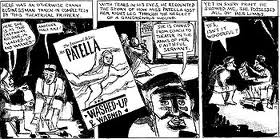
When I first read The Jew of New York – a graphic novel by Ben Katchor – I was astonished by how he represented the Jew who went off into the wilds of Upstate New York.   First of all, we must keep in mind that Ben Katchor was raised in New York and, in many of his comic strips, it is more than obvious that he sees the world through the complex lenses of a New York Jew.  In his graphic novel, he presents his readers/viewers with a narrative and a host of comic strip images of a Jew who went to Upstate New York in the 19th century.  In his narrative, the movement of the Jew – who is named Moishe Ketzelbourd – from New York City to Upstate New York is allegorical; it is the movement of assimilation and it, literally, is about a Jew gone wild.  In fact, in his comic strip, we see the Jew literally become-a-wild animal by virtue of his experiences in Upstate New York.  The main character, like my father, deals in animal skins and furs.  And this dealing brings him, so to speak, closer to the wild of America; so close that he eventually merges with the animal.  At the end of the story, he is brought back to New York City to be shown in a Yiddish theater as an American-Indian-Jew (one of the “lost tribes”); he is the the Jew who-went-Upstate-and-Became-an-Animal.  In the most intense scene in the book, he leaps off the stage and is killed.

Perhaps this allegorical comic strip alerts us to the dangers of capitalism and assimilation in America; but, ultimately, it is a representation of a specific place in New York State which has a mythological location in the urban-imagination.  And in this place the Jew is transformed into something of an animal.

Another interesting story I recently came across – written by Saul Bellow – is entitled “The Old System.”  It tells the story of Dr. Braun, an old veterinarian.  In the beginning of the story we meet a Dr. Braun who is very cynical and broods over the possibility that he might be no different from an animal. However, to counter this frightening thought, he comes to the realization that he can say: “I am.”

The feeling of necessary existence might be the aggressive, instinctive vitality we share with a dog or an ape.  The difference being the power of the mind or spirit to declare I am.

But as he broods more on this, he realizes that he is not pleased with this Cartesian conclusion or even with its existential of Buddhist alternative: that “he is not.”  Something else needs to be addressed, something that can help him to address his fascination with the question of man’s animality.

Drawing the reader into this reality, the narrator shows Dr. Braun not so much as a thinker as a person who is fully immersed in his body.  Cleaning his body is no consolation for the character; the narrator tells us that cleaning his body does not bring “order” to the world or answer Dr. Braun’s questions. This suggests that his joy lies elsewhere; in a body that is not “clean.” What could this be?

As he makes his breakfast, Dr. Braun thinks more and more about the meaning of civility, progress, and science (as James Joyces’s “anti-hero” Leopold Bloom does when we first meet him in Ulysses).  He wonders: has science and progress – in making us more abstract – detached us from something more organic, something wild.

As he thinks about this, he stumbles across memories of youth that he had buried away.  As we learn, he had another life.  He grew up as a Jew in Upstate New York. Dr. Braun is raised in Albany New York by his Godmother – Aunt Rose.  She, like Upstate New York, is described as “hard.” Her hardness is the “hardness of reckoning, hardness of tactics, hardness of dealing and speech.”   The narrator relates this hardness to what he dubs the “comic ugliness” of Upstate New York which grows by the “will of a demon spirit.”

She was building the kingdom with the labor of Uncle Braun and the strength of her obedient songs.  They had their shop, their real estate. They had a hideous synagogue of such red brick as seemed to grow in upstate New York by the will of a demon spirit charged with the ugliness of America in that epoch, which saw to it that a particular comic ugliness should influence the soul of man.  In Schenectady, in Troy, in Gloversville, Mechanicville, as far west as Buffalo. There was a sour paper mustiness in this synagogue.  (305, Jewish Stories ed. Irving Howe)

As the story goes on, we see this ugliness show its darker (less comical) side.  But it doesn’t do so in Albany; rather, it is in the wilds of the Adirondacks that we bear witness to Braun’s primal scene (wherein he goes from being a Jew to an animal of sorts).   Dr. Braun’s first sexual experience (at the age of seven) happens in a cabin in the Adirondacks.   At the cabin, we meet his cousins from the Adirondacks.  His cousin “Mutt” is a Jew-gone-wild:

Braun slept in the attic with his Cousin Mutt.  Mutt danced in his undershirt in the mourning, naked beneath, and sang an obscene song:

‘I stuck my nose up a nanny goat’s ass and the smell was enough to blind me’

He was leaping on bare feet, and his thing bounded from thigh to thigh.  Going into saloons to collect empty bottles, he had learned this.

Mutt’s sister – and Braun’s other cousin – is “fat Tina.”  Braun is essentially drawn into a sexual encounter with her.  Like Mutt, Tina is a Jew who has been made wild by Upstate New York.  She has thrown all civility to the winds.  And the narrator describes all the details of their sexual encounter putting a large emphasis on a physical animality:

She lifted her dress and petticoat to cool him and with her body. The belly and thighs swelled before him.  Braun felt too small and frail for this ecstasy…she rested her legs upon him, spread them wider, wider.  He saw the barborous and coaly hear.  He saw the red within.  She parted the folds with her fingers..  Parting, her dark nostrils opened, the eyes looked white in her head. (306)

Following this, we see Braun become wild with “her sexual odor” and later, “when he was playing in the yard,” he sees his cousin Isaac with his fiancée in the trees “embracing sweetly.”  The narrator tells us that Braun “tried to go with them,” which may imply that he tried to join in the sexual gestures.  But he is “sent away.”   When, like an animal, Braun goes back toward Isaac, he is turned “roughly” away.  In response,

little Braun then tried to kill his cousin.  He wanted with all his heart to club Isaac with a piece of wood. He was still struck by the incomparable happiness, the luxury of pure murderousness.  Rushing toward Isaac, who took him by the back of the neck, twisted his head, held him under the pump. (307)

What I find most startling about this and Katchor’s descriptions about what happens to Jews in Upstate New York is the fact that this area is associated with the end of Jewishness and the beginning of an American-life which is outlined by wildness, hardness, and barbarism.  These visions of Upstate New York both include a character who becomes murderous in his animality.  And as Bellow’s narrator tells us, he really enjoys his sexuality and violence.  To be sure, this is what troubles Dr. Braun most about his existence.  Deep down inside, he feels, as an American-Jew, that he feels closer to animality than to Jewishness.  And this feeling was fostered by his experiences in the Adirondacks.

I can’t say the same for myself, however.  To be sure, I’m astonished at how much the life of a Jew growing up in the Adirondacks has become such a charged figure (even a mythical figure) of Bellow and Katchor’s imaginations.  But, at the same time, I can understand what drives these representations as I did experience something of a wild, post-Jewish life growing up – a life in which I was surrounded by people who would take pride in being called a dog.    I was (almost) one of them…the meaning of this almost, however, has much more to do with the schlemiel…

….to be continued

The Schlemiel Who Tried to Get a Job – On Robert Walser’s “The Job Application”

DownloadedFile-2

While writing on Franz Kafka, the Jewish-German thinker Walter Benjamin was interested in finding common ground between Jewish and non-Jewish comic characters.  We see this project in his notes and in his essay on Kafka’s work.  To be sure, the essay starts with a reflection on a Russian fool named Shuvalkin; but it also includes reflection on Jewish fools vis-à-vis the messianic.  Kafka’s characters, as Benjamin understood them, may have some relation to the Messianic in the sense that, in their foolishness, they are the unredeemed figures of Exile.  They are incomplete and are waiting, so to speak, to be redeemed from their sad state.  What brings all of these characters together – in a state of exile – is not so much their pathetic character as a kind of innocence and blindness. This naïve state, for readers like Benjamin, gives us a sense of the best humanity has to offer in bad times.  (For Benjamin, such naïve foolishness, and not the powers of reason, idealism, progress, humanism, or heroism, is what is best in man.  After all, as Benjamin said to his friend and scholar Gershom Scholem, regarding Kafka, “only a fool can help.”)  It is the small things – things that we often miss – which, for Benjamin, hold the most meaning and hope.  And, in a world dominated by reason, humanism, and progress, it is the innocent loser who lives closest to the smallest things.  It is this character who, strangely enough, is closest to redemption.

One would think that Robert Walser, a writer Kafka and Benjamin read lovingly, would appear in Walter Benjamin’s notes or on his essay on Kafka.  But he doesn’t.  I find this omission to be very odd.   Reading Walser, I find all of the qualities that Benjamin found of interest in his essay on Kafka; namely, as I mentioned above, innocence, blindness, and the importance of small things.  To be sure, Walser is the master of these elements.

Susan Sontag, in an essay and introduction to Walser, notes that Walser is “one of the most important writers of this century” and, referencing the often melancholic writer and playwright Samuel Beckett, calls him “a good humored sweet Beckett.”   But the most important aspect of his writing, for Sontag, is found in the little things:

Walser is a miniaturist, promulgating the claims of the anti-heroic, the limited, the humble, the small – as if in response to his acute feeling for the interminable.

He was, like Melville’s Bartelby, a “non-doer.”  But, as Sontag notes, for such a non-doer we wrote a lot.  But what does an “acute feeling for the interminable” and being a “non-doer” amount to?  For Sontag, it amounts to an “awareness of the creatureliness of life, of the fellowship of sadness.”

Reading this, and contrasting it to what Benjamin thought about Kafka and the messianic, I would suggest that we read what Sontag calls “an awareness of the creatureliness of life” and the “fellowship of the sadness” against the comic.  To be sure, as I mentioned above, Sontag called Walser a “good humored Beckett” and suggests such a balance of the comic and the melancholic. But she drops in the end for melancholy.  What I’d like to suggest is that Walser – from time to time – puts out characters that resonate with the Eastern European tradition of the schlemiel: they simpletons who pronounce the tension between hope and skepticism.  And by doing so, they put the possibility of the messianic into quotation marks yet without extinguishing it.  This doesn’t bring about melancholy so much as a wounded kind of hope that is invested in the simpleton.  When reading Walser, I can’t help but hear these resonances.

The “Job Application,” a wonderful short piece by Walser, gives a good sense of what I mean by my current presumption.  Walser’s story is about a young man who wants a job.  But there is a problem.  He doesn’t understand how one should “properly” write a job application. And this has much to do with his character which is humble and innocent.

In other words, he is unable to see and understand what sacrifices one must make when applying for and working in a 9 to 5 job.  We see this in the first lines:

I am a poor, young, unemployed person in the business field, my name is Wenzel, I am seeking a suitable position, and I take the liberty of asking you, nicely and politely, if perhaps in your airy, bright, amiable rooms such a position might be free.

The schlemiel has been dubbed by Hannah Arendt – vis-à-vis Heinrich Heine – as a “lord of dreams.”  With this in mind, I can’t help but think of the schlemiel when I read Wenzel’s characterization of himself as “dreamy child” who wants a “small place in the shade.”  Wenzel repeats the fact that he is a simpleton – much like the schlemiel – when he states how:

Large and difficult task I cannot perform, and obligations of a far-ranging sort are too strenuous for my mind. I am not particularly clever, and first and foremost I don’t like to strain my intelligence overmuch.  I am a dreamer rather than a thinker, a zero rather than a force, dim rather than sharp.

His simplicity is the last quality (the most meaningful one) he wants to outline in his “job application.”  And what makes this feature most interesting is the fact that after stating it he believes that the business to which he is applying will, unlike the “world in which we live,” accept him:

My mind clear but refuses to grasp things that are many, or too many by far, shunning them.  I am sincere and honest, and I am aware this signifies little in the world in which we live, so I shall be waiting…

He naively waits for them to accept him and it seems Wenzl believes that his honesty will win them over.  But as in many a schlemiel story (such as I.B. Singer’s Gimpel the Fool or Sholem Aleichem’s Motl, the Cantor’s Son), honesty and trust do not win out although the characters, to the very end, believe they will.

Here we have a clear tension between hope and skepticism, which characterizes so many schlemiel stories; and, like them, it is the simpleton who pronounces this tension.  His interest in the little things such as trust and humility are naïve, but they are, as Walter Benjamin would say, the only things that help.  Ultimately, Benjamin clung to these simple things more than he clung to Marxism or the hope for a youth revolution (which, as I pointed out before in this blog, he wrote of in his review of Dostoevsky’s The Idiot).

In the end of the day, the schlemiel tries to get a job.  But he does so for one simple reason: to show that what is at stake with the schlemiel is something the messianic.  But instead of clinging to Marxist hope, the author – like Walter Benjamin – clings to the man-child, the schlemiel.  Somehow, he believes that simplicity, honesty, and the lord of dreams – here, Wenzel – will win out in the end.   Like Wenzel, he hopes that one day the employer will “hire” the “lord of dreams” as an employee.

This is obviously a foolish (and impossible) hope.  But, finishing the line I mentioned above in reference to Walter Benjamin’s letter to Gershom Scholem, perhaps we can say that the fool may be the only one who can help; but the question is whether or not he can do humanity any good.   This kind of question is the one that would be asked by Sancho Panza of Don Quixote.  Benjamin’s letter teaches us that the same question could be asked on the eve of the Holocaust, but can we still ask it, today, after the Holocaust and countless horrors of the 20th century?  Does it still ring true?  Or are today’s readers of Walser devoid of any hope and united in what Sontag calls a “fellowship of sadness?”

Dogs, Cats, and Schlemiels: A Brief Note on James Joyce’s Leopold Bloom

DownloadedFile-1

Although I am in the midst of a few different reading projects, I recently decided to take a look at James Joyces’ Ulysses.   I haven’t read the book for a while and it’s been on my mind.  To be sure, his representation of Leopold Bloom is of great interest to me as it is the representation of a Jew by one of the best writers of the 20th century and because Bloom may very well be a schlemiel.

What interests me most about Joyce’s representation of Bloom is the contrast between two styles of writing that Joyce uses when writing about Stephen Dedalus and Bloom.  The contrast tells us a lot about how Joyce approached Jerusalem and Ithaca/Athens.   Joyce is at home and more familiar in the language and culture of Athens and Ithaca than he is in the language and culture of the Jew.

To bring this contrast out, I selected two animals that correspond to these characters.  In relation to Daedeulus, Joyce writes of a dog and in relation to Bloom he writes of a cat.  The Jew is close to the cat and the feminine while the gentile is close to the dog and the masculine. This contrast was certainly on Joyce’s mind.  And it comes out in his prose style.  When he writes about dogs these are the dogs of war and masculinity.  History, heroism, and war can be heard echoing in these lines;

Then from the starving cagework city a horde of jerkined dwarfs, my people, with flayers’ knives, running, scaling, hacking in green blubbery whalemeat. Famine, plague, and slaughters. Their blood is in me, thei lusts my waves….The dog’s bark ran towards him, stopped, ran back.  Dog of my enemy.  I just simply stood pale, silent, bayed about. (56)

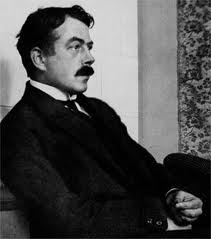
In contrast, when Joyce introduces Bloom to his readers, Bloom is attending cats and a woman.  He attends to the feminine.  It has been noted by a few Joyce scholars that he – like many writers in Europe – read the book Sex and Character by the “self-hating” German-Jewish thinker Otto Weininger.  He depicted the thoughts of Jews as “woman-like,” distracted, and hetoronomous (totally anti-Kantian and unable to be self-reliant).   Like Weininger, Joyce describes the thoughts of Bloom as feminine, wandering, and fragmented.  Bloom has no historical or intellectual basis for his reflections.  As Weininger would say, Bloom, like many Jews and women has “no essence” or foundation for his thoughts and actions.

Notice how much more the prose flows and fragments in Joyce’s representation of Bloom as he caters to his cat and his female acquaintance.  His mind isn’t on war, history, or honor.  His mind is on the movements of the cat and it moves from detail to detail:

Another slice of bread and butter: three, four: right.  She didn’t like her plate full.  Right.  He turned from the tray, lifted the kettle off the hob and set it sideways on the fire….The cat walked stiffly round a leg of the table with tail on high. 

-Mkgnao!

-O, there you are, Mr Bloom said, turning from the fire.

The cat mewed in answer and stalked again ….Prr. Scratch my head. Prr. (65)

Mr. Bloom watched curiously, kindly, the lithe black form. Clean to see: the gloss on her sleek hide, the white button under the butt of her tail, the green flashing eyes.

As he prepares breakfast, his mind wanders more and more and becomes more fragmented.  This contrasts greatly from the prose and style of the above-mentioned section of Ulysses.  It moves more like a cat than a dog, so to speak.  His focus on detail is based on his immersion in experience – on things he has around him, be careful not to disturb anyone, and things he has to get – rather than on thought and history:

Stamps: stickyback pictures.  Daresay lots of officers are in the swim too.  Course they do.  The seated legend in the crown of his hat told him mutely: Plasto’s high grade ha.  He peedped quicly inside the leather headband. White slip of paper.  Quite safe. On the doorstep he felt in his hip pocket for the latchkey. Not there.  In the trousers I left off. Must get it. Potato I have.  Creaky wardrobe.  No use disturbing her.  She turned over sleepily that time.  He pulled the halldoor to after him very quietly, more…looked shut.  All right till I come back anyhow. (67)

Perhaps, for Joyce, what makes Bloom a schlemiel (a man-child) is the fact that, unlike his gentile friends, Bloom is a caring person who, in his attention to detail and getting everything right, is constantly distracted.  The question on my mind, upon rereading these passages, is how Joyce relates Bloom’s distraction to the historical awareness of Daedelus.  He famously says, in this novel, that “history is a nightmare from which we must awaken.”  And, in addition, Joyce puts an accent on the awareness of death which may be on the mind of the gentiles but is not the mind of a Jew like Bloom.

Bloom is caught up in life and Joyce suggests that Bloom lacks an awareness of death, evil, history, and heroism.  He is too distracted.  Nonetheless, as we can see from the above passage, this is not because he is cruel but because he is loving and caring for his cat and his lady-friend.  After all, he wants to make a good breakfast and doesn’t want to wake her.

But he doesn’t understand the “bigger things” like history, death, heroism, etc.  Joyce was astounded by the fact that Jews didn’t know how to live in the world.  And this astonishment comes out in the contrast between those who follow cats and those who are in the midst of barking dogs.  This simple distinction – which is based on the distinction between masculine and feminine – makes Bloom into a cat-man of sorts.  A man who leans toward experience and the effeminate.

I saw this motif recur in Gary Shteyngart’s novel, too. As I pointed out in yesterday’s blog entry, it was Vladmir’s Jewish mother who pointed out that his Jewish feet and “homosexual” hips may be the reason why he can’t be a success in society.  The irony of course is that Vladmir’s job is to help immigrants assimilate when he himself can’t.

But Shteyngart sees this inability of this “unlikely hero” as endearing.  We may feel the same with Bloom, but the contrast in Joyce is based more on figures who are not, by any means, comic like the figure of Vladmir’s mother (who is laughable).

And perhaps that difference makes all the difference.   For Joyce this may be a difference between dogs and cats, the masculine and the feminine, Jew and non-Jew.  Perhaps it’s the “schlemiel difference”… The question, however, is how we understand it.  Shteyngart, it seems, understands it differently from Joyce.  But, regardless of these differences, they both would agree on one thing about the schlemiel and that one thing is distraction.

(To be continued….)

Jewish Mothers – Schlemiel Children

images-1

Growing up, I was always surprised by the representations of Jewish mothers I would see in films, TV shows, and books.  I was, in particular, floored when I first read Philip Roth’s Portnoy’s Complaint when I was an undergrad.  I read my father’s autographed copy of the novel and knew, well before reading it, that it was an important book for another generation (the baby boomers); and I wondered if it would speak to me.  But something about the representation of Portnoy’s mother didn’t resonate.

Perhaps I was surprised by the representation of Portnoy’s mother because I was raised in upstate New York by a mother whose Long Island upbringing didn’t include all of the urban, immigrant, or post-immigrant fears that many Jewish mothers are “supposed” to have.  I did in fact have some very aggressive New Yorkers in my family, but they seemed tame in comparison to Philip Roth’s fictional mother.  Portnoy’s animosity toward his mother and her “guilt trips” is extreme, to say the least.  In this moment, when Portnoy is speaking with his therapist, he let’s loose his animosity:

BECAUSE WE CAN’T TAKE ANY MORE! BECAUSE YOU FUCKING JEWISH MOTHERS ARE TOO MUCH TO BEAR! I have read Freud of Leonardo, Doctor, and pardon the hubris, but my fantasies exactly: this big smothering bird beating frantic wings about my face and mouth so that I cannot even get my breath. What do we want, me and Ronald and Leonardo? To be left alone! If only for half an hour at a time! Stop already hocking us to be good! (121)

Portnoy’s mother is a nag and, for Roth, Portnoy becomes a schlemiel by virtue of his mother’s over-weaning.  As Donald Weber says of the Borsht Belt Comedians, this generation’s comedy did much to blame mother’s for the inability to “fit in.”  For Roth, this was a sexual issue and a social issue that he, in his later novels, looks to overcome.

To be sure, Roth’s later work wants to leave the schlemiel and the nagging mother behind.  But, to my surprise, the nagging Jewish mother stereotype doesn’t die away.  In fact, I noticed that it resurfaced in recent film Guilt Trip (2012) and in Gary Shteyngart’s novel The Russian Debutante’s Handbook.

But in both works, the Jewish mother re-emerges in an odd way.  In Guilt Trip, the mother (played by Barbara Streisand) comes across as the schlemiel.   Her son, played by Seth Rogen, is also a bit aggravated at his mother’s nagging, but he is not by any means a Portnoy.  And while we may be turned off by Portnoy’s nagging mother, we are endeared by the absent-mindedness of Streisand, the schlemiel-mother.

The mother in Shteyngart’s novel is different and, in contrast to Rogen’s character, Vladmir, is without a doubt dwarfed by his mother.  But the difference between them is based on an entirely different premise than in Roth’s novel.  It doesn’t lead Vladmir to become a “sexual schlemiel” like Portnoy; on the contrary, his sexuality is not the issue.  Rather, his economic and social status is the issue.  Vladmir’s mother is an immigrant who has become a raging financial success and she hounds him to climb the socio-economic ladder.

His mother is loud and aggressive, while he is sensitive, weak, and introspective. And the day we first meet her is on Vladmir’s birthday:

“DEAREST VOLODECHKA!” Mother shouted.  “Happy birthday…! Happy new beginning…! Your father and I wish you a brilliant future….! Much success…!  You’re a talented young man…! Economy’s improving….!  We gave you all our love as a child…! Everything you had, to the very last….! (12)

Like Portnoy, Vladmir is frustrated, but I wouldn’t say he is angry: “Vladmir turned down the volume on the headset.  He knew what was coming, and, indeed, seven exclamation marks down the road, Mother broke down and stated wailing God’s name in the possessive”(13).    He listens as his mother goes off on him and actually admires her for her theatrical performance.

However, the narrator notes that this admiration is bitter-sweet; as we learn, Vladmir suffered as a child under his mother’s admonitions to be the best:

Vladmir…suffered under his mother’s accusative wails as B-plus report cards were ceremonially burned in the fireplace; as china was sent flying for chess-club prizes not won; as he once caught her in her study sobbing at three in the morning, cradling a photo of the three-year-old Vladmir playing with a toy abacus, so bright-eyed, so enterprising, so full of hope. (14)

We also learn that she laments that he has “hips of a homosexual” and, later in the novel, we also learn that she finds his walk to be “too Jewish”(45).  In other words, his body (and not just his economic and academic failures) also bears the mark of his failure to integrate.

The phone conversation that ensues against this background outlines the anger that his mother feels because he is not a success.  But, in the end, she notes that he is not a “complete loss”:

His mother made an effort to laugh and told him how insane it would be not to have a birthday barbeque.  “You’re only twenty-fine once,” she said. “And you are not a – How you say? A complete loss”(15). Since he’s not a “homo” and he has a “Jewish girl. Little Challah-Bread” he’s not a complete loss.

Here, the important thing for his mother is that he, at the very least, stay with a Jewish woman.   But he cannot look “too Jewish” or like a homosexual as that would keep him from being accepted and rewarded by society.

These sketches of Vladmir’s Jewish mother show her to be laughable but not to be a person worthy of anger and ridicule.  As I pointed out in yesterday’s blog, Vladmir is treated like a child by Rybokov and here, too, he seems to be in the position of a child. But this childishness is not something today’s readers will find reprehensible; in fact, many may in fact identify with Vladmir’s childishness and his plight.  Unlike his mother who resents it, readers will most likely identify with his innocence.  And, in our bad economy, we can understand his economic failure and his lack of ambition.

Portnoy’s mother “smothers” him and won’t let him be, and as we can see Vladmir’s mother is also overbearing.  However, Vladmir doesn’t resent her, he humors her and loves her.  Both Portnoy and Vladmir are schlemiels, but Portnoy takes his aggression out on his mother (who he blames for his becoming a sexual schlemiel) while Vladmir takes no aggression out on his mother and blames her for nothing.  He is, more or less, a passive schlemiel.  And the innocence of the latter is more endearing of interest to us that the aggression and anger of Portnoy.  Their failures are read differently by both authors.

In many ways, although I never had a mother like Portnoy’s or Vladmir, I can understand how their exaggerations may have some truth.  But of the two, I find that Shteyngart’s approach to Vladmir’s mother is much more to my liking that Roth’s approach to Portnoy’s mother.  Perhaps this has much to do with the fact that I find something admirable in the way the narrator and Vladmir relate to the mother.  They humor her.  This, to my mind, is the best approach.  And, besides, who, after all, should be to blame for being a schlemiel.  While it was a stigma for Roth, for Shteygart being a schlemiel has its advantages.   Being a failure, in other words, has its fringe benefits.

But, for Shteyngart, being a schlemiel, it seems, is more than simply being a failure. For this author, the best traits of the schlemiel can be found in his loving, reflective, and innocent nature.  Much of this difference in attitude has to do, I think, with our differing attitude on what it means to be a man and a success.  Although many people in Shteyngart’s novel want Vladmir to be a man and a success, we don’t.  What matters most to us isn’t his success or his manhood; rather, what matters is the fact that he loves his mother and all those around him no matter how much they may be disappointed with him.

And on this note, I guess I’m lucky.  My Jewish mother, unlike the mother of these fictional Jewish mothers, never gave me any guilt trips.  And even if she did, I think I , like Vladmir, would still love her.

Girshkin and Rybakov: Gary Shteyngart’s Comic Duo

images

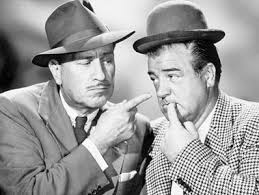
There’s nothing quite like a comic duo or what Neil Simon, at one time, called an “odd couple.”  To be sure, it always helps a comic routine when one comedian plays off another.  By witnessing one comedian play off another, the audience gets some kind of “contact buzz.”  One need only think of Laurel and Hardy, Abbot and Costello, Laverne and Shirley, or Neil Simon’s odd couple – Felix Unger and Oscar Madison – to know what I’m talking about.  If you want a more contemporary example, think of the film Dumb and Dumber (1994) with Harry (Jeff Daniels) and Lloyd (Jim Carey) or the 2008  film Step Brothers  which starred Will Farrell (as Brennan Huff) and John C. Reilly (as Dale Doback).

And what would Seinfeld or Curb Your Enthusiasm be without their endless procession of different comic pairs in all sorts of interesting combinations and situations?

Literature also has its host of comic pairs. Don Quixote had Sancho Panza and Don Quixote and its Yiddish brother, Mendel Mocher Sforim’s, Benjamin the III, which also had a comic pair.  Even Samuel Beckett made sure to have a comic pair in his classic play Waiting for Godot.   In these comic pairs, there is often a schlemiel and a shlimzael or, otherwise, two schlemiels or fools.  And, although each pair may seem formulaic, there is something that we can learn from their comic pairings.  To be sure, we can, by way of comic amplification, be confronted with tensions that are existential, cultural, historical, or political.  Some tensions, however, are more urgent than others.  In Waiting for Godot, an existential tension is foregrounded while in Don Quixote or Benjamin the III a historical tension is.  Some of these tensions can arguably be called timeless while others are timely.

In Gary Shteyngart’s The Russian Debutante’s Handbook, which I blogged on for the first time yesterday, we have a comic pair which introduces a “timely” tension: this pair amplifies the tensions that may or may not exist between immigrants as they make their way in America.  And it does this by way of a subtle, comic relationship which is fraught with many gaps and blindspots. In their playful relationship, we are prompted to give the schlemiel and his comic foil our full attention.   From the outset, the comic tension in terms of a number of oppositions: old/young; citizen/non-citizen; man-child/man.

As I pointed out in yesterday’s blog entry, Vladmir is portrayed as a schlemiel. He is the “unlikely” schlemiel hero.  He is half P.T. Barnum, half Lenin.  The Barnum part is the most prominent.

The narrator tells us that on the day we meet him, Vladmir is 25.  And of these years, half of them were spent in Russia; the even half (12 years). The odd half (13 years) is spent in the USA.  This odd half makes the difference when we meet, for the first time, Vladmir’s comic companion: the “fan man,” a man named Rybakov.

We first meet Rybakov by way of an altercation in the Emma Lazarus Immigration Absorption Society’s Manhattan Office.  He screams out in Russian and calls out Vladmir’s last name. This totally takes Vladmir by surprise:

Suddenly, Vladmir heard the frenzied croaking of an elderly Russian out in the reception room: “Opa! Opa! Tovarisch Girshkin! Ai! Ai! Ai!” (5)

In response to this, Vladmir let’s his Lenin-part take over: “It was time to act. Vladmir braced himself against the desk and stood up.”  But this “act” is comically deflated by the narrator.  What we see in this deflation is a tension between a man and a man-child, between P.T. Barnum and Lenin. Vladmir looks big, but he’s really small:

All alone in the back office, with no point of reference other than the kindergarten-sized chairs and desks that comprised the furniture, he suddenly felt himself remarkably tall.   A twenty-five-year-old man in an oxford shirt gone yellow under the armpits, frayed slacks with the cuffs comically coming undone…he dwarfed his surroundings like the line skyscraper built in Queens…But it was true: Vladmir was short. (5)

This dialectical tension between being a man and a child is played out in his meeting with Rybakov.  When he sees Rybakov harassing the guard, he shouts in Russian and asserts a categorical rule that must be obeyed: “Nyet! Nyet! Nyet!…We never do that to the guard.”

After hearing this, Rybakov (“the madman”) turns to face Vladmir and shouts “Girshkin!…It’s you!”  Like Vladmir, Rybakov is a “man of small stature,” but he is more aggressive than Vladmir.  He wears a jacket bearing the weight of many “Soviet war medals.”  And, when he sees Vladmir, he tosses the guard to the side.

Vladmir, upon seeing this, says aggressively: “What do you want from me?” But, in response, Rybakov repeats this question in a quizzical manner and adds “My God, what haughtiness!” And with this gesture, he lifts his crutch and gives Vladmir a “practice jab: On guard!”

This leads to an exchange that shows how Vladmir can also be a “man.”  But this doesn’t last long since he is disarmed by Rybakov’s madness and humor.  This comes across when Rybakov talks about his “fans.”  He has “two.”  Humored by this, Vladmir jokingly (and endearingly) says, “The fan said come over.” And then he realizes that this man is not a threat to him: “Right then, on the spot, Vladmir recognized that this wasn’t a problem client. This was a fun client.  A loop-de-loop client.  The kind of client that turned on your morning switch and kept you brisk and agitated all day”(7).

This moment of realization is a, so to speak, “schlemiel moment”; it is a moment of innocence and trust which makes Vladmir into a man-child of sorts.  And this happens, quite simply, because Vladmir is entertained.  To add to all the entertainment, Rybakov tells Vladmir that he is “psychotic” and Rybakov’s gestures that accompany this declaration are, to be sure, endearing:

His enormous eyebrows twitched in confirmation, and he smiled with false modesty, like a kind who brings in his father the astronaut on career day. (7)

Rybakov then tells a charming story about how he wrote a letter to the President and sent it to the New York Times.  Rybakov produces the letter, reads it, and talks about it.  Hearing this, Vladmir can’t help but think of this man as the most innocent idiot he has ever met.  And then he makes the big mistake; he identifies with him. This prompts him to start feeling sorry for their poor condition.  They are all immigrant-losers.  The narrator amplifies this effect by comparing Vladmir’s world, inside the immigration office (the world of the “poor huddled masses”), to the world outside the office, in the financial district:

Outside the nonexistent windows of the back office, the canyons of the financial district were awash with rationalism and dull commercial hope: suburban secretaries explored bargains on cosmetics and hose; Ivy Leaguers swallowed entire pieces of yellow tail in one satisfied gulp.  But here it was just Vladmir the twenty-five-year old and the poor huddled masses yearning to breathe free. (9)

Coming out of this misty recollection, Vladmir, like a child watching a clown, hears Rybakov speaking about his fans that go “krik krak” and “trikka trikka.”  Noticing this, Rybakov starts treating him like a child and calls him a “little goose”: “Oh, I know who you are, little goose.”

Surprised by this comment, Vladmir is reminded of how, when he was a child (“a diminutive, unsteady creature”), he was called a “little goose.”  This puts Vladmir into a childish state of mind and he becomes childlike.  Rybakov runs with it:

“The Fan sang an epic song for me the other night, said Rybakov.  “It was called “The Tale of Vladmir Girshkin and Yelena Petrovna, His Mama.” “Mother,” Vladmir whispered.  He didn’t know what to say.  That word, when spoken in the company of Russian men, was sacred in itself. (9)

At this point, Rybakov discloses the fact that he knows something about Vladmir’s mother and this wakes him up a little.  But, in the end, “the fan man” has the last word and the last gesture which reduces Vladmir to the status of a man-child:

The Fan Man reached over and pinched Vladmir’s nose between thumb and forefinger, a familiar Russian gesture reserved for small children.   “I’m psychotic,” the Fan Man explained. “But I’m no idiot.” (11)

In this end, Vladmir, the “unlikely hero,” comes across as the “idiot” not Rybakov.  This gesture and these words convey to us a subtle tension between these two.  Vladmir is the younger and the more inexperienced one; Vladmir is a US citizen, but Rybakov is not.  Without Vladmir’s help, Rybakov cannot be a citizen.   And, as we learn later in the novel, Rybakov has something Vladmir doesn’t: money (and lots of it).

The comic relationship between them, with all of its tensions, is first given to readers by way of a subtle sense of how easily Vladmir, with his big heart, can become like a child in Rybakov’s (or anyone’s hands).  The fact that he can go from shouting to cooing in front of Rybakov is a central aspect of Shteygart’s schlemiel and of many schlemiels (such as Saul Bellow’s) whose hearts can lead them into trouble.  Rybakov, as I hope to show, is that trouble.  And what he has to offer Vladmir is easy money.  With that offer comes the American dream and, also, a lot of other things a schlemiel doesn’t know about since, of course, the schlemiel doesn’t understand the meaning of money or, for that matter, evil.

As in many schlemiel comedies, it takes a comic duo to bring out, on the one hand, the schlemiel’s innocence and, on the other, the fact that there are some things that a schlemiel simply cannot see in front of him with his own two eyes.

Instead of being a tall and powerful Vladmir, perhaps he’s really just an innocent little Girshkin.


Gary Shteyngart’s Immigrant-Becoming-American Schlemiel: The Unlikely Hero of our Times

images-8

Vladmir Girshkin is the main character of Gary Shteygart’s novel The Russian Debutante’s Handbook.   It is the story of a particular kind of Immigrant-Becoming-American-Schlemiel and his becoming-American world.  The “arc of his dreams,” as the schlemiel-like narrator of the novel shows us, begins in Russia and ends in America.  These dreams come from a character whose story (and whose persona) is characterized as “Part P.T. Barnum, part V.I. Lenin, the man who would conquer half of Europe.”

If we listen closely to this sentence, we will have to ask two simple questions:

1)    If Lenin was the man who would conquer half of Europe, was P.T. Barnum the man who conquered the other half?

2)    What does it imply that Vladmir’s story is one part Lenin’s power and the other part, so to speak, “American circus power”?

In response to this, I’d suggest we ask what P.T. Barnum’s power is and how that power relates to Vladmir, and what Lenin’s power is and how that relates to Vladmir.  On the one hand, the power over “the other part of Europe” is an American-carnivalesque-power.  And this, as we see in the novel, is part of Vladmir’s character and is part and parcel of the narration of Vladmir’s story.  This circus power is the power of the American-schlemiel-dreamer.  On the other hand, we have the power of Lenin which is political, intentional, and masculine.  I’d suggest that the latter is humored by the former and that the schlemiel is kept in check by the latter.

But the narrator shows us, right off, that America has the home team advantage, since the story doesn’t begin in Russia; it begins in a shabby immigration office in Manhattan.  And the story takes off in the most mundane way, which indicates that Vladmir may in fact dream of power since he has none.  But we see something other than power in his office. He is in the “middle of (immigrant) things.”  The story begins…

On a Monday morning. In an office. With the first cup of instant coffee gurgling to life in the common lounge.

But not so fast.   This scene of the immigration office is revised by the narrator. His revision gives you a sense of the narrator’s way of thinking and speaking.  He tells us of how Vladmir’s

…story begins in New York, on the corner of Broadway and Battery Place, the most disheveled, godforsaken, not-for-profit corner of New York’s financial district.  On the tenth floor, the Emma Lazarus Immigrant Absorption Society greeted its clients with the familiar yellow water-stained walls and drying hydrangeas of a sad Third World government office.

He is a schlemiel who works together with “Assimilation Facilitators” to process immigrants.  In this American scene, these Assimilation Facilitators forge truces between warring peoples of the world in order to make peace in the office (not the world): “in the reception room, under the gentle but insistent prodding of trained Assimilation Facilitators, Turks and Kurds called a truce, Tutsis queued patiently behind Hutus, Serbs chatted up Croats at the demilitarized water fountains.”

While this is all going on, Vladmir is in “the back office.”  He is the immigrant schlemiel: “the immigrant’s immigrant, the expatriate’s expatriate, enduring victim of every practical joke the late twentieth century had to offer and an unlikely hero of our times.

Reading these words about a fool who is the “unlikely hero of our times,” I am reminded of the title and main theme of Ruth Wisse’s schlemiel-theory opus: The Schlemiel as Modern Hero.   At the end of her book, it seems as if the schlemiel ‘was’ a modern hero but is no longer one since (in the early 1970s) Jewish American writers like Phillip Roth wanted to put an end to the schlemiel.

The schlemiel can only live in a world which is neither fully optimistic nor fully skeptical.  And the world of the 1970s wanted to create more “positive” images of the Jew in which Jews were shown as normal, strong, and American.  The schlemiel, interpreted by Roth (in Portnoy’s Complaint) and Bruce Jay Friedman (in Stein) as a half-man and a loser, seemed to have been something they had left behind after they wrote his obituary.

To add to this, Irving Howe thought Jewish literature would lose its Jewishness the farther it went away from its immigrant roots. But this opening of the novel challenges Howe, Roth, and Friedman.  And it puts forth the new “unlikely hero” who also happens to be an immigrant.

In one fell swoop, Shteyngart shows us how the schlemiel lives on but as a new kind of immigrant: Vladmir Girshkin.

His becoming-American is the story of a schlemiel – an “unlikely hero” whose story is part P.T. Barnum and part Lenin.

(I will be blogging more on this extraordinary novel over the next few weeks.  This will, of course, be interspersed with blog entries and guest blog entries about new and old work on, about, or related to the schlemiel.)

Jerry Lewis’s Animistic Comedy

images-7

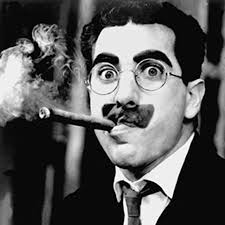
Many a schlemiel-comedian has made his or her livelihood by way of this or that physical gesture (or series of gestures).  Oftentimes, these gestures are animations of this or that physical feature.  One need only think of the assemblage (to use a word made popular by the philosophers Gilles Deleuze and Felix Guittari) of Groucho Marx which included raised painted eyebrows, mustache, a cigar, his odd frames, and his “Jewish” nose.  By simply raising his fake eyebrows, widening his eyes, or twitching his cigar, Marx had a punch line.

To be sure, this assemblage has been fetishized and marketed.  The animating gesture, so to speak, is missing.

DownloadedFile-1

In some cases, this assemblage has become a sign of comedy.  Here, in fact, is a book cover by MIT press. The book – The Odd One In – by Alenka Zupancic (the Slovenian philosopher Slajov Zizek’s teacher) espouses a philosophy of comedy.

DownloadedFile-2

The cover and the title make an allusion to the Groucho Marx joke about him not wanting to belong to a club that would have him as a member.  This classical schlemiel joke is also told by Woody Allen.  He, so to speak, also animates it at the beginning of his film Annie Hall (1976) by retelling it – albeit with his own physical mannerisms and gestures that play more on the charming “sexual schlemiel” stereotype.

Although we are clearly aware of how each of these comedians is comically animating their features by way of this or that gesture, what we might miss is the fact that they may also – at times – animating the spaces they are in and even time.  One comedian who animates not just himself but also the space and time he occupies is Jerry Lewis.

I was fortunate enough to have recently come across this brilliant insight into Lewis’s character when Steven Shaviro (whose work on film theory, literary criticism, social networking, and philosophy is exceptional – to say the least) apprised me of two recent essays he had written on Jerry Lewis.  The second of these two essays addresses Lewis’s relationship to space and time by way of a reading which takes the comedic theory of the Nobel Prize winning late 19th and early 20th century philosopher, Henri Bergson as a counterpoint.

I deeply appreciate Shaviro’s insights since I have also taken Bergson’s Essay on Laughter and his notion of “creative evolution” as a counterpoint to my reading of the schlemiel.  What I point out in my work is how, for Bergson (as for many members of the German-Jewish Enlightenment), comedy is purgatory.  The act of laughter is based on the act of targeting this or that comic behavior which is “mechanical.”  Laughter is a way of saying that such mechanical action must be excluded (purged) from a society which is based on “élan vital” and on a vitalism based on becoming and change.  Mechanical repetition evinces the opposite and that’s why, according to Bergson, we laugh at it.  We want to become; we don’t want to mechanically repeat.

But in my reading the schlemiel is not to be seen as a character whose behaviors must be excluded; rather, they should be emulated in the sense that they challenge society to change; not the other way around.  This is what we see in much Eastern European literature.  The “lord of dreams” that Hannah Arendt sees as an obstacle to normality is, in Eastern Europe, closer to truth that those who laugh at him.  Her repetitions, therefore, put us into question and this fundamentally challenges Bergson’s reading.

Shaviro’s reading of Jerry Lewis – by way of Henri Bergson – offers another challenge to Bergson while, at the same, opening up a new way of approaching comedy by way of paying more attention to the way a comedian’s gestures affect and animate the space and time around them.

Shaviro takes Jerry Lewis’s film The Patsy (1964) as his starting point.  He focuses mainly on the music lesson given to Jerry Lewis by Hans Conreid, the “stuffy, Germanic music teacher.”

In this clip, Lewis appeals to physical gesture by “contorting his body into various grotesque postures.”  But, more importantly for Shaviro’s thesis, his gestures affect the space around him since he “ends up either..wrecking the furniture” by touching it or “by sliding down off it and onto the floor.”  These caricatures go on and on and end up affecting time and space.

Regarding Bergson, Shaviro points out that Lewis’s gestures are “inelastic” to “an alarming degree.” Lewis is “open to any and every suggestion that reaches him.”  His body is like an “electronic transformer” which “amplifies gestures and expressions instead of electric currents.”  But, in contrast to Bergson, Shaviro says that these gestures enliven things around the comic and that instead of being outside of a life process – as Bergson suggests comic gestures are – they generate a process. This generation is “visible” and spatial.

Moreover, instead of separating objects in space, Lewis’s gestures of “reciprocal interference” bind things in the room together into a network of oscillating relations. This works, also in terms of time, since instead of crashing objects immediately, Lewis postpones the crash by holding this or that object up before it falls. This creates a “temporal delay” and an excoriating long wait for this or that explosion or crash.

The key, as Shaviro argues, has to do with reading Lewis in terms of “animism” as opposed to the “vitalism” that Bergson thinks about.  This animism gives life to dead objects by way of what Shaviro calls “contagion.”  But this kind of animism differs from that spoken of by Joseph Campbell and others since it does not “possess” the animator and efface his or her identity.  Rather, this animism works like an electric current.  And, even the delay of this energy is a part of it’s relay.  In fact, the delay of the crash in the above-mentioned scene, according to Shaviro, is an extraction from the horror genre since it works by animating dead bodies; here, objects in the room.

This kind of animation is connected to “cartooning and cinematic animation” which Lewis learned (“inherited”) from the animator Frank Tashlin.  As Shaviro notes:

Cartoon animation gives exaggerated life to imaginary and initially inanimate figures; Tashlin and Lewis apply such exaggeration to living bodies themselves, creating an “unnatural” more-than-liveness.

Here is one of Tashlin’s animations from the 1940s.  As you can see, inanimate objects like a cage and signs are given life by way of exaggeration.  And this, as Shaviro argues, brings together a kind of animism that is opposed to a Bergsonian vitalism (élan vital).

Shaviro ends his essay on Lewis by suggesting that we also look at Karl Marx’s descripion of  a table which illustrates “commodity fetishism.”  In the example brought by Marx, the product – here a table – comes to life.  Marx finds this illustration of the “magical character of commodities” to be grotesque.  Playing on Bergson and Marx’s readings, Shaviro makes up a word to illustrate the ideas he is working with; namely a “Marxist-Bergsonian” phenomena which involves the animation of dead objects in space and time by way of comedy.

This thesis is fascinating and it makes the claim that the animism we see in Lewis’s comedy articulates a historical-economic backdrop for his comic-animism.  This theory puts an interesting spin on the comedy of Groucho Marx as well since the fetishized glasses, nose, and mustache that are a sign of comedy and of being the “odd one out” have the most power not when they are on this or that person’s face but when they appear in Marx’s films.

Here, for instance, is a great scene that demonstrates how he animates time and space.

I’ll end with a clip from Woody Allen’s Zelig (1983) since it illustrates how Zelig – the human animation – changes vis-à-vis whatever space he is in.  And these changes give vitality to everyone around him and create an electric circuit of sorts (much like the spinning of a record).  Perhaps this is a product of capitalism, but, as Irving Howe argues (in this very film), it can also be read as a product of assimilation. Regardless, Shaviro’s suggestion about Lewis could also be applied to Allen.   Ultimately, these animated comic gestures would be nothing without animation but, as a part of the package, Jewish identity is (as Jacques Derrida would say vis-à-vis the text and deconstruction) supplemented by animation:


The Transformation of Seth Rogen: From a Schlemiel into a Green Hornet

images-4

Seth Rogen is often cast as a schlemiel in many Hollywood films.  We can see this in films like Knocked Up (2007), Superbad (2007), and Pineapple Express (2008).

But in films like Knocked Up we start seeing the transformation of Rogen’s character.  In that film, Rogen goes from a pot-smoking “lord of dreams” to a responsible father and “partner.”  By the end of the film, we can see a distinct difference between him and his schlemiel friends.  To be sure, Apatow, in this film (and in many others), defines the schlemiel in terms of someone who can’t be a “man” and as a “slacker” or “geek.”  This, unfortunately, reduces the radical potential of this character and makes him into the American “everyman.”

Moreover, it effaces any Jewishness this character may have had for nearly a century.   This act of effacement, according to Daniel Itzkovitz in an essay entitled “They are All Jews,” has been going on for a while.  It evinces a “not-so-subtle shift in U.S. popular culture regarding Jewishness.”  Itzkovtiz takes note of a few films that illustrate this “not-so-subtle shift”:

Independence Day with all the expectations it places on Jewish shoulders is just one example…The Billy Crystal vehicle City Slickers (1991) – a banal formula comedy that re-imagines Mel Brook’s Blazing Saddles (1974) with yuppie angst replacing giddy anarchy – was an early touchstone in this process.  Such films’ aggrandizing but flattening out of Jewishness also helps explain why critics seem to read American mass culture’s relationship to Jews in such disparate ways.  (235)

The casting of Seth Rogen gives us an excellent example of this “flattening out of Jewishness.”   As a part of this process, Rogen goes from a character who transforms from a schlemiel into a responsible adult – as in Knocked Up – or from an outright schlemiel – in films such as Pineapple Express or Superbad – to the son of a WASP whose dreams become realities by way of inherited wealth in a film like The Green Hornet (2011).

I was astonished by what I saw in this film because it took Rogen’s already post-schlemiel character of Zack and Miri Make a Porno (2008) and brought it to an entirely different level.  In Zack and Miri Make a Porno, Rogen plays a character who has a business idea and works it with other odd-balls; but, in comparison to what is shown in Knocked Up (regarding a porn-on-the internet business), this business is actually more solid and tangible than the foolish plan sketched out in Knocked Up.  It is laughable but, ultimately, it is less laughable (as is Rogen).  The greater laugh can be found in the characters Zack and Miri find.   Moreover, in this film, Zack (Rogen) is in a start up kind of business.  He is not wealthy; he is borne out of a slacker ethos.

But in The Green Hornet, we are first introduced to Rogen by way of his character Britt Reid – a playboy; the son of a wealthy newspaper mogul.  We see him at parties with many women fooling around here and there – something we don’t see in his earlier schlemiel films.  And, upon waking with a woman he had ended up with in a party (in his mansion), we learn that he doesn’t own the mansion; he only lives in it.  Nonetheless, he is still a playboy.  And his father is a consummate WASP by the name of James Reid.

In this film, not only is the schlemiel effaced but any sign of Jewishness is as well.  (To be sure, Rogen’s characters always had some small hint of Jewishness, but this film leaves no doubt in our minds that this is no longer even on the table.)  And instead of the Jew being the genius-geek-schlemiel who works together with another minority (as we see in Independence Day by way of Jeffrey Goldblum and Will Smith), we see an inversion of the geek, genius position.

Now, an Asian and not a Jewish character plays the “geek.”  But Kato (Jay Chou) isn’t exactly a geek in the sense Goldblum was; in fact, he’s really cool.  He rides a cool motorcycle, invents things like a special espresso machine (that fires up like a jet engine),  bulletproof glass, a hidden liquer cabinet, etc.  He’s a “genius” who Britt Reid (Rogen) takes as his guide.

Now the dreams we bear witness to are not the dreams of a schlemiel and they are not the dreams of a Jeff Goldblum who, in the process of fighting with Will Smith, becomes a man.  Rather, Kato is already a man.  And Rogen, who is already a WASP yet not fully integrated into the task of making wealth (as was his father), takes on Kato as a cool kind of partner (who, in reality, takes the role of a kind of father figure or midwife for Rogen).  Through Kato, Britt becomes a superhero.

And even though we see comic blunder on and off the film, such as in his encounter with Cameron Diaz (Lenore Case) or with many others, this is overshadowed by his comicbook heroism.  And that’s the point.  In the end, he’s no schlemiel or fool; he’s a responsible hero who can fight crime.  He’s not Clark Kent; he’s the Green Hornet.  Nonetheless, the end of the film includes a few comic moments.  But, as I noted, this doesn’t overshoadow or contaminate the heroism so much as make it a little more human and mundane.

This gesture away from the schlemiel toward the hero speaks to what Hannah Arendt said in the “Jew as Pariah” regarding the “failure” of Charlie Chaplin’s Hitlerian schlemiel in his film The Great Dictator (1940).  For Arendt, it failed because people wanted Superman and not Chaplin’s schlemiel.   And, I would add, they wanted the everyday hero.  Here, Rogen isn’t simply a working class hero or a slacker hero.  He’s a hero who comes from wealth.  And what we get is a spotted hero who is a little silly and a lot like us.  The potential of the schlemiel that we see in Yiddish literature or even in I.B. Singer or Saul Bellow is left behind for a character devoid of anything Jewish or anything that challenges what Ruth Wisse – in the first pages of The Schlemiel as Modern Hero – would call the “political and philosophical status quo.”

As a final note to this blog entry, I just want to point that one of Rogen’s most recent films, Guilt Trip (2012) casts him with a very Jewish mother (Barbara Streisand).  But in this film she plays the schlemiel, not he.  In fact, he’s the responsible one.  Regardless, the schlemiel that we see, with all of its little Jewish mannerisms, shows us something flat and ineffectual.  The schlemiel we see is cast as an “older mother” who is full of life but unable to fully navigate herself through modern life.  We – as audience members – are supposed to laugh at her lack of technical expertise and her lack of decorum.

But I find nothing funny here.  In fact, I find it quite sad that, as a Jew, I have to see this kind of representation.  The schlemiel is done a disservice in such silliness and such a condescending reading (although Streisand does her utmost to play the absent-minded one, I found it to be too schmaltzy and even insulting).

That said, I hope to return to this film and others of Rogen.  This blog entry is more or less a sketch of how Rogen has been casted.  And, in many cases, since he writes many of the films he stars in, he casts himself in this way.  Perhaps a more nuanced understanding of the schlemiel would be of great use to him; but, then again, that’s not what sells these days in Hollywood.

Jerry Lewis, Comedy, and Psychoanalysis (Terminable/Interminable)

images-3

What has always intrigued me about the schlemiel is the fact that he constantly fails and that nothing, it seems, can help him.  And one of the things that pops up in modern Jewish-American literature and film to help the schlemiel out of his embarrassing condition is psychoanalysis.  The psychoanalytic cure (aka “the talking cure”) presupposes that there is an “end” to analysis.  As I have pointed out in my readings of the schlemiel, the psychoanalyst appears from time to time in the films of Woody Allen or in Phillip Roth’s notorious schlemiel classic – Portnoy’s Complaint – to offer a cure.  In Allen’s earlier films, the cure often falls short.  But in his later films, like Hollywood Ending, we see the opposite.  In that film, a psychoanalyst holds the key which, at some point, Allen’s main character embraces.  And doing so changes his life and makes him “normal.”  His analysis is, at some point, terminated.  In truth, Allen embraced the cure and has left the schlemiel behind.  (I have written and published two essays on this topic in different Woody Allen anthologies.)

Writing on the schlemiel in Phillip Roth, Sanford Pinsker points out that Roth was very uncomfortable with the schlemiel and the effect Portnoy’s Complaint had on his career and image.   That novel, in fact, is structured on a discussion between a psychanalyst and Portnoy.  With this in mind, Pinsker argues that all of Roth’s novels following Portnoy’s Complaint are aimed at psychologically working through the schlemiel and leaving him behind (for Roth, therefore, literature offered some kind of analysis which had a clear goal in mind: becoming normal).  Although she doesn’t appeal to psychoanalysis, Hannah Arendt, in her essay “The Jew as Pariah,” also sees the schlemiel as a malady of sorts which can and should be cured.  For her, the cure is social, historical, and political normalization.  Writing during World War II, Arendt envisioned a time when the Jew would be accepted as an equal and will no longer be forced to find shelter in being “exceptional” schlemiels/pariahs.

In all of the above-mentioned cases, we see the same logic which, I would argue, has its basis in Germany and central Europe and not Eastern Europe.  In all of these cases, the schlemiel is equated with some kind of abnormality (psychic or political) which can be cured.

In my last few blog entries, I have been pointing out how, for both Ruth Wisse and Steven Shaviro, psychology, though useful, may be too reductive when dealing with either the schlemiel (Wisse) or with Jerry Lewis’s brand of masochism (Shaviro).  Nonetheless, I was very pleased to see, after I posted my blog entry on facebook, that Steven Shaviro read my piece and pointed out how he had recently written yet another two essays on Jerry Lewis.  In the first of the two essays, which are both e-published, Shaviro speaks to the issue of the psychoanalytic cure and its relation to Jerry Lewis’s comedy.  I was very pleased to see this because I have been pondering the tension between affirming the schlemiel (the Eastern European model) and rejecting him (the German model).   As I have noted above, this model has been appealed to by way of this or that use of psychoanalysis in the films and novels of many a Jewish-American writer and filmmaker.

That said, I’d like to go through a few of Shaviro’s points; since his argument, regarding Jerry Lewis’s comedy, resonated well with my own claims for the schlemiel.  He argues, in short, that Jerry Lewis’s comedy is not about affirming a cure so much as challenging the talking cure.  And instead of terminating analysis, Lewis’s comedy leads to what Freud, in one account, would call “interminable analysis.”

The first of the two essays on Lewis is entitled “Smorgasbord.”  The title of the essay is based on Lewis’s original title for his 1983 film whose final title was Cracking Up.  Shaviro starts off his reading by noting the Jewishness of this film which one can find in the emotionally riveting case of the “self-deprecating” comedian.  This act of self-deprecation is a way or strategy for warding off “humiliations imposed upon” the Jew by “others.”  And this is:

A quintessential strategy that has historically been adopted by Jews, by women, and by members of oppressed groups. (7)

Shaviro brilliantly frames this strategy in terms of another “great Jewish invention” – psychoanalysis:

We might well compare Jewish humor to another great Jewish invention that endeavors to deal with unavoidable, internalized suffering: psychoanalysis.  Like humor psychoanalysis gives relief by providing a “safety valve” through which one may give vent to otherwise unmentionable miseries.  (8)

Shaviro notes that psychoanalysis and comedy offer “insights” that are often self-deprecating.  And the “cure” (which Shaviro puts in scare quotes) “consists in recognizing and giving voice to, the most unpleasant things that one can find out about oneself”(9).  However, Shaviro notes (against popular wisdom) that both comedy and psychoanalysis do not “really provide a permanent solution.”  Rather, both are a part of an “interminable process.”  And this is what we see in Lewis’s comedy:

He struggles interminably to come to some conclusion, his well-meaning efforts instead spread chaos far and wide.  Every one of Lewis’s character’s actions seems to have limitless reverberations…Waves of destruction spread outwards, to infect or contaminate other people, and to overwhelm Lewis’s physical surroundings.  (11)

Shaviro points out, in this regard, Lewis’s failed attempts to kill himself in the movie.

Regarding this interminable failure, Shaviro points out who instead of transforming himself (as we see in Woody Allen’s Midnight in Paris or in Judd Apatow’s Knocked Up), Jerry Lewis’s character in this film “reiterates” and repeats things.  In this film, for instance, Lewis tries to give up smoking but keeps on going over and over again through the procedure of stopping – but to no avail.  He can’t quit and is, so to speak, “confined.”

Once again, Lewis’s persona is unable to achieve freedom, even at his machinations have cascading effects beyond the limits of his confinement.  (27)

Shaviro ends his essay with a detailed description of Lewis’s encounter with a psychoanalyst.  The twist is that he is not cured so much as free from the symptoms of neurosis that he transfers to his psychoanalyst:

All of the symptoms that have been excised from Warren’s (Lewis’s) body and mind reappear insteaed in Dr. Petchick.  All of a sudden the psychiatrist has adopted all of Warren’s mannerisms and incompetentcies. He lights a cigarette and gets punched out by Dick Butkis; he flails about, running this way and that, causing cars to crash and structures to topple, spreading chaos around him. (32)

And this, for Shaviro, is the main point.  Lewis’s comedy works by way of transferring his stammerings to others.  Instead of getting rid of his malady, he gives it to others.  The great irony of this, according to Shaviro, is that Lewis, in real life, is an advocate of the laughing cure and comedic catharsis but his films teach the opposite: one cannot be cured.  Comedy, like psychoanalysis, is (ultimately) interminable and that interminability is contagious.  In other words, one cannot simply be cured.

Shaviro’s reading of Lewis – in this instance – has important implications for schlemiel theory.  Lewis’s inability to be cured serve as a reminder to us that, in the schlemiel tradition, the desire to “cure” the schlemiel of its malady was posited by Jews who wanted to leave the past behind and felt that the schlemiel represented that past.  His awkwardness and dreaminess were for Arendt, and many others, remnants of a Jewish population that was “worldless” and unaware of how to act in a society and history from which they had been excluded for centuries.  On the other hand, the Eastern European Jews saw in the schlemiel a challenge to society and to its evils. They clung to its simplicity and honesty.  The only cure – for many of them – would be the end of exile or for society to eliminate all evil from its midst.

But let’s be frank and ask what, exactly, that would consist of.  Would it consist in being accepted by others as an equal? Would in consist in having a “Jewish State”?  Or would it consist in the end of evil?  Of the three options, it is the last one which held a lot of appeal for writers like Sholem Aleichem and I.B. Singer – but, in truth, they knew it was a utopian hope.  This implies that the schlemiel and its failures would be interminable because evil itself are and will – most likely – be interminable.

What Shaviro suggests is that Jews like Jerry Lewis know that the cure is far off and that it is shared. The healing process will not, by any means, just happen.  And film has an ethical role in the sense that it reminds us that the basis for interminable analysis is something that just can’t go away in a few days or years or, for that matter, in two hours in this or that film.  What Lewis does is expose us to this desire for a cure, its frustration, and its endless reiteration which are all features of the schlemiel and, for that matter, Jewishness in general.

Is Jerry Lewis a Masochistic Comedian or an Unconscious Anarchist?

images-2

All anarchists are fully conscious of their will to destroy the law.  The unconscious anarchist would not be; his anarchic “effect” would therefore be an accident. Steven Shaviro calls Jerry Lewis an “unconscious anarchist.”  But what does Lewis’s anarchism consist of?  Before we can answer that question, we need to look at the origin of this discussion; namely, the discussion of Masochism and its relation to humor.  And that brings us three questions: 1) Is the Schlemiel an “unconscious anarchist”; 2) To be an unconscious anarchist must one be a masochist; 3) Can we avoid psychologizing the schlemiel and reducing his political, social, and ethical potential?

In the beginning of yesterday’s blog entry, I pointed out how Ruth Wisse rejects – outright – the claim that the schlemiel is a masochistic character.  The reason for this is because she feels that this reading is – more or less – a reduction of the schlemiel to a psychological malady.  This reading obviously casts a negative glance at the schlemiel and it misses the point that Yiddish writers like Sholem Aleichem or I.B. Singer were looking to make; namely, that the schlemiel is, as she says at the beginning of her book, a challenge to the “political and philosophical status quo.”  Moreover, in the chapter where she challenges the reading of the schlemiel as a masochistic character – a reading made, primarily, by the psychoanalyst Theodor Reik – she points out that I.B. Singer’s Gimpel is a post-Holocaust character who, in the most ethical sense, looks to challenge the evil wrought by that horrific event by wandering, so to speak, after goodness.

The reason I brought up Deleuze’s reading of masochism was not to challenge Wisse by offering yet another psychological interpretation; on the contrary, I was very interested in how Deleuze reads Masochism (and Sadism) as challenges to the Law.  And by law, Deleuze does not simply imply law as such (although that is on his horizon) so much as social norms.  The point of the masochist’s humor is not to transgress the law (and the Idea of the Good) in the name of the Idea of Evil, which is what Sade’s irony does (according to Deleuze – since irony always rejects one thing in the name of something else; namely, a higher principle); rather the point of masochistic humor is to challenge the law by zealously keeping it in all its details.

I ended yesterday’s blog entry by briefly mentioning Steven Shaviro’s reading of Jerry Lewis, based in major part on the work of Gilles Deleuze, as a masochistic humorist.  I brought in Shaviro because it applies this not to a sexual masochist – as Deleuze does vis-à-vis Leopold Sacher Masoch, the author of Venus in Furs and the founder of masochism –  so much as a real humorist: Jerry Lewis.  I would like to return to Shaviro’s reading in this blog entry because he provides a valuable reading of Lewis and tests Deleuze’s claims for humor against Lewis’s comic performances.  In addition, Shaviro, like Wisse, moves away from the psychological reading and toward a more political or socially oriented reading.  Nonetheless, Shaviro takes his reading of Lewis to a place where Wisse, in her reading of the schlemiel, would not.  And he does this because Shaviro’s reading of humor is oriented according to a post-Marxist framework instead of an ethical framework (which is the basis of Wisse’s reading).

One of the most important distinctions Shaviro makes with respect to Lewis, is the fact that Lewis’s comedy may “mobilize all the affects of masochism” but “his comic personas never possess the will to twist and pervert the law that characterizes the true masochist”(110).  In other words, Lewis is only half a masochist or what Shaviro calls an “unconscious anarchist.”  And, as a critic, he looks to unmask what Lewis cannot see; namely, social and economic forces that his comedy unconsciously embodies and rejects.

Following the thread of Deleuze and applying it to Lewis, Shaviro points out that in many of Lewis’s films “Lewis’s overzealous efforts to obey orders, to mimic models of success, to act pragmatically, and otherwise to accede to the socially defined norm only end in failure and confusion”(110).

Here is an example from  Hardly Working:

What is most interesting about all this is that Lewis is “anarchist…despite his hyperconformism: he disseminates chaos in the course of earnestly trying to do exactly what bosses, psychoanalyists, media specialists…etc want him to do”(110).  This, points out Shaviro, is radically different from a “carnivelesque transgression” that you would find in the pages of Marquis de Sade.

Lewis is a failure.  Whenever he is “faced with responsibility,” he fails.  And when he does, claims Shaviro, he “experiences chaos on his own body.”  This is “disseminated in waves” to everything around him.  But this comic destruction of norms does not, according to Shaviro, issue a “judgment against norms” so much as a judgment “against himself.”  This characterization of Lewis’s failure is fascinating for schlemiel in theory because it is contrary to what we find in the schlemiel.  The schlemiel’s failures preserve some form of hope and do in fact present some kind of challenge to (or judgment against) the status quo; Lewis’s gestures, according to Shaviro, do not.  He, rather, is the sight of judgment and abjection.

Moreover, Lewis’s self-confidence is the main issue.  He is constantly at the mercy of other people who he hopes to impress.  But he fails.  Dean Martin often plays the role of this character.

This, of course, can be read as a psychological issue.  In fact, in the German reading of the Schlemiel (as opposed to Wisse’s Eastern European reading), the schlemiel is guilty of being heteronomous and not autonomous.  He, like women and children (as some Haskalah – Jewish Enlightenment – playwrights and thinkers argued), is too influenced by the other.  To be at mercy of the other is a negative trait that they believed came from the ghetto.  One of the most outspoken voices in this regard was Otto Weininger who saw in Jews (and he himself was a Jew) a masochistic aspect that needed to be addressed if Jews were to be a part of society.  This is stated explicitly in his book Sex and Character.

Although this reading seems to be the “correct” one, it’s not.  As Shaviro points out, this is a negative psychological reading which misses the point that Deleuze was trying to make.  But even Deleuze needs, in his view, to focus more on the social.  For this reason, Shaviro makes a fascinating reading of Lewis that looks into how Lewis’s body – when it breaks down under failure and the desire to please through zealous performances of social norms – is the surface upon which late-capitalism writes:

The social field of American late capitalism is directly invested by the disintegrative movements of Lewis’s physical comedy. In his most striking, intense, excessive moments, a schizophrenic dislocation of subjectivity is linked to bizarre distortions and topographical transformations of physical, corporeal, and social space. (116)

Paying close attention to Lewis’s physical comedy, Shaviro makes a powerful distinction between Lewis and Buster Keaton which characterizes the radical differences between American capitalism in the early 20th and the mid-20th century:

Whereas Keaton’s physical comedy is based on surprising external connections among discrete and solid objects, Lewis’s relies rather on a rush of delirious interpenetrations, in which separate identities of the initial components are lost.   Keaton’s body enters into combination with the wheels and lever of the train (The General) to form a new and complex machine.  (117)

Shaviro further characterizes this difference in terms of gases and solids.  While Keaton works with a “mechanics of solids,” Lewis works with a “mechanics of fluids or gases” since everything bounces and rebounds off of his body; and, as it does, his body loses its “integrity in a series of spastic lurches and twitches”(117).

And instead of reading Lewis’s “dependency” on the other as a lack of self-confidence and autonomy, Shaviro, drawing on a post-Marxist framework, points out that it “dependency” is:

The logical consequence of the Idiot’s typical position as an unskilled laborer and/or a naïve consumer in the American service economy.  

And Lewis’s failure is not a failure of “father figures” so much as “capitalist father figures.”   He can’t “grow up.”  And, since he clings to this infantilization (which we still see in many a Judd Apatow film), Shaviro tells us he offers a contrast to the “commodified form of the self, which can be recognized in the fatuous, overbearing authority figures who populate Lewis’s movies (the hotel manager in The Bellboy, the college president in the The Nutty Professor, etc”

Shaviro states Lewis’s case of remaining a child and not “growing up” (of his “continued abjection, dependency, and maladaptation) in terms of the a refusal of the commodity form: “only an adult can indulge in fantasies of plentitude and autonomy, for these fantasies are produced by the commodity form itself”(124).

Lewis is the “unconscious anarchist.”

What I find so interesting about this claim and Shaviro’s descriptions is how they relate or contrast to the descriptions and characterizations of the schlemiel.  The descriptions we have in schlemiel theory don’t look at the schlemiel’s challenges for failures within a post-Marxist framework.  Nonetheless, they do find the schlemiel’s challenge to be against the “political and philosophical status quo.”  Moreover, if we read Wisse closely and compare what she has said about the post-Holocaust schlemiel, we can see that the ethical pursuit of goodness and trust trumps all.  And it should, as the schlemiel isn’t only to be seen as a challenge the “commodity form” or to be an “unconscious anarchist.”  There is also an ethical component to this challenge and this anarchism.

And this anarchism can also be seen in terms of the “anarchic” relation to the other that Levinas describes in his book Otherwise Than Being.  Levinas places the accent on how open this relation is.  And this implies that there are or could be great surprises as well as great dangers that occur when one is exposed to the other.  And this exposure is itself ethical.  What we decide to do in relation to it, even if we fail, is ethical.  Humor brings this out.

Our awkwardness, which finds one form of articulation in the physical comedy of Jerry Lewis, comes out of our ethical relation to the other.  And although Lewis’s physical comedy indicates how his relations to “things” are more fluid, these relations don’t constitute his humanity.   Something else does, but, in truth, his humanity seems to be squashed constantly by failure.  But this would constitute, according to Shaviro, his “unconscious anarchism.”  I would argue, in addition, that there is another anarchism to this relation, the anarchism mentioned by Levinas.  And this “other” anarchism includes failure as a constant feature of being “exposed to the other.”  It is a failure that is not willed; and if there is any aspect of masochism, it is not intentional or “conscious.”

Shaviro’s exceptional post-Marxist reading of Lewis points out how he is “unconsciously challenging the law.”  What I’d like to bring out is the ethical dimension of Lewis’s comedy.  And, as I am noting above, this will involve a reading which pays close attention to the ethical meaning of Lewis’s physical comedy.  Should it be characterized as anarchic in Deleuze’s sense or in Levinas’s ethical sense?

I hope to address this more in depth in the next blog.