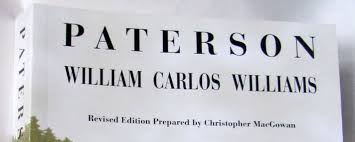
I didn’t grow up in the generation of the Beat Poets, but I was always interested in them. One of the poets who had a great influence on Beat Poets like Allan Ginsburg or Lawrence Ferlinghetti was William Carlos Williams. One of the first books of poetry I read of his was “Paterson.” I recently ran across the text and I was drawn in by the poetry of Book One Section II. I found something very American, poetic, and comical in that section. What I found so amazing is that Williams manages to keep each of these voices distinct. The difference between a few styles of writing produces this comedic effect and this has much resonance with the schlemiel (who is a simpleton, a “tam”).
In the opening stanza, we hear a voice that is confused, a voice that is concerned with the “how” (not the “what”). This voice is “more than a how,” says the poetic voice; it is a voice that Howls:
There is no direction. Whither? I
Cannot say. I cannot say
More than how. The how (the howl) only
Is at my disposal (proposal): watching –
Colder than stone –
In a modernist sense, Williams is suggesting that we pay close attention to “how” he speaks and even more so to his “howl.” This will help us to understand his poem.
The following stanza evokes an image of a “bud forever green.” But this bud has fallen on the pavement. It is “divorced.” From what?
Playing on this divorce, Williams evokes a public (and not a poetic) American voice which is mixed with a philosophical one:
Divorce is
The sign of knowledge in our time,
Divorce! Divorce!
These words direct our attention (by way of indirection) to the many ways things in this poem that are divorced from each other. The next stanza evokes the “roar” of Paterson’s main waterfall. It induces “sleep and silence…the roar of eternal sleep.” The roar looks to “divorce” us from “wakefulness.” It “challenges” us to stay awake.
Given the how we saw in the outset, we should ask a question: How – in the midst of this roaring – does one keep oneself awake?
The poem, at this point, presents “two halfgrown girls hallowing hallowed Easter.” They are “weaving about themselves.” But they are “disparate” among the roaring waters. The theme of separation and divorce are once again pronounced.
“Beauty” comes to the rescue. To be sure, Immanuel Kant and other philosophers associate beauty with harmony. And in this scenario, perhaps beauty can bring the divorced elements together. The poet, speaking from a poetic and a philosophical angle, provides a reflection on the girls mentioned above. He says they are wrapped up in ribbons, bows, and twigs. There is even reference to fur. Their beauty, it seems, harmonizes culture and nature. But, in the midst of this poetic solution to a philosophical crisis, we hear an American voice interrupt the image:
Ain’t they beautiful!
The voice of the slang is divorced from the poetic voice, but, in its simplicity, it brings the poem to a different place:
Certainly I am not a robin or erudite,
No Erasmus nor bird that returns to the same
Ground year by year….
The ground has undergone a subtle transformation, its identity altered.
The poet, who also seems to be a philosopher, loses his identity, the “ground” he speaks from (which could be a philosophical or poetic ground) is altered; and, as a result, he becomes a simpleton and child-like. But this transformation is not complete: the poet and philosopher return after this shift. And they are both overwhelmed by all of the details of existence. They stay “awake” out of some kind of existential terror. But the simpleton does not seem to be affected. Is he sleeping? Has the roar of the waterfall put him to sleep?
This contrast – between the poet, the philosopher, and the simpleton – makes me think of the schlemiel. The schlemiel travels around existence, explores it, yet without any philosophical quandaries about beauty, the divorce between the cultural and the natural, and so forth. He is free of that, but the poet is not. And this creates a kind of relationship – like the one between Sancho Panza and Don Quixote: the fool and the rationalist.
But, and this is the point, they (like the voices in this poem) stick together. And Sancho Panza learns from Quixote. Here, the poet and the philosopher learn from the ways of the simple American who is “not a robin or erudite” and he doesn’t return to the “same ground.” For the Simpleton, everything seems different (but in the way of wonder not angst, which sees everything as divorced). And, unlike the philosopher or the poet, he doesn’t have a ground. But, for the simpleton, that’s nothing to panic over. They panic, while he wanders, distracted, through the American landscape.
Reading through a 1964 interview between Hannah Arendt and Gunter Gaus, I was struck by Arendt’s responses to Gaus regarding the question as to whether or not Jews were apolitical and worldless. Gaus was prompted to ask these questions because of Arendt’s comments on her relationship to the “Jewish people.” With this in mind, Gaus (who is Jewish) asks Arendt the following question regarding politics and the “commitment to a group”:
As a politically active being, doesn’t man need commitment to a group, a commitment that can then to a certain extent be called love?
In response to this, Arendt notes that belonging to a group is a “natural condition.” And as I pointed out in my last blog entry on Arendt, the “second birth” is (for her) greater than the first birth (or what she calls here a “natural condition” – namely, the fact that she was born Jewish). By “second birth” Arendt means an “act” in which we “insert ourselves into the world” and become a “who” rather than a “what.”
On this note, Arendt says that the “act” of “joining or forming” a group is “something completely different” from the “natural condition.” And in doing this, one enters the world: “The kind of organizations (one forms or joins) has to do with a relation to the world.” But in contrast to this, both love and friendship are not worldly. They are more natural, and, by her clock, less important. She notes the worldlenssness of love in The Human Condition when she writes of the Christian “political principle” which is a “bond of charity between people”(53). This founds a “public realm of its own” but is “worldless” because it is based on love. Arendt goes so far, over there, to say that this “bond” “is admirably fit to carry a group of essentially worldless people through the world, a group of saints or a group of criminals, provided it is understood that the world itself is doomed” and that every act is provisional. As she points out there, this is antithetical to the Greek (pre-Platonic) understanding of action and it’s relationship with the world.
Hearing Arendt’s reading of the worldless apolitical nature of love and community, Gaus pushes her to further explain what she means. In response, Arendt describes the Jewish people in the same way as she describes the Christian community’s worldlessness (which we cited above):
I admit that the Jewish people are a classic example of a worldless people maintaining themselves through thousands of years. (17)
In response, Gaus asks if by “world” Arendt means her “terminology for the space of politics.” Arendt agrees to this formulation but Gaus pushes her to explicitly say that the Jewish people were “an apolitical people”(17). But she won’t. To be sure, she revises her original formulation of the Jewish people as worldless and shows that her reading of the “Jew as Pariah” has limits and conditions:
I shouldn’t say that exactly, for the communities were, to a certain extent, also political. The Jewish religion is a national religion. But the concept of the political was valid only with great reservations. The worldlessness which the Jewish people suffered in being dispersed, and which – as with all people who are pariahs – generated a special warmth among those who belonged, changed when the State of Israel was founded. (16)
Hearing this, Gaus makes a smart move and asks her what was “lost” in this transition from (for lack of a better word) “partial worldlessness” to political worldliness (with the founding of the Jewish State). This, to be sure, is a sharp question because, as I have pointed out in the last blog entry (and above), Arendt prefers political worldliness to apolitical worldlessness in The Human Condition. In fact, we find no such lamentation of loss there.
But at this moment of the interview Arendt does lament the loss of some kind of Jewishness:
Yes, one pays dearly for freedom. The specifically Jewish humanity signified by their worldlessness was something very beautiful. You are too young to have ever experienced that. But it was something very beautiful, this standing outside all social connections, the complete open-mindedness and absence of prejudice that I experienced, especially with my mother, who also exercises it in relation to the whole Jewish community. (17)
What I find so striking about her reflection is that she speaks as if she has a strong grasp of what Jewish “worldlessness” – before the founding of Israel – felt like. And instead of citing the pariahs and schlemiels she brought together in her famous “Jew as Pariah” essay, she talks about her mother and takes on a romantic kind of reflection on worldlessness: where everyone was “standing outside all social connections” and where there was a “complete open-mindedness and absence of prejudice.”
Read against this talk in the 1960s, her thoughts on schlemiels and Jewish ahistoricity takes on another dimension. In an earlier essay entitled “The Enlightenment and the Jewish Question,” Arendt doesn’t lament the lost world. She deplores it. She notes that Jews, such as Moses Mendelssohn, had no grasp of history and the world. For him “all reality – the world around us, our fellow men, history – lacks the legitimation of reason. The elimination of reality is closely bound up with the factual position of the Jews in the world. The world mattered so little to him that it became the epitome of what was unalterable.” He was “indifferent” to the “historical world.”
And in her essay on the “Jew as Pariah” – as well as on her work on Rahel Varnhagen – Arendt notes that Rahel, like other schlemiels, clung to “such universal things as the sun, music, trees, and children.” In other words, they clung to nature (to their primary birth) but not to history and politics (a second birth they couldn’t experience).
Although Arendt’s words on Varnhagen, Heinrich Heine, and Charlie Chaplin (amongst others) seem to be charming, they are ultimately for the dustbin of history. She doesn’t want to go back. She may find the worldlessness of Jews and Christian communities to have their charm, but their loss is what she ultimately calls the “price for freedom.” And, for her, that price is paid with the founding of Israel as a Jewish State.
Regardless of what she says, however, I think that Arendt is missing something. In her formulation, all worldlessness must be sacrificed in the name of the world and politics. But can worldlessness ever be sacrificed? Is the worldlessness of the Jews – which she thinks of as a thing of the past – gone? If that is the case, why do we find so many Jewish-American writers, filmmakers, and comedians – after the founding of Israel – drawing on it in their schlemiel routines? Are Arendt’s formulations of Jewish worldlessness and the end of such worldlessness too extreme and intolerant of any possibility of being both worldless and worldly at the same time? Or is (political) history the ultimate judge? And is the price unmistakable?
Who we are, in many ways, has to do with how we appear to others. The interpretation of our actions by other people may determine how we think of ourselves and how we will be regarded by what Hannah Arendt – the Jewish-German philosopher- calls “the world.” Furthermore, for Arendt, “who” we are – as opposed to “what” we are – is to be found in the space of appearance (how we disclose or are disclosed to others). And that space is the space of the world. And this appearance and its interpretation are all based on action – what Arendt – citing the Latin – calls Vita Activa (the “life of action”).
While I find all of these philosophical readings of identity interesting, I wonder how (or whether) Arendt’s readings of identity, appearance, world, and action would pass what I call the schlemiel test. But before we subject her readings to the “schlemiel test,” let’s briefly introduce them.
In the opening of chapter five of her book (aptly titled “Action”), The Human Condition, Hannah Arendt introduces “human plurality” as the condition for the possibility of “both action and speech.” Writing on plurality, Arendt argues that it has the “twofold character of equality and distinction.” On the one hand, if “men were not equal, they could neither understand each other and those who came before them nor plan for the future and foresee the needs of those who will come after them.” On the other hand, we have distinction: “if men were not distinct,” they would “need neither speech nor action to make themselves understood.”
Of the two elements, Arendt is most interested in what makes us all distinct. And what makes one distinct, as we can see above, is speech and action:
A life without speech and action…is literally dead to the world; it has ceased to be a human life because it is no longer lived among men. (176)
Arendt gives such weight to speech and action that she associates it with a “second birth.” For Arendt, this second birth is perhaps the most important aspect of the human condition:
With word and deed we insert ourselves into the human world, and this insertion is like a second birth, in which we confirm and take upon ourselves the naked fact of our original physical appearance. (176)
This second birth evinces the power of freedom since our “insertion” of ourselves into the “world” is a free act. Arendt says that it “responds” to our “first birth” by “beginning something new of our own initiative”(177). This leads Arendt to her theory of identity which basically posits that “who” we are is determined by this “initiative” to “insert” ourselves into the world. Our “distinct” character – our “who” – comes out by way of action.
Action, argues Arendt, has a revelatory power if and only if it is accompanied by speech:
Without the accompaniment of speech…action would not only lose its revelatory character, but, and by the same token, it would lose its subject. (178)
Arendt calls people who perform without speech “performing robots”(178). Their “speechless action” will be perceived as “brute physical appearance.” For Arendt, there is nothing unique about this since nothing unique is “disclosed.” Hence, Arendt’s principle:
In acting and speaking, men show who they are, reveal actively their unique personal identities and thus make their appearance in the human world. (179)
Speech – together with action – is a “disclosure of ‘who’ in contradistinction to ‘what’ somebody is”(179). But there is a lot at stake: this who can become a what. As Arendt says, one must “be willing to risk” the disclosure (180). The risk is that one’s appearance to the world may be rejected; and one may not find a place in the world of plurality as a “who” but as a “what.” Regardless, without speech action loses its “revelatory character”(178). And once one speaks, one risks one’s identity and puts it before the world (as the court of judgment).
We are now ready for the schlemiel test.
Arendt had a love/hate relationship with the schlemiel (I have been pointing this out in this blog and I will be writing more on this in my book and in forthcoming essays on the topic). What I glean from a book like The Human Condition is not so much the identity of the schlemiel as the anti-thesis of the schlemiel. To be sure, I wonder if Arendt’s criteria for being “distinct” could be applied to the schlemiel.
First of all, the schlemiel, as Arendt points out in other works (which I will be discussing in my book), does not live in the world. Arendt points out that the Jewish people didn’t have the privilege of being-in-the-world since they were excluded from the world and history. The schlemiel is – more or less – a move in the direction of the world and history, but it falls short. The schlemiel – as pariah – has meaning in its opposition to the world. But, as I have pointed out in an earlier blog entry, Arendt (and she also claims Kafka) dreamt of a world where Jews could be “normal.” But, that’s the point, it didn’t have that world only because the world couldn’t take the words and actions of Jews seriously.
In other words, I suggest we read the schlemiel against Arendt’s Greek model for the world (which I discussed above; to be sure, there is no mention of the schlemiel or the Pariah in The Human Condition; it is a Greek kind of text and openly takes a lot from the ancient Greeks and their passion for the world, politics, and action). If we do this, we will see that the schlemiel falls short of her model for identity.
Taking this suggestion to heart, we should take a close look at the schlemiel’s character vis-à-vis Arendt’s criteria for being-in-the-world. To begin with the schlemiel doesn’t understand the meaning of the risks he or she takes with this or that word which compliments this or that action. This implies that their actions really aren’t risks. If we look at a schlemiel like Gimpel, for instance, we see that his act of trusting everyone is a risk. Although everyone lies to him and laughs at him for trusting them, it is still a risk. But it’s not conscious. He naturally trust people, it seems; otherwise, there is something in him that drives him to trust others. But what we see is that the world is at fault. The world that Arendt so prizes is the very world which rejects the trust that a Jew like Gimpel has for it’s plurality.
In addition, the schlemiel’s actions and – as Arendt might say – the words that “reveal” the “who” are always – from the perspective of the world – wrong. This would imply that the schlemiel will not be regarded as a “who” so much as a “what.” He is defined by his failure to speak and act in a proper manner.
In other words, the schlemiel fails Arendt’s identity test.
But, on the other hand, her reading of speech, action, and identity fail the schlemiel test. They do so because the schlemiel is someone who speaks by way of indirection. The schlemiel is in the world but not of the world. And this difference is a challenge to the Greek model that Arendt so lovingly quotes. The irony of it all is that Arendt herself – like the schlemiel (who stands between the Jewish and the Greek) is a Greek-Jew. She, however, identified more with the heroic model of the Greeks. But that model can only work if one’s speech and actions are heard; if they are not, then one will, in her view, just be a robot: whose physical actions appear and are seen but are ultimately just “brute facts” of one’s physical existence. The fact that they are not backed up by speech (the kind of speech uttered by the hero) means that these actions have lost their “revelatory character.” The schlemiel is not a “who” – he is a “what” (that is, he is defined as a fool who lacks power and agency).
The schlemiel, in this view, evinces a brute, robotic (read mechanical, in the sense meant by the philosopher Henri Bergson) kind of existence. But this is far from the case. His existence is more revelatory of injustice – which challenges the world – than heroic words and deeds. The schlemiel – an outsider/insider – has an important place in the world. And this place is based on the fact that it’s challenges are neither heroic nor conscious. As Ruth Wisse says, he’s an “unlikely hero.” He is the kind of hero that we won’t find in the pages of The Human Condition. And that’s the rub: he fails one test (the one posed by Arendt), but wins another.
Like the German-Jewish thinker Walter Benjamin and like Sigmund Freud, I’m one of those people who loves searching through the trash for treasures. For both Benjamin and Freud, the trash that they searched through is the trash of history and the past. Their work in philosophy, literary criticism, and psychology was to look through the past so as to find things that would transform how we look at ourselves and the world we live in. While Freud was interested in the trash people bury in the their personal histories (and, at times, with a nation: as in his book Moses and Monotheism), Benjamin was also interested in the material that is buried in cultural history. To be sure, these things, upon discovery and re-interpretation, can teach us about who we are; after all, who “we” are as North Americans, or as people who have grown up on media, cartoons, films, TV, etc is who we were. Therefore, the more we know about or reflect on who we were, the more we can understand who we are or rather who we might be. Strangely enough, however, this requires us to look, as Benjamin understood it, through things that we may consider retro-trash. This trash, for him, wasn’t trash so much as a treasure: it helped him to tap into a collective sort of historical self-awareness.
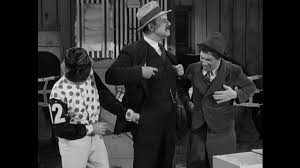
That said, I think we can learn something from cartoons. Like many people, I have grown up with cartoons. I lived in Upstate New York, but I would often see cartoons – after school – by way of my favorite channel (which hailed from New York City): 11 Alive. I also saw cartoons on the weekend. But, in addition to cartoons, I also watched the Three Stooges after school. To be sure, I really loved watching these episodes more than any comedy show on the boob-tube. Unlike many, I actually liked reruns of their performances.
First of all, as I noted in my blog entry, the crew (which consists of Captain Cornelius, Wet Willy Jones, and Axel Rod Magee) runs into a cartoon that is floating around the cartoon lagoon. (To be sure, this is a major part of the plot of every show.) When they run into the cartoon, they go down into a screening room to watch the cartoon and comment on it. The cartoon they view, to my surprise, was a cartoon of the Three Stooges entitled “Dentist the Menace.” What I found so interesting about this selection is that it has a “meta” quality: not only are we watching the characters from the cartoon watch another cartoon and comment on it; we are also, watching a cartoon that is based on the Three Stooges show.
There is an additional surprise to this since, while watching it, I am prompted to wonder whether there a) was another episode that this was based on (or if it is something new) or b) the gestures that are depicted in this cartoon “properly” depict the characters gestures from the show. In other words, the constant question in my mind, which the comments of the three comic characters watching the cartoon remind me of, is what to make of this interpretation which was made, most likely, in the 1970s or early 80s? How do we interpret this piece of cartoon trash (which may really be a treasure) that is floating around the Cartoon Lagoon. Like many things from the past, the submarine, so to speak, stumbles upon it. But, as with any dream or figment from the (cultural) past, we need to ask whether it is meaningful or just a piece of trash.
The first thing that strikes me, even before I hear the cartoon characters’ comments, is the fact that the speed of this cartoon, in contrast to the Cartoon Lagoon segment in the beginning, is much slower. There is already a lapse. And this may indicate that our sense of timing, today, is different.
In fact, the first comments focus on the represented space and on the time gap between the two: “I miss furniture tassels.” And when Curly says his “teeth are killing him,” one of the cartoon characters says that this “cartoon is killing me.” Already, he is agitated (perhaps by its slow delivery).
We are then reminded of the 90s (and a scandal which changed history) when, upon hearing Moe say “shut your trap and close your mouth,” one of the characters says: “That’s Bill Clinton’s motto.” This hits on the historical-political dimension.
Following this, the Cartoon Lagoon characters poke fun at the timing, design, and gestures of the cartoon Stooges. After Moe opens the door to attach Curly’s tooth, he makes an odd gesture with his leg. Upon seeing this, one of them asks: “Is he peeing on an invisible fire hydrant?” Following this gesture, Curly flies into the door. We see half of his body, the back half, twitching in the door. Seeing this, one of Cartoon Lagoon characters makes a reference to the present moment (namely, Miley Cyrus’s “twerking” on MTV moment): “Oh no…he’s twerking?” In contrast, the next comment focuses on the past (namely, on Vaudeville): “We didn’t save our money from Vaudeville.” Following this we hear a vulgar slapstick idiom which marks the time: “Hey, he’s talking out of his ass!” At this point, the commentary is interrupted. And we notice there is a technical difficulty – most likely in response to the vulgar commentary. But the Cartoon Lagoon doesn’t end with a reflection on the past. It ends with an ad for Squish Cereal. And this break, juxtaposed with the previous dated comments and scenes, suggests a way of thinking the past against the present cartoon moment.
To be sure, the attention to gesture (dated and not dated) that we see in this clip is an attention to the fine points of the past and its cultural translation into the present. What we need to ask is: What is translated and what is not? This question, necessarily, is a meta-commentary on cartoons. And I think this question is prompted by the fact that, by virtue of the plot, the characters and their submarine are bound to run into old cartoons and the fact that when they comment on them they often reference historical moments.
This implies that the cartoons as well as the commentary they use are historically embedded. And this calls for us to carefully read the translation into the present. We are, in effect, asked to consider whether the Cartoon Lagoon has discovered Cartoon Treasures or….trash that comes from the depths of cartoon history to the surface of our comic historical consciousness.
This exercise, I believe, is important since, in a postmodern age where, as Fredric Jameson argues, history itself is in the dustbin. And any form of historical consciousness, especially when articulated through the cultural imagination, is timely. What interests me most about this gesture is that at least two people of the Cartoon Lagoon commenting on these cartoons are schlemiels. This suggests that at least one variety of the schlemiel is caught up in reflections on the culture past. And this suggestion, to my mind, is right on the money. To be sure, Walter Benjamin would subscribe to this whole-heartedly. Indeed, one of the things that worried him most about his thinking is that the more he remembered the past, the more addicted he would become to its translation. For Benjamin, this was a good thing and a bad thing. The good thing is that it provided a relation to the cultural past (as in his reflection on the telephone, which I have blogged on). Yet, on the other hand, it is bad because too much reflection on the past may keep one from politically acting in the present. But, as Benjamin later realized, reflection on cultural artifacts (even if they are cartoons – which have never been of interest to philosophers but were of great interest to Benjamin) in itself had a redemptive and revolutionary act built into it. For as Jews have known for centuries, interpretation of the past has its benefits and can be the basis for a shared world.
Cartoon Lagoon steps along a similar path to Walter Benjamin and should provide us – just like the characters of Cartoon Lagoon – with lots of things from our animated-cartoon past to translate into the present. In a way, being addicted to the past makes schlemiels out of all of us; but in translating it into the present, we realize that, after all is said and done (and to play on the title of the Cartoon Lagoon episode), the game is far from over. Analysis is, as Freud once said, interminable…and so are the cartoons hidden and waiting for discovery in the cartoon lagoon!
These are the words of Jack Benny – whose real name was Benjamin Kubelsky. And they are – more or less – an affirmation of ethnic humor. He thought of such humor as – in the words of Lawrence Epstein – “socially redemptive.” They were spoken in relation to racist and anti-Semitic claims made against Jews and African-Americans during the depression; and the characters that Benny found “socially redeemed” ethnic humor were Mr. Kitzel (a character who “Jewish” mannerisms) and Rochester an African-American character. The two, in fact, shared many skits. Lawrence Epstein points this out by way of Benny’s own words – in retrospect – on these characters: “I never felt and I do not feel today that Rochester and Mr. Kitzel were socially harmful. You don’t hate a race when you are laughing at it.”
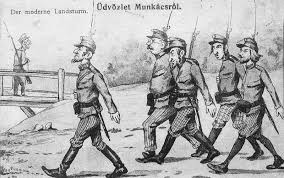
Given the fact that many an anti-Semite laughed at Jews, this is an astonishing claim. One of the major anti-Semitic claims made against Jews is that all Jews are weak. Sander Gilman, in The Jew’s Body, points out how Jewish men were often depicted as effeminate. This, to be sure, is ethnic humor (of a very negative, biased sort).
When Jews were represented, their bodies are pictured in relaxed, comic, and effeminate postures. The comic strips were used, in these pieces, to laugh at Jews and ridicule them for being outsiders whose bodies were not “normal” and “graceful” like their fellow German citizens.
Ethnic humor was used to invoke hatred of Jews in Germany from the Enlightenment to the Holocaust. Caricaturing Jews as power hungry, overweight, scheming, cheap, and weak had a horrific and a comic edge (aimed at exclusion):
But this, Epstein claims, was reversed on American soil. As Jews learned, the best place to challenge the representations of the Jewish body was on the American stage where weakness could become a Jewish trait that was not so much deplorable as worthy of compassion. And this compassion served, in some sense, to create a way for Jews to be accepted into an American society that had become, with the depression, hostile toward the Jews. This observation, it seems, finds much resonance in David Biale’s definition of the schlemiel as “charming.” It also echoes Hannah Arendt’s descriptions of Charlie Chaplin and Heinrich Heine’s “lord of dream” – exemplary schlemiels in the “hidden tradition.”
Lawrence Epstein makes a case for this in TheHaunted Smile. He finds the inversion of an anti-Semitic characterization of Jews as weak – which we see above in the negative ethnic humor and caricature – by way of the weakness in Jack Benny’s comic performance. Benny, argues Epstein, found a way of countering anti-Semitism by way of two routines that actually adopted anti-Semitic stereotypes and inverted them.
The claim that Jack Benny’s comic act inverts American culture was first made by Susan J. Douglas: “Douglas reads the character as an attack on both masculinity and upper-class pretensions.” (For more on the topic of masculinity, comedy, and inversion see my blog entry on Daniel Boyarin’s reading of the father of the Hasidim: the Baal Shem Tov.) Epstein agrees with her that “the Benny character subtly attacked the leaders without ever being political.” And, in the process, he affected audiences without their even knowing it. He spoke to the public’s anger at being duped by their leaders who worked in cahoots with the stock market to create the Great Depression. But this anger was misdirected at the Jews of the time.
Benny did address and invert this anger by adopting and playing on stereotypes; and did this, specifically, through the schlemiel:
Benny mocked his own prowess with a violin, a musical instrument widely identified with Jews, and the Benny program produced two Jewish ethnic stereotypes as characters, Mr. Kitzel and Schlepperman.
Interestingly, Epstein says many people in the American audience didn’t even know he was Jewish. Rather, he played with images that had some kind of, as the postmodern sociologist Pierre Bourdieu might say, symbolic power. And, in relation to them, he gave Jewish stereotypes a more positive valence. That said, the expressions he came up with went viral and this had a good effect of, in Epstien’s view, defusing anti-Semitism.
For instance, when Mr. Kitzel cried out, “with a pickle in the middle,” such diffusion was at work. The expressions of Mr. Kitzel – the expressions of a schlemiel- did this cultural work. Audacious, odd phrases, in a Lyotardian sense, created a new “idiom” which, when repeated, gave Jewishness a new currency that it never had before (even though much of the American audience may not have picked up that it was a “Jewish” dialect that was being displaced).
To be sure, it is Mr. Kitzel’s absent-mindedness, which he is blind to, that is most charming. The audience’s response, Epstein says, is “empathetic” as opposed to “being antipathetic.” And this small element of empathy, argues Epstein, was enough to sway an American audience to accept not necessarily Jews as Jewishness (which, he claims, they may not have even consciously noticed) as something non-threatening.
The key to this charm was the identification with Jack Benny, the man-child schlemiel. The lesson we learn is that the schlemiel’s charm can be used as a way of fostering a kind of American populism that is based on an openness to weakness. We see this in Benny and we see it in the latter part of the 20th century in Woody Allen, Ben Stiller, Adam Sandler, and Seth Rogen (amongst many). The strategy of weakness is the strategy of assimilation and a way of deflecting anti-Semitism, or so it seems. However, this appears to miss the fact that, today, Jewish comic traits of weakness are no longer Jewish. You can find them everywhere. And this can come out in a turn of phrase, a gesture, or a situation. Take, for instance, Napoleon Dynamite or the Dude from the Cohen Brothers film The Big Lubowski:
Their way is the way of the peaceful, inept, yet (unconscious) charming warrior. While the association of ethnicity with weakness seems to have fallen away in America, weakness (as such) remains. I’ll leave it at that….
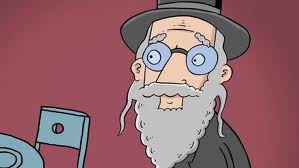
No. This blog entry is not on the Hasid or Hipster tumblr site, which, believe me, I really enjoy as does Jimmy Kimmel and a variety of people who regard themselves as “hipster Jews.” Rather, its on an animation by Nextbook called the Golem which pits a group of Hasids against a group of Hipsters. Playing on some kind of possible tension, which may or may not exist (after all, a lot hipsters live in Williamsburg which is home to Satmar Hasidim) this short animation does a lot to diffuse it. And it does it by way of showing that, in the end, the Hasid, the Hipster, and the Golem are all schlemiels who, instead of putting up a fight, would rather just hang out and chill.
As you can see from the opening credits, Golem graphic, and music, this animation (set against the background of a city) seems to promise something ominous. After all, a Golem is a creature which, the Talmud tells us, is made out of clay and given life by virtue of a magic spell. The famous words that are associated with the Golem in the Talmud are “Rava Bara Gavra.” Although they sound like a spell, they simply mean that Rava, an esteemed Rabbi from the third century, created (Bara) a man (Gavra). Apparently, as Midrashic legend tells us, he may have also made a lamb that would be killed for a Sabbath meal. Years hence, in the times of the Maharal of Prague, the story re-emerges of a Golem that was solicited to protect the Jews from attacks by mobs of anti-Semites. (At the time, Jews in Germany were often accused of what’s called “blood libel”: the hateful and totally false claim that Jews would kill Gentile babies and use their blood for Matzoh on Passover.)
The opening of this animation draws the story. But this wasn’t simply a legend amongst the Jews. The Golem story found wild expression in the German Expressionist film from the 1920s. In this film, the Golem is associated with the something very grim and Gothic. He appears to be a monster of sorts.
In the animation, this is displaced 11 seconds in to the clip. Not only is the dark imagery supplanted, so is the music. Now, we see a lighter background and odd techno-retro-ish music against the subtitle “Williamsburg, Brooklyn.”
We are then introduced to three Hasidim who are gathered in the apartment of a Hasid who lives above a Hipster Bar. He asks the other two Hasidim if it’s “Simchas Torah” (a Jewish holiday that celebrates the Torah) downstairs. This comment is effaced when, downstairs, one of two hipsters in the bar asks: “What is that pounding…is it Simchas Torah already?”
One of the Hasidim gets the idea that the Hasidim should boycott their establishments so that the Hipsters will leave. But this plan falls flat because, as he says, “none of them have jobs.” The same Hasid suggest that they take graver measures. And by this he means the creation of a “monster” who will “do our bidding” (a Golem). While he says, this we hear chilling music.
One of the Hasidim says that “the secret of the Golem has been lost for generations” while the narrator says “until now.” At this point, the animation shows us a Wikipedia page which shares the Golem’s secret. (The joke, in this instance, targets a Messianic kind of valuation our society gives to Wikipedia.) . And the comic blunders that follow accumulate and bring out sheer schlemielkeit. After all, what kind of Golem would Hasidim reading a Wikipedia page on the Golem produce?
The Golem they produce – first of all – speaks (which goes against the legend; the Golem, as a rule, can’t speak). But, more to the comic point, when it speaks he comes across more as a Nebish-schlemiel than as a monster. His back hurts. He needs to go lie down. And he’s worried that, since he may have been made of clay he may have allergy problems. When told that he will have to scare the Hipsters away (or, rather, “destroy them”), he comically points out how ridiculous this would be: “I mean..have you seen my body? What do you want me to do? File their taxes to death?”
These comical rhetorical questions tell us that this Golem is a schlemiel. He would rather have peace than war. As the Golem says, “Go destroy them yourselves. I’m no fighter.” (I discussed this trait of the schlemiel in my blog entry on the Political Schlemiel and in my entry on the schlemiel and weakness.)
After feeling a little Jewish guilt because of his “creators” kvetching, he goes downstairs.
But before he does, we bear witness to a hipster conversation which is, as in the earlier parts of the animation, looking to be cool and disaffected. In the midst of this conversation, the Golem breaks through the wall to scare them. In response, the hipster asks for his iphone. Upon hearing this, the Golem acts “as if” he is angry, calls them fools, and tells them that the “police won’t help them.” But the hipster doesn’t want the phone to call the police. Rather, he wants to “tweet a photo” of the Golem and put it on facebook.
This works to disarm the Golem and his act. Following this, they all start chatting and the Golem sets into his true identity: like them, he’s a hipster. When asked about the word on his head – what one of the hipsters calls a “head tattoo” (the word is Emet – Truth – which in the Golem story stays on his head to keep him alive; when the Aleph of Emet is taken away, he dies), he says it means truth but adds in indifferent hipster parlance: “Uh…I mean…but what is truth anyhow?”
Continuing the comedy, the Golem’s arm falls off and he asks the female hipster to put it back. She tells him not to worry: she’s dated Golems before.
In this world, all is banal. In a Warholian fashion, nothing shocks, not even a Golem. But that’s hip.
In characteristic fashion, the Golem makes it into the news, becomes popular, and attracts a group of ‘sports-bar’ types to the Williamsburg bar. At that point the hipsters, rather than the Hasidim, say: there goes the neighborhood. The last words they utter suggest that they go, instead, to Crown Heights, were there is a “Manticore” DJ (who is apparently half human/half scorpion). The Golem stays there, in the back of the bar, as they walk away. This suggests that the Golem is passé and that there are many other hybridic half human beings out there. But they are no longer scary monsters; they’re cool.
And the last scene we see of the Golem become a jock while the Rabbis complain of assimilation. Like Woody Allen’s chameleon-Schlemiel, Zelig, the Golem changes with every person he is around. But he is left back, while they move on. And we are left with a few questions: Should the Golem have gone off with the hipsters? Is his assimilation, now, giving in to jocks rather than hipsters?
Ending on this note of assimilation is telling because the Golem, like the schlemiel he has become, has been transformed by the American cultural imagination. This transformation of the Golem into schlemiel suggests that what lasts, in America, after all is said and done, is the schlemiel. American Jews, who may align themselves with the comic aspects of Jewish identity, feel more akin to the schlemiel than to the Golem. Of all characters, the American-Golem-Schlemiel – whose greatest asset is his coolness and indifference to fighting – remains.
Contrast this to Israel and its historical consciousness and you will find that their reading of the Golem is much different; for many, the schlemiel represented something Jews were not: a figure of power who could protect the community from enemies. Israelis deemed, in the wake of figures like the Golem, to protect themselves.
But in this animation, where Hipsters are seemingly pit against Hasidim, protection isn’t the issue: comedy is. In this battle, comedy displaces the Golem legend and transforms the Golem from a monster-of-sorts to a schlemiel. In this piece, the Golem-Schlemiel is the “unlikely hero.” And instead of Hasid or Hipster we have the schlemiel.
In the late 1960s Susan Sontag made many statements and wrote essays which demonstrated that she was interested in effacing the fine line between high and low culture. In one of her most interesting essays (“The Imagination of Disaster”), she makes an in-depth reading of science fiction films and B-films. To be sure, like her, I’ve been wanting to explore popular culture with a critical eye. And lately I’ve been looking to find comic material on the schlemiel in popular culture as I believe that one can find some schlemiels worthy of interest there. To this end, I have been thinking about animations.
Scrolling through my ipad facebook page yesterday, my eye caught on an interesting looking cartoon animation called Cartoon Lagoon. The episode I found is entitled “Game Over.” When I saw the Cartoon Lagoon image and the title, I was curious. Very…curious since the person who posted it, Jeff Newelt, works in and knows the field of comic animation and cartooning from the inside-out. Newelt is the comics editor of Heeb Magazine, the editor of the Harvey Pekar’s Pekar Project, and of Pekar’s Book Cleveland. Knowing this, I was excited to see what the Cartoon Lagoon was all about. “Who knows,” I thought, “maybe I’d find a schlemiel or two?”
And I did! Here’s the trailer for the first season of Cartoon Lagoon:
As you can see from the trailer, the mission of this Submarine (“The Mantaray”) is to go out in search of the “best and the worst cartoons…ever made.” And on this mission they must -as the captain says – “retrieve cartoons.” The stars of the show are “Captain Cornelius Cartoon”(the adventurer), Wet Willy Jones” (the schlemiel), “Axel Rod Magee” (the shlimazl – who the captain believes he can “cheer up” by discovering a new cartoon), and “Franky Planky.”
The clip I discovered on Jeff Newelt’s facebook page is, as I mentioned above, entitled “Game Over.” It starts off with Axel Rod Magee – a shlimazl – banging on a table repeating, several times and with a schlemiel’s insistence, “It’s Game Over!” The character, it seems, is really down on his luck. Like many a shlimazl, he is weakened by his situation. And this is in contrast to the schlemiel. To be sure, Ruth Wisse sees the comedy of the shlimazl as situational while she sees the comedy of the schlemiel as existential. The schlemiel is – so to speak – the purveyor of bad luck. Bad things don’t happen to him; rather, they happen to others who are in his path. (As the American-schlemiel joke goes, the schlemiel spills the soup while the shlimazel is the one who gets spilled on.) Regardless, both the schlemiel and the shlimazl are tied together by virtue of luck.
The schlemiel is less affected by bad luck than the shlimazl. It’s a matter of degree.
Now…where were we…?
Yes…after freaking out about how it is all “Game Over” (and that they are all going to die in the Cartoon Lagoon), we learn that it is Axel’s birthday. And for his birthday, he is given something that communicates good and bad luck to the user….a “nine ball.”
The fact that it is a nine-ball – rather than an eightball – is already comic; but, more importantly, this is a retro-eightball, the one popular in the eighties.
It is used as the leitmotif in this part of the episode. The ball – so to speak – communicates things that involve winning or loosing. Inside the popular eightball from the 80s is a pyramid floating in blue liquid; it has different “responses” on each side. When the person shakes it up, they are given a message (as if the message spoke the “truth” or some “secret” – something common to the ouji board phenomena).
The 9 ball brings the schlemiel-shlimazel routine together and, through its answers, we learn about the comic nature of every character. After telling the shlimazl that “these things never lie,” the captain shakes it up. He asks “are we going to watch another cartoon today?” The answer: “All signs point to yes!” The captain is ecstatic, but the shlimazl is not convinced. The schlemiel then takes the ball and asks “Where are my car keys?” The ball breaks with the normal answer that one might find on the cube (like the one received by the captain) and says they are “Behind your comic book collection under your dirty laundry next to your rubiks cube and your “Where’s the Beef” Lunchbox.”
This 9 ball seems to provide only good answers. Perhaps it will bring good luck? Inspired with some small bit of hope, when the skeptical shlimazl gets it, he asks questions that have much more existential depth: “Am I going to have a long life?” The response differs radically from the other two: “Reply Hazy: Ask again Later!” Frustrated, the shlimazl asks yet another deep, existential question: “Is this going to be my last birthday?” And, in comic repetitive form, it replies: “Reply Hazy: Ask again Later!” But the shlimazl doesn’t give up and asks for a third time; this question, however, hits at the core of his character: “Is something bad going to happen to me?” And it replies, in the most mocking fashion: “Dude let it go!” At that moment, something bad seems to happen: the ship hits something. But that’s a ruse. They’ve hit a cartoon. The captain tells them to go to the theater to watch the cartoon discovery.
What I love about this routine is that it shows the shlimazl to be a schlemiel. He doesn’t simply have bad luck; he seems to constantly bring it on. His condition is existential and it is situational. That’s the trick of being the disseminator and the target of bad luck. But unlike the other schlemiel, “Wet Wily Jones,” Axel is struck with bad luck, sometimes bringing it on, and he knows it. Just look at those eyes and hear his voice; bad luck and anxiety have left their mark on his body. But at the very least he gets to survive and watch yet another cartoon from the past at the end of each episode. His life isn’t that bad…
I’ll stop on this note and return – in the next blog entry on this topic – to their commentary on the Three Stooges clip (one that they discover, or rather run into, in the Cartoon Lagoon).
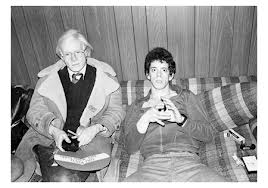
When I first heard that Lou Reed was influenced by the poet Delmore Schwartz, I was very happy. I love their work and I have been looking to write on the possible relationship between Reed’s music and Schwartz’s poetry for a while. With the passing of Lou Reed, this thought has crossed my mind more than once over the last few days. To my surprise, I noticed – just this morning – that The Jewish Philosophy Place had posted a blog entry on Lou Reed and Delmore Schwartz. The entry didn’t look into how Reed may have been influenced by Schwartz; it simply noted that Lou Reed majored in English at Syracuse University where Zachary Braiterman, the author of the Jewish Philosophy Place Blog, teaches. Regardless, his blog entry prompted me to return to Schwartz’s work and to think about how it might relate to Reed’s music.
I don’t want to go in depth about this or that influence on Reed, so much as point out their shared interest in irony and the comedic. What I love about their humor is that it doesn’t come from a high place that looks condescendingly on this or that target, so much as from an awareness of their own odd predicament in a world that is and is not theirs. Their fiction, poetry, and lyrics didn’t so much provide them with a form of redemption so much as a way of reflecting on their comic/odd relationship with America, their parents, and their dreams. They were both outsiders and regardless of their successes I can’t help but think that they thought of themselves as failures. Yet, in the spirit of their art – and in the spirit of the schlemiel – this reflection wasn’t tragic so much as comic. They shared the realization that they were the “odd one’s out” and in this we can say that they are an “odd couple” of sorts.
In his Foreword to the Delmore Schwartz’s collected stories, Irving Howe takes note of how the danger of addressing Delmore Schwartz is that one might get caught up in his sad life and miss his wonderful fiction and poetry. In the process, Schwartz risks becoming “the subject of a lurid cultural legend.” Nonetheless, Howe points out how Schwartz’s story is an American story of going in the opposite direction of the American dream – from success to failure: “The image of the artist who follows a brilliant leap into success with a fall into misery and squalor is deeply credited, even cherished in our culture.”
Howe points out that Schwartz’s “In Dreams Begin Responsibilities” found an odd location in the first issue of the new Partisan Review in 1937. It was the only story in the collection and it appeared right in the beginning. Howe tells us that when he first read the story he experienced the “shock of recognition.” What took Howe aback was the fact that the narrator, who sees his entire life pass before him on a movie screen, screams back at the screen when he sees his parents getting married: “Don’t do it. It’s not to late to change your minds, both of you. Nothing good will come of it, only remorse, hatred, scandal, and two children whose characters are monstrous.” Howe tells us that when he read it for the first time he deeply identified with Schwartz’s “cry against the mistakes of the past.”
When Howe reread the story, he found not just a protest against history but also a protest against existence. But this voice wasn’t so much a voice of an existentialist as a voice “at home with the speech of people not quite at home with English speech.” In other words, Howe found in Schwartz the struggles that were familiar to children of Immigrants (a theme I have been discussing a lot on this blog vis-à-vis Gary Shteyngart’s work).
In Schwartz’s work, Howe finds “the pathos and comic hopelessness of the conflict between immigrant Jewish families and their intellectual children”(ix). He also finds the “frantic mixture of idealism and ambition, high seriousness and mere seriousness.” The “mere seriousness” was also used as invective against New York intellectuals. Howe says his criticisms were “bitter and..sometimes nasty.” But, all in all, his words “created communities” and “floundering intellectuals.” They indicated a “strong awareness of the sheer foolishness of existence, the radical ineptitude of the human creature.” But he didn’t exclude himself from this foolishness and often played the fool. In doing so, he was able to surprise his audience and evoke an awareness of the “ridiculousness of….everything”:
The persona of buffoonery, which goes perfectly well with a sophisticated intelligence, brings with it some notable dangers, but at its occasional best it enabled Schwartz to catch his audience off guard, poking beneath the belt of its dignity, enforcing the shared ridiculousness of….I guess, everything. (xi)
All of this, Howe claims, comes out of Schwartz’s “anti-rhetoric.” This, he claims, was a “deliberate mimicry of immigrant speech.” And in this gesture, we find his sad and odd humor at work.
One story that really brings this out is “America! America!” In this piece, the narrator, using his anti-Rhetoric (which mocks an English adapted by immigrants), introduces us to “Shenandoah Fish.” He comes back from Paris and, in contradistinction to his American-immigrant parents, he was “not troubled by his idleness.” The narrator tells us that he enjoys “two months of idleness” but this enjoyment starts to evaporate when he experiences a new “emotion”:
The emotion of a loss or lapse of identity. “Who am I? what am I?” Shenandoah began once more to say to himself, and although he knew very well that this was only the projection of some other anxiety…nonetheless the intellectual criticism of his own emotions was as ever to no avail whatever. (11)
The comic aspect of this can be found in the fact that the narrator states things in a plain-American style (one which Howe finds to be a “mimicry of (English) immigrant speech”). The narrator states, in simple declarative sentences, that Fish didn’t like the Baumann’s (family friends who chased after money and success):
The important thing in insurance was to win one’s way into the homes and into the confidences of other people. Insurance cannot be sold as a grocer or druggist sells his goods. (12)
The descriptions of the Baumanns as the paradigmatic Jewish-American-Immigrant family, while simple, are demeaning. By using this anti-Rhetoric Mr. Baumann comes across as a monster. And although they “like” fish, it seems he doesn’t like them. And he doesn’t seem to like their children who all seem so perfect. All of this indicates that he sees himself as the odd one out: he can’t become an American; at least, not like the Baumann’s or their children.
However, we learn that Baumann has an “idle son” named “Sydney.” Fish identifies with him in some way. Toward the end of the story, we learn of Baumann’s relationship to Syndey, which Fish’s mother recounts to him. After hearing it, Fish feels abstract and removed from this world that he had left for Paris and returned to; he sees much of this world, which he had missed, as a “caricature, and an abstraction.” However, instead of being repulsed, we learn from the narrator that Fish wishes he could have “seen these lives form the inside, looking out”(32).
Following this twist in the plot, the narrator tells us that he now feels his connection to the immigrant Jews:
And now he felt for the first time how closely bound he was to these people. He felt that the contemptuous mood which had governed him as he listened was really self-contempt and ignorance. He thought that his own life invited the same irony. (32)
He looks in the mirror and sees himself and the moment he is living in as ridiculous and a failure. But the point I want to make is that he sees this all against the fact that he shares so much with the people he originally despised. He wonders how his children will see him. Will they see him as a schlemiel? How does he stand in relation to the future?
Schwartz ends this short story with a reflection on his schlemielkeit, which is based on the fact that “no one truly exists in the real world”:
No one truly exists in the real world because no one knows all that he is to other human beings, all that they say behind his back, and all the foolishness which the future will bring him. (33)
This realization teaches us that, in relation to others and to the future, in relation to that which transcends him, he, like a schlemiel, has no world. In this realization, he discovers that he is not the only “odd one out.”
I hear this story put to words in Lou Reed’s song “Perfect Day.” It’s odd appeal to the other discloses something that Fish and the narrator of “America! America!” were acutely aware; namely, that we don’t really know who we are to others and that “all they say behind his back” and the “future” itself will only bring more “foolishness.” Regardless, I think Howe is correct: this kind of realization comes to Fish, the narrator, and Schwartz by way of being the child of Immigrants, by virtue of being between two worlds where one’s identity is constantly at stake. The day Fish comes to his realization is far from a “perfect” day, but, as he realizes, this is the way every day is and will be for him…until he dies.
May Lou and Delmore – an “odd couple” – rest in peace…they no longer have to look in the mirror and wonder about who or what they are….
Many postmodern writers incorporate the texts of other writers within their own texts, and oftentimes they don’t cite them. This practice has been called pla(y)giarism by Lance Olsen, Kathy Acker, and others. These writers take great honor in the fact that they “steal” and retool texts. One of my favorite theft-texts is Kathy Acker’s Don Quixote. If anyone were to read this text, one would see that she is not telling the same story as Cervantes. In fact, the novel she writes plays more or less on the structure of Cervantes’ novel (namely the relationship between Sancho Panza and Don Quixote). But in her novel, the characters accompany each other in transgressive sexual exploits. The exploits bring Acker’s Don Quixote to the edge of madness as they go outside of the sexual “norm” into uncharted territory. That said, Acker, in this novel and in many others, pla(y)giarises and oftentimes has characters who, as in many a Jean Genet novel, steal, murder, and rape.
Although I have given thought to novelists or fictional characters who “steal,” in a fictional or authorial sense, I never gave much thought to authors who were actually thieves and how such thievery could aid their work as novelists. I recently came across this idea in Lawrence Epstein’s book, The Haunted Smile: The Story of Jewish Comedians in America. But Epstein uses theft vis-à-vis Jewish comedians, not writers. He provides evidence that many Jewish comedians were thieves (or had aspects of thievery) and suggests that this had influenced their comedy in some way. What makes his suggestion interesting is what it brings out about the American dream from an immigrant’s perspective.
Epstein notes that in the Lower East Side, Jews saw an abundance of goods and foods in the streets: a reality that had not experienced in Eastern Europe:
Deprived for so long of the certainty that there would be food for the next meal, Jews embraced the abundance of food in the Golden Land. Mothers, especially, urged their children to eat. Food was a living symbol of the Jewish drive for survival. The aroma of a Shabbes meal sustained many with its rich assurances and its heady promises of even greater success. (13)
But in the midst of all this abundance, there was a lot of poverty. And although there was such poverty, Jews knew that, in the last resort, they could always find food or a loan. Espstein calls this “family in a broader sense.” Nonetheless, Epstein tells us that many Jews would still steal. And many of them became comedians:
Many of the young immigrants were young thieves. George Burns always claimed that he took his name from the Burns Brothers coal yard. He and his brother would steal the coal, and the neighbors would shout: “There go the Burns brothers.”…. He also claimed that he had gone to the Automat with a sister’s hairpin, stood by the stew, and after someone bought the stew, Burns slipped in the hairpin, preventing the door from closing. (16)
And the list goes on:
Phil Silvers stole gum from pushcarts and sold stolen pipe. Fanny Brice stole gum from her mother’s store and then began shoplifting until she was caught. Eddie Cantor stole from pushcarts. At thirteen, he stole a purse. Burt Lahr stole form local stores and resold the goods at an open market on Saturday mornings. (16)
Epstein notes that “Groucho Marx didn’t exactly steal,” but his mother knew that Marx took the change when he got bread for her. She let this happen, says Epstein, because “she thought it showed initiative.” He notes that although they stopped stealing at an early age, it “had an effect.” According to Epstein “the antiauthoritarian nature of such thievery helped to make them feel apart not only from the rules of society but also from their own Jewish culture and sometimes, even, their Jewish families”(16).
Besides setting them apart from society, Epstein claims that we can find “a sort of assertion” and “transgression” in these acts, which “would in subtle ways influence the Jewish comic voice.” Following this, Epstein also notes how – when they were children – many Jewish comedians would also skip school.
Epstein is basically claiming that the audacity of Jewish comedians is drawn – in some way – from their “deviant” past. This is an interesting thesis, but as I pointed out in the last blog entry, Epstein also suggests that the audacity to question also has a “theological” basis since Jews are taught to question (from the Torah and the Talmud). In addition to this, Epstein also suggests that the Yiddish language has many rude and audacious expressions.
Regardless of the reasons Epstein brings to explain the audacity of Jewish comedy, I find the fact that he saw thievery as a major factor worthy of more thought. But I do so not simply in the genetic sense (that comedians are audacious because they were once thieves). I think it is thought-worthy because the relationship of theft to comedy can be read in a number of different ways.
I’ll cite just one. One interesting way of looking into theft is in terms of smuggling things that are illegal and then brandishing these things. In Jewish comedy, we often find that a joke is a way of smuggling in views and perspectives. The very structure of the joke is based on this. The first part often says something authoritative, while the second part of the joke smuggles something that defuses the authoritative nature of the first part of the joke. In a sense, it steals the authority away from the first part of the joke and brandishes this theft in plain view.
What’s left in the wake of this is, more or less, an empty shell: something is stolen. We see this, for instance, in this joke by Woody Allen: “Not only is there no God, but try getting a plumber on weekends.”
What this joke does is more or less secularize the theological by juxtaposing it with the historical. In a way, this is a theft. And although Allen wasn’t a thief when he was a child, at the very least he was exposed to a theft effected by history and radical change.
In relation to this note, Epstein is correct in noting that Jewish humor was not the main staple of religious Jews who lived in the Pale of Settlement. Rather, it was the product of a theft, so to speak, the theft of the religious life that was affected by the wave of secularism, violence, and massive migration to America. By way of all these factors, the Jews lost something. Yet, at the same time, they also gained something: humor. To be sure, humor helps to deal with this loss and it also presents something in its wake. And, more importantly, as Allen shows and as Epstein suggests, humor is best when it “steals the rug” from underneath things that have too much authority. (However, Ruth Wisse rightly associates this kind of humor with the tension between hope and skepticism as it suspends the authority without completely negating it. However, in her view, sarcasm – extreme irony – makes a total theft and destroys its “target.”) In the wake of such a theft we may realize that “the emperor has no clothes.”
But as I have pointed out in my blog entries on Gary Shteyngart, this is an issue that concerns us today. What I found in Gary Shteyngart is something that Lawrence Epstein – in his book The Haunted Smile: The Story of Jewish Comedians in America – also finds in the Immigrant experience; namely, the “insecure immigrant” who lives within the uncomfortable place between being an outsider and wanting to be an insider.
What interests me most about Epstein’s argument is 1) his description of this insecurity and 2) the proof he brings to the fore when he argues that Jewish immigrants to America, who happened to become famous comedians, managed this anxiety. According to Epstein, Jews drew on their own history, language, and optimism to make a unique contribution to American culture and, in the process, created a new kind of Jewish identity that could only have been devised by Eastern European Jews who were turning to comedy rather than religion for security. But this identity didn’t come out of a vacuum: Jewish humor evokes, as the title of his book suggests, a “haunted smile.” Insecure immigrants-who-became-comedians were not just fighting with the insecurity of being an immigrant or with a religion that no longer seemed to grant security; they were fleeing a horrible and impoverished life. And America motivated them, in Epstein’s view, to address all of these anxieties and create something new.
At the outset of this book The Haunted Smile: The Story of Jewish Comedians in America, Lawrence Epstein cites the New York Times columnist Frank Rich who states that the “very basis of American history was that insecure immigrants came to settle that land.” Adding to this, Epstein notes that the Jews were the “most insecure” and could “serve as a symbol for Americans as they could for no other people.”
Epstein marks out why, historically, Jews were unique. Epstein thinks that the great generation of Jewish comics emerged from the immigration at the end of the 19th century and the beginning of the 20th century. During that time, the largest number of immigrants came from Eastern Europe (at that time the majority of the world Jewry lived in Eastern Europe and Russia; but that changed with immigration and history):
In 1880, there were 80,000 Jews living in New York. By 1910, that number swelled to 1,250,000. By one estimate, a typical block consisted of 2,781 people – and no bathtubs. (11)
This wave of immigration emerged out of an insecurity that developed out of thwarted hopes and the horrors of history. Jews had, since the 18th century, been forced to live in the Pale of Settlement. Jews were often at odds with the Russians. And although the Haskalah movement (The Jewish Enlightenment) made its way from central Europe to Eastern Europe and gave Enlightened Jews hope that Russia would one day become a democracy, the laws against Jews and forced conscriptions flattened the optimism of many. But during the time of Czar Alexander II of Russia, there was a small window of hope (of a few decades in the middle of the 19th century) when Jews were allowed to leave the Pale of Settlement for Russian cities like Moscow and St. Petersburg. Jews were allowed to enter universities and take on typical professions. This prompted many Enlightened Jews to imagine that they had finally become equals.
But this was short lived. Alexander II was assassinated and Jews were blamed and this led to Pogroms and violence against the Jews. His plan was to solve Russia’s “Jewish problem”:
One third would emigrate, one third would be converted to Russian Orthodoxy, and one third would starve to death. (6)
Following this, Jews were killed in mass during several different pogroms and were forced to give their children over for military conscription. In the midst of this horror, America offered some form of hope. Epstein describes the trip across the Atlantic in detail so as to show how difficult it was and how Jewish immigrants were willing to go through all of these difficulties in order to live a better life.
This desire met with an America that was looking for a way to deal with “changes in American society itself.” Epstein makes the case that Jews used their ingenuity to address American anxieties about these changes:
Searching for a way to deal with the emerging anxieties of the modern age, America turned to the Jews, the masters of handling history’s troubles. Jewish humor, so useful in helping generations of anxious Jews, was called to action to serve the similar needs of the wider American community. An immigrant generation found in the Jews a people repeatedly practiced in starting over again in a new place while feeling marginal and scared. (xii)
Epstein’s reading suggests that Americans and Jews were, at this time of history, a good fit since both were “insecure.” And what Jews had to offer to a fledgling America (which lacked the history of Europe and its internal coping mechanisms) was a humorous means of dealing with modernity and radical historical change.
Epstein’s account of what Jews bring to this situation – vis-à-vis their history – is worth noting. He points out that “they drew on their heritage in ways they didn’t always understand”(xiii). And this act was transformational: “As they used that heritage to find ways to express truths about America, they transformed American culture, making Jews and Jewishness acceptable, even enviable”(xiii).
The greatest feature that Jews can draw from their history is their sense of anxiety that is the product of living on the margins of history: “Jewish comedians could sense majority anxieties early and transform them into humor, giving these anxieties a shape and a name as well as a way to cope”(xiii).
In this situation, Epstein argues that the schlemiel fit perfectly: “One of the most famous Jewish comic types is the schlemiel, a clumsy, maladjusted, hard-luck loser”(xv). The schlemiel addresses these majority anxieties. But instead of citing the immigrant comedians of the early 20th century as an example, Epstein turns to Woody Allen:
Sometimes, as in the classical schlemiels created by Woody Allen, this poor character is profoundly neurotic, His one liners reflect negative emotions (When we played softball, I’d steal second, then feel guilty and go back”) or a sense of being trapped by unfeeling institutions (“I went to a school for emotional disturbed teachers”). (xv)
Epstein says that his body and demeanor were a “standing sight gag” and that his “distinctive New York voice added the effect as he told his audience the story.” The story he cites is the “moose joke.”
Following this, Epstein turns to the Marx Brothers and describes each of them in detail. He contrasts them to Allen by noting that they – together – “created a different comic type, the free soul who doesn’t so much criticize all social mores as mock and ignore them.” Epstein names a few other “types” (that range from the “fool” (Ed Wynn and Rodney Dangerfield), the “observer” (Jerry Seinfeld), and the Social Critic (Lenny Bruce), but ends on the note that all of these types emerge out of a history and culture that is “extraordinarily verbal”:
Words form the center of study, of prayer, and of entertainment. The emphasis of language and on the argumentative patterns of Talmudic reasoning provided Jews with a style of thinking. (xviii)
And he even goes so far as to say Jewish comedy also emerges out of a “theology” in which Jews were “permitted, even encouraged to question.” This includes the challenges made to God we find in the Torah, the Talmud, and the Hasidic tradition. This challenge to authority is the “hallmark of Jewish humor.” And “Jewish comedians were notable in their willingness to test their audiences’ sense of which subjects and words were acceptable”(xviii).
Taken together, Epstein argues that these aspects of Jewish history were of great interest to the insecure American majority of the post-Civil War and rapidly industrializing America of the early 20th century. Jewish comedians, who emerged out of the uncomfortable space of immigration, were of interest as they gave Americans new ways of dealing with radical historical change. And this way became the basis for Jewish-American identity.
Epstein goes so far as to say that Jewish-American comedy offered a new kind of secular Jewish identity that displaced the security offered by religion. In America, Jews could be secure with their insecurity and use it as a basis of identity. As a recent Pew Poll shows, Jewish comedy is still a major basis for Jewish identity.
But after pondering Epstein’s thesis which he makes at the outset of his book, I wonder how, historically, it is the case that the comic American-immigrant fiction of Gary Shteyngart is so popular. Is it because America is and will always remain a country that can learn from “insecure immigrants”? Will America always be insecure and in need of new ways of coping with crisis? And will comedy always be in great demand for this very reason? Epstein seems to suggest that this is so…
If that is the case, the major question for schlemiel-in-theory is to figure out what the every changing basis for “insecurity” is and how comedy comes to address it. But is it the case that, as Daniel Itzkovitz in his essay “They are All Jews” (in You Should See Yourself: Jewish Identity in Postmodern Culture) claims, that Jewish comedy has become so common that it is indistinguishable from American comedy? And what might this imply about the Jewish contribution to American comedy? Insecurity may remain in America, but are Jews still really insecure about being Jews in America? Are comic Jewish-Immigrant writers like Gary Shteyngart an exception? And is Larry David’s comedy a product of his New York Jewishness which is out of place in Hollywood? Is he an inter-American immigrant like Woody Allen was in Annie Hall (1976) when he went off for Hollywood at the end of the film and went back with his tail between his legs?