Kafka’s Commandment – Take 2

DownloadedFile-4

In the first blog I did on “Kafka’s Commandment,” I noted how Kafka believed he heard a commandment coming to him but was puzzled as to whether that commandment came from himself or outside of himself.  Kafka cannot rule out either possibility.  In the end of his entry, he points out that the commandment comes upon him “as in a dream.” And he cannot turn away from its request, which is to communicate it and transmit the commandment to others.  However, to his chagrin, it is “not intelligible.”  Hence, his difficult task is to make the unintelligible intelligible to others and this transmission, to be sure, is the nature of tradition.

In my blog on Walter Benjamin, education, and the schlemiel tradition, I pointed out that Walter Benjamin defined tradition in terms of transmission.   When reading Kafka, in particular, Benjamin took tradition seriously.  In an important letter to Gershom Scholem, Benjamin argued that Kafka’s tradition is a comic one.  Moreover, for Benjamin, it parallels the tradition that starts with Don Quixote and Sancho Panza.

But there is more to the story.  And Benjamin knew this.  Kafka’s tradition is not simply comic; it is religious.   To be sure, Kafka feels commanded to communicate.  And although he is not sure of the source of that commandment, the fact of the matter is that it singles him out.  And Kafka feels compelled to respond to this commandment.

Moreover, Kafka, in several entries in the Blue Octavio Notebooks, in his diaries, and in a few of his parables, shows an affinity not just with Don Quixote and Sancho Panza but with Abraham.  Some of his most interesting aphorisms were on Abraham and deal, specifically, with the nature of the commandment.

To be sure, Kafka doesn’t think that the commandment happened once in history.  It was not something that occurred only in relation to Abraham or the Jewish people.  Kafka notes (like the Midrash and the Medieval Torah commentator, Rashi) that the commandment is “continual,” but, states Kafka, “I only hear it occasionally.”  And when it is heard or even when it isn’t, it presents a challenge to “the voice bidding me to do the other thing”:

From the fact that I hear it, as it were, even when I do not hear it, in such a way that, although it is not audible itself, it muffles or embitters the voice bidding me to do the other thing; that is to say, the voice that makes me ill at ease with eternity.

This interference is interesting because it shows us that Kafka’s struggle to translate and transmit the commandment was based, primarily, on first hearing it.  Kafka’s reflection on his own state and about what state to be in so as to better receive the commandment show us a person who has, in effect, become dumb.

These descriptions, made in the Third Octavio Notebook, are powerful.  They demonstrate a mystical-slash-prophetic vocation for the schlemiel.

The first of these entries appears in an entry dated December 2nd.   In this section, Kafka starts mid-sentence with a situation in which “they” are presented with a choice by God.  “They” have to choose between being “kings or kings messengers.”

They were given a choice of becoming kings or the king’s messengers.  As is the way with children, they all wanted to be messengers.  That is why there are only messengers, racing through the world and, since there are no kings, calling out to each other the messages that have now become meaningless.  They would gladly put an end to their miserable life, but they do not dare to do so because of their oath to loyalty (28).

Who are “they?”  I would suggest that they are schlemiels.  They act like “children” and, like schlemiels they deliver a message whose meaning they are blind to.  To be sure, one way of understanding what the schlemiel is (or rather, does) is by way of the Hebrew: Shelach (sent) m’ (from) el (God).

Parsing Kafka, we can say that the most interesting thing about them, these schlemiel messengers, is that they are bound by “an oath of loyalty” to tradition.  They must transmit it.  However, as simpletons who think like children, they keep to their word and obey the commandment that is embodied in the oath of the tradition-slash-transmission.  But they cannot be kings.  They are messengers.  In the Jewish tradition, the only king is the Messiah.  And many of the prophets did not simply exhort the Jews to return to God (teshuva in Hebrew).  As messengers, they communicated the coming of the Messiah to the people.

Immediately following Kakfa’s reflection on them, he speaks directly of the king-to-come: “The Messiah will only come when he is no longer necessary…he will not come on the last day, but on the last day of all.”

This “message” or rather “transmission” that Kafka is relaying about the Messiah is the message of a schlemiel.  The message doesn’t make any sense, yet it, like the Jewish tradition, promises redemption.

Two days later, Kafka describes his method for apprehending such messages:

Three different things.  Looking at oneself as alien, forgetting the sight, remembering the gaze.

This description of the prophetic process amounts to seeing oneself as other, forgetting the content of this otherness, but keeping the gaze that initiated this process.  In other words, Kafka is ultimately interested in the gaze that makes things other but not in the content of that otherness.  The gaze of the schlemiel, so to speak, is glazed over.  It forgets its contents, but by way of gazing, by way of the gesture, it communicates the tradition which is, ultimately, a messianic transmission without any content.

The next day, Kafka describes what is at stake in these meditations.

Man cannot live without a permanent trust in something indestructible in himself, though both the indestructible element and the trust may remain permanently hidden within him. One of the ways in which his hiddenness can express itself is through faith in a personal god.

In other words, what keeps Kafka going on is a “faith in a personal god”; that is, a god that commands and communicates with man.  Following this, Kafka describes this “indestructible” element as dumb:

Heaven is dumb, echoing only to the dumb.

This implies that the personal God relates “only” to the schlemiel (the dumb).   And it is this simplicity and stupidity that Kafka sees as man’s goodness. He notes this in the last line of this entry:

The mediation by the serpent was necessary: Evil can seduce man, but cannot become man.

For Kafka, man may be “seduced” by evil, but is ultimately good.  He cannot become evil.  It is ontologically impossible for Kafka. This is precisely what we see portrayed by way of the schlemiel.  A schlemiel like Gimpel or Motl cannot become evil; in their stupidity and trust they are good.  And in their aloofness they act as if they were committed to an oath.  And “they” are the messengers.  They are not kings.  They are too humble and simple for that.

What I find astonishing about Kafka’s entries is the fact that Walter Benjamin had never read them. They were published after Benjamin’s death.  Nonetheless, Walter Benjamin’s reading of Kafka resonates with these ideas.  Unfortunately, Benjamin never fully articulated them.  And this is why his essay on Kafka was a work-in-progress that he carried with him to his grave.   He noted the tradition of the schlemiel indirectly.

In my work on the schlemiel in this blog and in my book (which delves deeper into these insights), I look to carry this tradition on.  To be sure, Kafka wrote these lines feeling as if he were about to die.  For him, the commandment and its transmission were of the utmost urgency.  But, like Benjamin, he had a hard time communicating it.  As a result, no one was able to hear it properly and pass it on.

I suggest we listen closely to the commandment (which speaks continually) and the tradition of the schlemiel.   This is a task which, like Kafka’s messengers, runs ahead of us.  Yet, if we listen hard it will, like Kafka’s commandment, overtake us like a dream and stupefy us.  This will disclose the “indestructible element” and, as Kafka suggests, it will remind those of us who believe in a personal god that “heaven is dumb, echoing only the dumb.”    For Kafka, it seems, only a schlemiel can obey and transmit “the commandment.”  After all, a schlemiel is shelach m’el (sent ‘from’ God – literally into exile and literally as a messenger).    But, lest we not forget, this commandment is not simply apprehended by an empty gaze.  It also communicates a message about the Messiah, a message which may not mean anything anymore but must be told.  And, for Kafka, this is not a simple message; it must be translated.  But, in the end, it is not tragic.  It is comic.  The message is not simply given to the people who transmit it to yet other people; it is extolled by a dumb messenger to a dumb heaven.
Walter Benjamin’s Struggle With Adulthood and The Youth Movement (Schlemiel Precursors – Take 1)

DownloadedFile-2

To better understand Walter Benjamin’s approach to the schlemiel, I have, in previous blogs, looked into his relationship with the youth movement in Germany.  There is a strong link between the two since the schlemiel falls between being a man and a child.  And Walter Benjamin’s appeal to youth and his struggle with adulthood situate him in this very tension.  However, as he was later to learn, his religious devotion to the Spirit and the autonomy of the Youth movement were a dead end.  Moreover, the reading of the Messianic that comes out of this moment in his life also poses a problem for the reading of the schlemiel.

I started my inquiry into this tension with Benjamin’s review of Dostoevsky’s The Idiot.  This review followed in the wake of his falling out with the youth movement.  As I argued, Benjamin’s comments on Dostoevsky reflected his disillusion with the youth movement which had, in his view, failed not just in Germany but in Russia as well.  Before blogging on this topic, I had argued that Benjamin’s turn to the “Destructive Character,” crisis, and the Apocalyptic, is prefigured in this review.  This view may have also been influenced by his work on Baudelaire, who had a penchant for the daemonic that Benjamin was acutely aware.

What I would like to do in this blog and in the next two blogs is to take a closer look at Benjamin’s parting with the youth movement and how this parting led him to change his perspective on the tension between innocence and adulthood.  It also led him into a new understanding of the Utopian and Messianic elements of youth and its eventual triumph adulthood.

In his book Walter Benjamin and the Antinomies of Tradition, John McCole has done an exceptional job of researching and describing Benjamin’s passion for the ideas of Gustav Wynekin, the leader of the Youth Movement, and his falling out with him.   The main thrust of Wynekin’s appeal was his emphasis on youth and education.  As McCole notes, Wynekin called for youth to commit themselves, body and soul, to the objective Geist (spirit).   For only an “undivided devotion to Geist could guarantee the autonomy of youth culture”(47).

Parsing Benjamin’s essays for Wynekin’s journal Der Anfang, McCole notes that Benjamin believed in Wynekin because he believed that the university should not be committed to utilitarian or vocational goals, which corrupted the Geist, but must aim at shaping the “totality of the learner and inculcate a kind of universality.  This would redound to the benefit of learning as well, by restoring the totality of a metaphysical orientation to an academic culture that had been fragmented by narrow specialization; philosophy would be returned to its rightful place as the queen of disciplines”(47).

Beside affirming this project, Benjamin used this commitment to the Youth Movement to criticize other youth movements between the World Wars that were based on vitalism and confused ideas about youth (many of which were subservient to this or that instrumental or State project).  For Benjamin, Wynekin represented the best of the youth spirit and, for this reason, youth should devote themselves to it.  As Benjamin argued, for youth only an “unconditional pursuit of Geist could produce ‘the deepest bond between profession and life – to be sure, a deeper life”(49).

Benjamin was looking for something he could religiously commit himself to.  But he didn’t see this commandment as distinctly Jewish – although he thought Judaism could be seen through the “lens” of the Youth movement.

The problem with Geist, according to McCole, is that it left the gap between “Geist and convention”(51) unreconciled.   Benjamin, to be sure, insisted on this distinction which showed his hostility towards “the official institutions of the German empire”(51) and their utilitarian project.  McCole notes that this opposition, for Benjamin, was connected to a “quasi-religious will to decision as the fulcrum to establishing new values”(51).

McCole hones in on this “quasi-religious will to decision” in an essay written by Benjamin in 1914 entitled “The Religious Position of the New Youth.”    In this essay, Benjamin takes his commitment to Geist into a register that has resonances of Kierkegaard and Schmitt.  For Benjamin, as for them, what matters most is “the decision”:

Youth has always had to choose, but the objects of its choice were determined for it.  The new youth stands before the chaos in which the objects of choice (holy objects) are vanishing…it desires nothing more urgently than the choice, the possibility of choice, the holy decision.

McCole argues, however, that it is Nietzsche not Kierkegaard or Schmitt who has resonance here.  In this midst of chaos, one must will. However, this will is connected to the ideal: “in effect, Benjamin’s notion of religiosity was a variation of his idea of youth: religiosity meant ‘to submit oneself to a principle to permeate oneself with the idea’”(52).  And this, argues McCole, is connected to the utopian/messianic aspect since such submission was in “fervent expectation of the immanent irruption of a new era”(53).  As Benjamin himself notes: “Youth that professes itself to itself means religion, which as yet is not”(53).  In other words, this new utopian era of youth is “to come.”

To this, Benjamin notes there is a horror since this autonomy is really the autonomy of the Geist and not of the youth (which would be free to do whatever it wanted).  This autonomy is premised on “prostituting” oneself to the Geist (53).  By way of such prostitution, the Youth would be able to take up the necessary task of the future (whatever that is).  For Benjamin, what is to come is not freedom so much as a law to come: “the unfree will always be able to show us the cannon of their laws.  But we will not yet be able to name the law under which we stand”(54).  As McCole notes, this implies that Benjamin was ready to submit to whatever the Youth movement required so as to be ready (prepared) to take this law on when it would messianically irrupt.

The religion that Benjamin appealed to is a religion to come and it is based on a blind religious commitment to the Youth Movement.   When the war approached, however, Benjamin fell out with Wynekin.  He realized that the Youth Movement had failed to challenge the State and could do nothing in the face of War.  To be sure, McCole notes that Benjamin, near the end, saw Wynekin as claiming that the Spirit of the movement may even use the state.  Benjamin found this repulsive as he thought the “idea” of Youth was greater than the state.  More importantly, two of Benjamin’s close friends who participated in the movement committed suicide as the war approached.  For Benjamin, this marked a point of no return.

McCole notes that Benjamin took on a radically different approach to the Messianic after this rupture.  He argued that it would not come out of a movement but would irrupt at any point.   Moreover, Benjamin turned to critique rather than to politics as the horizon of such an irruption.  McCole argues that Benjamin’s interest in Kabbalah also began at this point of no return.

McCole’s analaysis of these shifts are very important and help Benjamin scholars to look for deeper roots to Benjamin’s interest in the Messianic.  Following McColes lead, I would like to take up where he left off and take a closer look into what happened in the wake of this fallout.   Did Benjamin let go of his religious ideas about youth? How did he renegotiate his ideas?

To be sure, Benjamin, in his letters and in his essays during WWI, did not let go of his ideas of youth; rather, he reworked them.  In youth, Benjamin saw a tension between innocence and adulthood which speaks directly to the schlemiel.  Moreover, it shows how Benjamin saw this tension as fundamental to the Messianic.  His blind commitment to the ideal seems to remain, but now it is turned more toward solitude.  We see this in his meditations on innocence and guilt.

We see indications of this shift in a letter to Carla Seligson written on August 4th 1913.  This meditation opens up a point of view that can help us in our approach to the schlemiel as it pits innocence against guilt and community against solitude.

In the letter, Benjamin talks about the dialectic between community and solitude, on the one hand, and the dialectic between innocence and guilt on the other.  Both meditations indicate that Benjamin was seeking for a way to mediate the religious by way of a new meditation on youth:

The most profound form of loneliness is that of the ideal person in relation to the idea, which destroys what is human about him.  And we can only expect this loneliness, the more profound type, from a perfect community (50).

Benjamin believes only an elite can have such a community. However, he believes that the “conditions of loneliness” have “yet to be created for the people.”  In the presence of the idea we will all become “lonely.”  This appeal to loneliness is an appeal to a certain kind of otherness that goes against the grain of youth movements which call for a vital Volkish kind of oneness.

After stating this, Benjamin levels a criticism against Der Anfang “for the first time.”   According to Benjamin, the Youth Movement takes away the “innocence” of youth only because they have an incorrect understanding of innocence:

But youth is beyond good and evil, and this condition, which is permissible for animals, always leads a person into sin.  This may be the greatest obstacle that the youth of today must overcome: the assessment of them as animal i.e. as unrepentant innocent, as that which is instinctually good.  For people, however, this kind of unaware youth…matures into an indolent manhood.  It is true that youth must lose its innocence (animal like innocence) in order to become guilty.  Knowledge, the self-awareness of a calling, is always guilt.  It can only be expiated by the most active, most fervent, and blind fulfillment of duty….All knowledge is guilt, at least knowledge of good and evil – the Bible says the same thing – but all action is innocence…The innocent person cannot do good, and the guilty one must (50).

What I find most interesting in this reading is that Benjamin is struggling with the meaning of innocence, which, to be sure, is one of the key elements of the schlemiel.  The schlemiel is innocent while the world is generally guilty.  But over here Benjamin would say that the schlemiel’s innocence indicates that this character, in fact, can’t do any good.  We can.  But there is a major difference here.

Unlike the German-Jewish Enlightenment, which would say that one should not be like a schlemiel and become independent and autonomous, Benjamin is saying the opposite.  By acting blindly, in the name of this “calling” to the idea of a youth to come, we become schlemiels.  We become innocent.  This action expiates the “guilt” of knowledge.

Action is innocence.  But it is also foolish as it doesn’t act in accord with Kantian ideals.  Rather, it awaits its law.  Its innocence is in its relationship to this law to come.  Not acting in accordance with it would imply some kind of bad conscience.  Acting in accordance, with the law is innocence.  But, as Benjamin notes, this will be looked upon by “the people” as odd and one will be “lonely” in this vocation.

Benjamin confers in Seligson because this idea was at odds with Wynekin in one important way: Benjamin believed that Wynekin, at this point, was committing himself to the ends of the state rather than this law to come.  In addition, Benjamin wanted to import a religious framework to understanding Wynekin’s call to the youth movement.

What I find most interesting about Benjamin’s decision for the law to come is that it echoes, in many ways, the work of Jacques Derrida who speaks of the Messianic in terms of the “to come.”  However, this move, as Benjamin understands it, is religious.  It is a “religion without religion” which is closer to Nietzsche and Georges Bataille than it is to Derrida. To be sure,  it is a blind commitment to something like a KINDERLAND which appealed to Friedrich Nietzsche and Georges Bataille.  Since it commits itself to a law to come and something beyond reason, this kind of commitment is utopian and it necessarily will leave behind anything that gets in the way of such an action.  This direction is like that of a schlemiel but with one exception: the schlemiel doesn’t feel guilt and his innocence is based on a lack of knowledge.  And if the audience feels guilt, it is only because they realize that goodness, in our world, is laughable.  The point is not to become like a schlemiel or to blindly commit ourselves to this or that ideal of youth but to be critical of ourselves.  The Yiddish writers were keen enough to know that the stakes of utopia are too high to risk blind adoration and commitment.  The experience of Shabbatai Zevi and his blind commitment to the Messianic, in reality, tore worlds open.  The point of the schlemiel is to create a balance between guilt and innocence and not to act believing that one’s action will eventuate the law-of-youth to come and the Messianic irruption.  It is also linked to the idea of tradition which Benjamin, at least over here, leaves behind.

To be sure, the total Apocalyptic rejection of the adult world, portrayed as an act of expiation, has major consequences that Benjamin was to more carefully consider as he grew older (although, to be sure, he was still tempted by its allure).

In the next blog entries, I will take a closer look into Benjamin’s religious musings on innocence and guilt, youth and adulthood, so as to show how his messianic idea remained but in an altered form.  The point being that the schlemiel takes on more of a role the more Benjamin reconsiders the messianic in terms of the mystical and the traditional.

“It’s Almost Incomprehensible!” The Circus and Kafka’s Natural Theater

images-2

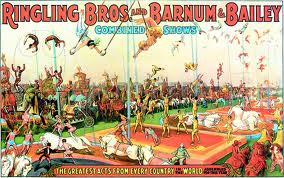
As I noted in the last blog entry, Ernst Bloch believed that “the circus is the only honest, down-to-earth honest performance.  A wall cannot be built anywhere in front of spectators who sit in a circle and surround performers.  Nevertheless, there is an estrangement” (179).

The confluences between Bloch and Walter Benjamin, in this claim and in these descriptions, are fascinating.  To be sure, Benjamin was also interested in the circus.  He also thought that although the circus was honest and utopian, it was fraught with estrangement.

We see the circus, utopia, and estrangement breached in Benjamin’s Kafka essay; namely, in the final section of the essay (which was published posthumously) entitled “Sancho Panza.”  In this section, Benjamin addresses the circus by way of the “Natural Theater of Oklahoma” that we see in Kafka’s novel Amerika.

Before addressing the Natural Theater, Benjamin cites a few lines from a Kafka short story about the “strange” ways of Kafka’s students and scribes.  They are the carriers and transmitters of tradition to the next generation and he is astonished by them:

‘To him, hammering is real hammering and at the same time nothing, which would have made the hammering even bolder, more determined, more real, and, if you like, more insane.’

Benjamin comments on this line that:

This is the resolute, fanatical mien which students have when they study; it is the strangest mien imaginable. The scribes, the students, are out of breath; they fairly race along.  (137)

Benjamin describes the scribes and students “as out of breath.”  They “race along” to receive and deliver the message of the tradition.  Benjamin goes to Kafka for the details.  And what we learn, from Kafka’s descriptions is that the narrator is astonished by the people who receive tradition.  Instead of seeing someone like Moses, Kafka’s narrator sees a bunch of schlemiels jumping up and down to get the message of tradition.  It is “strange…almost incomprehensible!”:

Often the official dictates in such a low voice that the scribe cannot even hear it sitting down; then he has to jump up, catch the diction, quickly sit down again and write it down, then jump up again and so forth.  How strange that is!  It is almost incomprehensible! 

Instead of explaining the meaning of tradition and this strangeness, Benjamin turns to the  Natural Theater of Oklahoma in Kafka’s Amerika:

It may be easier to understand this if one thinks of the actors in the Nature Theater.  Actors have to catch their cues in a flash, and they resemble those assiduous people in other ways as well.  Truly, for them, “hammering is real hammering and at the same time nothing” – provided that it is a part of their role.  They study the role, and only a bad actor would forget a word or movement. For the members of the Oklahoma troupe, however, the role is their earlier life; hence the “nature” in this Nature Theater. (137)

The nature of the nature theater is the earlier life of these characters.  The role they study is their tradition.  In other words, their earlier life is their tradition.  They inherit their childhood and learn it, play it.   In Bloch’s language, we could say that this is the “honest” element of the circus.  They play their earlier selves and they do so openly.  There is no curtain that stands between them and the audience.

Of them, Benjamin writes:

Its actors have been redeemed.

However, someone has not been redeemed and that is the student:

…whom Karl watches silently on this balcony as he reads his book, “turning the pages, occasionally looking something up in another book which he always snatched up quick as a flash, and frequently making notes in a notebook, which he always did with his face surprisingly close to the paper.”

The careful reader will understand what Benjamin is hinting at; namely, the fact that Karl is the student.  He is taking notes and “snatches” things up “in a flash.”  He is the unredeemed schlemiel who transmits the tradition.  Echoing the title of the section, he is Sancho Panza.

And perhaps this is what is most astonishing.  The fact that the schlemiel must spend his or her days recording and transmitting a tradition he or she doesn’t understand but only receives in flashes.  When it comes, he or she must “jump” up and snatch it as it flashes.

This is something the schlemiel must do as the schlemiel is not redeemed but these actors are.  By way of the Natural Theater of Oklahoma, Benjamin is saying something different than what Ernst Bloch says about the circus.  Although Bloch says there is an honesty and an estrangement to the circus that is unparalleled, he doesn’t explain why.  Benjamin does.

The honesty of Natural Theater, of the circus, is its nature.  It is the fact that it studies its earlier life and performs it.  This involvement is redemptive for the actors. However, those who carry on the tradition do not live this life.  It is they who are estranged.

Franz Kafka’s Karl Rossmann, who the Kafka scholar Heinz Politzer calls “infantile,” is a student; as is Sancho Panza and Walter Benjamin.  They are all students of tradition.  But in being students who transmit the tradition, they are not redeemed.  Not yet.

Rather, they are comic characters whose task is unnatural and yet necessary. Their leaping around after flashes and recording them, for Kafka, may be astonishing and strange but it is “almost incomprehensible.”

In other words, it is not completely incomprehensible.  It is in these small flashes that we know that a rationalist like Sancho Panza knew that the keepers of tradition and heritage were on to something.

Bloch knew this as well.  I would like to suggest that every comedian, writer, or performer of schlemiel comedy also understands this: without tradition, there would be no comedy and there would certainly not be a schlemiel.  Perhaps this is the “only honest down-to-earth honest performance” there is?

One doesn’t have to be in the circus to be a part of the circus.  All one has to do is watch it and, for those who want to carry on its tradition, all they have to do is leap up at the “flashes,” sit down, record them, and do that again….and again.

Its “almost incomprehensible!”

Ernst Bloch’s Musings on The Circus and Utopia – Take 1

DownloadedFile

History is the subject of a structure whose site is not homogenous time, empty time, but filled with presence of the now (Jetztzeit).  Thus, to Robespierre ancient Rome was a past charged with the time of the now which he blasted out of the continuum of history.  The French Revolution viewed itself as Rome reincarnate….Fashion has a flaire for the topical, no matter where it stirs in the thickets of long ago; it’s a tiger’s leap into the past (Walter Benjamin, Thesis XIV of the “Theses on the Philosophy of History”)

Throughout the ages, many great artists, poets, and thinkers have shown great love for the circus.  They feel that there is something about the circus.  It can tell us about who we really are, what we believe in, or what we hope for.  Perhaps the circus, as Walter Benjamin might say about “the presence of the now” (Jetztzeit), is our common origin.  Perhaps the circus is the revolution.  Perhaps it is the place where, as Benjamin says of fashion, there is a “tigers leap into the past.”

The circus, like the revolution, is a space where comedy, surprise, and excitement are center stage.  It is a social, an aesthetic, and a political space.  On the one hand, the Roman satirist Juvenal used the words “Panem et Circenses” (Bread and Circuses) to criticize those in power noting that the circus distracted Rome’s political leaders from history.  And it was used as a tool for gaining power.  On the other hand, the circus has been envisioned as a space of inversion and resistance to the dominant culture.  In the circus political power appears as ridiculous: it’s the only place where you will find Nobility and Clergy dressed up as or riding pigs.  Mikhail Bakhtin was one of the first theorists to explore this aspect of the circus; and in his notion of the carnivalesque, cultural studies and postmodernism found a model that proved fruitful for at least a decade or two.   In Rome, the circus was dominated by power; but in the middleages it was not.  The circus belonged to the people.

Like Bakhtin, Ernst Bloch also found the carnival to be of great interest.  In an essay entitled “Better Castles in the Sky” (from the essay collection The Utopian Function of Art and Literature) Bloch makes a confession or admission to truth.  His admission reveals that his fascination with the circus is a fascination with what makes us utopian.  His admission discloses the circus in what I, following Bloch, would call an “anticipatory illumination.”  To be sure, I would say that the circus, for Bloch, is the ultimate anticipatory illumination of utopia: “the circus is the only honest, down-to-earth honest performance.  A wall cannot be built anywhere in front of spectators who sit in a circle and surround performers.  Nevertheless, there is an estrangement”(179).

By saying that the circus is the “only honest, down-to-earth honest performance,” Bloch is saying something quite radical.  This implies that all other artistic performances are not honest or down to earth.  It also implies that Bloch values honesty and being “down-to-earth” which are basic folk virtues. To be sure, the honesty marks a kind of innocence with what makes us utopian.  In fact, he repeats the word “honest” twice so as to underscore the importance of this fundamentally social and political virtue.  But more importantly, these values, for Bloch, find their only vehicle in the circus and in no other artistic space.  Their vehicle is comedy!

All other theatrical performances are mixed with ideology, power, and dishonesty; the circus is not.  It has the quality of honesty.  It is so honest that it is utopian.  Bloch suggests that utopian justice, in this sense, is all about a kind of honesty that can only be prefigured in the circus.

Why is this the case?  Why does the circus, for Bloch, basically articulate, unlike any other art, the utopian function?  How does it articulate the “anticipatory illumination” and what he would call “genuine heritage?”

Before Bloch makes his admissions of truth for the circus and its utopian function, he discusses the roots of the circus performance.   According to Bloch, “the sideshows at the fair” are uncanny and exciting because “they don’t originate here, nor does their magic, which is continually dusted off and revealed anew in the repeated performances of the sideshows”(178).  The magic we see at the circus “operates as if abnormal and foreign.  Yet, it is ordinary and full of swindles”(178).  To be sure, it is very canny.  It is plain, simple, and downright ordinary.  However, it is “still more substantial than the trouble that the philistine causes for the age-old joy of young and old people.”  In other words, the circus, for all its ordinariness, is more substantial than the law.

The circus is the spirit; the philistines – the ruling class – are the law.

Instead of pursuing this distinction further, Bloch takes a detour.  Bloch’s detour takes us into the life of the circus and the nature of its magic: in taking this detour, Bloch avoids talking about the origin of the circus.  All Bloch notes, before this point, is that they (those in the circus) “don’t originate here.”  Does this mean they originate elsewhere, in another world?  Where are the people of the circus from?

Bloch cuts in with quasi-historicism for an answer.  Bloch suggests, as if we know,  that a circus is a “boat like show”: “So these boat like shows set sail and are carried by the South Seas for the simple soul and the uncorrupted, complicated soul too.”  The circus, originally a boat show, is for the simpleton (the schlemiel) and the complicated soul (the skeptic).

Moreover, the ship visits all kinds of cities; the ships have no boundaries: “The tent-boats weigh anchor for a short time in the dusty cities. They are tattooed with pale green or bloodthirsty paintings in which votive pictures projecting rescue at sea disasters are mixed with those of the harem.”

At this point, Bloch slips into the mode of allegory and allusion to illustrate why the circus is the “only honest, down-to-earth honest performance.”

I’d like to closely follow his words so as to figure out what he is alluding to with a canny-slash-uncanny circus that originates on the sea but, in our day, finds itself on the ground.

Bloch creates a metonymy of sorts associating the “motor” of the boat with a sound that is “foreign, fatty, unhuman, breathless, sluggish”(178).  And from sound Bloch moves to the figure of a “dancing wax lady screwed down next to the entrance.  And she dances with sudden contortions, moves with twisted gestures of screwed down wax that turn into dance, and she throws her head back from time to time.”

The first thing that strikes me about this metonymy is that the figure moves and is nailed down; its dance embodies a dialectical tension and, for this reason, it appears comical.  It reminds me of a dancing Hula doll.

Bloch writes of this figure lovingly and situates it behind the barker of the circus, who brings her to a halt.   After noting this Bloch explains its “hidden meaning” by way of a juxtaposition of life and death:

Eventually she comes to a halt and trembles in this position right behind the barker, who fears nothing.  The type of world extolled here has the secrets of the bridal bed and also the miscarriage at one end and the secrets of the bier on the other end. (178)

This image is mythical.  Bloch passes from this image, however, to one that is full of particularities and seems to play with myth by way of plurality:

Strange human creatures and their art offer themselves to spectators in nothing but peepshows of abnormality. The sword swallower and fire eater, the man with the untearable tongue and iron skull, the snake charmer add the live aquarium.  Turks, pumpkin men, fat women, they are all there.

Once Bloch realizes he has gone way out in his description, he reels it in with some analysis, noting that “fairy tale realm reappears continually and also that of the horror story.”  This implies that the fair moves between innocence and horror.  He calls “the fair, a colorful, peasant fantasy.”  However, it is interrupted by the city (as well as by horror).

He notes the historical change from the country to the city in the movement of the fair from Europe to America:

In the large American cities it has become increasingly automated with loudspeakers and amusement centers.   However, the land of the wishes from the medieval South Seas, so to speak, has remained.  And it maintains itself out of the Middle ages, which go much further back, right to the fair of the higher order, in the kind of show of the Circenses without any curtain at all. (79)

What Bloch does over here is articulate what we saw in yesterday’s blog; namely, the “genuine heritage.”  To be sure, Bloch sees the fair as the heritage to which he, a circus lover and a lover of honesty, must turn.  His language, following upon his mention of a show of a “higher order,” a Circenses “without any curtain at all” verges on the religious and the revolutionary.

In Benjamin’s sense of the “tiger leap” backwards, Bloch sees a merging of all times in the ring of the circus.  In the “ring” of the circus the Medieval, the Roman, and the tradition of the circus on the sea come together:

For, as the miracles of the sidewshows are assembled together under one roof, in a ring, and as the managerie breaks out from here, the coliseum or the circus now originates from the South Seas. (79)

However, as with history, something is lost.  And what is it?  The hula doll I referenced above (the wax dancer):

Of course, the feature of the wax figure cabinet cannot be present here, that suspended animation, that mechanical organ, because everything in the circus is alive.  And, in contrast to the fair, which operates with concealment, with stage, showcase, and curtains, the circus is fully open.  The ring brings everything with it.

But although the hula doll is gone, something new and revolutionary, something much more revolutionary than the fair or the sea circus has arrived.  For Bloch the circus is the most revolutionary because it is “fully open.”  It is, for this reason, the most utopian space.

To be sure, following this claim that the “circus is fully open. The ring brings everything with it,” Bloch makes his greatest claim: “The circus is the only honest, down-to-earth honest performance.”

This admission of truth is his way of taking the “tigers leap” into the past.

And as Friedrich Holderlin has said (and Martin Heidegger reminds us in his famous essay on the “The Origin of the Work of Art”): “that which dwells near the origin departs.”

Or as Bloch tells us, utopia starts and will always end in the circus.


Ernst Bloch and Tradition – Take 2

images-1

What does Ernst Bloch mean by the “rectification” as opposed to the “reification” of heritage?  And how does he justify rectification?  And, most importantly (at least for this blog), how does this relate to the tradition of the schlemiel?

As I pointed out in my last blog entry, Bloch is in favor of a “cultural surplus” which emerges from the “utopian function.”  Such a cultural surplus would be “beyond any kind of ideology.”  According to Bloch, one creates such a surplus by creating culture.  But here’s the twist.  By creating culture, Bloch does not mean that we create something that is “new” in the sense of something that is completely “modern.”  To be sure, Bloch’s understanding of cultural creation is related to the utopian function, which is inseparable from tradition.

This creation includes actual artworks and cultural criticism.

But what makes his criticism or this or that artwork an act of “rectification” is the fact that they include what he calls an “anticipatory illumination.”  These illuminations, he insists, are not in the service of ideology.  Rather, they are the “useful information of justice.”  In other words, when criticism or art dig into tradition what they bring out, in their anticipatory illuminations, is “information” that can be used toward achieving justice.

It seems that the justification of this cultural work of rectification can be found in this end and no other.  However, some people may rightfully find this vague.  To be sure, they may accuse Bloch of embellishment.  Anticipating this claim, Bloch notes, in his essay “Art and Society,” that anticipatory illumination is not a rhetorical figure; rather, it is a “structured illumination”:

If this anticipatory illumination, as structured illumination, has nothing in common with embellishment – rather, if it is based more on the tendency and latency of the time and on the unknown essence (das Eigentliche) in which the world (not art) could attain its aim – that this is realism. (49)

Bloch’s turn toward realism is telling since it seems to echo the turn to realism made by Georg Lukacs.   But Bloch explains:

To be sure, though, this is certainly not naturalism.  It is that realism of tendency and latency (the realism that touches on both) that includes the latent frames of the powerful reality of Velasquez, Balzac, and Tolstoy, just as it made the widest reality of the powerful latency of Goethe’s Faust. (49)

Bloch’s words may confuse many a reader, but what one must realize is that he is not using realism in the typical sense nor is he is citing Velasquez et al as examples of realism. Rather, he is including their work and Goethe’s Faust as illustrating both aspects of “anticipatory illumination”: tendency and latency.

The meaning of these terms can help us to understand what Bloch means by “rectification.”   Taken together, what these works do is to create what Bloch calls the “hypothetical in the cultural heritage.”  They do this by “converting” the material of the tradition into art:

The continual and effective conversion of the material into the hypothetical in the cultural heritage, that is, in the utopian surplus as both heritage and anticipatory illumination, sublates the material in such a minimal way that it opens up its potential in the most vigorous manner and articulates its horizon. (50)

By becoming a hypothetical, by becoming a real possibility, the cultural heritage becomes relevant.  On the one hand it does not, in a Hegelian manner, become surpassed; on the other hand, by giving it attention, it doesn’t become some kind of ideal.  It is materialized:

Due to this process, material is not left idealistically or even surpassed.  Rather, it continues to enlighten, opens itself up more and more to us, to the coming foundation of consensus, to that which has yet to become, that which has still not been accomplished, but which has not been thwarted in existence, in existence as realm. (50)

At this moment in the text, Bloch concludes that now, in this stage of his argument, the difference between “tradition” and “producing the future is dissolved”:

Thus the difference between tradition and producing the future is dissolved; certainly the contrast is dissolved.  The revelation of truth in the cultural heritage is a territory with boundary lines stripped away in a wider territory of anticipatory illumination that is to be articulated in a responsible and concrete way. (50)

Bloch, using Marxist rhetoric, goes on to claim that the past, after entering such a productive process of anticipatory illumination, will no longer be alienated.  And he exclaims: “Now this would be real cultural heritage, with tradition of the future.”

But, more importantly, the production of such a cultural heritage, this tradition of the future, creates hope.  Without such work, things would be bleak.

The question is how do we do such a work in a “responsible and concrete” way?  Have we accomplished our goal of “rectification” if we have taken this or that element of the past and created an “anticipatory illumination?”   Perhaps the success or failure of such a project of recovery and rectification of the past is measured by the hope it produces?

In doing my work on the schlemiel, I wonder, given what Bloch has written, how it could produce an “anticipatory illumination” and a “cultural surplus.”  How could writing on the schlemiel – doing schlemiel criticism – rectify the Jewish tradition and offer hope?

These are all good questions to ask and consider since, of all the aspects of Jewish culture, the humorous aspect is the most referenced in the public sphere. The schlemiel has been chosen as a significant representative of Jewishness in the modern world.  This is testified by its saturation in Hollywood and on TV.   But is the schlemiel, using Bloch’s language, still alienated?  When we watch Larry David’s Curb Your Enthusiasm or Judd Apatow’s Knocked Up, do we have an “anticipatory revelation” or is this missing in their work?

If we watch these shows and we have no sense of what is and what can be (of tendency and latency), then these works have not “rectified” the schlemiel.  Bloch would suggest, given this scenario, that if they do not then the work of criticism should.  Given this suggestion, I will continue looking into the “tradition of the schlemiel” and the “Jewish tradition” in search of “anticipatory illumination.”  I say “continue” because I have, in many ways, already been doing this.  I have been looking for how the schlemiel relates to tradition, on the one hand, and the prophetic and the messianic on the other.  The question of whether or not the schlemiel – in his or her failures – offers hope is a constant question.   I have also wondered how the utopian hope’s of the schlemiel can lead to disaster.  Moreover, I have – and will continue to address – the latency of the schlemiel in work on the schlemiel and Walter Benjamin.

Looking back on what I have written on Walter Benjamin’s reading of Sancho Panza and Don Quixote – in his Kafka essay – I can clearly see that Benjamin was looking at the structure of tradition and heritage.  He was looking into how the legacy of the fool related to his future.  To be sure, it would make sense to say that his reading of Kafka by way of Don Quixote is an anticipatory illumination.  It has a tendency and a latency to it and, as we see in at least one of his letters to Gershom Scholem, it gave him hope.

But the question, in that letter, remains.  It is the same question that Bloch would ask of the figure of the fool.  It may give hope but can it “do humanity any good?”  (Although it may rectify tradition, will it rectify humanity?)  This is the utopian question of the schlemiel.  But it may also be the schlemiel hypothesis.

Ernst Bloch’s Reflections on Tradition – Take One

DownloadedFile

In the last blog entry, I contrasted Slavoj Zizek to Walter Benjamin with regard to the tension between tradition and the liquidation of tradition. Zizek follows one strain of Benjamin; namely, the liquidationist strain.  Zizek prefers Benjamin’s “Destructive Character” and Benjamin’s notion of “Divine Violence” to Benjamin’s interest in preserving the tension between tradition and its liquidation.

At the end of my last blog entry, I stated why I was interested in such a tension; namely, because Benjamin’s reading of Kafka and Don Quixote is based on preserving this tension.  And, as I have been arguing, this tension has everything to do with the tradition of the fool and the schlemiel.   To further understand what Benjamin sought to find in this tension, I would like to turn to an essay by Ernst Bloch entitled “Art and Society” (from The Utopian Function of Art and Literature, trans. and edited by Jack Zipes and Frank Mecklenburg).

Walter Benjamin was influenced by and influenced Ernst Bloch. They had a productive relationship.  They were interested in this tension as it pertained to the future – to utopia.

For Bloch and Benjamin all works that emerge from the tradition are mortified.   They are fragmented and are in need of future redemption.  However, these works are not the works of the “victors” of history.  Rather, they are the incompleted works of those who lost.  These are the works of failures.   And, for Bloch, they are ‘our’ heritage.

In his essay “Art and Society,” Bloch cites Benjamin to illustrate some of the “spiritual” things we should take from this heritage:

They (the spiritual things) are alive as confidence, courage, humor, cunning, and fortitude, and they have a retroactive effect as time moves along.  They call into question each victory of the ruling class time and time again. (46)

However, Bloch adds on to what Benjamin says and gives it shape. He does this by calling attention to the next generation; namely, to the heirs of tradition:

In addition, cultural heritage only becomes what it is when the heir does not die along with its benefactor, when he stands on the side of the future in the past, when he stands with what is indelible in the cultural heritage and not with the takeover of parasitical rulers (46).

Bloch calls for a “productive cultural heritage” and contrasts it to a “refined completion” of “the great work of culture.”  For Bloch, a “productive cultural heritage” operates “as the successive continuation of the implications in the contellations of the past gathered around us as non-past.”  In other words, we continue a tradition whose implications are present (non-past).

Bloch notes that, as Benjamin would say, the past gives one agency.  The past, in a sense, elects one and empowers one to act.  It “anticipates” him:

The genuine agent of cultural heritage reaches into the past, and in this very same act the past itself anticipates him, involves and needs him. (46)

Bloch calls heritage a chariot which “carries only that which has an order to be sealed.” To take this heritage on, Bloch says one must be strong.  One may be overwhelmed by it.  To be sure, the person is strong because s/he takes heritage and besides having the strength to continue it s/he invents (47).

Bloch contrasts himself to Martin Heidegger who, in his opinion, created a “pseudo-philology and a pseudo-interpretation” of Holderlin, Anaximander, Parmenides, Plato, and Kant.  According to Bloch, Heidegger’s relation to history was to “caricature” it.  In contrast, Bloch argues that “genuine heritage is and remains precise and progressive transformation, and to be sure, a transformation of that immanent material in the material of heritage intended for completion without ideology, with implication”(48).

Bloch imagined a “rectification of heritage” and not a “reification of heritage.”  He imagined a rectification that would not serve this or that ideology.  This could happen in a world with a “cultural surplus beyond any ideology.”  This, Bloch says, comes out of the “utopian function.”

The utopian function, however, is not based on envisioning, quite simply, the liquidation of history or heritage.  To be sure, Bloch like Benjamin wanted to create a “cultural surplus beyond any ideology.”  And the best way to accomplish this is to dig into cultural heritage.  Namely, the heritage that many people might find insignificant or trivial.

It is these failed elements that carry the charge and call for transformation.  The interesting thing to keep in mind is that Bloch and Benjamin didn’t randomly choose this or that aspect of tradition.  They were both interested in storytelling, fairytales, folk legends, and fools.

Their heritage was plural. For this reason, Walter Benjamin and Bloch often drew on many different folk traditions in their work.  I am especially interested in Benjamin’s reading of Kafka insofar as he starts his essay not with a meditation on Jewish folklore but on Russian folklore.  And he ends the essay with a meditation on Don Quixote and Sancho Panza.

Nonetheless, Benjamin doesn’t shy away from citing Jewish folklore as well.  To be sure, he too was trying to create a cultural surplus and believed, like Bloch, in the “rectification of heritage.”  And this is more than evident in his Kafka essay where, I would argue, the schlemiel and the heritage of the schlemiel emerges.

(Please note that I will touch on this heritage in this blog.  But I will delve more deeply into it in my book. After all, I can’t reveal all my secrets.)

Like Bloch, Benjamin wasn’t interested in liquidating tradition so much as in rectifying it.  As I have already shown, Benjamin was aware of what is at stake with tradition.  The question, however, is how we are to read the cultural surplus (vis-à-vis the fool) that Benjamin left for us and what we should do with it.

Now that Benjamin’s criticism has nearly exhausted itself in terms of the obsessive reading of his work in terms of crisis and destruction, its time to dig up what has been passed over as irrelevant (the detritus of Benjamin criticism is to be found in the tension between heritage and its liquidation; it is to be found in the greatest comic failure of all and the tradition that gave birth to it: the schlemiel).

In the next few blogs, I will sketch out more of Bloch’s project vis-à-vis tradition and utopia.  The point of this exercise is to help us to understand Benjamin’s interest in Kafka, the schlemiel, and tradition.

Apocalypse Now – When Crisis Comes, Whither Humor?

images-1

Imagine everything coming to a grinding halt.  Imagine a moment in which all would be still.  Given our ever-increasingly hurried lives, this full stop is hard for us to imagine.  But it doesn’t keep us, by any means, from trying.  To be sure, countless films and science-fiction novels imagine this moment in endless variations.  But the cessation of time is not simply the matter of fiction and fantasy.  To be sure, real life crises interrupt everything.  Surprises are also at the core of religion.  Radicals, revolutionaries, and religious devotees all know that bringing the world to a grinding halt testifies to some kind of truth that goes beyond what we habitually perceive and practice.

On the one hand, death, murder, natural disaster, and terrorism stop everything.  On the other hand, miracles and unexpected occurrences stop everything.

In the Jewish tradition, Revelation usually stops everything. To be sure, Revelation interrupts.  We see this in simple passages when God comes out of nowhere to call on Abraham or Moses.  Moreover, many commandments are constructed, specifically, to interrupt this or that form of work or common practice.  The greatest interruption of work being the weekly Sabbath where all forms of work are forbidden.  The interruption of work reaches its climax in the Jubilee year – which falls on the fiftieth year, at the end of seven seven-year cycles – when all work is forbidden.

In terms of Revelation, the Midrash tells us that the revelation on Mt. Sinai made everyone pause.   In that moment of cessation, everyone shared a moment of prophesy. The Midrash goes so far as to say that every child in the womb partook in the vision of God.  Of greater interest is the characterization of the Messianic Era, which is, on the one hand, likened to a cessation of war.  On the other hand, it is likened to a series of miracles which will fundamentally change reality.  On the one hand, there is a type of cessation that is reasonable; on the other hand we have a cessation that is not.   The Rabbis prefer the peaceful manifestations of the Messianic; however, there are also manifestations which are riddled with crisis and disaster.  These are what Gershom Scholem would call Apocalyptic or Utopian manifestations of the “Messianic Idea.”

Regarding the most unexpected interruption, the Midrash tells us that the Messiah will come in the blink of an eye (k’heref ayin).   He will come when he is least expected.

To be sure, these interruptions are so important that nearly every Jewish holiday commemorates them.   Moreover, they many Jewish holidays anticipate interruption.  But, by and large, the interruption doesn’t destroy the law, it doesn’t “fulfill” it; rather, it keeps the law in tact. And this ‘fact’ distinguishes a Jewish interruption of the world from other disruptions whose Apocalyptic manifestations are much more severe.

Drawing on a similar mystical structure of cessation, Walter Benjamin and Slovoj Zizek have imagined a messianic moment of cessation.  Benjamin called it “dialectics at a standstill” and Neuezeit (now time).   But it can also be thought of, negatively, as a state of exception or crisis.  In this state, progress ceases and power predominates.  Zizek opts for the more Apocalyptic version and demands that we do to.   And although Zizek employs humor and ridicule in his work, there is nothing funny about this at all.  To be sure, Zizek uses ridicule to prepare us for the big thing: the Apocalyptic moment of cessation which has everything to do with making a decision that is riddled with crisis and even self-destruction.

At the end of his book First as Tragedy, then as Farce Zizek meditates on this moment of cessation.  To be sure, this is his dream.  When time comes to a standstill, there will be a revelation, that is, a profane illumination.  For Zizek, the revelation, at the time of crisis, is that we do not need a leader; “we” don’t need the Other.  Rather: We are all redeemers.

Zizek uses these terms, and many others like them, to describe who we are in the aftermath of the destruction of liberal democracy and capitalism.  They are Apocalyptic. To be sure, Zizek sounds a lot like what Gershom Scholem, in his book On Kabbalah and its Symbolism, calls a nihilistic mystic.

The nihilistic mystic descends into the abyss in which the freedom of living things is born; he passes through all the embodiments and forms that come his way, committing himself to none; and not content with rejecting and abrogating all values and laws, he tramples them underfoot and desecrates them, in order to attain the elixir of life.

One can no longer just “let being be.”  Zizek, like the nihilistic mystic, wants to bring the end on.  He wants us to act and hasten its coming.  He forgoes the Talmudic dictum that one must not hasten the end.

Scholem’s words on the Apocalyptic – in his essay “Towards an Understanding of the Messianic Idea” –  can be applied to Zizek’s final words in his book:

The apocalyptists have always cherished the pessimistic view of the world. Their optimism, their hope, is not directed to what history will bring forth, but to that which will arise in its ruin, free at last and undisguised.

The one who wishes for the end will, necessarily, destroy both progress and tradition.

Both the liberal and the conservative are one and the same for the nihilistic mystic.  In On Kabbalah and Its Symbolism, Scholem says that the nihilistic mystic, in effect, destroys the language of the tradition because his mystical experience cannot use words or words from the tradition to speak.  The regular mystic, on the other hand, transforms the existing language and modifies the tradition.  In other words, language, the tradition, remain.  And with it what language transmits.  As Walter Benjamin notes, tradition is primarily about transmission and not about content.  Nonetheless, it does transmit something to the student of tradition.  With the nihilistic mystic, that is lost.  The difference between one and the other is the difference between liquidating tradition and language and preserving it.

According to John McCole in his book Walter Benjamin and the Antinomies of Tradition, Benjamin has two modes: one mode is the modality of liquidation (this errs on the side of modernity and destroys tradtion) the other mode is conservative (not in the regular sense of the word; rather, it looks to conserve memory, tradition, transmission. Both matter to Benjamin.  According to McCole, this is one of the most fruitful and unexplored aspects of his work.  To be sure, Benjamin, paradoxically, wanted nothing more than to preserve the tension between conservation and liquidation of tradition.

The most essential thing to transfer is the teaching of tradition which is on the very edge of liquidation.  And as I have argued in another blog entry, the tradition of the schlemiel keeps us on the fine line between Apocalyptic liquidation and conservation.  Zizek, however, doesn’t take up this line of thinking.  He seems to be more interested in liquidation.

Zizek, strangely enough, cites Benjamin a lot in his Apocalyptic section.  To be sure, Apocalypse is all about liquidation; namely, of the law.  The law, for Zizek (and at least one strain of Benjamin; namely his piece of “Critique of Violence,” which McCole sees as only one of two aspects, as I mentioned above), is connected to the Other.  Law, for Judaism, is inseparable from tradition.  Without law, there can be no tradition.  For Zizek, this isn’t even an issue. The Benjamin Zizek is drawn to is Benjamin-the-liquidationist.  Which we find in the “Critique of Violence” and in “The Destructive Character.”  Taking a look at these, one forgets about Benjamin’s profound interest in tradition.

I will end this blog entry with an illustration of Zizek’s tendency toward liquidation. In the spirit of a nihilistic mystic, Zizek tells us that this liquidation is based on our decision. It is a “proper political act”:

This is what a proper political act would be today: not so much to unleash a new movement so as to interrupt the present predominant movement.  An act of “divine violence” would then mean pulling the emergency cord on the train of Historical Progress.  In other words, one has to learn fully to accept that there is no big Other. (149)

Zizek, a Messianic activist of sorts, cites Benjamin’s phrase in quotes (“divine violence”).  This appeal  is reminiscent of at least one strain of Benjamin’s work.  Rewriting one of  Walter Benjamin’s “Philosophical Theses,” Zizek says that he wants to “pull the emergency cord of the train of Historical progress.”  But when one does this, one must have another notion of time to substitute for progress.   Knowing this, Zizek cites Jean-Pierre Dupuy’s claim that:

If we are to confront adequately the threat of (social or environmental) catastrophe, we need to break out of the “historical” notion of temporality: we have to introduce a new notion of time.  Dupuy calls this time the “time of a project,” of a closed circuit between the past and the future: the future is causally produced by our acts in the past, wheile the way we act is determined by our anticipation of the future and our reaction to this anticipation. (150)

The anticipation of the end is, in other words, measured by our act to bring it about.  Our act of liquidation is the time of the project.  And this helps us, says Zizek, to confront the disaster:

This, then, is how Dupuy proposes to confront the disaster: we should first perceive it as our fate, as unavoidable, and then, projecting ourselves into it, adopting its standpoint, we should retroactively insert into its past (the past of the future) counterfactual possibilities….upon which we then act today.  We have to accept that, at the level of possibilities, our future is doomed, that the catastrophe will take place, that it is our destiny – and then, against the background of this acceptance, mobilize our selves to perform the act which will change our destiny itself and thereby insert a new possibility into the past. (151)

Everything will be destroyed.  Everything will be liquidated.  Zizek insists that we must accept this fact.   And once we have accepted our doom, we can decide; we can “perform the act which will change our destiny and thereby insert a new possibility into the past.”  In the most Sartrean or even Nietzschean sense, everything is in the act (or deed).

To “perform the act that will change our destiny” is to embrace at least one sort of mysticism; a mysticism without tradition.  This transmits nothing except our decision to accept total disaster of everything as the source of revelation.  The act posits a new past, but I would suggest that this has nothing to do with tradition so much as it does with a new initiation of history.  In other words, the decision to liquidate history is the beginning of a new tradition.

In contrast to the scene Benjamin proposes with Don Quixote, Zizek’s Apocalyptic scene has no humor whatsoever.  In the end, it seems the other way around: First as Farce, then as Tragedy.  Since, in the beginning Zizek ridicules ideology, liberalism, and deconstruction, but here ridicule passes away and one is faced with ones utter annihilation.  The only thing that matters, in this scene, is that act.  Even though, Zizek praises the act that initiates a new tradition, the fact of the matter is that the accent is on the act of liquidation not tradition.  Nothing is transmitted accept the act of destruction.  History ceases to exist; it stops. But so does tradition.

In this moment, Zizek’s approach to comedy takes a nosedive.  To be sure, ridicule, in Zizek’s sense, leads us to desire the moment of liquidation in which all time will stop.  It leads us to anticipate – and embrace – a time of crisis.  In contrast, for Benjamin, the tradition of comedy, the tradition on Don Quixote and the Schlemiel was worth saving.  Unfortunately, more people see Benjamin’s “Philosophical Theses” and his words on history, there, as his final word. They overlook his desire to preserve the comic tradition which we find in his Kafka essay.  Instead of picking liquidation over conservation, we need to find a way of balancing out the antinomy between tradition and its liquidation.  And I think that the best way to do this is by way of making a close reading of Benjamin’s reading of comedy.

What we need to ask, however, is how cessation relates to the comic relation between Don Quixote and Sancho Panza.  This is a question which has not yet been asked.  Lest we not forget, Kafka notes that Don Quixote was constantly surprising Sancho Panza.  And on his journey, following Quixote wherever he went, Panza was, so to speak, out of work.  His eyes were not on history and neither were they on catastrophe, they were on Don Quixote.  His “act” was to follow Don Quixote.  His act was not an act of liquidation; it was an act of reverence and respect for the comic figure not the tragic one.  His act was not an act of a nihilistic mystic; it was the act of a student of tradition.

And as Benjamin says, Kafka taught us that only a fool can help.

I’ll leave it at that.

On the Apocalyptic Tone of Comedy – Take 1

images-3

For some writers, there’s nothing like a good death sentence.   Merely describing a death, for some writers, is ecstatic and revelatory.  In doing so these writers feel as if they are bearing witness to death while proclaiming a new beginning.  There is a sense of pathos, meaning, and liberation from the dead in such descriptions.

By speaking in an Apocalyptic Tone, one is, so to speak, transformed.  But, most importantly, this transformation is based on describing some kind of disaster to the reader.

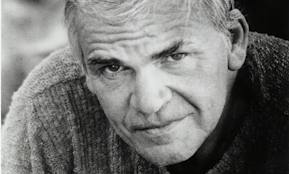
Milan Kundera, who is internationally known for novels such as the Unbearable Lightness of Being and The Book of Laughter and Forgetting, is one of these writers.  But what makes him unique is that the death sentence he pronounces or describes involves the enunciation of comedy, on the one hand, and his commitment to its legacy, on the other.

In The Art of the Novel, Milan Kundera argues that comedy changed everything.  According to Kundera, comedy announces the death of tradition, certainty, and religion.   But, at the same time, it announces a new tradition which is born in the wake of death.  For Kundera, the origin of this new tradition, which bears witness to the death of the old tradition, has a proper name.

Kundera names the herald of death and the father of a new tradition: Don Quixote.

Kundera’s words echo Nietzsche’s “Madman” aphorism in the Gay Science where Nietzsche’s madman announces “God is dead. God remains dead. And we have killed him.”  But as God dies, something new is born: the comic novel.

As God slowly departed from the seat whence he had directed the universe and its order of values, distinguished good from evil, and endowed each thing with meaning, Don Quixote set forth from his house into a world he could no longer recognize.  In the absence of the Supreme Judge, the world suddenly appeared in its tiresome ambiguity; the single divine Truth decomposed into a myriad of relative truths, parceled out by men.  Thus was born the world of the Modern Era, and with it the novel, the image and model of that world.

Kundera deftly moves from Don Quixote to Descartes and then Hegel to describe the new world that the novel is the “image and model.”  What does this mean?  Kundera repeats the words “to take” twice to indicate what is at stake:

To take, with Descartes, the thinking self as the basis of everything (and not God), and thus to face the universe alone, is to adopt the attitude that Hegel was right to call heroic.

To take, with Cervantes, the world as ambiguity, to be obliged to face not a single absolute truth but a welter of contradictory truths (truths embodied in imaginary selves called characters), to have as one’s only certainty the wisdom of uncertainty, requires no less courage.

Let’s spell out what Kundera is saying: For the philosopher “to take” him/herself as radically alone, without God, is courageous.  And for the novel “to take the world of ambiguity” and to be “obliged” (that is, ethically charged) to “face not a single absolute truth but a welter of contradictory truths” is also courageous.  Kundera pronounces this courage and he identifies with it.  It is his.

But, according to Kundera, the novel is more heroic than the philosopher because it challenges man’s moral “desire” for “a world where good and evil can be clearly distinguished.”   This desire is a religious desire and a philosophical desire that is inherited from what the Enlighteners would call the ancients.  For Kundera, modernity challenges orthodoxy on this specific point regarding good and evil.  And, for Kundera, it is Don Quixote who bravely travels into the world and says no to the desire for a world “where good and evil can be clearly distinguished.”

The comic novel, in other words, is the herald of the death of God and the courageous embrace of a world in which good blends into evil and vice versa.  According to Kundera, the “inability” to distinguish between good and evil “makes the novel’s wisdom (the wisdom of uncertainty) hard to accept and understand.”

In other words, a normal individual would rather accept the world of the Bible where good and evil are clearly distinguished than accept the novel.  For Kundera, the comic novel “courageously” says no to such a world.  It denies its existence.  In making such a claim, Kundera is basically rewriting Neitzsche’s madman aphorism in terms of the comic novel.  As I noted, Kundera insists that Don Quixote “sets forth into the world” while “God slowly departs.”

In other words, the fool arrives after the death sentence from God has been pronounced.  For Kundera, the two coincide.  The fact of the matter is that we are led into the modern world by a fool.  Furthermore, Kundera implies that the wisdom of the fool is the wisdom of the comic novel.  For Kundera, this wisdom is existential.  The fool and not the normal individual who desires a clear understanding of right and wrong  is the hero.  The fool courageously embraces ambiguity.  But this is not simply a description of an ubermesche (overman) or a modern existential ideal.  No.  For Kundera, what is more important that such courage is the tradition that is passes on.  As Kundera argues, Don Quixote lives on from generation to generation but he disguises himself.

Kundera traces a path from Don Quixote to Kafka and he spots Don Quixote in the disguise of Kafka’s Land Surveyor:

Isn’t that Don Quixotre himself, after a three-hundred-year journey, returning to the village disguised as a land surveyor?

What we have here is a comic tradition.  But things have changed.  Unlike Don Quixote, the Land Surveyor’s “adventure is imposed on him.”  He is forced to wander in ambiguity.  How can one courageously accept this?  To be sure, the latter day Don Quixote cannot freely embrace ambiguity as his predecessor did.  He is not heroic.

The new message is Apocalyptic and Kundera is describing it for us. The herald of this message is Kafka.  Now the land Surveyor lives in a world which is not simply ambiguous; it is dangerous.  The world may kill this comic character! It deprives the fool of his freedom.  Perhaps Kafka’s Land Surveyor (from The Castle) marks the death of a legacy?

After Kafka, Kundera wonders: is the novel dead?

But if Cervantes is the founder of the Modern Era, then the end of his legacy ought to signify more than a mere stage in the history of literary forms; it would herald the end of the Modern Era.  That is why the blissful smile that accompanies those obituaries of the novel strike me is frivolous.  Frivolous because I have already seen and lived thorugh the death of the novel, a violent death (inflicted by bans, censorship, and ideological pressure) in the world where I spent much of my life and which is usually called totalitarian.

In effect, Kundera is telling us, by virtue of his own personal witness, that the novel was killed by the Totalitarian world.  This world, in contrast to the novel, lives in accordance with “one single Truth.”

But this is not enough of a death sentence. Kundera says that the novel is a “cemetery of missed opportunities.”  They include four appeals: to play, to the dream, to thought, and to time.

Kundera notes authors for each appeal.  They include, respectively, Laurence Sterne and Denis Diderot (appeal to play); Franz Kafka and the Surrealists (appeal to dream); Musil and Broch (the appeal to thought); and Proust (the appeal to time).

In an Apocalyptic tone, he notes that they all belong to a “cemetery of missed opportunities.”  Milan Kundera has personally witnessed their death.  He has witnessed the political death of the novel and the death of all of these appeals.  However, at this moment of description, in the face of this death, Kundera pronounces a new life for the novel. He pronounces a new purpose in the post-totalitarian era.

In a world in which everything is caught up in a “veritable whirlpool of reduection” the novel’s raison d’etre is to “keep the ‘world of life’ under a permanent light and to protect us from the ‘forgetting of being.’”

To courageously accomplish this mission, the novel must battle that which will reduce its complexity.  But there is something more important that this great task.  In a moment which challenges the modern idea of overcoming tradition, Kundera embraces one.  Kundera tells us that the “novel’s spirit is the spirit of continuity.”  In other words, although Kafka’s novel suffered the fate of history and politics, although it died, and althought the novel is a “cemetery of missed opportunities.” it is still a legacy.  And it is this legacy that was given to Kafka by Don Quixote.  Kundera, in effect, takes this legacy up. 

He does this after he announces that he is not attached to the future, God, Country, the People or the Individual.  He is, rather, attached to the “depreciated legacy of Cervantes”:

But if the future is not a value for me, than to what am I attached? To God? Country? The People? The individual?  My answer is as ridiculous as it is sincere: I am attached to nothing but the deprecated legacy of Cervantes.

What I find so astonishing about this confession is that Kundera’s move to attach himself to this legacy parallels the decision made by Walter Benjamin at the end of his essay on Kafka.  There, Benjamin mentions his favorite Kafka aphorism, which is entitled Don Quixote.  There, Benjamin likens himself to a Sancho Panza who, like Kundera, attaches himself to the legacy of Don Quixote.  Before Benjamin takes on this legacy, he begins by citing Kafka’s aphorism:

A free man, Sancho Panza philosophically followed Don Quixote on his crusades, perhaps out of a sense of responsibility, and thus enjoyed a great and profitable entertainment to the end of his days.

To this, Benjamin adds a new description of Sancho Panza:

Sancho Panza, a sedate fool and a clumsy assistant, sent the rider on ahead.

To be sure, Benjamin rewrites Cervantes’ Sancho Panza as a Sancho Panza in Kafka’s clothing.  And strangley enough, Benjamin notes that Sancho Panza “sent the rider ahead” which implies that Sancho Panza sent the legacy of the fool out into future generations.  In an earlier blog, I called this the schlemiel tradition.

What I would like to note here, however, is that Kundera also sees this tradition.  And, as like Benjamin before him, Kundera lovingly attaches himself to it.  However, Kundera’s attachment is made in the wake of death; namely, the death of God.  Benjamin isn’t as explicit about the Apocalyptic in his taking on the tradition.  Rather, he does so by way of allusion.

Kundera spells out what we can see in Benjamin’s words.  The assumption of this tradition is “ridiculous and sincere.”  Kundera’s words imply that he is a schlemiel author, a simpleton, who, in taking this tradition on, is “sincere” yet “ridiculous.”   This, I would argue, outweighs the ambiguity and complexity of the novel.  This sincere and ridiculous assumption of the schlemiel tradition includes all of the appeals of the novel to time, play, dream, and thought.

Most importantly, Kundera is telling us that in a world where good and evil are hard to distinguish, the most moral person of all is he who commits himself, in the most ridiculous and sincere way to the schlemiel tradition.

When God departs and Don Quixote arrives, Milan Kundera, like Sancho Panza is faced with a question and a new imperative: in the midst of God’s departure, should one follow the schlemiel and – as I suggest elsewhere, in my reading of Benjamin’s understanding of tradition – become the schlemiel?

Kundera answers yes in the most ridiculous and sincere way.  For Kundera, ridiculousness and sincerity – not cynicism and nihilism – survive by virtue of one thing: by taking on the “deprecated legacy of Cervantes.”

The question, for schlemiel theory, is how this tradition of the fool compares to the other hidden tradition of the fool which follows in the wake of prophesy.  As I point out in my earlier blog entry on the “schlemiel as prophet,” that tradition is Jewish.  But for both the fool arrives after God departs.  And for both, the fool initiates a new tradition.

(Please note that, though I said I would address the cynical schlemiel in this blog entry, I took a detour.  I hope to come back to it in tomorrow’s blog entry.)

Before I Speak, I Have Something Important to Say

images-1

Last night at the White House Correspondents’ Dinner, President Obama did some stand-up comedy.  To be sure, he has done this before.  But last night’s comedy routine was thought-provoking and it illustrated that now the President not only aestheticizes politics but also politicizes aesthetics.  In doing so, we have a blurring of the line between politics and aesthetics which makes it complicated for us to know which is which.  But, more importantly for this blog on the schlemiel, is the fact that he does this by playing the schlemiel whose dreams don’t match up with reality.  The genius of the schlemiel routine is that the subject of this blurring of lines is the President’s politicized and aestheticized identity. To top it off, the President’s scriptwriter (or writers) included a joke that comes from one of the most notable schlemiels in American-Schlemiel history: Groucho Marx.  The place of the schlemiel in this routine should not go by unnoticed.  So, I’ll briefly sketch out some of its outlines so you can see the figure of the schlemiel emerge in the President’s routine.

What made many of President Obama’s jokes so interesting was that they were not simply jabs at the Right’s views of him.  Rather, they were all based on the comic structure of self-reflection and self-deprecation.  By putting himself down, a trick used by many stand-up comics, he was able to efface many negative images of him and gain sympathy from the audience.  It’s the kind of charm that we see in schlemiel-comedians like Charlie Chaplin, Woody Allen, or Sasha Baron Cohen.

One good example of this is when President Obama theatricalizes the claim that he was (and ‘still is’) a Muslim and a Socialist.  He does this by way of the structure of reflection:  “I have to admit, I look in the mirror and I have to admit that I’m not the strapping young socialist I used to be.”

President Obama also played on the theme of improving his image by imitating Michelle’s new hair style.   But, as he comically notes, this image was not enough.  He’s still a schlemiel.  His dream of success is not meeting reality.  He needs help.

images-1

And who but Steven Speilberg comes to the Schlemiel’s rescue.   In Speilberg’s “Obama” mock-up the image of the President is, in some ways, restored.  He is the dream and the reality.  Daniel Day Lewis is trying to imitate him:

Noting that President Obama is already a “lame duck,” Spielberg introduces the schlemiel theme: President Obama is aging and unpopular. There seems to be no hope for him.   The comic concert of this video works on the doppelganger.  Here, Daniel Day Lewis is said to have become President Obama when we can all see that this is a sham.  What makes Obama funny in this piece is that he acts “as if” he is imitating President Obama.  And this works to efface the line between image and reality.  The whole distinction itself, Spielberg seems to be saying, is a joke.  In other words, the media has gone to far and has made him into a schlemiel.

But this message is driven home by the last joke the President makes; drawn straight from Groucho (“and not Karl”) Marx:

“Before I speak, I have something important to say.”

However, and this is the unspoken implication, when the President opens his mouth the press effaces that “something important” that he wanted to say.  The media caricatures everything the President says and this conflicts with his intentions.  His ‘real’ words will always be mediated for the better or for the worse.

In other words, the President will always be made into a schlemiel by the media.  He will always be misunderstood.  Like a schlemiel, he is largely innocent while the media is guilty.

But of what?

The final note, which follows the joke, spells it out.  The media is guilty of cynicism and a lack of trust:

And so, these men and women should inspire all of us in this room to live up to those same standards; to be worthy of their trust; to do our jobs with the same fidelity, and the same integrity, and the same sense of purpose, and the same love of country.  Because if we’re only focused on profits or ratings or polls, then we’re contributing to the cynicism that so many people feel right now.

After saying this, only a few people in the room clap.  After all, the President was implying that the majority of “us” (which could either mean people in the media or Americans in general) have become cynical.  This isn’t funny.

To be sure, the choice of words and the response is very telling.  Given the President’s jokes last night, one can say that he played the schlemiel routine in an effort to regain trust.  In other words, he used the schlemiel to charm the audience.

The interesting thing about all of this, is that the schlemiel has been used by Woody Allen, Charlie Chaplin, Ben Stiller, Adam Sandler, Sasha Baron Cohen (and many other American comedians and writers) to create an awkward but charming character.  It works to make these artists popular but can it work within the realm of politics?

What happens in routines like this is that the schlemiel is used to blur the line between politics and aesthetics or, at the very least, to put their relationship into question.   At the end of his essay on “The Work of Art in the Age of Mechanical Reproduction,” the Jewish-German thinker Walter Benjamin spoke explicitly of his worries about the aestheticization of politics in the modern age.  He linked it directly to the media, film, photography, and speed.  However, he saw the fear as relating to the glorification of destruction in fascism.  And this may not concern us as fascism is not on the table with such jokes.  However, what we can walk away from this performance with is the fact that Benjamin warned us that the blurring of the lines between aesthetics and politics happens when we are radically alienated from ourselves.  And this happens, for him, by way of mass media.  He didn’t have twitter, facebook, live feeds, real time news, etc.  But he could see the enlargement of mass alienation and mass cynicism coming.

The cynicism that President Obama mentioned, the cynicism that he tried to relieve by way of his schlemiel routine, is still with us.  Benjamin understood (like Kafka, as he says to Gershom Scholem) that in a time of crisis, only a fool can help.  The question is whether the fool, that is, the schlemiel’s help can do humanity any good. This question remains alive today and it was alive last night as President Obama did his comic routine. What this crisis is all about is clearer to us, however, than it was for Benjamin.  Its clear to the President as well: it’s a crisis of trust and the stakes are high.  Cynicism may be too much for the Schlemiel.  If that is the case, we may be in big trouble.

Exposure, Failure, and Rhythm: Roland Barthes by Roland Barthes

images

Roland Barthes, the famous French thinker and essayist, is best known for S/Z, Mythologies, A Lover’s Discourse, Camera Lucida, Writing Degree Zero, Empire of Signs, and The Pleasure of the Text.  For many years, these books have had a great impact on critical theory, philosophy, comparative literature, anthropology, sociology, and even the academic studies of photography and cinema.  Although I enjoy these books and have learned a lot from them, my two favorite texts of his are his lecture notes for a course he gave in Morocco in 1978 (entitled The Neutral) and his autobiography Roland Barthes by Roland Barthes.

What interests me most about these two books are his reflections on weariness, the neutral, failure, rhythm, gesture, and himself.  Taken together, they disclose something that I also find in Walter Benjamin: an awareness of failure juxtaposed with an aesthetic sensibility that craves intoxication.  As in my readings of Benjamin, I have been reading Barthes with a desire to find his weak point; namely, his sense of vulnerability, innocence, and shame.  I have found this sensibility in a few of Barthes’ passages.  And it is in these passages where Barthes becomes small, humble, and most revealing.

In this blog entry, I will not be focusing on the lecture course; rather, I want to look at a few of Barthes autobiographical reflections which disclose exposure, failure, and a desire for protection, distraction, and aesthetic relief.  Like any good writer with a taste for the esoteric, Barthes leaves it to the reader to connect the dots, so to speak, between one reflection and another.  I would suggest that Barthes wants us to pay close attention to the rhythmic alteration between one reflection and another.  It is in the lacunae between one reflection and another that we can interpret and glean some type of wisdom.

The reflection entitled “Le retentissement – Repercussion” caught my eye.  In this passage, Barthes (who calls himself “him” rather than “I” so as to denote otherness and the fact that he sees his autobiography, as his epigram states, in terms of being a novel of sorts: “It must all be considered as if spoken by a character in a novel”) fears the “repercussion” his words and the words of others about him or his words will or may have:

Every word which concerns him echoes within him to an extreme degree, and it is this repercussion which he dreads, to the pint of timidly avoiding any discourse that might be offered about him.   The language of others, complimentary or not, is tainted at its source by the repercussion it might have…The link to the world is thus always conquered starting from a  certain fear (156).

Barthes’ fear of repercussion is a fear of exposure.  He knows that his words expose him to possible ridicule and rejection.  His words, in the mouths of others, have repercussions -meaning that they are sounded again but by another and in a way that is other.  Needless to say, the re-percussion (in the sense of a sounding or beating-again) makes him fearful and timid.  Such a confession implies that he, a well-known and highly respected writer in Europe, is exposed and vulnerable.  He is not self-possessed.  Apparently, nothing can secure him from this fear since he has no control over the repercussions of his words.  He has no control over how they will echo back to him.  Barthes language implies that, most likely, the recounting of his words will have negative repercussions – that is, they will expose him to possible damage.  He feels that the repercussions of his words will make him vulnerable and powerless.

Immediately following this reflection is yet another which deals with fear and vulnerability.  It is entitled Reussi/rate – Success/failure.  Barthes, here, reflects on Barthes “re-reading” himself. The effect of this re-reading is, yet again, a kind of exposure. This time it is an exposure to failure:

Rereading himself, he discerns in the very texture of each piece of writing a singular cleavage: that of success/failure: in gusts, felicities of expression, good patches, then bad ones, swamps and deserts which he has even begun to inventory.  Then no book is successful throughout? – Perhaps the book on Japan.

In the midst of his reflection on failure, he turns to success as a balm. And what he finds is a discourse that does not doubt itself and does not fear that its words fall flat. Rather, he finds “the continuous, effusive, jubilant happiness of the writing: in what he writes, each protects his own sexuality.”  But, given what he has just written, we have reason to be suspicious of these lines.  They are literally a distraction. The italics don’t change a thing. To be sure, his “sexuality” cannot be protected by his “continuous, effusive, jubilant” happiness of writing.  After all, didn’t Barthes say that he fears the repercussions of his words? And when he reads himself, he sees discontinuity and failure?  Is Barthes saying that writing, in differentiation to reading, is absent minded?  Is he suggesting that writing is distracted while reading is not?

Frustrated with this thought, Barthes turns to a third option, but even this option cannot lift him from being shamed and exposed.  And he, ironically, notes this:

A third category is possible: neither success nor failure: disgrace: marked, branded with the imaginary.

To be sure, his disgrace, his exposure to failure, is “branded” by the “imaginary.”  In other words, writing does not simply distract him from shame, it marks his shame, brands it.  This implies that the imaginary, that is, writing, is not a balm.  Rather, his personal disgrace is in a violent relationship with writing; it is as if writing, which is still a distraction from exposure, has forced itself upon his disgrace.

Writing tries to brand or mark shame. And this suggests ownership.  But can one’s exposure to failure ever escape writing and the distraction it offers?  Given what we have been saying about Benjamin and his interest in distraction, this is a legitimate question to ask.

Interestingly enough, the two reflections that follow are superficial and imaginary. They displace the negative affect of these two reflections by way of distraction.  The first reflection is entitled “Du choix d’un vetement – Choosing Clothes” and the second reflection is entitled “Le rhythme – Rhythm.”  Both of these reflections are, so to speak, escape routes.

In “Choosing Clothes,” Barthes likens the books one chooses to the clothes one wears.  He reads this in terms of “preparing himself to sustain…the discourse of truth starting from an economy which is that of his own body.”  In other words, these books clothe the body and protect it from negative repercussions that will inevitable ensue in “the discourse of truth.”

The reflection entitled “Rhythm” turns to another way of relating to exposure.  Barthes notes that he (that is Barthes) “always put his faith in that Greek rhythm, the succession of Ascesis and Festivity.”   In his 1978 lecture, Barthes also relates Ascesis to the “succession of paroxystic and opposite states: many collective celebrations, but between each of these festivals a period of retention, abstention, sobriety”(84).  In other words, there is a “rhythm” between one extreme state and the other in the “succession of Ascesis and Festivity.”  He contrasts this rhythm to the “banal rhythm of modernity” which alternates between work and leisure.  This rhythm is different.  Barthes refers to a “Slavic or Balkan” custom in which one “shuts oneself up for three days of festivity.”  He then suggests that one go back and forth between this kind of festivity and sobriety.   Or, I would suggest, a rhythm between exposure (reading) and distraction (writing).

The rhythm he speaks of is built into his text.  The reflection that follows this one, in fact, is all about exposure.  It is entitled “Que ca se sache – Let that be known.”  In this reflection, Barthes admits that “every utterance of a writer (even the fiercest, the wildest) includes a secret operator, an unexpressed word, something like the silent morpheme of a category as primitive as negation or interrogation, whose meaning is: “And let that be known!

In other words, Barthes realizes that in everything he writes, even with words written with great conviction (words that are fierce and wild), there is a snag.  There is something that will expose one to judgment.  By noting this, Barthes is, in effect, arguing that no matter how wild or angry he is – no matter how courageous, powerful, or self-possessed he may sound on paper– there will be something in his words – something undetected – that will render him powerless.

But does powerlessness have the upper hand in these reflections?

From what we have seen, Barthes insistence on rhythm and on protection suggests that powerlessness is, at times, sovereign.  In other words, at times one is made to be a fool.  At moments when one feels at the top of ones game, there will always be repercussions.  But, and this is Barthes point, one must know that one is always exposed to failure, judgment, and repercussions, while, at the same time, operating according to a rhythm.  Barthes suggests that style, writing, and sexuality are attempts to pull away from shame and exposure.  They distract us. However, as we saw above, imagination brands shame.  In other words, writing looks to mark exposure with its power.  But, the fact of the matter is that even though shame is marked by the imagination, shame remains.  Nonetheless, it is branded and, so to speak, re-markable.

And this is where the art meets ethics.  The exposure one has to failure, the timidity that comes with writing to others and re-reading oneself, is ethical, but this exposure is always branded by the imagination which looks to protect the body and vulnerability from too much exposure.    Or as Barthes suggests, the terror of reading oneself is tempered by the distraction of writing oneself.

What I find so interesting about Barthes’ suggestions is that they speak directly to the schlemiel and the reader of the American schlemiel.  Even though Barthes often fails to be comical (since he’s much too serious about himself), he does provide a structure which is best exemplified in the comedy of the American Schlemiel.

An American schlemiel, like Phillip Roth’s Portnoy or Larry David, is humiliated and exposed in what they say and in what they do.  But because their words are couched in the imagination, witty gesture, and style, they are innocent and, to some extent, are protected from extreme damage.  But, in the end, these schlemiels are still exposed. They are the subject of ridicule.  Their victories are, by all means, temporary.   As Barthes might say, the American Schlemiel is caught up in a rhythm of distraction and exposure.

To be sure, we love this rhythm; otherwise, we wouldn’t watch Woody Allen’s films, Larry David’s Curb Your Enthusiasm, or Andy Kaufmann’s embarrassing comic routines (to take only three examples). These shows invite us to witness how shame, in rhythmic variation, is “branded” by the imagination.   It shows us how distraction and exposure alternate.

Here’s Andy Kaufmann with a few rhythms of his own: