“It’s Funny,” No, it’s not: On Shalom Auslander’s Anxious Post-Holocaust Cynicism, or Sit-Down Comedy

“It’s Funny”: Shalom Auslander, Diogenes, and the Cynical Schlemiel After the Holocaust

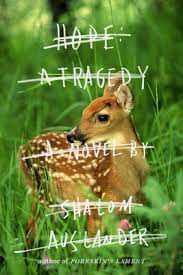
Teaching Shalom Auslander’s Hope: A Tragedy for a course on the Holocaust was a fascinating educational exercise because I used the novel to prompt my students—and myself—into a dialogue with what I would call anxious American Jewish post-Holocaust cynicism.

It is a strange dialogue because Auslander doesn’t exactly want to have one.

Or, better: Solomon Kugel, the novel’s main character, seems incapable of having one without turning it into a joke.

This is one of the things I ask my students to watch for as they read the novel: its constant post-Holocaust counter-intuitions. Whenever we expect solemnity, Kugel gives us obscenity. Whenever we expect memory, he gives us anxiety. Whenever we expect Jewish continuity, he gives us neurosis. Whenever we expect Anne Frank to signify innocence, tragedy, and the obligation to remember, Auslander puts her in an attic and transforms her into an irritable old woman who refuses to die.

And whenever we think we know what suffering means, Kugel makes a joke.

This is why the opening words of the novel are so important:

“It’s funny:”

Everything begins there.

Before the Holocaust, before Anne Frank, before Jewish memory, before theology, before Kugel’s mother and her bizarre obsession with suffering, before Kugel’s obsession with his own death—there is the declaration that something is funny.

But what could possibly be funny here?

And what kind of Jewish philosophical statement begins with the words “It’s funny”?

The Post-Holocaust Stand-Up Philosopher

The narrator of Hope: A Tragedy frequently sounds less like a novelist than like a cynical American Jewish stand-up comedian. He seems to be perpetually fighting with his own community, telling dirty jokes about Jewish suffering, American Jewish identity, Holocaust memory, family, death, guilt, and the strange condition of being an American Jew several generations after Auschwitz.

The comedy is aggressive because the anxiety is aggressive.

And, as with many Jewish comic protagonists, much of Kugel’s suffering begins with his mother.

She suffers.

She remembers suffering.

She invents suffering.

She seems almost disappointed by the fact that she has not suffered enough.

Kugel inherits this relationship to suffering, but transforms it into another form: an obsessive anticipation of his own death. He wants to know what his last words will be. He thinks about how he will die. He imagines disaster everywhere.

It is as if history has migrated inward.

The catastrophe that happened to European Jewry becomes, generations later, a catastrophe endlessly anticipated by the American Jewish psyche.

And then Kugel discovers Anne Frank living in his attic.

At this point, Auslander makes his most outrageous comic move. He takes perhaps the most sacred secular icon of Holocaust memory and refuses to leave her within the realm of tragedy.

Anne Frank has survived.

But survival itself turns out to be a problem.

This is where Hope: A Tragedy becomes philosophically interesting. Because Auslander is not simply making jokes about the Holocaust. He is asking—obscenely, aggressively, perhaps even cruelly—what happens when the moral language surrounding catastrophe becomes incapable of containing the lives of the generations that come afterward.

And this is precisely where I find myself thinking about Diogenes.

Diogenes: The Mad Socrates

Diogenes, the ancient father of Cynicism, was famously described by Plato as a “Socrates gone mad.”

The phrase is wonderful because it suggests that the Cynic is not simply the opposite of the philosopher. He is philosophy pushed beyond the boundaries of philosophical respectability.

In Critique of Cynical Reason, Peter Sloterdijk develops this idea through what he calls ancient kynicism. Kynicism is not simply pessimism or disbelief. It is bodily, vulgar, comic resistance to the elevated languages through which philosophy and political authority present themselves.

It is, above all, cheeky.

Sloterdijk associates this cheekiness with the German frech: boldness, impudence, productive aggressivity.

Diogenes does not refute philosophy by constructing another philosophical system.

He refutes philosophy with his body.

When Socrates speaks about the divine soul, the kynic picks his nose.

When Socrates speaks about the Ideas, the kynic farts.

When philosophers elevate Eros into metaphysics, the kynic masturbates in public.

The response is outrageous because it refuses the terms of philosophical discourse altogether.

Socrates can defeat the Sophist because the Sophist agrees to enter into conversation with him. And conversation already assumes something: that truth will emerge through argument, distinction, questioning, and reason.

Diogenes refuses the contract.

He doesn’t answer Socrates with a better argument.

He farts.

When the Clown Refuses the Conversation

This is much more significant than it initially appears.

For Sloterdijk, philosophical conversation itself presupposes what he calls an “idealist agreement.” Socrates is unbeatable so long as his opponent agrees that the question will ultimately be decided by discourse.

But what happens when someone refuses discourse?

What happens when someone answers metaphysics with obscenity?

Or tragedy with a joke?

The kynic discovers something that will later become central to the clown, the fool—and, I would argue, the schlemiel.

Sometimes the body can say what discourse cannot.

This is why Sloterdijk describes Diogenes through a constellation of wonderfully suggestive phrases: “satirical resistance,” “uncivil enlightenment,” “material embodiment,” “low theory,” and the “language of the clown.”

The clown doesn’t produce another theory.

The clown performs a counter-theory.

And this is also why the famous encounter between Diogenes and Alexander the Great matters so much.

According to the anecdote, Alexander supposedly declared that if he were not Alexander, he would want to be Diogenes.

Sloterdijk sees something profound in this statement. Alexander possesses armies, political power, historical ambition, and imperial authority. Diogenes possesses almost nothing.

And yet Alexander recognizes something in Diogenes that he himself cannot possess.

Freedom from Alexander.

The ruler confronts the fool and discovers that the fool inhabits a place beyond the ruler’s authority.

As Sloterdijk puts it, those who rule can lose their self-confidence before “fools, clowns, and kynics.”

The clown becomes dangerous precisely because he refuses to take power’s language seriously.

From the Kynic to the Schlemiel

But here I want to make a distinction.

Solomon Kugel is not Diogenes.

And the schlemiel is not simply a Jewish kynic.

Diogenes is shameless. Kugel is filled with shame.

Diogenes seems radically at home in his body. Kugel is terrified of his body dying.

Diogenes frees himself from society’s expectations. Kugel cannot stop hearing the voices of his mother, his therapist, Jewish history, Holocaust memory, and his own anxious conscience.

Diogenes chooses homelessness.

Kugel buys a house.

And then discovers Anne Frank living in it.

This difference matters.

The schlemiel does not stand outside history and laugh at it. History has already entered the schlemiel.

His comedy therefore has a different texture.

Diogenes can laugh because Alexander cannot control him.

Kugel laughs because he cannot control anything.

His family.

His house.

His mother.

His future.

His death.

His Jewishness.

And certainly not the Holocaust.

The classical Cynic confronts power through shamelessness.

The post-Holocaust schlemiel confronts history through anxiety.

This may be why Auslander’s comedy feels simultaneously liberating and suffocating. The joke attacks the sacred language surrounding Jewish suffering, but the comedian cannot escape the suffering he attacks.

He is trapped inside his own punchline.

Anne Frank in the Attic

And this brings us back to Auslander’s most outrageous invention.

Anne Frank is alive.

She is living in Kugel’s attic.

What does one do with this?

The obvious answer is that Auslander is desecrating an icon of Holocaust memory. And he certainly wants us to feel the force of that desecration.

But perhaps something more interesting is happening.

Anne Frank has become so thoroughly absorbed into the moral vocabulary of postwar Western culture that she risks becoming an abstraction: innocence, hope, victimhood, humanity.

Auslander violently returns her to the body.

She eats.

She smells.

She complains.

She takes up space.

She becomes inconvenient.

In other words, she stops functioning exclusively as a symbol.

This is an extraordinarily kynical gesture.

The sacred abstraction is dragged downstairs into material existence.

But Auslander adds a specifically Jewish-American complication: Kugel cannot simply dismiss her.

That would be too easy.

He feels obligated to her.

He feels guilty about her.

He resents her.

He fears her.

He wants to get rid of her.

He cannot get rid of her.

And perhaps this is the central comic situation of Hope: A Tragedy.

Kugel literally cannot get the Holocaust out of his house.

“It’s Funny”

This is why I keep returning with my students to those opening words:

“It’s funny:”

Perhaps Auslander is announcing the philosophical method of the entire novel.

Something happened to Jewish comedy after the Holocaust.

The schlemiel who once stumbled through the shtetl now wanders through American suburbia carrying historical catastrophe inside his head.

And the old philosophical opposition between tragedy and comedy becomes unstable.

Is Auschwitz tragic?

Of course.

Can its memory become neurotic?

Can remembrance become suffocating?

Can inherited suffering become absurd?

Can Jewish memory become an ideology?

Can the comedian mock that ideology without mocking the dead?

And what happens when the Jew who asks these questions discovers that the dead are not quite dead?

Auslander refuses to answer these questions philosophically.

Like Diogenes, he gives us something lower.

Dirtier.

More embarrassing.

A mother obsessed with suffering.

A neurotic Jew obsessed with death.

An elderly Anne Frank hiding in an attic.

And a narrator who keeps making jokes.

But there is an important difference between Diogenes and Auslander.

Diogenes uses comedy to free himself from illusion.

Auslander is not so sure freedom is possible.

That may be what makes Solomon Kugel a distinctly post-Holocaust schlemiel.

The kynic laughs and walks away.

The schlemiel laughs—and remains.

He remains with his mother.

He remains with Anne Frank.

He remains with Jewish history.

He remains with his anxiety.

And he remains with the impossible question of what one is supposed to do with suffering that happened before one was born but somehow continues to occupy the attic.

Perhaps that is why the novel does not begin with “Once upon a time.”

It begins with something far more dangerous:

“It’s funny.”
The Whistle and the Gaze of the Holy Fool – Take 2

images-2

How can an encounter with a schlemiel have an affect on one’s writing?  And does it matter if this encounter is fictional? Will our reading change as a result? And what do the figures of the “gaze” and the “whistle” have to do with these changes?

These are the questions that Meir Abehsera’s narrator prompts in the reader.  To be sure, in the last blog entry we saw how the writer leaves his town and the old librarian – who defends his task as a writer (which is to “teach the world”) – to follow the idiot/schlemiel.  The writer is prompted to leave with him since he is singled out by the fool and “gazed” at.  This gaze is the response to the librarians point which is that what is right and wrong for the idiot may not be right and wrong for others (namely, the writer and the people he wishes to teach).  For this reason, we can see that the gaze has an esoteric quality.   It is an assurance that what the schlemiel teaches is not a relative kind of truth about good and evil.  To be sure, we are introduced to the schlemiel by way of a “whistling” that is supposed to ward away evil. And the advice of the schlemiel to the town is to fight and run away from evil.  His whistling is a way of running from evil or fighting against it. And that evil, as he states, is merely an illusion.  Whistling will, apparently, challenge it.

I ended the last blog entry with the thought that the schlemiel helps us to get a sense of the shape of evil – regardless of whether that schlemiel is secular or religious. This schlemiel is a Holy Fool; so its absent mindedness is based on a certain tact: namely to challenge evil.

With this in mind, I would like to take us into the next phase of Abehsera’s parable.  In this phase, we learn, right off the bat, that:

The writer has had a difficult time since his encounter with the idiot.  He has not lifted his pen in years.  He even finds it hard to a write a letter to his family. (116)

In this phase of the story, the writer cannot write.  The only thing he has is the experience of the schlemiel’s gaze.  This gaze has, so to speak, suspended his writing (as well as his sense of himself as a writer with an appointed task of teaching humanity).   All he can think about is the gaze:

From time to time, he is tempted to offer people some peace of mind by tossing them some factual news, but he restrains himself because, you see, on that fateful day, as the idiot look at him with his piercing eyes, he completely lost contact with his work. Or rather, it all became meaningless to him. (116)

Since he is left with his encounter with the schlemiel he wonders about why it means so much to him and this thought leads him to a reflection on his new task.   The question that haunts him is whether he himself is a schlemiel or is he, rather, a writer?

The most amazing thing he had yet to discover was that the persona of the idiot happened to mysteriously cohere with an undefined, yet consistent, recurring thought that had accompanied him in his youth.  This was precisely the same pounding thought that had him start to write in the first place; but he had lost it…A few days went by before he could finally figure out that he knew the idiot from deep inside himself, not in the sense that they were one and the same person, but that he had become the idiot’s relay.   (117)

This new formulation is very telling and it sheds some light on what I have been working on with Walter Benjamin and Kafka; namely, the relationship of Sancho Panza to Don Quixote.  This question of what this relationship was and how it relates to the writer and thinker was of interest to both Benjamin and Kafka.  For Abehsera the relationship is defined in terms of the writer (Sancho Panza) being the “relay” for the idiot/schlemiel (Don Quixote). But this is more than a relay of foolishness. For Abehsera, it’s a relay of spirituality and wisdom.  (Benjamin, I would argue, also saw this kind of relay.)

Abehsera notes that his “wisdom grew at a remarkable pace” once he realized how, now, whenever he tries to speak his words would be overwhelmed by a “rush of ruminations.”  And when he tried to speak, he would utter “sheer nonsense.”  Now, this “infirmity” prompts him to “search for other modes of communication.” And one of these modes includes whistling. But it also includes theater and play; basically, anything that can make people laugh.

The writer now notes one of these practices.  However, he relates this practice to reading scripture.  Now, whenever he reads even a little bit of it, thoughts rush to his head. And when he fell into a “trance” he would “offset the undesired effect by standing on his head.” One would think that this clownish activity effaces his seriousness; but, as he puts it, it does something else:

He would feel rather silly doing it, but it was the only way he knew to keep his soul from taking off.  Ever since this began to happen, he would only study alone, from fear he would have to perform public headstands when his head threatened to explode.  (118)

After stating this, the writer reflects on an encounter he had with a Maggid (a story teller and a Rabbi). The point of the story is to illustrate the new task of the writer.  As the writer tells it, the Maggid starts his lesson off with humor (as it is a Talmudic tradition to start every lesson with a joke).  And this had the “audience roaring with laughter.”  All of this was “woven” into a talk the Maggid gave on the Torah.  Unfortunately, the lesson of the story went to the other extreme and slighted the audience with being sinners who, if they did not repent, would be punished.   In response to this, the writer notes:

He had the entire congregation in the palm of his hand.  But then, all faces had turned white from extreme fear.  A bad smell began to ooze out from an unknown source, but only the writer noticed it. (119)

This smell, which we will turn to in a second, prompted the writer to feel a rush of energy and it spurred a memory of the schlemiel – his “teacher” – and his words to “run from evil and do good.”   And this memory spurred words to emerge:

He screamed loud, deep within himself, to break the walls of darkness which were entrapping him.  He heard the din of galloping horses in his head. Soon, an avalanche of words began to roll out of his mouth. Every word was blasted out by a powerful combustion that was fueled by an utter abhorrence of evil. (120)

The effect of these words was to undo the “damage that the manic maggid had inflicted upon the congregants.”  According to the narrator, the “smell” that the writer sensed cam from a “low grade type of fear.”  In contrast to this low grade type of fear and the smell it emits, the fear of the righteous emits a smell is pleasant.

What is the deal with “smell” and what does it have to do with the schlemiel?

Abehsera is dealing with a tradition that emerges out of the prophets. In reference to the Messiah, it is written that he can judge by the way of smell.  Citing Isaiah 11:3, which says that the Messiah will judge good and evil by way of smell, the Babylonian Talmud (Sanhedrin 93b) writes:

Bar Koziva ruled for two and a half years, and then said to the rabbis, “I am the Messiah.” They answered, “It is written that the Messiah can judge by smell (based on Isaiah 11:3); let us see whether he [Bar Koziva] can do so.” When they saw that he could not judge by smell, they killed him.

Writing on this power of smell, which the schlemiel in this parable possesses, Abehsera writes of how smells will emerge from the memory of the “transgressions of his youth.”  And, “against” these odors from the past, the writer “measures other people’s sins by the nuances of smell.”  The Messiah, “however, like his saintly predecessors whose lives are untainted by sin, will be spared the noxious smell of other’s indiscretions.  Since he will lack first-hand experience (like the schlemiel or the writer), Heaven will have to grant him the power to judge at least the spirit, if not the substance of sin.”

This sense of smell is something that the writer apparently learns from the schlemiel. And, as mentioned above, since the writer is a “relay” for the schlemiel, this sense will also be relayed.  This suggests that the schlemiel not only teaches one how to whistle and find other ways of communication to “run from evil” but also a sense of smell which can detect it.  This sense, as I have indicated above, is connected – in some way –to the messianic.  It gives the schlemiel and the writer some form of judgment vis-à-vis evil.

In the next blog entry, we will return to this sense of smell which recurs; this time, however, in the form of a beggar.  Since the schlemiel, in the third part of the parable becomes the beggar.

Exposure, Failure, and Rhythm: Roland Barthes by Roland Barthes

images

Roland Barthes, the famous French thinker and essayist, is best known for S/Z, Mythologies, A Lover’s Discourse, Camera Lucida, Writing Degree Zero, Empire of Signs, and The Pleasure of the Text.  For many years, these books have had a great impact on critical theory, philosophy, comparative literature, anthropology, sociology, and even the academic studies of photography and cinema.  Although I enjoy these books and have learned a lot from them, my two favorite texts of his are his lecture notes for a course he gave in Morocco in 1978 (entitled The Neutral) and his autobiography Roland Barthes by Roland Barthes.

What interests me most about these two books are his reflections on weariness, the neutral, failure, rhythm, gesture, and himself.  Taken together, they disclose something that I also find in Walter Benjamin: an awareness of failure juxtaposed with an aesthetic sensibility that craves intoxication.  As in my readings of Benjamin, I have been reading Barthes with a desire to find his weak point; namely, his sense of vulnerability, innocence, and shame.  I have found this sensibility in a few of Barthes’ passages.  And it is in these passages where Barthes becomes small, humble, and most revealing.

In this blog entry, I will not be focusing on the lecture course; rather, I want to look at a few of Barthes autobiographical reflections which disclose exposure, failure, and a desire for protection, distraction, and aesthetic relief.  Like any good writer with a taste for the esoteric, Barthes leaves it to the reader to connect the dots, so to speak, between one reflection and another.  I would suggest that Barthes wants us to pay close attention to the rhythmic alteration between one reflection and another.  It is in the lacunae between one reflection and another that we can interpret and glean some type of wisdom.

The reflection entitled “Le retentissement – Repercussion” caught my eye.  In this passage, Barthes (who calls himself “him” rather than “I” so as to denote otherness and the fact that he sees his autobiography, as his epigram states, in terms of being a novel of sorts: “It must all be considered as if spoken by a character in a novel”) fears the “repercussion” his words and the words of others about him or his words will or may have:

Every word which concerns him echoes within him to an extreme degree, and it is this repercussion which he dreads, to the pint of timidly avoiding any discourse that might be offered about him.   The language of others, complimentary or not, is tainted at its source by the repercussion it might have…The link to the world is thus always conquered starting from a  certain fear (156).

Barthes’ fear of repercussion is a fear of exposure.  He knows that his words expose him to possible ridicule and rejection.  His words, in the mouths of others, have repercussions -meaning that they are sounded again but by another and in a way that is other.  Needless to say, the re-percussion (in the sense of a sounding or beating-again) makes him fearful and timid.  Such a confession implies that he, a well-known and highly respected writer in Europe, is exposed and vulnerable.  He is not self-possessed.  Apparently, nothing can secure him from this fear since he has no control over the repercussions of his words.  He has no control over how they will echo back to him.  Barthes language implies that, most likely, the recounting of his words will have negative repercussions – that is, they will expose him to possible damage.  He feels that the repercussions of his words will make him vulnerable and powerless.

Immediately following this reflection is yet another which deals with fear and vulnerability.  It is entitled Reussi/rate – Success/failure.  Barthes, here, reflects on Barthes “re-reading” himself. The effect of this re-reading is, yet again, a kind of exposure. This time it is an exposure to failure:

Rereading himself, he discerns in the very texture of each piece of writing a singular cleavage: that of success/failure: in gusts, felicities of expression, good patches, then bad ones, swamps and deserts which he has even begun to inventory.  Then no book is successful throughout? – Perhaps the book on Japan.

In the midst of his reflection on failure, he turns to success as a balm. And what he finds is a discourse that does not doubt itself and does not fear that its words fall flat. Rather, he finds “the continuous, effusive, jubilant happiness of the writing: in what he writes, each protects his own sexuality.”  But, given what he has just written, we have reason to be suspicious of these lines.  They are literally a distraction. The italics don’t change a thing. To be sure, his “sexuality” cannot be protected by his “continuous, effusive, jubilant” happiness of writing.  After all, didn’t Barthes say that he fears the repercussions of his words? And when he reads himself, he sees discontinuity and failure?  Is Barthes saying that writing, in differentiation to reading, is absent minded?  Is he suggesting that writing is distracted while reading is not?

Frustrated with this thought, Barthes turns to a third option, but even this option cannot lift him from being shamed and exposed.  And he, ironically, notes this:

A third category is possible: neither success nor failure: disgrace: marked, branded with the imaginary.

To be sure, his disgrace, his exposure to failure, is “branded” by the “imaginary.”  In other words, writing does not simply distract him from shame, it marks his shame, brands it.  This implies that the imaginary, that is, writing, is not a balm.  Rather, his personal disgrace is in a violent relationship with writing; it is as if writing, which is still a distraction from exposure, has forced itself upon his disgrace.

Writing tries to brand or mark shame. And this suggests ownership.  But can one’s exposure to failure ever escape writing and the distraction it offers?  Given what we have been saying about Benjamin and his interest in distraction, this is a legitimate question to ask.

Interestingly enough, the two reflections that follow are superficial and imaginary. They displace the negative affect of these two reflections by way of distraction.  The first reflection is entitled “Du choix d’un vetement – Choosing Clothes” and the second reflection is entitled “Le rhythme – Rhythm.”  Both of these reflections are, so to speak, escape routes.

In “Choosing Clothes,” Barthes likens the books one chooses to the clothes one wears.  He reads this in terms of “preparing himself to sustain…the discourse of truth starting from an economy which is that of his own body.”  In other words, these books clothe the body and protect it from negative repercussions that will inevitable ensue in “the discourse of truth.”

The reflection entitled “Rhythm” turns to another way of relating to exposure.  Barthes notes that he (that is Barthes) “always put his faith in that Greek rhythm, the succession of Ascesis and Festivity.”   In his 1978 lecture, Barthes also relates Ascesis to the “succession of paroxystic and opposite states: many collective celebrations, but between each of these festivals a period of retention, abstention, sobriety”(84).  In other words, there is a “rhythm” between one extreme state and the other in the “succession of Ascesis and Festivity.”  He contrasts this rhythm to the “banal rhythm of modernity” which alternates between work and leisure.  This rhythm is different.  Barthes refers to a “Slavic or Balkan” custom in which one “shuts oneself up for three days of festivity.”  He then suggests that one go back and forth between this kind of festivity and sobriety.   Or, I would suggest, a rhythm between exposure (reading) and distraction (writing).

The rhythm he speaks of is built into his text.  The reflection that follows this one, in fact, is all about exposure.  It is entitled “Que ca se sache – Let that be known.”  In this reflection, Barthes admits that “every utterance of a writer (even the fiercest, the wildest) includes a secret operator, an unexpressed word, something like the silent morpheme of a category as primitive as negation or interrogation, whose meaning is: “And let that be known!

In other words, Barthes realizes that in everything he writes, even with words written with great conviction (words that are fierce and wild), there is a snag.  There is something that will expose one to judgment.  By noting this, Barthes is, in effect, arguing that no matter how wild or angry he is – no matter how courageous, powerful, or self-possessed he may sound on paper– there will be something in his words – something undetected – that will render him powerless.

But does powerlessness have the upper hand in these reflections?

From what we have seen, Barthes insistence on rhythm and on protection suggests that powerlessness is, at times, sovereign.  In other words, at times one is made to be a fool.  At moments when one feels at the top of ones game, there will always be repercussions.  But, and this is Barthes point, one must know that one is always exposed to failure, judgment, and repercussions, while, at the same time, operating according to a rhythm.  Barthes suggests that style, writing, and sexuality are attempts to pull away from shame and exposure.  They distract us. However, as we saw above, imagination brands shame.  In other words, writing looks to mark exposure with its power.  But, the fact of the matter is that even though shame is marked by the imagination, shame remains.  Nonetheless, it is branded and, so to speak, re-markable.

And this is where the art meets ethics.  The exposure one has to failure, the timidity that comes with writing to others and re-reading oneself, is ethical, but this exposure is always branded by the imagination which looks to protect the body and vulnerability from too much exposure.    Or as Barthes suggests, the terror of reading oneself is tempered by the distraction of writing oneself.

What I find so interesting about Barthes’ suggestions is that they speak directly to the schlemiel and the reader of the American schlemiel.  Even though Barthes often fails to be comical (since he’s much too serious about himself), he does provide a structure which is best exemplified in the comedy of the American Schlemiel.

An American schlemiel, like Phillip Roth’s Portnoy or Larry David, is humiliated and exposed in what they say and in what they do.  But because their words are couched in the imagination, witty gesture, and style, they are innocent and, to some extent, are protected from extreme damage.  But, in the end, these schlemiels are still exposed. They are the subject of ridicule.  Their victories are, by all means, temporary.   As Barthes might say, the American Schlemiel is caught up in a rhythm of distraction and exposure.

To be sure, we love this rhythm; otherwise, we wouldn’t watch Woody Allen’s films, Larry David’s Curb Your Enthusiasm, or Andy Kaufmann’s embarrassing comic routines (to take only three examples). These shows invite us to witness how shame, in rhythmic variation, is “branded” by the imagination.   It shows us how distraction and exposure alternate.

Here’s Andy Kaufmann with a few rhythms of his own: