Gary Shteyngart’s Immigrant-Becoming-American Schlemiel: The Unlikely Hero of our Times

images-8

Vladmir Girshkin is the main character of Gary Shteygart’s novel The Russian Debutante’s Handbook.   It is the story of a particular kind of Immigrant-Becoming-American-Schlemiel and his becoming-American world.  The “arc of his dreams,” as the schlemiel-like narrator of the novel shows us, begins in Russia and ends in America.  These dreams come from a character whose story (and whose persona) is characterized as “Part P.T. Barnum, part V.I. Lenin, the man who would conquer half of Europe.”

If we listen closely to this sentence, we will have to ask two simple questions:

1)    If Lenin was the man who would conquer half of Europe, was P.T. Barnum the man who conquered the other half?

2)    What does it imply that Vladmir’s story is one part Lenin’s power and the other part, so to speak, “American circus power”?

In response to this, I’d suggest we ask what P.T. Barnum’s power is and how that power relates to Vladmir, and what Lenin’s power is and how that relates to Vladmir.  On the one hand, the power over “the other part of Europe” is an American-carnivalesque-power.  And this, as we see in the novel, is part of Vladmir’s character and is part and parcel of the narration of Vladmir’s story.  This circus power is the power of the American-schlemiel-dreamer.  On the other hand, we have the power of Lenin which is political, intentional, and masculine.  I’d suggest that the latter is humored by the former and that the schlemiel is kept in check by the latter.

But the narrator shows us, right off, that America has the home team advantage, since the story doesn’t begin in Russia; it begins in a shabby immigration office in Manhattan.  And the story takes off in the most mundane way, which indicates that Vladmir may in fact dream of power since he has none.  But we see something other than power in his office. He is in the “middle of (immigrant) things.”  The story begins…

On a Monday morning. In an office. With the first cup of instant coffee gurgling to life in the common lounge.

But not so fast.   This scene of the immigration office is revised by the narrator. His revision gives you a sense of the narrator’s way of thinking and speaking.  He tells us of how Vladmir’s

…story begins in New York, on the corner of Broadway and Battery Place, the most disheveled, godforsaken, not-for-profit corner of New York’s financial district.  On the tenth floor, the Emma Lazarus Immigrant Absorption Society greeted its clients with the familiar yellow water-stained walls and drying hydrangeas of a sad Third World government office.

He is a schlemiel who works together with “Assimilation Facilitators” to process immigrants.  In this American scene, these Assimilation Facilitators forge truces between warring peoples of the world in order to make peace in the office (not the world): “in the reception room, under the gentle but insistent prodding of trained Assimilation Facilitators, Turks and Kurds called a truce, Tutsis queued patiently behind Hutus, Serbs chatted up Croats at the demilitarized water fountains.”

While this is all going on, Vladmir is in “the back office.”  He is the immigrant schlemiel: “the immigrant’s immigrant, the expatriate’s expatriate, enduring victim of every practical joke the late twentieth century had to offer and an unlikely hero of our times.

Reading these words about a fool who is the “unlikely hero of our times,” I am reminded of the title and main theme of Ruth Wisse’s schlemiel-theory opus: The Schlemiel as Modern Hero.   At the end of her book, it seems as if the schlemiel ‘was’ a modern hero but is no longer one since (in the early 1970s) Jewish American writers like Phillip Roth wanted to put an end to the schlemiel.

The schlemiel can only live in a world which is neither fully optimistic nor fully skeptical.  And the world of the 1970s wanted to create more “positive” images of the Jew in which Jews were shown as normal, strong, and American.  The schlemiel, interpreted by Roth (in Portnoy’s Complaint) and Bruce Jay Friedman (in Stein) as a half-man and a loser, seemed to have been something they had left behind after they wrote his obituary.

To add to this, Irving Howe thought Jewish literature would lose its Jewishness the farther it went away from its immigrant roots. But this opening of the novel challenges Howe, Roth, and Friedman.  And it puts forth the new “unlikely hero” who also happens to be an immigrant.

In one fell swoop, Shteyngart shows us how the schlemiel lives on but as a new kind of immigrant: Vladmir Girshkin.

His becoming-American is the story of a schlemiel – an “unlikely hero” whose story is part P.T. Barnum and part Lenin.

(I will be blogging more on this extraordinary novel over the next few weeks.  This will, of course, be interspersed with blog entries and guest blog entries about new and old work on, about, or related to the schlemiel.)

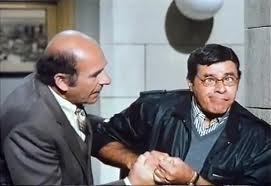
Jerry Lewis, Comedy, and Psychoanalysis (Terminable/Interminable)

images-3

What has always intrigued me about the schlemiel is the fact that he constantly fails and that nothing, it seems, can help him.  And one of the things that pops up in modern Jewish-American literature and film to help the schlemiel out of his embarrassing condition is psychoanalysis.  The psychoanalytic cure (aka “the talking cure”) presupposes that there is an “end” to analysis.  As I have pointed out in my readings of the schlemiel, the psychoanalyst appears from time to time in the films of Woody Allen or in Phillip Roth’s notorious schlemiel classic – Portnoy’s Complaint – to offer a cure.  In Allen’s earlier films, the cure often falls short.  But in his later films, like Hollywood Ending, we see the opposite.  In that film, a psychoanalyst holds the key which, at some point, Allen’s main character embraces.  And doing so changes his life and makes him “normal.”  His analysis is, at some point, terminated.  In truth, Allen embraced the cure and has left the schlemiel behind.  (I have written and published two essays on this topic in different Woody Allen anthologies.)

Writing on the schlemiel in Phillip Roth, Sanford Pinsker points out that Roth was very uncomfortable with the schlemiel and the effect Portnoy’s Complaint had on his career and image.   That novel, in fact, is structured on a discussion between a psychanalyst and Portnoy.  With this in mind, Pinsker argues that all of Roth’s novels following Portnoy’s Complaint are aimed at psychologically working through the schlemiel and leaving him behind (for Roth, therefore, literature offered some kind of analysis which had a clear goal in mind: becoming normal).  Although she doesn’t appeal to psychoanalysis, Hannah Arendt, in her essay “The Jew as Pariah,” also sees the schlemiel as a malady of sorts which can and should be cured.  For her, the cure is social, historical, and political normalization.  Writing during World War II, Arendt envisioned a time when the Jew would be accepted as an equal and will no longer be forced to find shelter in being “exceptional” schlemiels/pariahs.

In all of the above-mentioned cases, we see the same logic which, I would argue, has its basis in Germany and central Europe and not Eastern Europe.  In all of these cases, the schlemiel is equated with some kind of abnormality (psychic or political) which can be cured.

In my last few blog entries, I have been pointing out how, for both Ruth Wisse and Steven Shaviro, psychology, though useful, may be too reductive when dealing with either the schlemiel (Wisse) or with Jerry Lewis’s brand of masochism (Shaviro).  Nonetheless, I was very pleased to see, after I posted my blog entry on facebook, that Steven Shaviro read my piece and pointed out how he had recently written yet another two essays on Jerry Lewis.  In the first of the two essays, which are both e-published, Shaviro speaks to the issue of the psychoanalytic cure and its relation to Jerry Lewis’s comedy.  I was very pleased to see this because I have been pondering the tension between affirming the schlemiel (the Eastern European model) and rejecting him (the German model).   As I have noted above, this model has been appealed to by way of this or that use of psychoanalysis in the films and novels of many a Jewish-American writer and filmmaker.

That said, I’d like to go through a few of Shaviro’s points; since his argument, regarding Jerry Lewis’s comedy, resonated well with my own claims for the schlemiel.  He argues, in short, that Jerry Lewis’s comedy is not about affirming a cure so much as challenging the talking cure.  And instead of terminating analysis, Lewis’s comedy leads to what Freud, in one account, would call “interminable analysis.”

The first of the two essays on Lewis is entitled “Smorgasbord.”  The title of the essay is based on Lewis’s original title for his 1983 film whose final title was Cracking Up.  Shaviro starts off his reading by noting the Jewishness of this film which one can find in the emotionally riveting case of the “self-deprecating” comedian.  This act of self-deprecation is a way or strategy for warding off “humiliations imposed upon” the Jew by “others.”  And this is:

A quintessential strategy that has historically been adopted by Jews, by women, and by members of oppressed groups. (7)

Shaviro brilliantly frames this strategy in terms of another “great Jewish invention” – psychoanalysis:

We might well compare Jewish humor to another great Jewish invention that endeavors to deal with unavoidable, internalized suffering: psychoanalysis.  Like humor psychoanalysis gives relief by providing a “safety valve” through which one may give vent to otherwise unmentionable miseries.  (8)

Shaviro notes that psychoanalysis and comedy offer “insights” that are often self-deprecating.  And the “cure” (which Shaviro puts in scare quotes) “consists in recognizing and giving voice to, the most unpleasant things that one can find out about oneself”(9).  However, Shaviro notes (against popular wisdom) that both comedy and psychoanalysis do not “really provide a permanent solution.”  Rather, both are a part of an “interminable process.”  And this is what we see in Lewis’s comedy:

He struggles interminably to come to some conclusion, his well-meaning efforts instead spread chaos far and wide.  Every one of Lewis’s character’s actions seems to have limitless reverberations…Waves of destruction spread outwards, to infect or contaminate other people, and to overwhelm Lewis’s physical surroundings.  (11)

Shaviro points out, in this regard, Lewis’s failed attempts to kill himself in the movie.

Regarding this interminable failure, Shaviro points out who instead of transforming himself (as we see in Woody Allen’s Midnight in Paris or in Judd Apatow’s Knocked Up), Jerry Lewis’s character in this film “reiterates” and repeats things.  In this film, for instance, Lewis tries to give up smoking but keeps on going over and over again through the procedure of stopping – but to no avail.  He can’t quit and is, so to speak, “confined.”

Once again, Lewis’s persona is unable to achieve freedom, even at his machinations have cascading effects beyond the limits of his confinement.  (27)

Shaviro ends his essay with a detailed description of Lewis’s encounter with a psychoanalyst.  The twist is that he is not cured so much as free from the symptoms of neurosis that he transfers to his psychoanalyst:

All of the symptoms that have been excised from Warren’s (Lewis’s) body and mind reappear insteaed in Dr. Petchick.  All of a sudden the psychiatrist has adopted all of Warren’s mannerisms and incompetentcies. He lights a cigarette and gets punched out by Dick Butkis; he flails about, running this way and that, causing cars to crash and structures to topple, spreading chaos around him. (32)

And this, for Shaviro, is the main point.  Lewis’s comedy works by way of transferring his stammerings to others.  Instead of getting rid of his malady, he gives it to others.  The great irony of this, according to Shaviro, is that Lewis, in real life, is an advocate of the laughing cure and comedic catharsis but his films teach the opposite: one cannot be cured.  Comedy, like psychoanalysis, is (ultimately) interminable and that interminability is contagious.  In other words, one cannot simply be cured.

Shaviro’s reading of Lewis – in this instance – has important implications for schlemiel theory.  Lewis’s inability to be cured serve as a reminder to us that, in the schlemiel tradition, the desire to “cure” the schlemiel of its malady was posited by Jews who wanted to leave the past behind and felt that the schlemiel represented that past.  His awkwardness and dreaminess were for Arendt, and many others, remnants of a Jewish population that was “worldless” and unaware of how to act in a society and history from which they had been excluded for centuries.  On the other hand, the Eastern European Jews saw in the schlemiel a challenge to society and to its evils. They clung to its simplicity and honesty.  The only cure – for many of them – would be the end of exile or for society to eliminate all evil from its midst.

But let’s be frank and ask what, exactly, that would consist of.  Would it consist in being accepted by others as an equal? Would in consist in having a “Jewish State”?  Or would it consist in the end of evil?  Of the three options, it is the last one which held a lot of appeal for writers like Sholem Aleichem and I.B. Singer – but, in truth, they knew it was a utopian hope.  This implies that the schlemiel and its failures would be interminable because evil itself are and will – most likely – be interminable.

What Shaviro suggests is that Jews like Jerry Lewis know that the cure is far off and that it is shared. The healing process will not, by any means, just happen.  And film has an ethical role in the sense that it reminds us that the basis for interminable analysis is something that just can’t go away in a few days or years or, for that matter, in two hours in this or that film.  What Lewis does is expose us to this desire for a cure, its frustration, and its endless reiteration which are all features of the schlemiel and, for that matter, Jewishness in general.

The Difference Between Sadism and Masochism as the Difference Between Irony and Humor

Jerry-Lewis-War-Army

One of the most interesting distinctions I have come across, regarding comedy, deals with the distinction made by Gilles Deleuze (a French philosopher) between humor and irony.  According to Deleuze, in his book entitled Masochism, we find irony in Sadism and humor in Masochism (I am capitalizing these words for the sake of emphasis).  As a thinker who is interested in “leaving metaphysics behind,” Deleuze makes the interesting claim that Sadism simply reinstates metaphysics even through it purports to destroy it.   In contrast, Deleuze thinks that Masochism does leave it behind.  Evidence of this distinction can be found in the irony and humor we find in the work of Marquis de Sade and Leopold von Sacher-Masoch, respectively.

The reason this distinction is of such interest to me is not simply that it is unexpected; rather, it is also of interest because, as Ruth Wisse notes in The Schlemiel as Modern Hero, the psychologist Theodor Reik and the cultural critic Albert Goldman both “psychologize” the schlemiel by claiming that he is a masochistic character or, quite simply, a person who, in fear of reality, finds excuses and “rationalizes” inaction:

‘Psychoanalysis,’ writes Theodor Reik, ‘would characterize the schlemihl as a masochistic character who has strong unconscious will to fail and spoil his chances.’  Explaining the popularity of the schlemiel pose in modern culture, Albert Goldman calls it an excuse, an apology, and a rationalization.  (68)

To be sure, the basis of her reading of the schlemiel – in major part – is based on challenging the claim that the schlemiel is a masochistic character.  She argues against the psychoanalyst who “treats the schlemiel concept as a neurotic symptom and tries to determine the causes of a patient’s failure in actual situations.”    In contrast, while the author “may or may not be aware of the ‘masochistic need to fail’ that dominates the subconscious of his (schlemiel) character,” such “knowledge may be irrelevant to the story.”  Wisse claims that, in a story like “Gimpel the Fool,” the “irony…rests on our ability to perceive his failure as a success”(68).  And Gimpel’s “antipragmatic philosophy mocks the need for classification and rationalization of which the tendency to define Gimpel as a masochist is a good example”(68).  This mockery of psychological explanations – namely, the claim that the schlemiel is a masochistic character – affirms, by way of irony, goodness:

Since the schlemiel is above all a reaction against the evil surrounding him, he must reject more and more as the evil increases; Gimpel is prepared to walk into eternity in pursuit of personal goodness. (69).

Read against Wisse’s take on Masochism, Deleuze’s reading offers another way of addressing the claim that the schlemiel is a masochistic character.  I’d like to break his reading down and test Wisse’s reading against it so as to see how or whether Deleuze’s reading has any relevance to schlemiel theory.

Cutting right to the chase, Deleuze writes that “in modern thought irony and humor take on a new form: they are now directed at a subversion of the law”(86).   Both Sade and Masoch (respectively, the founders of what, today, is called Sadism and Masochism), “represent the two main attempts at subversion, at turning the law upside down.”  But the ways they went about doing this and the success in doing so differ radically.

In view of his claim, Deleuze offers definitions of irony and humor in terms of law.  Writing on irony, he states:

Irony is still in the process or movement which bypasses the law as a merely secondary power and aims at transcending it toward a higher principle. (86)

Deleuze’s reading speaks directly to the Socratic practice of irony where “Good” is a principle toward which one transcends one’s “secondary nature” in the name of one’s “primary nature.”   Through irony, one “discovers” one’s “primary nature.”   Sade, like Nietzsche after him, took the Good as their target.  And, as Deleuze notes, they used irony to “overturn” it; or rather reveal that the Good no longer exists and can no longer be used as the basis of law:

But what is the higher principle no longer exists, and if the Good can no longer provide the basis for the law or a justification of its power?  Sade’s answer is that in all its forms – natural, moral, and political – the law represents the rule of secondary nature which is always geared toward conservation; it is a usurpation of true sovereignty.  (86)

Sade sees the law as the basis of all of societies problems.  It is the basis of tyranny.  Deleuze paraphrases Sade as saying: “Tyrants are created by the law alone: they flourish by virtue of the law”(86).  Sade’s hatred of tyranny is the “essence of his thinking.”  And the heroes of his novels speak the “counter-language of tyranny.”

Sade looks to transcend the law, but not toward the Good (as Socrates would do); rather, he transcends the law toward the “direction of its opposite, the Idea of Evil, the supreme principle of wickedness, which subverts the law and turns Platonism upside down”(87).  (Note: The notion or rather language of inverting Platonism was stressed in a several aphorisms by Friedrich Nietzsche.)  By way of such a process, one will discover his or her “primary nature,” which, in Sade’s view is the opposite of tyranny.  Citing Sade, Deleuze notes that, for Sade, law is “inferior” to “anarchy”:

The law can only be transcended by virtue of a principle that subverts it and denies its power.  

This principle is, according to Deleuze, at the basis of the Sadean irony which destroys the law in order to transcend the law.  But, as Deleuze notes, we are still in the realm of metaphysics since one principle (the Idea of Evil) replaces another (the Idea of the Good).

Deleuze contrasts Sade’s ironic challenge to the law to the Masochist’s challenge, which is based, instead, on what Deleuze calls humor.  Although they both take the law as their “target,” the ironist and the humorist, like the Masochist and the Sadist, are fundamentally different.  However, this assertion may rightfully meet with a puzzled look since, to be sure, the Masochist is one who submits (and here, one would say, submits to the law). Deleuze, nonetheless, claims the opposite: a “masochist would not by contrast be regarded as gladly submitting to it (the law)”(88).

So, what is humor as opposed to irony?  And how does it relate to Masochism?

Deleuze uses a spatial metaphor to illustrate:

What we call humor –in contradistinction to the upward movement of irony toward a transcendent higher principle – is a downward movement from the law to its consequences.  (88)

This downward movement of humor is accomplished by “twisting the law by excess of zeal.”  In other words, one mocks the law by way of being “too zealous.”  And this is what Masochism-as-humor does:

By scrupulously applying the law we are able to demonstrate its absurdity and provoke the very disorder that it is intended to prevent or to conjure.  By observing the letter of the law, we refrain from questioning its ultimate or primary character; we then behave as if the supreme sovereignty of the law conferred upon it the enjoyment of all those pleasures it denies us; hence, by the closest adherence to it, and by zealously embracing it, we may hope to partake of its pleasures. (88)

This speaks directly to the Masochist since:

A close examination of masochistic fantasies or rites reveals that while they bring into play the very strictest applications of the law, the result in every case is the opposite of what might be expected (thus whipping, far from punishing or preventing an erection, provokes and ensures it).  It is a demonstration of the law’s absurdity. (88)

How can we, based on this reading, address the schlemiel?  While for Reik and Goodman, Masochism vis-à-vis the schlemiel has a negative value, for Deleuze, Masochism (and its essence: humor) has a positive value: it challenges the law in ways that Sadism cannot.   By over-observing the law one makes it absurd.

A good example of this is evoked by the film theorist and critic Steve Shaviro.  In his book Cinematic Bodies, he writes on Jerry Lewis as a figure of Masochism.  By being over-zealous and through intense mimicry, Shaviro tells us, Jerry Lewis masochistically inverts the law (or the norm).

In the next blog entry, we will continue on this thread and look into how or whether this reading of Masochism and humor relates to the schlemiel.  After all, Jerry Lewis does play a schlemiel.  But this reading is focused less on the psychologizations that Ruth Wisse criticized than on a different way of understanding one’s relation to “the law.”

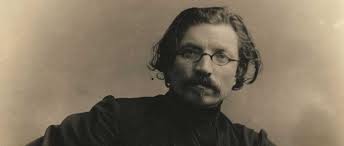
The Final Notes of Irving Howe and Ruth Wisse’s Epistolary Exchange over Sholem Aleichem

images-7

The last three letters exchanged between Irving Howe and Ruth Wisse over Sholem Aleichem’s fiction and its meaning show us the subtle differences between these two important thinkers and literary critics.  As I pointed out in my last blog entry about this dialogue, Ruth Wisse suggested that Aleichem was, in contrast to the Yiddish writers Mendel Mocher Sforim and I.L. Peretz, more “balanced.”  This was a part of Wisse’s epistolary strategy since she was countering Howe’s harsher view of Sholem Aleichem’s fiction.  Wisse’s response to Howe shows us that while she agrees that there are “dark undercurrents” in Aleichem’s work, these words do not subsume Aleichem’s approach to Jewishness, Jewish history, and Yiddish literature.

For Wisse, as I’d like to show in this entry, Howe’s view should be balanced out with a more positive view of the Jewish writer.  Like her brother, David Roskies, she sees Aleichem as an artist who acknowledges fragmentation but who, in response to it, takes on the tradition of the Magid (story-teller).   She sees Aleichem as a “stand-up” comic of sorts who is looking to create bridges and create balance; unlike Howe, who sees him primarily as a modernist writer who focuses on fragmentation and ruin.  The last letters between Howe and Wisse work to bring out this differing take on Aleichem and his work.

At the end of his third letter to Ruth Wisse, Howe notes that although Sholem Aleichem’s Motl Stories are “casual offhand, charming, even mischievous,” Aleichem will “suddenly…drop to a fierce irony, a harrowing sadness.”  And this, for Howe, is the keynote of Aleichem as a modernist writer.  He ends on the sad note: for Howe, Aleichem goes from laughter to tears.

In response, Wisse turns to Aleichem’s Yiddish so as to show that he was a Yiddish artist.  In other words, she agrees with Howe that Aleichem is an artist, but she takes a different strategy with respect to explain why this is the case. She turns to his language and shows that Aleichem used Yiddish to show how repetition is used to create a closed circle of thoughts – what she calls a “circular style.”   Noting this style in relation to one of Aleichem’s characters, Wisse points out that “her mind is imprisoned in its own obsessive circularity.”  But the point of Aleichem’s using circular style in relation to this character is to “give truth to her particular embattled consciousness, self-protecting and self-defeating.”  This speaks to the negative note that Howe is addressing.

But from here, Wisse turns to the linguistic strategies of Tevye (one of Aleichem’s most celebrated characters).  Wisse sees this character as evidence of Aleichem-the-artist and not simply Aleichem the-folk-storyteller:

Like a true musician, he enjoys showing the speed and grace with which he can skip from one note or one tone to another.  His best jokes and quotations are polyglot, drawing attention to their mixture of high and low.

But Aleichem differs from a writer like I.L. Peretz who “drew attention away from the specificities of Yiddish, away from its folk expressions, the interplay of its source languages, the different dialects of its various speakers.”  Contrary to Peretz, “the unfixed nature of Yiddish was its greatest attraction, and its infinite range of dialects and oral styles the best literary means of capturing the dynamic changes – or the resistance to change – in the culture.”  By pointing this out, Wisse is shifting the emphasis of this epistolary exchnage.  For Wisse, the emphasis should be on the way Aleichem bridges high and low culture by way of his use of Yiddish.  This makes him a modern artist.

Howe catches wind of this shift of emphasis and, so to speak, sticks to his guns.  In his final letter to Wisse, he reiterates his points.  His first words seek for the agreement between he and Wisse about the “oddity” of his stories.  In other words, he acts his if they agree fundamentally but, ultimately, he is changing emphasis.  Howe ends with five points which convey this “oddity” and how it relates to Aleichem being a quintessential modern writer.  For the purpose of understanding his tactic, I’ll summarize each.

1)    Aleichem is a literary artist and not an “oral story teller” and the evidence for this can be found in the “sudden, abrupt blockage” of closure in Aleichem’s stories.

2)    His work demonstrates that he is not interested in “resolution of an external action” so much as evoking “shocked laughter.”

3)    His work is more interested in the “clever Jew” (who is “complicated, quizzical, problematic”) than in the naïve simpleton who is concerned with the “old ways of piety.”  The relation of the “clever Jew” to the past is secondary to his being…a “complicated, quizzical, problematic” Jew.

4)    He is a sophisticated writer who is “very much aware” of his full departure from the tradition of oral storytelling.

5)    Shalom Aleichem, like Saul Bellow who followed in his footsteps, “knew intuitively that the boundary between comedy and tragedy is always a thin and wavering line.”

Howe’s last point is something I have been discussing from the very beginning of my blog series on Howe.  It taps into his approach to Jewishness.  To be sure, he sees the fluid movement between comedy and tragedy as a defining characteristic of modern Jewishness and modern Jewish-American literature.  And this reiterates what he was saying in his introduction to Jewish American Stories.

Wisse final letter to Howe – literally, her last word –  provides us with a key to understanding how she differs with Howe over how we should understand Sholem Aleichem and his project.

First of all, she notes that he avoided “the romantic subject, the heroic possibility, the grand style of the novel” because he was “simply unconvincing and demonstrably uncomfortable in this mode.”  More importantly, he was a modern writer because he is able to work on many levels simultaneously.  She notes “On Account of a Hat,” a story Howe loved, and points out that it has a “dozen interpretations: it is the plight of the Diaspora Jew, an exposure of rootlessness, a mockery of tyranny, the comic quest for identity, a Marxist critique of capitalism, and, of course, an ironic self-referential study of literary slight of hand.”

In other words, Wisse wants to “balance” out the “oddity” – that Howe finds so fascinating – with other elements of the text that Howe’s reading overshadows.  To be sure, she points out that Aleichem works by way of “indirection” with “the worm’s angle of vision, and with apparently flimsy materials.” But he uses them to present something tenacious about Jewishness, something Howe may miss.

As we saw above, Howe sees Aleichem’s Motl in terms of the final, negative note.  Wisse, reading the same character, points out his tenacity: “He confronts all the things that happened to him and forces himself upon life again and again, and the sum of these trials shape the rhythm, constitute the meaning, of his existence.”

Commenting on this, Wisse notes that:

Sholem Aleichem’s admiration for the stubborn ruggedness of Jewish faith and the surprising vitality of the people comes to expression not just thematically, in story after story, but in the resilient, recuperative shape of all his major work.

Knowing full well that her reading may not be deemed “academic” enough, she notes that Aleichem had no obsessive interest in an academic, modernist reading. She asks us to contrast Aleichem’s memoir to the “mountaineering saga of Jewish writers with all the high, serious climbs of other European literati.”  And what we will find from his simple memoir (consisting of only four anecdotes about the ordinary nature of other Yiddish writers and forgetting) is that he “he deflates intellectual and artistic pretentiousness, and even undercuts the grandeur of the Alps!”

In other words, Wisse, like Aleichem, thinks that Howe’s obsession with the “quizzical” and “troubling laughter” of Aleichem is something Aleichem would laugh at.  Playing on the word “quizzical” (which Howe uses several times in his letters to Wisse), Wisse gives her final words on Aleichem which show us a correlation of simple faith (hope) in the story (and storytelling) and not with the world:

What confronts us, finally, is the quizzical smile of the author, compulsively skeptical about everything but the story.

This tension between hope and skepticism, for Wisse, not only informs her reading of Aleichem as an artist; it also informs her reading of the schlemiel.   Howe’s reading of the schlemiel would differ significantly because, in reading Aleichem, he puts the emphasis on the quizzical-as-such and not the relation of the quizzical with the tension between fiction and reality or hope and skepticism.


Laughter through Tears or Tears through Laughter: Irving Howe and Ruth Wisse’s Dialogue over Sholem Aleichem – Take 3

DownloadedFile-5

Irving Howe initiated his letters to Ruth Wisse about Sholem Aleichem by staking his main claim that, based on his own experience of Sholem Aleichem’s stories, he must go against the grain and state that they, like all stories of the Schlemiel (from Chelm to Hershel Ostropolier), have “their undercurrents of darkness.”  Throughout Howe’s letter, we find a repeated emphasis on how odd he now feels when he reads Aleichem: “And now, in reading Sholem Aleichem, I find myself growing nervous, anxious, even as I keep on laughing.”   This troubled laughter reverberates throughout the letter.

Although she agrees in many ways, Ruth Wisse is suspicious of Howe’s way of speaking.  And despite the fact that she can understand its source and agrees with it – to some extent – she puts forth a different tone and a different emphasis.  As the epistolary correspondence moves on, this becomes more and more apparent.

Wisse initiates her epistolary response to Howe by noting that what he is saying was also said by the Yiddish critic and early admirer or Sholem Aleichem, Ba’al Makshoves.  According to him, Wisse tells us, Aleichem “conjures up the collective anxiety and then dispels it magically, laughing the danger away.”   Reflecting on this, Wisse argues that Aleichem’s contemporaries may have “taken the uncertainties for granted” and “enjoyed the relief he alone provided.” But she agrees with Howe and reflects that “nowadays his name has become such a byword for folksy good humor, innocent ‘laughter through tears,’ that we are surprised to rediscover the undertone of threat in his work.”

She concedes that it might be their shared “modernist bias” that makes them frown upon contemporary kitsch representations of Aleichem’s work; nonetheless, she does note that Aleichem was aware of the “fatal weakness of the culture.”  It comes through in the “narrator’s sense of his own shared culpability in having brought it (the culture) low.”

In other words, he is a “self-conscious” modern artist and, like Howe and Wisse, he has a modernist bias.  And unlike “Tevye, Sholem Aleichem encouraged his children’s Russification.”  But, and here is the difference, Aleichem knew he was “confined to a Jewish fate” and was the “product of ‘tradition.’”  He also left for American and made and remade himself like many other Jews fleeing a slowly dying Jewish life in Eastern Europe.

Although she acknowledges the modernist bias and the “ferocity” we see in Aleichem, Wisse wants to take some of the sting out of Howe’s reading. And she does this by  lending more emphasis on Aleichem as the artist who, she believes, can do the Jewish people some good.  Making reference to an Aleichem story entitled “Station Baranovitch,” Wisse notes how the narrator and the author share a similar task; the task of the story teller:

The fate of Kivke (the place in the story) and the Jewish community are ultimately in the hands of the gifted story teller whose untimely departure at Baranovitch constitutes the story’s only fatal event.  The artist can transform reality at will – a potent charm in desperate times – but his magic is subject to temporal claims.

Like her brother, David Roskies (who in his book A Bridge of Longing: The Lost Art of Yiddish Storytelling, looks into the power of the Magid, “storyteller,” to bridge the past and the present), Wisse wants us to pay closer attention to the storyteller.  Nonetheless history does matter for Wisse as much as it does for Howe.  But history is balanced against the powers of the story teller: as we see in Wisse’s words above, the storyteller’s “magic is subject to temporal claims.”

In response to Wisse’s counter-balancing of the story-teller and his magic to the horrors of history, which he addresses, Howe takes note once again of the kitschy view he is trying to think through with his emphasis on the undercurrent of horror in Aleichem.  He justifies his challenge in view of this:

To see Sholem Aleichem in this way seems a necessary corrective to the view, now prevalent in Jewish life, that softens him into a toothless entertainer, a jolly gleeman of the shtetl, a fiddler cozy on his roof.

The words “toothless entertainer,” “jolly gleeman of the shtetl,” etc are meant to cajole and insult those who fall for kitsch and masscult.  He goes on to say that Aleichem is a “self-conscious” artist and not a “folk writer.”  The problem with this claim, however, is that Wisse (like her brother Roskies) believes that Aleichem, although a self-conscious writer, was still drawing deeply on the folk tradition of the Magid (story-teller).  In response, Howe notes that he came out of this culture -where the storyteller and the audience were intimate – but that he was not bound by it.  Nonetheless, Howe himself is perplexed as his thesis – influenced by Saul Bellow – about comedy and horror being interchangeable is being challenged by Wisse who is looking for more balance between the powers of the story teller and the challenge of history.

The word Howe uses to distinguish his reading of Aleichem from the older type of Magid – and to “balance” the Jewish tradition with the modern artist – is “quizzical” (a word which, as we shall see, Wisse plays on):

Sholem Aleichem stands as both firm guardian of the Jewish past and a quizzical skeptical Jew prepared (as the story of the Tevye stories makes clear) to encounter and maybe accept the novelty and surprise of modern Jewish life.  It’s just this balance, so delicate and precarious, that I find so enchanting in his work.

In “the end,” says Howe, what we also hear in Aleichem’s folkloristic tales is a “quizzical voice.”  Howe goes on to say of this voice that it “tells of madness…but so long as we can hear that voice, we know the world is not yet entirely mad.”  Indeed, Howe sees quizzical voice as offering a kind of salvation for modern readers such as himself who see the world as mad.

But this mad, quizzical voice is not funny.  And its salvational aspect is, because it is mad, still troubling.  Nonetheless, Howe agrees that the traditional and the modern should be balanced by way of balancing the folk voice (the voice of the Jewish tradition) with the “quizzical” voice.

In response, Wisse next letter pushes Howe to think more about the meaning of balance so as to take the edge off of his modernist obsession with the “quizzical” and the uncanny.   She notes that of the three greatest Yiddish writers – Mendele, I.L. Peretz, and Sholem Aleichem – all tried to find a “balance” between tradition and modernist writing but each of them tilted too much in the direction of towards the skeptical: “The strain of this divided existence, and the resentment, shows in their work.”  However, Aleichem is “different”; he achieves balance:

Sholem Aleichem is different.  Though he too felt the impending break in the ‘golden chain’ of Jewish tradition, and felt the cracks within his own life, he makes it his artistic business to close the gap.

Wisse goes so far as to say that “wherever there is a danger of dissolution,” the stories “work their magic in simulating or creating a terra firma.”   In other words, we need to pay attention to the crisis but, more importantly, we need to see how Aleichem addresses it and “balances” out tradition.  As Roskies, Wisse’s brother might say, Aleichem provides a “bridge” and that, for Wisse, is more important that the “quizzical” voice that Howe hears in Aleichem’s work.

To be sure, by Terra Firma Wisse even goes so far as to agree with the Yiddish critic Borukh Rivkin that Aleichem gave the Jews of Eastern Europe a “fictional territory to compensate for their lack of a national soil.” Wisse’s reading, here, is echoed by Sidrah DeKoven Ezrahi in Booking Passage: Exile and Homecoming in the Modern Jewish Imagination.  In her book Ezrahi sees this move, for her embodied in the post-Holocaust American translation project of Howe, Bellow, and Feidler, as the creation of a “virtual shtetl” – and, after the founding of Israel, this substitute land (think of George Steiner’s “text as homeland”) comes into question.

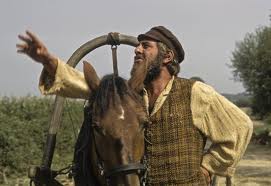
In addition to finding the necessary “balance” in terms of rescuing tradition from dissolution, Wisse claims, in response to Howe, that even though Tevye is not the Vilna Gaon, he is “the original stand-up comic, playing to an appreciative audience of one: his impresario, Sholem Aleichem, who then passes on this discovered talent to his readers.”

In other words, Wisse looks to underscore the ameliorative aspects of Jewish humor which are a response to history.  She does this by pointing out that Aleichem not only balances out tradition but he does so in the spirit of the “original stand up comic,” which he created.

And this speaks to Wisse’s recent book No Joke: Making Jewish Humor, since Wisse looks for a humor that balances tradition instead of destroying it by way of extreme/excessive sarcasm.

As I have tried to show in this blog entry, Wisse also thinks that extreme skepticism (the “quizzical” tone that Howe speaks of with Aleichem) can also pose a threat.  That’s why she introduces the notion of “balance” into the epistolary exchange with Howe.

(In the next blog entries that address this epistolary exchange, I’d like to bring out this subtle contrast between Howe and Wisse so as to show how the schlemiel can be read in terms of the tension between tradition and modernity.  If an author looks at the schlemiel in too skeptical or quizzical a light, the Jewish tradition may be compromised. Nonetheless, Wisse does agree that skepticism must be there.  As I noted above, for Wisse it seems to be a matter of emphasis.  She would agree that there is a strange, dark “undercurrent” with the schlemiel, but how much of an undercurrent?  How does it relate to – or balance out with – the comic element?  Is that what makes for Jewishness?  Or does radical skepticism and irrevernace, as we see in writers like Sholom Auslander or even Phillip Roth, mark Jewishness as “quizzical?”)

Laughter Through Tears or Tears Through Laughter? Irving Howe and Ruth Wisse’s Dialogue over Sholem Aleichem’s Humor – Take 1

images-5

Do we laugh through tears or do we cry through laughter?  The answer to this question or perhaps the question itself are, for Irving Howe, the crux of Jewish identity.  For Howe, the few Jews who really “scrutinize” themselves, the Jews who “dare to know” (so to speak), will come to this very question.  Howe has taken this risk and his experience of this question concerning Jewish humor serves as an example of his Jewishness.  This performance of Jewish identity – which comes out through his question concerning Jewish humor – is what Howe is showing us.   Howe is demonstrating a Jewishness that is based on pondering the question of what Jewish humor and with it Jewish identity is.

Either one laughs in order to dispel one’s sadness or one laughs and inevitably runs into sadness.   For Howe, laughter cannot dispel tears.  This declaration is, to be sure, Howe’s conversion experience. And he didn’t learn it from Saul Bellow, as he stated in his introduction to Jewish American Stories; rather, he learned it from an artist who is Saul Bellow’s Moses: Sholem Aleichem.

The relation of Bellow to Sholem Aleichem is a missing link for understanding not just Howe’s approach to Judaism, which ponders the question as to whether one laughs through tears or cries through laughter, but Howe’s Judaism, which he inherits.

Howe takes part in the legacy of a schlemiel tradition.  He is, in a way, educating the next generation of (troubled) schlemiels.

As I pointed out in the last blog-entry, Irving Howe, in his introduction to Jewish American Stories, and in this epistolary exchange, identifies with Saul Bellow’s reading of Jewishness.  And, as I pointed out, Bellow’s reading of Jewish identity is made in terms of Jewish humor.

Let us recall that Bellow finds that the uniqueness of Jewish humor is found in the fact that “laughter and trembling are so curiously intermingled that it is not so easy to determine the relation between the two.”  Howe so deeply identifies with Bellow’s claim about the intermingling of laughter and trembling in the Jewish humor that he repeats it in his shared introduction to another book published.  This new book, a collection of  Sholem Aleichem’s stories, was published three years after Jewish American Stories.  The 1979 collection of Shalom Aleichem stories is entitled The Best of Sholem Aleichem Stories.

In that introduction, Howe once again nods to Bellow and notes that Jewish humor “laughter and trembling are so curiously intermingled that it is not easy to determine the relation between the two.” The fact that Howe repeats this definition – not simply of Jewish humor, but, for Howe, Jewishness- is significant: he shares this “declaration” of his Jewishness with Ruth Wisse, a scholar of the schlemiel.

Given that he is testing his view of the schlemiel against hers, what Wisse says in response to Howe is even more telling.  Her similarities with Howe are important, but her differences are more interesting.  Her schlemiel and his differ.

The difference between their views of Jewish humor is instructive for those of us, today, who are concerned with the meaning of Jewish identity.  Their shared introduction to The Best Stories of Sholem Aleichem teaches us – by way of prompting us in a Talmudic manner – to interpret their relationship.  To prompt their readers to make a more literary reading of their introduction to Aleichem, they structured it as an epistolary exchange.

Let’s take note of this and read their dialogue closely.

I’d like to carefully go through this exchange of letters so as to show where Wisse agrees with Howe. After doing this, we can she where and how she tactfully disagrees.  The subtle differences between them are important and foreshadow Wisse’s recent book and much talked about book on Jewish Humor: No Joke.  ( I will address this book in a separate blog entry, but for now I’d like to draw out the precursor to that work which, I think, can be found in her dialogue with Howe.)

Ruth Wisse’s 1979 reading of Aleichem is of especial interest to a “schlemiel theorist” like me since Wisse is one of the foremost authorities on the schlemiel.  Her reading of Aleichem and Howe’s reading are not simply founded on their similar yet different readings of Jewish humor but also their readings of Jeiwshness.    For both, the famed Yiddish writer, Sholem Aleichem is an important starting point.  As a historian of Jewish literature, Howe believes that without Sholem Aleichem their could be no be Saul Bellow.  Bellow inherits crying through laughter not laughter through tears from Sholoem Aleichem.

First of all, although the introduction begins with (and is initiated by) Howe’s reflections on Aleichem’s perplexing humor, it ends with Wisse’s resolution.  Her resoluation balances between Howe’s “quizzical” view of Aleichem’s humor and Wisse’s own “quizzical” yet joyful view of his humor.   In the end, it is not just a matter of emphasis; in fact, their views of humor also articulate two kinds of Jewishness.  And the differences between these articulations are instructive and far reaching.

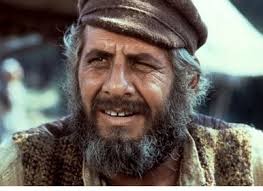
What concerns Howe most about Aleichem is the darker side of his work.  To be sure, one of the reasons he put Sholem Aleichem’s Best Stories together with Ruth Wisse was to show this neglected aspect of Aleichem’s humor.   Until then, many Americans who romanticized Aleichem (and, for Howe, Fiddler on the Roof didn’t help) associated Jewishness with joy and “laughter through tears.”

For Howe, this view, which I will call the “kitschy” view, is wrong.

The view of Aleichem (and the schlemiel) as simply a popular fun loving artist is, for Howe, too kitschy; and, as a result, it forgets history and rupture.  To be sure, Howe doesn’t desire a kitschy kind of laughter through tears.  He’s not interested in a Broadway or a Hollywood Production of Fiddler on the Roof (1964).

He seeks to be true to who he, by virtue of history, is: a Jew.  And his commitment to this kind of troubled laughter demonstrates his commitment to Judaism.  This commitment puts his kitschy identification with Jewishness into question. But the kitschy view of humor is not annihilated.  Alechem’s humorous world is, so to speak, “nihilated.”

Howe wants to show us (demonstrate for us) that his commitment to troubled laughter, in the face of such nihilation, is based on the approach to Judaism of his progenitor, Sholem Aleichem.  In other words, Howe’s Jewishness can be found in the troubled laughter we hear in Aleichem’s books.  He wants to share this insight and demonstrate how a commitment to Jewishness must challenge the popular, kischy view, that laughs through tears.

Howe seeks to set the record straight.  In the introduction he shares with Ruth Wisse, Howe tells us that Aleichem, like Bellow after him insist that to be Jewish we must admit that we cry through laughter.   This is tantamount to, as Howe says, “declaring” one’s Jewishness.

Wisse responds to Howe’s declaration with her own.

Irving Howe, Jewishness, and the Schlemiel – Take 2

DownloadedFile-2

From my own experiences and those of many of my friends, I have learned that many American Jews are perplexed about what it means to be Jewish while others, unfortunately, have become indifferent.  Those who are perplexed can turn to many different things for a resolution: some people try to understand their Judaism by turning to religion, some turn toward nationalism (Israel, Zionism, etc), some turn against Zionism, some turn to politics and justice, some turn to philosophers like Emmanuel Levinas or Martin Buber, some turn to Buddhism (Ju-Bus),  some turn to battles over sexuality and gender, some turn to music, and others turn to environmentalism,

Irving Howe’s search for the meaning of Jewishness differs from these.  His search was inseparable from his interest in the relationship of Jewish history to modernity and to Yiddish and Jewish American Literature.  It is also inseparable from his understanding of Jewish humor.  As I pointed out in the last blog entry on Howe, he went through many different readings of Jewishness and concluded that Jewishness is a “vague thing.”  Nonetheless, this doesn’t keep him from closely researching it and finding resonance in Jewish American literature.  What concerned him most was the future of Jewish American literature and Jewishness.   Relating to this, he thought that with the loss of the Jewish immigrant experience, which he believed were inseparable from places like New York and Chicago, Jewishness would also be lost.  As I pointed out in the blog entry, Howe believed that Jewish-American literature had no future because people no longer had a “felt” relationship to Jewish tradition or Yiddish.

Howe’s sense of Jewishness is, to be sure, found in his relationship with this loss of tradition and the transition from having a tradition to draw on to having no tradition.  But there is more to the story.  Of all the thinkers and writers that Howe mentions in relation to Jewishness (which include Osip Mandelstam, Saul Bellow, Harold Rosenberg, Isaac Rosenfeld, and Phillip Rahv), he finds his greatest affinity with the Nobel Prize winning author, Saul Bellow’s tragic-comic reading of Jewishness.  His own sense of Jewishness, which amounts to a big, sad, question mark, draws on what he says about Bellow in his introduction to Jewish American Stories and on what he says in a shared introduction to The Best of Sholom Aleichem (an introduction he shares, by way of letters (!), with Ruth Wisse).   Moreover, what he says about Jewishness vis-à-vis Bellow is nothing more nor less than his reading of the schlemiel.

Regarding Bellow’s understanding of Jewishness, Howe cites Bellow, in his introduction to Jewish American Stories, as saying:

In Jewish stories laughter and trembling are so curiously intermingled that it is not easy to determine the relation of the two.  At times laughter seems to restore the equilibrium of sanity; at times the figures of the story or parable, appear to invite or encourage trembling with the secret aim of overcoming it by means of laughter.

Immediately following this, Howe does something unusual.  He cites himself and gives his reading of Jewishness in terms of the perplexity of post-assimilation:

They (Jews) had achieved ‘a normal life’ in America, and for those with any taste for self-scrutiny, it was a life permanently beset by the question: who am I and why do I so declare myself? To live with this problem in a state of useful discontent was perhaps what it now meant to be a Jew.

Howe identifies himself with “those (Jews) who have any taste for self-scrutiny.”  And he also identifies with Bellow.  To be sure, later in the introduction, he confirms his identification with Bellow when he writes: “For what I want to assert is that the dominant American Jewish style is the one brought to a pitch by Saul Bellow and imitated and modified by a good many others.”  And, I would add, by himself.

Taken together, Howe is telling us that his “self-scrutiny” about what it means to be a Jew can be found in Bellow’s reflection on Jewish humor and its relationship to suffering and “trembling.”  Indeed, the exchange between the comic and the horrific is of great interest to Howe.   And this has a lot to do with what he thinks is Jewish, today.

His reading of Sholom Aleichem – as espoused in his introduction to The Best Sholom Aleichem Stories – is permeated by such a comic-horrific “feeling.”   With respect to the schlemiel, this reading is brought to its breaking point by way of his dialogue (in the shared introduction to that book) with the noted scholar of the Schlemiel, Ruth Wisse.

In the next blog entry, I will turn to this dialogue so as to tease out what is at stake when one reads the schlemiel in terms of an exchange between laughter and horror.  The stakes involve the relationship of literature and reflection to history.  As I have pointed out above, for Howe, this is his way of relating to Jewishness and it differs from those who seek to understand what it means to be Jewish by way of religion, Zionism, post-Zionism, etc.  And, unlike these other ways of seeking Jewishness, it underscores the importance of the schlemiel for understanding what it means to be Jewish.