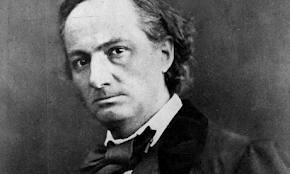
Baudelaire, Children, and Horror (Take 1)

images-1

As can be seen from many of my previous posts, I have been addressing the work of Charles Baudelaire on laughter and the comic. The reason I have spent so much time on this is because I have been attempting to understand Walter Benjamin’s reading of (and identification with) the comic (in general) and the schlemiel (in particular). To be sure, Benjamin had great interest in Baudelaire’s approach to the comic and, something we have not yet explored, children. Moreover, he was also interested in the comic as it appeared in Franz Kafka’s work.

Jeffrey Mehlman, in his book Walter Benjamin for Children, correctly notes that Baudelaire and Kafka were “nodal” points for Benjamin. This insight can be drawn from Gershom Scholem’s reflections on Benjamin which clearly show that Benjamin was preoccupied with two projects: one with Kafka and the other with Baudelaire and the Arcades Project. Mehlman claims that a close reading of Benjamin’s radio plays for children, which were written between 1929 and 1933 in Germany, can bridge the gap between the Kafka and Baudelaire projects.

Mehlman uses an approach influenced by psychoanalysis to do this. While Mehlman deserves much credit for his bringing these radio plays to the attention of English speaking critics and for his attempt to relate this work to Benjamin’s academic work, his reflections are preliminary. His book has a total of 97 pages and this makes sense since he moves from idea to idea at a very quick pace. Nonetheless, his work is valuable and it provides many entry points for this blog’s (and my book’s) investigation into Benjamin’s preoccupation with the man-child (the schlemiel).

Mehlman addresses the daemonic in his book in relation to Benjamin but not in relation to Baudelaire.  To be sure, it was from Baudelaire that Benjamin became intensely interested in the daemonic.  Mehlman’s reading of the daemonic in Benjamin is worth consideration – and we will do so in another post – but it still overlooks a few key links in Baudelaire.   In addition, Mehlman doesn’t mention any of Baudelaire’s reflections on children or on toys. These gaps need to be addressed before Mehlman or anyone tries to bridge the gap between Kafka and Baudelaire (Benjamin’s two final projects).

I have been dealing with this issue by giving an in-depth reading of the Daemonic in Baudelaire and its relationship to laughter. Furthermore, I have shown how it works into Benjamin’s reflections on himself and also Kafka (by way of the Shuvalkin Parable – which Mehlman reads psychoanalytically).

I’d like to continue along this thread. By doing so, we can better understand Benjamin’s conflict with childhood in general and his own childhood in particular. In addition, I think it is imperative for us to approach Benjamin’s reading of Kafka in light of these reflections. Since Benjamin’s readings of Kafka either draw on or reject Baudelaire’s approaches to humor and children.

To this end, I’d like to begin with a quote from Baudealire’s journals about art and horror and relate these reflections to his reflection on children and laughter.

Baudelaire was very interested in horror. To be sure, he imported the work of the master of horror, Edgar Allen Poe, into France by way of translation. Moreover, he introduced Poe to a French audience in his celebrated essay “Edgar Allen Poe: His Life and Works.”

In the essay, Baudelaire shows his utter fascination with Poe’s work. Baudelaire gives a detailed description of the terror and excitement the writer and the reader upon writing and reading horror:

The very fervor with which he hurls himself into the grotesque for love of the grotesque and the horrible for love the horrible I regard as proofs of the sincerity of his work and the intimate accord between the man and the poet. I have already noticed in several men that such a fervor is often the result of a vast store of unused vital energy…The supernatural rapture which man can feel at the sight of his own blood flowing, those sudden, needless spasms of movement, those piercing cries uttered without the mind’s having issued any orders to the throat…As he breathes the attenuated ether of this world the reader may feel that vague distress of the mind, that fear on the brink of tears, that anguish of the heart which dwell in strange immensities. But admiration is the dominant emotion, and moreover the writer’s art is great! (The Painter of Modern Life, 90-91)

In a journal entry dated May 13, 1856, Baudelaire writes a shocking passage which echoes these sentiments:

A man goes pistol-shooting, accompanied by his wife. He sets up a doll and says to his wife: “I shall imagine that this is you” He closes his eyes and shatters the doll. Then he says, as he kisses his companion’s hand, “Dear angel, let me thank you for my skill!”

Immediately following this passage, Baudelaire discovers his task as an artist: “When I have inspired universal horror and disgust, I shall have conquered solitude.”

Who inspires this tendency to horror? Baudeliare, in the same entry, describes his style in terms of Poe:

STYLE: The eternal touch, eternal and cosmopolite. Chateaubriand, Alph. Rabbe, Edgar Poe.

The last pair, Rabbe and Poe, is telling when juxtaposed the other two pairs, since Alphonse Rabbe is most well known for his Album d’un Pessimiste which pays homage to pessimism and nihilism. The other two pairs pay homage to culture, philosophy, and religion. The last pair, however, speak to the task of art which is, for Baudelaire, to “conquer solitude” by way of inspiring “universal horror and disgust.”

These reflections on Poe and horror shed an interesting light on Badeliare’s prose pieces on children, toys, and laughter.

To take one example, and I will provide others in our next blogs, Baudelaire when writing on the “Absolute comic,” claims that the European Edgar Allen Poe – namely, ETA Hoffmann – is the best illustration of the Absolute Comic. And the exemplary Hoffmann story that Baudelaire chooses to cite and discuss deals with the horror of a child.

I will end this blog entry with Baudelaire’s intricate description of the story in his “Essay on Laughter.” Notice how Baudelaire’s tone changes when he tells the story: he becomes a storyteller telling stories to children:

In the story entitled Daucus Carota, the King of the Carrots…no sight could be more beautiful than the arrival of the great company of the Carrots in the farmyard of the betrothed maiden’s home. Look at all those scarlet figures, like a regiment of English soldiers, with enormous green plumes on their heads, like carriage footmen, going through a series of marvelous tricks and capers on their little horses! The whole thing is carried out with astonishing agility. The adroitness and ease with which the fall on their heads is assisted by their heads being bigger and heavier than the rest of their bodies, like toy soldiers…The unfortunate young girl, obsessed with dreams of grandeur, is fascinated by this display of military might. But an army on parade is one thing; how different an army in barracks, refurbishing its harms, polishing its equipment, or worse, still, ignobally snoring on its dirty, stinking camp-beds! That is the reverse of the medal; the rest was but a magic trick, an apparatuses of seduction. (163)

The horror comes when her father, “a wise man versed in sorcery,” lifts the flap of the tent to shock her: “Then it is the that the poor dreaming girl sees all this mass of red and green soldiery in its appalling undress, wallowing and snoring…In its night-cap all that military magnificence is nothing more than a putrid swamp”(ibid)

Notice that Baudelaire moves from the childish and the innocent to the horrific and associates this shift with the “Absolute comic.” This shift marks two principle poles for Baudelaire which he travels between.  To be sure, the biggest shocks and the greatest comic revelations – for Baudelaire and for Benjamin – involve some kind of childhood damage.

In the next few entries I will look into this relationship of children and toys to horror and terror. These reflections on childhood and horror will help shed light on Benjamin’s vision of himself as a schlemiel and his vision of Kafka.


Guest Post by Professor Jeffrey Bernstein: “Schlemiel, Schlemazel . . . Augenblick in-corpor-ated?”

DownloadedFile-1

Lately I have been wondering about Menachem’s earlier posts regarding the prophetic (possibly messianic?) potentiality of the schlemiel.  In a post on Benjamin and Strauss, he gave a nod to the secretive ‘wink, wink’ capacity of the schlemiel’s humor which the spectator gets, but which the schlemiel may not.  Menachem writes:  “Winking is not a straightforward gesture.  It is oblique.  And it is immediate, like a blink of the eye.”  This characterization immediately strikes me; given that he juxtaposed the phrase ‘blink of an eye’ with the figure of Benjamin, I am put in the mind of the figures of the ‘augenblick’ (which means  both ‘blink/twinkling of an eye’ and ‘instant/moment’) and the ‘jetztzeit’ (‘now-time’).  I am lead to wonder:  what is the ‘time’ of the schlemiel?  And if there is a schlemielich temporality, is it well-characterized by these terms?

Just for laughs, let’s characterize the situation in which we might engage this question:  as the old saying goes, the schlemiel is the one who spills his soup and the schelmazel is the one’s who gets the soup spilled on him.   To my mind, it looks something like this:

Schlemiel:  (in cafeteria, walking with tray of soup, speaking to Schlemazel) So I says to him ‘Hey, whadda you talkin’?  As if Spinoza knew anything about the Geonim!’  I (trips)—whoa, whoa, whoops!!!!! (spills soup on Schlemazel)

Schlemazel:  Ow!  Vey iz mir!  That soup’s hot!  Look what you did!

Schlemiel:  Oy! Look what I did!

There doesn’t appear to be any prophetic aspect to this caricature—but of course, the littlest things contain the deepest truths.  Soup is hot; we make messes; we burn—such is life.  And what can we do except scratch our foreheads and say ‘Oy! Look what I did!’  This may be the adult secret contained in many of our childhood experiences.

But strangely enough, this appears not to resemble the arc of thought contained in the terms ‘augenblick’ and ‘jetztzeit’.  So a brief, and somewhat circumambulatory, consideration is in order:  In the Weimar Germany of the 1920’s, in the aftermath of the massive physical, psychological, cultural, and ideological destruction of the First World War, many different thinkers (sensing a fictitious quality to the narrative of ‘Enlightenment historical progress’) tried to find a way of speaking about the perceived crisis in which Europe was then involved.  Figures such as Barth, Heidegger, Rosenzweig, Lukacs, Benjamin, Kafka, Schmitt, Adorno, Schoenberg, Kandinsky, and Bloch all (in vastly different ways and for vastly different reasons) attempted to articulate the sense that if historical change is to happen, it will do so instantaneously and non-teleologically; it will come, as it were, like a thief in the night.  In doing so, they made witting or unwitting use of the idea of kairos  as it came to be articulated in Paul.  For Paul, kairos names the eschatologically charged instant in which the encounter with God and the acknowledgment of messianic time occurs.  It is always thought in opposition to chronos—i.e, profane time.   Augustine takes up this thought in his discussion of  ‘the present’ (in Confessions) as that which grants substantiality to the past (as recollection) and the future (as anticipation) by virtue of its being a divine(-ish) capacity of the human soul; if it were not for the creaturely replication of the present as nunc stans, time would consign humans to mortal oblivion.

Centuries later, as Luther studiously worked on his vernacular translation of the New Testament, he encountered the Pauline phrase ‘in the twinkling of an eye’ (in 1 Corinthians) and translates it with ‘augenblick’.  The ‘blink/glance/twinking of an eye’ is now understood not as one moment of ‘homogeneous empty time’ (Benjamin) or interval of ‘clock time’ (Heidegger) among others—it is precisely now understood in opposition to such mechanistic conceptions of temporality.  For the Weimar bunch, it becomes synonymous with authentic lived experiential time.  And though Heidegger calls ‘off-sides’ on Kierkegaard’s punt, the latter makes an important admission when he states (in The Concept of Anxiety) that “It is only with Christianity that sensuousness, temporality, and the moment can be properly understood, because only with Christianity does eternity become essential.”  True, Aristotle had also made use of the word kairos in the Nicomachean Ethics, but there it only meant the ‘opportune moment’ for action—like providing medicine or going to war.   It wasn’t essentially different from his characterization of the present (in the Physics) as a vanishing point—a pure limit between the ‘no longer’ and the ‘not yet’.

According to Agamben (oy!), Benjamin uses the term ‘jetztzeit’ (in his Theses on the Philosophy of History) to translate Paul’s ho nyn kairos (‘the of now time’) in Romans.  In this context, one might suggest that Benjamin is taking up the Aristotelian understanding (and its example of military battle) in holding that the ‘jetztzeit’ is that revolutionary moment which ‘blasts a hole’ in the ideology of ‘homogenous, empty time’.  But in viewing the ‘now-time’ over and against the normalizing, ideological conception, Benjamin simultaneously rejects the Aristotelian topos of the ‘opportune moment’ in favor of the Pauline one.  Certainly, Heidegger critiques the Aristotelian notion along similar lines (in Basic Problems of Phenomenology):   “The instant is a primal phenomenon of original temporality, whereas the [conventionally construed] now is merely a phenomenon of derivative time.  Aristotle already saw the phenomenon of the instant, the kairos, and he defined it in the sixth book of his Nicomachean Ethics; but . . . he did it in such a way that he failed to bring the specific time character of the kairos into connection with what he otherwise knows as time.”   In drawing the connection between kairos and ‘augenblick’ in his early readings of Paul, Heidegger thus simply makes explicit (on the theological level) what he will later phenomenologically describe as the suddenness of authentic temporality—i.e., that it happens as kairos and not as chronos.

I’m not trying to simply peg the terms ‘augenblick’ and ‘jetztzeit’ as Christian and thus inappropriate as descriptions of the schlemiel (well, ok, a bissel I am).  Rather, I want to suggest that—despite the Jews that adhere to these descriptors and the Christians who don’t—these terms fail to accurately describe the authentic temporality of the schlemiel.  This for two reasons:  (1) ‘augenblick’ and ‘jetztzeit’ (understood as sudden and arresting) are both set over against a conception of time as homogenous, empty, identical and simply quantitative, and (2) as such, both terms are markers for a presence which the schlemiel  always seems to refuse (or, perhaps, fails to attain).  Whether it be the ‘negative presence’ of the absent, absolute and unattainable future, the ‘eternal present’ of the nunc stans, or the ‘revolutionary and shocking momentary present’ of eschatological realization, ‘augenblick/jetztseit’ is always indexed to a point of stability.  The meaning and signification of the moment/instant—be it eternal, futural, or sudden—is infused, embodied, literally in-corpor-ated (even in-carnated), in an otherwise purely quantitative and empty temporal flow.  This is why, even in the mode of anxiety or transience, the moment/instant is still (on the formal level) the source of a radiant serenity.  Put differently, ‘augenblick/jetztzeit’ bears witness to a religious tradition and context that is poetic.

Are there any resources in ‘prosaic’ religious traditions (to adopt the terminology of Yeshayahu Leibowitz) for thinking the temporality of the schlemiel?  You guessed it—the answer is yes!  So now, a much shorter consideration of this ‘other’ tradition:  Amos Oz and Fania Oz-Salzberger (in Jews and Words) note that Biblical Hebrew points to a different understanding of time than what we get in the Western conception (i.e., the qualitative moment/instant vs. the quantitative flow from past to future or vice versa).   The word kedem denotes ‘ancient times’ but its derivative kadima means “ ‘frontward’ or ‘forward’ “.  Similarly, the word lefanim means both ‘a long time ago’ and ‘in front of/to the face’.  Finally, achreinu means ‘after us’ both in the sense of ‘behind us’ and ‘in future’.  Put differently, Oz and Oz-Salzberger (following the work of Adin Steinsaltz and Shulamith Harven) hold that “When we speak Hebrew, we literally stand in flow of time with our backs to the future and our faces toward the past.  Our very posture is different from the Western view of time . . . The Hebrew speaker literally looks frontward to the past.”  Sound familiar, oh theorists of the Continent?  It recalls not only Benjamin’s reading of Klee’s Angelus Novus (whose face is turned toward the past while he is blown uncontrollably into the future); it also bears some resemblance to Arendt’s reading of Kafka’s “He”, where ‘he’ stands in between the two antagonists (the past and the future) who are both battling him and each other.  Arendt’s interpretation is itself a struggle between the Weimar conception of moment (for Arendt, ‘he’ is the present understood as nunc stans) and the Hebrew one (‘he’ enlists the help of both the past and the future in ‘his’ battle with one another).  Insofar as it rejects the static distinction between the qualitative, lived, in-corpor-ated moment and quantitative but empty clock time, it remains in proximity to Benjamin’s Klee-interpretation.

What does it mean to look frontward to the past?  How can a prophet assume this posture and still ‘prophesy’?  Clearly, the schlemiel does not utter phrases like “And I say unto thee…”  If the schlemiel is prophetic, s/he is so retrospectively—i.e., “Oy!  Look, what I did!  Such is life!”  The schlemiel does not so much prophesy as ‘register prophetically’ what has already happened as what will always already continue to have been happening (oy, look what I did).  This retrospection, this belatedness, this reactivation of the past in the (present of the) future, has been characterized by Freud (with a little help from Rav Lacan) as nachtraeglichkeit and by Adorno (with a little help from Rebbe Said) as ‘late style’.  The schlemiel is always ‘late to the party’, always noticing things ‘after the fact’.  The signature phrase of the schlemiel’s wisdom is not ‘AHAH!’ but ‘OH . . . YEAH!’  And the schlemiel never ceases to register his/her insights too late for anything to be done about them.  Hence, as Janouch’s Kafka (as mediated through Benjamin) tells us, there’s an infinite amount of hope—just not for us schlemiels.  The moment of realization never happens by means of anticipation.  In the words of that other great theorist of the schlemiel, Carole King, ‘Its TOO LATE, baby, now its too late’.  If life were characterized by great poetry, we might at this point despairingly quote T. S. Eliot:  “After such knowledge, what forgiveness?”  But if life is ultimately prosaic, what else is there to do but laugh?  Incipit schlemiel!

Jeffrey Bernstein is an Associate Professor of Philosophy at the College of the Holy Cross. He works in the areas of Spinoza, German philosophy and Jewish thought.

On Aggressive Comedy, Souvenirs, And Prehistoric Schlemiels

DownloadedFile

Comedians can be very aggressive and may sometimes exude rage.  The comic rant, which we are all-to-familiar with, is an illustration of how comedy sometimes becomes indistinguishable from anger.

One need only think of the Three Stooges, Larry David, Andy Kaufmann, Lenny Bruce, or even Louis CK to see how rage plays out through comedy.

Given the history of the schlemiel in Jewish comedy, this is an interesting phenomenon.  Traditional schlemiels – of the Yiddish variety – are often very humble and are not filled with rage; but, in America, we often see a different variety of the schlemiel which is more aggressive.

This difference is noteworthy and it prompts a lot of questions about how the schlemiel, a character which, by and large, is traditionally innocent and humble, became aggressive.

The trajectory of my blogs over the last week leads us toward a way of framing and addressing these questions.

Over the last week, I have spent a lot of time thinking through Walter Benjamin and Paul deMan’s reading of Charles Bauldaire’s reading of comedy.  I have also addressed Walter Benjamin’s “s(c)h(l)ocking” discovery that he was a schlemiel.  The thread that joins all of these entries is what Walter Benjamin, following Charles Baudelaire, would call Spleen.

What is Spleen?

In his unpublished work of maxims, insights, and aphorisms entitled “Central Park,” Walter Benjamin defines Spleen (which is also part and parcel of Baudelaire’s Prose Collection – Paris Spleen) as “the feeling that corresponds to the permanent catastrophe.”

Max Pensky, in his book on Benjamin entitled Melancholy Dialectics, interprets Spleen as a “mode of melancholia in which the subject can no longer mournfully ‘observe’ the permanent catastrophe of natural history, but rather, in a quite literal sense is the catastrophe”(170).

Pensky’s reading of Spleen, at many points, sounds much like Paul deMan’s reading of the “irony of irony” which I addressed in a recent blog.  But Pensky sees it as the source of Spleen and not simply, as deMan does, as the essence of laughter.  Pensky points out the emotional tonality of Spleen: it is an “emotional complex consisting of various permutations composed of the two simple elements of profound fear and rage: primal emotions, in keeping with the power of the commodity to awaken prehistoric, savage modes of existence”(171).

Moreover, “Spleen is characterized in the first instance as ‘naked horror’; that is, the primitive, infantile fear of being swallowed up by the mass of objects, the fear of flying to pieces, disappearance in the diffraction and multiplication of selfhood.”

The very language of this description – “the fear of flying to pieces, disappearance in the diffraction and multiplication of selfhood” – echoes that of Paul deMan’s description of the effect of Baudelaire’s “irony of ironies.”

But the main point is that Spleen prompts Baudealire to write poems and allegories.  It is through them that Baudelaire exhibits a “heroic melancholy.”  It is here that, I contend, we can find the modern, aggressive schlemiel.

In the context of Benjamin’s reflections on Baudelaire’s notion of Spleen, the best model for relating Spleen to the schlemiel is by way of Benjamin’s reflection on the relationship of pre-history to history.

To be sure, the fact that Pensky says that Spleen is pre-historical reflects Benjamin’s concern with the relationship of pre-history to history. This is a concern that we see in his writings on Baudelaire and in Benjamin’s essay on Franz Kafka where, I would like to note, we see the most explicit engagement with the schlemiel.  The pre-historic nature of the schlemiel, in that essay, is associated with the innocent aspect of this character; however, I would like to argue that his comic characterization of Kafka’s characters and their innocence is Benjamin’s response, in some way, to Spleen.

Evidence of this can be found in the fact that Benjamin, in several places in that essay, discusses Kafka’s characters in relation to pre-history.

In “Central Park,” Benjamin notes that Baudelaire’s poems and prose pieces are a response to Spleen.  Benjamin calls the trace of this response, or rather, this “heroic” struggle, a souvenir.  The artwork-as-souvenir exposes us to this trace while protecting us from its shock.  Nonetheless, the heroism is not complete.

The souvenir emerges out of the “endless catastrophe of capitalism.” As we have seen from Pensky’s description, this catastrophe destroys the subject. The souvenir is the only thing that remains and, like an angel, saves the artist from Spleen, that is, from impotent rage and self-destruction.

For some strange reason, comedy is the only response to Spleen that Benjamin doesn’t address in depth.  Rather, as we saw in our reading of Benjamin’s interpretation of Baudelaire’s “Essay on Laughter,” the only thing that remains for Benjamin of comedy, the only souvenir, so to speak, is the Satanic smile that touches everything, even children.  Although this seems devastating, it is not.  In fact, the smile, for Benjamin, seems to be a “double image” which protects him from the catastrophic effects of Spleen.  (As Scholem notes, Benjamin associated the smile with “satanic serenity.”)

More importantly, I would argue that the trace of the struggle with Spleen touches Benjamin’s image of himself as a man-child. To be sure, we can say that the image of his handwriting in the Goethe Dream (found in his “Vestibule” aphorism), which is written in loud, childish letters, is a souvenir.  It retains the trace of a struggle with Spleen.  It doesn’t overcome it. And this trace of Spleen can be seen if we simply reflect on the fact that Benjamin, in the dream, is the subject of a Prank!

In other words, his self-image – in terms of his name being written/signed in childish letters – is a souvenir.

Likewise, the souvenirs that Benjamin finds in Kafka’s world are also traces of a battle with Spleen.  In that essay, he relates Kafka’s characters to a Jewish form of Spleen:  Exile.

What all of these figures of the schlemiel share is the fact that all of them are, as Benjamin says in his Kafka essay, pre-historic.

The schlemiel and all traces of the struggle with Spleen are pre-Historic because they cannot enter history.   They cannot assert the heroic and enter the historical struggle.

In fact, this was the critique leveled by Hannah Arendt and many Zionists against a Jewish people which had “degenerated” due to exile.   They level this criticism against the schlemiel which was, for them, the figure of Exile.   As Arendt had argued, the Jews were to accustomed to powerlessness and Exile to take action and enter history.  (I will return to this in a later blog entry.)

For them, the schlemiel was a figure of “impotent rage” that they believed had much to do with Exile (Diaspora).  It would fade away with the founding of a new state.  But as we have seen, the schlemiel remained in America; but what happened, in many cases, was that it more and more often started bearing the traces of Spleen.  The meaning of this agressivity has much to do with the power of art.

The American Schlemiel, seemingly, no longer embodies that sadness, that Melancholy, that Benjamin aspired to.  If anything, it has taken on Spleen.  It is full of rage and sarcasm.  Perhaps this has to do with the fact that entertainment has displaced art and the heroic artist has been defeated by the stand-up comic.

Perhaps the pre-historic has been displaced or perhaps the American schlemiel still hasn’t entered history.  Perhaps, as Benjamin feared, art cannot sustain the “endless catastrophe” of capitalism.  As a result, they only thing left for humor is “impotent rage.”

Is that what we see, so often, in Curb Your Enthusiasm?

Baudelaire and Benjamin: The Madness of Humility or the Madness of Humiliation?

images-3

Comedy often deals with power and powerlessness.  But as Baudelaire understands it, power usually has the upper hand.  For Baudelaire, comedy brings out the Satanic, powerful side of man, not the powerless and humble aspects.  It doesn’t return us to innocence.

Even though it has elements of “innocence” and although it is guided by the “law of ignorance,” the Absolute Comic is not a return to childhood in the full sense.  It retains the Satanic element since the Absolute Comic still nods to the superiority of the viewer\reader and man`s superiority over nature:

I would say that when Hoffmann gives birth to the absolute comic it is perfectly true that he knows what he is doing; but he also knows that the essence of this type of the comic is that it should appear unaware of itself and that it should produce in the spectator, or rather the reader, a joy in his own superiority and in the superiority of man over nature(165).

Notice that the Absolute Comic is innocent (“unaware of itself”) AND it produces a joy in the viewer’s “own superiority” and in the “superiority of man over nature.”

It retains this duality.

But, as we pointed out in our previous blog entry, this superiority is tainted.  It is a kind of madness.  In fact, as I pointed out, Baudelaire sees the insane as expressing the essence of this comic superiority.

The madness of the Absolute comic, as Baudelaire understands it, is different from what he calls the “madness of humility.”   Baudelaire associates the madness of humility with the “wise” who see the superiority of the comic as “inferior.”

Laughter is a sign of inferiority in relation to the wise, who, throughout the contemplative innocence of their minds, approach a childhood state.

It seems as if there are not only two kinds of madness but also two types of children: the humble and the satanic.  One is mad for God while the other is mad for itself and its superiority.

Which child does Baudelaire favor?  Which madness is superior? The madness of humility or the madness of the comic?  More importantly, why doesn’t Baudelaire, like Dostoevsky or Benjamin, imagine a holy fool?  After all, isn’t a holy fool humble, unconscious of himself, innocent, and funny?

How would Benjamin address these questions?   And when he talks about “Satanic Serenity” was Benjamin imagining a happy state that comes out of the Absolute Comic?  Was he siding with the madness of the comic over the madness of humility?  Could we call the “joy” that the viewers-slash-readers of the Absolute Comic feel when watching the Absolute Comic “Satanic Serenity?”  And how is this serenity different from the serenity that emerges from the madness of humility?

These questions present a problem: if Benjamin was so into the “return to childhood,” which we saw in his reading of Dostoevsky’s The Idiot, wouldn’t he aim for the serenity of the wise man?  After all, wasn`t Dostoevsky leaning more toward the madness of humility in his novel?  Would he stand on the side of the wise man, who would see the smile, and especially the satanic smile (like the laugh), as “inferior?”  Or would Benjamin argue that the only way to attain happiness is, as Baudelaire might say, through the Absolute Comic?

If this is the case, then, one may only attain to partial childhood but not full. The madness of humility no longer seems to be an option for modernity.  Violence seems to be more akin.   To be sure, the Absolute Comic evinces a delight in the destruction of innocence and delights in the excesses of play: as we see in Baudelaire’s portrayals of the mime and in his reading ETA Hoffman’s story in which a girl is shocked when she realizes that her image of order and beauty are false.  In fact, the negation of her childish superiority (the superiority of her ideas and military order) is the basis, according to Baudelaire, of the audience`s joy at its superiority.  They – the audience – and not she – the comic character – are the masters of ignorance and are superior over nature.  They are mad with superiority, yet in a way that is not ignorant.

To be sure, though the madness of humility is not an option for modern man, and although Baudelaire gives the madness of the comic center stage, he does mention the “madness of humility.”  Moreover, Baudelaire notes that wise men, “throughout the contemplative innocence of their minds, approach childhood.”  He acknowledges different levels of innocence and the challenge to comedy made by the wise; nonetheless, he doesn`t pronounce either in a definitive manner.

I think Benjamin knew full well what was at stake in this comparison.  And he ventured where Baudelaire did not.  In his reflections on the Goethe Dream and on the Shuvalkin parable, Benjamin was engaging in the madness of humility and not simply in the madness of the comic.

True, he sees himself as double: as a man and a child.  But did Benjamin see himself as superior as Baudelaire suggests of every reader or viewer of the Absolute Comic? Did Benjamin feel a “Satanic Serenity” when he saw himself as a man and a child; that is, when he discovered the meaning of the Goethe dream and when he penned the Shuvalkin parable?  And wouldn`t Satanic Serenity imply an experience of comic superiority?

I would like to suggest that Benjamin didn`t feel comic superiority so much as a certain kind of powerlessness and astonishment when he looked at himself as a schlemiel.  We also hear this in Benjamin’s claim about Kafka: that “the beauty of his work was the beauty of failure.” This comment evinces a sense of inferiority not superiority.  In fact, Benjamin didn’t seem to take joy in this joke.  This is in contrast to Baudelaire, who notes that joy goes hand-in-hand with the feeling of Comic Superiority. To be sure, I can’t imagine anything close to Satanic in this reflection. The same goes for his reflection on himself in the “Vestibule” aphorism.  In fact, this destiny, to be marked as a child in Goethe’s house, is disheartening.  More disheartening is the fact that he is the subject of a prank.

I would suggest that this experience leans more toward the “madness of humility” or rather the madness of humilation.  Unless, that is, Benjamin would smile (satanically) at his misfortune.

Getting Comically Wasted: On Charles Baudelaire’s Notion of Absolute Comedy

170px-Paul_Cézanne_060

Baudelaire had a penchant for “intoxication” and comedy.  And what better day to discuss Baudelaire’s notion of the comic than on St. Patrick’s Day!  To be sure, Baudelaire thinks that the absolute comic, at its best, is like “intoxication.” Perhaps the “Satanic Serenity” that Walter Benjamin takes note of has a source in this; after all, Benjamin wrote about “Satanic Serenity” in his notes for his essay “Hashish in Marseille.”  As Baudelaire understands it, the state that one enters in the Absolute comic includes a sense of being “double.”   The irony of it all is that  this duality reminds one that one is “innocent” and, literally, destroyed.  And on St. Patrick’s day people usually talk about getting “wasted,” “destroyed,” and “hammered.”  All of these phrases suggest some kind of violence and, as Baudelaire suggests, some kind of innocence.

As we learned in the last blog entry, Satanic laughter is associated with a sense of superiority.  Baudelaire sees the insane (“the mad”) as the best illustration of an extreme sense of superiority.  The laughter of the insane, based on the psychotic insistence on the superiority of the laugher, brings out the essence of the “significant comic” (the comique significatif).  Mad laughter is, for Baudelaire, Satanic.  It has a total disregard for the world. It laughs at the world.  But it is deluded.  It has no innocence about it whatsoever.  It takes on a destructive daemonic aspect.

The significant comic doesn’t seem to embody what Benjamin would call “Satanic Serenity” since it is solely destructive.  The significant comic is not simply comic because she is “wasted”; no, s/he is comic because s/he wastes people with her daemonic humor and laugh.

(Mind you, for Baudelaire, children, “budding Satans,” are included in this category.)

The Absolute comic is different from, yet related to, the “significant comic.”  It is the kind of comedy that would attract Walter Benjamin who appreciated, like Baudelaire, gestural comedy (mime) and the kind of comedy that included what Baudeliare called the “law of ignorance.”

Baudelaire first introduces the Absolute comic when he discusses “laughter at the grotesque.”  To be sure, “the laughter caused by the grotesque has about it something profound, primitive, axiomatic, which is much closer to the innocent life and to absolute joy than is the laughter caused by the comic in man’s behavior”(157).

For Baudelaire, this is the superior form of comedy because it brings man “closer to the innocent life and to absolute joy.”

Baudelaire notes that the “absolute comic” has “one criterion”: “that is laughter – immediate laughter.”  However, there is one condition for comedy to be absolute, besides immediate laughter and that relates to the disclosure of what is most pathetic in humankind:  “the comic can only be absolute in relation to fallen humanity”(158).

In other words, the absolute comic must signify through falleness.  It must be – so to speak – wasted.

And it is only the best artists, Baudelaire tells us, who apprehend it. For these minds “are sufficiently open to receive absolute ideas”(158).  Baudelaire, after saying this, writes of an author who is the master of German horror and the grotesque; namely, the late  18th century German writer ETA Hoffman (158): “He always made a proper distinction between the ordinary comic and the type which he called the “innocent comic.”

What Hoffman calls “the innocent comic” is a blending of the innocent and the grotesque.  Moreover, it isn’t so “innocent” in the sense that it includes a distinct form of “violence.”  It doesn’t escape violence.

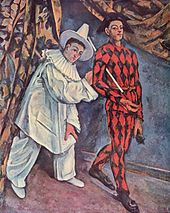
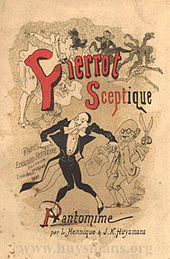
Baudelare notes that we also see such violence and innocence in the work of French mimes like Pierrot.  Regarding the mime and the clown, Baudelaire notes that Pierrot mixed the innocent and the grotesque by way of facepaint and gesture: “Upon his floured face he had stuck, crudely and without transition or gradation, two enormous patches of pure red.  A feigned prolongation of the lips, by means of two bands of carmine, brought it about that when he laughed his mouth seemed to run from ear to ear”(160).

170px-Léon_Hennique_-_Pierrot_sceptique

And although he appeared childish and innocent, he certainly was not: “As for his moral nature, it was basically the same as that of the Pierrot whom we all know – heedlessness and indifference, and consequently the gratification of every kind of greedy and rapacious whim”(161).

In other words, while he appears innocent, he is “devilish.”

The act of this rude yet innocent clown leads us to “a dizzy intoxication.” When one watches them “intoxication swims in the air; it is intoxication that fills the lung and renews the blood in the arteries”(163).  The “absolute comic” has “taken charge of each one of them.” And by each one, Baudelaire suggests that the comic and the audience are possessed.  Everyone is intoxicated.

The mime becomes possessed and seems to leave the realm of men: “Every gesture, every cry, every look seems to be saying: ‘The fairy has willed it, and our fate hurls us on – it doesn’t worry me! Come, let’s get started! Let’s get down to business!’ And then they do…which starts at this point – that is to say, on the frontier of the marvelous”(162).  In other words, the mime takes us into another realm by way of his gestures – a realm that, while laughable, brings us closer to childhood.

This can only mean that in his grotesque and childish disregard of limits, the mime’s gestures, his madness, while destructive counters the solely destuctive madness of the regular comic.   The mime is not simply mad – he is, actually; he certainly flaunts a superiority and indifference to the civilized world of adults.  But this madness, because it is childish, is also innocent.  The mime is a drunk of sorts and he spreads the feeling of intoxication through his rude and innocent gestures.

Baudelaire notes that nothing can surpass the absolute comic that we find in the mime: “But how could the pen rival the pantomime? The pantomime is the quitessence of comedy; it is the pure comic element, purged and concentrated”(162).

Nonetheless, Baudelaire ends his essay on laughter and devotes the most space to discussing this mad innocence by way of a close reading of ETA Hoffman’s story “Dacus Carota, The King of the Carrots.”

This story is exemplary because it shows us how a little girl, a “budding Satan,” loses her sense of comic superiority by way of the grotesque.  Her astonishment, her shock, brings us in touch with the “Absolute Comic.”

Baudeliare tells us that “the unfortunate young girl, obsessed with dreams of grandeur, is fascinated by a display of military might.”  When the girl is shown the soldiers sleeping at night, by her “magician” father, she experiences shock and vertigo.  Her exposure to the grotesque display of soldiers sleeping at night, when her father opens the “flap” of the tent, leads to what Baudelaire calls a “comic emanation, explosion, as it were, a chemical separation.”

What “emanates” from the comic explosion?

In the comic explosion we become aware of our childish part, which is unaware of itself.

This is the “law of ignorance.”  Indeed, for Baudelaire, “the most distinctive mark of the absolute comic is that it remains unaware of itself.”

This translates into a double consciousness for the viewer or reader. It indicates “the permanent dualism in the human being – that is, the power of being oneself and someone else at the same time”(165).

This experience, since it includes ignorance is double. As we saw above with the little girl who is astonished when she sees the grotesque soldiers but doesn’t know why she is astonshed: she is double.  She doesn’t know herself, but we do. Its an uncanny sense of self that the reader or viewer takes on. Baudelaire says it is superior – and, as we have seen superiority is the core of the satanic-slash-comic. It is the essence of laughter.

Perhaps this sense of duality is the cause of what Walter Benjamin’s calls a “Satanic smile.” Benjamin argues that it is based on a “Satanic Serenity” and not on destructive element of the Satanic.  But this misses one essential point made by Baudeliare: the serenity one has, which enables one to be oneself and someone else at the same time, is based on some kind of explosion.  It is based on some kind of destructive violence which, as Baudelaire, notes is inevitable when it comes to comedy.

This resonates with what we saw in Benjamin’s reading of Dostoevsky’s The Idiot.  There, he notes that a return to childhood, will not come without an “implosion.”

The violence that the mime and Hoffman apply leads to childhood.  This is the paradox.  With Benjamin this takes on a fascinating element because Benjamin sees himself as the butt of the joke.  He sees himself as a man and as a child: as himself and someone else.  But, and here is the point: he is both a man and a child.  He is double.

But there is one missing ingredient: the real basis for the Absolute Comic’s performance – as for the significant comic – is failure.  The secret of comedy is that it is based on what Baudelaire called Spleen – that is, rage and anger at one’s meaningless suffering in the world.  Superiority – whether of the significant or the Absolute comic variety – is ultimately a delusion.  But a necessary one as it casts out the hope that even though one is pathetic, one is innocent.  This can either bring about a Satanic Serenity or, perhaps, depression and melancholy.

Benjamin brought this double sense of himself in the Goethe aphorism and in the Shuvalkin parable. The absolute comic – and its sense of duality – is evident insofar as “the law of ignorance” pervades both: Benjamin was asked to sign but he had not idea that his name was already signed; and Shuvalkin thought he had the signatures of Potemkin but found that he was ignorant.  Shuvalkin, like Benjamin in the “Vestibule” dream, didn’t realize that the king had singed his name on each paper.  In both, the prank, though Satanic, is an emanation and explosion within which Benjamin sees himself as other: in which he sees himself as a schlemiel.. He sees himself as double: as man and child.

Perhaps we can say that every day was St. Patrick’s day for Benjamin insofar as every day he looked in the mirror he realized he was “wasted.”  Perhaps this gave him “Satanic Serenity.”  On the other hand, perhaps this made him a Sad Clown?  (As we shall see, in upcoming blog entries, this was one of Baudelaire’s double self-images.  Perhaps it was Benjamin’s too?)

(Here is one of the first animated films ever made.  This film, made in 1892, was named after the clown Pierrot that Baudelaire sees as exemplary of the Absolute Comic. Its entitled Pauvre Pierrot.  Can you spot Benjamin in this animated film (wink, wink)?)

It all started with Menachem Kipnis, one of the first journalists to report on the Schlemiel

I’m reposting this piece, which I saw on facebook on a page called der Shtetl.  It should certainly be mentioned and reflected on in Schlemiel-in-Theory.  The  piece – cited in full below – begins by mentioning Yiddish writer Menachem Kipnis who loved to write schlemiel stories.  He ventured a daring (fictional) proposition: he wrote a series of stories ‘as if’ he were a journalist “reporting from Chelm,” telling, humorously, of its characters, their daily rhythms, and the town’s foolish happenings.

The obvious question and the comic conceit of the Kipnis’s venture is: How could a journalist remain objective in Chelm?  Isn’t it the case that a reporter’s job is to ‘cover’ reality not fiction?  But this evokes another question.  Are there “real” schlemiels who exist in reality and not Chelm?  The answer is yes.  However, the city of Chelm – although a real place and a fictional place in Poland – is ultimately fictional KINDERLAND.

The last lines of this piece hit on what I’ve been discussing in the last blog: the smile.  Remember how Walter Benjamin, drawing on Baudelaire, points out that even the smile is “Satanic.”  Can we say that about Chelm?  When we innocently contemplate such a place like Chelm, will we smile with what Benjamin calls a “Satanic Serenity?”

I would expect a Satanic smile if I said I was reporting on hell. But on Chelm?

Now, can we imagine what would happen if I, like Professor Ruth Bernuth (who also does research on the schlemiel and is mentioned below in this article and in this quote), were to tell people, today,  that “I’m working on the schlemiel?”

Professor Bernuth notes how “when I meet people, especially elderly people, and tell them I’m working on Chelm,” she said, “they smile.”

This addition “especially elderly people,” denotes the fact that they knew of Chelm and we do not – well, only some of us do.

Let’s narrow this down.  The Chelm reporter, Menachem Kipnis, taught his readers that Chelm is on the one side, and the world on the other.

But Kipnis wrote before the Holocaust.   As this article below notes, Chelm and the world tragically collide during the Holocaust. Many of the people who identified with Chelm and called themselves “Chelmers” were, as the article notes, killed in the Holocaust. If anything, this puts a horrific and Satanic-slash-historical twist to the Chelm story.

Nathan Englander, a contemporary Jewish-American author, takes this historical shift as a main focus in his short story, “The Tumblers.” But in his story, the Chelmers survive the Nazis by acting “as if” they are clowns and not Jews – they act as if they are Jews. And this is the tragic irony. But perhaps Englander is telling us that the greater tragic irony is the historical one in which Chelmers died a real death during the Holocaust.

(Here’s an essay I co-authored and published which addresses Englander and the post-Holocaust Schlemiel: http://muse.jhu.edu/login?auth=0&type=summary&url=/journals/modern_fiction_studies/v054/54.1feuer.html)

Nonetheless, there is an enigma for us to ponder.  After the end of the schlemiel in Europe, it lives on here in this blog and in Nathan Englander’s story, in Woody Allen’s films, in Larry David’s Curb Your Enthusiasm, in Sasha Baron Cohen, Ben Stiller, etc and has virtually become a “cultural icon,” as Sidrah DeKoven Ezrahi says, in America. What does this mean? Does this represent, as Ezrahi claims, a failure to mourn or does its “after-life” represent something else? Does the American schlemiel have a, so to speak, different, mission?

And can I, a latter day Menachem Kipnis, still report from Chelm? Can there still be a schlemiel reporter after the Chlemites were killed in the Holocaust?

Schlemiel-in-theory contends that there can be. It contends that Chelmers can still exist and can still be reported on.  This blog post and this writer – who shares the same first name as Menachem Kipnis, the first schlemiel reporter – take on the task of sharing the news and mourning the passing of the European Schlemiel in the Holocaust.

(Note: in Hebrew the name Menachem is associated with the comfort that is offered to those who mourn.)

313311_438283439585119_484591086_nWarsaw, 1926:
By the turn of the 20th century, what originated with a collection of German stories in 1597 had become the literary canon known as Chelm.

In the 1920s, the Yiddish writer Menachem Kipnis wrote a series of humorous articles in the Warsaw newspaper Haynt in which he identified himself as a journalist reporting from Chelm. These dispatches were so popular that a mother from the real Chelm is said to have written the paper begging it to stop printing them — she was afraid she would never be able to marry off her daughter.

This anecdote might be just another Chelm story. But von Bernuth did notice that as the stories gained in popularity people stopped referring to themselves in print as “Chelmers.” Chelm was no longer just the name of a town — it was a joke, one that somehow remained funny even after hundreds of Chelm’s real Jews were marched out of the town and shot by German troops in late 1939 and thousands of others were sent to the death camp at Sobibor.

“In addition to the already mentioned Hersh Welczer, whose widow and his orphans later escaped from Chelm to Wolyn,” reads a description of the events of 1939 in a memorial book later published by survivors, “the following popular Chelm Jews were shot during the slaughter: Dr. Oks, the photographer, Rozenblat, the three Lewensztajn brothers — rich iron merchants, Gamulke, a former lieutenant in the Polish military and Itshe Sznicer, owner of the perfumery.

“Their dead bodies were then handed over to their orphaned families by the peasants who knew them,” the account tells us, and the rest were buried together, 50 to a grave.

It became clear long before that war that the world of the Chelm stories was disappearing, and their role changed — they became less a living culture’s joke about itself than a wry love letter to an endangered species.

The stories might have survived when so much else of Yiddish culture was lost because “their absurd, humorous logic gave them a certain life,” said Yechiel Szeintuch, a Yiddish professor at Hebrew University in Jerusalem. (Though interest in Yiddish culture is increasing worldwide and new Yiddish departments are opening up in places like Lund, Sweden, Hebrew University shut its own department down in 2008. Szeintuch calls this “a modern-day Chelm story.”)

Over time, Chelm became popularly seen as one of the purest expressions of Jewish folk traditions from Europe. For German scholars before WWII, on the other hand, the Yiddish stories were derided as foreign corruptions of the original Schildburg fables.

In fact, von Bernuth said, the only way to understand Chelm is as the joint creation of different people who lived in the same place and listened to their neighbors’ stories.

“These stories are one of the most interesting examples of how German and Yiddish culture influenced one another,” she said. “It shows how intertwined they were.”

“To tell the story of Chelm, you need to know about German culture and German literature. Otherwise it’s rootless,” she said.

Von Bernuth is used to raised eyebrows from scholars who hear how she spends her time — “Some of them think I’m crazy,” she said. But there are advantages.

“When I meet people, especially elderly people, and tell them I’m working on Chelm,” she said, “they smile.”
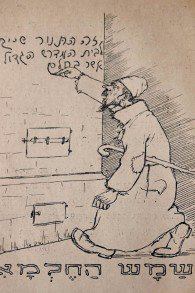
Photo credit: Illustration from F. Halperin’s, ‘Khakhme Khelm,’ Warsaw, 1926

Charles Baudelaire, Walter Benjamin, and the Daemonic (Take 1)

images-1

In an essay on Walter Benjamin entitled “Walter Benjamin and his Angel,” Gershom Scholem notes that one of the things that disturbed him most about Benjamin was his interest in the daemonic.  Scholem, in this essay, notes that Benjamin’s interest increased the more he delved into the work of the Parisian poet and cultural critic Charles Baudelaire:

The Luciferian element…entered Benjamin’s meditations…not directly from the Jewish tradition, but rather from the occupation with Baudelaire that fascinated him for so many years.  The Luciferian element of the beauty of the Satanic, stemming from this side of Benjamin’s interests, comes out often enough in his notes.  (213, On Jews and Judaism in Crisis).

Scholem goes on to provide examples of this element by noting a “Satanic phase” that Benjamin went through when he was writing on a Hashish impression of January 15, 1928.  Strangely enough, Scholem cites a passage from Benjamin that associates the Satanic with the smile:

My smile assumed Satanic features: though more the expression of Satanic knowing, Satanic contentment, Satanic Serenity than from Satanic destructive activity. (214)

Scholem latches on to Benjamin’s reading of the Satanic smile. He notes that, for Benjamin, everything is tainted by the Satanic.  Even the “’indescribable beautiful face’ of a human being can appear as ‘Satanic features – with a half-suppressed smile”(ibid).

The fact that Scholem finds Benjamin’s interest in Baudeliare to be the basis for his description of the smile as Satanic is instructive.  Although Scholem doesn’t delve deeper into this, we will.   To be sure, we can learn a lot about Benjamin’s approach to humor  by reading his reflections on Baudelaire’s reading of comedy, the smile, and laughter.   We can also learn a lot about Benjamin’s approach to comedy by simply reading Baudelaire’s reflections on the comic and, as I will point out, children (which, for Baudelaire, are related).  What we will find in both Benjamin’s reflections and in Baudelaire’s work is a keen interest in the relationship of humor to the daemonic.

In an unpublished piece called “Central Park,” written between 1938 and 1939, Benjamin devotes several reflections to Baudelaire’s prose, poetry, and critical essays.  The reflection that interests me most is Benjamin’s reflection on Baudelaire’s well-known essay “De l’essence du rire” (“The Essence of Humor”).

In this reflection, Benjamin writes:

De l’essence du rire” contains nothing other than the theory of satanic laughter.  In this essay, Baudelaire goes so far as to view even smiling from the standpoint of laughter.  Contemporaries often testified to something frightful in his own manner of laughter (182, Walter Benjamin: Selected Writings, Volume 4)

Benjamin is correct in his claim that Baudelaire argues that all laughter is daemonic.  As Baudelaire explains:

Laughter is satanic: it is thus profoundly human.  It is the consequence in man of the idea of his own superiority.  And since laughter is essentially human, it is essentially contradictory; that is to say, it is a token of infinity grandeur and infinite misery (The Painter of Modern Life and Other Essays, 154).

However, Baudelaire notes that there is a position that challenges this one; namely, the position of the “wise man”: “Laughter is a sign of inferiority to the wise, who, through contemplative innocence of their minds, approach a childlike state.”

This childlike state, however, seems, for Baudelaire, to be unattainable.  It is messianic: “As the comic is a sign of superiority, it is natural to hold that, before they can achieve absolute purification promised by certain mystical prophets, the nations of the world will see a multiplication of comic themes in proportion as their superiority increases”(ibid).

Baudelaire is basically saying that, as civilization advances, we will need to laugh more as we will feel more and more “superior” to nature.  This is not something to celebrate. Rather, for Baudelaire, it is something to lament.  And he hopes that one day we will become wise and transcend laughter altogether.

Benjamin is aware of this, hence, he notes that even the smile is tainted with the daemonic.

But if one reads Baudelaire’s essay on laughter, one will see that the grimace (the smile) only receives one sentence from Baudelaire while the laugh is mentioned throughout the essay: “All the miscreants of melodrama, accursed damned and fatally marked with a grin which runs from ear to ear, are in the pure orthodoxy of laughter.”

Benjamin latches on to this single sentence to argue that any bodily response which indicates humor is daemonic. To be sure, Baudelaire notes that no kind of laugh, even the laugh of a child, escapes the Satantic.  In fact, Baudelaire calls the laughter of little children the laughter of “budding Satans”(156).

Given this reading, what can we say of Benjamin’s reflections on children? As we saw in the hiding aphorism, which we addressed in an earlier blog, Benjamin argues that they “hide from the demon.”   And, as I suggested in that entry, this hiding place may be the shelter provided by a book.  Benjamin sees such hiding as an admirable strategy which, he claims, he learns from children.

The question we must ask is why Benjamin would see any response to humor is daemonic and whether he agreed, wholeheartedly, with Baudelaire’s reading of laughter and humor. This would imply that Kafka’s humor and Benjamin’s humor are or may be daemonic.  It would imply that Benjamin saw the signature-prank in his dream as wholly daemonic.  This would imply that Benjamin’s awareness of his identity – of his being a man-child – his awareness of a prank – was daemonic knowledge.  But is this knowledge, following a smile or a laugh, linked to superiority?  Did Benjamin read his calling, rather, in the opposite manner? After all, he is the butt of this joke.  As is the kingdom in the Shuvalkin parable we read and explained yesterday.

To be laughed at, to be a schlemiel, is entirely different from being the one who laughs or, as Benjamin notes, smiles.  Perhaps we can say that in the two moments where Benjamin reads himself and Shuvalkin as having been the butt of a joke, which reduced them to children, there is a challenge to the Satanic.  This would imply that masochism is redemptive.

In the end it is the same, Benjamin is not superior, he is a failure, a man-child, and a schlemiel. And perhaps, the “entire kingdom” is sunk into exile because the letters of a schlemiel named Shuvalkin hovers over its head. The implications of this reading are that Benjamin thought that he and “we” are not superior.  The joke, on the contrary, is on us.  And this bleak view suggests that if Benjamin is a schlemiel then Satan (the Other) must have written his name and Shuvalkin’s.  And if the herald who bears that message runs ahead of Kafka, as Benjamin claims, perhaps he runs ahead of us as well.  If this is so, then we are all doomed to endless failure and humiliation.   We are and will be the victims of a prank in which Satan has the last laugh and, as Benjamin seems to imply, doesn’t stop laughing.

Even so, Benjamin’s reflection on his (and our) destiny may in fact be redemptive, quite simply, because, in it, he (and we) is (are) not superior (he is not, as Baudelaire would say, Satanic); in his reflection, he sees himself as a powerless man-child.  And it is fascinating that this reflection on powerlessness stretches beyond Benjamin and finds itself in the pages of French thinkers such as Maurice Blanchot, Roland Barthes, and Gilles Deleuze.  They all seem to have taken Baudelaire and Benjamin seriously.  (We will return to this in future blogs.)

In our next blog entries, we will, hopefully, explore Baudelaire’s notion of the “absolute comic” and its relationship to the child and the mime.  This may give us another clue as to where Benjamin may have been going with his childish reflections.

Did you Say Your Name was Shuvalkin, Kafka, Walter Benjamin, or is this a Prank?

images-3

In the last two blog entries, I have been looking into Benjamin’s “Vestibule” aphorism in which he recounts a dream where he discovers his name inscribed in Goethe’s guestbook.  To understand what this meant to Benjamin, I discussed Benjamin’s understanding of what a name is and why it is significant.  As I noted, Benjamin saw the name as revelatory.  For him, it constitutes a link between God and man.  And, as I pointed out, the name is more about relation and less about content.  But there is a twist.

Although Benjamin is asked to sign his name, he realizes it has already been signed.  In other words, a trick has been played on him

But the shock is not simply that his name was already written but that it was written “in big, unruly, childish letters.”  Benjamin is, as I said yesterday, S(c)h(l)ocked by this prank.  To be sure, Benjamin saw something very deep in this prank.  As I noted, he discovered his calling to Schlemieldom.  In a “man’s world” (literally, in Goethe’s world, his house) it seems Benjamin is a child.  He is doomed to being a man who is thought of as a child.  The ‘shape’ of his name, so to speak, indicates this.

It’s interesting to note that the Zohar, one of the greatest books of the Kabbalah, which Gershom Scholem, in part, translated into German, has many sections which analyze the shapes of letters.  From these shapes, from the way they are written, we can learn secrets.

Elliot Wolfson, in his book Aleph, Mem, Tau: Kabbalistic Musings on Time, Truth, and Death, notes the passage in the Zohar in which “each of the letters presents itself before God in an effort to be chosen as the primary instrument through which the world would be created”(159).  Wolfson delicately unpacks this passage from the Zohar so as to show that each letter deals with time, truth, and death.

Aleph says it is the first letter of the word Emet (which in Hebrew means truth), but Tav says it is the last letter of Emet (and the Hebrew alphabet) and should be granted the privilege of being the letter through which the world is created (160).  But, Wolfson notes, Tav is disqualified because it is the last letter of the word Met (death).

However, as Wolfson argues, the letters taken together are the beginning (Aleph), middle (Mem), and the End (Tav).  Together, they designate time and together (the past, present, and future) make the truth.  The word, truth contains the word death, but it also opens up to the future as the truth-to-come.  Wolfson correctly notes, resonating the Apocalyptic elements in the Kabbalah, that the first letter of the Torah is Bet not Aleph.  And this reflection opens us up to a question: if the world was created with an Aleph (of the word Emet – truth) why isn’t the first letter of the Torah an Aleph?

This is the rub: the Aleph and the truth are concealed and will be revealed in the future, in the messianic age.  Meanwhile, we live in the world of the second letter which conceals the first.  In this world, truth (or for Wolfson, the truth of time) is distorted.

Walter Benjamin was quite aware of this teaching from the Zohar.  From Scholem and his own studies, he learned how the letters of the name, their shape and arrangement, disclose a secret that can be glimpsed in the present and seen to be coming from the future.  Building on Wolfson’s work, I would call this a truth-to-come.

Knowing this, how do we interpret Benjamin’s revelation of a name (his name) that was already written in clumsly children’s letters.  Was the disclosure of this prank a revelation of the truth-to-come or, rather, a distortion of the truth-to-come?  To be sure, this was the disclosure of Benjamin as a man-child (as a schlemiel).  But what does the shape of the schlemiel’s name have to do with the truth-to-come?

In the very beginning of Benjamin’s essay on Kafka, he returns to this question.

In the beginning of the essay, entitled “Potemkin,” Benjamin recounts a story of how Grigory Potemkin, the 18th century Russian military ruler, statesman, and beloved of Catherine the Great, went into a great depression.   (As a side note, Catherine gave Potemkin the title of the Prince of the Holy Roman Empire.)

As Benjamin recounts, Potemkin’s depression “lasted form an extraordinary length of time and brought about serious difficulties; in the offices documents piled up that required Potemkin’s signature”(112, Illuminations).

Who could get him to sign his name?

Benjamin notes that “an unimportant little clerk named Shuvalkin” comes to the rescue.  In other words, a simpleton (that is, a schlemiel of sorts) comes to their aid.   He doesn’t try to reason with Potemkin; rather, he acts: “Shuvalkin stepped up to writing desk, dipped a pen and ink, and without saying a word pressed it into Potemkin’s hands while putting the documents on his knees”(112).

Potemkin signs all of them.   And Shuvalkin walks into the anteroom, “waving the papers triumphantly,” as the councilors gather around to see.  And what happens is astounding: “Breathlessly they bent over them.  No one spoke a word; the whole group seemed paralyzed.”

When Shuvalkin looked in to see what happened – to see what had “upset” them and put them into a stupor, he sees that every one of the signatures has his name signed on it: “Shuvalkin…Shuvalkin…Shuvalkin.”

Benjamin sees this story as a “herald racing two hundred years ahead of Kafka’s work.” And then he adds that “the enigma which beclouds it is Kafka’s enigma.”

Benjamin then goes on to substitute Kafka’s character K for Shuvalkin.

These rhetorical movements are very hasty and to simply go along with them, without prying into the esoteric, would be clumsy.  Benjamin is telling us that Shuvalkin is a herald who goes “ahead of Kafka’s work.”  To be sure, this implies that Shuvalkin, a schlemiel, may even be (temporally) ahead of Benjamin’s work.  Moreover, he says that it is Kafka’s enigma but, in truth, it is also his.  In fact, he and Kafka share the enigma of Shuvalkin, which is the enigma of having one’s name already signed by the Other. Signed in such a way that the shape of the letters and their arrangement indicate that the bearer of the signature is a fool.

After the last three blog entries on Benjamin and the name, I hope that by now it will become evident to the blog-readers out there that a name is taking shape.  And that name, Benjamin and Kafka’s secret name, is a name that they are signed with and that name is the name of the man-child or the schlemiel.

There are many questions which come with this enigma and with this parable.  What does it mean that Kafka and Benjamin are the subjects of a prank?  And what does it mean that the “herald” has gone on ahead of Kafka?  Is he ahead of “us” as well?  I say “us” because everyone in the community, as is evidenced by the Potemkin parable, may be affected by the prank – that is, by the signature Shuvlakin.  But to say this, as Benjamin seems to suggest, wouldn’t we be entering the realms of ontology, politics, and religion?

Given this suggestion, can we say that we all share the same childishly written (and childish) name?  And instead of the name of God, as the name we all share (or the name Emet – truth, which Wolfson ventures in his reading of the Zohar), why is the name we share a name whose letters are childishly written?  Why is “our” name the name of a man-child?  Is this, as the Kabbalah might say, the “truth” (Emet) to come?  Or is it a prank?

All of these questions have not, in the history of Benjamin studies, been posed or discussed.  They are questions that come up if you read Benjamin (or Kafka for that matter) as he wanted to be read – as one would read a parable, midrashically.  I will be developing these ideas further in my book on the Schlemiel.  Nonetheless, I have decided to share some of these childish ‘secrets’ on this blog before my book makes the light of the day.  To be sure, there are a few more secrets about Benjamin and the Schlemiel that I may tell in this blog before I pass on to other schlemiels and schlemiel-topics, but I may have to withhold them or encode them in the very near future. Wink Wink!

Remember, you heard it here first – at SchlemielTheory!  More fun-to-come!

The S(c)h(l)ock of Walter Benjamin’s Discovery

images

There is nothing like the shock of discovery.  The moment of recognition is transformational.   In Greek, the word for recognition is anagoresis.  In Greek anagnōrisis comes from the word anagnōrizein to recognize.  The root of this word comes from ana- + gnōrizein to make known.  Webster’s dictionary goes on to point out that it is akin to Greek gnōrimos, meaning, well-known and the word gignōskein to come to know.

Anagoresis happens in Greek tragedy when the main character learns who he or she really is and/or who other people really are.  Usually, this knowledge is tragic.  One need only think of Oedipus in Sophocles’ famous play Oedipus Rex who, when he discovers who he is and who his real mother and father are, has a breakdown.   This tragic knowledge culminates with Oedipus poking his eyes out.

But anagoresis doesn’t always have to be tragic.  In fact, it can be comic.

In yesterday’s blog, I located the moment of Benjamin’s self-discovery in his aphorism entitled “Vestibule.”  In this aphorism, Benjamin writes of a dream he had about being in Goethe’s house.  When he is asked by the “curator” to write his name in Goethe’s guestbook, he discovers that his name is not only already written but that it is also written in “big, unruly, childish characters.”  In other words, Benjamin has a comic self-discovery.  He learns that his name, his essence, is childishly written.  And it is not he that has written it this way; someone else, some Other, has written his name in this childish manner.  To be sure, although this is comic; it is also tragic.  It’s as if, someone, some Other, has played a prank on him.

This discovery is astonishing.  But what does it mean?  Yesterday, I suggested that this is Benjamin’s discovery that he is a man-child.   More to the point, he discovers that he has been, prankishly, written into Goethe’s guest book (that is, the book of German letters) as a schlemiel (a man-child).

To be sure, Benjamin took names quite seriously.  And this discovery of his already written name, albeit in a dream, was revelatory.  In his essay “On Language as Such and On the Language of Man” Benjamin makes this explicit: “In naming, the mental being of man communicates itself to God”(318, Reflections).

Naming is, for Benjamin, a direct form of communication between God and Man.  It is, without a doubt, revelatory.

Naming, in the realm of language, has as its sole purpose and its incomparably high meaning that it is the innermost nature of language itself.  Naming is that by which nothing beyond it is communicated, and in which language itself communicates itself absolutely. (ibid)

But does Benjamin discover the essence of language in his dream or does he discover himself?  What does he discover?  Moreover, in this dream, Benjamin does not write.  He doesn’t, in this sense, communicate with God by way of naming.  To be sure, it seems to be the other way around.

Moreover, the “Vestibule” aphorism complicates Benjamin’s claim in “On Language as Such and On the Language of Man” that “Man is the namer, by this we recognize that through him pure language speaks.”

Benjamin’s mention of “pure language” is quite fascinating.  It further complicates things.  Gershom Scholem, in a chapter of Major Trends in Jewish Mysticism entitled “Merkabah Mysticism and Jewish Gnosticism” helps us to clarify what is at stake with such language.

In his discussion on ancient Kabbalistic liturgy, Scholem notes that the words of these Kabbalistic prayers to God, which can be found in prayers books today, are the “pure word.”  According to Scholem, they are pure words because they don’t mean anything; they don’t have any content.  Moreover, the “ascent of the words has not yet substituted itself for the ascent of the soul and of the devotee himself.  The pure word, the as yet unbroken summons stands for itself; it signifies nothing but what it expresses.”

The pure word is a word of man to God.  For Scholem, it is purely relational and bears no content.  It has a lot in common with what Benjamin calls naming.

However, in Benjamin’s aphorism, his name is already written.  Is it “pure?”  Is Benjamin pointing out a comic relationship with God?

The irony of all this is that Benjamin, in this aphorism, is recording what was already written; namely, Benjamin’s name in “big, unruly, childish characters.”  He is not, like Adam in his essay, naming.  He is recording what is written.

This is the prophetic mode or recording and not simply the mode of naming because, as Benjamin well knew by way of his friend Gershom Scholem, the Jewish tradition says that Moses wrote the Torah down after being told, word by word, what to write.

As the Medieval Rabbi, Scholar, and Philosopher Moses Maimonides points out, Moses’ prophesy, which is law, is communicated in this way of recording.  (And it is different from other prophets insofar as they, mainly, rebuke the people or prompt them to “return” to God.  Or, as Martin Buber might say, the prophets alert the people to the “demand of the hour.”)

Benjamin seems to be giving this prophetic legacy a comic twist.  In Benjamin’s aphorism, he is recording the name he saw in a dream: his name, childishly, that is, comically written.

Benjamin is not naming so much as being named (or renamed).  But this name, which he can’t even write, although asked to do so, has been comically altered.  It suggests that Benjamin’s destiny (the law he falls under) is, so to speak, tied up with the schlemiel.  He cannot escape the joke that has been played on him: he realizes, in his moment of anagoresis, that his destiny is to accept his childishly written name.  His identity, his essence, is written in “big, unruly, childish characters.”

This is tragic and comic knowledge.  This is a tragic and a comic anagoresis.  It is the, so so speak, S(c)h(l)ock of discovery.  (Schlock means a stroke of bad luck or denotes something that is low grade and cheap; it often has a comic connotation.)  He realizes, that in Goethe’s house, in this house of the classicist, he is childish.  He is the subject of laughter.

But why is his name improper? Why is it his destiny to be a schlemiel in Goethe’s house?  Are there other reasons for this shameful recognition?  Is this or rather was this, perhaps, the destiny of all Jews (even the most modern) in Germany?  Are all of their names “childishly” written?  Are they the butt of a bad, Greek joke?  Or is it just Benjamin who suffers this fate?

Most importantly, who is the mysterious Other who wrote his name in this childish manner?  Who played the trick on Benjamin?  Was it God, a demon, or Goethe?

Regardless of the answer, Benjamin knew that his destiny, his name, was tied to the schlemiel.

But, based on his writing on the child, childhood, and the fool throughout his work, as we have seen in a few entries on this blog, it seems as if he didn’t seem to be angry or disturbed about this revelation.  He seems to have accepted it and to have made it into one of his passionate interests.

Like Woody Allen, Benjamin doesn’t seem to get angry about this revelation so much as perplexed.  He is shocked but…

(In our next blog entry, we will look, once again, at this discovery yet from the angle of another name that Benjamin discovered.)

Wink, Wink! Walter Benjamin’s Childhood Secret and His Prophetic Calling to Schlemieldom

images-1

As a rule, careful writers are careful readers and vice versa.   A careful writer wants to be read carefully.  He cannot know what it means to be read carefully but by having done careful reading himself.  Reader precedes writer.  We read before we write.  We learn to write by reading.  –Leo Strauss, Persecution and the Art of Writing

When you’re in on a joke, don’t forget to wink.

When you wink, you imply that there is something that only some people can see.  Winking is not a straightforward gesture.  It is oblique.   And it is immediate, like a blink of the eye.  The wink indicates that the person you shared your secret with now knows something that only you know.

The esoteric, hidden meaning, is esoteric precisely because it signifies by way of an oblique gesture.  The conveyance of the esoteric (secret) message is gestural – like a wink.  There are esoteric writers and readers.  The esoteric writer winks at the reader.  But the reader must be looking for the wink, in advance.  To be sure, if the esoteric reader is to find a secret (or secrets, plural) she must “read between the lines.”

Throughout their work, Walter Benjamin and Leo Strauss were attentive in their readings of texts.  There eyes were either looking for the wink or winking at their readers.  And from such reading practices, they learned how to wink too.

For both, the good reader and the good writer knows how to wink and be winked at.

One winks at the reader, so to speak, through writing.  But one must be able to see the wink.  And that takes practice. One must learn to read for “allusions” – for things that are said obliquely.

But this is not simply a willed activity.  To be sure, both knew that inherent in language is the power to allude and hint at things.  This force astonished Benjamin and Strauss.   Built into language, there is a revelatory aspect. But the revelation of language is not simply a revelation of something outside language.

No.

They knew that their allusive writing style didn’t simply allude to something other than themselves.  Although they would never say it directly (since that is the point of the esoteric), they believed that their allusions referred, in some way, to themselves.

What Benjamin and Strauss desired most was to read and to write: to wink and be winked at.  They wanted to share their secrets.

Leo Strauss’s language is thick with such implication – it winks at his readers.  When he says that “a careful writer wants to be read carefully,” he is obliquely telling his readers his desire which, ultimately, comes from careful reading.  After all, as Strauss says in the epigram: “Reader precedes writer.”  When Strauss writes these words about Baruch Spinoza, he is speaking about himself and his deepest desire as a writer.  His words are autobiographical.

Strauss wants to be read well.  But this is not for his own sake.  He wants to read well so that he can write well.  Writing is not for himself; writing, for Strauss, is shared (partage, as Derrida would say); writing is for a community of careful readers and writers.  What Strauss calls “persecuted writers.”  (Derrida, in his essay on Emmanuel Levinas entitled “Violence and Metaphysics” calls it the “community of the question.”)

To get into the community, you simply need to know how to read the wink when-it-happens and how to write-slash-wink.  We can have no doubt that Benjamin saw himself as a part of such an esoteric community of readers and writers.  He knew that the wink signifies that we know something that many people don’t.   He knows that his knowledge, because it is esoteric and hidden from society, might be dangerous.  This is why Strauss would call it “persecuted”: the author cannot, under certain societal circumstances, reveal this knowledge directly.  S/he must wink.

But the wink doesn’t simply reveal a secret that may endanger society; it also tells us something about the writer that we may not know.  After all, a wink tells us one thing: you’re in on my secret.

Yesterday, in my cursory reading of the childhood section Benjamin’s book One Way Street, I pointed out how Benjamin’s sections on children are autobiographicalThe section begins with reading but ends with hiding.  I explained how Benjamin was identifying with the child and, in effect, becoming-child.  Most importantly, we must remember that this becoming happens in a world or micro-world.

One doesn’t become in a vacuum.  This means that Benjamin’s reading practices are ways of opening up and hiding in microworlds.   But he didn’t just go into these worlds for no reason.  No, as I pointed out, Benjamin was running away from terror as the child runs from a “demon.”  We can say that he was persecuted.  His words on The Idiot (and on hiding) tell us that he knows that his terror comes from childhood damage.  But this is not simply knowledge.  In writing about this terror, it is practiced: Benjamin, in the two aphorisms we read yesterday, demonstrates that he must live the life of a child if he is to be safe or as Jacques Derrida would say in his essay “Faith and Religion,” sacred, that is, removed from danger, “autoimmune.”

At the beginning of One Way Street, Benjamin prepares us for his venture into childhood and its safe havens.  We see this in an aphorism entitled “Vestibule.” Here he gives the reader his prophesy of childhood and his calling.

In the aphorism, Benjamin notes how, in a dream, he “visits” the home of the famed German writer, thinker, and poet: Johann Wolfgang von Goethe.  He notes that even though he was in Goethe’s house, “he didn’t see any rooms.”

Benjamin tells us how the interior of his dream space appears to him from his angle-slash-perspective: “that it was a perspective of whitewashed corridors like those in a school.”  This implies that he feels like a young student in Goethe’s house (or, rather, school of thought). In the house-slash-school, there are “two elderly English lady visitors and a curator.”  They are only “extras.”  They lead him to the secret, which, we must underscore, is to be read and written.  The curator asks that he and the two elderly ladies “sign the visitors’ book lying open on the desk at the end of the passage.”

When he opens the book to sign, he has a revelation about his name and his prophetic calling:

On reaching it, I find as I turn the pages my name already entered in big, unruly, childish characters.

He realizes that he doesn’t have to sign!

This is the prophetic calling of the schlemiel.  To be sure, his name is “already” written in “big, unruly, childish characters.”  The words literally wink at him: Benjamin is in on a big joke.   This passage suggests that we all know that Benjamin was always meant to be a fool.  Moreover, it is written in the book of Goethe: the prophet, so to speak, of all German scholarship.

But this revelation, lest we not forget, comes through a dream.    This is significant since one of the ways prophesy comes to man, in Judaism, is through dreams.  In exile, it is through the oblique and indirect way – the way of the dream – that God communicates with man.  In Benjamin’s prophetic dream, he realizes that he is a man-child.  His name is, after all, written in “big, unruly childish characters.”

His name, his essence, is childish.  Yet, at the same time, Benjamin is a man hiding in Goethe’s imaginary schoolhouse.  Most importantly, he didn’t name himself a child or schlemiel.  He didn’t sign his name in a childlike manner, someone else did!

Wink, wink!