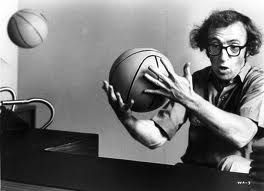
Last week, The Huffington Post ran a 44 minute clip of Woody Allen stammering. The clip puts together stammers that span Allen’s career.
When I saw it, the first thing that came to my mind was the Jewish-French philosopher Henri Bergson’s essay on laughter and, in particular, his words on the Jack-in-the-Box:
As children we have played with the little man who springs out of his box. You squeeze him flat, he jumps up again. Push him lower, and he shoots up still higher. Crush him beneath the lid, and often he will send everything flying….Now let us think of a spring that is rather of a moral type, an idea that is first expressed, then repressed, and the expressed again; a stream of words that bursts forth, is check, and keeps starting afresh. Once more we have the vision of one stubborn force, counteracted by another, equally pertinacious (35).
For Bergson, a recurring force is comic because it is mechanical and repeats itself – unlike real life (élan vital). Real people don’t “naturally” stammer like Woody Allen:
The truth is that a really living life should never repeat itself. Whenver there is repetition or complete similarity, we always suspect a mechanism at work behind the living…The deflection of life towards the mechanical is here the real cause of laughter (17)
So, what we have here is not simply a stammer but a concentrated one. But is this mechanical repetition of a mechanical repetition laughable? Does the clip take the “surprise” out of humor? Is Woody Allen’s stammer like a “jack-in-the-box” or does this video destroy the toy-slash-stammer?
I.B. Singer and Rabbi Nachman of Bratslav both refer to the schlemiel as a “Tam,” which is Hebrew for a simpleton. Tam also means a person who is “complete.” But this doesn’t make sense. How could a simpleton be complete? Isn’t the simpleton lacking intelligence, wit, and independence? How could these “lacks” constitute the simpleton’s – that is, the schlemiel’s – completeness? Isn’t the wise man or the independent individual the ‘complete one’? After all, the simpleton is a “schlemiel.”
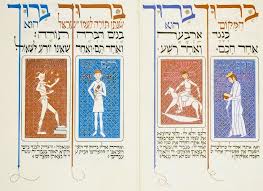
This question is given visual form in the Passover Haggadah (namely, the story telling portion of the Haggadah which is called Magid).
In his book, Unheroic Conduct, Daniel Boyarin takes a look at a few Medieval Haggadot to point out the difference between “the simpleton” and the “evil son” (the Rasha). For Boyarin, the point of this comparison is to show that the dominant Jewish male ideal in the Middle Ages was embodied in the character of the simpleton. Extreme humility is his/her trait. In contrast to the simpleton is the Rasha. Boyarin points out that the Rasha is the epitome of what, in Yiddish, is called “goyishe nachas” (the joy of gentiles). According to Boyarin, the Rasha embodies the non-Jewish “male ideal,” which is much more masculine (prideful, angry, overly physical, militant, etc) than the Jewish ideal.
Boyarin’s reading of the Jewish ideal is consistent, in many ways, with Moses Maimonides’ (RAMBAM’s) understanding of the ethical ideal. As David Shatz points out in his essay “Maimonides’ Moral Theory,” Maimonides, like Aristotle, strived to live in accordance with a golden mean. However, when it came to humility and pride, he was in stark contrast to Aristotle. While Aristotle thought extreme humility was a vice, Maimonides believed it was a virtue. And while Aristotle thought it was necessary to be angry and prideful in the face of one’s pride being denigrated, Maimonides taught that such an extreme was a vice not a virtue. Maimonides goes so far as to give an example of extreme humility by way of a story in which a man traveling on a ship is urinated on by an arrogant fellow-passenger. This man, who Maimonides calls a Hasid (since he goes “beyond the letter of the law”) is so humble that he does nothing. He, like Moses, the “most humble man of the land,” doesn’t waste his time with the Rasha. More important for the Hasid, Maimonides tells us, is the honor of God. And this requires extreme non-action in the face of arrogance and violence. Wasting one’s time with pride and anger, making oneself equal to it, is “goyishe nachas.” Extreme humility, a vice for Aristotle, is “Yiddish nachas”(Jewish joy).
Boyarin’s project is to show that the Jewish ideal of the extreme humility was operative throughout the Middle Ages and existed in the Eastern Europe up the early 20th century – before the Holocaust – however, as Jews became accepted into Modern society, this ideal was displaced by a more Aristotelian type of masculine ideal. Boyarin goes so far as to suggest that Zionism was deeply influenced by the ideals of strength and power rather than humility and powerlessness. He cites Max Nordau – the Vice President of the Zionist Congress’ – concept of the “muscle Jew” as the new ideal. In addition, he cites Herzl, Freud, and others who espouse this new ideal which despises the Eastern European ideal of extreme humility – deeming it too feminine and heteronomos.
Strangely enough, in all of Boyarin’s discourse, he doesn’t note that how the simpleton was, for many of the early Zionists, the schlemiel. The simpleton was equated with the powerless Diaspora Jew. To be sure, a pro-Zionist journal by that name was founded with the purpose of criticizing the Diasporic Jew and affirming a ‘new Jew’. The Jewish Renaissance, as Martin Buber put it, looked to reach deep into the roots of a Jewishness that was lost (or as Max Nordau would say, “degenerated”) in the Diaspora. Although Buber didn’t openly degrade the simpleton (after all, he translated Rabbi Nachman’s stories and praised the Simpelton), he, like many Zionists, sought for a “New Jew.”
The question – is the schlemiel a character marred by Exile, a character that was produced by degeneration and powerlessness or was the schlemiel an ideal?
Boyarin’s book prompts these questions and poses them to Jews living outside of Israel. Must we, in North America, contrast ourselves to Israelis? Are we the ‘real Jews’? And is their a real difference between us regarding whether or not we take on or reject an Aristotelian ideal?
Boyarin’s work certainly implies this. His reading of the Haggadot implies that the Rasha, the evil son, is excluding himself from the Jewish community. Which community would that be? Is this the American Jewish community or the community of Modern-Orthodox Jews that Boyarin identifies with?
I would add that Boyarin’s reading of the simpleton as an ideal may also include “the one who doesn’t know how to ask” in the Haggadah. To be sure, the tradition represents both of them in terms of Boyarin’s ideal.
Here, the Rasha is represented as a Warrior of sorts. While the simpleton and the son who doesn’t know how to ask are both represented as small – half his height – and humble:
In fact, they are both very gentle, childlike, and peaceful in their demeanor and in their gesturing.
Boyarin compares Medieval Haggadot to Zionist imagery to suggest that the Medieval Ideal has been abandoned. Moreover, he suggests, by way of his own example as a “feminist-modern-Orthodox-Jew” that we return to this ideal. As I noted above this would imply that Jews take on the schlemiel ideal.
But the ideal is not simply about humility – for the Rabbis, this humility which is based on faith in God’s power to redeem the Jewish people and in God’s place in history. We see this in the two questions and in the answers to them.
The Simple Son asks: “What is this celebration about?”
You shall say to him: “We are commemorating the fact that with a strong hand G‑d took us out of Egypt, from the house of slaves” (Exodus 13:14).
As for The One Who Knows Not How To Ask—you must open up [the conversation] for him.
As it is written: You shall tell your child on that day: “It is because of this that G‑d acted for me when I left Egypt” (Exodus 13:8).
So, ultimately, the masculine ideal that Boyarin wants to return to is or at least was based on the Schlemiel’s – that is, the Tam’s – simple faith.
To be sure, the simpleton is complete for this reason, but in the eyes of the world faith is ridiculous and the schlemiel lacks intelligence. That is, at the very least, the perspective of the Rabbis and Rabbi Nachman of Breslav. Boyarin, however, redefines this to state that the completeness of the Tam can be found in the fact that he doesn’t enjoy “goyishe nachas” and prefers powerlessness over a masculine kind of power that, for him, corrupts. This is not a matter of faith so much as a matter of whether or not Jews take on a masculine or a masculine-feminine ideal.
This is what I would call “Boyarin’s schlemiel ideal.”
The question for us – the so to speak fifth question of the four questions – is why is the night of Passover different from other nights?
Is it the night that we realize that “we” are all schlemiels? And what would this imply? That we are faithful or that we embody a less masculine Jewish ideal?
(Based on what we have learned from Boyarin, this is a good question to ask. But there are still other questions we can ask – at the Seder table, with the Jewish community – of his old/new ideal and its political import: 1) Is Boyarin right to reinstate a dualism that the early Zionists insisted on in the early 20th century? 2) Can there be schlemiel-Zionists? Or only schlemiel post-Zionists? 3) Can one be a “simpleton” in Israel? 4) Is the new Jew an old Jew – that is a schlemiel? Or is the new Jew a Rasha? Or is the new Jew something else besides these two options? In other words, where does the schlemiel figure, today?)
Regardless of the answers one comes up with, Schlemiel-in-Theory wishes all Jews – on whatever side of the spectrum – a Happy Passover!
Comedians can be very aggressive and may sometimes exude rage. The comic rant, which we are all-to-familiar with, is an illustration of how comedy sometimes becomes indistinguishable from anger.
One need only think of the Three Stooges, Larry David, Andy Kaufmann, Lenny Bruce, or even Louis CK to see how rage plays out through comedy.
Given the history of the schlemiel in Jewish comedy, this is an interesting phenomenon. Traditional schlemiels – of the Yiddish variety – are often very humble and are not filled with rage; but, in America, we often see a different variety of the schlemiel which is more aggressive.
This difference is noteworthy and it prompts a lot of questions about how the schlemiel, a character which, by and large, is traditionally innocent and humble, became aggressive.
The trajectory of my blogs over the last week leads us toward a way of framing and addressing these questions.
Over the last week, I have spent a lot of time thinking through Walter Benjamin and Paul deMan’s reading of Charles Bauldaire’s reading of comedy. I have also addressed Walter Benjamin’s “s(c)h(l)ocking” discovery that he was a schlemiel. The thread that joins all of these entries is what Walter Benjamin, following Charles Baudelaire, would call Spleen.
What is Spleen?
In his unpublished work of maxims, insights, and aphorisms entitled “Central Park,” Walter Benjamin defines Spleen (which is also part and parcel of Baudelaire’s Prose Collection – Paris Spleen) as “the feeling that corresponds to the permanent catastrophe.”
Max Pensky, in his book on Benjamin entitled Melancholy Dialectics, interprets Spleen as a “mode of melancholia in which the subject can no longer mournfully ‘observe’ the permanent catastrophe of natural history, but rather, in a quite literal sense is the catastrophe”(170).
Pensky’s reading of Spleen, at many points, sounds much like Paul deMan’s reading of the “irony of irony” which I addressed in a recent blog. But Pensky sees it as the source of Spleen and not simply, as deMan does, as the essence of laughter. Pensky points out the emotional tonality of Spleen: it is an “emotional complex consisting of various permutations composed of the two simple elements of profound fear and rage: primal emotions, in keeping with the power of the commodity to awaken prehistoric, savage modes of existence”(171).
Moreover, “Spleen is characterized in the first instance as ‘naked horror’; that is, the primitive, infantile fear of being swallowed up by the mass of objects, the fear of flying to pieces, disappearance in the diffraction and multiplication of selfhood.”
The very language of this description – “the fear of flying to pieces, disappearance in the diffraction and multiplication of selfhood” – echoes that of Paul deMan’s description of the effect of Baudelaire’s “irony of ironies.”
But the main point is that Spleen prompts Baudealire to write poems and allegories. It is through them that Baudelaire exhibits a “heroic melancholy.” It is here that, I contend, we can find the modern, aggressive schlemiel.
In the context of Benjamin’s reflections on Baudelaire’s notion of Spleen, the best model for relating Spleen to the schlemiel is by way of Benjamin’s reflection on the relationship of pre-history to history.
To be sure, the fact that Pensky says that Spleen is pre-historical reflects Benjamin’s concern with the relationship of pre-history to history. This is a concern that we see in his writings on Baudelaire and in Benjamin’s essay on Franz Kafka where, I would like to note, we see the most explicit engagement with the schlemiel. The pre-historic nature of the schlemiel, in that essay, is associated with the innocent aspect of this character; however, I would like to argue that his comic characterization of Kafka’s characters and their innocence is Benjamin’s response, in some way, to Spleen.
Evidence of this can be found in the fact that Benjamin, in several places in that essay, discusses Kafka’s characters in relation to pre-history.
In “Central Park,” Benjamin notes that Baudelaire’s poems and prose pieces are a response to Spleen. Benjamin calls the trace of this response, or rather, this “heroic” struggle, a souvenir. The artwork-as-souvenir exposes us to this trace while protecting us from its shock. Nonetheless, the heroism is not complete.
The souvenir emerges out of the “endless catastrophe of capitalism.” As we have seen from Pensky’s description, this catastrophe destroys the subject. The souvenir is the only thing that remains and, like an angel, saves the artist from Spleen, that is, from impotent rage and self-destruction.
For some strange reason, comedy is the only response to Spleen that Benjamin doesn’t address in depth. Rather, as we saw in our reading of Benjamin’s interpretation of Baudelaire’s “Essay on Laughter,” the only thing that remains for Benjamin of comedy, the only souvenir, so to speak, is the Satanic smile that touches everything, even children. Although this seems devastating, it is not. In fact, the smile, for Benjamin, seems to be a “double image” which protects him from the catastrophic effects of Spleen. (As Scholem notes, Benjamin associated the smile with “satanic serenity.”)
In other words, his self-image – in terms of his name being written/signed in childish letters – is a souvenir.
Likewise, the souvenirs that Benjamin finds in Kafka’s world are also traces of a battle with Spleen. In that essay, he relates Kafka’s characters to a Jewish form of Spleen: Exile.
What all of these figures of the schlemiel share is the fact that all of them are, as Benjamin says in his Kafka essay, pre-historic.
The schlemiel and all traces of the struggle with Spleen are pre-Historic because they cannot enter history. They cannot assert the heroic and enter the historical struggle.
In fact, this was the critique leveled by Hannah Arendt and many Zionists against a Jewish people which had “degenerated” due to exile. They level this criticism against the schlemiel which was, for them, the figure of Exile. As Arendt had argued, the Jews were to accustomed to powerlessness and Exile to take action and enter history. (I will return to this in a later blog entry.)
For them, the schlemiel was a figure of “impotent rage” that they believed had much to do with Exile (Diaspora). It would fade away with the founding of a new state. But as we have seen, the schlemiel remained in America; but what happened, in many cases, was that it more and more often started bearing the traces of Spleen. The meaning of this agressivity has much to do with the power of art.
The American Schlemiel, seemingly, no longer embodies that sadness, that Melancholy, that Benjamin aspired to. If anything, it has taken on Spleen. It is full of rage and sarcasm. Perhaps this has to do with the fact that entertainment has displaced art and the heroic artist has been defeated by the stand-up comic.
Perhaps the pre-historic has been displaced or perhaps the American schlemiel still hasn’t entered history. Perhaps, as Benjamin feared, art cannot sustain the “endless catastrophe” of capitalism. As a result, they only thing left for humor is “impotent rage.”
Is that what we see, so often, in Curb Your Enthusiasm?
There is nothing like the shock of discovery. The moment of recognition is transformational. In Greek, the word for recognition is anagoresis. In Greek anagnōrisis comes from the word anagnōrizein to recognize. The root of this word comes from ana- + gnōrizein to make known. Webster’s dictionary goes on to point out that it is akin to Greek gnōrimos, meaning, well-known and the word gignōskein to come to know.
Anagoresis happens in Greek tragedy when the main character learns who he or she really is and/or who other people really are. Usually, this knowledge is tragic. One need only think of Oedipus in Sophocles’ famous play Oedipus Rex who, when he discovers who he is and who his real mother and father are, has a breakdown. This tragic knowledge culminates with Oedipus poking his eyes out.
But anagoresis doesn’t always have to be tragic. In fact, it can be comic.
In yesterday’s blog, I located the moment of Benjamin’s self-discovery in his aphorism entitled “Vestibule.” In this aphorism, Benjamin writes of a dream he had about being in Goethe’s house. When he is asked by the “curator” to write his name in Goethe’s guestbook, he discovers that his name is not only already written but that it is also written in “big, unruly, childish characters.” In other words, Benjamin has a comic self-discovery. He learns that his name, his essence, is childishly written. And it is not he that has written it this way; someone else, some Other, has written his name in this childish manner. To be sure, although this is comic; it is also tragic. It’s as if, someone, some Other, has played a prank on him.
This discovery is astonishing. But what does it mean? Yesterday, I suggested that this is Benjamin’s discovery that he is a man-child. More to the point, he discovers that he has been, prankishly, written into Goethe’s guest book (that is, the book of German letters) as a schlemiel (a man-child).
To be sure, Benjamin took names quite seriously. And this discovery of his already written name, albeit in a dream, was revelatory. In his essay “On Language as Such and On the Language of Man” Benjamin makes this explicit: “In naming, the mental being of man communicates itself to God”(318, Reflections).
Naming is, for Benjamin, a direct form of communication between God and Man. It is, without a doubt, revelatory.
Naming, in the realm of language, has as its sole purpose and its incomparably high meaning that it is the innermost nature of language itself. Naming is that by which nothing beyond it is communicated, and in which language itself communicates itself absolutely. (ibid)
But does Benjamin discover the essence of language in his dream or does he discover himself? What does he discover? Moreover, in this dream, Benjamin does not write. He doesn’t, in this sense, communicate with God by way of naming. To be sure, it seems to be the other way around.
Moreover, the “Vestibule” aphorism complicates Benjamin’s claim in “On Language as Such and On the Language of Man” that “Man is the namer, by this we recognize that through him pure language speaks.”
Benjamin’s mention of “pure language” is quite fascinating. It further complicates things. Gershom Scholem, in a chapter of Major Trends in Jewish Mysticism entitled “Merkabah Mysticism and Jewish Gnosticism” helps us to clarify what is at stake with such language.
In his discussion on ancient Kabbalistic liturgy, Scholem notes that the words of these Kabbalistic prayers to God, which can be found in prayers books today, are the “pure word.” According to Scholem, they are pure words because they don’t mean anything; they don’t have any content. Moreover, the “ascent of the words has not yet substituted itself for the ascent of the soul and of the devotee himself. The pure word, the as yet unbroken summons stands for itself; it signifies nothing but what it expresses.”
The pure word is a word of man to God. For Scholem, it is purely relational and bears no content. It has a lot in common with what Benjamin calls naming.
However, in Benjamin’s aphorism, his name is already written. Is it “pure?” Is Benjamin pointing out a comic relationship with God?
The irony of all this is that Benjamin, in this aphorism, is recording what was already written; namely, Benjamin’s name in “big, unruly, childish characters.” He is not, like Adam in his essay, naming. He is recording what is written.
This is the prophetic mode or recording and not simply the mode of naming because, as Benjamin well knew by way of his friend Gershom Scholem, the Jewish tradition says that Moses wrote the Torah down after being told, word by word, what to write.
As the Medieval Rabbi, Scholar, and Philosopher Moses Maimonides points out, Moses’ prophesy, which is law, is communicated in this way of recording. (And it is different from other prophets insofar as they, mainly, rebuke the people or prompt them to “return” to God. Or, as Martin Buber might say, the prophets alert the people to the “demand of the hour.”)
Benjamin seems to be giving this prophetic legacy a comic twist. In Benjamin’s aphorism, he is recording the name he saw in a dream: his name, childishly, that is, comically written.
Benjamin is not naming so much as being named (or renamed). But this name, which he can’t even write, although asked to do so, has been comically altered. It suggests that Benjamin’s destiny (the law he falls under) is, so to speak, tied up with the schlemiel. He cannot escape the joke that has been played on him: he realizes, in his moment of anagoresis, that his destiny is to accept his childishly written name. His identity, his essence, is written in “big, unruly, childish characters.”
This is tragic and comic knowledge. This is a tragic and a comic anagoresis. It is the, so so speak, S(c)h(l)ock of discovery. (Schlock means a stroke of bad luck or denotes something that is low grade and cheap; it often has a comic connotation.) He realizes, that in Goethe’s house, in this house of the classicist, he is childish. He is the subject of laughter.
But why is his name improper? Why is it his destiny to be a schlemiel in Goethe’s house? Are there other reasons for this shameful recognition? Is this or rather was this, perhaps, the destiny of all Jews (even the most modern) in Germany? Are all of their names “childishly” written? Are they the butt of a bad, Greek joke? Or is it just Benjamin who suffers this fate?
Most importantly, who is the mysterious Other who wrote his name in this childish manner? Who played the trick on Benjamin? Was it God, a demon, or Goethe?
Regardless of the answer, Benjamin knew that his destiny, his name, was tied to the schlemiel.
But, based on his writing on the child, childhood, and the fool throughout his work, as we have seen in a few entries on this blog, it seems as if he didn’t seem to be angry or disturbed about this revelation. He seems to have accepted it and to have made it into one of his passionate interests.
Like Woody Allen, Benjamin doesn’t seem to get angry about this revelation so much as perplexed. He is shocked but…
(In our next blog entry, we will look, once again, at this discovery yet from the angle of another name that Benjamin discovered.)