The Whistle and the Gaze of the Holy Fool – Take 1

images-1

We all know what its like to be a stranger in a crowd.   The fact of the matter is that in big cities people are thrown into a situation where they are anonymous and alone.  We get used to it and some even crave being alone.   We hide away as we walk through urban streets and ride through the caverns of the city on subways.  And, like many who hide away, we like to look and not be looked at.  We are voyeurs and this isolated state leaves us without a world.  And, as Hannah Arendt has noted, a person is “worldless” if he or she is not seen.   Unfortunately, many of us would prefer to be worldless voyeurs.  And what we fear most is being caught.

But there is more to the story.  When we are confronted by a stranger, this experience may, at one and the same time, be a shock and a challenge.   This is the sense one has when one reads Edgar Allen Poe’s “Man of the Crowd.”  In that story, the main character sees someone very unique. Someone who sticks out in the crowd:

With my brow to the glass, I was thus occupied in scrutinizing the mob, when suddenly there came into view a countenance (that of a decrepid old man, some sixty-five or seventy years of age)-a countenance which at once arrested and absorbed my whole attention, on account of the absolute idiosyncrasy of its expression. Any thing even remotely resembling that expression I had never seen before. I well remember that my first thought, upon beholding it, was that Retszch, had he viewed it, would have greatly preferred it to his own pictural incarnations of the fiend. As I endeavored, during the brief minute of my original survey, to form some analysis of the meaning conveyed, there arose confusedly and paradoxically within my mind, the ideas of vast mental power, of caution, of penuriousness, of avarice, of coolness, of malice, of blood-thirstiness, of triumph, of merriment, of excessive terror, of intense-of supreme despair. I felt singularly aroused, startled, fascinated. “How wild a history,” I said to myself, “is written within that bosom!” Then came a craving desire to keep the man in view-to know more of him. Hurriedly putting on all overcoat, and seizing my hat and cane, I made my way into the street, and pushed through the crowd in the direction which I had seen him take; for he had already disappeared. With some little difficulty I at length came within sight of him, approached, and followed him closely, yet cautiously, so as not to attract his attention.

What we find in Poe’s story is the voyeur who passionately follows the “man of the crowd” in hope of not being discovered.   Now, imagine that instead of seeing the man in the crowd, one first hears him.  And instead of him being someone who only inspires horror and fascination, he also inspires joy and even prompts redemption and transformation.  And also imagine that one is found out and seen by the man in the crowd.  One is gazed at by the person one hides from.

This is the situation of the Holy Fool in Meir Abehsera’s parable.   And this is what gives the schlemiel, in Abehsera’s parable, a symbolist aspect.

The symbolic aspect – which can be found in Edgar Allen Poe and his French translator, Charles Baudelaire – is put at the beginning of the parable by way of reference to a “dream adventure” in which the schlemiel appears in the “middle of the night”:

In one of those dream-adventures, he appears in the central square of a small town, in the middle of the night.

But “he” is different from the “man in the crowd.”  He makes himself known and disturbs the entire town.  He is not an anonymous figure in a crowd that the writer/philosopher follows.  And his disruption is not his appearance; it is a sound. To be sure, a noise:

He whistles loudly. Everyone is awakened.  Then, with a second whistle, he shatters plaster moldings and chandeliers, bringing mirrors and paintings crashing to the floor.   Landlords and tenants pour into the square.  They run toward the sound of the whistling and find the idiot standing by the fountain.  (111)

In response to the idiot’s disruption of the town, he is singled out and accused of “destroying property.”  The idiot/schlemiel – like many schlemiels in the Jewish tradition – has no idea that he has done something wrong:

He looks around in bewilderment, his hands resting on his hips. 

In the midst of all this, a “man in his later thirties,” a writer, “shakes a crumpled sheaf of papers in front of the idiot’s face.  ‘This was all that is left of a manuscript which was to teach the world!”

The narrator that tells us that, as they were about to “lynch him” the idiot surprised them and said that he didn’t want to destroy their property; he just wanted something to eat.  But, while looking for food, he noticed something odd. And he had to whistle. He whistled because he saw “dark hosts gathering in the sky, preparing your annihilation.”  His whistling, he believed, would scare them away.

One of the people in the crowd confronts the idiot-slash-Holy-Fool by calling him out on his mission.

“If I understand his words correctly…this imbecile claims to have been sent to save us.  And to the idiot: “Answer me this, then: If you are really the rescuer you portray yourself to be, where does that power come from anyway?  From a holy place, or somewhere else?”

In response to this, the idiot’s face “lights up” and he says that his power is not really his and that “what has happened here is not done by own will or calculation. I do as I am told.”

In other words, the idiot literally interprets himself as a schlemiel which can be read as Shelach (sent) m (from) el (God).  He has no will.  His will is the will of the master.  And his master, it seems, wants him to whistle and disturb the entire town.

The idiot goes on to explain to the crowd that he, in fact, was at one time a mystic and wealthy (“I had everything: wealth, glory, and wisdom.  I could read minds and predict events”).  But he met a sage and lost all his powers.  And was told that he should devote his time to people.  This, says the idiot, was a revelation that caused him great joy:

What a relief that was!  He cleared my head.  I went out of there as a free man. I danced in the streets.  I howled.  And I whistled.  I whistled so much that my mind became an empty chamber.  Within that emptiness, which was devoid of all my intellectual acrobatics, I suddenly made an extraordinary and sublime contact with the sage, my Rebbe.  For just an instant, I ceased to be a separate self. (113)

After saying this, he throws water on his face from a nearby fountain and says he must leave.  But as he leaves he calls on the people to stop fighting with him and to, instead:

“Fight the enemy! But now how to do it.  For he is…illusion.  This is why he appears so overwhelming.   So take my advice.  Have no pity.  Use your breath.  Whistle as I do.  With the breath of pleasure we have sinned, and through the breath we shall be redeemed!”

But after stating this message, he “whirls around and peers through the crowd, scanning the faces as though expecting to find someone.”  And, lo and behold, who does he find but the writer:

The idiot points a trembling finger in his direction…The writer’s face, now in full view, turns green.

Like the philosopher/writer who is following the “man of the crowd” and who fears to be seen, the writer is found out and publicly accused.  This is a moment of surprise and shock which will, ultimately, prompt a transformation:

“And you! the idiot says.  “Be sure to despise evil with every fiber of your being.  You’ll see that it will make you a better writer.   As you run from evil, you will acquire rhythm, through which your soul will speak more freely.”

What is so emblematic about this scene is that the writer, like Sancho Panza, is taking his directives from a Don Quixote figure (the idiot/schlemiel).  The problem is for the writer to accept this mission.  And this mission, in contrast to the secular mission of the writer, is religious.

In response to this, a woman in the crowd speaks out, an “old librarian,” and says that she has “groomed this gentleman from youth.  And I have seen him blossom into the finest writer of his time.  Now you come, carrying on with crazed grandiloquence about clouds and evil forces, to lure the very spiritual genius from our midst!” After saying this, she notes that what the idiot sees as right and wrong is not the same for what others would deem right or wrong.

The idiot doesn’t speak; rather, he gazes at the writer.  The writer, shocked by this gaze, feels as if he has seen him before:

But where? Was it in dreams?  No, it was in his life. Where then? 

In this midst of this confusion and in the face of the “old librarian’s” defense of his work and life, the writer makes his decision with his feet and follows the idiot.

They disappear from the place. The townspeople return to their homes.

This ending echoes and resists Poe’s “Man of the Crowd.”  He is fascinated with the idiot; and like the writer/philosopher of Poe’s story he feels “as if” he knows him from somewhere.  But unlike Poe’s story, he is broken out of his space and follows him out of the town.  He is singled out; he is no longer anonymous.  And this singling out, which was initiated first by whistling, privileges the breath.  Abehsera is suggesting that the writer draw his life from this idiot and his revelation and not the librarian.  He suggests that writing should find its basis in disrupting evil and not fighting the town.

This is a religious path spurred by a religious schlemiel.  In the next blog entries, I will look into where the idiot takes the writer and where this parable takes you, the reader. I would like to suggest that what we have here, in this parable, is a sketch of a schlemiel, his mission, and its meaning.   This meaning is not the same as the secular schlemiel, but, ultimately, the secular schlemiel is also interested in fighting evil.  What is at stake, it seems, is the writers estimation of what evil is.  And the schlemiel’s form and mission – as well as the writer’s – will take shape in light of this estimation of evil.

And it all starts with a whistle and a gaze which singles out the writer and fool in the crowd….
Meir Abehsera’s “Possible Man” – The Holy Fool, The Writer, and the Beggar – Part II

Chagall_Harlequin_M578a

Before presenting his parable on the Holy Fool, the Writer, and the Beggar, Meir Abehsera tells us about a dream that he had as a young man.  Playing on the theme of “memory as redemption” – which we discussed in the last blog entry – Abehsera recalls a dream he had as a child and how that dream, which was vague, now comes back to him but with more clarity.  This dream offers us an allegorical key to understand what exactly is at stake with the schlemiel as Holy Fool.

Writing on his apprehension of the dream as a child, Abehsera writes metaphorically of how his dream:

…was like the hoarse, insistent pounding of the sea that exhorts young dreamers to set sail, and as mysterious as an unknown song begging to be aired. (106)

Abehsera goes on to liken this dream to a “song” that he, as a writer, wanted to pen.  He didn’t write it, apparently, because he didn’t think he was ready.  And, “at a certain point I decided that it would take me until old age before I would be prepared to do it justice.”  In such lines, one can hear a persona that is humble, perhaps too humble and afraid to take the leap into writing.  It foreshadows something. Indeed, I think Abehesera is asking the reader to pay close attention to this persona since, through his parable, we see that the writer goes through a transformation.  And this transformation is brought about by witnessing the schlemiel face-to-face. 

But before we get there, we learn of a person who is touched by a dream but who, as a matter of course, must let us know that he may not be prepared to write its song.  Echoing what he stated earlier, his problem is a memory-slash-imagination problem:

I might have kept my resolve to let go of the dream, had it not been for the rapid deterioration of memory that I perceived in the people around me.  It is true that I am uneven.  I am half raw and half burnt.   I had to come out….Can a crudely fashioned man such as myself succeed in singing the song whole?

In this passage, I want not only to point out his low estimation of himself and the world around him but also the fact that something has changed: instead of simply writing the song, he now says that his task is to sing it.  And he fears that he can’t.  Moreover, he can only sing a fragment of it. 

Looking down on himself and parodying the kind of song it will sound like, Abehsera jokingly plays out a narrative in which his performance is judged from the “ancient sages.”

The ancient sages look down on me from their heavenly portals. They are amused, but perturbed at my insolence.  One of them says: “Who gave that clown permission to speak?”  “Sounds like a barking dog,” says another.  “But look how his audience howls.” A third stage, though engrossed in an enormous book, has overheard the conversation.  He lifts his head for a moment and peers down at me.  “is there such a shortage of teachers that we’re forced to put up with this?”(106)

 This moment of slapstick put down’s be the sages is brought together by something they can all agree on; namely, that Abehsera is a schlemiel:

“We all agree,” says the first, “that he is an empty-headed fool.”

But Abehsera is not alone; it seems his generation gives birth to schlemiels. This is what one of the sages says:

“But consider the generation in which he lives…and read what it says here.”  He thrusts a thick volume across the table and quotes: “In a place where there are no men, strive to be a man.” 

This prompts the question that is of great concern to schlemiel theory: must the schlemiel stop being a man-child and become a man?  Is that the issue?  Will Abehsera’s singing of this song redeem him from being a schlemiel?  Or is it the case that the song itself is a comic one and leaves the schlemiel a schlemiel.  Is the schlemiel, in other words, the “Possible Man” that Abehsera mentions in the title?  Or will he always be a possible, half man, at least, until the Messiah arrives?

Following this reflection, we witness Abehsera trying to rally himself up to sing this song.  The effect is, in many ways, quite comical.  Yet, at the same time, it puts forth a spirit of revolt which is, to be sure, Abehsera’s response to the sages’ put-downs.

I had no choice but to go ahead with my original intent to speak with a spirit of revolt in my heart.  I figured that at that stage, my immaturity would prove more productive..

He must act, even if his actions appear crude.  He, in effect, is the barking dog the sages were talking about; but he transforms the barking dog into something redemptive.  It foreshadows a key, transformative, moment in the parable (which I will discuss in the next entries).

At the end of this moment of inspiration and revolt, he turns to the metaphor of dance and claims that his writing is with his feet and not his hands:

For a melancholy bystander (namely himself, as writer), I write page after page of holy texts with my feet, not stopping until the blood reds my cheeks.  He takes a liking to my dance, and asks for more than I can afford to give.

But something happens, the “melancholy bystander” takes charge of his dance:

Now I am his puppet. He maneuvers me like a bouncing ball.  I am about to collapse from exhaustion, yet here I am building up speed, trapped by own will to please. (109)

But something has happened.  It appears as if this melancholy bystander has become a fool of sorts and he loses himself in the dance:

He comes near me, clapping hands and jerking to the beat of my unconventional interpretation of scriptural verse.  His lack of rhythm throws me so off balance that I have to constantly change my pace to cover for his awkwardness.  A sudden surge of joy brims over his pathetic countenance, revealing a hint of dementia.  I grasp his hands, and together we compose holy patterns that swallow his affliction, until he begins to look like himself again. 

What Abehsera seems to be illustrating in this moment is his spiritual vocation.  His dance is the dance of the schlemiel and its goal is to heal – at least temporarily – the pain of exile.  Indeed, this happiness, says Abehsera, will be enough to “last him for one exile.”

However, after going through this Holy Madness, Abehsera comes back into his body and his weariness. But this is redeemed by his new friend – who gives the weak comfort and then takes the lead in this dance:

But my lungs are burning and my knees are weak.  He senses my weariness, pulls my head to rest against his shoulder, and we twirl, so fast that we form one body.  I am only mind; my feet no longer touch the ground.  And the music grows louder as we play that old Jewish game of being caught and freed at the same time. (110)

Out of this moment of shared joy and transformation, Abehsera gathers his wits and calls for the schlemiel to take to the streets.  And this is where the Messianic tone starts ringing out:

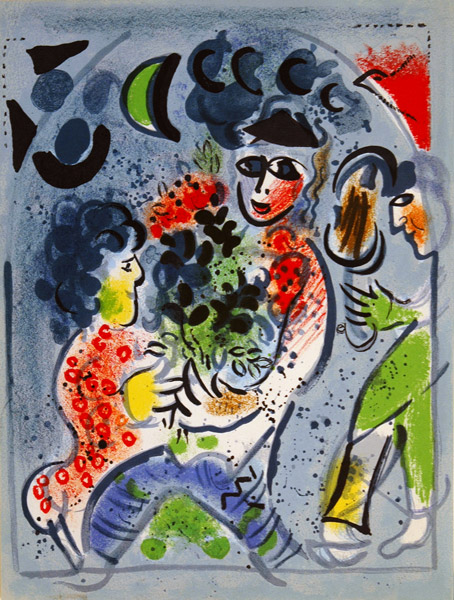
In the meantime, intelligence won’t be wasted.  On the contrary, it will only gain by going out into the streets.  It will wear street clothes.  It will come dressed as a harlequin to prepare people for the coming festivity. 

The Holy Fool he announces, who will prepare everyone for the “coming festivity,” is full of color and life.  He likens him to the major figure of commedia dell’arte – Harlequin.

The schlemiel and his wildly colored outfit and dance will “entertain the wrecked sensibilities of the perplexed.  It will amuse them with bright flags before flipping them over to reveal the basic black and white of unequivocal truth.”

Abehsera tells us that, in his dreams, he constantly thinks of the schlemiel.  The schlemiel is, in his words, his “alter ego.”  He, the writer, has the schlemiel as his muse.  And, to be sure, it seems that, at times, the writer transforms into the schlemiel.  He is a prophet of sorts who heals those “wrecked sensibilities of the perplexed” and who “prepares people for the coming festivity.” 

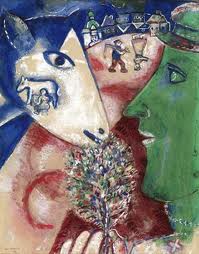
Perhaps this is what Marc Chagall – an artist who well-understood the place and meaning of the schlemeil to the Jews of Eastern Europe – had in mind when he made his lithograph “Harlequin with Flowers.”  The schlemiel makes us happy. He brings us flowers and hope.  But for Abeshera, he does more that just entertain: he discloses, by way of his theatrics and indirection, some kind of hidden, “unequivocal truth.”

Chagall_Harlequin_M578a

All of this is prologue to the parable of the Idiot, the Writer, and the Beggar.  In the next few blog entries we will address it and assess this messianic mission that Abehsera has given over to the schlemiel.


Meir Abehsera’s “Possible Man” – The Holy Fool, The Writer, and the Beggar – Part I

DownloadedFile

At the beginning of the summer, I had an interesting talk with the Kabbalah scholar Elliot Wolfson about Holy Fools.  The subject that I wanted to discuss with him, which pertains to the Holy Fool, is something he was familiar with in his studies of Habad (Lubavitch) Hasiduth and Mysticism; namely, something called Ruah Shtut D’kedusha (“the Holy Spirit of Foolishness”).  What spurred our conversation was a challenge that I posed to his reading of “negative theology.”  I suggested that we pay closer attention to the “madness” that this negative theology suggests and to think about how it may or may not relate to what Paul deMan – the literary theorist – would call, following the 19th century French poet Charles Baudelaire and the German Romantics – the “irony of ironies.”  As I have suggested in other blog entries, deMan’s reading of madness, which is spurred by the “irony of ironies,” leans toward the Daemonic.  What I wondered was whether the “madness of the Holy” differed from this type of madness prescribed by deMan.  To be sure, The Zohar, one of the most important books in Jewish mysticism, often makes distinctions between what’s called the Sitra d’Kedusha (the side of the Holy) and the Sitra Achra (the other side).  Where did the madness of the Holy fit?  Elliot was very intrigued by this question and has, since, exchanged some emails with me about it.

But the point I ended our conversation with was, to my mind, the most important. I suggested that Elliot take a look at Meir Abehsera’s book The Possible Man: Life in the Shadow of the Just.   For me, this book took the Holy Fool not so much as a concept than as a Midrash and an account of someone very close to the Lubavitcher Rebbe, someone who, in my view and perhaps his own, plays and played the Holy Fool.  During his years with the Rebbe, he lived out the “Holy Spirit of Foolishness” and, fortunately, he gave it to the next generation of Jews by way of parables in his book.  It can be found in the chapter entitled “The High Road.”

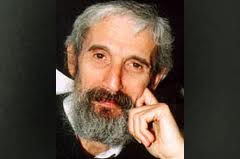
Before I discuss this wonderful work or writing, I just want to say a few words about Meir Abehsera.  I have great respect, love, and admiration for Abehsera.  Before becoming the Rebbe’s “whistler” (a name I will explain over the next few blog entries), Abehsera was a writer, artist, and poet in Paris. He was also one of the major people who was instrumental in bringing Macrobiotics (a way of life, eating, and community) to America.  After touring through the United States in the 1960s, he settled in Binghamton, New York, created something of a community, and influenced countless people there.  Two of those people are very close to me today.  (One of them is my uncle.)  In many ways, I find Abehsera to be one of the most important Jews in my life.  He is, in many ways, a schlemiel-rebbe for me.  His Jewishness is all-embracing, kind, joyful, and inspiring.  He wants to people to dance, sing, and talk with each other.  His gatherings at his home, whether in New York, Los Angeles, or in Israel, were gatherings unlike any I have ever been to.  I am not a child of the 60s, but in many ways I feel as if what he did is the closest thing I will ever come to a Jewish “be-in.”

That said, I’d like to summarize and unpack his wonderful parable.  I think it would be appropriate for Schlemiel-in-Theory to start the Jewish New Year with a spiritual reflection on the schlemiel (or at least one, important, variety of the schlemiel: the holy fool and the “holy spirit of foolishness”).

Here it goes:

Before talking about the Holy Fool, Abehsera begins his “High Road” chapter with a reflection on Memory, Imagination, and Redemption.   The serve as a central motifs in his chapter and they are the preface to his words on the Holy Fool, the Writer, and the Beggar.

Speaking of himself in terms of his inadequate memory, Abehsera writes that “unlike the Just – who are the true repository of memory… – I am a broken vessel, who must resort to circuitousness to find my own way around.  My memory is that of an archeologist by comparison.  Each fragment that I unearth calls for the next, until I finally face the complete form”(94).    What kind of memory do the Just have and how can we tap into it?  How is it possible?

Following this reflection on memory, Abehsera turns immediately to something that concerned The Baal Shem Tov and his grandson Rabbi Nachman of Breslav; namely, the rift that grew in Europe between educated Jews and simple Jews.  To be sure, as Ruth Wisse notes in The Schlemiel as Modern Hero, this rift gave birth to the first “literary schlemiels” in Rabbi Nachman’s stories.  The schlemiel, in these stories, challenges the Jewish intellectual who sees himself as closer to God as a result of his greater intelligence and skepticism.  The simplicity and naivite of the simpleton are, for the intellectual, negative traits.

Abhesera points out the Baal Shem Tov came around to address this rift:

He proceeded to transmit to common folk, in their own terms, what had been previously reserved for a select few.  His rationale was clear: the same Father in heaven who gives clever people the capacity to understand, also creates the feeble mind, and grants it no less right to share in the divine feast. (96)

Echoing the Baal Shem Tov, Abehsera lauds the simpleton. They, who live in the “now,” are closest to what Martin Buber would call “root experiences” (such as the giving of the Torah, Splitting of the Sea, etc) and they are the one’s who are closest to the Messianic.  And reflecting on what he says about memory, Abehsera describes this relationship to the “now” of the messianic the “memory of the future as well as of the past”:

Simple people were ideal chariots to transport the sacred, with never a self-conscious thought, for they did not suffer from the vanity with which the gifted are apt to be plagued. They could travel in an instant through time to Sinai, and fall to their faces, trebling as if they had just received the Law….The messiah was not a fable for these good people, or a possible dream of times to come; for them, redemption was now.   Cunning minds might contend that they were merely naïve.  I would say, rather, that they bore the mark of wisdom: a good memory of the future as well as of the past. (97)

The point of the imagination – and the point of the Baal Shem Tov’s famous expression “memory is redemption” – is to “bind past events with those that must inevitably come, to fuse the two extremes of the time and bring them to peace with the present.”  In other words, what Abehsera learns out of the Baal Shem Tov is that the imagination has a messianic and temporal task.  Imagination is equated with memory.  And for Abehsera memory/imagination is an “agent of healing” and spurs the “process of reawakening.”

Nonetheless, memory is challenged by the forces of trauma and destruction.  Memory “slips away.” And, for Abehsera, this is where the Baal Shem Tov and he himself comes in: his work (echoing that of the Baal Shem Tov) is the work of memory and its task is to heal the wounds that Jews have endured by exile and the Holocaust.

After pointing this out, Abehsera notes what he is up against; namely the fact that, in the times of the Baal Shem Tov, people were much more imaginative and hopeful.  Today, in contrast, the imagination is “less obsessive.”  We are – by and large – skeptics and rationalists who live in a disenchanted world.  And “yesterday’s dreamer is an extinct breed.”  So, in this world, we have to “smuggle” light in.  And this is done by way of metaphor.  Regarding this, Abehsera writes: “A metaphor is a transfer that can only be carried out by flesh and blood.” And it is human beings – and not angels – who have to use metaphor to transfer/smuggle light.   In other words, the way to truth, for Abehsera, is by way of the oblique.  We must hint at things but this is done by way of parable.

The trick is to keep this parable simple enough so as to speak to the hearts of people and not to an intellectual elite. And this is certainly something that is on his mind.

What I like most is how Abehsera situates himself within this framework and how, in his parables, he brings in the Holy Fool.  To be sure, it is the Holy Fool who smuggles in the light but, and here is the twist, this is conveyed by way of writing.  For this reason, Abehsera gives a parable that involves the relationship between the “writer” and the “idiot” (Holy Fool) so as to illustrate what is at stake.

In the next blog entry, I hope to discuss the dream that inspired this parable. Since this dream offers a, so to speak, allegorical key to the parable it deserves its own entry and must be laid out.  As I will demonstrate, it gives us a new way of understanding the schlemiel, one which shows how deeply personal and spiritually meaningful this comic character can be.

Living Schlemiels – Stranger than Fiction

images

One of the things I have never discussed on this blog is the topic of the “living schlemiel.”  To be sure, the most well-known books on the schlemiel – Ruth Wisse’s The Schlemiel as Modern Hero and Sanford Pinsker’s The Schlemiel as Metaphor – do not address this topic.  Their concern is the schlemiel in literature, folklore, and, for Pinsker (only with regards to Woody Allen), cinema.  The first time I saw the expression “living schlemiel” was in Sander Gilman’s book Jewish Self-Hatred: Anti-Semitism and the Hidden Language of the Jews.  To be sure, Gilman used this title for a section on his third chapter which includes German-Jewish writers and thinkers of the 18th and 19th century such as Ludwig Borne and Heinrich Heine.  For Gilman, Heine’s poetry, which dubbed the schlemiel the “lord of dreams” (the poet), bled into his life.  And Ludwig Borne’s life also, for Gilman, bore the stamp of the schlemiel.  Although Heine, according to Hannah Arendt, embraced the title of the “schlemiel” and “lord of dreams,” Gilman’s reading suggests that he and Borne did all they could to avoid it.  And that’s the point: Gilman calls them both schlemiels because no matter how much they did to fit into German society – and this included Heine’s baptism and both Heine and Borne’s attempts to satirize their Jewish origins to be accepted as equals – they remained the odd one’s out.

In judging their lives in this fashion, Gilman is teaching us that he, like many German Jews, uses the term in a critical/judgmental sense.  To live the life of the schlemiel, he suggests, is to live a life that is blind to the fact that it is excluded.  It “believes” it and fits into the world when it doesn’t. And this fits well into Gilman’s definition of the schlemiel vis-à-vis literature and theater. Schlemiels are  “fools who believe themselves to be in control of the world but are shown to the reader/audience to be in control of nothing, not even themselves.”  This is what Gilman is saying about Heine and Borne: they think they were in control of their world and could cajole it to accept them, but it refused their gestures.  In effect, Gilman suggests that they were odd in two senses: as a result of their satire they were excluded from their Jewish communities; and, despite their efforts, they were not accepted into the “world.”

Taking this definition into account, I wondered about how it could be applied to people I knew and not just to this or that intellectual.  And should it be modified?

Thinking about this, I would say that it should be modified to include the fact that, with a living schlemiel, there is a blindness over the reality that he or she is not fitting in; yet, despite it all, they keep on trying.  And here’s the twist: unlike Gilman who would suggest that the “living schlemiel” comes to a bad end, I would suggest that sometimes their foolishness can bear fruit.

I’ll offer a story about people who, I think, may be living schlemiels or at least analogous to living schlemiels.   This may serve as an illustration of how the schlemiel may be alive and living amongst us.  The question, I think, is how to judge them.

I was raised in Upstate New York by parents who were both raised in New York City.  I was one of a small handful of Jews and, in many ways, my parents skill set and education didn’t match up that well with the rural community that they made their new home.  Growing up, I often felt like I was the “odd one out.”

But, after years of travel, higher education, and exposure to the urban way of life, I realized that many people in my town, from an urban perspective, would be considered the odd one’s out.  I’m somewhere in the middle.   Describing my borderline state, my father jokingly calls me a “cosmopolitan hick.”  I think this title is apt and see read it in terms of what advantages it gives me over people who are either fully urban or are down-and-out country bumpkins.  The greatest advantage I have, to my mind, is the fact that I can participate in both groups and for this reason I am better able than many of my friends to comprehend or judge things that are said by one group about another.  I see it from the inside of both, widely different, cultures.  So when someone is said to be the “odd one out” by one group on another, my ears perk up.  However, there are times when no one says anything and I am the sole witness of an event that is of the schlemiel variety.  Let’s call it a schlemiel situation.

I recently went out for an evening with a group of friends to a bar on the Sacandaga Lake, a lake I spent a lot of my youth enjoying.   (To preserve my friend’s identity, I will change their names while noting what happened.)   In this group of friends, the words and deeds of at least two of my friends spurred a schlemiel-situation in which I bore witness to a schlemiel or two and was prompted to make a schlemiel-judgment call.

They traveled over to the bar by way of the boat.  I came in by car and met them there.  When I got to the bar, I heard that they were still on the lake on the way to the bar.  When I got word that they arrived, I went down to the lake to discover that one of my friends was playing guitar the entire way.  What’s unusual about this?  My friend, let’s call him Bob, is full of energy. He passionately gets into everything he does.  However, sometimes this can be grating because he subjects everyone he knows to his learning experience.  He does have experience as a lead singer in a band and he plays guitar, but he doesn’t take well to criticism.

That said, he was very excited to show me that he had learned how to play rhythm in a rockabilly kind of style.  I listened but, like the night before, he still needed to be much more gentle with his strumming if he was to get it right.  His erratic strumming coupled with his singing, which didn’t match up, his innocence, and his intense personality made me think of Bob as a “living schlemiel.”   To be sure, people tell him that his playing is off, but he goes on.  Its funny.  And so is he.  He is the odd one out, but he manages to slip through the cracks. But, as I found out, this has its limits.

Before going into the bar, Bob started talking with some people in a boat coming in to the bar’s dock.  Using a megaphone, he brought them in (acting as if he was an air-traffic control). This made the whole boat laugh and they were, instantly, endeared with him.  This gave him a big boost.

When he came up to the bar, he started working his foolish magic.  And this is when things started getting odd: reality and dream started clashing.  In the bar, Bob met up with a man in his seventies.  He got this gentleman going and he started dancing wildly to the music.  To have fun, I egged Bob on to increase the madness. But, to my chagrin, I bore witness to some mixed feelings in the bar.  The older gentleman started going off and people around the bar looked at him as if he was crazy.  I felt an odd identification and repulsion with the old man who was dancing wildly.  He was the odd one out and though people were giving him dirty looks, I couldn’t help but think them wrong.  He was having a good time and, yes, he appeared to be a schlemiel of sorts.  He believed he was enthralling the audience by going over the top, but he enthralled no one save Bob.

Together, they were whooping it and each encouraged the other.  I pulled back and noticed, immediately, that my friend Bob was eager to sing with the band.  In Upstate New York, it does often happen that people from the audience go on stage and sing.  But there are tell-tale signs when and when not to do this.  Moreover, it’s always good to have a friend in the band you’re joining.  In this situation there were neither signs nor friends. And my friend, Bob, went into it without any concern hoping his joy and charm would win the day.

But what happened was far from what he imagined. The drummer of the band told him to get off stage and the lead singer gave him dirty looks.   And the older man dancing around the bar started turning off a few of the audience members.  Things looked as if they would get ugly.

But they didn’t.  My friend did all he could to mend things.  It worked, but it didn’t get him on stage so much as in their favor.  What gets me, however, is that my friend kept at it as if there never was a negative moment.  And this blindness, though comic, gives him the title of a living schlemiel.

Following this, I went back to his boat and talked with another friend who keyed me into another kind of living schlemiel: one who has God on his mind and odd ways of relating to Him.   We were looking up at the stars when he said to me that he talks with God.  I asked how and he told me that he would ask questions while looking up at the stars. And for each question, God would answer with a shooting star.  I found this innocent and endearing, but coming from an adult this did seem odd. But isn’t faith a strange thing, too.  And, to be sure, Ruth Wisse notes that the first major literary schlemiel was, in fact, a schlemiel of faith.  That schlemiel comes out of the work of Rabbi Nachman of Breslav.  He is the simpleton who, with simple faith, believes in God.  His simplicity is scoffed at by the educated Jewish world, which, at that time, privileged the Jew who learns over the simple Jew.  The former, they believed, was closer to God. But the Baal Shem Tov – and his grandson, Rabbi Nachman of Breslav – thought the contrary.  Their stories bear witness to the spiritual doings of the simpleton.  My friend’s story about his communication with God reminded me of this; to be sure, the model for the literary schlemiel is a real one.  This is something Wisse doesn’t discuss as much.  But in this moment, I felt there is a need for more of this kind of reflection on “living schlemiels.”

If I weren’t a “cosmopolitan hick,” I’m not so sure I would look upon what I was seeing in the ways I do.  To be sure, I feel like Sancho Panza did when he followed Don Quixote.  He felt he could learn something from the fool, and so do I.

Some of my friends teach me about the living schlemiel.  But, to be sure, I can also see this from Chad Derrick’s documentary on (a segment of) my life: Shlemiel.  Every time I screen the film to audiences, I see that this is what the filmmaker – who is also my friend – was trying to accomplish.  And, every time I give the Question and Answer session following the film, I am asked if I am a schlemiel (a living schlemiel).  Perhaps I am.

But I am aware of many of the things I am blind too while my friends may not be.   However, then again, I am not.  We may see things that others don’t see, but we are often blind to ourselves.  You may not know this, but you too may be a schlemiel.  And, if we cared, we would be surprised how many living schlemiels are in our midst.   The question is how to judge them and ourselves.  Do we have anything we can learn from “living schlemiels”?

My friends and the older man I saw the other night reminded me that, though people may laugh or scoff at a schlemiel (of the Jewish or non-Jewish variety), there is something about this character – in fiction and in reality – that is good and worthy of our thought and reflection.   This goodness is something that many German-Jews missed (in their rush to judge the schlemiel as an idiot who should, like all things from the ghetto, be left behind).  But it was recognized by the Hasidim, by many of the Yiddish writers, and by some Jewish-American novelists, filmmakers, and artists.  Now that the times have changed, we need to ask ourselves where this goodness can be found and how it can be found.  These are questions not only for schlemiel-in-theory but for the schlemiel-in-reality.  The living schlemiel…..

Sarah Silverman, Hannah Arendt, and “The Old/New Lord of Dreams”

images-1

Last night, before I went to sleep, I noticed that Sarah Silverman had Tweeted something that had schlemiel written all over it.

Why?

In Hannah Arendt’s essay, “The Jew as Pariah: The Hidden Tradition,” Arendt argues that Heinrich Heine’s schlemiel initiates the “hidden tradition” of the Pariah.  Heinrich Heine, argues Arendt, was the first notable Modern German-Jewish poet to popularize the schlemiel in Germany.   According to Arendt, this happens in his Hebrew Melodies poems where we learn of the “lord of dreams” which is another name for the poet who is attached to nature and the world of dreams (which it fosters) but not fully to the world (not to “life life”).

Strangely enough, Arendt sees the model for this in Heine’s description of the Jewish Sabbbath and – in particular – in relation to the song “lecha dodi.”  Through the song, sung to welcome the Sabbath, the Jews are transformed:

In his poem, Princess Sabbath, the first of his Hebrew Melodies, Heinrich Heine depicts for us the national background from which he sprang and which inspired his verses. He portrays his people as a fairy prince turned by witchcraft into a dog. A figure of ridicule throughout the week, every Friday night he suddenly regains his mortal shape, and freed from the preoccupations of his canine existence (von huendischen Gedanken), goes forth like a prince to welcome the sabbath bride and to greet her with the traditional hymeneal, Lecha Dodi.

Arendt tells us that this is the only “positive” aspect of Judaism that Heine can find and, to be sure, he uses it for poetic purposes:

This poem, we are informed by Heine, was especially composed for the purpose by the people’s poet-the poet who, by a stroke of fortune, escapes the grueling weekly transformation of his people and who continually leads the sabbath-like existence which is to Heine the only positive mark of Jewish life.

Out of this figure, Heine creates the schemiel (spelled shlemihl in the German).  The transformation of the Jew from a dog to a prince foreshadows the task of the “lord of dreams” since the transformation is a way of telling the world to go to hell.  And for Heine, this is accomplished by the schlemiel poet.

As Arendt notes, by way of her schlemiel genealogy, the schlemiel has no “heroic deeds” to boast of; rather, his greatest trait is his “noble heart.”  To explain what this means, Arendt notes the schlemiel-poet’s “innocence.”  And, in her translation, the secret of the schlemiel’s innocence is not Phoebus Apollo but Rabbi Faibusch (the last name is a comic play on the Greek Phoebus):

Innocence is the hall-mark of the schlemihl. But it is of such innocence that a people’s poets-its “lords of dreams”-are born. No heroes they and no stalwarts, they are content to seek their protection in the special tutelage of an ancient Greek deity. For did not Apollo, that “inerrable godhead of delight,” proclaim himself once for all the lord of schlemihls on the day when-as the legend has it-he pursued the beauteous Daphne only to receive for his pains a crown of laurels? To be sure, times have changed since then, and the transformation of the ancient Olympian has been described by Heine himself in his poem The God Apollo. This tells of a nun who falls in love with that great divinity and gives herself up to the search for him who can play the lyre so beautifully and charm hearts so wondrously. In the end, however, after wandering far and wide, she discovers that the Apollo of her dreams exists in the world of reality as Rabbi Faibusch (a Yiddish distortion of Phoebus), cantor in a synagogue at Amsterdam, holder of the humblest office among the humblest of peoples.

The schlemiel, Arendt tells us, is “the peoples poet”; he is not the poet of the nouveau rich and the parvenu.  On the contrary, he, like the people, are outsiders in a fake society ruled by lies and posturing.  Moreover, the schlemiel stands with the people and with nature, not with culture:

It is but natural that the pariah, who receives so little from the world of men that even fame (which the world has been known to bestow on even the most abandoned of her children) is accounted to him a mere sign of schlemihldom, should look with an air of innocent amusement, and smile to himself at the spectacle of human beings trying to compete with the divine realities of nature. The bare fact that the sun shines on all alike affords him daily proof that all men are essentially equal. In the presence of such universal things as the sun, music, trees, and children-things which Rahel Varnhagen called “the true realities” just because they are cherished most by those who have no place in the political and social world-the petty dispensations of men which create and maintain inequality must needs appear ridiculous.

Arendt’s rhetoric makes it clear that the schlemiel, the “lord of dreams” stands on the side of the “true realities” because they are politically excluded.  In other words, they have no choice but to dream because they have no place in the world which, with all of its inequalities, appears “ridiculous.”

Can we say the same of Sarah Silverman?  In her tweet, she says that she is “crazy busy with dream life.” That’s where her real work is: in the dream world and in producing dreams.  She has “very little time for life life.”  She seems to be telling us that she is the old/new Lord of Dreams.

But here’s the catch.  Arendt believed the Schlemiel would no longer be necessary once the Jews were allowed to live in a world as equals.  At the point, Jews would no longer have to dream.  And Sidra Ezrahi, in Booking Passage, has argued that, while in exile, the schlemiel was appealing because it provided Jews (who were the losers of history) with a “substitute sovereignty.”  But now, after the establishment of Israel, that no longer seems necessary as real sovereignty is within reach.  However, Ezrahi notes that, though things have changed, American artists and writers still insist on what she calls the “trope of diaspora.” In lieu of this, she sees America as fertile soil since it is the “land of dreams.”  And in this virtual world, which comes straight out of Hollywood, the Lords, so to speak, are the “Lords of Dreams.”

What can we take out from this?

Perhaps Sarah Silverman gives evidence that supports Ezrahi’s argument about America and schlemiels.  If that is the case, what does it imply?  Isn’t it the case that the Lord of Dreams passes back and forth between the world of dreams and the world of reality?  Isn’t the schlemiel, the poet of the people who, like the schlemiel, feel like they are in the middle?

If this is the case, perhaps we can say that Arendt was wrong when she said that Superman replaced Charlie Chaplin (the last in her line of schlemiel-pariahs in the “hidden tradition”).  In my book and here, on this blog, I am venturing this possibility.

But we need to ask ourselves, whether or not Sarah Silverman is the schlemiel-poet-of-the-people and whether we can still say that she, like Heine’s Lord of Dreams, speaks from the angle of nature and the people.  Perhaps she speaks from a land of dreams that has no relation to the political or to a utopian dream that nature and culture merge.  Perhaps her work is to dream and nothing more nor less than that.

Perhaps she is just a woman-child, who lives somewhere in-between dreams and reality:


A Heated Discussion Over the Schlemiel in Brooklyn

DownloadedFile

Like any scholar, I love a good discussion.  I especially love difficult ones.   The best discussions put my arguments and assumptions to the test and, sometimes, alter them.  However, at some point, what at first seems like a good discussion may become a shouting match.  Such angry talk may become a “conversation stopper,” but I always make sure to ask myself what I can learn from these moments of passion.  Regarding such conversation, a recent discussion of the schlemiel I gave was especially interesting because, at some point, the academic became much more mundane and everyday.  The talk I originally planned dovetailed.  And I like this as I often find many academic discussions to be sterile. I often walk away from them the same person.

I grew up with friends who challenged each other on a daily basis, but these moments weren’t academic.  They were thoroughly mundane and through them I learned how to stand up for what I believed in or, at the very least, to test what I believed in.  These challenges helped to me to grow as a human being and left me with questions that I felt deeply and knew I had to work through.  Most of these questions had to do with my identity and breached the issue as to what it means to be Jewish, American, white, and male in small-town America.  The challenges which issued these questions altered how I looked at myself and the world around me.  They were physical and psychological; they were not intellectual or academic (although they became academic questions, their root was the everyday challenges I faced growing up).  So when I find spaces where academic challenges merge with everyday challenges and where these challenges come at me from different – unexpected – angles, I can’t help but smile: I know that I will, hopefully, experience a moment of possible growth and change.  On the other hand, I know that such challenges may also teach one nothing and may only create unnecessary difficulties or even stunt one’s growth.

The challenge I recently faced came up last Thursday night; it was over the meaning of the word and concept of the “schlemiel.”  I gave a talk in Brooklyn entitled I entitled “The Life and Death of the Schlemiel: Why does the Schlemiel Matter?”  As anyone can see from this blog (and from my articles), the “schlemiel” means a lot to me; but as I learned it means even more for people much older than I who grew up (oftentimes in households where Yiddish was one of the spoken languages or references) with the term: some used it to harm others while others were harmed by it; some associated it with humility, others with idiocy.  I knew these possible responses very well from my studies of this character but I had yet to experience the challenges posed by people who, throughout their life, intimately experienced its meaning.

In the talk, I wanted to pose the question of whether the schlemiel was still alive, why peple would want to eliminate this comic character, and, if it still exists, what kind of schlemiel “should.”  After seeing my abstract, the organizer of the evening wanted me to address the Holy Fool in more depth and relate it to my original topic. Here is the edited abstract:

Is the schlemiel a “holy fool” or just a Jewish fool?  Does s/he still exist today and, if yes, should it continue to do so ? Can the schlemiel offer hope to dark times or is simply entertaining?  Dr. Feuer –  a “schlemiel theorist” – will define & explain the meaning of the schlemiel.  To this end, he will contrast the Eastern European Schlemiel to the  Western European Schlemiel, trace its tensions with Zionism, discuss its passage from Europe to America before and after the Holocaust, its new variations in the United States in the post-WWII , and its legacy in film, literature, and TV over the last few decades. This will include a discussion of rabbis, writers, filmmakers, & actors, that span Rabbi Nachman of Breslav,  Sholem Aleichem, I.B. Singer, Phillip Roth, Woody Allen, Ben Stiller, and Seth Rogen.  After discussing the schlemiels meaning and history, philosophical and ethical questions will be posed as to whether or not the schlemiel should persist or vanish into the dust bin of history.  What’s at stake in this question?  Is the schlemiel just a secular fool and if not wherein lies its holiness?

As you can see, I wanted to 1) define the schlemiel in terms of two predominant traditions – one from Eastern Europe and the other from Western Europe; 2) trace the history of the character and outline its high points and its low points; and 3) to ask whether the Holy Fool could make a “come back” in today’s increasingly secular Jewish-American environment.

I planned on starting off by telling a few traditional schlemiel jokes and then, after doing this, introduce the cover of the May 2009 New York Magazine which had a picture of Larry David looking down at a pale Woody Allen (the look saying something along the lines of “you’re all washed up”).  Below the photo is the caption: “The Last of the Schlemiels.”  The subtitle had the obvious function of stating an irony; namely, that not only Woody who is washed up, so are you Larry David.  You are both the “last of the schlemiels.”  The statement is a bold assertion or rather ‘death sentence’.  The point of bringing this up was to ask whether these schlemiel jokes or the schlemiel himself had any place today in our American society.  As I looked to show, this statement may have relevance for some but it is not true: schlemiels live on.  But, more importantly, I wanted to show what had become of the schlemiel and how had first called for its death and why.

This would bring me into the topic of comparing and contrasting a German-Jewish view of the schlemiel to an Eastern European view.  The former desired the end of the schlemiel while the latter associated the schlemiel with piety, honesty, and even, for some, the holy fool.

For me, this distinction lives on today; but it is the negative imputations against the schlemiel (which draws on the German-Jewish tradition) which had a long after-life. On the other hand, schlemiels often played by Adam Sandler, Ben Stiller, Woody Allen, or Seth Rogen have a charm to them that challenges this view.  Nonetheless, they are far from being “holy fools” or share any resemblance with Sholem Aleichem’s schlemiels.

But before I could even address these contemporary schlemiels or the life and death of the schlemiel, I was met with a major challenge that issued from the distinction between Eastern European and German-Jewish Schlemiels.   Some people in the audience immediately took to one interpretation or the other and a heated argument took place.

I did my best to mediate between the two and explain what the other parties could not accept.  This was a great challenge as one of the people arguing insisted over and over again that there is nothing good that can be said about the schlemiel: she insisted that no one should be a schlemiel.

In response to this, I explained the meaning of the schlemiel in terms of its critique of society.  I explained that if I.B. Singer’s Gimpel the Fool was constantly being lied to it wasn’t his fault that he trusted everyone so much as the fact that everyone lied to him. The point of the schlemiel was to situate us between hope and skepticism (or cynicism). And as Ruth Wisse notes at the very end of her book, The Schlemiel as Modern Hero, the schlemiel cannot exist in a society that is wholly cynical or optimistic.  This led me to a discussion of Woody Allen’s latest film Blue Jasmine and his extreme emphasis on cynicism.  I asked where, in this film, we could find a schlemiel and about how this kind of film contrasts with Allen’s earlier films which had schlemiels.

This prompted audience members to think about the relationship of the schlemiel to the cynical times we are currently living in America and about how important the schlemiel is as a figure of critique.  But, still, there was a lot of anger in the audience about the schlemiel.  One person, in particular, couldn’t let go of her negative reading of the character and saw nothing redeeming about it.  This prompted other audience members to yell at her and associate her with a certain Jewish-ethnic perspective.  This heated talk led to a lot problems and kept me from continuing my lecture.

After I ended the talk, I wondered whether I did the right thing and whether I met the challenges that emerged out of a discussion of the schlemiel.  I talked with a few friends about this as well as the organizer. Some explained that this is what happens in Brooklyn: people are often very stubborn about their views, love to argue, and are oftentimes rude about it all.  Others explained that the reason there was so much contention was because many people in the room were called schlemiels when they were growing up or, otherwise, called people schlemiels.  Still others explained that some people, had entrenched views about the schlemiel which were based on what Jewish tradition they came out from in Eastern or Western Europe.

All of these explanations makes sense, but what I left this heated discussion with was something else; namely, a task.  I realized, by way of these challenges, that if I’m going to argue for a positive and critical reading of the schlemiel that I will be challenged by people who have deeply ingrained views of this character.  Its hard for me – a “little pisher” – to make such claims as I wasn’t raised in Brooklyn by parents who used this term regularly in a negative manner.  Nonetheless, I have the knowledge and awareness of this characters wider meaning and possible meaning which can challenge deeply ingrained views.  I can offer a new/old reading which can make the schlemiel relevant – once again – and spur people to ask themselves why Woody Allen and Larry David are not only not the “last of the schlemiels” but that there are other schlemiels.  And, more importantly, we need to ask ourselves what schlemiels should live on.  I believe some are not worth our time while other schlemiels are.  And I’m willing to take on the challenge of explaining why.  This, for me, is not simply an academic challenge; defending my reading of the schlemiel, is also a life challenge.  The schlemiel means that much to me, an American-Jew who, though he hasn’t been raised in Brooklyn by parents who speak Yiddish, has every right to defend my reading of this character. For me the schlemiel is not something I don’t want to be so much as a character who can spur me – and others – to stand in the uncomfortable space between hope and skepticism.

Cynicism and Hope: On Woody Allen’s “Blue Jasmine”

images-1

Last night I had the opportunity of seeing Woody Allen’s new film Blue Jasmine.  Since I have great interest in the work of Woody Allen and two of the characters he has cast in the film (Andrew Dice Clay and Louis CK), I took an immediate interest in the film and was eager to see it.  I have blogged and written on all of them and I was curious to see how or whether any comic elements could be found in the film that was, as many reviewers pointed out, not comical at all.

Much has been written on this film already.   Reviews from The New Yorker, The New York Times, and The Washington Post (amongst many others) already dot the landscape.

Regarding these reviews, nearly all of them note how Allen, in the making of this film, was very influenced by Tennessee Williams’ A Streetcar Named Desire.  And they all noted the obvious relation to the Bernie Madoff fallout.  Regarding the reviews, I will briefly defer to the words of the critic David Denby who, in my view, does a fine job laying the plot and themes of the film out.  What interests me most, in his review, is how he reads the comical element.  Denby notes that Jasmine, played by Kate Blanchett,

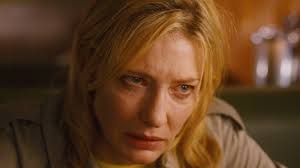
is a snob and a liar, and, at times, delusional (she talks to herself), but, like Blanche DuBois, she’s mesmerizing. You can’t get enough of her, and Cate Blanchett, who played Blanche on Broadway only a few years ago, gives the most complicated and demanding performance of her movie career. The actress, like her character, is out on a limb much of the time, but there’s humor in Blanchett’s work, and a touch of self-mockery as well as an eloquent sadness. When she drops her voice to its smoky lower register, we know that she’s teasing the tragic mode. That edge of self-parody keeps us close to her, and we need that closeness, because we’re in for a rough ride.

Without this comic element of self-parody, we would despise her.  But, as Denby points out, the harsh element is constant throughout.  This, Denby avers, has much to do with Allen’s outlook on life, as reflected in this film:

Allen, who’s now seventy-seven, has become flintier as he has got older. His men and women tell one another off; the social clashes among people from different ways of life can be harsh and unforgiving.

In other words, with age Allen wants to knit a closer relationship between comedy and suffering.  In effect, Allen’s film shows us how, in his view, class-difference, in our era, taints comedy:

Allen, in his own way, is commenting on our increasingly unequal society: the formerly rich woman and the working-class characters don’t begin to get one another’s jokes and references; they don’t understand one another’s needs—they don’t even see them.

Nonetheless, Denby wants to point out how the comic element survives, albeit in a way that is admixed with the tragic.   Allen now uses the comic element to produce a “miraculous” identification between the audience and Jasmine.

The miracle is that we feel for Jasmine—or, at least, our responses to her are divided between laughter and sympathy. When she takes a job as a receptionist in a dentist’s office, and the patients can’t decide when to schedule their next appointment, her irritation at their fumbling is both funny and recognizable.

What I like about Denby’s reading of the film is how he phrases our odd identification with Jasmine.  Our laughter at her way of handling her new work and life take off the edge. And we, for a few moments, see her as something other than a snob.  We can understand how ridiculous her situation is and we identify with her through laughter and tears, which keep each other in check.

Unlike Denby, I would say that, though I identified with Jasmine in this “miraculous” fashion, this identification was momentary and was often overshadowed by the other element which taints all of our identifications in the film; namely, the effect and dynamic of dishonesty and cynicism.

I was very troubled by this overwhelming presence as I stand behind the comic task of the schlemiel which is to maintain the tension between skepticism and hope.  The schlemiel, though foolish, stands on the side of trust and honesty. We see this in many classical schlemiels: from Rabbi Nachman of Breslav and Sholem Aleichem’s simpletons to I.B. Singer’s Gimpels and Woody Allen’s Alvy Singer types.  Although these characters are weathered by reality and lies, the element of trust remains.  It doesn’t triumph so much as remain in the balance.  When this tension collapses, we are in trouble.  It implies that what is best in humanity has been effaced.

At the end of her book The Schlemiel as Modern Hero, Ruth Wisse points out that in an era in which there is too much optimism or too much skepticism, the schlemiel cannot exist.

Allen’s film illustrates this principle-of-sorts.  To be sure, his film speaks to the cynicism that has grown post-Madoff.  And this overshadows much of the trust and hope we see in the film.  However, the fact of the matter is that although Andrew Dice Clay’s character is ruined by the games of the rich, his ex-wife (Jasmine’s sister, Ginger – played by Sally Hawkins) manages to start a new life.

She plays something of an innocent and hopeful schlemiel character.   Although Blanchett is obviously the focus of the entire film, it is Ginger who, at the very end of the film, retains some element of hope and trust.  She wants nothing to do with the cynicism that goes along with big-money and corruption.

Nonetheless, the best illustration of what is at stake in this film (and with the schlemiel) can be found in Blanchett’s relationship with Ginger’s children.  Although they openly disclose what they have heard from their parents about Jasmine and her husband’s lies and corruption, they don’t understand it.  In a key scene where Jasmine tells it all, they look back at her in astonishment not knowing what she is actually saying.   Her language is not theirs.

In truth, all of the adult characters are tainted by cynicism.  The children are, too.  But they don’t know it.  And, at the very least, I think it is important to note this.  The comic element survives best in them.  They retain the element of a schlemiel in a society which has become inundated with post-Madoff cynicism.

Though the film ends with Blanchett walking the streets alone, homeless, and delirious, this still leaves us with a horrible feeling we cannot forget that while most of us have been ruined by cynicism there are some who aren’t.  Children, in this film, are the schlemiels.  We need to ask ourselves what this implies.

The more we lie to each other, the more our humanity is lost.  Cynicism is the greatest threat to the schlemiel and to our humanity.  I applaud Woody Allen for bringing this out in Blue Jasmine.

He illustrates what Irving Howe, citing Saul Bellow, saw about Sholem Aleichem’s comedy; namely, that what makes Jewish humor relevant is the fact that it oscillates between laughter and tears.  And, as I have pointed out, this oscillation is based on the violation of trust.  Without trust, we can only cry.

Paraphrasing Denby, I would say that the miracle is not simply our feeling for Blanchett; it is the fact that the children don’t totally understand how dishonest people can be.  It’s the last remnant we have.  And, as I would argue, their lack of understanding, like that of any schlemiel, may give us time….time to change our ways and learn to trust one another once again.   Perhaps this is a foolish hope, but, in truth, it is the hope of a schlemiel.

It is our last remnant of humanity in a post-Madoff age.

Gilda Radner and Gene Wilder’s “Haunted Honeymoon” Interview

DownloadedFile-5

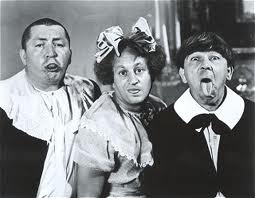
The schlemiel is often called a man-child.  The best way to articulate what this means is by taking a look at comedians who play men-children.  I originally planned to blog on this topic.  And I thought of three routines.  I first thought of the Three Stooges’ children routine.

images

I was especially interested in the later stooge, Joe Besser, who replaced Shemp from 1955-1958.  His childish routines are highly gestural, sometimes flamboyant.

DownloadedFile-4

Here he plays a child:

He also played “stinky” in Abbot and Costello:

I also thought of Gilda Radner.  She played many children in her own routines and on Saturday Night Live.  And, as in this routine, she slips from being the good, innocent child to the child who likes to speak dirty.

I am intrigued with all of the children she plays and I wanted to write on them today, but something else caught my eye which conflicted with her image as a child: a new routine that cast her as married…to Gene Wilder, a man she was married to in real life.  The movie that I’m talking about was directed by Gene Wilder and starred both he and Gilda (and Dom DeLuise as a cross-dressed man-child schlemiel): its called Haunted Honeymoon. It was filmed in 1986, two years after they were first married.

But it wasn’t the movie that first struck me as interesting so much as an interview I came across.  In the interview, we see a sobriety and an everydayness with not only Radner but Gene Wilder as well.

In the interview we see that Wilder wants to clearly separate himself from the comedian as does Radner. They even go so far as to say that they may not laugh at their own jokes.  Wilder, in fact, is very realistic and frank about how serious he actually is.

Radner stresses how normal they are in real life and that their fans should know this.  In other words, they are not schlemiels but they play them.   But there is more to the story then simply a separation between the world of the schlemiel and everydayness; there is an oscillation between horror and comedy which is of great interest to Wilder (and apparently Radner).

The interviewer’s first question to Wilder (who grants the interview from a bed) and Wilder’s response foreshadow this. When asked what Wilder can tell the audience about the film that “won’t give too much away.” To this, he says “nothing.”  But then he says: “Except for one thing.”  Namely, that he loved “these kinds of films,” by which he means “comedy chillers,” when he was a “little boy.”  He explains that they were called “comedy chillers” because they “scared you but you also laughed.”

As we saw with Irving Howe’s reading of Jewish humor (and Jewish identity), which was drawn from a remark made by the Jewish-American novelist Saul Bellow, there is a movement in Jewish humor between “laughter and tears.”

Gene brings the tears in the interview, too.  By talking about how exhausting it is to “direct” oneself, he puts forth a negative sense that the film isn’t any “fun” to make.  And he drives the mood to sadness when he says this may be his last film ever: “I don’t mean anything prophetic or sad but this may be my last movie as a director or an actor, actually.”

Gilda Radner follows suit.  She says that she and Gene don’t like being funny all the time. Genes response to the last interviewer’s question says it all:

The Interviewer: “What besides your own work makes you laugh?”

Wilder: “You assume my own work makes me laugh..that’s quite a big assumption…sir.”

For Wilder, who plays a schlemiel in nearly all of his movies, his humor may not make him laugh.  It may make him somber, sad.  His comedy is somewhere between laughter and tears.  He may evoke the laughter of others, but he may not find his own antics to be funny of all.  So when Radner or Wilder play that man-child, they may not find it so funny. But we do.

What does that tell us?

Perhaps it tells us that our “honeymoon” with the adorable yet deviant man-child may be “haunted” by something we may not want to recognize. Perhaps we wish I.B. Singer’s Gimpel the Fool was a schlemiel in fiction and in reality. That way, we would always bear witness to a schlemiels blind trust of others, and to society’s mockery of this trust. We can imagine a perpetual schlemiel like Sasha Baron Cohen who lives reality as his character. And perhaps this perpetual schlemiel is what Wilder and Radner, at this point of their careers, wanted to haunt.

(I hope to return to the theme of man-children over the next week.  There is so much to reflect on….)


Giorgio Agamben’s Fable, or the Crib as a Historical Gesture – Take 1

g3450tn

One of Giorgio Agamben’s most thought-provoking and clear explanations of “gesture” can be found in an essay entitled, “Fable and History: Considerations of the Nativity Crib.”   But, what we find there is not so much a gag.  It is more like a profane illumination that comes to us by meditating on the “crib as a historical gesture.”  For Agamben, the crib mediates between the sacred and the profane.  And, as a historical gesture, the crib takes us from the mystical and mythical to the secular and everyday.  In fact, Agamben says that the crib “liberates time.”

But the catch is that Agamben focuses on a very specific example as mediating between ritual and secularization: the nativity scene. He reads this scene first as the “nativity crib” and, at the end of his essay, as a “historical gesture.”

What does this mean?  What is at stake?  And, in terms of what I am most interested in, what does this mean for the schlemiel?  More importantly “who” is in the crib?  Is the schlemiel in the crib or is it, rather, the Christian fool?  And how does “he” (whoever he is) relate to the “crib as historical gesture”?

To answer these questions, I need to unpack the essay so as to follow Agamben’s logic and rhetorical tactics.   I will begin this task here and carry it out over a few entries.

(Note: A cursory look at first words and final words of his essay show us that Agamben has a messianic end in mind when he claims that the crib is a “historical gesture” which, ultimately, takes us into history and into a messianic kind of event.   Is this event-slash-gesture a secular one? Is it another crib? And will the fool or schlemiel be there in that messianic gesture?)

Agamben starts his essay by defining the crib as such: it is an “image of the world presented in miniature.”  And the image-of-the-world-it-presents-in-miniature is, and this is key, a “historical image.”   For Agamben, this means it is not a religious image or a mythical image; the crib is a “historical image.”   And it discloses itself as a “moment” of transition.  Using Benjaminian language, Agamben writes of this “moment”:

For what it shows us is the world of fable at the moment when it wakes from enchantment to enter history.

And this is possible only because the “fable has been able to separate itself from initiation rites.” And by “abolishing the mystery which was at its center and transforming it into enchantment.” This separation, abolition, and transformation of cult and ritual into enchantment is the key.  But there is a difference. As Agamben explains, the “creature of the fable” may be enchanted but is not under a religious spell or trance:

The creature of the fable is subjected to the trials of initiation and the silence of the mystery, but without experiencing them – in other words, by undergoing them as a spell.

Agamben further explains that the creature of fable is “bewitched” but s/he is not “participating in a secret knowledge that deprives it of speech.”

But wouldn’t “enchantment” also be a deprivation of speech?

Anticipating this question, but not openly stating it, Agamben argues that this is enchantment “must be shattered and overcome.”  I find this moment fascinating since, as I pointed out in my last blog entry, Agamben’s “gag” risks enchantment itself.   After all, a gag is something you put in a mouth to keep one from speaking.

This, I would argue, is the danger of the gesture which, though it may be “historical” can easily become and remain “enchanting.”  And although it may leave the creature on the other side of mystery, it may leave the creature in the midst of “enchantment.”

In the next entry, we will take a closer look at the creature and its relationship to the crib and the nativity scene.  And within this scence-slash-historical-crib-gesture, we will find Waldo (I mean the fool who may not be a Christian fool).


Giorgio Agamben on Infancy, Gestures, and Gags – Take 1

images-1

My grandparents really enjoyed watching live stand-up comedy.  Whether it was at the Lido Beach Club in Long Beach, the Catskills, or in Miami, they relished live-comedy.  But of all the comic moments, my grandmother (on my mother’s side) recently told me of one.  She pointed out how whenever my grandfather saw Milton Berle come onto stage he would start laughing hysterically.  Milton didn’t have to say anything.  According to my grandmother, the mere gesture of his coming onto stage and the look on his face was enough to make my grandfather laugh.   This moment meant a lot to him and, as I learned, it meant a lot to her.  I could only surmise that it was Berle’s comic gesture – his awkwardness on stage – which created a relay across the generations.

This little tid-bit of comic wisdom prompted me to think about something that has been on my mind for a while: the comic gesture.  I’ve been thinking about it because Walter Benjamin spends so much time pondering it in his essay on Kafka.  For Benjamin, it seems, the key to understanding Kafka is pre-linguistic: it involves a close attention to the gestures made by Kafka’s odd characters (mostly the characters we find in his parables and short stories).  And Benjamin, ultimately, found these gestures to be comic.

Giorgio Agamben is a contemporary thinker who has taken an interest in Benjamin’s foray into gesture and has, to be sure, incorporated it into his own project.  In the revised preface to his book Infancy and History: On the Destruction of Experience, Agamben locates a relationship that speaks to his concern with gesture; namely, the relationship between “voice” and “infancy.”  Before discussing gesture, later on in the book (namely in his “Notes on Gesture”) Agamben finds it necessary to explain this relationship.

Agamben reads voice in terms of the “limits of language” and argues that “the concept of infancy is…an attempt to think through these limits in a direction other than that of the vulgarly ineffable.” What Agamben means by the “vulgarly ineffable” is that the category of the “un-said” and the “ineffable” belong “exclusively to human language.”  What words, then, should we use for the “limits of language” which do not “belong” to human language but, rather, to the “inhuman?”

Regarding this, Agamben makes reference to Walter Benjamin:

The concept of infancy…is accessible only to a though which has been purified, in the words of Benjamin writing to Buber, ‘be eliminating the unsayable from language.’ The singularity which language must signify is not something ineffable but something superlatively sayable.

What exactly does Agamben mean by “superlatively sayable?”  He doesn’t explain what this means.  And it is far from obvious. Rather, he seems to suggest that its meaning can be found in the “presentation of the relationship between language and experience.”  Invoking Benjamin, once again, he says that he is looking for a “transcendental experience” of language, an “experimentum linguae.”

This experience, Agamben tells us, can only happen “in language.” It cannot happen by way of speaking about language but through language in its “pure self-reference.”

Against Heidegger, who claims – in his essays on language – that we can have an experience of language “where speech breaks on our lips,” Agamben tells us that “infancy is staked on the possibility that there is an experience of language which is not merely silence or a deficiency of names, but one whose logic can be indicated, whose site and formula can be designated, at least up to a point.”

What this amounts to is a sketch of the relations we are caught up in.   And this, Agamben tells us, helps to disclose an aspect of being human which has, thus far, not been fully disclosed:

Man does not merely know not merely to speak; he is neither Homo sapiens nor Homo loquens, but Homo sapiens loquendi, and this entwinement constitutes the way in which the West has understood itself and laid the foundation for both its knowledge and its skills.

Agamben’s abstractions may leave many a reader bewildered or indifferent.  After all, what’s the big deal with discovering that one is “entwined” in language.  Is this experience befuddling?  Will one feel the pressure of words on one’s existence to a much greater extent once they have a “experimentum linguae?”  Will gestures, within language, evince a hidden power?

For Agamben, the answer to all of these questions is a resounding yes.  The experience of infancy, that is, the experience of language, is the experience of the “very faculty or power of speech” and that “there is” language.

Ultimately, Agamben is not simply interested in the fact that “there is language” or that one experiences the “very faculty or power of speech” in one’s experimentum linguae.  To be sure, he translates this “experience” of infancy into gesture in his essay “Notes on Gesture”:

If we are to understand gesture, nothing is more misleading than to picture a sphere of means directed towards an end.

The gesture does not contain an end with in itself.  It has no end.  Writing on dance as gesture, he notes: “If dance is gesture, this is, however, because it is nothing but the physical tolerance of bodily movements and the display of its mediating nature.”  Out of this reflection on dance as gesture, Agamben makes his formulation:

Gesture is the display of mediation, the making visible of a means as such.

In other words, gesture mediates and communicates noting save for its own mediation: “gesture is the communication of a potential to be communicated.  In itself, it has nothing to say, because what is shows is the being-in-language of human beings as pure potential for mediation.”

To be sure, there doesn’t seem to be anything comic about this at all. How can one laugh at the “pure potential for mediation?”  Indeed, Agamben’s language and description are neutral at best.  However, Agamben associates this “pure potential for mediation” with the gag:

It is always a gag in the strict meaning of the term, indicating in the first instance something that is put in the mouth to hinder speech, and subsequently the actor’s improvisation to make up for a memory lapse or some impossibility of speech.

This lapse, this gag, is at the very core of “being in language.”  Moreover, “every great philosophical text is the gag that displays language itself, being-in-language itself, as a great memory lapse, as an incurable speech defect.”

In this final gesture, Agamben basically writes off everything philosophical as a gag.  Language is a gag as is being-in-language.  This is another way of saying that gesture indicates how our human speech and action are interrupted.  This gag leaves us awkward and powerless, but it leaves language as such with the pure potentiality.

My question, with regard to all of this, is how does this all relate to Milton Berle’s comic gesture? Was his gesture a “gag’?  And was my grandfather laughing at the gag because it discloses pure mediation?  Was he laughing at his memory lapse, that is, at Berle’s awkwardness?  Can a comedian provide us with an experience of infancy and language?

All of these questions are on my mind and Agamben, unfortunately, doesn’t answer them.  To be sure, I have a hard time finding a well-thought out approach to gesture and comedy. The only mention of comedy in all of is discourse are his final words on the gag.  For this reason, I’d say that Agamben’s words on the gag are preliminary and need more thought.

As I’d like to show in future blog entries, Benjamin was fascinated with the gestures in Kafka’s work and he thought they were comic in nature.  However, unlike Agamben, he doesn’t tell us there is a gag.  He alludes to it and what we find in such allusions is a schlemiel-like gesture which, as a matter of course, always misses its target.

Agamben could learn a lot from the schlemiel but, given his utmost seriousness, I’m not so sure he can.  He’s caught up in “pure means” to such an extent that he remains transfixed, as it were, before potentiality, which is more in line with Heidegger than with Sholem Aleichem.  And I wonder if Agamben would laugh at Milton Berle like my grandfather did so many years ago.  Perhaps, in his attention to Berle’s initial gestures, he would silently dwell on his infancy/powerlessness and the potentiality of language as such while my grandfather would, quite simply, laugh.