Agamben on The Historical as Opposed to the Magical Redemption of Man, Animal, and Nature

DownloadedFile

What is redemption?  And how would redemption, as understood by Giorgio Agamben, differ from the redemption we hear of in the Torah, the New Testament, or the Koran?  These are big questions that I don’t think can be addressed in one blog entry.  Nonetheless, they should be of great concern for anyone who reads Agamben’s revision of the Messianic which he, oftentimes, uses scripture to articulate.

In the essay I have been focusing on in the last few blog entries, Agamben has, as I have pointed out already, claimed that the “nativity crib” is the “decisive…historical gesture.”  For Agamben, the crib takes us out of the fable and enchantment.  It is a gesture of secularization. But, as I pointed out in the last entry, Agamben also regards it as messianic.  The question I posed was whether Kafka and Benjamin will be at that redemption.  Perhaps they are the sleepers in the nativity scene since they are caught up in the pre-historic rather than the historic (redemption).  Even thought Agamben doesn’t mention Benjamin in the key moment when he talks about the pre-historic it is clear that he is making reference to Benjamin’s essay on Kafka.  Regarding this essay, Benjamin told both Theodor Adorno and Gershom Scholem that he wanted to retain the tension between the mystical and the political (he likened this tension to the tension of a bow).  However, as he admitted to them, he had failed to maintain it.  In his own view, he had slipped into the mystical and missed the political aspect of Kafka’s work.  Agamben would read this as an admission that Benjamin had got caught up in Kafka’s pre-historical world.

Hence, Agamben’s reading looks to go where Benjamin failed to go in his Kafka essay: toward the historical.  This has its problems as it suggests that Jews like Kafka and Benjamin couldn’t make it into history.  Scholars like Irving Howe, Hannah Arendt, Yosef Yerushalmi, and Emmanuel Levinas (amongst many others) note the different relationship Jews have to time (albeit it in different ways: negative and positive).   But Agamben’s reading, drawing on Christianity, suggests that those who are stuck in the pre-historic are stuck in the world of myth, fable, and magic.  As I noted, however, this is far from the truth.  Jews have been involved in secularization for a while.  And Agamben, at the very least, notes this elsewhere (for instance, in the first chapter of his book Nudities he notes that prophesy, when it ended, was supplemented by interpretation).  But in this essay we find something else.

The problem has to do with his reading of the historical as it pertains to the Messianic.

Agamben, at the end of his essay, notes that the secularizing, historical gesture is with the Church and with Italian Renaissance artists.  They bring us toward as secular, historical messianism in which man, plant, and animal are redeemed (or so it seems).

After naming several Italian artists (who took their cue from the “nativity crib,” Agamben

notes that “the magical link between figures has been completely resolved in a historical link. Each fiture in the crib is certainly whole in itself, not united with others by any plastic or spatial tie simply set momentarily beside them” (144).  In other words, what they did is more than a matter of a secular aesthetic gesture.  In fact, its messianic:

All the figures, without exception, are welded into a single structure by the invisible adhesive of participation in the messianic event of redemption. (145)

Their “unity” is not just (!) Messianic says Agamben, is “historical.”  In other words, there is nothing magical about this messianic.  It is fully secular and historical.  He therefore uses the terms historical and messianic together so as to efface any belief that the messianic will be miraculous.  Strangely enough, however, he doesn’t state this explicitly.  And this makes his gesture esoteric not exoteric.

Taking a messianic tone on at the end of his essay, Agamben notes how all distinctions between secular and profane will be “bridged” in “history.”  History, however, is not, says Agamben, to be equated with “progress.”  This is an odd gesture, given that Agamben, throughout the essay, uses the structure of progress, evolution, and supercession to explain the crib.

All he adds, on this “historical” note, is that everything, all the “minutiae of history,” will be “immediately and historically complete.”   Here, he draws on Walter Benjamin but without mentioning him even once.  But the truth of the matter is that Benjamin’s words need much explaining.  To accept them as self-evident would be uncritical.  Nonetheless, Agamben acts as if they are.  In addition to this, the notion of immediate redemption (a notion discussed in the Midrash and Kabbalah – k’heref ayin – redemption in the ‘blink of an eye”) is a thoroughly miraculous and mystical notion.  But Agamben writes of it as if it is secular and historical.  How exactly would that be the case?

He doesn’t tell us, but we should, somehow, accept that it is.

With this in mind, how do we read Agamben’s final moments in his essay which deal with a thoroughly ambiguous and telling aesthetic figure.  Agamben writes of “the work of the anonymous survivors” of “Spaccanapoli.”   This work makes an

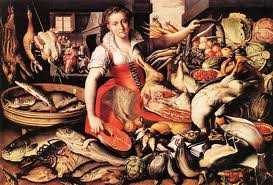
Infinite discrepancy between the figuring of man – whose lineaments are as if blurred in a dream, whose gestures are torpid and imprecise – and the delirious, loving impulse that shapes displays of tomatoes, auberigines, cabbages, pumpkins, carrots, mullet, crayfish….on the market stalls among baskets, scales..(146)

Here, once again, we have a secular gathering of things in the market.  Are these “things” which include (but pale, man) on the brink of messianic, historical redemption?

To this, Agamben notes something that seems to go against everything he has said before.  He ponders the possibility that this may be the “sign that nature is once more about to enter the fairy tale, that once more it asks history for speech.”  This would suggest that the messianic moment may be calling for the messianic and the miraculous.  In the midst of this moment, says Agamben, man will be “bewitched by a history which, for him, again assumes the dark outline of destiny.”  Perhaps man will, once again, enter the fable and be “struck dumb by a spell.”

After noting this, Agamben casts his own spell by saying his own secular messianic phrase:

Until one night, in the shadow-light where a new crib will light up the figures and colors unknown, nature will once again be immured in its silent language, the fable will awaken in history, and man will emerge, with his lips unsealed, from mystery to speech (146).

What I find most interesting about this gesture is the fact that, though it builds on what Benjamin says about myth, silence, and speech in his work (especially Benjamin’s Origin of German Tragic DramaUrsprung des deutschen Trauerspiel) it goes unmentioned.  More interesting is the fact that, for Benjamin, the movement from tragic, mystical silence to speech was first evinced by comedy (namely in the figure of Socrates and his irony).  Nonetheless, I find nothing comic about this movement to speech.  For Agamben, this moment is historical and serious and, because it lacks this comic element, it seems as if it is also a magical gesturing of sorts (but of the rhetorical variety).

Although Agamben opens up many doors for thinking the secular, historical aspect of the Messianic, sometimes his work , as in this essay, focuses too much on figures (such as the crib and “speech”) that have nothing ironic whatsoever about them.  Redemption is a serious affair, but is it possible to conceive it comically?  This, I would submit, is something Benjamin did consider (in his letters to the Kabblah scholar and is friend Gershom Scholem and in his work on Kafka), but it is not something Agamben would consider.

The comic may be a gesture of secularization for him, but it’s not the key.  The fruits, vegetables, market wares, and man await a serious form of historical redemption and a “new crib” for its new infancy.  But wouldn’t that imply that man doesn’t simply speak but that he is a man-child?  And isn’t that comic? Or is that too offensive for anyone who seriously ponders the new “nativity crib” to come?  Man is, after all, a creature.  Agamben knows that very well.  But is man a comic creature or a historical creature?  Both?

And what figure best approximates this?  A nativity crib to come or something other?  As a Jew who loves the schlemiel and sees it as a messianic figure of sorts, how can I accept this “nativity crib to come?”    Can the “decisive..historical gesture” be comic?
The “Anxiety of Influence” or Giorgio Agamben’s Gloss on Benjamin’s Reading of Kafka’s Pre-Historic Characters

DownloadedFile-7

One of the euphemisms that the literary theorist Harold Bloom is famous for is the “anxiety of influence.”  For Bloom, this term describes the contentious relationship of the contemporary writer to his antecedents.   The anxiety deals with how one relates to these antecedents and the greatness of the modern writer is to “revise” the tradition and overcome past influences.  So, what might seem as a generous interpretation is, in fact, an act of overcoming.  It relates to a temporal issue or what Bloom, citing the German philosopher Friedrich Nietzsche, would be the triumph of the “I willed it” over the “it was.”   This Nietzschean gesture is based on the desire to be free from the influence of history and tradition.  In saying “I willed it,” the “strong artist” (Bloom’s term) has a kind of victory over time and history.  He is free, a “great” individual.

We see a kind of “anxiety of influence” between Giorgio Agamben and Walter Benjamin with regards to Benjamin’s reading of Kafka and the pre-historic.  In my last two entries on Agamben, I have been making close readings of Agamben’s essay “Fable and History: Considerations of the Nativity Crib.”     In these readings, I have made brief mention of Walter Benjamin’s work but I have not considered the relationship of Giorgio Agamben to Walter Benjamin, that is, with reference to this essay in particular.  The key moment in this essay, to be sure, takes Benjamin’s reading of Kafka’s character’s up and, in effect, “completes” it as the New Testament completes the Old (yet another gesture of the “anxiety of influence”).

As I have been pointing out, for Agamben, the New Testament’s description of the nativity crib was taken up in representational form and these representations mark the “crib” as a “decisive…historical gesture.”  The nativity crib, for Agamben, secularizes the fable and, as I will show, opens us up to the messianic.  But, before he comes to the messianic, he must address his “anxiety of influence” with Walter Benjamin.

Agamben prefaces his reading of Benjamin by noting that in the “fairy tale” all is “ambiguous gesticulation of law and magic, condemning and absolving, prohibiting and permitting, spellbinding and spell breaking.”  For anyone who has read Benjamin’s reading on Kafka, these words will have resonance.  Agamben is, in effect, saying the the “prehistoric” world we find in Kafka is traversed by nomos (law) and magic: it is enchanted and pre-historical.  History is secular; fable is not.

Moreover, his reading of the crib is secular while Benjamin’s reading of Kafka is not.  And this is the point.  Agamben sets this reading up when he notes that, in contrast to the fable, “in the crib man is returned to the univocality and transperancy of his historical gesture”(142).

Following this, Agamben makes a long list of all the simple people who are in the “nativity crib” and to this list he appends a colon.  Following the colon is the meaning that parts with and revises Walter Benjamin.

Tailors and woodcutters, shepherds and peasants, greengrocers and butchers, hunters and innkeepers, roast chestnut and water vendors: this whole profane universe of the market and the street emerges into history in a gesture from the prehistoric depths of that world which Bachofen defined as ‘etheric’, and which had a short-lived revival in Kafka’s stories.  (142-43)

Although Benjamin does not appear in this reference, it is clearly an articulation of the “anxiety of influence.”  Benjamin, to be sure, is the only person to have written in this way about Kafka’s stories and, in fact, he also cites Bachofen.

But now Agamben is the master.  Like the New Testament, he “completes” Benjamin’s project when he reads the “fairy tale” as “the medium between the mysteries of the hierophants and the historical gesture of the crib.”   In effect, had Benjamin known about the “meaning” of the nativity crib, he would have written an entirely different essay on Kafka.  He would have realized that it was the secularizing gesture that Kafka had missed.

Now, to be sure, this rings very odd – especially if anyone is familiar with the metaphors and allegorical figures used by Augustine with regards to the “blindness” of the Jews.   Jill Robbins’ book Prodigal Son/Elder Brother: Interpretation and Alterity in Augustine, Petrarch, Kafka, Levinas does an exceptional job of showing how that metaphor played itself out in the history of the church and in literature.  The blindness of Benjamin, as Agamben suggests (by way of indirection) is that Benjamin (and Kafka) didn’t recognize the moment of secularization was, in fact, a Christian moment and a Christian gesture: it is the “decisive…historical gesture of the crib.”

After noting this, Agamben takes up the rethinking of the Messianic which is one of Walter Benjamin’s greatest legacies to us today:

For in the Messianic night, the creature’s gesture is loosed of any magical-juridicial-divinatory density, and becomes simply human and profane.

Here, the “naked life” of the creature, which is a major trope in Agamben’s work (a trope which he takes from Hannah Arendt),  is given yet another meaning.  Naked life now relates to the “nativity crib” and is “messianic.”  Secularization is equivalent to seeing man in the nativity crib, as a creature in its “everydayness.”  Kafka and Benjamin’s reading of Kafka are too caught up in fable and mysticism to be taken seriously.  The figures we find there are, for Agamben, too contaminated by myth, mysticism, magic, and law.  They are too pre-historical.

To add to this, there is someone in the crib who may in fact be a figure of the Jew: namely, the sleeper:

The sleeper who, strangely, never fails to appear near the manger can perhaps be seen as a figure from the world of fairy tale, unable to wake on redemption and destined to continue his crepuscular life among children.

Following this, Agamben actually cites the Book of James which does, in fact, align Jews with sleepers, but Agamben doesn’t mention this.

Instead, Agamben notes that the sleeper doesn’t sleep the sleep of the “incubatio, laden with divinatory presages, nor, like Sleeping Beauty, the timeless sleep of bewitchment, but the profane sleep of the living creature”(143).

Would this suggest that the one who awakes from sleep is the person who recognizes the “nativity crib” as a figure of secularization?   Is the sleeper a remnant of the pre-historic which, nonetheless, is disclosed by the “nativity crib” to just be a poor creature who doesn’t get the messianic?

What I’d like to suggest is that the “anxiety of influence” here is not simply between Agamben and Benjamin or Agamben and Kafka; it may also be between Christianity and Judaism.  The suggestion that Jews are pre-historic is not, to be sure, new.  Its been around for a long time and even Hannah Arendt suggests this in her own work on Jewishness.  The historical gesture, for her, however was political.  Jews didn’t know how to live in the political world and a part of Arendt’s project, which was very influenced by her work with Zionism, was to make sure Jews could be “normal.”  For her, Kafka just wanted to be normal; in fact, her reading of Kafka in the “Jew as Pariah” is based on this claim.

Perhaps Agamben would say that Kafka and Benjamin wanted to be secular but, unfortunately, they got caught up in the pre-historic and the magical.  Unlike them, however, he discovered the “nativity crib.”    They were like the sleeper in the nativity crib (or rather, on its margins).

He “woke” up.

(I put this waking in quotation marks for the sole reason that it is based on the “anxiety of influence.”  To be sure, the “gesture” of secularization and the departure from myth are found throughout the Torah and many scholars have pointed this out.  I would add that there are many historical gestures of secularization.  To limit it in this way, to a Christian moment, is odd.  My job is to simply “make it strange.”)

Giorgio Agamben’s Fable, or the Crib as a Historical Gesture – Take 2

230px-The_Goose_That_Laid_the_Golden_Eggs_-_Project_Gutenberg_etext_19994

What is the relationship of man to animal?  And what distinguishes man from animal.  This is a question which has interested philosophers since Aristotle who argued, in the opening book of the Metaphysics, that animals and men both have sensation and memory; but there is one key difference: man has the capacity for “experience” and lives by way of “the art of reasoning.”  Aristotle also notes that man differs from animal because, while animals may communicate, they do not have language (speech).

Giorgio Agamben is very interested in the relationship of man to animal.  We see this especially in his book The Open: Man and Animal.  We also see this concern in the essay I have been discussing “Fable and History: Considerations of the Nativity Crib” (in Infancy and History: On the Destruction of Experience).  For Agamben, the key to understanding the relationship between man and animal can be understood by way of a reading of the crib.  It relates to what Agamben calls man’s “decisive gesture”(142).  This gesture, it seems, separates man from animal.  It is a “historical gesture”(142).

Agamben articulates this difference by first quoting “Matthews Bible.”  He notes that to this bible “we owe the entry of the ox and ass into the iconography of the nativity.”  After this preface, he cites Matthew “The ox knows its master and the ass the manger of the Lord.

According to Agamben, this quote was the scriptural source for “one of the earliest descriptions of the crib” by Saint Ambrose who “counterposes the whimpering of the God-child, which is heard, with the silent lowing of the ox who recognizes his Lord.”  Agamben’s words suggest that both man and animal are making infantile sounds.  And this suggests that, in infancy, they are the same.  There whimpering and lowing sounds cling to silence. And, lest we not forget, this is a silence before the Lord.  This is what Agamben wants us to hear.

But he takes this mystical reading, which his words suggest, and suggests something else; namely, all in the nativity scene are secularized:

Objects, which enchantment had animated and made strange, are now returned to the innocence of the inorganic and stand besides man as docile implement and familiar tools. (142)

Following this, Agamben names all of the animals that can be found in fables (“talking hens, ants and birds, the goose who lays a golden egg, the donkey who shits money, etc”) and argues that “the crib must release all this from its spell.”  In other words, the Nativity Crib disenchants fable (even though fables continued on for centuries after the first nativity scene).   The crib makes them all into simple objects, things: “as food, merchandise or instruments…nature and inorganic objects are bundled up on the market stall”(142).

Man and animal are all disenchanted by the crib and the crib aids the spread of the economic function and capital.  However, Agamben doesn’t let the secularization of man be taken over entirely by the economic function.  He has us now behold “man.”

Man, too, whom the spell of the fairy tale had removed from his economic function, is now recognized to it with an exemplary gesture: the decisive gesture that severs the human world of the crib from that of the fairy tale. (142)

Agamben traces two genealogies to the crib: 1) the genealogy of the disenchantment that ends in things and 2) the disenchantment that ends in man and history.

To be sure, Agamben sees the “Nativity Crib” as the “decisive” historical gesture.  Regardless of why he would choose this as the decisive historical gesture, there is another problem.  Does the “historical gesture” take one out of the crib?  To be sure, Agamben says that the gesture is the crib.  Man, therefore, would be the gesture of the crib.  Agamben seems to be telling us that we, man, can’t totally leave the crib.  Man may enter history by way of the crib, but he can’t leave that gesture behind as it gives birth to historical man from his infancy.

This is the problem.

I will return to it in the next blog because, it seems that the man-animal relation hinges on his being in the crib.   That would imply that man is man so much as a man-child and not just man-animal. This is a point that Agamben doesn’t make explicit for reasons we will ponder in the next blog entries on this topic.   For, Agamben, the infant and the animals lull and whimper but they don’t laugh; and neither, it seems, does Agamben’s historically-decisive-gestural-nativity-crib-man.

Gilda Radner and Gene Wilder’s “Haunted Honeymoon” Interview

DownloadedFile-5

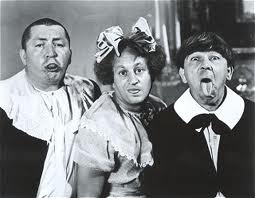
The schlemiel is often called a man-child.  The best way to articulate what this means is by taking a look at comedians who play men-children.  I originally planned to blog on this topic.  And I thought of three routines.  I first thought of the Three Stooges’ children routine.

images

I was especially interested in the later stooge, Joe Besser, who replaced Shemp from 1955-1958.  His childish routines are highly gestural, sometimes flamboyant.

DownloadedFile-4

Here he plays a child:

He also played “stinky” in Abbot and Costello:

I also thought of Gilda Radner.  She played many children in her own routines and on Saturday Night Live.  And, as in this routine, she slips from being the good, innocent child to the child who likes to speak dirty.

I am intrigued with all of the children she plays and I wanted to write on them today, but something else caught my eye which conflicted with her image as a child: a new routine that cast her as married…to Gene Wilder, a man she was married to in real life.  The movie that I’m talking about was directed by Gene Wilder and starred both he and Gilda (and Dom DeLuise as a cross-dressed man-child schlemiel): its called Haunted Honeymoon. It was filmed in 1986, two years after they were first married.

But it wasn’t the movie that first struck me as interesting so much as an interview I came across.  In the interview, we see a sobriety and an everydayness with not only Radner but Gene Wilder as well.

In the interview we see that Wilder wants to clearly separate himself from the comedian as does Radner. They even go so far as to say that they may not laugh at their own jokes.  Wilder, in fact, is very realistic and frank about how serious he actually is.

Radner stresses how normal they are in real life and that their fans should know this.  In other words, they are not schlemiels but they play them.   But there is more to the story then simply a separation between the world of the schlemiel and everydayness; there is an oscillation between horror and comedy which is of great interest to Wilder (and apparently Radner).

The interviewer’s first question to Wilder (who grants the interview from a bed) and Wilder’s response foreshadow this. When asked what Wilder can tell the audience about the film that “won’t give too much away.” To this, he says “nothing.”  But then he says: “Except for one thing.”  Namely, that he loved “these kinds of films,” by which he means “comedy chillers,” when he was a “little boy.”  He explains that they were called “comedy chillers” because they “scared you but you also laughed.”

As we saw with Irving Howe’s reading of Jewish humor (and Jewish identity), which was drawn from a remark made by the Jewish-American novelist Saul Bellow, there is a movement in Jewish humor between “laughter and tears.”

Gene brings the tears in the interview, too.  By talking about how exhausting it is to “direct” oneself, he puts forth a negative sense that the film isn’t any “fun” to make.  And he drives the mood to sadness when he says this may be his last film ever: “I don’t mean anything prophetic or sad but this may be my last movie as a director or an actor, actually.”

Gilda Radner follows suit.  She says that she and Gene don’t like being funny all the time. Genes response to the last interviewer’s question says it all:

The Interviewer: “What besides your own work makes you laugh?”

Wilder: “You assume my own work makes me laugh..that’s quite a big assumption…sir.”

For Wilder, who plays a schlemiel in nearly all of his movies, his humor may not make him laugh.  It may make him somber, sad.  His comedy is somewhere between laughter and tears.  He may evoke the laughter of others, but he may not find his own antics to be funny of all.  So when Radner or Wilder play that man-child, they may not find it so funny. But we do.

What does that tell us?

Perhaps it tells us that our “honeymoon” with the adorable yet deviant man-child may be “haunted” by something we may not want to recognize. Perhaps we wish I.B. Singer’s Gimpel the Fool was a schlemiel in fiction and in reality. That way, we would always bear witness to a schlemiels blind trust of others, and to society’s mockery of this trust. We can imagine a perpetual schlemiel like Sasha Baron Cohen who lives reality as his character. And perhaps this perpetual schlemiel is what Wilder and Radner, at this point of their careers, wanted to haunt.

(I hope to return to the theme of man-children over the next week.  There is so much to reflect on….)


Giorgio Agamben’s Fable, or the Crib as a Historical Gesture – Take 1

g3450tn

One of Giorgio Agamben’s most thought-provoking and clear explanations of “gesture” can be found in an essay entitled, “Fable and History: Considerations of the Nativity Crib.”   But, what we find there is not so much a gag.  It is more like a profane illumination that comes to us by meditating on the “crib as a historical gesture.”  For Agamben, the crib mediates between the sacred and the profane.  And, as a historical gesture, the crib takes us from the mystical and mythical to the secular and everyday.  In fact, Agamben says that the crib “liberates time.”

But the catch is that Agamben focuses on a very specific example as mediating between ritual and secularization: the nativity scene. He reads this scene first as the “nativity crib” and, at the end of his essay, as a “historical gesture.”

What does this mean?  What is at stake?  And, in terms of what I am most interested in, what does this mean for the schlemiel?  More importantly “who” is in the crib?  Is the schlemiel in the crib or is it, rather, the Christian fool?  And how does “he” (whoever he is) relate to the “crib as historical gesture”?

To answer these questions, I need to unpack the essay so as to follow Agamben’s logic and rhetorical tactics.   I will begin this task here and carry it out over a few entries.

(Note: A cursory look at first words and final words of his essay show us that Agamben has a messianic end in mind when he claims that the crib is a “historical gesture” which, ultimately, takes us into history and into a messianic kind of event.   Is this event-slash-gesture a secular one? Is it another crib? And will the fool or schlemiel be there in that messianic gesture?)

Agamben starts his essay by defining the crib as such: it is an “image of the world presented in miniature.”  And the image-of-the-world-it-presents-in-miniature is, and this is key, a “historical image.”   For Agamben, this means it is not a religious image or a mythical image; the crib is a “historical image.”   And it discloses itself as a “moment” of transition.  Using Benjaminian language, Agamben writes of this “moment”:

For what it shows us is the world of fable at the moment when it wakes from enchantment to enter history.

And this is possible only because the “fable has been able to separate itself from initiation rites.” And by “abolishing the mystery which was at its center and transforming it into enchantment.” This separation, abolition, and transformation of cult and ritual into enchantment is the key.  But there is a difference. As Agamben explains, the “creature of the fable” may be enchanted but is not under a religious spell or trance:

The creature of the fable is subjected to the trials of initiation and the silence of the mystery, but without experiencing them – in other words, by undergoing them as a spell.

Agamben further explains that the creature of fable is “bewitched” but s/he is not “participating in a secret knowledge that deprives it of speech.”

But wouldn’t “enchantment” also be a deprivation of speech?

Anticipating this question, but not openly stating it, Agamben argues that this is enchantment “must be shattered and overcome.”  I find this moment fascinating since, as I pointed out in my last blog entry, Agamben’s “gag” risks enchantment itself.   After all, a gag is something you put in a mouth to keep one from speaking.

This, I would argue, is the danger of the gesture which, though it may be “historical” can easily become and remain “enchanting.”  And although it may leave the creature on the other side of mystery, it may leave the creature in the midst of “enchantment.”

In the next entry, we will take a closer look at the creature and its relationship to the crib and the nativity scene.  And within this scence-slash-historical-crib-gesture, we will find Waldo (I mean the fool who may not be a Christian fool).


Giorgio Agamben on Infancy, Gestures, and Gags – Take 1

images-1

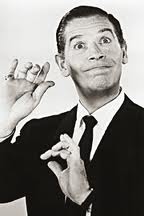
My grandparents really enjoyed watching live stand-up comedy.  Whether it was at the Lido Beach Club in Long Beach, the Catskills, or in Miami, they relished live-comedy.  But of all the comic moments, my grandmother (on my mother’s side) recently told me of one.  She pointed out how whenever my grandfather saw Milton Berle come onto stage he would start laughing hysterically.  Milton didn’t have to say anything.  According to my grandmother, the mere gesture of his coming onto stage and the look on his face was enough to make my grandfather laugh.   This moment meant a lot to him and, as I learned, it meant a lot to her.  I could only surmise that it was Berle’s comic gesture – his awkwardness on stage – which created a relay across the generations.

This little tid-bit of comic wisdom prompted me to think about something that has been on my mind for a while: the comic gesture.  I’ve been thinking about it because Walter Benjamin spends so much time pondering it in his essay on Kafka.  For Benjamin, it seems, the key to understanding Kafka is pre-linguistic: it involves a close attention to the gestures made by Kafka’s odd characters (mostly the characters we find in his parables and short stories).  And Benjamin, ultimately, found these gestures to be comic.

Giorgio Agamben is a contemporary thinker who has taken an interest in Benjamin’s foray into gesture and has, to be sure, incorporated it into his own project.  In the revised preface to his book Infancy and History: On the Destruction of Experience, Agamben locates a relationship that speaks to his concern with gesture; namely, the relationship between “voice” and “infancy.”  Before discussing gesture, later on in the book (namely in his “Notes on Gesture”) Agamben finds it necessary to explain this relationship.

Agamben reads voice in terms of the “limits of language” and argues that “the concept of infancy is…an attempt to think through these limits in a direction other than that of the vulgarly ineffable.” What Agamben means by the “vulgarly ineffable” is that the category of the “un-said” and the “ineffable” belong “exclusively to human language.”  What words, then, should we use for the “limits of language” which do not “belong” to human language but, rather, to the “inhuman?”

Regarding this, Agamben makes reference to Walter Benjamin:

The concept of infancy…is accessible only to a though which has been purified, in the words of Benjamin writing to Buber, ‘be eliminating the unsayable from language.’ The singularity which language must signify is not something ineffable but something superlatively sayable.

What exactly does Agamben mean by “superlatively sayable?”  He doesn’t explain what this means.  And it is far from obvious. Rather, he seems to suggest that its meaning can be found in the “presentation of the relationship between language and experience.”  Invoking Benjamin, once again, he says that he is looking for a “transcendental experience” of language, an “experimentum linguae.”

This experience, Agamben tells us, can only happen “in language.” It cannot happen by way of speaking about language but through language in its “pure self-reference.”

Against Heidegger, who claims – in his essays on language – that we can have an experience of language “where speech breaks on our lips,” Agamben tells us that “infancy is staked on the possibility that there is an experience of language which is not merely silence or a deficiency of names, but one whose logic can be indicated, whose site and formula can be designated, at least up to a point.”

What this amounts to is a sketch of the relations we are caught up in.   And this, Agamben tells us, helps to disclose an aspect of being human which has, thus far, not been fully disclosed:

Man does not merely know not merely to speak; he is neither Homo sapiens nor Homo loquens, but Homo sapiens loquendi, and this entwinement constitutes the way in which the West has understood itself and laid the foundation for both its knowledge and its skills.

Agamben’s abstractions may leave many a reader bewildered or indifferent.  After all, what’s the big deal with discovering that one is “entwined” in language.  Is this experience befuddling?  Will one feel the pressure of words on one’s existence to a much greater extent once they have a “experimentum linguae?”  Will gestures, within language, evince a hidden power?

For Agamben, the answer to all of these questions is a resounding yes.  The experience of infancy, that is, the experience of language, is the experience of the “very faculty or power of speech” and that “there is” language.

Ultimately, Agamben is not simply interested in the fact that “there is language” or that one experiences the “very faculty or power of speech” in one’s experimentum linguae.  To be sure, he translates this “experience” of infancy into gesture in his essay “Notes on Gesture”:

If we are to understand gesture, nothing is more misleading than to picture a sphere of means directed towards an end.

The gesture does not contain an end with in itself.  It has no end.  Writing on dance as gesture, he notes: “If dance is gesture, this is, however, because it is nothing but the physical tolerance of bodily movements and the display of its mediating nature.”  Out of this reflection on dance as gesture, Agamben makes his formulation:

Gesture is the display of mediation, the making visible of a means as such.

In other words, gesture mediates and communicates noting save for its own mediation: “gesture is the communication of a potential to be communicated.  In itself, it has nothing to say, because what is shows is the being-in-language of human beings as pure potential for mediation.”

To be sure, there doesn’t seem to be anything comic about this at all. How can one laugh at the “pure potential for mediation?”  Indeed, Agamben’s language and description are neutral at best.  However, Agamben associates this “pure potential for mediation” with the gag:

It is always a gag in the strict meaning of the term, indicating in the first instance something that is put in the mouth to hinder speech, and subsequently the actor’s improvisation to make up for a memory lapse or some impossibility of speech.

This lapse, this gag, is at the very core of “being in language.”  Moreover, “every great philosophical text is the gag that displays language itself, being-in-language itself, as a great memory lapse, as an incurable speech defect.”

In this final gesture, Agamben basically writes off everything philosophical as a gag.  Language is a gag as is being-in-language.  This is another way of saying that gesture indicates how our human speech and action are interrupted.  This gag leaves us awkward and powerless, but it leaves language as such with the pure potentiality.

My question, with regard to all of this, is how does this all relate to Milton Berle’s comic gesture? Was his gesture a “gag’?  And was my grandfather laughing at the gag because it discloses pure mediation?  Was he laughing at his memory lapse, that is, at Berle’s awkwardness?  Can a comedian provide us with an experience of infancy and language?

All of these questions are on my mind and Agamben, unfortunately, doesn’t answer them.  To be sure, I have a hard time finding a well-thought out approach to gesture and comedy. The only mention of comedy in all of is discourse are his final words on the gag.  For this reason, I’d say that Agamben’s words on the gag are preliminary and need more thought.

As I’d like to show in future blog entries, Benjamin was fascinated with the gestures in Kafka’s work and he thought they were comic in nature.  However, unlike Agamben, he doesn’t tell us there is a gag.  He alludes to it and what we find in such allusions is a schlemiel-like gesture which, as a matter of course, always misses its target.

Agamben could learn a lot from the schlemiel but, given his utmost seriousness, I’m not so sure he can.  He’s caught up in “pure means” to such an extent that he remains transfixed, as it were, before potentiality, which is more in line with Heidegger than with Sholem Aleichem.  And I wonder if Agamben would laugh at Milton Berle like my grandfather did so many years ago.  Perhaps, in his attention to Berle’s initial gestures, he would silently dwell on his infancy/powerlessness and the potentiality of language as such while my grandfather would, quite simply, laugh.

Reggie Watts: A Focused/Unfocused “Lord of Dreams”

DownloadedFile-1

One of the things we find in many schlemiels is the character of absent-mindedness.  In her essay on the schlemiel (entitled “The Jew as Pariah”), Hannah Arendt (a Jewish-German thinker from the mid-twentieth century) notes that in the “hidden tradition” (of the Pariah/Schlemiel) the first major modern schlemiel witnessed in the west was the 19th c. German-Jewish poet, Heinrich Heine’s “lord of dreams.”  For Heine, the “lord of dreams” is not just another name for the schlemiel; it is also the name for the modern poet.  The poet’s dreams don’t match with reality because the poet, like the schlemiel, is absent-minded.

But for Arendt the absent mindedness we find in Heine (and his conception of the modern poet) is driven by a desire for freedom which is frustrated by a world that one cannot be truly “free” in.  As Arendt argues, the source of this freedom is connected to “nature” as opposed to “culture.”  In this sense, the schlemiel/pariah differs significantly from the “parvenu” who, in throwing away their “Jewishness” in the name of being a “cultured” member of society also throws away his/her natural sense of freedom and their pariah status.

Although Arendt doesn’t spell it out, one can surmise that the reason Heine is at the beginning of her “hidden tradition” is because his freedom is not protected by the world.  He, like a poet, lives outside the world.  He is, as Arendt says about the schlemiel, “exceptional.”  But, ultimately, for Arendt being exceptional is secondary to being “normal” and free-in-the-world.  (She argues, strangely enough, that it is Kafka who seeks such normality and desires to leave the exceptional status of the “lord of dreams” behind.)  In other words, Heine may have the right “intention” (which is to be free) but this desire doesn’t fit (not yet, at least) with reality.  That comes later.  When Jews are given the opportunity to have their own state or be recognized, politically, as equals.

What’s most interesting about Arendt’s framework for the schlemiel and the “hidden tradition” is that the “lord of dreams” and his “absent-mindedness” have a cause we can understand yet, ultimately, they have a time and place in history and should be left behind.

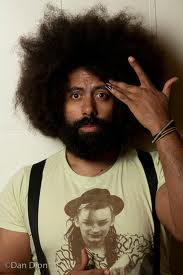
Today, with comedians like Reggie Watts, we see that “absent mindedness” and the “lord of dreams” remain.  In fact, this kind of comedy is emulated in a time when people are well integrated.  It seems as if Watts’ very popularity is proof that Arendt was wrong. But here’s the catch: Watts isn’t Jewish.  Nonetheless, the character he plays is without a doubt a schlemiel.  The “lord of dreams” need no longer have a basis in a political reality so much as in the image of a cultural niche or world which is “exceptional” and yet “free” from the world while being in the world.

What I find most interesting about Watts is that he plays the exceptional schlemiel and gives us a more “mystical” (dreamy) sense of being aloof than many historical schlemiels.  He is focused and unfocused.

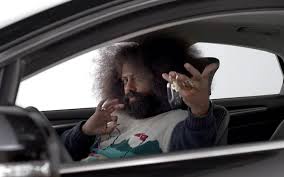
Punning on this theme, I’d say that we see a great display of this focused/unfocused state in his Ford Focus commercial.

In this commercial, we learn from the narrator that Watts, a “lyrical genius,” is “lacking one thing”: a Ford Focus.   Since the narrator is so nice and wants to fill Watt’s “lack” they “let him borrow a Fusion for three months…which he kind of fell in love with.”   In honor of this “gift,” and bursting with poetic love for the car, Watts, a postmodern “lord of dreams,” gives his “impromptu songamonial” about the car.

The images of Watts, his repetitive humming loop, and the little matchbox model of the car spinning (in slow motion) hypnotically touch the viewer of this commercial.  These effects, taken together, look to create a kind of lord-of-dreams affect.  But this is enhanced by the child-like fascination and love Watts has for the matchbox car.

At one point (:29 seconds in), Watts kisses the car, smiles, and laughs at the camera.  We then see imaginary drawn clouds raining on the car.  Watts lovingly looks at the car (like a concerned lover who doesn’t want to see his beloved harmed by rain) and talks about how the car looks when as it responds to the rain.   He then shows that all is well with a smile: he is happy, the car is sheltered from harm.  After smiling, he looks up to indicate that maybe, in his absent mindedness, this is a miracle from Heaven and not a miracle sponsored by the Ford Motor Corporation (which is the ironic twist).

From here, Watts goes on to talk about the “SONY audio edition” of the car.  He gets mystical and dreamy while focusing on the all the details of the sound system.  Then he links to the GPS system which, he notes, one can talk to.  As he points out how the GPS  will get one to where one wants to go, we see an image with detours and turns (suggesting that Watts is a wandering poet but the car will get him to the focused destination while allowing him to be free and, like a schlemiel, wander).

Then, for the last segment, Watts drops slang terms from Hip Hop Culture as he talks about the “cruise control” and “radar.” Drawn waves, illustrating his words, emanate from the car (1:40-1:46).  These waves continue and suggest a mystical absent-mindedness connected to these hidden radar waves.   While we see this, Watts waxes poetic-mystical and foregrounds the schlemiel poet when he says that the “Fusion can be anything you want…if you use your imagination.”

Immediately following this, Watts uses his imagination (coupled, of course, with drawn images edited in for effect) and says that other cars he had driven were “splooshy” and felt like a “covered wagon” while driving the Focus felt like driving a “spaceship.”

Following this, we see a series of edited absent-minded references to the cars features. The segment ends with Reggie making a hypnotic statement: “watch it roll…watch it spin.”  We see a spinning matchbox car with a flag with the hashtag #backatyou.

And the last image we see is an image that expresses Watts’ crush on the car: Reggie + Fusion in a drawn heart.

The subject of the ad is clear, focused: it is Watts’ exceptional, absent-minded love for the car.  To be sure, his love is focused and unfocused.  This ambiguity makes for a new “lord of dreams.”  And instead of it being based on natural freedom which searches for a world, as Arendt claimed with Heine, we have a freedom that is based on the flights of the imagination, hip-hop culture, mysticism, capitalism, and much else.  As we can see, Watts can be absent-minded and still be guided through the world by his Ford Focus.   It will shelter him from danger.

Arendt would be aghast at a “lord of dreams” who was encouraged to dream not about political freedom so much as the Ford Focus.  With such affluence and so much normality, it seems that comedians like Reggie Watts insist on being eccentric.  Being the exceptional schlemiel is, for Watts, to be  rhythmic, hip, spaced-out, and highly ironic.

Reggie’s schlemiel-like performance in this piece does not serve as a way of “challenging the status quo” so much as creating and marketing a comic-mystical absent-minded sensibility.  This can be used to sell products, as we see in this commercial.  But this is a general trend and as the people who made this video well-understand, there is a large market out there for absent-mindedness and wacky, ironic eccentricity.  In other words, there is a large market for these new types of schlemiels.

The “Lord of Dreams” didn’t die, as Arendt argues at the end of her essay, when Superman displaced Charlie Chaplin.  The schlemiel lived on and it lives on through Watts and many others.  The question is what this means for her thesis about the schlemiel and what she envisioned for Jews in America.

As we can see from Watts, the schlemiel lives on and it is no longer tied to the fate of Jews (as Arendt envisioned) as to capitalism and a large niche culture of Americans who, in this instance, may or may not buy the Ford Focus as a result of the musings of this “lord of dreams.”   It all hinges on how they are affected by the “lyrical genius’s…impromptu songamonial.”  The Focus could be the vehicle they need to become a more focused/unfocused late-capitalist, mystical schlemiel – like Reggie Watts.

A Note on Reggie Watts @ TED Talks

DownloadedFile

Reggie Watts shows us how right Marshall McLuhan was when he said that the “medium is the message.”  But with Reggie I would revise McLuhan to say that the “medium is the message(s).” Or, alternatively, we can also say that Reggie Watts is the message. He’s a signal of sorts, sometimes its coded and mystical; sometimes it’s cultural; but the signal we get, regardless of what he does, is always comic, rhythmic, and musical.

What makes Watts so fascinating, however, is that, like a radio switching from channel to channel (to use an “old school” metaphor) or a person scanning through their texts or facebook feeds, Watts moves from language to language and medium to medium.  Yet he gives us enough time to check out each medium or language before he moves on to the next.  But what makes his routine comic is not just found in how he works with each medium or voice, but also in how he moves from voice to voice with such rapidity and skill.

Reggie’s comic greatness is also written into his body and history.  He is a hybridic character with an unkempt retro-afro.  His mother is French and his father is American.  And since his father was in the military, he moved from place to place before he ended up in Great Falls, Montana.

In a way, Reggie seems to be linking these places, identities, and bodies.  He is seeking for a child-like relationship between them, one that plays at maturity.  In his work, I find an interesting take on what I looked at in yesterday’s blog entry; namely, what Gombrowicz calls “difficult childhood.”  Gombrowicz points out how a good artist will necessarily exhaust maturity and will be thrown into a “difficult childhood” while, at the same time, being, a grown person.  But while Gombrowicz returns to childhood in order to ruin his “Polish Childhood,” Watts returns in order to play on it.

In this clip from TED Talks, Watts inhabits a “difficult childhood” but in a way that seems to be lacking the anxious edge of Gombrowicz’s “difficult childhood.”  Watts does this by way of switching languages, melodies, and rhythms.  The affect of this is to play on the “seriousness” of TED talks.  Yet, at the same time, while playing on it, it does seem as if he is “serious.”  This is what we get from the audience.  They don’t laugh at him when he gets serious.  But at a certain point they do.  Like Andy Kaufman (Watts received the “Andy Kaufman Award” in 2006), he is able to hold the audience in an ambiguous space between laughter and seriousness.

Watts’s form of comedy is working on many levels and, as I mentioned above, he moves between one mode and another in a comic manner so as to create an unusual relatonship that we would never have surmised.  But, in the midst of all this, there is a mark of humility, charm, and absent-mindedness that makes one think of the schlemiel.   But he is not a traditional schlemiel; he is a schlemiel for a new age, an age that has been raised on the internet, hip-hop, and youtube.   But he is not for everyone.  His appeal is to a more narrow audience which appreciates all of this and, at the same time, likes to think deeply about the “meaning of it all.”

Reggie Watts is a comical mystic of the information age.

I would like to return to Watts’ work in future entries.  He is one of the most interesting and innovative comedians out there and watching him is not only entertaining but meaningful and thought provoking.  Playing on McLuhan, I’d say Watts is the message(s).

Witold Gombrowicz’s Affirmation of “Difficult Childhood”

images

Following the passages of Witold Gombrowicz’s diary entries on Simone Weil, which I commented on the other day, there is a fascinating entry labeled “Friday.” It’s first two words – at the top of the entry – are “Polish Catholicism.” In this passage, Gombrowicz expresses his past and present ambivalent attitude toward “childishness” by way of his reading of Polish Catholicism.   His reading has strange resonances with the man-childish-ness we find in many instances of the schlemiel.

The first childishness, for Gombrowicz, has to do with Catholicism “such as the one that historically developed in Poland.”  As he understood it, the Polish people became like children in relation to God.  They gave up their “burdens” to God and, like a child, “sought God’s protection.”  By “listening..respecting…loving…and abiding” by God’s commandments, man gained “a green world, green because it was immature.”  Although Gombrowicz looks down on this, he notes that it was also a “green world” because it was not the “black world” of metaphysics: “To live in the lap of nature, in a limited world, leaving the black universe to God.”

But this isn’t enough.  To be sure, Gombrowicz is more interested in criticizing the Polish Green of “immaturity” than in its embrace of nature. And this is because, he wants to be critical of Poland and its Catholicism.  He notes that this childish religiosity was responsible for a “historical lack of dynamism” and for Poland’s “cultural impotence.”

Gombrowicz precedes to tell us why he thinks of Poland has culturally impotent.  Strangely enough, his reading echoes a view that Sander Gilman uncovers in his book Jewish Self-Hatred.  But, here, it is not the view of an Enlightened Western Jew criticizing his “backwards” Eastern European brethren (the Ostjuden), but the view of a Pole towards the Polish people:

The nation without a philosophy, without a conscious history, intellectually soft and spiritually timid, a nation that produced only “kindly” and “noble-minded” art, a languid people of lyrical scribblers of poetry, folklorists, pianists, actors…

In other words, the Poles are not autonomous.  They are childish and even
“effeminate.”   And Gombrowicz notes that his work, in the present tense, “is guided by the desire to extricate the Pole from all secondary realities and to put him in direct confrontation with the universe.”  His utmost “desire” is to “ruin his (Poland’s) childhood.”  And by ruining it, Gombrowicz would compel him to become a man.

However, in the following paragraph, Gombrowicz takes a radical turn and suggests he has just contradicted himself.  He cannot and doesn’t want to ruin childhood; rather, he wants to find a way to affirm (albeit with a difference):

But now in the pursuant din, in the face of my own helplessness, in this inability to straighten things out, it occurs to me that I have just contradicted myself.  Ruin a childhood? In the name of what?  IN the name of a maturity that I myself can neither bear nor accept?

Gombrowicz, at this point, realizes that he cannot “ruin” the childishness of the Polish people because he himself wants to be a child! “How can I desire that they (the Polish) not be children if I myself, per fas et nefas, want to be a child?”

But then he explains the difference, and this is crucial.  He wants to be a man-child; in short, a schlemiel (albeit of a Polish variety): “A child, yes, but one that has come to know and has exhausted all the possibilities of adult seriousness.  This is the big difference.”

What he means by this is still in need of explanation. To this end, Gombrowicz suggests a process that brings out to this “other” kind of childishness: “First, push away all the things that make everything easier, find yourself in a cosmos that is as bottomless as you can stand…where you are left to your own loneliness and your own strength.”  This first part of the process sounds no different from what he had claimed, originally, was his task; namely, autonomy.  However, this leads one to the next step which is, more or less, failure and retreat to childhood: “Then, when the abyss which you have not managed to tame throws you from the saddle, sit down on the earth and discover the sand and grass anew.”  This process, for Gombrowicz, is – in-itself – a justification of childhood:

For childhood to be allowed, one must have driven maturity to bankruptcy.

While Gombrowicz, as we saw in the last blog entry, thinks that on his lips Simone Weil’s religious passion sounds “stupid,” he, in contrast, thinks the word “childhood” sounds much more earnest:

When I pronounce the word “childishness,” I have the feeling that I am expressing the deepest but not yet roused contents of the people who gave me birth.

In other words, the desire for “childishness” – true childishness as opposed to the Catholic variety – is hidden within the Polish people.  And this is “not the childhood of a child, but the difficult childhood of an adult.”

When I first read these words, I couldn’t help but think of Emmanuel Levinas’s expression: “difficult freedom.”  But this seems to be the opposite.  In fact, Levinas speaks a lot about maturity in his essay – in the book Difficult Freedom – entitled “A Religion for Adults.”  Like Gombrowicz, Levinas also uses “childhood” to express a kind of lack.  For him it is the lack of responsibility.  The “religion for adults” that Levinas speaks of is not a religion that is based on the passion of ecstasy and losing one’s freedom.  To be sure, the religion for adults insists that one’s freedom stay in tact but not, as Gombrowicz would seem to insist, in relation to the world, but in relation to the other.

Gombrowicz’s “difficult childhood,” however, does retain a kind of freedom.  It seems that this freedom is, on the one hand, the freedom of retreat from a ridiculous world of maturity that one “must,” on the other hand, “drive” to “bankruptcy.”

In future posts, I hope to look more into what Gombrowicz calls “difficult childhood.”  It resurfaces throughout this work and provides us an innovative way of thinking the schlemiel.  In light of this research, we will be in a better position to ask several relevant questions: Does the schlemiel also have a “difficult childhood?”  Or is the schlemiel’s difficult childhood entirely different? What, after all, is difficult about the man-childhood of I.B. Singer’s Gimpel, Sholem Aleichem’s Motl, or Philip Roth’s Portnoy?   Or is the “difficult childhood” that of the author?  If it is the author’s, does this imply that the author and not the character is the real schlemiel?


Andy Kaufman and the Inversion of the Comic Target

images-4

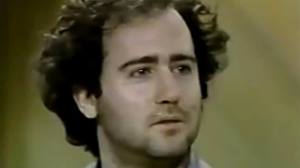
Andy Kaufman is a better candidate for a Levinasian inversion of the comic target, which I mentioned at the outset of this blog series.   He is a “stand-up” (as opposed to Portnoy, Philip Roth’s “sit-down”) comedian.  In a Levinasian sense, this means that he stands-up and faces us.  And we see, in his response to our laughter, how we are targeting him.  This comes out in our ambiguous relation to the character.  I have two videos that illustrate this.

The first video comes from a stand-up routine in LA.

Four minutes into his routine (actually 4:30), Kaufman is accosted by someone in the audience who targets him as a washed-up comedian.  He tells him that Kaufman’s routines don’t “work” anymore.  Kaufman has no new material.  The audience member makes Kaufman sweat and we can clearly see that he is the target.  In these moments, we don’t know whether we should feel sorry for him or not.  Has he failed to keep us excited?  How do we judge him?  Is our judgment too painful to even deal with?

Another example, which is more to the point, comes from an appearance he made on the David Letterman show (June 24, 1980).

In this clip, Andy is clearly out-of-his-wits.  And this deficiency turns the tables on us.   We don’t know whether or not he is really suffering.  This comes out, first, when he tells the audience to stop laughing.  But it comes out most clearly when Kaufman goes out to the audience for alms.  In this moment, he confuses the target and exposes the audience to its targeting.  He has them realize that they may be complicit in such targeting by disarming it.  He differs from Portnoy, who I discussed in yesterday’s blog entry; Kaufman is a schlemiel of a different variety.  His failure takes on another shade, altogether.

Emmanuel Levinas’s philosphy can be applied to both Roth and Kaufmann.  In Roth, the multiplicity of targets and the total disregard for responsibility make Portnoy into a caricature and a target of humor.  He makes us forget about his vulnerability and exposure by targeting his mother, sexuality, and Naomi (a Sabra who dubs him a schlemiel, in the most derogatory sense).   And in looking at him as pathetic (as Naomi does), we are complicit in this effacement.  The problem with this is, as I noted in the last blog entry, it requires an interpretation.   Moreover, for this reason, it’s easier for us to turn to traditional philosophical interpretations of comedy which are based on targeting.

On the other hand, with Kaufman we can see that we are complicit, quite simply, by seeing Kaufman’s responses to the audience and to his pleas for help.  In both, our judgment is suspended and the target is inverted.  We feel obligated to help, but we don’t know if or how we should.  Kaufman’s schlemiel – as opposed to Roth’s – acts to suspend the target rather than, as we saw in Portnoy, to mark it.

The Problem with Levinas’s Reading of Comedy

Levinas’s concept of inversion works; however, his understanding of art and bewitchment, which we see in his essay “Reality and its Shadow,” need revision.  The “meanwhile” – comedy without interpretation – implies that comedy, in itself, is mythology.  However, I would argue that there is a distinct difference between the “sit down” and the “stand-up” comedian; the former can, perhaps, be “bewitched,” but the stand up comic cannot.

Levinas argues that comedy, like tragedy, can “bewitch” a reader or viewer.  The reason for this is because comedy (like tragedy or any story) is, for Levinas, about endless repetition. In Henri Bergson’s sense, comedy doesn’t become; it is static.  Levinas goes farther than Bergson to associate the static aspect of repetition with “mythology” and being “bewitched.”  The time of myth is the time of what he calls the “interval” or the “meanwhile.”  For Levinas, it’s time is the time of myth.  The only way out of this is through interpretation.

As I have suggested, this may be applied to Roth but not to Kaufmann.  In the latter, one leaves mythology by virtue of relation not interpretation.  Our relationship to “stand up” (rather than “sit down”) comedy is ethical.   And in this comic relationship with Kaufmann, we are exposed to our targeting.  He is released from the meanwhile and given over to becoming by virtue of our confused response to his confused response.  We bear witness to the fact that we are complicit in targeting and that we may NOT be able to help the other.  In Roth, on the other hand, we see Portnoy caught up in his own targeting.  And his effort to efface that targeting by enjoying his “impotence” may wound the target but, ultimately, they set the character into an endless repetition of failure.  Nothing changes for Portnoy except for his words.

Final Suggestions

In Levinas’s reading of Don Quixote, which can be found in his Sorbonne lectures of 1976, he notes that although Quixote was “bewitched” by images and imaginings, he was awoken from his slumber in images by virtue of the “hunger of the other man.”  This hunger reminds Quixote that he was bewitched.  With Stand Up comedy, I would suggest that we come to learn that we are the one’s who are bewitched with the power of consciousness and targeting.   And this is the case because, with Kaufman’s “stand-up,” we see the suffering of the comedian; we literally see his hunger communicated by way of comedy.

To be sure, Andy Kafuman uses comedy to expose us to how bewitched we are by violence.  Strangely enough, all of the theories of comedy we evaluated at the outset confirm our fascination as these theories are all based on targeting and the superiority of reason, consciousness, madness, etc.  These theories are challenged by the one I am proposing and by virtue of a comedy like Kaufman’s which turns the tables.

Schlemiels are well-known for missing their targets.  And, in the scenario I have just drawn up, it is fair to say that when Kaufmann misses the comic target, so do we.  And this comic failure can have ethical effect if and only if the comedian exposes us to his vulnerability and its relationship to violence.  Comedy of this nature, as opposed to comedy that is obsessed with targeting, can loosen the grip of reason, culture, and masculinity over all of us.  In other words, it can release us from the superiority espoused by comic theories from Socrates to Paul deMan.  Comedy, by inverting the target, can expose us to the hunger of the other man.  And this possibility, I would argue, resides in the very character that makes Portnoy into a target: the schlemiel.

Yes, indeed, the schlemiel is here to stay. But we still need to ask whether the schlemiel is a “sit-down” comedian or “stand-up” comedian.   Comedy of the latter variety can be ethical, while comedy of the former variety may not be.  However, as we can see in many comedians today, some “stand-up” comedians are really “sit-down” comedians.  And, strangely enough, these kinds of schlemiels never miss their target (even if it is themselves).