As a third generation American – and as a person three times removed from the Holocaust – I was always curious about the meaning of the Holocaust. It happened, as the author David Grossman writes in his novel See: Under Love, “over there.” What I find so intriguing about Grossman’s novel, which begins with the meditations of an Israeli child about the Holocaust, is how close it is to my own experience in so many ways. To be sure, the main character of the novel, Momik, tries to piece the Holocaust together by way of things he hears and gathers from scattered conversations and images relating the to the Holocaust. Unlike his parents, who refuse to discuss, he can sense that something rotten is being hidden from him. And, like a detective, he tries to put it all together.
Although, as an American, my experience is much different from an Israeli’s, I can identify with the desire to put together clues. For, in truth, when it comes to the Holocaust, we are all like children. Something “whispers” to the child – regarding trauma – that the civilized adult can’t hear.
Theodor Adono points this out in his book Negative Dialectics:
Children sense some of this in the fascination that issues from the flayer’s zone, from carcasses, from the repulsively sweet odor of putrification….An unconscious knowledge whispers to the child what is repressed by civilized education; that is what matters, says the whispering voice….it kindles “what is that?” and “where?”
David Grossman’s Momik is constantly hearing these kinds of whispers from people around him. And after hearing them, him repeats them and puts them together into a comic kind of narrative-slash-collage. The narrator of the novel parries this naïve search for truth and suggests that Momik believes that he is hearing a “secret language” from people who were “over there”:
Momik loved Grandma Henny very much. To this day it makes his heart ache to think of her. And all the suffering she suffered when she died too. But anyway, Grandma Henny had a special language she used when she was seventy-nine after she forgot her Polish and Yiddish and the little bit of Hebrew she learned here. When Momik came home from school he used to run in to see how she was, and she would get all excited and turn red and talk that language of hers….She had a permanent smile on her little face, a kind of faraway smile, and she talked through her smile. (34)
Henny is a living cartoon-like character for Momik. He doesn’t see her as mentally ill so much as funny or odd. Strangely enough, the language she speaks sounds a lot like Sholem Aleichem. To be sure, David Grossman was inspired to write by Aleichem and it comes through in this section. What I’d like to suggest is that Henny’s secret language brings together Aleichem with the Holocaust. Something that, in reality, never happened. After all, Aleichem died in the early 20th century.
Henny talks about “Mendel,” an Aleichem character that leaves her and travels from Russia to America (35). This is what Momik gathers of this narrative:
How could you do such a thing and break your mother’s heart, and then she begs him, Sholem, never, never, even when he reaches America where the streets are paved with gold, to forget he’s a Jew, and to wear tefillin and pray in synagogue. (35)
The narrator tells us that she is speaking a “language no one understands” and yet “Momik understood everything. That was a fact. Because Momik has a gift, a gift for all kinds of languages no one understands, he can even understand the silent kind that people who say maybe three words in their whole life talk”(35).
Moreover, Momik can “translate nothing into something. Okay, that’s because he knows there’s no such thing as nothing, there must be something, nu, that’s exactly how it is with Grandfather Anshel” (35).
Momik hears these “whispers in the dark,” and as the novel goes on we learn that the little bits and pieces he hears are all a part of different narratives. Some of them are fictional while others are not. Regardless, all of these stories are mimicked (like his name, Momik) and translated into Momik’s narrative on the Holocaust.
I can identify with this. And I think that Momik’s queries about the Holocaust were a search for the truth and that truth was tied to the meaning of his Jewish identity. I still ask the question today, on Yom HaShoah: who am I in relationship to what happened over there? Like Adorno’s child, I ask “What is it?” and “Where is it?” It is still over there, so to speak. And with all of the media we have today, I still feel as if I am hearing a faint whisper of some secret language. The facts are incontrovertible, true; but, still, they must be put together in ways that relate to us and that is an act of the imagination.
In going through this exercise, we become like Momik, a schlemiel. We feel through the dark yet with the passion of a schlemiel, which, though misguided, is still the passion for truth. In listening closely to these whispers in the dark, to this secret language, we become like children. And a man-child is…to be sure….a schlemiel. Here….a post-Holocaust schlemiel.
David Heti is an (un)timely comedian. His comedy speaks to a time that is becoming more and more unhappy with itself. (And I mean this in a good way since I believe that such unhappiness will prompt us to come out of our dogmatic slumber…and think.) Unlike many comedians whose jokes are purely scatological and childish, Heti’s jokes are thoughtful and deeply probing. He respects the intelligence of his audience and his comedy plays with our most deeply held beliefs which span our attitudes about families, sexuality, religion, and the meaning of suffering. Ultimately, Heti’s jokes hit at the fact that while, in the most philosophical sense, we all want to be happy (an insight that Aristotle saw fundamental to being-human), the fact of the matter is that our desire for happiness originates in (and returns to) a state of existential unhappiness. And today – perhaps because of the internet, globalization, and withering economies – we are becoming more aware of this state of (unhappy) being. Heti’s comedy acknowledges it while, at the same time, giving us some comic relief.
(To be sure, Heti’s challenge is akin to the challenge posed by Judaism to Greek philosophy and culture. Aristotle, in his Metaphysics, argues that philosophy starts with wonder (which Aristotle associates with unhappiness; wonder is attended by the feeling of “ignorance”) but ends with knowledge (happiness). Aristotle believes that our desire for knowledge will overcome this ignorance once we know the causes of things. In other words, knowledge makes us happy; ignorance makes us unhappy. In contrast, Judaism puts a greater emphasis on the limits of knowledge. And instead of focusing solely on happiness and knowledge as the answer, it often focuses on time, suffering, and injustice. Centuries after Aristotle, GWF Hegel went so far as to call the Jews an “unhappy people.” For Hegel, This unhappiness had to do with the fact that Jews live with uncertainty and many unanswered questions. The English critic Matthew Arnold argued that civilization is based on the tension between Jews and Greeks. I would go further and say this tension is between happiness (rational self-certainty) and unhappiness (existential un-certainty). While the Greek part of our society wants to deny this tension, the Jewish part brings it to our attention. And this is (un)timely because it challenges the notion of progress and truth, which, in the West, are both premised on Greek ideals. In modern society we are supposed to be living better than we did in the past and we are supposed to be smarter – and all of this should make us happy – but are we?)
Heti’s jokes are Jewish in this sense. The punch lines of his jokes may start on a happy, Greek note, but they all have a kind of unhappy, Jewish ending. And this is a good thing because they trick us into experiencing the profound contradictions that underlie our experiences of sex, family, culture, and religion (the buttresses of Western, North American Society). The trick is to have us think differently. His humor hits at our desire for happiness and self-certainty. And, to be sure, Heti’s act has taught me that comedy can do a more affective job than post-Enlightenment philosophy to critique our beliefs and self-understandings.
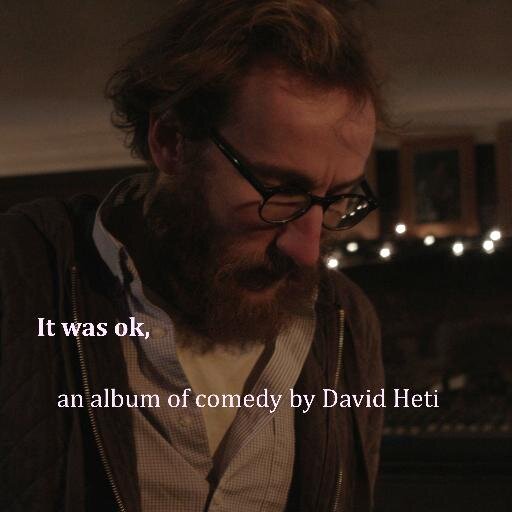
I have seen Heti doing stand-up comedy and have also had a few private conversations with him about comedy, philosophy, culture, and religion. I have also interviewed Heti and have been intrigued with his brand of comedy. I had an intuition that he was doing something (un)timely in his comedy act. But it wasn’t until recently, when I saw his recent comedy film, It was ok, an album of comedy by David Heti, that I was convinced that he had something incredibly urgent and important to offer our troubled times by way of comedy.
I’d like to share a few clips and touch on a few of his jokes to illustrate how (un)timely his jokes are. I would go so far as to suggest that the movement from unhappiness to happiness we find in them suggests a kind of practice that is instructive on how, today, we can – and should – have a comical awareness of the tension between happiness and unhappiness. It informs, to speak, our comical (rather than our tragic) sense of existence. To be sure, the tragic awareness of existence is just as Greek as the emphasis on happiness. But his humor offers us a tension between the two that is, by all means, necessary. Without it, we will to serious (and tragic) or too deluded (and happy). (I’d also like to note, before I begin, that Heti’s timing and gesture are the important elements that animate these jokes. This can be seen in the clips I have included.)
Heti begins his performance with a philosophical joke that plays on the first words of a comic performance:
I know that it’s convention to be, like, “oh, it’s good to be here.” But the fact of the matter is that I “am” here, you “are” here. Why ask ourselves how we feel about it? Let’s just move on.
The underpinning of this joke is clearly existential. Why should we describe our existence as “good” or “bad”? Existence just is….the way it is. Like the title of Heti’s film, we can imagine him responding to the question “How was your performance?” with the existentially neutral: “It was Ok.” Its not great and its not bad. It, like existence, is…not tragic…or wonderful….it’s “ok.”
Following this joke, Heti continues on his philosophical vein by telling his audience to hold back their laughter until the end of the performance. This request is followed by philosophical reasoning. Although each joke “exists unto itself its own particularity,” and can be laughed at, ultimately there is “another, deeper level” which comes at the end where one can laugh at the performance “as a whole.” The joke is not simply on the audience; it’s also on philosophy. The idea of withholding laugher in the name of a greater laugh – at the end – sounds like a good joke to level at a philosopher like Hegel or Karl Marx who see the “end of history” as the most meaningful moment of all.
But the punch line isn’t here. It’s in the existential insight: “I’m sorry. I know you come to a comedy show expecting to laugh, and enjoy yourselves…but life isn’t fair.”
Besides playing on existence-as-such, Heti plays on the contemporary philosophical notion – found in Emmanuel Levinas, Martin Buber, and Martin Heidegger – that the most important thing about existence is relationality. Heti introduces this idea by pointing out how “I’m here” and you are “over there” and we are “unable to relate” (on the same level). The punch line is that when he was out there, where the audience is, he would think about how he could “do a better job than this fuck!” This comic disclosure brings comedy into an otherwise bland, basic (and oftentimes for Heidegger, a tragic) insight into “relationality.”
On another note, which is equally existential, Heti’s jokes about his family follow along a tradition of many Jewish comedians. But they differ in the fact that they are more reflective on the divide between happiness and unhappiness. In one joke about his mother, Heti says that she and I have a “very strained relationship.”
She says all she’s ever wanted is for me to be happy. All I’ve ever wanted is to be loved and respected. It’s a real stalemate.
Following this, he notes how he recently went home to see that his mother had remodeled his room “into a place where a kid would have been happy growing up.” He adds a joke about his father that brings out the tension between happiness and unhappiness more explicitly. It also shows a schlemiel-ish aspect to Heti’s relationship with his mother (something we find in the writings and film of Philip Roth, Woody Allen, Bruce Jay Friedman, et al):
It wasn’t easy. My father was a little…violent. I remember….I recall as a kid, telling my mom, “one day, when I grow big enough, he’s going to beat the shit…out of only you.
The schlemiel character is in effect here because Heti’s character isn’t going to “stand up” to his father when he grows up. He’s just going to leave and his mother will receive the violence of his father. (Note to reader: do not confuse this joke with reality; to be sure, Heti, like many great comedians, loves exaggeration.)
Although Heti tells jokes about his family, his main jokes, to be sure, turn around philosophical and theological topics. As the performance moves on, these jokes are most prominent. And all of them hinge on the tension between happiness and unhappiness.
One joke which shows how averse Heti is to happiness deals with a scenario he discusses about how he did a comic performance at a music festival. On his way back, he tells of how he rode in a car with musicians for thirteen hours. During this trip they had “an esoteric/philosophical conversation about the nature of art.” Heti, here, points out why he tells jokes, and, in the process he discloses his own way of comic-being:
Basically, we are only here to be happy, really. And so, for me, what’s funniest is when we’re not happy. And it just so happens to be the case that, just, intuitionally, I tend to subvert, for myself, any happy moment which begins. You know, I see what’s terrible in it. And even for the stage, now doing stand-up, I look for what’s awful in every moment, so my life is a series of unhappy instances and that’s why jokes; that’s why I’m a comic.
But this isn’t the punch line. It comes with his response to the musicians answer to the question of what the nature of art is:
And then so…I asked the musician, I was, like, “Why music? Like, why music?” And, he was like, “well. He said, “when I’m actively listening to music or, like, writing or playing it…like, that’s when I’m closest to the universal; that’s when I’m one with the universe.” And I was like, “ohhhhhhh…You can go fuck yourself! Like FUCK YOU! FUCK YOU! FUCK YOUUUUU….!”
Heti’s answer-slash-punch-line (his FUCK YOU! x3) demonstrates, to my mind, a differentiation between a Greek mind, which emphasizes “unity” with the universe, and a Jewish view which emphasizes existential difference and fragmentation. I would argue that this difference is by no means arbitrary. To be sure, Heti tells several jokes that speak to Jewish identity, history, and religion. These jokes disclose Heti’s comedy as fragmented on many fronts.
Heti’s jokes on circumcision start off with an interesting paradox. Namely, God is thought of as “unknowable and unthinkable” yet with all of this “we can see that He likes circumcised pensises.” Heti goes on to have the audience imagine God with many dicks in his mouth. And this does a great job of exaggerating anthropomorphisms that Jewish theology would obviously reject.
Heti also tells jokes that deal with the Holocaust. He prefaces this part of the show by noting how “there is a fine line between comedy and tragedy.” And that he is “unsure of where” he stands on the “issue of genocide.”
Because, on the one hand, undeniable tragic. But on the other hand, undeniably funny. I guess it’s just one of those things where you really had to be there.
This joke hits at the existential dimension of genocide (of “being there” for the reality…and the “joke”). But it also speaks to something very interesting; namely, the negative sublime of the Nazis who did the killing. Many, in fact, did laugh at genocide. And for this reason, it hits on a deeply troubling issue which needs to be addressed, an issue that deeply complicates our understanding of humanity and evil.
The most complicated joke on the Holocaust is about his grandfather’s relationship to the Holocaust. The very context of the joke brings the audience into a very focused state and into an awareness of how good it is that he has survived it; but the punch line brings us back to the unhappy state of Jews-slaughtered-in-history:
My grandfather was actually one of the few, lucky members of his generation to grow up Jewish in Europe and avoid the horrors of the Holocaust. Thankfully, several months before the war broke out, he was beaten to death, in a pogrom.
Near the end of his performance, Heti moves from the particularity of Jewish experience to a more general experience of God. And this joke hits directly at the existential condition and the question of faith:
But what I find most – what I can’t understand most is these people with these extreme physical disabilities…who are nonetheless capable of maintaining religious faith. ‘Cause you’re like – you’d think that… given what, they are already forced to put up with in this world, God would have at least spared their minds.
This last joke bespeaks the existential state of having a mind that is conscious of suffering. (Indeed, most existentialists find that existential consciousness is afflicted and tortured; especially Sartre and Levinas.) The joke poses the greatest challenge to Aristotle (and Spinoza), on the one hand, who believed that knowledge would create true happiness and on the other to religion which posits faith as an answer. Heti is perplexed by why God would give these disabled people consciousness. It doesn’t make sense. This is at once a Jewish question and a question that should provoke anyone trying to understand faith in general.
Taken together, Heti shows us – by way of comedy – that true thinking isn’t based on the elimination of perplexity and its attendant unhappiness (which is what Aristotle believed) so much as in dwelling in perplexity. The specificity of Heti’s jokes perform the (un)timely service of reminding us of the existential state of perplexity we inhabit. We need this reminder because we are, so often, distracted by happiness from the true questions of existence that plague us all. Here it is the comedian and not the philosopher or the theologian who can help us to address our greatest questions. And this all happens when Heti delivers the punch line. At that moment, we experience the movement from happiness to unhappiness. And in that moment, we come face to face with our (un)timely comical existence. And today, more than ever, we need to be reminded. False happiness will only sink us deeper into oblivion. Heti reminds us that comedy can awaken us (as Immanuel Kant once said of David Hume) from our “dogmatic slumbers.”
One of the things that really prompted me to look into the schlemiel was a statement Walter Benjamin once made – in a letter to his dear friend, the Kabbalah scholar, Gershom Scholem – about Franz Kafka’s literary project. In the letter, dated June 12, 1938, Benjamin describes Kafka’s entire literary project in terms of failure:
To do justice to the figure of Kafka in its purity and its particular beauty one must never lose sight of one thing: it is the purity and the beauty of a failure. The circumstances of this failure are manifold. One is tempted to say: once he was certain about eventual failure, everything worked out for him en route as in a dream. There is nothing more memorable than the fervor with which Kafka emphasized his failure.
Scholem did not respond to Benjamin’s reading of Kafka vis-à-vis failure until November 6th, 1938. In the middle of the letter, Gershom Scholem expresses his bewilderment at Benjamin’s claim:
But I would like to understand what you take to be Kafka’s fundamental failure, which you virtually embed at the heart of your new reflections. You really seem to understand this failure as something unexpected and bewildering, whereas the simple truth is that the failure was the object of endeavors that, if they were to succeed, would be bound to fail. Surely that can’t have been what you meant. Did he express what he wanted to say? Of course.
To be sure, Scholem doesn’t understand what this could mean. He sees Kafka’s work and his life as a success. In response to Scholem’s challenge, Benjamin changes tact. And instead of writing on failure, he writes, in a letter dated February 4th, 1939, on comedy. There he claims that Kafka was not so much a failure as a comic figure. Kafka is man “whose fate it is…is to be surrounded by clowns.” There is something esoteric in this new claim: it suggests a link between literature, failure, and comedy. That’s the thread. It runs through Kafka’s work and Benjamin’s reading of it.
Years later (and after the Holocaust), Howard Jacobson, one of the greatest Jewish novelists today, has made similar claims in describing his own work. In a 2011 talk Jacobson gave at the New York Public Library, he makes an explicit link between literature, failure, and comedy.
During the talk, the interviewer, Paul Holdengraber, engages the discussion of failure by suggesting that Jacobson’s fiction is “wedded to the idea of failure in some way.” And Jacobson says, flat out, that he loves failure:
PAUL HOLDENGRÄBER: And you’re very interested in that, particularly in ideas that come back to haunt novel upon novel, essay upon essay, and we’ll move to that very quickly, the notion of failure. You are wedded to the idea of failure in some way.
HOWARD JACOBSON: Yes, yes.
PAUL HOLDENGRÄBER: What’s so fascinating?
HOWARD JACOBSON: I love failure.
PAUL HOLDENGRÄBER: You love failure.
Following this, Jacobson explains that we see failure everywhere. He describes it as a “crack in everything” and argues that “we are not interested in success” in this country or in his home country of England. Rather, he argues that “we” are interested in why the “world is not quite right.” In other words, we tend more towards cynicism (based on the “cracked” state of the world) rather than optimism (and success). That’s why we turn to literature.
HOWARD JACOBSON: Yes, yes. It’s do with this, there’s a crack, a crack in everything. We are not interested in success. You in this country and we in our country—we think we are, and but we in this room are not—the fact that you are, that you and I are here together, and the people in this room are in this room listening to me talking to you means that they are not interested in—all right, I’ve won a prize, and you all well know. But we’re not really interested—you don’t read books if you’re interested in success, as the world knows success. You go to read a book because some way or other you feel that the world is not quite right. If the world is right for you, you become a footballer, you become David Beckham, or you become Donald Trump or something.
Following this, Jacobson adds a punch line and injects some comedy by mocking the position that thinks “I’m going to do all right in this world, I am at home in it.” He doesn’t trust this worldliness. And he says “we” don’t and that’s why we read books. And “we” don’t do this because we are all “wedded to failure.”
HOWARD JACOBSON: Yeah, fine, but there are a million ways in which, you know, you feel the world is okay, “I’m going to do all right in this world, I’m at home in it, Me and this world can enjoy whole relations, completeness. We can be complete. This world will offer me something I want and I will succeed in it.” Whereas we all don’t feel that, so you read books, and I write books, because we are wedded to failure, and we should be proud of that in the best sense, in the best sense. History is written by the winners. Literature is written by the losers.
To be sure, the Talmudic kind of punch line is that the interviewer is wrong. I am not the one who is wedded to failure; rather, you are and so are all of us in this gathering because we all like to read. Moreover, the condition of this “we” is that “we” don’t write history (“history is written by the winners”). We write literature (“literature is written by the losers”). And, I would add, “we “do comedy. And, to be sure, the New York Public Library portrays Jacobson more as a comedian than as a writer.
What I find so fascinating about this link is that Jacobson is suggesting that we are not happy with our world and that we are no longer making history. This makes us all failures who have, as Ruth Wisse says of the schlemiel, an “ironic victory” by way of literature. This suggests that we, like writers who embrace the schlemiel (like Jacobson in nearly every novel), stand on a tightrope between cynicism and optimism.
And to be “proud” of being “wed to failure” suggests an irony that blasts in the face of a world based on success. It suggests that comedy and literature speak against the world and against power and the makers of history. It speaks from the angle of failure.
Perhaps this was the point that Benjamin understood about Kafka. He saw his literature as wed to failure and comedy. And, I would argue, he threw his lot in with Kafka and the novelists. This, it seems, was something Scholem could not stomach. The fact that Kafka wrote the fiction he wanted to write was a success, not a failure. But seen dialectically, as Benjamin was attempting to do, that success is really based on a failure. And Jacobson reminds us that this is nothing to be ashamed of; it is a badge of honor to write in response to failure and to admit, comically, that “we” are wed to failure.
Bruce Jay Friedman has been writing fiction since the early 1960s. As a novelist, he is most well-known for Stern. But he is most famous for his plays Scuba Duba and Steambath. Both were shown Off Broadway in the early 1970s and were overnight successes. Steambath was adapted for TV in 1973. And Friedman wrote several screenplays that were turned into popular movies such as Heartbreak Kid (1973), Stir Crazy (1980). Dr. Detroit (1983), The Lonely Guy (1984), and Splash (1984), and Brazzaville Teenager (2013). (The last film is short directed by Michael Cera and Heartbreak Kid was recently redone with a starring role by Ben Stiller).
In most of his novels, short stories, and screenplays, Friedman includes at least one schlemiel character. To be sure, Friedman, like Philip Roth, Woody Allen, Harold Ramis, Mel Brooks, and Judd Apatow, has popularized the schlemiel in American culture. Unfortunately, very few people have properly read his schlemiels. In the Schlemiel as Modern Hero, Ruth Wisse characterized his novel, Stern, in negative terms. The main character, a schlemiel named Stern, “suffers from an ulcer, the localized symbol of hurt, and actual cause of his anxiety and pain. The ulcer is a kind of “heart condition”(87). This, for Wisse, is the anti-thesis of what Saul Bellow had done with the schlemiel in his novel, Herzog (Herzog means “heart song” in Yiddish). This schlemiel’s sickness is “a lower, less poetic organ” and it is, for Wisse, “symptomatic of Friedman’s harsher, lower form of humor”(87). Wisse goes on to call Stern just “another study of the sick man as the relatively healthy man, the psychological equivalent of loser as winner, but one that exposes the full horror of this inversion”(87).
Wisse’s words are by no means charitable to Freidman and neither are the words of the famous film critic J. Hoberman who recently likened – in the most negative way – the Coen Brother’s A Serious Man (2009) to Stern. Larry Gopnik, the schlemiel of Serious Man – is like Stern:
Abandoned by his wife, betrayed by his colleagues, ignored by his children, confounded by his rabbis, Larry Gopnik could be the most fully fledged schlemiel in American fiction since the eponymous anti-hero of Bruce Jay Friedman’s Stern. Stern, however, was a schlemiel in a gentile world; Gopnik is surrounded by Jews so grotesque that the movie might have been cast by Julius Streicher.
To be sure, the case for the weak and sick man-child schlemiel is made in many places by Bruce Jay Friedman. But what’s sometimes missed is how this sickness relates to the other or in the case of a story called “The Good Time” the (m)other. In this story the mother’s boundless energy also makes her into a schlemiel. And while she may appear healthy and the boy sick they are, in fact, a team.
In “The Good Time,” the main character and narrator of the story is a schlemiel who is going off to war in Korea. He is in Chicago and will be leaving from there to basic training and then war. Friedman uses “coldness” as a leitmotif in the story. The main character is followed by it everywhere:
No matter what I wore, the cold got into me and down inside my clothes and made feel lonely and as though I would never relax for the rest of my life. It followed me into the hotel room in which I stayed and chased me as I drove along the Lake. (117, The Collected Short Fiction of Bruce Jay Friedman).
It seems as if the main character is in a transitional point between childhood and manhood and that the cold chasing him around is the cold of life and adulthood which he pulls back from. Regarding sickness, he notes that the word Korea reminds him of the word “Cholera.” In the following sentence, he notes that, for the first time in his life, he is getting a pair of eyeglasses. The fact that he is astonished that when you put the glasses on you can “see everything” should alert the reader that he is naïve and childlike.
In the midst of this cold and his contemplation of what may happen to him over there, his mother decides to leave Philadelphia for Chicago so as to show him a “good time.” She “knew I was feeling bad” and wanted to “cheer me up”(117). His mother, to be sure, is fearless, loud, and brash. But when we see her in juxtaposition to her son, we see that she is also a schlemiel. But her schlemielkeit, it seems, is more in tune with a vital American culture. It is a kind of energetics that is based on fast-talk and quick-action.
When we first meet the mother (or rather “Mother,” her name throughout the story), we see that she is brimming with enthusiasm for every experience she has (as if every moment is her last). Mother brings a woman she meets on the train who travelled with her. She insists that the lady and her baby meet her son. It doesn’t make any sense, but since Mother is so excited by their spending time with each other she wants her son to meet her:
“Did you ever see such a sweet face on a girl? Look at her. That’s the type I meet everywhere I go. And good? Good as gold. Her and her baby.” (118)
Upon seeing him, Mother demands a hug: “Grab your mother around for a hug. It’s all right. It’s your mother. I came all the way from Philadelphia.” When he notes that the girl, which his mother said was so great, was ordinary, his mother says, “You’re in quite a mood.” In other words, the mother wants him to be infected by her intensity and to overlook the ordinariness of things. She wants him to live in the moment instead of being in fear of the future.
His mother yells for a cab, engages the cabbie in talk, and they are off. As they are moving, the narrator notes a juxtaposition between age and youth in his mother. And as he passes from the one to the other he warms up: “Her figure was still so young and good it embarrassed me to look at it. And I have to admit I didn’t feel quite so cold now with her near me”(119).
Once they start talking, the narrator feels he can be honest with her and speak about how he feels about going “over there.” In response, she tosses a line, rhythmically, that sounds off against the word “there” – he calls this a “pet line”: “He’s there and you’ve got to get there.” These lines irk him and make him cold because they refuse to give in to his fear. After hearing this, he remembers another one liner, which, to be sure is all about challenging the other: “You’re on your way in, I’m on my way out.”
To be sure, as the story moves on more and more of these pet lines come to the surface. They are used to get things going and keep things warm and exciting. However, they don’t leave room for any emotional bonding between them. And they don’t leave room for fear. They are given out in rapid-fire fashion, as are her bold movements.
She has no regard for the civility. When they get back to the hotel, she takes off her top and walks around in “her brassiere and skirt…it made her comfortable”(120). It doesn’t matter that she is doing this in front of her son. To be sure, he takes this as normal. But after a while, as we shall see, he lets too many things slide. And this comes back to bite him.
The story shifts into high gear as they go out. And as they move, we hear more and more noise. But Friedman turns this noise into a kind of music that is laced with optimism. In one scene they go to a club where Tommy Dorsey is playing music. While they are getting into the music, a large group of paraplegics come into the club. Excited by the music, they all start making noises to the music. They are giving canes by the club and they tap them against the floor in rhythm to the music. The narrator’s mother hears the word “sheeeet” repeated by some of them while one of the narrator’s friends, who tags along, goes “spit-spat.” All of this noise works to just move things forward, into the future.
Moved by this rhythm, they get into the car and speed off along the Chicago lakeshore Listening to music as they drive, they continue the rhythm from the club. They carry it on late into the evening, but the mother doesn’t want to sleep:
“If you want to sleep, sleep…It’s your privilege. But you’re crazy if you miss a minute. I have quite a day planned for you.”(124)
The next day they go off to see a musical comedy called “New Faces.” During the act, the mother has her own comedy act and interrupts people in the audience. She wants to be the center of attention and make a scene for her son. After having her laugh and causing a stir, she leaves with her son to see an old friend called “Monkey” Lucella.
Monkey is a lot like her. He is wild, but he is also very wealthy. When they first meet, Monkey pulls out a wad of bills and tells Mother, “look at this.” In response, Mother says: “The son of a bitch…The money this son of bitch must have made here in Chicago. The fortune of money”(126). All of this theater hits a fever pitch at the end of the party when Lucella, who is married (his wife is “cold” and quiet) and has a son named “Seal”, lifts Mother up on his shoulders.
The narrator breaks down when he sees his mother’s underwear:
Her skirt split open and some garment showed that I never wanted to see in my whole life. It had elaborate hooks and snaps on it and it seemed you’d have to be very old before wearing it. It was just something I never wanted to see on my mother. (128)
When he sees “more” of the undergarment, he loses control and does something “I haven’t done in perhaps fifteen to twenty years, but something I had been in the habit of doing for quite some time as a child. Starting to cry, I put my head down, closed my eyes and rammed my head into Lucella’s groin” (128).
His mother responds by sweeping him out of the house and getting a cab. Upon leaving, the main character, feeling miserable, vents:
Was this her idea of giving me a good time? Was that the way you treated a son who was very cold and couldn’t relax and needed glasses and was going to a place that sounded like a terrible children’s disease – a disease that probably began with a rash, for all I knew, and ended by attacking your damned kidneys. (129)
Like Stern, this story ends with sickness. But what needs to be seen is that this sickness, which is steeped in fear, is spurred in many ways by the mother. Her optimism and bold embrace of the moment divorce her from her son and make him sick. Moreover, it is her sexuality that she doesn’t hide from him. Freidman seems to be suggesting that this is what drives him back into his childhood and makes him a schlemiel. His mother has gone to far and instead of cheering him up, she has only made him more bitter and scared. This comic due shows us that a schlemiel can be a kind of nebbish character (like the son) and can also be a vital character who is out of touch with reality (like the mother).
Contrary to what many critics might say, Bruce Jay Friedman was interested in the many varieties of the schlemiel. The critics only got him half right. As we can see in this story, the main character may be like Stern but his mother is not. And I would like to suggest that it is the latter, fast-talking kind of schlemiel that is often missed in Friedman’s work. Her optimism and brashness, though foolish, is – in this story – juxtaposed to the main character’s fear, childishness, and cynicism. It is the relation between the two that makes this story – and these schlemiels – distinctly American.
When Swede, the main character of Philip Roth’s American Pastoral, finally makes contact with his daughter Merry – who, as I have pointed out in other blog entries, became a domestic terrorist – he has a few moments of reflection on what “happened to our smart Jewish kids?” Swede’s reflections are worth recounting since they show how, to his mind, cynicism directed at the middle class, assimilated Jewish life is at the core of Merry and Rita Cohen’s radicalism. This cynicism is in dire contrast to the optimism of the two previous generations of American Jews; namely, Swede and his father Lou Levov. Their optimism was based on their successes in the leather industry, sports, and American life. All of this is trashed by Merry and the third generation of American Jews because they find the source of this optimism – and the optimism itself – to be corrupted by capitalism and inequality. The process of Swede’s coming to this realization shows us what, in part, is at stake for Jews in America.
Swede is astonished when he first sees his daughter because – after engaging in several terrorists acts, killing four people, and also being taken advantage of by people she had encountered in her flight from society – she had become a Jain. As a Jain, she wears a veil and walks barefoot in fear that she may kill an insect. Swede reads her conversion into a Jain as a sign of powerlessness and it eats him up. Thinking to himself, we learn that Swede sees her powerlessness, emblematized in her veil, as destroying the power and optimism of the entire Levov family. It is a rejection and as such has its own power which angers and weakens Swede:
Your powerlessness is power over me, goddamn it! Over your mother, over your grandmother, over everyone who loves you – wearing this veil is bullshit, Merry, complete and utter bullshit! You are the most powerful person in the world! (254)
Zuckerman, the narrator, notes that this rage against his daughter wasn’t going to make him “any less miserable.” Nonetheless, Zuckerman can’t help to spell out the audacity of her gesture: “The viciousness. The audacity. The unshatterable nerves. God alone knew where such kids came from”(254). Reflecting on this, Zuckerman goes into the paradox of Jewish American children become radicals; he can’t believe that this is possible:
They were raised by parents like him. And so many were girls, girls whose political identity was total, who were no less aggressive and militant, no less drawn to “armed action” than the boys. There is something terrifyingly pure about their violence and the thirst for self-transformation. They renounce their roots to take as their models the revolutionaries whose conviction is enacted ruthlessly…They are willing to do anything they can imagine to make history change. (254)
Swede’s father, Lou, after “foolishly watching a TV news special about the police hunt for Underground Weatherman” also chimes in. Astonished, he asks the key question: “What happened to our smart Jewish kids?” What follows his question is a series of observations about how Jewish American kids cling to oppression and seem to flee away from what his generation fled to.
What happened? What the hell happened to our smart Jewish kids? If, God forbid, their parents are no longer oppressed for a while, they run where they think they can find oppression. Can’t live without it. Once Jews ran away from oppression; now they run from no-oppression. Once they ran away from being poor; now they run away from being rich. It’s crazy. They have parents they can’t hate anymore because their parents are so good to them. (255)
Reflecting on this, Zuckerman wants to get at what “drives them crazy” and he concludes that it is cynicism: “Distrust is the madness to which they have been called”(255). Distrust led Merry to rebel so as to “bring the world into subjection” but in the end this cynicism led to the opposite. Now, as a Jain, she is “subject to the world.”
Regardless, Swede realizes that she is no longer in his power and perhaps never was (256). And, thinking this, he also becomes cynical:
She is in the power of something that does not give a shit. Something demented. We all are. The elders are not responsible for this. They are themselves not responsible for this. Something else is. (256)
The cynicism spreads to Zuckerman who reflects on how “the bodies of mutilated children and their mutilated parents everywhere” indicate that we are “all in the power of something demented. It’s just a matter of time, honky! We all are!” And, according to Zuckerman, this all comes how to Swede by way of the laughing terrorists:
He heard them laughing, the Weatherman, the Panthers, the angry ragtag army of violent Uncorrupted who called him a criminal and hated his guts because he was one of those who own and have…They were delirious with joy, delighted having destroyed his once-pampered daughter and ruined his privileged life, shepherding him at long last to t heir truth….Welcome aboard, capitalist dog! Welcome to the fucked-over-by-America human race! (257)
In the above-mentioned fictional scenario, Roth shows us the power of cynicism. It touches everything in this novel: Swede, Merry, and the narrator. It is something that comes not from one’s ancestors, as Swede notes above, so much as from history. This novel has much relevance today. As I have noted elsewhere, cynicism seems to be making a comeback. And the laughter we are hearing is by and large destructive. This would be a good time for the schlemiel who teaches us what Ruth Wisse would call “balanced irony.” This irony maintains a tension between hope and cynicism. However, in American Pastoral, this irony is absent. And that is truly tragic.
Dan Miron, one of the greatest living scholars of Yiddish literature, has argued that Yiddish literature took on a project that was consistent with Haskalah (the Jewish Enlightenment), on the one hand, and the modernist concept of the artist on the other. In his book A Traveler Disguised: The Rise of Modern Yiddish Fiction in the Nineteenth Century, Miron convincingly argues that Mendel Mocher Sforim should in fact be regarded as the real origin of Modern Yiddish fiction and that Sholem Aleichem followed Sforim’s lead.
Miron’s brilliant argument starts off with pointing out the main problem for the Eastern European Haskalah; namely, that Yiddish, as a language, was not “beautiful.” It is, in the view of the German Haskalah, an ugly “caliban” language. It is inferior to Hebrew. But if the Haskalah wanted to reach the Jewish masses, so as to educate and improve them, then it would be ridiculous to use Hebrew; after all, Yiddish, not Hebrew, was the language they were most familiar with. That said, many Haskalah writers turned to Yiddish but none succeeded because they didn’t find a way of, in Miron’s words, “dramatizing” Yiddish.
For Miron, Mendel Mocher Sfroim, whose real name was S.Y. Abromovitsch, succeeded because he saw himself as a clown of sorts. He took on an ironic, schlemiel-like narrator who spoke directly to his audience. The irony is not that he is a clown but that he is an actor and can take on any personality. He is and is not one of the people; Abromovitsch is not Mendel Mocher Sforim but he acts as if he is. Sholem Aleichem does the same. And this brings out a kind of irony about everything is said.
By being a comic narrator, Yiddish fiction becomes modern. To be sure, comedy and the presence of the comic artist in the text, for Miron, make Sforim and Aleichem’s fiction modern. And, as a modern critic, Miron points this out for his modern readers. We must, in effect, be aware of the irony behind this; namely, that the artist is “tricking” us.
Citing Y.L. Berdichevski, Miron argues that the modern Yiddish writer needs to be a circus performer of sorts. He is a “mimetic genius” who is able to convey his views while, at the same time, appearing to be one of the people:
First, he is a dedicated artist. To achieve his goal, he must absorb himself in his work, “lose whatever he possesses in it.” Second, he is a mimetic genius. He evokes comparisons from one distinct area, that of theater or even the circus. One may compare him to a tightrope dancer who skillfully keeps his perilous balance between the historical bias of the language toward the exclusive mentality of the “the Jew” and his own intellectual bias toward “foreign” ideas and concepts. One may even compare him to a ventriloquist who is able to assume a voice or voices distinctly different from his own master and with mimetic subtlety, with such accuracy of nuance, as to make them express his own “ideas” without letting his audience become aware of his trick. (84)
In other words, the schlemiel – like its author – is double. The schlemiel appears naïve and absent minded but in reality is not. Schlemiels are and are not alienated from the community. They are a part of it and yet they are the odd ones out. In other words, the schlemiel, like the author, walk a tightrope and this provides them with a form of aesthetic freedom in a community that would, otherwise, not accept their “foreign” views.
By walking the tightrope, common Yiddish readers are indirectly exposed to a kind of theatricality. And it is this theatricality that, according to Miron, has an educational and an aesthetic purpose. Comedy, in effect, allows the artist to be an insider and an outsider to his own culture. And this duplicity is something that the artist ultimately would like to inculcate in his readers. In mimicking characters in the ghetto, one gains a distance yet, at the same time, this mimicry is endearing. It shows that the author wants to be a part of his people and by accepted by them; yet, by way of a dramatic form of comedy (theatricality) the author is free from them. The vehicle of this comic closeness and distance is the schlemiel. His mimetic genius is that of the author. Moreover, for Aleichem and Abromovitsch, who both had a version of the Haskalah project, humor was the best means for teaching “mimetic genius” as a means of becoming…modern.
Given the emphasis on Enlightenment values and thinking, we often don’t see or hear anything about comedy or theatrical mimesis as a key ingredient. Miron is novel in this claim. His claim is interesting when read against Leo Strauss who has argued, in the introduction to Philosophy and Law, that the Enlightenment’s main weapon is mockery. The difference between the two is that the narrators and schlemiels of Sforim and Aleichem’s books don’t mock their characters directly. Their art is the art of indirect caricature. It is the work of the “mimetic genius” who can speak like all of us but who, ultimately, is caricaturing what we all take for granted. It is, as Antonin Artaud might say, a “theater and it’s double.” The schlemiel’s comedy is his mask.
Some schlemiel theorists like Ruth Wisse and Sidra DeKoven Ezrahi read comedy as a kind of compensation for failure and powerlessness. Comedic language, in this scenario, is a kind of prosthesis. The feverish pace of comedy is, in this scenario, structured to give the writer, joke-teller, and audience a false – read fictional – sense of control.
Reflecting on the excessive use of language in Sholem Aleichem’s schlemiel-comedy, Ruth Wisse writes:
Sholem Aleichem generally employs the technique of monologue, of which the epistolary form is but a variation, to convey the rhythms and nuances of character, and to underscore the extent to which language itself is the schlemiel’s manipulative tool. Through language the schlemiel reinterprets events to conform to his own vision, and thereby controls them, much as the child learns to control the environment by naming it. One need only read Menachem Mendl’s joyous, and incomprehensible, explanation of the stock market to appreciate how proficient handling of language can become a substitute for proficient commerce. Moreover, the richness of language in some way compensates for the poverty it describes. There is in the style an overabundance of nouns, saying, explanations, and apposition….The exuberant self-indulgence of…description takes the sting out of failure itself….Maurice Samuel called…it “theoretical reversal.” (54)
In this scenario, all comic language is ironic as is the laughter that goes along with it since, in this view, everyone goes along with the joke. Nonetheless, we know what the schlemiel is doing. He is, as it were, not fully absent minded. And, as Wisse suggests, the schlemiel uses language like a “manipulative tool” so as to reinterpret events and things that they cannot master so that they can “conform to his own vision.”
Writing on the telephone as a prosthesis, Avital Ronell argues that it is “capable of surviving the body which it in part replaces” and it “acts as a commemorative monument to the dissolution of the mortal coil”(88, The Telephone Book). Playing on Freud, Ronell goes on to call the prosthesis a “godlike annexation of a constitutively fragile organ.” It performs a “restitutional service” by going right to where the trauma touches the body.
Ronell argues that Freud anticipates Marshall McLuhan who argues that if the body fails the prosthesis succeeds. However, for McLuhan, the prosthesis is not simply a substitute for a weak or “fragile organ.” It is an extention of our existing organs. Citing McLuhan, Ronell notes that for him the prosthesis will no longer be a buffer between the body and the world. It will directly relate to it. In other words, it is no longer a substitute and it no longer is false. And now when it is shocked or traumatized there is an “auto-amputation of the self.”
Ronell contrasts this new understanding of trauma mediated by a prosthesis which now becomes “real” to Freud who argues that the enjoyment of this false limb amounts to a “cheap thrill.”
Bringing all this together, I’d like to test out the prosthetic theory of humor posited by Wisse, above. If humor is a prosthesis, than wouldn’t our enjoyment of it be, in Freud’s words, cheap? Perhaps this suggests that the schlemiel is understood as a prosthesis and that our “ironic victory” is…ironic. Without that understanding, our laughter would in fact be cheap.
On the other hand, if we read prosthetic humor along the lines of McLuhan there is no false limb. It is not a tool so much as an extention of our bodies. If that is the case, humor – as an extention of our bodies – exposes us to existence. It doesn’t protect us and it can potentially harm the schlemiel. This insight, to my mind, bears some interesting fruit. We see the effects of this more in stand-up comedy than in Yiddish literature. While Sholem Aleichem’s Motl or Mendel Mocher Sforim’s Benjamin seem to be immune to existence – by way of their humor – stand-up comedians and some contemporary schlemiel characters, like Philip Roth’s Portnoy or Shalom Auslander’s Kugel are not. Sometimes language can provide us with an ironic victory othertimes the same words can signify, for a schlemiel, defeat.
It all depends on how you read the prosthesis for sometimes the substitution afforded by comedy doesn’t compensate for lack so much as expose us to excess.
I’ll leave you with a clip from Andy Kaufmann since his comic words and his gestures seem to expose him rather than protect him from failure.
Schlemiel Theory has published several posts on Hannah Arendt and her reading of the schlemiel in her celebrated essay “The Jew as Pariah.” As I pointed out in many of my readings, Arendt believed that the schlemiel had, for a certain time during modernity, a necessity. But, as she argues (and many critics overlook), she looked to leave the schlemiel-pariah behind. She found its worldlessness to be problematic and wished, instead (as she claimed Kafka did), that she could leave worldessness (and the schlemiel, its key figure) behind so that she could live a “normal” life. (In my book, I will be outlining the reasons for the use of the word normal which, to be sure, has less to do with what we post-post-moderns think of today as “normal” as what Zionists thought of as “normal.”) The schlemiel, in her view, was worldless and exceptional. And, as I pointed out, the schlemiel would fail what I would call Arendt’s Greek identity test; namely, the one we find in The Human Condition. The criteria for passing this test is contingent on whether one has a world to “act” in or not. And the schlemiel, for Arendt, does not. Ergo, the schlemiel is and, in Arendt’s book, always will remain a failure of sorts.
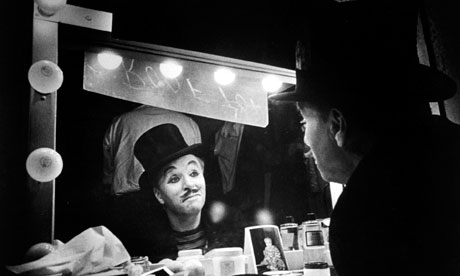
But, as I point out in several entries, being a failure before the Holocaust is one thing – since that would be a good thing for Arendt, for Heine, the beginning of her “hidden tradition” of the schlemiel, is a pariah who, in being a “lord of dreams,” rebels against society and the parvenu. Once one can be considered as an equal, for Arendt this time period is hazy, one can leave the last of the schlemiels – for Arendt, Charlie Chaplin – behind for superman (literally).
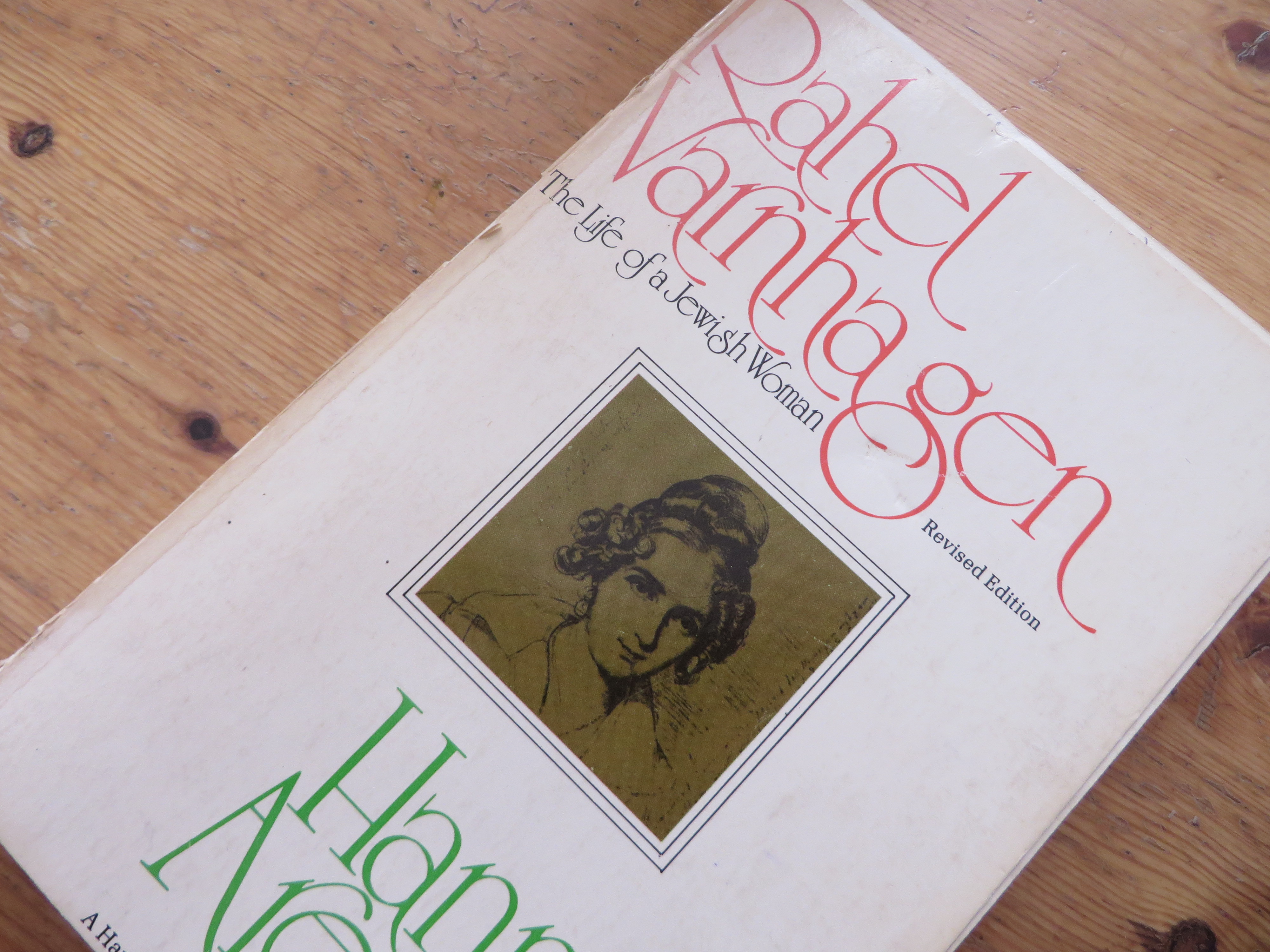
In response to a recent post by Zachary Breiterman on his blog Jewish Philosophy Place regarding Arendt’s treatment of Rahel Varnhagen – in her first published book, Rahel Varhagen: The Life of a Jewess, I would argue that Arendt’s first attempt at reading the schlemiel was based on her reading of Varnhagen in this book. This reading, unlike the reading she would make when she landed in America, is very negative. To be sure, Arendt was confused about Varnhagen. In her essay, “The Jew as Pariah: A Hidden Tradition,” she lists Heinrich Heine as the beginning of the Schlemiel tradition. She doesn’t mention Varnhagen in that essay. However, in her essay “We Refugees,” written a year earlier than “The Jew as Pariah,” Arendt includes Varnhagen in her “hidden tradition.” There, she argues that Varhagen was a part of this “other” tradition:
Modern Jewish history, having started with court Jews and continuing with the Jewish millionaires and philanthropists, is apt to forget about this other thread of Jewish tradition – the tradition of Heine, Rahel Varnhagen, Sholem Aleichem (who isn’t in her “Jew as Pariah” essay, either), of Bernard Lazare, Franz Kafka, or even Charlie Chaplin (who she considers that end of the “hidden tradition” of the schlemiel). It is the tradition of the minority of Jews who have not wanted to become upstarts, who preferred the status of “conscious pariah.” (274, The Jewish Writings)
Compared to what she writes in her Varnhagen book, these words are very kind. I will limit myself to a few quotations to prove my point. (This blog entry, therefore, is preliminary and will be followed up with more entries. But the deeper treatment will be found in my book.)
Arendt argues that Varnhagen’s life was “bound up” with a feeling that she was “inferior” because she was Jewish and emerged out of the ghetto. Her Jewishness was a mark of this shame. Arendt translates Varnhagen’s attitude toward her Jewishness when she writes: “Naturally one was not going to cling to Judaism – why should one, since the whole of Jewish history and tradition was now revealed to be a sordid product of the ghetto”(89).
Following this, Arendt inserts her own theory of about the world and worldless to argue that Varnhagen, as a schlemiel, had to do all she could to deny (or is it negate?) the world because the world reminded her that she was inferior (that is a Jew who had emerged out of the ghetto). For this reason, Varnhagen denies the things that Arendt values most – action, love, and the world – in the name of “thinking”:
Rahel’s life was bound by this inferiority, by her “infamous birth,” from youth on up. Everything that followed was only confirmation, “bleeding to death.” Therefore she must avoid everything that might give rise to further confirmation, must not act, not love, not become involved in the world. Given such absolute renunciation, all that seemed left was thought. (89)
Arendt argues that Varnhagen’s turn to thought was based on a delusion that it would save her. Varnhagen, according to Arendt, misunderstood the words of Lessing who called for “self-thinking.” She made a bifurcation between thought and the world and ultimately saw herself as free in the world of thought but a Jew in reality. Arendt tells us that Varnhagen refused to accept the reality that she was really a schlemiel; that is, the real odd one out:
Thinking amounted to an enlightened kind of magic which could substitute for, evoke and predict experience, the world, people, society. The power of reason lent posited possibilities a tinge of reality, breathed a kind of illusory life into rational desires, fended off ungraspable actuality and refused to recognize it. The twenty year old Rahel wrote: “I shall never be convinced that I am a Shlemihl and a Jewess; since all these years and after so much thinking about it, it has not dawned upon me, I shall never grasp it”(89).
Compared to Heine and Chaplin, as characterized by Arendt in her “Jew as Pariah” essay, Varnhagen is the worst kind of schlemiel. Her worldlessness is an act of denial. Arendt says that she denies that she is a schlemiel when she really is one. Only a schlemiel, in this instance, would negate the world in the name of what Arendt calls a “foundation for cultivated ignoramuses.” Arendt snidely notes that “self-thinking” is good, but not in Varnhagen’s hands: “Self-thinking can no longer be rubbed raw with any contact with actuality…Self-thinking in this sense provides a foundation for cultivated ignoramuses”(90).
As long as Don Quixote continues to ride forth to conjure a possible, imagined, illusory world out of the real one, he is only the fool, and perhaps a happy fool, perhaps even a noble fool when he undertakes to conjure up within the real world a definite world. But if without a definite ideal, without aiming at a definite imaginary revision of the world, he attempts only to transfer himself into some sort of empty possibility which he might be, he becomes merely a “foolish dreamer.” (93)
By calling Varnhagen a “foolish dreamer,” rather than a “fool” (like Don Quixote) Arendt is suggesting that the schlemiel is worse off than the fool since he has no “ideal” and does not aim at a “definite imaginary revision of the world.” This is a fascinating turn since, a few years later and in a different continent, Arendt calls Heinrich Heine a “lord of dreams.” However, that phrase, in contrast to “foolish dreamer,” has a positive valence for Arendt.
To be sure, it seems that Arendt made a distinction between good and bad schlemiels based on whether they had an “ideal” or an “imaginary revision of the world.” Unfortunately, Arendt never made this explicit in her work on the schlemiel. One can only find this, as I have, by comparing and contrasting one version of the schlemiel to the other.
Finishing up preparations for a talk on Mendelssohn, I turned to Hannah Arendt’s Rahel Varnhagen: Life of a Jewish Woman). I think it was Lilliana Weissberg who pointed out the original subtitle was Life of A Jewess, but I may be getting this detail wrong. Varnhagen’s story represents the effort of a German Jewess to escape from Judaism into society, the struggle for recognition as an individual, the effort to secure a little happiness in the bourgeois world, and the ultimate collapse of the German Jewish salon society around 1813 as German Jewish assimilation bangs up against the hard real social world.
Writing in 1933 and republished in 1957, Arendt can be read as presenting in Varnhagen and German-Jewish assimilation an opposition between “the human condition” and “the Jewish condition.” In complete opposition to the world of Enlightenment, figured here by Moses Mendelssohn, Rahel Varnhagen reads like a negative…
Philip Roth’s American Pastoral takes American radicalism and terrorism as one of its main topics. Zuckerman, the narrator, explores the life of “the Swede” (or “Swede”) whose daughter, Merry, becomes a radical and ends up blowing up a few buildings and killing a few people in the process. In flight from her first terrorist act, she leaves home and her father. In despair, Swede imagines that if he becomes radicalized (or shows himself to her as radicalized) she will come home. Parodying his attempts to understand and become radical, Zuckerman imagines Swede as having a fantasy that Angela Davis appears in his house. I have dedicated two blogs to Zuckerman’s portrayal of Angela Davis (“Saint Angela”) which, to be sure, has its comic elements. As I noted in my entries, Zuckerman shows how Swede wants his daughter back so bad that he does all he can to “hide” some of his differences with Davis regarding her radicalism.
Zuckerman, at many different points in the novel, mocks radicalism and associates it with a kind of fanatical, religious form of worship. (I have pointed this out in his reflections on Angela Davis and Swede’s emulations of her as a “saint” who he prays to for help.) Later in the novel, Zuckerman recounts how Merry, in flight from the FBI, becomes paranoid. She recalls this moment to her father when, towards the end of the novel, the two come back together:
Merry told her father, she noticed a youngish black bum, new to the park (where she was hiding out in Miami), watching her tutoring boys (English). She knew immediately what that meant. A thousand times before she’d thought it was the FBI and a thousand times she’d been wrong – in Oregon, in Idaho, in Kentucky, in Maryland, the FBI watching her at stores where she clerked; watching in the diners and the cafeterias where she washed dishes; watching on the shabby streets where she lived; watching in the libraries where she hid out to read the newspapers and study the revolutionary thinkers (260)
Zuckerman tells us that in these libraries she would read so as to “master” the work of “Marx, Marcuse, Malcom X, and Franz Fanon”(261). Of the three thinkers, Zuckerman gives the most space to Franz Fanon. Writing on him, Zuckerman notes that Fanon was a “French theorist whose sentences” were “litanized” by Merry “at bedtime like a supplication”(261). He goes on to note that for Merry, Fanon’s work had “sustained her in much the same way as a ritual sacrament”(261). To bring out the ritualistic nature of the text, so to speak, Zuckerman quotes him at length:
It must constantly be borne in mind that the committed Algerian woman learns both her role as “a woman alone in the street” and her revolutionary mission instinctively. The Algerian woman is not a secret agent. It is without apprenticeship, without briefing, without fuss, that she goes out into the street with three grenades in her handbag. She does not have the sensation of playing a role. There is no character to imitate. On the contrary, there is an intense dramatization, a continuity between the woman and the revolutionary. The Algerian woman rises directly to the level of tragedy. (261)
Immediately after this passage, Zuckerman takes us into Swede’s mind. What does Swede think about this passage from Fanon which his daughter recites as if it were a holy text?
Thinking: And the New Jersey girl descends to the level of idiocy. The New Jersey girl we sent to Montessori school because she was so bright, the New Jersey girl who at Morristown High got only A’s and B’s – the New Jersey girl rises directly to the level of disgraceful playacting. The New Jersey Girl rises to the level of psychosis. (261)
As one can see, he thinks of this text and its recitation as evincing a “level of disgraceful playacting” and the “level of psychosis.” In his mind, this text affirms the unthinkable. These words evince the anti-American pastoral.
Edward Said, however, doesn’t deem this psychotic or playacting. He takes it seriously and argues that violence makes perfect sense. In his book Culture and Imperialism, Said turns to Fanon’s work as a move toward post-nationalism (which, in effect, is the anti-American pastoral). Said notes that Fanon turned to violence as a way of going beyond nationalism:
If I have so often cited Fanon, it is because more dramatically and decisively than anyone, I believe, he expresses the immense cultural shift from the terrain of nationalist independence to the theoretical domain of liberation. (268)
But, to be sure, one doesn’t arrive at the “theoretical domain of liberation” without violence. In fact, Said says it is necessary for the transformation of the national into a “trans-personal” and “trans-national force”(269). Fanon’s “entire work” is “set into motion, so to speak, by the native’s violence, a force intended to bridge the gap between white and non-white”(270). Violence (and not peace) is the great uniter of humankind. Said calls it a new kind of “humanism” and calls violence (drawing on a Hegalian language used by Fanon) a “synthesis”:
For Fanon violence…is the synthesis that overcomes the reification of white man as subject, Black man as object. (270).
To add academic legitimacy (or is it, rather, the “legitimacy effect”?) to this, Said cites the respected Marxist thinker Georg Lukacs who, he claims, Fanon was reading while he wrote these words about violence as “synthesis.”
My conjecture is that while he was writing the work Fanon read Lukacs’s History and Class Consciousness, which had just appeared in Paris in French translation in 1960. Lukacs shows that the effects of capitalism are fragmentation and reification: in such a dispensation, every human being becomes an object, or commodity, the product of human work is alienated from its maker, the image of whole or community disappears entirely. (270)
Although Lukacs doesn’t call for violence, Said paraphrases him to say that he calls for an “act of mental will, by which the lonely mind could join another by imagining the common bond between them, breaking the enforced rigidity that kept human beings as slaves to tyrannical outside forces. Hence reconciliation and synthesis between subject and object”(270). In other words, Said interprets “act of mental will” as violence. But in the following paragraph he calls it an “act of the will.” There is, of course, a difference between a mental and a physical “act of the will,” but Said elides the difference in one fell swoop of the pen.
Regardless, Said’s reflections of Fanon – by way of Lukacs – have one goal; namely, the legitimacy of violence. Said goes on to call violence, citing Fanon, a “cleansing force”(271), cites another passage where Fanon says that the “native’s work is to imagine all possible methods for destroying the settler,” and also a passage where Fanon states that, for the native, “life can only spring up from the rotting corpse of the settler”(271).
What is astonishing is the fact that all of this passes through the gates of reason and that Edward Said makes us think that violence makes perfect sense; in fact, for Said (and for Merry of American Pastoral) it makes the most sense. What would Zuckerman or Swede think of this legitimization of violence by Fanon and Said? Given what we have seen above, we can see that they think that Merry is psychotic and childish to repeat Fanon in a religious manner. But what happens when Fanon’s advocation of violence-as-an-answer is articulated by an academic and granted legitimacy? Should we also call him psychotic and childish or something else?
If Said and Fanon make sense, then post-nationalism, the kind arrived at through violence (real and mental), also makes sense. And this should give us pause….This is no laughing matter….





 Schlemiel Theory