
The Last Picture Show? Spielberg, The Fabelmans, and the Schlemiel

When it first came out, I went with my parents to the legendary Delaware Theater (formerly the Spectrum) in Albany, New York, to see Steven Spielberg’s newest film, The Fabelmans, which takes Spielberg himself—the genealogical story of his love of film and his family—as its subject.

What struck me first, even before seeing the film, was the place where I was seeing it and the audience with whom I was seeing it.

Because of the streaming revolution—Netflix, Hulu, Prime, and everything that has followed—fewer people go to movie theaters anymore. Of the few people who were sitting in this classic theater, which opened in 1941 and still bears traces of another cinematic America, nearly all were my parents’ age. Most of them, like Spielberg, were baby boomers.

Sitting there with my parents made me pause.

I realized that I was about to watch Steven Spielberg look back at his childhood while sitting beside the generation that had given Spielberg—and the movies—to me.

Like millions of Americans of my generation, I was raised on movies made by my parents’ generation. I was inspired by them and, in many ways, have lived my life in the light they cast across the shadowy film caves of my youth. Spielberg made some of our favorite films: Jaws, Close Encounters of the Third Kind, Raiders of the Lost Ark, E.T., and so many others. Even films he produced rather than directed—Back to the Future, for instance—belonged to the Spielbergian universe in which many of us grew up.

We entered those dark rooms and came out seeing the world differently.

But now the theater was nearly empty.

And Spielberg, the great maker of dreams, was no longer showing us dinosaurs, aliens, sharks, archaeologists, soldiers, or spaceships.

He was showing us his mother and father.

He was showing us himself.

And, perhaps most importantly, he was showing us the little Jewish boy who learned how to hide behind the camera.

The Man Behind the Blockbuster

This is what makes The Fabelmans such a strange film in Spielberg’s career.

For decades, Spielberg gave America images that seemed larger than life. His movies were exercises in wonder. Something suddenly appeared that shattered the limits of the ordinary world: a shark beneath the water, a spaceship in the sky, an extraterrestrial hiding in a suburban house, an archaeological object charged with divine power.

Spielberg was the magician.

The Fabelmans asks us to look behind the magician’s curtain.

And what do we find there?

Not Indiana Jones.

Not the heroic American filmmaker.

We find Sammy Fabelman: an awkward Jewish boy with a camera.

In other words, we find something remarkably close to the schlemiel.

Sammy does not dominate the world. He watches it. He is frequently confused by it. His family embarrasses him. His mother overwhelms him. His father does not entirely understand him. His classmates humiliate him. His Jewishness marks him as different. He wants desperately to belong to America, and yet he repeatedly finds himself standing slightly outside of it.

But this distance becomes his gift.

He watches.

And then he turns what he sees into images.

The Schlemiel Sees What Everyone Else Misses

The schlemiel has always occupied an unusual relationship to reality.

Everyone else seems to understand the rules of the world. The schlemiel arrives late, misunderstands the situation, says the wrong thing, trips over something, or takes literally what everyone else understands figuratively.

We laugh because the schlemiel doesn’t quite understand reality.

But the deeper comic possibility is precisely the opposite.

Perhaps reality does not understand the schlemiel.

Because he does not completely fit into the social order, the schlemiel sometimes sees something that those who are successfully integrated into it cannot see.

That is Sammy Fabelman’s situation.

His camera initially seems like an escape from reality. He recreates train crashes. He stages Westerns. He turns Boy Scouts into actors and the ordinary American landscape into Hollywood.

But Spielberg gradually reverses this relationship.

The camera is not simply a means of escaping reality.

It becomes a way of discovering it.

The decisive moment comes when Sammy edits the footage from the family camping trip and discovers something nobody else has noticed: his mother is in love with Bennie, his father’s best friend.

The camera knows before the family knows.

Or rather, the boy behind the camera sees what the adults cannot—or will not—see.

The filmmaker is therefore caught in a terrible position. The images that create wonder can also destroy illusions.

Film reveals.

The Jewish Family and the Birth of an Artist

This is also why Spielberg’s Jewishness matters so much in The Fabelmans.

Spielberg has made explicitly Jewish films before, most obviously Schindler’s List. But The Fabelmans approaches Jewishness differently. Jewishness is not primarily historical catastrophe here. It is family. It is embarrassment. It is difference. It is the mother. It is relatives talking over one another. It is being called names at school. It is the strange feeling of being Jewish while simultaneously wanting to participate completely in the American dream.

Sammy wants America.

And America beats him up.

Then Sammy films America.

And something extraordinary happens.

The antisemitic athlete who torments him at school becomes, through Sammy’s camera, a Greek god.

This is one of the strangest and most important moments in the film.

Why would Sammy make his tormentor beautiful?

The bully himself cannot understand it.

Neither, perhaps, can Sammy.

And this inability to explain himself is crucial.

Sammy possesses power but does not use it in the obvious way. He could humiliate his enemy. Instead, he transforms him.

This is not revenge.

It is something much stranger.

It may even be the ethical secret of Spielberg’s cinema.

The Schlemiel’s Revenge

The schlemiel’s revenge has rarely been revenge.

Sholem Aleichem’s characters do not conquer their enemies. Chaplin’s Tramp does not seize political power. The little man survives the powerful by transforming the world through gesture, fantasy, language, laughter, and imagination.

Sammy does something similar with film.

He cannot defeat the beautiful, athletic, antisemitic American boy on the boy’s own terms. But behind the camera, the hierarchy suddenly changes.

The outsider becomes the creator of the image.

The powerful person becomes his subject.

And yet Spielberg complicates this fantasy of artistic power because Sammy does not simply make his enemy ridiculous. He makes him magnificent.

This is the generosity—and perhaps the foolishness—of the schlemiel.

The schlemiel cannot stop imagining that the world might be better than it is.

Spielberg’s cinema has always been accused of sentimentality for precisely this reason. His movies repeatedly return to wonder, reconciliation, childhood, family, homecoming, and the possibility that the damaged world can somehow be repaired.

The sophisticated person knows better.

The cynic certainly knows better.

But perhaps Spielberg doesn’t.

Or perhaps he knows perfectly well and chooses wonder anyway.

“You Do What Your Heart Says You Have To”

One of the film’s most important characters appears almost like a messenger from another world: Sammy’s great-uncle Boris, played by Judd Hirsch.

He understands something Sammy’s parents do not.

Art will tear him apart.

Family pulls in one direction. Art pulls in another.

The artist loves people, but he also turns them into images.

This is the frightening discovery at the center of The Fabelmans. The camera gives Sammy the ability to preserve the people he loves, but it also puts distance between himself and them.

To film something is already, in some sense, to stand outside it.

Sammy therefore occupies the classical position of the schlemiel: inside and outside at once.

He belongs to his family and watches his family.

He belongs to America and watches America.

He wants the beautiful American girl and cannot quite believe she wants him.

He suffers antisemitism and then turns the antisemite into a movie star.

He participates in life and simultaneously converts life into representation.

This doubleness may be one of the deepest sources of Spielberg’s cinema.

The Movie Theater as a Cave of Memory

And this brings me back to that nearly empty theater in Albany.

There was something uncanny about watching this particular film there.

An old movie theater.

My parents.

An audience largely made up of people from Spielberg’s generation.

And on the screen, an aging Spielberg reconstructing the moment when a frightened Jewish child first discovered the power of cinema.

For most of Spielberg’s career, we looked forward with him.

What will emerge from the water?

What will descend from the sky?

What lies behind the next door?

What forgotten world will the camera reveal?

But The Fabelmans reverses the camera.

Spielberg looks backward.

And suddenly the great cinematic cave in which generations of Americans dreamed together begins to look historical.

People no longer need to gather in darkness to see moving images. The images follow us everywhere now. They are on our televisions, laptops, tablets, and phones. They arrive endlessly, privately, algorithmically.

Something has been gained.

But something may also have disappeared.

The movie theater made strangers dream together.

What Our Parents Projected

Perhaps this is why watching The Fabelmans with my parents affected me so deeply.

I realized that Spielberg’s generation had projected more than movies onto those enormous screens.

They projected a world.

And we inherited it.

We inherited their sharks and spaceships, their archaeologists and aliens, their fears and fantasies, their suburban homes, broken families, miraculous children, monsters, adventures, and dreams of reconciliation.

They taught us how to look.

But The Fabelmans asks a more difficult question: Who taught them how to look?

Spielberg’s answer takes us backward—from the blockbuster to the filmmaker, from the filmmaker to the boy, from the boy to the family, and from the family to a Jewish-American story of migration, assimilation, difference, longing, embarrassment, and imagination.

Behind Steven Spielberg stands Sammy Fabelman.

And behind Sammy stands his mother, dancing in headlights.

His father, believing in machines and reason.

His sisters.

His eccentric relatives.

The Jewish family.

America.

And a little boy holding a camera between himself and all of them.

The Fable-Man

Even the fictional name Spielberg gives himself is worth considering.

Fabelman.

The fable-man.

The man who makes fables.

There is something wonderfully schlemiel-like about the name because the schlemiel has always survived through stories. He does not possess the world. He narrates it.

Tevye cannot control his daughters, history, modernity, Russia, poverty, or God.

But he can tell us about them.

And through the telling, something survives.

Sammy Fabelman cannot keep his parents together. He cannot prevent desire. He cannot eliminate antisemitism. He cannot control America. He cannot even fully understand why he needs to make movies.

But he can make a fable from what happens.

That may be Spielberg’s deepest autobiographical confession.

Cinema did not give him control over life.

It gave him a way of responding to life’s uncontrollability.

That distinction matters.

The Schlemiel Behind the Camera

At the end of the film, Sammy encounters John Ford.

Ford gives the aspiring filmmaker one brutally simple lesson about the horizon: if the horizon is at the bottom of the frame, it’s interesting; if it’s at the top, it’s interesting; if it’s in the middle, it’s boring.

Sammy leaves.

And then Spielberg gives us one final joke.

The camera itself suddenly tilts.

The horizon moves.

It is an extraordinary little gesture because, after a film about divorce, antisemitism, desire, loneliness, generational conflict, and the painful birth of an artist, Spielberg ends with a gag.

The world is crooked.

So adjust the camera.

Perhaps that is the schlemiel’s philosophy in miniature.

The schlemiel cannot straighten the world.

He cannot undo the past.

He cannot keep his parents together.

He cannot prevent history from happening.

But he can change the angle from which we see it.

And sometimes that tiny adjustment is enough to transform suffering into a story, humiliation into comedy, memory into art.

Sitting beside my parents in that old Albany theater, watching an aging Spielberg look back toward his parents, I felt for a moment as though several generations were looking at one another across the darkness.

Our parents gave us these images.

We lived inside them.

And now, as the theaters empty and the generation that created this cinematic world grows older, Spielberg has finally turned the camera around.

Behind the spectacle we discover the family.

Behind the filmmaker, the Jewish child.

Behind the hero, the outsider.

And behind one of the most powerful image-makers in the history of American cinema, perhaps, there was always a schlemiel holding a camera, trying to figure out what in the world he was looking at.
“It’s Funny,” No, it’s not: On Shalom Auslander’s Anxious Post-Holocaust Cynicism, or Sit-Down Comedy

“It’s Funny”: Shalom Auslander, Diogenes, and the Cynical Schlemiel After the Holocaust

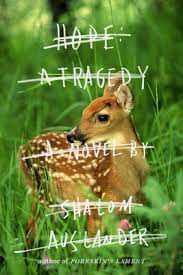
Teaching Shalom Auslander’s Hope: A Tragedy for a course on the Holocaust was a fascinating educational exercise because I used the novel to prompt my students—and myself—into a dialogue with what I would call anxious American Jewish post-Holocaust cynicism.

It is a strange dialogue because Auslander doesn’t exactly want to have one.

Or, better: Solomon Kugel, the novel’s main character, seems incapable of having one without turning it into a joke.

This is one of the things I ask my students to watch for as they read the novel: its constant post-Holocaust counter-intuitions. Whenever we expect solemnity, Kugel gives us obscenity. Whenever we expect memory, he gives us anxiety. Whenever we expect Jewish continuity, he gives us neurosis. Whenever we expect Anne Frank to signify innocence, tragedy, and the obligation to remember, Auslander puts her in an attic and transforms her into an irritable old woman who refuses to die.

And whenever we think we know what suffering means, Kugel makes a joke.

This is why the opening words of the novel are so important:

“It’s funny:”

Everything begins there.

Before the Holocaust, before Anne Frank, before Jewish memory, before theology, before Kugel’s mother and her bizarre obsession with suffering, before Kugel’s obsession with his own death—there is the declaration that something is funny.

But what could possibly be funny here?

And what kind of Jewish philosophical statement begins with the words “It’s funny”?

The Post-Holocaust Stand-Up Philosopher

The narrator of Hope: A Tragedy frequently sounds less like a novelist than like a cynical American Jewish stand-up comedian. He seems to be perpetually fighting with his own community, telling dirty jokes about Jewish suffering, American Jewish identity, Holocaust memory, family, death, guilt, and the strange condition of being an American Jew several generations after Auschwitz.

The comedy is aggressive because the anxiety is aggressive.

And, as with many Jewish comic protagonists, much of Kugel’s suffering begins with his mother.

She suffers.

She remembers suffering.

She invents suffering.

She seems almost disappointed by the fact that she has not suffered enough.

Kugel inherits this relationship to suffering, but transforms it into another form: an obsessive anticipation of his own death. He wants to know what his last words will be. He thinks about how he will die. He imagines disaster everywhere.

It is as if history has migrated inward.

The catastrophe that happened to European Jewry becomes, generations later, a catastrophe endlessly anticipated by the American Jewish psyche.

And then Kugel discovers Anne Frank living in his attic.

At this point, Auslander makes his most outrageous comic move. He takes perhaps the most sacred secular icon of Holocaust memory and refuses to leave her within the realm of tragedy.

Anne Frank has survived.

But survival itself turns out to be a problem.

This is where Hope: A Tragedy becomes philosophically interesting. Because Auslander is not simply making jokes about the Holocaust. He is asking—obscenely, aggressively, perhaps even cruelly—what happens when the moral language surrounding catastrophe becomes incapable of containing the lives of the generations that come afterward.

And this is precisely where I find myself thinking about Diogenes.

Diogenes: The Mad Socrates

Diogenes, the ancient father of Cynicism, was famously described by Plato as a “Socrates gone mad.”

The phrase is wonderful because it suggests that the Cynic is not simply the opposite of the philosopher. He is philosophy pushed beyond the boundaries of philosophical respectability.

In Critique of Cynical Reason, Peter Sloterdijk develops this idea through what he calls ancient kynicism. Kynicism is not simply pessimism or disbelief. It is bodily, vulgar, comic resistance to the elevated languages through which philosophy and political authority present themselves.

It is, above all, cheeky.

Sloterdijk associates this cheekiness with the German frech: boldness, impudence, productive aggressivity.

Diogenes does not refute philosophy by constructing another philosophical system.

He refutes philosophy with his body.

When Socrates speaks about the divine soul, the kynic picks his nose.

When Socrates speaks about the Ideas, the kynic farts.

When philosophers elevate Eros into metaphysics, the kynic masturbates in public.

The response is outrageous because it refuses the terms of philosophical discourse altogether.

Socrates can defeat the Sophist because the Sophist agrees to enter into conversation with him. And conversation already assumes something: that truth will emerge through argument, distinction, questioning, and reason.

Diogenes refuses the contract.

He doesn’t answer Socrates with a better argument.

He farts.

When the Clown Refuses the Conversation

This is much more significant than it initially appears.

For Sloterdijk, philosophical conversation itself presupposes what he calls an “idealist agreement.” Socrates is unbeatable so long as his opponent agrees that the question will ultimately be decided by discourse.

But what happens when someone refuses discourse?

What happens when someone answers metaphysics with obscenity?

Or tragedy with a joke?

The kynic discovers something that will later become central to the clown, the fool—and, I would argue, the schlemiel.

Sometimes the body can say what discourse cannot.

This is why Sloterdijk describes Diogenes through a constellation of wonderfully suggestive phrases: “satirical resistance,” “uncivil enlightenment,” “material embodiment,” “low theory,” and the “language of the clown.”

The clown doesn’t produce another theory.

The clown performs a counter-theory.

And this is also why the famous encounter between Diogenes and Alexander the Great matters so much.

According to the anecdote, Alexander supposedly declared that if he were not Alexander, he would want to be Diogenes.

Sloterdijk sees something profound in this statement. Alexander possesses armies, political power, historical ambition, and imperial authority. Diogenes possesses almost nothing.

And yet Alexander recognizes something in Diogenes that he himself cannot possess.

Freedom from Alexander.

The ruler confronts the fool and discovers that the fool inhabits a place beyond the ruler’s authority.

As Sloterdijk puts it, those who rule can lose their self-confidence before “fools, clowns, and kynics.”

The clown becomes dangerous precisely because he refuses to take power’s language seriously.

From the Kynic to the Schlemiel

But here I want to make a distinction.

Solomon Kugel is not Diogenes.

And the schlemiel is not simply a Jewish kynic.

Diogenes is shameless. Kugel is filled with shame.

Diogenes seems radically at home in his body. Kugel is terrified of his body dying.

Diogenes frees himself from society’s expectations. Kugel cannot stop hearing the voices of his mother, his therapist, Jewish history, Holocaust memory, and his own anxious conscience.

Diogenes chooses homelessness.

Kugel buys a house.

And then discovers Anne Frank living in it.

This difference matters.

The schlemiel does not stand outside history and laugh at it. History has already entered the schlemiel.

His comedy therefore has a different texture.

Diogenes can laugh because Alexander cannot control him.

Kugel laughs because he cannot control anything.

His family.

His house.

His mother.

His future.

His death.

His Jewishness.

And certainly not the Holocaust.

The classical Cynic confronts power through shamelessness.

The post-Holocaust schlemiel confronts history through anxiety.

This may be why Auslander’s comedy feels simultaneously liberating and suffocating. The joke attacks the sacred language surrounding Jewish suffering, but the comedian cannot escape the suffering he attacks.

He is trapped inside his own punchline.

Anne Frank in the Attic

And this brings us back to Auslander’s most outrageous invention.

Anne Frank is alive.

She is living in Kugel’s attic.

What does one do with this?

The obvious answer is that Auslander is desecrating an icon of Holocaust memory. And he certainly wants us to feel the force of that desecration.

But perhaps something more interesting is happening.

Anne Frank has become so thoroughly absorbed into the moral vocabulary of postwar Western culture that she risks becoming an abstraction: innocence, hope, victimhood, humanity.

Auslander violently returns her to the body.

She eats.

She smells.

She complains.

She takes up space.

She becomes inconvenient.

In other words, she stops functioning exclusively as a symbol.

This is an extraordinarily kynical gesture.

The sacred abstraction is dragged downstairs into material existence.

But Auslander adds a specifically Jewish-American complication: Kugel cannot simply dismiss her.

That would be too easy.

He feels obligated to her.

He feels guilty about her.

He resents her.

He fears her.

He wants to get rid of her.

He cannot get rid of her.

And perhaps this is the central comic situation of Hope: A Tragedy.

Kugel literally cannot get the Holocaust out of his house.

“It’s Funny”

This is why I keep returning with my students to those opening words:

“It’s funny:”

Perhaps Auslander is announcing the philosophical method of the entire novel.

Something happened to Jewish comedy after the Holocaust.

The schlemiel who once stumbled through the shtetl now wanders through American suburbia carrying historical catastrophe inside his head.

And the old philosophical opposition between tragedy and comedy becomes unstable.

Is Auschwitz tragic?

Of course.

Can its memory become neurotic?

Can remembrance become suffocating?

Can inherited suffering become absurd?

Can Jewish memory become an ideology?

Can the comedian mock that ideology without mocking the dead?

And what happens when the Jew who asks these questions discovers that the dead are not quite dead?

Auslander refuses to answer these questions philosophically.

Like Diogenes, he gives us something lower.

Dirtier.

More embarrassing.

A mother obsessed with suffering.

A neurotic Jew obsessed with death.

An elderly Anne Frank hiding in an attic.

And a narrator who keeps making jokes.

But there is an important difference between Diogenes and Auslander.

Diogenes uses comedy to free himself from illusion.

Auslander is not so sure freedom is possible.

That may be what makes Solomon Kugel a distinctly post-Holocaust schlemiel.

The kynic laughs and walks away.

The schlemiel laughs—and remains.

He remains with his mother.

He remains with Anne Frank.

He remains with Jewish history.

He remains with his anxiety.

And he remains with the impossible question of what one is supposed to do with suffering that happened before one was born but somehow continues to occupy the attic.

Perhaps that is why the novel does not begin with “Once upon a time.”

It begins with something far more dangerous:

“It’s funny.”

The Last Yiddish Schlemiel: Cynthia Ozick’s “Envy; or, Yiddish in America”

What happens to the schlemiel when the world that created him disappears?

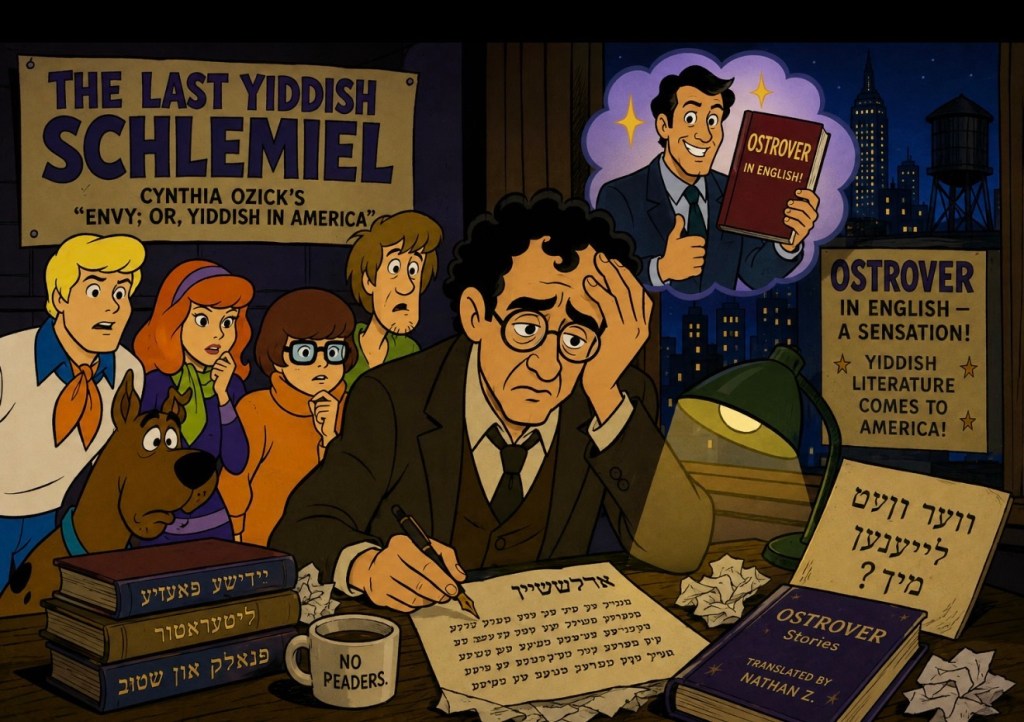
Cynthia Ozick’s “Envy; or, Yiddish in America” poses this question with extraordinary comic cruelty. Its central character, Edelshtein, is an aging Yiddish poet living in America, surrounded by a language that increasingly cannot hear him. He writes. He complains. He envies. He dreams of recognition. But almost no one reads him.

His great rival, Ostrover, has escaped this fate. Ostrover has been translated into English and has become famous. He has crossed over.

Edelshtein has not.

And therein lies the joke—and the wound.

A Writer Without Readers

The tragedy of Edelshtein is not simply that he is unsuccessful. Writers have always been jealous of successful writers. Ozick is interested in something much more disturbing.

Edelshtein belongs to a language whose readership is disappearing.

This changes the meaning of literary failure. If a poet writes a great poem and nobody appreciates it, he can blame his readers. But what if the readers themselves are disappearing? What if the language in which one has formed one’s deepest thoughts, memories, jokes, rhythms, and desires is becoming inaccessible to the next generation?

Edelshtein does not simply fear that he will be forgotten.

He fears that the world capable of remembering him is disappearing.

This is why translation becomes almost messianic in the story. Edelshtein wants to be translated into English because English promises resurrection. Translation might carry him across the boundary separating the Yiddish past from the American future.

But there is a terrible paradox here.

To survive as a Yiddish writer, Edelshtein must cease to be read in Yiddish.

The Comedy of Envy

Ozick refuses to turn Edelshtein into a noble martyr.

This is crucial.

He is jealous, vain, bitter, obsessive, self-important, and frequently ridiculous. He cannot stop measuring himself against Ostrover. Ostrover’s success becomes an insult that Edelshtein experiences almost metaphysically.

Why him?

Why not me?

Why should he become the representative of Yiddish literature to America?

This is where Ozick’s story becomes a story about the schlemiel.

The schlemiel traditionally inhabits the distance between what he imagines himself to be and what the world allows him to become. He wants dignity and encounters humiliation. He wants recognition and encounters indifference. He attempts to act upon history and discovers that history is acting upon him.

Edelshtein inhabits precisely this gap.

But Ozick gives the schlemiel’s comedy a historical dimension.

Edelshtein is not merely unlucky.

History itself has made him ridiculous.

When History Outruns the Schlemiel

This is one of the deepest problems raised by modern Jewish comedy.

The traditional schlemiel can stumble through the world because, somewhere behind him, there remains a community capable of understanding the joke. His failures take place within a shared language, tradition, and cultural memory.

But what happens when that community disappears?

After the Holocaust and the massive assimilation of American Jews into English-speaking American culture, Yiddish entered a radically different historical situation. The schlemiel could survive—but increasingly in translation.

Tevye could become Fiddler on the Roof.

Yiddish stories could become Jewish-American literature.

And eventually the schlemiel could appear in American fiction, television, stand-up comedy, and film without speaking a word of Yiddish.

Something survives.

But something has also been lost.

Edelshtein stands precisely at this threshold.

He is a schlemiel who knows that the joke may continue after him—but perhaps in another language.

Translation as Resurrection

This is why Edelshtein’s obsession with translation should not be dismissed as simple vanity.

He understands something.

Translation is power.

Ostrover has not merely acquired readers. He has acquired an afterlife.

English allows him to enter another cultural world. He can circulate among people who have never lived within Yiddish culture. His work can become “literature” rather than merely “Yiddish literature.”

Edelshtein wants the same transformation.

But translation presents an impossible question:

What exactly survives when a Jewish story leaves the language that created it?

The plot may survive.

The character may survive.

The joke may survive.

But does the world survive?

Yiddish is not simply a collection of words that can be exchanged for English words. It carries gestures, ironies, biblical echoes, rabbinic rhythms, curses, diminutives, exaggerations, historical memories, and forms of intimacy.

The schlemiel emerges from this linguistic world.

Translate him into English and something extraordinary happens.

He becomes universal.

But perhaps he becomes universal precisely by becoming less particular.

From Sholem Aleichem to America

This problem becomes especially interesting when Ozick is placed alongside Sholem Aleichem.

Sholem Aleichem’s characters inhabit a Jewish world even when that world is collapsing around them. Tevye argues with God through biblical quotations. His misunderstandings are funny precisely because his language is saturated with tradition.

The schlemiel does not stand outside Judaism.

He trips over its words.

By the time we reach Ozick’s America, however, the problem has changed.

The question is no longer simply how the Jew survives modernity.

It is how Jewish language survives the Jew’s successful entry into modernity.

America offers extraordinary possibilities. Jews can enter universities, professions, publishing, entertainment, politics, and the arts.

But cultural success creates its own paradox.

The Jew enters America.

English enters the Jew.

And Yiddish slowly becomes memory.

Edelshtein therefore represents a strange historical figure: the schlemiel produced not by exclusion from modernity but by Jewish integration into it.

The Schlemiel After Yiddish

This helps explain why the American schlemiel becomes so important.

The figure does not disappear when Yiddish disappears from everyday Jewish life.

He migrates.

One can trace something of this migration from Sholem Aleichem through American Jewish literature and eventually into American comedy.

Woody Allen does not need to speak Yiddish to inherit something from the schlemiel.

Neither does Larry David.

Nor do the countless anxious, socially maladroit, overly intellectual, self-defeating Jewish characters who populate American comedy.

But Ozick forces us to ask what happened during this migration.

What was gained?

What was lost?

Perhaps Edelshtein stands at the border crossing.

Behind him lies the Yiddish world.

Ahead of him lies American Jewish comedy.

And Edelshtein cannot quite cross.

That is why he is funny.

That is why he is unbearable.

And that is why he is tragic.

The Schlemiel as a Witness

There is another possibility.

Perhaps Edelshtein’s failure is itself a form of testimony.

The schlemiel has always possessed a peculiar relationship to history. He rarely conquers history. He doesn’t resemble the epic hero who imposes himself upon the world through strength, courage, or political power.

The schlemiel persists.

He remains after humiliation.

He continues speaking when speaking seems pointless.

And this may be Edelshtein’s deepest significance.

He keeps writing Yiddish poetry in a world that increasingly has no use for Yiddish poetry.

From one perspective, this is absurd.

From another, it is an extraordinary refusal.

The world tells him that his language has become obsolete.

He answers by speaking it again.

And again.

And again.

His failure therefore contains a strange dignity.

Not the dignity of the hero who defeats history, but the dignity of the person who refuses to allow history to have the final word.

Who Gets the Last Laugh?

Ozick leaves us with an uncomfortable question.

Who is the real schlemiel?

Is it Edelshtein, stubbornly writing for readers who no longer exist?

Or is it the American Jewish world that believes it can abandon the language of its ancestors without losing anything essential?

Perhaps the joke turns back upon us.

We laugh at Edelshtein because he cannot accept reality.

But Edelshtein may understand something that everyone around him has forgotten.

A language is not merely a tool.

It is a world.

And when a language disappears, a particular way of laughing, suffering, remembering, arguing, and speaking to the dead disappears with it.

The schlemiel survives.

He crosses into English.

He becomes American.

He becomes famous.

But Ozick’s “Envy; or, Yiddish in America” asks us to look back for a moment at the figure who did not make the crossing.

Edelshtein remains standing on the other side, still talking.

Perhaps nobody is listening.

But he keeps talking anyway.

And what could be more schlemiel-like than that?