
“It’s Funny”: Shalom Auslander, Diogenes, and the Cynical Schlemiel After the Holocaust
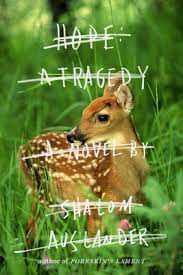
Teaching Shalom Auslander’s Hope: A Tragedy for a course on the Holocaust was a fascinating educational exercise because I used the novel to prompt my students—and myself—into a dialogue with what I would call anxious American Jewish post-Holocaust cynicism.
It is a strange dialogue because Auslander doesn’t exactly want to have one.
Or, better: Solomon Kugel, the novel’s main character, seems incapable of having one without turning it into a joke.
This is one of the things I ask my students to watch for as they read the novel: its constant post-Holocaust counter-intuitions. Whenever we expect solemnity, Kugel gives us obscenity. Whenever we expect memory, he gives us anxiety. Whenever we expect Jewish continuity, he gives us neurosis. Whenever we expect Anne Frank to signify innocence, tragedy, and the obligation to remember, Auslander puts her in an attic and transforms her into an irritable old woman who refuses to die.
And whenever we think we know what suffering means, Kugel makes a joke.
This is why the opening words of the novel are so important:
“It’s funny:”
Everything begins there.
Before the Holocaust, before Anne Frank, before Jewish memory, before theology, before Kugel’s mother and her bizarre obsession with suffering, before Kugel’s obsession with his own death—there is the declaration that something is funny.
But what could possibly be funny here?
And what kind of Jewish philosophical statement begins with the words “It’s funny”?
The Post-Holocaust Stand-Up Philosopher
The narrator of Hope: A Tragedy frequently sounds less like a novelist than like a cynical American Jewish stand-up comedian. He seems to be perpetually fighting with his own community, telling dirty jokes about Jewish suffering, American Jewish identity, Holocaust memory, family, death, guilt, and the strange condition of being an American Jew several generations after Auschwitz.
The comedy is aggressive because the anxiety is aggressive.
And, as with many Jewish comic protagonists, much of Kugel’s suffering begins with his mother.
She suffers.
She remembers suffering.
She invents suffering.
She seems almost disappointed by the fact that she has not suffered enough.
Kugel inherits this relationship to suffering, but transforms it into another form: an obsessive anticipation of his own death. He wants to know what his last words will be. He thinks about how he will die. He imagines disaster everywhere.
It is as if history has migrated inward.
The catastrophe that happened to European Jewry becomes, generations later, a catastrophe endlessly anticipated by the American Jewish psyche.
And then Kugel discovers Anne Frank living in his attic.
At this point, Auslander makes his most outrageous comic move. He takes perhaps the most sacred secular icon of Holocaust memory and refuses to leave her within the realm of tragedy.
Anne Frank has survived.
But survival itself turns out to be a problem.
This is where Hope: A Tragedy becomes philosophically interesting. Because Auslander is not simply making jokes about the Holocaust. He is asking—obscenely, aggressively, perhaps even cruelly—what happens when the moral language surrounding catastrophe becomes incapable of containing the lives of the generations that come afterward.
And this is precisely where I find myself thinking about Diogenes.
Diogenes: The Mad Socrates
Diogenes, the ancient father of Cynicism, was famously described by Plato as a “Socrates gone mad.”
The phrase is wonderful because it suggests that the Cynic is not simply the opposite of the philosopher. He is philosophy pushed beyond the boundaries of philosophical respectability.
In Critique of Cynical Reason, Peter Sloterdijk develops this idea through what he calls ancient kynicism. Kynicism is not simply pessimism or disbelief. It is bodily, vulgar, comic resistance to the elevated languages through which philosophy and political authority present themselves.
It is, above all, cheeky.
Sloterdijk associates this cheekiness with the German frech: boldness, impudence, productive aggressivity.
Diogenes does not refute philosophy by constructing another philosophical system.
He refutes philosophy with his body.
When Socrates speaks about the divine soul, the kynic picks his nose.
When Socrates speaks about the Ideas, the kynic farts.
When philosophers elevate Eros into metaphysics, the kynic masturbates in public.
The response is outrageous because it refuses the terms of philosophical discourse altogether.
Socrates can defeat the Sophist because the Sophist agrees to enter into conversation with him. And conversation already assumes something: that truth will emerge through argument, distinction, questioning, and reason.
Diogenes refuses the contract.
He doesn’t answer Socrates with a better argument.
He farts.
When the Clown Refuses the Conversation
This is much more significant than it initially appears.
For Sloterdijk, philosophical conversation itself presupposes what he calls an “idealist agreement.” Socrates is unbeatable so long as his opponent agrees that the question will ultimately be decided by discourse.
But what happens when someone refuses discourse?
What happens when someone answers metaphysics with obscenity?
Or tragedy with a joke?
The kynic discovers something that will later become central to the clown, the fool—and, I would argue, the schlemiel.
Sometimes the body can say what discourse cannot.
This is why Sloterdijk describes Diogenes through a constellation of wonderfully suggestive phrases: “satirical resistance,” “uncivil enlightenment,” “material embodiment,” “low theory,” and the “language of the clown.”
The clown doesn’t produce another theory.
The clown performs a counter-theory.
And this is also why the famous encounter between Diogenes and Alexander the Great matters so much.
According to the anecdote, Alexander supposedly declared that if he were not Alexander, he would want to be Diogenes.
Sloterdijk sees something profound in this statement. Alexander possesses armies, political power, historical ambition, and imperial authority. Diogenes possesses almost nothing.
And yet Alexander recognizes something in Diogenes that he himself cannot possess.
Freedom from Alexander.
The ruler confronts the fool and discovers that the fool inhabits a place beyond the ruler’s authority.
As Sloterdijk puts it, those who rule can lose their self-confidence before “fools, clowns, and kynics.”
The clown becomes dangerous precisely because he refuses to take power’s language seriously.
From the Kynic to the Schlemiel
But here I want to make a distinction.
Solomon Kugel is not Diogenes.
And the schlemiel is not simply a Jewish kynic.
Diogenes is shameless. Kugel is filled with shame.
Diogenes seems radically at home in his body. Kugel is terrified of his body dying.
Diogenes frees himself from society’s expectations. Kugel cannot stop hearing the voices of his mother, his therapist, Jewish history, Holocaust memory, and his own anxious conscience.
Diogenes chooses homelessness.
Kugel buys a house.
And then discovers Anne Frank living in it.
This difference matters.
The schlemiel does not stand outside history and laugh at it. History has already entered the schlemiel.
His comedy therefore has a different texture.
Diogenes can laugh because Alexander cannot control him.
Kugel laughs because he cannot control anything.
His family.
His house.
His mother.
His future.
His death.
His Jewishness.
And certainly not the Holocaust.
The classical Cynic confronts power through shamelessness.
The post-Holocaust schlemiel confronts history through anxiety.
This may be why Auslander’s comedy feels simultaneously liberating and suffocating. The joke attacks the sacred language surrounding Jewish suffering, but the comedian cannot escape the suffering he attacks.
He is trapped inside his own punchline.
Anne Frank in the Attic
And this brings us back to Auslander’s most outrageous invention.
Anne Frank is alive.
She is living in Kugel’s attic.
What does one do with this?
The obvious answer is that Auslander is desecrating an icon of Holocaust memory. And he certainly wants us to feel the force of that desecration.
But perhaps something more interesting is happening.
Anne Frank has become so thoroughly absorbed into the moral vocabulary of postwar Western culture that she risks becoming an abstraction: innocence, hope, victimhood, humanity.
Auslander violently returns her to the body.
She eats.
She smells.
She complains.
She takes up space.
She becomes inconvenient.
In other words, she stops functioning exclusively as a symbol.
This is an extraordinarily kynical gesture.
The sacred abstraction is dragged downstairs into material existence.
But Auslander adds a specifically Jewish-American complication: Kugel cannot simply dismiss her.
That would be too easy.
He feels obligated to her.
He feels guilty about her.
He resents her.
He fears her.
He wants to get rid of her.
He cannot get rid of her.
And perhaps this is the central comic situation of Hope: A Tragedy.
Kugel literally cannot get the Holocaust out of his house.
“It’s Funny”
This is why I keep returning with my students to those opening words:
“It’s funny:”
Perhaps Auslander is announcing the philosophical method of the entire novel.
Something happened to Jewish comedy after the Holocaust.
The schlemiel who once stumbled through the shtetl now wanders through American suburbia carrying historical catastrophe inside his head.
And the old philosophical opposition between tragedy and comedy becomes unstable.
Is Auschwitz tragic?
Of course.
Can its memory become neurotic?
Can remembrance become suffocating?
Can inherited suffering become absurd?
Can Jewish memory become an ideology?
Can the comedian mock that ideology without mocking the dead?
And what happens when the Jew who asks these questions discovers that the dead are not quite dead?
Auslander refuses to answer these questions philosophically.
Like Diogenes, he gives us something lower.
Dirtier.
More embarrassing.
A mother obsessed with suffering.
A neurotic Jew obsessed with death.
An elderly Anne Frank hiding in an attic.
And a narrator who keeps making jokes.
But there is an important difference between Diogenes and Auslander.
Diogenes uses comedy to free himself from illusion.
Auslander is not so sure freedom is possible.
That may be what makes Solomon Kugel a distinctly post-Holocaust schlemiel.
The kynic laughs and walks away.
The schlemiel laughs—and remains.
He remains with his mother.
He remains with Anne Frank.
He remains with Jewish history.
He remains with his anxiety.
And he remains with the impossible question of what one is supposed to do with suffering that happened before one was born but somehow continues to occupy the attic.
Perhaps that is why the novel does not begin with “Once upon a time.”
It begins with something far more dangerous:
“It’s funny.”

