The Schlemiel Does Kardashian and Gets Done by Franco: On Seth Rogen and James Franco’s “Bound 2” Video

DownloadedFile

Is Seth Rogen giving the schlemiel a bad name or…another name?  To be sure, I’ve written several blog-entries on Rogen-as-Schlemiel.  Before I saw Rogen and Franco’s parody of Kanye West’s Latest video, I was already on Rogen’s trail.  And, to my understanding, he, along with Judd Apatow and others, were looking to revise the schlemiel character.  Their formula – the same formula used by Woody Allen since Hollywood Ending (2002) and Anything Else (2003) – was to cast the main character as a schlemiel (a half-man) in the beginning of the film, but by the end of the film he would become a man.   This contrasts to Woody Allen’s older formula – which we see in Zelig or Annie Hall, amongst other films – which is to cast a main character who starts and ends the film as a schlemiel.  This formula is actually older than film; to be sure, we find it in Yiddish folklore and throughout Yiddish and Jewish-American fiction.  However, some authors, like Phillip Roth, have decided to leave this character behind in their later novels.  Despite this, the schlemiel lives on in fiction, film, and television.  Even the famous talk-show star, Howard Stern often reminds his audience (which numbers in the millions) that regardless of how successful he is, he is still “half-a-man” (that is, still a schlemiel).

Rogen, it seems, is confused about whether he should cast himself as a half-man becoming a full man – as we see in Knocked Up (2007), Zack and Miri Make a Porno (2008) or The Green Hornet (2011) – as a half-man becoming a little more of a man – as in Guilt Trip (2012), or as a man who has his share of bad luck – as in Take this Waltz (2011).  Now, with this video, we can add another position: casting himself as a woman (namely, Kim Kardashian).

By casting himself as a woman or gay (both?), Rogen, it seems, is taking the schlemiel into new territory.  And he is disseminating a new image of this character on a wide basis.  After all, the video has seen over 2 million views over the last 24 hours and will likely get more hits over the next day or two.

But is this new ground?

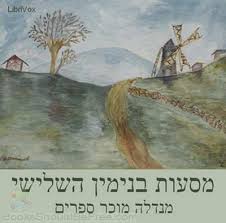
It’s not.  To be sure, the schlemiel has often been cast as an effeminate character.  This goes back to Mendel Mocher Sforim’s Yiddish novel Benjamin the III.  In that novel, written in the mid-19th century, the main character plays a Don Quixote kind of character who models himself on the tales of Benjamin of Tudela who is best known for his travelogue. This book – apparently written in the 12th century – was based on his ten years of travel around the world.   He describes the world to his Spanish compatriots.  But in Sforim’s book, the schlemiels think they will go on a similar journey when, in fact, they don’t even leave the “Pale of Settlement” – an area where Jews were, for over a century, confined.  In the novel Benjamin refers to his make travel partner as his wife and at times trials him like a wife. And his partner goes along with it, too.

Following this novel, we see more and more effeminate portrayals of the schlemiel.  To be sure, this character is often cast as half-a-man and is more sensitive and vulnerable than others.  And although Milton Berl cross-dressed, he always retained his male aspects by way of his speech.   As Ruth Wisse points out, regardless of how vulnerable they are – or even if they cross-dress – schlemiels often win an “ironic victory” over the world and history which excludes them; but they don’t do this by being entirely passive.  They do this by way of speech.   As many a schlemiel joke or story will show you, the schlemiel is a master of words and loves to play with them.   In this, at the very least, there is something redemptive.  A Jews dignity, though trampled on in this or that story, is retained through such verbal humor. And this comic act, so to speak, indirectly speaks truth to power.

What Seth Rogen has done here, however, is to make himself totally passive.  To be sure, he, like Kim Kardashian in the video, doesn’t really say anything.  Kanye or James Franco speak; Kim and Seth are submissive.   And they are both being ridden by a man.  They are both in a Missionary kind of position –even though, for all intents and purposes, it’s on a surreal motorcycle.

In addition to this, I’d say that Rogen is not the first “heavy” schlemiel.  There are many others before him – although many people often associate the schlemiels body with wiry people like Woody Allen, Jack Benny, or Ben Stiller (to name just a few).    Regardless, in comparison to Kim Kardashian’s “perfect” body, we see Rogen’s hairy and heavy body as its anti-thesis. And when Rogen makes sexy faces, we can’t help but snicker.

But the joke is really on Rogen and the schlemiel.  It is not on Kanye and Kim.  And it isn’t even on James Franco.  If anything, the schlemiel may cross-dress or play the half-man in many novels, films, or stand-up routines.  But what a schlemiel won’t do is lose speech, which is the schlemiel’s greatest ally since it keeps total passivity at bay.

For this reason, I had a hard time watching this only as parody (which it obviously is) since, in many ways, it seemed to be effacing the schlemiel I have grown to love and even respect.  So, while Kanye and Kim may have found it funny, I don’t.  Because the joke is ultimately on the schlemiel, not them.

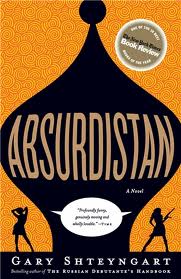
“Russians Are Just a Bunch of Niggaz” – Introducing Multiculturalism to Shteyngart’s Absurdistan

images-2

Every Gary Shteyngart novel addresses multiculturalism.   And they do so by way of articulating the complex relationships of the main characters – who are all Jewish-Russian-Americans – to Eastern Europeans, Latino-Americans, African-Americans, Asian-Americans, Jewish-Americans, and Non-Jewish-Americans.  To be sure, Shteyngart portrays his main characters as former exchange-students who majored in “multiculturalism” in a mid-western college by the name of “Accidental College.”   In the first novel, The Russian Debutante’s Notebook, we are introduced to Vladmir, a twenty-five year old character whose post-college work is to help settle new Immigrants into the American experience.  He works at the Emma Lazarus Immigrant Absorption Society.

But what is most interesting about the novel is not to be found in the relationships Vladmir finds as the Absorption Society, so much as the relationships he forges when, in the face of a deal gone wrong, he flees America for Eastern Europe.  There he meets up with fellow Russians and Eastern Europeans and plots to rip off young-rebellious-American-students.  These relationships teach us how he navigates between one cultural identity and the other.  And this, more than anything, makes for one of the greatest novelties of Shteyngart’s fiction.    It shows us at least one possible way in which a Jewish-Russian-American-Immigrant can live in a growing multicultural, globalized, and Americanized society. This kind of fiction provides readers with an opportunity to, as the philosopher Richard Rorty might say, become more cosmopolitan and less xenophobic.  But Shteyngart’s fiction also shows us “how” prescient and rich this post-nationalist experience is or can be.  And it does this by way of a multi-cultured-schlemiel.

In contrast to The Russian Debutante’s Notebook, which focuses mainly on relationships between the main character, white-Americans, and Eastern Europeans, Absurdistan introduces a new relationship: namely, the relationship of the main character with an African-Latino-American- character named Rouenna.  The novel also introduces, as I pointed out in the last blog entry, an incorporation of rap and African-American culture into the schlemiel’s persona.     In the last entry I outlined how Misha, the main-character, and Alyosha-Bob, his sidekick, composed a rap at party at St. Petersburg and how, in response to the rap, they were chastised by Russians who saw this rapping as uncomely.  Misha and Alyosha-Bob are called out on being the “odd one’s out” (schlemiels in a negative sense); but instead of dealing with the situation, Misha calls his psychiatrist in New York, and, when he doesn’t reach him, he does what is most natural to him: he eats.  And this inability to “man-up,” informs, in at least one aspect, his comical Jewish-Russian-American identity.

But the cultural identification informs his identity as a multi-cultural-schlemiel.  To be sure, Misha’s character has all the makings of a “black-Jew.”   (In using this term, I’m playing on the motif that we find in the film The Hebrew Hammer (2003) – a movie that was out there for three years before Shteyngart’s novel was published. The film is based on a Jewish parody of the Blaxploitation genre; I hope to talk on this at greater length in the near future.)

He is large, loves rap, and he has an African-Latino-American girlfriend who lives in NYC, and his nickname is “snack daddy.”   (The name and character remind me of Rappers like the Notorious B.I.G.)

images-1

And in my blog-entry on the prologue, I pointed out how he yearns to be back in NYC with her rather than Absurdistan (somewhere in Eastern Europe) with the “Mountain Jews.”

We meet Misha’s African-Latino-American girlfriend Rouenna in the first chapter.  And we meet her by way of a conversation; namely, between Lyuba – Misha’s young step-mother (who he sleeps with, after his father dies) – and Rouenna.

The differences between their way of speaking and thinking show us a cultural gap and how Shteyngart navigates it by way of a multicultural narrational style.  To begin with, Shteyngart casts Lyuba and her first attempts to speaks to Rouenna about an “orange towel” that she “thinks” is ugly:

She was having trouble with her tenses: “I think, I thought…I think, I thought…” I sink, I sought…I sink, I sought…(11)

In response, Rounna says:   “Damn, sugar…you’re hard-core.” But Lyuba doesn’t know this word and asks: “What it is ‘harcourt’?”  To this, Rouenna, instead of correcting her grammar, tells Lyuba that she is “hard-core” in her treatment of her housekeepers:

“Talking shit about servants.  Like they got dirty hands and all.” 

Lyuba retorts by saying that, before she met Misha’s father she too was “unfortunate.”  Misha gives more details to Rouenna about this and Rouenna, in response, says: “Is that right, sister?”  Lyuba then opens her arms and hugs Rouenna while Misha says that its “just an African-American expression.”  But then Rouenna adds yet another:

“Cause, as far as I can tell, Russians are just a bunch of niggaz”(11)

Lyuba – and Alyosha-Bob’s Russian girlfriend, Svetlana, who is also present – ask Rouenna and Misha what this means, and Rouenna says it is a “compliment.”  But neither of them get what this means and they get offended.  Rouenna tries to relax them by explaining:

All I’m saying is, you know…your men don’t got no jobs, everyone’s always doing drive-bys whenever they got beefs, the childrens got asthma, and y’all live in public housing.  (12)

This only leads to more confusion which is compounded when Rouenna calls them OG’s (Original Gangsters).  And this leads Svetlana to chastise Alyosha-Bob:

“It’s all your fault, she seethed in Russian, “With all your stupid rapping.  With that idiot ghetto tech.  No wonder people treat us like we’re animals”(12).

She then tells Alyosha-Bob that if he wants to be Russian – he is an American Jew – he will have to “think of what kind of image you want to project.”  And that this kind of “talk” doesn’t work to support the image that Russians need to project of themselves.

Since Svetlana and Alyosha-Bob are saying all this in Russian, Rouenna gets upset and tells them to “speak English already.”  But right about when this is about to spring into a fight, the scene is interrupted by an announcement that the police are coming.

I find this interruption telling because it situates a theme that Misha (aka “snack daddy”) will be dealing with throughout the novel; namely, his relationship (and not just Alyosha-Bob’s) with Rouenna’s African-Latino-American culture.  To be sure, her way of life and way of speaking are something he really respects and even emulates as a Russian-American-Jew.

This is all brought to the fore by what happens late in the novel when we see a Rouenna who goes to college, meets up with another character named “Shteynfarb” (who teaches at Hunter College and who, we learn, is a fellow Russian-American, was friends with Misha in “Accidental College,” and shared a “multiculturalism” major) and loses her slang. As this happens, things change dramatically and with it Misha’s Multicultural-Schlemiel-identity.

But for now she speaks in slang saying that “Russians are just a bunch of niggaz.”   And this kind of talk – though shunned by Svetlana – nurtures Misha’s image of the ideal-American identity, which informs his own Jewish-American identity (at least at the outset).  I hope to come back to this in a future blog entry since Shteyngart’s translation of her language, culture, and relationship to Misha’s Russian-Jewish-American identity into fiction shows us how Shteyngart, in this novel, negotiates Jewish-multicultural-identity vis-à-vis the schlemiel.

“Speak, You Also” – Remembering Paul Celan’s Birth

DownloadedFile

As Jacques Derrida noted several times in his celebrated essay on Paul Celan entitled “Shibboleth,” Paul Celan wrote several poems dedicated to anniversaries.  For Derrida, these repetitions of important dates operate to have us think about the tension between a date’s unique character and how, through its repetition, a date can also be effaced.  This tension speaks directly to the dates that Celan was most familiar; namely, the dates of the Holocaust in which he experienced unique loss.  This loss found its way to language.  And this, in a way, breaks the tragic silence that Celan, as a poet, was often at odds with.  And although his poetry clings to silence, it is not destroyed by it.

As Celan says in his poem “Speak, You Also,” one who speaks truly “speaks the shade.”

Speak, you also

Speak at the last,

Have your say.


Speak –

But keep yes and no unsplit.

And give you say this meaning:

Give it the shade.


Give it shade enough,

Give it as much

As you know has been dealt out between

Midnight and midday and midnight


Look around:

Look how it all leaps alive –

Where death is! Alive!

He speaks truly who speaks the shade.

The spirit of this poem recurs and is reborn throughout his poetry, which travels along the unspoken and the unsaid giving it voice by way of allusion, relation, and constant repetition.

But there is another repetition that we don’t often hear about: a comic repetition found in his comic piece (dedicated to Theodor Adorno) called “Conversation in the Mountains.”  It also walks with the shadow.  But in this piece, the shadow has lot’s of company and comic variation:

One evening, when the sun had set and not only the sun, the Jew – Jew and son of a Jew – went off, left his house with his name, his unpronounceable name, went and cam, came trotting along…went under clouds, went in shadow, his own and not his own – because the Jew, you know, what does he have that is really his own, that is not borrowed, taken and not returned.

Schlemiel-in-theory has addressed several blog-entries to “Conversation in the Mountains” and shows how the subjects of this piece, Klein and Gross, are schlemiels.  And it is through them that we see another kind of repetition.  And through their “conversation” we can see another kind of silence which is effaced by two schlemiels talking: two schlemiels on their way, somehow, to themselves.  These two schlemiels, in the spirit of his poem, have their “say,” and they leave “yes and no unsplit.”  Unbeknownst to them, they both “speak the shade” by speaking in the shade of their names and comic repetitions.

Here are the hyperlinked posts – enjoy!

Shmideo Animations: Starring Dweeb! A Note on The Menorah-Lighting-Schlemiel in a Recent Animation from Shimdeo

DownloadedFile-5

A friend of mine from Pittsburgh is a part of a Jewish artist’s collective called the “Hasidic Arts Collective.”  And their comic baby is called Shimdeo.  (The subtitle of the website – which is the portal to the wild-and-wacky Shmideo world gives away it’s target audience: “Awesome Stuff for Awesome Jews”).   My friend’s name is Sruly Brooker.  He is an animator, a family man, and a religious Jew (a CHABAD Lubavitcher).

I met Sruly by way of association; namely, through a good friend of mine I went to seminary in Israel with named Raphy and another friend who made the film on me called Shlemiel – the director Chad Derrick.  To be sure, I met Srurly face-to-face in Pittsburgh not-that-long-ago.  After first meeting, we spent a lot of time together.  And we hit it off immediately.  When I found out that he had heard about my “schlemiel project” (which was documented in part by Chad Derrick), I told him more of my story.  (Some of the stuff that didn’t make it into the film.)  And he told me his story.  Sruli shared with me his first love, which carried with him from Austin, Texas (where he went to University): animation and theater.

During our conversation about animation, comedy, and our paths to religion (I’m a baal Teshuva through Lubavitch), we realized that we both love the schlemiel.  And we have created art that looked to channel this wonderful character.  Sruli proceeded to tell me about his “Shmideo” project; while doing this he showed me his first animation (before Shimdeo.com had even gone up).  I was so happy to see what he had done with the schlemiel.  And I was reminded of this today when he posted his second animation entitled “Supernatural”:

This animation belongs to a series entitled “Shais Time.”  The Shais of “Shais Time” is Rabbi Shais Taub.  He has been written up in the New York Times which says that Shais:

Has been teaching and writing about the spiritual component of recovery from addiction. He had begun within the Jewish community, specifically the Chabad movement, and yet providence or serendipity or destiny has brought him increasing recognition and influence well beyond it.

Taub’s first book is entitled God of Our Understanding: Jewish Spirituality and Recovery from Addiction.  As one can imagine from the title, the work has a unique claim of relating Judaism to “recovery from addiction.”  And it deals with this claim in very kind, witty, and fun ways.  It aims to be practical, funny, and inspiring.

Sruli’s animations illustrate Taub’s talks on different topics.  In this animation, the topic is the “miracle of Hannukah.”  It begins with a discussion of what a miracle is and ends with a description of the miracle in a simple, straight to the point, witty manner (all of this in less than one minute).  Most importantly, for the purposes of the animation, is the Rabbi’s timing.

As they say in Showbiz, it’s all in the timing.

Sruly comes to the Rabbi’s aid by way of creating a schlemiel-character named “Dweeb.” Dweeb’s comic movements and odd situations are determined by the things the Rabbi says.  What I like most about this is how Sruli has Dweeb journey into outer space where he lights a retro-eighties-video game menorah.  He – like the Miracle – becomes “supernatural” (instead of being drawn by gravity, he is lifted up into outer space where he lights the miraculous video-game-menorah).  The take away: even though “Dweeb” seems to be in some tight situations and even though he bounces around (as some of the frames illustrate very well) he gets to light the menorah and win the video game! (Lights, sounds, and gestures – that is, batteries – included!)

What I love about “Dweeb” is that he, like many a schlemiel, is on a journey through time and space: schlemiels – in a quixotic sense – like to travel.  And Dweeb, like a many a schlemiel, is positive about the journey: in his simplicity, he simply bounces around.  But here we have an added dimension: the narrator of this tale – who sends him bouncing around – is a Rabbi who is speaking about miracles and Biblical commandments.  And although he speech bounces Dweeb around, ultimately, that same speech is what guides “Dweeb” to a good end.

To be sure, this is what makes his adventure novel and unlike much Yiddish literature.

To begin with, this is a production made my Hasidic Jews (Baal Teshuva).  This contrasts to the creators of Yiddish literature who were often people who grew up Hasidic (observing Torah passionately) but became Maskilim (members of the Haskalah). But what both of these groups – religious or not – focus on is the journey of trusting individuals.

Indeed, one of the things I love about the schlemiel in Yiddish literature is that it is often the case that the original schlemiel character – much like the creation of Cervantes called Don Quixote – seems to just move around from place to place in a trusting manner.  But, regardless of where the schlemiel goes and what he experiences by way of bad luck, the schlemiel still seem to be happy.

We see such a schlemiel in the Yiddish classic The Travels and Adventures of Benjamin the III by Mendel Mocher Sforim (which was written in 1864 in Yiddish and first published in 1885).  And although, in the author’s mind, they were foolish to ever believe they could leave the “Pale of Settlement” – in their journey – ultimately, this foolishness showed how, in exile, at the very least, the comic-imagination gave some sense of hope.

DownloadedFile-4

Benjamin – the main character of the novel – is on a foolish journey.  He thinks he will leave the Pale.  When Benjamin – who is based on the character from a “real” travelogue (Benjamin of Tudela), which he parodies – approaches a man named Senderl, to come with him on a journey, we are introduced to a comical-dynamic between them that will accompany the two on their journey:

Ha! Perhaps you really should come along with me, Senderl?  Here’s your chance, the chance of a lifetime, foolish one.  I intend to go there anyway – and two would be company.  And if by some stroke of luck I should become king, I’d make you my right hand man.  Shake hands on it!  Come along, Senderl.  God willing you won’t regret it.”

It seems Benjamin has met his schlemiel-match in Senderl.   Like many a fool, Senderl  gives no thought to his answer.  He’s ready to go.   Like Benjamin, he shares the dream:

“Well, if you will things that way,” Senderl said, falling in with the plan, “So be it!”

At that moment, Benjamin leaps up to hug him. And he exclaims: “You’re all right! Let me hug you!”  Benjamin, the narrator tells us, “went into raptures.”

I’d say that “Dweeb”- like Benjamin and Sendrl – is on a Quixotic journey. But that journey is guided by the kind and witty voice of Rabbi Taub and is made possible by the illustrations of Sruli Brooker.  This journey is similar in some ways, different in others.

The main difference is that “Dweeb” is bouncing around from situation to situation (based on what is being described); but he is ultimately bouncing toward another Mitzvah (commandment) not back to the Pale of Settlement.  He ends up lighting what looks to be a video game menorah, while Benjamin and Sendrl get to share a tale of their adventure to the Shtetl.

And Dweeb wins!

Although Dweeb may lose from time to time: by being tossed aimlessly by the sea, being thrown into closed spaces, and being bounced around, he wins by way of faith.  In contrast, Sendrl and Benjamin may lose by way of reality but they both win an ironic, imaginary victory.  They get to tell the comic tale and they manage to save the best element if man through comedy: trust. This is the secular antidote to a troubling situation.  (Note that their work was first published after a few major waves of Pogrom’s on the Pale of Settlement.)

The difference between them seems to be the difference between the ironic victory of faith and the ironic victory of the imagination, but what makes this Shmideo animation interesting is that it seems to be both.

And that is the takeaway: Dweeb is still a schlemiel: no matter what Mitzvah he ends up doing – by virtue of the Rabbi’s staccato explanations – he will still be comically be bounced around reality.  That’s one way to look at it; another way of looking at this is that the Mitzvah of lighting the Menorah (celebrating the “miracle”) is what is at the end of the road.  And this redeems it all.

But – then again – its just the miracle of comedy and animation: that Dweeb just keeps on going on.  Perhaps this is what makes Dweeb – like many animations -“supernatural.”

This is the kind of argument you would get if you were to put Shmideo and Mendel Mocher Sforim in the same room.  One reading of the schlemiel’s journey is secular, the other Hassidic.  Regardless, both of them would agree that the Jews need an ironic ending to make light of this long, long journey through Exile (“golus”).

Way to go Sruli!  Dweeb is on the “Jewdar” of Schlemielintheory.com!

Don’t slip on your way out! And Happy Hannukah!

Shut yo mouf! Two Schlemiel-Rappers And A Microphone in Shteyngart’s Absurdistan

images-1

Although I am not a wealthy 30 year-old overweight-Russia-Jew who is stuck in Russia and looks to get back to NYC,  I am very drawn to the antics, body, and blindspots of Gary Shteyngart’s Misha character in his novel Absurdistan. His nomadic-translations of American culture into his own way of life are endearing: they bring me – strangely enough – close to a similar comic experience I have had as an American-Jew.  My translations, though different, oddly enough find resonance in someone who is much different from me and where I am located: a Russian Jew who lives in the wake of a post-communist culture and during the upsurge of globalization and urban decay.  What I like most is that this translation is fictional and it is done in jest.  But this format works wonderfully to allow the reader to come into deep questions concerning the meaning of history and Jewish identity.

The novelty of  the Misha character hit me when, in the first chapter entitled “The Night in Question,” he describes a party he was at the night his father was killed.   His description of this evening and the party (in a comic Russian-American dialect) are witty and endearing.  But unlike poor schlemiels – who are down on their luck and are low on cash – this schlemiel is affluent:

On the night of June 15 in the catastrophic year 2001, I was getting plenty of respect from my friends in a restaurant called the Home of the Russian Fisherman on Krestovsky Island, one of the verdant islands caught in the delta of the Neva River…we are standing around the Spawning Salmon pontoon, yelling at our servants, drinking down carafes of green California Riesling, our Nokia mobliniki ringing with social urgency that comes only when the White Nights strangle the nighttime, when the inhabitants of our ruined city are kept permanently awake by the pink afterglow of the northern sun.  (4)

This affluence is situated in a decaying post-Communist culture (“our ruined city”).   For this reason, it is meaningless.  He becomes depressed when he realizes that he is the next generation.  And, like many of the people his age, he cannot and doesn’t want to relive the past and the dreams of his communist parents and culture.  His communist training, since youth, is now meaningless.  And he counts himself, along with all his friends, as failures:

Let me tell you something: without good friends, you might as well drown yourself in Russia.  After  decades of listening to the familial agitprop of our parents (“We will die for you! they sing), after surviving the criminal closeness of the Russian family…after the crass socialization foisted jupon us by our teachers and factory directors….all that’s left is that toast between two failed friends in some stinking outdoor beer kiosk.  (4)

He tells us that he is a “modest person” and doesn’t have many friends.  Of his friends, he notes one who is very close to him (a fellow schlemiel). His other failed friend is named Alyosha- Bob.  Like him, he is Jewish; and, like Misha, he is an odd Jew.  But he is not a Russian-Jew; rather, he is an American Jew who he met at “Accidental College”:

My best buddy in Russia is a former American I like to call Alyosha-Bob.  Born Robert Liptshitz in the northern reaches of New York State, this bald eagle (not a single hair on his dome by age twenty five) flew to St. Lenninsburg eight years ago and was transformed…into a successful Russian biznesman named Alyosha, the own of ExcessHollywood, a riotously profitable import-export business.  (5)

Alyosha’s face is odd (“pinched” with a “reddish goatee”).   Misha tells us that a “skinehead on the metro once described him as a gnussiy zhid, or a ‘vile looking Yid.”  His choice of terms to describe Alyosha tells us that Misha’s Jewish identity – in part – is connected to how his body is seen by anti-Semites.  This adds to what I noted yesterday regarding his own Jewish identity, which is connected to his body and even his weight. To be sure, he sees his body and Alyosha as sharing a similar kind of schlemiel-body.

But a schlemiel is not a schlemiel by virtue of his/her body; a schlemiel is a schlemiel also by virtue of what he or she does and how she does it.  For these schlemiels, rap is part-and-parcel of their schlemiel character and when done in this Russian post-communist context it comes across in an odd way.

After describing Alyosha Bob in terms of his schlemiel-body, Misha turns toward their “interesting hobby,” which they first engaged in while in university:

We think of ourselves as the Gentlemen Who Like to Rap.  Our oeuvre stretches from the old-school jams of Ice Cube, Ice-T, and Public Enemy to the sensuous rhythms of ghetto tech, a hybrid of Miami bass. (5).

(In this clip, notice how Jews are referred to and the odd confluence an anti-Semitic comment in this rap creates – vis-a-vis – this novel and Misha’s Jewish-identifications with African-American rap-music and culture.)

Using the rhetorical register of an American detective or a policeman (who would be interested in what happened the night his father was killed), Misha introduces the rap he and Alyosha made up.  “On the night in question, I got the action started with a Detroit ditty I enjoy on summer days.”  Misha begins:

Aw shit,

Heah I come

Shut yo mouf

And bite yo tongue.

And Alyosha-Bob adds the rejoinder:

Aw, girl,

You think you bad?

Let me see you

Bounce dat ass.

At the end of this rap, Misha notes that “some idiot” interrupts them and asks them “why they are singing like African exchange students?  You both look so cultured?”  Misha’s translation of these questions to the reader is telling because it shows he identifies anti-Semitism – directed against the Jewish body – with racism:

In other words, like vile-looking Yids. 

In Russia, the Jews are the blacks.  And Misha retorts by saying that if the Russian author Pushkin were around he would be doing rap.  The “idiot” calls Misha and Alyosha “children” and this quip hits Misha hard:

Children? Was he talking about us?  What would an Ice Cube or an Ice T do in this situation? (7)

But instead of taking a stand – in real life (or even in rap) – like these African-American rappers, Misha calls his “Park Avenue analyst, Dr. Levine” for help:

To tell him once again that I had been insulted and injured, once again I had been undermined by a fellow Russian.  (7)

In other words, let me translate: “I (Misha) am a schlemiel; I may tell you to “Shut yo mouf” but I have to “shut my mouf” because I’m too weak to stand up to you; however, I can (and will) speak to my analyst because I am wounded.”   But he comes back to reality when, in comic fashion, he eats some food; namely, sturgeon.  When he eats it, he tells us that he rocks back and forth “as if” he’s in prayer:  “My body fell into a rocking motion like the religious people when they’re deep in the thrall of their god”(8).  This eating, it seems, comes to his rescue when he fails.  In fact, there are lots of ways he can avoid dealing with this negative accusation against him, his comic actions, and, apparently, his Jewish body.

True, Misha feels like he is a man-child and the comment that he is a “child” and not a man (or a real rapper) seems to wound this wealthy, overweight, schlemiel.  And, ultimately, though he does manage to distract himself, he does, at the very least, come to the realization that he must leave his history and the Russian people:

I am not enamored of such people, I must say.  How is it possible to live outside history?  Who can claim immunity to it by dint of beauty and breeding?

He realizes that “you can’t ignore history altogether.”  And this history includes Russian history and Jewish history.  All of these meditations come to him in the wake of this insult directed at him by virtue of his rap with Alyosha-Bob.

But instead of attacking them with words or fists, he wants to understand who he is, who they are, and how he must deal with these different histories.  What he doesn’t understand, however, is how his reading of his body relates to this. And this, it seems, is one of his main blindspots at the outset of the novel.  Another blindspot in his identity is his relationship with his father who, that evening, he discovers was killed.  He learns of this in them midst of this odd party where he is “wounded” and finds solace in his psychiatrist and food.   With all his eating and talking, Misha, though wounded, can’t seem to shut his “mouf.”

And neither can the Jewish-rapper from Brooklyn otherwise known as Necro….

In the next blog, I will discuss how Misha’s Jewish khui (penis) – and his-late-in-life-circumcision – as well as his African-American girlfriend Rouenna – enters into this schlemiel-self-image.     

By Way of Bodily Introduction: The Jewish-Body in Gary Shteyngart’s Absurdistan – Take 1

517mEZ0MkhL

In an essay called “The Mouse than Never Roars: Jewish Masculinity in American Television,” Maurice Berger uses Jack Benny as one of a few illustrations of how the Jewish body appeared in the American public eye.  Calling him a schlemiel, Berger notes that Benny’s body and gestures appear effeminate and that Jews, initially, played on these stereotypes of the Jewish body to gain public attention.  However, as Berger notes, this changes over time as we see more and more masculine Jewish men on TV in the 60s and 70s.   The images Berger uses to illustrate these changes show us, on the one hand, a thin Jack Benny; and, on the other, more muscular and weighty characters in a variety of shows right up to the 1990s.  But this visual-genealogy of Jewish body images is by no means linear or definitive.  The Jewish body – in all its shapes and sizes – remains.

To be sure, we see many Jewish bodies in film and TV – over the last few decades – that are not masculine; such as the bodies of Woody Allen, Ben Stiller, and Larry David (to name only a few Jews who have less-masculine kinds of Jewish bodies in film).  And most of these bodies are thin.  They are not overweight. And if we look back, we can also find heavy schlemiel characters that differ greatly from the thin Jack Benny; for instance, schlemiels portrayed by Zero Mostel.

And lately we have seen something of a physical turn with characters like John Goodman, Seth Rogen, and Jonah Hill.  These characters show us that schlemiels need not be thin; they can also be overweight or heavy.   To be sure, their weight makes them more charming.  And, as we see with many schlemiels (whether in literature, film, or television), his/her charm has to do with the schlemiel’s body, its gestures, and its demeanor.

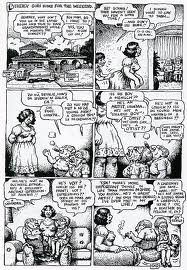
As a side note, I find many of the Cartoonish images of Robert Crumb employ this bodily charm.  Indeed, Crumb is fascinated with shapely people.  And while many of these images have erotic connotation, many others have a comic and sometimes a Jewish connotation.  One could plausibly argue that this weight often denotes, for Crumb, a shapely schlemiel as in this piece from his comic, The Snoid.

DownloadedFile-3

In designing the main character for Absurdistan, it seems Shteyngart was acutely aware of this charm.  We see this in the opening lines of the first chapter where Misha, the main character, introduces himself:

I am Misha Borisovich Vainberg, age thirty, a grossly overweight man with small, deeply blue set eyes, a pretty, a pretty Jewish beak that brings to mind the most distinguished breed of parrot, and lips so delicate you would want to wipe them with the naked back of your hand. (3)

Here we see the Jewish body foregrounded.  We also see it in Shteyngart’s first novel.  But over there the focus is more on the main character’s “Jewish” hips and his Jewish “walk” (both pointed out by the main character’s Russian mother).  Here it is the nose (the “Jewish beak”); but in addition to this Misha also sees himself in terms of his weight.  To be sure, his weight is a topic of interest throughout the novel and, in Misha’s eyes, it (and not simply his Jewish features) makes him “the odd one out.”

But there is more to the story. His weight should also be read against the background of his affluence.  To be sure, Misha comes from a very wealthy family and his weight may be an expression of his wealth.  And how we view this wealth, his approach to himself, and to the world he lives – which could be unduly harsh – should be counterbalanced by his weight.  Indeed, his weight – and not his nose – brings out the schlemiel’s charm; and because of this, his weight (and his attitude toward it) becomes one of the main signs of his schlemielkeit. Reading the text against his body can yield some interesting insights.

First of all, in yesterday’s blog entry I pointed out how Misha – in the Prologue – sees Absurdistan as a book about “too much love” and about “being had.”  Read against his representations of his body – in the first chapter – these passages become more endearing.  He is a person who, we can imagine, may be self-conscious by virtue of his weight; given this supposition, his love and bad luck take on another shade. In addition, because Misha’s Jewishness is an issue in the Prologue, we can now see that his Jewishness is also altered by virtue of his weight.

To be sure, there are many folkloric images of heavy people.  They are at the core of this or that folk culture: they often signify joviality and life itself. In the prologue, he notes how he is “writing from” the land of “Mountain Jews” and he conjures up folk images by saying that the community is “pre-historic” (he even likens the community to a dinosaur – a large creature – and calls it, playing on the Jewish name, Haim and the word Heim in Yiddish (which means home), a Haimosaurus).

In a folkloric sense, this village full of diverse kinds of people who surround him and look to help him.  In fact, in a folkloric sense, he comically notes that they are “too hospitable.”  And when we realize that he is a heavy person (from the beginning of the first chapter) who is in need of help, which we see at the outset of the novel (the prologue), Misha’s schlemiel character takes on folkloric proportions. However, the first chapter (as opposed to the Prologue) is not located in a folkloric space; it’s located in the post-modern, post-communist, and globalized space of St. Petersburg.  And after making his “bodily” introduction, we are introduced to this post-city (which has nothing pre-historic or folkloric about it at all):

By the year 2001, our St. Lennisburg has taken on the appearance of a phantasmagoric third-world city, our neoclassical buildings sinking into the crap-choked canals, bizarre peasant huts fashioned out of corrugated metal and…worst of all, our intelligent, depressive citizenry has been replaced by a new race of mutants dressed in studied imitation of the West, young women in Lycra…men in fake black Calvin Klein jeans hanging limply around their caved-in asses. (3)

As you can see, this is not the world of folklore that Misha is describing.  And his way of speaking demonstrates – in contrast to much of the prologue – that he is an intelligent, observant person.  However, as the introduction goes on, we notice that his intelligence is also tainted by affluence and the very culture he can’t stand:

The good news is that when you’re an incorrigible fatso like me – 325 points at last count – and the son of the 1,238th richest man in Russia – all of St. Lenninsburg rushes to service you….You are blessed with the rarest treasure to be found in this mineral-rich land.  You are blessed with respect. (3)

In other words, he has a love/hate relationship with the city he was raised in.  He is spoiled by it and his schlemielkeit may also have to do with his affluence.  By being served like a prince and gaining weight, he becomes foolish.  However, at the same time, we see from the Prologue that his weight also has a folklorish aspect (which can be situated in an odd, Jewish context).    The contrast between these two spaces is brought about by way of how his body is situated.    His body seems to fit into both spaces, but, as I have shown, its meaning differs considerably. As I continue reflecting on the novel, I will –from time to time – come back to his (Jewish) body and its relation to his schlemielkeit.   The novelty of this reflection is that it looks to show how important the body and its odd relationship to the world are to schlemiel comedy in general and to this novel in particular.

The Prologue to Gary Shteyngart’s Absurdistan

DownloadedFile

Schlemiels come in all sizes, shapes, and colors.  Rather than simply generalize about the schlemiel – which I, like Ruth Wisse, Sander Gilman, Hannah Arendt, Sidrah DeKoven Ezrahi, and a few other schlemiel theorists often do – I’d also like to take a closer look at all the different kinds of schlemiel so as to expand the horizon of schlemiel theory.  I’m especially interested in how different writers from different time periods articulate this character.  To be sure, the way they convey the schlemiel and his/her ways teaches us about how they approach the schlemiel.   And the differences between these articulations – as well as the general trends – teach us a lot about this character and how it takes on different shades: sometimes s/he is adorable, other times s/he is irritating; sometimes s/he is an utter failure, other times s/he’s a partial failure; sometimes s/he’s redemptive, sometimes s/he’s not.  But, to be sure, one can always say that the schlemiel is the odd one out.  His/her oddity is manifested in an awkwardness that arises out of misjudging the norm or in misjudging this or that situation.  On the other hand, the schlemiel’s oddity may not be manifested in awkwardness: he or she may be odd with out even knowing it.  But how odd is s/he? What makes him/her odd?  These questions inform the decisions that many writers, filmmakers, poets, and comedians make when portraying the schlemiel.  And the decisions they make can and often do change the way we look at this character in this or that historical period.

One writer who provides something of a new schlemiel – who evinces a complex form of oddity – is Gary Shteyngart.  In this blog, I have written extensively on Vladmir Girshkin – the schlemiel of his first novel: The Russian Debutante’s Notebook.   I initially found what I call Shteyngart’s “immigrant-becoming-American-schlemiel” to be quite a novelty.  This new articulation of the schlemiel challenged the literary critic Irving Howe’s claim that, with the end of the waves of post-pogrom Jewish-European immigration to the USA, Jewish fiction would have little to draw on.  To be sure, Howe, saw great creativity in the struggle Jews had with assimilation.  Their liminal state prompted many Jewish writers to create fiction which often had a modernist flavor.  Now that we are in a “post-assimilation” era, he thought that was a thing of the past.  However, Shteyngart shows that its not.  His characters are Russian Jews who have come over to the United States in the post-Communist Era.  And, because they are somewhere between worlds and have a hard time succeeding, they provide us with a new articulation of the schlemiel.

However, what I found disappointing about Shteyngart’s first novel is that it actually traced a story arc that differs considerably from the story arcs we find in much literature on the schlemiel (from Sholem Aleichem to Saul Bellow).  This starts with what I called a “partial transformation.”   And when he flees America for Eastern Europe, this transformation takes on more of a reality (as he becomes more masculine).   At the end of the arc (the epilogue), the main character, Vladmir, decides to live a normal life.   Since he becomes a dad, and because I find the gradual displacement of the schlemiel in this novel to be disappointing, I call this a “dad ending.”   After assessing the novel, I turned toward a generalization about the schlemiel and its arc, which can be found in the work of Hannah Arendt.    In my view, Arendt and Shteyngart (at least in this novel) were situating the schlemiel on a path that I did not agree with since I find nothing wrong with the schlemiel being an “exceptional” (as opposed to a “normal”) character.

With this reading in mind, I have decided to give Gary Shteyngart another chance. To this end, I have chosen to make a series of close readings of his second, follow up, novel: Absurdistan.

Like any reading, I’d like to start at the beginning, which Shteyngart makes a prologue rather than a first chapter.  It’s entitled “Where I’m Calling From”.   Perhaps because I have read too much Freud or have a penchant for history, I can’t help but think of the expression the “the past is prologue” whenever I see a prologue.  Regardless, I think it is a good intuition to take this thought to heart when reading this prologue.  And in this novel it “pays” to do so since the main character – Misha Borisovich Vainberg – is a narrator who is interested in telling the reader how he screwed up.   And this, to be sure, is one of the schlemiel keys to this novel.   But the question that interests me is whether such reflection means he is, so to speak, beyond his schlemiel character and situation.  Will he, like Vladmir in The Russian Debutante’s Notebook, undergo a transformation from a schlemiel (a man-child) into a man in the Epilogue?

As I read this novel, this question lingers.

But at the beginning there is no question: Misha is a schlemiel.  His description of this book tells us that this book is, on the one hand, a book “about love…too much love” and, on the other hand, a “book about being had.”  His love, so to speak, produces bad luck: it allows him “to be had.”   But, like many an innocent schlemiel, he is not to blame; they are:

I’ve been had.  They used me.  Took advantage of me. Sized me up. Knew right away they had their man.  If “man” is the right word.  (vii)

Indeed, is “man” the right word or is schlemiel the right word?

Reflecting on how he came to being a man-child of sorts who has taken advantage of, Misha demurs: “Maybe this whole being-had deal is genetic.”  Along this line of thinking, he first turns to his grandmother who was “an ardent Stalinist and faithful contributor to Lenningrad Pravda.”   But his point isn’t that she was had by the Communists she supported.   To be sure, in his flurry to explain himself, he seems to have lost his point regarding the “being-had deal” as “genetic.”   However, he does remember himself in a picture with his grandmother “as an infant…I’m drooling on her. She’s drooling on me.”

This logic, of course, is off.  But that’s the point.  He’s less concerned with the “genetic” origins of his condition then with his present, sad state.  Now, apparently, he is “missing teeth” and has a “dented lower stomach.”  His heart is “bruised” and there is a “kilogram of fat hanging off” his “breastbone.”

Although he reflects on his present state, he doesn’t loose his thought regarding his genetics.  It resurfaces, it seems, in a thought about “where he is writing from” (the title of the prologue).   This place may have something to do with the origin of his schlemiel-condition.  Misha is writing from the “former Soviet republic of Absurdsvani.”  And this place is a “small village populated by the so-called Mountain Jews.”   These Jews are “isolated” and have a “single minded devotion to clan and Yahweh.”  In contrast to the Jews he has grown up with, they are “prehistoric, premammalian even, like some clever miniature dinosaur that once schlepped across the earth, the Haimossaurus.”

This village of Jews – his people -are an odd bunch:

The villagers gathered around me, the dried-out senior citizens, the oily teenagers, the heavy local gangsters…even the confused one-eyed octogenarian rabbi who is now crying on my shoulders, whispering in his bad Russian about what an honor it is to have an important Jew like me in the village. (viii)

Although he is astonished by this odd village of “mountain Jews” and feels touched by their kindness, he tells the reader that he is a “deeply secular Jew” who misses New York City and his old girlfriend Rouenna:

The mountain Jews coddle and cosset me; their hospitality is overwhelming…and yet I yearn to take to the air. To soar across the globe.  To land on the corner of 173rd Street and Vyse, where she is waiting for me.  (viii)

So…where he is writing from (a place of Jews where he feels comfortable with – an important point, as I hope to show, since he has problems with some kinds of Jews; namely, Hasidim) is not where he wants to be. He wants to be somewhere else far from these “pre-historic” origins (which he is not totally at odds with, but cannot settle with).

The prologue ends with him meditating on his “love” in New York City.  And he restates his claim that this book – Absurdistan – is a “book about love.”  But he adds to this one new thought: “it’s also about geography….I am Here.  I am here next to the woman I love.  The city rushes out to locate and affirm me.”

One can end the prologue here, but that would be a mistake.  After all, he’s not there. He’s in a Village of Mountain Jews.  And, in addition to that, he says that this is a novel about love AND about “being-had.”   These last two elements, in contrast to his emphasis on love as the underlying meaning of the book, teach us that this is much more than a novel about love: its also a novel about Jewishness and the schlemiel-who-is-had.

This combination makes for a nuanced schlemiel character.  What I like about this prologue is the suggestion that we read Misha – and the schlemiel character – in terms of a tension between a consciousness of being-had, Jewishness, love, and New York City’s tension with Absurdistan.  This makes for yet another Immigrant-Become-American-Schlemiel story arc.  However, the question is whether or not it ends with the schlemiel it starts off with in the prologue: a schlemiel-in-love, a schlemiel-who-has-been-had, and a schlemiel-in-search-of-home.

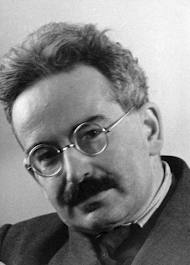
On an Aesthetic of Redemption or The Problem With Historicizing Walter Benjamin (Take 1)

images

I’m not an intellectual historian.  And while I enjoy reading intellectual history, I always worry about the problem of periodization.   Like any historicization, the risk is to say that on this or that date everything changed with this or that thinker.  The problem with such claims is that – in a Derridian sense – something always remains.  Many intellectual historians, in an effort to make a coherent historical narrative, often leave things out or argue that this or that element of said thinker’s thought took a turn.  While much of this may find support in this or that prooftext, oftentimes one can find counter-texts (and counter-memories, as Michel Foucault might say) to challenge this or that genealogy.   For me, the case in point is the intellectual history of Walter Benjamin.

What makes him such an interesting figure for intellectual history is the fact that he, himself, was an intellectual historian of sorts.  But his history was oftentimes focused on the intellectual history of different mediums (although they would focus on the shift as found in this or that writer, poet, or filmmaker).  In many essays, such as “The Storyteller,” “The Work of Art in the Age of Mechanical Reproduction,” or “Some Motifs of Baudelaire” or in his book, The Origin of German Tragic Drama, Benjamin clearly demarcates the shift from one era to another which can be found in different mediums (the novel, storytelling, film, and poetry).    But although Benjamin made rigorous demarcations, these demarcations were not absolute.  One can see overlap.  For instance, although Benjamin announces the end of the aura in one essay, he still notes that it lives on in others.  And when he argues that storytelling has been displaced by the newspaper, this doesn’t keep him from reflecting on it and bringing out it’s modern proponents (such as Kafka, Walser, or Proust).

To be sure, Benjamin, who read much Freud and incorporated his work into his own, believed that we are haunted by the past. In addition, there are many examples in his work where the past permeates the present and serves as an index of the future.   We see this in his Arcades Project, The Berlin Childhood, One Way Street, his essays on Baudelaire and Proust, his Kafka essay, and his essays that address the Messianic.

Moreover, in his personal reflections he also takes note of what remains.

And although there is room to argue that he was noting his own personal-historical shifts (as we saw in yesterday’s blog entry), he still sees these moments as lingering in the present.    Nonetheless, some intellectual historians choose not to take this into consideration.  One such intellectual historian is Peter Osborne, who argues that Benjamin, after writing his essay on Kafka, turned wholeheartedly to the political and turned away from the aesthetic.  Were one to read Benajmin’s letters to his dear friend Gershom Scholem, however, one would find another narrative.  In that narrative, Benjamin’s interest in the aesthetic and Kafka remain right up until his untimely death.

Richard Wolin’s intellectual history also chooses to leave a few things out, but, at the very least, he does what Osborne doesn’t: he shows how certain elements of Benjamin’s work cling –from the beginning to the end – to the “aesthetic of redemption.”  Wolin’s focus is commendable and merits closer reading.  I would like to point out, however, where he draws the line and what this implies.  (I will be commenting on his book on and off in this blog, so this reading is based on the beginning of his book where he addresses Benjamin’s “origins.”)

In the first chapter of Wolin’s book, Walter Benjamin: An Aesthetic of Redemption, he makes a reading of Walter Benjamin’s Berlin Childhood around 1900.   This reading reflects, on the one hand, an acute sense of how Benjamin looked to “redeem” his past via the aesthetic; on the other hand, it looks to periodize this work and leaves no doubt in the reader’s mind that Benjamin had left this behind.

One of the things that caught my mind was Wolin’s selection of texts to illustrate Benjamin’s vision of himself in the past and how it relates to the present:

He speaks of the unclear vision of intellectuals which results from an innate tendency toward flight from reality; a tendency he claimed to have detected in himself at an extremely early age which in his eyes manifested itself in his staunch refusal to form with others in a united front…”My habit of seeming slower, more maladroit, more stupid than I am, had its origins in such walks (through the city), and has the great attendant danger of making me think myself quicker, more dexterous, and shrewder than I am.”(3)

Commenting on this, Wolin argues that Benjamin “turned to the theme of childhood memories in a time when all possibilities seemed to be blocked”(3).  In other words, Wolin historicizes this line (and the whole book) to argue that if Benjamin wrote about the past, so as to find something hopeful (or even helpful) in it, he did so because his life (when he wrote it, in the 1930s) was bleak.   But, given that reading, we could argue that everything he wrote was prompted by the fact that he saw himself as a loser and was looking, as Wolin suggests, for reasons as to why he produced such bad luck.  In other words, he was looking for how he had become such a schlemiel.    To be sure, in this passage, Benjamin is trying to explain why he appeared so belated and slow (seemingly more stupid than he was): the very characteristics of many a schlemiel who is often too late or too early for this or that thing and who, like Gimpel the Fool, appears stupid when he is not.

Although this seems negative, Wolin, at the very least, notes that Benjmain derived something meaningful from his childhood experience (but, for Wolin, this has nothing to do with the fact that he has many comic and child-like aspects to himself):

What he attempted to capture in these reflections was, above all, a capacity for lived experience associated with an upbringing in Berlin at this time, whose last vestiges were in the process of being extinguished by the world-historical march of the forces of disenchantment. (4)

In other words, the only thing that Benjamin was interested in saving from the past was his “capacity for experience.” The experiences themselves, however, are left behind forever. As Wolin notes, “Berlin existed once upon a time, as it will never appear again.”   This implies not only that this book was a commemoration of a city that is no longer, but that Benjamin cannot go back.  His book was, more or less, a movement away from the childhood and toward maturity and adulthood.  The only thing worth salvaging is something that would always be there: the “capacity for experience.”

While I find the notion of such a “capacity,” interesting, I find it elides too much.  This capacity may be something gleaned from youth but it is ultimately abstract and seems to transcend history like Aristotle’s notion of capacity and potentiality.  Rather than make this move, I’d like to suggest – as I have throughout this blog –that Benjamin was acutely aware of how all of his capacities were haunted by failure.  This historical aspect isn’t redeemed; it is a remnant from his past which pops up in most of his work in the 1930s and in his letters to Scholem.  But this failure has a comic rather than a tragic note.

The problem with intellectual history is that it might find this element to be in competition with the narrative of maturity.  And it is right for thinking this because it is; and Benjamin knew this well.  It remained with him to the end.  And even Hannah Arendt, in her introductory essay to his work (to an American audience), noted the specter that remained with him to the end: she gave it a figure, the “hunchback.”  This figure –the figure of bad luck –haunted his maturation process and it should haunt any intellectual history of his work.  It reminds us that no matter how much there is evidence of evolving thought, something, in Benjamin’s work, remains.  But for Arendt, this has more to do with bad luck as such.  To be sure, in her view Benjamin is more of a shlimazl than a schlemiel (a topic that I will be addressing in my book and in forthcoming essays).

Walter Benjamin’s Messianic Butterflies

images-1

In his introductory essay to Walter Benjamin’s Berlin Childhood around 1900 entitled “Hope in the Past,” Peter Szondi argues that, in his belief that the past held the secret of the future, Benjamin became a schlemiel of sorts.  To illustrate, Szondi cites one of the passages in which Benjamin remembers his childhood experience of a party, when the rooms of his home were filled with “something…impalpable, slippery, and ready at any instant to strangle those around whom it played.”  Commenting on this passage, Szondi says that Benjamin’s metaphors bring together “the present and the future, the premonitions of the child and the knowledge of the grown man.”  As I have pointed out many times, often in relation to Walter Benjamin, a schlemiel is half-man/half-child; the schlemiel passes between Don Quixote and Sancho Panza.  What Szondi adds to my reflections on Benjamin is the claim that in going back to the past, in becoming a child, Benjamin was able to bring together the “present and the future.”   In other words, by becoming a child – and recording these reflections – Benjamin was not simply trying to understand himself; rather, he was trying to relate to his future and, to be sure, a messianic future shared by all.

Szondi suggests that Benjamin is close to Marcel Proust and Charles Baudelaire on this note because, in his search for “time past,” he is looking for the “disappearance of time.”  I would add, however, that this is not simply a search.  Drawing on Gershom Scholem’s reading of the Apocalyptic and Utopian elements of “The Messianic Idea,”  I would argue that Benjamin was looking for something that would “smash” history (as Scholem puts it) and expose him to something free of time.  For Scholem, what is free of time is…anarchic freedom.

And what better figure for freedom is there than a Butterfly?

Butterflies wander freely around space.  They move from thing to thing and aren’t touched by time or history.  To be sure, Benjamin was without a doubt familiar with Charles Baudelaire’s poem “Les Phares” (“Beacons”).  The poem begins by invoking a symbolist kind of garden.  And in each stanza, Baudelaire evokes several great artists such as Rubens, Leonardo da Vinci, Rembrant, Michelangelo, Puget, Watteau, Goya, and Delacroix:

Rubens, garden of idleness watered by oblivion,

Where the quick flesh pillows the impotence of dreams,

Where life’s affluence writhes in eddying abandon.

Like air in the air, or water on streams.

The stanza on Watteau invokes butterflies:

Watteau, carnival where many a distinguished soul

Flutters like a butterfly, lost in the brilliance

Of chandeliers shedding frivolity on the cool,

Clear decors enclosing the changes in the dance.

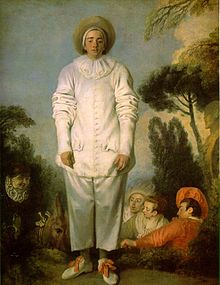
Watteau, in this stanza, is associated with the carnival where “many a distinguished soul flutters like a butterfly, lost in brilliance.”   Besides acrobats, jugglers, and side show performers, we often find the clown.  And one of Watteau’s most famous series of paintings takes Commedia del Arte as their subject. One of the most famous of these, is his painting of Pierrot.   What I find so interesting about this painting is that the subject – a man-child – is separated from the others.  And his body, dress, and gaze are off.  Baudelaire, no doubt, was aware of this work, and wrote about it in his famous essay “The Painter of Modern Life.”

220px-WatteauPierrot

What I find of interest is the fact that – for Baudelaire – people become like butterflies around this comic figure, lose their sense of time, and wander through space.  With this in mind, I read Walter Benjamin’s reflection on Butterflies, hoping to find what Szondi calls “omens of the future in the past” by way of becoming childlike (and, to some extent, like a clown).

Benjamin’s reflection on butterflies, in The Berlin Childhood around 1900, is entitled “Butterfly Hunt.”  Benjamin starts off his reflection by remembering “the beginnings of his butterfly collection.”  He goes on to provide a detailed description of some of these butterflies.  Following this, Benjamin remembers his movements which, to be sure, merge the present and the past and provide an opening on to the future.  And the main crux of these reflections points back to his own activity: to capture that which is fleeting from the past in the present so that it can be a sign for the future.  The butterflies take on the figure of this ephemera and, in a way, mark something almost “pre” and “post” historic”:

They would flutter toward a blossom, hover over it.  My butterfly net upraised, I stood waiting only for the spell that the flowers seemed to cast on the pair of wings to have finished its work, when all of a sudden the delicate body would glide off sideways with a gentle buffeting of the air, to cast its shadow – motionless as before – over another flower, which just as suddenly it would leave without touching.  (51)

As he follows the Butterfly move from flower to flower, Benjamin loses his sense of time.   He experiences freedom…a kind of experience that is like that of a dandy (moving from thing to thing and from space to space effortlessly).  But, as this happens, it seems he has forgotten to capture it.  But then he remembers his task to “capture” the butterfly and feels “as if” the Butterfly has made a “fool of me through its hesitations, vacillations, and delays.”  In response, Benjamin becomes a hunter by virtue of losing his identity as a man.  He becomes-a-butterfly in order to capture the butterfly. But this is not a simple act of hunting a butterfly; as Benjamin describes it, this act of becoming breaches the limits of the human:

Between us, now, the old law of the hunt took hold: the more I strove to conform, in all the fibers of my being, to the animal – the more butterfly-like I became in my heart and soul – the more this butterfly itself, in everything it did took on the color of human volition; and in the end, it was as if its capture was the price I had to pay to regain my human existence. (51)

What follows this capture, more or less, is a recording of how Benjamin became a “man” who had subdued his prey and gained new knowledge:  “His lust for blood had diminished and his confidence was grown all the greater”(52).

Instead of seeing this as the narrative of his movement toward maturity, I would like to suggest that Benjamin took the moment of following the butterfly and becoming the butterfly – while fearing that he may not come back to humanity – as the messianic moment in the text.  In this moment, Benjamin frees himself of the human while, at the same time, reflecting on it.  He has, in a sense, captured this moment of oscillation between the human and the non-human which, as Giorgio Agamben has argued in The Open (and elsewhere), has messianic resonance.

That said, how does this all connect to the fool, the butterfly, Watteau, and Baudelaire’s poem?  I would like to suggest that Benjamin was aware of Baudelaire’s “butterfly’ and understood how it was likened to the people who were amused at the circus.  These people get lost in what they say and move from thing to thing.  Of the things that fascinate them most, we find the clown or man-child. What he does is similar to what Benjamin does, he reflects back to them their deepest desire which is a desire to be free of Time and history.

Although Scholem associated this messianic moment with smashing history, Benjamin (at least during one point of his reflections) believed that, in becoming-a-butterfly (by becoming a child), one could, for a brief moment, gracefully touch upon this messianic moment.  However, as Benjamin notes, it also paved the way for his manhood.  The risk of capturing the butterfly is that, as Benjamin notes, a “price” must be paid. For him, the price of knowledge and manhood is the experience of timelessness and the sense that, in becoming a messianic butterfly, one may not come back to humanity.

When we watch the fool or schlemiel lose himself (as Sholem Aleichem’s Motl does with nature, Singer’s Gimpel with trust, etc) do we also experience that moment which is suspended between childhood and adulthood as well as between the human and the inhuman?  Is our “post-historical” hope (our future) locked up in this “pre-historic” past?

A Note on the Poet, the Philosopher, and the Simpleton in William Carlos Williams’ “Paterson”

DownloadedFile-6

I didn’t grow up in the generation of the Beat Poets, but I was always interested in them.   One of the poets who had a great influence on Beat Poets like Allan Ginsburg or Lawrence Ferlinghetti was William Carlos Williams.  One of the first books of poetry I read of his was “Paterson.”  I recently ran across the text and I was drawn in by the poetry of Book One Section II.  I found something very American, poetic, and comical in that section.  What I found so amazing is that Williams manages to keep each of these voices distinct.  The difference between a few styles of writing produces this comedic effect and this has much resonance with the schlemiel (who is a simpleton, a “tam”).

In the opening stanza, we hear a voice that is confused, a voice that is concerned with the “how” (not the “what”).  This voice is “more than a how,” says the poetic voice; it is a voice that Howls:

There is no direction. Whither? I

Cannot say. I cannot say

More than how.  The how (the howl) only

Is at my disposal (proposal): watching –

Colder than stone –

In a modernist sense, Williams is suggesting that we pay close attention to “how” he speaks and even more so to his “howl.”   This will help us to understand his poem.

The following stanza evokes an image of a “bud forever green.” But this bud has fallen on the pavement.  It is “divorced.”  From what?

Playing on this divorce, Williams evokes a public (and not a poetic) American voice which is mixed with a philosophical one:

Divorce is

The sign of knowledge in our time,

Divorce! Divorce!

These words direct our attention (by way of indirection) to the many ways things in this poem that are divorced from each other.   The next stanza evokes the “roar” of Paterson’s main waterfall.  It induces “sleep and silence…the roar of eternal sleep.”   The roar looks to “divorce” us from “wakefulness.”  It “challenges” us to stay awake.

Given the how we saw in the outset, we should ask a question: How – in the midst of this roaring – does one keep oneself awake?

The poem, at this point, presents “two halfgrown girls hallowing hallowed Easter.”  They are “weaving about themselves.”  But they are “disparate” among the roaring waters.  The theme of separation and divorce are once again pronounced.

“Beauty” comes to the rescue.  To be sure, Immanuel Kant and other philosophers associate beauty with harmony.  And in this scenario, perhaps beauty can bring the divorced elements together.  The poet, speaking from a poetic and a philosophical angle, provides a reflection on the girls mentioned above.  He says they are wrapped up in ribbons, bows, and twigs.  There is even reference to fur.  Their beauty, it seems,  harmonizes culture and nature.  But, in the midst of this poetic solution to a philosophical crisis, we hear an American voice interrupt the image:

Ain’t they beautiful!

The voice of the slang is divorced from the poetic voice, but, in its simplicity, it brings the poem to a different place:

Certainly I am not a robin or erudite,

No Erasmus nor bird that returns to the same

Ground year by year….

The ground has undergone a subtle transformation, its identity altered.

The poet, who also seems to be a philosopher, loses his identity, the “ground” he speaks from (which could be a philosophical or poetic ground) is altered; and, as a result, he becomes a simpleton and child-like.  But this transformation is not complete: the poet and philosopher return after this shift.  And they are both overwhelmed by all of the details of existence.  They stay “awake” out of some kind of existential terror.  But the simpleton does not seem to be affected.  Is he sleeping?  Has the roar of the waterfall put him to sleep?

This contrast – between the poet, the philosopher, and the simpleton – makes me think of the schlemiel.  The schlemiel travels around existence, explores it, yet without any philosophical quandaries about beauty, the divorce between the cultural and the natural, and so forth.  He is free of that, but the poet is not.  And this creates a kind of relationship – like the one between Sancho Panza and Don Quixote: the fool and the rationalist.

But, and this is the point, they (like the voices in this poem) stick together.  And Sancho Panza learns from Quixote.  Here, the poet and the philosopher learn from the ways of the simple American who is “not a robin or erudite” and he doesn’t return to the “same ground.” For the Simpleton, everything seems different (but in the way of wonder not angst, which sees everything as divorced).   And, unlike the philosopher or the poet, he doesn’t have a ground.  But, for the simpleton,  that’s nothing to panic over.  They panic, while he wanders, distracted, through the American landscape.