Final Notes on Jewishness in Gary Shtyengart’s Absurdistan – Take 1

images-4

The image of Judaism and Jewishness that comes across to the readers of
Gary Shteyngart’s Absurdistan is disturbing in many ways. Over the last month, I have written several blog entries on Gary Shteyngart’s representation of circumcision (by way of Misha, the main character of Absurdistan).   As I point out in many of these blog entries, the description of circumcision and his “mutilated” penis (descriptions that have much resonance with Paul and even Augustine’s most anti-Jewish words) are not, as they say, “good for the Jews.”  Although the author may not have intended this, the fact of the matter is that each of these descriptions makes Judaism into a barbaric and primitive kind of religion.  But, to be sure, this is what Misha thinks about when he thinks of Judaism.

At the outset of my readings of Absurdistan, I wrote a blog on the Prologue which notes Misha’s description of the “Mountain Jews” he meets in Absurdistan as “pre-historic.”

They are “prehistoric, premammalian even, like some clever miniature dinosaur that once schlepped across the earth, the Haimossaurus.”

As we learn in the Prologue, he doesn’t want to stay with this group of “pre-historic” Jews.  He appreciates their hospitality, but he finds it “overwhelming.”  He needs air and feels he must leave the Jews for his Latino-African-American girlfriend, in his second home, New York City:

The mountain Jews coddle and cosset me; their hospitality is overwhelming…and yet I yearn to take to the air. To soar across the globe.  To land on the corner of 173rd Street and Vyse, where she is waiting for me.  (viii)

Ultimately, Jews and his circumcision make him fill ill-at-ease.  And while at the outset of the novel he refers himself as a “secular Jew,” later on, toward the end of the novel, Misha refers to himself as a “multicultualist.”  In front of other people, he doesn’t seem to like Jews and shows no preference for his “pre-historic” roots; rather, he likes “others”:

“I am not much taken with Judaism,” I announced.  “I am a multiculturalist.”  Except there was no Russian word for “multiculturalist,” so I had to say, “I am a man who likes others.”(218)

This declaration comes at an odd time in the novel since he is, at this point, asked to get money for the Svani “cause” by way of making an appeal to the Jews for money (224).  To this end, he is appointed the “Minster of Multicultural affairs.”  The appeal to multiculturalism, he thinks will bring money.  However, Misha learns that he must appeal to Israel for money; but to do this, Misha has to act “as if” he wants to do something for the Jews when, in fact, Misha’s not interested in doing anything for them.  After all, he’s a “multiculturalist.”

This new task confuses him.  When he thinks about what to do, he is thrown into an imaginary conversation with this dead father (who, as I mentioned in other blogs, had prompted him to get his circumcision).  His father loved Jewishness and Israel and, as we can see, Misha does not.

In his imaginary conversation, Misha wants his father to see him as an independent man: “Papa! Look at me!  Look how fine I’ve grown.”  But in his memory, Misha notes that his father was too busy with work and didn’t pay attention to him.  Misha remembers how his father had, in a sense, ruined his life.  Amongst the things he recalls, we find the circumcision.

How little use he had for me.  But then why did you send for me, Papa?  Why did you interrupt my life?  Why did you have to put me through all this?  Why did you have my khui (penis) snipped?  I have a religion, too, Papa, only it celebrates the real. (235)

Misha is a man-child looking for his father’s approval.  Yet, at the same time, he tries to be independent.  For this reason, he tells his father that, like him, he wants to help a people; but not the Jewish people; rather, the Sevo people:

“I want to believe in something, too, Papa,” I said. “Just like you believed in Israel. I want to help the Sevo people.  I’m not stupid.  I know they’re no good.  But they’re better than their neighbors.” (237)

His imaginary conversation inspires him to help the Sevo people.  To this end, he drafts up a proposal so as to get money from the Israelis (which he will give to the Sevo people).  The irony is that the project is dedicated to the preservation of Jewish identity by way of an appeal to the Holocaust and Holocaust memory.

The project name is: “The Institute for Caspian Holocaust Studies, aka the Museum of Sevo-Jewish Friendship.”

I’ll cite his justification for this project since it will give the reader a sense of how Misha is playing the “identity card”:

The greatest danger facing American Jewry is our people’s eventual assimilation into the welcoming American fold and our subsequent extinction as an organized community.  Due to the overabundance of presentable non-Jewish partners in the country as tantalizing diverse and half naked as America, it is becoming difficult if not impossible to convince young Jews to engage in reproductive sex with each other….It is time to turn to the most effective, time-tested, and target-specific arrow in our quiver – the Holocaust. (268)

The irony of all this is that he is not convinced by this argument for Jewish identity but, nonetheless, he makes it so as to solicit money.  He isn’t interested in perpetuating Jewish identity, but he acts “as if” he is:

Identity politics are a great boon in our quest for Continuity. Identity is born almost exclusively out of a nation’s travails.  For us…this means Holocaust, Holocaust, Holocaust.  The twin halves of the broken matzoh will be infused with the spirit of the New Tribalism that is captivating young people across the Western world in angry response to global homogenization.

To be sure, Misha has no interest in this “New Tribalism”; in fact, he’s running away from it.  And he would rather assimilate than hang out with the Mountain Jews.  For this reason, we can rest assured that Misha  must be chuckling when he describes the New Tribalism as a combination of Holocaust Memory and “towering videos of Jewish college boys at fraternity mixers hitting up demure Korean girls, while pretty suburban Jewish maideleh fetishize their urbanized African American counterparts at a Smith Barney softball game. Subtext: six million died and you’re twirling around a bar stool with some hazzar?”(270).

The point of all this is to show how Misha, a “multiculturalist,” sees Jewishness as pre-historic and out of tune with the tide of globalization.  However, as I will point out in the next blog entry, he is, in the end, duped by the “Sevo people.”  And on his way out, he is saved by the “Mountain Jews.”  Nonetheless, he doesn’t want to stay with them.  For, as I noted in the outset, they make him uncomfortable.

To be sure, it is Jewishness that makes Misha, the multiculturalist, uneasy.  He associates it with his father, with his circumcision, and with a people that wants to preserve itself through the Holocaust industry and guilt.  Perhaps we can argue that this is a satire and that Misha needs to get in touch with a Jewishness that he has trashed; however, I haven’t as yet seen any of these readings or heard anything from the author to this tune.

For this reason, it seems as if there is an element of truth for Shtyengart in this reaction to things Jewish.   And for those of us who think differently about Jewishness, these types of quips against it may make the character less charming and more troubling.

And the irony of it all is the fact that he is more interested in “other” people preserving their identity and less in his own people’s doing so.  And for the strange reason that one kind of preservation is better than the other because one is modern (and not Jewish) while the other is a “pre-historic” and ancient practice.  This, it seems, is his major blindspot and may, in fact, be the thing that makes him into a multicultural-schlemiel-of-sorts.

…to be continued
I Don’t Have to Grow Up, I’m an American Kid: Gary Shteyngart’s Parody (?) of American Dreams

images-3

Near the end of Gary Shteyngart’s second novel – Absurdistan – Misha, the main character, reflects on what he learned about America from “Accidental College.”  What we find in this account is a description of America as a place where the fine line between childhood and adulthood “has been eroding.”  At Accidental College, dreams are greater than all and dreams, for Misha, are the substance of childhood:

At Accidental College, we were taught that our dreams and our beliefs were all that mattered, that the world would eventually sway to our will, fall in step with our goodness, swoon right into our delicate white arms.  (230)

The classes Misha took at Accidental College reflect a curriculum that is not so much about preparing one for the adult world as returning one to the state of dreams and childhood.  He sees this as a symptom of something larger happening in America in which the fine lines between childhood and adulthood, on the one hand, and the personal and the fantastic, on the other, are effaced:

All over America, the membrane between adulthood and childhood had been eroding, the fantastic and the personal melding into one, adult worries receding into a pink childhood haze. (230)

As support for this claim, Misha notes that he was gone to parties in Brooklyn “where men and women in their mid-thirties would passionately discuss the fine points of the Little Mermaid or the travails of their favorite superhero.  Deep inside, we all wished to have communion with that tiny red-haired underwater bitch.  We all wanted to soar high above the city…and champion the rights of somebody, anybody”(230).

Misha finishes his meditation on America by likening democracy to “the best Disney cartoon ever made.”

Although Misha often comes across as an out-of-touch fool, this meditation on America, like much else he says, has an element of truth.  To be sure, Shteyngart, in much of his work, celebrates the effacement of the fine line between childhood and adulthood.  The fact that his parodies of this effacement are mild and silly doesn’t do much to reinstate this line.  In fact, I’d say that that’s not what he wants to do.  Rather, it seems as if he sees this as a new, ironic norm, which, in many ways, comes to accept the childish aspects of American reality as a fact.

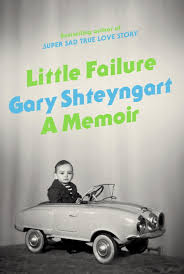
Reading his account, one wonders how much of this description resonates with the author of the new memoir Little Failure.  To be sure, Shteyngart no longer goes through characters such as Misha or Vladmir to explore his relationship to America; he goes by way of a reflection on himself.  And many of these reflections, as we can see from interviews and excerpts from his memoir, cast him as a man-child.

His “little failure” (as well as the picture for the book) give another shade to the America that Misha saw by way of his education at Accidental College and his experiences in Brooklyn.  They may be ironic, but the fact of the matter is that unlike much irony, which looks to wound or destroy its target, this irony is the irony of a kind of acceptance which, ultimately, is ridiculous.

In this irony, America, the land of dreams, becomes literalized.  This works well with Sidrah DeKoven Ezrahi’s reflections on America in Booking Passage: Exile and Homecoming in the Modern Jewish Imagination.   In her view, America remains a land that is perfect for the diasporic schlemiel.  Shteyngart adds to this by showing that its not just a land of dreams it’s a land of perpetual childhood where the line between being an adult and a child is, for all intents and purposes, effaced.

We don’t have to accept these generalizations or descriptions.  To be sure, they belong to a certain project.  To be sure, the schlemiel need not be seen as a man-child.  S/he shuttles back and forth.  And her failure is not something silly or childish.  This is what great Jewish American novelists like Bernard Malamud and Saul Bellow want to show us.

One that fine line between childhood and adulthood is effaced, however, failure itself will become “little” and silly.  When it comes to the schlemiel, we have to take this risk seriously.  The problem with characters like Misha is that they seem to have no problem with this, and we see this in his portrayal of American and his American education.

I suggest that the line between the two remain porous, but not effaced.  The question of what it means to become mature is at the basis of the question of failure.  We need to learn how to articulate this question by way of the schlemiel who is a comic failure.  His failures may be comic but let’s hope they don’t become so small as to become childish and silly.

When that happens, the meaning and power of this comic character will be lost.

When is too much…too much? The Exhaustion of Failure in Shteyngart’s Little-Failure-Ad-Campaign

DownloadedFile-2

Ok.  Its good to know what someone is doing, but when is too much…too much?  And what happens when what he or she is saying is not particularly that insightful?

When it comes to the schlemiel, there is a limit.   Every good writer knows that.  Overkill doesn’t do the schlemiel well.  This is what I fail to see in the Gary Shteyngart’s ad campaign to promote his work.  The content of this endless series of faux pas – inside of interviews, a film trailer, the pages of memoir that he sent to the New York Times, endless praise in this or that newspaper, where we see the ironic little immigrant failure foregrounded – is too obvious and cliche.  It is overplayed and it actually reduces the schlemiel character to the endless repetition of bad jokes.   To be sure, I turn to literature so I don’t have to see all the schlemiel characters that Will Farell, Seth Rogen, and Ben Stiller do so well.  I don’t want to find Hollywood in a schlemiel novel (or a schlemiel memoir).  And I don’t want to hear the a self-congratulatory and slightly snarky tone that I so often find on the pages of New York Magazine.

When I see all of this, I realize what I don’t like.  What I want to see is a schlemiel that is far from New York Hipsterdom and Hollywood comedy.   And I have recently found this in the pages of Bernard Malamud’s novel A New Life.  What I discovered is that, not too long ago, the American schlemiel was a character who, though comic, was trying to seriously start a “new life.”  Shteyngart mimes this process in much of his work.

The life that his characters live or end off with in nearly every novel is, as I pointed out elsewhere “normal” or else lived in yearning of returning to New York.  The end is lacking believability because the characters are either too normal or too ridiculous in their life.

In Malamud’s A New Life, the main character Levin is much more believable.  His schlemiel character touches deep on the life of the male American Jew.   The failures of Levin are not too caricatured.   They feel like real failures.

In taking himself as his subject, Shteyngart’s failures are caricatured.   They are truly silly.  Though animated, they are about as interesting as the next article on your facebook feed.

A recent cartoon interview with Shtyengart is a case in point.

A Comic Interview with Gary Shteyngart

The ironic line that gives it all away happens when Shteyngart jokingly tells us that:

Inside the little clown was an angry kid trying to get out.  Had I been bigger I would have been some kind of bully. 

And the punch line:

Thank God for my tiny frame.

What we are left with is a Jew whose body limits his inner anger.  He doesn’t have the frame to be a man.  The joke is obvious and it makes the Jewish body into a pathetic site of failure.

What’s lost in all this is Levin, Malamud’s schlemiel.  When I think of Levin, I don’t think of his body.  I think in terms of his desire for something better than what he has experienced in his life.  He is a schlemiel because the life he ends up with is new but not in the way he expected.  He often makes the wrong choices, but not always.  He is not a pathetic failure, nor does he endlessly play on failure.  Levin seems to be on, but he’s  just a little off.   Nonetheless, he does have some minor triumphs.  And these are meaningful.  The treatment of failure in American life (for a Jew) is much more believable, humbling, and meaningful.  Malamud’s schlemiel is someone who I can identify with: his failures, real enough, hit on something common to many American Jews – even I, who was born from a different generation than Malamud, find something more resonant in his schlemiels (something that really is about being a Jew and being a failure).

Shteyngart is my age.  We come from the same time, but we come from different countries.  And, more importantly, we have a different understanding of the schlemiel.

Though I have spent a lot of time writing on his work, I always felt that this treatment of the Jewish-American schlemiel was missing something.  I couldn’t identify with his schlemiels as I could with Roth, Bellow, or Malamud’s.   In Levin, Herzog, and Portnoy there is a serious engagement with the link between an American, a Jew, and a schlemiel. Their schlemiels have given me insight into how Jewish schlemiels are locked into different identity-crises: one’s that matter.

The fact that the Jews survives this crisis while at the same time failing gives a deeper shade to the meaning of failure.  Shteyngart’s interviews and ads do the opposite.  In fact, watching them, I feel as if the schlemiel becomes more and more clichéd and empty.  Failure loses all of its content.

When did we ever settle for this?  What does it mean that Random House thinks that we can no longer live through the schlemiel like we used to?  When did they decide that the schlemiel was utterly meaningless by way of infinite repetition and non-variation?

So, when is too much, too much?  When is the praise of the “Little Failure” too much?

Answer: right now.

What we have with this repetition of a certain kind of  schlemiel….is the exhaustion of failure….

Pajama Boy, The (New) Schlemiel, and Obamacare

131218_lowry_pajamaboy

When I woke up this morning I noticed an article by Politico (which is not a right-wing publication) that registered a high frequency on my schlemiel radar.  The words that caught my attention were in its headline: “Pajama Boy, An Insufferable Man-Child.”   The article was written in response to an ad tweeted by “Organizing for America,” a group that has been putting out ads in support of Obamacare.   The ad has been responded to by the likes of Chris Christie who tweeted – in one of several tweets – that he should “get out of his pajamas and get a job.”  And George Will, a well-known conservative who writes for the Washington Post called this an expression of the Democratic party.

Organizing for America was obviously shooting for a large demographic which emulates the man-child; that is, the schlemiel.  To be sure, as Sidrah DeKoven Ezrahi writes in Booking Passage: Exile and Homecoming in the The Modern Jewish Imagination, the schlemiel has become a “cultural icon.”  Daniel Itzkovitz has also noted this trend in his essay “They Are All Jews” and points out that the “new schlemiel” is the “everyman.”

The people on Morning Joe on MSNBC found it – like America finds many “new schlemiels” – very funny.

Regarding this tweeted ad, Lowry of Politico writes:

Pajama Boy is about as threatening as Michael Cera and so nerdy he could guest-host on an unwatched MSNBC show. He is probably reading The Bell Jar and looking forward to a hearty Christmas meal of stuffed tofurkey. If he has anything to say about it, Obamacare enrollments will spike in the next few weeks in Williamsburg and Ann Arbor.

Lowry’s characterization is trying to dig up the stereotype that would appeal to a certain demographic.  And this demographic is one that finds great interest in the everyman as the new schlemiel.  He likens the subject to “Michael Cera,” who isn’t Jewish and isn’t cast as a Jew in any films; indeed, Michael Cera and “pajama man” are new schlemiels.  Indeed, many characters in Portlandia or Big Bang Theory qualify as “new schlemiels.”

Nonetheless, Jay Michaelson recently wrote a piece for the Forwards suggesting that the characterization of the Pajama Boy as a “man-child” (Michaelson, strangely enough doesn’t use the word “schlemiel”) was a negative characterization that draws on what he would call “fascistic” stereotypes of Jews-as-schlemiels (effeminate males):

In fact, Pajama Boy stands at a centuries-old nexus of anti-Semitism and misogyny. As scholars including Sander Gilman and Daniel Boyarin have shown, Jewish men have been accused of being unmanly for hundreds of years – including by other Jews, such as the early Zionists, whose muscular Judaism was a direct response to diaspora Jewish emasculation. This is an old, old motif.

The Jew is the Other is the Effeminate is the Liberal. He is the urbanite, the parasite, the usurer, the lawyer. His effeminacy corrupts the Volk or the Heartland or the real American values. He wouldn’t know how to drive a pick-up truck if it was on cruise control. And he definitely votes for Obama.

While I can understand what Michaelson is getting at, I think he is going to far.  He claims that the Pajama Boy – because of his looks – signifies as a Jew and that the Right thinks of all progressives, unconsciously, as Jews.

These last words go a little too far and go beyond politics to suggest anti-Semitism on the part of the Right.  It suggests that any characterization of the man-child draws on this age-old stereotype – that emerged by and large out of Germany – that was leveled against Jews.  I will quote them at length:

Normal human beings are gentiles. They spit or smoke tobacco, they speak plainly, and they are manly men who don’t wear pajamas, don’t raise their eyebrows, don’t support affordable healthcare, and definitely don’t flay their arms around like Woody Allen. Or Shylock. Real men. Not Jews.

Whether or not the Pajama-Boy bashers are unconsciously anti-Semitic or not, I don’t know. Consciously, they are against everything “Judaism” stands for, at least as construed by its enemies: outsiderness, cosmopolitanism, liberalism, a progressive rather than nativist agenda, an opposition to the notion that there is one kind of “normal” person, a sympathy for the underdog and the immigrant as opposed to the successful and the privileged, and, yes, a rejection of a certain gendered, masculinist understanding of justice wherein the strong survive and the weak are trampled underfoot like the untermenschen they are.

That fascistic outlook has long been a part of far-right conservatism – whether in revisionist Zionism, contemporary French/Hungarian/Greek nationalism, American Republicanism, or German fascism. Real men are strong, and the weak don’t deserve our pity. Let them get sick for lack of healthcare; they probably deserve it. And as for women, and the parasitic “Jewish” men who resemble them? They are to be suppressed and domesticated, not empowered. Patriarchy is good. Sexism is natural. Get out of your onesies, America. And put on your jackboots.

While I think there is some truth to what Michaelson is saying (since there is a history of negatively characterizing Jews as effeminate, schlemiels; and I have written on this, extensively), the fact of the matter is that the “ideal of work” (which he calls patriarchal) is at the core of the right’s characterization.  But I wouldn’t call this fascistic.  And do “they” deplore “everything a Jew stands for?”  Do they hate Jews like they hate liberalism?  Do Jews = Liberalism?  Do Jews = Progressivism?

The fact of the matter is that the effeminate male, the nerd, is the new schlemiel.  But many new schlemiels work and are successful.  All of the nerds, for instance, in a show like Big Bang Theory may have their trials and tribulations with sexuality, but they will all likely be successful.  (The new schlemiel is not necessarily a slacker, despite some (not all) of Judd Apatow’s characterizations.)  And the whole country right and left knows this.  The problem is tactical.  The ad campaign made a big mistake in producing this character in pajamas which, obviously, would suggest that he is a “dependent” child.

Regardless, I think it is problematic for Michaelson to present things in this manner as it suggests that half of this country hates Jews and thinks of all Jews as progressive man-children.  The connotation of the man-child who doesn’t work and isn’t a “real-man” is a problematic, obviously.  But, if we are going to go there, then are we going to slight Woody Allen and his latest films or Judd Apatow and his for giving in to patriarchal fascism?  After all, at the end of most of their films, the man-child becomes a man.

I find this problematic.  But I wouldn’t call it fascism or even anti-Semitic.  If anything, it denotes a move away from the “little failure” (as Gary Shteyngart calls himself) to a success. This tension is what defines America, today.  It’s the tension that is produced by the schlemiel.  I notice it.  I try not to politicize it.

So when I saw the tweets, the right-wing responses, and Michaelson’s reaction, I decided to step back and present it the whole spectrum.  What we have here, as I have argued, is an America that is coming to grips with the “new schlemiel.” Its not Jewish so much as the “everyman.”  The question that this ad evokes is the question of what it means to be a young American.  What does it mean that some people see themselves through Duck Dynasty while others see themselves through Portlandia or Big Bang Theory?    What happens when people watch both programs?  Are they confused about whether or not they are an American schlemiel?

Regardless, I want to be careful and say that the equation may be with progressivism and not with pajama-boy-as-Jew.  Although I had the brief thought that the Pajama Boy was a Jew  and was tempted by it, it occurred to me that this is a new schlemiel, not an old one (that emerged out of Germany, and NOT Eastern Europe).  And I would suggest that we don’t use the word ‘fascism” and make such comparisons.  Its not the right tact.

We need to find another language for this, one that doesn’t enter into the register of anti-Semitism and suggest that America has more in common with Nazi Germany than ever in its characterizations of the “pajama boy.”

Yes, this is – in major part – a masculinity issue that emerges out of a country that wants to see itself, once again, as a nation at work, not on vacation.  If that’s fascist, anti-Semitic, and patriarchal, what does that imply about Communist social-realism or the images that progressives in this country used to signify what it means to be an American?

In other words: how does the new schlemiel fit into the American image? And how do we characterize these kinds of reactions?  Is it right to make analogies of Nazi Germany and to argue that the negative schlemiel stereotype (the Jew as man-child) is at work, today?

A Brief Note on Varieties of Schlemiel Experience: Coen Brothers, Gary Shteyngart, and Judd Apatow

images-1

As far as schlemiel theory goes, I’ve been writing on a variety of the schlemiels this week.  The differences between them are suggestive.  But, more importantly, I’m seeing that I identify more with one variety rather than another.  And the reasons I have for this identification speak most to what I find, today, most important about this character.    I hope that my identification resonates with other people since, to my mind, we now have a rare opportunity to understand how important the schlemiel can be – at this historical  moment -for prompting thought about what it means to be an American.  This thought, as I will argue, engages us in existential questions that are of great urgency.

A few days ago, I wrote a blog post on a trailer that Random House posted on Gary Shteyngart.  The point of the blog entry was to address a reading of the trailer made by Slate.   The author of the article claimed that the trailer failed miserably in attempting to make a gay joke vis-à-vis Shteyngart’s performance as a gay author with two husbands (played by James Franco and Jonathan Franzen).  I felt the repeated characterization of this trailer as the product of “lazy” thinking was a red herring.  Instead of presenting an argument it presents that author’s preference for gay jokes told about a James Franco who, in his mind, authentically attempted to embody gayness in a recent celebrity roast.   This aside, I felt that the real issue was the characterization of Shteyngart as a schlemiel (a “little failure”) in this trailer for his book by the same name.

To this end, I looked at how the trailer – by way of the schlemiel -offers a critique of success and masculinity.  This is what I call the “meaning of failure.”  However, the truth of the matter is that the critique is mild.    I wouldn’t exactly call it the product of “lazy thinking” so much as a similar concession to a market that filmmakers like Judd Apatow have taken full advantage.

To be sure, Judd Apatow’s schlemiels – in films like Forty Year Old Virgin, Knocked Up, and Super Bad – may be failures but they are all, ultimately, commercial successes.  And, in contrast to the schlemiel we see played by Gary Shteyngart, his schlemiels end up, at the end of the film, winning.  Regardless, both varieties of schlemiels in Shteyngart’s tailer and Apatow’s films are charming.  Their failure doesn’t hit home to hard.  It isn’t what I’d call existential.  And, ultimately, there is little we can gain from it save for a kind of snarky, comic titillation.   This brand of schlemiel comedy can be seen in shows like Big Bang Theory and in nearly every Will Farell film.   There is little that can be said about this save for the fact that it simply maintains a status quo and instead of prompting change it creates a new norm in which schlemiels-are-one-of-us.  They may not be the likes of James Franco or Jonathan Franzen – “real men” who seek out “truth” and live out the “erotic” – but they are, like all of us, a little deluded by their hopes.  Nothing too disturbing is at work, here.  No.  In the end, all of this schlemiel comedy is feel-good-comedy.  Americans can laugh a little at their schlemiel-keit and still feel good about their misperceptions.  We can face the day without any anxiety or sadness.

In contrast to these varieties of schlemiel, I was fortunate to have seen the Coen Brothers film Inside Llewyn Davis this week.  In this film, we see another variety of schlemiel that, to my mind, deserves more elaboration.   As I noted in yesterday’s blog entry, J. Hoberman decided to read the film – and all other Coen Brother’s films – in terms of the schlemiel.   His reading of the schlemiel sees this character as the subject of his own demise since he is blind to the things he does and brings on his own bad luck.  However, as Hoberman also notes, he is also is the subject of bad luck that is not of his own making.   To be sure, one might think he is a shlimazel (the subject of bad luck) since he is hit with so much bad luck (indeed, one of my friends tweeted me that he thought Hoberman was wrong: Llewyn Davis wasn’t a schlemiel, he was a shlimazel.)

The reason I identify more with the Coen Brothers film is because the schlemiel they show us is not of the feel-good type.  Davis’s misperceptions, false-hopes, and failures are not laughable in the same way they are with Adam Sandler, Ben Stiller, Seth Rogen et al.  Rather, they are painful to watch.  And, as I noted, yesterday, what makes him a schlemiel is not so much his charm or this or that redeeming quality so much as the possibility that, at the end of the film, he may have hope.  But more to the point, he is a schlemiel because he persists – despite the fact that the odds are against him.  But this persistence is permeated with weariness and failure.

The range of identifications we have with Davis is much more complex than any of the feel-good schlemiel films.  To be sure, I left the film thinking about myself: my false hopes, failures, my family, and the America that helped to foster my dreams.  I didn’t leave any Judd Apatow film with these thoughts.  On the contrary, I could go home feeling good about myself.

One of the great insights I left the film with was that we need to look into what is outside Llewyn Davis (outside the schlemiel) so as to understand what is inside him.  The Coen Brothers cast him in relation to failed artists, his decaying family, outsiders, and a long-journey from New York City to Chicago and back again.  His schlemiel character is defined against this outside which exudes hopelessness, hardness, and decay.  His false hopes, in many ways, are a response to this outside.  They protect him from being destroyed by this outside.  However, this protection is thinned out as the film goes on.

The more weary he grows, the more he realizes that the hopes he had set up for himself were out of tune with what was possible.  However, we see that it is not simply his fault.  The fact that he actually does make an album shows us that his hopes were nurtured by an industry.  But, as we see, this industry could care less about him.  And when he arrives in Chicago this hits home.  To be sure, his long journey there reminds me of what happens to the main character of James Joyce’s classic story “Araby”: the time the character has to wait before arriving at his destination wears away at his passion so much so that when he arrives he realizes that he was running on false hope.

To be sure, during the trip to and back from Chicago Llewyn shows us a schlemiel who realizes that he has failed on many levels. But the twist is that, though this is the case, he still goes on hoping and being a schlemiel (albeit with reduced hopes).

J. Hoberman, in his review of the film, thinks that this film has resonance with Bruce Jay Friedman’s novel, Stern.  But, after seeing the film,  I think the better reference is to Bernard Malamud.  Ruth Wisse points out that Malamud’s schlemiel’s also fail but they go through an existential process of coming to terms with these failures.  Yet, like this film, they still remain schlemiels.

Wisse tells us that Malamud’s “interest” in the schlemiel has “not been sociologically determined.   Alone among American writers he has fixed on the Jews as representative man – and on the schlemiel as the representative Jew.  His Jewish Everyman is an isolated, displaced loner, American in Italy, Eastern in the West, German refugee in America, bird among bipeds”(110).  And there is a challenge to the status quo in his work:  “Malamud sees the schlemiel condition as the clearest alternative to the still-dominant religion of success”(111).   But the alternative is based on becoming cognizant of one’s failure and delusions: “The character courageous enough to accept his ignomity without being crushed by it is the true hero of Malamud’s opus, while the man playing the Western hero without admitting to his real identity – Jewish, fearful, suffering, loving, un-heroic – is the absolute loser”(111).

Wisse’s final distinction can be applied to the Coen Brother’s Llewyn Davis.  Everything he touches “turns to shit,” he is a good musician, but he is not the hero of folk music.  By the end of the film he “admits” to this.  And we see this in the scene where, after leaving the venue where Bob Dylan is playing (for the first time), he is beat up by the husband of a woman-musician he lashed out at when he – for a moment – threw all his dreams away.

Sitting on the sidewalk and watching the cab drive away, with Dylan playing in the background, Davis, for the first time in the film, smiles.  And by doing so, he accepts his “real identity” as a ‘fearful and suffering man” who has no right to take away the dreams of others.

I want to add to this by pointing out that this, in contrast to the possibility of becoming successful with Bob Dylan, is what makes him a schlemiel.  He is a schlemiel because he fails, grows bitter, and accepts it.  At this moment, what is outside Llweyn Davis goes inside.   Still, it is up to us to decide whether or not all of his bad luck is redeemed by the possibility of Dylan.

To be sure, this decision is based on our historical situation and the place of hope and cynicism in our society, today.  The brief moment at the end of the film may, for us, be outweighed by the rest of the film and, in that case, Davis may come across as yet another American casualty.   On the other hand, this brief moment may come across as a moment of hope. This all depends on how we see ourselves in history.  Malamud, it seems, finds the power of freedom – the power to accept one’s bad luck – as the definitive moment.   And this, it seems, would be in defiance of history.  On the other hand, what might matter most is how we, and not the characters, in this historical moment, have to say about hope and cynicism.

Regardless of how you look at it, the fact of the matter is that this variety of the schlemiel – as opposed to the other varieties I have mentioned above – prompts these questions.  To be sure, we need more schlemiels of the Coen Brothers and Bernard Malamud type today.  These other schlemiels simply make us feel good about ourselves; in contrast, their schlemiels prompt us to think, become anxious about who we are, and to seriously address the meaning of hope and cynicism in America. The “land of dreams” gives birth to schlemiels, but it also destroys them and enables them to destroy themselves.  It also gives them an opportunity to ask questions about existence that, in other countries, are simply not possible.

Outside Llewyn Davis: The Schlemiel in the Coen Brothers Latest Film

DownloadedFile

After having read J. Hoberman’s film review of Inside Llewyn Davis in Tablet, I was excited to see the latest Coen Brothers film.   What I found most interesting about the review was the fact that Hoberman uses the schlemiel to interpret the Coen Brothers films in general and this film in particular.  But in his reading of the schlemiel in their films, he employs an interesting strategy: he starts by focusing on the Coen Brothers’ desire to “torture” their characters and from there moves to a description of their “victims.”    Before I discuss the film and my response to it, I’d like to address Hoberman’s strategy since it seems to suggest something contrary to what Ruth Wisse, who he cites in his article, suggests about the schlemiel: while he focuses on the comic character’s “existential victimization,” Wisse argues that the point of the schlemiel is not just to disclose “existential victimization” so much as its tension with those little things about humanity that give hope.  The schlemiel narrowly averts total victimization by way of wit, language, or art.  In her own words, the schlemiel may lose in reality but she ultimately wins an “ironic victory” by way of art.  But, as Wisse well knew, this victory is not complete.  It is marked by the tension between hope and skepticism.

While Hoberman is correct in noting that the main character of the Coen Brothers film is plagued by bad luck, his emphasis on the Coen Brother’s desire to “victimize” their characters and his characterization of the schlemiel as an “existential (read absolute) victim” takes away from this tension.   To be sure, if a character is totally hopeless, he or she is not a schlemiel.  No matter how minimal, there must be some redeeming quality (either in the character, the characterization, or the tone of the medium).  To be sure, the Coen Brothers film tests the limits of the schlemiel and prompts us to ask about why they would do this.  What is at stake with this old/new incarnation of the schlemiel?  How does it relate to how “we” view ourselves in these trying times?

Hoberman begins his reading of the schlemiel in the Coen Brothers films with a reading of Larry Gopnik, the “Job-like anti-hero” of A Serious Man.  He calls Gopnik an “existential victim”:

While most Coen characters could be considered garden variety shmeggeges, Larry Gopnik is something more culturally specific: a schlemiel. A shmeggege is merely a nitwit. The luckless and self-deceiving, well-intentioned but ineffectual schlemiel, defined by the Universal Jewish Encyclopedia as one who “handles a situation in the worst possible manner” is an existential victim—or maybe the embodiment of an existential condition.

Paraphrasing Ruth Wisse and her opus on the schlemiel, The Schlemiel as Modern Hero, he argues that for writers like Sholem Aleichem the Jewish people are a “schlemiel people.”   But were he to look closer at Wisse’s book, he would find that though they may be a “schlemiel people,” Aleichem, in Wisse’s view, always maintained that while he saw the Jews as the losers of history, he didn’t see them as “existential” (read absolute) victims.  (I want to note, here, that I don’t equate the word “existential” with absolute, but the way Hoberman uses it – vis-à-vis the “existential victim” – one would think that a fatalism is at work.  And this is not what the schlemiel is about.  His crisis-slash-victimization-by-existence (or history, rather) is informed by his existential condition; however, it is narrowly averted.)  In fact, in Aleichem’s novels we find joy juxtaposed with pain.  And this is accomplished through wit and art.  Both Irving Howe and Ruth Wisse have noted this juxtaposition in their critical analysis on Aleichem.

Hoberman goes on to emphasize the schlemiel’s “existential” (victim) quality in A Serious Man by comparing it to the one of the most bleak American schlemiel novels in the 20th century; namely, Stern by Bruce Jay Friedman:

Abandoned by his wife, betrayed by his colleagues, ignored by his children, confounded by his rabbis, Larry Gopnik could be the most fully fledged schlemiel in American fiction since the eponymous anti-hero of Bruce Jay Friedman’s Stern. Stern, however, was a schlemiel in a gentile world; Gopnik is surrounded by Jews so grotesque that the movie might have been cast by Julius Streicher. (A Serious Man, as outraged Village Voice reviewer Ella Taylor wrote in a memorable rant, was “crowded with fat Jews, aggressive Jews, passive-aggressive Jews, traitor Jews, loser Jews, shyster-Jews, emo-Jews, Jews who slurp their chicken soup, and—passing as sages—a clutch of yellow-toothed, know nothing rabbis.” They are, to say the least, uniformly unlovely.)     

This contrast is telling, and I would love to hear more on the meaning of this difference.  However, from here Hoberman turns to Inside Llewyn Davis to note that the main character in this film “inspires a sympathy beyond the constraints of his creators’ rote contempt.”  If this is the case, wouldn’t Llewyn’s schlemiel character have some redeeming qualities that turn us against the world?  While Wisse would see this as a key feature of the schlemiel (in many a Yiddish novel), Hoberman doesn’t – at this point – make too much of the sympathy inspired by this character.

Rather, Hoberman gives much more attention to the character as existential victim:

Every aspect of Llewyn’s life is absurd. He is the universe’s plaything. For much of the movie’s first half, the Coens contrive to have him in futile pursuit of a benefactor’s pet cat while at the same time fending off the escalating fury of a friend and fellow folksinger’s wife (Carey Mulligan) who claims that he’s made her pregnant. Later, Llewyn goes on the road to Chicago with a feline cat and a human one (John Goodman as a hideous jazz junkie hipster), hoping to land a gig at the Gate of Horn or at least get representation from the owner Bud Grossman (F. Murray Abraham). A stand-in for Dylan’s manager Albert Grossman, this imposing figure is singularly unimpressed by Llewyn’s heartfelt and not unoriginal rendition of “The Death of Queen Jane,” crassly remarking only “I don’t see a lot of money here.”

Hope does peep up, however, at the end of the film.  But it is minimal.  And Hoberman rightly points out that, at the very end of the movie, the appearance of Bob Dylan is kept minimal so as to disclose Llewyn as the schlemiel.  Dylan is the “movie’s structuring absence”:

It cannot have been lost on the Coens that it was a Minnesota Jew like themselves who effectively schlemiel-ized an entire movement of earnest idealists. (Who could top the singer’s “Positively 4th Street” kiss-off: I wish that for just one time, you could stand inside my shoes/ You’d know what a drag it is to see you.) Nor could the brothers have failed to see the joke. The magnitude of Dylan’s off-screen success magnifies Davis’ humiliation. Dylan is their movie’s structuring absence: That he is a Jew who is not a schlemiel means he can’t be shown at all.

The last words of Hoberman’s review suggest that the Coen Brothers want to victimize Llewyn Davis by leaving the successful Jew out.  We can only read Llewyn Davis’s failure by way of what is “outside” of Llewyn Davis; namely, the “Jew who is not a schlemiel.”  This suggests that while Hoberman begins his review with a reading of the schlemiel and Llewyn as the “existential victim” with little to no hope, he reads the schlemiel in terms of the tension between hope and skepticism.   The only redeeming quality of the schlemiel is really to be found in our historical understanding that for every Llewyn there is a Bob Dylan.

This last insight is of great interest to me because it suggests that the existence of the schlemiel, today, may be premised on how we understand history.  At the end of The Schlemiel as Modern Hero, Ruth Wisse argues that the schlemiel can only exist in a historical time that is an admixture of hope and skepticism.   If we live in a time that is totally skeptical or totally optimistic, the schlemiel, in her view, cannot exist.

This brings us to the question of what is “outside” Llewyn Davis.  Rather than reading this film (and others) in terms of the Coen Brothers “victimizing” the schlemiel we need to ask why this might appear to be the case for Hoberman..or any of us.  To be sure, the Coen Brothers are providing us with a limit case of the schlemiel that is based on how we view ourselves.  Although Bob Dylan does emerge at the very end of the movie and although we know that he will emerge after the failure of folk music, we also know that history is not over and that it is not characterized by pure progress.

At one point, Ruth Wisse thought that the historical founding of Israel spelled the end of the schlemiel.  But now, in her latest book, she still sees its existence as having some historical use.  The Coen Brothers, to my mind, also see history as a part of their film.  The film, though framed in the early 1960s, should give us pause to ask whether the schlemiel – as they understand it – exists today.

As I watched the film, I realized that the schlemiel does exist; regardless of the successes of this or that Jew, the economy is slumping and many, like Davis, feel as if everything they touch “turns to shit.”  The only redeeming quality of Davis is outside him in the sense that the possibility of success exists.  And although Davids is not a Jew, he is an outsider and an “existential victim” by virtue of harsh, American historical reality.

But if we don’t see the historical possibilities around us, then the appearance of Dylan at the end of the film is meaningless.  Hoberman suggests –at the end of his review – that Davis will likely go up with Dylan to a life of success.  But is this true? Can we read this historical moment in such positive terms?  It all depends on how we read what is outside Llewyn Davis.  And this is where the genius of the Coen Brothers consists: they teach us that the thin line between being a schlemiel and an absolute victim of harsh American reality is based on our historical circumstances.  The power of art is limited by history.

The Yiddish writers, who popularized the schlemiel, knew this too.  And they always foregrounded hope against the existential realities of history.    But even during the worst pogroms, they still found hope.  And many of them, including Sholem Aleichem and even Franz Kafka, saw some kind of hope in America, We live after that hope, after the Holocaust, and after 9/11.  Our view of history is obviously different.  But, in the end, the presence of the schlemiel depends on how we view the meaning of success in America.

As long as there is a tension with the promise of success in America, the schlemiel will exist.  The minimal presence of Bob Dylan against the presence of Llweyn Davis reminds us that the margin between success and failure is growing.

When we compare Llewyn Davis to schlemiels played by Seth Rogen or Ben Stiller you can see that while films by Judd Apatow are popular they are based, ultimately, on the belief that there is lots of hope for the schlemiel and that his failure is laughable.  The Coen Brothers, on the other hand, think otherwise.  And this is what makes their film and their schlemiel more appealing to me than Apatow’s (which fails to balance hope and skepticism in a realistic and existential manner).

The Coen Brothers realistically look into what is outside Llewyn Davis to understand what is inside him.  And our historical situation will determine whether he is a schlemiel or an “existential victim.”  In other words: Dylan’s minimal presence at the end may not be enough to make us smile. In that case, our knowledge of what is outside Llewyn Davis may not change a thing.

Let’s hope he’s a schlemiel.  If he’s not, America is in trouble.

The Meaning of Failure: A Word or Two on the Trailer for Gary Shteyngart’s New Memoir

DownloadedFile-7

I recently stumbled across a trailer for Gary Shteyngart’s new book – Little Failure –  which will hit the streets on January 2014.

I came across the trailer by way of an article in Slate. The title of the piece, “Gary Shteyngart’s Homophobic Little Failure of a Book Trailer,” suggests that the trailer, because it played on “gay stereotypes,” was homophobic.   But the author of the article – J. Bryan Lowder – isn’t against gay jokes that poke fun at this or that stereotype so much as gay jokes that are based on “lazy stereotypes”:

Gay jokes aren’t that hard to pull off. Whether the comedian is straight or gay themselves, they only need to be clever, to pick out something fundamentally true about gay people or culture and play with it deftly. Unless you just reject identity-based humor altogether, a well-crafted gay joke delivered in the spirit of good-natured frivolity should not offend. That should only happen when the joke is malicious or, as is more often the case, draws its “humor” from lazy stereotypes.

Using the word “lazy” repeatedly, the author says that Shteyngart was looking for a “lazy gay laugh.”  And he uses it, once again, in his final summation of the piece:

Look, I’m sure Shteyngart and the folks at Random House thought they were making fun of the author’s shlumpy looks and demeanor, but there are ways of doing that which don’t necessitate lazily dusting off tired homophobic clichés.

And it recurs in his last words on the trailer:

Of course, considering the source, it’s clear this trailer wasn’t produced with malicious intent; it’s just the product of unimaginative, lazy thinking. Unfortunately, that doesn’t make it any less offensive.

The problem with this kind of reading is that by repeating the word “lazy” over and over again in different variations we are led to believe, falsely, that there is an argument here.  What would a more imaginative gay joke look like?  The author refers us to an article he wrote on a James Franco roast for his criteria.

But what we find there is that Franco’s jokes were acceptable because they were an “imagined embodiment of gayness” and were not “at the expense of gayness.”

Were the jokes really at the expense of gayness in general, or were they based on Franco’s imagined embodiment of it? From what I saw, the latter was the case; specifically, the jokesters all seemed very focused (to the point of fetishization, really) on how much crazy gay sex Franco was having, often with the person speaking.

This “imagined embodiment,” in his view, was “very focused” as opposed to Gary Shteyngart’s “lazy” performance.  Rather than level such a “taste- based” reading of this video – as to whether or not it is “at the expense of gays” – I think it would be more fruitful to read this performance of gayness by way of the schlemiel.  To be sure, the schlemiel and not gayness is the real focus of this trailer.

But what, in fact, is a gay schlemiel?  What examples do we have?

The gay schlemiel is something that has not been explored by any writer I know of – including Shteyngart.  But in this trailer, Shteyngart gives a go at it.  He starts off with a slightly inflected pitch for his new memoir by suggesting titles that “fail” because they are out of tune with reality (something we often find in the schlemiel is a disconnect between reality and their dreams; this at work here, too).  Playing on James Joyce, he first suggests The Portrait of an Artist as a Young Mensch, which is actually witty (and not lazy) because the subject of Joyce’s novel – Stephen Daedelus – is the anti-thesis of the schlemiel.  The second suggestion, playing on the serious writer David Eggers’ opus, The Heartbreaking Work of Staggering Genius (a title which, though ironic, has a serious non-Jewish, edge, and lucid prose), is The Staggering Work of Great Jewness.   Both titles are frowned upon (notice the musical cues and the blank facial reactions); however, what is missed is that these titles evince a major difference between a comic Jewish attempt at a memoir (the attempt of a schlemiel – a half-man) and a “serious” (heroic) non-Jewish attempt.

Both titles are rejected.  And the two representatives of Random House tell Shteyngart that through their “focus group” they have discovered that the best title for his book (and for Shteyngart) – which best describes what he “is” – is Little Failure.   In other words, he is identified as a schlemiel by a “focus group” that consist of people who are self-actualized and normal.

Now comes the “gay schlemiel” part.  For the rest of the trailer, Shteyngart tries to deal with the fact that he has been designated a “failure” by Random House.  (Lest we not forget, the attempt to come to terms with failure, of course, is something Woody Allen does in many of his films.  It is a central schlemiel motif in his films.  And Shteyngart, in many ways, takes Allen as a model.)  When Shteyngart goes home to talk to his “husbands” about this designation, we first see James Franco who tries to cheer him up.  He tells him that Shteyngart shouldn’t worry about being designated as a “failure.” In Franco’s eyes, he’s a lover.  But, as we can see, Franco is self-actualized (a “real man”) and has his own Memoir (“an erotic journey”) which, once again, pits success against failure.  Although Shteyngart is in Franco’s memoir, the real focus is Franco and his erotic journey.   (Shteyngart is incidental)

Shteyngart’s attempt to come to terms with being a “little failure” – something that he, as a schlemiel, was blind to all these years (which reminds me of the motif of “blindness” in Woody Allen’s Hollywood Ending) – is repeated in the rest of the trailer.

In the next scene we see Jonathan Franzen – another self-actualized individual – as his therapist/husband and Shteyngart on the couch.   After Shteyngart presents the book, Franzen, condescendingly, says the more appropriate title should be “the little narcissist.”  Franzen ends with his identity as a heroic-slash-authentic writer of sorts who has to “speak the truth” without any irony: “I’m so sorry I have to stop speaking the truth aloud.”

The last part of the trailer – framed by the words “three weeks later” and sad violin music – shows us a sad Shteyngart at a coffee house.  The barista is reading Franco’s book, which isn’t a memoir – he says – so much as “an erotic journey.”  Memoirs, we see, aren’t welcome there.  To foreground Shteyngart’s failure, we bear witness to everyone else in the coffee house reading Franco’s book. We hear a series of clichéd descriptions of Franco’s book by these young and “hip” readers: his prose is perfect, he captures the Zeitgeist, etc.   The final blow is directed at Shteyngart: “why is he married to that dork?”

The meaning: no one wants to read the memoir of a “little failure” (a schlemiel).

In contrast to the author of the Slate article, I wouldn’t call this “lazy thinking” or a denigration of gay culture so much as an articulation of Shteyngart as a gay-schlemiel.  But, to be sure, this gayness is not fully sketched out and could use a lot more development.  It is by no means the benchmark for a new kind of schlemiel.

That said, the context for Shyeyngart’s designation as a “little failure” is that all of his “husbands” are good looking, confident, and successful.  He, like Jews who were historically excluded from a society that privileged masculinity, is not.  The schlemiel, to be sure, can be used – in this regard – to critique serious art, eroticism, and culture.  His failure can speak truth to power – albeit in an indirect manner (not like Franzen, Eggers, et al).

That’s what I like about this character. To be sure, I’m more interested in Moses Herzog, Gimpel, or the schlemiels of Yiddish literature than I am in Hemingway and all his literary heroes. That’s why I found Woody Allen’s Midnight in Paris to be a great disappointment: in the end Owen Wilson’s character is influenced by Hemmingway to “be a man” and as the movie progresses we watch him “become a man.”  Woody Allen’s concession, in this film (and several others that stretch back to Anything Else in 2003) is to masculinity.

The schlemiel, in contrast, offers a critique of this emulation of masculinity (as we saw, for instance, in Woody Allen’s Annie Hall).

For this reason, I would suggest that the author of the article for Slate take a moment to think about the historical context of the “little failure” aka the schlemiel and how this comic character offers a powerful critique of masculinity.  Perhaps he should read Daniel Boyarin’s Unheroic Conduct: The Rise of Heterosexuality and the Invention of the Jewish Man to better understand what is at stake with the schlemiel’s critique of masculinity.  (I have dedicated a few blogs to this insightful book.)  If this trailer has any power to it, it comes from this tradition.   And while I can appreciate the concern the author has for the trailer’s treatment of gayness, I cannot overlook the fact that in this reading (by calling it “lazy”) he misses the point of the schlemiel (the little failure).

All of this comes across as odd since, ultimately, gay culture – at its best – offers a critique of masculinity that has much resonance with the schlemiel.

Jewish Emasculations: On Gary Shteyngart’s Metaphors for the Wounded “Member”

images-1

Following Gary Shteyngart’s depiction of Misha’s (fictional) circumcision – his first “American experience” – there are two chapters that address the two people closest to him. The first person to be addressed, in a chapter entitled “Who Killed Beloved Papa?” is his father. As I pointed out in other blog entries, his father – who he has, in a schlemiel-like fashion, “too much love” for – is responsible for Misha’s decision to be circumcised. And, as I pointed out in the last blog entry, this circumcision is the source of Misha’s “uncanny” and negative relationship with Jewishness. It is his moment of emasculation. However, in this chapter he tries to mourn his father’s death. Nonetheless, he doesn’t express anger at his father regarding the circumcision so much as anger over the fact that since his father was involved in the killing of a man from Oklahoma, he will not be able to return to New York City:

If only I could believe that you are in a better place now, that “other world” you kept rambling about whenever you woke up at the kitchen table, your elbows swimming in herring juice, but clearly nothing survives after death, there’s no other world except for New York, and the Americans won’t give me a visa, Papa. I’m stuck in this horrible country (Russia) because you killed a businessman from Oklahoma, and all I can do is remember how you once were. (25)

As you can see, Misha doesn’t share the religious views of his father. As he stated in the prologue, he’s a “secular Jew.” And he sees Jews as a “prehistoric” group. He finishes this chapter with mock reflection on the Jewish process of mourning. The haste of this articulation indicates that he has yet to work through his loss but it also indicates his impatience with Jewishness:

And that, in so many words, is how I became an orphan. May I be comforted among the mourners of Zion and Jerusalem. Amen. (26)

In contrast to this chapter, the chapter that follows – entitled “Rouenna” – is much longer and much more detailed. And in this chapter Misha reflects on his circumcision as it relates to a Latino-African-American woman he meets at bar and falls in love with. Her name is Rouenna.

Before he meets her, he talks about how alone he is in his “Wall Street loft.” His description includes a reflection on his penis which continues in the same vein as we saw in his horrific final descriptions of his circumcision:

On occasion I would wail this deep-sea arctic wail invented specifically for my exile. I cupped what remained of my khui (Russian for penis) and cried for papa five thousand miles to the east and north. How could I have abandoned the only person who had ever truly loved me? (29)

Following a few despairing descriptions of his bad-luck, Misha tells us that “one day I got lucky.” The luck has to do with meeting Rouenna. He meets her with a friend named Max – a “middle aged Jew” who had “long given up ever encountering human warmth or arousing the love of a woman”(30). The pairing of the two should alert us that the two – at this point – are “Jewish” because they are wounded sexual schlemiels. But, at the very least, one of them has a “lucky” break: Misha.

The bar, we learn, is special because the barmaids walk around in bikinis and, for money, pour drinks between their breasts and allow the customers to lick them up. When Rouenna sees Misha for the first time, she says “Whoa, daddy!” The first response it telling. It should remind us of his nickname, which we see at the outset of the novel: “Snack Daddy.” As I discussed in an earlier entry, this nickname was given to Misha in “Accidental College.” At the outset of the novel, this name and his Jewish-Black-Fatman identity are foregrounded. He identifies more with being “Snack Daddy” than he does with being a Jew. But all of that is the realm of culture and multicultural fantasy. Rouenna makes this identification a reality when she says “Whoa, daddy!”

And that’s the point.

The only thing that needs healing, however, is his circumcised penis; that is, his Jewish identity. In fact, there is a whole discussion of Jewishness when Rouenna and Misha meet for the first time:

Her breasts were ponderous. “You Jewish? She asked me…”Yes, I am a secular Jew,” I said proudly. “Knew it,” the girl said. “Totally a Jewish face.”(31)

What sticks out most in this encounter is the body. She recognizes his face as Jewish. What she doesn’t see, however, is his hidden face, the true mark of his Jewish identity. This worries Misha. He fears what she will say if she were to see his circumcised penis.

He is reminded of his penis when his tears of joy, at having met this multicultural woman (lest we not forget he majors in “multiculuralism” in “Accidental College,” apparently fall between his legs and touch his “crushed purple insect”(32).

After he reveals to Rouenna that they nicknamed him “Snack Daddy” in college, Misha and Rouenna make a line for his bedroom and “tumble upon” his bed (33). But when the moment of truth comes near, he gets scared:

I fought with my mass, but Rouenna overpowered me. My underwear ripped in two. The crushed purple insect shyly drew its head back into its neck. (34)

Following this, he, once again, makes a detailed negative description of his circumcised member. And finishes his description with a new metaphor. Instead of calling it a “crushed purple insect” now he calls his circumcised penis an “abused iguana”:

It would seem that the khui’s knob had been unscrewed from its proper position and then screwed back into place by incompetents so that now it listed at an angle of about thirty degrees to the right, while the knob and the khui proper were apparently held in place by nothing more than patches of skin and thread. Purple and red scars had a created an entire system of mountain-ridge highways running from the scrotum to the tip…I suppose the crushed insect comparison worked best when my khui was still covered with blood on the operating tale. Now my genitalia looked more like an abused iguana. (34)

As his penis moves close to her mouth, he yells at his “abused iguana” (penis): “Stop it! I told myself. You’re a disgusting creature. You don’t deserve this!” (35).

What is happening here is that Misha fears that Rouenna will reject him and withdraw in horror from him when she sees his Jewish monster. She looks at it, “turns it over,” finds the “most hideous spot on its underbelly – a vivid evocation of the Bombing of Dresden – and, for the next 389 seconds…imparted upon it a single, silent kiss”(35).

At the end of the chapter, he reflects on his “floating feeling” to his absent father. But, to be sure, his “happiness” is altered by the fact that Rouenna has her lips around “what’s left of me.” His circumcision has taken a piece out of his self. As we see above, he likens it to the Dresden bombing. He thinks of himself as mortally wounded by his Jewishness. His circumcision – the mark of his Jewishness – is the mark of his monstrosity.

However, after Rouenna’s “single, silent kiss,” things seem to change. To be sure, he seems to leave his Jewish body behind. She makes him feel like a man. However, as the novel progresses he loses her to Russian-American professor (who he was friends with in College). And though he flees from his Jewishness, it returns in the end of the novel since he finds refuge with the “Mountain Jews” of Abusrdistan (following a protracted civil war). But, as we saw in the prologue, he doesn’t want to stay with these “pre-historic” Jews. He wants to go back to New York and to win back Rouenna.

And in the end of the novel, Misha and his servant Timofey flee the “mountain Jews” and make the heroic journey back to New York and Rouenna. What I find most interesting about this flight is that it all comes down to a flight from the Jewish body and the “pre-historic” Jewish community. Rouenna holds the keys to his redemption from both. The suggestion is that by leaving both he can live a “normal” post-Jewish life. This, of course, is troubling.

The irony of all this is that his circumcised penis, which one can call a “wounded member,” is the appropriate word for Misha himself. He, like his penis, is a “wounded member” of the Jewish people. Seeing his Jewishness in this way should be troubling for a Jewish reader of the text since it looks negatively on Jewishness – seeing at as a wound and a monstrosity to oneself and others. To see one’s Jewishness in terms of how one’s body appears to others, is to prove Jean-Paul Sartre’s thesis in his book Anti-Semite and Jew: if a Jew sees himself and his body in terms of what others say about it, he will hate himself. This, of course, is not the right way to go. Even Sartre, who wasn’t Jewish, could see the pitfalls of this view of the Jewish self and Jewish body. By seeing his penis and himself as a “wounded member,” Misha affirms – unbeknownst to himself – anti-Semitism. He is ashamed of his Jewish member(ship). Rouenna’s single kiss alleviates him of this shame and allows him to feel more at ease about leaving his “pre-historic” Jewishness for something else, something in tune with history and its correlate: multiculturalism. Apparently, Jewishness and the world of “mountain Jews,” for Misha, are neither historical nor multicultural; New York and Rouenna, in contrast, are.

Misha wouldn’t belong to a club that would have him as a member. But the punch line is that this club is Jewish.

Guest Post by the Poet Jake Marmer: Six Poems from the “Old Country Cycle”

DownloadedFile-6

Same Ass but View Sideways

mirrors of fat,

circle fatefully

evading the spoon

“let me tell”

“exactly the type of a girl”

“that’s alright, that’s not what gentile women

love us for”

“though one day they remind you

who – “

yes yes, this world, etc.:

Pushkin, Mandelshtam, the radio

in these pants?

what you know

is every buttock

in this town, tapped each one lovingly

on public transportation

with your bags of groceries

the provider!

already, a real man! “they” spend their dough

drinking but we:  invite relatives and talk, talk

we talk how we eat, in

circles, blowing

Public Bathhouse

Age 5, first time in the public bathhouse

I thought everyone’s penis

looked like a miniature accordion

“usage”         “music”

explained my grandfather

Like Water off the Goose


with a pocket full of sunflower seeds

spitting shells by the goal

why am I always a goalie

because you don’t run as fast

because falling is your calling

“wise-men sit at the gate”

from behind the stadium’s trees, the beaten

gold of the church, still the center of the city –

so much for the “opium”

path to the bridge over a thinning, rotting river

Tzarina Elizaveta fortified the shores against nomadic elements

a few rusted ships

on Hanukkah you get a rubel

another year of missed shots and offsides –

hope for things

not

happening is the closest you come to intuiting

prayer

before you read somewhere people do that

you get dreamy

you get smacked

with a ball on your face


Assimilation: After the First Decade

I admit I enjoy being held

on hold

composing

orally

bold complaints

replacement ivory/sand colored shoelaces

priority mail

have been a loyal customer

some ancient being

                  holding a hose, opens

its mouth, gold-toothed

Memoir

my aunt’s friend worked at the meat factory

that cooked up secret kalbasas, salamis, cured meats

inaccessible to general public

and because there were eyes

and ears everywhere, on the phone, with my aunt,

the friend used code:

“I have what’s hurting

your husband”

(meaning, liver –)

and a meeting would be arranged

my uncle’s

liver must have swelled every time with signified’s burden –

professor of Marxist philosophy

in our provincial university –

when he heard a joke he liked

instead of laughing, he’d make a pained smile and say:

“so is that how it is?”

Anniversary

roses in the mouth

of a three headed trout

happy birthday

motherland’s

shadow

airplane

happy absence

& double-stamped passport

squashed final apricots

loneliness, squashed

in the stomach

under air-

plane food

& sodas and victory

I’m not my age

not my nationality   my ancestors

made biiig mistakes

rode the wrong

horse

in the wrong direction

did

ensure sur-

vival vaval viva

words

lots of words on the t-shirt I wasn’t planning

on changing so often as I

changing, scrambling signals, I

“called a suburban, k?”

“do you know what the word ‘humongous’ means?”

and shame & glory & terror & poverty

happy new ritual   happy one-time

——–

Jake Marmer is the author of Jazz Talmud (Sheep Meadow Press) and has recently released a Jazz and Spoken-Word Poetry CD entitled Hermeneutic Stomp.   Marmer maintains a blog entitled Jake Marmer’s Bob Apocalypse: Poetry, Philosophy, Existential Rants.  For more on his work, take a look at the blog entries Schlemiel Theory has posted blog on his recent poetry-CD.

“A Crushed Purple Bug” – Jewish-American Identity Before and After Misha’s (Fictional) Circumcision (Part 2)

DownloadedFile-5

For novelists and for readers of novels, one of the most complicated issues is to determine what one can learn from the fictional “experiences” and inferences of different characters.  This is of especial interest when the character in question is a schlemiel.  Since the schlemiel’s experiences are often permeated by several different blind spots, we need to figure out 1) what the blind spots are and 2) what is missing.  However, sometimes it is the case that it is the narrator who has the blind spot.  I’m very interested in how this works with Gary Shteyngart’s portrayal of Misha’s circumcision.  To be sure, Misha, the narrator of this novel, depicts his circumcision in such a way as to disclose himself as a character wounded by Jewishness.  Misha’s description, I believe, is his blindspot.   As readers, we can either identify with this disclosure or reject it.  I think it is imperative that we reject this identification of Jewishness with botched circumcision since, as I pointed out in a previous blog, this identification harbors a deeper form of resentment: reading Judaism as a form of castration.   According to his reading, which I reject, Misha is a schlemiel by virtue of allowing himself to be castrated by Jewishness.

To arrive at this rejection, we need to understand how Misha presents his “experience” of circumcision.  That way, we can understand how he presents and interprets that experience of a fictional circumcision.

To this end, I began my last blog entry with a reflection on the difference between “experience” and “thought” as brought down by Aristotle.  And from there, I discussed how this tradition was carried on into the modern era with thinkers like Rene Descartes, Baruch Spinoza, Immanuel Kant, et al.  After doing this, I looked into the challenges posed by Martin Heidegger and Sigmund Freud to this distinction.    Their challenges flip this distinction.  For both of them, experience and thought are deeply intertwined.  And it is not just experience in general that interests them; it is the  “uncanny” experience that, for both, prompts us to reflect on who we are.  However, these experiences can also do the opposite.  Anxiety about this or that thing is a sure sign that the subject is coming close to something that is at the core of his or her identity.

For the narrator of Absurdistan, that thing is Jewishness.  It is associated with a late-in-life circumcision and, as I have argued here and elsewhere, a form of castration.  Misha’s power to assimilate and enjoy the world is, in many ways, curtailed by his Jewishness.  The description of his circumcision is a substitute (prosthesis), in a Freudian sense, for this belief.   We see this in the fact that is it is uncanny.

The word for uncanny in German is un-heimlich (which means not-homely).  The German word is suggestive because it suggests that it is not totally alien (it is also something that we are familiar with).   Drawing on this, I’d like to pay close attention to the narrator’s description of the circumcision.  His familiarity with the Hasidim who circumcise him is juxtaposed to the horrific depiction of the circumcision.  This mixture of familiarity and horror is the literary correlate for the uncanny.

As I noted in the prologue, the narrator looks at Jewishness as old and “prehistoric.”  In his opening description of the Hasidic neighborhood we see this connotation return:

The cab stopped in front of an old but grand house whose bulk was noticeably sinking into its front columns the way an elderly fellow sinks into his walker. (19)

The narrator’s description of the first Hasid he sees is familiar and even endearing:

A pleasant young Hasid with an intelligent expression (I’m partial to anyone who looks half blind) welcomed me in with a handshake and, upon ascertaining I spoke neither Hebrew nor Yiddish, began to explain to me that concept of a mitzvah, meaning a “good deed.”  Apparently, I was about to perform a very important mitzvah.  (20)

Following this, Misha describes the odd but non-threatening experience  of drinking and singing that precedes the circumcision.  They want him to feel “at home” and this, apparently, fosters this feeling:

“Now do you feel at home?” the happy Hasids shouted at me as I swigged from the plastic cup and chased the drink with a sour pickle.  “A tsimis-tov, a humus tov,” they sang, the men branching their arms and kicking up their feet, their remarkably blue eyes drunkenly ablaze from behind their black getups.  (21)

All of this goes awry when Misha suggests that he pay them “seventy dollars” and that they skip the operation:

Please tell my papa I got cut already. He never look down there anymore, because now I am so fat. (21)

They didn’t “buy” his suggestion and they turn it into “their mitzvah”: “This is a mitzvah for us.”  Misha hears the words “redeeming the captive” from them (which is apparently said by them since the Hasidim see him as a “captive of the Soviet Union).  But, in truth, he now sees himself as a “captive.”  In other words, Misha represents himself, at this point, as losing control and being violently taken in by the Hasidim.  It is their mitzvah, not his.  He is their captive.  This is when the familiar aspects of Jewishness because unfamiliar and threatening.

Misha is then pushed into a hospital for the operation and is clearly angry.  He feels duped and in his drunken anger at this realization, he screams out to his father for help: “Papa, make them stop! I cried in Russian”(23).

And when he awakes from the operation, he sees, in horror, his penis and describes it as a “crushed purple bug”:

When I woke up, the men in black hats were praying over me, and I could feel nothing below the carefully tucked folds of flesh that formed my waistline.  I raised my head.  I was dressed in a green hospital gown, a round hole cut in its lower region, and there, between the soft pillows of my thighs, a crushed purple bug lay motionless, its chitinous shell oozing fluids, the skin-rendering pain of its demise held at bay by anesthesia.  (23)

Given this description and the fact that he describes this as a form of capture and imposition, the Hasidm’s blessings following the operation (“mazel tov and tsimmus tov and hey, hey, Yisroel”) are uncanny.  Following these now uncanny words, he writes:

The infection set in that night. (23)

Reading this, I cannot help but see this as an allusion to his Jewishness and not just his circumcision.  Following this operation, Misha sees his Jewishness as diseased (an anti-Semitic connotation that Sander Gilman – and many other scholars – has documented in many of his scholarly studies of 19th and 20th century depictions of Jewishness in Europe).

Although Misha’s feeling of being duped by his “co-religionists” calls for identification, I reject this call.  It’s a blindspot which, without a doubt, gives substance to Freud’s claim that circumcision is a substation for castration.  This passage makes it clear to me that Misha sees himself as a schlemiel-who-agreed-to-circumcision-out-of-a-blind-love-for-his-father.  His maturity consists in realizing that he was duped not just by this love but by Judaism.  And this comes through a description that is un-canny.

The greatness of fiction is to be found that, like much else in experience, we are free to reject the descriptions and judgments of the narrator or characters in a novel.  To simply identify with a character would be a mistake.  In this case, it would lead to reading Judaism as diseased and this, I believe, is set up by Misha’s description of the circumcision – a description that starts with familiarity and being-at-home and ends with horror.