A Schlemiel or Two in the Cartoon Lagoon – Part II

images-6

Like the German-Jewish thinker Walter Benjamin and like Sigmund Freud, I’m one of those people who loves searching through the trash for treasures.  For both Benjamin and Freud, the trash that they searched through is the trash of history and the past.  Their work in philosophy, literary criticism, and psychology was to look through the past so as to find things that would transform how we look at ourselves and the world we live in. While Freud was interested in the trash people bury in the their personal histories (and, at times, with a nation: as in his book Moses and Monotheism),  Benjamin was also interested in the material that is buried in cultural history.  To be sure, these things, upon discovery and re-interpretation, can teach us about who we are; after all, who “we” are as North Americans, or as people who have grown up on media, cartoons, films, TV, etc is who we were.  Therefore, the more we know about or reflect on who we were, the more we can understand who we are or rather who we might be.   Strangely enough, however, this requires us to look, as Benjamin understood it, through things that we may consider retro-trash.  This trash, for him, wasn’t trash so much as a treasure: it helped him to tap into a collective sort of historical self-awareness.

That said, I think we can learn something from cartoons.  Like many people, I have grown up with cartoons.   I lived in Upstate New York, but I would often see cartoons – after school – by way of my favorite channel (which hailed from New York City): 11 Alive.  I also saw cartoons on the weekend.  But, in addition to cartoons, I also watched the Three Stooges after school.  To be sure, I really loved watching these episodes more than any comedy show on the boob-tube.  Unlike many, I actually liked reruns of their performances.

So, when I saw the latter half of the Cartoon Lagoon Episode entitled “Game Over!” (which I blogged on last week), I was surprised on a few different levels.

http://www.youtube.com/watch?v=iUBHfbsOg8s

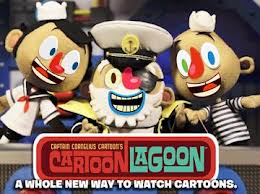
First of all, as I noted in my blog entry, the crew (which consists of Captain Cornelius, Wet Willy Jones, and Axel Rod Magee) runs into a cartoon that is floating around the cartoon lagoon.  (To be sure, this is a major part of the plot of every show.)  When they run into the cartoon, they go down into a screening room to watch the cartoon and comment on it.  The cartoon they view, to my surprise, was a cartoon of the Three Stooges entitled “Dentist the Menace.”  What I found so interesting about this selection is that it has a “meta” quality: not only are we watching the characters from the cartoon watch another cartoon and comment on it; we are also, watching a cartoon that is based on the Three Stooges show.

There is an additional surprise to this since, while watching it, I am prompted to wonder whether there a) was another episode that this was based on (or if it is something new) or b) the gestures that are depicted in this cartoon “properly” depict the characters gestures from the show.  In other words, the constant question in my mind, which the comments of the three comic characters watching the cartoon remind me of, is what to make of this interpretation which was made, most likely, in the 1970s or early 80s?  How do we interpret this piece of cartoon trash (which may really be a treasure) that is floating around the Cartoon Lagoon.  Like many things from the past, the submarine, so to speak, stumbles upon it.  But, as with any dream or figment from the (cultural) past, we need to ask whether it is meaningful or just a piece of trash.

The first thing that strikes me, even before I hear the cartoon characters’ comments, is the fact that the speed of this cartoon, in contrast to the Cartoon Lagoon segment in the beginning, is much slower.  There is already a lapse.  And this may indicate that our sense of timing, today, is different.

In fact, the first comments focus on the represented space and on the time gap between the two: “I miss furniture tassels.”  And when Curly says his “teeth are killing him,” one of the cartoon characters says that this “cartoon is killing me.”  Already, he is agitated (perhaps by its slow delivery).

We are then reminded of the 90s (and a scandal which changed history) when, upon hearing Moe say “shut your trap and close your mouth,” one of the characters says: “That’s Bill Clinton’s motto.”  This hits on the historical-political dimension.

Following this, the Cartoon Lagoon characters poke fun at the timing, design, and gestures of the cartoon Stooges.  After Moe opens the door to attach Curly’s tooth, he makes an odd gesture with his leg.  Upon seeing this, one of them asks: “Is he peeing on an invisible fire hydrant?”  Following this gesture, Curly flies into the door. We see half of his body, the back half, twitching in the door.  Seeing this, one of Cartoon Lagoon characters makes a reference to the present moment (namely, Miley Cyrus’s “twerking” on MTV moment): “Oh no…he’s twerking?”  In contrast, the next comment focuses on the past (namely, on Vaudeville): “We didn’t save our money from Vaudeville.”  Following this we hear a vulgar slapstick idiom which marks the time: “Hey, he’s talking out of his ass!”  At this point, the commentary is interrupted.  And we notice there is a technical difficulty – most likely in response to the vulgar commentary.  But the Cartoon Lagoon doesn’t end with a reflection on the past.  It ends with an ad for Squish Cereal.  And this break, juxtaposed with the previous dated comments and scenes, suggests a way of thinking the past against the present cartoon moment.

To be sure, the attention to gesture (dated and not dated) that we see in this clip is an attention to the fine points of the past and its cultural translation into the present.  What we need to ask is: What is translated and what is not?  This question, necessarily, is a meta-commentary on cartoons.  And I think this question is prompted by the fact that, by virtue of the plot, the characters and their submarine are bound to run into old cartoons and the fact that when they comment on them they often reference historical moments.

This implies that the cartoons as well as the commentary they use are historically embedded.  And this calls for us to carefully read the translation into the present.  We are, in effect, asked to consider whether the Cartoon Lagoon has discovered Cartoon Treasures or….trash that comes from the depths of cartoon history to the surface of our comic historical consciousness.

This exercise, I believe, is important since, in a postmodern age where, as Fredric Jameson argues, history itself is in the dustbin.   And any form of historical consciousness, especially when articulated through the cultural imagination, is timely.  What interests me most about this gesture is that at least two people of the Cartoon Lagoon commenting on these cartoons are schlemiels.  This suggests that at least one variety of the schlemiel is caught up in reflections on the culture past.  And this suggestion, to my mind, is right on the money.  To be sure, Walter Benjamin would subscribe to this whole-heartedly.  Indeed, one of the things that worried him most about his thinking is that the more he remembered the past, the more addicted he would become to its translation.  For Benjamin, this was a good thing and a bad thing.  The good thing is that it provided a relation to the cultural past (as in his reflection on the telephone, which I have blogged on).  Yet, on the other hand, it is bad because too much reflection on the past may keep one from politically acting in the present.  But, as Benjamin later realized, reflection on cultural artifacts (even if they are cartoons – which have never been of interest to philosophers but were of great interest to Benjamin) in itself had a redemptive and revolutionary act built into it.  For as Jews have known for centuries, interpretation of the past has its benefits and can be the basis for a shared world.

Cartoon Lagoon steps along a similar path to Walter Benjamin and should provide us – just like the characters of Cartoon Lagoon – with lots of things from our animated-cartoon past to translate into the present.  In a way, being addicted to the past makes schlemiels out of all of us; but in translating it into the present, we realize that, after all is said and done (and to play on the title of the Cartoon Lagoon episode), the game is far from over.  Analysis is, as Freud once said, interminable…and so are the cartoons hidden and waiting for discovery in the cartoon lagoon!
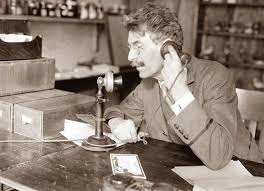
The Voice on the Other Side of the Line: Walter Benjamin, The Telephone, and the Schlemiel

images-1

My parents used to take my brother and I to New York City at least once a month. (Since both of my parents were born and raised there, and because they wanted to visit family and leave the Adirondacks for the city, this was an imperative.)  We used to go to museums a lot.  Although my parents preferred to go to MOMA or the MET, my brother and I liked the Museum of Natural History.  And if we ever went to the MET, we would spend a lot of time in the Egyptian exhibits.  There was something so intriguing about the way the exhibit was laid out.  The walls, the coffins, the animal worship, the hyeroglypics, were astonishing.  Being so intrigued with the mysteries of the past, I had little interest in Modern Art.  But my mother, a BFA, wouldn’t let that bother her.  More important than seeing art was doing art.  She would often paint, draw, and work clay with me.  To be sure, some of my most memorable childhood moments were when I was doing art with my mother.   She prompted me to taste, touch, hear, and feel things in nuanced ways that are still with me today.  But as I grew older and became a teenager, all of my artistic experiences took a backseat.

But this all changed when I left my hometown for university.  When I was an undergraduate, I wanted to better understand the artistic experiences I had as a child.  But instead of taking an interest in realism or classical art, I took an intense interest in Modern Art.  I found something reminiscent of my childhood experiences of art in some modern artists.  I can still remember the astonishment I had when I saw, for the first time, paintings by Cy Twombly, Paul Klee, Arshile Gorky, and Phillip Guston.  What struck me about their work was the fact that they would paint and draw “as if” they were children.  Around their work, I would feel like a child.  And when I went to art school in Manhattan, I spend a lot of time working in this manner.  I have journals full of drawings that are very childlike.  And, looking back at what I wrote, I can see that I was constantly fascinated with memories of childhood and dreams of childhood.  Certain moments, smells, sights, feelings, or gestures stuck out in my mind and I would explore them.  And in this, I felt like a schlemiel, a man-child who – in my case – lost touch with adulthood while he/she tapped into allusive memories, gestures or feelings from childhood.   In many ways, I felt that Twombly, Klee, Gorky, and Guston were all schlemiels – artistic schlemiels – they were, so to speak, caught up with voices on the other side of the line (voices that spoke to them from out of their childish relationships with things).

While my artwork drew a lot of inspiration from the work of the above-mentioned painters, the thinker whose approach to childhood caught my eye was none other than Walter Benjamin.  When I first read Berlin Childhood Around 1900 (Berliner Kinderheit um Nunzehnhundert), I was astonished by how he would mime the child and his/her experiences of things.

I recently decided to reread the book, and was hoping to find things I had never found before.  And, to my joy, I stumbled across several things that were very appealing to me. For now I’ll only mention one: a section entitled “Telephone.”

Benjamin’s description of his childhood relation to the telephone (a device of social communication) is mystical and may very well constitute what he, elsewhere, called a “profane illumination” or what Richard Wolin, in his book Walter Benjamin: An Aesthetic of Redemption, calls “redemptive criticism.” According to Wolin, this criticism (which could also take the form of a memoir like Berlin Childhood) saves the moment from “the ever threatening forces of social amnesia to which humanity over the ages has become inured”(45).  Wolin says the goal of this activity is “remembrance.”

Benjamin starts off his meditation on the telephone with this very notion:

Whether because of the structure of the apparatus or because of the structure of memory, it is certain that the noises of the first telephone conversations echo differently in my ear from those of today. (48)

In other words, the call – as he remembers it – is different from what he hears today.   And what interests him most about those calls are the “noises” on the line: “They were nocturnal noises.  No muse announces them.”  Benjamin, alluding to mysticism, notes that these noises “precede every true birth.”

The schlemiel aspect of all this comes out in Benjamin’s description of his relationship to the phone.  To begin with, he calls the phone his “twin brother” and looks to it for hope.  The phone, unlike himself, “rises above the humiliations of its early years.”  It is “like a legendary hero once exposed to die in a mountain gorge.”  And unlike other technologies that are moved into the back room, the phone is prominent; it stays in the front.  Benjamin, in this scenario, is not the hero; and instead of standing in the front, he stands in the back.

But the phone is more than just a hero.  It is messianic: “Now, when everything depended on its call, the strident voice (of the phone) it had acquired in exile was grown softer.”  The ringing of the phone is a portent of things to come but this ringing is also an alarm of sorts that sets family members on edge and against each other.  It is an “alarm signal” that “menaced” his family and “the historical era that underwrote and enveloped the siesta”(49).

The most interesting observations of the phone come through his father’s specific relation to it.  He  noticed, on the one hand, the “threats and curses” uttered by his father at operators; and, on the other hand, he noticed his father’s “real orgies” which came when he “cranked the handle” or when doing this he totally forgot himself:

His hand, on these occasions, was a dervish overcome by frenzy.  My heart would pound.

In these moments, Benjamin is terrified by his father.  He imagines that his father will yell at someone after getting worked up by the phone: in other words, the phone has a redemptive function and a daemonic one, too.  To be sure, after describing his father’s relation to the phone, he says the phone, when it wrung, “served to multiply the terrors of the Berlin household.”

In response to all of this violence put forth by the phone and through the phone, Benjamin notes that he had managed to “master his senses with great effort.”  In this state, he musters the strength to attack the phone.  His description denotes his counter-violence to the phone’s ringing:

I tore off the two receivers, which were heavy as dumbbells, thrust my head between them, and was inexorably delivered over to the voice that now sounded.  There was noting to allay the violence with which it now pierced me. (50)

Since he says he was “inexorably delivered over to the voice that now sounded” – a voice that is violent and pierces him – one would be amiss not to notice how his moment resonates high in the religious frequency.

At this moment, he becomes “powerless.” His “consciousness of time” as well as his “firm resolve” and “duty” are “obliterated.”  Benjamin goes so far as to liken himself to a “medium” who obeys “a voice beyond the grave.”  But what was the content of the call?  It doesn’t matter.  For, at this moment of “profane illumination,” Benjamin, in affect, is showing us how, by way of the phone, he became a schlemiel.

He was so enthralled with his childhood experience of the phone that he forgot where he was and what he was doing vis-à-vis reality.  And his act of heroism, when he attacks the phone, discloses itself as a flop since, in the end, he becomes totally powerless to the voice at the other end.

What I love most about this passage, is that Benjamin is not simply engaging in “remembrance.”  He is also reliving the process he went through in relation to the phone and I would suggest that it evinces a pattern we see throughout his memoir (and in One Way Street) where Benjamin looks into how, in his childhood, his relationship with things often evinced some form of failure or disconnection.  And by disconnection, I mean disconnection from reality.  All of these comes out of an intimate experience of how things, such as the telephone, affect who we are and how we are.  He isn’t simply interested in analyzing this like a sociologist; rather, he is interested in how he experiences things.  He realizes that the only way he can experience these things is through an “immanent criticism” that is offered by way of the thing itself; here, the telephone.  But what we find, time and time again, is that in his relationship to things he often loses control of himself and his world.  He can’t stand up to the phone, but when he does, he becomes subject to the voice – a voice that comes from the dead (the inhuman); that is, from things.

I think Cy Twombly, Paul Klee, and the other artists I mentioned above were also fascinated with this childish relation to things because, in this relation, they found something more intimate than any discovery they had ever made.  However, in doing this, these artists become children and schlemiels.  And this requires a kind of passivity and receptivity that may make them all subject to the voice on the other side of line.


The Schlemiel Who Tried to Get a Job – On Robert Walser’s “The Job Application”

DownloadedFile-2

While writing on Franz Kafka, the Jewish-German thinker Walter Benjamin was interested in finding common ground between Jewish and non-Jewish comic characters.  We see this project in his notes and in his essay on Kafka’s work.  To be sure, the essay starts with a reflection on a Russian fool named Shuvalkin; but it also includes reflection on Jewish fools vis-à-vis the messianic.  Kafka’s characters, as Benjamin understood them, may have some relation to the Messianic in the sense that, in their foolishness, they are the unredeemed figures of Exile.  They are incomplete and are waiting, so to speak, to be redeemed from their sad state.  What brings all of these characters together – in a state of exile – is not so much their pathetic character as a kind of innocence and blindness. This naïve state, for readers like Benjamin, gives us a sense of the best humanity has to offer in bad times.  (For Benjamin, such naïve foolishness, and not the powers of reason, idealism, progress, humanism, or heroism, is what is best in man.  After all, as Benjamin said to his friend and scholar Gershom Scholem, regarding Kafka, “only a fool can help.”)  It is the small things – things that we often miss – which, for Benjamin, hold the most meaning and hope.  And, in a world dominated by reason, humanism, and progress, it is the innocent loser who lives closest to the smallest things.  It is this character who, strangely enough, is closest to redemption.

One would think that Robert Walser, a writer Kafka and Benjamin read lovingly, would appear in Walter Benjamin’s notes or on his essay on Kafka.  But he doesn’t.  I find this omission to be very odd.   Reading Walser, I find all of the qualities that Benjamin found of interest in his essay on Kafka; namely, as I mentioned above, innocence, blindness, and the importance of small things.  To be sure, Walser is the master of these elements.

Susan Sontag, in an essay and introduction to Walser, notes that Walser is “one of the most important writers of this century” and, referencing the often melancholic writer and playwright Samuel Beckett, calls him “a good humored sweet Beckett.”   But the most important aspect of his writing, for Sontag, is found in the little things:

Walser is a miniaturist, promulgating the claims of the anti-heroic, the limited, the humble, the small – as if in response to his acute feeling for the interminable.

He was, like Melville’s Bartelby, a “non-doer.”  But, as Sontag notes, for such a non-doer we wrote a lot.  But what does an “acute feeling for the interminable” and being a “non-doer” amount to?  For Sontag, it amounts to an “awareness of the creatureliness of life, of the fellowship of sadness.”

Reading this, and contrasting it to what Benjamin thought about Kafka and the messianic, I would suggest that we read what Sontag calls “an awareness of the creatureliness of life” and the “fellowship of the sadness” against the comic.  To be sure, as I mentioned above, Sontag called Walser a “good humored Beckett” and suggests such a balance of the comic and the melancholic. But she drops in the end for melancholy.  What I’d like to suggest is that Walser – from time to time – puts out characters that resonate with the Eastern European tradition of the schlemiel: they simpletons who pronounce the tension between hope and skepticism.  And by doing so, they put the possibility of the messianic into quotation marks yet without extinguishing it.  This doesn’t bring about melancholy so much as a wounded kind of hope that is invested in the simpleton.  When reading Walser, I can’t help but hear these resonances.

The “Job Application,” a wonderful short piece by Walser, gives a good sense of what I mean by my current presumption.  Walser’s story is about a young man who wants a job.  But there is a problem.  He doesn’t understand how one should “properly” write a job application. And this has much to do with his character which is humble and innocent.

In other words, he is unable to see and understand what sacrifices one must make when applying for and working in a 9 to 5 job.  We see this in the first lines:

I am a poor, young, unemployed person in the business field, my name is Wenzel, I am seeking a suitable position, and I take the liberty of asking you, nicely and politely, if perhaps in your airy, bright, amiable rooms such a position might be free.

The schlemiel has been dubbed by Hannah Arendt – vis-à-vis Heinrich Heine – as a “lord of dreams.”  With this in mind, I can’t help but think of the schlemiel when I read Wenzel’s characterization of himself as “dreamy child” who wants a “small place in the shade.”  Wenzel repeats the fact that he is a simpleton – much like the schlemiel – when he states how:

Large and difficult task I cannot perform, and obligations of a far-ranging sort are too strenuous for my mind. I am not particularly clever, and first and foremost I don’t like to strain my intelligence overmuch.  I am a dreamer rather than a thinker, a zero rather than a force, dim rather than sharp.

His simplicity is the last quality (the most meaningful one) he wants to outline in his “job application.”  And what makes this feature most interesting is the fact that after stating it he believes that the business to which he is applying will, unlike the “world in which we live,” accept him:

My mind clear but refuses to grasp things that are many, or too many by far, shunning them.  I am sincere and honest, and I am aware this signifies little in the world in which we live, so I shall be waiting…

He naively waits for them to accept him and it seems Wenzl believes that his honesty will win them over.  But as in many a schlemiel story (such as I.B. Singer’s Gimpel the Fool or Sholem Aleichem’s Motl, the Cantor’s Son), honesty and trust do not win out although the characters, to the very end, believe they will.

Here we have a clear tension between hope and skepticism, which characterizes so many schlemiel stories; and, like them, it is the simpleton who pronounces this tension.  His interest in the little things such as trust and humility are naïve, but they are, as Walter Benjamin would say, the only things that help.  Ultimately, Benjamin clung to these simple things more than he clung to Marxism or the hope for a youth revolution (which, as I pointed out before in this blog, he wrote of in his review of Dostoevsky’s The Idiot).

In the end of the day, the schlemiel tries to get a job.  But he does so for one simple reason: to show that what is at stake with the schlemiel is something the messianic.  But instead of clinging to Marxist hope, the author – like Walter Benjamin – clings to the man-child, the schlemiel.  Somehow, he believes that simplicity, honesty, and the lord of dreams – here, Wenzel – will win out in the end.   Like Wenzel, he hopes that one day the employer will “hire” the “lord of dreams” as an employee.

This is obviously a foolish (and impossible) hope.  But, finishing the line I mentioned above in reference to Walter Benjamin’s letter to Gershom Scholem, perhaps we can say that the fool may be the only one who can help; but the question is whether or not he can do humanity any good.   This kind of question is the one that would be asked by Sancho Panza of Don Quixote.  Benjamin’s letter teaches us that the same question could be asked on the eve of the Holocaust, but can we still ask it, today, after the Holocaust and countless horrors of the 20th century?  Does it still ring true?  Or are today’s readers of Walser devoid of any hope and united in what Sontag calls a “fellowship of sadness?”

A Response to Jeffrey Bernstein’s Guest Blog Post: “Schlemiel, Schlemazel…Augenblick Incorporated”

DownloadedFile

Comedy is all about timing.  As they say in showbiz, “it’s all in the timing.”  So, if “it’s all in the timing,” how do we understand comic timing?   More to the point, how does schlemielintheory.com understand the timing of the schlemiel?

I have been thinking about the timing of the schlemiel in many different entries.  But, to be sure, one of the most insightful entries into the timing of the schlemiel came to me by way of a guest post by Professor Jeffrey Bernstein.   On March 24th, he wrote a guest post for schlemielintheory.com entitled “Schlemiel, Shlimazel….Augenblick Incorporated.”  It addressed an earlier post (and other posts) that addressed the relationship of the schlemiel to the prophetic and the messianic.    Bernstein’s post, on the one hand, looks into how and whether the schlemiel’s temporality relates to the models of temporality handed down to us from such religious figures and theologians as Paul, Augustine, and Luther, on the one hand, and from such philosophers as Giorgio Agamben and Martin Heidegger.  On the other hand, he asks, in the wake of these whether another model exists.  I think Bernstein is on the right track and I would like to briefly go over his readings and his suggestions before I give my two cents.

Bernstein begins his blog post by correctly noting that one of my posts suggests the tradition of the “augenblick” (the wink of the eye).  He cites that passage:  “Winking is not a straightforward gesture.  It is oblique.  And it is immediate, like a blink of an eye.”

Commenting on this, Bernstein notes that when he read this he thought of the “augenblick” of the religious and philosophical tradition and Walter Benjamin’s notion of Jetztzeit (“now-time”).  Bernstein’s question, upon seeing this, was about whether or not there is a “schlemielich temporality.”

To answer this question, Bernstein turns to the classic (American) schlemiel joke about a schlemiel and a schlemazel (or shlimazel, as one transliteration from the Yiddish has it) who go out to eat and the schlemazel asks the schlemiel to get him some soup.  When he comes with the soup, the schlemiel accidentally trips and pours the hot soup on the schlemazel.  In Bernstein’s retelling, the temporal aspect is highlighted:

Schlemazel:  Ow!  Vey iz mir!  That soup’s hot!  Look what you did!

Schlemiel:  Oy! Look what I did!

Commenting on this joke, Bernstein notes that there, apparently, isn’t anything indicating anything “messianic” or “prophetic.”

There doesn’t appear to be any prophetic aspect to this caricature—but of course, the littlest things contain the deepest truths.  Soup is hot; we make messes; we burn—such is life.  And what can we do except scratch our foreheads and say ‘Oy! Look what I did!’  This may be the adult secret contained in many of our childhood experiences.

To be sure, this last line does offer an important clue. But before explaining why this is the case, Bernstein correctly notes that the “augenblick” – that I associated with the schlemiel by way of the wink – does have a source in theology and philosophy.  On this thread, Bernstein points how many thinkers and theologians in the 20th century – such as Barth, Heidegger, Rosenzweig, Lukacs, Benjamin, Kafka, Adorno, Bloch, Schmitt, etc – “all attempted to articulate the sense that if historical change is to happen, it will do so instantaneously and non-teloelogically.”  To do this, many of them drew on the concept of the “augenblick.”  As Bernstein points out, however, this is nothing new.

To be sure, it goes back to Paul and finds its way to Augustine and then to Luther.  Bernstein points out how Paul’s notion of “Kairos” marks a sense of immediate and non-teleological historical change:

(It is) the eschatologically charged instant in which the encounter with God and the acknowledgment of messianic time occurs.

As Bernstein also points out, this notion resurfaces in Augustine’s “discussion of ‘the present’.  Years after Augustine, Paul’s notion of Kairos is translated, for the first time, into German by Luther as “augenblick.”  Augenblick translates Paul’s claim that the redemption will come in a “twinkling of an eye.”

After citing the religious thread, Bernstein points out the thread that leads from philosophers such as Martin Heidegger to Giorgio Agamben who read the Augenblick against the “mechanical conceptions of temporality.”  He correctly notes that Heidegger and Agamben both oppose Aristotle’s reading of Kairos as “opportune time” and how they both lean more toward Paul’s reading of Kairos.

Taking all of this into account, Bernstein argues that Augenblick is not the right term to use in reference to the schlemiel.  The reasons are as follows:

(1) ‘augenblick’ and ‘jetztzeit’ (understood as sudden and arresting) are both set over against a conception of time as homogenous, empty, identical and simply quantitative, and (2) as such, both terms are markers for a presence which the schlemiel  always seems to refuse (or, perhaps, fails to attain).

In other words, the schlemiel is much more prosaic.  He/she doesn’t appeal to this concept of time which “bears witness to a religious tradition in a context that is poetic.”  Rather, Bernstein tells us that it appeals to a Jewish sense of time.  Citing Amos Oz and Fania Oz-Salzberger’s book Jews and Words,  Bernstein points out that Jews look forward and face the past.  This recalls the reading of Paul Klee’s Angelus Novus by Walter Benjamin in his “Theses on the Philosophy of History” and Hannah Arendt’s essay on Kafka (and her introduction to her book by the same title) “Between Past and Future” where she situates the “he” of Kafka’s novels between the past and the future.

How does all of this reading of Jewish temporality relate to the schlemiel?

Bernstein brilliantly argues that “the schlemiel does not prophesy so much as ‘register prophetically’ what has already happened as what will always already continue to have been happening (Oy, look what I did).”   The schlemiel doesn’t have an “Ahah!” moment so much as an “oh…yeah!” moment.  And this is not by any means an moment of Kairos or messianic anticipation (with all of its poetry and pathos).  Rather, it is quite a prosaic and mundane moment.

I think Bernstein’s reading of the schlemiel’s temporality is right on the money.  Thirteen days before he wrote his guest post, I was pondering this kind of Jewish temporality vis-à-vis the moment in Walter Benjamin’s “Vestibule” aphorism (in One Way Street).  In my blog entry, entitled “Wink, Wink! Walter Benjamin’s Childhood Secret and his Calling to Schlemieldom,” I point how he discovers that he already is a schlemiel:

In the aphorism, Benjamin notes how, in a dream, he “visits” the home of the famed German writer, thinker, and poet: Johann Wolfgang von Goethe.  He notes that even though he was in Goethe’s house, “he didn’t see any rooms.”

Benjamin tells us how the interior of his dream space appears to him from his angle-slash-perspective: “that it was a perspective of whitewashed corridors like those in a school.”  This implies that he feels like a young student in Goethe’s house (or, rather, school of thought). In the house-slash-school, there are “two elderly English lady visitors and a curator.”  They are only “extras.”  They lead him to the secret, which, we must underscore, is to be read and written.  The curator asks that he and the two elderly ladies “sign the visitors’ book lying open on the desk at the end of the passage.”

When he opens the book to sign, he has a revelation about his name and his prophetic calling:

On reaching it, I find as I turn the pages my name already entered in big, unruly, childish characters.

He realizes that he doesn’t have to sign!

This is the prophetic calling of the schlemiel.  To be sure, his name is “already” written in “big, unruly, childish characters.”  The words literally wink at him: Benjamin is in on a big joke.   This passage suggests that we all know that Benjamin was always meant to be a fool.  Moreover, it is written in the book of Goethe: the prophet, so to speak, of all German scholarship.

In the blog entry following this one, I call his realization (humorously) the “schlock of discovery.”  The point of the shock is, as Bernstein would say, not a poet “Aha-moment” so much as a prosaic “oh-yeah-moment.”  Benjamin’s discovery has a belatedness to it which is unmistakable.  And it has a prophetic element to it as well since it does, as Bernstein says, “prophetically register what has always happened as what will always already continue to happen.”  And when Benjamin says “Oy, look what I did,” he realizes that he, like a schlemiel, didn’t know what he did and only finds out later about it.  But, ultimately, the lingering question for Benjamin – in the “Vestibule” aphorism – is really “who”did this?  Am I the source of this prank or something/someone else?

I want to thank Professor Bernstein for clarifying the schlemiel’s temporality for me.  It is prophetic and messianic but in a way that is more prosaic that anything we find in Paul, Augustine, Agamben, or Heidegger.  And this temporality yields a prophetic and messianic kind of time that is “other.”

Bernstein ends his piece on the schlemiel’s temporality with a contrast that brings out what is at stake; it’s the difference between a poetic and a prosaic ending-slash-beginning:

If life is poetic, we turn to TS Eliot: “After such knowledge, what forgiveness.”

If it is prosaic, what else is there to do but laugh? Incipit schlemiel…

In lieu of this, I find it fascinating that, in relation to the Messianic, the Midrash associates real laughter with a laughter-to-come.  In making this claim (or rather interpretation) it uses Psalm 126:2 as its textual basis:

Then our mouth was filled with laughter And our tongue with joyful shouting; Then they said among the nations, “The LORD has done great things for them.”

Q: How do we reconcile the schlemiel’s belatedness with this laughter to come?

A: It’s all in the timing.


Why Have I Been Blogging on Agamben or How Can the “Decisive Historical Gesture” be Comic?

images

As anyone who has been following my blog will notice, I have been blogging a lot on Giorgio Agamben’s “Notes on Gesture” and his “Fable and History: Considerations of the Nativity Crib.”  The reason I have been pursuing these readings is because I am very interested in thinking through the meaning of comic gesture.  Agamben, following Walter Benjamin (and Aby Warburg – another Jewish-German thinker-slash-art-historian who I will address in the near future), has taken to the task of addressing the gesture-as-such.  What I want to remind everyone is that what spurred my search for the meaning of gesture was (and is) Walter Benjamin’s treatment of gesture in his essay on Franz Kafka.

To be sure, Benjamin scrutinized the gestures of Kafka’s characters and argued that by paying close attention to them we could learn something of great – even messianic – urgency.   Benjamin reads these gestures as “pre-historic,” and this is what Agamben latches onto; however, what Agamben misses is the fact that Benjamin also saw them as comical.  As I have noted elsewhere, the keynote of Benjamin’s essay on Kafka can be found in its final gestures, which belong to Don Quixote and Sancho Panza.

Like Sancho Panza, we watch the comic gesturing of Don Quixote.  But we are not alone.  Benjamin’s most favored Kafka aphorism was the aphorism on Don Quixote.  It teaches us about a comic tradition that is passed on.  And, this, for Walter Benjamin, is relayed to us through a close attention to comic gesture.    Benjamin knew, as well, that the messianic had to be thought through a close attention to this comic gesture.

We see this in his essay on Kafka and in some of his last letters to his friend and confidant Gershom Scholem.  Benjamin was after the comic aspects of Jewish theology.  And this is a point that Giorgio Agamben misses since he uses Benjamin’s work within a different context, one which, as I have argued, is much more solemn and Christian then Benjamin’s.

The point of my blog entries on Agamben is to show how Agamben is and is not on the right track.  Following Benjamin, he is right to think about the relationship of gesture to secularization, history, infancy, and the messianic; however, Agamben’s way of thinking of gesture misses something comical that both Benjamin and Kafka were following through.

I’d suggest that “infancy” and the “decisive historical gesture” that Agamben speaks of need not be isolated to the “nativity scene.”  For Agamben, the most profound movement which should be of concern to us, today, is the movement from silence to speech.  To be sure, as I pointed out in the last blog entry, Walter Benjamin addressed this in terms of the movement from tragedy to comedy.  Indeed, for Benjamin, comedy speaks from out of infancy.  And I would suggest that it constantly returns to it; hence, the preponderance of men-children and schlemiels in Jewish comedy.   I’d like to look more into this gesture of return and departure from infancy since, as far as I can see, Benjamin initiated this thread without following it through.  I would like to suggest that this gesture, and not the gesture of the crib, is “the decisive historical gesture” which brings man out of tragic silence.

To think infancy in a “serious” manner, as thinkers such Giorgio Agamben, Maurice Blanchot, and even Jean-Francois Lyotard have done, may miss the point that Benjamin was sketching out in his early work.   As these thinkers all knew (and know), their work could be aided by the Jewish tradition. But the tradition that they often turn to does not include any reflection on the comic gesture.

I would like to suggest that there is another Jewish tradition that they missed; namely, what Hannah Arendt called (in her “Jew as Pariah” essay) the “hidden tradition.” Arendt tells us that at the beginning of this tradition is the schlemiel.  Although Arendt is right in calling this a “hidden tradition,” I think her reading of it is problematic.  I will discuss this in future blog-entries (and it will appear as a fundamental point in my book).

For now I just want to suggest that, for Jews, the “decisive historical gesture” is not to be found in the “nativity crib.” For a people who was “pre-historical” for centuries, the comic gesture played a key role in linking Jews to history.  And it is the comic gesture which, for many Jews, has had messianic, historical, and secular resonance.

So, in closing, I just want to point out that my attention to Agamben’s work on gesture, infancy, and the messianic was based on laying out the question of gesture.  I may not agree with his reading of it, but, at the very least, I tip my hat to him for making it an issue and thinking through its relations.  This is a discourse which, I believe, can be fruitful for schlemiel-in-theory.  After all, comedy is not simply about ideas as about gestures.  And these gestures are, as I will argue, deeply historical.  As all comedians know, it’s “all in the timing.”

Agamben on The Historical as Opposed to the Magical Redemption of Man, Animal, and Nature

DownloadedFile

What is redemption?  And how would redemption, as understood by Giorgio Agamben, differ from the redemption we hear of in the Torah, the New Testament, or the Koran?  These are big questions that I don’t think can be addressed in one blog entry.  Nonetheless, they should be of great concern for anyone who reads Agamben’s revision of the Messianic which he, oftentimes, uses scripture to articulate.

In the essay I have been focusing on in the last few blog entries, Agamben has, as I have pointed out already, claimed that the “nativity crib” is the “decisive…historical gesture.”  For Agamben, the crib takes us out of the fable and enchantment.  It is a gesture of secularization. But, as I pointed out in the last entry, Agamben also regards it as messianic.  The question I posed was whether Kafka and Benjamin will be at that redemption.  Perhaps they are the sleepers in the nativity scene since they are caught up in the pre-historic rather than the historic (redemption).  Even thought Agamben doesn’t mention Benjamin in the key moment when he talks about the pre-historic it is clear that he is making reference to Benjamin’s essay on Kafka.  Regarding this essay, Benjamin told both Theodor Adorno and Gershom Scholem that he wanted to retain the tension between the mystical and the political (he likened this tension to the tension of a bow).  However, as he admitted to them, he had failed to maintain it.  In his own view, he had slipped into the mystical and missed the political aspect of Kafka’s work.  Agamben would read this as an admission that Benjamin had got caught up in Kafka’s pre-historical world.

Hence, Agamben’s reading looks to go where Benjamin failed to go in his Kafka essay: toward the historical.  This has its problems as it suggests that Jews like Kafka and Benjamin couldn’t make it into history.  Scholars like Irving Howe, Hannah Arendt, Yosef Yerushalmi, and Emmanuel Levinas (amongst many others) note the different relationship Jews have to time (albeit it in different ways: negative and positive).   But Agamben’s reading, drawing on Christianity, suggests that those who are stuck in the pre-historic are stuck in the world of myth, fable, and magic.  As I noted, however, this is far from the truth.  Jews have been involved in secularization for a while.  And Agamben, at the very least, notes this elsewhere (for instance, in the first chapter of his book Nudities he notes that prophesy, when it ended, was supplemented by interpretation).  But in this essay we find something else.

The problem has to do with his reading of the historical as it pertains to the Messianic.

Agamben, at the end of his essay, notes that the secularizing, historical gesture is with the Church and with Italian Renaissance artists.  They bring us toward as secular, historical messianism in which man, plant, and animal are redeemed (or so it seems).

After naming several Italian artists (who took their cue from the “nativity crib,” Agamben

notes that “the magical link between figures has been completely resolved in a historical link. Each fiture in the crib is certainly whole in itself, not united with others by any plastic or spatial tie simply set momentarily beside them” (144).  In other words, what they did is more than a matter of a secular aesthetic gesture.  In fact, its messianic:

All the figures, without exception, are welded into a single structure by the invisible adhesive of participation in the messianic event of redemption. (145)

Their “unity” is not just (!) Messianic says Agamben, is “historical.”  In other words, there is nothing magical about this messianic.  It is fully secular and historical.  He therefore uses the terms historical and messianic together so as to efface any belief that the messianic will be miraculous.  Strangely enough, however, he doesn’t state this explicitly.  And this makes his gesture esoteric not exoteric.

Taking a messianic tone on at the end of his essay, Agamben notes how all distinctions between secular and profane will be “bridged” in “history.”  History, however, is not, says Agamben, to be equated with “progress.”  This is an odd gesture, given that Agamben, throughout the essay, uses the structure of progress, evolution, and supercession to explain the crib.

All he adds, on this “historical” note, is that everything, all the “minutiae of history,” will be “immediately and historically complete.”   Here, he draws on Walter Benjamin but without mentioning him even once.  But the truth of the matter is that Benjamin’s words need much explaining.  To accept them as self-evident would be uncritical.  Nonetheless, Agamben acts as if they are.  In addition to this, the notion of immediate redemption (a notion discussed in the Midrash and Kabbalah – k’heref ayin – redemption in the ‘blink of an eye”) is a thoroughly miraculous and mystical notion.  But Agamben writes of it as if it is secular and historical.  How exactly would that be the case?

He doesn’t tell us, but we should, somehow, accept that it is.

With this in mind, how do we read Agamben’s final moments in his essay which deal with a thoroughly ambiguous and telling aesthetic figure.  Agamben writes of “the work of the anonymous survivors” of “Spaccanapoli.”   This work makes an

Infinite discrepancy between the figuring of man – whose lineaments are as if blurred in a dream, whose gestures are torpid and imprecise – and the delirious, loving impulse that shapes displays of tomatoes, auberigines, cabbages, pumpkins, carrots, mullet, crayfish….on the market stalls among baskets, scales..(146)

Here, once again, we have a secular gathering of things in the market.  Are these “things” which include (but pale, man) on the brink of messianic, historical redemption?

To this, Agamben notes something that seems to go against everything he has said before.  He ponders the possibility that this may be the “sign that nature is once more about to enter the fairy tale, that once more it asks history for speech.”  This would suggest that the messianic moment may be calling for the messianic and the miraculous.  In the midst of this moment, says Agamben, man will be “bewitched by a history which, for him, again assumes the dark outline of destiny.”  Perhaps man will, once again, enter the fable and be “struck dumb by a spell.”

After noting this, Agamben casts his own spell by saying his own secular messianic phrase:

Until one night, in the shadow-light where a new crib will light up the figures and colors unknown, nature will once again be immured in its silent language, the fable will awaken in history, and man will emerge, with his lips unsealed, from mystery to speech (146).

What I find most interesting about this gesture is the fact that, though it builds on what Benjamin says about myth, silence, and speech in his work (especially Benjamin’s Origin of German Tragic DramaUrsprung des deutschen Trauerspiel) it goes unmentioned.  More interesting is the fact that, for Benjamin, the movement from tragic, mystical silence to speech was first evinced by comedy (namely in the figure of Socrates and his irony).  Nonetheless, I find nothing comic about this movement to speech.  For Agamben, this moment is historical and serious and, because it lacks this comic element, it seems as if it is also a magical gesturing of sorts (but of the rhetorical variety).

Although Agamben opens up many doors for thinking the secular, historical aspect of the Messianic, sometimes his work , as in this essay, focuses too much on figures (such as the crib and “speech”) that have nothing ironic whatsoever about them.  Redemption is a serious affair, but is it possible to conceive it comically?  This, I would submit, is something Benjamin did consider (in his letters to the Kabblah scholar and is friend Gershom Scholem and in his work on Kafka), but it is not something Agamben would consider.

The comic may be a gesture of secularization for him, but it’s not the key.  The fruits, vegetables, market wares, and man await a serious form of historical redemption and a “new crib” for its new infancy.  But wouldn’t that imply that man doesn’t simply speak but that he is a man-child?  And isn’t that comic? Or is that too offensive for anyone who seriously ponders the new “nativity crib” to come?  Man is, after all, a creature.  Agamben knows that very well.  But is man a comic creature or a historical creature?  Both?

And what figure best approximates this?  A nativity crib to come or something other?  As a Jew who loves the schlemiel and sees it as a messianic figure of sorts, how can I accept this “nativity crib to come?”    Can the “decisive..historical gesture” be comic?

The “Anxiety of Influence” or Giorgio Agamben’s Gloss on Benjamin’s Reading of Kafka’s Pre-Historic Characters

DownloadedFile-7

One of the euphemisms that the literary theorist Harold Bloom is famous for is the “anxiety of influence.”  For Bloom, this term describes the contentious relationship of the contemporary writer to his antecedents.   The anxiety deals with how one relates to these antecedents and the greatness of the modern writer is to “revise” the tradition and overcome past influences.  So, what might seem as a generous interpretation is, in fact, an act of overcoming.  It relates to a temporal issue or what Bloom, citing the German philosopher Friedrich Nietzsche, would be the triumph of the “I willed it” over the “it was.”   This Nietzschean gesture is based on the desire to be free from the influence of history and tradition.  In saying “I willed it,” the “strong artist” (Bloom’s term) has a kind of victory over time and history.  He is free, a “great” individual.

We see a kind of “anxiety of influence” between Giorgio Agamben and Walter Benjamin with regards to Benjamin’s reading of Kafka and the pre-historic.  In my last two entries on Agamben, I have been making close readings of Agamben’s essay “Fable and History: Considerations of the Nativity Crib.”     In these readings, I have made brief mention of Walter Benjamin’s work but I have not considered the relationship of Giorgio Agamben to Walter Benjamin, that is, with reference to this essay in particular.  The key moment in this essay, to be sure, takes Benjamin’s reading of Kafka’s character’s up and, in effect, “completes” it as the New Testament completes the Old (yet another gesture of the “anxiety of influence”).

As I have been pointing out, for Agamben, the New Testament’s description of the nativity crib was taken up in representational form and these representations mark the “crib” as a “decisive…historical gesture.”  The nativity crib, for Agamben, secularizes the fable and, as I will show, opens us up to the messianic.  But, before he comes to the messianic, he must address his “anxiety of influence” with Walter Benjamin.

Agamben prefaces his reading of Benjamin by noting that in the “fairy tale” all is “ambiguous gesticulation of law and magic, condemning and absolving, prohibiting and permitting, spellbinding and spell breaking.”  For anyone who has read Benjamin’s reading on Kafka, these words will have resonance.  Agamben is, in effect, saying the the “prehistoric” world we find in Kafka is traversed by nomos (law) and magic: it is enchanted and pre-historical.  History is secular; fable is not.

Moreover, his reading of the crib is secular while Benjamin’s reading of Kafka is not.  And this is the point.  Agamben sets this reading up when he notes that, in contrast to the fable, “in the crib man is returned to the univocality and transperancy of his historical gesture”(142).

Following this, Agamben makes a long list of all the simple people who are in the “nativity crib” and to this list he appends a colon.  Following the colon is the meaning that parts with and revises Walter Benjamin.

Tailors and woodcutters, shepherds and peasants, greengrocers and butchers, hunters and innkeepers, roast chestnut and water vendors: this whole profane universe of the market and the street emerges into history in a gesture from the prehistoric depths of that world which Bachofen defined as ‘etheric’, and which had a short-lived revival in Kafka’s stories.  (142-43)

Although Benjamin does not appear in this reference, it is clearly an articulation of the “anxiety of influence.”  Benjamin, to be sure, is the only person to have written in this way about Kafka’s stories and, in fact, he also cites Bachofen.

But now Agamben is the master.  Like the New Testament, he “completes” Benjamin’s project when he reads the “fairy tale” as “the medium between the mysteries of the hierophants and the historical gesture of the crib.”   In effect, had Benjamin known about the “meaning” of the nativity crib, he would have written an entirely different essay on Kafka.  He would have realized that it was the secularizing gesture that Kafka had missed.

Now, to be sure, this rings very odd – especially if anyone is familiar with the metaphors and allegorical figures used by Augustine with regards to the “blindness” of the Jews.   Jill Robbins’ book Prodigal Son/Elder Brother: Interpretation and Alterity in Augustine, Petrarch, Kafka, Levinas does an exceptional job of showing how that metaphor played itself out in the history of the church and in literature.  The blindness of Benjamin, as Agamben suggests (by way of indirection) is that Benjamin (and Kafka) didn’t recognize the moment of secularization was, in fact, a Christian moment and a Christian gesture: it is the “decisive…historical gesture of the crib.”

After noting this, Agamben takes up the rethinking of the Messianic which is one of Walter Benjamin’s greatest legacies to us today:

For in the Messianic night, the creature’s gesture is loosed of any magical-juridicial-divinatory density, and becomes simply human and profane.

Here, the “naked life” of the creature, which is a major trope in Agamben’s work (a trope which he takes from Hannah Arendt),  is given yet another meaning.  Naked life now relates to the “nativity crib” and is “messianic.”  Secularization is equivalent to seeing man in the nativity crib, as a creature in its “everydayness.”  Kafka and Benjamin’s reading of Kafka are too caught up in fable and mysticism to be taken seriously.  The figures we find there are, for Agamben, too contaminated by myth, mysticism, magic, and law.  They are too pre-historical.

To add to this, there is someone in the crib who may in fact be a figure of the Jew: namely, the sleeper:

The sleeper who, strangely, never fails to appear near the manger can perhaps be seen as a figure from the world of fairy tale, unable to wake on redemption and destined to continue his crepuscular life among children.

Following this, Agamben actually cites the Book of James which does, in fact, align Jews with sleepers, but Agamben doesn’t mention this.

Instead, Agamben notes that the sleeper doesn’t sleep the sleep of the “incubatio, laden with divinatory presages, nor, like Sleeping Beauty, the timeless sleep of bewitchment, but the profane sleep of the living creature”(143).

Would this suggest that the one who awakes from sleep is the person who recognizes the “nativity crib” as a figure of secularization?   Is the sleeper a remnant of the pre-historic which, nonetheless, is disclosed by the “nativity crib” to just be a poor creature who doesn’t get the messianic?

What I’d like to suggest is that the “anxiety of influence” here is not simply between Agamben and Benjamin or Agamben and Kafka; it may also be between Christianity and Judaism.  The suggestion that Jews are pre-historic is not, to be sure, new.  Its been around for a long time and even Hannah Arendt suggests this in her own work on Jewishness.  The historical gesture, for her, however was political.  Jews didn’t know how to live in the political world and a part of Arendt’s project, which was very influenced by her work with Zionism, was to make sure Jews could be “normal.”  For her, Kafka just wanted to be normal; in fact, her reading of Kafka in the “Jew as Pariah” is based on this claim.

Perhaps Agamben would say that Kafka and Benjamin wanted to be secular but, unfortunately, they got caught up in the pre-historic and the magical.  Unlike them, however, he discovered the “nativity crib.”    They were like the sleeper in the nativity crib (or rather, on its margins).

He “woke” up.

(I put this waking in quotation marks for the sole reason that it is based on the “anxiety of influence.”  To be sure, the “gesture” of secularization and the departure from myth are found throughout the Torah and many scholars have pointed this out.  I would add that there are many historical gestures of secularization.  To limit it in this way, to a Christian moment, is odd.  My job is to simply “make it strange.”)

Giorgio Agamben’s Fable, or the Crib as a Historical Gesture – Take 1

g3450tn

One of Giorgio Agamben’s most thought-provoking and clear explanations of “gesture” can be found in an essay entitled, “Fable and History: Considerations of the Nativity Crib.”   But, what we find there is not so much a gag.  It is more like a profane illumination that comes to us by meditating on the “crib as a historical gesture.”  For Agamben, the crib mediates between the sacred and the profane.  And, as a historical gesture, the crib takes us from the mystical and mythical to the secular and everyday.  In fact, Agamben says that the crib “liberates time.”

But the catch is that Agamben focuses on a very specific example as mediating between ritual and secularization: the nativity scene. He reads this scene first as the “nativity crib” and, at the end of his essay, as a “historical gesture.”

What does this mean?  What is at stake?  And, in terms of what I am most interested in, what does this mean for the schlemiel?  More importantly “who” is in the crib?  Is the schlemiel in the crib or is it, rather, the Christian fool?  And how does “he” (whoever he is) relate to the “crib as historical gesture”?

To answer these questions, I need to unpack the essay so as to follow Agamben’s logic and rhetorical tactics.   I will begin this task here and carry it out over a few entries.

(Note: A cursory look at first words and final words of his essay show us that Agamben has a messianic end in mind when he claims that the crib is a “historical gesture” which, ultimately, takes us into history and into a messianic kind of event.   Is this event-slash-gesture a secular one? Is it another crib? And will the fool or schlemiel be there in that messianic gesture?)

Agamben starts his essay by defining the crib as such: it is an “image of the world presented in miniature.”  And the image-of-the-world-it-presents-in-miniature is, and this is key, a “historical image.”   For Agamben, this means it is not a religious image or a mythical image; the crib is a “historical image.”   And it discloses itself as a “moment” of transition.  Using Benjaminian language, Agamben writes of this “moment”:

For what it shows us is the world of fable at the moment when it wakes from enchantment to enter history.

And this is possible only because the “fable has been able to separate itself from initiation rites.” And by “abolishing the mystery which was at its center and transforming it into enchantment.” This separation, abolition, and transformation of cult and ritual into enchantment is the key.  But there is a difference. As Agamben explains, the “creature of the fable” may be enchanted but is not under a religious spell or trance:

The creature of the fable is subjected to the trials of initiation and the silence of the mystery, but without experiencing them – in other words, by undergoing them as a spell.

Agamben further explains that the creature of fable is “bewitched” but s/he is not “participating in a secret knowledge that deprives it of speech.”

But wouldn’t “enchantment” also be a deprivation of speech?

Anticipating this question, but not openly stating it, Agamben argues that this is enchantment “must be shattered and overcome.”  I find this moment fascinating since, as I pointed out in my last blog entry, Agamben’s “gag” risks enchantment itself.   After all, a gag is something you put in a mouth to keep one from speaking.

This, I would argue, is the danger of the gesture which, though it may be “historical” can easily become and remain “enchanting.”  And although it may leave the creature on the other side of mystery, it may leave the creature in the midst of “enchantment.”

In the next entry, we will take a closer look at the creature and its relationship to the crib and the nativity scene.  And within this scence-slash-historical-crib-gesture, we will find Waldo (I mean the fool who may not be a Christian fool).


“Don’t You Mind People Grinning in Your Face!” Son House, Kafka, and The Grin

DownloadedFile-1

In preparation for a series of blog entries that I will be doing on Walter Benjamin, Kafka, and Comic Gesture, I’ve been pursuing research on humorous gestures.  In yesterday’s post, for instance, I pointed out that Franz Kafka and Walter Benjamin were both fascinated (and afflicted by) “childish” and “clumsy scribblings.”   The fact is that they both write about this gesture and consider it to be of the utmost importance.  But what does it mean that they admit to these gestures and “own up” to them?  Have they taken on a tradition which starts with Don Quixote or with a tradition that starts with the end of prophesy – as I have suggested in the past?

Bearing mention of these comic gestures, Kafka and Benjamin direct us to a more acute sense of the “how” of their work rather than the “what.”  Their reading of these “childish scribblings,” their identification with them, is instructive.  Teetering between the gestures of an adult and a child, gesturing like schlemiels, they show us a wholly other side of their work and expose us to a sense of comic historicity.

But it’s not just the singular gestures – the childish and clumsy scribblings that they write of and identify with –that I’m interested in.  I’m interested in how these comic gestures relate to or spur others and how they are shared.

What kinds of relationships do schlemiels create by virtue of their gestures; that is, by virtue of their clumsy childish scribblings?

In the last blog, I suggested that these scribblings are related to the temple (the Holy) on the one hand, and the future on the other.   In other words, although they are ruinous of the holy, they, at the same time, open up a circuit in relation to the future and another kind of otherness which comes to the fore in the wake of the sacred’s departure.  And here, I would add, it opens up, additionally, a circuit with other people.

How, in fact, does a comic gesture create a relationship to the future, otherness, and others?

One of the most interesting things I find about many of my favorite comedians is that they often don’t laugh or even smile at the audience.  They may spur laughter through their gestures, but they often don’t smile or grin.  The audience does.  They see all of us laughing for the better or the worse.  This gestural relationship is intriguing as it creates a community based on ridicule and difference.

The comedian wants to spur laughter; however, they don’t want to be laughed at.  Laughter, as it were, can create relief or pain.  And the difference between the two is prepositional: the difference between laughing “with” and laughing “at.”

However, today, some comedians want to be laughed “at” and to laugh “with” others “at” themselves.  This complex form of self-ridicule can be seen in comedians like Larry David, Louis CK, Marc Maron, and Andy Kaufmann, to name only a few. What makes these comedians unique is that they laugh at those who laugh at them while at the same time laughing at themselves.  They laugh “with” others, “at” themselves, and “at” the audience. The schlemiel, to be sure, is oftentimes laughed at.  But he or she doesn’t get it or, if he or she does, just moves on.  That’s the trick.

However, in reality, no one can just be laughed at and go on unscathed.  While researching gesture, I came across this video by Son House, the legendary Blues Musician and Preacher.  In this video, he gives solace to those who have been scathed by the quintessential comic gesture: the grin.

Son House’s advice, throughout the song, is not to “mind people grinning in your face.”  The way to get through people grinning “in” (or “at”) your face, sings Son House, is to turn to keep in mind that “a true friend is hard to find.  This implies that people you thought were your friends are really not.  The gesture of their betrayal is the “grin.”    True friends won’t grin at you.

Seen from the perspective of a schlemiel like Gimpel or Motl, what does this mean?  It would imply that they have no true friends.  But that doesn’t keep them from trusting people.  The comedy of the schlemiel is inherent in the fact that they still do trust people.  It is the viewer, however, who might have the problem.  The viewer is the one who might become cynical.   Unlike Gimpel, he or she knows what its like to be laughed at.

Son House’s song speaks to them.  It is a gestural response to being ridiculed.  It is a response to the grin.  The song actually addresses the wound a comic gesture may inflict on a person.  His song, in this sense, is “universal” in scope insofar as everyone – at some time in his or her life – has been laughed at by people he or she thought were friends.

So, on the one hand we have the schlemiel, whose comedy exposes us to a ridicule that he or she cannot recognize; on the other hand, we have the viewer who does recognize this ridicule.  On the one hand we have comedy; on the other hand, we have the comic blues. Both are sides of the same coin. And on the coin we find one thing: the grin.

Kafka noted the relationship of the grin to truth his December 11th entry in the his Third Octavio Notebook:

Our art is a way of being dazzled by truth: the light of the grotesquely grimacing retreating face is true, and nothing else.

For Kafka, the truth is not simply in the grinning face.  It is in the movement of the grimacing face; it can be found in the retreat of a “grotesquely grimacing (grinning) face.”  The fact that Kafka notes the retreat rather than the approach of the grimacing face is telling.  It indicates that Kafka sees truth in the wake of ridicule.

We hear this in Son House’s song.  He sings it to those who the grin has touched.  We also hear it both Kakfa and Benjamin’s mediations on the “scribblings of children” which embody the grotesque grin.  Kafka seems to be telling us that our truth, the truth of who we are, can be found in the withdrawal of ridicule.

This implies that the comedian who sees the audience grinning back at him or her has the best view of truth.   This relationship, I would aver, is not a once in a lifetime thing.  Kafka suggests that this gesture of comic withdrawal happens repeatedly.

This gesture has a lot in common with a childish scribble; however, the only difference is that a scribble remains inscribed while the grin comes and goes.  Nonetheless, perhaps like Derrida, we can imagine the scribble as a trace which, in its iterability, is caught up in endless repetition…constantly ridiculing the totality of the text in withdrawing the text from itself.  Perhaps the text, in this sense of being childish, comes and goes?

Regardless, Kafka understood that the relationship to the truth, which he associated with God, can only be related to comically…in the withdrawal of the grin or in the wake of “childish scribbles.”

On the other hand, a Preacher named Son House advises us “don’t mind people grinning in your face.”  The purpose of this line is to give solace to the believer who, in his or her search for God and justice, will have to face ridicule.  The question, for Son House, is what to think and how to cope with this ridicule.  The question, for Kafka, deals with the meaning of ridicule as it retreats and leaves us powerless and weak.

Nonetheless, both of them see truth in the withdrawing face of laughter (in the wake of laughter).  And perhaps this is a new, comic tradition, which emerges in the wake of God’s withdrawal or, as Kafka might say, in the wake of a withdrawing grin….

Losing Time and One’s Way… but Finding Laughter: On Kafka’s “Give it Up!”

images-1

At the outset of his book Franz Kafka: Parable and Paradox, Heinz Politzer cites a Kafka manuscript piece which Max Brod, in 1936, published under the title “Give it Up!”  Politzer points out that Kafka didn’t give it this title; Brod did.  In fact, Kafka called it “A Commentary.”    Politzer uses this parable as the best illustration of his claims that Kafka’s parables are paradoxical.   Politzer’s reading is very insightful.  It brings up aspects of the parable that touch on the ridiculous and simple character of the “I “(who he calls a “wanderer”).  This character, to be sure, approximates the schlemiel.

Although Politzer notes the “wanderer’s” ridiculous character, he moves on to entertain other possibilities.  I would like to suggest that instead of ranking this as one amongst many possibilities, it be marked as one of the most important: since the ridiculous nature of this character accentuates the central role of the foolish simpleton in Kafka’s work.   And this is something that has oftentimes been overlooked whether in the name of Maurice Blanchot’s reading of Kafka or Politzer’s (which focus on much more “serious” topics such as “paradox,” “the incessant,” and the “works demand”).  They would regard such elements as, to use Poltizer’s term, “juvenile.”   Seeking deeper meaning or a meaning that stresses ambiguity as such, they leave aside the simple, comic elements that inform many of Kafka’s parables.  But, at the very least, Politzer’s notes them.

Here’s the Kafka parable that Politzer addresses:

It was very early in the morning, the streets were clean and deserted, I was on my way to the railroad station.  As I compared the tower clock with my watch I realized it was already much later that I had thought, I had to hurry, the shock of this discovery made me feel uncertain of the way, I was not very well acquainted with the town as yet, fortunately there was a policeman nearby, I ran to him and breathlessly asked him the way.  He smiled and said: ‘From me you want to learn the way? ‘Yes,’ I said, ‘since I cannot find it myself.’ ‘Give it up, give up,’ said he, and turned away with a great sweep, like someone who wants to be alone with his laughter.

Immediately after translating the parable from the German, Politzer notes several multivalent aspects.  First, he points out that this parable is a narrative and it states a “negative truth”: “It’s a narrative and a statement of truth, although a negative one.”  In addition, it provides “lyrical impressions” and “dramatic dialogue” which, in the end, are resolved by a “silent gesture” in the end.

Politzer, at this point, withholds the “negative truth” and, as for the gesture, what does it mean that Kafka, on the contrary, doesn’t associate it with silence so much as “someone who wants to be alone with his laughter?”

We’ll turn back to the “negative truth” in a moment; but before we do, I’d like to figure out why or how Kafka can conclude his parable with this gesture of turning away and laughter.  Strangely enough, although it is not his intention, Politzer’s description of the “wanderer” gives some clues.

Politzer notes that the character is “shy” and that his words are “monosyllabic.”  They are closer to English than they are to German.  In other words, Kafka is appealing to the talk of someone who is a country bumpkin of sorts, a simpleton.

Politzer points out that wanderer is ridiculed by the Shutzman (the policeman).  His role, according to Politzer, is to be two-faced and scandalous.  His role is to “protect the man from whom he seems to be waiting.”  And his smile takes on an “ominous” meaning “by the words which the policeman adds to it”; the smile is “false or ambiguous”(5).  If this is the case, then the information he gives him (even the command) is clearly deceptive.   Writing about the reader’s response, Politzer notes that

The discomfort that the change intends to convey arises in the reader only gradually.  Some time is needed to realize the strangeness of this information giver who answers a question with a counter-question: ‘From me you want to learn the way?’ (5)

Moreover, Politzer tells us that we can’t miss the “undertone of arrogance and indignation in the worlds of the policeman who puts himself first in his question.”

Politzer cites the German that is used to address the wanderer as proof that the policeman is scoffing at the wanderer.  He talks to him like a child: “He talks to him as one talks to an infant”(7).   In other words, he regards the wanderer as a man-child (a schlemiel).

And the basis of this, Politzer hints, is a negative attitude toward religion.  Noting the condescension of the policeman, Politzer translates the “it” of the words “Give it up!” in terms of the main characters “wanderings,” and his “haste.”  However, the policeman doesn’t speak from the position of patience since, Politzer tells us, he doesn’t invite the wanderer to take his time and “linger” in the city.

Politzer argues that “Give it up!” can be translated as a commandment for the wanderer to give up on the journey towards God:  “The policeman seems to be saying, ‘let all hope go, abandon the way and the desire to find it, give up your quest and your yearning, your very existence – yourself!’” (7).

Although the reader will catch on to this arrogant command which “infantilizes” the wanderer’s religious quest, Politzer argues that the reader will most likely take the side of the policeman: “The wanderer appears ludicrous to the reader, the official petty, pompous, and awe inspiring”(8).   However, Kafka doesn’t take sides.  He “doesn’t decide for any one of the conflicting points of view.  Instead he forces the reader to change continuously from one to another”(8).

Instead of hearing “Give it up!” as a command, Politzer suggests that we also hear it as a question.  He calls this ambiguity Kafka’s “evasiveness.”   Unfortunately, Politzer doesn’t look into the meaning of wandering between the two positions which would essentially mean moving between the schlemiel, who has lost his sense of time and endlessly wanders in search of the truth, as opposed to the policeman who sees such a search, with all of its religious overtones as “infantile” in a negative way.

Kafka is interested in both.  Is Kafka the wanderer, then?  Politzer argues that we may be “tempted” to say that he is; however, “the man in our story may be an image rather than a more or less true likeness of the author”(17).  He may only be a “code cipher” conveying “indecipherable messages.”

Regardless of such an esoteric reading, which eschews the biographical reading, both are possible.  In fact, Politzer argues that there is even more possible “background” to this story and even suggests that we take Eric Auerbach’s claim, in his book Mimesis: The Representation of Reality in Western Liteature, seriously; namely, that there are two “styles” of writing: one Greek (founded in Homer) and the other the Jewish (Elohist of the Bible).  The latter makes all clear while the latter states details but leaves countless gaps or lacunae.  Kafka, he argues, is certainly influenced by the Elohist as his parables are “fraught with background” and lacunae.

However, the Jewish influence is not the only one; in fact, says, Polizer, it is in a tension with the view that finds no certainty in faith.  To be sure, Abraham was faithful but “Kafka’s man,” on the other hand,” consists of a darkness symbolizing the complete absence of such certainty”(19).

Given all of these paradoxes, Politzer notes that Kafka won’t say he rejects faith or affirms the opposite.  And that’s the point for Politzer.  The crux of the matter is that Kafka states problems.  And unlike the Biblical model, Politzer claims that Kafka gives “so many interpretations” that they “defy any and all.”  In other words, Kafka’s parables present and then efface the possible meaning of a paradox.  Its as if Politzer says that Kafka over-interpreted so as to destroy the meaning of interpretation.

I think that Politzer is on to something here that echoes what deconstruction would say twenty years after he wrote his book on Kafka.  But the problem with all this is that Politzer’s reading is too generalized.

In the process of making this claim, we miss the central problem which, in this parable, is not effaced by too many possible meanings. Rather, I’d suggest that the position of the ridiculed simpleton who is looking for truth is something very close to Kafka.  Politzer is correct in saying that we move back and forth between the positions but Kafka did this because he saw something deeply important about the schlemiel and his relationship with this character.

The interesting thing is that, as in much schlemiel literature, Kafka’s piece points out the bifurcation between the fool from the country who trusts everyone (even the police) and those who lie or scoff at him (like the policeman).  His laugh, at the end of the story, is a negative one.  Note that he laughs alone.  And to do this, he turns away.  He, so to speak, preaches a conversion (a turn) of sorts away from hope and wandering.  What we are left with is the option provided by modern society which comes across as ridicule.   In a negative sense, don’t be a schlemiel.  On other hand, Kafka is advising us that the schlemiel is not in the wrong.  When the schlemiel loses his sense of time and fears he may miss his encounter (perhaps with God or truth), these fears disclose something Kafka though of with regard to Abraham.

As with all of Kafka’s Abrahams, there is always something missing which keeps them from being, so to speak, “on time.”  Yet, at the same time, Kafka wonders: why would anyone want to be on time for a command that may, in fact, be misapprehended.  Why would anyone want to wander around for that?  Yet, and this is the point, people still do.

And this brings us back to Walter Benjamin’s insight that only a fool can help; however, his help may not do humanity any good.  Both thoughts illustrate how a reader may identify with the foolish wanderer, but, in the end, may think of him to be wasting his time.   Benjamin, like Kafka, simply pondered the point.  And he took on both positions.  He also had a hard time deciding. But he didn’t have too many interpretations.  Benjamin, before he died, understood that, in the midst of crisis, there were only two possibilities before him.

He wasn’t ready to play the role of Kafka’s policeman.  Not yet. Walter Benjamin couldn’t completely ridicule the fool.  And that is telling….