On Awkwardness – Part I

images

Last year I read Adam Kotsko’s Awkwardness: An Essay.   I put it on the backburner as something I would write about in the near future because, quite frankly, Schlemiel Theory has been busy with several different philosophers, books, and comedians over the last year. That said, when a friend of mine tagged me in a post on facebook today – about an article written in The New Yorker entitled “The Awkward Age” – I felt I had to, at the very least, read the article and comment on Adam Kotsko’s book, which is referred to in the beginning of the article. While the article is not that interesting, Kotsko’s philosophical, sociological, and historical approach to the phenomena of awkwardness is. His “essay” suggests a few possibilities for schlemiel theory that may or may not be of interest because they tap into philosophical and historical approaches to one of the most notable features of comedy today: awkwardness.

At the outset, the article from The New Yorker cites and makes the following comments on Kotsko’s book:

As the Eskimos were said to have seven words for snow, today’s Americans have a near-infinite vocabulary for gradations of awkwardness—there are some six hundred entries in Urban Dictionary. We have Awktoberfest (awkwardness that seems to last a whole month), Awk and Pshaw (a reference to “shock and awe”), and, perhaps inevitably, Awkschwitz (awkwardness worthy of comparison to the Holocaust). We have a hand signal for awkwardness, and we frame many thoughts and observations with “that awkward moment when…” When did awkwardness become so important to us? And why?

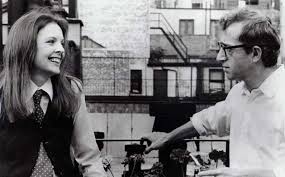
In “Awkwardness: An Essay” (2010), the critic Adam Kotsko dates our age of awkwardness—embodied by “the apparently ontological awkwardness of George W. Bush” and manifested in television shows like “The Office,” “Arrested Development,” and “Curb Your Enthusiasm”—to the early aughts, with a postwar prehistory. (In short, Kotsko writes, the fifties purveyed capitalism into an ideology of “traditional Christian values”; in the sixties, these values were destabilized by the counterculture movement; the ideological vacuum of the seventies led to the paranoia and nihilism, reflected in the metaphysical being of Woody Allen; in the eighties, pure capitalism became its own value system, sustained by opposition to the Soviet Union; and in the nineties nihilism returned, minus the Cold War paranoia, inaugurating the age of irony.

What caused the shift from irony to awkwardness? Interestingly, Kotsko refuses to blame September 11th, connecting the end of irony less with “a culture-wide turn towards earnestness and patriotism” than with irony having “simply exhausted itself.” My feeling, however, is that we can peg the end of irony to September 11th precisely because of the failure of “earnestness and patriotism” that Kotsko describes. We finally had an “evil opponent” again. Terrorists, like Communists, hated “our way of life.” If we neglected our Christmas shopping, Bush said, the terrorists would win. But, this time, the rhetoric didn’t stick. The U.S.S.R. had been a nuclear superpower, with geopolitical aims comparable, if opposed, to those of the U.S. Al Qaeda was nationless, nihilistic, and armed with box cutters. You couldn’t lump it together with North Korea and call it the Axis of Evil—that didn’t make sense.

The problem with this hasty overview and application of his book is that it doesn’t explain the basis of Kotsko’s reading of awkwardness vis-à-vis philosophy and suggests that Kotsko’s book simply historicizes awkwardness. This is incorrect and misleading.

Yes, the “age” we are living in may be awkward, as the author suggests, but she doesn’t understand why and neither does the reader.   To understand how he historicizes awkwardness, we need to first understand the philosophical basis for his project.

Kotsko turns to Martin Heidegger and then Jean-Luc Nancy to explain the philosophical basis of awkwardness.   Regarding Heidegger, Kotsko notes how the “most fundamental mood” that Heidegger “examines in the context of Being and Time is anxiety”(12).   Through this mood, Dasein (being-there, man) has a “special window onto a question that he pairs with that of the meaning of being: namely, the questions of time”(12). When a person “dwells” in a “mood of anxiety” he or she experiences “time” as an “existential urgency”(12).

Besides being interested in anxiety and its relation to time, Kotsko is also interested in Heidegger’s treatment of another mood; namely “boredom”: “Whereas anxiety provides special insight into the question of time, boredom bears specifically on the question of how humanity is related to animal life”(12).   Drawing on Heidegger, Kotsko notes how boredom – like anxiety – brings out what is “truly distinctive about humanity” since it enables us to be “detached” from “an amazing array of stimuli” (or what Heidegger would call the world). This detachment is what Heidegger would call transcendence.

From here, he notes how, for Heidegger sees anxiety as a more “fundamental mood” than boredom because the mood of boredom is still too connected to the world.   While boredom is a “breakdown in our normal relationship to the world…anxiety points toward the ultimate breakdown of death”(14).

Although Kotsko finds the moods of anxiety and boredom to be interesting in terms of understanding our relationship to time and the world (as well as its breakdown), what he wants to find, most of all, is a mood that will tap into what interests Jean-Luc Nancy most: the meaning of relationship as such.   To this end, he asks the question: what mood can this be. And his answer is awkwardness:

Awkwardness clearly fits the general pattern of insight through breakdown, but unlike anxiety or boredom, it doesn’t isolate the person who feels awkward – as I have already discusses, it does just the opposite: it spreads. (15)

In other words, Kotsko is interested in how awkwardness is a contagious kind of mood. Other people, in relation, can catch it (as it “spreads”) can become awkward.

Kotsko adds that “awkwardness is a breakdown in our normal experience of social interaction while itself remaining irreducibly social”(15). By doing this, he opens the door to a sociological and historical reading of awkwardness which is really about being unable to act “properly” in an (ab)normal situation that one is caught in. He brings in the sociological register of “norms” to explain:

Awkwardness shows us that humans are fundamentally social, but that they have no built-in norms: the norms that we develop help us to “get by,” with some proving more helpful than others. We might say, then, that awkwardness prompts us to set up social norms in the first place – and what prompts us to transform them. (16)

With a definition like this, how can one say that our post 9/11 age is the most awkward one of all as the writer from The New Yorker suggests? With this philosophical and sociological kind of basis, one can argue that any age that is transitional will be awkward.

However, Kotsko is responsible for the title and theme of The New Yorker article’s periodizing since he focuses on the present and the origins of our awkward time. In fact, he entitles the section, immediately after his philosophical grounding “The origins of our awkward age.”

It should be clear by this point that I believe that we are currently in a state of cultural awkwardness. Contemporary mainstream middle-class social norms are not remotely up to the task of minimizing awkwardness, but at the same time, there seems to be no real possibility of developing a positive alternative….There are many possible reasons that such a condition could have arisen in the first decade of the 21st century….but…I believe we must look to the social upheavals of the 1960s. (17)

What follows is a sociological exercise. Since the 1960s challenged, traditional values the norms changed and America had a hard time adjusting. He discusses changes in terms of civil rights, sexuality, experimentation, and nihilism. Woody Allen, according to Kotsko, emerged as “one of the pioneers of awkwardness” in the 1970s because of this radical social upheaval.   And even though things changed in the 1980s because of the Regan Era (which looked to reestablish tradition and norms and “overcome awkwardness”) the 90s, which marks a fall back into instability, gives us Seinfeld.

But, argues Kotsko, “none of the main characters actually sit and stew in their awkwardness, and I’d propose that that’s because they are all essentially sociopaths. They cause awkwardness in others but don’t truly feel it themselves, because they lack any real investment in the social order – instead they merely attempt to manipulate it”(23).

The only exception to the Seinfeld rule is the schlemiel, George: “His sheer patheticness and vulnerability, his lack of the steady income and social status of Jane or Elaine or the strange self-assurance of Kramer, keep him from being completely detached”(23). In other words, he is awkward because he is not successful in a context where others are.

Kotsko argues that the “seeds of awkwardness” are planted here. And that it is after 9/11 that the we become an “age of awkwardness.”   In this age, Curb Your Enthusiasm and films by Judd Apatow illustrate how awkward we have become.   There are two ways, according to Kotsko, that we can approach awkwardness. Either it is “individuals” who create awkwardness, as we see in the US version of The Office (25) or it is a social order as we see in Apatow’s films. He finds the second position to be of greater interest to his project:

If the social order itself seems to be producing awkwardness, let people indulge in awkwardness on purpose as a way of letting off steam. This strategy is on full display in several Judd Apatow films: if men are afraid to leave behind the awkward state of overgrown adolescence and get married, then build in a space for them to indulge in their awkwardly adolescent pleasures. (26)

Besides “letting off steam” and remaining awkward, Kotsko sees awkwardness as a strategy to challenge the status quo, on the one hand, or as an opportunity to relate to each other in a way that is not based on any norm whatsoever:

When we resist awkwardness, the social order looks good. When we resist social order, awkwardness looks good. But on those rare occasions when we figure out a way to stop resisting the social order and yet also stop resisting awkwardness and just go with it, something genuinely new and unexpected may happen: we might be able to simply enjoy one another without mediation of any expectations or demands. (26)

Kotsko calls this “the promise of awkwardness”(26) and argues that “for all its admitted perils and difficulties, awkwardness does contain a seed of hope”(26). To be sure, Kotsko, who does much work in Continental Philosophy, is familiar with Karl Marx, Ernst Bloch, and Walter Benjamin who all discuss hope and its relation to opposing the status quo. He is no doubt drawing on this trend by claiming that the mood of awkwardness is a “seed of hope” and a “promise.”   It is not merely a term to describe the “age” we are it – as the writer from The New Yorker suggests.

Kotsko spells it out at the end of his first chapter: “More than describing a cultural trend, then, my goal here is ultimately to point toward what we’re all already hoping for”(28). What Kotsko means by this is that the mood of awkwardness – suggested by Apatow films and…in general – is a messianic or utopian kind of mood that anticipates living in a world where “we might be able to simply enjoy one another without mediation of any expectations or demands”(26).

Does Big Bang Theory also project this hope? Is Seth Rogen a messianic figure? If we are to live perpetually in a kind of childhood state, as Apatow’s films suggest, we will be in a perpetual state of awkwardness. And this anticipates, for Kotsko, a messianic state of not living up to an ideal and being an adult.

The suggestions that Kotsko makes about our age have to do with the collapse of norms that we can maintain by not wanting to return to tradition or anything normative. It’s better to just figure out our-relation-to-each-other as we go along. I find this proposal to be very interesting because it suggests something we see with the schlemiel who is often portrayed as an innocent, naïve, and awkward character. In fact, all of the characters that Kotsko looks at could be called schlemiels.

…to be continued….
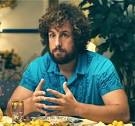
The Tale of Two Sandlers: The Jewish-American Schlemiel and Adam Sandler

images-3

Adam Sandler’s brand of comedy has always been of interest to me. And since today is Adam Sandler’s birthday, I was thinking about what to write about Sandler. To be sure, Schlemiel Theory has no blogs on Sandler save for a blog that discusses Don’t Mess With the Zohan (2008) within the context of the schlemiel and his/her adverse relationship with war.   In this blog I want to briefly take note of two ways that scholars have addressed Sandler. On the one hand, Daniel Itzkovitz addresses Sandler in terms of the schlemiel character and its relation to American culture; and on the other hand, Lawrence Epstein reads Sandler in terms of a new generation of post-assimilation Jews who are dealing with their Jewishness in nuanced ways that previous generations could not. Both scholars provide us with interesting insights about Sandler. But the key to understanding their differing readings depends on how you understand the meaning of (and relationship of) Jewishness in (or to) America.   Reading one against the other, we see two competing readings of Jewishness.   And we see…the Tale of Two Sandlers.

Daniel Itzkovitz brings up Daniel Sandler in his essay “They are All Jews.” In his essay, Itzkovitz queries into what has happened to Jewishness in America after films like Independence Day. Even though “Jewishness” seems to be coming more and more to the forefront in this (and other films) he wonders whether this “Jewishness” has more to do with Hollywood and less with reality (since, after all, there is a worry that, with intermarriage and assimilation, less of this new generation is interested in Jewishness and his continuation).

In this film, the main character Jeff Goldblum (who plays David Levinson, a “computer geek”) teams up with Will Smith (who plays Captain Steve Hiller, a “Black fighter pilot”) to save America and the world from an alien invasion. As a part of this teaming up, there is a “conversion of the Jewish nerd into a manly hero”(233). This “conversion” works to remake the Jew “into an unironically hypermasculine and stunningly generic ethnic: my big-fat-Jewish-savior, whose ultimate job is simultaneously to stand in as a universal representative of an unthreatening and vacuous difference, and to do so in part by converting everyone else to the newly watered down Jewishness”(234). In other words, Itzkovitz suggests that this film has the Jews stand in for a kind of bland new sense of difference in America. We are all Jews now, meaning all of our differences are non-threatening. The stand in for this is a Jew that goes from being a nerd-schlemiel to a “an unironic hypermasculine..ethnic”(234).   Itzkovits calls this “Hollywood’s ‘new male Jew’ and this is marked as a “world converting cinematic pinnacle”(235). In these moments, the minorities come together to save America and the world and, as Itzkovitz claims, to convert ethnic difference to something vacuous and unthreatening.

In contrast to this we have the “new schlemiel films” that cast actors like Ben Stiller, Jason Biggs, and….Adam Sandler. Given the new film paradigm with Independence Day, Itzkovitz wonders about these new schlemiel films. Now we have two “prominent categories” of Jewish men in America: “either as vaguely eccentric standard bearers for ethnic tolerance in a new multicultural America…or as vaguely eccentric embodiments of the middle class everyman. As the latter group makes clear, if the “neurotic nebbish” is really “out,” someone forgot to tell Hollywood”(241).   Biggs, Stiller, and Sandler, are “neurotic nebbish” schlemiels, the “unwholesome trinity of antiheroes whose in whose humiliations we find supreme pleasure”(241).   They“challenge us to rethink the manly triumph celebrated by Goldblum’s character”(241).

Writing on Sandler, Itzkovitz notes how in films like The Waterboy (1998), Punch Drunk Love (2002), and Anger Management (2003) he “plays nice guys prone to humiliation by tougher men and women but who ultimately triumph”(242). And in other films like Eight Crazy Nights (2002) and 50 First Dates (2004) “the manhood of his Peter Pan-ish characters is called into question by their inability to grow up”(242).

What Itzkovitz finds most interesting about Sandler (Stiller and Biggs’) “nebbishe outpouring” is that the Jewishness of these “new Hollywood Jews” reveals more about the “instability of postmodern culture than about Jews”(243). In other words, there is nothing really Jewish being disclosed about these films so much as the fact that “as much as American Jews are becoming mainstream, American audiences are “becoming Jewish”(243). They are becoming “instable.” And Jewishness is, as David Biale and Jon Stratton argue, becoming identified with being American. It is being naturalized. In this sense, Sandler really doesn’t tell us much about Jewish identity save for the fact that he, like other Hollywood Jews who play schlemiels, has “generalized” it and shown us more about American culture than about Jewishness.

What Itzkovitz would rather see, in other words, is a Jewishness that tells us more about being Jewish and not about America. But we don’t find this coming out of Hollywood.

Lawrence Epstein, in his book The Haunted Smile, sees Sandler in a different light.

He argues that Sandler has “found a crucial spot in the comedy of his generation”(250). His films are “about the anxiety of growing up, about the need to reconcile with the family, and about taking responsibility”(250). Instead of seeing this as speaking solely to a general American audience, Epstein takes note that “part of Sandler’s comedy comes from his Jewish heritage. The emphasis on family and family reconciliation so prominent in Sandler’s films is embedded in Jewish life”(250).   He goes on to note that Sandler is “famously proud of being Jewish” and “draws on those traditions” so that other Jews of his generation and Americans of his generation “needed”(250).   In other words, Epstein argues that Sandler’s comedy draws on Jewishness and speaks to Jews of his generation and it speaks to Americans. It is literally Jewish-American comedy.

But there is more to the story.

Epstein argues that Sandler shows us that “part of his movement toward maturity” includes a “willingness to embrace an identity that transcends his individual self” – that is, Jewish identity. Epstein’s proof of Sandler’s willingness is the fact that he sung the “Hannukah Song” on Saturday Night Live which became an “ethnic anthem.”

He is openly a Jew and “like his generation, doesn’t have to or want to hide being Jewish or feel any shame either. And in this sense there is a great irony.” The irony is that in previous generations Jews would do their utmost not to appear “too Jewish” in public (even though, Epstein agues, Jewishness was “enveloped and penetrated them”). Through Sandler, argues Epstein, we can see how Jewish values can “influence other parts of….identity and vice versa”(252).   Epstein sees Sandler as “balancing” Jewishness with being an American.   “The future of American and Jewish comedians will in part be determined by how they finally balance their American and Jewish identities”(252).

In contrast to Itzkovitz, Epstein’s Sandler is not simply a stand in for American identity he is a symbol of the future task of Jews to balance Jewishness.   His Jewishness, in this or that film, is a part of a larger spectrum.   Itzkovitz sees his Jewishness in a different light. And although Itzkovitz doesn’t discuss the “Hannukah Song,” one can assume that this is a part of the multicultural project that neutralizes ethnic difference. The Jewishness that interests Itzkovitz is more ambivalent and, as I said, most likely won’t be found in Hollywood.

I’d like to end with a clip of Don’t Mess With the Zohan. It shows us a more recent Sandler who is still looking to balance out Jewish identity. But in this film, unlike his other films, he is more explicitly Jewish than ever. And in the film the nebbishe American schlemiel and the hypermasculine Israeli merge to create an odd character who is struggling with his identity. His move to America is prompted by his more effeminate need to leave war behind and cut hair. This film leaves us with many questions about what has become of Jewishness in Hollywood and the meaning of ethnic difference. It also shows us how Sandler is “balancing” his Jewish identity – between America and Israel.   Perhaps this film is also a Tale of Two Sandlers….

Joan Rivers’ Tattoo(s) – “6M” – for 6 Million Jews Killed in the Holocaust and…a Freckle

images-2

Over the weekend, someone told me that a Rabbi praised Joan Rivers for having a “6M” tattooed on the inside of her arm in the memory of the 6 million who died in the Holocaust. Although the Rabbi noted that Jews are, according to the Torah, forbidden to have tattoos, he noted that what she did was an exception. Apparently, she did this right near the end of her life and, according to this Rabbi, her public support for her fellow Jews in Israel was of great importance. She had, in his mind, become a saint-of-sorts and it didn’t matter if she had a “6M” tattoo.

Hearing this, I immediately went on line in search of the tattoo. But when I did a google search I found no such “Holocaust tattoo.” Rather what I found was an episode of “Joan and Melissa: Joan Knows Best?” (Season 2, Episode 9) where she goes to get a tattoo of a “bumble bee” on her derriere. This, apparently, was her “first tattoo.”  But instead of going through it, she gives up in the process. Reflecting on the failed attempt to get a tattoo, she kvetches: “I wanted a bee and I got a freckle.”  

http://www.wetv.com/joan-melissa-joan-knows-best/videos/joan-melissa-tattoo-time

Eventually, I found a few articles that mentioned her “6M” tattoo. The reflections they offered were meager. The most I found was a statement she made about it in an interview where she notes that:

“Being Jewish has always been important to me,” she reiterated and to prove it she got a tattoo last year. “I now have 6M tattooed on the inside of my left arm. It’s only a half-inch but every time anyone sees it they’re reminded of the six million who perished, and so am I.”


In pursuit of something more reflective, I was fortunate enough to find a “diary entry from her last book, published this year, in which she talks about the tattoo within the context of a two jokes.

In her Diary of a Mad Diva (2014) Joan Rivers writes, in her June 2nd entry, of her “6M” tattoo. But before she discusses her tattoo and its relation to the Holocaust, she writes of something she’s “always wanted to do: I went shoplifting with Lindsay Lohan.”   But this is a joke. And this joke is the preface to her confession about something much more serious:

Dear Diary: 

Today I did something I’ve always wanted to do: I went shoplifting with Lindsay Lohan. Ha, ha. No, that’s not a joke. In my own way I have been stealing for years. I have bath towels with big Ns on them from the Ark. However, I would never steal with Lindsay Lohan, as she is not smart. She keeps putting things down the front of her dresses even though she wears see through dresses. Once I was told she stuffed a sofa into the back of her Spanx but was caught when she waddled out of the store with a huge butt. They thought she was Jennifer Lopez.

What I did do today was I got t a tattoo! To honor the six million Jews who died in the Holocaust, on my left forearm I had them tattoo a little blue “6M.” Surprisingly it hardly hurt, so next week, I’m planning to get a “12M” to honor the twelve million Jews who refused to buy retail, and if that doesn’t hurt, I’ll get a “26 ½ M” for all the Jewish business men whose second wives are blond shiksa goddesses.

What I love about this reflection is that she couches her confession about her tattoo – the only one she really went through with – in a series of jokes about the other tattoos that she will get. Each of the numbers she rattles off hit on classic jokes about Jews in America and their love for a good deal and “blond shiksa goddesses.”

These jokes, so to speak, take the edge off of what she really did on June 2nd. The book was released one month later. Her death wasn’t far off.

And while one can see the pattern of her “bumble bee” tattoo on her but, which never came to be in reality, one can’t find the tattoo of the “6M” on her arm on google image search.   It’s there, but we can’t see it. She also decided not to record her getting this tattoo as she did with the bumble bee (attempt-at-a-tattoo). And this is telling. It seems that she wanted to keep the image of this tattoo to herself. She could talk about it, as we have seen above, and she shared it with a few people here and there; but she didn’t want to make it into an icon. Her reminder was something…that would remind herself primarily….Or so it seems…..

Joan Rivers and Holocaust Humor

images-1

During the week of Robin Williams death, I wrote a piece on his role in Jakob the Liar. As I pointed out, Williams didn’t shy away from the challenge of bringing humor to the Holocaust. To this end, he decided to take on the role of the schlemiel, Jakob, who did his utmost to distance the Lodz ghetto from its impending doom.   He and Roberto Bengnini – who wrote and played the main role in Life is Beautiful – turned to the schlemiel and both were duly criticized for this since, “after Auschwitz,” Theodor Adorno and several Holocaust scholars who follow in his wake argue that humor, much like poetry, might be thought to be unethical when it comes to representing the Holocaust.   However, what makes the schlemiel interesting is, as Sidrah Ezrahi suggests, that its brand of comedy “revolts” against the world so as to preserve hope.   But that revolt is in the name of innocence.

While Bengini and Williams took to the schlemiel in the face of the Holocaust, Joan Rivers took more to a comic style that was in the spirit of Lenny Bruce (who, arguably, made a major impression on Rivers and changed her way of doing comedy).   These jokes do not preserve innocence so much as the spirit of revolt itself.   They strike at the civility that is at the core of the west.   And, as David Biale argues, Lenny Bruce created a new sense of Jewishness as a position that was not so much American as marginal, counter-cultural, and against the status quo. And because Rivers is “Jewish,” perhaps in Bruce’s sense, her Holocaust jokes take on another aspect.

The most recent joke Joan told about the Holocaust was on Fashion Police. In this joke she likens the “hotness” of Heidi Klum’s ass in a dress to the hotness of Germans “pushing Jews into the ovens” in concentration camps:

On CNN she was asked if she regretted telling the joke. She starts off by saying that it’s “just a joke,” notes that a large part of her husbands family died in the Holocaust, and finishes up by saying that her joke prompts this generation to think about the Holocaust (simply because it’s not on their minds and this will spur them to think).   After being asked again if she will apologize, she notes how her Jewishness keeps her from criticism: “Why don’t you worry about Mel Gibson? Why don’t you worry about the anti-Semites out there?” But the clincher is that the main thing is to laugh because if you can laugh “you can deal with it.”

This principle, it seems, is nearly identical to the one used by Begnini and Williams in their use of the schlemiel. It is not simply revolt for the sake of revolt. It seems that Rivers is suggesting this and the fact that it can spur people to think about the Holocaust.

In her interview with WSJ live, she says something a little different. She begins by saying the joke is on the Germans; they and not the ADL and Abe Foxman should be upset.   And she finishes off the discussion by noting what Dick Cavett said via Mark Twain: “Against the assault of humor, nothing can stand. Don’t flinch, Joan.” In other words, comedy is pure revolt.  Perhaos Cavett is suggesting the same thing as Lenny Bruce: Jewish comedy should always be in  revolt. She says it’s a brilliant comment (several times, in fact).

This year Rivers began her appearance on Jimmy Fallon (the first return to the Tonight Show for decades – since she was “banned” from the show) made a Holocaust joke about how if the German’s could successfully kill millions of Jews at least they could make cars that work. Its interesting that, in following up this joke, she told a joke about her getting vagina rings, and then she turned to a joke dealing with ethnicity and emotion. The joke is an inside/outsider joke. She asks Fallon if he is Irish. He says yes and then she says that she and Fallon get this but WASPS (White Anglo Saxon Protestants) don’t. (This initial insider/outsider joke hearkens back to Lenny Bruce’s jokes about what’s “Jewish” and “Goyish,” meaning WASPish.

Her Jewish/Goyish kind of routine with Fallon sughests that she us in the same camp as all ethnic comedians who fight to succeed in a WASP culture.  This seems to authorize her to tell jokes about anything, even the Holocaust.

But this is not the first time she has told jokes on the Holocaust.   In her book I Hate Everyone…Starting With Me (2012), Rivers tells jokes about Hitler, the Holocaust, and Anne Frank.

On Hitler:

“I hate people who say they’re ‘workaholics…There is no such thing. Hitler put in a lot of hours. Would you call him a workaholic? People who work 24/7 are not ‘addicted’ to work … they either hate their families or don’t have basic cable.”

On Anne Frank:

“They only order half a chicken, take two bites, then put it in a doggie bag to take home, where it lasts them for six months. Anne Frank didn’t hoard food like this, and that bitch was hungry.”

And in Larry King’s interview with her in 2010, King asks Rivers about Holocaust humor in 5:49.   He asks her if there is any “area you will not go to?” And she says, “No. If I think I want to talk about, it’s right to talk about.” And she goes on to say that if she were in “Auschwitz she would tell jokes just to make it ok for us.”

And she concludes, as she did three years later, that if you make something funny you can deal with it. Both statements are telling, but the first is more telling since it has resonance with the films made by Begnini and Williams. Both of them play characters who also tell jokes to help make it ok for us. But the “us” is different and so are the jokes. The humor that Robbins and Begnini use is the humor of the schlemiel. It’s purpose is to make fool younger people so as to preserve their innocence. In contrast, one can imagine that River’s humor, inside of Auschwitz, would have been much different. Instead of prompting Jews to live “as if” the good still exists (and preserving innocence), one can imagine that her jokes would be anything but innocent. However, they would work in the same way: they would make things ok for us (for fellow Jews who were suffering in the Holocaust). And this suggest that Rivers would use humor to revolt against the world. By saying no to it, things would be “ok for us.”

One may disagree with this approach – and many Holocaust scholars and the ADL have. But one needs to ask not just whether humor is tenable after Auschwitz but whether it is tenable during Auschwitz. This is what Rivers suggests to Larry King. And, unlike Williams and Bengini, she saw the Jewish humor that subscribes to vulgarity as more powerful than the humor that subscribes to the schlemiel when it comes to the Holocaust. And this difference also shows us a difference between two trends in post-Holocaust Jewish-American humor: one leaning toward Lenny Bruce and the other toward the traditional schlemiel that we see in I.B. Singer’s “Gimpel the Fool.” In the face of Evil, Gimpel acts “as if” good exists. In contrast, Rivers, in contrast, laughs at Evil. And perhaps her revolt is the demonstration (instead of an acting “as if”) of what’s best in humanity.

And this appeal to comedy – in the face of disaster – harkens back to what Walter Benjamin once said of Franz Kafka: “the only thing Kafka was certain of is that only humor helps. The question, however, is whether it can do humanity any good.”

Joan Rivers, “She Was the Bravest of Them All”

Bwt6GWiCAAA9pM1.jpg-medium

The death of Joan Rivers has left its mark. Many of us have been searching for words. And, as with any death, we try to remember the best things about her. So many things come to mind, but how, I wondered, could I find words. This was too much. After Robin Williams death, I was besides myself and now Joan. All of the joy they brought to my life, the life of my friends, and my family. It felt as if it was all gone.

….

As soon as I heard the news of Joan’s death, I went immediately to twitter to check the comedians I follow for insights into who she was and what she did. After learning of her death, Mel Brooks tweeted: “Joan Rivers never played it safe. She was the bravest of them all. Still at the top at the end. She will be missed.”

Something about Brooks’ words resonated deeply in me. Yes, he was right. She never played it safe. She was the bravest of all. Her bravery, however, didn’t have to do with the comic boundaries she broke with her words so much as with her person. As a female comic, she took risks that broke boundaries for other women comics. And this, I thought, is what Brooks meant when he said she was “the bravest of them all.”   And this needs to be recognized and remembered in the wake of her passing.

Lawrence Epstein, in his book The Haunted Smile, gives Joan her own chapter. The title of the chapter and its subtitle suggest that with female comedy had radically changed Jewish comedy in America: “Kosher at Last: Jewish Women Comedians.” Epstein begins his chapter without mentioning Joan’s name. Joan is presented as a woman without a name (“she”):

She was still struggling for recognition as a comedian. Billed as “Pepper January – Comedy with Spice,” she was faced with a hostile audience. The raucous men seated at the tables had a very definite set of ideas about the men and women who stood in front of them to provide entertainment: the men were supposed to tell jokes, and women were supposed to take their clothes off. Here, though, was this thin, loud woman trying to tell them jokes. The audience members began booing. (253)

After writing this description of “her” act, Epstein tells us her name: Joan Molinsky. As with many Jewish-American comic artists (and artists in general), she had to change her name. She went to her agent, Tony Rivers, and he told her that in order for her to get recognized as an American artist she had to change her last name to Rivers. From then on, she was Joan Rivers.

But the name change wasn’t enough. As Epstein notes, after World War II Borsht Belt humor, which Brooks, Reiner, and Allen (amongst many other famous comedians) participated in, “instilled a deep hostility toward women and mothers”(254). But these comedians weren’t doing something that went against the norm. Epstein tells us that they were a part of a “wider American culture” that was changing radically and was anxious about its identity. They, like many Jews, wanted to assimilate as they moved from the city to the suburbs. Given this situation, male comedians, argues Epstein, were worried that women comedians could “retard their entrance into American society.”

Within such a cultural milieu it was hard for a woman comic to survive unscathed.

And while men had an easier time assimilating, Jewish women, argues Epstein, were the “new Jews, the unaccepted minority, the people seeking power who were not allowed to gain entrance into society, in this case the society of comedians”(257).

For this reason, Epstein argues that women comics, like Totie Fields and Joan Rivers, were “unable to engage normal comic subjects.” As a result, a woman comedian was “stuck making fun of herself”(257). Totie Fields was the first to do this.

And Joan Rivers “built on Fields’s success.” Her humor, like Fields’ was based on self-deprecation.

However, she was also adept at speaking whatever came to her mind and this helped her to become more independent. However, Epstein argues that it wasn’t until she saw Lenny Bruce perform in 1962 that she became radically independent: 

The real turning point for her…was in watching Lenny Bruce perform in 1962. She saw in Bruce a sort of comedy she wanted to perform, a comedy that came from personal, intimate experiences, a direct and honest approach. Rivers was not interested in the political and religious confrontations that came to dominate Bruce’s material, but she was deeply impressed by his delivery style. She transformed his blunt obscenity into softer words such as tramp or slut. She also made a deliberate choice. She went for the large lower middle class. (258)

Epstein characterizes her transition as a “change from self-mockery to self-assertion.”   She talked about subjects women never talked about.   For a woman to do this was heroic and courageous.

What I find so interesting about Epstein’s reading is that it parallels, in many ways, the reading of David Biale in his book Eros and the Jews. But in Biale’s book, there is a different trajectory which moves from the male “sexual schlemiel” to Lenny Bruce.

Biale, to be sure, gives the schlemiel a fundamental role in the creation of American culture and a new, awkward sexuality which finds its best expression in the work of Woody Allen. He argues that the schlemiel doesn’t simply adapt to American culture; it also creates something new.   The sexual schlemiel, with his “comic fumbling,” de-eroticizes “gentile America.”   And in doing so, his comic fumbling and “sexual ambivalence infects gentile women and turns them into mirror images of himself: even gentile Americans become ‘Jewish’”(207). With this unique claim and powerful rhetoric (“infests,” “turns into mirror images”), Biale does something no schlemiel theorist has done before: besides noting how women become mirror images of the schlemiel, he also argues that America has become more “Jewish” by virtue of the schlemiel.

Biale goes on to elaborate that there is a “hidden agenda”(207) that goes hand-in-hand with this “mirroring,” which is “to identify American with Jewish culture by generalizing Jewish sexuality and creating a safe, unthreatening space for the shlemiel as American antihero”(207). And this identification illustrates what he means by “harmonizing” Jewish experience with American culture.   By being the American anti-hero, Biale is suggesting that the “sexual schlemiel” plays an important role in a new American culture that, in many ways, emulates the anti-hero.

Biale’s choice of words is instructive as it suggests that this “unthreatening space” was prefaced by living in a space of cultural anxiety and a desire to get rid of it. In fact, he notes that in “America a deep insecurity about the Jews position in American culture seems to underlie this instinctive turn tot comedy”(207).   Based on this reflection, Biale muses that the distance afforded by comedy may have relieved anxiety by winning over a “potentially hostile gentile audience”(207).   For this reason, Biale ventures a hypothesis about how, if Americans can laugh at Jewish sexual neurosis and see such a neurosis as it’s own, then “perhaps the Jew will be accepted as an organic part of the cultural landscape”(207).  

However, he notes that since Jews put such neurosis on the screen and in novels, one can argue that they weren’t too anxious so much as slightly anxious. Rather, he argues that they “assumed” that the “sexual schlemiel” was a “legitimate part of American culture”(207) And this prompted them to “generalize Jewish sexuality” by way of the schlemiel.

Biale notes that this generalization of Jewish sexuality by way of the schlemiel was challenged by another one; namely, that of Lenny Bruce. He, “perhaps more than any other comedian, broke with the tradition of the Jew as a sexual schlemiel in order to outrage conventional morality with Jewish eroticism”(216). While Roth and Allen have schlemiels who freely talk about sex, these characters don’t challenge the status quo. As we saw above, they create it by creating an identification between being a schlemiel and being an American.

For Bruce, being Jewish means to “be outside the American mainstream, both verbally (mouths) and erotically (bosoms). It means to identify with what was sexually liberated on the margins of American culture”(217). Biale’s reading makes it clear that the schlemiel – though an anti-hero – is a character that belongs to the American mainstream while Bruce’s anti-schlemiel does not. Bruce, in contrast to the schlemiel, is a part of and edgy and “hip” Jewish culture (217) which “was in as much conflict with Jewish convention as with Christian convention…and for Bruce the former was more sexually liberated than the latter”(217). This suggests a political reading of the schlemiel.

However, Biale notes that while Bruce was going against the American grain he was not a feminist. At the very least, he was “able to imagine a male Jewish counterculture that was subversively erotic”(217).   Moreover, Bruce’s kind of comedy – in contrast to the schlemiel’s – taps into a working class ethos. It is Lenny Bruce’s brand of comedy that “captured the bawdy tumult of the Lower East Side culture, from the ribald Yiddish theater to the lurid tales of the Bintel Brief” (219).   His work, along with the work of E.L. Doctorow (namely in his novel, The Book of Daniel), evinces a Jewish sexuality that refutes “America’s erotic and political hypocrisy”(220).

Given Biale’s reading, we can say that Rivers also passed from a self-deprecating schlemiel phase to a Lenny Bruce phase. She didn’t simply, as Biale says above, “mirror” the schlemiel. She left this comedic-type behind for a more aggressive kind of comedy. We can also argue that though Bruce was courageous for what he did, perhaps Rivers was even more courageous since she was a woman. And doing what Bruce did, as a woman, was much more difficult.

The question we need to ask is whether Joan Rivers created such a subculture as well.   Epstein suggests she did in the sense that she created a space for women comedians to speak and for Jewish women to feel comfortable with being assertive and bold.

And in this, Mel Brooks was spot on. He suggests that she had more courage than all of them. This means that she had more audacity than the Borsht Belt comedians (who he was a part of) and Lenny Bruce. As a woman, she broke more boundaries then they did. And she led the way for comedy to where we are today with comedians like Gilda Radner, Sandra Bernhard, and Sarah Silverman.

We will miss you Joan. You opened doors for women that were closed and you changed the face of comedy. Your legacy lives on and you were…the hardest working woman in showbiz.

Almost Communicating, or What Happens When a Middle-Age Schlemiel Falls in Love With a Korean Girl – Part I

images

Over the last decade, we have seen countless films about “middling” or aging schlemiels. Think of Ben Stiller’s roles in Meet the Fockers (2004), Greenberg (2010), or The Heartbreak Kid (2007), Seth Rogen’s Neighbors (2014) or Guilt Trip (2012), or of Judd Apatow’s 40 Year Old Virgin (2005), Knocked Up (2007), or This is 40 (2012).  Apatow, more than any filmmaker, has made something of a cottage industry based on middle age schlemiels.

Also think of Sarah Silverman’s latest work for her youtube channel, Jash, where she is constantly looking into what her character, a 40 plus year old woman, goes through as she ages. The task of documenting the aging schlemiel is nothing new, however. One need look no father than the popularization of this in Woody Allen’s films – especially Annie Hall (1977).   

While the filmic exploration of the aging schlemiel is widespread and noticeable – to such an extent that the middling schlemiel is becoming something of an American cultural icon – the literary equivalent is less noticed by the everyday American. To be sure, books like Stern, by Bruce Jay Freedman, Herzog, by Saul Bellow, A New Life, by Bernard Malamud, Hope: A Tragedy by Shalom Auslander, and How Should a Person Be? by Sheila Heti – to name only a handful examples which span over four decades – take the aging schlemiel as their theme.

What’s most interesting about these literary treatments of the middling/aging schlemiel is that they give us an acute sense of how the schlemiel – and we ourselves – are becoming more and more out of sync with the times we are living in. After repeated failure, the schlemiel eagerly tries to carve out a “new life.” But as s/he ages s/he comes to realize that she hasn’t succeeded and that now, with age, things are more difficult than before. This creates a desperate situation and character whose new failures are much worse than before. Yet, with all of this failure and repeated failure, there is a kind of charm that comes through in this or that missed encounter, missed social cue, or belated response. Most charming is the middling schlemiel’s failure to communicate when love is on the table and cultural differences are front-row-center. The conceit of the narrative is to be found in how the middling schlemiel navigates these gaps.

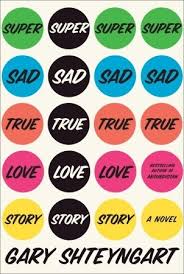
We see an exceptional illustration of this middling schlemiel’s attempt at bridging the gaps between youth and middle age as well as between Korean and Jewish in Gary Shteyngart’s Super Sad True Love Story.   The fascinating thing is that one gap challenges another in his novel. The middling main character Lenny Abramov – a Russian-American-Jewish son of immigrants – stumbles across Eunice Park, falls in love with her, and does his most to deal with this gap and win her over. But his failures show the desperation of this gesture; nonetheless, she also fails. And the way she fails – with her family’s expectations and her own expectations – transforms her into a character who, though Korean, shares much in common with the schlemiel. Regardless, the communication gap, the age gap, and the cultural gap challenge this commonality and make for a fascinating read on the middling schlemiel which solicits culture, love, and communication as relevant to being (and understanding) a schlemiel.

For now, I just want to touch on the communication gap when they first meet. It becomes the foundation for the ensuing struggle to bridge it. When he leaves with her, after a party that he and she occasion in Rome, Italy, he feels she left with him because she really likes him and that, in some way, he is her hero. In his mind, he has saved her from another middling man – a physically intimidating sculptor – who, aggressively, challenges Lenny when he tries to talk with Eunice, his Korean love interest. He is snubbed by the sculptor but, in the end, he wins a kind of indirect victory when she leaves with him not the sculptor.

Notice the comedic rhetoric that is used to describe his movements in relation to hers. He thinks of himself as a hero, but comes across as an anti-hero:

Eunice Park and I marched ahead. She marched, I hopped, unable to cover up the joy of having escaped the party with her by my side. I wanted Eunice to thank me for saving her from the sculptor and his stench of death. I wanted her to get to know me and then to repudiate all the terrible things he said about my person, my supposed greed, my boundless ambition, my lack of talent…I wanted to tell her that I myself was in danger….all because I had slept with one middle-aged Italian woman. (21)

But telling her wouldn’t matter. Eunice could care less about the situation Lenny was going through.

Feeling young and hip – although he is middling – he tells her of a cool “Nigerian” restaurant in Rome to go to following the party: “I stressed “Nigerian” to underline my openmindedness. Lenny Abramov, friend to all”(21). But this doesn’t get through to her.

She calls him a nerd and throws several three letter abbreviations – hip in youth culture – at him to show the gap between them. And this “hurts” him:

“You’re such a nerd.” She laughed cruelly at me.

“What?” I said. “I’m sorry.” I laughed to, just in case it was a joke, but right away I felt hurt.

“LPT,” she said, “TIMATOV. ROFLAARP, PRGV, Totally PRGV.”

The youth and their abbreviations. I pretended like I knew what she was talking about. “Right,” I said, “IMF. PLO. ESL.”

His abbreviations emerge out of a different era and show what things that were of interest to him, then: ESL (fitting in to American culture), PLO (being a Jew whose Russian parents were very concerned with Israel’s future), and IMF (which shows he may have had interest in activism against globalization, when it first started emerging)

The gap is pronounced and the pain that comes with the missed encounter and communication lag show us the life of a middling schlemiel who desperately tries to overcome what, in fact, may not be possible to overcome. After all, age is existential. So is culture….

Charm…that’s another issue…. Can it bridge the gap?

….to be continued…


Introducing Larry Abramov, Your Humble Diarist in “Super Sad True Love Story”

DownloadedFile-2

Thomas Mann, near the beginning of his book Death in Venice, presents a figure of a man on a boat who, though old, is dressed as if he is young. Mann uses the most grotesque terms to describe him. The narrator tells us that Aschenbach, the main character, is appalled by the juxtaposition of youth and old age. And this evokes an experience of what the German philosopher Martin Heidegger might call an experience of angst or what Freud would call the uncanny. At first, he sees a man in a “bright yellow summer suit of ultra-fashionable cut, with a red necktie, and a rakishly tilted Panama, surpassed all the others in his crowing good humor.” But when he looks closer the “good humor” and gay-candor become terrifying:

But as soon as Aschenbach looked at him more carefully, he discovered with a kind of horror that the youth was a cheat. He was old, that was unquestionable. There were wrinkles around his eyes and mouth. The faint crimson of the cheeks was paint, the hair under his brilliantly decorated straw hat was a wig; his neck was hollow and stringy, his turned-up mustache and imperial on his chin were dyed; the full set of yellow teeth which he displayed when he laughed, a cheap artificial plate…Fascinated with loathing, Aschenbach watched him intercourse with his friends….He felt as thought everything were not quite the same as usual, as though some dreamlike estrangement, some peculiar distortion of the world were beginning to take possession of him.

What I love about Gary Shteyngart’s novel Super Sad True Love Story is the fact that, unlike Mann’s Aschenbach, we are given an opportunity to chuckle about the juxtaposition of age and youth (that is middle-age and youth). Instead of pulling back in horror and anxiety, Shteyngart gives a kind of sad-charm to the juxtaposition.  

At the outset of the novel, entitled “Do not go Gentle,” we read a diary entry by the main character, Larry Abramov. He is a middle aged man who tells us that he has made a “major decision: I am never going to die.”   His description of how he is going to live on beyond his body is comical. He tells us, with a faux confidence, that “others will die around me. They will be nullified. Nothing of their personality will remain.”

In pop-cultural confidence, Abramov tells himself (after all, it’s his diary) to stop “them” from telling us that “life’s a journey” where you end up somewhere. He assures himself that they are going nowhere, while he is going somewhere:

When I beg the pilot of the rickety UnitedContinentalDeltamerican plane currently trembling its way across the Atlantic to turn around and head straight back to Rome and into Eunice Park’s fickle arms, that’s a journey.(3)

But he won’t beg him. He’s a schlemiel. And this is his fictional attempt at romantic heroism.  Yes, he will return to the woman he is in love with: Eunice Park. But how?  After writing this, he can’t keep his mind on the romantic mission.  He’s a distracted anti-hero.  He changes the subject in what  seems a sudden revelation. And that revelation is not about returning to her on a romantic journey, but the meaning of a line in a popular Whitney Houston song.  It speaks to his obsession with “living on.”

But wait. There’s more, isn’t there? There’s our legacy. We don’t die because our progeny lives on! The ritual passing of the DNA, Mama’s corkscrew curls, his granddaddy’s lower lip, au buh-lieve thuh chil’ren ah our future. I’m quoting here from “The Greatest Love All,” by 1980s pop diva Whitney Houston, track nine of her eponymous first LP. Utter nonsense. The children are our future only in the most narrow, transitive sense. They are our future until they too perish. The song’s next line, “Teach them well and let them lead the way,” encourages adult’s relinquishing of selfhood in favor of future generations. (4)

He thinks this self-negation (for the children and their future) is foolish. But when he reflects on the meaning of Whitney Houston’s line about “ah chil’ren” this brings him to reflect, once again, on Eunice Park.  And in this reflection, we see why he charmed by her: she is young and innocent.  The two, taken together, bring out a comical juxtaposition of youth and middle age:

Lovely and fresh in their youth; blind to mortality; rolling around, Eunice Park-like, in the tall grass with their alabaster legs; fawns, sweet fawns, all of them, gleaming in their plasticisty; at one with the simple nature of their world. (4)

As one can see, he is drawn in by Eunice Park who is “blind to mortality” while he, apparently, is not. He sees her as an “innocent” schlemiel. And he seems to want that for himself because he is thinking about death and immortality. But, and this is the catch, he is also a schlemiel because he dreams of escaping mortality by way of technology. He has been swayed by what Dostoevsky would call the “miracle” of science. 

But unlike Thomas Mann’s narrator, we don’t see a character who is horrified of this juxtaposition of youth and age. This covering over of death evokes a different mood and has a charm that is missing in Mann’s novel.

….to be continued….

Why Do We Find Schlemiels So Charming? The Sexual Schlemiel and Freud’s Reading of Narcissism

images-2

Schlemiels are sometimes described as “innocent” and “charming.” Hannah Arendt used these terms to describe Charlie Chaplin. And the scholar Sidrah DeKoven Ezrahi uses these terms to describe different Yiddish characters in the novels of Sholem Aleichem, Mendel Mocher Sforim, and I.B. Singer.   Ezrahi, like Dan Miron, also points out that the first schlemiels of modern Yiddish literature (not folklore) – Benjamin and Senderl of Mendel Mocher Sforim’s The Adventures and Travels of Benjamin the Third, are homoerotic. In a few points in the novel, Benjamin calls Senderl his wife.   This suggests that the character has a “feminine” character.

On the other hand, Philip Roth marks a shift in the schlemiel’s sexuality. Portnoy is sexually aggressive and sees himself, unlike his Yiddish compatriots, in negative terms vis-à-vis the Sabra (native born Israeli), Naomi in Portnoy’s Complaint.  His life is filled with masturbation, self-love, and loathing of those with power.  The Sabra, Naomi un-man’s him.  He is “Im-po-tent in Is-ra-el.”  In the wake of his impotence, he calls her names.  She tells him that his schlemiel humor is not “Jewish” humor – it is, rather,the humor of the ghetto.  She calls Portnoy a schlemiel.  And of all the names she calls him, this one puts him into place: he is a sexual schlemiel (in the negative sense).  But if he is impotent, reflects Roth, at least he has comedy.  He can compensate for the loss. 

In Eros and the Jews, David Biale takes notes of the shift in sexuality that we find in Roth’s Portnoy: “the image of the sexually and militarily potent Israel.”   And, coinciding with this, we have  that the image of the “impotent American Jew,” with predates this new opposition (born after 1967). However, the origins of what Biale calls the “sexual schlemiel” have deep roots.  They go through America and, as I have briefly noted above, find their way back to Yiddish literature:

The image of the sexually and militarily potent Israeli is a projection based on its opposite: the myth of impotent American Jew. The Jew as sexual schlemiel has its roots in the Yiddish theater of the Lower East Side of New York, in comedy of the borsht belt in the Catskill Mountains, and in the anti-heroes of fin de siecle Hebrew and Yiddish literature. (205)

But what makes the schlemiel charming is not its “impotence.”   In Yiddish literature, the schlemiel is not seen as impotent. He has a certain charm. It is in America that this impotence makes its debut.   However, in the case of Woody Allen (as opposed to Roth’s Portnoy) we don’t find virility or impotence. Biale says we find a “neutralization” of the stereotype that Jews are “hypersexual” (something we find in Roth’s work).   We find Allen’s sexuality to evince a kind of sexual “awkwardness” that has, in many ways, become a norm.

But what is meant by this awkwardness? And why do we find it so charming?

I’d like to venture a possibility: perhaps the schlemiel’s sexual charm has something to do with a kind of narcissism that we renounce; but, nonetheless, after renouncing, find it attractive in other people, animals, or things? This would be more of a Freudian thesis. I don’t fully agree with it, but it is worth considering for a moment.

In his essay “On Narcissism: An Introduction,” Freud suggests that people are attracted to a narcissism; they had to renounce “part of it” in order to live in society:

It seems very evident that one person’s narcissism has a great attraction for those who have renounced part of their own narcissism…the charm of the a child lies to a great extent in his narcissism, his self-sufficiency and inaccessibility, just as the charm of certain animals which seem not to concern themselves about us, such as cats and the large beasts of prey. In literature, indeed, even the great criminal and humorist compel our interest by narcissistic self-importance with which they manage to keep at arm’s length everything which would diminish the importance of their ego.

Perhaps we see this narcissism in characters like Larry David who, in Curb Your Enthusiasm. David likes to keep “at arm’s length” everything that would “diminish the importance” of his thoughts and perceptions. His looks of disgust, to be sure, have a certain kind of charm.   And his desire to keep and defend them create a kind of childishness and awkwardness vis-à-vis those around him. Freud would argue that we like it because we want some of that narcissism…which we “partially” renounced as we matured into adults.

But perhaps Biale is right and it is better for us to understand the sexual schlemiel and his or her charm through a cultural lens.  Woody Allen’s sexual schlemiel is much different from Roth’s…or Mendel Mocher Sforim’s.   And now lady-schlemiels are just as charming, perhaps, also, for culture reasons.  But isn’t narcissism always there, regardless?

To be continued….

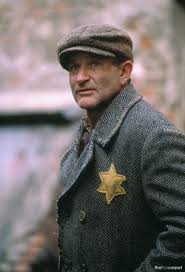
Robin Williams and The Post-Holocaust Schlemiel in “Jacob the Liar”

DownloadedFile-1

Both Roberto Benigni and Robin Williams are popular, internationally acclaimed comedic actors. Their work does a lot to open up the possibilities of comedy and expand its scope. Perhaps in an effort to test the limits of comedy, they took on one of the most difficult tasks imaginable for a comedic actor in the 20th century: addressing the Holocaust. After Roberto Benigni’s film Life is Beautiful (1997) and Jacob the Liar (1999), starring Robin Williams as Jacob, made their debuts, there was a major debate over whether or not, as Sander Gilman puts it, the “Shoah can be funny.” While Gilman finds these films to have “aesthetic” merits, the answer to his own question is an emphatic no.

Since both Benigni and Williams both played the innocent and naïve Jewish fool otherwise known as the schlemiel, another question comes up which Gilman does not address. Speaking to this issue and hitting on a deeper problem, Sidrah DeKoven Ezrahi, in an essay entitled “After Such Knowledge, What Laughter?” argues that “what is at stake in the reinstatement of laughter ‘nach Auschwitz’, after Auschwitz, is not the fidelity of a comic representation of the Shoah but the reinstatement of the comic as a building block of a post-Shoah universe”(Yale Journal of Criticism, Volume 14, Number 1, 2001, p287).

In other words, the question isn’t about whether Robin Williams or Roberto Benigni can accomplish the feat of using comedy, nach Auschwitz, to relate to the Holocaust so much as whether the schlemiel character that they draw on – which is one of the most important stock characters in the Jewish tradition – can or even should exist after the Holocaust.

This question is important to many scholars of the Holocaust and should be important to authors, poets, artists, and filmmakers who address the Holocaust in their work. The task of judging the meaning and value of the Enlightenment’s projects – vis-a-vis literature, philosophy, and politics – ‘nach Auschwitz’ was launched by Theodor Adorno in essays and in sections of his books. Adorno is most well known for his claim that writing poetry after Auschwitz was barbaric. He was directing his words toward the poet Paul Celan. However, while some, like George Steiner, took Adorno literally (and making a categorical claim), others, like Lawrence Langer did not. And Langer is correct. Adorno was looking for a new kind of poetics “after Auschwitz.”

Here, the issue is comedy.

Adorno also has a little known essay about comedy and historical disaster entitled “Is Art Lighthearted?” In this essay, Adorno suggests that the lighthearted nature of comedy, after Auschwitz, must be challenged. As in his claim regarding poetry after Auschwitz, here Adorno finds an exception to the rule in Samuel Beckett’s kind of comedy:

In the face of Beckett’s plays especially, the category of the tragic surrenders to laughter, just as his plays cut off all humor that accepts the status quo. They bear witness to a state of consciousness that no longer admits the alterative of seriousness and lightheartedness, nor the composite comedy. Tragedy evaporates because the claims of the subjectivity that was to have been tragic are so obviously inconsequential. A dried up, tearless weeping takes the place of laughter. Lamentation has become the mourning of hollow, empty eyes. Humor is salvaged in Beckett’s plays because they infect the spectator with laughter about the absurdity of laughter and laughter about despair. This process is linked with…a path leading to a survival minimum as the minimum of existence remaining. This minimum discounts the historical catastrophe, perhaps in order to survive it (Notes on Literature, Volume 2; 253)

Adorno’s approach to Beckett suggests that it is possible for comedy to exist after the Holocaust. But this is only because Beckett’s kind of comedy goes beyond the typical dichotomy of tragedy and comedy. And in doing so it creates a “laughter about the absurdity of laughter” and a “laughter about despair.” It is a “laugh that laughs at the laugh.”

Can we apply Adorno’s approach to Beckett’s humor to the schlemiel, which Robin Williams plays in Jacob the Liar? Can (or should) the schlemiel, like comedy in general, live on after the Holocaust? And, with that in mind, can we say that Williams’ portrayal of the Holocaust schlemiel was unethical, amoral, or ethical?

Prior to the Holocaust, the schlemiel was a “building block” for generations of Jews who lived in the Pale of Settlement (in the 19th century), left for Europe, and landed in America. The schlemiel gave millions of Jews a way to understand themselves and survive the many defeats of history (which included pogroms). It’s humor gave them a sense of dignity when they were powerless.

In her book, The Schlemiel as Modern Hero, Ruth Wisse points out that although the Jews suffered multiple defeats in history they could still turn to the schlemiel who won an “ironic victory.”

The traditional Western protagonist is heroic insofar as he attempts to change reality. The schlemiel becomes hero when real action is impossible and reaction remains the only way a man can define himself. As long as he moves among choices, the schlemiel is derided for his failures to choose wisely. Once the environment is seen as unalterable – and evil – his stance must be accepted as a stand or the possibilities of “heroism” are lost to him altogether. (39)

The schlemiel comically responds to historical disaster. Through word play, plot, and humor in this or that story or novel by Yiddish writers such as Mendel Mocher Sforim or Sholem Aleichem, Jewish readers could, as David Roskies says, “laugh off the traumas of history.” Sidrah DeKoven Ezrahi illustrates this in a book entitled Booking Passage: Exile and Homecoming in the Modern Jewish Imagination where she includes a dialogue between Motl, the main character of Sholem Aleichem’s last novel (Motl, the Cantors Son) to illustrate. He is so innocent and naïve that he can’t grasp the nature of a pogrom and the concept of evil:

I ask him what is a pogrom? All the emigrants keep talking about “pogroms” but I don’t know what they are/ Kopl says, “Don’t you know what a pogrom is? Then you’re just a baby! A pogrom is something that you find everywhere nowadays. It starts out of nothing, and one it starts it lasts for three days.”
“Is it like a fair?” “A fair? Some fair! They break windows, they bust up furniture, rip pillows, feathers fly like snow…And they beat and kill and murder.” “Whom?” “What do you mean, whom? The Jews!” “What for?” “What a question! It’s a pogrom, isn’t it?” “And so it’s a pogrom. What’s that?” “Go away, you’re a fool. It’s like talking to a calf.”

Motl, like many Yiddish schlemiel characters, is innocent. And Ezrahi argues that the idea of preserving Jews from historical trauma was not just a modern practice; it was used in relation to the attempted genocide against the Jews in Purim which is remembered on Purim. As a part of the holiday, Jews celebrate the “aborted catastrophe” and turn “defeat into triumph.” The Jewish world is “turned topsy-turvy (nahofokh-hu) for one day each year and saints and villains become interchangeable.” (“Cursed is Haman” and “Blessed is Mordechai” are exchanged in a day of celebration where the Rabbis suggest that the Jewish people should drink so much as to not know the difference between them.) Ezrahi suggests that this carnivalesque and comical act spares Jews of having to get caught up in the trauma of history; it distances them from the disaster.

But can this act be done after Auschwitz?

Like the Purim story, Ezrahi argues that the schlemiel was a modern, Yiddish version of the comedic rewriting of history. Jacob the Liar, however, falls after the Pogroms that Aleichem included in his novel from the early 20th century and after the Holocuast.

Writing on the film (and book), Ezrahi notes that it is a “self-declared counter-narrative” to the Holocaust. It effaces the historical dimension of the ghetto and the Holocaust:

The mise-en-scene has been identified by readers as the Lodz ghetto, where Jurek Becker (the author of the novel) himself was incarcerated as a child. But like the other ghettos and camps in the fictions under consideration, the ghetto is never named, and takes on a generic quality.

Ezrahi argues that this generic quality is the “baseline” for the novel. It looks to return everything back to normal and we see this in the central theme of Jacob and his lies which look to desperately turn the clock back:

The lie that Jakob fabricates, his possession of a radio that broadcasts good news to the ghetto, is simply an editorial projection of the normal onto the abnormal. The recipients of the lie are the inhabitants of the ghetto (or all its gullible inhabitants) but its primary target is a young girl, Lina, whom Jakob adopts when her parents are deported.  (Note that Ezrahi uses the original Jakob while the American film changes it to Jacob.)

Ezrahi focuses in on the fact that Jacob’s heroic efforts “are aimed at preserving the innocence of her childhood world at all costs.” To be sure, in saying this, Ezrahi is hitting on something we find not just with the Yiddish schlemiel but also with Charlie Chaplin. Williams, much like Charlie Chaplin, plays the schlemiel and uses comedy to preserve the innocence of different characters (including himself).

Ezrahi makes a daring move and suggests that the issue of using comedy (and denying history) goes deep: it hits at theological issues. In the wake of the Holocaust, Terrence Des Pres argues that laughter is “a priori…hostile to the world it depicts.” While tragedy “quiets us with awe…laughter revolts” against the world.

Ezrahi suggests that the basis of this revolt – with respect to the schlemiel – is not simply a rejection of history because it can’t live in it. Rather, it evinces a messianic kind of hope that is implicit in the Jewish tradition: the hope for a better world and return to a world and a history without evil. This wish is at the core of Jewish eschatology and a utopian dream wish for a better world which smashes history.

What’s most interesting is that the audience “colludes” with the schlemiel. And this suggests that we have been very influenced by this belief in a better world so much so that we are willing to go along with this or that lie to save “innocence.”  And, in the wake of disaster, the schlemiel is the vehicle for such collusion.  Perhaps Williams took to the role of Jacob because he – like other authors of the schlemiel and actors who played the schlemiel – wanted to preserve innocence and found comedy to be the best way of preserving hope. However, he knew that the only way to do this, after the Holocaust, would be to lie…like the character he played, Jacob. For without this hope and without this lie, there can only be the belief that history wins and that comedy, after Auschwitz, is impossible.

Robin Williams: Energy, Comic Improv, and Mystery

images

Upon hearing of Robin Williams passing, I, like millions of other fans, felt we have lost one of the best comedians of the last century. I’m not able (nor do I want to attempt) to write up an overview of his comedy career noting its highlights and main themes. However, I would like to say a few things about the energy and the mystery that ran through his improvisational kind of comedy.   Unlike many comedians who would let their mania go out of control, Williams tempered it with a charm and calm.   His comedic energy was infectious and solicited great laughter in his audiences. And his act had a kind of kinetic appeal to it that was new and surprising for many people living in America. But, in its wake, it left us with a kind of darkness or mystery. And for this reason, it touched on a kind of truth that is or may be possible through a kind of comedy that makes the audience “explode” with laughter.

In The Last Laugh: The World of Stand-Up Comedy, Phil Berger introduces Robin Williams near the end of the book.   To show how unique he was, Berger points out how different he was from other comedians who were managed by Rollins Joffe & Brezner (a talent management firm).   They managed comedians like Billy Crystal, Woody Allen, David Letterman, and Martin Short. And most of the comedians they managed had a similar shtick. Robin Williams was different, and this had much to do with his energetic style and his uses of improvisation in his act. He would efface the line between himself and the audience and go with whatever he came across:

In the case of Robin Williams, the problem was that his energy-charged act was so different from those of other comics that Los Angeles talent managers couldn’t get a fix on him. Williams lived on the improvised moment, doing takeoffs on Shakespearean plays, cracking up audiences in spur-of-the-moment iambic pentameter. Plucking a flower from a ringside vase: “….and look, a gentle rose, dying here anon…like myself.” He would plunge into the crowd, reacting to what he saw or heard. Lifting a carafe of wine from a patron’s table: “Hello, Laurence Olivier for Ripple wine.” He might even retire to a table in the audience and heckle himself: “I’ve heard all that stuff before. Your material is derivative.”

Williams’ ability to switch roles on the dime made him unique. In Williams, Brezner saw a “manic” energy that had the affect of something like a “wind tunnel”:

With Williams, the challenge was to take his nearly manic, stream of consciousness style (Brezner: “He had comedic energy that rebounded through the room. It felt like you stepped into a “wind tunnel.”) and not let it get out of hand. This meant giving the act structure – a beginning, middle, and an end – that had enough slack in it for Williams to dazzle audiences with his improvisational wit and energy. “If he just did his thing,” said Brezner, “the effect was that people laughed a lot, but they wouldn’t know who he is.”

Brezner’s last line is very interesting. It suggests that Williams, at the outset of his career, didn’t have a persona like Woody Allen. Rather, Williams was trading in a kind of energetics and play that has resonance with Woody Allen’s Zelig – a character who was likened to a chameleon.

In Zelig and Williams there is a mysteriousness that is born out of a transformational and manic energy. It is highly mimetic and performative.   The laughter he evoked, as well, had a mysterious character to it. And it may have this mysteriousness because it touches on something hidden, dark, sad, and even tragic.

Writing on laughter, Jean-Luc Nancy, argues that laughter is a “gaze brought to bear on tragedy itself, in its tragic truth…the laughter is the knowledge of this truth. But it doesn’t know this truth as the content of knowledge”(“Laughter, Presence,” 366).   For Nancy, it is in the moment of laughter and comedy that “it is known, it is in laughing that laughter is the truth.”   And this truth comes forth in energetic “bursts” or “explosions,” which, when they withdraw, leave a mysterious silence.

The one bursts with the other and from the same burst, truth withdraws into laughter, into the “dim glistening of the mystery.” That is why the laughter remains mysterious – more, it is the exposition of a mystery. The burst of laughter reveals that the structure of its truth is to be hidden. (366)

Whenever I saw Williams doing comedy, I always had a sense of this kind of darkness in the wake of his routine which came across as a series of comic explosions. It was as if he pulled back from his laughter – and the explosions – so as to expose us to a dark truth. Sometimes there would be a kind of violence to his “nearly manic” routine. We see it here, in this mime routine within a film.

We also see energetic uneasiness in his earlier routines. The laughter it evokes, like the laughter that Andy Kaufmann would evoke in many of his routines discloses how Americans survive from one rapid change (or “explosion”) to another. The movement from character to character – as Zelig does – evinces a departure from identity and a series of rapid fire changes.

Williams stand-up routine, near the end of his life, brings out a kind of comedy that uses energetics to deal with a series of shocks that are distinctly America.   His comedy reminds us of what many of us share. And it shows us how survival of these shocks, as he presents them, is an American-kind-of-thing to do.

Yet, at the core of this sudden outbursts and shocks, which he comically stages for us, there is a mystery about where all of this is going. He takes us on a journey of sorts through many states, but it is really the future that is the mystery. It is not simply (or only) as Brezner believed, related to Williams’ identity. Not only do we not know who Williams is (in the wake of each of his routines), we also don’t know where we are all going. He reveals something common to us that emerges in the wake of a series of shocks that permeate out time.

Thinking back over all the comedy I saw him perform I now feel as if I understand him better than I ever did. What Williams gave me, as a child, was a way of feeling I was a part of something larger than myself and that the best way to touch that was through exaggerating experience and playing out the things that shocked me. By improvising these things, I felt as if I could touch something real and alive. But the bigger question always lingered – as it did for Zelig – who was he and who are we? And where are all of these changes taking us?

You will be missed, Robin. Thanks for making comedy real and for tapping me in to existential questions that I share with many Americans; questions that emerge out of rapid changes and the flight of history. Thanks for exposing me to the mystery of being alive, now, at this time.