On election night, the Comedy Store hosted several comedians – such as Bill Burr, Russell Peters, Fat Jew, Morgan Murphy, and Sarah Tiana – who sat (in front of an LA audience) through the entire election night from the beginning to the very end. The jokes they tell – to while away the four hours – represent a diversity of comedic perspectives that, since they are popular comedians, are expressed in such a way as to speak to large parts of the population. Each of them – after all – have large audiences and taken together they entertain millions of people. What is most fascinating is how – when the results come in from the election – their jokes start changing and things start becoming more serious. But, in the end, they seem to be telling us that, since things are so crazy in the country, it’s better to just change the subject.
In the beginning of the evening, they play on the panic around how the evening will go. Doug Standhope reads fake texts by Joe Rogan about how he is worried about the evening but then…as he reads…the text changes and says something along the lines of “it doesn’t matter…at least I’ll smoke some joints, have some drinks, and tell some jokes.” While they tell jokes about abortions and Trump putting an end to them if he gets elected, they joke about “the end of the world.” But what’s worse than this, says one comedian, is the boring CNN coverage. One comedian says it’s “an election that doesn’t matter” while another says “it’s not good.” Joe Rogan – the organizer of the evening – takes note of how things are different now than they were: “When Obama went to school…here’s a guy who could form full sentences…we were happy with this guy who was intelligent and reasonable.” This joke is displaced by things that have nothing to do with politics. In fact, whenever anyone gets too deep, they displace it. “If the President reflects your true life, you made poor choices.” They discuss Donald Trump and Jon Stewart’s Twitter exchange. They make fun of it while at the same time enjoying Trump’s comedic antics, which, as their routine shows, go in the face of political correctness in its appeal to raw emotion and stupidity. This is best epitomized by Bill Burr (9min in) who portrays Trump in the middle of the night Tweeting while the people around him telling to stop: “I’ll grab him (Stewart) by the pussy.” This prompts a lot of laughs from the audience.
Joe Rogan tries to sober the audience by saying that “if he gets in there” he’s going to “talk shit” in the White House. “It’s going to get really fucking weird…it shows you how fragile this group is…this group we call America. We’re about to elect a douchebag.” Fat Jew interjects: “The upside is that we will see an assassination.” This produces some laughter and some confusion – Burr tries to hush it a little while laughing – but the comedians manage to distract the comment by looking at Burr’s iPad screen and the election results.
Later in the evening, when it becomes more clear that Trump is likely to win, the comedians’ dispositions change, but they don’t stop telling jokes. Nonetheless, many different things start coming up about America. Discussion of condom legislation, Porn Industry, and masculinity in California. The disputes between Morgan Murphy, Burr, Sarah Tiana, Rogan, and Standhope indicate some of the sore spots (see 3 hours in) around the relationship of comedy to political correctness.
An even more interesting moment happens after Russell Peters comes in and it becomes more obvious that Trump is winning. Burr defends Scott Baio while Morgan Murphy tries to explain why Trump may win based on racism, sexism, etc (see 3:05). She mentions anti-Semitism as a factor but then Fat Jew says, no, it has to do with “returning to the 50s.” Morgan gets upset when other comedians try to shut her down and insists on explaining things. But this brings up more issues. To remedy things, some of the comedians get in some sexist jokes while praising her (so as to slip past political correctness). Murphy retorts by making fun of the age of one of the comedians – who took a barb at her – Doug Standhope. She continues talking about racism.
At the end of the evening – when it is almost final – Joe Rogan says “it’s really interesting…what the fuck have we got ourselves into?” This spins into cynicism about politics in general. Fat Jew adds “let Sara get her opinions (about abortion) in while she can…once Trump becomes President. they’ll zip that shut.” Burr then (3:37) argues that there is a geographical issue here. He argues that Murphy – who resides in LA – lives in a bubble and doesn’t understand the rest of America (during the evening, it should be noted, Burr says that he didn’t vote Trump – in fact, no one says they did). Burr says the polls are garbage. Fat Jew says agrees and says that people don’t want to say anything (about what they really feel) for fear of getting in an argument “around the water cooler.”
When they, apparently, get the word about Trump’s victory they sing: “It’s the end of the world as we know it.” But then they realize it’s not called. Burr plays on the final results and then says “that a Reality TV star is now the leader of the most powerful country in the world….It looks like Trump kicked her ass.” Looking at the audience, Rogan says, “You guys are disappointed. I can see that. Right?” “I voted for Johnson,” says Rogan, “Hillary sucks.” Burr says, “Yes, indeed it (the world) is unraveling.” And then Rogen adds, rhetorically: “Doesn’t this reflect the world we are living in, collectively unraveling?”
But Burr – the most popular of this group of comedians – has the last word. He starts talking about cars and TV shows in the nineties and everyone gets in there to tell jokes about this topic. “This is America. You start talking about cars.” Humor can’t dwell on the new reality for too long, it seems. It’s really not that funny. Let’s talk about something else, something “we” Americans all like.
In the wake of Leonard Cohen’s passing, I reached for a book of his poetry that I have – from time to time – taken up and slowly read: The Book of Longing (2006). Each of the poems in this book is dense with mortality and a distinct Jewish sensibility that, to my mind, begs for interpretation. Cohen, like a Kabbalist of sorts, writes very symbolic poetry that is based on a longing for G-d’s presence (Cohen spells “God” as would a religious person who wants to preserve the mystery of God’s name, as “G-d”).
While his poetry is deadly serious, one will also find an unexpected comical element in it as well. But this is harder to find and when I recently came across a video – shared with me by a friend – of Cohen doing stand-up comedy (in the late 60s), I felt it necessary to write something brief – but respectful – about how a comic and a deeply mortal sense of his Jewishness can be found in his work. To this end, I will juxtapose some of his poems with a documentary on Cohen (by the National Film Board of Canada) that ironically casts him as a stand-up comedian so as to show the tragic-comic thread that runs through some of his work.
In the first poem, “The Book of Longing,” Cohen immediately notes a Biblical distance between himself and G-d while at the same time bearing his brokenness. Art seems to mediate this relationship and state of being:
I can’t make the hills
The system is shot
I’m living on pills
For which I thank G-d
I followed the course
From chaos to art
Desire the horse
Depression the cart
I sailed like a swan
I sank like a rock
But time is long gone
Past my laughing stock
In the right corner of the page is the image of a naked woman – in profile – with most of her back to the viewer. She may be a symbol of the divine feminine presence that his “Book of Longing” is dedicated to. He depicts her, at the end of the poem, in terms of a mystical moment that he desires and believes will come:
She’ll step on the path
She’ll see what I mean
My will cut in half
And freedom between
For less than a second
Our lives will collide
The endless suspended
The door open wide
Then she will be born
To someone like you
What no has done
She will continue to do
I know she is coming
I know she will look
And that is the longing
And this is the book
Later in the book, Cohen meditates on faith. He ironically relates to it fun – because faith makes him long and suffer – and suggests something comical:
FUN
It is so much fun
To believe in G-d
You must try it sometime
Try it now
and find out whether
or not
G-d wants you
to believe in Him.
Notice that “You” and “Him” are capitalized. He is daring the reader to take up faith in an ironic manner. The voice of the poem asks that you search and find out whether G-d wants your belief. It’s a challenge.
Cohen’s belief is at once comical and deeply mortal. In a poem called “Thing,” he sees himself as a creature, a thing that “needs to sing” to her (his beloved in the flesh and the feminine presence of G-d), to G-d, and to what he calls – with an obvious sexual allusion – “my baby’s lower fur”:
I am this thing that needs to sing
I love to sing
To my beloved’s other thing
And to my own dear sweet G-d
I love to sing to Him and her
And to my baby’s lower fur
Which is so holy
That I want to crawl on my knees…
I am this thing
that wants to sing
when I am up against the spit
and scorn of judges
O G-D I want to sing
I Am
THIS THING THAT NEEDS TO SING
Cohen’s eroticization of God brings the physical and the spiritual together. It seems to be full of joy and desire. But when he reflects on something more particular, like his Jewishness, his voice takes on a note of ironic courage about his Jewish particularity. In a poem entitled “NOT A JEW,” Cohen faces his readers and tells them that – against a Sartrean position about Jewishness in his famous book Anti-Semite and Jew – the other person doesn’t define his Jewishness and that those who do aren’t really Jewish:
Anyone who says
I’m not a Jew
is not a Jew
I’m very sorry
but this decision
Is final
The mark of his Jewishness is – as Cohen notes – in his flesh.
Cohen’s final poem in the collection has a name and a date at the end: “Sinai, 1973.” It suggests that Cohen’s place is with the Jews and with tradition on a day that was marked by war and victory over forces that wanted to exile the Jews from their homeland (once again). It has a Biblical title, “THE FLOOD” and bears a picture of a dove on a branch. It is a poem of mortality, hope, and comedy:
The flood is gathering
Soon it will move
Across every valley
Against every roof
The body will drown
And the soul will break loose
I write this down
But I don’t have the proof
The comedic element is the final stroke of the poem because it suggests that this isn’t really a testimony that can be scientifically or historically verified; it is a poem. What he writes isn’t proof. It is like faith since the crux of the poem is that the soul will “break loose” once the body drowns. It is, for this reason, profoundly religious but not empirical. He ends on this note. He longs for it to be true as he longs for the feminine presence of G-d, for G-d, for her, and for flight. His Jewishness is certainly not ancillary to his poetry. His testimony to Jewishness may be mixed but it is also very straightforward and finds a special place in his poetry.
His comedy suggests something different: his unique sense of otherness.
Using the trope of mental illness, Cohen, at the outset of his routine, casts himself as a possible mental patient in a mental institution. To be sure, his opening jokes – some drawing on mystical symbolism – play on this possibility and prompt the crowd to laugh nervously. Is he visitor or a mental patient?
In the next sequence, we hear a serious monologue by Cohen as we see him walk through the streets of Montreal. He says he is not just a stand-up comic but a serious writer. He wants to take on – it seems – more than one identity. The poetry we hear in the documentary is very serious and mortal. Many of the poems deal with the topic of being exile in general and in particular (in Montreal).
The viewer of this film has to wait seven minutes into the film to get the first mention of anything comic (post the initial scene) and this has to do with his body and how he shows it (7:36). The narrator describes him as having the “stoop of an aged crop picker and the face of a curious little boy.” Is this man-child element – the schlemiel element – found in this description a matter of the body? The segment shows him walking around with a big smirk on his face. Is he a bodily schlemiel of sorts?
What does Cohen say about this?
He seems to agree. And apparently, he sees his path – which is going to know defined place and without direction – as a “very good path with someone who moves as funny as he does.”
In the following segment, where he and Irving Layton (a famous Canadian poet who is very serious in his bearing and poetry) is interviewed by a CBC commentator, he swerves questions (much like the young Bob Dylan) with witty remarks that turn the questions back on the interviewer. But, after his quips, he notes that his “real concern is to know whether or not he is in a state of grace.” It is a kind of “balance” one feels in “riding the chaos.” His answer confuses the interviewer and Layton tries to save him by saying that Cohen is concerned with “preserving the self.” Cohen doesn’t agree or disagree. He doesn’t care.
His comedy, it seems, is to be found in the fact that he, like a schlemiel, can’t give the answers and fit into the discourse people call for; he would rather remain other in his search for “balance” between comedy and serious poetry. His way of speaking and walking are juxtaposed to his passion for grace.
One line that struck me was, when he was referring to a lover that, “I dread the moment when your mouth calls me hunter.” This line made me think about the juxtaposition of Jacob and Esau. The former was a “man of the tents” and a “simple man” while the latter was a “hunter” and a man of the field. The latter is associated with Rome, with Edom, while the former is associated with Israel and the Jewish people. Here I could hear his fear that he would lose his Jewishness in these trysts. He doesn’t want to become a hunter, which he associates with no longer surfing chaos or being comical and self-deprecating. He wants to remain aloof and to keep up the search for grace. And there is in this a kind of understated schlemielkeit. It may not make us laugh, but it does show us a comical disposition that is not satisfied with this world (as Esau was).
Twenty-seven minutes in to the documentary we see this clarified. When Cohen is captured in a discussion about comedy, we see a reflection on the different standards of humor. Cohen suggests that there are other ways of being comical that aren’t simply to be found in the social situation. And he discloses that he can’t stand academic scenes that are pretentious. He doesn’t want to be the big man on campus. He doesn’t want the power.
In the last section of the documentary, we finally get to see some real attempts at stand-up comedy. But – ultimately – the last note is serious and the final joke overdubs are mixed with tragic reflections on Jewishness. The comedy is tainted. And for this reason, the desire for a better world, for a way out, remains. His comedy exposes the holes and the imperfections in reality. He brings his Jewishness into his poetry and shows an uncomfortable relation to the world. The schlemiel we hear in these lines can be found in his reserve of goodness and in his trust that he will somehow find it.
Cohen’s music and life have left a deep imprint on us all. And for me, personally, I can say that his movement back and forth between faith, doubt, comedy, mortality, and Jewishness is exemplary of how a Jew can be an artist and live in world. And that life can be mediated through a kind of poetry and an embodiment that remains aloof and doesn’t give in to power but wrestles with it and comes close to it as Jacob wrestled – according to one Midrash – with the angel of Esau.
Rest in peace, dear soul. Your soul – although I have no proof of this – has broken loose. Now…”this thing needs to sing.”
When one reads a fairy tale, one doesn’t simply identify with the main character. One identifies with all things touched by animation. In many of Grimm’s Tales, the inanimate becomes animate in a way that is at once endearing and uncanny (because it is both familiar and unfamiliar). And in this sense, animation is liberating. It effaces the fine line between man and animal and between the inanimate and the inanimate. It makes the space of the world into a fantastic realm where virtually anything can happen and where anything can be transformed into something else. The unexpected is expected. But this isn’t always tragic. Oftentimes, the animations of the fairy tale are meant to be comical.
Regardless of the outcomes, one feels a kind of comical freedom when one reads about how a sausage, a mouse, and a bird live together in a house or about how a kettle will cook food if one tells it to cook but, at the same time, seems to have a mind of its own. Although both stories plunge into disaster or near disaster, the endless transformation of things through animation is comical. This has a lot to do with the fact that – in terms of scale – most of the figures in Grimm’s Tales oscillate between being big and small. And, as Gustave Flaubert suggests in his final novel (published after his death) – a novelistic study of comedy and its history – Bouvard and Pecuchet, comedy hinges on this kind of oscillation. This spatialization of comedy – moving, at the drop of a hat, between the big and the small – is something we often find in the fairy tale.
The thinker, Michel Serres takes fairy tales seriously and even writes his own. He suggests that the fairy tale brings us closer to our quintessential relationality with many small things. It’s the connectivity of animated animals and things that fascinates the voice of his book, Parasite. In his fairy tale, the animals create “small, simple” machines for the parasite (the smallest of all beings) so that she can fly high into the sky. They give her an opportunity to see a world from a vantage point she has never seen. But when the parasite loses her grip, by opening her mouth to speak, she falls to her death in the multitude:
With a few pieces of wood and some rushes or strands of hemp, small, simple machines can be constructive that have an exquisite relation to the business at hand. A tortoise, awkward and slow like any tortoise of its size and carrying his house around on his back, tires of traveling back roads and wants to see the country. Two ducks like the project and create a flying machine to carry the pilgrim. They put a piece of wood sideways in his mouth, and each grabs one end of the stick. Hold tight, they say: take off. The formal plan, seen from here, is described at three thousand feet: the twin birds and the parasite, whose teeth are hooked ono the middle of the stick. A miracle! Cry gawkers; relations and diagrams, flies way above our heads. Above our heads, you fools, answers the passenger, who, letting go of the stick to chatter, falls and dies at the feet of the passers-by. (61)
Serres doesn’t take the parasite trivially. He wonders who this comical parasite is. Serres suggests a hypothesis about the possibility that “man” may be the parasite in this and in every fairy tale. Man is more than man:
If the parasite is a man, he is all that, tortoise or hawk, lion without rivals or grown old; if he is man, he is the whole animal kingdom, through his fabulous metamorphoses. If you do not recognize the parasite, it is precisely because he goes through the whole fable and the whole system and that he is transformed as if by magic…He is sometimes a horde of rats making noise in the attic, sometimes the king’s court, and the kind in the palaces where people bow to him. Pumpkin and carriage, char-girl and princess. Only the fable says that. Only the fable and its metempsychosis allow me to see the same third man in the nest, in the cave, at my table, and on the throne. (63)
The fable, in other words, allows me to constantly “see” what Serres calls the “third man” or “the neutral.” The fact that man is nothing – for Serres – means that he is everything. His smallness is the condition for the possibility of the fairy tale. And through the animations of the fairy tale we can “see” our animated neutrality.
If we are to take this one step further, it can be argued that the “miracle” Serres is speaking of is best displayed and seen through animation and not print. It is visualized in the animation. When thinking about such a visualization, one animation that comes to mind: Max Fleisher’s 1931 animation, Crazy Town. Man is not just this or that animation. Rather, man dwells in the space that is, for lack of a better word, crazy because it is animated. Man’s neutrality is spatial as well as relational.
What makes Fleisher’s American version of the fairy tale so compelling is that in this world fish fly, cats swim, and rhinos meow. In Crazy Town, people can take off their heads and replace them with other heads. Like rubber, they can stretch and shrink.
When a man with a boot for a hat, takes it off his head, shrinks and disappears, Bimbo (Betty Boop’s man-animal cohort) notices a large mooing elephant behind him. As one can see from the animation, all things are in a constant stream of what Serres would call metempsychosis. The third man is everywhere. And he is animated in the most unexpected ways. In Crazy Town, the mouse can roar and the lion can crow like a rooster. But animals and things don’t have the last word.
In the end, Betty Boop steals the show. She’s the most charming animation of all. When she embraces the crazy – near the end of the video – it’s a moment of celebration: instead of being afraid of all these crazy surprises (as we often see in many a fairy tale), she loves them. She also wants to lose her identity, so she starts dancing around with Bimbo. In loving all of the crazy beings through a song and dance routine, she doesn’t simply allow us to “see” the “third man,” she allows us to happily be the third man in a way that is more comical than tragic and more mobile than sedentary. She – along with all of the uncanny comic beings of Crazy Town – animates space and smallness when she moves. Betty shows us how, through animation, one can let go into a space that was once reserved for fables. In this virtual space, anything can happen. Here, small things animate….out of the inkwell for even the ink, as Fleisher’s first major animation shows, is animated.
“The Seven Swabians” is a funny Brothers Grimm tale about how a bunch of cowards pretending to be tough manage to avoid possible monsters that are really, since they are created out of fear, of their own making. But that’s not the point. The highlight is the fact that – despite their ridiculous encounters – their comical community still believes it is on an adventure even after it has realized that it was fooled by its own imaginings. Their charm is to be found in the their wandering stupidity. Two ironic moments stand out: one by the largest and first of the Swabians and one by last and smallest. The reader gets the last twist when she realizes that she has been thinking that they were big people who were going out into the world but they are really smaller than Rabbits who they comically mistake for monsters.
Once seven Swabians were together. The first was Herr Schulz, the second Jackli, the third Marli, the fourth Jergli, the fifth Michal, the sixth Hans, and the seventh Veitli.
All seven had decided to travel throughout the world seeking adventure and performing great deeds. In order to arm themselves and assure their safety, they thought it would be a good thing to have a single, but very strong and very long spear made for them. Together all seven of them took hold of this spear. The bravest and most manly of them was in front, and that had to be Herr Schulz. The others followed in order, with Veitli bringing up the rear.
When Master Shultz, the leader, sees something that may be dangerous, we see that he can’t manage the courage and just throws himself into destruction. And they all surrender, immediately, with him:
Now one day in the month of July, when they had walked a long way but still had a good piece to go before reaching the village where they were going to spend the night, it happened that they were in a meadow just as it was getting dark, and a large beetle or hornet flew by them from behind a bush, buzzing in a threatening manner.
Herr Schulz was so frightened that he almost let go of the spear, and a cold sweat broke out over his whole body. “Listen, listen,” he shouted to his comrades. “Good heaven, I hear a drum!”
Jackli, who was holding the spear behind him, and who had just smelled, I don’t know what, said, “Something is here for sure. I can smell the powder and the fuses.”
Hearing these words, Herr Schulz began to run away, and he quickly jumped over a fence, landing right on the teeth of a rake that had been left lying there from haymaking. The handle hit him in the face with a tremendous blow.
“Oh dear, oh dear,” screamed Master Schulz. “Take me prisoner! I surrender! I surrender!”
The other six all jumped toward him, one over the other, screaming, “If you surrender, I surrender too. If you surrender, I surrender too.”
But no enemy was there to bind them and take them away, so they finally saw that they had been deceived. To keep the story from getting out and causing them to look foolish and to be ridiculed, they all swore to one another that they would say nothing about it until one of them should open his mouth by mistake.
But it is the smallest one who starts a chain of reaction to the next danger they encounter, which may or may not be real:
The second danger that they experienced cannot be compared to the first one. A few days later their path led them across an unplowed field where a hare was sitting asleep in the sun. Its ears were standing straight up, and its large glassy eyes were wide open.
All of them were frightened at the sight of this terrible wild beast, and they discussed with one another what would be the least dangerous thing to do. If they were to run away, they feared that the monster would pursue them and devour them all, even their skin and hair.
So they said, “We will have to fight a great and dangerous battle. Well begun is half done!”
Then all seven took hold of the spear, Herr Schulz in front and Veitli at the rear. Herr Schulz was always trying to hold the spear back, but at the rear Veitli had become quite brave, and wanted to break loose. He shouted:
Strike out, in every Swabian’s name,
Or else I wish that you be lame.
They all follow suit with poetic articulations of their last words before they charge, but the last words go to the leader. He must charge first.
But he falls apart and can’t do it. At that moment, the monster wakes up, its just a Rabbit:
Then Herrr Schulz took courage, and said:
Boldly then, we go to war.
Then all will know how brave we are.
Then all together they attacked the dragon. Herr Schulz crossed himself and prayed to God for assistance, but none of this helped, so, approaching the enemy, he screamed in great fear, “Oh, oh, oh, oh!”
This awakened the hare, and the frightened animal darted swiftly away. When Herr Schulz saw it thus fleeing from the battlefield, he shouted out joyfully:
Quick, Veitli, look there,
The monster is a hare.”
It was all an illusion. And the reader realizes that they are all really just small people who mistakenly see rabbits as monsters.
But they move on…as if the journey through the “big” world is still on. Wanda Gag’s translation of the story* leaves out the negative ending (in which they all drown as they cross a river on the back of a frog) and finishes on a positive Quixotic note and with a secret that is shared with the reader:
And the seven warriors wandered on, well pleased with themselves. No doubt that had other exciting perilous adventures, but they never told anyone about them, no one told me – and so, of course, I can’t tell you.
This reminds me of the “Fools of Chelm” but with a significant difference: when the Seven Swabians are leaving their small town (which is, to play on the schlemiel-Chelm analogy, like a Shtetl) to go out into the world, they all holding onto a weapon, a spear, to protect themselves from anything that may come to kill them. Schlemiels, in contrast, don’t carry any weapons and usually aren’t terrified of the world. (Although the schlemiels of the Woody Allen variety are a little neurotic,they aren’t terrified of the world.)
What I love about this tale is that it is not just the tale of these small people who go through world. It is also a secret that is (in the most present tense) shared with the reader. The secret that the author tells us is apparently embarrassing. But why? Is it the case that the secret that we may be embarrassed to admit is that we are – like the Seven Swabians – little people on a journey through a big world and that half the things we fear aren’t real?
To tell this secret might be both awkward and embarrassing. This fear may imply that the world we see is actually smaller and less frightening than we are willing to admit or it may imply that we are smaller than the world. And herein lies the question in which the comedy of smallness is suspended.
*Side note: See this nice survey of Wendy Gag’s illustrations (which is in the company of a few exceptionally great illustrators of children’s stories and fairy tales).
Critics argue that Woody Allen’s Crime and Misdemeanors (1989) is his best film, in part, because it addresses the Holocaust in many different ways that have nothing to do with humor. It is one of his most serious films. However, in one scene Alan Alda, who plays Lester – a successful filmmaker that Woody Allen’s character, Cliff Stern despises – explains that “comedy is tragedy plus time.” It prompts a very important question, which is one of the main subjects of Ferne Pearlstein’s new documentary on Holocaust Humor, The Last Laugh (2016): when can one tell jokes about the Holocaust?
What makes the documentary so special is the fact that it juxtaposes the views of comedians and comic writers – such as Mel Brooks, Gilbert Gottfried, Carl Reiner, Rob Reiner, Judy Gold, Sarah Silverman, Etgar Keret, Sussie Essman, Larry Charles, David Cross, and Shalom Auslander (amongst many others) – with the touching and tragic life story and contemporary outlook of Renee Firestone (a Holocaust survivor). Also included in this juxtaposition is Abe Foxman – the former director of the Anti-Defamation League (ADL) – and the reactions (in one important scene of a gathering in Las Vegas) – of many different survivors. The juxtaposition helps the viewer to properly think through whether or not now (or any time) is right for Holocaust humor. Is there an amount of time that gives one enough distance to joke about one of the most tragic events in history?
Of the comedians and writers who spoke to this issue, I found that Mel Brooks made the most compelling observations about the limits of Holocaust humor. And he has every right to do so since his film, The Producers (1967), broke a lot of taboos about Holocaust representation. But his main subject was not Jews who survived the Holocaust or the Holocaust itself so much as the Nazis. Holocaust jokes were never front and center. Brooks points out how – before he made the film – he used to tell Holocaust jokes in the back rooms of Borsht Belt hotels. In the documentary, Carl Reiner recalls the joke nearly word-for-word. Pearlstein juxtaposes the two recountings so as to give the viewer a sense of how unique and taboo the joke was. Brooks draws the line with Holocaust humor. He worries about it.
As many of the comedians in the documentary point out, comedians like Joan Rivers, Sarah Silverman, and Louis CK, have all made jokes about the Holocaust. The reactions to these jokes varied. Mel Brooks said that though he loved Sara Silverman, he found some of her Holocaust jokes problematic. He also found Joan Rivers’ Holocaust humor to be offensive. Sussie Essman – of Curb Your Enthusiasm – also found them to be offensive. Other comedians did not. While their opinions may or may not sway us, when Perlstein shows us Renee Firestone’s reaction, we pause.
Firestone wasn’t crazy about some of these jokes. While she chuckles at the comical depection of Nazis, she doesn’t like all the Holocaust jokes she hears. You can see it her face and not in her words. The subtlety of her gestures strikes the viewer, bodily. While the audience, where I saw the film, laughed throughout the film, there were many parts where they were deathly silent: these were the moments when Firestone winced. The silence in the theater was palpable.
What I found most interesting about this audience was the fact that since it was screened in Toronto, it was highly likely that the audience (which was, on average, between 50 and 80 years of age) may have consisted of Holocaust survivors or children of survivors. (Toronto has one of the largest Holocaust survivor populations in the world.) One wonders how a younger audience – which has grown up with Louis CK, Sara Silverman, et al – would react to these scenes.
In an essay entitled, “Is Life Beautiful? Can the Shoah Be Funny?” Sander Gilman argues that a film like Life is Beautiful (1998) is inappropriate because it doesn’t balance comedy with tragedy. It erases it by over-emphasizing comedy. It focuses – predominantly – on the comedic antics of the actor, Roberto Begnini, not the Shoah: “Throughout the film, indeed up to the very end, Roberto Begnini’s physical comedy underlines the childlike nature of the actor and the necessity of representing the image of innocence” (p. 81, Jewish Frontiers). In contrast to this, Jurek Becker’s book made film, Jacob the Liar (1999) – starring Robin Williams – does something different: it maintains the tension between the comic and the tragic (91). Citing an interview with Robin Williams, Gilman points out how the actor was fully aware of how comedy needs to be kept in check (“trapped” as Williams says) if it is not to efface the event. Unlike Silverman and Rivers (may she rest in peace), Williams shows how Holocaust humor cannot be unbridled.
But in this documentary it is ultimately Renee Firestone – and not this or that comedian or commentator – who marks this limit (strangely enough, Foxman actually thought Life is Beautiful was a good film and that its humor was appropriate). But when she – like so many survivors – passes away we need to remember that even though time + tragedy = comedy, the meaning of that equation needs to be carefully thought through. When will the event, through comedy, be erased and when will it be kept…in tension? That formula would look more like this: tragedy + time almost equals comedy. And that prompts the question that lingers in the title and throughout the film, a question that deals with time and comedy: Who will have the last laugh?
Schlemiel Theory has a great interest in the work of the philosopher Emmanuel Levinas (especially his work on the aesthetics, ethics, and idolatry). The tension between Levinas’ two takes on art should be of great importance to anyone working in Jewish philosophy, aesthetics, and ethics and should be explored in depth. Take a look at this blog post by Professor Zachary Breiterman which takes a step in that direction. What is the relationship of art to the world. Does it enhance it? What is world for Levinas?
Reading Existence and Existents by Emmanuel Levinas, I stumbled across this neat little bit about art in the chapter on “Existence without a World.” This is a 1947 text, written right after the war, and before, it seems, the turn by the philosopher to more systematic conceptualizations of alterity and ethics, and before what might be construed as a flat and programmatic iconoclasm (i.e. the stereotypical blather about “idolatry”). The chapter starts out with the statement, “In our relationship with the world we are able to withdraw from the world” (p.45). Paintings, statues, books, cinema are all objects of “our world, but through them the things represented are extracted from our world.” Colors detach from things. The particular is allowed to exist apart (pp.46,-8 emphasis in the original).
The particular has a unique status in modern art (at the time of writing, he calls it “contemporary”). “From a space without…
Writing on Snow White, the Freudian thinker and Holocaust survivor Bruno Bettelheim argues that the “fairy story permits the child to comprehend that not only is he jealous of his parent, but that the parent may have parallel feelings”(195, The Uses of Enchantment). It can “help to bridge the gap between parent and child” and it “reassures the child that he need not be afraid of parental jealousy….because he will survive successfully”(ibid). Robert Walser’s rewrite of the story – into a short play – takes on a different task which involves something other than bridging the gap between the parent and child which has been created by jealousy. Walser’s tale is written for the adult, not the child. And, if anything, it is interested in a tension between cynicism and trust. Seen against a Nietzschean backdrop which sees cruelty as fundamental to the will-to-power and appeals to kindness and trust as mere distractions, Walser’s reflections on Snow White make the case for trust and what he calls feeling. The problem, however, is that, in the face of evil, it may lead to a kind of yes-saying and trust that will lead to madness. The staging of Snow White’s plea shows the possible fate of a theatrical kind of compassionate activism in the face of power. What remains is the possibility of smallness that exists somewhere between here (the world of power) and there (where the dwarves and humility live).
The play begins in the wake of death. Snow White is brought back to life by a kiss of the Prince that Walser doesn’t present (but only refers to it). Snow White knows that her mother – the Queen – wanted to kill her. She is aware of how the Queen is trying to make her forget what happened by virtue of a number of distractions. Snow White points out how the hunter – who the Queen coaxed to kill Snow White – has a “good heart full of compassion” while the Queen lacks this kind of heart and can’t be a mother. The Queen tells Snow White to “trust a parent’s word as your own” but – as the viewer/reader knows – that would requite Snow White to deny the truth. She can see that while the Queen speaks kindly, her gestures and actions lack kindness:
Those eyes, flashing scornfully, wince at me so threatening, so unmotherly, laugh with menace at the affection of your tongue, with derision. They speak the truth and they alone, those proud eyes, I believe, not the backstabbers’ tongue.
While listening to this back-and-forth, the Prince pipes up. For the play, Walser notes that he should be small and that he should be dressed awkwardly. The Queen’s comments bring this out when she calls him “small and weak” and calls him a “stranger clad in motely clothes.” The Prince has good intent since he asks that the Queen “admit” her “wickedness” and show her “good conscience.” But when he tells the Queen that she can lay her head on his shoulder if she is “too weak,” he betrays his passion for her. He loves Snow White and the Queen. In response, the Queen shows her power: “Go away, lead weakness away.” After saying this, she walks away with the hunter who, apparently, is not weak (although he failed to kill Snow White).
When the Prince reveals that he is in love, we learn that Snow White thinks that this kind of talk is small and wants no part of what he means by the term (which, for her, is really passion). She mocks it:
Yes, let’s make small talk, be merry. Let us banish from Love’s kingdom melancholy and dolefulness…why worry of the pain of now, which commands us to be silent.
When she asks the Prince to depict what he sees outside the window (of the Queen and Hunter in the grass), he describes a scene of passion. This turns her off. She sees it as a “filthy scene” and is disgusted by it. The Prince, however, is deeply moved by the love scene. She says, “Woe to me that I must hear” while he says, “Woe to me that I must see.” Here, as in Walser’s Tanners, there is a distinction between seeing and hearing. (Walser may privileged the painter but, ultimately, he is on the side of the one who hears; the reader and the writer.)
Snow White is shocked to hear that, after seeing her in a death bed (in the pathetic “beauty” of death), the Prince started fantasizing about the Queen. “Look, look! Now that I am alive. You dump me like a dead body! How strange you men are.” However, she doesn’t let her anger beset her and does something unprecedented and (perhaps) mad: she tells him to tell the Queen that she forgives her. The Prince, in confusion, says “I don’t understand you.” The same can be said for the reader. How could she forgive her mother who wanted to kill her? It should be the other way around. And so far all the mother can do is act as if there never was an attempt to kill Snow White.
To exacerbate the question, Walser has Snow White plea for forgiveness: “Please be my merciful mother. Let me be your good little girl who clasps frightened to your body….My thinking is the only sin here.” Her plea works. It prompts the Queen to admit that she tried murdering Snow White. But the only reason she says this is because she fears that her daughter is going mad: “You’re not thinking right.” In response, Snow White does something we find in Robert Walser’s novel, Jakob von Gunten; the main character, throughout the novel struggles with what Walser calls “thinking.” It gets in the way of being true and humble. At the end of the novel, Jakob takes off with his former principal on a Quixotic journey. To go, to move, he must stop thinking and start feeling.
Snow White says something similar:
I just feel! A feeling thinks sharp. It knows every detail of this matter…So I see nothing in thinking. …Away with the judge who but thinks! If he can’t feel, he must think small.
This is an interesting turn because, now, smallness has two meanings. On the one hand, the person who is obsessed with judgment is small and the Prince is small (she calls the Prince a “little boy” and says that he is “weak, like the body he’s trapped inside, small, lik eth emind he depends on” in this scene); on the other hand, there is the smallness of the dwarfs which is all about goodness.
The Queen’s confession doesn’t bring Snow White “to her senses.” Rather, it makes her more bold in her appeal to “childlike” and “humble” love (which for her, is the best of all):
Hate me so that I can but love more childlike, more wholeheartedly, for no other reason than that love is sweet and ambrosial to one who humbly offers it. Don’t you hate me?
Her love, in affect, is humble and small.
However, the Queen is not appeased. She takes a different tact in response. She calls the Prince, the Hunter, and Snow White to perform a play that recounts the attempted and failed murder. When the play is over, she says “I’ll call her my dear child” and that what happened was all “for fun.” In other words, she didn’t want to murder Snow White, she wanted to play a practical joke! This is obviously pushing Snow White (and the reader) to protest.
The Question: If one is to come out and say that this is a lie, would one be renouncing love and humility in the name of truth?
The Queen tells the Prince and the Hunter to follow her out of the chamber so that Snow White can think about what is at stake. What the reader might miss is her appeal to laughter: “Come,” she says to the Prince and the Hunter, “laughter will lead the way.” This is the kind of laughter that Nietzsche would call cruel. It is the kind of laughter which laughs at pity, humility, and compassion. It is a challenge. (It speaks to what I, elsewhere, call the “two bodies of comedy.”)
Walser shows us that Snow White can’t withstand this final (laughing) lie. Although she gives in, she calls on the memory of the dwarves to make an important distinction: “so long as I live, I cannot get this out of my mind…It darkens every joyful note of my soul and I am so tired….were I but with the dwarfs then…a thousand miles away.”
The distinction between here and there is telling because it shows how smallness is an essential figure in this play:
There sleep lays as quiet as snow. I would be with them, like brothers, they were so kind; there it sines, having a cheerful cleanliness.
There and here.
There…there is no pain. Here…there is. For Walser and for Snow White, the world is a world of pain and selfishness. People are not generous here. The Queen, a true cynic, asks how it could be possible that there is no hate where the dwarves are since, after all, there can be no love without hate.
In response, Snow White argues that she lives between both worlds. Because of what her mother has done, she realizes what the world of the Dwarves is. After saying this, she hears the disturbing words in her head: “Your mother is not your mother.” And that “the world is never a sweet world,. Love is a leary, worldless hate.” After saying this to her mother, the Queen turns away. Snow White panics and tries her previous tact, but it fails. The Queen – in the most Nietzschean sense – says “to hell with forgiveness, guilt, shame, going soft.” And this drives Snow White mad.
In the wake of being trashed by her mother, she ends up saying Yes to everything. She becomes totally dominated by feeling rather than thought. She asks the hunter to lie to her about what happened (the mother sends the hunter to try to make everything better by acting as if nothing happened) and Snow White acts as if her mother never had any animosity toward her. At a certain point, she cracks:
No makes me tired. Yes is lovely. I like to say: Yes, I believe. No has long been averse to me. Thus, yes, yes, I do believe you….Yes, how gladly so. O yes, why not yes to all that you say. Saying yes feels so good, is so endlessly sweet. I believe you. Yes, if you were to lie, to build the fairy tale in the sky, tell me lies….Never has such beautiful faith swelled in me than now, never such a sweet confession than this yes. Say what you want. I believe you.
Like many a simpleton (like I.B. Singer’s Gimpel the Fool), Snow White trusts the other even though s/he lies to her. She tells the hunter that – regardless of how much he lies to her – “my confidence makes them into truth as pure as silver.” The reader – of course – will be frustrated because she wants Snow White to renounce her mother and the lies. And this trust will be regarded as nothing short of madness. However, on the other hand, the reader can see that it is the Queen that has driven Snow White to madness. Snow White deserves the world of the dwarfs and she believes that it is here. She believes in human beings. Regardless of how much they lie, they are true. This is her “feeling.”
In the least scene of the play, the King shows up on the scene and there is an opportunity to do justice. But the Queen – once again – explains that it was all just a joke. Snow White goes along with it. She praises the Queen and asks the Prince to do the same: “O, there is no longer any sin. It’s no longer in our circle. It’s fled from us. The sinner, here, I, as her true child, kiss her hand and ask of her if she might but sin as much in so dear a way.” She sees herself as “stupid and stubborn” for thinking that she was the one who was hurt. Justice, she says, is “clemency and clemency is peace enwreathed…Be happy you can be happy.”
Its all a lie.
But everyone is happy. The twist and final irony is that the fairy tale speaks the truth. “Hush, O hush,” says Snow White in the final lines, “Just the fairy tale says so, not you and never me.” After saying this, she walks away – hand-in-hand – with the Queen and King. It’s a royal family that is bound together by a lie. It’s a tragic irony that this Fairy Tale discloses. Its reconciliation – unlike the one that Bettelheim suggests – is false. Nonetheless, the place of smallness and humility – despite the tragic and cynical conclusion – remains. The dwarfs may be there but they are also here. But they co-exist with the cynical conclusion that although something horrible happened, we will act as if it didn’t. The last laugh seems to belong to the Queen. But that’s the way it is over here. Its different….over there….where the Dwarves live. Walser puts us, along with Snow White, somewhere between here and there.
When I first came across Robert Crumb’s depiction of Jewish grandparents in the first issue of his Snoid Comics project, I was surprised by the juxtaposition he posed between the big grand-daughter and the small Jewish grand-parents. It didn’t seem possible that such a big Jewish American woman could come from such small grand parents. Are Jews from the “old country” small and American Jews (their granddaughter is born in America, apparently) big? After seeing this comic strip, I wanted to look more into the association of Jews with smallness. (I have been researching big and small in several different entries which look to philosophy, comedy, literature, theology, and film for answers.)
Ultimately, the association of Jews with smallness is nothing new. Many Yiddish stories (from Mendel Mocher Sforim, to I.L. Peretz and Shalom Aleichem) cast Jews as a small people. One of Kafka’s greatest short stories, “Josephine the Mouse Singer,” in an obvious allusion to Jews, makes the main character and her “people” into mice. Everything they say or do is small. Even her singing – which affects an entire people – is depicted as “piping.” The narrator of the story, a mouse, laments this smallness, and argues that they are and remain small in the sense that they are “childish” and yet “old.” There seems to be no way for him and his people to escape smallness. It is, as it were, biological. After all, no matter what they do they are and remain mice. But what does this mean? What is the meaning of the relationship of Jews to smallness? And, in contrast to Kafka, what does Crumb mean when he juxtaposes small “old country” Jews to their big American grand daughter? Does America make Jews (biologically, psychically, culturally, etc) bigger? Or is Crumb wrong? Do all Jews (American Jews included) or should Jews be depicted in terms of smallness? Or is that an insult?
In his book Freaks: Myths and Images of the Secret Self, the literary and cultural critic, Leslie Fiedler (who was not without his critics) suggests that we think about Jewishness in terms of small people. In his chapter “Dwarfs: Changing the Image,” Fiedler notes that the “even in the most grotesque paintings of Dwarfs and dogs, it is the Dwarf who has the last laugh, since the beast almost always remains anonymous, while his companion is known”(82). In other words, small people can lose their anonymity and gain fame. Fiedler names several different books, dictionaries, and encyclopedias which mention particular dwarfs as if they were legends of history. He picks out one book which stands above the others: “surely no other category of anomalous humans is well documented enough to make possible such a tour de force of cataloguing as Walter de la Mare brings out in his Memoirs of a Midget”(82). Fiedler points out how de la Mare names sixteen famous small people that appear written on the main character’s birthday cake. The list starts with “Lady Morgan” and ends with “Mrs. Anne Gibson.” What Fiedler finds problematic about this list is that there are no Jews on it. For this reason, he adds a Jewish small person to this list, Lia Graf:
Finally, taking advantage of the more than half a century that has passed since the publication of Memoirs of a Midget in 1922, I am nominating to fill the last blank on the cake Lia Graf, originally called Schwartz, who was in June 1933 “a plump, well-proportioned brunette” twenty-seven inches tall. (84)
Lia Graf’s moment of fame came in 1933 when she was put on the “lap of J.P. Morgan while he was testifying before the Senate Banking and Currency Committee”(85). Before that, she appeared at the Ringling Brothers Barnum and Bailey Circus.
Fiedler takes note of how short her career was. Although this appearance made her famous, she had “for whatever the reason, left the United States in 1935, despite the fact that Hitler was by then in control of her native land and she was half Jewish. Not only as a Jew but as a Dwarf, Lia Graff was doomed. In 1937, after all Freak shows were banned in Germany, she was arrested as a useless person”(86). And she was tragically “transported to Auschwitz” in 1944 (86).
Reflecting on her existence and her tragic story, Fiedler finds something unique and generalizable about the life of small people:
Yet the fact that an event like Lia’s death could occur even once casts new light on the situation of Dwarfs everywhere and always: the vulnerability implicit in their special status and high visibility. (86)
He can understand, based on this state of being, why they would want to “normalize” themselves “to escape sterotyping which (at least in the minds of the most sensitive among them) has distorted their lives, predetermining their behavior in the actual world as well as their image in the eyes of normal”(86). Citing Irving Goffman’s book, Stigma, Fiedler takes note of how Goffman uses the dwarf as an example of how, regardless of one’s education, experience, and wisdom, one will always be stigmatized by smallness and be associated with “fools ever since the royal courts of the Middle Ages”(87).
Small people, for this reason, sought for a much wider cultural recognition as an “oppressed minority”(87) and not be treated as “less than human.” But there is a problem. As Fiedler points out, in the late 70s, when he wrote this book, he found that “old terrors die hard, particularly when they are disguised as fables and jokes; and it seems improbable that anything can be radically altered until new myths have been created to replace the old”(87). He points out how new organizations have developed such as Little People of America (LPA) to address this issue and normalize smallness.
Why has it taken so long to gain recognition?
Fiedler sees this lack of recognition as quite significant and contrasts this failure to the successes of other minority groups:
I detect a certain note of defeatism in the most ebullient press releases of the much-longer-established LPA….Individual Dwarfs may have been highly visible in the bad old days of their oppression, but as an organized group they fade into invisibility beside other stigmatized minorities like blacks, Indians, and Jews, or afflicted ones like heart disease victims, cancer cases, and sufferers of muscular dystrophy. (88)
As a result, they are thrown back into themselves and are hyper-self-conscious: “Dwarfs fall, in fact, in their own self-consciousness, somewhere between two categories; since despite a literary tradition which regards them as an “ancient people” exiled among aliens, they tend to see themselves as patients needing help from chemotherapy or hormones”(88). Who would have heard this small group, Fiedler asks rhetorically, “above the voices of millions of students demanding peace and parity, more millions of blacks clamoring for political power, or the cries of the largest oppressed group of all, women”?(89)
At the very least, argues Fiedler, “little people will always be remembered as the first Freaks who attempted to demythologize themselves – or rather to re-mythologize themselves as an oppressed and stigmatized minority rather than collection of deviants from an desirable norm”(89). And this, for Fiedler, sounds a lot like the Jewish people who “after millennia of ghettoization…have dared to dream of forging themselves into the ‘most cohesive class of people since the unification of Jews’”(89).
Fiedler declares his revelation of how small people and Jews have so much in common: “Jew and Dwarf! How often that conjunction has occurred to me as I, a Jewish non-Dwarf, have pursed their history”(89). He tells the ironic story of how Josef Boruwlaski, a small person and a gentile, saw Jews in Eastern Poland, and called them “poor people” who lived in “sorry villages.” And, “despite the disconcerting anecdote,” Fiedler thinks it is apt for the Jews to be described by a small person in this way:
Looking back over their five thousand years of recorded history, it seems to me that the Dwarfs are, in a real sense, the Jews of the Freaks: the most favored, the most successful, the most conspicuous and articulate; but buy the same token, the most feared and reviled, not only in gossip and popular press, but in enduring works of art, the Great Books and Great paintings of the West. They have been, in short, a “Chosen People,” which is to say, a people with no choice; but they have begun, like the Children of Israel, to choose at least to choose. (90)
The final twist, however, is the shared movement from Europe to America. Fiedler notes that, in the passage, things have changed for both groups who “have prospered in show business in America” and who “take the lead now in organizing for mutual defense, consciousness raising, and social action”(90). And although, in America, Jews may, like Dwarfs, no longer be seen as “monsters” they “will still be Dwarfs.” In other words, Fiedler thinks that they will remain small yet…without the stigma. He seems to be saying the same for Jews; but, strangely enough, he is not happy with the drive of many small people to call on medical science in order to look like everyone else:
But it is a protest which I really have no right to make – I who have stumbled through a world built to an alien scale only in my earliest childhood and in occasional adult nightmares, from which I awake with the coming of dawn. (90)
One wonders, when reading these words, what Fiedler is suggesting about Jewish assimilation and not just little people. He doesn’t want them to change their smallness, it seems.
Although smallness is something he only really knew when he was a child, he also suggests that his Jewishness has an intimate sense of smallness. He doesn’t know, in other words, if he is really big. Is Fiedler more like the American woman in Crumb comic – who is much larger than her Eastern European grandparents distance herslef or does she identify more with the European (grand)parents? Either way, Crumb depicts both as caricatures. And perhaps that’s the point. Regardless of how big or small a Jew is in America, s/he will always fail to fit in; but this need not be seen as stigmatizing. In fact, Crumb seems –throughout his career – to be creating a space for smallness and Freakiness in America. He is, as Fiedler would say, re-mythologizing smallness and…Jewishness.
Woody Allen’s Crisis in Six Scenes has prompted me to think a lot about a time that I have not lived through; but, like many Americans, have inherited. His short series has also made it clear to me that Allen is giving the schlemiel a new and important role in the important task of addressing and assessing radicalism in a time when it is coming back with a new kind of force and vigor. By way of using the comedic antics of the schlemiel to re-imagine the time period, Allen’s series helps us to gain some distance from our own troubled times and reflect on them in a more nuanced and intelligent manner.
Like many Americans born to parents who were baby boomers, I was always fascinated with the meaning of 60s radicalism. My parents were not, by any means, radicals. However, I did have at least one family member who left New York City for the West Coast, joined a commune, and essentially “dropped out and tuned in.” On occasion we talked about his experiences in the grand 60s. He suggested music for me to listen to and when I asked him about what books to read, he turned me on to Jack Kerouac, Allan Ginsberg, and Tom Wolfe. I kept these writers close to my chest and, reading them, I started becoming more rebellious against my more conservative leaning father (my mother was more liberal than he). Although I was difficult, it wasn’t until I went to university that I got my first taste of radicalism and became a real contrarian. I expanded my reading list and started reading Karl Marx, Franz Fanon, and a host of post-Colonial writers. I remember coming home and arguing with my father who, because he went to Columbia University as an undergrad, was familiar with all the clichés that radicals would toss around in the sixties. Although we often clashed and I did a lot of my studies in spite of him, I learned, that he was, in many ways, right to challenge my radical fire.
On campus and off campus, I experienced radicalism that sometimes bled into anti-Semitism. (I also experienced this during and after my graduate studies – as a student and as a professor.) I was shocked at how a number of intellectuals claimed that Jews were behind the slave trade, were taking revenge on Blacks and Palestinians, or that Israel was essentially a terrorist nation that was only concerned with “ethnic cleansing” and using every available opportunity to use “self-defense” as a shield for killing as many Palestinians as possible. I was astonished at how resentful, vindictive, and angry radicalism had become so as to insist that, if I were to be a radical, that I would have to hate and suspect my own people and Israel itself as evil incarnate. As a result of these extremely negative experiences, I was prompted to take a more critical look into what radicalism is and was. I was looking not only for a critical discourse that addresses these excesses but for a kind of literature or aesthetics that put this kind of radicalism into question.
When I came across Philip Roth’s American Pastoral, I was astonished by how Roth situated 60s radicalism in the context of a Jewish American family that stretched back two generations. (It spoke to my own life situation since the main character and the previous generations were in the leather business.) Through his novel, I was able to see how each generation strayed farther from its Jewish roots and deeper into the American dream. The third generation was epitomized by the main character’s daughter, Merry. We see her go through the process of becoming an American radical and eventually a terrorist. We see her opposition to the war and desire for social justice lead her to reading radical authors such as Franz Fanon and Mao and her emulation of a character much like Angela Davis. Merry’s readings, education, and experiences in and of radical politics translate into a kind of radicalism which finds no qualms with using violence to accomplish its goals.
Roth’s depiction of Merry is quite tragic. The whole family unravels around her descent into violence that leads to the death of innocent people. For Roth, radicalism basically turns the American pastoral into an American tragedy. It also suggests – as Michel Houllebecq also does in his book Elementary Particles – that the only way to address the 60s is through a tragic lens. As a liberal American Jew, Roth, it seems, wants to distinguish himself from radicalism.
Because it also addresses 60s radicalism in a critical manner, Woody Allen’s Crisis in Six Scenes has much in common with Roth’s novel. But it does something that Philip Roth’s American Pastoral could not do: it uses comedy to address the relationship of a Jewish family to 60s radicalism.
In the series, there is a rich family of characters. There is a smart, impressionable, and compassionate wife, a kind, anxious, and distracted schlemiel husband and two – so to speak – adopted children: a naïve radical daughter and a son who falls in love with her and her “radical chic” (Tom Wolfe’s phrase to describe the aesthetic appeal of radicalism in the 60s). In the first episode of the six-part series, we are introduced to Alan Brockman who lives in the Muntzinger house. He is a naïve young man with liberal leanings. His life is laid out in front of him and is on the way to getting married; and, yet, as the series goes on, we can see that he is not crazy about living this kind of life and looks for a way out. He also wants – like his liberal fiancé and Mrs. Muntzinger and her schlemiel husband – to stop the war in Vietnam and end the mistreatment of Blacks in America. When he meets Lennie for the first time – played my Miley Cyrus – he is taken by her beauty and her radicalism.
He’s not alone. Mrs. Muntzinger, Kay, is also taken in and also gets her reading group to join in. Everyone gets taken in, except for Sidney Muntzinger. But, since he is a schlemiel, he can’t dissuade any of them from getting caught up in her radicalism. They don’t listen to him. They humor him.
The contrast between Lennie and Sidney Muntzinger (the schlemiel father/husband) bears much food for thought. Lennie shows herself to be an angry kind of child. In fact, as we learn, her mother died when she was young and her father, a blacklisted actor, drank himself to death. She basically raised herself. We also learn that Kay is indebted to Lennie’s family because they took care of her after her mother died. For this reason, when she sees that Lennie has broken in to their house, in episode two, she takes her in while Sidney complains. Lennie gets her way and, as a part of the comical plot, takes on the vindictive daughter role casting Sid as the ultimate capitalist (which he surely isn’t; he is not an aggressive capitalist, he’s a schlemiel whose failures outdo his successes; the accusation and vindictiveness shows her reactionary sensibility).
When she first makes her case to Sidney and his wife, once can see that although she may have some kind of vocabulary and understanding of radicalism, she is ultimately a middle class girl who is naively jumping into radicalism: “This country doesn’t care for the unfortunate. They have pay toilets…you have it right there; you have to go to the bathroom, you have to pay!”
Sid’s slow realization that she is a criminal is comical – like everything he does – but his wife pays no heed: “I get it, I get it, we should turn her in to go on our Caribbean vacation…. She’s a fugitive.” In response, Lennie throws out her view of herself and her violence: “one man’s fugitive, is another man’s freedom fighter.” She sees all of her activities, no matter how murderous or violent, as justified. Sidney notes this injustice: “You blew up a draft board.” In response she says that she is justified in killing them because “our armed forces are dropping napalm on Asian children.” She sees herself as guilt free and active and Sidney as guilt ridden and passive: “I’m not a criminal; I’m an activist. I don’t shoot anyone, I return fire. Policy is made on the streets. Government is doing the criminal act.” She pledges her allegiance to the “Constitutional Army.” And repetitively points out how Sidney is old, senile, and dispensable while she is young, active, and indispensable.
But in this household, his wife has all the power. This schlemiel is powerless. He can complain, but he can’t keep his wife from taking Lennie in. Sidney’s wife, Kay, admires Lennie for going “against the status quo” while Sidney, echoing Macbeth and the Hebrew Bible, reminds her that “she’s got blood on her hands” that she can’t just wash off. She “can’t erase her sins.” When his wife retorts that “we have challenges with inequality, racism, etc. she asks “what do we do?” And he argues that we “vote.” But she then reminds him – adding the punch line – that he has voted in the last six elections. At the very least, he can see that there is a problem. His issue, however, is the radicalism that insists that violence is the only way to change things. And this issue remains to the very end of the series.
Sidney is always worried in this six-part series. Most of all, he’s afraid of being arrested. His wife, however, doesn’t care and, as the series, goes on, becomes more and more involved. All of this tension is diffused by the family situation in which we see Sidney fighting with Lennie about how much food she is eating. He grumps about not having any sturgeon to eat because she has eaten it all. She makes fun of his obsession with food (while hypocritically eating it all): “While kids are starving, you’re making waffles.” Sidney responds, “While you make bombs.” The bantering hits its height when, during one kitchen scene, she tells Morty, in the spirit of Nietzsche, “You’re a stooge with herd mentality.” He screams at her to leave. But it is ineffectual because his wife won’t kick Lennie out.
Alan Brockman is Lennie’s student. She gets him to read books by Fanon, Marx, and others. And in one important conversation she tells him that “real change comes at the barrel of a gun” not in a voting booth. She asks him if it bothers him that “this country is ruled by oligarchy” and lays down her bottom line, as she does continuously, that “violence is the source of all values.” “Violence,” she says in another conversation in which she cites Franz Fanon’s book, The Wretched of the Earth, “is man recreating himself.”
After stating this position, Brockman tries making a case for the schlemiel, for Morty, and she argues that “he suffers from the bullshit big questions like…the meaning of life and mortality. I think he’s a passive imbecile.” She calls him a “limousine liberal” and, convinced of this, Brockman responds that the point is not to “know the world but to change it.” And the only way to do that is through radical action. In this scenario, the “bullshit big questions” that Sidney finds so interesting (think of his aspirations to be a writer like Salinger or his reflection on Job that happens in the first episode) are negated. Allen, it seems, sees the schlemiel as a means of maintaining a tension between the two much like what Bernard Malamud tried to do in his book The Tenants where a Jewish and an African American writer –who both live in an abandoned building – articulate two radically different understandings of literature and its task (one more political, the other more existential).
In a conversation with Bortman, we learn that Lennie was majorly influenced – in Berkeley – by two men: A Jewish radical thinker (his last name is Cohen) and a Black Panther kind of intellectual. She fell in love with them and what they represented. They were her teachers and she accepted their cruelty. Allen provides such background because he wants to show the romance that she has with radicalism. And she is not alone, Brockman falls in love with her and her radicalism and so does Morty’s wife and her reading group. The only person who is not affected by this “radical chic” is the schlemiel, Sidney Muntzinger.
In one of their last major arguments, Lena goes ballistic when, once again, Sidney refuses to give in to her radicalism. And this time she shows that she would have no qualms with seeing him dead: “You’re the kind of guy they’re going to put up to the wall and shoot…you little fascist…You’re the guy who plays the sniveling coward in all those films.” While Cyrus plays an endearing character and seems like a daughter who is simply angry, the viewer can see that she is being a little extreme. The fact that no one seems to care is telling. It shows that the charm and comedy of the whole thing makes one overlook the little tantrums she has in which she threatens the schlemiel with death.
Brockman and Morty’s wife join forces with Lennie in spreading ideas, building bombs (Morty’s bomb, comically, explodes while he is making it and he walks away with bandages and a failed, schlemiel’s attempt at making a bomb), and delivering packages. The last two episodes delve into these scenes in which Sidney is thrown into a delivery and, like a schlemiel, screws it up. That aside, what Allen wants to show is all the excitement around the clandestine affairs of radical activism. His wife – before and after a some chase scenes – speaks about how exhilarating it is to be on the run. Allen seems to be telling us that this kind of excitement is part of the radical chic and what makes it so appealing.
In the last episode, Allen has everything come to its culmination under the roof of one house. The whole family, so to speak, comes together: his wife’s patients, the reading club, friends of the family, maintenance men, and African American radicals. It’s a comic scene that goes out of control with an energy that articulates the confusion and excitement of all these things coming together. The chaos – coupled with the prospect of Lennie really leaving for Cuba and leaving the house – prompts Sidney to volunteer to take her to a secret location where she will go to and leave from in her trek to Cuba.
What ensues is telling.
Sidney – speeding somewhere in the backroads of Upstate New York – is pulled over by a policeman. The tension mounts when Sidney can’t seem to find his driver’s license or registration. Then the policeman asks him to open his trunk (where Lennie is hidden). But before he fully opens the trunk, the policeman has a moment of recognition and says that he knows Sidney Muntzinger; he’s read his books! But then, as he keeps on talking, the viewer can see that the officer has mistaken Sidney for Salinger. Sidney goes along with this and the irony of the affair is that we all know that he’s just a schlemiel writer. He is the small (unrecognized) man. Meanwhile, Lennie slips out of the trunk and runs into the woods never to be seen again. They are different people and have different paths. The charming radical doesn’t negate the absent-minded schlemiel.
He doesn’t stop the series at the point at which she escapes. The schlemiel remains. But the schlemiel almost gets the last word.
In bed that night, he reflects with his wife about what happened and he says the words that spell out the role of his liberal schlemiel: “Beware of fanatics no matter how just their cause seems.” His wife asks who said that and he claims himself – mocking chairman Mao Tse Tung, who his wife quotes throughout the series – “That was Chairman Muntzinger.”
His very last words express the dreams of a schlemiel writer: “Do you think it’s in me to write a great novel like Catcher in the Rye?” His wife – in response – gives the last word: “You’re an amusing and I always said, you can be another Salinger.” What I find so endearing is that it is the women in this film that encourage others to believe and not give up hope. But there is a difference. In this series, we see that there are mothers of invention and there are mothers of violence. This ending, as opposed to Philip Roth’s’ in American Pastoral, is not tragic. Its comic. It shows how comedy can address radicalism in a way that is balanced. In both, it is the literary imagination that intervenes and draws a fine line between a liberal attitude toward history and a radical one. In both, the best strategy is to be found by thinking about radicalism in relation to a family.
In the family, we find a microcosm of America and the possibility that if this or that modern “crisis” is to be addressed in six scenes or in a novel, perhaps, if it is to be more human and affective, it should be addressed through the family rather than in isolation from it. This is an important lesson; one that I can personally testify to. When it comes to addressing the most violent and dangerous aspects of radicalism, Allen seems to be arguing that comedy is better than tragedy. Rather than allowing one side from another, Allen suggests that comedy works best when it keeps the American family together rather than tearing it apart. As Sly Stone once said, “it’s a family affair.”
After reading an extremely negative review of Woody Allen’s “Crisis in Six Scenes” in the Daily Beast, I decided that it is necessary for me to set the record straight. In the review, the author, Amy Zimmerman, completely misunderstands the role of the schlemiel that Allen plays: Sidney Muntzinger. Moreover, she projects a negative judgment against Allen’s plot because she wants to see a different main character in a series dealing with the upheavals in the 60s: a politically active heroic character. The problem, in other words, is not with the series so much as with the reviewer’s ideological overreach. I’ll cite a few of her critical words to illustrate her misreading and her intense dislike of Allen’s schlemiel character. After doing this, I’d like to give a more nuanced reading of the first episode.
Zimmerman correctly points how Allen situates Sidney Mutzinger in the midst of political upheaval but she mischaracterizes his schlemiel character:
The war in Vietnam is raging, reefer madness is spreading, and the [insert movement here] is dominating college campuses across the country. Amidst all this upheaval, we’re introduced to Sidney Muntzinger, Allen’s off-brand J.D. Salinger avatar. This abrupt tonal shift to the seated curmudgeon, absorbed in a conversation about himself—his favorite topic—is the first joke of the series. Muntzinger is so deep in a decades-long tailspin of neurotic narcissism, he’s just about the last person to realize that the world is blowing up around him. This juxtaposition—between a timeless, self-involved Woody Allen id and the political chaos lapping at his consciousness—is at the heart of the series.
As one can see, her opinion about the character is – at the very outset – jaded. Allen doesn’t cast Muntzinger as an avatar of JD Salinger. In the first scene, the barber jokes with him about how his writing falls far short of Salinger. Muntzinger – to be sure – is a schlemiel author. His fiction is not popular and he makes a living off of making commercials. He is like many Woody Allen characters who are schlemiel-writer types. We see this kind of character in films like Hollywood Ending (2002) and Midnight in Paris (2011). In these films, Allen uses the schlemiel writer to address the question of success and failure. He is often reluctant to throw in the towel for the hero and this speaks to an ethos that is diasporic and Jewish since it doesn’t give in to the cult of heroism, success, and power. Failure and comical misfortune create a fence against the fanaticism that comes with politics, history, and utopianism. (The tension between two different novels – one that balances between the human and the historical and the other which sees literature as a means to a political end is artfully depicted in Bernard Malamud’s The Tenants.)
To call Allen’s character ahistorical and to have spite for him, rather than find him endearing or even teaching us about the fate of the schlemiel in American history (or in at least one period; in relation to this, we should keep in mind that Allen’s schlemiel’s thrived during the Vietnam War era; think, for instance, of Bananas(1971)), shows us more about the author of this article than about Allen’s character.
Allen situates the schlemiel in times of radical upheaval so as to have us understand the contrast between being a “man” (“active”) and falling short and appearing “effeminate” or an anti-hero. It creates a tension that puts comedy to the test. To be sure, all of Allen’s schlemiel characters give us a vantage point that more pathos ridden films do not. To not see this is not to understand Woody Allen.
When Zimmerman calls Allen’s series “lazy” and expresses frustration with the character’s “endless hand wringing,” it becomes obvious that she wants a hero not an anti-hero. With this criterion in mind, she casts Muntzinger as a nostalgic schlemiel who can’t live in the present. And this angers Zimmerman. Muntzinger “continues to fumble through his own series, stumbling through a series of increasingly high stakes hijinks in a futile quest to return to the way things were.” She wants a more political character that she can identify with, not a schlemiel who “fumbles” and “stumbles.”
She likens the series to a “mediocre Madmen” and writes it off in one fell swoop:
What it is, really, is mediocre Mad Men. Sidney Muntzinger, who freelances as an ad writer, is criticized by Lennie as a symbol of the mindless American capitalism machine. But unlike Don Draper, everyone’s favorite self-destructive ad man, Muntzinger has none of the empty hunger that Dale so un-subtly accuses him of. Draper’s depth as a seller and a consumer stems from his insatiability. His damaged psyche drives him towards sex, drugs, drink, love, and self-annihilation. Draper is desperate for any experience that drags him outside of himself, which makes him a perfect guide through culture and counter-culture. Allen’s Muntzinger is the complete opposite—an insular homebody whose only appetite is for the sturgeon that Lennie steals from his fridge.
Zimmerman spells out her ideological biases in the final paragraphs:
Crisis in Six Scenes is proof that Allen can, and will, create in the face of his own ignorance and even apathy. Allen doesn’t seem to have given the politics behind Lennie’s character any more thought than Muntzinger has given his fictional Neanderthals. The joke—that Muntzinger assumes that human beings are basically the same, anywhere and at any time—is evident in Allen’s ahistorical approach. Obvious name drops and dates aside, Muntzinger is a character outside of time. His co-stars, despite their valiant attempts to give this show its time-specific color, don’t have enough space or depth to really do the ’60s justice.
The problem is that she feels that there is nothing to learn from Muntzinger. He is a “fictional neanderthal,” he’s not political enough for her tastes. Allen is “ignorant” and “apathetic” when it comes to history and politics. Based on this framing of Allen and the schlemiel, Zimmerman shows us that she has no desire to learn anything from the schlemiel narrative.
Rather than call the film names and turn it into a mirror of the reviewer and her political views, Allen’s schlemiel should be read in relation to the relationship of comedy to historical and political upheaval. Unlike Philip Roth’s American Pastoral, which doesn’t cast a schlemiel in relation to the upheavals of the 60s, Allen does. And we need to think this in a different frame, one that is more literary and even theological. To not do so is to trash the power of the comic literary imagination to address history. The one needs to be read in relation to the other.
The fact that Zimmerman dismisses these aspects is troubling because it deems a whole genre irrelevant to a new framework which sees everything – even comedy – in terms of political power and action. The vulnerability and comical fallibility of the schlemiel is deemed irrelevant to this agenda because schlemiels are usually powerless characters.
Now I want to turn to the first episode.
In the first scene, Allen situates the failed author and who he has failed to be: heroic. He wants to have a haircut like James Dean (but obviously can’t) and the barber reminds him that he is no “J.D. Salinger.” And that he likely won’t succeed in being a wealthy and successful novelist. Mutzinger is not a hero and not a monetary success. The barber suggests that he write what makes everyone happy (in the wake of this review, this is ironic). But he can’t seem to do that. He’s always off. Allen casts the schlemiel in a more theological plot.
Reflecting on himself, Muntzinger says he’s a “lucky man” (he has a good wife, great grandchildren, a nice home, etc) and that he is “blessed,” but the barber says, in response to this, that “so was Job and…1,2,3 God fucked him over.” This motif, which Zimmerman completely overlooks, is central. Throughout the episode, the question of who is lucky and who is not – themes we find in much schlemiel fiction and film – is central.
The scene following this one is of his wife – a therapist – and a troubled couple. She asks them “what marital problems bring you here today.” The first response – made by the wife – is that “we argue.” But the husband responds, “We don’t argue about material things.” Hearing this, one wonders what spiritual things do they argue about. And this links to the Job theme. However, this is displaced when the wife says that “he wants to live in the city and I want to live in the country; he doesn’t want me to work, I work, etc.” The differences go on for a minute or two but when asked if “there is anything they agree upon” they say tell Mutzinger’s wife that they both agree that “neither one of us likes guacamole.” The punch line is delivered by the therapist: “Ok that’s a beginning…its clear that you two love each other….and we can build on guacamole.” The irony is that you can’t; it’s not solid. And this adds to the central plot. Is the basis for a relationship between man and God, between husband and wife solid, or between humankind and history based on anything solid? Or is it all determined by chance? Is misfortune always a possibility?
Muntzinger comes home and wonders about how he appears to his wife: “who do I look like?” Instead of telling him that he looks like Jimmy Dean with his new haircut, she names several schlemiel-like B actors. She sees him as an effeminate kind of schlemiel not as a heroic male figure. He then asks about what’s happening in the world and we hear about war and chaos. He is comforted when he hears that the TV is fixed, however. This obviously gives Zimmerman’s claims some teeth but what she misses is the more metaphysical theme of appearance and reality. He knows he doesn’t look like a hero and is far to old for that. He lives off of this irony but makes the failure laughable.
The next scene deepens the Job theme and shows us the literary thread that runs through the series. It is of a women’s reading group that discusses Franz Kafka’s Gregor Samsa, the main character of “The Metamorphosis.” It’s obvious that Allen – like Philip Roth – identifies with Kafka but no one seems to get Kafka just like they don’t seem to get Muntzinger. However, the observations they make about guilt, Kafka’s relationship to his father, and so forth do give the viewer a key for understanding Mutzinger.
The following scene shows Muntzinger in a “manly” situation – cooking stakes for a gathering – that he has never engaged in before. He expresses frustration in not being able to get the bbq going. His wife comes into the scene and tells the guests that “he is a brilliant writer but he can’t change a fuse.” She justifies the writer-schlemiel and shows that, despite his failures as a “real man” in the house, she still loves him. She then speaks proudly of an ad he did, but when he explains it the viewer can see how ridiculous his script for the commercial is.
This scene is followed by others in which we see a juxtaposition of the men who go to war or the people who protest and Muntzinger who is not physically fit to go to war. He is afraid to die and doesn’t want to leave home. He wants to stay put. The contrast between the schlemiel anti-hero and the male hero is foregrounded. As we have seen, Zimmerman is angry that the schlemiel is not a protestor. She sees no room for comedy in this historical context.
But the final scene of the first episode posits the larger question for Allen, which deals with the relationship of fortune and misfortune to God and theodicy. Before going to bed, Allen gives thanks for his good fortune saying that he ended up with the “right wife.” She responds, “We are lucky people.” He may be a schlemiel and not be the most successful person, but he is loved. And that matters most. Like many a schlemiel who finds something redeeming in the end, he is “lucky” to have found her.
Following this, Allen asks if “should I say my prayers in the event that there is a God and I have been wrong over all these years?” And his wife asks, “Do you think we should have gone to Washington to demonstrate?” He shirks the question and she says the prayer, “God bless the Muntzinger household.” And Muntzinger carries on with a serious plea and a joke: “if You’re listening that goes double for me. But if you have found any tax loopholes that my accountant hasn’t thought of, slip it into my dream tonight.”
Following this, Muntzinger, before turning the light out, tells his wife that, of all people, his barber likened him to the Biblical character, Job. And this is the foreshadowing of the last moment of the episode. Muntzinger forgets to lock his doors and we see a burglar has broken in. The episode ends on this note of misfortune and shows us how a comic, schlemiel figure, can go from a character of minor misfortunes to a tragic, Kafka like character, in the blink of an eye.
What Allen is trying to address by way of the schlemiel and the question of God in relation to one’s luck is deeply theological. It also deals with the question of what one is to do in time of historical and political upheaval if he or she is closer to death than to life. What matters most to a schlemiel who is near the end? This explains why Job and theodicy comes up throughout the episode.
But Zimmerman, the Daily Beast reviewer, isn’t interested. In the series, the role of the schlemiel and questions pertaining to God and fortune are besides the point. Her review sees Muntzinger in a negative light because politics – rather than any other element in the series – should predominate. She sees his schlemiel as abdicating and too self-absorbed to act in or even think about history. She doesn’t see what Allen is trying to do with a character who is nearing his death while the country burns. What she misses is that the Muntzinger character that Allen is grappling with speaks to larger issues that, because they deal with the schlemiel and figures like Job, reach back deeper into Jewish history and existentiality. How does this balance out with what is happening in American history?
Rather than throwing Allen’s series to the dustheap of history and along with it the schlemiel (as Zimmerman has done), I would like to carefully consider what he is doing in this series by closely reading each episode. Calling it “lazy” shows us more about the elevated and condescending character of the reviewer and less about the series. The criterion for judging it is not solely political. And perhaps what Allen is trying to show us has more to do with the question of not just whether or not but how the schlemiel can live in the wake of historical and political upheaval. Perhaps it’s place has a lot to do with the meaning and promise of comedy to the future.
Sholem Aleichem, who wrote during the times of pogroms and mass dispersion, taught hundreds of thousands of admiring readers that the schlemiel matters, especially in time of historical chaos. The question of how this is the case is something that Allen grapples with in this series. The intellectual vantage point he offers speaks to the heart (as Bellow’s Moses Herzog does in the novel Herzog) and not to an ideology that sees the schlemiel as an enemy of history and political action. Calling the language of the heart narcissistic and “neanderthal” because it is not political and active enough is to misunderstand the importance of the schlemiel and to affirm something more heartless and cold as a criterion for truth.


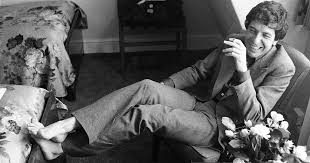

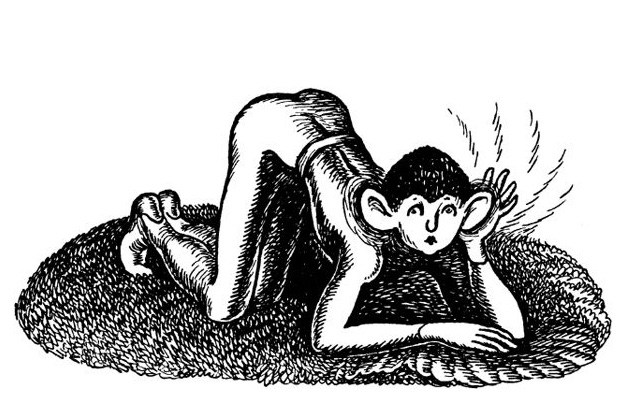
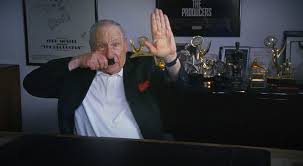

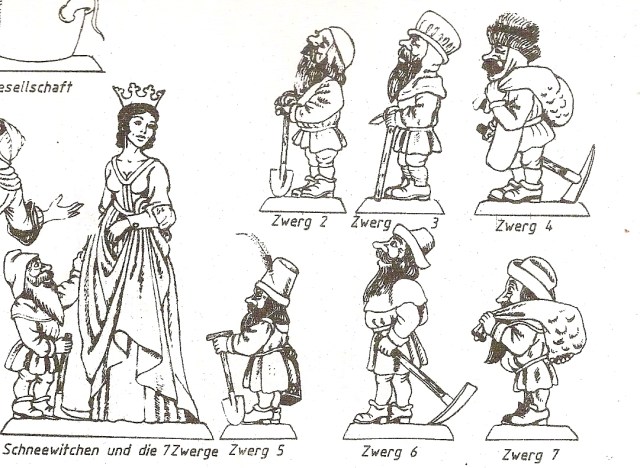


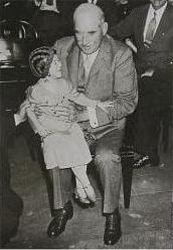



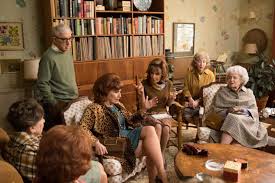
 Schlemiel Theory