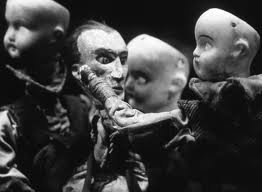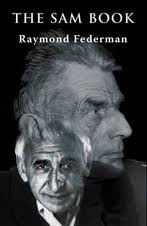
In Memoriam of Samuel Beckett (and Raymond Federman): The Laugh that Laughs at the Laugh

images-1

In case you may not have noticed, the subtitle of Schlemiel-in-Theory is the “The Place Where the Laugh Laughs at the Laugh.”    The notion of a laugh that laughs at a laugh comes from Samuel Beckett; namely, from his novel entitled Watt.  There, we read:

The bitter laugh laughs at that which is not good, it is the ethical laugh. The hollow laugh laughs at that which is not true, it is the intellectual laugh. Not good! Not true! Well well. But the mirthless laugh is the dianoetic laugh, down the snout — Haw! – so. It is the laugh of laughs, the risus purus, the laugh laughing at the laugh, the beholding, saluting of the highest joke, in a word the laugh that laughs – silence please — at that which is unhappy.

In this passage, we see three types of laughter.  The first and second kind of laughter can be seen in the work of Henri Bergson.  In his famous “Essay on Laughter,” Bergson argues that laughter is on the side of élan vital.  The laugh looks to reject mechanical, asocial behaviors from the social sphere.  Laughter, in other words, negates the mechanical while affirming life and change (becoming).  Bergson notes, explicitly, that all laughter is intellectual in the sense that, for life, becoming is true while the mechanical is false.  The same goes for Immanuel Kant who identified, in The Critique of Judgment, humor with incongruity:

In everything that is to excite a lively convulsive laugh there must be something absurd (in which the understanding, therefore, can find no satisfaction). Laughter is an affection arising from the sudden transformation of a strained expectation into nothing. This transformation, which is certainly not enjoyable to the understanding, yet indirectly gives it very active enjoyment for a moment. Therefore its cause must consist in the influence of the representation upon the body, and the reflex effect of this upon the mind.

Beckett proposes a laugh that is neither ethical (in the Bergsonian sense) nor intellectual (in either Bergson or Kant’s sense).  Rather, his laugh, the “risus purus” is directed “at the laugh.”  It laughs, as he says, at “that which is unhappy.”

What does this mean?

First of all, I would submit that while the laugh that Kant and Bergson (and even Baudelaire) discuss enjoins one to power and superiority over the thing laughed at, the laugh that laughs at “that which is unhappy” is a laugh of powerlessness.

Theodor Adorno, in an essay entitled “Is Art Lighthearted,” ponders the “laugh that laughs at the laugh” along these lines:

In the face of Beckett’s plays especially, the category of the tragic surrenders to laughter, just as his plays cut off all humor that accepts the status quo.  They bear witness to a state of consciousness that no longer admits the alterative of seriousness and lightheartedness, nor the composite comedy.  Tragedy evaporates because the claims of the subjectiveity that was to have been tragic are so obviously inconsequential.  A dried up, tearless weeping takes the place of laughter.  Lamentation has become the mourning of hollow, empty eyes.  Humor is salvaged in Beckett’s plays because they infect the spectator with laughter about the absurdity of laughter and laughter about despair.  This process is linked with…a path leading to a survival minimum as the minimum of existence remaining.  This minimum discounts the historical catastrophe, perhaps in order to survive it (Notes on Literature, Volume 2; 253)

Adorno suggests, here, that the laugh that laughs at the laugh bears with it a minimal self.  It is, so to speak, so exhausted and laughs only for the sake of surviving the disaster.  It realizes that laughter can’t do any good and neither can tragedy.  The laugh that laughs at the laugh, therefore, can be seen as a mourning of both tragedy and comedy.

The risus purus, so to speak, is in the shadow of the disaster.

I also noticed this in an interview between the poet Charles Bernstein and the late Raymond Federman (who I was fortunate enough to have befriended and written several essays on).  Federman is best known for his post-Holocaust postmodern literature.  He, himself, survived the Holocaust and witnessed, while hiding in a closet, his parents taken away by the French authorities.  This disaster remained with him throughout his life.  And it is reflected in many of his novels, stories, and poems.

Strangely enough, when Federman left Europe, after the War, for America, he took on a doctoral project at Columbia University on Samuel Beckett.  His scholarship has gained much recognition in field of literary studies.  But his main love wasn’t literary criticism; it was writing fiction.  And, one cannot help but notice, in reading this fiction, that although its topic is horrific and unthinkable, Federman still maintains some kind of sense of humor.

In the interview with Bernstein, Bernstein hits directly on this issue:

But you’re very funny about it (the facts of history) as opposed to terribly solemn and serious memorials that we are perhaps more accustomed to.  Your work seems to mock not only the possibility of accurate representation but also the idea that mourning should be a solemn affair.  Should mourning be funny?

Federman’s reply to Bernstein hits directly on what Adorno reads in Beckett’s laugh at the laugh, yet, he adds another note with regard to laughter and the joy of survival:

And my answer is simple: I am a survivor.  That I survived this is a very happy occasion.  I am still alive.  That is an occasion for, well, if not great laughter, at least some kind of joy…I hope you can hear … the laughter and the nonseriousness of what I do.

Bernstein nudges Federman with regards to this response and says:

But I can hear the sadness and great seriousness, too.

Bernstein then goes on to note that Federman’s humor is certainly not “black humor.” So, what is it?   To explain what it is, Federman cites Beckett:

I…learned it from my great mentor Beckett the same kind of sadness and joy and laughter you find in Beckett.

This is what Federman, in his book Aunt Rachel’s Fur, calls “sad laughter.”

However, this still doesn’t satisfy Bernstein, who pushes him still further by saying that Federman is completely unlike Beckett:

Yes, but unlike Beckett, you are actually more sort of hysterical and more histrionic.

But instead of agreeing with him, and leaving Beckett behind, Federman cites his “mentor” and notes that in Beckett’s Molloy we see a major kind of histrionics and not simply a melancholy laugh.    Federman notes how, in that novel, there is a “Beckettian acrobat who does a beautiful set of somersaults and then falls back on his feet and everything is erased.”  However, Federman distinguishes himself from Beckett, his mentor, when he puts himself in the acrobat’s position:

I am the acrobat who falls down on his face, and so you don’t remember the somersault.   You remember the failure of the guy that falls on his face.  And that’s where you laugh – when the acrobat or the clown does that, that’s where the laughter is.  That’s the kind of laughter I’m trying to achieve.

In other words, Federman sees himself as an acrobatic schlemiel.  The schlemiel has us remember the fall not the somersalt.  Reading this line, I was struck by how oddly resonant it was with Nathan Englander’s post-Holocaust story “The Tumblers.”  As I pointed out in a blog entry I devoted to that story, the characters survive by virtue of being clumsy acrobats. No one knows that they are Jews and yet the irony is that the Nazis officials in the audience say that the klutz acrobats who fall on their faces act “like” Jews.

In retrospect, I can say that Beckett and Federman may both laugh at the laugh, they remind us that now our laughter is after the disaster; however, Federman’s laugh at the laugh puts a personal and a post-Holocaust Jewish accent on survival.  In the end, although his laughter is sad, it is also histrionic, happy, and contagious.   Like many Jews throughout history who know what its like to have survived numerous disasters and exiles, Federman knows what it’s like to survive disaster.  More importantly, Federman, like the creators of the schlemiel, knew how important it was to balance out sadness with the joy of humor.  Everyone who knew Federman personally knew that he wanted us to laugh with him.  He wanted us to laugh at the laugh and, like acrobats, to retain the tension between a skeptical laugh and an optimistic laugh.  His laugh, the laugh of a post-Holocaust schlemiel, does exactly that.  More importantly, the laughter of the post-Holocaust schlemiel is not based on some hidden logos or kernel of meaning; it is based on a kind of acrobatics or movement, the kind that, as Federman tells us, ultimately falls on its face.  Nonetheless, it survives.

The subtitle of this blog (and this blog entry) is in Memoriam of Samuel Beckett.  But it is also in Memoriam of Raymond Federman, who taught us how a Jew named Raymond Federman carried on Samuel Beckett’s legacy and gave it a post-Holocaust nuance.

After the Holocaust, after the disaster, Schlemiel-in-Theory is the place where the laugh (can still) laugh at the laugh.


Who has the Last Word? Power or Comedy? On Baudelaire’s “A Heroic Death”

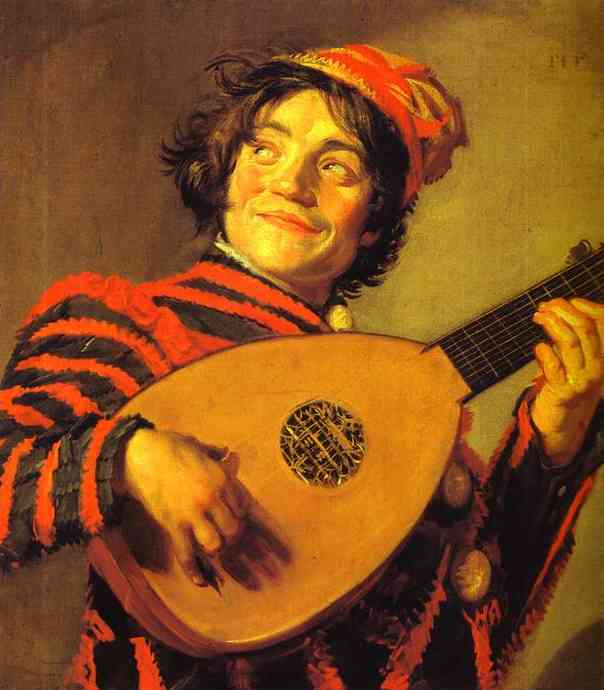
Jester-with-a-Lute-Frans-Hals

In our culture, comedians are cultural icons and, from time to time, they even come to influence public opinion.  Most recently, for instance, Jon Stewart’s parody of Egyptian President Mursi and the jailing of a comedian reached Mursi and caused a stir.  Sara Silverman, Bill Maher, and Stephen Colbert have also looked to use comedy to influence politics.  This trend, in fact, goes back to the Enlightenment where Satire was used quite often to influence public opinion and shape political debate.

As Leo Strauss, Peter Gay, and others have pointed out, satire (of the Enlightenment variety) errs on the side of the secular.  It has nothing holy about it.  Charles Baudelaire, however, had a different understanding of comedy and its relation to power.  Rather than put Satire into a conflictual relationship with power, he put the fool in such a relationship.

We see this best in his prose piece, “A Heroic Death.” In his prose piece, Baudelaire puts the fool in a battle with power.  To say that this battle is cosmic would not be an understatement.  To be sure, if one were to take the time to read his journals in tandem with his poetry and prose, one would see that Baudelaire was always looking to evoke and think through the conflict between the sacred and the profane.   More importantly, Baudelaire saw this conflict best pronounced in the fool and by way of irony.

“A Heroic Death” shows us that the tension between art (and for Baudeliare, as for Kierkegaard and Schlegel, comedy was the quintessence of art) and power was one of his greatest preoccupations.  We would be amiss if we were to think that Walter Benjamin, in his studies of Baudelaire, had simply missed this.  To be sure, the tension between comedy and power is something that Benjamin thought about – particularly, in his work on Kafka – right up to his untimely death.

By way of a close reading of Baudelaire’s prose piece, I hope to show what is at stake in the tension between comedy (art) and power.  Moreover, I hope to show how Baudelaire took this tension and its outcome personally.  I’d like to suggest that we also take it personally since, as the prose piece shows, it hits directly on the modern condition that we are all-to-familiar with, a condition that Baudelaire constantly addressed.

Baudelaire begins his prose piece by noting that Fancioulle, “an admirable buffoon and almost like one of the Prince’s friends,” got involved with a “conspiracy” with “certain discontented nobles in the court” to overthrow the Prince.  The narrator, waxing philosophical, observes that “for men whose profession is to be funny, serious things have a fatal attraction.”  In other words, the narrator believes that comedy may likelly lead the fool to politics and thus fatality.  This observation, and the opening plot of the story, suggest that politics and comedy are strange bedfellows.  When they collide, there will be a life and death battle.  “A Heroic Death” illustrates this.

The narrator tells us that once the Prince discovers the plot, “all of them faced certain death.”

But after saying this, the narrator pauses to consider the Prince and his reaction to learning that Fancioulle was a part of the plot.  In this pause, we learn about what kind of person the Prince is.

According to the narrator, the Prince was a lover of entertainment.  In fact, his desire for entertainment has no bounds: “having an excessive sensibility he was in general far more cruel than his fellows.”

To be sure, the Prince was so cruel in his pursuit of pleasure that he was “indifferent enough in regard to men and morals.”  Setting up the battle that will ensue between the Prince and the fool, the narrator calls the Prince “a real artist.”  This suggests that the consumer of art, who will bypass morality and humanity to be entertained, is a “real artist.”  This ironic statement should be disturbing.  First of all, the Prince doesn’t produce art he consumes it.  How, then, could he be called an artist (a person who “makes things” – a technes in Greek)? More importantly, the narrator tells us that a “real artist” is deemed to be someone who disregards morality and humanity.  This means that the “real artist” has no interest in helping or in inspiring humanity to pursue justice. This artist is not interested in art for art’s sake so much as consumption for the sake of ending or at least differing Boredom.

When the narrator points out that the Prince’s most “dreaded” enemy is Boredom, the reader may realize that he or she has a lot in common with the Prince.  In fact, like us, the Prince would go “to extravagant efforts to vanquish or outwit this tyrant of the world.”  These efforts would win the prince the “epithet of ‘monster’” if, in fact, anyone in the Kingdom were allowed to write what they really thought about him and his ways.

The narrator, in a sarcastic manner, notes that the “misfortune of the Prince was in not having a stage vast enough for his own genius.”   This genius is, obviously, Satanic.  And a vaster stage would mean the world.  This discloses the desire of the Prince: to turn the world into a reality TV show of sorts – a laboratory for his perpetual amusement.

The narrator spells this out when he reflects on how the Prince decided to let Fancioulle live and perform for him.  This clemency, the narrator muses, was not simply because the fool was the Prince’s friend.   The narrator said it would be “nice” to believe this; however, he notes:

It was infinitely more probable that the Prince wanted to test the value of the histrionic talent of a man condemned to die.  He wanted to profit by this occasion to make a physiological experiment of a capital interest, to find out to what extent an artist’s faculties might be challenged or modified as extraordinary as this.

The narrator muses to himself as to whether or not the Prince had a “more or less definite idea of mercy”; this, he says, “is a point that has never been clarified.”  This musing hits on the question of good and evil.  With the Prince, this remains a question.  However, the fool, for the narrator, is different.

The fool bespeaks the best in humanity.  And he does this by way of his art.  And this is where the battle ensues; namely, over the question “who is the real artist – the Prince or the Fool?”

The narrator makes this question explicit when he differentiates between a “good actor” and the exceptional actor:

When people say of the actor: ‘What a good actor,’ they are using an expression which implies that beneath the character they can still distinguish the actor, that is to say, art, effort, volition.  But if an actor should succeed in being, in relation to the part he played, what the best statues of antiquity, if miraculously animated they lived, walked and saw, would be in relation to the confused idea of beauty, that would indeed by a singular case and altogether unheard of.

The narrator then tells us that “Fancioulle was that night just such a perfect idealization, so that one could not help believing in the impersonation as alive, possible and real.”

In other words, Fancioulle is the epitome of the “real artist.”  He effaces the line between the real and the ideal.  He is laughter, beauty, comedy, and tragedy in the flesh.  He is holy and the narrator tells us that he, unlike anyone else, can see that the fool has an aura:

The buffoon came and went, laughed and wept, and lashed into fury, with always about his head an imperishable aureole, invisible to all, but visible to me, that blended in a strange amalgam the beams of Art and the glory of Martyrdom.

The narrator further testifies to this revelation when he notes how, in recording this experience, his pen “trembles and tears of an emotion that has never left him.”  In watching the fool, he has found certainty and faith. He realizes that art is greater than death:

Fancioulle proved to me in the most preemptory, the most irrefutable way, that the intoxication of Art is more apt than any other to veil the terrors of the eternal abyss.

But here is the twist.

The Prince notices that the whole audience, like the narrator, is intoxicated.  More importantly, he realizes that he has lost his power over his subjects.  The narrator notes this change when he remembers how the Prince’s face changes: “a new palor spread like snow falling upon snow.”

The narrator notices, in the midst of this, how the Prince whispers to one of his pages and, within a few moments, a “shrill prolonged hiss” is heard.  Upon hearing this hiss, the fool is awakened from his dream, shocked, and his performance ends, literally, with his death.

The end of the prose piece is fascinating because the narrator, instead of lamenting what he saw, poses several questions about whether the Prince knew the hiss would kill the fool.  He wonders whether or not he did it as a prank and whether the Prince regretted what he did: “It is sweet and legitimate to hope so.”

However, the narrator and the attentive reader will realize that regardless of this “sweet” thought, the fool lost the battle and the Real Artist is the Prince.

Baudelaire’s mediation on art is melancholic and autobiographical.  This prose piece is, in many ways, an Oracle of sorts.  It teaches us that he believed that if comedy is put in a battle with Power and politics, power and Entertainment will win.  Reflecting on ourselves, can we say that reality television and its cruel battle with boredom have displaced the art of the “Real Artist”? Each and every one of us, it seems, is the Prince.  And, like him, we will go to any lengths to be entertained and destroy our worst enemy, Boredom.  And, as Reality Television makes clearly evident, all of humanity, the world , is our laboratory.

Nonetheless, the merit of the fool is to give the narrator “evidence” that comedy can be revelatory.   He witnessed this possibility, but he also witnessed its end.   Will we ever see a fool like Fancioulle?  Can we hope for a religious and revelatory kind of comedy?  Can we say that the schlemiel is such a holy fool or is there a distinct difference between Baudelaire’s fool and the Jewish fool?   Did Baudelaire’s holy fool die “a heroic death” or was he murdered for the sake of Amusement (or jealousy)?

Perhaps Baudelaire was saying that the holy fool (not Satire) should steer clear of the political, for if it does not it will find a similar fate.  Like Fancioulle, entertainment and power will win and the holy fool (artist) will lose. The narrator’s sad tone, implies that boredom and the will-to-entertainment are too powerful.  They cannot be defeated.  Or so it seems.  After all, he did have the evidence of the Holy Fool.  But he also saw that Holy Fool murdered.  Nonetheless, he says, it would be “sweet” to think that the Prince was merciful on the fool.  Indeed, it would be “sweet” but its not.   In the end, the real and the ideal remain separate.  And why?

Because the Prince, who loves nothing more than to kill Boredom, killed the Fool. He killed someone who, as the narrator says in the beginning, may have been his friend.

Students and Teachers of The Schlemiel Legacy: From Sancho Panza to Walter Benjamin

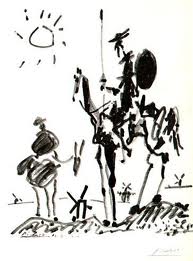
don-quixote-26.jpg!Blog

(Enter Walter Benjamin)

To be distracted and become absent minded, is so to speak the condition of the possibility of the schlemiel. Walter Benjamin knew this lesson very well.  He learned if from Kafka, who learned it from Sancho Panza and Don Quixote.

At the end of his Kafka essay, Benjamin notes that he is like a Sancho Panza to Don Quixote.   To be sure, at the end of his Kafka essay he cites his favorite Kafka parable, the parable on Sancho Panza and Don Quixote which ends: “A free man, Sancho Panza philosophically followed Don Quixote on his crusades, perhaps out of a sense of responsibility, and thus enjoyed a great and profitable entertainment to the end of his days.”

In other words, Benjamin, like Sancho Panza, literally spent the “end of his days” following around a schlemiel named Franz Kafka.  And in this, he became very distracted and absent-minded himself.  After all, a reflection without penetration is the manner of the schlemiel.  And in response to it, one will either die laughing or “come laughing.”  Benjamin, near the end of his life, imitated the ways of Sancho Panza who imitated the ways of Don Quixote (a fool).

With Benjamin, we know that he took the modern Don Quixote, Franz Kafka, as his last teacher.  Gazing upon Kafka’s text, Benjamin knew, as he said in one of his last letters to Gershom Scholem, written on June 12, 1938, that Kafka was correct about two things: “first, that someone must be a fool if he is to help; second; only a fool’s help is real help.”  However, as Benjamin mused:  “the only uncertain thing (the only question) is whether the fools help will do humanity any good.”

Indeed, that is the ethical question of the schlemiel.  And this is the question I have been asking in the last two blog entries.

Benjamin was the first to reflect on it.   And while Derrida is on to the tragic or comic manner of the schlemiel, unlike Benjamin, he does not pose this ethical question (at least not in his language phase).  Benjamin does.  Benjamin wonders whether the attention given to learning the wisdom of the fool, the manner of the schlemiel, can do humanity any good.   The same question applies to the ways of deconstruction and to learning the manner of the foolish (schlemiel) text.

If such a way of reading of the text doesn’t do humanity any good, will it be rejected?  And in the name of what?  The politician?  The philosopher?  How, Benjamin queries to Gershom Scholem, could they help?  The only one who “can help is the fool.” As Benjamin says in the same letter to Scholem, perhaps the only wisdom “is the wisdom of the fool.”  But, perhaps, as Kafka suggests, Benjamin was wrong.   Perhaps it isn’t wisdom that Sancho Panza gleans from the fool so much as entertainment (which Sancho Panza, a philosopher of sorts, enjoys until he dies…laughing). But, then again, Kafka muses that he may have followed him out of a sense of responsibility. This would imply that following the schlemiel is an ethical act of sorts. So…which is it? Ethics or entertainment? Both?

Let’s ask again: Will the wisdom of the fool, of Don Quixote, the schlemiel, do humanity any good? 

On this blog, it is imperative that we pronounce this question in different ways.   It’s inescapable.  This question emerges out of an endless reflection on the “reflection without penetration.” It emerges out of paying very close attention to the “manner” of the schlemiel. Paraphrasing Paul Celan, who paraphrases Walter Benjamin, who paraphrases Malbranche: attention (to the schlemiel) is the silent prayer of the soul.

Two questions may emerge from the attention of the reader to the schlemiel; that is, the attention of Sancho Panza for Don Quixote:

1) Can the attention that Sancho Panza (Walter Benjamin or Jacques Derrida) gives to Don Quixote (Franz Kafka or the Foolish Text) and his foolish ways do humanity any good?

2) What can we learn from the examples of Sancho Panza and Walter Benjamin? Did they seriously imitate their schlemiel teachers or did they laugh at them and themselves for imitating them?

But can the fool(ish) text do Humanity any Good? Maimonides, Derrida, and Gasche (Part II)

DownloadedFile-1

Echoing Jacques Derrida’s reading of Stephen Mallarme’s “Mimique,” Gasche writes that:

If the mime of “Mimique” only imitates imitation, if he copies only copying, all he produces is a copy of a copy.  In the same manner, the hymen that comes to illustrate the theatrical space reduplicates nothing but the miming of the mime.  Miming only reference, but not a particular reference, Mallarme keeps the Platonic differential structure of mimesis intact while radically displacing it.  Instead of imitating, of referring to a referent within the horizon of truth, the mime mimes only other signs and their referring function.

Derrida, Gasche tells us, calls this miming of other signs re-marking.

Gasche notes that this remarking has the “structure of the hymen.”  But instead of focusing on a static structure, Gasche looks to depict its dynamic nature.  For this reason, Gasche focuses on “the manner” in which “the double structure of the hymen relates to itself.”

He calls this “manner” a “reflection without penetration.”

In other words, Gasche sees the mime and the reader as taking on a manner of reflection without penetration.  Gasche derives the evidence for this “manner” from a line in Derrida’s essay that depicts the double structure of the hymen in terms of a “violence without blows.” But what Gasche misses is that Derrida links this dynamic structure, which manifests a “violence without blows, or a blow without marks,” to a person who is “made to die or come laughing.”

In fact, for Derrida, remarking is an event.  The manner of reflection without penetration happens when there is a “violence without blows, or a blow without marks.”  When this happens, one “is made to die or come laughing.”   And this laughter is exemplary of what is, so to speak, remarkable.

With all the undecidability of its meaning, the hymen only takes place when it doesn’t take place, when nothing really happens, when there is an all-consuming consummation without violence, or a violence without blows, or a blow without marks…when the veil is without being, torn, for example, when one is made to die or come laughing (232)

Gasche fails to underscore that, for Derrida, the “manner” of the double movement is comic and perhaps tragic (as one is made to either “die” laughing or made to “come laughing”).   Derrida is denoting how the event of  “a reflection without penetration” is the event of laughter.

Perhaps this is because language, unlike God, does not show us, in a prescriptive manner, ethical or political ways of being; rather, the text shows us its absent-minded ways.  In fact, if the text prescribes anything, it prescribes the manner of absent-mindedness.  Or, as Derrida says in his essays in on the poet Edmond Jabes (in Writing and Difference), the text prescribes the detour and the ellipsis.

In the same essay on Jabes, Derrida notes how the text prescribes exile from God. Unlike Maimonides, Derrida would say that the text does not prescribe any ethical or political ways of being.  The text doesn’t perfect man.   While Maimonides would say that Moses was exiled from knowing God and having a “penetrating reflection,” he would not say that God only prescribed exile for Moses.  In fact, as Maimonides argues, God prescribed His ways to Moses for emulation, imitation, and practice.

In contrast, if we reread Gasche by way of Derrida’s own remarks, we can say that the manner of the reader and the text is the manner of a schlemiel.  This manner is prescribed.  Unlike the text (which is unaware of itself), the attentive reader is aware of its absent-mindedness.  If one reflects on the text’s schlemiel-ish “reflection without penetration,” the attentive reader will be conscious or become conscious.  And this, Derrida might say, would happen when one laughs.

But are we who laugh at the foolish text, for this reason, better (or superior)?  As I have shown in other blog entries, this is exactly what Baudelaire proposes at the end of his essay on laughter.   However, this is a conclusion which, as I also have shown, Paul deMan disagreed with.   In fact, if anything, the consciousness that comes out of this, for deMan, leads to madness and self-destruction not superiority.

Would Derrida agree with deMan?  Does the absent-minded schlemiel text, and the reader’s attendant “reflection without penetration,” lead to vertigo, madness, and self-destruction?  Should we read Derrida’s comment that one may “die of laughter” in lieu of deMan?

By virtue of its inability to know itself, by virtue of its being a “reflection without penetration,” the text presents itself as absent-minded.  Recognizing what the text doesn’t see, Derrida seems to be suggesting that the reader will either “die” of laughter or “come to” laughter.  Why?  Because he or she realizes that the only thing he or she can follow is an opaque and aleatory text which, in its absentmindedness, dynamically flows, warps, and weaves in different directions, one will either die of laughter or come to laugh.

Regardless, one laughs at the text’s absent-mindedness.  Perhaps one also laughs at the fact that one’s “reflection without penetration” on the text is also risible.  But in knowing that language doesn’t have a meaning or know of any, are we, in a deManian sense, mad?

Derrida’s text implies that, upon reading the hymen, we are either made to die or “come laughing.”  Derrida seems to be suggesting that we either affirm this “reflection without penetration” with a yes, and laugh or we don’t.  This, in fact, is a suggestion he makes on his essay “Ulysses Gramophone: Hear Say Yes in Joyce.”  Without such a suggestion, it would seem that deMan and Derrida would be in agreement: the manner of the text would be a manner of madness and self-destruction.  In other words, the person who reflects on what deMan calls the “irony of ironies” would die laughing or go mad.

Derrida, in that essay (which I will return to in an upcoming blog entry) suggests that we should describe and affirm the reflection without penetration; and, in doing so, say yes to it.  This affirmation, this yes-saying, in a Nietzschean and Joycean spirit, is a prescription of sorts.   Like Sancho Panza who follows Don Quixote on his Journeys, the postmodern saint says yes to following the aberrant and absent-minded ways of the text.  Instead of Moses following the ways of God, we have a much more secular (and risible) model of observance.

So, here’s the question: Do we – like Sancho Panza – learn and repeat the schlemiel’s manner?  Is this, according to Derrida, our postmodern prescription and destiny?  Is this our postmodern ethic?  And will the foolish text do humanity any good?

Since the text has the structure of the hymen, Gasche would say that the repetition of the text (and the “reflection without penetration”) is inescapable.  The text repeats itself and we repeat the text repeating itself.  That’s it.  Nothing more nor less.

But what is the point of the text or our lives if they always remain caught up in an endless textual ellipsis?  Again: What good will this do for humanity?

The structure of the schlemiel, its manner, for Gasche and Derrida, would be an endless reflection on the surface.  It would be a manner of moving across an endless surface or as Deleuze might say, a thousand plateaus.  And in response to it we will, as Derrida –that is, Rabbi Derissa – de (of) the risus (laughter) – claims, either die laughing or come laughing.

(Enter laughter)

But can the fool(ish) text do Humanity any Good? Maimonides, Derrida, and Gasche (Part I)

images

In his book Of Minimal Things: Studies on the Notion of Relation, Rodolphe Gasche notes, in one of his readings of Jacques Derrida, that a text, like a person, can have a manner.

A manner is a way of acting or bearing.  A manner can also be read as a style.

What is the meaning of Gasche’s description?

This description of the text as a manner has religious resonance.  The reader, in an exegetical manner, must figure out his or her bearing in relation to the text and its bearing.  How does the text appear to the reader and how, in turn, does the reader present him or herself to the text?  Can the text teach us about how to bear ourselves or is it devoid of any such prescriptions for action?

Gasche suggests that the relation to the text is not by way of knowledge so much as by a relation to its way of being (its manner).  Textual relation bears two questions: How do we relate to the text and how does it relate to us?  Does the text turn away from us, as God turns away from Moses in the moment of revelation?

I can’t help but hear Maimonides reading of Prophetic Revelation in Gasche’s claim. In Part I, Chapter 54 of The Guide to the Perplexed, Maimonides discusses how, when Moses requests to see God’s essence, he sees, instead, God’s actions.  In other words, Moses , according to Maimonides, was only allowed to see God’s manner of being:

When Moses asked for knowledge of the attributes and asked for forgiveness for the nation, he was given a favorable answer with regard to their being forgiven.  Then he asked for the apprehension of His essence, may He be exalted.  This is what he means when he says, “Show me, I pray You, Your glory” (Ex. 33:18), whereupon he received a (favorable) answer with regard to what he had asked for first – namely, “Show me Your ways.”

Although Moses didn’t learn of God’s essence, he was shown God’s “ways” so that he could teach and practice them.  He was given what Gasche would call – in his essay on Derrida – a “reflection without penetration.” Nonetheless, he is given a manner that can make life better for himself and for the Jewish people.  To be sure, for Maimonides, the prophet is a political leader and a philosopher.  Most importantly, Moses, “the greatest of all prophets,” is the only prophet who is a lawgiver.  All three are related, in some way, to God’s ways or manners, which Moses practices.  Practice, it seems, trumps reflection into the essence of things.  The manner of God, God’s ways, bear themselves to Moses.  Not God’s essence.

Walter Benjamin, Jacques Derrida, and the later Martin Heidegger, have taught us, with respect to language, that if it doesn’t have an essence that can be known (like God cannot be known), then all one can know of language is not what language is but what language does.  We can only know or describe how language does things.

Maimonides notes how Moses can perfect himself and be the best leader and prophet if, and only if, he imitates what God does – which can only be found by following God’s ways.  Maimonides sees Moses’ practical knowledge as being based on divine contemplation of God’s ways.  Such contemplation can foster love and fear and, most importantly, prompts imitation that promotes ethical and political well being.

The imitation of these manners or ways would do humanity good.  Maimonides tells us that such imitation will help man to perfect himself; moreover, without imitaiton, society cannot perfect itself.  Without a teacher of God’s ways, without a leader who pursues the ways of justice, society will degenerate.

Can we say the same for language?  Can or does language as such – language and its ways -do humanity any good?  Can language help?

Heidegger, near the end of his life, focused solely on “listening” to language.  And Benjamin wrote several essays and notes on language.   Derrida and Giorgio Agamben, amongst others, also call on us to pay close attention to language.

For them, its an imperative to pay close attention to the ways of language.  But do they do this because they believe that following the ways of language will do humanity any good?  Are they miming religion, so to speak, while emptying it of its content?  Instead of the manner and ways of God, do we study and practice, instead, the ways of language?  Are these, as Derrida might say, the way one would practice a “religion without religion?”

To answer these questions, let’s play a game.  I’ll imagine what would be implied if we read the relation of the reader to the text as we would read the relationship of Moses to God.  To know what to do, to act or imitate the ways of the text, we would have to know what a text is doing and how it is doing it:

What is the manner of the text?

Can we learn justice from the ways of language? Or do we just learn its ways?  Are we in the position to imitate its ways or is this a ridiculous question reserved only for religion and theology not language as such?

Reading Gasche, we should like to know if we are going to imitate the text so as to perfect ourselves and society; otherwise, Gasche’s language suggests that we reflect on a manner that is devoid of any ethical or political content.  Does the act of reflection suffice?  Does it help humanity?

If ethics is based on actions and not on knowledge, as Levinas points out in a reading he makes of Maimonides (in one of his essays on Judaism), for language to be ethical, it would have to be prescriptive in some way.   Otherwise, its “manner” would have no ethical content.

If we take Jacques Derrida seriously, we would have to say that a text has the manner of the schlemiel.  It does not know what it is doing.   And language likes to dream and get distracted.  A text can be absent-minded.  But can a text, like a schlemiel, fail?

How would it fail?  In what manner would the text, as schlemiel, fail?

Roldophe Gasche gives us a clue.  In his book, Of Minimal Things: Studies on the Notion of Relation, Gashe writes of Derrida’s notion of mimesis.  He reads mimesis through Derrida’s essay on Mallarme entitled “The Double Session.”  There, Gasche looks into the relationship between the text and reflection.  He argues that Derrida’s notion of textual mimesis shows has the manner of a mystical and absentminded kind of consciousness: a “reflection without penetration.”

Gasche’s notion of a “reflection without penetration” is really another name for what is commonly called “absent-mindedness.”

How, according to Gasche, does one, along with the text, become absent-minded?

Is the text, as Derrida might say, always-already absent minded?  And is our manner of reading, always already, absentminded? Through Gasche’s reading of Derrida, I would like to briefly touch on these questions.

To be continued, in tomorrow’s blog…..

The Post-Holocaust Schlemiel (Take 3)

DownloadedFile

What happens to the Schlemiel after the Holocaust?

This is a very complicated question.  In one entry, I discussed the end of the schlemiel by way of the story of Menachem Kipinis, a reporter who acted as if he was reporting on the town of Chelm (a real town in Poland, and a fictional town in Jewish folklore). Chelm, as I explained there, is a town of schlemiels.  As the story about Kipinis goes, he, the schlemiel reporter, along with all of the living Jewish members of Chelm, found their end in concentration camps. I suggested, there, that I was here to continue reporting on the schlemiel whose existence now transcends the boundaries of the real or fictional town.

In another entry on the post-Holocaust schlemiel, I noted that, for Sidrah DeKoven Ezrahi, the schlemiel lives on in America, but not in Israel, because America has not properly mourned the Holocaust and the end of European Jewry.  It lives on in America as a cultural icon; it lives on in a culture dominated by Simulcura.  Here, in America, after the Holocaust, the schlemiel finds its home in Hollywood.  One need only think of Woody Allen, Ben Stiller, Adam Sandler, Larry David, Seth Rogen, etc to get a sense of what she is getting at.

For Ezrahi, the schlemiel takes part in what she calls “Diasporic privilege.”  This privilege is not restricted to the domain of Hollywood and popular culture; in fact, it is found in high, literary, culture.  Regarding this, Ezrahi notes that the schlemiel is bound to a textual homeland not to a real land such as Israel.  It is a figure of endless discovery not, as in Israel, a figure of historical recovery.  It’s trope is the trope of Diaspora not Homecoming.

In today’s blog, I’d like to suggest another route for the post-Holocaust schlemiel; one mapped out by Nathan Englander in his short story “The Tumblers.”  This route takes us into a scenario where the schlemiel lives on, but as damaged by history.

Ezrahi is correct when she claims that, with books like Roth’s Portnoy’s Compalint (and after 1967), American Jews can no longer think of themselves without thinking of Israel.  Jewish identity has changed radically, she says.  We are no longer, simply, schlemiels.  In fact, the American schlemiel battles, as we see in Portnoy’s Complaint, with the Sabra (I will return to this in another blog entry).

However, Ezrahi is not correct on all accounts.  There is a post-Holocaust schlemiel in America, one she doesn’t recognize, one that has yet to be researched.  As I would like to suggest, Englander, someone who has not survived the Holocaust and is far from its origin, recognizes that an American-Jew can’t look to the schlemiel as his predecessors did.  If at all, the schlemiel takes on a new shade.

Englander’s story appears in the book For the Relief of Unbearable Urges.

“The Tumblers” takes place in Chelm at the beginning of the Holocaust:

“Who would have thought that a war of such proportion would bother to turn its fury against the fools of Chelm?”

First off, we learn of the main character, Mendl, who descends from the legendary “Gronam the Ox.”   He inherits Chelm and he carries on this legacy which, as the story goes on, changes.

Before the big changes happen, we learn that “Gronam’s logic was still employed when the invaders built the walls around the corner of the city, creating the Ghetto of Chelm”(28).

This schlemiel logic was used to make light of the difficult things: “they called their aches “mother’s milk,” the darkness became “freedom”; filth they referred to as “hope”(28).  This is the logic of the faithful simpelton (the tam) – who as Rabbi Nachman of Breslav – in his stories – taught is the schlemiel.

However, there is a limit to their substitutions and that limit is death: “It was only death that they could not rename, for they had nothing to put in its place. This is when they become sad and felt their hunger and when some began to lose their faith in God”(28).

At this moment, the narrator tells us that “This is when the Mahmir Rebbe, the most pious of them all, sent Mendel outside the walls”(28).

Mendel, although a schlemiel, goes out to learn what is going on.   We witness how Mendel filters much of what he knows through the mind of a schlemiel.  He struggles with what he sees; none of it makes sense.  When he meets up with an orphan friend named Yocheved, she tells him of how she and he will run away to a farm and eat duck.  Like any schlemiel, he dreams his hunger away.

However, he loses his innocence and much of his dream logic when he sees Yocheved killed by a bullet. The description of her death, as seen through his eyes, is a measure of his incomprehension and his new, liminal sense of existence.  As the narrator points out, Yocheved would not have died had she not been startled by the beating of her uncle.  Her death, both real and represented, is mixed with aesthetics, shock, and religious confusion.

The bullet left a ruby hole that resembled a charm an immodest gril might wear.  Yocheved touched a finger to her throat and turned her gaze toward the sky, wondering from where such a strange gift had come. Only Mendel looked back at the sound of the shot: the other had learned the lessons of Sodom. (35)

Mendel is damaged by this memory.  He has seen death.  But he moves on and doesn’t give up hope.

His Rabbi tells him and his group of Hasidim to shave off their beards and to dress like they are secular people.  They all manage to escape and stumble upon a circus train by way of passages built by way of schlemiel logic.

This leads them to the next game they must play.  They are taken to be acrobats by the other circus performs in a train.  They take them for such performers because of their thin, Jewish bodies.  Now, to survive, they must act “as if” they are acrobats.

The rest of the ride to their first performance, Mendel learns how to do a few acts from the other performers on the train and he relays them to his fellow schlemiels.

They learn them as best they can, but when the moment of truth comes, and they have to perform before an audience of high officials, they fail.

However, their failure saves them, since the audience takes them to be acting “as if” they are Jews who “tumble” all over each other.

What bothers Mendel most about all of this is that the world they are performing for – the world the circus performers are performing for – is “efficient” and “orderly” in a violent sense.   In Chelm, where the order was loose and playful, there was no such violence.

Moreover, Mendel realizes that to be ordered, as a performer, one must act as if he or she is something when he or she is not.  He notices that the art of the circus performers is based on a forced kind of duplicity.

At the end of the story, he puts his hands up.  Unlike other schlemiels, the narrator notes that Mendel’s hands are not soft and humble, they are “cracked and bloodless, gnarled and intrusive”(54). These are the hands of a post-Holocaust schlemiel.

Englander ends his story by reminding us that Mendel’s hands, the hands of this accidental entertainer, are different from the hands that have died in the Holocaust:

But there were no snipers, as there are for hands that reach out of the ghettos; no dogs, as for hands that reach out from the cracks of boxcar floors; no angels waiting, as they always do, for hands that reach out from chimneys into ash-clouded skies. (55)

As a reader, we now know that we cannot think of the schlemiel without thinking of the Holocaust.  This is the novelty that Englander wants us to come to terms with.  This isn’t a Hollywood Schlemiel and it isn’t a schlemiel whose homeland is the text, as Ezrahi claims with so many other schlemiels.

Rather, Englander teaches us that we American-Jews who live in the shadow of the Holocaust can no longer think of the schlemiel in the same way; regardless, he knows that the schlemiel, Mendel, lives on.  But, as Englander shows us through his creative fiction, he lives on in shame.

His irony – the irony of the schlemiel – is no longer fictional; it is historical.

Minimalizations or Schlemiel Revelations ((Snap))

celebrities-as-everyday-people-planet-hiltron-thumb640

The other day I had what Walter Benjamin might call a “profane illumination” of minimization.

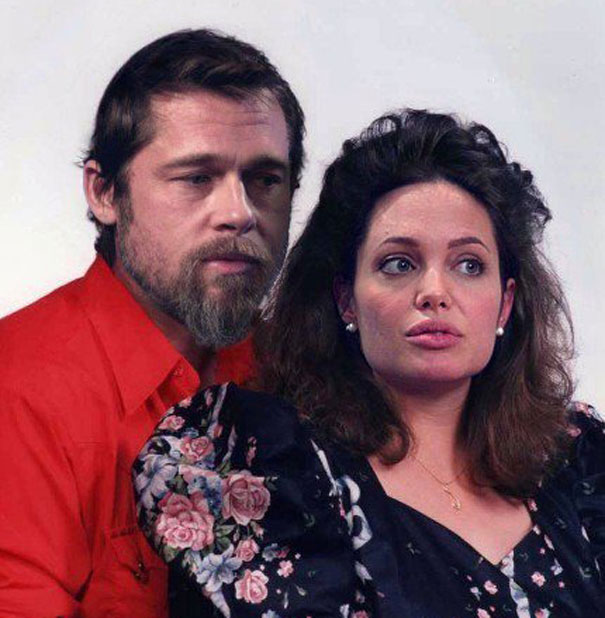
I read (or rather ‘saw”) an article, which appeared on the demilked website, on the New York Based artist Danny Evans.  It addressed a series of photos in which Evans looked to portray the stars as (or photo-morph the stars into) “ordinary people.”  I call this an act of miniaturization as it makes stars, larger than life beings, small.   It makes cultural heroes into schlemiels.  This act creates what Walter Benjamin would call a “double-image.”  In these images we see stars who are not stars.  And this creates a kind of schlemiel-effect.

celebrities-as-everyday-people-planet-hiltron-4

Hollywood Stars live the dream while schlemiels dream the dream.  These images put both together by what I would call a miniaturization technique.

celebrities-as-everyday-people-planet-hiltron-15

The photoshopped images of Pitt and Jolie or West and Kardasian wake us from the dream, so to speak, by showing us “our” dream.  To be sure, the way of miniaturization is the way of the schlemiel.  They may dream big but they are small.  Underlying all of this is the fact that a schlemiel is really a simpleton – a schlemiel is an ordinary person.

celebrities-as-everyday-people-planet-hiltron-7

But these “double images” state something a little more complicated.  Its not that Jay Z, Johnny Depp, et al thought that they were stars when they really weren’t (which is what these photos seem to be betraying).  Rather, the joke is on us.  Perhaps it is our dreams that don’t match up with reality and those dreams – the dreams of America – are the stars.  Perhaps our schlemieldom consists in our desire for stardom and to believe we can be like them, larger than life, when we are all just ordinary people.

Perhaps this is what Walter Benjamin was thinking when he realized, in his Vestibule dream, that in Goethe’s house (the house of a literary and cultural hero), he was a schlemiel.  His dream, a double image of sorts, was a miniaturization.   And not only did he know it, he lived with it.   Can we live with miniaturization? Can we live with being schlemiels?  When we chuckle at these photos, are we laughing at them or ourselves?


Destroying Toys With Jacques Derrida and Charles Baudelaire

images-1

In “The Philosophy of Toys,” Baudelaire writes of how the “overriding desire” of children is to destroy their toys so as to get at the soul of each toy:

The overriding desire of most children is to get and see the soul of their toys, some at the end of a period of use, others straightaway.  It is on the more or less swift invasion of this desire that depends the length of life of a toy.  I don’t find it in me to blame this infantile mania; it is a first metaphysical tendency.  When this desire is implanted itself in the child’s cerebral marrow, it fills his fingers and nails with an extraordinary agility and strength.  The child twists and turns his toy, scratches it, shakes it bumps it against walls, throws it on the ground….

But in the midst of destruction, Baudelaire tells us that there emerges a question:

But where is the soul?  This is the beginning of melancholy and gloom.

Contrast this to the celebrated French Philosopher Jacques Derrida’s portrayal of his “overriding desire” – in his book The Post Card: From Socrates to Freud to Beyond.  It brings him into contact with toys which he, like Baudelaire’s child, destroys:

In effect I believe that the idea imposes itself, this is indeed the word, in any event imposes itself upon me and I want it (want it horribly, flight, no, to enclose myself in a book project, to deploy all possible ruses and a maximum of consciousness, intelligence…while remaining…enclosed in this puerile (and masculine) enclosure of naivete, like a little boy in a playpen, with his construction toys.  That I spend the clearest part of my time taking them to pieces and throwing them overboard changes nothing essential in the matter.  I would still like to be admired and loved, to be sent back a good image of my facility for destruction and for throwing far away from me these rattles and pieces of tinkertoy), finally you will tell me why I still want all this.

Derrida’s destruction of toys is different from Baudelaire’s child.  He destroys them because he wants to be loved in “your” absence.  This “you,” in this passage, sounds like his mother.  He relates to her absence, to his desire for her, by destroying toys.  And he wants this as his image.  He wants “to be sent back a good image of my facility for destruction and throwing far away from me these rattles and pieces of tinkertoy.”

He says that he destroys toys for her “in order to prepare in your absence what I will give you on your return, at the end of time. What is it?”

Yes, indeed, what is it?  What will he give the absent mother when she returns?  It seems as if he has destroyed all of the toys she has given him.

What could this imply?  Is the destruction of the toy-gift a destruction of that which distracts the child for the mother’s absence?  And, on the contrary, wouldn’t the destruction of the toy do the opposite?

Instead of preparing the child for the mother’s absence, the destruction of the toy would expose the child to the mother’s absence.  And when I hear Derrida ask, regarding what gift he will give her upon her “return at the end of time,” I cannot help but hear a man-child’s impotent rage.

It seems as if Derrida is being very sarcastic and angry here.  Instead of Baudelaire’s child who sinks into melancholy and gloom, Derrida-as-man-child becomes mad.

Juxtapose this Derrida to the Derrida who celebrates play, the Derrida who plays with texts as if they were toys, and what you might find is the other – less playful – side of deconstruction.  Madness, it seems, is the remainder of this exercise in toy destruction since it is the mother, after all, who gives Derrida the toys to play with in her absence.  And now there is nothing – that is, there is no toy – that can distract him from her “betrayal.”

Derrida is, on the one hand, like the shocked child that Baudelaire sees as exemplary of the Absolute Comic.  But, unlike her, he is not in a stupor.  Derrida is mad.  He knows he has been duped.  And we are reminded of this by the fact that he has broken all of his toys and thrown them outside of his playpen.

And, although this seems different from the melancholy and gloom that Baudelaire refers to in the wake of discovering that the toy has no soul (that the soul is absent), the fact of the matter is that Derrida has ejected broken toy fragments away from him.  Nonetheless, they lay around his crib like melancholic ruins.  What he wants “back” (in return for his destruction) is an image of himself as a toy destroyer.  It is, what I noted in relation to Benjamin, a souvenir of sorts.

This is part and parcel of the man-child’s “overriding desire.”

I’ll close this blog entry with a 1935 Walt Disney Animation entitled “Broken Toys.”

After the “YouTubeLoop,” What is the Comic Legacy of Charlie Chaplin and Woody Allen?

DownloadedFile-1

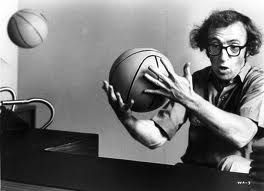
In yesterday’s post, I made a brief reading of the recent 44 minute video of Woody Allen “stammering” over the span of his career.   The picture I used as a thumbnail for the blog post came from the beginning of Woody Allen’s film Bananas. The reason I chose this image was because it nicely illustrated the mechanistic-slash-comic aspect of the video; in addition, it also illustrated what Henri Bergson believed was the essence of the comic: mechanical repetition. For Bergson, we laugh at the Jack-in-the-Box, or any mechanical repitition, because it is a caricature of life and freedom or what he called élan vital.  Like many in his time, Bergson’s theory is based on an organicist model or what the German’s called Lebensphilosophie (life philosophy). The greatest challenges to life philosophy can be found in meaningless, mechanical habits.  For thinkers like Friedrich Nietzsche or Georges Bataille, the source of these mechanical habits was the growing mechanization of society – a society in which everything meaningful or progressive had “utility.”  For this reason, both Nietzsche and Bataille pursued a “vitalism” which looked to act without any meaningful end.  Life, as they understood it, was excessive.  For us to put a determined end on existence, by way of work, mechanism, and habits was, in effect, to say “no” to life.  Saying “yes” to life would be to affirm what Maurice Blanchot would call “un-working.”  Saying yes to life, for Bergson, would be equivalent to saying yes to elan vital and no to the mechanical gesture. To be sure, filmmakers like Charlie Chaplin, who lived in and around the time Nietzsche, Bergson, and Bataille lived and wrote on vitalism, knew that the greatest threat to vitalism and élan vital was posed by technology.    America, with its concept of the assembly line and mechanical mass production, became the focal point for many Europeans (including Nietzsche, Batialle, Martin Heidegger, Karl Marx, and many others) of what is to come; namely, an existence in which the individual is lost in (and to) the machine. And this is the point: life was at stake – life embodied in the individual (the subject) and his/or her freedom. We see this tension between life and the machine comically elaborated in both Charlie Chaplin’s film Modern Times (1936) and in Woody Allen’s repetition of key scenes of this film (with, of course, some variation) in Bananas (1971): Here is Chaplin’s film: As you can see, Chaplin is the subject of the machine.  However, his comic gesturing (and the absurd nature of the machine – a toy of sorts – he is subject to) make him distinct from the machine.  Both his gestures and the absurd nature of the machine give him some kind of agency. Here’s Allen’s film, Bananas: This film does something nearly identical to Modern Times.  The machine and Allen’s gestural responses to it give Allen agency.   As one can see, Allen believes that such responses are still affective and meaningful. Although 35 years and major advances in technology and history separate them, both of these clips communicate the same message about comedy and its challenge to mechanization.  For both, one mechanism seems to be defeating another and élan vital triumphs (comically). It must be noted that, for many thinkers and film critics of the early 20th century, the source of this scenario (of comedy versus the mechanical), which Allen repeats, is Charlie Chaplin. In his book Late Modernism: Politics, Fiction and the Arts Between the World Wars, Tyrus Miller notes that Andre Bazin, the famous French Film critic, wrote a seminal essay in 1948 about Chaplin claiming that Chaplin’s comedy was a means of ‘brushing aside danger’.  Miller goes on to note that Bazin sees Chaplin’s power as the power of “mimicry” which acts by “reabsorbing time and space”(51).  What he means by this is that Chaplin’s comedy wins time and space back for organic humanity and beats the machine at its own game.  Bazin bases his advancement of mimicry on the work of the surrealist Roger Caillois who claimed that insects, like humans, imitate the environment in order to protect themselves from being killed. Miller reads this in terms of the medium of film: Supplementing Bazin’s claim that time reabsorbs space, then, we might say that Chaplin’s organic body becomes a mimetic extension of cinematic technology, which breaks down movement into constitutive fragments, discarding some while isolating others.  Having incorporated the technical principle of montage into his physical movements, Chaplin is able to mirror it back to the camera in embodied form. (52). Sounding much like Walter Benjamin, Miller argues that Chaplin becomes the “very allegory of cinema in its inaugural phase and the changes in experience it will precipitate”(52). The self survives as a “minimal self: as much technical as organic, and held together by the stiffening bonds of laughter”(52). This presupposes that there is a community between the comedian and the audience and that if we don’t have comedians who can mimic the damage wrought by technology – that is, if we don’t have comedy to laugh at, our agency and selfhood will be diminished to such an extent that instead of a minimal self, there will be no self. It’s fascinating to note that Theodor Adorno also suggests this call for comedy and the minimal self in his book Minima Moralia.   Three decades following Adorno’s plea for the minimal self, comedy and the minimal self are evoked by Jean-Luc Nancy in an essay on Baudelaire in his book The Birth of Presence.  But, as I will show in future blogs, Nancy likens laughter to an explosion.  But the question is this: what does it explode?  Does post-modern laughter – for lack of a better word – explode the machine or the person?  If the latter, then we can surmise that Nancy thinks we can no longer protect ourselves from the machine and might as well celebrate nihilism. Regardless of Nancy’s take on laughter, Allen seems to be more on the side of Chaplin.  He has an optimistic view of comedy and sees it as a “defense” against technology and empty, mechanical repetition. In yesterdays video, however, I wondered about the meaning of the mechanically reproduced stammering which has become a micro-stammering of sorts (concentrated into 44 minutes). Did that video testifiy to the obliteration of the self and absorption into the medium or something else?  How, in fact, do we understand ourselves and one of our greatest defenses (comedy) by way of being looped, re-looped and morphed by new technology?  Has Allen’s stammer exploded and been emptied of all its human (organic) content?  Does such a video evince a subject who is powerless and “defenseless” against the ever expanding field of technology (with all its information and audio and video “flows” and “feeds”)? How does comedy and how do “we” – who are “in the network,” who come after Chaplin and Allen’s comic parody of technology and who now come after the “YouTube-loop” of Woody Allen…stammering – “live on?”  

Woody Allen and his Jack-in-the-Box-Stammer (x1000)

images

Last week, The Huffington Post ran a 44 minute clip of Woody Allen stammering.  The clip puts together stammers that span Allen’s career.

When I saw it, the first thing that came to my mind was the Jewish-French philosopher Henri Bergson’s essay on laughter and, in particular, his words on the Jack-in-the-Box:

As children we have played with the little man who springs out of his box. You squeeze him flat, he jumps up again.  Push him lower, and he shoots up still higher.  Crush him beneath the lid, and often he will send everything flying….Now let us think of a spring that is rather of a moral type, an idea that is first expressed, then repressed, and the expressed again; a stream of words that bursts forth, is check, and keeps starting afresh.  Once more we have the vision of one stubborn force, counteracted by another, equally pertinacious (35).

For Bergson, a recurring force is comic because it is mechanical and repeats itself – unlike real life (élan vital).  Real people don’t “naturally” stammer like Woody Allen:

The truth is that a really living life should never repeat itself.  Whenver there is repetition or complete similarity, we always suspect a mechanism at work behind the living…The deflection of life towards the mechanical is here the real cause of laughter (17)

So, what we have here is not simply a stammer but a concentrated one.  But is this mechanical repetition of a mechanical repetition laughable?  Does the clip take the “surprise” out of humor?  Is Woody Allen’s stammer like a “jack-in-the-box” or does this video destroy the toy-slash-stammer?

That, my dear Watson, is the question.