Humor as Prosthesis: On Comic Word Play and Ironic Victories

images

Some schlemiel theorists like Ruth Wisse and Sidra DeKoven Ezrahi read comedy as a kind of compensation for failure and powerlessness. Comedic language, in this scenario, is a kind of prosthesis.   The feverish pace of comedy is, in this scenario, structured to give the writer, joke-teller, and audience a false – read fictional – sense of control.

Reflecting on the excessive use of language in Sholem Aleichem’s schlemiel-comedy, Ruth Wisse writes:

Sholem Aleichem generally employs the technique of monologue, of which the epistolary form is but a variation, to convey the rhythms and nuances of character, and to underscore the extent to which language itself is the schlemiel’s manipulative tool. Through language the schlemiel reinterprets events to conform to his own vision, and thereby controls them, much as the child learns to control the environment by naming it. One need only read Menachem Mendl’s joyous, and incomprehensible, explanation of the stock market to appreciate how proficient handling of language can become a substitute for proficient commerce. Moreover, the richness of language in some way compensates for the poverty it describes. There is in the style an overabundance of nouns, saying, explanations, and apposition….The exuberant self-indulgence of…description takes the sting out of failure itself….Maurice Samuel called…it “theoretical reversal.” (54)

In this scenario, all comic language is ironic as is the laughter that goes along with it since, in this view, everyone goes along with the joke. Nonetheless, we know what the schlemiel is doing. He is, as it were, not fully absent minded. And, as Wisse suggests, the schlemiel uses language like a “manipulative tool” so as to reinterpret events and things that they cannot master so that they can “conform to his own vision.”

Writing on the telephone as a prosthesis, Avital Ronell argues that it is “capable of surviving the body which it in part replaces” and it “acts as a commemorative monument to the dissolution of the mortal coil”(88, The Telephone Book). Playing on Freud, Ronell goes on to call the prosthesis a “godlike annexation of a constitutively fragile organ.” It performs a “restitutional service” by going right to where the trauma touches the body.

Ronell argues that Freud anticipates Marshall McLuhan who argues that if the body fails the prosthesis succeeds. However, for McLuhan, the prosthesis is not simply a substitute for a weak or “fragile organ.” It is an extention of our existing organs. Citing McLuhan, Ronell notes that for him the prosthesis will no longer be a buffer between the body and the world. It will directly relate to it. In other words, it is no longer a substitute and it no longer is false. And now when it is shocked or traumatized there is an “auto-amputation of the self.”

Ronell contrasts this new understanding of trauma mediated by a prosthesis which now becomes “real” to Freud who argues that the enjoyment of this false limb amounts to a “cheap thrill.”

Bringing all this together, I’d like to test out the prosthetic theory of humor posited by Wisse, above. If humor is a prosthesis, than wouldn’t our enjoyment of it be, in Freud’s words, cheap? Perhaps this suggests that the schlemiel is understood as a prosthesis and that our “ironic victory” is…ironic. Without that understanding, our laughter would in fact be cheap.

On the other hand, if we read prosthetic humor along the lines of McLuhan there is no false limb. It is not a tool so much as an extention of our bodies. If that is the case, humor – as an extention of our bodies – exposes us to existence. It doesn’t protect us and it can potentially harm the schlemiel. This insight, to my mind, bears some interesting fruit. We see the effects of this more in stand-up comedy than in Yiddish literature. While Sholem Aleichem’s Motl or Mendel Mocher Sforim’s Benjamin seem to be immune to existence – by way of their humor – stand-up comedians and some contemporary schlemiel characters, like Philip Roth’s Portnoy or Shalom Auslander’s Kugel are not. Sometimes language can provide us with an ironic victory othertimes the same words can signify, for a schlemiel, defeat.

It all depends on how you read the prosthesis for sometimes the substitution afforded by comedy doesn’t compensate for lack so much as expose us to excess.

I’ll leave you with a clip from Andy Kaufmann since his comic words and his gestures seem to expose him rather than protect him from failure.




On Hannah Arendt’s Reading of Rahel Varnhagen and the Schlemiel – Take One

rahel-varnhagen-540x540

Schlemiel Theory has published several posts on Hannah Arendt and her reading of the schlemiel in her celebrated essay “The Jew as Pariah.” As I pointed out in many of my readings, Arendt believed that the schlemiel had, for a certain time during modernity, a necessity. But, as she argues (and many critics overlook), she looked to leave the schlemiel-pariah behind. She found its worldlessness to be problematic and wished, instead (as she claimed Kafka did), that she could leave worldessness (and the schlemiel, its key figure) behind so that she could live a “normal” life. (In my book, I will be outlining the reasons for the use of the word normal which, to be sure, has less to do with what we post-post-moderns think of today as “normal” as what Zionists thought of as “normal.”) The schlemiel, in her view, was worldless and exceptional. And, as I pointed out, the schlemiel would fail what I would call Arendt’s Greek identity test; namely, the one we find in The Human Condition. The criteria for passing this test is contingent on whether one has a world to “act” in or not.   And the schlemiel, for Arendt, does not. Ergo, the schlemiel is and, in Arendt’s book, always will remain a failure of sorts.

But, as I point out in several entries, being a failure before the Holocaust is one thing – since that would be a good thing for Arendt, for Heine, the beginning of her “hidden tradition” of the schlemiel, is a pariah who, in being a “lord of dreams,” rebels against society and the parvenu. Once one can be considered as an equal, for Arendt this time period is hazy, one can leave the last of the schlemiels – for Arendt, Charlie Chaplin – behind for superman (literally).

In response to a recent post by Zachary Breiterman on his blog Jewish Philosophy Place regarding Arendt’s treatment of Rahel Varnhagen – in her first published book, Rahel Varhagen: The Life of a Jewess, I would argue that Arendt’s first attempt at reading the schlemiel was based on her reading of Varnhagen in this book. This reading, unlike the reading she would make when she landed in America, is very negative. To be sure, Arendt was confused about Varnhagen. In her essay, “The Jew as Pariah: A Hidden Tradition,” she lists Heinrich Heine as the beginning of the Schlemiel tradition. She doesn’t mention Varnhagen in that essay. However, in her essay “We Refugees,” written a year earlier than “The Jew as Pariah,” Arendt includes Varnhagen in her “hidden tradition.” There, she argues that Varhagen was a part of this “other” tradition:

Modern Jewish history, having started with court Jews and continuing with the Jewish millionaires and philanthropists, is apt to forget about this other thread of Jewish tradition – the tradition of Heine, Rahel Varnhagen, Sholem Aleichem (who isn’t in her “Jew as Pariah” essay, either), of Bernard Lazare, Franz Kafka, or even Charlie Chaplin (who she considers that end of the “hidden tradition” of the schlemiel). It is the tradition of the minority of Jews who have not wanted to become upstarts, who preferred the status of “conscious pariah.” (274, The Jewish Writings)

Compared to what she writes in her Varnhagen book, these words are very kind. I will limit myself to a few quotations to prove my point. (This blog entry, therefore, is preliminary and will be followed up with more entries. But the deeper treatment will be found in my book.)

Arendt argues that Varnhagen’s life was “bound up” with a feeling that she was “inferior” because she was Jewish and emerged out of the ghetto.   Her Jewishness was a mark of this shame. Arendt translates Varnhagen’s attitude toward her Jewishness when she writes: “Naturally one was not going to cling to Judaism – why should one, since the whole of Jewish history and tradition was now revealed to be a sordid product of the ghetto”(89).

Following this, Arendt inserts her own theory of about the world and worldless to argue that Varnhagen, as a schlemiel, had to do all she could to deny (or is it negate?) the world because the world reminded her that she was inferior (that is a Jew who had emerged out of the ghetto). For this reason, Varnhagen denies the things that Arendt values most – action, love, and the world – in the name of “thinking”:

Rahel’s life was bound by this inferiority, by her “infamous birth,” from youth on up. Everything that followed was only confirmation, “bleeding to death.” Therefore she must avoid everything that might give rise to further confirmation, must not act, not love, not become involved in the world. Given such absolute renunciation, all that seemed left was thought. (89)

Arendt argues that Varnhagen’s turn to thought was based on a delusion that it would save her.  Varnhagen, according to Arendt, misunderstood the words of Lessing who called for “self-thinking.” She made a bifurcation between thought and the world and ultimately saw herself as free in the world of thought but a Jew in reality.   Arendt tells us that Varnhagen refused to accept the reality that she was really a schlemiel; that is, the real odd one out:

Thinking amounted to an enlightened kind of magic which could substitute for, evoke and predict experience, the world, people, society. The power of reason lent posited possibilities a tinge of reality, breathed a kind of illusory life into rational desires, fended off ungraspable actuality and refused to recognize it. The twenty year old Rahel wrote: “I shall never be convinced that I am a Shlemihl and a Jewess; since all these years and after so much thinking about it, it has not dawned upon me, I shall never grasp it”(89).

Compared to Heine and Chaplin, as characterized by Arendt in her “Jew as Pariah” essay, Varnhagen is the worst kind of schlemiel. Her worldlessness is an act of denial.   Arendt says that she denies that she is a schlemiel when she really is one. Only a schlemiel, in this instance, would negate the world in the name of what Arendt calls a “foundation for cultivated ignoramuses.” Arendt snidely notes that “self-thinking” is good, but not in Varnhagen’s hands: “Self-thinking can no longer be rubbed raw with any contact with actuality…Self-thinking in this sense provides a foundation for cultivated ignoramuses”(90).

Liliane Weissberg, who edited and translated Arendt’s Varnhagen book into English, correctly notes – in her introduction – that Arendt is concerned with Varnhagen’s assimilation (50). But Weissberg doesn’t note the extent to which Arendt judges Varnhagen for this offense. To be sure, Arendt wittily compares Varnhagen, a Jewish Don Quixote of sorts, to the real Don Quixote. (Note that the first Yiddish novel with a schlemiel or rather schlemiels as its main characters – The Travels and Adventures of Benjamin III by Mendel Mocher Sforim – was based, in major part, on Don Quixote).   Arendt writes that there is a fundamental difference between Don Quixote and this German-Jewish schlemiel:

As long as Don Quixote continues to ride forth to conjure a possible, imagined, illusory world out of the real one, he is only the fool, and perhaps a happy fool, perhaps even a noble fool when he undertakes to conjure up within the real world a definite world.   But if without a definite ideal, without aiming at a definite imaginary revision of the world, he attempts only to transfer himself into some sort of empty possibility which he might be, he becomes merely a “foolish dreamer.” (93)

By calling Varnhagen a “foolish dreamer,” rather than a “fool” (like Don Quixote) Arendt is suggesting that the schlemiel is worse off than the fool since he has no “ideal” and does not aim at a “definite imaginary revision of the world.” This is a fascinating turn since, a few years later and in a different continent, Arendt calls Heinrich Heine a “lord of dreams.” However, that phrase, in contrast to “foolish dreamer,” has a positive valence for Arendt.

To be sure, it seems that Arendt made a distinction between good and bad schlemiels based on whether they had an “ideal” or an “imaginary revision of the world.” Unfortunately, Arendt never made this explicit in her work on the schlemiel. One can only find this, as I have, by comparing and contrasting one version of the schlemiel to the other.

…to be continued….


Trust Issues: Cynicism, Post-Nationalism, and Captain America

images-3

Politics and theater go hand-in-hand. One doesn’t have to be an intellectual to know that politicians use words and gestures to gain attention, garner support, or justify this or that agenda. It’s obvious to anyone that the media, film, and the internet can affect this or that political agenda. Within a few hours, a political agenda can be ruined or bolstered. Everyone knows this and we have seen this happen and see it happen on a daily basis.

But while the greatest obstacles to accomplishing this or that political agenda may be created by the media or Hollywood, the opposite is also true.   One of the markers used by this or that politician to measure the success or failure of a project is whether the “public” is optimistic or cynical. To be sure, President Obama has been using these terms a lot in his speeches. He has been worrying that Americans are too cynical and no longer trust the government. And, to address this, he has even turned to comedy and theater to regain confidence. He has played the schlemiel (a character whose charm often acts to win the viewer over). He understands how, without optimism and trust, his administration will lose power and authority. But more is at stake than belief or disbelief in the government.

For many Americans, the greatest stakes have to do with the belief in exceptionalism. Is America unique….anymore? Or is it a nation like all others?   It has become an issue, today, because America seems to be losing it’s standing in the world. We see this issue discussed in the media, in Washington, DC, and in Hollywood.   We also see it discussed in academia. And, as an academic, I can tell you that I have many colleagues who despise American nationalism and exceptionalism. For many of them, there is a conviction that America would be better off it were a part of a larger collective that would work to eliminate racial, economic, sexual, and cultural oppression and inequality around the world. Instead of leading the effort, they would like it if America were more humble. But, to be sure, they just don’t want this to happen; rather, like good post-Marxists, many believe it is already happening and that there is nothing we can do to stop it. Justice, meaning post-nationalism, will prevail. All resistance is futile and, in their view, stupid. Nationalism and patriotism are one and the same thing for many of them. Marx believed that the nation-state would eventually “wither away” and so do many of my colleagues. It’s only a matter of time.

But what will take its place?

This is an interesting question. In a post-nationalist America, what will people turn to for hope and inspiration? There are many answers to this question. I would suggest looking at some of the biggest academic conferences out there these days for an intimation of where academics think the answers may lie. One thing I can say, from what I see within my own academic circle, is that many academics want to leave nationalism and patriotism behind for “justice” and “ethics.” To be sure, nearly all of the post-Zionist thinkers in the field of Jewish Philosophy are post-nationalist. Many envision Israel not in terms of a state but in terms of something “bi-national” where Israelis and Palestinians can co-exist, side by side with each other.   Hence, there is a lot of scholarship in my field that sees the Jewish nation-state as powerful, violent, unjust, and unethical. All resistance to the state (in academia and in the street) is deemed ethical. This, it seems, is a part of a larger political agenda – a post-nationalist one.

If I were to sum up what they are looking for in a blunt way, I would say that what is common to their readings of Judith Butler, Martin Buber, Hannah Arendt, and Emmanuel Levinas (amongst others) is the belief that we can trust each other but don’t because of the nation state or politics (which breed distrust and violence). After all, when Hannah Arendt was accused by Gershom Scholem of not having “ahavat Yisrael” (love of Israel, the nation) in her treatment of Adolph Eichmann, she replied by saying she cannot conceive of national love. She could only understand the love of friends. That, in a nutshell, pronounces the desire of post-nationalism: to live in a world where we don’t need nations or nationalism to define who we are and what we do. All we need to do, to live a just, ethical life, is be friends and agree to coexist. That would be true justice. Nationalism and patriotism, on the other hand, are thought to be the anti-thesis of friendships and trust. Nationalism creates, for them, cynicism and war, while post-national trust creates optimism.  (Slavoj Zizek’s opposition of “kynicism” to “cynicism” provides a model for this project.)

The opposition between some kind of post-nationalist trust and nationalist distrust and cynicism has found its way into Hollywood, but, I would contend, this is by no means a mistake. To be sure, the mood in academia these days finds that American exceptionalism and nationalism have done us no good whatsoever. The latest Captain America film – Captain America: Winter Soldier – is a case in point.   And I have a feeling we will see more of these types of films.

In the film, nationalism is downplayed and distrust and cynicism touches everything. The new, revived, Captain America isn’t fighting so much for America as for trust and hope. He is looking for people he can trust. Unlike Independence Day (1996), saving America is really secondary to the main theme, which is saving trust and hope.

In this film, Captain America is looking for people he can trust. The nation, as it stands, is infiltrated with cynicism and distrust. Hydra has its hand in everything.   And Hyrda is fascistic. America – that is, nationalism – is not the alternative so much as is trust in the other. And this film shows Captain America battling with people inundated with fascist nationalism, on the one hand, and other American’s who have been infected with it (which suggests that fascism and its desire for order and security is the true essence of nationalism). The war isn’t between America and Hydra; it’s a war between trust and mistrust or post-nationalism and nationalism.

The Message: in this post-nationalist world, the most important thing is to know who your friends are. In this world, America, as in the first scenes of the film, with all of its monuments, is merely the backdrop for a larger existential drama. In this film, Captain America dons the same uniform he used during WWII – when American patriotism was at an all-time-high – but it is faded (just like the glory). He is, so to speak, putting new wine (the wine of trust) into an old (nationalist) skin.

I found this movie interesting not simply because it could be read as reflecting or not reflecting the current attitude of Americans toward American exceptionalism, so much as the fact that it is structured to appeal to something post-national. It moves toward a post-national kind of trust. But what does this mean about American nationalism? What does it suggest about patriotism? Is it merely, like Washington, DC, a backdrop for an existential issue?

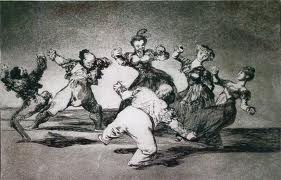
A Note on Goya and Sholem Aleichem’s Caricatures

images-2

Charles Baudelaire, in his essay “Some Foreign Caricatures,” distinguishes between a “historical” and an “artistic” caricaturist. Writing on Goya, who took the horrors of the Spanish Insurrection and the war with Napoleonic France, Baudelaire notes that Goya opened up the field of caricature by introducing “fantasy” into the comic. And, in contrast to the categories he set up in his famous “Essay on Laughter,” Baudelaire argues that Goya’s brand of comedy fits neither into the category of the “absolute” or the “purely significative comic.” Unlike ETA Hoffman, who is the master of the “absolute comic” (and what Paul deMan, citing Baudealire, calls the “irony of irony”), while Goya may be able to “plunge down” into the depths of grotesque and “soar up to the heights of the absolute,” the “general aspect under which he sees all things is above all the fantastic.”

When an average person, who knows nothing about history, sees Goya’s historical figures, although they may not recognize the historical aspect, he will “experience a sharp shock at the core of his brain.” His works overcome us, says Baudelaire, like “chronic dreams” that “besiege” our sleep.   He calls Goya a “true artist” because in his caricatures, which Baudelaire calls “fugitive works,” he is able to remain “firm and indomitable.”   In other words, the test of the “true artist” is to bring shock to caricature.   And he ultimately accomplishes this, claims Baudelaire, by showing us how the “monstrous” is possible and “credible.”   And this “fantastic” element, because it made so tangible, is what shocks us:

No one has ventured further than in he in the direction of the possible absurd. All those distortions, those bestial faces, those diabolic grimaces are impregnated with humanity…In a word, the line of suture, the point of junction between the real and the fantastic is impossible to grasp; it is a vague frontier.

Reading this, I wonder how would Baudelaire regard the caricatures found in Yiddish literature and Jewish American literature. How would he interpret the choice of writers like Sholem Aleichem or Howard Jacobson who have cast schlemiels as caricaturists? Do they, as Baudelaire says of Goya, “remain firm and indomitable” in their “fugitive works”? And is their goal to make the “monstrous” credible, by way of caricature, or seem less “diabolical”?

To be sure, Dan Miron argues that Motl is not a “diabolical character” and neither are his caricatures. As Miron points out, the caricatures marks a “cold” relation to the past of a desponded and ailing world that he wants to leave behind. But he does this by way of humor.   Motl, to be sure, is the agent and reporter of this distortion. Miron tells us that he doesn’t change while his world does and this sounds like what Baudelaire would say regarding the caricaturist as an artist. However, the main difference between what Miron is saying about caricature and what Baudelaire is saying is that the schlemiel’s survival has more to do with the possibility of a new life and less to do with having an epiphany of the “possibility” of the “impossible.”

Baudelaire’s interest in caricature is focused on jarring humanity by way of shock while Sholem Aleichem’s interest is in providing a figure for Jews to understand how to relate to the past and the new future, promised by America. The schlemiel’s caricatures – rather than the schlemiel as a caricature – provide the vehicle, so to speak, to travel from Europe and arrive in America.   Caricature, for Aleichem (as opposed to Baudelaire) doesn’t suspend identity so much as provide a way of forging a new identity.   And the agent of that caricature is the schlemiel-artist (and not Baudelaire’s version of the modern artist).

Comedic horror, in other words, doesn’t seem to have a role in schlemiel literature and art while for Baudelaire it has a central place.

It’s Not “All” in the Timing: Noise, Space, and Comedy

DownloadedFile

In The Parasite, Michel Serres looks to get rid of the idea of the center/periphery distinction and the idea that power “occupies” the center.  In its stead, he discusses things that fill and occupy space.  In a chapter entitled, “Energy, Information,” Serres starts from music and from there he moves to noise and the occupation and “counter-occupation” of space. The roar of motors is mixed with music to create a sense that there is no escape from sound. It fills all space:

Music has been a fundamental part of my life. I could not conceive of life without music.  But now, I’ve begun to hate it. It is everywhere nowadays, trapping me everywhere. I knew that we had entered the motor age when the noise coming from motors filled space everywhere. There was no space without a motor.  Even in the most rural country spots, the chain saws…replaced the grasshoppers.  (94)

The motor, says Serres, is an “expansive phenomenon.”   And it became a “founding fact of property.”  It works by making the “occupation of space intolerable” and thus “gets it for itself.”   And these noises are countered and “covered” (94) by others:

The grasshopper counterattacks with loudspeakers. Hi-fi, full-strength, earphones: the motor is beaten.  Music culture – that is to say, the culture of communication – has just wiped out the industrial revolution…Little packets of energy chase out the bigger ones. One parasite chases out another.   One power chases out another.  (95)

Serres sees this power as parasitic. It may be the power of speech or anything that has a voice in space.  He personifies this power:

Where are you?  I don’t know. Where are you going?  It doesn’t matter.  The grasshopper wanders every which way.   In other words, the emitters can be randomly distributed…Where are you going?  Everywhere.  All spaces bathe in its power.  The parasite is everywhere…Voice, wind, sound and noise. (96)

But, given this interpretation of space and expansion, wouldn’t it be the case that an explosion of sound (or an explosion itself) would be the greatest illustration of Serres’ understanding of sound?   To be sure, the explosion of words and sound I am thinking of take place in a comic kind of novel by another Frenchman, Louis Celine.  The first lines of his baudy tale, Guignol’s Band, are an explosion:

Boom! Zoom!…It’s the big smashup!…The whole street caving in at the water front!…It’s Orleans crumbling and thunder in the Grand Café!  A table sails by and splits in the air!…Marble bird!…spins round, shatters a window and splinters!

While this explosion is caricatured with such words as “Boom! Zoom!” it marks something very violent.  The explosion, the “big smashup,” is a total occupation of space.  The fact that it is comic is fascinating since it suggests that comedy is, by and large, about noise and jokes (and the laughter that attend them) are explosions of sorts that fill space. To be sure, they take over space.   It creates a tension or a kind of competition between the comedian who fills space and the audience which, in the wake of his voice, fills space with laughter.

And these explosions of comedy and sound, so to speak, communicate with each other. For your consideration, here’s a clip with many sound and spatial occupations.  To be sure, in this clip spaces are overtaken, emptied, filled, and covered over:

http://www.youtube.com/watch?v=o61pWzvQMsU

And, in a sense, the comedian needs to clear out the space of different sounds.  He needs to displace other sound-scapes and noises if he or she is to be affective. The schlemiel, in this account, is of prime importance; for, as Ruth Wisse and Sidrah Ezrahi have argued, the schlemiel lives by way of language.  Speech, they argue, is his substitute for sovereignty. But, as Serres seems to suggest, it isn’t a substitute for power; rather, it is power itself. It may not be history, but it overflows all spaces and competes with all narratives by turning to space (of the page, of the stage, etc) rather than time.  And that space explodes with meaning and possibility; but not in a tragic so much as in a comic sense.

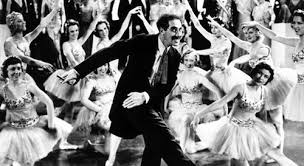
Groucho and Chaplin show us the possibility of such explosions of movement and sound, which, to be sure, take over the space:


Progressive Schlemiels: On Dan Miron’s Reading of Sholem Aleichem’s “Motl the Cantor’s Son”

DownloadedFile-7

Dan Miron is one of the greatest living critics of Yiddish and Jewish-American literature today.   His books on these bodies of literature have won him critical claim.  What interests me most is how Miron would approach a schlemiel like Motl (the main character of Sholem Aleichem’s Motl the Cantor’s Son: Writings of an Orphan Boy.   After all, I have written several blog entries on this character and have read Motl in terms of ontological and epistemological distraction.  And in my last reflection, based on a review made by Saul Bellow, I outlined the character’s Jewishness by way of his  “refusal to adapt.”  To be sure, Bellow argues that Motl, like the Jews, had no choice but to refuse since adaptation would be tantamount to giving in to history.  And that would be a complete abdication of freedom.   Like Bellow, Miron is interested in how Motl relates to history.   According to Miron, Aleichem faced his greatest artistic task in creating a character who could properly relate to the sad and difficult history of the Jewish people in eastern Europe:

To say the truth about the crisis of eastern European Jewry in the first decade of the twentieth century that nobody else would dare to say, a truth to be reported only by someone as innocent and guileless as a child…Motl is put forward to say, in his childish way, that the demise of the traditional eastern European civilization is not only unavoidable but also welcome.  (xxviii Introduction to Tevye the Dairy Man and Motl the Cantor’s Son).

Miron’s last point stakes out a historical claim and situates his reading within a progressivist framework.  As Miron suggests, Aleichem wanted to push off from the past and embrace a new Jewish future.  Paraphrasing Aleichem, Miron writes: “it is high time for the shtetl culture to leave the historical stage for something else, no matter how primitive and crass, as long as it is alive and vital; that being an orphan is, under certain circumstances, preferable to being burdened by a moribund ancestry”(xxviii).    In other words, Miron reads the schlemiel in terms of an effort to kindly say goodbye to eastern Europe and the Shtetl and to say hello to  health, vitality, and a new future.   In other words, the schlemiel, in this historical context, embodies a progressive historical force that leaves the past, suffering, and history behind for the new.

To this end, Miron describes Motl, a schlemiel, not so much as a character than as an “attitude.”  He cites Deleuze and Guittari as his theoretical support:

As a fictional character, Motl is what Deleuze and Guittari, in their discourse on minor literature, refer to as agencement, an arrangement of traits and narrative inflections that convey an attitude rather than the reality of a specific fictionalized human being.  (xxviii)

Miron tells us that this “attitude” remains consistent throughout the story.  It is “static” against a background and changing locations that are in “constant flux.”   He is immune to the effect of time: “his character” is “immune to the process of aging and to being reconditioned by drastically changing life situations”(xxix).  In other words, the schlemiel’s blindness to the world and change is not a negative aspect of the character worthy of criticism; rather, it is a part of a kind of force that transcends change, a historical force that is vital: “nimble, energetic, bright, unencumbered by heavy clothes, never seeking the warmth of hearth and home, always Puck-like, need to walk, to run, almost to fly”(xxix).

What I find so original about this reading is that Miron, unlike any commentator on the schlemiel, describes the character as a kind of model of the “attitude” that is necessary to be vital and live on.  In other words, this schlemiel is the model for a kind of Jewish post-European vitalism-slash-historical force.  Miron likens him to a force that can be either “hot” or “cold.”

He flows with all that is vibrant: appetites, vitality, effervescence, motility, optimism, lust for life, and freedom.  On the other hand, he is a keen, unemotional, unflinching observer. (xxix)

The latter part, the cold part, is the part that watches history fade away and distances itself from the “ghettoized” aspects of his mother, brother, family, village, etc.  Miron uses this hot/cold distinction to depict this progressive attitude that looks coldly at the past yet is hot for the future and the new.   The cold part, Miron tells us, finds its best expression in the fact that Aleichem makes Motl’s new occupation, upon landing in the new world, a caricaturist.  He has a “passion for drawing cartoons that emphasize all kinds of unseemly metonymies.”  These “unseemly metonymies” are caricatures of the past.   Miron sees caricature as a “non-Jewish art” because Jews are prohibited by the Torah from making any “graven images.”  And this, for Miron, is the perfect vehicle for rebellion against tradition.  It helps him to become “detached from it” and to see it for how bad it is or has become.  And, in Miron’s words, “Motl’s inclination toward caricature contributes to Sholem Aleichem’s objective to deconstruct shtetl literature, to dismantle its components and to expose it as nonfunctional”(xxxi).

Miron’s claim suggests that schlemiel, as a caricaturist, is really not blind.  He coldly sees and rejects shtetl culture and history.  The blindness is more on the “warm” front where he chases after life in all its “flow” and “vitality.”  This is a reading of the schlemiel that has never been put forward and it is very amusing insofar as it suggests that schlemiel is not totally blind or absent-minded and that the character is the expression of a progressive “attitude.”   He is not, as Paul Celan might say, mindful of his dates.

Miron’s progressivist reading mirrors, in many ways, a Zionist reading of diasporic, European culture.  Aleichem, in his view, reads the diaspora in similar terms. But unlike German-Jews, who viewed the schlemiel as a product of the ghetto and should be abandoned, Aleichem sees Motl as a heroic figure who leaves the ghetto behind.  Miron tells us that Motl may start out as a “prospective victim” (xxxi) but he avoids this negative fate by leaving Europe behind.   He is, as Miron notes, “happy” in the midst of negative conditions since he detaches himself from these conditions and attaches himself to life and hope.  His “child rebellion” is not extinguished by the repressive apparatus of the “shtetl’s oppressive system of education.”    Motl “celebrates his independence” from this system and this “child rebellion” against the shtelt is the key to his survival.  For Miron, this is the “attitude” that left the ghetto behind for “new life.”  He is an “orphan,” a member of an “orphaned people,” which “emerges” from “historical lethargy.”  “Whipped into wakefulness” Motl, like the Jewish people, “gropes for happiness that has evaded it for so long”(xxxii).

Miron’s rhetoric suggests, more than Irving Howe, that Aleichem wasn’t simply laughing and crying over history; he was rejecting it.  This reading of the schlemiel suggests that this schlemiel, the immigrant schlemiel, is premised not so much on the rejection of the status quo (which is what Hannah Arendt and Ruth Wisse have suggested) as rejecting the shtetl while embracing the new.  The schlemiel must, for progressive reasons, be cold to the past (and caricature it) while being warm to every new experience.

What happens, however, to the new schlemiel. The one who arrives in America?  Will they retain hope, too?  Is the new schlemiel hot and cold?  After all, Motl is an immigrant leaving Europe behind.  What happens to the landed schlemiel?

In my latest readings of Cynthia Ozick’s  “Envy; or Yiddish in America” I pointed out that the landed schlemiel, after the death of eastern European Jewry and its cultural legacy, is not so happy.   Edelshtein is a “master of failure” and, as an older schlemiel, has a much different “attitude” than Motl.   He lives in the wake of the Holocaust, Motl doesn’t.

Miron’s suggested reading, a historicist reading, should be put in context.  Not all schlemiels are like Motl.   And his hot and cold relations may not be found in schlemiels we find in much post-Holocaust literature.  Their attitude toward history and progress is much different from his.  They are more acutely aware of failure than he.  We see this in Malamud, Ozick, and Bellow.

…to be continued….

Swimming in a Sea of Invisible Ink: A Note on Ozick’s “Envy; Or, Yiddish in America.”

images-7

One of the more interesting characteristics of the schlemiel relates to his/her timing.  The comic character is belated: s/he comes too late to the party or is out of sync with what is going on.  But what is most interesting about this belatedness is how the schlemiel relates to it: the schlemiel can either be oblivious to being belated or painfully aware of it.   However, even in the latter case, which often leads to bitterness, there is still a blindness that prevails.  And the schlemiel, it seems, is swimming in, as it were, invisible ink.  Sometimes, however, that ink can be a bitter sea.

Edelshtein, the main character of Cynthia Ozick’s, “Envy; Or, Yiddish in America,” is a case in point.  He is caught up in a dying dream of being recognized in America as a Yiddish writer.  Yiddish, as he notes, died in Europe.  But this doesn’t keep him from being enthusiastic about it.  Besides writing in Yiddish and maintaining a journal entitled A Bitterer Yam (the “Bitter Sea”) he goes from synagogue to synagogue and Jewish community center to Jewish community center to talk about Yiddish.  The narrator likens him to a “television stand-up comic” whose humor is bitter, sardonic, and falls dead (like the language he dreams in).  Nonetheless, he continues to talk about Yiddish and write in Yiddish although he knows it is dying and will not live on.  And, regardless of his humor, he lives a belated existence and continues to swim in bitterness.

However, there is hope; but, for him, it is not hope.  It comes in the form of a man named Yankel Ostrover.  He and Baumzweig, the editor of A Bitterer Yam (which Baumzweig’s wife jokingly calls Invisible Ink), can’t stand him:

Edelshtein’s friendship with Baumzweig had a ferocious secret: it was moored entitled to their agreed hatred for the man they called der chazer.  He was named Pig because of his extraordinarily white skin, like a tissue of a pale ham, and also because in the last decade he had become unbelievably famous. When they did not call him Pig they called him shed – Devil.  (133, Jewish American Stories ed. Irving Howe)

Ostrover, they complain, is not a real Yiddish writer.  Like a pig, he appears to be Kosher (pigs have split hooves on the “outside,” but they do not “chew their cud” and are not kosher in the “inside”) but is not.   His writing in the Yiddish lacks the greatness of all the famous Yiddish writers.  And his topics are, in his view, vulgar.  And, as Edelshtein learns, his popularity is largely based on his translator and is, in many ways, the function of good luck.  And that’s the point.  Edelshtein has bad luck and this kills him.  He feels he is more deserving and is pained by the fact that the youth – the next generation of Jews – love Ostrover while he can only speak to older Jews who give no hope of carrying the tradition on.  In other words, the tradition of Yiddish isn’t really be carried on, in his view, by Ostrover.  Something else is.

Edelshtein is a schlemiel of a rare type because his hope is impossible.  He cannot admit to himself that he has failed or that Yiddish in America is closer to what Sidrah DeKoven Ezrahi – in Booking Passage – would call a “virtual shtetl.”  To be sure, the person, she argues, who was translated into Yiddish and became a central figure in this virtual shtetl was I.B. Singer.  His “Gimpel the Fool,” translated into English by Saul Bellow and published in the Partisan Review, marked the beginning of the new wave.

However, Edelshtein’s resentment is based on the fact that he didn’t make it and not just Yiddish.  He is the schlemiel because he believed he, himself, could actually preserve the core of Yiddish when America wanted something else, something in English that may have some link to Yiddish – one it will never know.   He comes to late, it seems; but Ostrover seems to come in on time.  The difference between the two is, as a I mentioned above, a matter of luck; but it also has to do with the fact that America wants to have a “virtual shtetl,” one, so to speak, in its own image.

And in this virtual shtetl there seems to be no room for the bitter failure and his journal A Bitterer Yam; or is it, rather, Invisible Ink?  After all, who will read him and carry on his legacy?   He comes too late and the tradition that goes on, it seems, isn’t Yiddish, it’s virtual.   Edelshtein – because he is belated and afflicted by bad luck – seems to be swimming in a bitter sea of invisible ink because no one will read him like they read Ostrover and his virtual Yiddish novels.

I Want to Start Again: The Schlemiel, Bad Luck, and the Desire for a New Life (Starring Walter Benjamin)

images-6

The desire for change and a new life is fundamentally human.  And oftentimes the desire to start a new life is based on the fact that one is beset by bad luck.  To be sure, this is a theme which many Jews are familiar.  Bad luck seems to follow Jews around.  And, as a result, Jews have been forced – for centuries – to move from town to town or country to country.  But, despite this negative reality, the Talmud tells us that if one changes one’s place one changes one’s mazel (luck).

Schlemiels are often beset with bad luck.  And most of them go on journeys in search of a new land and a new life.  To get out of their predicament, they often dream of starting anew.   We see this in the classics of Yiddish literature such as The Travels and Adventures of Benjamin III by Mendel Mocher Sforim, Mendel the Cantor’s Son by Sholem Aleichem, and I.B. Singer’s Gimpel stories.  We see the schlemiel’s journey for a new life in Kafka’s Amerika.  And we also it in Jewish American literature, such as A New Life by Bernard Malamud, Stern by Bruce Jay Freidman, Hope: A Tragedy by Shalom Auslander, and every novel by Gary Shteyngart.

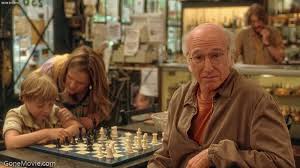
We also see the schlemiel’s desire for change in movies like Annie Hall, where Woody Allen ventures to California (albeit with great skepticism), Whatever Works, where Larry David consents to live with a young woman, or Greenberg – where Ben Stiller plays a schlemiel character who goes to California in search of a new life.

In just about all of the above-mentioned stories and movies, the schlemiel’s hopes for a new life are shown to be deluded or misguided.   And as we observe the process of their fictional journey, we experience the juxtaposition of hope and failure.  The affect, especially in Freidman and Auslander’s novels, can be unsettling.  But the process can also suggest some kind of balance between being naïve and being realistic.

The question, for all of these novelists and filmmakers, is fundamentally human and particularly Jewish: how do we realistically address bad luck and our desire for change?  Can we simply believe that our desire for a new life is realistic?  Will moving to another place change our luck or is that a misguided hope?  Is it better to just be reminded of how bad things are by virtue of a character who is out-of-touch or naïve about reality?

We see a fascinating analogue of this in the real life experiences of a living schlemiel named Walter Benjamin.  Near the end of his life Walter Benjamin met up with Hannah Arendt in Paris.  Both of them fled Germany but in leaving they looked for a new life.  But, of the two, Benjamin was the schlemiel.  Regardless of the fact that he looked to live a new life (and he was offered to leave Europe for America or for Israel by good friends of his), he still had bad luck.  And he knew it.  His life, in other words, didn’t change much: it seemed to be one bad thing after another.

Hannah Arendt, in her introductory essay to his work, entitled the first section “The Hunchback.”  She recalls that Benjamin failed to become successful in his lifetime.  He always had failure at his back.  Since he was a child, the “hunchback,” a figure of bad luck, was with him: “The hunchback was an early acquaintance of his, who had first met him when, still a child, he found the poem in a children’s book, and he never forgot”(6, Illuminations).   Arendt quotes the poem:

When I go down to the cellar

There to draw some wine,

A little hunchback is there

Grabs that jug of mine

When I go into the kitchen,

There my soup to make,

A little hunchback who’s in there

My little pot did break.

Arendt goes on to argue that Benjamin was obsessed with childhood figures that threatened failure and death: “His mother, like millions of other mothers in Germany, used to say, ‘Mr. Bungle sends his regards’ whenever one of the countless little catastrophes of childhood had taken place.”

According to Arendt, the “child knew of course what this strange bungling was about.”  It was about falling and failure:

It was he who had tripped you up when you fell and knocked the thing out of your hand when it went to pieces.  And after the child came the grown-up man who knew what the children was ignorant of, namely, that it was not he who had provoked the “little one” by looking at him…but the hunchback who looked at him and that bungling was a misfortune.  (6)

Arendt is right regarding the constant misfortune that Benjamin experienced.  But while her reading is telling, Arendt misses something fundamental; namely,  Benjamin didn’t simply have bad luck (“the hunchback looked at him”); rather, he was a schlemiel.  He “bungled” and discovered, as a man, that his bungling – which was with him since he was a child -was congenital.  It was a part of his existential makeup.  He was a man-child.  So, regardless of his desire for a new life, Benjamin knew, in the back of his head, that he would likely “bungle.”

Regardless, near the end of his life he looked at this foolishness as his only salvation.  For, as Kafka knew, “only the fool can help.”  So, even if the fool is misguided in thinking that a change of place will foster a new life, in the end it gives him, as Irving Howe might say, a “margin of hope.”   Commentary, Benjamin also argued, redeemed Kafka from total failure, but not completely; since the text he was commenting on was “unknown.”   In reality, both foolishness and commentary (another foolish endeavor, if it isn’t based on a real text) gave Benjamin a very small margin since all he did was tainted, in some way, by failure.  It seems he wanted to believe, like a schlemiel, in the good, but what he couldn’t forget was failure.  His foolish desire for a new life, in other words, was tainted by the memory of failure.

Presidential Comedy: On the Meaning and Task of President Obama’s Comedic Performances

DownloadedFile-6

Just yesterday, Zach Galifianakis’s comic interview of President Obama – on his show “Between the Two Ferns” – went viral.  I noticed that some of my friends on facebook were upset about the video and believed that President Obama was trivializing his Presidency by going on the show and doing a comic routine with Galifianakis.  And in a press conference yesterday, Jay Carney was asked about whether he thought it had this negative effect and if it had been discussed before the President decided to make an appearance.  Skirting the issue as to whether or not this tarnishes the image of the President, Carney pointed out that the task of the President was not to just get facetime.  Rather, he was looking to promote the “Affordable Care Act.”  There is ample evidence of this in the interview since Galifianakis gives the President a few minutes to discuss it.   And the comic interview ends with Galifianakis showing the President a bunch of spider bites on his arm.  Given the pitch, one knows the punch line: “Zach, you should look into the Affordable Care Act.  You need a doctor.”  Because, “You,” like many young Americans, “think you are invincible (not “invisible”) but you’re not.”

What has been missed in this discussion about the President’s appearance on the show is the fact that the President has done comedy before.   In fact, I wrote on his comedic performance at the Presidential Correspondents’ Dinner in April 2013.  As I noted, President Obama told a Groucho Marx joke and even played a role in a comic short written and directed by none other than Steven Speilberg.


The fundamental difference between his appearance on “Between the Ferns” and his comedic performance in the film (and on the podium) at the Presidential Correspondents’ Dinner was the fact that in film and on the podium he played the role of the schlemiel.  Here, in contrast, Galifianakis plays the role of the schlemiel while President Obama appears serious.  To be sure, he isn’t doing comedy so much as humoring a schlemiel.

I find this shift in comedic roles to be telling.

The shift is tactical and, obviously, political.  And it shows us how the schlemiel can be used, politically, depending on the context and the goals.  With regard to the comedic performance at the Presidential Correspondence Dinner, President Obama was, at that time, trying to regain the confidence of the public.  As I noted in my blog entry on that performance, President Obama, at the end, tells the audience that the American public has become too cynical and had a hard time trusting him.  And this, one can see, is directly related to why he played a schlemiel of the Eastern European variety: the schlemiel is, in the Eastern European style of Jewish comedy (which has been inherited, in part, by Hollywood), a comic character who, oftentimes, gains the trust of his or her audience by way of absent-mindedness, naivite, and charm.   The schlemiel, in other words, can help to counteract cynicism.  To be sure, Ruth Wisse, in her book The Schlemiel as Modern Hero, notes several times how the schlemiel creates a tension between hope and skepticism (or, at the extreme, cynicism).   But, here, as in many other instances of the contemporary schlemiel, that tension is effaced and gives more power to hope over cynicism.  (And as I have noted in relation to what President Obama did at this dinner, the topic of encountering cynicism finds an interesting correlate in the work of Slavoj Zizek.)

In contrast to his comedic use of the schlemiel, his appearance on “Between the Two Ferns” is serious. Zach Galifianakis plays the schlemiel.  But this performance has a different task.  Instead of gaining trust and effacing cynicism, President Obama is looking to present a serious issue: The Affordable Care Act.  To do this, he must be serious.  Now, instead of being endearing, the naivite of Zach Galifianakis (which is tainted with cynicism, no less) comes across as plain stupid.  Here the schlemiel is depicted as he was by Jews in Germany (not in Eastern Europe); this schlemiel does things that are to be laughed at because they are in need of correction.  His cynicism and lack of intelligence are an obstacle to his health and well-being.  Here, President Obama is out to correct the misguided schlemiel, Zach Galifianakis. The message: don’t be like Zach, sign up and get a doctor; you’re not invincible.  And stop being so cynical.

The fact that the President can sometimes play the schlemiel and other times mock the schlemiel shows us that he is versatile in his comic performances.  But, more importantly, it shows us that the schlemiel has a role in the crafting of his public image and his political strategy.    This is a fascinating twist because, as Hannah Arendt and Ruth Wisse have pointed out in their work on the schlemiel, the schlemiel is often apolitical.  If anything, it challenges politics.

For instance, take a look at the beginning of Wisse’s The Schlemiel as Modern Hero, and you will see several jokes that parody politics and power.   Here we see the schlemiel employed, on the contrary, for political purposes.  To be sure, there is a lot to learn from this.  The political appropriation of the schlemiel by a Presidential administration is a topic that needs attention and schlemiel theory is leading the way in opening up this new discourse.  I hope to write more on this in the near future.

A Kvetching Schlemiel: On Cynthia Ozick’s “Envy; or, Yiddish in America” – Take One

images-5

You don’t see many schlemiels in Yiddish Literature or Jewish-American literature that spend most of their time kvetching or complaining.   Schlemiels are better known for being dreamers, not complainers.   They live on air (luftmensches); not hot air so much as the air of dreams.  However, it does happen from time to time that one occasions a kvetching schlemiel.   Saul Bellow’s Herzog (from the novel of the same name) kvetches from time to time and so does Bruce Jay Friedman’s Stern (from the novel of the same name).   We also see a few kvetching schlemiels in contemporary literature.  Kugel, the main character of Shalom Auslander’s Hope: A Tragedy lets out an occasional kvetch about his horrible situation.

And Larry David, in Curb Your Enthusiasm or in his lead role for Woody Allen’s Whatever Works, turns kvetching into an art form that, for all its repetition, has crafted a popular kind of modern-American schlemiel type.

But all of this kvetching, as is the kvetching of the other schlemiels mentioned above, is lightened by way of comedy.  And if we look deeper into the source of this kvetching we find a trail of bad luck.  But, as Ruth Wisse points out the schlemiel usually creates bad luck but is unaffected by it.  These schlemiels, however, are.  They are, as it were, schlemiels and shlimazels at the same time.

One kvetch that has recently caught my eye is the kvetching of the narrator and main character of Cynthia Ozick’s “Envy; or, Yiddish in America.”  Edelshtein, the main character, has the kvetch of an immigrant.  He has left Europe and Yiddish behind for America.  And he can’t stop thinking about what has been lost.  His being caught up in what was and how it fails to relate to what is creates a comic rift which also has, for all its kvetching, a sad note.

Ozick’s descriptions of Edelshtein reflect a kind of comic kvetching that hits on many different levels.  Edelshtein’s anger is really “envy.” It is comical, yet painful because he feels that he knows history and that American Jews do not.  He doesn’t think, for this reason, that they should be considered Jews.

Spawned in America, pogroms a rumor, mamalashon a stranger, history a vacuum.  Also many of them were still young, and had black eyes, black hair, and red beards…He was certain he did not envy them, but he read them like a sickness.  They were reviewed, praised, and meanwhile they were considered Jews, and knew nothing.  (129, Jewish American Stories ed. Irving Howe)

Edelshtein looks around New York City and sees a childhood acquaintance from Kiev named Alexei Kirilov.  He wonders what ever happened to him.   How had history swallowed him up?  Did he die in the massacre of Babi Yar or did he flee to Russia?

This memory and question plies him, but what is he left with from the past?  Edelshtein, like many Yiddishists, turns to language.  But he realizes that the language he so loved is dead.  And he is a schlemiel by virtue of being stuck with a language that no one speaks anymore:

And the language was lost, murdered.  The language – a museum.  Of what other language can it be said that it died in a sudden definite death, in a given decade, on a given piece of soil…Yiddish, a littleness, a tiny light – oh little holy light! – dead, vanished. Perished. Sent into darkness.  (130)

The murder or “sudden death” of this language was, the narrator tells us, Edelshtein’s “subject” – the one “he lectured on for a living”(130).  He constantly recalls it to people in Jewish community centers, synagogues, etc. But while he tells Yiddish jokes to make people laugh he knows – and they know – that the language is dead and that his humor is really meaningless:

But both Edelshtein and his audiences found the jokes worthless.  Old jokes.  They were not the right kind. They wanted jokes about weddings – spiral staircases, doves flying out of cages, bashful medical students – and he gave them funerals.  To speak Yiddish was to preside over a funeral….Those for whom his tongue was no riddle were specters. (131)

He lives in memory of a dead past; he draws life from it.  But his memory is not caught up in Europe alone; he remembers, most clearly, his experiences at the American home of Baumzweig.  Unlike Baumzweig, who was also a Yiddish writer, he had no children.  He had no one to pass on his past too; however, he does watch how Baumzweig’s children speak to him – using English to respond to their Yiddish.  The parents couldn’t adequately pass the tradition on. And this has an effect on him and gives him a sense of the “new generation.”  There was a generation gap.

But then it became plain that they could not imagine the lives of their children.  Nor could the children imagine their lives.  The parents were too helpless to explain, the sons were too impatient to explain.  So they had given each other up to a common muteness.  In that apartment Josh and Mickey had grown up answering in English the Yiddish of their parents.  Mutes.  Mutations.  What right had these boys to spit out the Yiddish that had bred them? (132)

In the midst of all this kvetching, Baumzweig reminds him of the schlemiel and that, though he never had children, Edelshtein has a son, himself

She told Edelshtein he too had a child, also a son.  “Yourself, yourself,” she said.  “You remember yourself when you were a little boy, and that little boy is the one you love, him you trust, him you bless, him you bring up in hope to a good manhood.” (133)

This memory is a kind of counter-memory to his present resentments.  It also prompts the question as to whether he actually did bring his “son” up to a “good manhood.”  Does his son remain a child, and he, a schlemiel?  Or was his “little light” a language that is dead?  Is his son dead if the language is dead?

We also can see his mind wander back to the child in Kiev who, regardless of his kvetching about the end of Yiddish, remains close to his heart.  The question of his “son” and its “maturity” as well as this memory of a child whose fate his unknown  – juxtaposed to the present memory of the death of Yiddish – makes him into a kvetching schlemiel of sorts.

…to be continued….