Facing Failure: A Levinasian Reading of Bernard Malamud’s Fiction – Part I

images-2

The schlemiel is often thought of as the Jewish fool who, in the traditional joke, is paired up with a nudnik and a schlimazel. The schlemiel, as the traditional joke goes, is asked to get a bowl of soup by the schlimazel. When the schlemiel gets right near the table, and it seems as if all will go well, he spills the soup of the schlimazel’s lap. The schlimazel, who receives the bad luck, screams out. And the nudnick asks what kind of soup it is. In this scenario, the schlemiel is portrayed as a perpetual bungler who disseminates bad luck wherever he goes. (In fact, all three figures congregate around bad luck.) As the explanation goes: Jews, accustomed to bad luck throughout their history, took to this character so as to laugh at their misfortune. But, to be sure, there is obviously more to the story. The schlemiel is not the ordinary fool and shouldn’t simply be thought of as a bungler. The schlemiel is, to be sure, related to the Jewish saint. His failure has deeper roots.

In The Schlemiel as Modern Hero, Ruth Wisse points out how the schlemiel, in Yiddish literature, Ruth Wisse argues that “the genesis of the literary schlemiel within the context of Yiddish literature is the tale of Rabbi Nachman of Bratzlav entitled “A Story about a Clever Man and a Simple Man.” The story, published in 1807, anticipates Yiddish literature which will take the schlemiel as its main character. In Hebrew and Yiddish, the word “simpleton” is “Tam,” this term was often used by Hasidim to describe a righteous man. The irony, however, is that for the Hasidim, the simple man is the righteous man. He need not be a “wise man” or “clever man.” Rather, he can be a schlemiel, too. And, as Wisse notes with regard to this story by Rabbi Nachman, what makes it special is that “the instinctive response of devotion” is privileged over “the highest achievement of the mind”(17).   In the story, the simpleton’s devotion is seen as comical by the “clever man,” but in the end the simpleton’s devotion pays off.   The most important thing for Wisse is to map the movement from the simple schlemiel to the secular one in Yiddish literature. She is interested in how faith and righteousness is translated into the secular. Writing on this, Wisse argues that “in the later secular works, faith is not a matter of religious credence, but the habit of trusting optimistically in the triumph of good over evil, right over wrong. It is also the dedication to living “as if” good will triumph over evil”(22).   In Yiddish literature:

The figure of the schlemiel was employed to present the case of hope over   despair, because the author retained his awareness of reality even if his character did not. The schlemiels are committed to Messianic truth, and if need be they can reinterpret, distort, or obviate immediate reality when it contradicts their ultimate ideal. Society finds them wanting, but according to the internal judgment of the story, their foolishness is redeemed. Rarely does this literary schlemiel rise to the heights achieved by the Bratzlaver’s simple man, because rarely does the modern author share the great Rabbi’s full-hearted conviction. More usually, the schlemiel remains the practical loser, winning only an ironic victory of interpretation. (23)

Wisse was referring to the Yiddish tradition of schlemiel literature. And her explanation of the schlemiel is framed in terms of the translation of Rabbi Nachman’s simpleton into Yiddish literature vis-à-vis the concept of faith and acting “as if” the good will triumph.

What I would like to suggest is that we approach the schlemiel’s relationship to religion and literature differently. Instead of looking into Yiddish literature, I would like to take up the schlemiel in post-Holocaust Jewish-American literature (namely, by way of Bernard Malamud, one of it’s greatest representatives); and instead of looking at the schlemiel by way of Wisse’s framework for faith and its translation into the secular, I would like to use a different model based on Edith Wyschogrod’s reading of Levinas in terms of addressing the Saint and hagiography. The latter, as I hope to show, is a model which helps us to understand how faith is not an idea but something that is transmitted, as Wyschogrod would say, by way of “samples of ethical behavior”(277). Unlike Wyschogrod, however, I am not taking actual saints as my example so much as schlemiels who, to be sure, are really saints in disguise. The main character of Bernard Malamud’s novel, The Assistant, a Jewish store owner in the post-War era named Morris Bober is a case in point. Since, today, our hagiography is fiction and our saints are the “little men” and everyday people.


Edith Wyschogrod’s Reading of Levinas, Saints, and Hagiography

Before we begin our reading of Bernard Malamud’s The Assistant, I’d like to briefly go over Edith Wyschogrod’s reading of Emmanuel Levinas, Saints, and Hagiography.

To begin with, Wyschogrod, in an essay entitled “Exemplary Individuals: Toward a Phenomenological Ethics,” argues that her starting point for a reading of hagiography and saints must start off with what she calls “carnal generality.” She draws on this notion from the work of Merleau-Ponty and Levinas (264).   For Ponty, “generality is inscribed in the incarnate subject, an ensemble of self-transcending acts and lingual capacities. By contrast, Levinas focuses on the alterity of other persons and its impact on the self, an alterity that cannot be brought into conceptual focus by language.” Although these definitions differ, “both agree that the psycho-physiological primordium that is the incarnate subject expresses a generality of which universals and essences are derivative types”(264).

Wyschogrod argues that these generalities are “context-specific” (she calls these contexts “carnal generality”).   In the spirit of phenomenology, Wyschogrod argues that Ponty, in his “analysis of social existence,” looks, through “successive exfoliations” of the context, to get at the “essence” of the phenomena. However, Wyschogrod notes that Ponty stays away from the word “universal” and suggests that we use the word “carnal generalities” to avoid the connotations suggested by words like “essence.”   To be sure, Wyschogrod tells us that he uses the term “carnal generalties” in reference to “dialogue” and language. Drawing on this, she argues that “this generality is constituted by the power of the self to inhabit the body of the other”(265). In other words, language is the medium that brings a “carnal generality” between self and other together: “together the other and I form an ensemble of significations, a single flesh that is traversed and expresses meaning”(265).

Wyschogrod notes the difference, however, between Ponty and Levinas on this issue of language. While, for Ponty, there is a coming together of the self and other in moments of communication, for Levinas, “the breach between the self and other is unsurpassable”(266).   This difference, argues Wyschogrod, is what “”opens discourse” and makes “ethical relation possible”(266).   Regardless, for Levinas and Ponty, the “carnal generalities” remain. The question, however, is what they communicate and what we can learn from them.   For Wyschogrod, “carnal generality” conveys what she calls “exemplification” and this is best seen in hagiography.

To introduce this new idea, Wyschogrod, instead of writing about saints and their hagiography, talks about a case of “idiot savant twins” convey by the neuropsychologist Oliver Sacks. In his account of the case, Sacks recalls how the two would engage in “a singular and purely numerical conversation,” a “mathematical game in which they exceeded the competence of the most sophisticated mathematicians”(269). After watching them, Sacks concluded that “the twins did not form abstract notions of numbers but experienced them in some sensuous and immediate way”(269). As Wyschogrod explains, Sacks discovered that they learned and communicated not by way of mathematical ideas but…spatially.

Saints, argues Wyschogrod, are not much different: “they are idiot savants of the ethical, although, in contrast to the twins, they often possess considerable psychological acuity, as well as remarkable powers of political and social organization”(269). Wyschogrod argues that the entire life of the saint is devoted to the “alleviation of sorrow (psychological suffering) and pain (physical suffering) that afflict other persons without distinction of rank or group…or that afflict sentient beings, whatever the cost in pain or sorrow to him or herself”(270).

With this definition in mind, Wyschogrod argues that not all saints are mystics in the sense that they do not all experience a from of unity with the Godhead but many, the most ethical, remain painfully incarnated (270).   Her project is to preserve, for “modern and postmodern critics,: a “concept of saintliness” by “uncovering singularities,” which she associates with the “landscapes of the saintly imagination”(270).   To illustrate how this relates to hagiography, Wyschogrod cites a few passages from St. Teresa of Avila and St. Catherine of Siena. But the last two examples she cites come from the Baal Shen Tov and Buddhism.   What she notes, in this hagiography, is how the “trace of transcendence” can be seen in them. To be sure, she notes that the bodily presence in them is an ethical figure.

In the second to last section of her essay, Wyschogrod writes of what she calls “exemplification”(277). This is the view that, “in taking the saint to be an exemplary figure, we mean that the saints’ acts are samples of ethical behavior and that the saint’s life as a whole an sample of compassion, generosity, and love”(277). Take note that Wyschogrod takes heed of Jacques Derrida’s critique of the example, which is based on the structure of the signifier and the signified (the idea – signified – has an example – a signifier) and, ultimately finds its birth in Plato’s concept of “forms” – eidos). For this reason, she uses the word “samples” (not examples) to describe what the saints provide readers:

The utility of samples lies in their enabling us to learn the character of the whole of which they are samples. Thus, in the case I am considering, one would watch the saint’s behavior in order to learn what goodness, compassion, and love are like. (277)  

Unlike Wyschogrod, who took saints as her samples, I would like to take the schlemiels of modern fiction as our samples. There is a “trace of transcendence” in them. Perhaps the reason Wyschogrod overlooked them is because she didn’t associate the comical with the ethical. And this, I believe, needs to be addressed. To be sure, as I have noted, the schlemiel, as Wisse sees it, is ultimately a religious figure. It can provide us with a sample that is closer to us since the world we inhabit is much more ironic than the world that the saints occupied. To be sure, I think that the saint’s hagiography survives by way of schlemiel fiction. And it speaks to us in an intimate manner after the Holocaust.

 

Charles Bernstein: Writing “On Theatricality” and Doing Poetic Stand-Up

DownloadedFile-2

I was recently looking through Charles Bernstein’s essay collection Content’s Dream: Essays 1975-1984. Side by side in the collection, I found two pieces that really caught my interest: one is an essay entitled “On Theatricality” and the other is a poetry piece entitled “G-/”. The difference between the two pieces really struck me because they reminded me that, at a certain time, writers on theatricality associated it with language and play. However, for some strange reason, they didn’t associate it with comedy. I think of Derrida’s work, for instance, on Artaud. His essays on Artaud are more concerned with emptying language of content via performing texts.  For Derrida, it seems, it’s all about metaphoricity and textuality.   Nothing in them gives an indication of comedy.

The “difference” that I’m referring to, above, is that Bernstein’s poetry piece “G-/”, which is next to “On Theatricality,” is comical.  It differs.   To be sure, when I read it, against the essay on language and theatricality, I felt it would be wrong to read it in terms of Bernstein’s theoretical reflections. Rather, it called for a comic sensibility.

Let me explain.

In the essay “On Theatricality,” Bernstein writes of the actor Joseph Chaiken’s performance of Samuel Beckett’s Texts for Nothing and How It Is (200).   According to Bernstein, Chaiken has provided him with “one of the most satisfying performances of Beckett I have ever heard”(200). Bernstein explains why in a language that is clearly garnered from the a theoretical reading of theatricality and textuality:

Chaiken’s reading situates the address of the text not to a listener but to itself, as reverie, the self – or more properly the writing – talking to itself, proceeding, stopping, questioning, circling back: a textual practice organized by internal compositional necessities and not by the sound of a speaking voice.   By performing the text as a musician might play a score, rather than enacting a persona, Chaiken was able to realize the textual dimension of Becket’s work (200).

To accomplish this in poetry, Bernstein suggests that poets make a “sharp break” form “shamanistic incantation of neoritualistic sound poetry” and from “the presentation of personality as a projected coherent force”(200). All of this prevents language from being merely, as Heidegger would say of art, a form of equipment or a tool of expression. Rather, it lets language resonate as language.

While I know this reading very well, I find that it is missing the comical spirit of language that we find, oftentimes, in Bernstein’s poetry (especially his later work). The poem following this, to be sure, draws directly on the comedic.

Here are a few lines that will give a sense of how Bernstein does a kind of stand-up performance of poetry. It has the quality of what I call schlemiel-poetics. (And one should note that Chaiken did work with Yiddish theater and the schlemiel.). Notice how, in the midst of his meditation on possible failure (or his sense of failure, which is a key trait of the Jewish fool) he laughs:

I had this liberating thought the other night      imagine that nothing that I write or thought was good       it was all crummy   and the fact of crumminess would somehow free me up from this burden That I feel to express       to say something   meaningful     because I couldnt   and I an I started to laugh       it seemed a joyous kind of concept   and then this thinking lead me I mean sometimes I feel depressed I feel a little bit that way in the morning

These lines from the poem remind me of Woody Allen or Marc Maron’s self-deprecation. To be sure, stand-up poetics, playing the schlemiel on the stage or in a poem, is a way of doing more than theory says it does. The running joke and the act of self-deprecation in language do more to loosen up language and make it playful than any abstraction. Playing with failure is a way of playing with pathos.

I’ll end with this clip of RD Laing and Joseph Chaiken doing some very comical mirroring exercises. What you find in them is a play on bodily gesture by way of the face, something that actors portraying schlemiel have done since Yiddish theater got its start in Eastern Europe. Bernstein, it seems, is influenced by this kind of theater which is all about “facing” the audience as a stand-up comedian would. This isn’t simply language play…its comedy.   Comedians, after all, make faces.  They make the body comically signify.


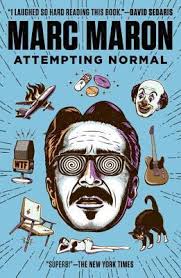
Psychotic Man-Child Fathers – Schlemiel Children: Marc Maron’s “Attempting Normal” (Part I)

DownloadedFile

When I watch comedy, I’m always curious as to what kind of life this or that comedian lived while growing up. Like many theorists of comedy, I do think there is some plausibility to the claim that comedy, in some way, is born out of and addresses some kind of trauma or loss.   Ruth Wisse, in her book The Schlemiel as Modern Hero, claims that schlemiel humor is a response to failure and weakness. After all, Jews were often excluded from history and often related to the countries they lived in from a position of weakness. Given this situation, Wisse argues that the schlemiel and it’s brand of Jewish comedy are a “theoretical reversal” of history and creates what she calls an “ironic victory.” However, the victory is ironic because the memory of trauma, loss, and failure persist. Jews are acutely aware of this. But, at the very least, comedy mitigates the power they have over Jewish life and gives the comedian some kind of freedom. The victory is, at best, minimal.   But, at the very least, such humor provides, as Irving Howe might say, a margin of hope. The comedian, to be sure, gives the audience not something to laugh at so much as a way to address suffering and loss that is not a negation of it so much as a way of facing it with some kind of intelligence which, in turn, bears on our freedom.

When I first started reading Marc Maron’s book Attempting Normal, I was astonished to learn that he grew up in a house with a psychotic father.   Like the comedian Marc Maron, I also grew up in a household with a brilliant psychotic father. And like him, I also felt like, because of my life growing up, I was also “attempting normal.” Reading this book for the first time, I was so excited to learn how he, through humor, addressed the suffering he went through by virtue of being the child of a psychotic. Like Maron, I became very interested in humor. And when I started reading his book, I knew he would approach it in ways that would make perfect sense to me. Through humor he found a way into a way of life he had, since youth, never known.   And although he would never “be” normal, at the very least he could “attempt” it. This very thought is one I know intimately. To be sure, I feel that I “attempt” it in nearly everything I do. And there is something comical and something very sad about that fact.

To be sure, as a result of my experience, I have spent most of my life trying to put the pieces together. Along the way, it occurred to me that, as a result of my odd and brilliant father, and the psychotic experiences I had been a part of, I had, like Maron, become a schlemiel. In one of my first blog entries I called myself a schlemiel and a son of a schlemiel. It stuck me that this is appropriate because, from what little experience I have of psychotic individuals (I was raised by one) I can say that they are, by and large, schlemiels. They dream big and often reinterpret reality to fit into the their psychotic narrative (in which they are the winners and they control the show). However, unlike the schlemiel, the psychotic is far from a nebbish. He or she goes out of her way to make reality conform to his or her vision. The psychotic is not simply living in an imaginary world; they actually change reality.   And this often gets them in trouble. To be sure, my father was arrested several times and was thrown into many mental institutions because of his psychotic actions (and by psychotic I don’t mean violent but…unusual).   In the film Shlemiel (2011), by Chad Derrick, I recount some of these experiences. And, as a filmmaker, Derrick was interested in why I turned to this comic character and how I, like Maron, attempted normal.

Maron’s retelling of his father’s psychosis has a comic element that touches me and inspires me to write my own account. For this reason, I’d like to briefly discuss some of Maron’s stories and bring together what makes them not only a lesson for me but for anyone who wants to understand who humor relates to madness and suffering. Being the children of psychotic parents, and not being psychotic ourselves, we can laugh at the stories and gain some kind of understanding of our parents and ourselves.

Maron begins his account of his father’s psychosis and its relationship to his life by noting the saddest pat of his father’s madness; namely, the times his father had a psychotic episode:

The most peculiar, sad, and entertaining part of living with a manic-depressive is the timing of erratic emotional behavior, whether it is up or down. My father has had some really impressive mood events. (39)

The first event Maron recounts – vis-à-vis his father’s timing – is his graduation from university. He notes how his father – just like mine – was the Valedictorian of his high school class. He also notes how his father was deemed “the center” and the “wunderkind” of the family.   He was, as Maron says, “mythic in the family. The doctor, the genius, the golden one.” I find this description so close to my own, because my father was also regarded in this way. And, to be sure, he regarded himself as a legend as well. (He was a Valedictorian, also, at Columbia University, went on to receive the prestigious NASA fellowship, and went on to a promising career.)

However, Maron, strangely like myself, had to live with his father’s high estimation of himself, his mind, and is capabilities. Like Maron’s father, my father was also highly selfish and erratic. And like Maron’s father, mine could also be abusive. But what I like most about Maron’s account is how he addresses it; he wonders if his father was consciously manipulating things. I wondered the same about my father:

I had lived with my father’s erratic, selfish, sometimes abusive behavior all my life it was always about him. A midlife diagnosis of bipolarity seemed to be his way of taking an easy way out, at least to my mind.   Initially I didn’t buy the diagnosis. Even now, sometimes I don’t know. It’s very hard to determine the validity of a mood disorder when someone is as plain old narcissistic as my dad. I thought he was just a man-child who refused self-awareness and defied wisdom even as his life fell apart around him. When necessary he would blame the “illness.” (39)

His father, in his eyes, was a man-child, a schlemiel. And he sees him as simply refusing self-awareness. This is a fascinating claim because I also thought of myself as more rational than my father and saw him opting out as things went down the tubes.   But although the son of the schlemiel may be the rational one, in the end, he is still deeply affected by the erratic nature of his father’s actions. Nonetheless, by recounting it, in this way, Maron gives the background for the comical events his father would spur on him – namely, in moments that would require the greatest seriousness.

In these moments, the inappropriate things his father does are comical; but seen against the background of his life and upbringing, we see the humor as bordering on sadness.

…to be continued….


My Vicarious Role in a Journalist’s Missed Encounter With Seth Rogen…in Las Vegas

images-1

About a month ago, I was contacted by Louie Lazar, a journalist who told me that he was given an assignment by Tablet: to determine whether or not Seth Rogen was the future of Jewish comedy. Pondering this question, Lazar came across several article/blog posts I had written on Seth Rogen for this blog. After going through them, he contacted me by way of email and told me he wanted to talk on the phone. Since he was hoping to interview Rogen, who was at a three-day-special-event hosted by the National Association of Theater Owners (NATO) that had Seth Rogen, Evan Goldberg, and a few other stars in attendance, he told me he would call me from Las Vegas. I was excited to talk to him. I thought to myself, in dream-like fashion, here was an opportune moment.

Anticipating of the phone-call, I spent a few hours thinking about Rogen, what I had written on him, and what I could now say about him. I even posted a query on facebook to gather what people were thinking about Rogen.

When the journalist called, we ended up talking for over an hour about Rogen. One of the things I discussed with him was how Rogen was a “new schlemiel.” He was, as Daniel Itzkovitz might say about Adam Sandler or Ben Stiller, an example of the schlemiel as “everyman.” This, of course, goes against the grain of the older model of the schlemiel who, as Hannah Arendt and Ruth Wisse argued, looks to challenge the “philosophical and political status quo.” His failure, so to speak, is an “ironic victory.” Rogen, I argued, is the status quo. Meaning: he is not an elitist; rather, he is “one of us.” The journalist agreed and noted that he was a “bro.” He has the body and demeanor of a bro – he likes to smoke pot and party – and that makes him “one of us.” To be sure, the motif of being a “bro” is central to his latest film Neighbors.

Before the conversation ended, Lazar asked me what questions I would ask Rogen if I were to interview him. In a rush of excitement, I gave the journalist several questions. (And even after the conversation ended, I sent him several more.)   After hanging up, I imagined – in schlemiel-like fashion – what answers Rogen would give. In a sense, I felt as if the journalist was a messenger; though him it was “as if” I was meeting Seth Rogen himself (who, just today, was dubbed by TIME magazine to be the “Stoner King of Comedy”). (An interesting side note, the word schlemiel seems to have a bit of Hebrew in it: Shelach (send) m’ (from) el (God) – in other words, he is a holy messenger of sorts or else…exiled from God and redemption; sent away.)

So…one can imagine how I felt when, just today, the journalist emailed me and told me that he published his feature piece on Rogen just yesterday.   I read his essay with great interest hoping to see how the interview worked out. I was so excited. I felt as if my schlemiel-like-dreams were going to come true. However, what I found was the most disappointing thing imaginable; namely, that the journalist wasn’t able to meet Rogen and converse with him. I felt as if, in the end, Lazar and I were the real schlemiels.   He hoped to have an encounter, we both dreamed about it, but in the end…it just didn’t happen.

To be sure, the difference between Rogen and Lazar is that while Lazar sought to find, meet, and interview Rogen, Rogen, as I told him on the phone, doesn’t really act in many films; he just “shows up.” To be sure, Lazar, uses this expression in the title of his piece: “Seth Rogen Exemplifies the Jewish Journey from Chosen People to Just Showing Up.”

Reading the piece, I felt an intimate sense of being duped because I was a part of Lazar’s search. What makes this failure so enjoyable, however, is the fact that it was written in the style of Gozo journalism that I love and have loved since high school. This was appropriate since the journalist, comically modeling himself on Hunter S. Thomson’s journey in Fear and Loathing in Las Vegas, was asked to interview Rogen in….Las Vegas. The subtitle of the piece, “Beer and Loafing in Las Vegas, on the heels of the everyman start of the new stoner man-child comedy” says it all.   He is on the heels of a schlemiel and in following him, he also becomes a schlemiel of sorts. Together with the title, I couldn’t help but think that Lazar was suggesting something that was in the midst of our conversation; namely, that Rogen is a “new schlemiel,” an everyman stoner who just “shows up” in this or that film or talk-show appearance. As I noted, half of Rogen’s comedy is just showing up.

And this is the sense that Lazar communicates in his piece. However, there is a big problem. Even though Rogen “shows up,” the problem, for the journalist, is that he can’t speak to him. I can hear Lazar asking himself, as the article moves on, “But…if he was really like one of us, why can’t I speak to him?”

But there is more to the story. Reading the piece, I couldn’t help but think that Lazar was astounded at how odd the whole scene, along with Rogen’s popularity, was. And this, to my mind, is exceptional: it prompts us to wonder, with him, what all this means. What is the meaning of a comic character’s everydayness when it is presented within a hyper-capitalist milieu of a conference dedicated to stars in Las Vegas?

At the outset, we can hear the juxtaposition in his sarcastic tone:

I’m drinking scotch in the VIP section of the Garden of the Gods, waiting for the God of the Gods, Seth Rogen, Any minute now, he should be walking past the 50-foot-high Corinthian columns flanked by statues of Julius Caesar mounted on war horses and into the private area between the Neptune Pool and Temple Pool, in which I’m standing, comfortably besides a heat lamp.

He, the everyman, is framed as a “God of the Gods.” And this is odd.

Lazar presents himself as a schlemiel in the process. He is, like Rogen, wearing a Grey suit and has stubble. (Grey being the color of mediocrity; the color that is the color of everydayness, showing up, etc.) And like a schlemiel, he “cuts himself shaving.” This motif comes back at the end of the piece when he thinks he will, finally, meet with Rogen.   But his worry is for naught.

One of the things that follows this introduction of sorts is a great sketch of how Rogen came across the everyman. To be sure, Lazar nails it when he points out that:

In 2009, in what they’ve described as their best work, Rogen and Goldberg wrote a Simpson’s episode about an overweight nerd (played by Homer) who becomes a superhero by channeling the powers of other comic book heroes. His name: “Everyman.”

In addition to this, Lazar points out that Rogen recently called himself a schlemiel, that is, a “self-medicated man-child” (he did so in his recent appearance before a U.S. Senate hearing on Alzheimer’s disease, which, to be sure, came right before his Las Vegas appearance!).

Following this, Lazar turns to himself, reflectively, and notes how he believed, against all the odds (Vegas style), that he would get to interview Rogen. But, as I noted above, this is thwarted several times. At one point, he notes how he drank too much and ended up missing Rogen; he was “too late.” While other journalists shout things out, he can’t say anything; he is tongue-tied. On another occasion, he ended up “locking eyes” with Rogen, but “before I could act” Rogen “snapped out of whatever mental state he was in…and walked off.” In other words, Rogen wasn’t really looking at him and, like a schlemiel, Lazar missed yet another possible encounter. He leaves in frustration; but, with the hope of a schlemiel, he is determined to try yet again.

And in a moment when he comes very close, he says that “I felt a surge of hope; here was my shot at redemption.” He blends in with a group of people and waits. But no one comes. It seems like yet another failure.

In one of his last attempts, he meets up with a “hippie” named “John.” The name and his description reminded me of an everyman like the dude. Near the end of the article, he notes how John, out of nowhere, tells him that “I just talked to him inside.” Wondering what he said and desperate for an encounter, Lazar screams out: “What!” When he asks John what they spoke about John, in a casual manner, says, “I dunno, we talked for a few minutes…He’s a great guy. Real normal-like.” Lazar, not satisfied with this simple reply, asks again “What did you talk about?” (After all, Lazar and I discussed so many questions that we were dying to get answers for, but, to no avail.)

The last lines of piece are written to me:

In my research, I’d spoken with a philosopher, Menachem Feuer, who’s written extensively about Rogen and who teaches a Jewish Studies course at York University in Toronto.* His students, a geographically and ethnically diverse mix, “know Rogen and identify with him.” What is that I asked. “It might have to do with him being an ordinary guy, the guy that just shows up,” he said. “He’s just like us.”

What I love about these last lines is that they hit on the central irony of his piece. If Rogen is so much like us, if he’s such an everyman, why can’t I speak with him? To be sure, the juxtapositions that Lazar runs through in his piece show us that he is and is not like us. He is made into a God of sorts, and, as I noted above, TIME calls him the “Stoner King of Comedy.” Lazar found out the hard way.

And so did I. Like Lazar, I imagined that there would be an interview and that all of my questions would be answered. And, in many ways, I felt as if, through Lazar, I would be meeting a god of sorts. I felt as if I too would be redeemed.   This is, without a doubt, the conceit of a schlemiel.   And, like any schlemiel, we end up failing and with dreams that were…just dreams.

The irony is that Rogen also casts himself as a schlemiel. He’s “just like us.” He just shows up. But, in the end, the schlemiel, the traditional one at least, doesn’t just show up. Like Mendel Mocher Sforim’s Benjamin the IIIrd, he goes on a journey. He does things. And for this, I thank Louie Lazar. I feel as if he has shown me, in a kind of private joke, that he is an old schlemiel while Rogen, the everyman, is a new one.

In many ways, I prefer the old schlemiel to the new one. But now that Rogen’s film has become yet another blockbuster and now that he is the new “stoner king of comedy,” I may have to accept the fact that the new schlemiel is now the God of comedic gods.   And what we are left with today – it seems – is “beer and loafing.”

——————

*I teach several courses at York University, actually.


Menachem Feuer – The Creator and Author of Schlemiel Theory – Welcomes You

Hi, my name is Menachem Feuer, the Creator and Author of the Blog.

Welcome to Schlemiel Theory! I hope you enjoy the blog!  More Blogs and Vlogs (New Addition *) are on the way!

(Check out this story for more on who I am, where I come from, and why I love the schlemiel.  Click here for a definition of this character and the purpose of this blog.)

Body Talk: On Seth Rogen’s Comical-Erotic Descriptions of Zac Efron’s Body

images

When Seth Rogen recently went on Conan to promote his latest film, Neighbors, Conan’s first comment went right to the relationship of Seth Rogen to Zac Efron’s body: “Your costar Zac Efron, in this film, I…I didn’t know this but apparently…he’s in ridiculous shape.”

In response, Rogen says, shaking his head up and down, as if obsessed with Efron’s body: “Yes..It’s Insane. It’s freakish! The first time I saw him without his shirt on I thought there was something wrong with him…honestly…because he has so many bump sticking out of his body.”

Rogen then compares the “bumps” all over Efron’s body to his own body, which, “like is just one big bump.”   To be sure, Rogen is telling us that his body, in relation to Efron’s body, is the punch line.  

In the next joke about Efron’s body (in relation to his own), Rogen recalls a description he makes in the movie: “It’s like his whole body is an arrow…that points to his dick.” Rogen goes on to talk about how Efron is “without shirt in many scenes.”

(As I pointed out in my last blog entry, this is a key figure for Rogen in the movie. When, at the end of the film, Rogen (Mac) takes off his shirt and joins Efron (Teddy), they become “bros” again after, for much of the movie, being turned against each other. Their topless bodies, radically different from each other, in public are the basis for their renewed friendship. In the end, even though Rogen is a husband and father, he is now a bro.)

Playing on the topless-Efron-figure, Rogen discusses how the Efron would work out between one shot and another. This, for Rogen, is “psychotic.” Rogen points out if he were to work out between sets he would be knocked out for the day.

Rogen tops if all off by saying that every time he looks at Efron’s body he just wants to touch it (as he gestures outward toward the audience). But he adds that he sees his body in a psychotic manner, “as if it were a mirage.” But, in a moment of liberation, he passes from illusion to reality (“coming out of the closet,” so to speak) when he declares, in defiance of public standards, that Efron “is the sexiest mother fucker alive!” Since this is a comic-erotic revelation, which the crowd laughs loudly at, Rogen pulls back and laughs to himself.   In comic shame, Rogen comes back and says, with a shrug, “I’m sorry…he brings it out in me.”   This sets him up for the final joke of the evening on Conan.

Rogen goes for it when he claims that Efron’s body doesn’t just “bring it (the craziest-most-erotic-things) out” of himself; it brings “it” out in everyone. Rogen calls “it” a “sound” that comes out of women’s bodies (without their volition) when they see Efron. Then he moves on to describe how men’s bodies, when they see Efron on screen, also makes this “sound.” The punch line is that this sound, because it is automatic, must come from one’s penis. In other words, the sound people make when they see Efron is a kind of “mouth orgasm.”

What Rogen does here is speak what I call “body talk.” By making his body the foil of Efron’s body he engages in body talk.

While people – Rogen included – metaphorically ejaculate when they see Efron, they do chuckle when they see Rogen. The conceit is that, even though at the end of the film Rogen and Efron become bros-with-their-tops-off, this clip shows us that it is Efron that is the real basis of Rogen’s passion. Even though Rogen is caricaturing his sexual reactions to Efron’s body, the point of the routine is to leave the audience member with a sense that this may really not be a joke. There is, so to speak, a comic suspense of disbelief.

Rogen, it seems, gets very excited when he describes Efron’s body. Efron’s body is “insane,” “psychotic,” and a “mirage” that Rogen wants to touch. Efron is the “sexiest motherfucker in the world.” All of these expletives give the effect of a person who is erotically-and-yet-comically aroused by Efron. And in his comical passion, Rogen insists that men and women in the audience who see Efron on screen (or live) are just as obsessed as he is.   Although we don’t make this “noise” over Efron’s body, Rogen’s insistence that we do is the insistence of a sexual schlemiel. It works like a charm because Rogen’s body – and not Efron’s body – is the punch line. That bodily and erotic difference makes Rogen’s….“body talk.”

But in a different setting, namely an interview with Movie Maniacs, the interviewer asks Rogen and Efron about their “bro moments” in the film and if, in real life, they have these moments.

In response to whether they have anything as “intimate” as the film suggests, Rogen speaks first and says “I don’t think we’ve had anything that intimate.” Efron says they “haven’t hooked up lately.”  And Rogen adds “not since the movie.”  But, in truth, they have no such interest.

Efron compliments Rogen and says (2:24) that he “really defines comedy for our generation in an honest and cool way…and in a way I’d like to do it someday and I’m learning now…Seth is a mentor.”  In these moments, we see that Rogen, in real life, is Efron’s mentor.  And to say that he “really defines comedy for our generation in a cool and honest way” is to give Rogen the greatest honors.

This, it seems, is what is behind all the body talk.  In reality, all of this comical body talk and standing shirtless with Efron is about “defining comedy for the next generation in an honest way.”

But, ultimately, the irony of all this is that really Seth Rogen’s body is “defining comedy for the next generation in an honest way.”  It’s the “other” body (which is closer to “our” bodies), not Efron’s body, which is the punch line that can possibly be said to “define comedy etc.”

I want to underscore the word “possibly” because this is quite a claim to make.  It’s validity would have to be proven on the basis of Rogen’s body talk and its popularity.  Can it really define “comedy for the next generation in an honest way”?

Seth Rogen’s Body – A Few Thoughts on Seth Rogen’s Latest Appearance in “Neighbors”

images-3

In one of the most urgent moments of Judd Apatow’s Knocked Up (2007), we see a desperate Ben Stone, played by Seth Rogen, go to his father, played by Harold Ramis, for advice about whether to become a father and have children. Ramis tells Rogen to go for it and that he wants to have grandchildren. At this point, Stone is inspired to be a responsible father. He decides, at this very point, to go from being a schlemiel (man-child) to becoming an adult. What interests me most about this moment is the fact that Seth Rogen is put face-to-face with Ramis and is given the ok to “bear children.” I cannot but read this as a symbolic moment when the maker of such films as Ghostbusters (1984), Meatballs (1979), Cadyshack (1980), and Animal House (1978), gives the power over to his son. It’s as if we are witnessing Moses giving everything over to Joshua, who will cross the Jordan. Moses will die, while Joshua will carry the tradition on.

We see that Rogen took this to heart in his latest role in the film Neighbors (2014). But, to be sure, this role is something that was set up by a middle-man; namely, Judd Apatow.

With films like, Super Bad, Knocked up and This is Forty, Judd Apatow has made a decision to address, by way of comedy, the process of moving from being a man-child to an adult with children. In Superbad, a movie written by Evan Goldberg and Seth Rogen but produced by Apatow, we see the life of two teens in their first sexual experience. There are still schlemiels, but, at the very least, they are successful.

But between Knocked Up and This is Forty (2012), there is a distinct difference: in Knocked Up (2007) Apatow casts Rogen as a schlemiel has decided to have a baby, while in This is Forty Apatow wanted to show us a couple in its forties which, for all intents and purposes, is also dealing with schlemiel-like issues. In Neighbors(2014) we see that there is a gap between the films which Rogen addresses; that gap has to do with age and experience.

In Neighbors we have a young couple who take us to the next level after Knocked Up but to a level ten or so years before This is Forty. The running narrative of all this, it seems, is to map out for the viewing public the life of a schlemiel from high school to having a baby, living with the baby (or babies), and attempting (as Marc Maron would say) “normal.”

This is an old/new theme. We see it in many Ramis films, too. But, in this film, we see Ramis and an Apatow type of film conjoined Animal House and This is Forty (and Knocked Up) . The question underlying the plot is: How would the two worlds interact? How will a schlemiel couple, who just had a baby, relate to the younger, single fraternity brothers?

The result of this test was, to my mind, nothing short of being (to pun on the movie by Apatow and Rogen) “super bad.” But it was bad on too many levels. I didn’t laugh that much and neither did the theater; and when they did there were more like little chuckles. To be sure, something was missing in this film and, on the other hand, something was overdone. The plot, which involved the meeting of two worlds, seemed much too caricatured and the theme and its articulation seemed to miss the mark.

In search of this lack or excess, I found a nasty little review in Salon.com that made no form of apology in its putting the film down. It noted that the film made no mention of the economic crisis and hard times we are going through. What we saw, instead, was affluence that looked to cover up the truth. (In other words, a post-Marxist reading: Neighbors as False Consciousness.)

The final judgment of the reviewer says it all:

Under current economic conditions that are never visible in this movie, Mac and Kelly’s path of happy-family upward mobility is almost as much an illusion as Teddy’s life of all-night, drug-addled ragers. We can long for either, or dare to imagine a mystical, momentary fusion of the two. When the movie’s over, most of us are left with neither one.

While I find this reading to be interesting, I also find it to be a stretch. The “momentary fusion” of the two worlds is not what interests us. Rather, what struck me, while watching the film, was the most interesting thing for the audience; namely, the contrast between Zack Efron’s body and Seth Rogen’s body. To be sure, one of the greatest appeals of Seth Rogen’s character is his slightly overweight body (naked or not naked). We see this in his recent youtube parodies (done with James Franco) where Franco rides Rogen like Kanye West rides Kim Kardashian.

In many scenes Rogen’s body is juxtaposed with Efron’s body, his wife’s body, and the fraternity members’ bodies. What does this all mean? Toward the end of the film, Rogen’s character meets up with Efron’s character at an Abercrombe & Finch store. Efron has his shirt off; Rogen takes his off to and says “he’s always wanted to do this.” He jumps around while Efron laughs and is endeared. At this moment, Efron seems to forgive him and he validates this when he says that Rogen’s body makes “everyone feel comfortable.” Because of his body, people will feel comfortable shopping at Abercrombe and Finch.

To be sure, from the beginning of the film until the end of the film, we now know what makes it sell: Seth Rogen’s body, the schlemiel’s body, is the body that guides us. Not Zack Efron’s body and not the bodies at the Fraternity or elsewhere. I make this reading in all seriousness because, to be sure, Rogen doesn’t act in this film so much as throw his body around into different yet (often) charming configurations.

This should be taken together with the fact that Mac-slash-Rogen’s wife, Kelly, played by Rose Byrne, can hang out with him and eat pizza, stoned, in bed after beating the fraternity. In the end, the battle is a bodily one. Rogen, like Jack Black or John Candy, has an interesting bodily presence; however, in contrast to these actors, he doesn’t have to work as hard in making comic gestures. He just has to be himself.

The plot is that the schlemiel-couple-with-one-baby win over the fraternity. In Animal House it was John Belushi with the weight; now it’s Rogen. And Rogen, as Mac Radner, has a wife and child. He’s responsible. Things have changed.

There is no question that Rogen has taken on the baton from Ramis and that Apatow has set this up for him. The question is whether this re-casting of Ramis’s work, within a context that Apatow has created, is meaningful. Who are our heroes and role models today? Is Rogen’s naked body, bouncing up and down in front of Abercrombe and Finch a sign of what is to come? For such a popular film, can we say that this is “our” comical form of hope? Are Ramis’s grandchildren…ours or somebody else’s? After all, some babies don’t survive. But with a face and body like Seth Rogen’s – reminding us that we can all just relax, get high, and eat whatever we want, whenever we want, while raising children (!) – how can we say no? After all, it seems as if this film is telling us that, ultimately, Rogen’s bodily antics make the differences between our bodies and masculinities less apparent and meaningful. His bodily presence makes us feel at home with the family, etc.

And yet isn’t it the comedians who make us feel least at home that are the most meaningful? But…Neighbors seems to be telling us that, in the end, what we want is to have a new norm, a bodily, comic norm that, to be sure, is more in accord with who we are; namely, comfortable with hanging out with the bros, getting high, eating, and having a good time at a party.

(For something else, something different from this, check out the work of up-and-coming comedians like David Heti. His work ends on an entirely different note.)

John Steinbeck, Marc Maron & Walter Benjamin on Driving, Distraction, and Reflection

images-2

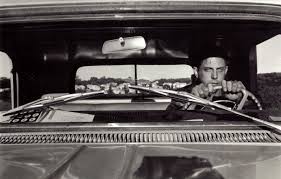
Over the years, I have driven thousands of miles across the United States. And I have always looked at these journeys – with all of those hours behind the wheel – as opportunities for me to think and reflect on all kinds of things. To be sure, some of my best thoughts have come to me while driving. I would (and have) often make it an imperative to have my tape recorder or mp3 recorder on while I drive because I don’t want to miss the thought while it happens.   I was pleasantly surprised to find – most recently – that John Steinbeck has a beautifully written passage in Travels With Charley where he writes on the topic of driving, distraction, and thought.   And between John Steinbeck and the Jewish-American comedian Marc Maron (whose autobiography, Attempting Normal, I have also been reading), I find interesting similarities and contrasts between the types of thinking one does when one is driving a car and distracted.   The differences, especially, show us how the worlds they inhabit differ in content and character. The differences between them, however, come together in the fact that the association of driving with distraction and thinking is essential.

I have written on distraction, thought, and comedy vis-à-vis Rodolph Gashe’s reflections on Immanuel Kant’s claim that “literature” is not thought but distraction and on Walter Benjamin’s words on distraction. I entitled these posts “The Distracted Schlemiel: Empirical Consciousness, Reading and Distraction.”   I’d like to briefly recount Benjamin’s philosophical account of distraction in “The Work of Art in the Age of Mechanical Reproduction.” It gives us a means of addressing the autobiographical-fictional-accounts of Steinbeck and Maron on driving, distraction, and thought.

At the very end of his essay, Benjamin shares his greatest thought on the new way we have of relating to the world in the “age of mechanical reproduction.” His reading of distraction is largely positive; he associates it with “habit” and a new means of dealing with “perceptual shock”:

For the tasks which face the human apparatus of perception at the turning point of history cannot be solved by optical means, that is, by contemplation, alone. They are mastered by habit, under the guidance of tactile appropriation. (240, Illuminations)

And what better form of “tactile appropriation” is there, for Americans today, than driving a car? Benjamin notes that the “distracted person (who we are, for arguments sake, calling the-person-who-drives-a-car) can form habits.”   These habits – the habits of a kind of thinking on the go – provides a “solution” to the problem of modern perception. And he goes so far as to liken this kind of distraction to the modern artists distraction while painting:

More, the ability to master certain tasks in a state of distraction proves that their solution has become a matter of habit. Distraction as provided by art provides a covert control of the extent to which new tasks have become soluble by apperception. (240)

Benjamin goes on to argue that this kind of distraction can “mobilize the masses” and suggests that the best medium for this isn’t driving so much as watching films:

Reception in a state of distraction, which is increasingly noticeably in all fields of art and is symptomatic of profound changes in apperception, finds in the film its true means of exercise. (240)

The last lines of Benjamin’s essay point out that what the public does, when watching a film, is not a form of contemplation. Rather, it is a form of “absent minded” examination:

The public is an examiner, but an absent-minded one. (241)

Taking Benjamin’s point to heart, I’d like to apply what he says to driving rather than movie going.   Steinbeck’s account of distraction and the thought it evokes, while driving, is exceptional in this regard. He goes right to the core of what Benjamin calls “habit” and “absent minded” examination. Steinbeck even coins a phrase “machine-like unconscious” to describe this state. Because it is so important, I’ll quote it at length:

If one has driven a car over many years, as I have, nearly all reactions have become automatic. One does not think about what to do. Nearly all the driving technique is deeply buried in a machine-like unconscious. This being so, a large area of the conscious mind is left free for thinking. (94)

Steinbeck now turns to the content of these thoughts:

What do people think about when they drive? On short trips perhaps of the arrival at a destination or memory of events at the place of departure. But there is left, particularly on very long trips, a large area for day dreaming or even, God help us, for thought. (94)

As one can see, “day dreaming,” which Freud associates with the artist, is mentioned side-by-side with thought. They are both absent-minded activities. However, Steinbeck reels it in by pointing out that most of his distracted day drams and thoughts have a practical dimension. He “plans houses” he will never build; “gardens I will never plant” and a “method for pumping the soft silt and decayed shells from the bottom of my bay up to my point of land at Sag Harbor (where he lived), of leaching out the salt, thus making a rich and productive soil”(94). He also notes how he has “created turtle traps” and “detailed letters he has never sent.”

Reflecting on these practical thoughts/day drams, he notes that he doesn’t know whether or not he will do this in reality but, at the very least, it comes to him as a possibility.   He also notes how, as the radio was going, his “memory” of “times and places, complete with characters and stage sets” was “stimulated.” In other words, the distraction moved from memory to fiction.   It also leads to him “projecting future scenes” that will “never take place.”   Steinbeck points out, many times, he would “write short stories” in his mind while he drove. He would “chuckle” at his “own humor” and be “saddened or stimulated by structure or content”(94).

In his final reflections, Steinbeck points out how he can “only suspect” that the “loveless” driver will dream of women, the “lonely” driver will dream of people, and the “childless” driver will dream of children. He then goes on to ask himself whether the driver will imagine regrets and go over what should have been done or said. In relation to this, Steinbeck says that he sees this “potential” in his “own mind” but can only “suspect it in others,” but he “will never know, for no one tells”(95). To be sure, the greatest secret is to be found in this “potential.” To be sure, even though Steinbeck, as we can see, discusses many things he thinks about while driving, he doesn’t discuss these darker things. He leaves them out of his text.   This habit (“potential”) and its content are his secret, one that his readers will have to guess at.

That said, it’s fascinating to see a contemporary comedian like Marc Maron doing what Steinbeck doesn’t do: he addresses these kinds of thoughts in his text. What Maron thinks about when he drives is an open secret. Writing about what he used to think about when he was driving between comedy gigs, Maron notes how, in his distraction, he thought about how he had failed and what he could have done differently:

I drove everywhere to do gigs anywhere: Pancho Villa’s in Leominster, Franks in Franklin, Cranston Bowl in Cranston, Rhode Island, Captain Nicks in Ogunquit, Maine…Most of the time I drove home for hours half drunk, chain-smoking in my car and reliving my set. I always felt like I had survived something, that the simple fact that I made it through the show meant I was victorious. But the war wasn’t over yet: The next battle was in the car, the war with myself. I’m not funny enough, that joke didn’t work, why can’t I stop sweating, fuck those people, I need more jokes, where the fuck am I, shit I don’t have a map. I’ll never forget the electricity of postperformance elation and self-flagellation, flying through the New England countryside at night in my VW Golf. Not romantic. (13)

Maron’s thoughts show us what a schlemiel-comedian thinks about while he drives home.   He discloses what Steinbeck would like to hide away and perhaps that makes all the difference. And it provides us with something to think about. Driving – and the distraction that goes along with us – leads us to think and reflect on ourselves, about how things are, how they were, and how they could be. This kind of thinking becomes what Benjamin would call an “absent-minded” habit. But the question Maron and Steinbeck were preoccupied with was what one should report about what happens in the car while we are driving.   Today, in a culture that does a lot of it’s thinking in cars or in distracted transit, this content has a personal urgency that is of great interest to all of us because, after all, we all do it. It’s a modern habit that is not simply superficial; it informs who we are and gives us a moment to take account of the real and possible past, present, and future. It allows us to drift into things we regret and things we would like to do to make life better (even though most of these thoughts, as Steinbeck correctly notes, will never make it to reality).   To be sure, our absent-mindedness, while driving from one place to another, makes for the best reflection.

Academic Schlemiels

DownloadedFile-4

In Bernard Malamud’s A New Life, the main character S. Levin leaves New York City for a job teaching at a college in California. He envisions a new life for himself on the West Coast as an academic. Little does he know that the job he has applied for is not the same job he is given. When he gets to California, he realizes that the college he works for doesn’t respect the liberal arts. They don’t want what he has to offer: an English professor who gives students a deeper understanding of literature and humanity. Rather, they want professors who can teach technical writing. When he gets there, he realizes that he is one of several adjunct teachers and will remain so for an indefinite time period. And even though he realizes that he is stuck and that only a few options are open to him in a small, conservative college town in northern California, he still retains some kind of hope that his journey will enable him to start all over again and live a “new life.”

What Levin finds out is that the new life he gets is much different from the new life he expected. And this reality, amongst other things, makes him into a schlemiel. To be sure, a schlemiel’s expectations don’t match with reality. Schlemiels often dream big (Hannah Arendt, by way of Heinrich Heine, calls the schlemiel the “lord of dreams” and in Yiddish the schlemiel is often called a “luftmensch,” someone who “lives on air”). But they are in for a shock when they realize that their dreams paved the way to failure. Nonetheless, schlemiels are often fortunate enough to have the ability to distract themselves from failure and to pursue some other project or dream. Were they to fully gather the meaning of their failure, they would be tragic characters.   Hence, the innocence and absent-mindedness of the schlemiel.

S. Levin, to be sure, fails in many of his encounters at the college. Even before his first day teaching, he ends up in a fling with a girl named Laverne who he meets in town. He goes with her to a barn to have sex and has problems getting his clothes off. When he does, he is immediately interrupted with his pants down. He and Laverne, both naked, run into the street in terror.   This is his first failure.

Moreover, his first day of class doesn’t go according to protocol. He fidgets over his mistakes, while in the midst of teaching, and ends up making a comic performance:

Sweating over the error he might have made…Levin got up and demonstrated on the blackboard types of sentences, as the students, after a momentary restlessness, raptly watched his performance….Levin, with a dozen minutes left to the hour, finally dropped grammar to say what was still on his mind: namely, welcome to Cascadia College. He was himself a stranger in the West but that didn’t matter. By some miracle of movement and change…At this they laughed, though he wasn’t sure why. (85)

The narrator points out how, after saying his piece, they turned away from him yet “in his heart he thanked them, sensing he had created their welcome of him. They represented an America he had so often heard of, the fabulous friendly West”(85). Meanwhile, they are treating him rudely.   Yet he tells them that “this is the life for me”(85). In response they “broke into cheers, whistles, loud laughter”(86). Instinctively, “as if inspired,” Levin “glanced down at his fly and it was, as it must be, all the way open”(85). In other words, they weren’t giving a laugh and cheers of support so much as mockery. Like a schlemiel, he misinterpreted everything that was going on around him for the better when, in fact, it was bad.

In hope of checking out the beautiful California scenery, Levin ends up getting a car; but when he first starts driving it, he feels terror more than joy as he turns the wheel. This changes over time, but the initial experience was not what he expected. And when Levin tries to make waves in the school to get more liberal arts that also backfires. As the novel progresses, we see that he ends up in an affair with a professor’s wife who is desperate for love. This ends up on a bad note, too. He is found out by the professor and is asked, by the dean, to leave the college town. The novel ends with him leaving just as lonely as when he came, but also a little wiser.

However, all is not lost. His failure doesn’t define him. As he moves from new experience to new experience, his life seems to get better (although, in the most minute way).   He may be an existential schlemiel who, it seems, is always getting himself into trouble. But at the very least he gets a better sense of his existential failures as the novel comes to an end. His name, after all, is Levin (the root of the name Levin is “lev,” Hebrew for heart). He is better for all of his failures, he has suffered and become more human, but he is still an academic schlemiel.

Today, the majority of untenured academics who teach in universities and colleges are a lot like Levin. They sign up for a job thinking that they will be a success, achieve tenure, and will gain respect. But what they find, in a job market where non-tenured professors outnumber tenured professors 4:1, is that they were mistaken. Their efforts, it seems, were for naught. Nonetheless, many of them keep at it and endure great suffering so they can, at the very least, live a life that they love. In this sense, they are like Levin. They have great hearts, but the fact of the matter is that the world they are in could care less for them.   They live with humiliation and failure.   And, as a friend on facebook suggested today, this kind of failure has become the new normal.

In this sense, the academic – that is, the adjunct – schlemiel is becoming the norm. Like any schlemiel narrative, this reality is not just a commentary on the person who is foolish enough to pursue their dreams; rather, it is a commentary on the world they believed they knew. In this scenario, the commentary is on the academic world. The academic schlemiel is not wholly responsible for his dreams; if it weren’t for the world that puts out the possibility of success, these dreams wouldn’t exist.

We can see this relation of the world to the schlemiel in many Sholem Aleichem stories, where characters envision America as a land of freedom and success. When they get to America, they see failure all around them. But they do and don’t see it. They remain optimistic when the reader can clearly see that reality says otherwise. That optimism, the conceit of the Jewish fool, doesn’t diminish the cynicism the reader should feel when reading this. This is what Ruth Wisse would call a “balanced irony.”

Strangely enough, Wisse, at the end of The Schlemiel as Modern Hero, argues that we should leave the schlemiel and its balanced ironies behind.   In other words, such ironies are not good for Jewish character in modern day America. She wrote this in 1972. Today, however, we need these kinds of balanced ironies because academic and economic failure have become endemic. Cynicism, spurred by failure and neglect, is at the base of daily academic life. In the face of this, we need to balance the cynicism that comes with lost dreams against the hope that one will eventually succeed. To be sure, the current acadmic system should be seen within this tension: it encourages graduate students to dream while, at the same time, showing that those dreams have little reality. And for that, we need the schlemiel figure to challenge what Wisse calls the “political and philosophical status quo.” The sorry state of the academic schlemiel should be an eye-opener. Levin, a character from Malamud’s 1961 novel, is still with us in 2014.

Anyone who stays in academia will identify with Levin’s hopes, failures, and misreadings. In a sense, they have been duped and have allowed themselves to be duped while knowing full well that success, today, is not so easy to attain. Like Levin, the academic schlemiel wants a “new life.” And although they are given a new life, that life may not be the one they expected. But, at the very least, like Levin…they can move on. They can experience, as he says to his class, the “miracle of movement.” Even though, at times, it seems one is going nowhere and even though they are humiliated and disrespected, an academic schlemiel can always leave and go elsewhere. Knowing this, perhaps, is the only hope an academic schlemiel can have.

In a system that dupes graduate students and PhDs into becoming a “lord of dreams” (a dream of tenure and academic success), it seems to be the only consolation.  We see this clearly in I.B. Singer’s “Gimpel the Fool,” after he is lied to by everybody – who he trusts time and time again believing that they can be good – he decides to leave the city for some other city. He moves on….and leaves the city, which duped him into marrying a woman with kids and lovers, for some other place where, hopefully, people will be honest.  The real “new life” is elsewhere.

“Travels With Charley: In Search of America,” or John Steinbeck, an American Don Quixote: Take 1

DownloadedFile-3

When I was in high school, I realized that to discover America I would have to go off the beaten path. I never thought of my endeavor as comic so much as adventurous.  With a journey in mind, one of the first books I really took to in high school was Jack Kerouac’s On the Road.   Like the narrator of the book – who was the travel companion of the character Dean Moriarity (who was, in real life, Neal Cassidy) – I had a desire to discover America. I wanted to leave my small town in Upstate New York and find out, for myself, what America had to offer. This book spurred me to travel across country with a good friend.   And as I traveled, I also came across Walt Whitman’s Leaves of Grass and Allen Ginsburg’s poems about America.   Although I was not of the Beat Generation, I was intrigued by their reflections on the USA. I found their fictional and poetic meditations on America to reflect their “serious” adventures.  The events and experiences that happened on Kerouac and Whitman’s respective journeys were fundamentally transformational.  Would I have the same kinds of transformational experience?

Between what I found and I experienced, I found that some things just didn’t match. I was looking for something else. From my angle, their journeys were too filled with pathos (“the urge to be transformed by experiences in America”) to be believable.   As an American Jew, I know now that what I was looking for was an adventure that had comical elements of failure and not so much transformation but comical astonishment. In my American adventure, I was looking for something closer to what we find in the adventures of Sholem Aleichem or Mendel Mocher Sforim, on the one hand, or the adventures of schlemiels like Saul Bellow’s Moses Herzog, Bruce Jay Friedman’s Stern, or Shalom Auslander’s Kugel as they left the city for the countryside.  The America I discovered would have to come by way of a schlemiel.   If I were to find any correlate for this in pop culture, I would have to say that National Lampoon’s Vacation might just work.  After all, Harold Ramis was behind it and knew how to bring the schlemiel into popular American culture.

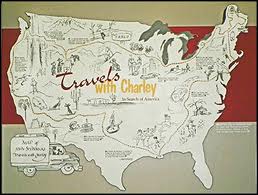
When I, just last week, came across John Steinbeck’s Travels With Charley: In Search of America, I was recently reminded that Vacation, for me at that time, wasn’t enough.  Despite seeing this film and having a lot of laughs, I knew that there was something better.   Steinbeck’s book reminded me.

It was odd that I missed the book.  In truth, I had a few friends who told me to read the book; but I never got my hands on a copy of it. My literary studies brought me elsewhere…more into modernist European literature than American literature.   It was only recently on a trip to visit my father in Upstate New York that I stumbled across a copy of the book. I found it in a small used book store in Schenectady, New York. It was in the American fiction section. I bought the book and, to my surprise, I discovered, right off the bat, that this book, unlike Kerouac or Whitman’s books, starts off on a comic note and it takes Cervantes’ Don Quixote as a model-of-sorts.

The novel, to begin with, is supposed to be based on Steinbeck’s real experiences. But as a New York Times article (from 2011) notes this claim has been heavily-disputed. Nonetheless, I’m less interested in the “truth” of the claim so much as the form it takes, which is the form of the comic adventure, and the fact that Steinbeck wrote this at a time (the early 1960s) when he felt down on his luck and alienated: two factors that often make for good Yiddish and Jewish American comic literature.   Most importantly, the novel suggests a desire not so much to discover American as to be elsewhere, which is, to be sure, a Jewish desire. The suggestion that this is not just a Greek or Spanish motif can also be found in the fact that Steinbeck dedicated this book to a Jew named Harold Guinzburg.

At the outset of the book, the narrator recalls how, when he was young, “the urge to be someplace else as on me, I was assured that by mature people that maturity would cure this itch”(3). However, as the narrator points out, although he was in middle age, “the sound of a jet, an engine warming up, even the clopping of shod hooves on pavement brings on the ancient shudder, the dry mouth and vacant eye…In other words, I didn’t improve; in further words, once a bum always a bum”(3).

In these words, he see that, in his own eyes and in the eyes of the community, the narrator is a “bum” and a “man-child.” But he is not an aimless wanderer. To be sure, the narrator calls himself a “practical bum.” He isn’t just wandering around America: “He has a built-in garden of reasons to choose from. Next he must plan his trip in time and space, choose a direction and a destination. And last he must implement the journey”(3).

Even though he sees himself as a “practical bum,” the narrator associates himself with Don Quixote who didn’t seem to have a plan. We see this in the fact that, in choosing the name for his vehicle (he is driving, not hitchhiking) he selects the name of Don Quixote’s horse:

And because my planned trip had aroused some satiric remarks among my friends, I named it Rocinante, which you will remember was the name of Don Quixote’s horse…I was advised that the name Rocinante painted on the side of my truck in sixteenth-century Spanish script would cause curiosity and inquiry in some places. I do not know how many people recognized the name, but surely no one ever asked about it. (7)

In other words, this was the narrator’s private joke. What really brings him together with Americans, however, is not his car. It is his dog, Charley, that brings him into the world. He takes the dog with him because he had worried about traveling alone. He felt that he might be assaulted, but, ultimately, he fears the weight of desolation would kill him:

There was some genuine worry about my traveling alone, open to attack, robbery, assault. It is well known that the roads are dangerous. And here I admit I had some senseless qualms. It is some years since I have been alone, nameless, friendless without any of the safety one gets from family, friends, and accomplises. There is no reality in danger. It’s just a very lonely, helpless feeling at first – a kind of desolate feeling.(8)

And it is “for this reason” that I “took one companion on my journey – an old French gentleman poodle known as Charley. Actually his name was Charles le Chien. He was born in Bercy…and trained in French”(8). To be sure, the dog only responds to French words.

I find the dog, and its European pedigree, to be an interesting American re-writing of Don Quixote. In this version, the more rational and grounded Sancho Panza is replaced by a dog. The dog helps the narrator relate to the world and pulls him out of dreams: “Charley is a born diplomat. He prefers negotiation to fighting, and properly so, because he is very bad at fighting”(9). He fails at fighting, but he is good at relating and negotiating with others. He is a “bond with strangers. Many conversations en route began with “What degree of a dog is that?”

It is conversation that the narrator wants because, in doing so, he doesn’t simply see American and its various landscapes; rather, he experiences American by way of talking with people from around the country. Regarding this, he notes that the dog is actually not the best conversation starter; even better is than the dog is the state of “being lost.” It’s the best way to “attract attention.”

With these last words, one wonders about what Steinbeck is doing. On the one hand, he casts himself as a “practical bum” and yet, on the other hand, he casts himself as someone who must “be lost” if he is to rediscover America. It seems to be a little of both. He seems to be, like many a schlemiel or ironic figure (think of Socrates, even) someone who can act as if he is lost while not being lost. The whole point, to be sure, is to gain new experiences by way of conversation. The only way to do that is to act as if one is lost. And in this act, which is carried on with a dog, the comic journey begins.

…to be continued….