“I’m Only Half a Man” – Howard Stern and the Schlemiel – Take 1

images-3

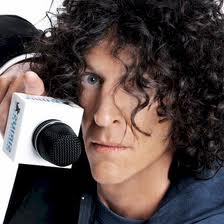
A few friends of mine have, for the longest time, told me that I should write on Howard Stern as a schlemiel.  It’s been on the back of my mind for a while and I do listen to his show from time to time, but I’ve always been a little ambivalent as to how he could be seen as a schlemiel.  After all, schlemiel’s are usually very humble and are not as rude as he.  But then again, we have the Borsht Belt Comedians, Lenny Bruce, Larry David, and, of course, Phillip Roth’s Portnoy (of Portnoy’s Complaint) all of who are considered by this or that scholar to be schlemiels.  That said, I finally had an opportunity to do some in-depth listening to Howard on Satellite Radio as I recently drove across one part of America.  And, lo and behold, I found evidence of the schlemiel on several levels.  Most importantly by way of what Ruth Wisse, in reference to Sholem Aleichem, calls “indirection” and through an identity that is, in many ways, parallel to Phillip Roth’s Portnoy.

I tuned in to Howard’s news part of the program in which Robin Quivers reads a news item and Howard gives commentary.  The first thing I heard was  a report by Robin about how the second in command in Al-Queda, Said al-Shehri was killed by a drone.     Instead of speaking about drones, Howard launches into a reflection about how much he loves films where commandos go in and kill terrorists.  Then he praises the commandos in the American military and says he wishes he could be one of them.  Responding to this, Robin says why don’t you or why didn’t you join the military?  Howard answers: “I can’t.  I’m only ‘half-a-man.’”  He repeats a few times with something of a shoulder shrug and moves on.  To be sure, the claim that the Schlemiel is a mouse and not a man is an American one.  In his essay for the collection Too Jewish? Challenging Traditional Identities edited by Norman Kleeblatt, Maurice Berger writes of how this “half-man” stereotype made its way through TV and film in the 20th century.  But he concludes that the stereotype had nearly disappeared in the 90s and that things had been changing.

Moreover, Phillip Roth’s main character of Portnoy’s Complaint, also sees himself as “half a man,” but, still, he goes on attempting sexual acts to prove he is a man.  As I point out in one of my blogs on Roth and Portnoy, Portnoy is ultimately defeated by a female Sabra.  She emasculates him and reminds him that he is an American Jew, not an Israeli; he is “half-a-man.”  However, as Portnoy shows us, where he wins is with his words and wit.  But, as Roth claims in his interviews, his books which followed Portnoy’s Complaint were efforts to leave the “half-a-man” schlemiel behind to be a man.  (The illicit sexual forays in a book like Sabbath’s Theater – to give only on of several examples – should give one ample evidence of this.)

But the schlemiel as half-a-man lingers on after the 90s.  To be sure, the Schlemiel as half-a-man is also posed by Woody Allen by way of Jason Biggs in the 2003 film Anything Else.

We see a good example of it in this series of scenes.

As you can see, Jason Biggs is the one who says that, in the face of men, Jews have wit.  But it is Allen who turns the car around and does damage to the car of the two aggressive men.  To be sure, Allen, like Stern is also obsessed with being thought of as half-a-man.

But, this is only one part of the schlemiel-complex, so to speak.  More interesting is how Stern deals with the “heavy news” items; he changes the subject to something he’s more interested in: Sharknoado (2013).

Stern loves the name and the B film concept and the absurdity of sharks flying through the air attacking people.  He can’t get it off his mind.   He plays a piece called Tardnado which is a parody of this film that was sent by one of his fans.  As one can imagine, with a title like this, the audio includes screaming people who are mentally challenged who fly at people.

When the “important” news items come up, Stern sometimes launches into his interest in Sharknado.  Other times, he’ll pick out something that is a seemingly arbitrary aspect of the new event and talk about it thereby deflating whatever media-hype it may have.

I’ll make note of a few examples:

When Robin notes that Stevie Wonder has refused to play in Florida, Howard says”mmm hmm” and takes a call from Ralph who talks with him about Sharknado.  They talk about how ridiculous the premise is and enjoy this for a minute or two.  This indirection shows us that film is of more interest to him than Wonder’s boycott.

In response to hearing Robin’s news on Al Sharpton’s National Action tour in the name of Trayvon Martin, Howard also moves by way of indirection and discusses Sharpton’s new girlfriend with Robin.  After doing this, he passes on to how Al looked better when he had more weight.  In other words, aesthetics in the media eye is of more interest to Howard than politics.

After saying this, Howard talks about the heat and air-conditioning and moves on to talking about his mother and her complaints.  He does a few comic imitations of her to drive it home.

This act of imitating his mother has great resonances with Portnoy who basically does the same thing throughout the text.  This routine of struggling with the mother was, according to Donald Weber, one of the main feature of Borscht Belt and post-Borsht Belt schlemiel-comedians.  Weber, like Berger, thinks it has changed with Marc Maron whose comedy is not based on such resentment.  However, as we can see here, it carries on into Howard’s performance.

Most importantly, Howard’s obsession with his mother, Sharknado, or about this or that detail, seem to work to distract him from the world and the political.  And his admission that he is “half-a-man” seem to give us a reason for this need to distract himself.  However, this is, as I have been stating, what seems to be the case. What makes Stern so interesting is that we all know he is living a normal life with a high profile model.  And even though he often jokes about his sexual performance, the audience sees him as a man-of-sorts.

But this is what gets the listener. The overlapping of the distracted schlemiel and the real Howard Stern who has the power to spur millions of his listeners to this or that political action creates a fascinating figure.

The end of this segment, when seen in contrast to what was said before, discloses this figure.

When asked to discuss what he thought of the Rolling Stone cover with Dzhokar Tsarnaev, Stern doesn’t work by way of any indirection.  He comments on the message it communicates to the people and not to academics.   He doesn’t want to see him made into a rock star.  And he takes on the position of the victims to explain his point: “If I had my kid killed or my legs blown off by that kid, I certainly wouldn’t want to see him on the cover of Rolling Stone.”

What I find interesting about Stern is that he moves in and out of the Schlemiel persona.  And he does so for certain reasons.  It seems this above comment on the Rolling Stone cover was his “superman” moment since it is couched in the midst of his self-deprecation (“I am half-a-man”) and his numerous indirections (about Sharknado, Al Sharpton’s girlfriend and how Sharpton appears on camera, and imitations of his mother kvetching).

Regardless of whether or not you agree with what Stern chooses to emphasize, I think I learned and you have seen how, at least in this instance, he plays the schlemiel and what this may imply.

I hope to, in the near future, come back to Howard’s Schlemiel persona.  My friends were right.  Stern does play the schlemiel.  And, as I’ve shown, this performance, when it is at its best, traverses the edge of the political.
“Let’s Have the Music” – Reflections on Sholem Aleichem’s Inside Kasrilevke – Take 1

images-2

In a “Five Books” interview, the Jewish-American writer Allegra Goodman was asked what five books in Jewish fiction she would suggest people read.  Each book, for Goodman, would provide readers with one sense of the Jewish experience.  One of the books she chose was Sholem Aleichem’s Inside Kasrilevke (the contents of which are the stories of this fictional town (Kasrilevke) which is, arguably, Sholem Aleichem’s version of Chelm).  Like Irving Howe, she notes that the Broadway version of Fiddler on the Roof is a “cartoon version of his work.”  What she finds so important about Inside Kasrilevke is that it is “very funny, laugh out loud funny.”  Goodman likens the stories to “comedy routines” and notes that this book is her “comic ideal.”

Taking Allegra Goodman’s suggestion to heart, I think it makes a lot of sense to focus on these comic routines. But in doing so, I’m interested not so much in a comic ideal as in how the narrator of this collection of stories relates to schlemiels and other stock comic characters in the stories.   In this and in other blog entries on Inside Kasrilevke, I will be making a series of different readings which look into comic relationships and comic rhythms so as to understand how Aleichem, in this collection of stories, presents the schlemiel.

Right off the bat, Aleichem, the “author,” explains why he is writing this book in the “Author’s Foreword.” The picture he presents gives us a sense of someone is an insider and an outsider of the town.  For this reason he, like Sancho Panza to Don Quixote, can report on what happens in the town.

Like a writer of his times (and not, as Howe would say, a folkish “oral story teller”), he notes that “of recent years” many people have been writing books “about cities and lands.”  Playing on a Jewish stereotype (and echoing something we see years late played on in Woody Allen’s film Zelig) he “says to himself”: “We imitate other peoples in everything: they print newspapers – so do we; they have Christmas trees – so do we; they celebrate New Year’s – so do we.” So, just like they publish “guides” to big cities, he asks (with a shrug of sorts): “why shouldn’t we get out “A Guide to Kasrilevke?”

After pointing out how he has much in common writers in pursuing such a project, Aleichem notes how much he owes to this town of fools.  He tells us that he is a native who has left and has recently returned to honor the dead; namely, to visit his parents grave.  While he was visiting their graves, it occurred to him how much he wants to show his “gratitude” for the “hospitality” of his “friends” in Kasrilevke By writing this book, he felt he would be doing this.  I want to underscore this element, here, because Aleichem is noting, in the very beginning, that his book is a response to hospitality.  This implies that his representations, no matter how comic or even negative, are kind-hearted and articulate a way of returning kindness for kindness.

What is so fascinating about the final paragraph of the “Author’s Foreword,” is that it works by way of what Ruth Wisse would call “indirection.”  After stating his personal gratitude and the personal cause of this book, the narrator states that he, “of course” doesn’t have “personal motives” for the book. Rather, he writes it in response to “considerations of public service” meaning that he wrote the book in order to “guide strangers visiting Kasrilekve.”  This, he tells us, will help them to know where to get a train, where to go, eat, and have fun.  But at the end of the paragraph he states something that would contradict his present project, what Irving Howe would see as “troubling.”  He notes that “Kasrilevke is no longer the town it used to be.  The great progress of the world has made inroads into Kasrilevke and turned it topsy-turvy.  It has become a different-place.”

This final, sour note gives us a sense of how, in Aleichem, the comic is as Irving Howe would say, citing Saul Bellow: “laughter and trembling are so curiously intermingled that it is not easy to determine the relation between the two.” But, in relation to Howe’s claim, I would also like to emphasize, as does Howe and Sidrah Dekoven Ezrahi, how important place is for Aleichem and how place relates to comedy. After all, the book is all about this place, perhaps the changing place of Jews in Eastern Europe.  Through fiction, Aleichem gives honor to the place and the people.  This, he claims, is not simply personal; it is a “public service.”

Even though Aleichem ends on this somber note of how “it has become a different place,” he changes rhythm and words by “indirection.”  And I want to underscore rhythm because there is a comical music going on at the outset and how this comic music is connected to place.  It addresses what the place has become (which is sad) by way of comedy.  (Laughter and tears, in other words, are intimately related to and emerge out of a place, a world.)

As a comic rejoinder to this sad meditation on place in the “Author’s Foreword,” the narrator points out how, immediately on arrival, he is accosted by a bunch of hotel porters and a sea of yellow: “At the station I was set upon by a horde of yellow porters with yellow whiskers, yellow coats, and bits of yellow tin stuck on their yellow, threadbare caps.”

The cacophony of yellow, so to speak, is coupled by a cacophony of voices calling on the narrator to come to his hotel/place: “Mister! Grand Hotel!” “Hotel Francia, mister!” “Hey, mister, Portugalia” “Mister! Turkalia!”  He tries to avoid this cacophony by moving to another place, but there too he is once again occasioned by a mob.

They are not “civil” and take his bag away from him just to get him to their hotel.  He fights with one to get back what is most important to him: his manuscripts.  Right after he seizes his back, he rushes for the “tramway.”  But when he gets there, he occasions more cacophony this time between passengers, the rider, and the manager.  All of the “noise” is comic and sheer slapstick.  And once it does move, it gets in an accident.

The movements in this text teach us that, for Aleichem, the schlemiel is not simply in the character as in a comic exchange and rhythm: that occur in terms of an erratic movement from place to place, stopping and starting, while comically gesticulating. All the while, there is a blindness and a timing in each movement.  Each thing collides, changes direction, moves no, stops, and repeats this process.  Each event prompts one to move, so to speak, from one vehicle or hotel to another.

But each of these movements, while erratic, is endearing.  In the midst of all this, the narrator is scrambling.  In fact, by the time he gets to the hotel, he has a hard time retaining his cool.  When the hotel manager tells him that he can either be in a room that is infested by bed bugs or a room penetrated by the music of a cantor practicing for the Sabbath or a bunch of Yiddish actors, the narrator is startled.

And for good reason… Given what we have learned from the “author’s forward” we don’t see evidence of hospitality so much as rudeness, he don’t see civility so much as chaos.  More importantly, since we know that he was a native of the town and is now on a visit, we see that he may be lying or have forgotten what really goes on in this town.  Its as if he led us on.

Its confusing for the reader and its confusing for the author, it seems, to know how to relate what is happening to him on the tram and the hotel to what he has said before.

He is startled (and we are startled) by a city that is full of many erratic rhythms.  And, it seems, the narrator is the shlimazel while the town, and all its rhythms, is the schlemiel.  This comes out when, after being told about choosing between music and bedbugs in another room (without music) the narrator chooses the music:

“If that’s the case,” I said, “let’s have the music.”

Indeed, in Karilevke, in a town full of schlemiels and permeated by schlemiel rhythms, that seems to be the only option.   And perhaps Aleichem is telling us that to understand the schlemiel, we must first relate to its comic musicality.

Perhaps we hear a similar in Woody Allen’s Zelig but in Allen’s film there isn’t an ambivalent sense of place; there is constant movement and change which echoes what we said in the beginning of this entry; namely, that Jews do what others do and become what they become.  For Allen, as opposed to Aleichem, this music of change, which happens in America, is purely comic. While there are tears, laughter, and music for Aleichem over Kasrilevke, there are no tears for Allen; in relation to America, there is only laughter and music.  Here you can dance the Zelig-dance (“The Chameleon”) without any remorse:

Emmanuel Levinas, Don Quixote, and the Hunger of the Other Man

DownloadedFile-2

Like many Jews over the centuries, I am fasting to commemorate the destruction of the Temple in Jerusalem in 70 AD.  Now that I’m in middle of the fast, I’m having a hard time distracting myself from my hunger.  In the midst of being enthralled with my hunger, an academic memory came to my rescue.   I remember how the Jewish philosopher Emmanuel Levinas, in apposition to the German philosopher Martin Heidegger, argued that it’s not about my death and suffering (as Heidegger would say (in translation) my “being-towards-death”), it’s about the death and the suffering of the other.  Echoing this, I thought: perhaps Levinas is right, it’s not about my hunger; it’s about the hunger of the other.

Strangely enough, Levinas writes about the “hunger of the other man” in relation to Don Quixote (a comic figure which has appeared quite often in Schlemiel in Theory).  In 1975 and 1976, Levinas gave a course at the Sorbonne. His course notes are included in the book God, Death, and Time (translated by Bettina Bergo).   On his February 13th 1976 lecture, Levinas addresses Don Quixote and the “hunger of the other man.”  This talk, to my mind, gives us at least one angle to understand Levinas’s approach to humor.

Let me sketch it out.

Before making his reading of Don Quixote, Levinas prefaces with a meditation on the relation of thought to the world. He writes: “thought contains the world or is correlative with it”(167).  He notes that by “correlative” he means that it comes “prior to” the world.  In this spirit, Levinas argues that thought “disqualifies” anything that would be “disproportionate to the world.”  He provides two adjectives to describe things that would be disqualified: “all thought said to be ‘romantic’ or ‘theological’ in its inception.”

“Disqualified” thought, argues Levinas, is not equated with the world (which thought contains); it is equated with what is to come.  It is, for this reason, equated with “a question” and “hope.”  Levinas goes on to say that “God” is also included as something which is “disproportionate” with thought and the world.   To be sure, God, hope, and the question are deemed to be “outside” thought and, for that reason, outside the world.

Writing of this, Levinas wonders how much we can be “affected by what is not equal to the world, how one can affected by what can be neither apprehended nor comprehended”(167).  In other words, how much can we be affected by that which is disqualified by thought?

Following this question, Levinas launches into a discussion about the disenchantment of the world.  He addresses this, like Martin Heidegger or the sociologist Max Weber, from the angle of technology.  Unlike them, Levinas sees the disenchantment fostered by technology as good.  Here, however, he notes that although it is good, technology “does not shelter us from all mystification”(168).  Now “there remains the obsession with ideology, by which men delude each other and are deluded.”  And, says Levinas, even “sober knowledge…is not exempt from ideology.”

Everything, even knowledge, is still threatened by mystification.  Levinas finds the source in what he calls “amphibology”: “technology cannot shelter us from the amphibology that lies within all appearing, that is, from the possible appearance coiled at the bottom of all the appearing being.”

Benjamin Hutchens explains that amphibology is the “confusion between what something is and the concept that enables what it is to be known.”  This, says Hutchens, leads to a “kind of ambiguity.”  John Llewelyn cites Martin Heidegger’s notion of Being – in his claim that “language is the house of Being” – as an example of “amphibology.”  Being is ambiguous and this ambiguity troubles Levinas as he sees it as the source of what he calls “bewitchment.”  And, as Llewlyn suggests, this ambiguity goes along with the ambiguity of language.  Perhaps this implies (and may even be a jab at deconstruction) that one can easily become enchanted with the play of words and language and this may distract us from the other.

What Levinas seems to be saying here is that what threatens the project of demystification most is the embrace of ambiguity as such and this kind of ambiguity is associated with how things show themselves or appear.  Levinas notes that the basis of “man’s persistent fear of allowing himself to be bewitched” is “amphibology.”

And, strangely enough, the writer who best illustrates amphibology and the attending fear of being “bewitched” (and “allowing” oneself to be bewitched) is Cervantes in his book Don Quixote.  In fact, Levinas says that “bewitchment” is the book’s “principle theme.”  Levinas finds this to be most pronounced in chapter 46.  Hinting at his own phenomenology of the face, Levinas calls Don Quixote the “Knight with a Sad Face” and points out that “he lets himself be bewitched, loses his understanding, and assures everyone that the world and he himself are the victims of bewitchment.”

Bewitchment, it seems, is another word for foolishness.  And Don Quixote, the “Knight of the Sad Face,” lets himself become a fool.  Levinas hints as such when he cites Don Quixote’s urgent claim to his side-kick Sancho Panza: “’Sancho my son,’ he said, ‘now you realized the truth of what I have many a time told you, that everything in this castle is done by means of enchantment.”    Levinas stresses the point that Sancho Panza is clear minded and is “stronger” that Don Quixote for this very reason: “Sancho alone maintains a lucidity and appears stronger than his master.”

In other words, the person who watches the schlemiel or the fool is more “lucid” and “stronger” than him/her.  To give this reading more textual support, Levinas cites a passage in which Sancho Panza is astonished by the “gullibility” of Don Quixote.  Yet, at the same time, he can see the “shapes” that Don Quixote conjures up.  Levinas notes that “these ‘distinguished shapes’ that Sancho doubts are a priest, a barber, and a whole group that had decided to take Don Quixote back to his country, where he could be cured.”

After noting this, Levinas concludes: “thus the adventure of Don Quixote is the passion of the bewitchment of the world as the passion of the Knight himself.”  At this point, Levinas knew he had to relate his reading of Don Quixote to the beginning of his lecture: to thought, the outside, amphibology, and bewitchment.

To this end, Levinas goes right to work and claims that “we must understand that the whole of Descartes’s Evil Genius is present in these pages.” To be sure, Levinas is asking us to read philosophy by way of Don Quixote!  Continuing on this thread, and indirectly explaining amphibology, Levinas argues that in this passage from Don Quixote “enchantment functions in the form of an imprisonment within a labyrinth of uncertainties, lacking any connection between faces, which are only masks or appearances.”

Playing on Descartes notion of the cogito (mind), Levinas argues that, in the midst of his bewitched experiences, Don Quixote “experiences, in a way, the cogito on which a certitude is founded.”(169).  Citing Don Quixote, Levinas allows for Don Quixote to merge with Rene Descartes: “I know and feel that I am enchanted, and that is not enough to ease my conscience…I allowed myself to lie in this cage, defrauding multitudes of the aid I might offer of those in need and distress…”

The last line of this passage from Don Quixote is crucial for Levinas.  It separates Don Quixote from the Rene Descartes we hear in the opening lines, and this line brings the reader face-to-face with what Levinas calls the “hunger of the other man.”   To be sure, we can see from these lines that Don Quixote is ashamed.  He sees himself as allowing “to lie in this cage, defrauding multitudes of the aid I might offer to those in need and distress.”

I put the stress on the word “allowing” only because Levinas does.  But one doesn’t simply choose to be or not to be bewitched.  Levinas believes that this passage could not be written if Don Quixote was not, in some way, disenchanted by the “hunger of the other man.”  Levinas calls this interruption of bewitchment “transcendence.”  It comes from “outside” thought and disturbs it.   And he calls the process of disturbing this bewitchment “secularization.”

To be sure, Levinas is suggesting that the only thing that can truly “secularize” or “demythologize” reality and clear away the bewitchment of ideology (which is the project of the Enlightenment) is the “hunger of the other man.” This hunger is what, Levinas claims, awoke Don Quixote from his “bewitched” slumber.

What interests me most, as a schlemiel theorist, is what this kind of reading implies for the schlemiel.   How does it fit?  After all, Mendel Mocher Sforim, the father of Yiddish literature, wrote Benjamin III with Don Quixote in mind.  In that book, we have schlemiels who are, like Don Quixote, caught up in dreams. But can we say that these schlemiels are caught up in the same problems?  And if we take Levinas’s position are we taking the position of the clear-thinking Sancho Panza toward Don Quixote?  In other words, would Levinas think of the schlemiel in the same way he would think of Don Quixote? Does humor put the accent on the bifurcation between being “bewitched” and being “responsible” for the hunger of the “other man?”

I don’t know about you but I’m hungry for an answer!

(To be continued….)

The Final Notes of Irving Howe and Ruth Wisse’s Epistolary Exchange over Sholem Aleichem

images-7

The last three letters exchanged between Irving Howe and Ruth Wisse over Sholem Aleichem’s fiction and its meaning show us the subtle differences between these two important thinkers and literary critics.  As I pointed out in my last blog entry about this dialogue, Ruth Wisse suggested that Aleichem was, in contrast to the Yiddish writers Mendel Mocher Sforim and I.L. Peretz, more “balanced.”  This was a part of Wisse’s epistolary strategy since she was countering Howe’s harsher view of Sholem Aleichem’s fiction.  Wisse’s response to Howe shows us that while she agrees that there are “dark undercurrents” in Aleichem’s work, these words do not subsume Aleichem’s approach to Jewishness, Jewish history, and Yiddish literature.

For Wisse, as I’d like to show in this entry, Howe’s view should be balanced out with a more positive view of the Jewish writer.  Like her brother, David Roskies, she sees Aleichem as an artist who acknowledges fragmentation but who, in response to it, takes on the tradition of the Magid (story-teller).   She sees Aleichem as a “stand-up” comic of sorts who is looking to create bridges and create balance; unlike Howe, who sees him primarily as a modernist writer who focuses on fragmentation and ruin.  The last letters between Howe and Wisse work to bring out this differing take on Aleichem and his work.

At the end of his third letter to Ruth Wisse, Howe notes that although Sholem Aleichem’s Motl Stories are “casual offhand, charming, even mischievous,” Aleichem will “suddenly…drop to a fierce irony, a harrowing sadness.”  And this, for Howe, is the keynote of Aleichem as a modernist writer.  He ends on the sad note: for Howe, Aleichem goes from laughter to tears.

In response, Wisse turns to Aleichem’s Yiddish so as to show that he was a Yiddish artist.  In other words, she agrees with Howe that Aleichem is an artist, but she takes a different strategy with respect to explain why this is the case. She turns to his language and shows that Aleichem used Yiddish to show how repetition is used to create a closed circle of thoughts – what she calls a “circular style.”   Noting this style in relation to one of Aleichem’s characters, Wisse points out that “her mind is imprisoned in its own obsessive circularity.”  But the point of Aleichem’s using circular style in relation to this character is to “give truth to her particular embattled consciousness, self-protecting and self-defeating.”  This speaks to the negative note that Howe is addressing.

But from here, Wisse turns to the linguistic strategies of Tevye (one of Aleichem’s most celebrated characters).  Wisse sees this character as evidence of Aleichem-the-artist and not simply Aleichem the-folk-storyteller:

Like a true musician, he enjoys showing the speed and grace with which he can skip from one note or one tone to another.  His best jokes and quotations are polyglot, drawing attention to their mixture of high and low.

But Aleichem differs from a writer like I.L. Peretz who “drew attention away from the specificities of Yiddish, away from its folk expressions, the interplay of its source languages, the different dialects of its various speakers.”  Contrary to Peretz, “the unfixed nature of Yiddish was its greatest attraction, and its infinite range of dialects and oral styles the best literary means of capturing the dynamic changes – or the resistance to change – in the culture.”  By pointing this out, Wisse is shifting the emphasis of this epistolary exchnage.  For Wisse, the emphasis should be on the way Aleichem bridges high and low culture by way of his use of Yiddish.  This makes him a modern artist.

Howe catches wind of this shift of emphasis and, so to speak, sticks to his guns.  In his final letter to Wisse, he reiterates his points.  His first words seek for the agreement between he and Wisse about the “oddity” of his stories.  In other words, he acts his if they agree fundamentally but, ultimately, he is changing emphasis.  Howe ends with five points which convey this “oddity” and how it relates to Aleichem being a quintessential modern writer.  For the purpose of understanding his tactic, I’ll summarize each.

1)    Aleichem is a literary artist and not an “oral story teller” and the evidence for this can be found in the “sudden, abrupt blockage” of closure in Aleichem’s stories.

2)    His work demonstrates that he is not interested in “resolution of an external action” so much as evoking “shocked laughter.”

3)    His work is more interested in the “clever Jew” (who is “complicated, quizzical, problematic”) than in the naïve simpleton who is concerned with the “old ways of piety.”  The relation of the “clever Jew” to the past is secondary to his being…a “complicated, quizzical, problematic” Jew.

4)    He is a sophisticated writer who is “very much aware” of his full departure from the tradition of oral storytelling.

5)    Shalom Aleichem, like Saul Bellow who followed in his footsteps, “knew intuitively that the boundary between comedy and tragedy is always a thin and wavering line.”

Howe’s last point is something I have been discussing from the very beginning of my blog series on Howe.  It taps into his approach to Jewishness.  To be sure, he sees the fluid movement between comedy and tragedy as a defining characteristic of modern Jewishness and modern Jewish-American literature.  And this reiterates what he was saying in his introduction to Jewish American Stories.

Wisse final letter to Howe – literally, her last word –  provides us with a key to understanding how she differs with Howe over how we should understand Sholem Aleichem and his project.

First of all, she notes that he avoided “the romantic subject, the heroic possibility, the grand style of the novel” because he was “simply unconvincing and demonstrably uncomfortable in this mode.”  More importantly, he was a modern writer because he is able to work on many levels simultaneously.  She notes “On Account of a Hat,” a story Howe loved, and points out that it has a “dozen interpretations: it is the plight of the Diaspora Jew, an exposure of rootlessness, a mockery of tyranny, the comic quest for identity, a Marxist critique of capitalism, and, of course, an ironic self-referential study of literary slight of hand.”

In other words, Wisse wants to “balance” out the “oddity” – that Howe finds so fascinating – with other elements of the text that Howe’s reading overshadows.  To be sure, she points out that Aleichem works by way of “indirection” with “the worm’s angle of vision, and with apparently flimsy materials.” But he uses them to present something tenacious about Jewishness, something Howe may miss.

As we saw above, Howe sees Aleichem’s Motl in terms of the final, negative note.  Wisse, reading the same character, points out his tenacity: “He confronts all the things that happened to him and forces himself upon life again and again, and the sum of these trials shape the rhythm, constitute the meaning, of his existence.”

Commenting on this, Wisse notes that:

Sholem Aleichem’s admiration for the stubborn ruggedness of Jewish faith and the surprising vitality of the people comes to expression not just thematically, in story after story, but in the resilient, recuperative shape of all his major work.

Knowing full well that her reading may not be deemed “academic” enough, she notes that Aleichem had no obsessive interest in an academic, modernist reading. She asks us to contrast Aleichem’s memoir to the “mountaineering saga of Jewish writers with all the high, serious climbs of other European literati.”  And what we will find from his simple memoir (consisting of only four anecdotes about the ordinary nature of other Yiddish writers and forgetting) is that he “he deflates intellectual and artistic pretentiousness, and even undercuts the grandeur of the Alps!”

In other words, Wisse, like Aleichem, thinks that Howe’s obsession with the “quizzical” and “troubling laughter” of Aleichem is something Aleichem would laugh at.  Playing on the word “quizzical” (which Howe uses several times in his letters to Wisse), Wisse gives her final words on Aleichem which show us a correlation of simple faith (hope) in the story (and storytelling) and not with the world:

What confronts us, finally, is the quizzical smile of the author, compulsively skeptical about everything but the story.

This tension between hope and skepticism, for Wisse, not only informs her reading of Aleichem as an artist; it also informs her reading of the schlemiel.   Howe’s reading of the schlemiel would differ significantly because, in reading Aleichem, he puts the emphasis on the quizzical-as-such and not the relation of the quizzical with the tension between fiction and reality or hope and skepticism.


On Louis CK’s “Goodbye Jews!” and the “Jewish Thing” – Take 2

images-6

Early this morning I reposted a blog entry on Louis CK.  And as a part of the facebook tagline, I jokingly referred to Louis CK as an “honorary Heeb.”  In response, a friend of mine pointed out that she thought that Louis CK was not Jewish and, on the contrary, that at least one of his pieces might disclose a “bit” of anti-Semitism.  She asked me if I ever saw the “Airplane” clip, suggesting that this clip in particular has elements of the anti-Semitic and may alter my reading.

The possibility of anti-Semitism did in fact come across my mind before she gave me her opinion.  I was, in fact, writing up a new blog entry which addresses Louis CK’s joke about Schindler’s List.  When I first saw it, I wondered how he would traverse the risky topic of the Holocaust.  To my mind, Louis CK’s joke about Steven Spielberg’s Schindler’s List  hit at the limit of anti-Semitism. Louis CK brings it to the limit by way of imagining the auditions that Steven Spielberg would have to give for a key role in which a young German girl brazenly sends the Jews away to the concentration camps with the words “Goodbye Jews!” This is a serious role, but what would happen if the auditioning little girls had a miniscule amount of knowledge of the kind of voice that should be used.  This irony addressed to this serious topic is the focus. Spielberg gathers many different girls for the audition and it is Louis CK’s performance of the voices that sends the audience into peals of uneasy laughter.

Here he tells the joke to Conan O’Brien.

And here he gives it over to an audience at Carnegie Hall:

He imagines there are fifty little girl actresses who are trying out.  They are “going from the Hannah Montana auditions to the Schindler’s list audition.”  Each of them pronounces the phrase “Goodbye Jews” and, as one can see, Louis CK has them do versions that don’t fit the context.  Nonetheless, the power of the message could prompt people to think that the message is overshadowed by the comic performance of the words “Goodbye Jews.”

Although I find this point interesting, I would argue that this is not anti-Semtic; rather, it shows Louis CK’s tension with Jewishness.  And this is what I am looking for. The point of the contrast, in comparing the “Goodbye Jew” piece to the Louie piece in the last blog, is to show that Jewishness is something that Louis CK, at times, addresses.

For him, if comedy is not disturbing than it is not comedy.  And the fact that a film like Schindler’s List is a holy cow is quite apparent to him.  As a non-Jew he’d like to inject a tension into this so as to point out, by way of the young girls auditioning, that they had no sense of the role they were to play.  As young American women who want to be on TV or Film, they have no sense of history, the Holocaust, or how to properly relate to the topic. Their awkwardness is telling: it teaches us that they don’t have a cultural sense of what is the norm. That norm, so to speak, is lessened now.  As Louis CK notes at the beginning of the piece; its no longer a blockbust film; its on TBS (the main Boston TV channel).

Its banal.  And, when we have to relate to it with the proper gravitas, we become awkward. What happens when our children, so to speak, don’t know what’s at stake? They will, of course, be awkward.  And, regardless of that, the very fact that “Goodbye Jews!” is to be performed would make one very awkward. Who, after all, would want to say those words (with conviction) in an America that deems itself, by and large, conscious of the Holocaust?  The mere fact of saying it is disturbing.  This comes out in the awkward approaches we hear in each of Louis CK’s voices.

Now for the contrast: On the one hand, you have pieces that put Louie CK in the position of the loser-who-can-redeem himself; he is given a choice between succeeding and failing as a comic by a Jew who was once a comic but is now a movie mogul.   He is like a schlemiel but not quite.  He has an odd relationship to this tradition.

Through this Louie clip, we can address his relationship to scenarios in which he acts in relation to Jews or with Jewish topics.  How does he situate himself?

Moreover, from this clip we can query into what his relationship is to a Jewish comic tradition; one which, as the Jewish film mogul/executive suggests, starts in New York City in the Carnegie Deli.   How does Louis CK relate to this Jewish comic tradition? How does he, literally, compete with Seinfeld?  Is it a Jew vs. a non-Jew struggle?  Or is this a question of “who” takes on a comic tradition?  Need it be a Jew? Or is Louis CK far from this?  As we see in the beginning of the clip, Louis CK doesn’t know who this Jewish-comic ancestor is.   This blindness directs us to the tension and the issue: what is Louis CK’s relationship to a Jewish comic tradition?  Is there any?  Why should he care about Jews?

In contrast to a clip like this, anyone who watches Louis CK can tell you that Jewishness is certainly not something Louis CK regularly concerns himself with.  In the clip below, we don’t see any such narrative.  What we find is scatological humor.  Here’s a joke justify farts – providing reasons why farts are so amazing.

He reasons that “they come out of your ass.  The hang out around shit and they smell for that reason.  His gestures are mired in the physical processes.  There is nothing “Jewish” here.   To be sure, this video segment simply doesn’t pose the question.  Its caught up in the gestural.  In the “Goodbye Jews,” the gesture of enunciating these words.  This gestural focus, however, takes us away from the historical tension.

More important is how Louis CK’s use of gesture brings about – when he addresses the issue – a tension with Jewishness.  It is a clash between repeating or not repeating a Jewish comic tradition. As I noted above, is Louis CK a competitor with Jerry Seinfeld? Does he emerge from the same tradition, in Carnegie Deli, or is he doing comedy despite that relationship?

Searching for evidence of Louis CK’s tense relationship to Jewishness and to his possible anti-Semtitism, I did a Google search correlating the airplane routine, which I heard was anti-Semitic, to Louis CK and anti-Semitism and I found only two links of interest: the first link was published in The Jewish Press.  It was entitled “Louis C.K. – Not a Jew.”  It was published in May 20, 2012 and was authored by the blog Not a Jew – Jew: Choosing to be Chosen A Blog of My Journey to Judaism http://notajew-jew.com/?p=66

The blog is authored by someone who refuses to give his name and directs us, instead, to the journey of conversion: from being a non-Jew to a Jew. In the “about” section we read:

His name is not important, but his journey to become a Jew is.

But, apparently, said person who wrote the blog has written for the New York Times, the Jerusalem Post, etc.  His task, ultimately, to show his readers that he realized that Louis CK isn’t Jewish and this, in some way, prompts him to want to convert to Judaism.

In this piece, he presents his argument as to why Louis CK is “not Jewish.”  He begins his argument by creating a criteria by which he distinguishes between what it means to be a Jew from what it means to be a non-Jew.  To give authority to his reading, he cites his “friend” (the notorious Rabbi, TV show host, Hollywood personality, and author of Kosher Sex – amongst other books) Shmuley Boteach:

One of the main things I’ve learned about the differences between Jews and non-Jews (namely Christians) is: non-Jews place a great deal of importance on how you feel, what you believe, your intentions, your inner motivations for being good.  By contrast, according my friend Rabbi Shmuley Boteach, Jews “care far less about what you believe.  What you do is more important.”

If it all comes down to a tension between concern with belief and conviction – on the one hand – and action – on the other -how does Louis CK fare?

He, the author of the blog, sites a comedy routine by Louis CK where he talks about how he relishes the fact that he “thought” about being ethical and giving up his seat to a soldier on an airplane but he didn’t.  This, argues the blogger, isn’t Jewish.  A Jew wouldn’t think about whether he or she thought about doing said deed; a Jew, says Boteach, would do it. The principle of Jewishness is, as the blogger states: Action is greater than thought.  This seems to be a crude principle, but it can be understood in a more significant and sophisticated manner.

Relishing the thought that one “could” help would make Louis CK into a solipsistic, Cartesian, kind of philosopher instead of what Emmanuel Levinas. The latter thinks ethics is “first philosophy,” not thought or being.  Levinas puts the other, ethics, before all philosophy and reflection.   Levinas’s essay, entitled the “Temptation of Temptation,” makes it clear that Louis CK is caught up in the “temptation of temptation.”  For if temptation is about relishing the fact that one is “capable” of thought (that one “can”) than the temptation of temptation is to think about what one is capable of doing and not doing anything. As Aristotle might say, this is philosophy:  thought thinking thought.   That, Levinas would argue, is not holy.  It is not Jewish.  For Levinas, being-for-the other (in action, not thought) is Jewish.

The blogger notes something like this when he notes that there may be a “Little Jew” in Louis CK because he gives a lot of his money to charity:

But perhaps there’s a little Jew inside of Louis C.K., after all.  Because, when his video generated over a million dollars in downloads in just its first 12 days online, he issued a statement “to set an example of what you can do if you all of a sudden have a million dollars that people just gave to you directly because you told jokes.”

He gave $250k to the people who produced the video and built the web site to sell it.  Another $250k went to his staff for “a big fat bonus.”  $280k went to five different charities (including Kiva, which I discovered because of him – thank you Louis C.K.!).  In total, he gave away 78% of his million dollars, which is 7.8 times more Jewish of him than a Jew who tithes 10%.

While this is very interesting, while it gives me a criteria for what’s Jewish and what’s not Jewish, it doesn’t equate Louis CK’s comedy with the anti-Semitic.

But this criteria doesn’t seem to work.  Aren’t Jewish comedians always playing around with thoughts and possible scenarios?  Doesn’t that happen throughout the Talmud?  However, the Rabbis always think in terms of how this or that scenario relates to Jewish law while Louis CK thinks of scenarios in terms of things we find embarrassing or odd.   These scenarios seem to be replayed in much Borscht Belt comedy, too.  Were they also “tempted by temptation?”  Or should we read Louis CK’s reflections differently – in terms of the social relations he works through?  Is it a Jewish way to go against the grain and test the limits of this or that discourse (here, the discourse of Holocaust representation or in terms of the relationship of Jewish comedy in the past to Hollywood today)?

Besides this should we call Louis CK Jewish or Non-Jewish in terms of only one example and a citation from Shumley Boteach?

I think we need to look more deeply into the matter. And I’d like to say that I leave this blog post with the voices of Louis CK’s little girls as they say “Goodbye Jews.”   They are out of touch with Jewish history but its really not their fault now is it?  America right now seems to be forgetting more and more and Louis CK, in that piece, brings us face to face with that reality. At the same time, he’s marking off the fact that he is not Jewish in saying “Goodbye Jews.”

But his departure is not so much anti-Semitic as marking off a difference between himself and Jews.  He also doesn’t know who he is inheriting the comic tradition from.  It may not matter to him, as we see in the Louie clip, above.

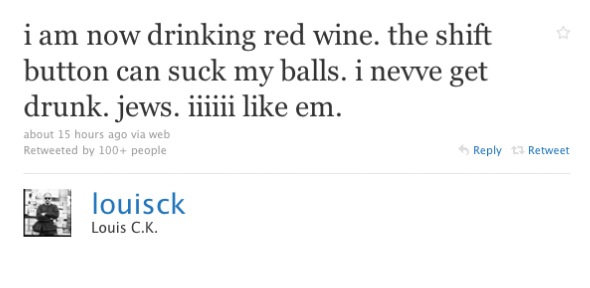
The only other link I found on Google relating Louis CK to anti-Semitism, had nothing in fact to do with anti-Semitism.  Rather, it was an article from Heeb Magazine which simply notes some Tweets Louis CK did while he was, apparently, drunk.  I’ll note one of his Tweets and leave it at that:

louisck_tweets_3

Even though Louis CK shouts out, in the voices of many bright eyed girls, “Goodbye Jews,” this drunken Tweet says: “Don’t worry, Louis CK likes Jews!”

Jew or Not Jew: Louis CK’s Humor and The Jewish Thing – Take 1

DownloadedFile-6

After I first saw him perform, I immediately wondered if Louis CK (Louis Szekely) was Jewish.   At first glance, his gestures, jokes, and comedy routine seemed, for me, to be Jewish.   But I was uncertain.  The ambiguity over his identity prompted me to think about what I was interested in: was I interested in whether or not he was a Jew or whether or not his gestures were Jewish?   I also wanted to know what he thought of such a question about his comic routines and their ethnic identifications.  I couldn’t put my finger on what made his comic routine (or he himself) seem “Jewish.”  This inquiring mind…wanted to know.

A simple Google search brought me to the site “Jew or Not Jew.”  (This site, by the way, has nothing to do with the app that was deemed anti-Semitic.)  On this web page, I discovered that Louis CK wasn’t Jewish.  He was raised a Catholic. And, according to the blurb on the page, Louis CK said the following to the LA Weekly which, this site believes, indicates a happenstance kind of relationship to Jewishness:

L.A. WEEKLY: Why are so many funny comics from Boston?

LOUIS C.K.: Because Boston is a miserable place filled with drunks, losers and Jewish girls with big tits.

From this and from his lineage, the site concludes that he is not a Jew.  Fine.  But I was not satisfied by this superficial assessment.  I wanted more. I wanted to see how he dealt with the Jewish thing.

But before I look into that, let’s take a look at the man himself.  Louis CK is a provocative stand-up comic whose self-deprecating, aggressive, awkward, and vulgar brand of comedy has gained critical acclaim over the years.  Many of his best skits draw on his personal life and observations as a divorced and aging father.  The character he plays on stage is constantly attempting to come to terms with all of the odd situations and minute details of being a father, being single, and searching for success.  In all of these departments, no matter what he does, something always seems to go wrong.

Despite what we often see in his comic routines, he has, apparently, been very successful.  He has credit for writing comedy and doing many comedy performances and has written for the Late Show with David Letterman, Late Night With Conan O’Brien, and The Chris Rock Show. And between 2008 and 2010 he recorded two full-length comedy specials: Chewed Up (2008) and Hilarious (2009). In 2011 he released Live at the Beacon Theater.

In addition to these comedy specials Louis CK has starred in two different sitcoms where he was the center of the show: Lucky Louie (2006) and Louie (2010).

And recently, in 2013, he did a special for HBO entitled Oh My God.

From time to time, Louis CK is involved in comic situations or tells jokes that involve Jews.  In this segment from Louie on FX, Louis CK is face-to-face with a stereotyped Jewish media executive from Hollywood.  But before he goes in to meet the media executive, he and his agent, an awkward looking teenager in a tight suit with large glasses, are left to wait in a waiting room not knowing who they are there to see or what is about to happen to them.  When called, they naively go into the office.  The scene is reminiscent of a Kafka novel.  And, as a result of their utter lack of knowledge and the lack of communicating between them and the secretary, it seems as if they are on the way to some kind of disaster.  However, as in a Kafka novel, he is not greeted by a non-descript messenger of the institution.  Rather, he is greeted by a New York Jew who speaks with a distinctly New York (“Jewish”) accent.  In this scene, Louis, who is usually very aggressive and uptight, cowers.  When asked by the executive, “Do you know who I am?” Louis CK acts as if he knows.

The executive begins by complementing Louis CK for his performance on the David Letterman Show.  This butters him up.  It also enter Louis CK into a cat and mouse game.  The executive tells Louis CK that he has a secret to tell him.  But before he tells Louis CK his secret, he says that he “started off in Carnegie Deli” (as a comedian).

To be sure, we still don’t know “who” he is, but we now know one thing he has done and may fuzzily infer his identity.  This comment is oddly placed and, at the same time, it suggests that the man talking to him went through the Jewish comedy circuit (and, for some reason, this is something the executive thinks Louis CK should identify with as a root of the modern day stand-up comedy that he does).  However, Louis CK mistakenly thinks that this factoid is the secret.  The executive laughs at the mistake and indicates that the secret is not Jewish comedy or the origin of stand-up comedy.  The secret has nothing to do with Jewish comic identity.

Before Louis CK can hear the secret, he has to, in a Kafkan sense, sign papers that he has no time to read.  After he does, the Jewish media mogul reveals the “secret” to Louis CK which isn’t a statement so mush as a question: Do you want to replace David Letterman?  Louis CK humbly declines and suggests a Jewish comedian for the job: Jerry Seinfeld.  Strangely enough, the executive confirms that Louis CK was right: Seinfeld was also asked to be the new host.

But this doesn’t mean that he is on par with Seinfeld; the mogul basically tells Louis CK that the two are incomparable.  Louis CK learns that he is an “option” while Seinfeld is a “slam dunk.”  In this scenario, Louis CK is the ridiculed schlemiel.  He’s not the first in line, although he dreams of being there.

In response to this offer, Louis CK suggests that the media executive may not want him because, if he knew who he was and how old he was, he would reject him.

In response to this, the media mogul describes Louis CK as a guy who comes from a working class family in Boston and notes, with a big jab, that Louis CK isn’t doing so well and that his career is in a slump.   And after noting that Louis CK is at the point in his career where he is afraid that he might do something embarrassing, he asks, “Am I right?”

The camera pans to Louis CK who lightly sighs and turns his head slightly away.  Then the music starts as the media executive suggests a way Louis CK can redeem his career and his sad life.  But then, after giving hope, the media executive takes it away and notes how Louis CK, as he gets older, will become more and more of a failure.  With poetic egress, the media executive calls him a “circling failure in a rapidly decaying orbit.”   In other words, he makes Louis CK “conscious” that he is a schlemiel of the worst (negative) variety and will remain so if he doesn’t grasp hold of his proposal.   In contrast to classical schlemiels in Sholem Aleichem or I.B. Singer, Louis CK is not so absent-minded that he will miss the meaning of the media executive’s description.  In their stories, they don’t know they are schlemiels and they don’t care; in this clip, it’s the opposite.

In this version of the schlemiel, the schlemiel has the possibility of success or failure.

“It’s in your power to change that…and sill your chances are very slim.  David Letterman is retiring…do you want his job?”

The episode ends with this question.

In truth, this question draws the fine line between being a schlemiel and not being one. This is the line the American schlemiel must cross if he/she is to be a “man.”  There is an either/or at work here which underlies one aspect of American identity: One can either remain a failure or change.  For instance, this Jewish media executive changed from being a comedian in New York to being a mogul in Hollywood.  Can Louis CK do it?  Can he be like Seinfeld, a successful Jewish comic?  Or is it too late?

This segment makes for a fascinating commentary on how Jews have “made it.”  And now, instead of a Jew, it is a non-Jewish comedian who is in the position of the failure and it is a Jewish media executive and Jerry Seinfeld who are in the opposite position.

After writing on Irving Howe and Ruth Wisse’s dialogue over Sholem Aleichem’s humor, it hit me that the Jewishness of this piece is close to what Irving Howe saw as the “undercurrent of darkness” in Sholem Aleichem’s humor.   It is an analogue to the overlapping of laughter and tears which Howe draws from a comment by Saul Bellow about Jewishness.  To be sure, there is nothing kitschy or sentimental about Louis CK’s humiliation.  His aging and failure are tangible.  We can, like the media executive, imagine him going on as a failure (even though we all know that the real Louis CK is a great success).    And this possibility is supposed to trouble us since, as we can see from the clip, it is troubling for Louis CK.  He wants to be a success but can’t help thinking of himself (or knowing himself to be) as a failure.

We all want him to make it just like we all want characters in Sholem Aleichem’s stories to make it in America but, as we all know, the characters in Aleichem’s books don’t often gain such success.  As Ruth Wisse points out in her book The Schlemiel as Modern Hero, their success is in their words.  When it comes to success in the world, they often fail.  Language is often their saving grace.  Reading Aleichem, we know that his characters may be funny but in the end they may all remain schlemiels.  And nothing will change (save for their place).

But is that such a bad thing?  It is if success is your only criterion and where being a schlemiel is equated with being an aging and decaying loser who doesn’t have a real job.  What we see with Louis CK is that, although he is not a Jew, he still can play a Jew in the sense that he plays the everyman.  His very existence is that of a schlemiel.  He is an aging failure who likely has “no future.”  Louis CK is, as the media executive says, “a circling failure in a rapidly decaying orbit.”  In other words, like a schlemiel, he doesn’t seem to be going anywhere and the places he does occasion are dying away.

Louis CK, if he is to be considered at all, is an “option.”  From the executive’s perspective, Louis CK can save the studio money (Seinfeld is too expensive).  But in reality the secret is that Louis CK makes the studio money because the Jewish comic gestures that started in the Carnegie Deli (which the Media Mogul notes indirectly) have now become part and parcel of all Hollywood comedy.  The irony of it all is, as the clip shows in the end, the pilot must be done in New York City (home of the Carnegie Deli) and not in Hollywood.  In other words, Louis CK goes back to the place where it all started and he is given this mission by a Jew, but, and this is the point, he is not Jewish.

After watching this clip, I had a better understanding of how one could understand Louis CK’s ambiguous Jewishness and what it implies.  I also understood that although we would like to see him become like Seinfeld, we would, ultimately, rather see Louis CK fail as he desperately tries to succeed.  And in such failure we discover something that looks and feels Jewish but really isn’t.  We also discover a comedy that is far crueler than anything we would find in Sholem Aleichem.  Things have changed.

In America today, failure, it seems, has become a commonplace.  As Walter Benjamin tells us, beauty, for Kafka (and himself), is the beauty of failure.  And failure has, in America, lost its ethnicity and perhaps even its beauty when it found Louis CK.  Echoing Irving Howe’s reading of Sholem Aleichem, I would say that my laughter at Louis CK is deeply “troubled.”  And this “troubled laughter” has nothing to do with comedy in the face of the threat to Jewish existence posed by Jewish history so much as comedy in the face of the threat posed by one’s age, choices, and bad economic situation.  And this threat is common to many Americans.  It doesn’t come out of a tradition, as does the schlemiel, so much as out of a condition. Perhaps the take away from Jewish humor – which seems to be echoed in this episode – is that only a comedy that honestly depicts and performs failure can survive it.

Laughter through Tears or Tears through Laughter: Irving Howe and Ruth Wisse’s Dialogue over Sholem Aleichem – Take 3

DownloadedFile-5

Irving Howe initiated his letters to Ruth Wisse about Sholem Aleichem by staking his main claim that, based on his own experience of Sholem Aleichem’s stories, he must go against the grain and state that they, like all stories of the Schlemiel (from Chelm to Hershel Ostropolier), have “their undercurrents of darkness.”  Throughout Howe’s letter, we find a repeated emphasis on how odd he now feels when he reads Aleichem: “And now, in reading Sholem Aleichem, I find myself growing nervous, anxious, even as I keep on laughing.”   This troubled laughter reverberates throughout the letter.

Although she agrees in many ways, Ruth Wisse is suspicious of Howe’s way of speaking.  And despite the fact that she can understand its source and agrees with it – to some extent – she puts forth a different tone and a different emphasis.  As the epistolary correspondence moves on, this becomes more and more apparent.

Wisse initiates her epistolary response to Howe by noting that what he is saying was also said by the Yiddish critic and early admirer or Sholem Aleichem, Ba’al Makshoves.  According to him, Wisse tells us, Aleichem “conjures up the collective anxiety and then dispels it magically, laughing the danger away.”   Reflecting on this, Wisse argues that Aleichem’s contemporaries may have “taken the uncertainties for granted” and “enjoyed the relief he alone provided.” But she agrees with Howe and reflects that “nowadays his name has become such a byword for folksy good humor, innocent ‘laughter through tears,’ that we are surprised to rediscover the undertone of threat in his work.”

She concedes that it might be their shared “modernist bias” that makes them frown upon contemporary kitsch representations of Aleichem’s work; nonetheless, she does note that Aleichem was aware of the “fatal weakness of the culture.”  It comes through in the “narrator’s sense of his own shared culpability in having brought it (the culture) low.”

In other words, he is a “self-conscious” modern artist and, like Howe and Wisse, he has a modernist bias.  And unlike “Tevye, Sholem Aleichem encouraged his children’s Russification.”  But, and here is the difference, Aleichem knew he was “confined to a Jewish fate” and was the “product of ‘tradition.’”  He also left for American and made and remade himself like many other Jews fleeing a slowly dying Jewish life in Eastern Europe.

Although she acknowledges the modernist bias and the “ferocity” we see in Aleichem, Wisse wants to take some of the sting out of Howe’s reading. And she does this by  lending more emphasis on Aleichem as the artist who, she believes, can do the Jewish people some good.  Making reference to an Aleichem story entitled “Station Baranovitch,” Wisse notes how the narrator and the author share a similar task; the task of the story teller:

The fate of Kivke (the place in the story) and the Jewish community are ultimately in the hands of the gifted story teller whose untimely departure at Baranovitch constitutes the story’s only fatal event.  The artist can transform reality at will – a potent charm in desperate times – but his magic is subject to temporal claims.

Like her brother, David Roskies (who in his book A Bridge of Longing: The Lost Art of Yiddish Storytelling, looks into the power of the Magid, “storyteller,” to bridge the past and the present), Wisse wants us to pay closer attention to the storyteller.  Nonetheless history does matter for Wisse as much as it does for Howe.  But history is balanced against the powers of the story teller: as we see in Wisse’s words above, the storyteller’s “magic is subject to temporal claims.”

In response to Wisse’s counter-balancing of the story-teller and his magic to the horrors of history, which he addresses, Howe takes note once again of the kitschy view he is trying to think through with his emphasis on the undercurrent of horror in Aleichem.  He justifies his challenge in view of this:

To see Sholem Aleichem in this way seems a necessary corrective to the view, now prevalent in Jewish life, that softens him into a toothless entertainer, a jolly gleeman of the shtetl, a fiddler cozy on his roof.

The words “toothless entertainer,” “jolly gleeman of the shtetl,” etc are meant to cajole and insult those who fall for kitsch and masscult.  He goes on to say that Aleichem is a “self-conscious” artist and not a “folk writer.”  The problem with this claim, however, is that Wisse (like her brother Roskies) believes that Aleichem, although a self-conscious writer, was still drawing deeply on the folk tradition of the Magid (story-teller).  In response, Howe notes that he came out of this culture -where the storyteller and the audience were intimate – but that he was not bound by it.  Nonetheless, Howe himself is perplexed as his thesis – influenced by Saul Bellow – about comedy and horror being interchangeable is being challenged by Wisse who is looking for more balance between the powers of the story teller and the challenge of history.

The word Howe uses to distinguish his reading of Aleichem from the older type of Magid – and to “balance” the Jewish tradition with the modern artist – is “quizzical” (a word which, as we shall see, Wisse plays on):

Sholem Aleichem stands as both firm guardian of the Jewish past and a quizzical skeptical Jew prepared (as the story of the Tevye stories makes clear) to encounter and maybe accept the novelty and surprise of modern Jewish life.  It’s just this balance, so delicate and precarious, that I find so enchanting in his work.

In “the end,” says Howe, what we also hear in Aleichem’s folkloristic tales is a “quizzical voice.”  Howe goes on to say of this voice that it “tells of madness…but so long as we can hear that voice, we know the world is not yet entirely mad.”  Indeed, Howe sees quizzical voice as offering a kind of salvation for modern readers such as himself who see the world as mad.

But this mad, quizzical voice is not funny.  And its salvational aspect is, because it is mad, still troubling.  Nonetheless, Howe agrees that the traditional and the modern should be balanced by way of balancing the folk voice (the voice of the Jewish tradition) with the “quizzical” voice.

In response, Wisse next letter pushes Howe to think more about the meaning of balance so as to take the edge off of his modernist obsession with the “quizzical” and the uncanny.   She notes that of the three greatest Yiddish writers – Mendele, I.L. Peretz, and Sholem Aleichem – all tried to find a “balance” between tradition and modernist writing but each of them tilted too much in the direction of towards the skeptical: “The strain of this divided existence, and the resentment, shows in their work.”  However, Aleichem is “different”; he achieves balance:

Sholem Aleichem is different.  Though he too felt the impending break in the ‘golden chain’ of Jewish tradition, and felt the cracks within his own life, he makes it his artistic business to close the gap.

Wisse goes so far as to say that “wherever there is a danger of dissolution,” the stories “work their magic in simulating or creating a terra firma.”   In other words, we need to pay attention to the crisis but, more importantly, we need to see how Aleichem addresses it and “balances” out tradition.  As Roskies, Wisse’s brother might say, Aleichem provides a “bridge” and that, for Wisse, is more important that the “quizzical” voice that Howe hears in Aleichem’s work.

To be sure, by Terra Firma Wisse even goes so far as to agree with the Yiddish critic Borukh Rivkin that Aleichem gave the Jews of Eastern Europe a “fictional territory to compensate for their lack of a national soil.” Wisse’s reading, here, is echoed by Sidrah DeKoven Ezrahi in Booking Passage: Exile and Homecoming in the Modern Jewish Imagination.  In her book Ezrahi sees this move, for her embodied in the post-Holocaust American translation project of Howe, Bellow, and Feidler, as the creation of a “virtual shtetl” – and, after the founding of Israel, this substitute land (think of George Steiner’s “text as homeland”) comes into question.

In addition to finding the necessary “balance” in terms of rescuing tradition from dissolution, Wisse claims, in response to Howe, that even though Tevye is not the Vilna Gaon, he is “the original stand-up comic, playing to an appreciative audience of one: his impresario, Sholem Aleichem, who then passes on this discovered talent to his readers.”

In other words, Wisse looks to underscore the ameliorative aspects of Jewish humor which are a response to history.  She does this by pointing out that Aleichem not only balances out tradition but he does so in the spirit of the “original stand up comic,” which he created.

And this speaks to Wisse’s recent book No Joke: Making Jewish Humor, since Wisse looks for a humor that balances tradition instead of destroying it by way of extreme/excessive sarcasm.

As I have tried to show in this blog entry, Wisse also thinks that extreme skepticism (the “quizzical” tone that Howe speaks of with Aleichem) can also pose a threat.  That’s why she introduces the notion of “balance” into the epistolary exchange with Howe.

(In the next blog entries that address this epistolary exchange, I’d like to bring out this subtle contrast between Howe and Wisse so as to show how the schlemiel can be read in terms of the tension between tradition and modernity.  If an author looks at the schlemiel in too skeptical or quizzical a light, the Jewish tradition may be compromised. Nonetheless, Wisse does agree that skepticism must be there.  As I noted above, for Wisse it seems to be a matter of emphasis.  She would agree that there is a strange, dark “undercurrent” with the schlemiel, but how much of an undercurrent?  How does it relate to – or balance out with – the comic element?  Is that what makes for Jewishness?  Or does radical skepticism and irrevernace, as we see in writers like Sholom Auslander or even Phillip Roth, mark Jewishness as “quizzical?”)

Laughter Through Tears or Tears Through Laughter? Irving Howe and Ruth Wisse’s Dialogue over Sholem Aleichem’s Humor – Take 1

images-5

Do we laugh through tears or do we cry through laughter?  The answer to this question or perhaps the question itself are, for Irving Howe, the crux of Jewish identity.  For Howe, the few Jews who really “scrutinize” themselves, the Jews who “dare to know” (so to speak), will come to this very question.  Howe has taken this risk and his experience of this question concerning Jewish humor serves as an example of his Jewishness.  This performance of Jewish identity – which comes out through his question concerning Jewish humor – is what Howe is showing us.   Howe is demonstrating a Jewishness that is based on pondering the question of what Jewish humor and with it Jewish identity is.

Either one laughs in order to dispel one’s sadness or one laughs and inevitably runs into sadness.   For Howe, laughter cannot dispel tears.  This declaration is, to be sure, Howe’s conversion experience. And he didn’t learn it from Saul Bellow, as he stated in his introduction to Jewish American Stories; rather, he learned it from an artist who is Saul Bellow’s Moses: Sholem Aleichem.

The relation of Bellow to Sholem Aleichem is a missing link for understanding not just Howe’s approach to Judaism, which ponders the question as to whether one laughs through tears or cries through laughter, but Howe’s Judaism, which he inherits.

Howe takes part in the legacy of a schlemiel tradition.  He is, in a way, educating the next generation of (troubled) schlemiels.

As I pointed out in the last blog-entry, Irving Howe, in his introduction to Jewish American Stories, and in this epistolary exchange, identifies with Saul Bellow’s reading of Jewishness.  And, as I pointed out, Bellow’s reading of Jewish identity is made in terms of Jewish humor.

Let us recall that Bellow finds that the uniqueness of Jewish humor is found in the fact that “laughter and trembling are so curiously intermingled that it is not so easy to determine the relation between the two.”  Howe so deeply identifies with Bellow’s claim about the intermingling of laughter and trembling in the Jewish humor that he repeats it in his shared introduction to another book published.  This new book, a collection of  Sholem Aleichem’s stories, was published three years after Jewish American Stories.  The 1979 collection of Shalom Aleichem stories is entitled The Best of Sholem Aleichem Stories.

In that introduction, Howe once again nods to Bellow and notes that Jewish humor “laughter and trembling are so curiously intermingled that it is not easy to determine the relation between the two.” The fact that Howe repeats this definition – not simply of Jewish humor, but, for Howe, Jewishness- is significant: he shares this “declaration” of his Jewishness with Ruth Wisse, a scholar of the schlemiel.

Given that he is testing his view of the schlemiel against hers, what Wisse says in response to Howe is even more telling.  Her similarities with Howe are important, but her differences are more interesting.  Her schlemiel and his differ.

The difference between their views of Jewish humor is instructive for those of us, today, who are concerned with the meaning of Jewish identity.  Their shared introduction to The Best Stories of Sholem Aleichem teaches us – by way of prompting us in a Talmudic manner – to interpret their relationship.  To prompt their readers to make a more literary reading of their introduction to Aleichem, they structured it as an epistolary exchange.

Let’s take note of this and read their dialogue closely.

I’d like to carefully go through this exchange of letters so as to show where Wisse agrees with Howe. After doing this, we can she where and how she tactfully disagrees.  The subtle differences between them are important and foreshadow Wisse’s recent book and much talked about book on Jewish Humor: No Joke.  ( I will address this book in a separate blog entry, but for now I’d like to draw out the precursor to that work which, I think, can be found in her dialogue with Howe.)

Ruth Wisse’s 1979 reading of Aleichem is of especial interest to a “schlemiel theorist” like me since Wisse is one of the foremost authorities on the schlemiel.  Her reading of Aleichem and Howe’s reading are not simply founded on their similar yet different readings of Jewish humor but also their readings of Jeiwshness.    For both, the famed Yiddish writer, Sholem Aleichem is an important starting point.  As a historian of Jewish literature, Howe believes that without Sholem Aleichem their could be no be Saul Bellow.  Bellow inherits crying through laughter not laughter through tears from Sholoem Aleichem.

First of all, although the introduction begins with (and is initiated by) Howe’s reflections on Aleichem’s perplexing humor, it ends with Wisse’s resolution.  Her resoluation balances between Howe’s “quizzical” view of Aleichem’s humor and Wisse’s own “quizzical” yet joyful view of his humor.   In the end, it is not just a matter of emphasis; in fact, their views of humor also articulate two kinds of Jewishness.  And the differences between these articulations are instructive and far reaching.

What concerns Howe most about Aleichem is the darker side of his work.  To be sure, one of the reasons he put Sholem Aleichem’s Best Stories together with Ruth Wisse was to show this neglected aspect of Aleichem’s humor.   Until then, many Americans who romanticized Aleichem (and, for Howe, Fiddler on the Roof didn’t help) associated Jewishness with joy and “laughter through tears.”

For Howe, this view, which I will call the “kitschy” view, is wrong.

The view of Aleichem (and the schlemiel) as simply a popular fun loving artist is, for Howe, too kitschy; and, as a result, it forgets history and rupture.  To be sure, Howe doesn’t desire a kitschy kind of laughter through tears.  He’s not interested in a Broadway or a Hollywood Production of Fiddler on the Roof (1964).

He seeks to be true to who he, by virtue of history, is: a Jew.  And his commitment to this kind of troubled laughter demonstrates his commitment to Judaism.  This commitment puts his kitschy identification with Jewishness into question. But the kitschy view of humor is not annihilated.  Alechem’s humorous world is, so to speak, “nihilated.”

Howe wants to show us (demonstrate for us) that his commitment to troubled laughter, in the face of such nihilation, is based on the approach to Judaism of his progenitor, Sholem Aleichem.  In other words, Howe’s Jewishness can be found in the troubled laughter we hear in Aleichem’s books.  He wants to share this insight and demonstrate how a commitment to Jewishness must challenge the popular, kischy view, that laughs through tears.

Howe seeks to set the record straight.  In the introduction he shares with Ruth Wisse, Howe tells us that Aleichem, like Bellow after him insist that to be Jewish we must admit that we cry through laughter.   This is tantamount to, as Howe says, “declaring” one’s Jewishness.

Wisse responds to Howe’s declaration with her own.

Irving Howe, Jewishness, and the Schlemiel – Take 2

DownloadedFile-2

From my own experiences and those of many of my friends, I have learned that many American Jews are perplexed about what it means to be Jewish while others, unfortunately, have become indifferent.  Those who are perplexed can turn to many different things for a resolution: some people try to understand their Judaism by turning to religion, some turn toward nationalism (Israel, Zionism, etc), some turn against Zionism, some turn to politics and justice, some turn to philosophers like Emmanuel Levinas or Martin Buber, some turn to Buddhism (Ju-Bus),  some turn to battles over sexuality and gender, some turn to music, and others turn to environmentalism,

Irving Howe’s search for the meaning of Jewishness differs from these.  His search was inseparable from his interest in the relationship of Jewish history to modernity and to Yiddish and Jewish American Literature.  It is also inseparable from his understanding of Jewish humor.  As I pointed out in the last blog entry on Howe, he went through many different readings of Jewishness and concluded that Jewishness is a “vague thing.”  Nonetheless, this doesn’t keep him from closely researching it and finding resonance in Jewish American literature.  What concerned him most was the future of Jewish American literature and Jewishness.   Relating to this, he thought that with the loss of the Jewish immigrant experience, which he believed were inseparable from places like New York and Chicago, Jewishness would also be lost.  As I pointed out in the blog entry, Howe believed that Jewish-American literature had no future because people no longer had a “felt” relationship to Jewish tradition or Yiddish.

Howe’s sense of Jewishness is, to be sure, found in his relationship with this loss of tradition and the transition from having a tradition to draw on to having no tradition.  But there is more to the story.  Of all the thinkers and writers that Howe mentions in relation to Jewishness (which include Osip Mandelstam, Saul Bellow, Harold Rosenberg, Isaac Rosenfeld, and Phillip Rahv), he finds his greatest affinity with the Nobel Prize winning author, Saul Bellow’s tragic-comic reading of Jewishness.  His own sense of Jewishness, which amounts to a big, sad, question mark, draws on what he says about Bellow in his introduction to Jewish American Stories and on what he says in a shared introduction to The Best of Sholom Aleichem (an introduction he shares, by way of letters (!), with Ruth Wisse).   Moreover, what he says about Jewishness vis-à-vis Bellow is nothing more nor less than his reading of the schlemiel.

Regarding Bellow’s understanding of Jewishness, Howe cites Bellow, in his introduction to Jewish American Stories, as saying:

In Jewish stories laughter and trembling are so curiously intermingled that it is not easy to determine the relation of the two.  At times laughter seems to restore the equilibrium of sanity; at times the figures of the story or parable, appear to invite or encourage trembling with the secret aim of overcoming it by means of laughter.

Immediately following this, Howe does something unusual.  He cites himself and gives his reading of Jewishness in terms of the perplexity of post-assimilation:

They (Jews) had achieved ‘a normal life’ in America, and for those with any taste for self-scrutiny, it was a life permanently beset by the question: who am I and why do I so declare myself? To live with this problem in a state of useful discontent was perhaps what it now meant to be a Jew.

Howe identifies himself with “those (Jews) who have any taste for self-scrutiny.”  And he also identifies with Bellow.  To be sure, later in the introduction, he confirms his identification with Bellow when he writes: “For what I want to assert is that the dominant American Jewish style is the one brought to a pitch by Saul Bellow and imitated and modified by a good many others.”  And, I would add, by himself.

Taken together, Howe is telling us that his “self-scrutiny” about what it means to be a Jew can be found in Bellow’s reflection on Jewish humor and its relationship to suffering and “trembling.”  Indeed, the exchange between the comic and the horrific is of great interest to Howe.   And this has a lot to do with what he thinks is Jewish, today.

His reading of Sholom Aleichem – as espoused in his introduction to The Best Sholom Aleichem Stories – is permeated by such a comic-horrific “feeling.”   With respect to the schlemiel, this reading is brought to its breaking point by way of his dialogue (in the shared introduction to that book) with the noted scholar of the Schlemiel, Ruth Wisse.

In the next blog entry, I will turn to this dialogue so as to tease out what is at stake when one reads the schlemiel in terms of an exchange between laughter and horror.  The stakes involve the relationship of literature and reflection to history.  As I have pointed out above, for Howe, this is his way of relating to Jewishness and it differs from those who seek to understand what it means to be Jewish by way of religion, Zionism, post-Zionism, etc.  And, unlike these other ways of seeking Jewishness, it underscores the importance of the schlemiel for understanding what it means to be Jewish.

Shlemiel, the Day After: Post-Screening Reflections

DownloadedFile-1

Last night the screening of Shlemiel at the Isabella Freedman Retreat Center went very well.  What I love most about sharing the film are the Q & A sessions that follow the screening.  This time I was fortunate to be showing the film to a group of artists and art critics whose insights into the film were insightful and novel.  These emerged out of questions pertaining to where I am now and where I am going.

Every time I see the film, I see myself going through a process and I can’t help but smirk to see how my dreams, like a schlemiel, didn’t match up with reality.  I dreamed big and the film maker did a fine job of showing how my father also did.  From the very start, I could see that I was casting my net out and believed that my band, Men With Babies, would be successful.  What the film shows is how it failed to make it to the NXNE (North by North East Music) Festival.  Nonetheless, after the film was made, it screened at NXNE and my band was invited to play. (And the band’s future – albeit in a new incarnation – is still yet to be determined.)  The film also shows how I dreamed big about religious experience and how that also faltered.   This had to do with the fact that I came to Judaism through a Hasidic group that had major Messianic aspirations.  Moreover, my father also had the Messianic on his mind (as a part of his psychosis).  And, as I pointed out in my last post, I opened myself up to his insights and they bled into my own search for what it meant to be an American Jew.

To be sure, I thought of the Messianic in terms of my own music.  But I didn’t cast all my chips down with the Hasidic vision of the Messianic.  The film shows that part; but it doesn’t show how I was influenced by the Messianic aspirations of avant-garde art and poetry.  I was interested in breaking boundaries like Antonin Artaud, the Living Theater, or Jerzy Growtowski.

To my mind, these movements, words, and gestures looked to break open boundaries and expose us to something we have never seen, something to come, something Messianic.

I also saw this in the mad writing that came out of Thomas Pynchon and other experimental writers.  I heard this madness in much of Paul Celan’s later poetry.  And as a person who has studied philosophy and teaches philosophy, I found a philosophical root for this in the Messianic as understood by the philosophers Emmanuel Levinas and Jacques Derrida.  All of this amounted to an avant-garde type of secular messianism (or as John Caputo might say – in the name of Derrida – a “messianism without messianism”) and a revolutionary kind of practice.

When I was a teenager, I foolishly looked to art as Nietzsche, in the preface of The Gay Science), did: I thought I could – by my own efforts – transform my bodily and psychological pain and trauma into joy. But, unlike Nietzsche, I learned when I was an undergraduate that if this were to possibly happen, I could not do this alone.   I truly believed, like Emmanuel Levinas, that it depended on the other.

The “schlemiel-problem” in all of this doesn’t lie with this insight; it inheres in the word “believe.”  To be sure, I believed too much in the interaction of myself and the audience and this led to a crash course.  But, at the very least, I learned that if I were to crash it would be before the other and not by myself.

The questions from the audience prompted me to think about how much my dreams didn’t fit with reality.  I now realize that I couldn’t, like the avant-garde artists I loved, go at it alone.  I still believe that a secular messianic happens and can happen between the actor, writer, artist and the audience – it happens between people.  And that I, of course, must initiate an encounter or respond to an encounter.  I know that, because the actor, writer, and artists must take risks that they are, and have to be, to some extent hopeful and, yes, foolish.  Artists, like schlemiels, must dream.  And those dreams – if they are to be affective – must be shared.  And this, one must admit, is foolish because it is uncertain.  Nonetheless, one must take one’s (foolish) chances.

The schlemiel fails best because he or she still goes on and is, in many ways, blind to failure and to the scope of his or her dreams or perceptions.

I can testify to that as can many a schlemiel-artist.   I am a schlemiel who is aware of his propensity to dream big; but that won’t stop me from being a schlemiel.  Unlike others, I don’t think the schlemiel is something that can or even should be eliminated through a conscious rejection of ‘dreams’ in favor of ‘reality’ or the ‘world’ or the feminine for the masculine, or humor for seriousness.  No.  One can and must dream and take risks and this is a part of the human condition.  No matter how hard a Jew tries not to be comic and to shoot far over their mark and avoid the blind spots, one will always miss something.  And this makes sense.

This doesn’t simply mean that we should, as Beckett said, “fail better.”  It means that we should always try to make for a fit between ourselves and the world but with a comic awareness that that fit will always, comically, be off.

And this speaks to my own Jewishness.  I may have tried to reject one part of it, but I have at the same time embraced another part.  I am not afraid to say that me relationship to the world, as a Jew, is still mediated by the schlemiel.  My relationship to Jewishness also bears its mark.

I thank the artists and art critics at the Isabella Freedman Artists Retreat for helping me to rethink where I have, as Paul Celan might say, come from and where I am going to.  In the end, this schlemiel has come out of a mess and is now going (awkwardly) towards you, the other, but with different eyes.  And yet, I know, that even with these new eyes there will always be a blind spot which may keep me from seeing what or who is in front of me.

Who is that in the mirror?  It’s me and its not me….