After the “YouTubeLoop,” What is the Comic Legacy of Charlie Chaplin and Woody Allen?

DownloadedFile-1

In yesterday’s post, I made a brief reading of the recent 44 minute video of Woody Allen “stammering” over the span of his career.   The picture I used as a thumbnail for the blog post came from the beginning of Woody Allen’s film Bananas. The reason I chose this image was because it nicely illustrated the mechanistic-slash-comic aspect of the video; in addition, it also illustrated what Henri Bergson believed was the essence of the comic: mechanical repetition. For Bergson, we laugh at the Jack-in-the-Box, or any mechanical repitition, because it is a caricature of life and freedom or what he called élan vital.  Like many in his time, Bergson’s theory is based on an organicist model or what the German’s called Lebensphilosophie (life philosophy). The greatest challenges to life philosophy can be found in meaningless, mechanical habits.  For thinkers like Friedrich Nietzsche or Georges Bataille, the source of these mechanical habits was the growing mechanization of society – a society in which everything meaningful or progressive had “utility.”  For this reason, both Nietzsche and Bataille pursued a “vitalism” which looked to act without any meaningful end.  Life, as they understood it, was excessive.  For us to put a determined end on existence, by way of work, mechanism, and habits was, in effect, to say “no” to life.  Saying “yes” to life would be to affirm what Maurice Blanchot would call “un-working.”  Saying yes to life, for Bergson, would be equivalent to saying yes to elan vital and no to the mechanical gesture. To be sure, filmmakers like Charlie Chaplin, who lived in and around the time Nietzsche, Bergson, and Bataille lived and wrote on vitalism, knew that the greatest threat to vitalism and élan vital was posed by technology.    America, with its concept of the assembly line and mechanical mass production, became the focal point for many Europeans (including Nietzsche, Batialle, Martin Heidegger, Karl Marx, and many others) of what is to come; namely, an existence in which the individual is lost in (and to) the machine. And this is the point: life was at stake – life embodied in the individual (the subject) and his/or her freedom. We see this tension between life and the machine comically elaborated in both Charlie Chaplin’s film Modern Times (1936) and in Woody Allen’s repetition of key scenes of this film (with, of course, some variation) in Bananas (1971): Here is Chaplin’s film: As you can see, Chaplin is the subject of the machine.  However, his comic gesturing (and the absurd nature of the machine – a toy of sorts – he is subject to) make him distinct from the machine.  Both his gestures and the absurd nature of the machine give him some kind of agency. Here’s Allen’s film, Bananas: This film does something nearly identical to Modern Times.  The machine and Allen’s gestural responses to it give Allen agency.   As one can see, Allen believes that such responses are still affective and meaningful. Although 35 years and major advances in technology and history separate them, both of these clips communicate the same message about comedy and its challenge to mechanization.  For both, one mechanism seems to be defeating another and élan vital triumphs (comically). It must be noted that, for many thinkers and film critics of the early 20th century, the source of this scenario (of comedy versus the mechanical), which Allen repeats, is Charlie Chaplin. In his book Late Modernism: Politics, Fiction and the Arts Between the World Wars, Tyrus Miller notes that Andre Bazin, the famous French Film critic, wrote a seminal essay in 1948 about Chaplin claiming that Chaplin’s comedy was a means of ‘brushing aside danger’.  Miller goes on to note that Bazin sees Chaplin’s power as the power of “mimicry” which acts by “reabsorbing time and space”(51).  What he means by this is that Chaplin’s comedy wins time and space back for organic humanity and beats the machine at its own game.  Bazin bases his advancement of mimicry on the work of the surrealist Roger Caillois who claimed that insects, like humans, imitate the environment in order to protect themselves from being killed. Miller reads this in terms of the medium of film: Supplementing Bazin’s claim that time reabsorbs space, then, we might say that Chaplin’s organic body becomes a mimetic extension of cinematic technology, which breaks down movement into constitutive fragments, discarding some while isolating others.  Having incorporated the technical principle of montage into his physical movements, Chaplin is able to mirror it back to the camera in embodied form. (52). Sounding much like Walter Benjamin, Miller argues that Chaplin becomes the “very allegory of cinema in its inaugural phase and the changes in experience it will precipitate”(52). The self survives as a “minimal self: as much technical as organic, and held together by the stiffening bonds of laughter”(52). This presupposes that there is a community between the comedian and the audience and that if we don’t have comedians who can mimic the damage wrought by technology – that is, if we don’t have comedy to laugh at, our agency and selfhood will be diminished to such an extent that instead of a minimal self, there will be no self. It’s fascinating to note that Theodor Adorno also suggests this call for comedy and the minimal self in his book Minima Moralia.   Three decades following Adorno’s plea for the minimal self, comedy and the minimal self are evoked by Jean-Luc Nancy in an essay on Baudelaire in his book The Birth of Presence.  But, as I will show in future blogs, Nancy likens laughter to an explosion.  But the question is this: what does it explode?  Does post-modern laughter – for lack of a better word – explode the machine or the person?  If the latter, then we can surmise that Nancy thinks we can no longer protect ourselves from the machine and might as well celebrate nihilism. Regardless of Nancy’s take on laughter, Allen seems to be more on the side of Chaplin.  He has an optimistic view of comedy and sees it as a “defense” against technology and empty, mechanical repetition. In yesterdays video, however, I wondered about the meaning of the mechanically reproduced stammering which has become a micro-stammering of sorts (concentrated into 44 minutes). Did that video testifiy to the obliteration of the self and absorption into the medium or something else?  How, in fact, do we understand ourselves and one of our greatest defenses (comedy) by way of being looped, re-looped and morphed by new technology?  Has Allen’s stammer exploded and been emptied of all its human (organic) content?  Does such a video evince a subject who is powerless and “defenseless” against the ever expanding field of technology (with all its information and audio and video “flows” and “feeds”)? How does comedy and how do “we” – who are “in the network,” who come after Chaplin and Allen’s comic parody of technology and who now come after the “YouTube-loop” of Woody Allen…stammering – “live on?”  
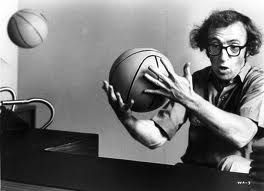
Woody Allen and his Jack-in-the-Box-Stammer (x1000)

images

Last week, The Huffington Post ran a 44 minute clip of Woody Allen stammering.  The clip puts together stammers that span Allen’s career.

When I saw it, the first thing that came to my mind was the Jewish-French philosopher Henri Bergson’s essay on laughter and, in particular, his words on the Jack-in-the-Box:

As children we have played with the little man who springs out of his box. You squeeze him flat, he jumps up again.  Push him lower, and he shoots up still higher.  Crush him beneath the lid, and often he will send everything flying….Now let us think of a spring that is rather of a moral type, an idea that is first expressed, then repressed, and the expressed again; a stream of words that bursts forth, is check, and keeps starting afresh.  Once more we have the vision of one stubborn force, counteracted by another, equally pertinacious (35).

For Bergson, a recurring force is comic because it is mechanical and repeats itself – unlike real life (élan vital).  Real people don’t “naturally” stammer like Woody Allen:

The truth is that a really living life should never repeat itself.  Whenver there is repetition or complete similarity, we always suspect a mechanism at work behind the living…The deflection of life towards the mechanical is here the real cause of laughter (17)

So, what we have here is not simply a stammer but a concentrated one.  But is this mechanical repetition of a mechanical repetition laughable?  Does the clip take the “surprise” out of humor?  Is Woody Allen’s stammer like a “jack-in-the-box” or does this video destroy the toy-slash-stammer?

That, my dear Watson, is the question.

The Schlemiel and Horror, or Zero Mostel on the Muppet Show

DownloadedFile

Zero Mostel z”l (1915-1977), in this brilliant segment from a 1977 episode of the Muppet Show, laughs at the Horror genre (or I would argue, getting spooked by crisis theory). What better example do we have of the laugh that laughs at the (satanic) laugh (or smile)?

This is, as my father’s friend David Kaplan z’l, used to say: “Top notch!”

Zero Mostel was one of the greatest stars in the history of Yiddish theater and performance!  He moved hundreds of thousands of people to laughter and tears.  Mostel was certainly a (perhaps ‘the’?) King of Comedy.   He was a real schlemiel whose performances show us how impassioned physical comedy – though caught up in schlemiel dreams – can trump fantasies of terror and catastrophe.  The fantasies he plays with are the fantasies of fear, terror, and transgression; the fantasies that Baudelaire and Poe found so titillating.

By performing 1,001 terrors, filtered through all his “wide eyed” gestures, Mostel caricatures horror, fear, and spirit possession in a matter of minutes.

Instead of tricking us into being horrified, as Baudelaire believed the “Absolute Comic” should, Mostel tricks horror into being ridiculous.  And he does it in the best place one can to placate horror with comedy: The Muppet Show.

Horror is equivalent to formless Muppet dolls attacking Zero Mostel and driving him Mad.

Does Zero Mostel tear us from fear? Does he defeat it?  Or do Edgar Allen Poe and Charles Baudelaire have the last word?

Guest Post by Professor Jeffrey Bernstein: “Schlemiel, Schlemazel . . . Augenblick in-corpor-ated?”

DownloadedFile-1

Lately I have been wondering about Menachem’s earlier posts regarding the prophetic (possibly messianic?) potentiality of the schlemiel.  In a post on Benjamin and Strauss, he gave a nod to the secretive ‘wink, wink’ capacity of the schlemiel’s humor which the spectator gets, but which the schlemiel may not.  Menachem writes:  “Winking is not a straightforward gesture.  It is oblique.  And it is immediate, like a blink of the eye.”  This characterization immediately strikes me; given that he juxtaposed the phrase ‘blink of an eye’ with the figure of Benjamin, I am put in the mind of the figures of the ‘augenblick’ (which means  both ‘blink/twinkling of an eye’ and ‘instant/moment’) and the ‘jetztzeit’ (‘now-time’).  I am lead to wonder:  what is the ‘time’ of the schlemiel?  And if there is a schlemielich temporality, is it well-characterized by these terms?

Just for laughs, let’s characterize the situation in which we might engage this question:  as the old saying goes, the schlemiel is the one who spills his soup and the schelmazel is the one’s who gets the soup spilled on him.   To my mind, it looks something like this:

Schlemiel:  (in cafeteria, walking with tray of soup, speaking to Schlemazel) So I says to him ‘Hey, whadda you talkin’?  As if Spinoza knew anything about the Geonim!’  I (trips)—whoa, whoa, whoops!!!!! (spills soup on Schlemazel)

Schlemazel:  Ow!  Vey iz mir!  That soup’s hot!  Look what you did!

Schlemiel:  Oy! Look what I did!

There doesn’t appear to be any prophetic aspect to this caricature—but of course, the littlest things contain the deepest truths.  Soup is hot; we make messes; we burn—such is life.  And what can we do except scratch our foreheads and say ‘Oy! Look what I did!’  This may be the adult secret contained in many of our childhood experiences.

But strangely enough, this appears not to resemble the arc of thought contained in the terms ‘augenblick’ and ‘jetztzeit’.  So a brief, and somewhat circumambulatory, consideration is in order:  In the Weimar Germany of the 1920’s, in the aftermath of the massive physical, psychological, cultural, and ideological destruction of the First World War, many different thinkers (sensing a fictitious quality to the narrative of ‘Enlightenment historical progress’) tried to find a way of speaking about the perceived crisis in which Europe was then involved.  Figures such as Barth, Heidegger, Rosenzweig, Lukacs, Benjamin, Kafka, Schmitt, Adorno, Schoenberg, Kandinsky, and Bloch all (in vastly different ways and for vastly different reasons) attempted to articulate the sense that if historical change is to happen, it will do so instantaneously and non-teleologically; it will come, as it were, like a thief in the night.  In doing so, they made witting or unwitting use of the idea of kairos  as it came to be articulated in Paul.  For Paul, kairos names the eschatologically charged instant in which the encounter with God and the acknowledgment of messianic time occurs.  It is always thought in opposition to chronos—i.e, profane time.   Augustine takes up this thought in his discussion of  ‘the present’ (in Confessions) as that which grants substantiality to the past (as recollection) and the future (as anticipation) by virtue of its being a divine(-ish) capacity of the human soul; if it were not for the creaturely replication of the present as nunc stans, time would consign humans to mortal oblivion.

Centuries later, as Luther studiously worked on his vernacular translation of the New Testament, he encountered the Pauline phrase ‘in the twinkling of an eye’ (in 1 Corinthians) and translates it with ‘augenblick’.  The ‘blink/glance/twinking of an eye’ is now understood not as one moment of ‘homogeneous empty time’ (Benjamin) or interval of ‘clock time’ (Heidegger) among others—it is precisely now understood in opposition to such mechanistic conceptions of temporality.  For the Weimar bunch, it becomes synonymous with authentic lived experiential time.  And though Heidegger calls ‘off-sides’ on Kierkegaard’s punt, the latter makes an important admission when he states (in The Concept of Anxiety) that “It is only with Christianity that sensuousness, temporality, and the moment can be properly understood, because only with Christianity does eternity become essential.”  True, Aristotle had also made use of the word kairos in the Nicomachean Ethics, but there it only meant the ‘opportune moment’ for action—like providing medicine or going to war.   It wasn’t essentially different from his characterization of the present (in the Physics) as a vanishing point—a pure limit between the ‘no longer’ and the ‘not yet’.

According to Agamben (oy!), Benjamin uses the term ‘jetztzeit’ (in his Theses on the Philosophy of History) to translate Paul’s ho nyn kairos (‘the of now time’) in Romans.  In this context, one might suggest that Benjamin is taking up the Aristotelian understanding (and its example of military battle) in holding that the ‘jetztzeit’ is that revolutionary moment which ‘blasts a hole’ in the ideology of ‘homogenous, empty time’.  But in viewing the ‘now-time’ over and against the normalizing, ideological conception, Benjamin simultaneously rejects the Aristotelian topos of the ‘opportune moment’ in favor of the Pauline one.  Certainly, Heidegger critiques the Aristotelian notion along similar lines (in Basic Problems of Phenomenology):   “The instant is a primal phenomenon of original temporality, whereas the [conventionally construed] now is merely a phenomenon of derivative time.  Aristotle already saw the phenomenon of the instant, the kairos, and he defined it in the sixth book of his Nicomachean Ethics; but . . . he did it in such a way that he failed to bring the specific time character of the kairos into connection with what he otherwise knows as time.”   In drawing the connection between kairos and ‘augenblick’ in his early readings of Paul, Heidegger thus simply makes explicit (on the theological level) what he will later phenomenologically describe as the suddenness of authentic temporality—i.e., that it happens as kairos and not as chronos.

I’m not trying to simply peg the terms ‘augenblick’ and ‘jetztzeit’ as Christian and thus inappropriate as descriptions of the schlemiel (well, ok, a bissel I am).  Rather, I want to suggest that—despite the Jews that adhere to these descriptors and the Christians who don’t—these terms fail to accurately describe the authentic temporality of the schlemiel.  This for two reasons:  (1) ‘augenblick’ and ‘jetztzeit’ (understood as sudden and arresting) are both set over against a conception of time as homogenous, empty, identical and simply quantitative, and (2) as such, both terms are markers for a presence which the schlemiel  always seems to refuse (or, perhaps, fails to attain).  Whether it be the ‘negative presence’ of the absent, absolute and unattainable future, the ‘eternal present’ of the nunc stans, or the ‘revolutionary and shocking momentary present’ of eschatological realization, ‘augenblick/jetztseit’ is always indexed to a point of stability.  The meaning and signification of the moment/instant—be it eternal, futural, or sudden—is infused, embodied, literally in-corpor-ated (even in-carnated), in an otherwise purely quantitative and empty temporal flow.  This is why, even in the mode of anxiety or transience, the moment/instant is still (on the formal level) the source of a radiant serenity.  Put differently, ‘augenblick/jetztzeit’ bears witness to a religious tradition and context that is poetic.

Are there any resources in ‘prosaic’ religious traditions (to adopt the terminology of Yeshayahu Leibowitz) for thinking the temporality of the schlemiel?  You guessed it—the answer is yes!  So now, a much shorter consideration of this ‘other’ tradition:  Amos Oz and Fania Oz-Salzberger (in Jews and Words) note that Biblical Hebrew points to a different understanding of time than what we get in the Western conception (i.e., the qualitative moment/instant vs. the quantitative flow from past to future or vice versa).   The word kedem denotes ‘ancient times’ but its derivative kadima means “ ‘frontward’ or ‘forward’ “.  Similarly, the word lefanim means both ‘a long time ago’ and ‘in front of/to the face’.  Finally, achreinu means ‘after us’ both in the sense of ‘behind us’ and ‘in future’.  Put differently, Oz and Oz-Salzberger (following the work of Adin Steinsaltz and Shulamith Harven) hold that “When we speak Hebrew, we literally stand in flow of time with our backs to the future and our faces toward the past.  Our very posture is different from the Western view of time . . . The Hebrew speaker literally looks frontward to the past.”  Sound familiar, oh theorists of the Continent?  It recalls not only Benjamin’s reading of Klee’s Angelus Novus (whose face is turned toward the past while he is blown uncontrollably into the future); it also bears some resemblance to Arendt’s reading of Kafka’s “He”, where ‘he’ stands in between the two antagonists (the past and the future) who are both battling him and each other.  Arendt’s interpretation is itself a struggle between the Weimar conception of moment (for Arendt, ‘he’ is the present understood as nunc stans) and the Hebrew one (‘he’ enlists the help of both the past and the future in ‘his’ battle with one another).  Insofar as it rejects the static distinction between the qualitative, lived, in-corpor-ated moment and quantitative but empty clock time, it remains in proximity to Benjamin’s Klee-interpretation.

What does it mean to look frontward to the past?  How can a prophet assume this posture and still ‘prophesy’?  Clearly, the schlemiel does not utter phrases like “And I say unto thee…”  If the schlemiel is prophetic, s/he is so retrospectively—i.e., “Oy!  Look, what I did!  Such is life!”  The schlemiel does not so much prophesy as ‘register prophetically’ what has already happened as what will always already continue to have been happening (oy, look what I did).  This retrospection, this belatedness, this reactivation of the past in the (present of the) future, has been characterized by Freud (with a little help from Rav Lacan) as nachtraeglichkeit and by Adorno (with a little help from Rebbe Said) as ‘late style’.  The schlemiel is always ‘late to the party’, always noticing things ‘after the fact’.  The signature phrase of the schlemiel’s wisdom is not ‘AHAH!’ but ‘OH . . . YEAH!’  And the schlemiel never ceases to register his/her insights too late for anything to be done about them.  Hence, as Janouch’s Kafka (as mediated through Benjamin) tells us, there’s an infinite amount of hope—just not for us schlemiels.  The moment of realization never happens by means of anticipation.  In the words of that other great theorist of the schlemiel, Carole King, ‘Its TOO LATE, baby, now its too late’.  If life were characterized by great poetry, we might at this point despairingly quote T. S. Eliot:  “After such knowledge, what forgiveness?”  But if life is ultimately prosaic, what else is there to do but laugh?  Incipit schlemiel!

Jeffrey Bernstein is an Associate Professor of Philosophy at the College of the Holy Cross. He works in the areas of Spinoza, German philosophy and Jewish thought.

On Aggressive Comedy, Souvenirs, And Prehistoric Schlemiels

DownloadedFile

Comedians can be very aggressive and may sometimes exude rage.  The comic rant, which we are all-to-familiar with, is an illustration of how comedy sometimes becomes indistinguishable from anger.

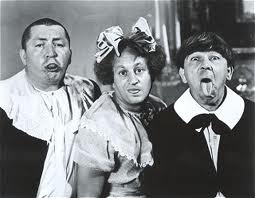
One need only think of the Three Stooges, Larry David, Andy Kaufmann, Lenny Bruce, or even Louis CK to see how rage plays out through comedy.

Given the history of the schlemiel in Jewish comedy, this is an interesting phenomenon.  Traditional schlemiels – of the Yiddish variety – are often very humble and are not filled with rage; but, in America, we often see a different variety of the schlemiel which is more aggressive.

This difference is noteworthy and it prompts a lot of questions about how the schlemiel, a character which, by and large, is traditionally innocent and humble, became aggressive.

The trajectory of my blogs over the last week leads us toward a way of framing and addressing these questions.

Over the last week, I have spent a lot of time thinking through Walter Benjamin and Paul deMan’s reading of Charles Bauldaire’s reading of comedy.  I have also addressed Walter Benjamin’s “s(c)h(l)ocking” discovery that he was a schlemiel.  The thread that joins all of these entries is what Walter Benjamin, following Charles Baudelaire, would call Spleen.

What is Spleen?

In his unpublished work of maxims, insights, and aphorisms entitled “Central Park,” Walter Benjamin defines Spleen (which is also part and parcel of Baudelaire’s Prose Collection – Paris Spleen) as “the feeling that corresponds to the permanent catastrophe.”

Max Pensky, in his book on Benjamin entitled Melancholy Dialectics, interprets Spleen as a “mode of melancholia in which the subject can no longer mournfully ‘observe’ the permanent catastrophe of natural history, but rather, in a quite literal sense is the catastrophe”(170).

Pensky’s reading of Spleen, at many points, sounds much like Paul deMan’s reading of the “irony of irony” which I addressed in a recent blog.  But Pensky sees it as the source of Spleen and not simply, as deMan does, as the essence of laughter.  Pensky points out the emotional tonality of Spleen: it is an “emotional complex consisting of various permutations composed of the two simple elements of profound fear and rage: primal emotions, in keeping with the power of the commodity to awaken prehistoric, savage modes of existence”(171).

Moreover, “Spleen is characterized in the first instance as ‘naked horror’; that is, the primitive, infantile fear of being swallowed up by the mass of objects, the fear of flying to pieces, disappearance in the diffraction and multiplication of selfhood.”

The very language of this description – “the fear of flying to pieces, disappearance in the diffraction and multiplication of selfhood” – echoes that of Paul deMan’s description of the effect of Baudelaire’s “irony of ironies.”

But the main point is that Spleen prompts Baudealire to write poems and allegories.  It is through them that Baudelaire exhibits a “heroic melancholy.”  It is here that, I contend, we can find the modern, aggressive schlemiel.

In the context of Benjamin’s reflections on Baudelaire’s notion of Spleen, the best model for relating Spleen to the schlemiel is by way of Benjamin’s reflection on the relationship of pre-history to history.

To be sure, the fact that Pensky says that Spleen is pre-historical reflects Benjamin’s concern with the relationship of pre-history to history. This is a concern that we see in his writings on Baudelaire and in Benjamin’s essay on Franz Kafka where, I would like to note, we see the most explicit engagement with the schlemiel.  The pre-historic nature of the schlemiel, in that essay, is associated with the innocent aspect of this character; however, I would like to argue that his comic characterization of Kafka’s characters and their innocence is Benjamin’s response, in some way, to Spleen.

Evidence of this can be found in the fact that Benjamin, in several places in that essay, discusses Kafka’s characters in relation to pre-history.

In “Central Park,” Benjamin notes that Baudelaire’s poems and prose pieces are a response to Spleen.  Benjamin calls the trace of this response, or rather, this “heroic” struggle, a souvenir.  The artwork-as-souvenir exposes us to this trace while protecting us from its shock.  Nonetheless, the heroism is not complete.

The souvenir emerges out of the “endless catastrophe of capitalism.” As we have seen from Pensky’s description, this catastrophe destroys the subject. The souvenir is the only thing that remains and, like an angel, saves the artist from Spleen, that is, from impotent rage and self-destruction.

For some strange reason, comedy is the only response to Spleen that Benjamin doesn’t address in depth.  Rather, as we saw in our reading of Benjamin’s interpretation of Baudelaire’s “Essay on Laughter,” the only thing that remains for Benjamin of comedy, the only souvenir, so to speak, is the Satanic smile that touches everything, even children.  Although this seems devastating, it is not.  In fact, the smile, for Benjamin, seems to be a “double image” which protects him from the catastrophic effects of Spleen.  (As Scholem notes, Benjamin associated the smile with “satanic serenity.”)

More importantly, I would argue that the trace of the struggle with Spleen touches Benjamin’s image of himself as a man-child. To be sure, we can say that the image of his handwriting in the Goethe Dream (found in his “Vestibule” aphorism), which is written in loud, childish letters, is a souvenir.  It retains the trace of a struggle with Spleen.  It doesn’t overcome it. And this trace of Spleen can be seen if we simply reflect on the fact that Benjamin, in the dream, is the subject of a Prank!

In other words, his self-image – in terms of his name being written/signed in childish letters – is a souvenir.

Likewise, the souvenirs that Benjamin finds in Kafka’s world are also traces of a battle with Spleen.  In that essay, he relates Kafka’s characters to a Jewish form of Spleen:  Exile.

What all of these figures of the schlemiel share is the fact that all of them are, as Benjamin says in his Kafka essay, pre-historic.

The schlemiel and all traces of the struggle with Spleen are pre-Historic because they cannot enter history.   They cannot assert the heroic and enter the historical struggle.

In fact, this was the critique leveled by Hannah Arendt and many Zionists against a Jewish people which had “degenerated” due to exile.   They level this criticism against the schlemiel which was, for them, the figure of Exile.   As Arendt had argued, the Jews were to accustomed to powerlessness and Exile to take action and enter history.  (I will return to this in a later blog entry.)

For them, the schlemiel was a figure of “impotent rage” that they believed had much to do with Exile (Diaspora).  It would fade away with the founding of a new state.  But as we have seen, the schlemiel remained in America; but what happened, in many cases, was that it more and more often started bearing the traces of Spleen.  The meaning of this agressivity has much to do with the power of art.

The American Schlemiel, seemingly, no longer embodies that sadness, that Melancholy, that Benjamin aspired to.  If anything, it has taken on Spleen.  It is full of rage and sarcasm.  Perhaps this has to do with the fact that entertainment has displaced art and the heroic artist has been defeated by the stand-up comic.

Perhaps the pre-historic has been displaced or perhaps the American schlemiel still hasn’t entered history.  Perhaps, as Benjamin feared, art cannot sustain the “endless catastrophe” of capitalism.  As a result, they only thing left for humor is “impotent rage.”

Is that what we see, so often, in Curb Your Enthusiasm?

A Map of Misreading: Paul deMan’s (Mis)reading of Madness in Baudelaire’s “Essay on Laughter.”

DownloadedFile

One can tell a lot about an author by virtue of things that he or she mentions and highlights in his or her writings.  Charles Baudelaire, a poet and an incredibly talented prose writer, was fully aware of what is at stake in an essay.  And he knew full well that the final “notes” of any essay should hit on the main point.

To be sure, Baudelaire’s essay on laughter ends on a positive note.  There, he points out that the Absolute Comic, which is best illustrated in the work of ETA Hoffman, evinces man’s superiority over nature.  And that all laughter, all comedy, is inter-subjective and shared by human beings.  Baudelaire’s reading of laughter is amplified and given exquisite detail by the philosopher Henri Bergson, who, like Baudelaire, sees an intersubjective element of comedy which is based on the superiority of élan vital over the mechanical.  Laughter, for Bergson, is equated with life and becoming (not stasis and empty repetition).  And like Baudelaire, Bergson emphasizes the progressive aspects of comedy.

However, Baudelaire doesn’t arrive at such a view without a few misgivings.  It must be noted that, earlier in the essay, Baudelaire points out that the significant comic and the laughter that attends it do in fact manifest a kind of (Satanic) madness of superiority.  And, as I pointed out in my last blog entry, he also notes that comic madness is diametrically opposed to the madness of humility.  Nonetheless, he argues that, in the end, man’s sense of himself as different from nature may manifest madness, but, ultimately, this madness is mitigated by the Absolute comic.

To be sure, Baudelaire says that since the madness of humility is no longer an option for modern society, all nations must become pure by way of a madness that asserts superiority over nature.  And comedy is the means to achieving such an intersubjective “purification.”

In other words, comedy, for Baudelaire, is a “good” thing.  As Baudelaire notes in his description of mimes like Pierrot, the laughter evoked by the Absolute Comic is intoxicating.  It enlivens the crowd and produces joy.

There is one problem.

As I mentioned above, Baudelaire notes, early on, that the comic is Satanic.  He points out that it is a manifestation of fallen-ness.  But by the time he finishes the essay, this is no longer the main issue.  Baudelaire decided that it was more important to emphasize man’s inter-subjective superiority over nature than to emphasize fallen-ness, madness, and the Satanic.

Paul deMan, in his essay “The Rhetoric of Temporality,” was not satisfied with Baudelaire’s conclusion.  He ignores Baudelaire’s final note and, instead, focuses in on madness and the hidden meaning of man’s superiority over nature.  In deMan’s hands, “superiority” has a very negative and alienating note.  In addition, Baudelaire’s insistence that comedy is shared and inter-subjective is rejected.

Right off the bat, deMan notes:

In the first place, the accent falls on the notion of dedoublemant (duality) as the characteristic that sets apart reflective activity, such as that of the philosopher, from the activity of the ordinary self caught in everyday activities.  Hidden away at first in side-remarks such as this one, or masked behind a vocabulary of superiority and inferiority…the notion of self-duplication or self-multiplication emerges at the end of the essay as the key concept of the article, the concept for the sake of which the essay had in fact been written (212).

In this gesture, deMan shifts the focus from superiority and doubling to “self-duplication or self-multiplication.”  DeMan goes on to argue that “superiority” is not in relation to others – which is what Baudelaire and also Henri Bergson note.  Rather, superiority “merely designates the distance constituitive of all acts of reflection.”

In deMan’s reading, Baudelaire is really telling us that the effect of laughter is extreme alienation from the world and oneself.  Instead of attaining self-knowledge by way of laughter, deMan tells us that the laughing subject experiences the abyss.  His madness is not based on superiority so much as on a radical and debilitating loss of his center.

For Baudelaire…the movement of the ironic consciousness is anything but reassuring. The moment the innocence or authenticity of our sense of being in the world is put into question, a far from harmless process gets underway.  It may start as a casual bit of play with a stray loose end of fabric, but before long the entire texture of the self is unraveled and comes apart.  The whole process happens at an unsettling speed. (214)

DeMan’s rhetoric, as Jacques Derrida might say, “supplements” Baudelaire and rewrites his text.  In deMan’s hands, Baudelaire affirms madness and eschews all forms of inter-subjectivity.

Irony is unrelieved vertige, dizziness to the point of madness.  Sanity can exist only because we are willing to function within the conventions of duplicity and dissimulation, just as social language dissimulates the inherent violence of the actual relationships between human beings (216).

By writing in this way, DeMan is, so to speak, going backwards.  He is unraveling Baudelaire’s text to show that at the root of his comedy is what Baudelaire would call Spleen: the physical and symbolic organ associated with rage, anger, and melancholy.

Walter Benjamin saw Baudelaire’s allegorical prose and poetry as a response to Spleen – or what Max Pensky calls “impotent rage against the world.” Benjamin saw such aesthetic responses as a manifestation of “Heroic Melancholy.”  However, deMan does not.  Rather, beneath all of Baudelaire’s laughter he only sees insanity and Spleen.

What we need to ask is whether such a reading has any validity.  Is laughter or irony, in reality, an admittance to one’s radical alienation from the world and oneself?  Is laughter, in other words, self-destructive and anti-social?

And, with respect to Walter Benjamin, is his ironic return to childhood noting more than the experience and re-experience of his radical alienation from himself and others?  In other words, can we apply deMan’s reading of irony and laughter to Walter Benjamin’s humor?

Is Paul deMan right or radically wrong in his reading of irony?  To paraphrase Harold Bloom, how do we read Paul deMan’s “map of misreading” Baudelaire?  Was Baudelaire – or even Walter Benjamin- hiding something behind his laughter? Namely, his endless comic humiliation and fallenness?

Baudelaire and Benjamin: The Madness of Humility or the Madness of Humiliation?

images-3

Comedy often deals with power and powerlessness.  But as Baudelaire understands it, power usually has the upper hand.  For Baudelaire, comedy brings out the Satanic, powerful side of man, not the powerless and humble aspects.  It doesn’t return us to innocence.

Even though it has elements of “innocence” and although it is guided by the “law of ignorance,” the Absolute Comic is not a return to childhood in the full sense.  It retains the Satanic element since the Absolute Comic still nods to the superiority of the viewer\reader and man`s superiority over nature:

I would say that when Hoffmann gives birth to the absolute comic it is perfectly true that he knows what he is doing; but he also knows that the essence of this type of the comic is that it should appear unaware of itself and that it should produce in the spectator, or rather the reader, a joy in his own superiority and in the superiority of man over nature(165).

Notice that the Absolute Comic is innocent (“unaware of itself”) AND it produces a joy in the viewer’s “own superiority” and in the “superiority of man over nature.”

It retains this duality.

But, as we pointed out in our previous blog entry, this superiority is tainted.  It is a kind of madness.  In fact, as I pointed out, Baudelaire sees the insane as expressing the essence of this comic superiority.

The madness of the Absolute comic, as Baudelaire understands it, is different from what he calls the “madness of humility.”   Baudelaire associates the madness of humility with the “wise” who see the superiority of the comic as “inferior.”

Laughter is a sign of inferiority in relation to the wise, who, throughout the contemplative innocence of their minds, approach a childhood state.

It seems as if there are not only two kinds of madness but also two types of children: the humble and the satanic.  One is mad for God while the other is mad for itself and its superiority.

Which child does Baudelaire favor?  Which madness is superior? The madness of humility or the madness of the comic?  More importantly, why doesn’t Baudelaire, like Dostoevsky or Benjamin, imagine a holy fool?  After all, isn’t a holy fool humble, unconscious of himself, innocent, and funny?

How would Benjamin address these questions?   And when he talks about “Satanic Serenity” was Benjamin imagining a happy state that comes out of the Absolute Comic?  Was he siding with the madness of the comic over the madness of humility?  Could we call the “joy” that the viewers-slash-readers of the Absolute Comic feel when watching the Absolute Comic “Satanic Serenity?”  And how is this serenity different from the serenity that emerges from the madness of humility?

These questions present a problem: if Benjamin was so into the “return to childhood,” which we saw in his reading of Dostoevsky’s The Idiot, wouldn’t he aim for the serenity of the wise man?  After all, wasn`t Dostoevsky leaning more toward the madness of humility in his novel?  Would he stand on the side of the wise man, who would see the smile, and especially the satanic smile (like the laugh), as “inferior?”  Or would Benjamin argue that the only way to attain happiness is, as Baudelaire might say, through the Absolute Comic?

If this is the case, then, one may only attain to partial childhood but not full. The madness of humility no longer seems to be an option for modernity.  Violence seems to be more akin.   To be sure, the Absolute Comic evinces a delight in the destruction of innocence and delights in the excesses of play: as we see in Baudelaire’s portrayals of the mime and in his reading ETA Hoffman’s story in which a girl is shocked when she realizes that her image of order and beauty are false.  In fact, the negation of her childish superiority (the superiority of her ideas and military order) is the basis, according to Baudelaire, of the audience`s joy at its superiority.  They – the audience – and not she – the comic character – are the masters of ignorance and are superior over nature.  They are mad with superiority, yet in a way that is not ignorant.

To be sure, though the madness of humility is not an option for modern man, and although Baudelaire gives the madness of the comic center stage, he does mention the “madness of humility.”  Moreover, Baudelaire notes that wise men, “throughout the contemplative innocence of their minds, approach childhood.”  He acknowledges different levels of innocence and the challenge to comedy made by the wise; nonetheless, he doesn`t pronounce either in a definitive manner.

I think Benjamin knew full well what was at stake in this comparison.  And he ventured where Baudelaire did not.  In his reflections on the Goethe Dream and on the Shuvalkin parable, Benjamin was engaging in the madness of humility and not simply in the madness of the comic.

True, he sees himself as double: as a man and a child.  But did Benjamin see himself as superior as Baudelaire suggests of every reader or viewer of the Absolute Comic? Did Benjamin feel a “Satanic Serenity” when he saw himself as a man and a child; that is, when he discovered the meaning of the Goethe dream and when he penned the Shuvalkin parable?  And wouldn`t Satanic Serenity imply an experience of comic superiority?

I would like to suggest that Benjamin didn`t feel comic superiority so much as a certain kind of powerlessness and astonishment when he looked at himself as a schlemiel.  We also hear this in Benjamin’s claim about Kafka: that “the beauty of his work was the beauty of failure.” This comment evinces a sense of inferiority not superiority.  In fact, Benjamin didn’t seem to take joy in this joke.  This is in contrast to Baudelaire, who notes that joy goes hand-in-hand with the feeling of Comic Superiority. To be sure, I can’t imagine anything close to Satanic in this reflection. The same goes for his reflection on himself in the “Vestibule” aphorism.  In fact, this destiny, to be marked as a child in Goethe’s house, is disheartening.  More disheartening is the fact that he is the subject of a prank.

I would suggest that this experience leans more toward the “madness of humility” or rather the madness of humilation.  Unless, that is, Benjamin would smile (satanically) at his misfortune.

Getting Comically Wasted: On Charles Baudelaire’s Notion of Absolute Comedy

170px-Paul_Cézanne_060

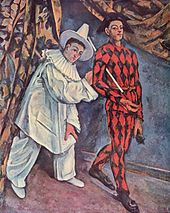
Baudelaire had a penchant for “intoxication” and comedy.  And what better day to discuss Baudelaire’s notion of the comic than on St. Patrick’s Day!  To be sure, Baudelaire thinks that the absolute comic, at its best, is like “intoxication.” Perhaps the “Satanic Serenity” that Walter Benjamin takes note of has a source in this; after all, Benjamin wrote about “Satanic Serenity” in his notes for his essay “Hashish in Marseille.”  As Baudelaire understands it, the state that one enters in the Absolute comic includes a sense of being “double.”   The irony of it all is that  this duality reminds one that one is “innocent” and, literally, destroyed.  And on St. Patrick’s day people usually talk about getting “wasted,” “destroyed,” and “hammered.”  All of these phrases suggest some kind of violence and, as Baudelaire suggests, some kind of innocence.

As we learned in the last blog entry, Satanic laughter is associated with a sense of superiority.  Baudelaire sees the insane (“the mad”) as the best illustration of an extreme sense of superiority.  The laughter of the insane, based on the psychotic insistence on the superiority of the laugher, brings out the essence of the “significant comic” (the comique significatif).  Mad laughter is, for Baudelaire, Satanic.  It has a total disregard for the world. It laughs at the world.  But it is deluded.  It has no innocence about it whatsoever.  It takes on a destructive daemonic aspect.

The significant comic doesn’t seem to embody what Benjamin would call “Satanic Serenity” since it is solely destructive.  The significant comic is not simply comic because she is “wasted”; no, s/he is comic because s/he wastes people with her daemonic humor and laugh.

(Mind you, for Baudelaire, children, “budding Satans,” are included in this category.)

The Absolute comic is different from, yet related to, the “significant comic.”  It is the kind of comedy that would attract Walter Benjamin who appreciated, like Baudelaire, gestural comedy (mime) and the kind of comedy that included what Baudeliare called the “law of ignorance.”

Baudelaire first introduces the Absolute comic when he discusses “laughter at the grotesque.”  To be sure, “the laughter caused by the grotesque has about it something profound, primitive, axiomatic, which is much closer to the innocent life and to absolute joy than is the laughter caused by the comic in man’s behavior”(157).

For Baudelaire, this is the superior form of comedy because it brings man “closer to the innocent life and to absolute joy.”

Baudelaire notes that the “absolute comic” has “one criterion”: “that is laughter – immediate laughter.”  However, there is one condition for comedy to be absolute, besides immediate laughter and that relates to the disclosure of what is most pathetic in humankind:  “the comic can only be absolute in relation to fallen humanity”(158).

In other words, the absolute comic must signify through falleness.  It must be – so to speak – wasted.

And it is only the best artists, Baudelaire tells us, who apprehend it. For these minds “are sufficiently open to receive absolute ideas”(158).  Baudelaire, after saying this, writes of an author who is the master of German horror and the grotesque; namely, the late  18th century German writer ETA Hoffman (158): “He always made a proper distinction between the ordinary comic and the type which he called the “innocent comic.”

What Hoffman calls “the innocent comic” is a blending of the innocent and the grotesque.  Moreover, it isn’t so “innocent” in the sense that it includes a distinct form of “violence.”  It doesn’t escape violence.

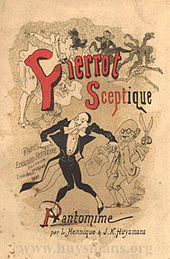
Baudelare notes that we also see such violence and innocence in the work of French mimes like Pierrot.  Regarding the mime and the clown, Baudelaire notes that Pierrot mixed the innocent and the grotesque by way of facepaint and gesture: “Upon his floured face he had stuck, crudely and without transition or gradation, two enormous patches of pure red.  A feigned prolongation of the lips, by means of two bands of carmine, brought it about that when he laughed his mouth seemed to run from ear to ear”(160).

170px-Léon_Hennique_-_Pierrot_sceptique

And although he appeared childish and innocent, he certainly was not: “As for his moral nature, it was basically the same as that of the Pierrot whom we all know – heedlessness and indifference, and consequently the gratification of every kind of greedy and rapacious whim”(161).

In other words, while he appears innocent, he is “devilish.”

The act of this rude yet innocent clown leads us to “a dizzy intoxication.” When one watches them “intoxication swims in the air; it is intoxication that fills the lung and renews the blood in the arteries”(163).  The “absolute comic” has “taken charge of each one of them.” And by each one, Baudelaire suggests that the comic and the audience are possessed.  Everyone is intoxicated.

The mime becomes possessed and seems to leave the realm of men: “Every gesture, every cry, every look seems to be saying: ‘The fairy has willed it, and our fate hurls us on – it doesn’t worry me! Come, let’s get started! Let’s get down to business!’ And then they do…which starts at this point – that is to say, on the frontier of the marvelous”(162).  In other words, the mime takes us into another realm by way of his gestures – a realm that, while laughable, brings us closer to childhood.

This can only mean that in his grotesque and childish disregard of limits, the mime’s gestures, his madness, while destructive counters the solely destuctive madness of the regular comic.   The mime is not simply mad – he is, actually; he certainly flaunts a superiority and indifference to the civilized world of adults.  But this madness, because it is childish, is also innocent.  The mime is a drunk of sorts and he spreads the feeling of intoxication through his rude and innocent gestures.

Baudelaire notes that nothing can surpass the absolute comic that we find in the mime: “But how could the pen rival the pantomime? The pantomime is the quitessence of comedy; it is the pure comic element, purged and concentrated”(162).

Nonetheless, Baudelaire ends his essay on laughter and devotes the most space to discussing this mad innocence by way of a close reading of ETA Hoffman’s story “Dacus Carota, The King of the Carrots.”

This story is exemplary because it shows us how a little girl, a “budding Satan,” loses her sense of comic superiority by way of the grotesque.  Her astonishment, her shock, brings us in touch with the “Absolute Comic.”

Baudeliare tells us that “the unfortunate young girl, obsessed with dreams of grandeur, is fascinated by a display of military might.”  When the girl is shown the soldiers sleeping at night, by her “magician” father, she experiences shock and vertigo.  Her exposure to the grotesque display of soldiers sleeping at night, when her father opens the “flap” of the tent, leads to what Baudelaire calls a “comic emanation, explosion, as it were, a chemical separation.”

What “emanates” from the comic explosion?

In the comic explosion we become aware of our childish part, which is unaware of itself.

This is the “law of ignorance.”  Indeed, for Baudelaire, “the most distinctive mark of the absolute comic is that it remains unaware of itself.”

This translates into a double consciousness for the viewer or reader. It indicates “the permanent dualism in the human being – that is, the power of being oneself and someone else at the same time”(165).

This experience, since it includes ignorance is double. As we saw above with the little girl who is astonished when she sees the grotesque soldiers but doesn’t know why she is astonshed: she is double.  She doesn’t know herself, but we do. Its an uncanny sense of self that the reader or viewer takes on. Baudelaire says it is superior – and, as we have seen superiority is the core of the satanic-slash-comic. It is the essence of laughter.

Perhaps this sense of duality is the cause of what Walter Benjamin’s calls a “Satanic smile.” Benjamin argues that it is based on a “Satanic Serenity” and not on destructive element of the Satanic.  But this misses one essential point made by Baudeliare: the serenity one has, which enables one to be oneself and someone else at the same time, is based on some kind of explosion.  It is based on some kind of destructive violence which, as Baudelaire, notes is inevitable when it comes to comedy.

This resonates with what we saw in Benjamin’s reading of Dostoevsky’s The Idiot.  There, he notes that a return to childhood, will not come without an “implosion.”

The violence that the mime and Hoffman apply leads to childhood.  This is the paradox.  With Benjamin this takes on a fascinating element because Benjamin sees himself as the butt of the joke.  He sees himself as a man and as a child: as himself and someone else.  But, and here is the point: he is both a man and a child.  He is double.

But there is one missing ingredient: the real basis for the Absolute Comic’s performance – as for the significant comic – is failure.  The secret of comedy is that it is based on what Baudelaire called Spleen – that is, rage and anger at one’s meaningless suffering in the world.  Superiority – whether of the significant or the Absolute comic variety – is ultimately a delusion.  But a necessary one as it casts out the hope that even though one is pathetic, one is innocent.  This can either bring about a Satanic Serenity or, perhaps, depression and melancholy.

Benjamin brought this double sense of himself in the Goethe aphorism and in the Shuvalkin parable. The absolute comic – and its sense of duality – is evident insofar as “the law of ignorance” pervades both: Benjamin was asked to sign but he had not idea that his name was already signed; and Shuvalkin thought he had the signatures of Potemkin but found that he was ignorant.  Shuvalkin, like Benjamin in the “Vestibule” dream, didn’t realize that the king had singed his name on each paper.  In both, the prank, though Satanic, is an emanation and explosion within which Benjamin sees himself as other: in which he sees himself as a schlemiel.. He sees himself as double: as man and child.

Perhaps we can say that every day was St. Patrick’s day for Benjamin insofar as every day he looked in the mirror he realized he was “wasted.”  Perhaps this gave him “Satanic Serenity.”  On the other hand, perhaps this made him a Sad Clown?  (As we shall see, in upcoming blog entries, this was one of Baudelaire’s double self-images.  Perhaps it was Benjamin’s too?)

(Here is one of the first animated films ever made.  This film, made in 1892, was named after the clown Pierrot that Baudelaire sees as exemplary of the Absolute Comic. Its entitled Pauvre Pierrot.  Can you spot Benjamin in this animated film (wink, wink)?)

On Georges Bataille – Childishness, Stupidity, and Salvation

images

What does it mean to make “a fool out of oneself” or to act “childish?”  Both terms suggest that imitating a child or acting like a fool is shameful.  Now, imagine that the very thing that society despises most is designated as a spiritual practice.

In our last blog entry, we pointed out that Georges Bataille took Nietzsche’s notion of KINDERLAND and identified it with the future.  As we pointed out, one would have to destroy oneself if one were to get there.  The paradox is that by going backwards to childhood, one can go forwards, to the future, to KINDERLAND.

But, as with many spiritual practices, one needs to know what to do if one is to reach this sacred land of childhood.    Bataille was interested in describing these practices.  As one can imagine, Bataille relished the idea that acting like a child or becoming a fool was hated by civil society. In his book Inner Experience, he not only provides spiritual exercies of childishness, he also describes childishness and foolishness in great depth.

Bataille associates “childishness” with salvation.

The only challenge to becoming childish is not to turn it into a “project,” which would give it a meaning within a coherent totality.  Nonetheless, he insists that becoming a “true child” is the way to “deliverance.”  This path is, necessarily, shameful and self-destructive.  The task for Bataille, was to, so to speak, enact it, without turning it into a project.   The spiritual experience of the movement of the adult to childishness and shame, he believed, would be sufficient to destroy “the project.”  And open us up to a messianic “taste,” so to speak, of the promised land: KINDERLAND.

In Part II of his book, in a section entitled “Torment,” Bataille provides his reader-slash-disciple with intimate (yet intellectual) experiences of childhood and self-destruction.  By refusing to grow up and by returning to childhood, he, in effect, is not entering into the project.  In literary form, he describes or rather “dramatizes” his childhood and his struggle with maturity.

To be sure, Bataille, at the beginning of his book, notes that dramatization is a spiritual exercise: “If we did not know how to dramatize, we wouldn’t be able to leave ourselves…From this way of dramatizing – often forced – emerges an element of comedy, of foolishness which turns into laughter”(11).

Dramatization, for Bataille, distances us from tradition and reduces us to powerlessness. It is another name for acting out ones renunciation of maturity; that is, the project.

Dramatization brings one to an awareness of his or her childishness.

I will cite several lines which describe Bataille’s coming to consciousness that he is a child and the realization that he is, ultimately, “stupid.”  In grand mythic style, Bataille tells us that to return to childhood is to return to one’s origins.  The problem is that “grown ups” don’t get it:

To grasp the extent of knowledge, I go back to the source. First a small child, in every way similar to the madmen (the absent ones) I play with today.  The miniature “absent ones” are not in contact with the world, if not through the channel of grown-ups: the result of an intervention on the part of grown-ups is childishness, a fabrication.  Grown ups clearly reduce being coming into the world, which we are at first, to the level of trinkets.  This seems to me to be important: that the passage to the state of nature (from birth) to our state of reason should necessarily take place through the route of childishness.   It is strange on our part to attribute to the child itself the responsibility for childishness, which would be the character proper to children.  Childishness is the state which we put naïve being….When we laugh at infantile absurdity, laughter disguises shame, seeing to what we reduce life emerging from Nothingness. (42)

Bataille’s lesson to adults, who become children, is the following:

1) Children need to divest themselves from their parents: “The error of children: to derive truth from grown-ups.”

2) Children should not be laughed at.

Laughing at childish behavior is a “grown up” activity which, in his view, belongs to a project.  Rather than laugh at them, we should – seriously – imitate them.  But, Batialle goes beyond such advice.

In the midst of becoming childish, Bataille describes how he, and one who becomes childish, will feel shame and powerlessness.

To be sure, Bataille, craftily, alternates his reflections on childishness with reflections on shame, self-destruction, and salvation.  And this juxtaposition creates the breakdown he desires: “the idea of salvation comes, I believe, from one whom suffering breaks apart.  He who masters it, on the contrary, needs to be broken, to proceed on the path towards rapture.”

Besides being a “spiritual practice” and an “inner experience,” this alternation clearly suggests a link between childishness, self-destruction, and salvation.

Bataille dramatizes this link by shamefully confessing his passion of childishness. But, in doing so, he realizes that taking this childishness seriously may present an obstacle:

Childishness, knowing itself to be such, is deliverance, but taking itself seriously, it is enmired.”  And this “taking itself seriously” is an obstacle to “deliverance.”  To eliminate this obstacle, to dramatize it, one must laugh at it: “The search for the extreme limit can in its turn become a habit, dependent of childishness: one must laugh at it, unless, by chance, one has a heavy heart: then ecstasy and madness are within reach. (44)

As we saw above, Bataille says that one should not laugh at childishness.  But if one takes it too seriously, then Batialle tells us that one must laugh at it!  Because seriousness is too mature and is part and parcel of “the project.”  But isn’t a spiritual exercise too serious?  Should Bataille think it to be ridiculous?

Batialle avoids this reflection.  Instead, he creates a rule, because he sees an opportunity in this kind of laughter: if childishness becomes a “habit,” laugh at it so one can, through despair (a heavy heart), “reach” ecstasy and madness.

Ok, so let’s sum it up.  There are two possibilities for one to be saved from the project and “grown ups”- two, so to speak, KINDERLAND possibilities: 1) salvation through childishness or 2) salvation through the rejection of a “serious” and “habitual” childishness.

After describing these possibilities, Bataille, strangely enough, argues that to be a child one must “know” that “seriousness exists” and if one doesn’t one isn’t a “true child” : “The most serious seem to me to be children, who don’t know they are children: they separate me from true children who know it and laugh at being. But to be a child, one must know that the serious exists…if not, the child could no longer laugh nor know anguish”(44, my emphasis).

This conclusion brings us to the schlemiel and helps us to distinguish Bataille’s man-child the “true child” – from the false one, which, given what we know about this character, is the schlemiel.

“True” children are not schlemiels, since they “know” they are children.  They can “laugh” at being.  To be a child, one must “know” that “the serious exists.”  If they know this, children can laugh and know anguish.   Children cannot laugh or know anguish if they don’t know that the “serious exists.”

This implies that a schlemiel, who doesn’t understand seriousness, is not a “true” child.  A true child suffers and laughs.

But, then again, Bataille turns this around when he writes about stupidity.  Children may know that the serious exists, but they cannot be saved if they don’t “perceive a greater stupidity.”

“My privilege is to be humiliated by my profound stupidity and, no doubt, through others, I perceive greater stupidity.”

The more stupidity, the better.  We see this early on in his book as well: “The great derision: a multitude of little contradicting “everythings,” intelligence surpassing itself, culminating in multivocal, discordant, indiscrete idiocy”(25).

Bataille’s passion is for childhood and stupidity.  His desire is to be the “true child” who knows seriousness, suffers, and laughs.

To become the true child, Bataille confesses that he must dramatize the descent into idiocy.   This will return him to childhood. And it will save him.

But this is not a total loss of the mind.  As he says, the man who becomes a child “knows” as a child does that “the serious exists.”  This is a tragic vision of childhood or becoming-a-child.  He is aware of his stupidity as much as he is aware of seriousness.  He is also aware of what a “true” as opposed to a “false” child is.

Compared to the childishness of I.B. Singer’s Gimpel or Sholom Aleichem’s Motl’s childishness, Bataille’s dramatization of childishness is focused on the spiritual practice of self-destruction as revelation. The schlemiel is absent minded, but Bataille’s child is not.

And the tension between good and evil, between hope and skepticism, which the schlemiel looks to preserve, is effaced by Bataille’s “spiritual exercise” in which life, mad life, childish and idiotic life, ultimately triumphs and laughs at itself in its utter shameful Dionysian stupidity.

The way to KINDERLAND is through becoming a suffering-powerless-idiot-child.  This act of the will greatly contrasts to the simplicity of the schlemiel – the man-child – that we often see in Yiddish or Jewish American literature.  There is no passion of the schlemiel, but for Bataille there is a passion of the man-child.  The schlemiel can’t save himself, Bataille’s man-child can.

And perhaps this is the key: Judaism puts salvation outside of man’s efforts.  In Judaism, man cannot redeem or save himself.  Redemption is in the future.  The schlemiel stands, unredeemed, in relation to the future.  He can’t redeem himself through his foolishness.  (At the end of “Gimpel the Fool,” he simply moves on.  Gimpel has not changed; he is still an unredeemed schlemiel in, and this is the point, an unredeemed world.) Bataille, however, believes that through this “spiritual exercise” he (and perhaps his childish community) can be “delivered” to the KINDERLAND of the future.   A place where we can all make fools of ourselves all the time…a place where we can know, finally, that we are, shamefully, “true children!”

And this is only possible because we know, in the midst of shame and humiliation, that “the serious exists.”

So, here’s my question, is it worth passionately becoming fools and childish if we are to come to this conclusion and the consciousness that we are “true children”?  Or is this, quite simply, stupid?  Is this the point of, as Bataille might say, the “useless” exercise-slash-dramatization of “true” childhood?

Would Bataille regard this scene from John Water’s Pink Flamingos (1972) to be a spiritual exercise in becoming a child?  And does John Waters, who put the film together, know what “true children” are and that “seriousness exists?”  What do we make of these “dramatizations” of childishness?  Are they…and we saved? After all, the daughter who is quelling her mother-in-the-crib is named Divine. Is this where we are going? Is John Waters giving us a prophetic glimpse at the future? A glimpse of KINDERLAND?

KINDERLAND or Chelm?

DownloadedFile-4

Chelm is a real place in Poland that some say has existed since the 9th century.  It is also a mythological place where, legend has it, all the Jews are schlemiels.

From the YIVO encyclopedia, we learn that Chelm-like stories have existed, in print, since 1597.  But the legend itself may go back further.  And as the encyclopedia points out, many Yiddish writers either cited these stories, retold them, or modeled their own mythic schlemiel cities on Chelm.

In America, the most well-known Chelm stories, The Fools of Chelm and Their History, come to us by way of I.B. Singer.  When I was a child, my Rabbi – who presided in a conservative synagogue in a small town in the Adirondacks named Knesseth Israel – used to read them to us every Saturday so as to inspire us before we had the “children’s minyan.”  (He would gather the children around him and either read these stories or a variety of fun Hasidic stories.  I liked these best, however; we all did.  I can remember giggling with my friends as he told them.  Imagine that, I used to think, a town of fools and led by fools!)

I mention the fools of Chelm in this blog entry because this land of Schlemiels relates, however obliquely, to what Benjamin and Dostoevsky (apparently wanted): namely, a KINDERLAND (a land of children) which I discussed in yesterday’s blog.

The term KINDERLAND actually comes from Nietzsche but it became a key word for Georges Bataille, a good friend of Walter Benjamin.

It is well-known that Benjamin and Georges Bataille were friends.  To be sure, Benjamin’s archival material, much of which we have today, was left with Bataille.  (As J.M. Coetzee notes in his 2001 essay on Benjamin for The New York Review of Books,  Bataille hid and preserved the Arcades Project manuscript.)

The two may have spoken of this vision of a land of children.  But we can have no doubt that they discussed their utopian visions as the Nazi spectre hung over Europe and crisis loomed on the horizon.

Bataille takes to the word KINDERLAND in a piece entitled the “Nietzschian Chronicle.” There, he writes (in capital letters) of a Nietzschean KINDERLAND which challenges “every man’s VATERLAND.”

According to Bataille, this KINDERLAND was something of a prophesy which was expressed by none other than DIONYSOS:

The very first sentences come from ‘realms of dream and intoxication’.   The entire message is expressed in one name: DIONYSOS.  When Nietzsche made DIONYSOS (in other words, the destructive exuberance of life) the symbol of the will to power, he expressed in that way a resolution to deny to a faddish and debilitating romanticism the force that must be held sacred.

This prophesy, says Bataille, is wrapped up in the future.  And it bespeaks the renewal of life.  And, like Benjamin, he notes that KINDERLAND will only come about through destruction and “decomposition.”

Elsewhere, in an essay entitled “The Sorcerer’s Apprentice,” Bataille notes that “action alone proposes to transform the world, make it similar to dreams.”  This language of dreams, youth, and action is familiar to this blog.

As I noted in an earlier blog entry, Schlemiels and “Messianic activists” share the same problem: they confuse dreams with reality.  Here, Bataille insists, in the name of Nietzsche and his prophet DIONYSOS, that action will transform the world into a KINDERLAND.

In his “Nietzschian Chronicle” he suggests that this Land would be “without a head.”  This has striking resonance when one thinks about the “Wise Fools of Chelm” who lead the land.  Their judgments are foolish and childlike in nature.  They lead “without a head.”  (But, in I.B. Singer’s version, this is laughable.  Its not real.  And, more importantly, there doesn’t seem to be anything destructive about this.)

When I was a kid, the fools of Chelm used to make me laugh aloud.  But I could never imagine a KINDERLAND in reality.  And perhaps this is the trick.

Although I would dream of such a land as a child, I’m not so sure I would do so as an adult.  This land of children they envision couldn’t be Chelm.  Or could it?  Would there be any fools in the KINDERLAND?

What exactly did Benjamin and Batialle mean when they (and apparently Dostoevsky) imagined a land of children?  Did they share the same vision of this KINDERLAND or differing visions?

We can hear their call for life, which resonates with the tones of vitalism, but can we imagine the land?  What, after all, would a KINDERLAND look like? If we can’t imagine a KINDERLAND in reality, perhaps we can say that KINDERLAND is a text?  Is it the Derridian text where everything is play or in play?  Is this a land without a head?  A land without a center?  Or is it….Chelm?

And must we destroy the land (and ourselves) to redeem the land, as Bataille and Benjamin suggest we should when the land is lacking “youth”?  Is this the only way to the future KINDERLAND?

(I’ll leave this post, as Paul Celan says with respect to the Other, an ‘open question.’  Celan says that the poem is going toward the other, toward the future, but does this mean we are going towards Chelm, KINDERLAND, or “?”)

But….perhaps the interchange between Dwayne and Alvy Singer bears a clue of where we’re going?