Withdrawal as Communication: On Jean Luc Nancy, Awkwardness, and Smallness

images

These days one cannot watch a comedian or see a comic show or film without coming across a punch line that doesn’t include an awkward reply or gesture.  Many a comedian seems to be telling us that in most of our encounters there is an awkwardness that we find both endearing and terrifying.  The fact that we slip up or that we are in the wrong situation – in which we are, suddenly, as it were, called on to speak – seems to endlessly slap us in the face.   In this awkward moment, we become smaller.  We withdraw into smallness.

For the longest time, I have been interested in the philosophical meaning of the awkward experience of smallness and why it is so compelling.   I have turned to philosophers such as Walter Benjamin, Emmanuel Levinas, Theodor Adorno, and Hannah Arendt and writers such as Kafka and Robert Walser to understand the meaning of smallness.   Jean-Luc Nancy’s work has also been a great draw for me because he oftentimes works on and elaborates many of Levinas’s points vis-à-vis the relationship to the other that touch upon a state of reduction.    One point that interests me most is his reading of communication in terms of withdrawal, tragedy, and comedy.  What he misses, however, is the fact that what he is describing is a kind of tragic-comical awkwardness.  It goes hand-in-hand with smallness.

In a Jean Luc Nancy interview with Ann Smock, Smock, winking at Levinas, starts off the interview by arguing that when we face another person we are “under an obligation to respond to him, answering the demand, which his nearness is, that you should hear him – hear him and thus let him speak; make it so he can; let him come up close and be there, speaking”(310, The Birth of Presence).    Smock focuses in on the fact that, in conversation, everything is surprising.   The demand, so to speak, comes out of nowhere:

In this situation there is nothing to start from, nothing to base anything on.    You have to answer to an utterance (an entreaty, a question, a command, who know?) that you have never heard and that you won’t have heard until you’ve answered.  For if you have to answer (“Il faut parler”), it’s so that what, or rather whom, you are obliged to answer may be heard.  (311)

The manner in which Smock describes this situation is troubling.  One must, more or less, undergo and endure a shock if one is to let the other speak.  Its not so simple.  She suggests that, in this situation, when the other comes close to me and I feel the demand upon me, “the other withdraws.”  He becomes a “friend” and is “way beyond you and way beyond anything or anyone you could ever be with.” But the other is not the only person to withdraw.   I do too.  And this leads to a kind of failure which can be read as either tragic or comic.

Smock provides an example of a meeting between the feminine and the (implied) male subject in terms of a kind of failure.  The more he worries about what to say or do, the smaller and more confused the subject becomes.  Its as if he’s not sure who is his friend when she approaches.  He seems frightened:

She comes when and where it’s perfectly clear she’s not….How to receive her visit?  How to acknowledge her?  Who else would be so true as to say “I am not with you; I haven’t come?” It’s she! The she is once again and as she always was, undeniably herself.  Yet this is to deny exactly what it is so like her to convey…and not to hear, or welcome her. (313)

Smock imagines her rejection: “How to recognize her voice when she says You do not hear me?”(313).

In response to this argument and scenario created by Smock, Nancy wittily suggests that Smock’s depiction of communication may be a joke.  He cites the joke structure by citing Freud to explain:

This may look like a joke, indeed, like the famous Jewish joke reported by Freud: “Why do you tell me you are going to Cracow, to make me believe you are going to Warsaw?” I could say, “Why do you call me ‘you’, to make me believe that you know me, when you know neither me nor what ‘you’ mean?”  (314)

But then Nancy shifts gears and admits that this is no joke: “Communication is always disappointing, because no subject of the utterance comes in touch with another subject.  The is no subjectivity here; in this sense there is no self-recognizing of the utterance.   It always speaks before it becomes self-present”(314).  In other words, one will always trip over one’s words.  One will always be embarrassed by them and be disappointed.

Building on this point and suggesting something more positive, Nancy argues that “speaking comes by surprise.  Or by chance, as a chance”(315).  In a “loose conversation” anything can happen; “nobody knows what he or she will say before he or she has said it”(315).   But although there seems like a chance that one can “succeed” when he or she takes a chance in speaking, Nancy suggests, by way of Maurice Blanchot and Georges Bataille, that “communication take place as the communication of a disappointment, of a nonpossibility, of a withdrawal of communication itself”(315).  This seems tragic.  But Nancy argues that it is and is not:

On the one hand, this is tragedy.  It is the tragedy of a world, a mankind, where there is no longer a substance,  a subject giving the matter and the way of “communicating.”  That is, giving the element, the body of a “communion.”  Or at least, of real encounter, where there is a partaking of the same sense….This tragedy implies a comedy.  Every attempt to communicate, to make present the link, the real linkage and exchange between two, is comedy: the words of lovers, but also “love making” itself, and philosophical dialectics, and religious sacrifice.   (315)

Nancy’s take on the comic aspect of communication is fascinating because it suggests that the presentation of  the exchange between people as an exchange (whether in philosophy, conversation, or even “religious sacrifice”) is comical and tragic.  The relationship is there but nothing is being communicated.  Disappointment at the failure of relation is tragic and comic.  He calls this – ironically – communication:  “Communication communicates this withdrawal – communicates it, and through it, and as it”(315).

Let’s put this together.

The demand to speak and the act of letting the other speak is a part of what Nancy calls communication and it necessarily leads to a tragic and comic situation in which one is surprised by the other and the words that pass or fail to pass between oneself and the other.

What is left out of the Nancy’s account is an exploration into the meaning of what he calls “communication.”    To better understand the meaning of this withdrawal, we need to see it for what it is: an awkward comical encounter in which one party or the other feels awkward and small in this or that failure of communication.   Nancy also fails to clearly point out what is at stake.

If, in most if not all of our conversations, we gauge the success or failure of a conversation based on whether we feel or see the other interested or happy, we need to ask ourselves what it would imply to think of every conversation as a kind of failure in which neither party truly communicates with the other?

Is it the case that, regardless of how the other responds, there will always be awkward moments in conversation?  Perhaps what we need to do, building on Nancy, is to rethink the relationship of surprise, smallness, and awkwardness in relation to each and every conversation we have and what it implies that we can become small.

It may be the case that many of us laugh at awkwardness and smallness in this or that comedian because, as Thomas Hobbes or Henri Bergson might say, we are not the ones who are awkward or who have failed to get this or that cue: the comedian is and has failed, not us. Perhaps that is why they are laughable.

Perhaps this is the test: to realize that what makes these comic characters laughable is also what makes them endearing.  Like us, they are always surprised by things that they didn’t expect in this or that conversation.   Like us, they are awkward and become small and withdraw – regardless of how well guarded they appear to be.  This is the comedy and tragedy of communication: withdrawal as (awkward) communication and smallness.
 Everything has Become Smaller! On Nietzsche’s Microaggressions

images-1

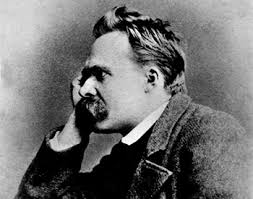
Nietzsche’s Zarathustra has a big problem with little people.  You could say that he literally has a microaggression.  After he has a profound revelation of who he is “Before Sunrise” while he gazes into the deep sky and “trembles with divine desires,” Zarathustra comes down from the heights to the valley below to learn if “man” has “become bigger or smaller.”    The contrast between Zarathustra who, as a result of his ecstatic visionary experience, has become very big and the little people is metaphysical.  Zarathustra’s disparaging comments about smallness are aggressive.   This aggressivity against small things has a root in his attitude toward “Judea” and “the slave revolt in morals.”     And through Zarathustra this aggressivity is figured in terms of what I’ll call a mircoagression against smallness and small people.  This microagression informs his satire as well. Through satire, Nietzsche looks to constantly belittle his enemies.  And  through Zarathustra’s repulsion, through which he takes measure of the smallness of the small people of the valley, Nietzsche creates a metaphorical figuration of this microagression.

In The Genealogy of Morals, Nietzsche says that the opposition between “Rome and Judea” is necessary: “Rome against Judea, Judea against Rome – there has hitherto been no greater event than this struggle, this question, this deadly contradiction.  Rome felt the Jew to be something like anti-nature itself, its antipodal monstrosity as it were”(34).  He insists that Rome must despise the Judeans if nature and the body is to be affirmed against the decadent betrayal of the body.  The Judeans are, in the view of “Master Morality,” in the view of “Rome,” small.  Judea is Rome’s “monstrosity” and challenges its ideal of beauty which is “beyond good and evil” (good and evil being what makes the Judeans a “monstrosity”).   Nietzsche uses an aggressive kind of cynicism to associate them with “slave morality,” “weakness,” “degeneration,” and “sickness.”  He despises pity and emulates cruelty.

The problem and the ultimate question has to do with the meaning of pain. The small people internalize pain; the big inflict it (whether in words or in actions). Cruelty is necessary for Master Morality, for Rome, if it is to rise above the small people.  He needs to point out that man is like a “domesticated animal” because he has lost the capability of being cruel:

It seems to me that the delicacy and even more the tartuffery of tame domestic animals (which is to say modern men, which is to say us) resists a really vivid comprehension of the degree to which cruelty constituted the great festival pleasure of more primitive men and was indeed an ingredient of almost every one of their pleasures.  (66)

Nietzsche’s reflection on the relationship of “primitive people” to their cruelty waxes poetic and is a little disturbing.  He says Yes(!) to it:

And how naively, how innocently their thirst for cruelty manifested itself, how, as a matter of principle, they posited “disinterested malice” (or in Spinoza’s words, sympathia melevolens) as a normal quality of man – and thus as something to which the conscience says Yes! (66)

Nietzsche sees the “deification” or cruelty in the “entire history of higher culture”(66).    At the end of a litany of cruelties, Nietzsche points out how “no noble household was without creatures upon whom one could heedlessly vent one’s malice and jokes”(66).  Nietzsche’s words suggest that every “noble” household was involved with a kind of mircroaggression.  It would have a “creature” that it could belittle with “malice” and “jokes.”    To illustrate, Nietzsche then cites the Court of the Duchess scene in Cervantes’ Don Quixote where Quixote is cruelly laughed at, tricked, and humiliated.

Nietzsche affirms satire and cruelty in the same breath when he argues that inflicting and seeing people in pain is good. It informs the “mighty, human, all too human principle.”

To see others suffer does one good, to make others suffer even more: this is a hard saying but an ancient, mighty, human, all-too-human principle to which even the apes might subscribe; for it has been said that in devising bizarre cruelties they anticipate man and are, as it were, his “prelude.” Without cruelty there is no festival.  (67)

These last lines suggest that the “mighty” (the “big”) know that true joy goes hand-in-hand with cruelty: “Without cruelty there is no festival.”

When Zarathustra has his visionary experience, he, like his friend, the “sky,” realizes that he is big, free, and beyond good and evil.  He says Yes to this:

O SKY above me! O pure, deep sky! You abyss of light! Gazing into you, I tremble with divine desires….We have been friends from the beginning…We do not speak to one another, because we know to much….we smile our knowledge one to the another…..Together we learned everything; together we learned to mount above ourselves to ourselves and to smile uncloudedly…And what have I hated more than the passing clouds and that defiles you?…They take from you what he have in common – the vast and boundless declaration of Yes and Amen….For all thing are baptized at the fount of eternity and beyond good and evil…I set this freedom and cheerfulness above all things.  (186, Thus Spake Zarathustra)

But what he seems to hide, because there are no people where he has his vision, is that it is only in being cruel to others that one can be truly happy.   His “Yes saying” – which he discovers “before sunrise” – is made concrete through the cruelty down below.

When Zarathustra comes down below, after this epiphany of greatness, we learn that he wanted to “learn what had happened to men while he had been away: whether they were bigger or smaller”(187).     The first thing he sees is a “row of new houses” and finds them worthy of ridicule.  These houses are likened to bodies, and their makers to small, “childish,” souls.  He belittles these houses and their makers: “Did a silly child perhaps take them out of its toy-box? If only another child would put them back into its box!”(187).

His microagressions grow after seeing this first monstrous sight.  He doesn’t like to stoop down when he goes into them (187).   The bodily metaphor suggests that to live amongst the small people, to visit their houses, he has to reduce his greatness.  And he longs to leave these spaces which distort his “natural” power and physiognomy:

“Oh When shall I return to my home, where I shall no longer have to stoop- shall no longer have to stoop before small men!”  And Zarathustra signed and gazed into the distance.  (187)

What makes these people small?  Virtue, answers Zarathrustra.

Apparently, he tolerates them and liens them to tiny bothersome animals: “Here I am like a cockerel in a strange farmyard, who is pecked at even by the hens; but…I am polite toward them, as towards every small vexation”(188).   They bother him by trying to draw him into virtue and the “small happiness” that comes with being good: “I go among this people and keep my eyes open: they have become smaller and are becoming even smaller: and their doctrine of happiness and virtue is their cause”(189).  Everything they do, including virtue, is modest.  And this contrasts to the greatness that Zarathustra finds in saying Yes.

He notes that “some of them will” but most of them are “willed.”  What makes the people small can be found in their creedo: “I serve, you serve, we serve’(189).  Their honesty in striving to be servants, for Zarathustra, is a sign of weakness and smallness.  They are “frank, honest, and kind to one another, as grains of sand are frank, honest, and kind to grains of sand”(189).   This happiness in service is, for Zarathustra, “cowardice”(190). They turn man into a “domestic animal”(190).  And as we saw above, this is the figuration that Nietzsche uses to describe the person who negates cruelty.   The small man forgets what the animal taught him when he is “frank, honest, and kind.” By taking to the ethos of service he leaves the possibility of bigness and his primal roots in wild animality and joy behind.

When Zarathustra addresses the small people, he declares that what makes him fundamentally different from them is that he embraces and declares his rejection of God: “Yes! I am Zarathursta the Godless!”   He then proceeds to let loose his final microagressions and tells them that he would “crack them” (destroy them) if he weren’t so disgusted by their way of life: “These teachers of submission! Wherever there is anything small and sick and scabby, there they crawl like lice; and only my disgust stops me from cracking them”(190).   Nietzsche then warns them that he need not do anything and makes a veiled threat of violence.  By pursuing goodness, by the life of service, they will become so small that they will disappear from the earth:

You will become smaller and smaller, you small people! You will crumble away, you comfortable people! You will perish- through your many small virtues, through your many small omissions, through your many small submissions. (191)

His final microagression is a prophesy that “their hour is coming.”  When it strikes, the strong will overcome the weak; Rome will overcome Judea; cruelty will overcome kindness.  Both Zarathustra and his author, Nietzsche, exalt in this moment when the small will disappear from the earth.  When that happens, he will exalt in his cruel laughter.  But before that happens, Nietzsche suggests we can bring the messianic age of cruelty on by way of crushing the small and mocking them without end.

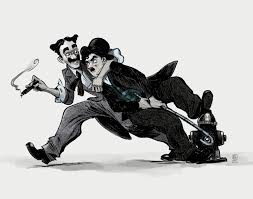
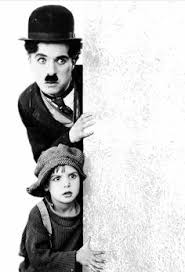
What Neitzsche neglects to think through, however, is the fact that, in the face of this microagression and power, another body of comedy exists.    And instead of prompting the disappearance of the small it promotes the growth of comic smallness.  But that didn’t happen in Germany, it took root in America, grew, and spread throughout Europe.   It was another kind of comedy that, as the German Jewish film critic Siegfried Kracauer would call the comedy of chance and contingency in contrast to the  comedy of fate and myth.  It was, as he points out, the comedy of Buster Keaton and Charlie Chaplin (who the Nazis called the “little yid”).    They are, as Hannah Arendt said of the schlemiel, “the suspect” (who we all know is innocent) on the run.   He escapes on the seat of his pants.

Chaplin’s The Great Dictator (1940) – who he portays as a small guy who acts like he is big – is endearing in its celebration of everydayness and frankness; it flies in the face of Zarathustra and his microagressions.  The irony is that smallness, in America, can be pretty big.  And when we realize that “everything has become smaller” we don’t shirk like Zarathustra; we smile.  In these comedies cruelty does not trump love.  We realize, unlike Nietzsche, that we don’t need “cruelty” to have a “festival.”


Cynicism, the “Highest Achievement on Earth” – Nietzsche on What Makes a Great Book

unknown-2

Since he was so cheeky and loved to upset his German readers, Nietzsche always loved to reflect on how wonderful he was.   He did this because he wanted to create a space in which his voice, despite its being despised, could weigh in on any subject he wished to discuss.  It was, in his view, his satirical cynicism that put him in a position to battle with anyone he deemed a “worthy opponent.” In a section of Ecce Homo entitled “Why I Write Such Great Books,” Nietzsche reflects on what makes a good book.

Before he gives us his final word, however, he lets us know how frustrated his critics are with him and how, in turn, how disappointed he is with books that other, esteemed Germans, write:

I have some notion of my privileges as a writer; in a few instances I have been told, too, how getting used to my writings “spoils” one’s taste.  One simply can no longer endure other books, least of all philosophical works. (Genealogy of Morals and Ecce Homo, 263)

In the most daring and arrogant manner, Nietzsche tells the German reader that the world that he is speaking from is higher than theirs.  It is a “distinction” to enter it:

It is a distinction without equal to enter this noble and delicate world – one must not by any means be a German; it is after all a distinction one must have earned.  But whoever is related to me in the height of his aspirations will experience veritable ecstasies of learning; for I come from the heights that no bird ever reached in its flight, I know abysses into which no foot ever strayed.  I have been told that it is impossible to put down one of my books – that I even disturb nightly rest.  (263)

After noting how incredible his writing is he tells us why it is so lofty; namely, because it achieves the heights of cynicism:

Altogether, there is no prouder and at the same time subtler type of book: here and there they achieve the highest achievement on earth, cynicism; they have to be conquered with the most delicate fingers as well as the bravest fists.  (264)

Nietzsche goes on to describe, metaphorically, the physiognomy that one must need to be a great writer.  One needs a “cheerful digestion”(264).  The irony of this claim is that Nietzsche, in his cheeky cynicism, seems more bitter than cheerful.  However, he suggests that his bitterness is cheerful because, when he angers his opponents and makes them cynical about their own world, he is happy.   His hatred of his critics is cheerful in the sense that he finds all of their criticisms and comments about his work laughable.

I have one question:

After all his ranting is over and after he has spread more cynicism in the world and crowned himself the solar king (which Michel Serres associates with madness) what is left after the book (and the author) that destroys all other books?

Two Bodies of Comedy: On Friedrich Nietzsche & Robert Walser’s Bodies of Comedy

unknown

Nietzsche was obsessed with the relationship of the body to thought.   And whenever he articulated his reading of the body, he always made sure to put it forth in what Peter Sloterdijk (winking at Diogenes) called a “cheeky” manner.  He looked to offend and this gesture, for Nietzsche, was healthy.    In the beginning of his book, Ecce Homo, he assesses his health in a cheeky manner. He looks to what he has taken, physiologically, from his mother and father* and what this means to his personal (“unique”) fate:

The good fortune of my existence, its uniqueness perhaps, lies in its fatality: I am, to express it in the form of a riddle, already dead as my father, while as my mother I am still living and becoming old.  The dual descent, as it were, both from the highest and the lowest rung of the ladder of life, at the same time, decadent and a beginning….I have a subtler sense of smell for the signs of ascent and decline than any other human being before me; I am the teacher par excellence for this –  I know both, I am both.  (222, Genealogy of Morals and Ecce Homo).

These claims to being the “teacher par excellence for this” are outrageous.  They are meant to be.  He wants to be challenged.  And he doesn’t stop on the first page to demonstrate how much he knows about the relationship of the body to thinking. Throughout Ecce Homo, Nietzsche discusses the body and its relation to thought and power (or decadence). He takes any tendency to “dialectic” as a “symptom of decadence” and cites Socrates as a sick thinker.   But he is only one enemy, the other is the moral enemy who asks us to pity or feel for the other:

The overcoming of pity I count among the noble virtues: as “Zarathustra’s temptation.” I invented a situation in which a great cry of distress reaches him, as pity tries to attack him like a final sin that would entice him away from himself.  (228)

The “proof” of his strength is to be found in a rejection not just of pity but a kind of humor that goes along with it.  This kind of humor is the anti-thesis of the humor he employs in his endless satire and cheekiness.  He sees this cheekiness as poetic.  His model for this is not just the cynic Diogenes (Nietzsche calls himself the “medical cynic”); it is also Heinrich Heine:

The highest concept of the lyrical poet was given to me by Heinrich Heine…He possessed the divine malice without which I cannot imagine perfection: I estimate the value of men, of races, according to the necessity by which they cannot conceive of god apart from the satyr. (247)

Nietzsche saw the health of Heine’s poetry to be associated with his sarcasm. Heine’s strength could be “measured” by the strength of the opponents he chose to target in his satire: “The strength of those who attack can be measured in a way by the opposition they require: every growth is indicated by the search for a mighty opponent”(232).

The irony of Nietzsche’s interest in Heine is brought out in the fact that Heine was, according to Hannah Arendt, not just interested in satire.  He was also interested in the schlemiel, a comic character that Nietzsche would find to be unhealthy and weak since, through its charm, it called on the reader to laugh in a way that was not satirical.

Hannah Arendt saw Charlie Chaplin as the last in a long line of schlemiels that were first introduced into the German bloodstream by Heine.  His vulnerable and clumsy comic subjects of schlemieldom were poor and simple, not clever and cheeky in the Nietzschean sense.

Robert Walser, who had a major influence on Kafka’s fiction, was fascinated with comic characters who many would find pitiable but charming.   They present another body of comedy which, to be sure, differs significantly from Nietzsche’s body of comedy.   In his short story, “Helbling’s  Story,” Walser has the narrator, Helbling, give his view on himself and work world he has decided to enter.  He is the everyman (who Nietzsche despised) and yet he is different in a way that sets him not a height so much as on a comical plane of existence:  “The striking thing about me is that I am a very ordinary person, almost exaggeratedly so. I am one of the multitude, and that is what I find so strange”(Selected Stories, 31).    He finds it strange because he realizes that, unlike them, he is, like Chaplin in Modern Times (1936), unable to work or be like them.


He tells us that he is not cut out for work.  He’s too fragile and slow.  Like many a schlemiel, he is belated:

I constantly feel that there is about me something delectable, sensitive, fragile, which must be spared, and I consider the others as being not nearly so delectable and refined.  How can that be so?  It is just as if one were not coarse enough for this life.  It is in any case an obstacle which hinders me from distinguishing myself, for when I have a task to perform, let’s say, I always take thought for half an hour, sometimes for a whole one. (32)

His body, when he works, is comical.   Like Chaplin’s body, it can’t keep up and ends up gesticulating in all different directions:

A task always frightens me, causes me to brush my desk lid over with the flat of my hand, until I noticed that I am being scornfully observed, or I twiddle my cheeks, finger my throat, pass a hand over my eyes, rub my nose, and push the hair back from my forehead, as if my task lay in that, and not in the sheet of paper which lies before me, outspread, on the desk. 

He can’t seem to stay on task.  He seems to be constantly distracted.  And when he is called a “dreamer and a lazybones,” he refuses to accept these descriptions: 

Perhaps I have the wrong profession, and yet I confidently believe that in any profession I would be the same, do the same, and fail in the same way…People call me a dreamer and a lazybones.  What a talent people have for giving me the wrong labels.  (32)

But when he reflects, he realizes that he is a simpleton:

I do not know if I have an intellect, and I can hardly claim to believe that I have, for I have been convinced that I behave stupidly whenever I am given a task which requires understanding and acumen….I have a quantity of clever, beautiful, subtle thoughts; but as soon as I apply them, they fail and desert me, and I am left standing there like an ignorant apprentice. (33)

Unlike Nietzsche’s body of comedy, he doesn’t aim to always win and overpower.  He is, a Michel Serres would say, “inventing weakness” and is calling on us to pity him.  But when he messes up he does so with such charm that we, like millions who were adored by Charlie Chaplin, forgive him.   But Nietzsche would not.

While the body of comedy that Nietzsche favors is tough, invulnerable, rude, and on the offensive, the body of Walser’s comedy is vulnerable, weak, flexible, and self-deprecating.  It fumbles and stumbles when it has to do a task and, for that reason, is more human.  Nietzsche’s body of comedy is that of the overman who looks down at the world it came from and laughs a laugh of health and defiance.  It laughs, as Zarathustra did, from the mountaintops; not from the valley.


*Compare Nietzsche’s reading of the relationship of his father and mother legacy to his fate, to that of Gene Wilder (which, to be sure, is completely different because Wilder frames his birth in terms of the schlemiel not the healthy overman.)


“Sesame Street’s Count is My Grandfather” by Gary Barwin

unknown

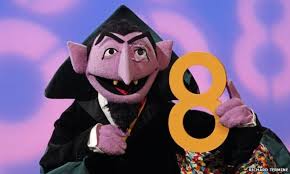
Sesame Street’s Count is My Grandfather

for Jennifer Glaser

What are the numbers, Count? Your Transylvanian cackle seems Yiddish to me, your unhinged delight, your bitter joy enumerates the world, an inventory of what’s there, what hasn’t be destroyed. The time I’m waiting, the time I’m waiting for those numbers in your kitschy voice which isn’t different than my parents, grandparents’ voices.

You’re counting, chanting the numbers, the Sh’ma at the Warsaw ghetto, the empty chairs at the Seder, numbers on my grandfather’s arm, my grandmother’s. To count the future with thunder, to remember the past with lightning. I see you, Count, a survivor. The chortling paradox that there are things and that they can be counted.


gary-headshot-at-taj-mahal

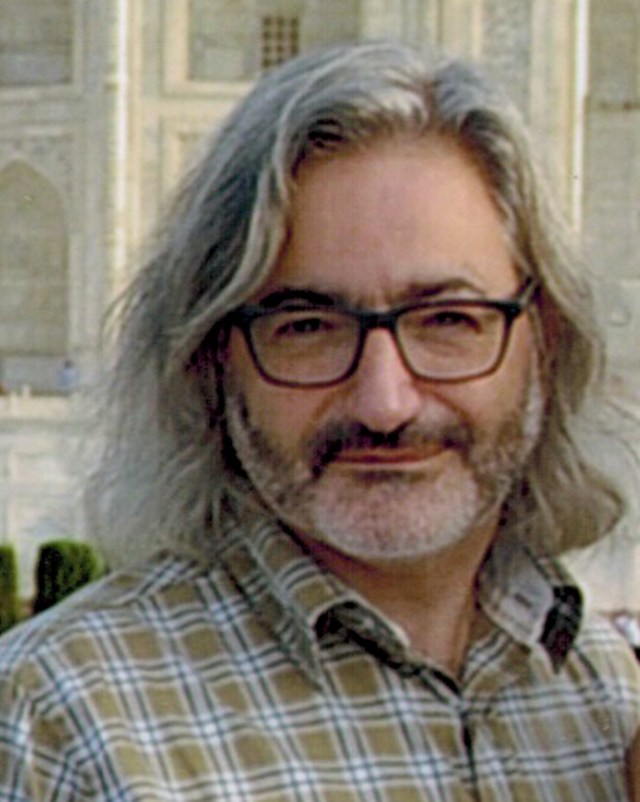
Gary Barwin’s novel, Yiddish for Pirates (Random House) has just been longlisted for the Giller Prize and will appear in paperback in November. He lives in Hamilton, Ontario where is writer-in-residence for at-risk youth and at Hillfield Strathallan College. His new poetry collection, No TV for Woodpeckers will appear with Wolsak and Wynn in 2017. (Check out more of work at www.garybarwin.com.   Also see the review of his novel, Yiddish for Pirates and the review of his book Franzlations by Schlemiel Theory.  Barwin has also written “Before the Soup (After Kafka)” –  a Kafkaesque piece on the schlemiel recently featured by Schlemiel Theory.)


The (Sch-Sch) Sounds of a Misfortunate (Sch)lemiel in Wilco’s New Album: Schmilco

unknown

Jeff Tweedy always struck me as the “odd one out.”  But in never occurred to me to think of him as a schlemiel of the Woody Allen variety.  Although he has an anti-hero kind of ethos and is a scruffy fellow, he has a penchant for beauty and perfection. There doesn’t seem to be anything comical about him.  He’s a beautiful loser, not a schlemiel.

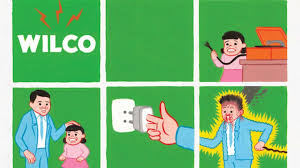
But when, just this morning, I saw that the title of his band, Wilco’s new album was Schmilco, I paused. Could it really be that he was shedding the beautiful loser for the schlemiel?  Was he taking on a comical turn?  The schlemiel detective in me was out on the scene: Was Tweedy, was Wilco, suggesting that their band meets the schlemiel half way?  Did Wilco + the schlemiel = Schmilco?  Or was is it, in the spirit of misfortune that Tweedy often dwells in, the Sch of the Schlmazel?  The comic-bookish-schlemiel graphic they chose for the album suggests that the schlemiel (or perhaps a hybrid schlemiel/schlimazel) was in the house.  But the only way to find out if the music took to the schlemiel theme was to listen to the album.

Here’s what I found.

The schlemiel, at his core, is a humble simpleton. He’s the one who wants to do good and be one of us but can’t for the life of him do it.  He always ends up spilling the soup or doing some wrong.  The first song “Normal American Kids” suggests that the subject of the song is the odd one out.  He has a simple grudge against those “normal American kids.” He’s not one of them.  And the song’s simple acoustic melody gives us a sense of the shoulder shrugging character that the song is rooted to. He was hiding under his sheets or dreaming, alone by himself, and afraid of the men (“the normal American kids”).  He would rather be a luftmensh (a “person who lives on air”)and dream.  As Freud once said, the artist is a day-dreamer.  And, as Tweedy sings it, he’s not a part of the crowd and has better things to do such as dream and dislike them.

One thing that songs like “Nope,” “Common Sense,” and “Someone to Lose,” leave me with is a sense of misfortune that is not “completely” debilitating (only “partially”).  The melodies and the lyrics are cynical and disjointed but show us that, at the very least, lyrics are being strung together.  The folksy-bluesy content is there, but it’s not clear. The songs are confused, schlemiel-like yet also very cynical. “Someone to Lose” is a schlemiel like tune with a few comical notes interspersed with Beatleisms.   Because it is about the fact that the schlemiel-subject may not be good enough for the other or that the other is not intersested has a Noah Baumbach feel to it (as in a film like Greenberg).  But that’s a different kind of schlemiel who, to be sure, passes into the realm of the tragic.  This song plays on that edge.

To be sure, many songs play on this edge and some slip from the reflections of a schlemiel to the reflections of a schlimazel.  In the song, Happiness, for instance, Wilco plays a kind of melody that trudges back and forth as we hear “Happiness depends on who we blame.”

“Shrug and Destroy” also has a melancholic tinge to it.  In the song we hear: “sometimes I wish to set free/ the things that still matter to me.”  I can’t imagine Larry David, Charlie Chaplin, or Woody Allen saying something like this.  To be sure, the voice in this and in many of the songs lack that endearing comic element.  These songs invite pity. But do they invite cynicism?  Isn’t that the contrary of what a schlemiel does?

The last song of the album, “Just Say Goodbye,” strikes a sad final note.  It touches on a kind of exhaustion that  “Sometimes….when I’m fading…I fight…stay awake….I’ll go…I’ll go so far…just to say…Goodbye.”   Or “I work just…so I can say…Goodbye.”

Although there is a sadness that attends the schlemiel, it is not a melancholy.  And the character’s quips are more vital than degenerative.    Twitty’s singing, coupled by the music, and especially in the coda made me think that the sound that predominates in this album is the retro-sound of an album that turns on a turntable (sch-sch-sch).  In our time, it is the sound of something that is fading away and spinning in circles.  It’s like the lyrical content in the album. Each song circles and fades, barely remembering what was or barely able to hold on to what is.

Perhaps Schmilco is a commentary on what has happened to the band as it has passed through time.  Perhaps it is more an expression of cynicism than hope.  After listening to the album for the first time, I felt that it was trying to articulate the world weariness of a kind of music that Wilco tried to merge (country, folk, and rock) with something alternative.

At the very least, one can look at the cover and smile.  Its schlemiel/schlimazel antics – given visual form – may help one to forget about the weary sounds of the album (the sch, sch, sch). Unfortunately, I can only look at the digital image on Spotify or google images.  I can’t hold the album in my hand.  Perhaps that nostalgia could keep me from experiencing the time that is lost throughout the album.

Sch, sch, sch…but, in the end, no schlemiel.  There’s only a beautiful loser, a timeworn singer, saying Goodbye.  When we look in the mirror, however, we realize that, in the end, it seems we have been duped.  But by who? Or What? Time? Wilco?  Its hard to tell.  It could be all of them.

At the very least some of us can hold the album (that is, the collector items below) in our hands and realize what schlemiels we are for getting excited about it. After all, they say that schlemiels are always born too late. That’s something to giggle about. This isn’t.  After all, the schlemiel (schlimazel) in these images gets electrocuted when he plugs the record player in for his daughter.  That’s funny in a slapstick kind of way, but also really sad when juxtaposed to the weary sounds of the album which testify to the triumph of time over the artist, the beautiful loser, who’s only virtue is the fact that he – and his band – are still here.

Wait!  I can hear another voice now.  And I see a figure shrugging her shoulders.  And she’s saying, with a Yiddish accent: “Wilco, Schmilco…whatever.”

cr7kriaxeaay1df

Books I Like Versus Books I Think I Ought to Like

Eric Kaplan : lists

ericlinuskaplan's avatarEric Linus Kaplan

Back in junior high school and high school we had to read books, but there were also books I read because I wanted to read them.  I think this distinction has seeped into my unconscious and surfaced as a feeling that there are certain books that are actually Good and Good For Me, and others that are just enjoyable.   The books I think I ought to like are:

  • about realistic limited characters with boring jobs who struggle with their families and their powerlessness
  • realistic
  • old
  • long
  • hard to read
  • make you aware of language as language — they have prose that is beautiful and self-conscious
  • are in favor of social change
  • serious
  • depressing — they castigate us for our hopes and strip us of our illusions
  • they are unpopular — they make me feel smart and special for liking them while most people would not like them.
  • morally complex

Examples:…

View original post 82 more words

Sleepers and Slippers: On Schlemiel Robots and Jewish Cyborgs

unknown

Lately, I’ve been looking into the latest fantasies about Robots.  I felt a mixture of amazement and repulsion when I saw a viral video about a robot who hangs out and plays little games with a man – like a dog – as he works at his desk.  This giddy fascination with a robot-slash-pet was getting to me.  I felt that I needed some comic relief from this strange childlike amusement with Robots which, in this and in other videos, are being programmed to be our friends.  I needed some comic relief; after all,  comedy always helps us to rethink many of the things we are immersed in and, perhaps, have more control over this or that cyborg fantasy.

dog-slips-on-banana-peel-imgur

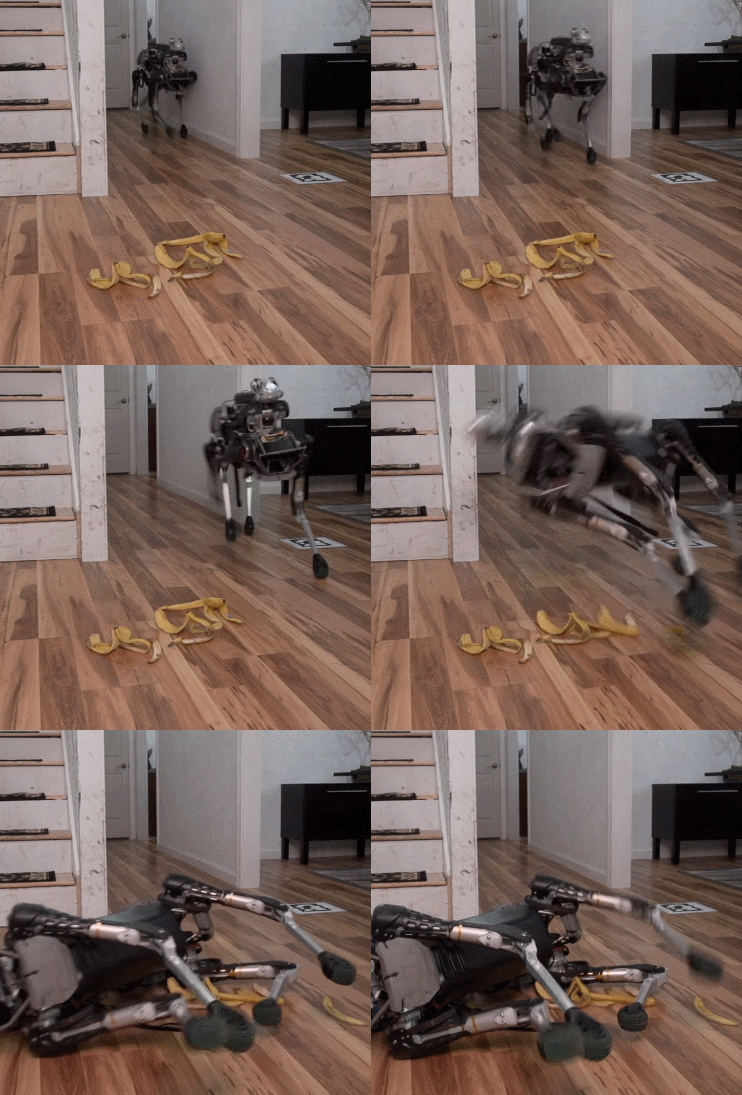
So when I came across a video of a Robotic dog slipping on some banana peels, I found what I was looking  for all along: a schlemiel robot.  And what makes this even more interesting is the fact this robot is in the form of a dog.

After seeing this video, I reflected on all the comic robots I have seen in the past and how rare they were.   To be sure, I can’t count the amount of movies I have seen where cyborgs are depicted as dangerous and destructive beings.   And although there are many versions of the kind cyborg, the comic cyborg is less present.   When I first saw C3PO, I was astonished by the idea of a comical cyborg.  He and R2D2 were a comic team and came across as a sci-fi version of the “Odd Couple.”

But C3P0’s schlemielkeit wasn’t at the forefront of his existence.  The fact that he was a humble servant was.  He lives on, but the thought of his death has scared millions of movie goes.   There is something we identify with in the Star Wars version of a schlemielish kind of robot.

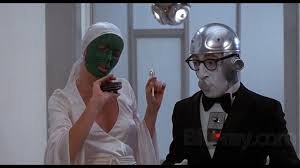
C3PO’s version of schlemiel pales, however, in comparison to Woody Allen’s quasi-cyborg-schlemiel-servant, Miles Monroe.   He is the main character of Sleeper (1973), who Rumpelstilskinlike, awakes in the future.    We find Miles bumbling through one scene to another in a world that, it seems, has left all schlemiels behind.

He spills the soup and much else in this film.  While in the kitchen, he loses control of the cake mix.  He literally kills the cake and then, when trying to serve his master’s orders, becomes obsessed with the orgasmatron he is supposed to pass from person to person (to such an extent that the robot loses control and refuses to give it to anyone else).   The more he passes it the more he becomes childlike.  He tops it off by doing a Groucho-Marx–mocking-kind-of-dance.   What’s interesting is that people don’t seem to notice that the robot is not a robot: that the robot is a schlemiel.   But we do.  They are too high to know the difference.

Before becoming machines, it seems schlemiels got caught in them.  Think, for instance, of Charlie Chaplin in Modern Times (1936).


Or think of the first scene in Woody Allen’s film Bananas (1971).


Although it may be the case that the Jewish Cyborg – as we see in Woody Allen’s, Sleeper – ruins the mythology of the monster cyborg while keeping the line between the human and the machine in-tact, the fact of the matter is that it is not particular to Jewishness.  The schlemiel robot (dog) can replicate a schlemiel’s behavior.*  What makes it so interesting is that instead of having a normally functioning robot, the fall of the schlemiel robot seems to indicate its finitude.  Like us, it fails (falls).

But isn’t it the case that no robot is designed to fail?  Robots are designed to perform certain specified functions.  It can be programed to respond to the environment in a certain way.  But can it be programed to be a schlemiel?  That, it seems, is impossible.

…unless we are talking about a robot that is programmed to constantly malfunction and…like Allen’s quasi-cyborg ….spill the soup slip on a banana peel…at every turn.  Regardless, like Allen’s Miles Monroe, the cyborg schlemiel may just  be another sleeper (day-dreamer) and…a slipper.


*If the robot is a dog, a cat, or a monkey, the comic effect might pass.   But what if it was a mechanical schlemiel spider or rat?  Would we feel the same?

Another Kind of Schlemiel: On Gene Wilder, Family, Comedy, Melancholy & Prayer

14195389_1791401984476951_8973232125453760027_o

Gene Wilder’s (Jerome Silberman’s) passing has given me so much to think about.  Ever since I was a little kid, I (like millions of other children) was fascinated with Gene Wilder’s rendition of Willie Wonka.  After seeing the film, I wanted to see every film he acted in.  I felt as if he was a member of my Jewish American family and that, like a teacher, he wanted to help me – through his acting – to let go and turn my actions into a vehicle for a comical kind of transcendence or for establishing a creative and yet humble relationship with people and the world.   I would literally try out some of his gestures (with my head, my eyes, or even my posture) with my own family members and then take note of whether or not I made them smile.  In the midst of this, I would check in with myself and see how I felt.  In a way, this kind of activity gave me my first taste of how embodiment could be comical and spiritual.  It conjured up moments or events that took me out of one world and into another (which is sustained by a kind of improvisational and endearing way of being).   Wilder also gave me my first intimation of what I would call a spiritual schlemiel.

When I learned, yesterday, that he passed away I wanted to find out what it was that spoke to me in his work.  And since Wilder was always so articulate, I went online to find some interviews with him.  What I found was fascinating.  I learned that his comedy was very influenced by his mother and father and that he, from the very start, thought of himself as melancholic and felt a desire to pray.   More importantly, he realized that his comedy wasn’t simply a means to save himself; it was way of helping his mother make her way through suffering.    But most notable is the fact that he identified this task with the schlemiel.

In this 1976 interview with Bobby Wygant, Wilder is asked about the film he did at that time, The Frisco Kid (1976).

When Wygant takes note of how his character comes across as a “bumbler,” she basically articulates the description of a schlemiel and asks Wilder to respond.  She says that she “identified” with the schlemiel character/Rabbi he plays: “We have to talk about the Frisco Kid, that’s why we are in Los Angeles.  I identify with that Rabbi, the character you play, he’s a bumbler, he knows up and down, maybe, but he doesn’t know left and right and north and south and gets lost probably in his own back yard.  I identify with that guy.”

Wilder’s answer is telling.

He starts off by saying that, as an actor, his job is to make the audience emotionally identify with the hero and create a – using a psychoanalytic register – “transference.”   As a result, they are “no longer watching that character but watching themselves” (which would imply that they are seeing themselves as the schlemiel and emotionally identifying with it).   Wilder takes it further and suggests that men and women can identify with the characters he plays because what he is speaking to goes beyond gender to something spiritual which he associates with the “emotional make up” of the human being (for Wilder,this has to do with what he calls identification).

In response to this, Wygant asks the ultimate schlemiel question (which suggests that there may be no fine line between a fictional and a living schlemiel): “Is there a bit of a bumbler in Gene Wilder?”

In response, Wilder says – with a delightful gesture – “that’s a good question, I have never been asked that before…and I want to give you as deep an answer as I can.”   Wilder begins by turning to his family and stating that “there is the mother in me and the father in me.”  And through this framework he discusses the familial origin of his schlemiel characters (but with a caveat; his father was not a schlemiel in the typical sense):

The mother in me is not a bumbler at all.  The director in me and the writer is not a bumbler.  My father in me, from whom I think I derive most of the qualities that you see on the screen, not what made me want to be an actor, that was my mother, but the basic naivite, the innocence, that’s my father.  I wouldn’t call him a bumbler but I would say that he was, there was something so naïve about him…a stranger could say that he was…a klutz, a boob, a schlemiel…if they didn’t know him…because he was so innocent…but not a bumbler…but that quality is inside me, yes….and it comes out in different ways…I can go on stage and act…but I’m not a bumbler at that but…just walking down the street I can say the wrong thing, I say the wrong name….that way, yes.   

Wilder’s wording is telling.

He sees his father as the source not only of his innocence but also his bumbling.   The type of schlemiel he is referring to – who is more of an innocent simpleton than just a simple bumbler-has its source in Rabbi Nachman’s tales.  He is not alone in making such distinctions.  In an interview, the award winning novelist, Bernard Malamud, does the same thing.  They both want to give the bumbler his spiritual roots and not just get caught up in the antics.

But what sticks most in this interview are his words about the relationship of family to comedy. In a 2007 interview for PBS, Wilder goes more in depth about this relationship and also brings in two other elements melancholy and prayer.

In the (animated) interview, he takes note how, when he was eight years old, his mother had a heart attack.    He remember how the doctor, who was sweating profusely, told him to “never get angry because you might kill her….but the other thing he said was try to make her laugh…For the first time in my life I tried consciously to make someone else laugh.”   His ailing mother – who laughed at his jokes – gave him confidence to be a comedian:

When you please your mother it gives you confidence to please other people.  And that’s where the courage to make people laugh came from but I didn’t want to be a comedian, I wanted to be an actor….And that’s what got me into acting, putting on an act, because in life I wasn’t funny, on the stage on in the movies I was free…I could do whatever I wanted to.

But then he turns to a difficult time in his life.  When he was 18 he “felt the compulsion to pray….and I must have prayed for twenty minutes or so….I didn’t know what I was praying about, I was feeling guilty about something…the next day it was 30 minutes…and than an hour and two hours.”   Wilder then confesses and discloses the source of his guilt: he was too worried about his mother dying to enjoy his freedom in life.  He “didn’t think he had the right” to be happy when she was suffering.

Following this, Wilder turns to the opening scene in Willy Wonka (1971) and about how he wanted to first appear to children in the film with a cane, limping, and then do a tumble so as to show he was just acting (he really wasn’t cripple and in pain).  The director, in response, says that he doesn’t know why he’d want to “do that for,” and Wilder responds that following this tumble “from that time on no-one will know if I am lying or telling the truth.”  The animated image, following this, depicts him as a dual character (two-in-one).

But the point that is missed is that his comedy is not only fun; it is also sad.  His comic character (his schlemiel)  is innocent and has the aspect of a wounded child.  And perhaps this indicates that Wilder never really left his guilt for his suffering mother behind.  He tried to cover it up and make people laugh, but it slips through the cracks.  And perhaps this is what made Wilder so endearing.  His schlemiel character’s emotional content is foregrounded.  He isn’t simply a bumbler.   His schlemiel character prays and is wounded by the death (not his own) of the (m)other.

And as we can garner from these interviews, his seriousness as a writer and actor drew from his mother while his desire to make her laugh came from his father.  It came in response to the realization that his ability to make her laugh might help her to stay alive.  But, at the same time, he knows that this naive and innocent belief in the power of comedy, couldn’t keep him mom from suffering…and eventually dying.

Gene Wilder’s acting embodied a kind of innocence and a kind of mortal awareness in the face of death and suffering.  Bringing them together made his acting deeply moving and truthful.

That said, I want to end this essay by way of switching tenses and speaking directly to you, Gene Wilder (Jerome Silberman).  The tumble you did at the opening of Willy Wonka gave us hope that we could turn the tables.  But it also showed how the basis of your comedy was not in acting but in the family.  You tumbled for your mother (and perhaps in memory of your mother) and for the crowd. Rest in peace Gene, you were family.   You made us laugh through the suffering (while having us remember that it was still there).  The world won’t be the same without you.  I’ll say a prayer for you who are…another kind of a schlemiel and  not simply…a blunderer, but a teacher.

PS: Of all the films I saw you in, I think that it was the Frisco Kid that spoke most to who you are or wanted to be.  In the schlemiel Rabbi, you seem to have brought together Gene Wilder and Jerome Silberman.   In that film the actor, the Jew, and the comedian became one.


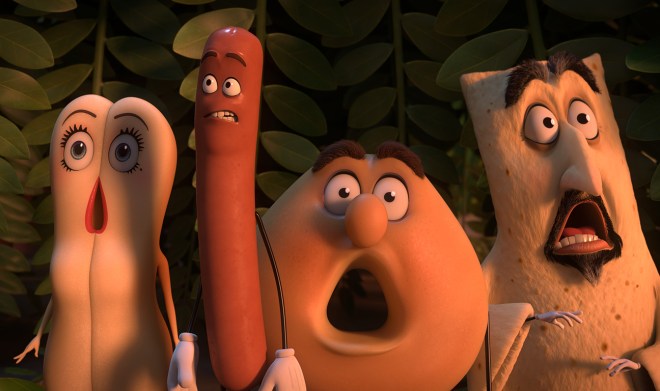
Sausage Party & Gnostic Techno Religion

Zachary Braiterman on the new Seth Rogen film. He takes note of the gnostic tendencies. I wonder…did Rogen ever take a class in religious studies?

zjb's avatarjewish philosophy place

Columbia Pictures’ “Sausage Party.”

(SPOILER ALERT!)

It seems like there’s no way to shake off religion in popular American film, even at its most impious and irreligious. The narrative sense of a satisfactory end won’t allow for it. Sausage Party could have concluded this way or that –with what one could be sure would have been the grim, brutal work as the human gods return to Shopwell to clean up the total havoc  wrought in the wake of the great food revolt or with the realized post-coital bliss of the poly-perverse food orgy. But that’s not what happens as, instead, the unio mysitico of Gnostic religion supersedes the cruel, anthropomorphic gods of conventional religion.

After coming to true knowledge about the bitter truth that this world is an unjust and unkind veil of suffering run by demonic demi-urges only thought to be divine, the denizens of Shopwell finally reject the pious delusions about the Great Beyond taught by “the great religions.”…

View original post 124 more words