Hearing Comics: Audio Renditions of Ben Katchor’s “Julius Knipl: Real Estate Photographer”

unknown-2

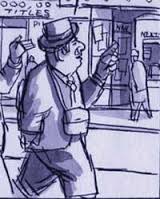
The comic strips, graphic novels, and story-images of Ben Katchor are one of a kind.   Many of his strips manage to touch on something particular to being Jewish and American.  Michael Chabon – the well-known Jewish American novelist  – said that Katchor is the “creator of the last great comic strip.”   Because he often deals with characters that are schlemiels, his work speaks, in countless ways, to the concerns and interests of schlemiel theory.

I have taken special interest in his 1998 graphic novel The Jew of New York, and I have written on it in relation to its portrayal of a Jew who journeys into the Adirondacks and goes “wild.”  But I have been wanting to write on his 1996 book, Julius Knipl: Real Estate Photographer for quite some time.    Katchor’s main character draws on many different aspects of the schlemiel and his curious wandering mind and stumbling body; always in search of something new, always ready to make a deal, while, at the same time, losing track of time as he traverses through space.  (Think, for instance, of Mendel Mocher Sforim’s Sendrl and Benjamin, Aleichem’s Motl and Menachem Mendel, Singer’s Gimpl, or Bellow’s Herzog).  But what makes these strips so amazing is not just the endless flow of urban comic imagery but also the words that seem to come out of nowhere yet always at the right time.  The words have a certain speed to them that is, for lack of a better word, embodied in the character.  (My personal favorites are the scenes over food and before meals, when there is a sense of hunger; it’s as if Knipl is not just moving between scenes or photographs but between meals and conversations.  To be sure, Katchor gives the schlemiel a Bloomian kind of feel.)

I thought about the book recently when I stumbled across a series of audio clips that take segments of the book and perform them (in the fabled American radio-play-style).  The translation of the strip into an audio clip, which was produced by David Isay and his “sound portrait” project,  is a delight.  (In the recordings, one can hear the legendary comical voices of Jerry Stiller, Irwin Corey z’l – the “World’s Foremost Authority” – and Joey Faye, amongst others.)  These recordings add yet another dimension to the strip.   They make the images leap off of the page, fly into our ears, and spark our imaginations.  The schlemiel comes to us, so to speak, in two mediums and since one medium is visible and the other not it gives the listener and reader an opportunity to share in the imagination of the schlemiel.

unknown-1

If you haven’t clicked on the hyperlink to the audio clips above, click here.


Kotonti! A Note on Freud, Humor, and Tevye

unknown-3

At the outset of Sholem Aleichem’s Tevye the Dairyman, there is a letter – dated 1895 – addressed from Tevye to Sholem Aleichem, the author.    At the top of the page is an expression that is used by Jacob to describe himself: “Kotonti – I am Unworthy.”  The English translation of the word, Kotonti as “I am unworthy” is not literal (although it is consistent with the verse that follows in the Bible).  Kotonti means “I am small.”  To be sure, this gesture of humility – of smallness – underscores not just Tevye’s story but his humor as well.   Let me cite the first two paragraphs of the book to illustrate this gesture:

In honor of my dear, beloved friend Reb Sholem Aleichem, may God grant you health and prosperity together with your wife and children, and may you have great fulfilment whatever you do and wherever you go. Amen Selah!

Kotonti! I am unworthy!  This I tell you in the language of our Father Jacob spoke to God in the portion Vayishlach, when he went to meet Esau.  Bu tit is not entirely appropriate, I get you, Pani, Sholem Aleichem, not to be upset with me, as I am an ordinary man and you certainly know more than I do – who can question that?  After all, living one’s life in a little village, one is ignorant.  Who has time to look into a holy book or learn a verse of Rashi? (3, Tevye the Dairyman and Motl the Cantor’s Son).

Aleichem’s humor is one of self-deprecation.  He honors the haskalic man, the Jewish intellectual, Sholem Aleichem, who wants to bring the story of the little man to the world.   What is so laughable about Tevye, according to Ruth Wisse, are his mistakes and his excessive use of language in order to impress Aleichem.  Despite the fact that Tevye says he is ignorant, he does try to show that he knows a little something.  Yet, at the same time, he keeps on showing how small he is.

I don’t know what you found so interesting that you would devote your time to an insignificant person like myself, to write me letters and, unbelievably, to put my name in a book, make a big fuss over me, as if I were who knows who.  For that I can certainly say, Kotonti! – I am unworthy! True, I am a good friend of yours, may God grant me a hundredth portion of what I wish for you! You know very well that I served you in bygone years when you were still living in the big dacha – do you remember?  I bought you a cow for fifty rubles that I bargained down from fifty-five.  It was a steal.  So she died on the third day? It wasn’t my fault. Why did the other cow I gave you also died….Even with the best intentions things like this can happen! (3)

What makes this funny, besides the self-deprecation is the fact that, like many a schlemiel, he realizes that, despite his intentions, “things like this happen!”  He seems to have no control over the soup that spills on the schlimazel (who in this little story is the author himself, Sholem Aleichem).   He wants to help him. But unexpected things happen.  Although bad luck is not a laughing matter, here, it is.  What’s going on?

There are a number of different theories about comedy – from Thomas Hobbes to Henri Bergson and Freud – which read humor in terms of power.  We laugh at the one who stumbles and falls because, quite simply, we are in a better position from them.  We are fortunate, they are not.  But this laughter is not at something tragic.  The person who has misfortune – in this or that comedy performance or joke – makes a mistake.  They repeat things that are, as Bergson would say, mechanical and lack elan vital.  But is this the case with Tevye?  And how do we read his humor in terms of his relationship to Aleichem?  Why would Aleichem – who is in the position of the listener, like us – find him funny?  Did he see him as a poor, ignorant man who, because he talked to much or made bad decisions, was laughable?  Would Aleichem find Tevye’s “smallness” a joke since he sees him from the height of power and bigness (after all doesn’t Tevye note this in his self-deprecation)?

I turned to Freud for an answer or, at least, to pose a question: What makes Tevye funny? And when we laugh, what does that say about…us?

His essay on “Humor,” published in 1928, starts off by saying that there are “two ways in which the process at work in humor can take place”(263, Freud: Character and Culture).    Freud looks at humor from two different positions which one can associate with Tevye, Aleichem, and the reader:

Either one person may adopt a humorous attitude, while a second person acts as a spectator, and derives humor from the attitude of the first; or there may be two people concerned, one of whom does not consider himself taking any active share in producing the humorous effect, but is regarded by the other in a humorous light.  (263).

The conceit of Tevye’s introduction is that both positions are at work.  While Aleichem is a spectator to Tevye’s self-deprecation and humor, he is also the author of this tale.   According to Freud, the first kind of humor refers to the subject’s self while the latter to others.  However, the latter is at the expense of the other.   Is Aleichem, like the reader, distinguishing herself from the small, mistake ridden subject?

Freud argues that either way one looks at it, the same release of energy is at work in humor:

Like wit and the comic, humour has a liberating effect.  But it also has something fine and elevating, which is lacking in the other two ways of deriving pleasure from intellectual activity.   Obviously, what is fine about it is the triumph of narcissism, the ego’s assertion of its own invulnerability.   It refuses to be hurt by the arrows of reality or be compelled to suffer.  It insists that it is impervious to wounds dealt to it by the outside world, in fact, that these are merely occasions for affording it pleasure.  This last trait is the fundamental characteristic of humor.  (265)

With this in mind, we can say that Freud would read Tevye and Aleichem as protecting themselves from the “arrows of reality” and “suffering,” albeit for entirely different reasons. Ruth Wisse takes this reading on when she argues that humor is a way of surviving the horrible times that Jews went through (notice the date of the letter in the novel is 1895, a time when Jews were and had experienced waves of violence through pogroms).   There is no mention of these pogroms.  There is only a positive attitude that uses humor to protect the ego from being crushed by anti-Semitism and hate.

What is ironic is the fact of the matter is that by becoming small, by saying I am small, and making the ego small, Tevye’s ego is protected.  He makes himself small in relation to the intellectual.  His simplicity and self-deprecation is his salvation.  But if we look at him from the positoon of Freud’s second person mentioned one should sees another kind of position.  If the joke is on Tevye, than means that we have survived him.  While he is small, we are big. We, like Aleichem, do not dwell in small villages and are not of the working class.   We identify with the artist.

But today, in retrospect of the Holocaust and what happened to millions of Jews who died in the Holocaust, can we, rather, bypass Sholem Aleichem’s position and imagine that we are in the presence of Tevye and his self-deprecation?   Can we laugh at how small we are?  Can we laugh at how ridiculous we are?  Or are we too smart for that?   Do we have choice in the matter?

Wisse, in her reading of Aleichem, makes an interesting observation.  She argues that there is a tension between hope and skepticism in his work.  I would go further and argue that this difference has to do with who we identify with – Tevye or Aleichem – and how we identify.  Are we, because of history, in a skeptical position?  Or can we see the position of self-deprecation and smallness as something that can give us hope in a time that is riddled with skepticism?  Perhaps it is the case that every identification with smallness and self-deprecation will be riddled with skepticism as we, as Holderlin said of Oedipus, have an “eye to many” (we know too much).

I have a third option that one can draw from Tevye himself.

Before we do stand-up, which, to be sure, has a lot to do with simply saying who we are, what we believe in, what we find amusing, and what we worry about or are puzzled over, perhaps we should honor the other and give her blessings.  Perhaps we should take note that our foibles are in the face of someone who is better than we are.  Perhaps we should take note that it is an honor that she is listening to us.   In relation to them, we are small.  But when we take the “second position,” we are large.  Although, in our culture, that happens all the time when we call people names and make fun of them and make ourselves big, it’s not right.

Tevye is right.  To you I say: Kotonti!

A Note on Seth Rogen and His Stoner-Schlemiel Character

unknown-3

Ten years after Seth Rogen appeared in Judd Apatow’s Knocked Up (2007) as a stoner schlemiel, Seth Rogen has made this character into his biggest selling point.  Here is a list of movies where we see the schlemiel-stoner character: Superbad (2007), Pineapple Express (2008), Zack and Miri Make a Porno (2008), Funny People (2009), This is the End (2013), The Interview (2014), Neighbors (2014), and Neighbors II (2016).  In addition to movies, he has made several appearances in different TV series – ranging from Workaholics to Arrested Development – and TV shows as the stoner schlemiel.  For Rogen, it is the gift that doesn’t stop giving.

I have many reservations about what he is doing with the Stoner Schlemiel since it takes the classical character and lowers its IQ a few points.   One need only compare the schlemiel he puts out there to that of Woody Allen, Jason Alexander, or Larry David to see what I mean.  They may not be the most intelligent schlemiels, but they are sharp enough and urban enough to give the schlemiel a degree of respectability.   What Rogen does is make the schlemiel into an everyman in ways that his predecessors – like Adam Sandler and Ben Stiller – did not do.  He has made the stoner schlemiel into the main image America has of this character.  When we see his schlemiel we automatically ask if he is stoned or going to be stoned in this or the next scene.  The foibles that the stoner schlemiel has are adorable – since Rogen’s demeanor (and body, see below) has a certain charm to it – but these skits are not intelligent and they offer no kind of gesture that goes beyond mere entertainment or lifestyle advertising (or marketing, if you will).

The stoner, oftentimes, has nothing to say. He just drops things, makes mistakes, laughs, smokes more pot, and then smokes more pot.  The celebration of marijuana is the schlemiel’s only political and cultural statement.  We are far away from the schlemiels of Rabbi Nachman of Breslav, Mendel Mocher Sforim, Sholem Aleichem, Kafka, and I.B. Singer who all had something powerful to offer readers in Yiddish and in translation.  For them, something more than getting high was at stake.

Let me take a 2013 appearance on Jimmy Fallon’s Tonight Show – in which the two do a skit that involves the stoner schlemiel – as an example.

Fallon starts off by recalling how they both acted in a “Canadian Soap Opera” called “Jacob’s Weed Shop.”  Fallon says that “it was interesting,” while shaking his head.  Rogen responds with the stoner schlemiel’s joy over getting high: “it was fun.”

The stoner schlemiel’s prop for the skit – which guarantees that there will be laughs – are two prosthetic arms (which he calls “but cheeks with hands”).  Rogen justifies using them because his arms don’t look good on camera.    They are big and pale.  Rogen’s turn to his body as a schlemiel prop is something he does all the time. The stoner’s body, the “dad-bod,” is a staple in many of his films. Especially in his film Neighbors where he puts his body in juxtaposition to Zac Efron’s throughout that film (and its sequel).    (Also take a look at his guest appearance on Wokaholics with Erfon, which I have written on over here.)

In the skit with Fallon, the prosthetic arms prevent Rogen and Fallon from getting high. Because of them, he can’t properly roll or light a joint; he can’t make edibles.   The last scene has him putting a mess in the oven that will, apparently, turn into pot brownies.   Even so, the main plot of this skit is guided by the stoner schlemiel.

Millions of Americans smoke or consume pot.  As a schlemiel theorist, I have no problem with that.  My problem is with what Rogen has done with the schlemiel. It’s main role, for him, seems to be the promotion of a lifestyle.


And, in truth, that’s no different from any ad on TV or the internet.   On this note, The New York Times film critic, A.O. Scott goes the farthest in denouncing Rogen and others like him who, to Scott’s mind, are promoting what he calls the “end of adulthood” and “perpetual adolescence.”  For Scott, it seems, this is more than just a lifestyle.  Its not good for humanity, in general, and America, in particular.

Thankfully, writers like Gary Shteyngart or Shalom Auslander and comedians like Marc Maron or Larry David, or shows like Transparent or Louie, are doing much more with this character. For them it doesn’t simply represent a lifestyle that is based on being perpetually high. They have a different project that can help us better to understand our modern problems and their complexity.


Leaving the Sect: Reflections on Irving Howe’s Portrayal of His Intellectual Journey Into the World

unknown-3

One of the most interesting stories of Jewish-American intellectual life in the 20th century is that of Irving Howe who, for years, was an iconic thinker, a storied American literary critic, and a politically active member of the pre- and post-WWII American left.  It was only after I read Howe’s essays on Yiddish literature – where he establishes his rationale for pursuing  Yiddish translation and the promotion of a Yiddish literature (in translation) project that put Saul Bellow’s translation of “Gimpel the Fool,” the first literary schlemiel translated into English, at the forefront – that I became very interested in what led him to this literary project.  Howe’s argument for why it was necessary for Yiddish literature to be injected into the American bloodstream was that Yiddish literature could introduce “sweetness and light” into an American milieu that had – after the war – become much too serious.

Howe was not turning to literature because he was turning away from America.  He turned to it as a way of entering the world .  After having been cut off from it by virtue of what he called “the movement” (a “sect”), literature opened up the world to him that he had never seen.   Later in his life, Howe situated his particular life in relation to the “World of Our Fathers” and not to the “movement.”

In order to figure out what prompted him to go in this direction, I took up his “Intellectual Biography,” entitled A Margin of Hope.  In the second and fifth chapters of the book, entitled, respectively, “Life in a Sect” and “Into the World,” I think that I have found what I have been seeking.  In these chapters, Howe, in the most honest, self-reflexive, literary, and phenomenological manner, looks back at his life and his journey.   The metaphorical frame he uses to disclose that life, which for him is through-and-through political, is “the sect.”  His story describes: 1) his life in the sect; 2) his desire and decision to leave it; and 3) what that process, “of entering the world,” consisted of, historically.

The epigram of his second chapter (“Life in a Sect”) comes from the American poet, Emerson.  It anticipates the crux of the chapter: “If I know your sect I anticipate your argument.”  What was Howe’s sect?  And why would he use a religious register to denote it?

Howe was not a part of a religious sect. He tells us that he was – after the war – a part of a political sect.  In America, he argues, “we have hundreds of left-wing sects, but they have seldom thrived.  When you think about it this seems odd, since there is a long history of religious sectarianism among us”(37).  According to Howe, there are three aspects that contributed to the “rigidity of our radicalism”: Protestantism, the tradition of dissent from Emerson and Thoreau, and Debsian socialism.   They were the “children of the dawn” but “our potential sects have withered while the religious one’s have flourished.” He notes that sometimes there has been a “crossing of energies,” but this has brought “little good.” It is the “fundamentalist temper,” argues Howe, that has “been a recurrent disaster in American radicalism”(37).

Howe describes the sect in terms of a kind of “little world” that must “huddle” in its own “bit of space”:

The sect crates a life apart, casting aside the imperfections of the world as given and hoping, through disciplines of withdrawal, to establish its own “little world” as  a haven for the elect.  It is chosen to be the vanguard of History, a vessel of the Idea…It must huddle in its own bit of space. It endures a hibernation of waiting. Its members know they must suffer the pain of hopelessness, and in time they learn to celebrate this pain as a sign of vindications to come.  (37)

Howe, purposefully quoting a sociologist, Lewis Coser, notes that while the political party is inclusive, the sect is exclusive.   The political party must “remind itself not to slump into withdrawal from the world which often seems its natural condition, perhaps even its deepest desire”(38).  Even so, the irony is that, according to Howe’s reading, the American Marxists that he was a member of were not a political party, they were a sect (38).   And, in violation of the political imperative not to “slump into withdrawal from the world,” it did.

Howe tells his reader that “these are observations of retrospect, purchased at the price of error”(38).  He went through those errors and is now telling how he, so to speak, was a part of a sect and not a political party that situated itself in the world.  Recalling the appeal of the Trotskyists to American Marxists, he notes how they were “nervous in the bristling style that self-educated people affect in the presence of trained intellectuals” of the Partisan Review, like Philip Rahv and William Phillips.    While he appreciated the fact that the Trotskyists gave a critique of Stalinism and the “intellectual world of those befuddled writers who praised Stalin’s dictatorship as a ‘higher form of democracy’” and were “among the few people in the thirties telling the truth about Stalinism, or at least part of the truth,” he takes note of the fact that, once they tried to gain credence in America, they “shrank to a historical oddity”(41).

Howe recalls how, in 1938, it did seem as if the “Trotskyists might break out of their isolation” when the “Nazis announced a meeting in Madison Square Garden”(41).  The “Jewish community failed to respond in any dramatic way” but a SWP (Socialist Workers Party) leaflet calling on people to demonstrate at the garden was “reproduced in The Daily News.”  When this happened, the “leader of the Minneapolis teamsters” came in to train them in the “arts of street combat”(41).  The young Howe was excited about how “thousands stormed through the streets.  Rapport with the masses, a path to their desires”(42). But this was short lived.   He tells us that the masses “only cared about demonstrations” and not about their “program.”  They went “back into our familiar isolation”(42).

Even so, that moment lived on for Howe. He recalls his devotion to the sect:

To yield oneself to the movement – really a sect, but we called it “the movement,” and out of courtesy to the past so shall I – was to take on a new identity.  Never before, and surely never since, have I lived at so a high, so intense a pitch, or been so absorbed in ideas beyond the smallness of self.  It began to seem as if the very shape of reality could be molded by our will…What mattered was the movement….it gave my life a “complete meaning,” a “whole purpose.” (42)

Although that may have been the case, Howe sees, in retrospect, that the movement was itself “hermetic”(50).  A “despite all their efforts to break out of sect confinements, the Trotskyists still accepted the idea that…it was impossible to build a mass movement”(50).  All one could do is speak to other groups.  Even so the “movement was my school in politics, my school in life”(51).   By virtue of the movement, he could “take positions” and he could have a “coherent perspective upon everything happening in the world”(53).  And this was his education.  He developed intellectually and even culturally.  However, the movement, he admits, remained worldless.

It was later, after he enlisted in the army (for four years) and returned to New York that things shifted and realized he had to enter “into the world” (the title of chapter five).  The watershed moment, claims Howe, was an essay he came across in 1947 by a “young writer named Isaac Rosenfled, who together with his friend Saul Bellow….published a story in Kenyon Review called ‘The Party’”(109).  The story helped him to realized that he was in a sect.   The short story parodied the movement in America: “They met after hours in cafes to draw up their program of action, which they called a program of inaction.  It was impossible to change the course of events….The party would change only when it was thoroughly bored with iself.  It was to produce in the members a state of boredom so great that they would be unable to attend their own meetings.”

The story, says Howe, was “like a finger pressing secret wounds”(110).  It “hurt to the point of rage, perhaps because we knew that in its fantastic way it was scraping against the truth”(110).  And now he realized that “the time had come to break out”(110).  Howe’s articulation of this is moving as it marks a major turn in his life out of the sect and into the world:

I needed to find some nourishment in the common air, refreshment in the world as it was, a world as badly flawed, no doubt, as we had always said, but still the only one at hand.  Grateful as I felt for what the movement had taught – even mistaught – me, it was a crutch that I could no longer lean on.  It was morally bracing to see myself as an ordinary young man who had to earn an ordinary living.  (111)

The break wasn’t easy.  “To quit a movement in which one has invested one’s strongest feelings can be terribly painful – at least as painful as leaving home or starting a divorce”(111).  He looks at his old friends, who still clinged to the movement, with pity.  They would hold on “just a little longer, in the hope that something might turn up”(111).  And, leaving them, he felt guilty (111).   He recalls his struggle with guilt and his realization:

I accused myself of opportunism – and who, looking within himself, will fail to find it? But neither could I shed the conviction that the time of the sect was at an end. Nor deny the charge of my own desires, the persuasion that I was a young man with energy, ambition, perhaps talent.  My friends – most of them – did not judge me: it was their understanding that tormented me. (111)

What is that understanding? According to Howe, it was their understanding that they were not in the world and were stuck in the sect while he was leaving it.  This torment is fascinating because it suggests that they are stuck in a sinking ship and, because of their nostalgia for the past movement and their desire to recapture certain moments that no longer existed, they were stuck.

Howe takes note that not only Rosenfeld’s short story helped him to dislodge himself and see the sect as a sect but Rosenfeld’s novel A Passage from Home.  It described the “inner experience of a Jewish boy, ‘sensitive as a burn’, breaking out of family and entering selfhood: from dark to dark”(112).  The book had an “overwhelming impression on him” because it exposed him to what he had buried away.  And this spurred him to write his own Jewish American experience as the son of an immigrant.   He turned this into a review that Clement Greenberg put through to Commentary.

After reviewing Rosenfeld’s book, he received a letter from the author praising him for showing how the “Marxist method” could be used in the “undogmatic flexibility of literary criticism”(113).  He realized that he had a new calling:

Not only was I now pronounced a literary critic, but I even had a “method,” though when writing the review I had merely released some personal responses, without a thought of using “Marxism” or anything else.  (113)

But, he says, there was a “cultural misunderstanding” that emerged out of this moment and lasted for decades.  What didn’t he understand?  In the last chapter of the book, he suggests that he didn’t understand the extent to which his relationship to the world was enhanced the more he listened to the novelists on the “margin,” who he calls the “witnesses.” The American is, in his view, a “witness to witnesses.”  And it is the testimony  of these writers on the margin – and they include names like Eliot, Brecht, Solzhenitsyn and Orwell, Kafka and Silone – that he wants to “identify.”

Howe recalls how he asks a “group of assembled writers” if they can “still be stirred” by these novelists and their testimonies. He recalls the poet Octavio Paz, whose book, The Labyrinth of Solitude, gave the answer: “desperate hopefulness”(351).  While Howe notes that Paz’s book was historically situated, the moment is gone.  That hope has changed, as have the witness.

Citing Kundera’s Book of Laughter and Forgetting, Howe suggests that comedy must take note of the desire for the “unity of their circle” but also that it is, like a sect, a closed one. Their utopia may lead, in other words, to Stalinism.   He left that movement behind and in the very end of the book he realizes that he can’t totally throw the baby of utopia out with the utopian bathwater.  For this reason, he calls for a “utopia of the skeptics” and, in the spirit of dialogue, puts a question mark at the end.  He poses it to “four writers” as he waits for their answer, he sees that, before they speak, they shrug and smile.   After all, a utopia of the skeptics is contrary to the sect but, at the same time, it may be a fitting term to describe a world that bears witness to history and all its disasters while, at the same time, finding a margin of hope in literary reflection.  Strangely enough, one could argue that this “utopia of skeptics” is what he found in Yiddish literature and in what he considered to be Jewishness.   His Jewishness, his “utopia of skeptics,” was the world he discovered after he left a worldless sect and its utopia of believers.

A Comical Alphabet of Postmodern Horror: On “Mannix” & Walter Abish’s “Ardor/Awe/Atrocity”

unknown-3

There was a time in graduate school when I did a lot of research into Postmodern Holocaust Literature.  One of the authors I came across was Walter AbishHow German Is It was my first introduction to his body of literary work.  What impressed me most was his cool and intelligent use of language to approach things that are terrifying and tragic.    In How German is It and in many of his short stories, Abish uses narrators and a language that continuously allude to something horrible that is either not being talked about or not being reacted to in a manner befitting of real horror.  The narrator’s approach to terrorism and the Holocaust – in How German is It – are designed to prompt the reader to feel anxious and troubled.   (We see a similar approach in the works of Aharon Appelfeld which use a retrospective view on the Holocaust. And this prompts the reader to experience radical disbelief and intense historicity.)    What makes How German is It so interesting is that, throughout the book, language and the photograph are figures of humankind’s distance from atrocity.   Language and the image, in other words, make us numb.   Drawing on this understanding, Abish’s project is to expose this in cold prose that is either cruel or comic.  While a book like How German is It takes the cold approach his book Alphabetical Africa and his story “Ardor/Awe/Atrocity” (which uses the TV show, Mannix, as a central motif) both take a more comical approach to this linguistic and aesthetic numbness.

Susan Sontag, in her book On Photography, addresses the numbness to violence incurred by the photo when she argues that the excess of media representations of horror (and she wrote this in the 1970s, imagine what she would say today) has made us all numb.  Sontag argued that artists like Dianne Arbus looked to wake us up from this stupor.  However, although she wanted to make us feel pain and wake up, Sontag finds these efforts as displaying the numbness of an American lifestyle that is nearly impossible to break out of. Since violence is always kept far away from the secure life, how can one become – as Giorgio Agamben might say – or return to “naked existence”? And what happens when we, playing on Philip Roth’s reflections in his novel, American Pastoral, naively take to violence as if it were absolutely necessary to use violence to destroy the system that hides it?

How does one address this?  Should one, rather, write novels and short stories that are filled with horror and violence?  Or should one, as Abish does, use the device of tragic irony to show how numb we are?  And, if we know, what difference does it make and what will it accomplish? Will we as a matter of course just become more bitter about everything we see or hear about atrocity?  Does it suggest a life of cynicism?  And what is the difference if that cynicism is comical or tragic?

In Alphabetical Africa, Abish takes every letter of the alphabet to address the topic of colonialism, war, conflict, and death in Africa in the 1970s.    Each chapter is based on a letter but the logic is to build on previous letters.  In the first chapter, for instance, every word in the chapter begins with the letter “a,” the second chapter adds the letter “b,” and only words starting with “a” or “b” are used.  As one can imagine, this exercise is fun and comical. But at the novel goes on, the violent and disturbing subject of the book comes more and more into focus.  However, there is a very interesting challenge that is posed to the reader in this process: when it becomes clearer to the reader that subject of the book must be taken in with a more sober sensibility, the reader needs to check in and ask herself if a) she is willing to forgo the comic aspects or b) that is even possible at this point (after all, most of the novel has been a language game that has created a series of comical and surreal images).    This ingenious literary approach should prompt the reader to ask about whether empathy is possible, today.  Is it “fake” for us to say that we care when we are more interested, as he suggests, in being entertained? The mind is more interested, it seems, in play and diversion.  And even though there is a glut of images and words about atrocity, Abish seems to be suggesting that it all just appears to us in a comical manner.  Do we just, at a certain point, shrug our shoulders and accept that we prefer to be sheltered and remain numb?  What can we really expose ourselves to?  When we get upset at this or that trauma in the public realm,  is this outrage really just an act – since, as Abish suggests, we are really to (as Heidegger might say) “tranquilized” by the world we live in?  If this is the case, then Abish is suggesting that the most intelligent outlook on what is going on today is actually the coldest and the most bitter of all.  Perhaps the most intelligent amongst us are – despite their protestations – cruel and indifferent because the glut of language, imagery, and information make that inevitable? This pessimism lingers for the reader of Abish’s work.

His short story “Awe/Ardor/Atrocity” brings this closer home to Americans (since How German is It speaks more to a German audience or an American audience which is fascinated with the German intellectual or activist’s response to atrocity).   Throughout the story, there are numbers on words that suggest endnotes or footnotes; however, there aren’t any.  Its left up to the reader to figure out why certain words rather than others have these notations (as they may relate to the central theme) – to aid the reader, I will put these notations in brackets next to the words when they come up in this essay.

(Let me preface by saying that one of the main reasons I want to discuss this story – in the context of Abish’s work – is because the main character of Mannix (a TV show on CBS that spanned from 1968-1975), Mike Connors, died today.)

In the first section of the story, Abish situates the main character of the story and suggests – in tension with the words (and footnote numbers appended to them) “Awe1/Ardor2/Atrocity3” – an erotic and sadistic plot that draws on the Film Noir but one can already hear the “knocking,” so to speak, of violence on the door of the narrative:

Her car, an old Dodge station wagon, developed engine trouble as she was driving along Route 15, traversing the bleakest and most desolate part of the Mojave Desert.  She slowed down to twenty miles an hour and listened to the knocking, the persistent knocking sound that came from the engine.  A sign she had passed a few miles back indicated that it was forty miles to the next gasoline station.  Rather than stop and wait for someone to assist her, she decided to continue at a reduced speed.  (In the Future Perfect, 42)

She, who we learn has a name, Jane, drives past a male hitchhiker who has a “sign” (a word which has an appended footnote number – 57 – to it) that says “GOING MY WAY? EL LAY.”  The sign is odd and suggests an aggressive sexual encounter.  When she passes him and he yells at her “silly cunt.”  These words “kept reverberating in her ears long after she had lost sight of him in the rearview(64) mirror.  There was no sign(57) of life in the rugged terrain to her left or right.  Lost in thought, she did not see immense billboard looming ahead until she was almost on top of it.  A freshly cut(9) half of an orange, displayed in the center of the billboard, floated against a bright dayglow yellow background. Beneath the orange the word PLEASURE(46) stood out in large red letters”(42).

As one can already sense, the allusion to violence and sex is throughout this text.  Its subtext is violence and sadism.  In the next section, ‘BUOYANT(4)/BOB(5)/BODY(6),” we bear witness to another moment of violence: “The large buoyant-looking(4) man in the red checkered shirt who had approached her in the motel dining room was taken away by the police, and so was the young man who received a deep(11) cut(9) in his arm as a result of the altercation that had taken place between the two of them.  He’ll be all right, the motel owner assured her, after the young man, blood dripping(10) from his left arm, was driven to the nearby hospital”(43).

In the D section “DRIP(10)/DEEP(11)/DELIGHT(12),” the reader is shown a sexual scene in her bedroom.  “She is lying naked on her bed.  Her heart is beating wildly.  This is absolutely ridiculous, she thinks.  There is no reason to feel nervous, uncertain, or afraid”(44). But then we learn that her head is “thrust into a the pillow” and that a man is “holding her by the waist as he thrusts(58) himself into her again and again. Both she and the man are committed to complete silence”(44). The fact that the number thrusts is 58 and the number appended to the sexually aggressive hitchhiker is 57 suggests that there is a continuity.  Even so, the silence and that she thinks there is no reason to be “nervous, uncertain, and afraid,” should trouble the reader.

Once again, Abish uses irony to make the reader uncomfortable.

And this is when Abish’s narrator slips the TV show, Mannix in.  In the next section, entitled “ERECTION(13)/EXOTIC(14)/EARTHQUAKE(15),” Abish introduces the show which Jane, who is now alone, is watching:

Jane(28)is watching a rerun of “Mannix” on the color(8) TV in her room…Intently she watches a pink-faced Mannix, gun(27) drawn, racing along the length of a red-tiled rooftop on a stylish hacienda.  Now(40) and then the camera settles briefly on the familiar Southern California(7) background of palm trees, swimming pools, exotic(14) plants, an interior filled with massive pieces of modern furniture, etc”(44).  The description of the scene depicted on TV displaces some of her worry – its architecture is meant, as it is in How German is It, to hide the violence.  But then it resurfaces while she watches and it comes out through a reflection on her car which has an “oily substance dripping(10) from the left front axle”(44).  The only “dripping(10)” mentioned so far in the book was the dripping of blood from the man who got in  a fight in the hotel.  She worries now, in relation to the car, “Each time she pulls out, she leaves a shiny black stain on the ground.  What possibly can she be afraid of?”(44).

The TV show and Jane’s life bleed, so to speak, into each other.  She thinks of the life and the world that Mannix lives in and compares her own to it.  These thoughts make her life seem more meaningful and mitigate the hidden violence.  Mannix, for Jane, manages the violence.  He doesn’t let it pain him.  But the reader can see the horror.  She lives in language and image.  Her life passes from “awe” to “atrocity” by way of “ardor.” The word in the middle, so to speak, neutralizes the awe and atrocity.  Beauty – even if it is violent – displaces the awe and atrocity.  And, even more interesting, is the fact that we, as readers (even today), are complicit in this Southern Californian fantasy.  And we, like Jane, know it.

In one section, entitled “RECOGNITION(52)/REAL(53)/REMEMBER(54), Abish doesn’t mention or relay any of these words.  There is no memory, only a world of Southern California – of “buildings, cars, and people” who “age comfortably in the sun”(52).  The final figure in this section is of smiles in a bank.   They displace any memory, recognition, or reality of horror.   In the last section of the story, the narrator tells the reader than she’s never been to Southern California.  She made it up – as one can imagine – from the TV show, Mannix.   It’s comical since this final quip suggests that the whole story was just a joke.  And even our sense of a violent subtext – even in a literary sense, and not a televisual one – is a joke.  In our age, irony isn’t what it used to be.  History and memory are even more distant.

Perhaps this is the tragic-comedy.

Our lives and even our experiences of horror are buried under language and images that stream to us on TV, film, and the internet.  We have no – punning on the filmmaker David Cronenberg’s (2005) film – awareness of the “history of violence.”  Violence has little to no historicity in our lives; unless, that is, we have experienced it ourselves, personally.   Other than that, it is a story.  And Abish believes that the only way to crack it and lift the reader out of numbness is to suggest that something sinister lies beneath the surface. The comedy hides the tragedy.  Even so, as Alphabetical Africa suggests, we may be to attached to the comedy of language and image (in the security they offer) to care when we get through the “whole” alphabet (or horror).   The message is bleak: We are more accustomed to comedy and fantasy to care about what lurks beneath.  And even if we do go beneath that surface, we can’t take it.

As Freud well knew, the psyche is a protective shield (despite the fact that there might be a death drive, Thanatos, in it).   Trauma eats away at it. But no one wants trauma.  To want that, to want horror, would be suicidal.   Perhaps it is better to be, as Abish suggests through the TV show, in manic pursuit of the meaning of a text or film?   Deconstruction certainly enjoyed that (semiotic and syntactical) adventure.  The pleasure of the text (as Roland Barthes might say), a comic pleasure, may expose us to darkness by way of allusion; but, as Abish suggests, we can’t look into that darkness directly.  We can be bitter, true.  But that bitterness is couched in comedy and, for him, it seems inevitable that we will – in this age of endless carnage and violent displacement – prefer to be tranquilized or manic than to be inundated with horror and death.   Perhaps we are caught up in a comical alphabet of postmodern horror?

On the “Aesthetic of Religious Simplicity,” Political Theology & Pre-Monarchical Israel

battle-of-gideon-against-the-midianites-16261

Up until his departure in 2003 for Bar Ilan University, James Kugel was teaching Biblical Criticism at Harvard University for two decades (where he was the Harry M. Starr Professor Emeritus of Classical and Modern Hebrew Literature).   His book, How to Read the Bible: A Guide to Scripture, Then and Now, draws on these two decades of teaching and condenses them into one large volume (numbering over 700 pages) which spans the entire Bible from Genesis to the Book of Daniel.      What makes the book special is that it reads Biblical Criticism against what Kugel (drawing on Rabbinic, Apocryphal, the New Testament, Christian interpretation, etc.) calls “ancient interpretation.”  The book brings in the insights of Biblical Criticism, archaeology, and history to offer a major challenge to how people ordinarily think about the Bible. The book is, in this sense, truly troubling for a person of faith.   Although Kugel numbers himself amongst those who are Orthodox, he steps outside of that box to present the many challenges that Biblical Criticism offers to Orthodox Judaism and Christianity.

What does his book have to do with schlemiel theory?   Since the schlemiel is often thought of and described as a simpleton, one wonders how far back the notion of the Jew as a simpleton goes. Kugel’s book offers an interesting hypothesis about simplicity that suggests that it has deeper roots in an ancient aesthetic.  And it emerges out of something at once political, theological, and topographic.

One of the most thought provoking reflections I have found in his book are on the Book of Judges and his notion of the “God of Old.”  In this section of the book, Kugel, drawing on Max Weber, discusses the notion of “charismatic leadership.”    Kugel begins this section by noting that “whatever the system of rule, one of the trickiest problems is that of succession” (388).    He shows that the question of succession speaks to a deep crisis and he links this crisis to the emergence of the charismatic leader:

Who will be the next leader?  Unless this question has a clear answer that has been accepted in advance by all members of the society, the old leader’s death can lead to a protracted power struggle, bringing with it the gravest consequences: civil war, economic collapse, or conquest by outsiders.  (388)

But what happens when there is no fixed system for “automatic replacement” (388)?  Kugel explains: “So dangerous is the chaos that might result from not having an established process of succession that, all over the world, people have been willing on principle to accept the king’s son or daughter…without proof that the new ruler will be any good for the job…. almost anything is better than chaos” (388).  This is the background for the Book of Judges: “Israel in the Book of Judges was a society without a king…. There was no successful coordination among the tribes.  Instead, they seem to have had a succession of temporary, ad hoc leaders, the “judges” (388).

They did “not come from a dominant family or rise up through the ranks.   Instead, their rise to power was created by a crisis; something occurred that required someone to take over, and the person in question suddenly emerged” (388).

This unexpected nature and the suddenness of this election, for Kugel, speaks to what Max Weber called “charismatic leadership.”

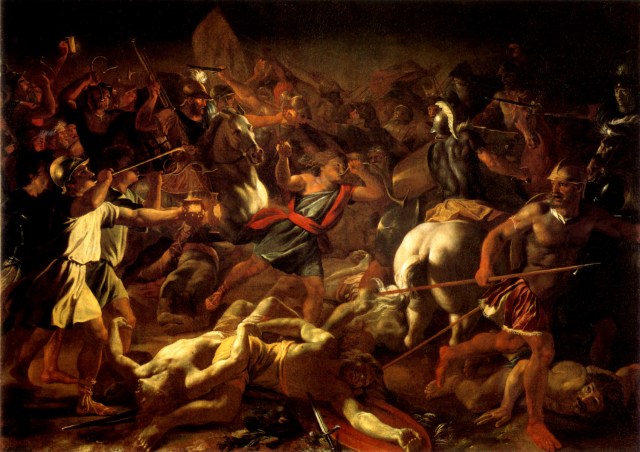
The first example Kugel uses to explain this sudden and unexpected rise to power is by way of Gideon.   He cites Judges 6:11-15.

11 Now the angel of the Lord came and sat under the terebinth at Ophrah, which belonged to Joash the Abiezrite, while his son Gideon was beating out wheat in the winepress to hide it from the Midianites. 12 And the angel of the Lord appeared to him and said to him, “The Lord is with you, O mighty man of valor.” 13 And Gideon said to him, “Please, my lord, if the Lord is with us, why then has all this happened to us? And where are all his wonderful deeds that our fathers recounted to us, saying, ‘Did not the Lord bring us up from Egypt?’ But now the Lord has forsaken us and given us into the hand of Midian.” 14 And the Lord[a] turned to him and said, “Go in this might of yours and save Israel from the hand of Midian; do not I send you?” 15 And he said to him, “Please, Lord, how can I save Israel? Behold, my clan is the weakest in Manasseh, and I am the least in my father’s house.” 16 And the Lord said to him, “But I will be with you, and you shall strike the Midianites as one man.” 

Kugel’s description of this passage is telling.  He describes Gideon as a total simpleton and the scene as comical:

What is relevant in the present context is the angels’ commissioning of Gideon to lead the people.  One can hardly image a less qualified candidate.  The scene opens with Gideon so intimidated by the raiding Midianites that he has to hide his spare grains of wheat inside a winepress.   What a pathetic figure!  The angel’s opening words to him – “The LORD is with you, you mighty warrior” – seem almost a joke in view of his timorousness…Most important, the passage spells out Gideon’s political unfitness to become a leader: he comes from a not particularly powerful tribe, Manasseh, in fact, from the “poorest clan” in that tribe and he himself is “the least in my family.”  (389)

He is, in other words, a simpleton, a schlemiel-like character.  But he, like the Clark Kent character, undergoes a “divine transformation: the “spirit of the Lord” comes over him” and he, like Deborah and other judges in the Book of Judges, is “suddenly capable of great feats (Judg. 11:29; 14:6, 19, 15:14). They are the very model of charismatic leadership” (390).

The people, in Judg. 8:22-23 ask him to rule over them after they are saved from the Midianites.  However, he, like a Simpleton who doesn’t want power, says no.  He is not a total superhero of sorts; he retains his simplicity:

But Gideon said to them, “I will not rule over you, and my son will not rule over you; the LORD will rule over you.” (Judg. 8:22-23)

At the end of his chapter on Judges, Kugel argues, contrary to the Biblical account and drawing on archaeological speculation, that the people who wrote Judges and the people to whom it spoke mark the emergence of the Jewish people in Israel as a people who lived in the mountains.   Kugel speculates that the dislike of kings by many of the Judges – especially Gideon – had to do with the topography of the land in Israel:

According to archaeologists, what was later to become the distinct “Israel group” in Canaan is first attested to in little, undefended settlements on the mountaintops of the central highlands.   There is a reason why they were undefended: conquerors are generally not interested in mountaintop settlements.  In terms of real estate, mountaintops are not nearly as valuable as the fruited plain below…. To capture that land, with its relatively dense population and its other riches, is to win a prize.  By contrast, the sloping rocky terrain of the mountaintops is not particularly easy to farm and is not thickly settled…The fruited plain thrives; the mountaintop survives. (409)

In other words, the Israelites were left to themselves and the culture that they developed reflected this lifestyle.   Kugel argues that they were radically independent and this affected not just their political view but their religious views as well:

The central highlands of the land of Israel are not as high as any of these other mountain ranges (in Kurdistan, Switzerland, etc.), but they are high enough, scholars theorize, to have led to a somewhat comparable state of fierce autonomy in the twelfth or eleventh century BCE.  The people up in the mountains soon grew used to being left alone (that’s why they settled there); scholars do not imagine that they were particularly enthusiastic about any grand reamalgamation of themselves with the valley dwellers, or even with other mountaintop tribes.  (411)

This argument supports Kugel’s argument that many of the Judges dealt with a population that was turned off by Kings and didn’t desire unity with other tribes.   It shows a picture of a people that is fiercely independent and would rather have God for a king that a man.  Only the threat of war brings up the issue of having a leader.

In his chapter on “The Other Gods of Canaan,” Kugel returns to the other aspect of the Israelite people: simplicity.  In the final section of that chapter, he discusses the mountaintop settlements and takes note of their simple life.  He takes note of this in terms of their homes and even in terms of what he calls an “aesthetic of simplicity” that one also finds in the patriarchs (perhaps reflecting an “older” deity):

There was nothing elegant about these houses – in fact, the family members shared their living quarters with some of the family’s livestock, who lived on the bottom floor during at least part of the year and whose pungent odor filled the air.  (Keeping a donkey or cow or two inside the house not only gave these valuable animals safe shelter but also provided additional warmth for the family during the chilly months of winter.)  (433)

Kugel goes on to describe how all families lived together and how they were in tune with the cycles of nature: “The crops they grew and ate, like the animals they raised and bred, kept them altogether tied to the cycles of nature” (433).   Their religion reflected this simple life:

The religious practices of these people were quite in keeping with the other aspects of their life, archaeologists say; here too, simplicity reigned…. The archaeological remains suggest…. a rather uncomplicated religious regime, practiced in individual homes or village wide, in “cult rooms” and local shrines (“high places”), on in the open-air, hilltop areas like the twelfth-century “Bull site discovered in northern Samaria. (433)

Delving into the Bible, Kugel depicts much of the aesthetics in the Bible as reflecting such simplicity:

He must have somehow seemed – despite other similarities and synchretisms – different from other deities.  He did not (as we have seen to be the case with gods and goddesses in Mesopotamia) dwell inside a statue set off in a magnificent house (that is, a temple) constructed for Him.  Instead, He was worshipped at what appear to be deliberately crude installations: He might infuse or appear above a standing stone (massebah) or in a sacred grove (asherah) for a time, or else reveal Himself to a chosen servant at an oak tree or another outdoor site; then He disappeared.   His presence, in any case, was not captured by the skilled work of human hands. This practice may be said to reflect a similar aesthetics of religious simplicity, perhaps a historic descendant of the outlook of those early hilltop settlers.  Under this same rubric of simplicity one might list the blunt laws of the Ten Commandments – “Do this!” and “don’t do that” (so different from the complicated case law of Mesopotamian legal codes) …. In keeping with this same aesthetic of religious simplicity is the Bible’s commandment to build only plain, dirt altars, or, if stones were to be used, then only unhewn stones (Exod. 20:24-25).  (434)

But he doesn’t stop there.  He goes on talk about the Patriarchs and argues that “no professional clergy exists in their world…instead the Patriarchs themselves slaughter and sacrifice animals to God at their homemade altars, spontaneously turning to God in prayer and acknowledgement, wherever they may be.  God sometimes appear to them in the guise of a fellow human being, at least for a time – then they recognize the truth and fall to the ground in worship” (434).   Kugel uses the word “God of old” to describe this simple experience of astonishment.

He concludes his argument by arguing – as all Biblical Critics do – that the authors (plural) of the tales of the patriarchs and of the Judges may have come from pre-Monarchical Israel.  This hypothesis suggests that with the election of a king and the construction of Solomon’s Temple in Jerusalem, new ideas took shape that went contrary to these less elaborate views of life and religion.

Simplicity was replaced by complexity and an aesthetics that was far from simple, more ornate, and connected to a different political theology.   Nonetheless, Kugel argues that this is where monotheism got its first roots.   The God of Sinai had migrated, in his view (drawing on what is called the “Midianite Hypothesis”) from the south (on Mt. Sinai) to the mountaintops of Israel and eventually to Mount Zion.

Kugel’s read on Gideon, coupled with his read on simplicity in the context of archaeological gleanings, suggests that the simpleton (which Ruth Wisse sees as the ancestor of the schlemiel) may have deeper roots in the hilltops of Israel and in a time when monarchy was shunned in the name of a kind of a libertarian spirit.  

Who knows?  As Kugel, well understood and all Biblical critics know, this reflection is based on a hypothesis that hinges on an interpretation of archaeological evidence.  New evidence can always emerge and change things all around.  Even so, Kugel found it necessary to portray the Jewish people as a simple people whose simple roots have a topographical and political basis.

The charismatic leader he portrays in Gideon suggests a situation that we would find in many a schlemiel tale.  After all, he didn’t want to lead – it comes out of nowhere – and when they want him to – despite the fact that he wins a major battle – he abdicates power. 

Like any schlemiel, he would rather live the simple life than take on the role of the charismatic leader.  Clark Kent may love justice and saving lives but, despite this charismatic role, perhaps he, like Gideon, would rather be Clark Kent?

Spinning Tops: Eric Santer’s Treatment of Play and Fantasy in Kafka and Walser

unknown-3

Does attention to detail make one a thinker?  Isn’t it the attention to the whole?  Robert Walser’s portrayal of the philosopher – in his prose piece “The Philosopher” – makes him into a person who is obsessed with small things.   He is, as Walser says, like a child who is “groping for small things.”  But does this groping make him more like the artist and less like the philosopher?  Is the devil in the details or in the vision of the whole? After all, Rene Descartes, in The Meditations on First Philosophy – didn’t get caught up in the details.  At the very outset, he said that he didn’t want to doubt the details. That would take him forever.  He wanted to start with the general categories that subsumed all of those details. To wit, Walser’s philosopher is not what one would typically associate with a thinker.   The figure of the thinker who is obsessed with smallness is a pathway to another way of thinking, a creative one that is touched by humility and careful intuition.  Kafka was deeply influenced by this literary kind of thinking as was Walter Benjamin.  On the other hand, they were also very interested in – although in conflict over – the meaning of work and family.

But not everyone reads Walser and Kafka’s obsession with smallness in the same way.  At the outset of the first chapter of On the Psychotheology of Everyday Life – a title which plays on Freud’s Psychopathology of Everyday Life – Eric Santer takes up a reading of a Robert Walser short story, “End of the World,” and, comparing it to a Kafka story, “The Top,” makes his central proposition about how the “old thinking” (as Franz Rosenzweig would say) turns us away from “life.”  To be amidst life, one must leave the old thinking behind.   To this end, Santer chooses Walser’s short fiction piece as the thread to travel toward life.  It is, for Santer, a cautionary tale.

Santer notes that the child of Walser’s story is at the “limits of the human habitation we call the world”(11).  The child in Walser’s story is an orphan and without family:

A child who had neither father nor mother nor brother and sister, was a member of no family and utterly homeless, hit on the idea of running off, all the way to the end of the world. 

The wordless child runs and runs as she looks for “the end of the world” taking no notice as she runs along.  But as the child runs, Walser tells us that she imagines the end of the world in terms of several different figures: “first as  high wall, then as a deep abyss, then as a green meadow…then as nothing at all or as something child itself could not identify”(12)

The child, exhausted from running, collapses and when she wakes she finds a farm, asks if she can stay and work, and “be of service to the family.”  After this, the child never runs off again.

Building on this plot, Santer turns to Kafka’s tale,”The Top,” which “tells the story of a philosopher who sought after groups of children playing with a top, imagining that were he to seize the toy in the midst of its rotation he would discover universal truths”(12).  Santer likens the “spinning of the top” to an “interminable repetition compulsion.”   And the “project’s repeated failures generate a quasi-psychotic state in the philosopher.”  Kafka’s story lays out the scene:

The screaming of the children, which hitherto he had not heard and which now suddenly pierced his ears, chased him away, and he tottered like a top under a clumsy whip.

From these two stories, Santer concludes that “the problem is that of inhabiting the midst, the middle of life”(13).  One character is in flight from it and becomes, as a result, “fundamentally fantasmatic”(13).   She sees the world as an object and, as a result, goes mad and collapses.  She imagines she can “occupy the place of an impossible gaze” while Kafka’s philosopher seeks to occupy a “position beyond life.”

What Santer overlooks – since he wants to argue that both the child in one story and the adult in the other are philosophers – is the question of smallness in Walser and Kafka’s work.  Building on Santer, I would like to suggest that one of the biggest conflicts for both Walser and Kafka, which stems from their love of language, is how an interest in smallness may take one away from a life of family and friends.   The question for them – building on Santer – is whether this obsession is a fantasy.  Is the life of the artist, obsessed with detail, the life of the daydreamer (as Freud would say)?  Or is it the life of an orphan (the life of otherness and worldlessness, minus fantasy)?

Does the obsession with small things, with art, keep one from growing up and, as the Walser story suggests, joining a family and working for its survival? Kafka worried about this as well – especially in the last years of his life.  But they weren’t asking this question from the position of the philosopher so much as the position of the writer.  At stake was a way of life; however, that way of life, the way of art, doesn’t live in the same world.  And they worried whether that life, since it was so alienated (albeit with moments of joy) was really “life.”

Over the question of whether they were in the midst of the world or in the midst of wordlessness, they were spinning tops.


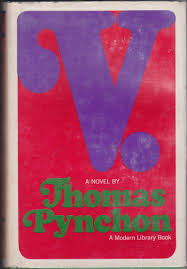
A New Essay on the Schlemiel in Thomas Pynchon’s “V” for Berfrois

unknown-2

As one can see from different Schlemiel Theory posts over the last two months, I have been writing different motifs in the fiction of the great American writer Thomas Pynchon (on the “fat Jew,” “Lardass Levine,” in his short story, “Little Rain,” on Aryan Bikers and Stoner Schlemiels in his book Inherent Vice,  and on his treatment of sloth, slowness, and schlemiels in his Slow Learner collection).   Building on my research into Pynchon’s work, I have recently published one of two parts of an essay on the schlemiel in Thomas Pynchon’s V for Berfrois.    

Click here to take a look at the new essay.

The second installment will be in before the end of January.  I will post it here when it is published.

Despite all the stumbling blocks in my way and bananas I slip on, I will continue to research the schlemiel.   My goal has and continues to be to provide the most diverse and far reaching analysis on the schlemiel in the world.  My archive of essays, interviews, and guest posts that pertain to the schlemiel continues to grow and is the largest database on this character to date.

On a personal note, the research I have done on this character has awakened me to the fact that this character is more than a passing fad or minor character.  It’s comedy speaks to something that is widely shared and deeply human; something particular to Jewishness and something much more general and common to not just Americans but people around the world who speak in many different languages.

I hope you joy this essay and continue to support Schlemiel Theory.  Without you, none of this would be possible.


Menachem Feuer


Schlemiels Can’t Do Camp

unknown-2

At the end of my last blog post, I suggested the possibility of Jewish Camp.  But is that possible?  Aren’t the two mutually exclusive?  This is what Susan Sontag suggests when she argues that Jews and Homosexuals are the creators of two modern sensibilities that are at odds with each other: a moral and an aesthetic Camp sensibility.  And as I noted in my last post, Sontag thinks that one necessarily “neutralizes” the other: “Camp is solvent of morality.  It neutralizes moral indignation, sponsors playfulness”(“Notes on Camp,” 290).   Camp is all aesthetics, in other words, it is interested in play not moral seriousness.

Although the clash between ethics and aesthetics is nothing new – Plato, Kierkegaard, and Emmanuel Levinas all insist on the distinction – Sontag is introducing a nuanced reading of it, here.   Sontag’s distinction between a gay Camp sensibility and a Jewish moral sensibility (in modernity) suggests that Camp takes up the threads of aristoratic taste:

Aristocracy is a position vis-a-vis culture (as well as vis-a-vis power), and the history of Camp taste is part of the history of snob taste.  But since no aristocrats in the old sense exist today to sponsor special tastes, who is the bearer of this taste? Answer: an improvised self-selected class, mainly homosexuals, who constitute themselves as aristocrats of taste.  (290)

With this history in mind, I’d like to introduce a challenge and ask a question.

The schlemiel is a moral-aesthetic figure that, on the one hand, partakes in the moral sensibility Sontag thinks Jews used to legitimate their place in American and European culture; and, on the other hand, it also partakes in the aesthetic sensibility. But the key difference is that the schlemiel does not take its historical cure from “the history of snob taste.”  On the contrary, the schlemiel’s history is rooted in historical trauma and takes its lead – as Ruth Wisse argues – from Jewish “weakness” in the face of history.  Wise argues that it appeals to self-deprecation as a way of humoring this weakness.   It is not, by any means, aesthetic taste that one sees articulated in the schlemiel.  If anything, we see the failure and self-deprecation in the schlemiel character.  She doesn’t take on an aristocratic Camp sensibility.  It’s comedy doesn’t evince a dominant, playful sensibility.

Think, for instance, of Woody Allen or Larry David.  If anything, they deliberately put forth characters whose comedy is informed not by bad taste so much as a comedy of errors that belies a character who is, ultimately, good natured and moral.   Larry David’s portrayal of Bernie Sanders is a good example.


In the parody, the moral sensibility is mocked.  But it is central throughout.  Aesthetic play, as Sontag would say, isn’t the key feature.

That prompts the question: Can a Schlemiel do Camp?

One interesting possibility has come up recently, as I noted in my last post, with Transparent.

In an essay on the show for the Los Angeles Review of Books entitled “Transparent: A Guide to the Perplexed,” Jonathan  Freedman doesn’t mentioned camp once.  He sees it, rather, in terms of Diasporic Jewish identity which is constantly changing and morphing.

Lech lecha: you must wander, you must change. Both of these imperatives are deeply — one might even say constitutively — Jewish. The first manifests itself in the historical experience of Jews as an exilic or diasporic people. To be a bit tendentious about it, the Promised Land has long served as much as a promise as a land; at the time of Christ, the heyday of the Second Temple, for example, more Jews lived in the Nile Delta than in Biblical Palestine; and the phrase at the end of the Passover ceremony, “Next year in Jerusalem,” has resonated and continues to resonate as much in Minsk or Berlin or Los Angeles as it does in, well, Jerusalem. The diasporic heritage has been key to the cultural and economic success of Jews qua model minority — as traders or middlemen, as makers and remakers of the cultures of the lands into which we have passed: without us, could Donald Trump even have conceived of the word “schlonged”? But it also means that we diasporic Jews are really home nowhere, as reflected in the rootlessness of the Pfefferman family, where the family mansion passes from Mort to his daughter so that Tammy can redecorate it out of existence….As a wandering people, Jews have of course had to change as they moved from country to country, ghetto to citizenship, religious to assimilated, ghetto Jew to sabra, frum to modern, which raises and practically identifies the Jew with the perpetual questioning of identity that is a hallmark of modernity.

Freedman also points out how the identification of Jews with the feminine is noting new.  It has a history and even James Joyce subscribes to it:

The understanding of the male Jew as a woman — as a proto-transsexual — had radiated throughout culture. A somewhat unhinged but brilliant converted Jew, cultural critic Otto Weininger, spoke of the male Jew’s essentially female nature in 1901. In 1922, James Joyce’s Jewish half-protagonist in Ulysses, Leopold Bloom, is called “a finished example of the new womanly man.” Radiating out from such figures were identifications of Jewish men as women by medical professionals, chiefly in the cutting-edge medical research in 1920s and 1930s Germany.

It seems, for him, that the main focus of the show has to do with dealing with modernity in terms of identity issues and change.  Freedman seems to be telling us that the legacy of the effeminate Jew, it seems, is a part of that identity complex.

What is missing, however, in Freedman’s masterful account of the show, is a discussion of the moral sensibility.  How does it figure in this show?  Can it not be argued that Morton (Maura) Pfefferman character is playing a schlemiel?  After all, Joyce casts Bloom as a schlemiel and, to be sure, David Biale is correct in argue that most of the schlemiels we see in film are “sexual schlemiels.”  What is the moral undercurrent?  What does it mean for a schlemiel to grapple with sexual identity?  And how is this – as in many schlemiel tales, shows, and films – situated within the context of the family, the community?

This isn’t camp. And, based on this, one can argue that a schlemiel can’t do camp.  The schlemiel exposes a different sensibility that exists between a moral and aesthetic sensibility.  But this is not Camp aesthetics, as Sontag would understand it.  There is an aesthetics, a moral-asethetics, in this show.  There is moral conflict.  How do we articulate it? And what does it tell us about forces in American culture that Sontag may not have understood?  How can a reading of the schlemiel help us to understand a third kind of sensibility one that isn’t about the “aristocracy of taste” but about a struggle with modernity that is…shared…in common.  The schlemiel’s comic approach to transgender – at least in this show – may help us to understand how modern American Jews turn more to a moral-aesthetic sensibility to deal with the conflicts of modernity than to something solely aesthetic or solely moral.


Camp is a Solvent of Morality: Addressing Susan Sontag on Jewish & Gay Sensibilities

unknown-2

Today, on Facebook, I noticed that many colleagues – several who are professors of philosophy (Jewish, Continental, Modern, Feminist, etc) – were having a field day with the hashtag #goldenshowers (Twitter had hundreds of thousands of Tweets today with this hashtag).   In at least two of the discussions I saw, however, there was an argument about whether or not it is ethical to shame someone and whether it was right to pass on something that was most likely a rumor or lie.  (Even if the subject is Donald Trump; he is a human being like all of us and philosophical rules apply to all; no one is exempt from respecting the other.)  In both, there was a slight pause to consider the situation.  But that didn’t last for long: the arguments dropped and people kept on telling “pee” jokes.   Philosophical consistency was thrown to the winds.  The attitude was more or less justifying it all.  After all, why can’t philosophy professors have some fun?

Drawing on Susan Sontag, I would argue that what happened today was the ascendence of a camp sensibility in the public space.  But in doing so, it had to toss the moral sensibility to the winds.  In her essay, “Notes on Camp,” written in 1964, Sontag suggests that the representatives of the camp sensibility and the moral sensibility are homosexual’s and Jews respectively.   They – “Jewish moral seriousness” and “homosexual aestheticism and irony” – are the two “pioneering forces of modern sensibility”(Against Interpretation, 290).

Since I would like to argue that the Camp sensibility was ascendent today, a brief look at her genealogy and definitions of Camp and Moral seriousness would be helpful.

Sontag argues that Camp taste  sees itself in terms of “aristocracy.” Even though aristocrats died with the Middle Ages and the birth of the Modern Era, Sontag sees an important structural relation; namely, “snob taste”:

Aristocracy is a position vis-a-vis culture (as well as vis-a-vis power), and the history of Camp taste is part of the history of snob taste.  But since no aristocrats in the old sense exist today to sponsor special tastes, who is the bearer of this taste? Answer: an improvised self-selected class, mainly homosexuals, who constitute themselves as aristocrats of taste.  (290)

To argue her point, Sontag claims that a comparison and a distinction is in order between a Homosexual Camp Sensibility and a Jewish Moral Sensibility:

Not all liberals are Jews, but Jews have shown a peculiar affinity for liberal and reformist causes.  So, not all homosexuals have Camp taste.  But homosexuals, by and large, constitute the vanguard – and the most articulate audience – of Camp.  (290)

What she says we are certain of is that “Jews and homosexuals are the outstanding creative minorities in contemporary urban culture.”  What makes them special is that they are “pioneering forces.”  But they are at odds with each other.

While both use their sensibilities as a “gesture of self-legitimization,” “Camp taste…has something propagandistic about it.”  They both promote themselves.  But while “Jews have pinned their hopes for integrating into modern society on promoting the moral sense,” homosexuals “have pinned their integration into society by promoting the aesthetic sense”(290).

When taken together, however, there is a problem.   One, argues Sontag, dissolves the other:

Camp is solvent of morality.  It neutralizes moral indignation, sponsors playfulness.   (290)

Drawing on Sontag, one could argue that the Camp sensibility, which revels in playfulness and irony, disregarded and “neutralized moral indignation” today.  It gave people permission to disregard shame and to engage in something aesthetic: adding endless ironic expressions to Facebook threads and Twitter Feeds.

Sontag’s first husband, Philp Rieff, may have encouraged her to pursue this kind of tension between the moral and the aesthetic.  (See his book: The Jew of Culture: Freud, Moses, and Modernity).

What I find most fascinating about today’s situation is that of the many philosophy professors I know – in my little circle – who were justifying the aesthetic excesses, some were professors of Jewish philosophy.   Playing on Leo Strauss, perhaps one can say that they made the Jewish moral sensibility the handmaiden of the homosexual aesthetic sensibility.

What we need is a dialogue between the two. Something like we find in a show like Transparent.  The irony of Camp has its limits.   A thinker needs to find them.  Otherwise, the snobby jokes will displace the morally serious issues that haunt us each and every day. Perhaps, there is another possibility: a Jewish kind of camp.

….to be continued