
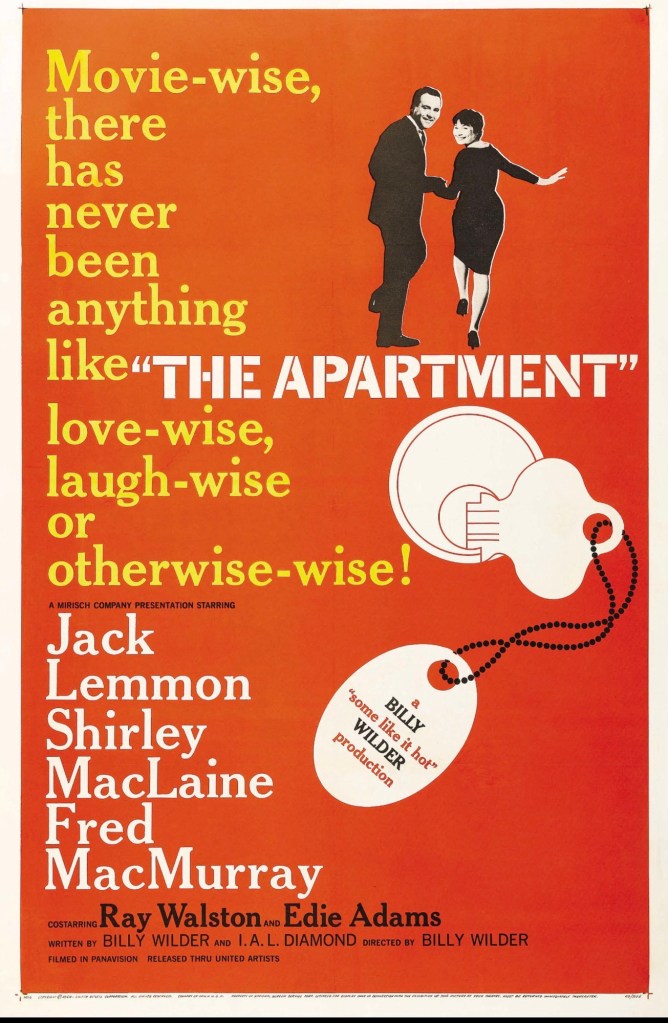
What happens when the schlemiel discovers that the only way to win is to stop playing the game?
Billy Wilder’s The Apartment (1960) is one of the great American comedies about failure, humiliation, and the strange dignity of the schlemiel. But beneath its romantic comedy lies something darker: a portrait of a world in which success requires the surrender of one’s dignity, and where the person who finally says no becomes, paradoxically, the only person capable of saying yes to life.
Jack Lemmon’s C.C. Baxter is an insurance clerk who believes in the American Dream. He works hard, follows orders, and lends his apartment to his superiors for their extramarital affairs, hoping that his willingness to accommodate their desires will lead to his own success. And, in a sense, it does. Baxter receives promotions. But the higher he climbs, the more he loses himself. His success is inseparable from his humiliation.
This is what makes Baxter such a fascinating schlemiel. His foolishness isn’t simply that he fails to understand the world. It is that he understands its rules all too well and mistakenly believes that playing by them will make him happy. His apartment becomes a metaphor for his alienation: everyone else seems to enjoy his life except him. The schlemiel, who traditionally seems out of place in the world, discovers that even his own home no longer belongs to him.
In Ruth Wisse’s The Schlemiel as Modern Hero, the schlemiel’s apparent defeat can become an ironic moral victory. Wilder gives this paradox a distinctly American, corporate twist. Baxter’s real victory comes not through another promotion but through his refusal to continue participating in a corrupt system. When he finally returns the key to his boss and walks away, he exchanges professional success for something far more elusive: dignity.
But we should not mistake this refusal for a simple triumph of innocence. Baxter isn’t merely the victim of a cruel world. He has helped sustain it. He has traded his privacy, his self-respect, and even his concern for others for the possibility of advancement. In this sense, Wilder’s schlemiel is also a critique of the modern individual who mistakes accommodation for freedom. Baxter is not outside the system, as the traditional schlemiel so often seems to be. He is inside it, desperately trying to belong.
What changes Baxter is not simply his recognition that his bosses are corrupt. He already knows that. What changes him is his encounter with Fran Kubelik (Shirley MacLaine), whose suffering interrupts his calculations. Her suicide attempt makes visible the human cost of the arrangement he has helped maintain. Suddenly, the question is no longer how to get ahead but how to respond to another human being. In this moment, Wilder brings the schlemiel close to an ethical insight: responsibility begins where self-interest ends.
There is something deeply Jewish about this reversal, even though Baxter’s Jewishness is not established by the film. The schlemiel’s moral significance has often rested in his inability—or refusal—to conform to a world governed by power, calculation, and instrumental reason. But Baxter must learn this refusal. His innocence is not something he simply possesses. It emerges through disappointment, complicity, and the painful discovery that success without responsibility is another form of failure.
Wilder also gives this transformation a remarkable visual expression. The enormous insurance office, with its seemingly endless rows of desks, reduces individuals to interchangeable parts of a machine. Baxter’s apartment, meanwhile, is supposed to represent the private refuge of the individual. Yet it has been colonized by the very corporate hierarchy from which he seeks escape. His tragedy is that there is no longer any distinction between work and home, ambition and intimacy, public advancement and private degradation. His bosses occupy his apartment just as their values occupy his imagination.
And then there is the famous broken compact mirror belonging to Fran. Baxter recognizes it as the mirror he had seen in the hands of his boss, Mr. Sheldrake. The object reveals the truth of their relationship without a word being spoken. More importantly, the broken mirror becomes a fitting symbol for Wilder’s universe: people see themselves through fractured images, measuring their worth through the distorted reflections offered by others. Fran, like Baxter, has allowed someone else’s promises to determine her sense of possibility.
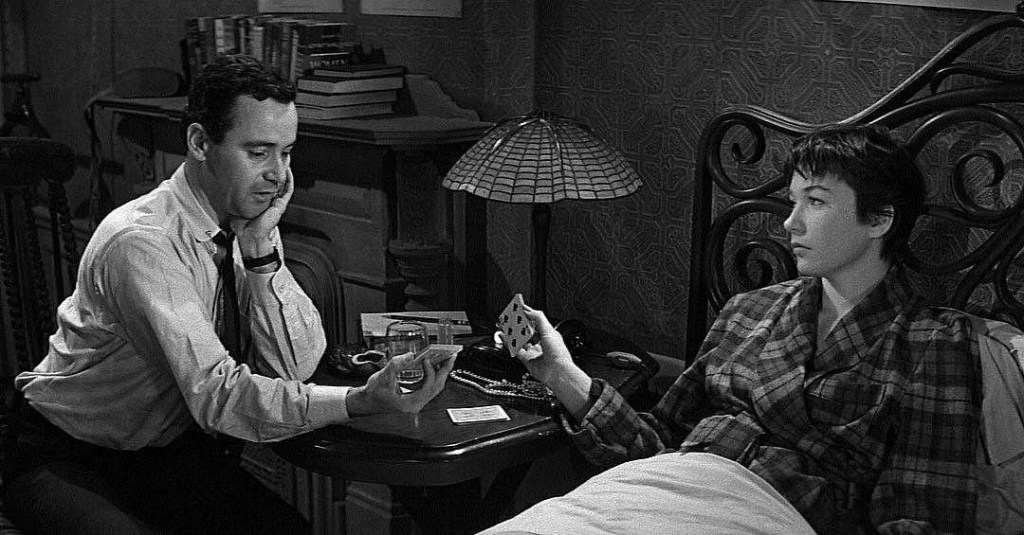
The final scene is therefore more radical than it first appears. Fran’s famous “Shut up and deal” refuses the sentimental resolution we might expect from a Hollywood romance. There is no grand declaration, no assurance that life will suddenly become perfect. Instead, there is a card game, an ordinary gesture, and the possibility of a relationship freed from manipulation. They are still playing a game, but it is no longer the corporate game in which one person’s success requires another person’s humiliation.
The schlemiel doesn’t triumph by becoming a winner. He triumphs by discovering that the terms of winning were wrong in the first place.
This is the irony at the heart of Wilder’s comedy. Baxter becomes a mensch precisely when he stops trying to become somebody. And perhaps this is what makes The Apartment such an enduring schlemiel comedy: its deepest hope is not that the fool will finally conquer the world, but that he will find the courage to stop surrendering himself to it. He
The question of victory also connects to two earlier Schlemiel Theory essays. In Freedom, Comedy, and the Inversion of Fate, I explored how the schlemiel’s relationship to failure can reverse our conventional understanding of freedom. In The Schlemiel as ‘Essentially…Existential’, I considered the schlemiel’s peculiar relationship to existence itself. Baxter brings these concerns together. His freedom does not emerge from mastering circumstances but from changing his relationship to them. The world hasn’t suddenly become just. Rather, Baxter has stopped accepting its judgment as the final measure of his existence.
There is, however, a final irony. Wilder allows his schlemiel something that many literary schlemiels never receive: the possibility of reciprocal love. Baxter doesn’t merely preserve his dignity in defeat; Fran comes back to him. This raises a question about the Americanization of the schlemiel. Does Hollywood need to reward its fools in order to make their failures bearable? Or does Wilder give us something more interesting: a comic ending in which happiness becomes possible only after the hero abandons his fantasy of success?
Perhaps Baxter’s greatest accomplishment is that he finally learns to inhabit his own apartment. He gets his key back, but more importantly, he gets himself back.
And what could be more schlemiel-like than discovering that the whole world was never worth the price of admission?
What happens when the schlemiel discovers that the only way to win is to stop playing the game?
Watch: The Apartment (1960)
Watch The Apartment (1960) trailer on YouTube
Billy Wilder, director. Starring Jack Lemmon, Shirley MacLaine, and Fred MacMurray.
.

