
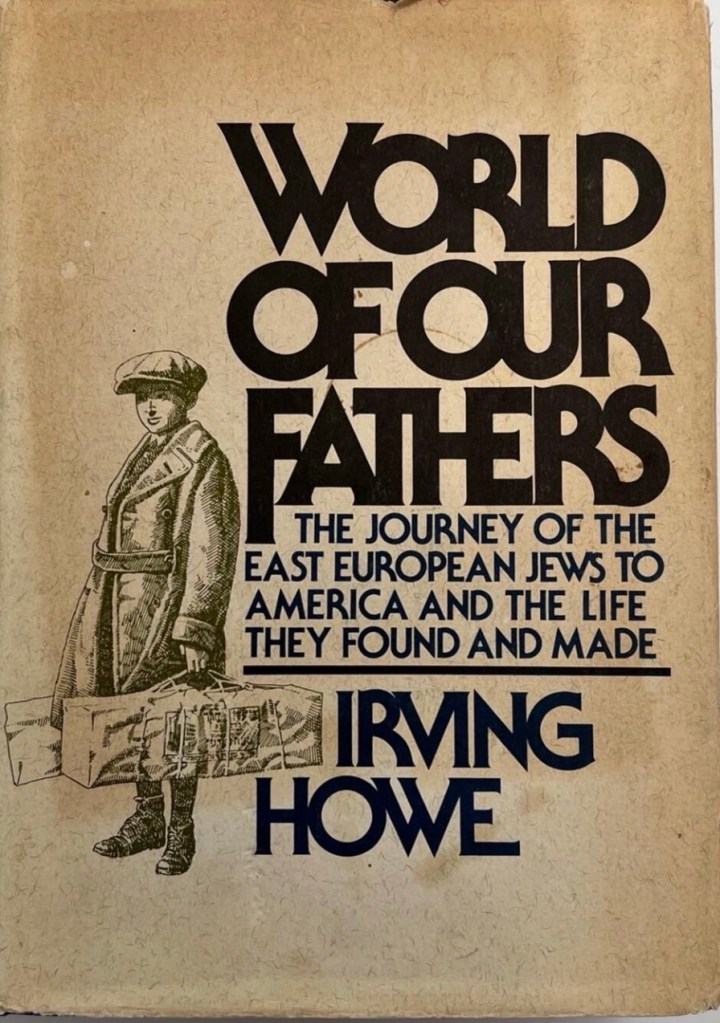
On the 50th anniversary of Irving Howe’s World of Our Fathers (1976–2026)
In 1976, Irving Howe published World of Our Fathers, one of the most important accounts of the Eastern European Jewish immigrant experience in America. Fifty years later, the book remains a monumental work of social and cultural history. But what makes it especially compelling today is not simply its account of the Jewish immigrants who came to America, built communities, organized unions, embraced socialism, and transformed American Jewish life. It is Howe’s attempt to preserve something that history, assimilation, and the Holocaust had threatened to erase: a Jewish sensibility, a way of looking at the world that was deeply informed by suffering, irony, compassion, and an abiding suspicion of power.
For Howe, this world was not simply the world of his fathers. It was a world that was already disappearing when he began writing about it. And what makes his project so fascinating is that he wanted to rescue this world without romanticizing it. As Leon Wieseltier noted in his 1976 review of the book, Howe’s account was remarkable for its resistance to sentimentality. His was a history of the ordinary Jew, the immigrant, the worker, the intellectual, and the kleine mentshele (the little man), who struggled to make a life in America.
But what happens when the little man becomes successful? What happens when the world that gave birth to him disappears? And what happens to the Jewish humor that once made it possible to live in that world?
These questions, I would argue, are at the heart of Howe’s project. They are also central to the schlemiel tradition.
From the World of Our Fathers to the World of the Schlemiel
In my earlier essay, “Irving Howe, Jewishness, and the Schlemiel – Take 1,” I noted that Howe’s relationship to Jewishness was deeply informed by his sense that the Jewish immigrant world was vanishing. For Howe, Jewish identity was not reducible to religion, nationalism, or political commitment. It was something more elusive, something that emerged from the everyday experiences of Jews who lived between different worlds.
In World of Our Fathers, Howe reconstructs the Jewish immigrant experience through the Lower East Side, its tenements, Yiddish newspapers, political movements, synagogues, theaters, and literary culture. The book follows the transformation of Eastern European Jews into American Jews, a process that brought extraordinary opportunities but also threatened the cultural world that had sustained Jewish life for generations.
The irony is that the very success of the Jewish immigrant experience contributed to the disappearance of the world that Howe wanted to preserve. The movement from the tenement to the suburb, from Yiddish to English, and from marginality to middle-class respectability was both a triumph and a loss.
But what, exactly, was lost?
In two essays I wrote on Howe and Eliezer Greenberg’s defense of Yiddish literature—“The Writers of Sweetness,” Part I and Part II—I explored their argument that Yiddish literature offered an alternative to the Western obsession with heroism, power, and historical greatness.
For Howe and Greenberg, the Yiddish writer was interested in the ordinary Jew who struggled, failed, laughed, and survived. This character was not the conquering hero of Western literature. He was often a schlemiel, a figure whose apparent weakness disclosed a different kind of strength.
The schlemiel’s greatness was not found in his ability to master history but in his refusal to let history have the final word.
And this is precisely what makes Howe’s World of Our Fathers so interesting. Although it is a work of history, its deepest moral sympathies are often with those who do not make history in the conventional sense. The ordinary Jewish immigrant may not conquer the world, but through language, humor, argument, and community, he finds a way to live in it.
The Paradox of Jewish Success
In “Irving Howe, Jewishness, and the Schlemiel – Take 2,” I explored Howe’s identification with Saul Bellow’s understanding of Jewish humor. For Bellow, Jewish humor brings laughter into an uneasy relationship with trembling. Howe recognized something deeply Jewish in this relationship because it refused to separate comedy from historical suffering.
This tension is important for understanding World of Our Fathers. The immigrant Jews who came to America did not simply abandon their past. They carried its memories, habits, fears, and forms of humor into a new world. But their children and grandchildren inherited these things differently. What had once been lived experience gradually became memory, literature, theater, and eventually popular culture.
In his introduction to Jewish American Stories (1977), Howe worried that Jewish writers were losing the shared experiences that had made Jewish literature possible. As I noted in my earlier essays, he wondered whether Jewishness could survive when it was no longer rooted in a distinctive communal life.
This question becomes even more pressing fifty years after World of Our Fathers. Jewish Americans have achieved levels of social, economic, and cultural success that would have astonished many of their immigrant ancestors. Yet the disappearance of Yiddish as an everyday language and the weakening of historical memory have made the world Howe described increasingly distant.
The schlemiel, however, has not disappeared. He continues to appear in Jewish-American literature, television, film, and comedy. But is this the same schlemiel who once inhabited the Yiddish world? Or has he become a distinctly American character whose Jewish origins are increasingly difficult to recognize?
Perhaps the schlemiel survives precisely because Jewish success never completely resolves the question of Jewish belonging.
Laughter, History, and the Holocaust
One of Howe’s greatest insights was that Jewish humor could never be separated entirely from Jewish history. In my essay, “Laughter Through Tears or Tears Through Laughter? Irving Howe and Ruth Wisse’s Dialogue over Sholem Aleichem’s Humor,” I examined Howe’s resistance to sentimental interpretations of Sholem Aleichem.
For Howe, Sholem Aleichem was not simply a writer who made Jews laugh at their misfortunes. His humor was darker and more complicated. It disclosed the vulnerability of Jewish existence while refusing to surrender entirely to despair.
This understanding of Jewish humor is inseparable from Howe’s reflections on the Holocaust. In “Jewishness, the Holocaust, and History,” I discussed Howe’s realization that his earlier Marxist categories were inadequate to the historical and moral catastrophe of the destruction of European Jewry.
Howe also challenged Jean-Paul Sartre’s tendency to define Jewish identity primarily through the antisemitic gaze. For Howe, Jews were not merely the products of persecution. They possessed a history, a culture, a literature, and forms of collective life that could not be reduced to the hostility of others.
World of Our Fathers can be read as an extended response to this problem. Howe wanted to recover Jewish life as something more than a history of Jewish suffering. He wanted to show how Jews created a world of their own, even while living in conditions of marginality and exclusion.
And yet the Holocaust casts a shadow over this project. The Eastern European world from which the immigrants came had been largely destroyed. The American world they created was also undergoing profound transformation. Howe was therefore writing about a world that had disappeared twice: once through catastrophe and again through assimilation.
The World of Our Fathers in 2026
Fifty years after its publication, World of Our Fathers speaks to a Jewish-American community confronting questions that Howe could hardly have anticipated in their present form.
The resurgence of antisemitism, especially in cities such as New York, has challenged the assumption that Jewish integration and success would eventually render Jewish difference unproblematic. The city that once represented the promise of Jewish immigrant life has become, once again, a place where questions of Jewish visibility, vulnerability, and belonging are impossible to ignore.
This does not mean that contemporary Jewish Americans inhabit the same world as the immigrants Howe described. They do not. Nor should we romanticize the poverty, exclusion, and powerlessness that shaped the lives of earlier generations. But the return of these questions reminds us that Jewish history cannot be understood as a simple movement from persecution to security, from marginality to acceptance.
There is another tension here, one that Howe and Greenberg anticipated in their reflections on Yiddish literature. The schlemiel represents a Jewish suspicion of power, but Jewish history also demonstrates the necessity of political agency, collective defense, and the ability to act in the world.
How does one preserve the compassion of the powerless without idealizing powerlessness itself? How does one retain the ironic perspective of the schlemiel while recognizing the historical necessity of Jewish self-determination?
These are not questions that can be resolved by choosing either the schlemiel or the hero. They concern the difficult relationship between vulnerability and responsibility, between Jewish particularity and universal ethics.
Leaving the Sect, Returning to the Fathers
In “Leaving the Sect: Reflections on Irving Howe’s Portrayal of His Intellectual Journey Into the World,” I explored Howe’s account of his departure from the ideological certainties of his youthful Trotskyism. What interested me was how literature helped Howe move beyond the closed world of political ideology and rediscover the complexity of ordinary human experience.
His turn toward Yiddish literature was part of this movement. It was not simply a return to his origins. It was a discovery that the world of his fathers contained forms of wisdom that his earlier political commitments had overlooked.
Howe’s intellectual journey was, in this sense, deeply ironic. The young radical who wanted to transform history eventually became the historian of a Jewish world whose greatest literary figures often questioned the very desire to master history.
In his intellectual autobiography, A Margin of Hope, Howe eventually entertained the possibility of a skeptical utopia. Perhaps something similar can be found in his relationship to the schlemiel. The schlemiel is neither a revolutionary nor a cynic. He inhabits a world that continually disappoints him, yet he refuses to give up on it entirely.
And perhaps this is what Howe wanted to rescue from the world of his fathers: not merely its politics, its language, or its institutions, but its capacity to live with disappointment without surrendering the possibility of hope.
Fifty Years Later: Is the World of Our Fathers Really Gone?
When World of Our Fathers appeared in 1976, Howe was looking backward at a Jewish world that had already undergone a profound transformation. Fifty years later, we are looking backward at Howe himself, at the Jewish intellectual culture he represented, and at the world he struggled to preserve.
But perhaps the most interesting question is whether Howe’s project was ever simply about the past.
His defense of Yiddish literature, his fascination with Sholem Aleichem, his identification with Bellow, and his sympathy for the schlemiel all suggest that he believed the world of his fathers had something to teach the modern world. Its humor challenged the pretensions of power. Its literature gave dignity to the ordinary person. Its skepticism resisted ideological certainty. And its compassion reminded readers that weakness and failure need not be the final measure of a human being.
To be sure, the world Howe described cannot be recovered in its original form. The Lower East Side is no longer the center of American Jewish life, Yiddish is no longer the language of most American Jews, and the political culture of the Jewish immigrant left has largely disappeared.
But perhaps the question is not whether we can return to the world of our fathers. Perhaps it is whether we can inherit something from that world without turning it into nostalgia.
The schlemiel, after all, never promises a return to a lost world. He survives by inhabiting the world as it is, with all its contradictions, disappointments, and absurdities. He laughs, but his laughter is troubled. He hopes, but his hope is never innocent of history.
Fifty years after World of Our Fathers, this may be Irving Howe’s most important legacy. He reminds us that Jewishness is not simply something to be preserved in archives, books, or museums. It is also a way of responding to the world, a way of remembering those whom history has forgotten, and a way of finding humanity where the world sees only weakness.
The world of our fathers may be gone. But the questions it posed—and the laughter that accompanied them—have not disappeared.
And perhaps, so long as there is a schlemiel to remind us of this, they never will.

