Reflections of a Jewish-American Dreamer on “Shlemiel” – a Documentary

528020_10151563961785506_208405394_n-1

Words cannot express the honor and gratitude I have for Chad Derrick who decided a few years ago to film my life and my Jewish-American story.  He patiently followed me around with a camera for a few years and listened to my story.  He edited hundreds of hours of film to distill it to its essential moments.  It is a wonderful work of cinema verite style that, without a doubt, does justice to at least one part of my life and struggles with being an American-Jew.

I’m really excited to be showing the film Shlemiel (directed by Chad Derrick) in the United States.  It has been shown in Toronto and in Montreal, but it has not been shown in the country I was born and raised in.   And this is significant since this country, so to speak, nurtured this schlemiel.  Living in the Adirondack’s in a small rural Jewish community, with a father who dreamed big and crashed hard, I learned to dream.  It was here that I learned how, as I say at the beginning of the film, “a schlemiel is a dreamer and his dreams don’t match up with reality.”

On my way to The Isabella Freedman Jewish Retreat Center in Falls Village, Connecticut – where I will be making the first screening of the documentary to an American audience – I have decided to stop off in my hometown Gloversville, New York and to reflect on who I am and what this film discloses about my journey – the journey of a wayward, dreaming Jewish-American schlemiel.

A lot of my story is rooted in this area.  As you can see from the trailer in this post, the documentary is interested in how and why I became a religious Jew and how and why I decided to create a band – named with Men With Babies – as a way of communicating and celebrating this new found Jewishness.  I say “new found” as I was not raised as a religious Jew.  I was born in a hospital up the road from where I grew up, which was named after a wealthy Jew in the area by the name of Nathan Littauer.  I did have a Brit Milah (a circumcision) with a Rabbi and Mohel (who does the circumcision).  And I was given a Hebrew name: Menachem Menkah (it was the name of my grandfather, father’s side, who died before I was born).  But that, together with several years after school, at the Lucius Littauer Jewish Community Hebrew school (until I was thirteen), and my bar-Mitzvah were the only Jewishness I had.  And it didn’t last.  I didn’t go by my Hebrew name and all of my Hebrew learning was not related to my life.  (My parents never told me what it meant to be Jewish. We just did it as a matter of course.)

All of my friends knew me as “Matt” or “Feuer” (mispronounced as ‘fewer’ rather than the Germanic pronunciation Foyer – which means ‘fire’).  No matter what I did, and no matter how well I performed in sports, school, or at parties, I always thought of myself as “less than” (fewer) I could be.  And that came from my sense of being an American, not a Jew.

Like many Americans from the area, I was raised on little league baseball games, football, ice cream socials, clam bakes, keg parties, hunting, fishing, and the wind that blows down from the Adirondack mountains every day into the valley where I live.  Like many people in my town, I was raised to be kind and fun-loving.  I spent a lot of time on the Sacandaga Lake and, as a teenager I used to ride a “three-wheeler” through the Adirondacks.

My American side conflicted with my Jewish side and the difference between the two often prompted me to question who I was.  To begin with, both of my parents were from New York City and were, from my perspective, out of place in upstate New York.  My father didn’t fish, hunt, or participate in coaching a sport team.  He was an intellectual and a businessman.  And my mother tried hard to adapt, and though she cried many times for having to leave the city, she did succeed in being much like the other soccer moms in the area.  But my mother’s efforts were not enough.  And my father’s preoccupations led me away from my family and my tradition.   They led me to find a group of friends who, like me, were trying to figure out what it meant to be an American.

But, to be sure, what really drove me to my friends was not simply my father’s non-interest in doing what my friend’s fathers did.  My father’s life was complicated by lots of trauma, family feuding over the leather business, and mania.  (As you can see from these two hyperlinks, I have written about this topic in the blog, already.)  From what I have already written, you can see that my father was a person with big dreams who had real possibilities that were given to him and taken away.  His brilliance was too much for this small town and, unfortunately, I was often embarrassed when I found out, through my friends or other people, that rumors were going around town that my father had been put in a metal hospital or jail, or that he was going around town saying or doing crazy things.

What I haven’t mentioned about my father’s story is the fact that, while in high school, when he had many manic episodes, he took an interest in Kabbalah and Jewish mysticism.  He bought a full-volume set of The Zohar and made several trips to New York City to visit with Rabbi Rabbi Berg and his newfangled Kabbalah Center (which today attracts many Hollywood stars).  My father’s mania had a real source which was based on hateful things that were done to him by his own family, making money and spending it all, and by virtue of a genetic condition. But the interest in Kabbalah didn’t help.  To be sure, it made his psychosis more intense.

While this was going on, I kept one eye open on religion and the other on my friends.  To be sure, the more trouble my father got in and the more mystical he became, the more I was driven to my friends and to a desire to leave the house.  And when the opportunity came to leave came, I took it up with a passion.  In truth, the real problem was no longer simply my father, I started despising my home town.  I felt people were to narrow minded.  This came to me while reading books in my backroom (I had to hide this from my friends) and by way of following the Grateful Dead.  Seeing them in concert for the first time, in the early 90s, changed my perspective on a lot of things.

I started becoming more spiritual.  And, after a few shows on the east and west coast, I decided to read some of Rabbi Berg’s books and, for the first time, I listened closely to my father’s psychosis and traveled with him on several of his manic episodes.  Reading literature and philosophy, I thought that it would be better to let my father be and to experience him as I would experience a novel.  In a way, I felt like a Sancho Panza and he felt like a Don Quixote.  And so much of what he was doing was Jewish – a strange continent for an American-Jew who had opted to be an American first.  As I went along with him, I started drifting away from my town and my life.  I wanted a mystical experience.  I dreamt of it.  And I felt Kabbalah, as lived by my father, could lead the way.

My father was so full of life and insight.  Everything he did was by virtue of chance.  I felt as if I was living a Paul Auster novel and my father was the main character.  His playing with chance led him to Washington, DC where he acted ‘as if’ he was going to save the country and talk to the President.  On the way to the White House, we stopped off at the Washington Hilton.  He went down to the lobby and saw Nietzsche’s Beyond Good and Evil.  He opened the book, read an aphorism that dealt with going beyond dichotomy, and charged into the hotel restaurant.  He ordered a table as if he was a dignitary.  We sat down and father asked for menus.  Before he could look at the menu, Dan Rather passed by and father yelled out “Dan!” Rather turned to my father, said, “Yes, how can I help you?” And from there my father had a discussion about world affairs and his solutions for at least ten minutes.  At the moment when my father presented a wild idea, Rather was turned off and left the table. My father felt something “was wrong,” and left immediately thereafter.

When we went upstairs, he said he had to make a phone call to the doctor that delivered me (a Dr. Woolsey).  He acted as if he had him on the phone, he turned to me, and said “Dr. Woolsey just told me the truth…You are not my son.  You are my brother’s son.  You are an imposter.”  This talk, which I had never heard before, threw me off guard.  I was confused.  And in the midst of this, my father stormed out of the room.  I followed after him.  He said we must leave DC.  We are being followed.    What ensued was a wild imaginary goose-chase. My father swerved in and out of traffic as we sped off to New York City (where my mother, at that time, was visiting).  As he swerved, he read license plates and did letter-number combinations.  He translated these into messages about what was going on and what we should do.

In the midst of this madness, he said that we must pull over into a rest-stop.  We went inside, and my father told me, “There he is!” “Who,” I asked.  “Just come with me,” he said.  We went over to a man in overalls and my father stared him directly in his eyes.  He asked him, “What do you do for a living?” And the man replied, “I am a ‘tree-whacker.”  My father rejoined: “You cut down trees, correct?” “Yes,” said the man. After saying this my father said, “There, you see, he was trying to cut us down. Its code.”

All of this relates to a sad story that goes back to when I was a ten-year-old boy.  My father had, for years, thought that he was being stalked by his brother’s mafia men since my father had a real law suit against them.  His brothers were scared and bought off many lawyers, apparently.  In any case, my father’s first manic episode came after a new car he had bought, in celebration of the case actually hitting the courts, came up.

The car had a tape deck. And I wanted to hear Grease (the musical). But my father said I couldn’t until we left NYC for Gloversville.  On the way, I put the tape in and immediately thereafter the car set on fire.  We pulled over.  And the car went up in flames on the side of the New York State Thruway. This led to much paranoia and speculation.  It also led to my father’s madness and gave me my first experience of my father’s madness as a child.  It also led me to meet with a mafia boss who confirmed that a ‘hit’ was made on my family (mind you, I was ten) and that he would, from then on, protect us.  I’d like to share more but I’ll save that for another blog.

Needless to say, these experiences all formed a backdrop for my “return” to Judaism.  After my father’s breakdown in DC, I no longer felt I could go to him to learn about mysticism or Judaism.  It was a wake up call of sorts to find things out for myself.  And I did.

But I took a big detour by way of my studies in Comparative Literature and Philosophy.  I took a big detour by way of trying to live a life in total denial of God, a life of pure experience informed by art, literature, and relationships.  All of this led to my own breakdown of sorts.  It also led me back to this, my hometown.

I felt like I had to return to my roots: my American roots and my Jewish roots.  And that led to a process in which I went to Yeshiva, became religious, married, and had two wonderful little children.  Shlemiel documents this transition, but it also shows how, over the last five years, my life has changed.  My struggle to figure out what it means to be an American-Jew, I feel, is ongoing.  It has brought me back to my home town, it brought me into a music project, and it has brought me into this, my schlemiel project.

Today, as I write this, I realize that I was right to say that a schlemiel is a “dreamer and his dreams don’t match up with reality.”  I have no problem saying that I have played the schlemiel. And though it may be a derogatory term for some people I know, it need not be.  It was the German-Jewish tradition that found fault in the schlemiel and were embarrassed by the schlemiel (depicting him as a backwards, Eastern-European shtetl type). They were interested in reality not dreams. But the Eastern European schlemiel is a different story; in him we find a tension between hope and skepticism; in him we find something sad about history and life and yet also something very optimistic and good.

I’ll admit that my dreams don’t match up with reality and they haven’t for a while. But the key to all of this doesn’t have to do with my way of thinking.  No.  It has to do with the my specific history and with my grappling with Jewish-American identity.  In this struggle, I cannot help being the schlemiel.  My dream of being a Jew is interrupted by my American dream.  And these dreams are caught up with unredeemed fragments of history and reality.  Hopefully, someday they will find a better match, but until then I remain – sincerely yours – a schlemiel.  My dreams still don’t match up with reality.

But I can still dream.  Here’s a clip from a film produced by Samuel Goldwyn, my uncle, who once passed through Gloversville as he traveled to Hollywood.  He, a Jewish-American like me, also had a dream.  And it started here, in Gloversville. Thank you Chad Derrick, for making this dream a filmic reality!

Irving Howe, Jewishness, and the Schlemiel – Take 1

DownloadedFile

Irving Howe is most well known for being one of the “New York Intellectuals.”  He was born in the Bronx in 1920 to immigrant parents.  His name at birth was Irving Horenstein.  Like many children of immigrants, he went to City College in New York and there he met other “New York intellectuals” such as Irving Kristol and Daniel Bell.  Howe was interested in radical politics and literature.  He had written in both fields and had gained acclaim in each.

But as Leon Wieseltier claimed in his 1993 New York Times piece entitled “Remembering Irving Howe,” “What kept his eyes and his heart open, however, was not poltics.  It was literature.  He loved nothing more.”  Wieseltier points out that Howe’s approach to literature was eclectic.  He turned to literature to “learn about life, but the life about which he most wished to learn was the hard and lumpy common one.”  Nonetheless, Howe “despises proletarian art, and the ways in which populism and mass politics tortured the writer.”  On the other hand, he also couldn’t stand “art’s high priests.”  Given this kind of taste, Wieseltier tells us that “Irving’s greatest thrill was high art that felt democratic.”

After noting this, Wieseltier moves to Howe’s taste for Yiddish and his efforts to save a dying language by way of criticism, edited editions, and writing.  What is so interesting about this move is that Wieseltier leaves a gap between Howe’s love for “high art that felt democratic” and Howe’s love for a dying language.  Wieseltier, nonetheless, does give us a clue since he briefly focuses on Howe’s sense of what constitutes Jewishness.   I see this as a clue because Howe’s interest in Yiddish literature and Jewish American literature was primarily driven by his own personal sense of what Jewishness is or better yet was.  Jewishness, to be sure, pained Howe because he saw it as dying with post-WWII America.

As Wieseltier notes:

for decades Irving threw himself into the task of rescue, editing and introducing and writing about what he made famous as the “world of our fathers.”  He was without nostalgia, but he was not without grief.  I cannot count the the number of breakfasts at Leo’s on East 86th Street that were take up with the disappearance of that world, with the decline of secular Jewishness.

In his introduction to Jewish American Stories, which he edited and published in 1977, Howe delves into the meaning of Jewishness by way of Jewish-American literature.  Given Wieseltier’s words, we can truly see that this compilation looks to rescue that ‘world of our fathers” by showing that Howe is not alone in his efforts.  To be sure, Howe draws out a host of authors which includes Saul Bellow, Norman Mailer, Philip Roth, Bernard Malamud, I.B. Singer, Stanley Elkin, etc.  For him, these writers write in the wake of immigrant Jewishness.   They are writers who live in the period of assimilation and post assimilation.  What, he wonders, will be the “foundation” for Jewishness after Jewish life has migrated from the city to the suburbs and beyond.  How long will this “foundation” show in the work of later Jewish-American writers?

Taking the perspective of a historical materialist, Howe initially situates Jewishness in different places.  Writing of “some writers in this book, like Gilbert Rogin, Paul Goodman, and Daniel Fuchs,” Howe notes that “what comes through, as pathos, comedy, or both, is the continued power of origins, the ineradicable stamp of New York or Chicago slums, even upon grandsons and granddaughters who  may never have lived in or seen them” (6).

Out of this general reflection, Howe tries to derive some particulars about Judaism:

But is that not an essential aspect of Jewish experience? – the way that past grips and forms us, and will not allow us to escape even when we desperately want to.  Or the way we come to feel the anxiety of loss, a depression of abandonment, even when we do escape. (6)

The last point is autobiographical.  Howe does see a link between his Jewishness and his geographical roots.  Citing Eudora Welty essay entitled “Place in Fiction,” Howe drives the relation of place to Jewish identity to its limit by saying that all literature is related to place:

“The truth is, fiction depends for its life on place.  Location is the crossroads of circumstance, the proving ground of ‘What happened?  Who’s here?  Who’s coming?’ and that is the heart’s field.”

For “many Jewish writers,” notes Howe, “‘the heart’s field’ will forever be those gray packed streets, turbulent and smelly, which they have kept from childhood, holding them in memory long after the actuality has been transformed or erased”(7).

But Howe knew that although this emphasis on locale was important, it was not sufficient for explaining the uniqueness of Jewish-American literature – and Jewishness – in a post-assimilation American context.  Another element he looks to is the family.  He argues that while we see the individual stressed by Emerson, Thoreau, Whitman, Melville, Hemmingway, and Fitzgerald, we see the family (or struggles with the family) emphasized in Jewish-American literature.

After passionately arguing for the relevance of location and family, Howe testifies to the fact that, ultimately, Jewishness “suggests a certain vagueness.”  To be sure, he puts the word “Jewishness” in scare quotes and notes that “when one speaks of “Jewishness,” it is to invoke a spectrum of styles and symbols, a range of cultural memories, no longer as ordered or weighty as once they were yet still able to affect experience”(10).

And this fact is what astonishes Howe.  It also troubles him as he doesn’t know how long the awareness of Jewishness will last and have an impact on American Jews.  He notes that American Jews, in the 70s, did think of themselves as distinct and argues that there is a “persuasion remains that ‘we’ (whoever we may be, however defined or bound) must live with a sense of our differentness and perhaps draw some sustenance from it.”  Without this sense of “differentness,” without the “assumption that there is something distinctive in ‘Jewishness’, the standard for many to affirm or others to violate, the (Jewish) story would verge on incoherence”(10).

But this is a vague standard.  And Howe struggles to clarify it.  To this end, he cites himself, Osip Mandelstam, Harold Rosenberg, Saul Bellow, Issac Rosenfeld, and Phillip Rahv.  Each of these citations points out a unique aspect of Judaism.  Mandelstam says that the slightest hint of Judaism fills up an entire house and one’s life; Bellow points out that Jewishness is found in the intimate relation of laughter to trembling; Rosenberg notes that Jewishness is found in the possibility of linking a Jew with the “collective and individual experience of earlier Jews’; Rosenfeld notes that Jewishness is rooted in cultural and historical marginality; and Rahv notes that for a Jewish-American writer like Bernard Malamud, as opposed to Dostoevsky, suffering is not idealized; rather, “suffering is not what you are looking for but what you are likely to get.”

Howe, in contrast to them, notes that, for many post-assimilation Jewish writers, Jewishness has to do with endless self-questioning (even when things are ‘normal’): “They had achieved a ‘normal life’ in America, and for those with any taste for self-scrutiny, it was a life permanently beset by the question: who am I and why do I so declare myself?  To live with this problem in a state of useful discontent was perhaps what it now meant to be a Jew.”

Although Howe considers all of these views to be important and although he does think that Jewishness has to do with questioning who one is and why one would “declare” oneself a Jew, today, he laments the loss of a sense of tradition in today’s Jewish-American writers (that is, for him, in the 1970s). A “lapsed sense of tradition” won’t help or doesn’t help.  What he sees today are remnants of Jewishness which are not anchored in any historical memory or “felt” experience.  And this makes him worry since that historical sense and experience are related to a historical origin which, as we saw above, is linked to certain locales and experiences that are fading.

Howe ends his introduction in a pessimistic manner.  While he feels that “there remains, to be sure the problem of ‘Jewishness’, and the rewards and difficulties this definiton may bring us,” he notes that it “does not yield a thick enough sediment of felt life to enable a new outburst of writing about American Jews.”  Today, since the “felt life” is missing, much Jewish writing is a “matter of will or nerves, and not enough of shared experience.”

This claim, made in the late 1970s, finds interesting resonance in the schlemiel of today.  Did this character’s popularity emerge out of “will or nerves” and not “shared experience” or does the schlemiel and its popularity come from another source of experience?  I want to end this blog entry with this question and return to it.  It gives a lot of food for thought since there are Jewish American writers today like Shalom Auslander, Nathan Englander, and Gary Shteyngart (to name just a few) who draw on the schlemiel in their work and find this character to be vital.  In addition, we see this Jewish character is and has been prevalent in films, TV shows, and stand-up comedy as well.  But does its “Jewishness” remain?

Questions for Reflection: Is the fact of its popularity and its appeal to Jewishness a remnant of a dead past?  What experience does it draw on? And has the schlemiel become, as Daniel Itzkovitz has argued in an essay entitled “They are all Jews” the “everyman”?  If Itzkovitz is correct, was Howe right?  Has Jewishness passed into Americana?  Or is this only the case for Hollywood but not for the world of Jewish-American literature?  If there is a tradition of the schlemiel, what makes it Jewish?  And where does it live on?

Do you Hear Me? A Schlemiel’s Stuttering Elaboration of the Messianic in “Conversation in the Mountains” – Part I

images-2

The great thing about conversation is that, from time to time, we stumble across things that are transformational.  In the midst of all our babbling, something comes through.  The point is to listen closely for these moments.  And to find the moment we need to, so to speak, follow the movement.

In my last blog entry, I traced these movements which are, in Celan’s prose piece, repetitive.  In a Talmudic sense, all things must be repeated so as to understand where the lacunae (gaps) are in this or that phrase or expression.  For in looking at it again, we can see something or hear something we may have missed “at first glance.”  And, as I noted with respect to Celan’s “Conversation in the Mountains,” these repetitions are situated in conversation.

Between Klein and Gross, between the narrator and you, and between he and them, we hear many different voices.  Of the voices, the most important was the voice that distinguished the Jew from nature.  This voice points out a heterogeneity between them.  It also points out a difference between the Jew and the mystic who yearns for communion.  Celan is acutely aware of the fact that the mystic destroys language to arrive at some form of communion.  Celan, however, puts a limit on this by way of the stuttering between Klein and Gross.  And, nodding toward Jewishness, Celan points out when a Jew meets another Jew they can’t keep “quiet for long.”

After pointing out their acute relation to time as it relates to Klein and Gross’s alienation from nature (“have been and still are, even today, even here”), the narrator describes how things are simply next-to- each-other.  This description, itself, is repetitive and shows us a lack of one-ness between them and nature.  And this teaches us that the narrator errs on the side of Jewishness:

So there they are, the cousins.  ON the left, the turk’s-cap lily blooms, blooms wild, blooms, like nowhere else.  And on the right, corn-salad, and dianthus superbus, the maiden-pink, not far off.  But, they, those cousins, have no eyes, alas.  Or, more exactly: they have, even they have eyes, but with a veil hanging in front of them, no, not in front, behind them, a moveable veil.  (18)

But, more importantly, the narrator notes their blindness, which is a key feature of the schlemiel.  Everything they see is mediated by “the veil”; it spins “itself around the image and begets a child, half image, half veil.”  In other words, everything they see and say is childish (“half image, half veil”).

The narrator gives us a sense of how the reader may look at these schlemiels.  He likens them to these oddly named flowers: “poor lily, poor corn salad”(19).  He then goes on to note their language as, in some way, lacking:

No word has come to an end and no phrase, it is nothing but a pause, an empty space between words, a blank – you see the syllables stand around, waiting.  They are all tongue and mouth…(19)

It seems as if the narrator has a very negative reading of the way schlemiels “babble.”  He exclaims: “The windbags!  Even now, when their tongues scramble dumbly against their teeth.”  However, he notes that “they have something to say to each other.”  In other words, in the midst of all their babble, these schlemiels can show us or direct us toward something meaningful.  And that “something” is messianic.

The first words we hear from them work on two levels.  On the one hand, they are what we would expect of two Jews meeting in the mountains; on the other hand, it hints at something messianic:

‘You’ve come a long way, have come all the way here….’  

‘I have. I’ve come, like you.’

‘I know’

They have both come, in a messianic sense.  As is well known, the Messianic begins with the announcement of the Messiahs’s arrival.  It is announced by Eliyahu the Prophet.  The language used to describe the Messianic include much mention of his “coming” and “arrival.” Read in this sense, Celan seems to telling us that these are Schlemiels who announce themselves as Messiahs. But, in a veiled manner, they don’t quite understand what their “arrival” means.

What Celan does with this arrival is fascinating.  As I pointed out in the last blog, the conversation between Klein and Gross is characterized as repetitive in a Talmudic manner.  This is exactly what we see here.  Klein recounts to Gross what he sees of the earth and where he and Gross are at this moment and concludes that the earth is not for either he or Gross (it speaks an “alien” language) ; rather, they are for each other:

You know.  You know and see. The earth folded up here, folded once and twice and three times, and opened in the middle, and in the middle there is water, and the water is green…that this is the language that counts here…a language not for you or me – because, I ask you, for whom is it meant, the earth, not for you, I say, it meant, and not for me – a language, well, without I and without You, nothing but He, nothing but It, you understand…(20).

After saying this, something has been acknowledged and now the next step can be taken – a step toward the messianic coming (yet, within the context of alienated language and nature).  And, like many Jewish things, this comes in the form of a question:

‘I understand, I do.  After all, I’ve come a long way, I’ve come like you.’

‘I know.’

“You know and want to ask: And even so you’ve come all the way, come here, even so – why, and what for?’

To be sure, this question and its answer can and do serve as a marker distinguishing between Jews, Muslims, Christians, and Atheists.   But, for Celan, it distinguishes a Jewish poet; it is the mark of the schlemiel.

Why, and what for…Because I had to talk, maybe, to myself or to you, talk with my mouth and tongue, not just with my stick. Because to whom does it talk, my stick?  It talks to the stones, and the stones – to whom do they talk? (20).

The stones talk to “no-one” (niemand).  And this is a language that the Jewish poet doesn’t speak.  The schlemiel must speak with the other. This is the crux of the matter.  And this speech must recur over and over gain.  And the reason it must speak is because it gives the schlemiel a sense of who he or she is, what he or she is doing, and who she is speaking to.  Though seemingly simple, this gesture shows the deeply ethical and relational aspect of the schlemiel.  And this comes out in Klein’s words about God and hearing.

As we learn, the stick talks to “nobody and Nobody.” The latter Nobody troubles Klein the former (nature) does not.  He, that is Nobody, says: “Do you hear me?”  As a schlemiel, Klein responds to this voice and takes it on as his own.  And this brings us to the messianic moment, repeated and nuanced:

‘Do you hear me: he says – I know, cousin, I know… Do you hear me, he says, I’m here. I am here, I’ve come.  I’ve come with my stick, me and no other, me and not him, me with my hour, my undeserved hour, me who have been hit, who have not been hit, me with my memory, with my lack of memory, me, me, me’(20).

These lines are the testimony of a schlemiel who has come, but who can only say that he has come; and like Him, the schlemiel wants to be heard.  He echoes the “Do you hear me?” and he communicates it to Gross.

And this is the point.  He bears witness to the Gross (big) Other (with a big “O”), and to the (Klien) other (with the little “o”).  And he’s trying to figure out his relations to these others by way of repetition.  In this form, Celan gives a dignity to the schlemiel that the narrator notes, in the middle of the piece, is lacking.  He shows that the schlemiel is situated in an encounter with the other; and by putting the schlemiel in relation to the other, he, so to speak, revises the Messianic moment and the schlemiel.

In the next blog entry, I will look into Gross’s response to this testimony, this echo.  It repeats the messianic moment of coming which, for Celan, must be elaborated and re-elaborated.  And, here, this re-elaboration is unique for many reasons: it is not in poetry, it is tinged with the comic, and it is between schlemiels.

“Do you hear me?”

‘I Am Here, I’ve Come’: An Interpretation of Paul Celan’s “Conversation in the Mountains” – (Take 2)

220px-Chamisso_Peter_Schlemihl_1804

We like to repeat ourselves.  And oftentimes we forget what we said before and are reminded by our friends that “we already said that.” Nonetheless, people being people, we forget and do it again.  The people most susceptible to this blindness are older people.  However, sometimes repetitions – which are seemingly absent-minded – are full of implication and meaning.  And one of the advantages of conversation is that these meanings can be teased out; given that the person you are conversing with is compelling enough to do so.

As a child, I was privy to such conversations.  My father and his best friend, David Kaplan (a Jew who went from the streets of Brooklyn to the leather mills of Gloversville New York), used to have such conversations.  They were very repetitive but they were filled with meaning and implication.  David told us that he came from a line of magidim (story-tellers) and this is how they would speak.  After David died, it hit me that his style of speaking, which my father picked up on and practiced daily with him, was not just the style of the story-teller.  It was also a Talmudic style.  His way of speaking was steeped in an ongoing conversation.  And it included moments of skepticism, play, and wit.

So when I read Paul Celan’s “Conversation in the Mountains” for the first time, I had tears in my eyes and a smile on face.  Since David had passed, my father stopped speaking this way.  He had no one to talk to in such a manner.  After David’s death, it seemed like such ways of speaking were now a thing of the past, a memory.  So when I read Celan’s “Conversation in the Mountains,” it hit me that this kind of conversation could and in fact should find its way into the work of one of my favorite poets.  It should find its way into the work of a poet whose work was often full of mourning and loss not comedy.

One of the things I loved about each of David’s stories is that they always included an element of vision.  He would always preface his stories with the words of a street-smart visionary: “I can see it now! Get this….”  These repetitions made us all smile.  And my father would push him to tell more and to tell it better.  And David would always prompt my father to challenge him to do so and add to his story.

The key element of their conversations was the repetition and variation of this or that fragment of information that they claimed to have heard or witnessed.  And in the midst of this, David would often remind us that he had heard this or saw this, so as to assure us of the revelatory aspect of his words.  This way of speaking is something we can see at the outset of “Conversation in the Mountains.”

One evening, when the sun had set and not only the sun, the Jew – Jew and son of a Jew – went off, left his house and went off, and with him his name, his unpronounceable name, went and came, trotting along, made himself heard, came with a stick, came over stones, do you hear me, you do, it’s me, me, me and whom you hear, whom you think you hear, me and the other.

Notice that the Jew, for the speaker, is “a Jew and son of a Jew.”  This is not arbitrary.  There is a tradition of saying that one is ‘A the son of B’ (for me Menachem ben Mattityahu Zev).  And this traditional way of speaking has repetition built into it. Tradition requires that Jews speak of themselves or others in this way if they are being honored or remembered. And in this world, the Latinized world, it sounds comic; Especially to American ears which like to hear shortened names (like Matt, Greg, Bill, Bob, Jr. etc).

The thing about this name, and about being Jewish, is that it implies the speaker.  These Jewish names “come and go” and come “trotting along.”  They come and go, as it were, in ways that are beyond “our” control.  What I think Celan is saying is that the other Jew reminds me that I am a “Jew and son of a Jew” – just as much as he or she is a Jew with a name, so am I.   In response to this dialogical relation, the speaker says: “its me, me, me.”  But following this he notes: “whom you hear, whom you think you hear, me and the other.”  These lines remind the reader that he, the speaker, is not alone in saying me.  Me, so to speak, is not his conclusion.  His woes about being a Jew are shared with the other (Jew).

In Celan’s conversation there are four positions that are returned to constantly: him, me, you (the reader), and the other.  In the above passage, the I breaks through to the listener but then folds back into talking about him:

So he went off, you could hear it, went off one evening when various things had set, went under clouds, went under shadow, his own and not his own – because the Jew, you know, what does he have that is really his own, that is not borrowed, taken and not returned –

For anyone versed in German literature, this line about “him” and his “shadow” appear to be a reference to Peter Shlemihl; the influential and widely read novel of Adelbert von Chamisso’s which was published in 1814.  In the novel the main character ends up in a battle for his soul which originates over a deal with the devil to sell his shadow.  The schlemiel is, from time to time, associated with this novel.  But this is a mistake and, to be sure, this novel makes no mention of Jews let alone an association of the Jews with Peter Shlemihl.

In effect, Celan is bringing the schlemiel back to its source: in a Jewish-styled conversation.  This is where the schlemiel’s “shadow” belongs.  It is situated in relation to that conversation.  The shadow is something that is his and not his; like all things that a Jew “has.”  And this includes what a Jew says. And this is what might be missed.  “His” words, though repeated, are shared with the other.  And we are alerted of this when “he” meets “Gross”(large).

In fact, when “he” meets “Gross,” he becomes “Klein” (small).   And, as I have often pointed out in this blog, the schlemiel is oftentimes humble; that is, small.  And the less one “has” the “smaller” one is.  Nonetheless, Celan’s lesson is not about what the Jew has so much as what the Jew does: the Jew speaks with another Jew.  The Jew speaks repetitively in an effort to speak the truth or rather go toward the truth.  And going towards it, he becomes smaller and smaller.  But, on the other hand, Celan suggests that when he is in conversation, Gross comes along the way with Klein.  And together they go along the road towards the truth…and each other.

I say “go towards” since he, that is Klein, is on the road.  And on the road he meets up with Gross. And once they meet they walk and talk. Before that, “he” is not Klein (he has a shadow, a name, and he walks; but he can’t talk; when he meets Gross he can).

But when they first meet each other, there is a silence.  But, as Celan nicely points out, silence is not the way of the Jew.  Silence, as he well knew, is closer to the traditions of Christian mystics who see language and law as obstacles to communion.

The stones, too, were silent. And it was quiet in the mountains where they walked, one and the other.  So it was quiet, quiet up there in the mountains.  But it was not quiet for long, because when a Jew comes along and meets another, silence, cannot last, even in the mountains.

Celan pronounces silence in this passage, but he undoes it in the repetition.  After making this repetition and undoing silence, the speaker notes that the reason why Jews break silence is because the Jew and nature are not one:

Because the Jew and nature are strangers to each other, have always been and still are, even today, even here.

Besides pronouncing alterity and difference, this passage performs it by putting an accent on time and space when he notes that they are strangers: “have always been and still are, even today, even here.”  This accent, which is enhanced by repetition, brings us into the moment of the telling.  It also gives us an acute sense of the speaker’s words.  We hang on to his words and they open us up to a future that is beyond our grasp.  What will he say next?

In The Writing of the Disaster, Maurice Blanchot associates repetition with the fragment and the “destruction of the present.” What he implies by this destruction needs to be elaborated since it can help us to better understand what is at stake in this text’s emphasis on repetition, time, and space:

There cannot be a successful, a satisfactory fragment, or one indicating the end at last, the cessation of error, and this would be the case if for no other reason than that every fragment, though unique, repeats, and is undone by repetition.  Let us remember.  Repetition: nonreligious repetition….the ultimate over and over, general collapse, destruction of the present. (42)

Although Blanchot is correct in saying that repetition destroys the present, he gives it a negative valence that Celan does not.  By the destruction of the present, I would note that Emmanuel Levinas (a close friend of Blanchot) in his book Time and the Other has the right idea.  It is a destruction of the past-present and the future present and, for Levinas, this implies that a future beyond by control, which is not “present” opens up to me.

The “ultimate over and over” that Celan brings into the “conversation” opens us up, as we shall see in the next blog entry, to something messianic (and not messianic).  Blanchot’s notion of a “nonreligious repetition” finds an interesting counterpoint in Celan because Celan doesn’t open up to a mystical experience that eschews humor. He doesn’t mourn the loss of communion as Blanchot does.  To be sure, as I have been showing, this moment would have to happen within the structure of this conversation – a comic conversation. With all of its repetitions and clumsiness, Celan’s conversation is not only destructive.  It also opens us up to the future; to what is to come.

And this is what I would often hear when my father and David conversed.  In each of their conversations, with all of their repetitions and witty rejoinders, they pushed each other to enunciate the moment in which and the spatial angle from which they were speaking to each other.  And, though it was comic, each of them always enunciated the fact that they were speaking to each other here, in this space, and in this manner.  And in doing so, they enunciated that the words were their own words, yet, at the same time, they were not.  They were shared and replayed to each other.  And that’s were their words were also not their own.  This fact made their words and themselves vulnerable and oftentimes blind.  And this is was what made them schlemiels.  This is what made David and my father, for me, Klein and Gross.  After all, what does a Jew own that is really his own?

JAPS, Schlemiels, and Princesses: Long Island

DownloadedFile-1

The post-WWII American schlemiel takes many forms that  more often than not go along gender lines.  Yes, there are male schlemiels who, in the 60s and 70s, are represented by Bruce Jay Friedman, Phillip Roth, or Woody Allen as Portnoy’s or nebbishes. Think of Friedman’s Stern, Roth’s Potnoy’s Complaint, or any of Allen’s movies from the period.   These schlemiels, often young men or bachelors, are as David Biale would say “sexual schlemiels.”  And sometimes, as in the case of Woody Allen’s schlemiels, they are charming.  We also are fortunate to have many Jewish women who play schlemiels.  Fanny Brice was a schlemiel but not as much of a sexual schlemiel as Barbara Streisand who played her in Funny Girl.  The stand-up comedienne Joan Rivers is also a sexual schlemiel, but she traverses all kinds of sexual territory. And, unlike Brice or Streisand in Funny Girl, she can also be very irritating.  She was and still is far from shy; but, like any schlemiel, she is absent-minded.  With her comedy, we see an alteration of charm and irritation.

In the 80s the feminine-schlemiel-landscape changes.  We see something new that the female schlemiel must contend with; namely, the Jewish American Princess.  She also has sexual problems and, like the schlemiel, seems out of touch with the world.  But her biggest problem is that she is portrayed as someone who is spoiled, expects a lot out of men, and is aggressive.  But when a schlemiel like Gilda Radner portrays the JAP; the character is aggressive but not too aggressive.

In this clip, she is playing the Long Island Jew who happens to have a group: “Rhonda and the Rhondettes.”  She is tinkering with the stereotype by playing the schlemiel.  She goes way over the top with it, to such an extent that the JAP appears ridiculous while she appears charming.

To be honest, after Gilda Radner died I didn’t think I would see another JAP being parodied again.  I was wrong.

Believe it or not there is a new reality show on Bravo that is all about Jewish American Princesses. Its called Princesses: Long Island.  It’s not often that you see a comedy routine, a TV Episode, or even a film clip of or about a group of unmarried Jewish American Princess (JAP).   They are, without a doubt, almost a mirror image of the Judd Apatow bachelors in films like 40 Year Old Virgin, Knocked Up, or Super Bad.

All of these girls are having a hard time hooking up, they are getting older, and they are in a bind.  They love home and are attached to their parents. (And their parents are attached to them.) They want too much.  And this creates major (potentially comic) difficulties.

The reality TV show stars and their locations in Long Island are:

Here’s the trailer:

As you can see, the show emphasizes their “Jewishness” and equates it with their awkwardness.  What we find here is a recurrence of the JAP but with a few differences.  More interesting is the fact that they are presented as being real embodiments of JAP schlemiels.

Take a look at episode number one:

Although they may be, at some level “irritating,” they are nonetheless charming schlemiels.  But not all JAPs are schlemiels.  In an effort to deflate the JAP stereotype, Anna Sequoia, in The Official JAP Handbook (published in 1982) notes that JAPs are good, charming, and intelligent. But she associates them with mothers and not their unmarried daughters:

Jewish American Princesses are warm, coddling, funny, smart and achieving.  They are wonderful, dedicated mothers.

Later in her book, however, we see the bachelorette.  Namely in a section entitled “Looking for Love in All the Wrong Places.”   But what we find are more or less warnings about how a JAP mother should worry about her JAP daughter.  After all, she doesn’t want her daughter to get involved with the wrong guy.  Hopefully, she can inculcate the right JAP values in her daughter:

Maybe secretly…little Marsha Lynn feels insecure and has to “sleep up,” or “sleep down,” or maybe its just part of growing up, gaining the experience of love, and life will one day, one hopes, lead them toward the right people for them (114).

This motherly concern hovers all over Princesses: Long Island.   These mothers are concerned because their daughters are at an awkward age and are still living with them.  Their JAP daughters internalize this concern. And, in a way, they share too much with their scared Jewish mothers, like Anna Sequoia, the author of The Official JAP Handbook.

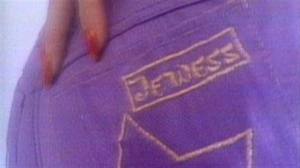
Their awkwardness, while silly, has its charm. At the same time, these girls irritate us.  The frission is enticing and may propel the show to a second season.  On the other hand, it may not.  I have a “feeling” about this.  Maybe I’m wrong.  But after Gilda Radner modeled Jewwess Jeans on SNL, I knew that it would be really hard for any comedienne to fill her designer schlemiel jeans.

“Ladies and Gentlemen!” A Preface to Paul Celan’s “Conversation in the Mountains”

DownloadedFile

As a Jew, I can assure you that Jews love to talk.  In their work on the schlemiel, Ruth Wisse and Sidrah DeKoven Ezrahi see the schlemiel’s speech as a kind of “substitute” sovereignty.   Ezrahi tells us that before Israel, speech, not action, was the best defense.  And for centuries there was a historical principle at work: in the world, Jews lose; but in the world of speech, they win. For this reason, the schlemiel is, for Wisse, the “modern hero.” He is the modern hero who wins a comic victory.

But, to be sure, any fool can see that this victory is incomplete.  We all know that it is not real.  We are all reminded, by way of the schlemiel’s act of substitution, that the world is unkind.  But rather than suffer quietly and tragically, Jews speak.  And they speak (or have spoken) comically.

Listening in to the conversation of schlemiels, we can (as John Felstiner suggests with “Conversation in the Mountains”) hear the shrug.  We can also hear a voice that wants to figure things out by way of indirection: whether by text, a relation, an event, etc.  This act of (or rather attempt at) comprehension is where schlemiel comedy starts.  If that comically intent voice is shared with another schlemiel, we can see the comic ordeal that the schlemiel must go though in order to get anything (even the simplest tasks) done.

As we see with The Three Stooges, its easy for a schlemiel to talk of and promise things.  But, for the schlemiel, it seems, it’s hard to do anything :

But schlemiels do more than just fail at figuring out how to do this or that thing.  Isn’t the schlemiel keying us into the comic relationship that is created by way of conversation?  As Kafka notes in “Excursion in the Mountains,” the freest conversations happen when the “wind blows” between schlemiels.  For Kafka, this wind blowing is conversation; it is what Felstiner calls “babbling.”   But with Celan and Kafka, this babbling has a relationship that is, literally, going in some direction.

This is what Paul Celan teaches in his “Conversation in the Mountains” by way of a Jew named Klein (little):

So he went off, you could hear it, went off one evening when various things had set, went under clouds, went in the shadow, his own and not his own – because the Jew, you know, what does he have that is really his own, that is not borrowed, taken and not returned. (17)

But where is this Klein-the-schlemiel taking us? And why do we have to know where he is or where he is going?  To be sure, he’s looking to meet up with his friend, Gross (Big).  And both of them are looking for a conversation.  They’re going toward each other and, once they find each other, they move on toward something “wholly other.”

In “Conversation in the Mountains,” Paul Celan teaches us that the schlemiel is not simply involved in a “substitute sovereigny”; rather, he is always orienting him or herself with a place where he or she is or where he or she may be going.   And this orientation and speech are repetitive in their address to the other.  Paul Celan conveys this in his “Meridian Speech” by saying, over and over again, the words: “Ladies and Gentleman.”

Celan proposes a kind of comic, repetitive movement that addresses the other.  And, since this is a movement that is never final, it must be replayed in a schlemiel-like fashion.

Each movement is an address.

Ladies and Gentlemen!

It’s another way of saying: “Hello, I’m here! Where are you? I’m waiting for you to come.”  The comic effect is in the fact that we are asked where we are when we are already there before the schlemiel.  But this is a serious matter in the sense that this repetitive address suggests that the other is being called on to hear, and be here, once again.

These are the words of Celan’s Klein to Gross and these are words that he speaks to his audience in “Conversation in the Mountains.”  These words not a “substitute sovereignty” so much as a spur to comically relate Klein to Gross and me to you.  Comedy’s main mode, Celan seems to be telling us, is relational

Each comic address is meant for a rejoinder, a response, in which we come to speak.  Strangely enough, it is the voice of a schlemiel named Klein that calls us to join him/her to speak – on this comical journey toward the other.

Ladies and Gentleman: This should serve as a preface….

Conversations in the Mountains between Franz Kafka and Paul Celan – Part II

DownloadedFile-6

I ended the last blog entry by drawing a limit or threshold between Kafka’s conversation and Nietzsche’s singing.   To be sure, Kafka, at the end of his piece, wonders why his group of nobodies isn’t singing.  Their conversation in the mountains is “free” like the winds but it doesn’t break into song, while Nietzsche’s speech fuses with the “wind” and becomes song.  It is joyous song and approximates Zarathustra’s laughter in Thus Spoke Zarathustra – a laughter that laughs at – and elevates itself beyond – all suffering and tragedy “real or imagined.”

Kafka, however, sticks close to conversation and can’t take the leap because, as I suggested, Kafka’s comedy, the comedy of the schlemiel evinces a sad kind of laugther.  And, unlike Nietzsche, whose lover and companion is the wind, Kafka envisions several “nobodies” (several schlemiels) as companions.

The interesting thing about Kafka’s excursion in the mountains is that the speaker “envisions” his meeting with these schlemiels.  He doesn’t actually have such a meeting.  Taking on, so to speak, the schlemiel tradition from Kafka, Paul Celan – who translated Kafka’s “Excursion into the Mountains” into Romanian – has this conversation in his prose piece “Conversation in the Mountains.”

John Felstiner, in his book Paul Celan: Poet, Survivor, Jew, suggests that Paul Celan may have been inspired by Kafka’s piece.  But he also suggests a few other “influences.”  I’d like to follow up all of his suggestions because, of them, Felstener follows only one thread which deals solely with the type of language used in this conversation.   And it is this reading which is in need of critique.

For Felstener, the way the Jews speak in Celan’s “Conversation in the Mountains” is thought of as evincing a kind of falleness and shame which eschews the comic in the name of the tragic.   While it is important to mention the possibility that Celan thought of a certain way of speaking as “fallen” and shameful, the fact of that matter is that this displaces the comic aspect of the conversation and misses the schlemiel that is at the core of it.

Before I address this reading, I’d like to lay out the influences brought together by Felstiner.  They are suggestive and can help us to understand his reading.

To begin with, Celan dedicated the text to a missed encounter with the thinker Theodor Adorno.  After reading Adorno’s Notes on Literature, Celan wanted to meet him.  But, as Felstener notes, Celan thought he was addressing Adorno as a Jew in the story (by the name of “Gross” – big – while Celan played the other Jew, “Klein” – small.  Upon hearing this, Adorno noted he was not Jewish; he had changed his name from his father’s Jewish name to his mother’s name.  And he was raised as a Catholic, not as a Jew.  Instead, Adorno suggested the Jew Celan was looking for was Gershom Scholem.   The point made by Felstener, which is his basic theme, is that Celan, when he originally wrote the piece, believed that since Adonro was a Jew, he would understand the character’s way of talking; namely, the Yiddish dialect.  (We will return to this below.)

Another influence may have been the bastardization of Nietzsche’s Ubermensch (overman) by the Nazis.  He correctly notes that Celan wrote “Conversation in the Mountains” in Sils Maria where Nietzsche wrote must of his work (including the poem I cited in the last blog entry).  As evidence, he points out that Celan inscribed a copy of his story: “In memory of Sils Maria and Friedrich Nietzsche, who – as you know – wanted to have anti-Semites shot”(140)  Although he points this out, he takes it no further.

But was Celan looking to redeem the overman, as Felstiner suggests?  Do we see an overman in “Conversation in the Mountains?”  To the contrary, following the contrast I put forth above and in the last blog entry, I would argue that there is nothing resembling the overman in not just Kafka’s “Excursion in the Mountains” but in Celan’s “Conversation in the Mountains” as well.   In fact, while Celan may respect Nietzsche’s anti anti-Semitism, he didn’t respect his overman.  The schlemiels he features in “Conversation in the Mountains” are the anti-thesis of the overman.  They are humble, comic, and their talk is not that of song.  Without a doubt, their speech doesn’t transcend suffering and tragedy as the laugh of Zarathustra does.  As I noted above and as I will note with Celan, it is speech that they share, not song.  Speech is the limit.

Another influence comes from Georg Buchner (1813-37).  Namely, his novella entitled Lenz.  According to Felstiner, the line that grabs Celan is “On the 20th of January Lenz went walking through the mountains.”  He gathers this from Celan’s “Meridian” speech where Celan notes that Lenz and his own “’little story’ with its ‘roundabout paths form thou to thou…paths on which language gets a voice, these are encounters.’”(140).

Building on the “thou” that he cites above, Felstiner brings in Martin Buber as another possible influence: “Above all, “Gesprach im Gebrig” owes to Martin Buber, whose philosophical writings and retellings of Hasidic tales Celan was reading during the late 1950s.”  Buber actually wrote a piece with a similar title: “Buber’s “Gesprach in den Bergen” (“Conversation in the Mountains,” 1913) expounds the I-thou encounter that concerned Celan”(140).

Felstiner goes on to say that the  “principles that underpin” Celan’s “Conversation in the Mountains” can be found in two lines he wrote on Buber’s I-Thou relation:

On his birthday in 1959, Celan bought a book about Buber and underscored his speech philosophy: “Creatures stand within the secret of Creation, of Speech…We can say thou, because thou is said to us.” And this: “Spirit is not in the I, but between I and Thou”(140).

The final influence Felstener names is the poet Osip Mandelshtam.  He notes that in Mandelshtam’s essay “On the Interlocutor,” Celan found the notion that poetry is the “search for an other and oneself”(141).  Citing, once again, the “Meridian” speech Felstener argues that Celan took Mandelshtam seriously since Celan says that, through language, he was “on the way” to himself.

The point of all of Felstiner’s notes on what may or may not have influenced Celan’s can be found in this last influence; namely, that Celan was looking to go through language “on the way” to himself.  And this is the point.  The language Celan wanted to go through, according to Felstiner, is Mausheln (the German Yiddish dialect that was thought, by cultured Germans and German Jews, to be shameful and, as the German word suggests, Mouselike).

In other words, by speaking in this manner, Celan was looking to leave it behind for real lanaguage.  To be sure, Felstiner likens the talk of the two main characters in “Conversation in the Mountains” to “babble” and says it is a “comedown’.  Citing Heidegger and Walter Benjamin’s words on pure language and inauthentic language (“everyday talk” as Heidegger says in Being and Time) Felstiner argues that Celan saw the two main characters as speaking inauthentically and in a “fallen” language (144-145):

The “babbling” of Celan’s Jews is a comedown – via the cataclysm that ruined Benjamin – from God Given speech.  This talk of theirs, its halting double back, dividing and divided against itself, like the self it speaks…Sometimes in the dialogue you catch the shrug behind it, elusive yet vital.  Celan said the “Gesprach” was “actually a Mauscheln” between him and Adorno – that is, a sort of jabber that Germans overhear between Jews, Mauscheln being an old slur coined from Moishe, Moses.

This elusive “shrug,” I would suggest, is the shrug of the schlemiel. For Felstiner, it has a negative valance.  To be sure, in the footnote to this passage Felstiner cites the work of Sander Gilman; namely, Jewish Self-Hatred: Anti-Semitism and the Hidden Language of the Jews.  In this book, as in his book on Franz Kafka (Franz Kafka, The Jewish Patient), Gilman points out how Jews were ashamed of themselves and internalized hatred because of what the Germans regarded as their “secret language” (Yiddish).  The Yiddish dialect was, for many German Jews, a source of shame.  Taking this reading to heart, Felstiner argues that Celan was no different from many assimilated Jews who looked to eliminate all traces of Mausheln from their speech.  Therefore, for Felstiner, “Conversation in the Mountains,” is an attempt to move through Mausheln – a fallen language – to a pure language.

By making this reading, Felstiner gives Celan’s comic dialogue between two schlemiels a negative valence.  What I would like to suggest is that we read the comic dialogue in a less negative manner.  In fact, Celan, like Kafka, deeply identifies with this conversation not in the sense that he wants to leave it behind but in the sense that it is a way of relating to alterity.  Without this language, without this comic relationship between schlemiels, Jews would not know the limit (threshold) between conversation and song.

Why, after all, would Yiddish writers continually return to the schlemiel and his comic way of conversing? Did they do this because they despised Mausheln? What I would like to suggest is that, in a piece like “Conversation in the Mountains,” Celan didn’t despise his Yiddish roots as much as Felstiner would have us believe.

Fesltiner is correct to note that German was the preferred language in Romania.  And that it was Celan’s “mother tongue.”   However, Felstiner also notes that Celan knew Yiddish, Yiddish folklore, and humor as a child.  And notes that at one time he even defended Yiddish to classmates when they made fun of it saying that the classics were translated into Yiddish.  But, ultimately, Felstiner goes with the historical and cultural reading of the relationship of the German Jew to the Ostjude (Eastern European Jew) as informing the dialect play in Conversation.

Contrary to this, I’d suggest, as Julian Semilan and Sanda Agalidi do in the introduction to their translation to Paul Celan’s Romanian Poems that Celan looked to alter German with a “minor” language (for them his translation work in Romanian).  This, they claim, had some influence on his nuanced treatment of German.  And, most importantly, we should note that Celan’s “Conversation in the Mountains” was written after his stay in Romania following the Holocaust.

We can see from “Conversation in the Mountains,” that he respected and understood the foolish and wise ways of Yiddish folklore and that he used them to introduce a Jewish element into the German.  This comic play had a positive valance and puts an emphasis on Jewish particularity.  He had a sense of Yiddish ways of speaking and in “Conversation in the Mountains,” he spoke through them.  But he spoke not in order to transcend these ways but to, on the contrary, retain the limit between speech and song.  This limit is something that the schlemiel’s ways of speaking and gesturing marked.  The fact that speak and don’t sing, as in Kafka’s “Excursion in the Mountains,” marks this Jewish particularity which is acutely aware of suffering, history, and difference.

It is this kind of speech that lives on for Celan after the Holocaust.  It survives on the way to himself and the other.  It is not totally destroyed.  His way to himself and to the other, at least in “Conversation in the Mountains,” is by way of these two schlemiels: Klein and Gross.   In other words, the schlemiel and his ways of conversation are not things Celan wants to leave behind.  The schlemiel remains…speaking…of this…and of that….with a shrug that is, as Felstiner correctly notes “elusive and vital.”  But unlike Felstiner, I’d like to say that this “elusive and vital” shrug, this gesture, has a positive valence and works as much to preserve something Jewish while, at the same time, altering the German language.

(In the next blog entry, I will be making a close reading of Celan’s “Conversation in the Mountains” so as to show how it is a conversation of schlemiels – a conversation that carries on what Kafka had originally initiated in his “Excursion in the Mountains.”)

Conversations in the Mountains between Franz Kafka and Paul Celan – Part I

DownloadedFile-5

For Friedrich Nietzsche, the place to clear out one’s mind and find oneself or one’s calling (so to speak) is in the mountains.   In Thus Spake Zarathustra, the main figure, Zarathustra, goes into the mountains and has his epiphany.  In the mountains, Zarathustra takes on the serious task of becoming himself.  However, he also learns how to laugh.   And this laughter evinces a kind of superiority over all suffering.  As Nietzsche notes, “he who climbs upon the highest mountains laughs at all tragedies, real or imaginary.”

Franz Kafka and Paul Celan have written of monologues and conversations in the mountains which, in contrast to Nietzsche, do not evince any form of superior laughter.  On the contrary, what we find in Kafka’s “Excursion in the Mountains” (which Paul Celan translated into Romanian after the Holocaust) and in Paul Celan’s “Conversation in the Mountains” (which echoes Kafka’s piece) is a comic experience that evokes a laughter that is by no means beyond “all tragedies, real or imaginary.”  To be sure, Kafka and Celan give us schlemiels in the mountains, not Nietzschean overmen.  And, unlike Nietzsche, they have a hard time being alone.  They call for or are with the other in ways that do not stand above suffering but in ways that share suffering and bear it, ever so slightly, by way of humor.

Franz Kafka’s short piece begins with the a self-deprecating voice screaming out for the other:

‘I DON’T KNOW,” I cried without being heard, “I don’t know.  If nobody comes, then nobody comes.  I’ve done nobody any harm, nobody’s done me any harm, but nobody will help me.”

After saying this, the voice utters something odd about a “pack of nobodies.”  He notes that he’d rather go on an “excursion in the mountains” with a bunch of “nobodies” (that is, a bunch of fools) than by himself (with Nobody):

A pack of nobodies. Yet that isn’t all true.  Only, that nobody helps me – a pack of nobodies would be rather fine, on the other hand, I’d love to go on an excursion – why not? – with a pack of nobodies.  Into the mountains, of course, where else? How these nobodies jostle each other, all these arms linked together, these numberless feet treading so close!

The voice wants to laugh with other nobodies.  His laughter is shared.  Kafka goes on to emphasize the comic nature of this endeavor by noting that “they are all in dress suits.”  In other words, the nobodies in the mountain are defying their context and they don’t care.  At this point, the voice of the piece decides that he is no longer separate from these nobodies.  He is one of them. He announces this by pronouncing the “we”:

We go so gaily, the wind blows through us and the gaps in our company. Our throats swell and are free in the mountains!  It’s a wonder that we don’t bust into song!

Reflecting on this, I can’t help but hear the desperation and suffering in this voice which imagines this shared excursion with fellow “nobodies.”  Nonetheless, just like any schlemiel, the voice is invisible or blind to itself.  It is the reader who can see this blind spot; nonetheless, the reader will also recognize that this absurd vision is fun.

Where it cracks the surface is with the last words; they indicate a distinction between speaking and singing.  The wind that “blows through us and the gaps in our company” is the wind of free conversation.  It’s not the tragic-comic kind of “idiot wind” that Bob Dylan makes reference to in the song of the same title.  Rather, it’s a wind that cannot elevate itself to song.

To be sure, this is an important element. Song would signify an elevation above suffering.  It would signify joy.  For the voice, it is “wonder we don’t burst into song!”  But, given the structure of the piece and given that the voice is that of a schlemiel, for the reader it should not be a wonder.

It isn’t a wonder because Kafka is sharing a joke with his readers in which the voice imagines he is together with a bunch of nobodies in the mountains who, after having free conversation blow (like wind) between them, will sing.  But we know better.

I would suggest that Kafka’s fools are Jewish fools.  And Jewish fools (more often than not) don’t sing; they talk.   The movement from conversation to song is barred from Jew insofar as that would suggest a movement beyond suffering, history, and uncertainty.

Contrary to this, Nietzsche has no problem moving from wind to song in the mountains.  In contrast to Kafka, the wind makes the song possible.  We see this at the culmination of his book, The Gay Science in a poem entitled “To the Mistral: A Dancing Song”

In Nietzsche’s poem, the poet embraces the “mistral wind”: “Mistral wind…how I love you when you roar! Were we two not generated/ in one womb, predestinated/ for one lot for evermore?”

At the end of the song, Nietzsche refers to himself and the wind as “free spirits” and exalts in their meeting: “Since I met you/ like a tempest roars my joy.”  And he wants to attest to this joy “forever.”

Kafka’s voice doesn’t do this.  Moreover, there isn’t any pathos in Kafka’s voice.  Its deflated by the solitude and his clearly framed imagining of himself and other nobodies.  Nietzsche, in contrast, can laugh but not at himself.  That would signify a kind of deplorable weakness.

To be sure, Kafka’s “Excursion in the Mountains” denotes how, in the mountains, the “winds blow” between them and the nobodies freely converse.  This is the limit or threshold that a schlemiel cannot cross.  It is a limit that Nietzsche could not understand since, as I mentioned above, Zarathustra thought that joy and laughter could lift themselves above any tragedy “real or imagined.”  The (sad) laughter of the schlemiel, however, challenges this by hitting the limit between speech and song.

In the next blog entry, I will address how this limit finds its way into Paul Celan’s “Conversation in the Mountains.”

Kafka, Seriously: Paul Auster’s Kafka

DownloadedFile-2

After reading and posting Matthue Roth’s guest post yesterday, I reflected on how seriously many writers, literary critics, and philosophers took Kafka.  I find it interesting that few can sense the irony and humor in his work. What they usually find is weight and despondency.  What I’m looking for in Kafka is much different.

I’m looking for the comical aspect of his work.  Like Walter Benjamin, I am looking where no one else looks.  And taking Kafka’s cues, I’m looking for the small things.  Its these small things that make for a nuanced schlemiel.   One need not go so deep.  One can stay on the surface.  But, strangely enough, staying on the surface is a serious endeavor.

The comic aspect of Kafka’s work may be found in the close attention to detail. One may not think this comic; but for Shalom Aleichem, Motl or Menachem Mendl’s attention to detail is the basis for their constant distraction.  The same can be said for Charlie Chaplin or any of the Three Stooges.

Like children, they forget what they are supposed to do and get caught in something else.  They don’t get caught up in the depths or with the seriousness of the sacred.  They play.

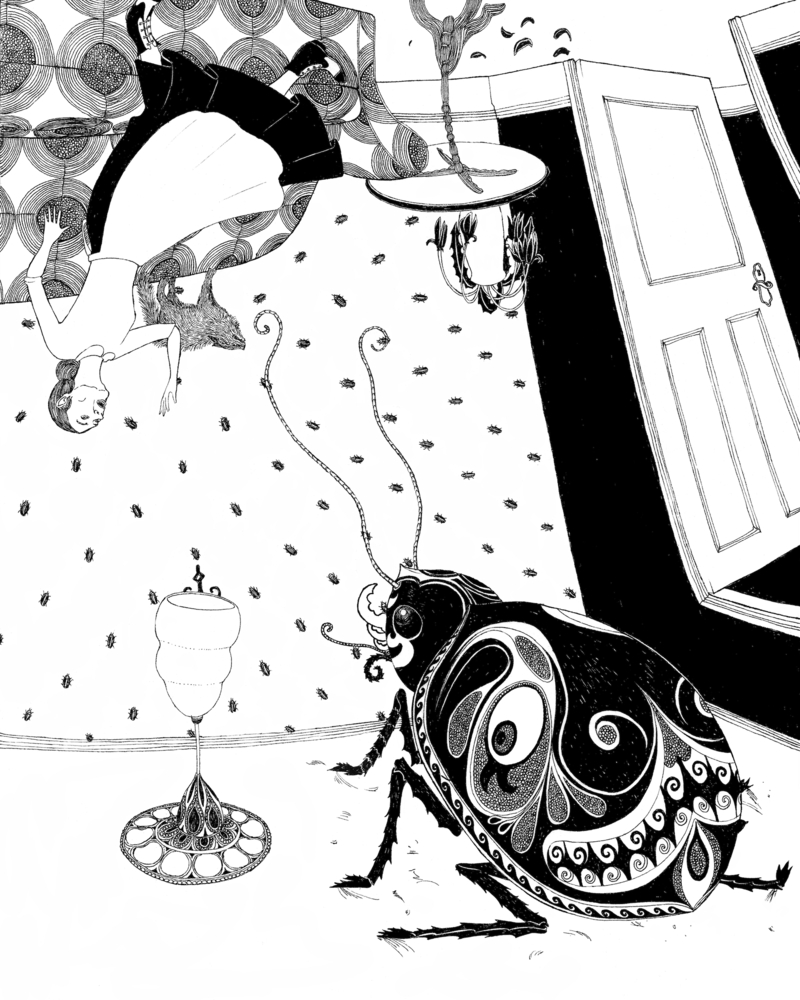
And this is what Matthue was pointing out in his post.  To be sure, his book My First Kafka: Runaways, Rodents, and Giant Bugs is for kids.  It is replete with accessible phrasing and illustrations to capture the imagination of children and adults (or man-children).

As I pointed out in my reading of Kafka’s “Temple” aphorism, the childish scribbles on the temple remain.  They are on the surface of the temple and reduce its depth.  Yet, at the same time, the children’s scribbles have made a serious joke out of the temple.

The trick, in Kafka, is to figure out how to retrain the tension between the serious and the comic.  By doing this, the reader will not get stumped in the seriousness of his or her solitude and despondence.

On this note, I recently read Paul Auster’s “Pages for Kafka” with great interest. The piece, written in 1974 (and published in The Art of Hunger), is an indication of how seriously one can take Kafka.  The short piece was written, like Walter Benjamin’s piece on Kafka, for the anniversary of Kafka’s death.  Due to the occasion, one would expect it, to some extent, to be serious and mournful.  Moreover, Auster is not known for writing comic novels.

On the one hand, Auster’s reading reflects an acute sense of despair that is based on a journey that never goes anywhere.  On the other hand, it has a comic ring to it since ‘he’ (that is, Kafka) is constantly getting distracted.  Even though the failures Auster enumerates in this piece seem to tilt the balance toward a serious and mournful approach to Kafka, they are ultimately based on Kafka’s ridiculous and impossible endeavor.

Auster begins his piece by describing Kafka’s main endeavor (which we find in the Octavio Notebooks or in a piece like “Before the Law”): “He wanders toward paradise.”

This wandering is endemic for Auster.  He meditates on it in the whole piece and relates it to one of his favorite themes (in many of his books): the travelogue.

Auster notes that Kafka “moves from one place to another, and dreams of stopping”(23).   But he can’t stop because this “desire to stop” haunts him. This makes no sense.  How could a desire to do something keep one from doing it?  Isn’t he haunted, rather, by the goal, paradise?  Auster explains by simply reiterating: “He wanders.  That is to say: without the slightest hope of ever going anywhere.”

If that is the case, then why is he still walking?  And what would a schlemiel be if he had no hope of going anywhere?  Gimpel, for instance, is the embodiment of hope.  That’s why he continually trusts people while being betrayed by them.   And, as we learn at the end of Singer’s tale, he keeps on wandering.

I’d like to suggest that we read Auster against Kafka (or “him”).  The narrator is making his skeptical observations of “him” – the fool on the road to paradise named Kafka.  By reading Auster this way, we can see just how comic this piece really is.

For the narrator, the central paradox can be found in Kafka’s inertia and its relationship to wandering: “He is never going anywhere.  And yet he is always going.”  The reason for this, says Auster, has to do with the fact that Kafka is “invisible to himself.”  Lest we not forget, this is one of the most important aspects of the schlemiel.  S/he doesn’t know what s/he is doing.  Although they are hopeful, his/her actions don’t fit with reality.  Auster tells us that, in being invisible  to himself, Kafka “gives himself up to the drift of his body, as if he could follow the trail of what refuses him.”

In other words, Auster is willing to concede that Kafka, like Don Quixote, is a blind wanderer.  Even though he doesn’t know where he is going and is blind to it, his “blindness…invents the road he has taken.”  This invention is not “intentional”; it is, rather, based on giving in to what Kafka, in his Octavio Notebooks, called the “indestructible.”  Because he is a skeptical narrator, Auster won’t call it faith or passion.  Rather, for Auster, it is a surrender to “the drift of his body.”    And we can have no doubt that this can be comical and even inspiring – although it is “misguided” and although we “know” he’ll never reach paradise.

Here Auster notes the “existential” nature of this “road.”  Even though it is misguided, it is “his road, his alone.”  And the further along he goes on it, the more he “doubts.”  His breaths become “fitful.”   No one “rhythm” or “pace” can be held because of this ever-increasing doubt.  The image is kind of like Chaplin’s going down a road, but with a difference.  This movement is more fitful and less graceful.

Auster adds another element to Kafka’s walk; namely, his past and his point of departure.  Auster notes, with melancholy, that he leaves it behind and thinks he has a vantage point, but he doesn’t.

His only “law” is that “he remains.” And instead of looking to the future, Auster tells us that he looks down:

All this conspires against him, so that each moment, even as he continues on his way, he feels he must turn his eyes from the distance that lies before him, like a lure, to the movement of his feet, appearing and disappearing below him (24).

In other words, the fool will look at what’s near him and get caught up in it.  That’s where he foolishly “remains.”  He’s caught up in the details and, as Auster puts it, he becomes an “intimate of all that is near.”

But unlike the playful Motl or Menachem Mendl of Shalom Aleichem, he gets too caught up in detail and this attachment weakens “him”:

Whatever he can touch, he lingers over, examines, describes with a patience that at each moment exhausts him, overwhelms him, so that even as he goes on, he calls this going into question, and questions each step he is about to take (25).

This is the Kafka-schlemiel trap.  He can’t move because he is too attached to what is near him.  He gets caught up in it and questions about where to go after he has encountered this or that detail.  Auster sums this up with an adage of sorts: “He who lives for an encounter with the unseen becomes an instrument of the seen.”  He becomes a “spokesman of its surfaces.” But that is not what “he” wants.  He wants to go to paradise but, Auster tells us, Kafka gets caught up on the way with the road.  In other words, he’s a schlemiel like Mendl Mocher Sforim’s schlemiels The Wanderings of Benjamin III who can’t arrive at their destination.

After noting “his” being stuck on the surface, Auster repeats the message: “He wanders.”  And then he states Kafka’s other law.  He doesn’t simply remain “where he is” he also has an ethos:

Whatever is given to him, he will refuse. Whatever is spread before him, he will turn his back on.  He will refuse, the better to hunger for what he has denied himself. For to enter the promised land is to despair of ever coming near it.

This is Auster’s law.  It is the law of hunger.  And it keeps him moving and not moving.  It keeps him hungering for fragments.  For, between one shadow or one fragment and another, says Auster, there is light.

What this amounts to is a serious endeavor that clings to and rejects revelation.  Yet, on the other hand, it is a comic endeavor.  But who is “he.”  Kafka? Auster?

In the end, he, whoever he is, is like Sancho Panza following Don Quixote.  The narrator’s description ends with a note of redemption in the sense that he says that between one shadow and another there is light.  But does he think this or does the narrator?

Who would take such a foolish path?  Is the author dreaming of light between this or that thing or is the he, the schlemiel, dreaming this?

A rationalist would reject such a road, but the writer doesn’t.  For Auster, the poet must trust experience even if it is, at times, deceptive.  This is what the schlemiel teaches us. Although we, the readers, may see that paradise is not to be found, the road to experience paves the way (or as Auster says, “invents” the way).  And it brings the world near to us in the most comic fashion.  As the world approaches, Paradise withdraws but the schlemiel insists that the way to paradise is through the world.  And this is the comic conceit.

He actually thinks that in this or that fragment, this or that thing, redemption is near.  While we all “know” its ridiculous, however, we still foolishly follow “him” (like children who should ‘know better’) in his journey   And so does Auster.

Seriously.  I’m not joking.

Guest Post by Author Matthue Roth: “How to Analyze Kafka (Hint: It Helps if You’re 4 yrs Old)”

slide_301276_2534653_free
It’s either a huge compliment or a huge mistake to be invited so kindly to write a piece for this blog — and, more particularly, this series. Diving at the heart of what Kafka has to offer the universe is a noble pursuit, and the idea that I turned some of his stories into a picture book for kids either fits in perfectly or is way out of its depth.
Earlier this week, on this blog’s fabulous series of Kafka-related pieces, the Schlemiel wrote that “Kafka and Benjamin direct us to a more acute sense of the ‘how’ of their work rather than the ‘what.'” When you read Kafka, whether you’re an academic or not, and whether you’re a kid or not, it’s pretty impossible not to look for deeper themes and connections, some meaning beyond the apparent text and, well, thestory of the story. At some point in every Kafka piece, there’s a moment where you pull back* and realize that maybe there are deeper things going on than just the plot, the characters, the events in motion. Is Gregor Samsa a disgrace to his family because he’s a giant vermin, or because he’s a hopelessly single middle-manager? Are The Castle’s K. and The Trial’s Josef merely physically lost, or is there a deeper existential lost-ness?
We’ve been conditioned not to ask these questions, not because they’re obvious (although they certainly are) but because the nature of the question disspells everything we’ve been taught to believe in about stories. Stories are spells, and in them the interior and exterior are fused together, from the sublime to the ridiculous; it’s taken for granted in what we think of today as “serious” literature, but it’s no less true in popular literature. In Twilight, Bella is drawn to a dark, sulking guy because he makes his solitude and broodiness into something supernatural and magical, something she wishes it would be for herself (spoiler: it happens! She becomes a vampire too). In Dan Brown’s books, “symbologist” Robert Langdon is solving literal puzzles and infiltrating secret orders, but he’s also ostensibly engaged in a quest for self-definition, simultaneously attempting to impress whatever vaguely international love interest pops up as well as the naysayers who are, essentially, always asking, what is a symbologist?
So now that I’ve offended basically everyone who’s ever liked Kafka by comparing him to two of the most vapid, flaccid characters in modern fiction (both of which I think are reasonably good books, taken at their own merits), let me dig the knife in a little deeper by suggesting that, if we’re going to set up some sort of objective comparison, Kafka’s stories are more fundamentally poppy than both. Part of what draws us to Kafka, I think, is that there’s no distinction between signifier and signified, barely a set of cultural constructs that we need to understand, barely any references beyond the words themselves. A lot of the time, all we need to understand Kafka’s writing is a rudimentary understanding of the language.
None of which is actually true. The qualities about which he writes, loneliness and isolation and the fundamental meaninglessness, or our inability to find meaning in our lives, are the very stuff that our lives our made of. The other day someone asked me about my My First Kafka book, and, when I explained, he said, “Kafka? You mean, the philosopher?” Maybe once you pare human experience down to a labelless blob of emotions and motivations, as Kafka does, you switch from stories to philosophy. Or maybe at heart all our greatest philosophy are just stories. And that’s why, in the end, kids understand them so much better than the rest of us.
______________
* that is, if you’re me
(In addition to My First Kafka, Matthue Roth is the author of several works of fiction: Never Mind the Goldbergs, Yom Kippur A Go-Go, Candy in Action, Losers, and Automatic. Check out his blog for more:http://www.matthue.com/p/my-first-kafka.html)