Baudelaire and Benjamin: The Madness of Humility or the Madness of Humiliation?

images-3

Comedy often deals with power and powerlessness.  But as Baudelaire understands it, power usually has the upper hand.  For Baudelaire, comedy brings out the Satanic, powerful side of man, not the powerless and humble aspects.  It doesn’t return us to innocence.

Even though it has elements of “innocence” and although it is guided by the “law of ignorance,” the Absolute Comic is not a return to childhood in the full sense.  It retains the Satanic element since the Absolute Comic still nods to the superiority of the viewer\reader and man`s superiority over nature:

I would say that when Hoffmann gives birth to the absolute comic it is perfectly true that he knows what he is doing; but he also knows that the essence of this type of the comic is that it should appear unaware of itself and that it should produce in the spectator, or rather the reader, a joy in his own superiority and in the superiority of man over nature(165).

Notice that the Absolute Comic is innocent (“unaware of itself”) AND it produces a joy in the viewer’s “own superiority” and in the “superiority of man over nature.”

It retains this duality.

But, as we pointed out in our previous blog entry, this superiority is tainted.  It is a kind of madness.  In fact, as I pointed out, Baudelaire sees the insane as expressing the essence of this comic superiority.

The madness of the Absolute comic, as Baudelaire understands it, is different from what he calls the “madness of humility.”   Baudelaire associates the madness of humility with the “wise” who see the superiority of the comic as “inferior.”

Laughter is a sign of inferiority in relation to the wise, who, throughout the contemplative innocence of their minds, approach a childhood state.

It seems as if there are not only two kinds of madness but also two types of children: the humble and the satanic.  One is mad for God while the other is mad for itself and its superiority.

Which child does Baudelaire favor?  Which madness is superior? The madness of humility or the madness of the comic?  More importantly, why doesn’t Baudelaire, like Dostoevsky or Benjamin, imagine a holy fool?  After all, isn’t a holy fool humble, unconscious of himself, innocent, and funny?

How would Benjamin address these questions?   And when he talks about “Satanic Serenity” was Benjamin imagining a happy state that comes out of the Absolute Comic?  Was he siding with the madness of the comic over the madness of humility?  Could we call the “joy” that the viewers-slash-readers of the Absolute Comic feel when watching the Absolute Comic “Satanic Serenity?”  And how is this serenity different from the serenity that emerges from the madness of humility?

These questions present a problem: if Benjamin was so into the “return to childhood,” which we saw in his reading of Dostoevsky’s The Idiot, wouldn’t he aim for the serenity of the wise man?  After all, wasn`t Dostoevsky leaning more toward the madness of humility in his novel?  Would he stand on the side of the wise man, who would see the smile, and especially the satanic smile (like the laugh), as “inferior?”  Or would Benjamin argue that the only way to attain happiness is, as Baudelaire might say, through the Absolute Comic?

If this is the case, then, one may only attain to partial childhood but not full. The madness of humility no longer seems to be an option for modernity.  Violence seems to be more akin.   To be sure, the Absolute Comic evinces a delight in the destruction of innocence and delights in the excesses of play: as we see in Baudelaire’s portrayals of the mime and in his reading ETA Hoffman’s story in which a girl is shocked when she realizes that her image of order and beauty are false.  In fact, the negation of her childish superiority (the superiority of her ideas and military order) is the basis, according to Baudelaire, of the audience`s joy at its superiority.  They – the audience – and not she – the comic character – are the masters of ignorance and are superior over nature.  They are mad with superiority, yet in a way that is not ignorant.

To be sure, though the madness of humility is not an option for modern man, and although Baudelaire gives the madness of the comic center stage, he does mention the “madness of humility.”  Moreover, Baudelaire notes that wise men, “throughout the contemplative innocence of their minds, approach childhood.”  He acknowledges different levels of innocence and the challenge to comedy made by the wise; nonetheless, he doesn`t pronounce either in a definitive manner.

I think Benjamin knew full well what was at stake in this comparison.  And he ventured where Baudelaire did not.  In his reflections on the Goethe Dream and on the Shuvalkin parable, Benjamin was engaging in the madness of humility and not simply in the madness of the comic.

True, he sees himself as double: as a man and a child.  But did Benjamin see himself as superior as Baudelaire suggests of every reader or viewer of the Absolute Comic? Did Benjamin feel a “Satanic Serenity” when he saw himself as a man and a child; that is, when he discovered the meaning of the Goethe dream and when he penned the Shuvalkin parable?  And wouldn`t Satanic Serenity imply an experience of comic superiority?

I would like to suggest that Benjamin didn`t feel comic superiority so much as a certain kind of powerlessness and astonishment when he looked at himself as a schlemiel.  We also hear this in Benjamin’s claim about Kafka: that “the beauty of his work was the beauty of failure.” This comment evinces a sense of inferiority not superiority.  In fact, Benjamin didn’t seem to take joy in this joke.  This is in contrast to Baudelaire, who notes that joy goes hand-in-hand with the feeling of Comic Superiority. To be sure, I can’t imagine anything close to Satanic in this reflection. The same goes for his reflection on himself in the “Vestibule” aphorism.  In fact, this destiny, to be marked as a child in Goethe’s house, is disheartening.  More disheartening is the fact that he is the subject of a prank.

I would suggest that this experience leans more toward the “madness of humility” or rather the madness of humilation.  Unless, that is, Benjamin would smile (satanically) at his misfortune.
Getting Comically Wasted: On Charles Baudelaire’s Notion of Absolute Comedy

170px-Paul_Cézanne_060

Baudelaire had a penchant for “intoxication” and comedy.  And what better day to discuss Baudelaire’s notion of the comic than on St. Patrick’s Day!  To be sure, Baudelaire thinks that the absolute comic, at its best, is like “intoxication.” Perhaps the “Satanic Serenity” that Walter Benjamin takes note of has a source in this; after all, Benjamin wrote about “Satanic Serenity” in his notes for his essay “Hashish in Marseille.”  As Baudelaire understands it, the state that one enters in the Absolute comic includes a sense of being “double.”   The irony of it all is that  this duality reminds one that one is “innocent” and, literally, destroyed.  And on St. Patrick’s day people usually talk about getting “wasted,” “destroyed,” and “hammered.”  All of these phrases suggest some kind of violence and, as Baudelaire suggests, some kind of innocence.

As we learned in the last blog entry, Satanic laughter is associated with a sense of superiority.  Baudelaire sees the insane (“the mad”) as the best illustration of an extreme sense of superiority.  The laughter of the insane, based on the psychotic insistence on the superiority of the laugher, brings out the essence of the “significant comic” (the comique significatif).  Mad laughter is, for Baudelaire, Satanic.  It has a total disregard for the world. It laughs at the world.  But it is deluded.  It has no innocence about it whatsoever.  It takes on a destructive daemonic aspect.

The significant comic doesn’t seem to embody what Benjamin would call “Satanic Serenity” since it is solely destructive.  The significant comic is not simply comic because she is “wasted”; no, s/he is comic because s/he wastes people with her daemonic humor and laugh.

(Mind you, for Baudelaire, children, “budding Satans,” are included in this category.)

The Absolute comic is different from, yet related to, the “significant comic.”  It is the kind of comedy that would attract Walter Benjamin who appreciated, like Baudelaire, gestural comedy (mime) and the kind of comedy that included what Baudeliare called the “law of ignorance.”

Baudelaire first introduces the Absolute comic when he discusses “laughter at the grotesque.”  To be sure, “the laughter caused by the grotesque has about it something profound, primitive, axiomatic, which is much closer to the innocent life and to absolute joy than is the laughter caused by the comic in man’s behavior”(157).

For Baudelaire, this is the superior form of comedy because it brings man “closer to the innocent life and to absolute joy.”

Baudelaire notes that the “absolute comic” has “one criterion”: “that is laughter – immediate laughter.”  However, there is one condition for comedy to be absolute, besides immediate laughter and that relates to the disclosure of what is most pathetic in humankind:  “the comic can only be absolute in relation to fallen humanity”(158).

In other words, the absolute comic must signify through falleness.  It must be – so to speak – wasted.

And it is only the best artists, Baudelaire tells us, who apprehend it. For these minds “are sufficiently open to receive absolute ideas”(158).  Baudelaire, after saying this, writes of an author who is the master of German horror and the grotesque; namely, the late  18th century German writer ETA Hoffman (158): “He always made a proper distinction between the ordinary comic and the type which he called the “innocent comic.”

What Hoffman calls “the innocent comic” is a blending of the innocent and the grotesque.  Moreover, it isn’t so “innocent” in the sense that it includes a distinct form of “violence.”  It doesn’t escape violence.

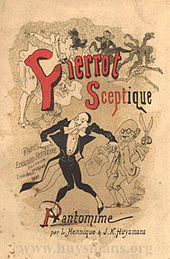
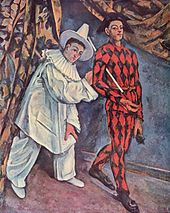
Baudelare notes that we also see such violence and innocence in the work of French mimes like Pierrot.  Regarding the mime and the clown, Baudelaire notes that Pierrot mixed the innocent and the grotesque by way of facepaint and gesture: “Upon his floured face he had stuck, crudely and without transition or gradation, two enormous patches of pure red.  A feigned prolongation of the lips, by means of two bands of carmine, brought it about that when he laughed his mouth seemed to run from ear to ear”(160).

170px-Léon_Hennique_-_Pierrot_sceptique

And although he appeared childish and innocent, he certainly was not: “As for his moral nature, it was basically the same as that of the Pierrot whom we all know – heedlessness and indifference, and consequently the gratification of every kind of greedy and rapacious whim”(161).

In other words, while he appears innocent, he is “devilish.”

The act of this rude yet innocent clown leads us to “a dizzy intoxication.” When one watches them “intoxication swims in the air; it is intoxication that fills the lung and renews the blood in the arteries”(163).  The “absolute comic” has “taken charge of each one of them.” And by each one, Baudelaire suggests that the comic and the audience are possessed.  Everyone is intoxicated.

The mime becomes possessed and seems to leave the realm of men: “Every gesture, every cry, every look seems to be saying: ‘The fairy has willed it, and our fate hurls us on – it doesn’t worry me! Come, let’s get started! Let’s get down to business!’ And then they do…which starts at this point – that is to say, on the frontier of the marvelous”(162).  In other words, the mime takes us into another realm by way of his gestures – a realm that, while laughable, brings us closer to childhood.

This can only mean that in his grotesque and childish disregard of limits, the mime’s gestures, his madness, while destructive counters the solely destuctive madness of the regular comic.   The mime is not simply mad – he is, actually; he certainly flaunts a superiority and indifference to the civilized world of adults.  But this madness, because it is childish, is also innocent.  The mime is a drunk of sorts and he spreads the feeling of intoxication through his rude and innocent gestures.

Baudelaire notes that nothing can surpass the absolute comic that we find in the mime: “But how could the pen rival the pantomime? The pantomime is the quitessence of comedy; it is the pure comic element, purged and concentrated”(162).

Nonetheless, Baudelaire ends his essay on laughter and devotes the most space to discussing this mad innocence by way of a close reading of ETA Hoffman’s story “Dacus Carota, The King of the Carrots.”

This story is exemplary because it shows us how a little girl, a “budding Satan,” loses her sense of comic superiority by way of the grotesque.  Her astonishment, her shock, brings us in touch with the “Absolute Comic.”

Baudeliare tells us that “the unfortunate young girl, obsessed with dreams of grandeur, is fascinated by a display of military might.”  When the girl is shown the soldiers sleeping at night, by her “magician” father, she experiences shock and vertigo.  Her exposure to the grotesque display of soldiers sleeping at night, when her father opens the “flap” of the tent, leads to what Baudelaire calls a “comic emanation, explosion, as it were, a chemical separation.”

What “emanates” from the comic explosion?

In the comic explosion we become aware of our childish part, which is unaware of itself.

This is the “law of ignorance.”  Indeed, for Baudelaire, “the most distinctive mark of the absolute comic is that it remains unaware of itself.”

This translates into a double consciousness for the viewer or reader. It indicates “the permanent dualism in the human being – that is, the power of being oneself and someone else at the same time”(165).

This experience, since it includes ignorance is double. As we saw above with the little girl who is astonished when she sees the grotesque soldiers but doesn’t know why she is astonshed: she is double.  She doesn’t know herself, but we do. Its an uncanny sense of self that the reader or viewer takes on. Baudelaire says it is superior – and, as we have seen superiority is the core of the satanic-slash-comic. It is the essence of laughter.

Perhaps this sense of duality is the cause of what Walter Benjamin’s calls a “Satanic smile.” Benjamin argues that it is based on a “Satanic Serenity” and not on destructive element of the Satanic.  But this misses one essential point made by Baudeliare: the serenity one has, which enables one to be oneself and someone else at the same time, is based on some kind of explosion.  It is based on some kind of destructive violence which, as Baudelaire, notes is inevitable when it comes to comedy.

This resonates with what we saw in Benjamin’s reading of Dostoevsky’s The Idiot.  There, he notes that a return to childhood, will not come without an “implosion.”

The violence that the mime and Hoffman apply leads to childhood.  This is the paradox.  With Benjamin this takes on a fascinating element because Benjamin sees himself as the butt of the joke.  He sees himself as a man and as a child: as himself and someone else.  But, and here is the point: he is both a man and a child.  He is double.

But there is one missing ingredient: the real basis for the Absolute Comic’s performance – as for the significant comic – is failure.  The secret of comedy is that it is based on what Baudelaire called Spleen – that is, rage and anger at one’s meaningless suffering in the world.  Superiority – whether of the significant or the Absolute comic variety – is ultimately a delusion.  But a necessary one as it casts out the hope that even though one is pathetic, one is innocent.  This can either bring about a Satanic Serenity or, perhaps, depression and melancholy.

Benjamin brought this double sense of himself in the Goethe aphorism and in the Shuvalkin parable. The absolute comic – and its sense of duality – is evident insofar as “the law of ignorance” pervades both: Benjamin was asked to sign but he had not idea that his name was already signed; and Shuvalkin thought he had the signatures of Potemkin but found that he was ignorant.  Shuvalkin, like Benjamin in the “Vestibule” dream, didn’t realize that the king had singed his name on each paper.  In both, the prank, though Satanic, is an emanation and explosion within which Benjamin sees himself as other: in which he sees himself as a schlemiel.. He sees himself as double: as man and child.

Perhaps we can say that every day was St. Patrick’s day for Benjamin insofar as every day he looked in the mirror he realized he was “wasted.”  Perhaps this gave him “Satanic Serenity.”  On the other hand, perhaps this made him a Sad Clown?  (As we shall see, in upcoming blog entries, this was one of Baudelaire’s double self-images.  Perhaps it was Benjamin’s too?)

(Here is one of the first animated films ever made.  This film, made in 1892, was named after the clown Pierrot that Baudelaire sees as exemplary of the Absolute Comic. Its entitled Pauvre Pierrot.  Can you spot Benjamin in this animated film (wink, wink)?)

Charles Baudelaire, Walter Benjamin, and the Daemonic (Take 1)

images-1

In an essay on Walter Benjamin entitled “Walter Benjamin and his Angel,” Gershom Scholem notes that one of the things that disturbed him most about Benjamin was his interest in the daemonic.  Scholem, in this essay, notes that Benjamin’s interest increased the more he delved into the work of the Parisian poet and cultural critic Charles Baudelaire:

The Luciferian element…entered Benjamin’s meditations…not directly from the Jewish tradition, but rather from the occupation with Baudelaire that fascinated him for so many years.  The Luciferian element of the beauty of the Satanic, stemming from this side of Benjamin’s interests, comes out often enough in his notes.  (213, On Jews and Judaism in Crisis).

Scholem goes on to provide examples of this element by noting a “Satanic phase” that Benjamin went through when he was writing on a Hashish impression of January 15, 1928.  Strangely enough, Scholem cites a passage from Benjamin that associates the Satanic with the smile:

My smile assumed Satanic features: though more the expression of Satanic knowing, Satanic contentment, Satanic Serenity than from Satanic destructive activity. (214)

Scholem latches on to Benjamin’s reading of the Satanic smile. He notes that, for Benjamin, everything is tainted by the Satanic.  Even the “’indescribable beautiful face’ of a human being can appear as ‘Satanic features – with a half-suppressed smile”(ibid).

The fact that Scholem finds Benjamin’s interest in Baudeliare to be the basis for his description of the smile as Satanic is instructive.  Although Scholem doesn’t delve deeper into this, we will.   To be sure, we can learn a lot about Benjamin’s approach to humor  by reading his reflections on Baudelaire’s reading of comedy, the smile, and laughter.   We can also learn a lot about Benjamin’s approach to comedy by simply reading Baudelaire’s reflections on the comic and, as I will point out, children (which, for Baudelaire, are related).  What we will find in both Benjamin’s reflections and in Baudelaire’s work is a keen interest in the relationship of humor to the daemonic.

In an unpublished piece called “Central Park,” written between 1938 and 1939, Benjamin devotes several reflections to Baudelaire’s prose, poetry, and critical essays.  The reflection that interests me most is Benjamin’s reflection on Baudelaire’s well-known essay “De l’essence du rire” (“The Essence of Humor”).

In this reflection, Benjamin writes:

De l’essence du rire” contains nothing other than the theory of satanic laughter.  In this essay, Baudelaire goes so far as to view even smiling from the standpoint of laughter.  Contemporaries often testified to something frightful in his own manner of laughter (182, Walter Benjamin: Selected Writings, Volume 4)

Benjamin is correct in his claim that Baudelaire argues that all laughter is daemonic.  As Baudelaire explains:

Laughter is satanic: it is thus profoundly human.  It is the consequence in man of the idea of his own superiority.  And since laughter is essentially human, it is essentially contradictory; that is to say, it is a token of infinity grandeur and infinite misery (The Painter of Modern Life and Other Essays, 154).

However, Baudelaire notes that there is a position that challenges this one; namely, the position of the “wise man”: “Laughter is a sign of inferiority to the wise, who, through contemplative innocence of their minds, approach a childlike state.”

This childlike state, however, seems, for Baudelaire, to be unattainable.  It is messianic: “As the comic is a sign of superiority, it is natural to hold that, before they can achieve absolute purification promised by certain mystical prophets, the nations of the world will see a multiplication of comic themes in proportion as their superiority increases”(ibid).

Baudelaire is basically saying that, as civilization advances, we will need to laugh more as we will feel more and more “superior” to nature.  This is not something to celebrate. Rather, for Baudelaire, it is something to lament.  And he hopes that one day we will become wise and transcend laughter altogether.

Benjamin is aware of this, hence, he notes that even the smile is tainted with the daemonic.

But if one reads Baudelaire’s essay on laughter, one will see that the grimace (the smile) only receives one sentence from Baudelaire while the laugh is mentioned throughout the essay: “All the miscreants of melodrama, accursed damned and fatally marked with a grin which runs from ear to ear, are in the pure orthodoxy of laughter.”

Benjamin latches on to this single sentence to argue that any bodily response which indicates humor is daemonic. To be sure, Baudelaire notes that no kind of laugh, even the laugh of a child, escapes the Satantic.  In fact, Baudelaire calls the laughter of little children the laughter of “budding Satans”(156).

Given this reading, what can we say of Benjamin’s reflections on children? As we saw in the hiding aphorism, which we addressed in an earlier blog, Benjamin argues that they “hide from the demon.”   And, as I suggested in that entry, this hiding place may be the shelter provided by a book.  Benjamin sees such hiding as an admirable strategy which, he claims, he learns from children.

The question we must ask is why Benjamin would see any response to humor is daemonic and whether he agreed, wholeheartedly, with Baudelaire’s reading of laughter and humor. This would imply that Kafka’s humor and Benjamin’s humor are or may be daemonic.  It would imply that Benjamin saw the signature-prank in his dream as wholly daemonic.  This would imply that Benjamin’s awareness of his identity – of his being a man-child – his awareness of a prank – was daemonic knowledge.  But is this knowledge, following a smile or a laugh, linked to superiority?  Did Benjamin read his calling, rather, in the opposite manner? After all, he is the butt of this joke.  As is the kingdom in the Shuvalkin parable we read and explained yesterday.

To be laughed at, to be a schlemiel, is entirely different from being the one who laughs or, as Benjamin notes, smiles.  Perhaps we can say that in the two moments where Benjamin reads himself and Shuvalkin as having been the butt of a joke, which reduced them to children, there is a challenge to the Satanic.  This would imply that masochism is redemptive.

In the end it is the same, Benjamin is not superior, he is a failure, a man-child, and a schlemiel. And perhaps, the “entire kingdom” is sunk into exile because the letters of a schlemiel named Shuvalkin hovers over its head. The implications of this reading are that Benjamin thought that he and “we” are not superior.  The joke, on the contrary, is on us.  And this bleak view suggests that if Benjamin is a schlemiel then Satan (the Other) must have written his name and Shuvalkin’s.  And if the herald who bears that message runs ahead of Kafka, as Benjamin claims, perhaps he runs ahead of us as well.  If this is so, then we are all doomed to endless failure and humiliation.   We are and will be the victims of a prank in which Satan has the last laugh and, as Benjamin seems to imply, doesn’t stop laughing.

Even so, Benjamin’s reflection on his (and our) destiny may in fact be redemptive, quite simply, because, in it, he (and we) is (are) not superior (he is not, as Baudelaire would say, Satanic); in his reflection, he sees himself as a powerless man-child.  And it is fascinating that this reflection on powerlessness stretches beyond Benjamin and finds itself in the pages of French thinkers such as Maurice Blanchot, Roland Barthes, and Gilles Deleuze.  They all seem to have taken Baudelaire and Benjamin seriously.  (We will return to this in future blogs.)

In our next blog entries, we will, hopefully, explore Baudelaire’s notion of the “absolute comic” and its relationship to the child and the mime.  This may give us another clue as to where Benjamin may have been going with his childish reflections.

Did you Say Your Name was Shuvalkin, Kafka, Walter Benjamin, or is this a Prank?

images-3

In the last two blog entries, I have been looking into Benjamin’s “Vestibule” aphorism in which he recounts a dream where he discovers his name inscribed in Goethe’s guestbook.  To understand what this meant to Benjamin, I discussed Benjamin’s understanding of what a name is and why it is significant.  As I noted, Benjamin saw the name as revelatory.  For him, it constitutes a link between God and man.  And, as I pointed out, the name is more about relation and less about content.  But there is a twist.

Although Benjamin is asked to sign his name, he realizes it has already been signed.  In other words, a trick has been played on him

But the shock is not simply that his name was already written but that it was written “in big, unruly, childish letters.”  Benjamin is, as I said yesterday, S(c)h(l)ocked by this prank.  To be sure, Benjamin saw something very deep in this prank.  As I noted, he discovered his calling to Schlemieldom.  In a “man’s world” (literally, in Goethe’s world, his house) it seems Benjamin is a child.  He is doomed to being a man who is thought of as a child.  The ‘shape’ of his name, so to speak, indicates this.

It’s interesting to note that the Zohar, one of the greatest books of the Kabbalah, which Gershom Scholem, in part, translated into German, has many sections which analyze the shapes of letters.  From these shapes, from the way they are written, we can learn secrets.

Elliot Wolfson, in his book Aleph, Mem, Tau: Kabbalistic Musings on Time, Truth, and Death, notes the passage in the Zohar in which “each of the letters presents itself before God in an effort to be chosen as the primary instrument through which the world would be created”(159).  Wolfson delicately unpacks this passage from the Zohar so as to show that each letter deals with time, truth, and death.

Aleph says it is the first letter of the word Emet (which in Hebrew means truth), but Tav says it is the last letter of Emet (and the Hebrew alphabet) and should be granted the privilege of being the letter through which the world is created (160).  But, Wolfson notes, Tav is disqualified because it is the last letter of the word Met (death).

However, as Wolfson argues, the letters taken together are the beginning (Aleph), middle (Mem), and the End (Tav).  Together, they designate time and together (the past, present, and future) make the truth.  The word, truth contains the word death, but it also opens up to the future as the truth-to-come.  Wolfson correctly notes, resonating the Apocalyptic elements in the Kabbalah, that the first letter of the Torah is Bet not Aleph.  And this reflection opens us up to a question: if the world was created with an Aleph (of the word Emet – truth) why isn’t the first letter of the Torah an Aleph?

This is the rub: the Aleph and the truth are concealed and will be revealed in the future, in the messianic age.  Meanwhile, we live in the world of the second letter which conceals the first.  In this world, truth (or for Wolfson, the truth of time) is distorted.

Walter Benjamin was quite aware of this teaching from the Zohar.  From Scholem and his own studies, he learned how the letters of the name, their shape and arrangement, disclose a secret that can be glimpsed in the present and seen to be coming from the future.  Building on Wolfson’s work, I would call this a truth-to-come.

Knowing this, how do we interpret Benjamin’s revelation of a name (his name) that was already written in clumsly children’s letters.  Was the disclosure of this prank a revelation of the truth-to-come or, rather, a distortion of the truth-to-come?  To be sure, this was the disclosure of Benjamin as a man-child (as a schlemiel).  But what does the shape of the schlemiel’s name have to do with the truth-to-come?

In the very beginning of Benjamin’s essay on Kafka, he returns to this question.

In the beginning of the essay, entitled “Potemkin,” Benjamin recounts a story of how Grigory Potemkin, the 18th century Russian military ruler, statesman, and beloved of Catherine the Great, went into a great depression.   (As a side note, Catherine gave Potemkin the title of the Prince of the Holy Roman Empire.)

As Benjamin recounts, Potemkin’s depression “lasted form an extraordinary length of time and brought about serious difficulties; in the offices documents piled up that required Potemkin’s signature”(112, Illuminations).

Who could get him to sign his name?

Benjamin notes that “an unimportant little clerk named Shuvalkin” comes to the rescue.  In other words, a simpleton (that is, a schlemiel of sorts) comes to their aid.   He doesn’t try to reason with Potemkin; rather, he acts: “Shuvalkin stepped up to writing desk, dipped a pen and ink, and without saying a word pressed it into Potemkin’s hands while putting the documents on his knees”(112).

Potemkin signs all of them.   And Shuvalkin walks into the anteroom, “waving the papers triumphantly,” as the councilors gather around to see.  And what happens is astounding: “Breathlessly they bent over them.  No one spoke a word; the whole group seemed paralyzed.”

When Shuvalkin looked in to see what happened – to see what had “upset” them and put them into a stupor, he sees that every one of the signatures has his name signed on it: “Shuvalkin…Shuvalkin…Shuvalkin.”

Benjamin sees this story as a “herald racing two hundred years ahead of Kafka’s work.” And then he adds that “the enigma which beclouds it is Kafka’s enigma.”

Benjamin then goes on to substitute Kafka’s character K for Shuvalkin.

These rhetorical movements are very hasty and to simply go along with them, without prying into the esoteric, would be clumsy.  Benjamin is telling us that Shuvalkin is a herald who goes “ahead of Kafka’s work.”  To be sure, this implies that Shuvalkin, a schlemiel, may even be (temporally) ahead of Benjamin’s work.  Moreover, he says that it is Kafka’s enigma but, in truth, it is also his.  In fact, he and Kafka share the enigma of Shuvalkin, which is the enigma of having one’s name already signed by the Other. Signed in such a way that the shape of the letters and their arrangement indicate that the bearer of the signature is a fool.

After the last three blog entries on Benjamin and the name, I hope that by now it will become evident to the blog-readers out there that a name is taking shape.  And that name, Benjamin and Kafka’s secret name, is a name that they are signed with and that name is the name of the man-child or the schlemiel.

There are many questions which come with this enigma and with this parable.  What does it mean that Kafka and Benjamin are the subjects of a prank?  And what does it mean that the “herald” has gone on ahead of Kafka?  Is he ahead of “us” as well?  I say “us” because everyone in the community, as is evidenced by the Potemkin parable, may be affected by the prank – that is, by the signature Shuvlakin.  But to say this, as Benjamin seems to suggest, wouldn’t we be entering the realms of ontology, politics, and religion?

Given this suggestion, can we say that we all share the same childishly written (and childish) name?  And instead of the name of God, as the name we all share (or the name Emet – truth, which Wolfson ventures in his reading of the Zohar), why is the name we share a name whose letters are childishly written?  Why is “our” name the name of a man-child?  Is this, as the Kabbalah might say, the “truth” (Emet) to come?  Or is it a prank?

All of these questions have not, in the history of Benjamin studies, been posed or discussed.  They are questions that come up if you read Benjamin (or Kafka for that matter) as he wanted to be read – as one would read a parable, midrashically.  I will be developing these ideas further in my book on the Schlemiel.  Nonetheless, I have decided to share some of these childish ‘secrets’ on this blog before my book makes the light of the day.  To be sure, there are a few more secrets about Benjamin and the Schlemiel that I may tell in this blog before I pass on to other schlemiels and schlemiel-topics, but I may have to withhold them or encode them in the very near future. Wink Wink!

Remember, you heard it here first – at SchlemielTheory!  More fun-to-come!

Hide and Seek: Walter Benjamin’s Reading of Children and Childhood – Take 2

DownloadedFile-6

Yesterday’s blog ended with several questions which puzzled over why Walter Benjamin or Georges Bataille would be so interested in “returning to childhood” or describing the “true child.”

Before going to sleep last night, I thought about these questions.  But instead of simply thinking about them, I thought about myself.  After all, I am as intrigued with childhood and the fool as they were.  But was I fascinated for the same reasons?

In thinking about this, I turned to a blog entry I wrote earlier this week entitled “Damaged Childhood: Fools, Self-Destruction, and Reclaming Youth,” There, I pointed out how Walter Benjamin, in his essay of Fyodor Dostoevsky’s The Idiot, argued that Dostoevsky’s book was a response to the “failure of the youth movement” and a “damaged childhood.”

I noted how Benjamin goes on to claim, after writing on failure, that a “return to childhood” – a return to “childlike simplicity” – promises “unlimited healing powers.”  But then it hit me: if the youth movement already failed, and if the purpose of that youth movement was to “return to childhood,” why was he insisting that we try again?

At this point, I realized that Benjamin (and Dostoevsky, as Benjamin reads him) were involved in what Freud would call a “repetition compulsion.”  According to Freud, in his book Beyond the Pleasure Principle, the repetition compulsion is a response to trauma, that is, a response to a damaged childhood.  Benjamin is repeating the failure to return to childhood by insisting on doing it again.

Although he believes that this must be done, because a return to “childlike simplicity” has “unlimited” healing powers, he also admits, in the same essay, that it is desperate and pathetic.  We see this, Benjamin says, in the novel’s characters.

The Idiot, in effect, is not simply the illustration of a desire to return to childhood; it is a displacement of failure.

Its astonishing how Benjamin’s writing on children, in many ways, parallels that of Dostoevsky’s The Idiot.  It seems that, in the face of this political, secular messianist failure of the “youth movement,” Benjamin, in his own work, displaced his failure and turned to the micro-worlds of children.  In these worlds we see a “childlike simplicity.” We see micro-worlds that exist within the world of adults.  This retreat into micro-worlds may not only be seen as a response to a “damaged childhood” but it can also be seen as a response to a failed (or incomplete) political project whose goal is to “return to childhood.”

We see much evidence of this in Benjamin’s book One Way Street.    Even though Benjamin does address the political on and off throughout the piece (this is the part that many Benjamin scholars and Theodor Adorno focus on, in fact) he has an entire section on children.   It consists of several aphorisms.  The subtitles of each are the following: Child Reading, Belated Child, Pilfering Child, Child on Carousel, Untidy Child, and Child Hiding.

I would love to discuss all of them over the span of several blog entries.  For now, I just want to note a one (preliminary) thing and relate it to my own personal interest in the schlemiel and childhood.

Since I am a lover and practitioner of literary interpretation and exegesis, the first thing I did when I glanced over this section was to notice and think about the first and last entries.  The first entry is entitled “Child Reading” while the last one is entitled “Child Hiding.”

This, for me, states something meaningful about Benjamin and his response to a “damaged childhood.”  His reading, the reading of a child, is a way of hiding in a micro-world.  And, as Benjamin says at the end of that section, he is hiding from a “demon” and the places he finds to hide in are “magical.”  Reading, exploring space, and constructing micro-worlds (hiding places), are his “magical” way of avoiding terror (“the demon”).  To be sure, the entire section on childhood is prefaced by a line which gives us a clue of this response to trauma: “To be happy is to be able to become aware of oneself without fright.”

Indeed, Benjamin’s self-awareness, his awareness of his, so to speak, childhood demon, is terrifying.  But Benjamin, like the child, has found a reading strategy, a way of hiding that enables him, like a child, to becomes “happy” without fright.  Seeing himself as this child, the child in the text that he writes of, he finds a way to address trauma.   In his reading spaces he is hidden and sheltered from trauma.  To be sure, he seems to be alluding to this throughout his section on childhood.

To be sure, Benjamin, like a child, is more intrigued with his hiding spaces, his mirco-worlds, than with the world.  He goes to these places out of terror.  A schlemiel does this as well.  A man-child dwells and travels through spaces within the world, spaces that are unfamiliar to the world and its preoccupations.  Ultimately, these journeys through space that the schlemiel-slash-man-child takes are responses to something hidden, something he can’t understand.  The schlemiel, in his “childlike simplicity” just moves on.  He doesn’t notice the disaster, perhaps, because it would destroy him.

Growing up with a father who had a wild imagination, loved politics, liked to travel, tell stories, and often confused dreams and reality, I often felt like Sancho Panza following Don Quixote through space and time.  I inherited my father’s response to his own trauma, which, as I learned, is to find and create micro-worlds where one can hide.  The key, however, to such childish games is to know not simply how to read but how to tell stories.

Growing up, I felt that I had to listen to and interpret these stories. Each story, as it were, was what I would call a “traumatic imperative.”  But these stories were not simply told.   They were written over various spaces, people, and time.  My father’s micro-worlds were not in a book; they were found in this or that pocket of reality.  My (as Benjamin might say) “self-awareness” was caught up in these spaces.

When dream and reality overlap, reality becomes a book.  It comes to life.  However, its meaning, because it is confused, is unclear and, as Benjamin knew and my father always reminded me, terror seems to be waiting around each corner.  Like Benjamin, my father taught me that if you are to return to childhood, if you are going to live out your schlemiel-hood through time and space, you must know how to play hide and seek.

Its the game that every failed messiah – that is, every man-child who comes out of a damaged childhood – plays.

On Georges Bataille – Childishness, Stupidity, and Salvation

images

What does it mean to make “a fool out of oneself” or to act “childish?”  Both terms suggest that imitating a child or acting like a fool is shameful.  Now, imagine that the very thing that society despises most is designated as a spiritual practice.

In our last blog entry, we pointed out that Georges Bataille took Nietzsche’s notion of KINDERLAND and identified it with the future.  As we pointed out, one would have to destroy oneself if one were to get there.  The paradox is that by going backwards to childhood, one can go forwards, to the future, to KINDERLAND.

But, as with many spiritual practices, one needs to know what to do if one is to reach this sacred land of childhood.    Bataille was interested in describing these practices.  As one can imagine, Bataille relished the idea that acting like a child or becoming a fool was hated by civil society. In his book Inner Experience, he not only provides spiritual exercies of childishness, he also describes childishness and foolishness in great depth.

Bataille associates “childishness” with salvation.

The only challenge to becoming childish is not to turn it into a “project,” which would give it a meaning within a coherent totality.  Nonetheless, he insists that becoming a “true child” is the way to “deliverance.”  This path is, necessarily, shameful and self-destructive.  The task for Bataille, was to, so to speak, enact it, without turning it into a project.   The spiritual experience of the movement of the adult to childishness and shame, he believed, would be sufficient to destroy “the project.”  And open us up to a messianic “taste,” so to speak, of the promised land: KINDERLAND.

In Part II of his book, in a section entitled “Torment,” Bataille provides his reader-slash-disciple with intimate (yet intellectual) experiences of childhood and self-destruction.  By refusing to grow up and by returning to childhood, he, in effect, is not entering into the project.  In literary form, he describes or rather “dramatizes” his childhood and his struggle with maturity.

To be sure, Bataille, at the beginning of his book, notes that dramatization is a spiritual exercise: “If we did not know how to dramatize, we wouldn’t be able to leave ourselves…From this way of dramatizing – often forced – emerges an element of comedy, of foolishness which turns into laughter”(11).

Dramatization, for Bataille, distances us from tradition and reduces us to powerlessness. It is another name for acting out ones renunciation of maturity; that is, the project.

Dramatization brings one to an awareness of his or her childishness.

I will cite several lines which describe Bataille’s coming to consciousness that he is a child and the realization that he is, ultimately, “stupid.”  In grand mythic style, Bataille tells us that to return to childhood is to return to one’s origins.  The problem is that “grown ups” don’t get it:

To grasp the extent of knowledge, I go back to the source. First a small child, in every way similar to the madmen (the absent ones) I play with today.  The miniature “absent ones” are not in contact with the world, if not through the channel of grown-ups: the result of an intervention on the part of grown-ups is childishness, a fabrication.  Grown ups clearly reduce being coming into the world, which we are at first, to the level of trinkets.  This seems to me to be important: that the passage to the state of nature (from birth) to our state of reason should necessarily take place through the route of childishness.   It is strange on our part to attribute to the child itself the responsibility for childishness, which would be the character proper to children.  Childishness is the state which we put naïve being….When we laugh at infantile absurdity, laughter disguises shame, seeing to what we reduce life emerging from Nothingness. (42)

Bataille’s lesson to adults, who become children, is the following:

1) Children need to divest themselves from their parents: “The error of children: to derive truth from grown-ups.”

2) Children should not be laughed at.

Laughing at childish behavior is a “grown up” activity which, in his view, belongs to a project.  Rather than laugh at them, we should – seriously – imitate them.  But, Batialle goes beyond such advice.

In the midst of becoming childish, Bataille describes how he, and one who becomes childish, will feel shame and powerlessness.

To be sure, Bataille, craftily, alternates his reflections on childishness with reflections on shame, self-destruction, and salvation.  And this juxtaposition creates the breakdown he desires: “the idea of salvation comes, I believe, from one whom suffering breaks apart.  He who masters it, on the contrary, needs to be broken, to proceed on the path towards rapture.”

Besides being a “spiritual practice” and an “inner experience,” this alternation clearly suggests a link between childishness, self-destruction, and salvation.

Bataille dramatizes this link by shamefully confessing his passion of childishness. But, in doing so, he realizes that taking this childishness seriously may present an obstacle:

Childishness, knowing itself to be such, is deliverance, but taking itself seriously, it is enmired.”  And this “taking itself seriously” is an obstacle to “deliverance.”  To eliminate this obstacle, to dramatize it, one must laugh at it: “The search for the extreme limit can in its turn become a habit, dependent of childishness: one must laugh at it, unless, by chance, one has a heavy heart: then ecstasy and madness are within reach. (44)

As we saw above, Bataille says that one should not laugh at childishness.  But if one takes it too seriously, then Batialle tells us that one must laugh at it!  Because seriousness is too mature and is part and parcel of “the project.”  But isn’t a spiritual exercise too serious?  Should Bataille think it to be ridiculous?

Batialle avoids this reflection.  Instead, he creates a rule, because he sees an opportunity in this kind of laughter: if childishness becomes a “habit,” laugh at it so one can, through despair (a heavy heart), “reach” ecstasy and madness.

Ok, so let’s sum it up.  There are two possibilities for one to be saved from the project and “grown ups”- two, so to speak, KINDERLAND possibilities: 1) salvation through childishness or 2) salvation through the rejection of a “serious” and “habitual” childishness.

After describing these possibilities, Bataille, strangely enough, argues that to be a child one must “know” that “seriousness exists” and if one doesn’t one isn’t a “true child” : “The most serious seem to me to be children, who don’t know they are children: they separate me from true children who know it and laugh at being. But to be a child, one must know that the serious exists…if not, the child could no longer laugh nor know anguish”(44, my emphasis).

This conclusion brings us to the schlemiel and helps us to distinguish Bataille’s man-child the “true child” – from the false one, which, given what we know about this character, is the schlemiel.

“True” children are not schlemiels, since they “know” they are children.  They can “laugh” at being.  To be a child, one must “know” that “the serious exists.”  If they know this, children can laugh and know anguish.   Children cannot laugh or know anguish if they don’t know that the “serious exists.”

This implies that a schlemiel, who doesn’t understand seriousness, is not a “true” child.  A true child suffers and laughs.

But, then again, Bataille turns this around when he writes about stupidity.  Children may know that the serious exists, but they cannot be saved if they don’t “perceive a greater stupidity.”

“My privilege is to be humiliated by my profound stupidity and, no doubt, through others, I perceive greater stupidity.”

The more stupidity, the better.  We see this early on in his book as well: “The great derision: a multitude of little contradicting “everythings,” intelligence surpassing itself, culminating in multivocal, discordant, indiscrete idiocy”(25).

Bataille’s passion is for childhood and stupidity.  His desire is to be the “true child” who knows seriousness, suffers, and laughs.

To become the true child, Bataille confesses that he must dramatize the descent into idiocy.   This will return him to childhood. And it will save him.

But this is not a total loss of the mind.  As he says, the man who becomes a child “knows” as a child does that “the serious exists.”  This is a tragic vision of childhood or becoming-a-child.  He is aware of his stupidity as much as he is aware of seriousness.  He is also aware of what a “true” as opposed to a “false” child is.

Compared to the childishness of I.B. Singer’s Gimpel or Sholom Aleichem’s Motl’s childishness, Bataille’s dramatization of childishness is focused on the spiritual practice of self-destruction as revelation. The schlemiel is absent minded, but Bataille’s child is not.

And the tension between good and evil, between hope and skepticism, which the schlemiel looks to preserve, is effaced by Bataille’s “spiritual exercise” in which life, mad life, childish and idiotic life, ultimately triumphs and laughs at itself in its utter shameful Dionysian stupidity.

The way to KINDERLAND is through becoming a suffering-powerless-idiot-child.  This act of the will greatly contrasts to the simplicity of the schlemiel – the man-child – that we often see in Yiddish or Jewish American literature.  There is no passion of the schlemiel, but for Bataille there is a passion of the man-child.  The schlemiel can’t save himself, Bataille’s man-child can.

And perhaps this is the key: Judaism puts salvation outside of man’s efforts.  In Judaism, man cannot redeem or save himself.  Redemption is in the future.  The schlemiel stands, unredeemed, in relation to the future.  He can’t redeem himself through his foolishness.  (At the end of “Gimpel the Fool,” he simply moves on.  Gimpel has not changed; he is still an unredeemed schlemiel in, and this is the point, an unredeemed world.) Bataille, however, believes that through this “spiritual exercise” he (and perhaps his childish community) can be “delivered” to the KINDERLAND of the future.   A place where we can all make fools of ourselves all the time…a place where we can know, finally, that we are, shamefully, “true children!”

And this is only possible because we know, in the midst of shame and humiliation, that “the serious exists.”

So, here’s my question, is it worth passionately becoming fools and childish if we are to come to this conclusion and the consciousness that we are “true children”?  Or is this, quite simply, stupid?  Is this the point of, as Bataille might say, the “useless” exercise-slash-dramatization of “true” childhood?

Would Bataille regard this scene from John Water’s Pink Flamingos (1972) to be a spiritual exercise in becoming a child?  And does John Waters, who put the film together, know what “true children” are and that “seriousness exists?”  What do we make of these “dramatizations” of childishness?  Are they…and we saved? After all, the daughter who is quelling her mother-in-the-crib is named Divine. Is this where we are going? Is John Waters giving us a prophetic glimpse at the future? A glimpse of KINDERLAND?

Messianic Schlemiels and Messianic Activism: Bound to Failure

DownloadedFile-2

In Yiddish literature, schlemiels are usually harmless.  The dreams that these Jewish fools live by spur them to be absent-minded. And, though they do collide with reality from time to time, these absent-minded dreams don’t harm it.  Rather, reality often harms the schlemiel.

The term Luftmensch, which means a person who “lives on air,” on dreams, is often associated with the schlemiel.  With her big ideas about how s/he is going to make a living, the schlemiel lives on air.  They often fail to realize their dreams in reality, but this doesn’t stop them from dreaming again.  Regardless, these types of schlemiels are characterized by their dreams and their failures.

But what happens when a schlemiel’s dreams collide with reality and force reality to conform to these dreams?

In an essay entitled “Toward an Understanding of a Messianic Idea,” Gershom Scholem argues that those who “press for the End” are bound to fail.

His wording is striking as it contrasts the “man of faith” to the Kabbalistic “activist.”  To understand his contrast, I’d like to suggest a distinction that is based on a standard understanding of the schlemiel.

In many of his stories, the Hasidic Rabbi, Rabbi Nachman of Breslav, considers the man of faith to be simpleton and a schlemiel.  In his simple faith, he waits and prays for redemption.  He doesn’t push for the end.  His foolishness is a matter of perspective.  For the person who relies on his intellect and deeds to get him through life, the “man of faith” is a schlemiel.  But, for the reader of these Hasidic tales, it’s the other way around.  The real fool is the man who relies on his intellect and will power.

Gershom Scholem tells us that, for the “man of faith,” there is an “essential lack of relation between human history and the redemption.”  But, Scholem argues, this attitude was “again and again in danger of being overrun by the apocalyptic certainty that the End had begun and all that was still required was the call to ingathering.”

This “call,” so to speak, is read by Scholem as a call to action.  He calls it “messianic activism.”

“Even and again the revolutionary opinion that this attitude deserves to be overrun breaks through in the Messianic actions of individuals or entire movements.”

This “enticement to action…is inherent in this projection of the best in man upon his future.”

It would seem that this utopian and revolutionary action is contrary to the schlemiel.  But Scholem notes that “the enticement to Messianic action” is an “enticement that is bound to fail because no one is capable of such action.”

Scholem goes so far as to say that such action is so impossible “it must be done by magic, and it must fail for just this reason.”

To be sure, even though the Messianic activist has little interest in the schlemiel (that is, the man of faith), Scholem characterizes him, to be sure, as a luftmensch who will always fail “because no one is capable of such action.”

In other words, Scholem sees all secular humanists with utopian aspirations as schlemiels.  He sees their Utopian Kabbalist precursors, some who resorted to magic, also as schlemiels.

The actions of these dreamers, he notes, are dangerous. Once they fail, they can lead to nihilism on a large scale.

What can we learn about the schlemiel from Scholem’s characterizations of “messianic activism”?  If the schlemiel’s actions remain within the shtetl or within the space of fiction, they are harmless, but if they enter history, then the schlemiel’s actions are dangerous.

Even though Scholem never uses the word schlemiel to characterize the “messianic activist,” it should be clear, based on what we have said, that he would.

Entering history with a utopian dream, thinking that one can redeem it through their actions, will, for Scholem, always lead to failure.

The action, Scholem says, is impossible.  Nonetheless, it has been done not just by Shabbatai Zevi, the false messiah who Scholem has written on extensively, it has also been done by political utopians (whether on the left of right such as Hitler, Mao, Stalin, and many many others whose messianic activism has, as Scholem might say, torn a hole in reality).

Scholem sees the origin of Modernity in this Messianic kind of activism, but this doesn’t mean he looks upon it in a positive way.  From his rhetoric, we can surmise that he might agree that there are schlemiels that dream of the messianic age and don’t do anything to bring it (the “men of faith” – schlemiel’s who don’t act) and there are schlemiel who act on their Messianic dreams and aspirations.

As we saw above, there is, for the man of faith, an “essential lack of relation between human history and redemption.”  While for the Messianic activist, there is.

And, lest we not forget, Scholem is speaking about Jews entering history.  He understood this movement to be dangerous as it was saturated with the aspirations of utopian schlemiel activists.

One wonders if Scholem would call the Israelis who took Israel in 1948 schlemiels. For on that day, they entered history and did, what he would think, is impossible.  But, as we see now, things are far from redeemed.  And, unfortunately, some damage has been done.  And nihilism is on the horizon.

This is wholly ironic because, as Sidrah DeKoven Ezrahi argues in Booking Passage: Exile and Homecoming in the Modern Jewish Imagination, which we mentioned in our blog on Purim (https://schlemielintheory.wordpress.com/2013/02/24/here-in-america-everyday-is-purim/), Israeli’s have had little to no interest in the schlemiel.  “Israel is Real, “says Ezrahi; its not a dream (like America).  Nonetheless, the act that brought it into reality was utopian; it was the act of a schlemiel.

It was impossible.  Nonetheless, this should give us a lot to think about.  In America, in Europe, and around the world the “messianic activism” of at least one variety of schlemiel lives on.  And if we were to follow Scholem, we would see the danger that looms around their actions is the danger of nihilism.

Perhaps Scholem wanted to fare somewhere in the middle.  Somewhere between one schlemiel and another; for, as the main character Stephen Daedelus says in James Joyce’s Ulysses: “history is a nightmare from which I’m trying to awake.”

Perhaps history is the dream, and all of the messianic activists on the stage of history are really schlemiels?  But, unlike Stephen Daedelus, the schlemiel usually doesn’t know she is dreaming.   And if you don’t know you’re dreaming, how can you awake from your dreams?

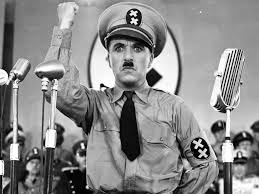
Ask the Great Dictator:

http://www.youtube.com/watch?v=IJOuoyoMhj8