Damaged Childhood: Fools, Self-Destruction, and Reclaiming Youth

DownloadedFile-2

The destructive elements of the American schlemiel cannot be understood apart from the innocent aspects of this character – its childishness.   Likewise, one cannot understand the “destructive element” in Walter Benjamin without understanding its relationship to innocence, childhood, and youth.   Benjamin’s intense interest in childhood and in the daemonic from early on in his life bears evidence of this link.

As I would like to argue, here, and in future blog entries, Benjamin was a schlemiel of sorts and had much interest in comic failures.  He was a man-child.  And, as we see from his work on Kafka, he identified with the comic failure.  However, unlike many Yiddish writers, who saw their task in a more ameliorative light, he understood his obsession with youth and childhood to be a response to a damaged childhood; a response that was, ultimately, destructive.  Nonetheless, he felt it was necessary for himself and for Europe.

When Benjamin was 29 years old, he wrote an essay on Fyodor Dostoevsky’s The Idiot.  In this essay, published in 1921, Benjamin says, quite explicitly, that the “pure word for immortality is ‘youth’.”  And by this he means that it, in a poetic sense, is a dangerous word.  The concept of the “pure word” comes from the German poet Friedrich Holderlin.

In his book on Paul Celan’s poetry entitled Poetry and Experience, Phillip Lacoue-Labarthe likens the “pure word” to a “spasm” and a suspension of meaning. “Poetry is the spasm or syncope of language. Hölderlin called the caesura ‘the pure word’” (49)   But this “spasm” of language cannot be spoken, Benjamin tells us, because the youth have failed.

He notes that Dostoevsky’s “great lamentation in this novel is for the failure of the youth movement.”  The problem, the reason for the movement’s failure, has to do with Russia’s inability to “keep a hold on, or absorb into itself, its own immortality.”  According to Benjamin, this failure explains “why the author of the novel believes that the only salvation for young people and their nation lies in childhood.”  The proof for this, claims Benjamin, can be found in the fact that there are many “childlike figures” in The Idiot.  The novel clings to them, so to speak, out of desperation.

However, according to Benjamin, this turn to childhood, while desperate, is necessary.   Turning back to “childlike simplicity” brings with it “unlimited healing powers.”  This healing was necessary because “this young generation suffers from a damaged childhood: the damaged childhood of the Russian country and people has paralyzed their energies.”  From here, Benjamin ventures a thesis about the “spirit of childhood”; namely, that without this spirit, “noble life” will not develop.

This implies that one must return to this childhood spirit – one must, in effect, return to the schlemiel – if one is to “grow” and become “noble.”  But, Benjamin notes, there is a fundamental problem with the child.  In fact, there is a disaster: it can’t speak.

“The child’s inability to express itself continues to have a crippling effect on the speech of Dostoevsky’s characters in general and an overwrought yearning for childhood….consumes the women in the novel.”

Benjamin saw this “overwrought yearning for childhood” and this “inability to speak” to be signs of disaster.

Benjamin likens the cumulative affect of such speechlessness and such yearning for childhood, compounded by all the childish characters in the book, to a natural disaster; it “resembles the implosion of a gigantic crater.”

Benjamin explains the meaning of this figure: “Because nature and childhood are absent, humanity can only be arrived at via a catastrophic process of self-destruction”(my emphasis).

Much of what Benjamin writes about others is autobiographical and mimetic.  We can see this in his writings on authors he admires such as Franz Kafka and Robert Walser.  We can also see this in his words about Dostoevsky.  Dostoevsky’s failure and damaged childhood are his.  The characters who desperately yearn for childhood reflect Benjamin’s own yearning.  Their inability to express themselves is his.

What does this all lead to?

Benjamin argues that their “overwrought yearning,” which is based on a “damaged childhood,” leads to a “catastrophic process of self-destruction.”

His obsession with his childhood, with the past, and with comic characters, which we will turn to in a few future blog entries, is the obsession of a self-destructive kind of schlemiel.  Benjamin sees such obsessions as self-destructive but he justifies self-destruction because “nature and childhood” are absent from humanity.  To be sure, he says that childhood (“youth”) can only be arrived at through self-destruction.

If he doesn’t do this, Benjamin is telling us that he will not be able to live a “noble life.”   Indeed, a noble life is an innocent life.  And that is what he, like Dostoevsky’s characters in The Idiot, desperately yearns.  But, as Benjamin knows, this innocence, though yearned for, is damaged.

Unlike the traditional, Yiddish schlemiel, his hope for a “noble life” doesn’t seem to be in tension with despair.  He knows he must go through self-destruction if he is to rescue youth.  However, he also notes that it may come of itself.  He likens this disclosure of youth to an explosion.

Perhaps the kinetics of schlemiel comedy is based on a kind of chemical breakdown and explosion of new energy.  Perhaps the yearning for innocence and youth, which comes out of a response to a damaged childhood, will lead us to an eruption or breakdown.   One thinks of the eruptions of self-destructive schlemiels like Andy Kaufmann or Lenny Bruce.

Gershom Scholem and Walter Benjamin, to be sure, were both interested in likening modern breakdowns to natural disasters. Scholem likens the Sabbatinan disaster to an exploding volcano.  While Benjamin likens the self-destruction of a culture yearning for youth to the “implosion of a gigantic crater.”

Regardless of the metaphors, both Scholem and Benjamin see something self-destructive in the schlemiel’s actions.  More importantly, this self-destruction, this chemical-slash-comic breakdown of the schlemiel, comes out of a “damaged childhood” and the “failure” of writers, artists, and youth to recover “youth.”

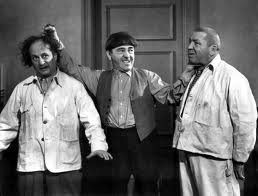
In light of Benjamin’s insight, how do we read this Marx Brothers clip?  Does the breakdown they stage through their comic-kinetics show us an obsession with youth which is based on failure?  Are they paving the road from self-destruction to the “noble life?”   Or are these schlemiels simply….destructive?  What breakdowns do they articulate?:
The Destructive Element in Comedy (Take 1)

DownloadedFile

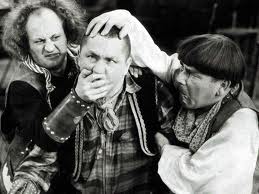
Something happened in the schlemiel’s journey from Eastern Europe to America.  One of the most striking – yet unrecognized – shifts in humor is that while the Eastern European schlemiel tends to be simple, humble, innocent, and generally harmless, the American schlemiel tends – from time to time – to be much more violent, aggressive, and (self)destructive.  American Schlemiels are more physical and intense.  One need only think of The Three Stooges, Zero Mostel, Groucho Marx, Lenny Bruce, Phillip Roth, Andy Kaufmann or even Larry David to understand that sometimes the schlemiel is far from harmless.

As we see in this segment from Mel Brooks’ The Producers, two schlemiels, Zero Mostel and Gene Wilder, are caught up in an intense form of miscommunication.

Each move closer drives these schlemiels father apart.   Their relationship is innocent and violent.

How do we understand the kinetics between them? Is there an element of destruction and violence between them? How do we read this?

Perhaps there is a destructive element inherent in all irony and comedy.   There certainly is a kinetics in comedy; say, for instance, in slapstick comedy.   But how does this relate to the schlemiel?  Are kinetics and play necessarily destructive?  And are they intimately related to the character of the schlemiel?

The blog entries I have done on Scholem and Benjamin point me in this direction since both of them cannot avoid the question of disaster and destruction when they talk about hope.  There seems to be a subtle relationship between hope and disaster.  And the schlemiel, as a character, cannot be separated from hope and disaster.

Gershom Scholem suggested that the intense hope for redemption that we find in the Kabbalah and in the Sabbatinians was a response to disaster.   But in the Sabbatinian case, it not only came out of disater, it created it.   Scholem suggests that Benjamin, like the Sabbatinians, went down the road to disaster when he confused religion and politics.  And, as I suggested in the last blog, the schlemiels confusion of dream and reality often leads to some kind of disaster – even though the schlemiel may, in fact, be unaware that this is the case.  After all, the schlemiel is absent minded.

But there is a problem.  Although absent-mindedness can give us hope, it can also make us melancholic.   In a story like I.B. Singer’s “Gimpel the Fool,” for instance, the constant lying to Gimpel seems to be natural to society.  It seems as if his naïve trust in others will never make headway.  Each time he trusts people, the hope of the reader or of the audience, is challenged.  And this can be disasterous.  But, as I suggested in the last blog, the fool suspends such disaster and holds it in a tension with hope.  Nonetheless, disaster is present in nearly every moment of the story.  Our laughter at Gimpel, the foolish schlemiel, is mitigated by this tension.  Its really not so funny when you really think about what’s happening to him.

In her book, The Schlemiel as Modern Hero, Ruth Wisse, much like Scholem, argued that the schlemiel grew out of historical disaster.  The schlemiel is a “modern hero” insofar as he comically responds to disaster.  His humor, in a sense, negates the fact that Jews were ruined and rendered powerless by the forces of history and Exile.   Her theory closely parallels Scholem’s reading of Kabbalah’s origins since the schlemiel, like the Kabbalah, offers the Jews hope in bad times.  However, with the schlemiel, this hope is not intense; it is tempered by a destructive element; namely, skepticism.  The Kabbalah on the other hand, once it enters history, has nothing to temper it.  And this, for Scholem, is the disaster.  It is the same disaster, he argues, which secular messianic political movements face.

The question for us is whether this reading is sufficient for us to understand aggressive schlemiels.

While Scholem and Wisse turn to history to understand the dialectic of destruction and creativity, Walter Benjamin argues that the violent elements of comedy have a deeper root.  For this reason, he, like the Romantics before him, turns to irony and the imagination for an answer.  And what he finds there, however, is not a mental capacity so much as a material one.  Like children, there is something innocent and natural about destruction which Benjamin wanted to employ in his own criticism and writing.   His understanding of the relationship of children, the imagination, and irony to disaster is very instructive.

I would like to suggest that we follow, in the next blog (or two) Walter Benjamin’s investigation into this matter.   His observations can give us a sense of what a criticism of the schlemiel would look like if it were to adhere to Benjamin’s understanding of the destructive element (in contrast to the understanding held by Wisse or Scholem regarding the dialectic of history and creativity).

Can the Wisdom of the Fool Do Humanity Any Good?

images-2

In my last blog-  https://schlemielintheory.wordpress.com/2013/03/01/messianic-schlemiels-and-messianic-activism-bound-to-failure/ – I argued that the “messianic activist,” as Scholem understood him, could be read as a “schlemiel activist.”  Both the traditional schlemiel (“the man of faith”) and the schlemiel activist are caught up in dreams.  But the difference is that the dreams of one do not affect reality while the dreams of the latter, schlemiel activist, do.  The former schlemiel is not in history; the latter is.

Scholem goes so far as to say that the messianic activist’s attempt to make her utopian dreams a reality is “impossible.”  And in saying this he, inadvertently, equates him with the schlemiel – the “lord of dreams.”

Dreams are seemingly harmless, but the fact of the matter is that, for Scholem, the actions of the “schlemiel activist” are dangerous, potentially nihilistic, and destructive.

There is something else besides the dream that the schlemiel and the messianic activist share: the schlemiel activist, like any given schlemiel in Yiddish literature, is bound to fail.  But the schlemiel’s failures do not necessarily lead to nihilism.

In Yiddish literature, the reader can understand that the schlemiel, an innocent, simple fool, is not at fault; society is.  His failures foreground the tension between hope for evil one day disappearing and skepticism knowing that human beings are generally bad and will never change. The schlemiel’s goodness, dreams, and failures are, for the skeptic completely meaningless.  The literary schlemiel keeps these two extremes in check.

This tension suspends nihilism.

In contrast: the messianic-schlemiel-activist fails; but her failures are disastrous.

Is there any way to avoid this disaster? More to the point, how does one avoid the dangers of secular messianism?

For Scholem, the secular messianic/utopian movements in 20th century politics continued the tradition of the “messianic activist” that began with Sabbatai Zevi (the false, Jewish Messiah of the 17th century) and the “Sabbatinians” who followed in his footsteps.  The secular messianic movement, which his brother actively participated in, perplexed Scholem.  He understood that the problem with this movement was that it confused religious and political concepts.  It was this confusion which could lead to nihilism and disaster.

The confusion of concepts is the hallmark of the schlemiel.   A schlemiel is known for confusing his dreams with reality.  This confusion of concepts finds a striking analogue in Scholem’s understanding of his dear friend Walter Benjamin.

He provides a diagnosis of such a confusion in a 1975 interview with Sdeemot: Literary Digest of the Kibbutz Movement.  The interview was with Muki Tsur, Sdeemot’s Managing editor.  Tsur asked Gerschom Scholem the following two questions about Walter Benjamin:

Muki:  Could you speak of your connection with Walter Benjamin?…Was the closeness and the tension between you and Walter Benjamin a kind of reenactment of your relations with your brother and with the secular messianic movement?

Scholem immediately hits on the fact that Benjamin confused “religious and political concepts.”  And that this “mix-up becomes a destructive element.”

This is even in his last writings. There were times when he knew the distinction very well and was careful about it, and was not prepared to discuss matters of history in terms of redemption.

But the times were few and far between:

The debate with a thinker like Benjamin was conducted on an altogether different plane from the one which I argued with my brother (regarding secular messianism).  My brother was much less profound and dialectical than Benjamin.  My brother did not at all believe in the possibility of utter rout.  He didn’t take it seriously.  A man like Benjamin took this seriously. Toward the end of his life he fell into total despair – as is evident in his published last letters.

In these last letters, Benjamin, however, is not simply caught up in despair by the fact that redemption would not come through secular politics in his lifetime.  Benjamin also drifts into meditations on the fool and comedy.  It is Benjamin’s reflection on the topic that brings out an admixture of hope and skepticism.  And I would argue that his appeal to the fool and comedy works, to some extent, to suspend nihilism.

(I will only touch on one of these letters.  In future blog entries, I will address others.)

In June 12, 1938, Benjamin addresses one of his last letters to Scholem.  This letter included a key mediation on Kafka.  After writing, with respect to Kafka, that wisdom is gone and that “only the products of decay remain,” we may certainly think that Scholem was right: Benjamin is in despair at the fact that his “messianic activism” has failed.  His confusion of religious and political concepts has led to this bleak reflection.

However, Benjamin turns things around when he notes that “Folly lies at the heart of Kafka’s favorites – from Don Quixote via the assistants to the animals….This much Kafka was absolutely sure of: first, that someone must be a fool if he is to help; second, only a fools held is a real help.  The only uncertain thing is whether such help can still do humanity any good.”

In the end, Benjamin’s mixing of categories still remains, but it remains, this time, as a question.  Can foolishness do humanity any good?  Can the wisdom of the schlemiel, of the fool, do humanity any good?

With this question, Benjamin seems to be standing, at the end of his life, between hope and skepticism.  And, after waking from his dream, he seems to no longer be confusing religious and political concepts.

Regardless, the question stands, for Benjamin, Scholem, and this blog: Can the wisdom of the fool do humanity any good?

Messianic Schlemiels and Messianic Activism: Bound to Failure

DownloadedFile-2

In Yiddish literature, schlemiels are usually harmless.  The dreams that these Jewish fools live by spur them to be absent-minded. And, though they do collide with reality from time to time, these absent-minded dreams don’t harm it.  Rather, reality often harms the schlemiel.

The term Luftmensch, which means a person who “lives on air,” on dreams, is often associated with the schlemiel.  With her big ideas about how s/he is going to make a living, the schlemiel lives on air.  They often fail to realize their dreams in reality, but this doesn’t stop them from dreaming again.  Regardless, these types of schlemiels are characterized by their dreams and their failures.

But what happens when a schlemiel’s dreams collide with reality and force reality to conform to these dreams?

In an essay entitled “Toward an Understanding of a Messianic Idea,” Gershom Scholem argues that those who “press for the End” are bound to fail.

His wording is striking as it contrasts the “man of faith” to the Kabbalistic “activist.”  To understand his contrast, I’d like to suggest a distinction that is based on a standard understanding of the schlemiel.

In many of his stories, the Hasidic Rabbi, Rabbi Nachman of Breslav, considers the man of faith to be simpleton and a schlemiel.  In his simple faith, he waits and prays for redemption.  He doesn’t push for the end.  His foolishness is a matter of perspective.  For the person who relies on his intellect and deeds to get him through life, the “man of faith” is a schlemiel.  But, for the reader of these Hasidic tales, it’s the other way around.  The real fool is the man who relies on his intellect and will power.

Gershom Scholem tells us that, for the “man of faith,” there is an “essential lack of relation between human history and the redemption.”  But, Scholem argues, this attitude was “again and again in danger of being overrun by the apocalyptic certainty that the End had begun and all that was still required was the call to ingathering.”

This “call,” so to speak, is read by Scholem as a call to action.  He calls it “messianic activism.”

“Even and again the revolutionary opinion that this attitude deserves to be overrun breaks through in the Messianic actions of individuals or entire movements.”

This “enticement to action…is inherent in this projection of the best in man upon his future.”

It would seem that this utopian and revolutionary action is contrary to the schlemiel.  But Scholem notes that “the enticement to Messianic action” is an “enticement that is bound to fail because no one is capable of such action.”

Scholem goes so far as to say that such action is so impossible “it must be done by magic, and it must fail for just this reason.”

To be sure, even though the Messianic activist has little interest in the schlemiel (that is, the man of faith), Scholem characterizes him, to be sure, as a luftmensch who will always fail “because no one is capable of such action.”

In other words, Scholem sees all secular humanists with utopian aspirations as schlemiels.  He sees their Utopian Kabbalist precursors, some who resorted to magic, also as schlemiels.

The actions of these dreamers, he notes, are dangerous. Once they fail, they can lead to nihilism on a large scale.

What can we learn about the schlemiel from Scholem’s characterizations of “messianic activism”?  If the schlemiel’s actions remain within the shtetl or within the space of fiction, they are harmless, but if they enter history, then the schlemiel’s actions are dangerous.

Even though Scholem never uses the word schlemiel to characterize the “messianic activist,” it should be clear, based on what we have said, that he would.

Entering history with a utopian dream, thinking that one can redeem it through their actions, will, for Scholem, always lead to failure.

The action, Scholem says, is impossible.  Nonetheless, it has been done not just by Shabbatai Zevi, the false messiah who Scholem has written on extensively, it has also been done by political utopians (whether on the left of right such as Hitler, Mao, Stalin, and many many others whose messianic activism has, as Scholem might say, torn a hole in reality).

Scholem sees the origin of Modernity in this Messianic kind of activism, but this doesn’t mean he looks upon it in a positive way.  From his rhetoric, we can surmise that he might agree that there are schlemiels that dream of the messianic age and don’t do anything to bring it (the “men of faith” – schlemiel’s who don’t act) and there are schlemiel who act on their Messianic dreams and aspirations.

As we saw above, there is, for the man of faith, an “essential lack of relation between human history and redemption.”  While for the Messianic activist, there is.

And, lest we not forget, Scholem is speaking about Jews entering history.  He understood this movement to be dangerous as it was saturated with the aspirations of utopian schlemiel activists.

One wonders if Scholem would call the Israelis who took Israel in 1948 schlemiels. For on that day, they entered history and did, what he would think, is impossible.  But, as we see now, things are far from redeemed.  And, unfortunately, some damage has been done.  And nihilism is on the horizon.

This is wholly ironic because, as Sidrah DeKoven Ezrahi argues in Booking Passage: Exile and Homecoming in the Modern Jewish Imagination, which we mentioned in our blog on Purim (https://schlemielintheory.wordpress.com/2013/02/24/here-in-america-everyday-is-purim/), Israeli’s have had little to no interest in the schlemiel.  “Israel is Real, “says Ezrahi; its not a dream (like America).  Nonetheless, the act that brought it into reality was utopian; it was the act of a schlemiel.

It was impossible.  Nonetheless, this should give us a lot to think about.  In America, in Europe, and around the world the “messianic activism” of at least one variety of schlemiel lives on.  And if we were to follow Scholem, we would see the danger that looms around their actions is the danger of nihilism.

Perhaps Scholem wanted to fare somewhere in the middle.  Somewhere between one schlemiel and another; for, as the main character Stephen Daedelus says in James Joyce’s Ulysses: “history is a nightmare from which I’m trying to awake.”

Perhaps history is the dream, and all of the messianic activists on the stage of history are really schlemiels?  But, unlike Stephen Daedelus, the schlemiel usually doesn’t know she is dreaming.   And if you don’t know you’re dreaming, how can you awake from your dreams?

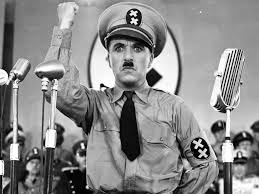
Ask the Great Dictator:

Reflecting on Comedy: Miriam Katz’s Comic-Art Project (Take 2)

DownloadedFile-1

Miriam Katz is an art curator who has taken on the task of bringing comedy into the serious and overly academic artworld.  On March 19th 2011, she was the curator of a “showcase of experimental comedy” at MOMA P.S. 1.  As Martha Schwender of the The Village Voice points out in an article entitled “Have you Heard the One About the Art Scene Embracing Comedians?” Katz included comic performers such as Jon Glaser, David Hill, Jenny Slate, Reggie Watts, Maeve Higgins, and Rory Scovel in her art show.

Echoing Miriam Katz, Martha Schwender demurs on what happens when “comedians are being presented as artists?”  Will there be a collision?

What I found interesting about her article’s presentation of Katz’s project was its insistence on the link between trauma, comedy, and thoughtful reflection.

Schwender, citing Katz, notes that “comedy is much less safe than art.”  Literally and figuratively.  Apparently, there are more starving comedians than starving artists. Art has become too smug with itself and now “comedy is a model for artists who feel art has become to academic or safe.”  The world of comedy is a dangerous space and those who live in it take more risks that are typical of those who dwell in the artworld.

But here is the problem.   Comedy is unreflective and forgetful.  Citing Katz, Schwender writes: “Laugher obliterates the memory of what took place, so people don’t sit down and write a response, aside from ‘Check it out, its so awesome!”

This, Katz argues, is problematic.  Comedians are “hungry for critical feedback.”

In other words, comedians want us to think about comedy and share our thoughts with them.

At the end of this piece, Schwender, echoing Katz, gives her own reflection on comedy.  She notes that when comedians do well on stage they say that they “kill.”  This, I would add, is similar to the Borscht Belt expression of ‘knocking them dead.”  Or “blowing them away.”

What do they mean by such language?  Does the comedian have a violent and antagonistic relationship with her audience?

Schwender doesn’t give a direct answer.  Instead, she demonstrates that comedy is not all lightness and fun; death and mortality are themes in contemporary comedy: “(Andy) Kaufman talked about faking his own death…Zadie Smith..uses her own hapless father as an example of comedy triumphing over mortality: Her father “missed his own death” because he died in mid-sentence, “joking with his nurse.”

But does comedy really triumph over reality?  Is comedy redemptive?  Schwender seems to suggest as much here.  It takes us through the darkness and leads us to light.

Schwender ends the piece with a suggestion of hope; namely, a new era of art.  What Dada was to WWII, Katz’s new efforts will be to our current post-traumatic situation: “Our own art-comedy moment feels rooted in a similarly apocalyptic soil: wars, natural disasters, and nasty elections.  Four years ago, skulls were the leitmotifs in art, clustered in paintings or crushed with diamonds.  Now, laughter is taking over.”

But what does this mean?  Is Miriam Katz awakening us to a messianic-kind of Dadaist comic-epoch which has found its birth in 2011, in Manhattan?   And how do we “reflect” on this post-traumatic comic moment?  Do we find redemption in it? Does comedy, dark comedy of the Andy Kaufmann variety, offer redemption or catharsis?

In search of an answer, I went to hear from Katz herself.  I found an interview with Katz in BOMBLOG.  The interview took place recently and focuses on her new podcast project.  Since her exhibition, Katz created a website with monthly podcasts of comedians reflecting on their work: http://www.breakdownshow.com/about/

The website is called Breakdowns.  The name is apropos as it hints at an emotional breakdown and a reflective breakdown of the (comic) breakdown.  But, and here is the question, is reflection on comedic-slash-traumatic comedy redemptive?  Must all comedy, worth anything, be thought of in this way?

In her interview with Sam Korman in BOMBLOG, we get a better picture of her understanding of the relationship of comedy-slash-trauma and reflection.

http://bombsite.com/issues/1000/articles/7063

Blogging on February 15th, Korman leads the way to the question of comedy and redemption when he associates Katz’s art project (and his own interview) with going into the depths of darkness by way of the comedian but, in the end, finding “our way back…redeemed.”  He suggests that his interview and her comic-art project are a mythic type of journey into and out of darkness.

When first asked why “comedy is so important,” Katz gives an answer that speaks to trauma and reflection.  She notes that comedy gives people relief, is critical and fun, and allows for “difficult truths to emerge.”

Her challenge to the artworld is to be critical “in a joyous way” instead of being too serious and academic.  And comedy makes this joyous type of criticism possible (which sounds much like what Friedrich Nietzsche called “Gay Science”).

But, toward the middle and end of the interview, Katz shifts and gives us a picture of comedy that is not redemptive.  First of all, she notes the position of the comedian to the audience is not a mutual catharsis.   Rather, “structurally we (the audience) are arbitrary.  The comic just wants the sounds coming from our bodies.”  All she wants is the audience to have a “bit more agency or influence.”  The little freedom she wants for “us” inheres in our “critical” response to comedy.  The act itself, however, harbors no agency.  Its just bodies responding in space to humor.

Korman is not satisfied with this kind of answer, so, later in the interview, he tries to bring in another philosophical angle.   He demurs that when one laughs at oneself, one becomes a listener.  This relation would be redemptive.

In response, Katz notes that this would be equivalent to standing outside of oneself and looking at oneself from a birds-eye-view: “That’s so weird and cool: making yourself laugh.  It forces you to ask, who’s that?”

For Katz, this seems to be a moment of ambivalence and self-alienation; not a moment of self-recognition.  It is traumatic.

What’s of more interest to her, it seems, is the relationship between the audience and the comedian: not what it means, but what happens.

(As Walter Benjamin once wrote in his Kafka essay, “attention is the silent prayer of the soul.”  This attention, I would add, is to what happens-as-it-happens.)

Katz ends the interview with a paradoxical reflection.  When you laugh there is relief (and I would add that this is cathartic and redemptive); however, she contradicts this when she says: “there’s also no escape.  It forces you to admit things about your limitations and about what you really want.”

The fact that we cannot “escape” ourselves and that we are forced to admit things about ourselves and our desires is a shameful moment.  On the contrary, there is no relief.

Comedy, in other words, forces us to be uncomfortable.  It exposes us to our mortality and our desires (whether frustrated, failed, sick, or what have you).

But this isn’t the comedy we see on The Daily Show, Jimmy Fallon, David Letterman, or Saturday Night Live; no, it’s the disturbing kind of comedy we find in comedians like Andy Kaufmann and Lenny Bruce.  The comedy she is talking about is the variety that makes us chuckle while feeling uneasy in our skins.

And this is what we see in this Andy Kaufmann video, which I posted in yesterday’s blog:

Bringing a critical understanding of comedy can help us to understand what comedy does to us, but it can’t redeem us.  Nonetheless, it can spur us to act.  The schlemiel faces us, in a Levinasian sense (which I mentioned in the previous blog entry) with the “demand of the hour.”  Our choice to act, to decide, follows in the wake of our comic exposure to ourselves, the other, and to the hour (our situation).

This, I would argue, is the agency that Miriam Katz is trying to find for her comic audience.  Our freedom follows the comic breakdown.

Freedom and critical reflection are in the wake of the schlemiel’s oblique prophesy.

What do Louis CK, Andy Kaufmann, Emmanuel Levinas, and The Miriam Katz Project have in Common?

Today, I was incredibly delighted to see a post by the Jewish arts and culture website Tablet on my facebook page with the following tagline and question:

Art historian Miriam Katz thinks of comedians as spiritual guides, and she wants to bring stand-up into the serious world of galleries and museums:

553347_10151445852084691_1197436688_n

What do you think — can comedy be intellectualized?

As I scanned the tagline, the question, the image, and the post, I was overwhelmed.  I was really excited to see that something I am deeply concerned with in my blog is being echoed “out there” in the virtual sphere and “in reality.”

The “schlemiel as prophet,” as a “spiritual guide,” seems to be catching on.

But it’s confusing. What does this mean?  I could see that the question after the tagline and the responses to it in the facebook thread bore confusion over this question.

What the thread opined on was whether or not a comic could be a spiritual guide. As one can imagine, some thought this idea to be absurd while others did not.  The general response, however, was that this is a question that has yet to be thought through in a thoroughgoing manner.

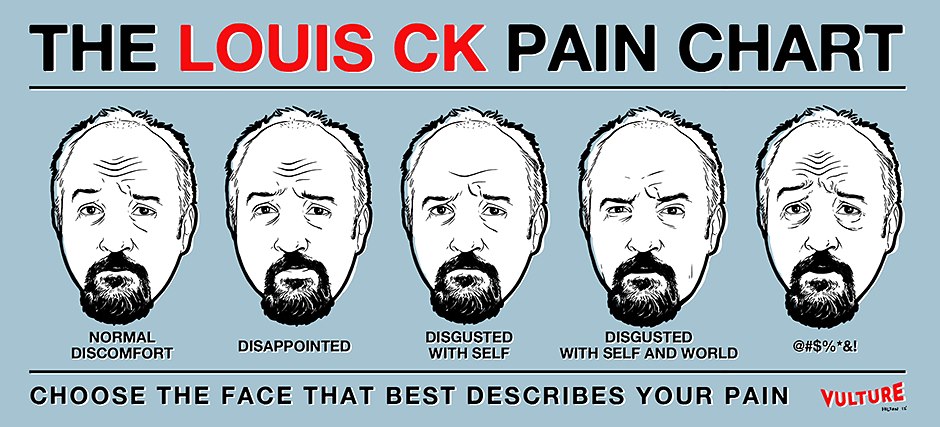
The image, propped between the tagline and question, also evokes questions as to what the comedian can communicate to us.  To be honest, I found the Louis CK image to be more telling than the question.

What astonishes me about the Louis CK image and the caption is that, taken together, they suggest that the face is linked to comic-spiritual guidance.  This suggestion or allusion hits at something deep: it hits at the relationship of prophesy to comedy and the face.

For me, this is profound because Emmanuel Levinas, a philosopher I esteem above nearly all the philosophers of the 20th century, argued that the face is prophetic.  And this prophesy pertains to suffering.    The face, for Levinas, traumatizes and inspires “me” to be-for-the-other.  It takes me outside of myself before I can even think about whether or not I want to help the other.

For Levinas, one is always-already and yet-to-be for the other.  The face tells me, in a prophetic manner, “Thou shalt not Kill.”  Levinas calls my relationship to the other the one-for-the-other.  Which means, I am for the other before I am for myself.  And this is magnified by the other’s suffering which “I” struggle with only because I am always-already affected by it.

Perhaps this struggle bespeaks the bittersweet comedy of being-for-the-other?

The subtitle of the piece bespeaks this in an oblique way: “choose the face that best describes your pain.”

The irony of this image is that none of them describe my pain; rather, they strike me with the pain of the other.  They concern me and I cannot simply choose one over the other.  They all beckon me to ethical concern.   My choice is, so to speak, too late.

After looking at this image and thinking these things, I thought immediately of Andy Kaufmann.

To my surprise, I clicked on the Tablet link associated with the image and found this article by Jessica Weisberg on the art curator Miriam Katz entitled “Andy Kaufmann Isn’t Funny.”  At this point, you can only imagine, I was besides myself.  Astonished.

http://www.tabletmag.com/jewish-arts-and-culture/theater-and-dance/125181/andy-kaufman-isnt-funny#

I decided, nearly two years ago, that I would write the final chapter of my book (a work in progress) on him.  To my mind, he is one of the best illustrations of the schlemiel-as-prophet.

There is a demand in his comedy; namely, the demand of the other.  His pain on stage, while funny to many, solicits the viewer.  As Levinas might say, it traumatizes and inspires her to think about her laughter and about what to do in response to the schlemiel.  (In my book and in a later blog, I will return to this scene on the David Letterman show.):

Notice how the audience doesn’t know whether he is joking or really suffering.  This ambiguity is the basis of the prophetic-comic demand that he makes to the audience.   He does this, quite simply, through his face and his gestures.

I am overjoyed to see that I am not the only one who has been struck by the prophetic demand of Kaufmann’s comedy.  And I applaud Miriam Katz for the work she has done on Andy Kaufmann.

Here’s is a brief overview of the scene she is a part of in NYC. This article comes from The Village Voice.

http://www.villagevoice.com/2011-03-16/art/have-you-heard-the-one-about-the-art-scene-embracing-comedians/

In my next blog entry, I hope to further address this article and the merits of her artistic project, which, like mine, is to show the world “out there” that there’s more to the schlemiel than entertainment value.

After Purim, Whither Prophesy? The Legacy of the “Hidden Tradition” (And a New Schlemiel-Anniversary)

In the blog entry entitled “The Schlemiel as Prophet (Take 1),” I cited a passage from the Talmudic tractate Baba Batra (12b). The Midrashic passage made the claim that prophesy passed on from the prophets to children and fools. What I didn’t note is the date that prophesy ended: it ended on Purim. Yesterday. This means that today is the anniversary of the first day after the end-of-prophesy.

But what begins after the end of prophesy?

The answer to this question is not so simple. The Midrash from Baba Batra says that after prophesy ends it passes on to fools and children, but Talmud Yoma 39a says that end of prophesy is the beginning of the Oral Tradition.

Here is the passage:

Why is Esther compared to the dawn? To teach you that just like the dawn is the end of the night, so to is Esther likened to the end of all Miracles. But what about Hanukkah? We are talking about miracles mentioned in the prophets. (My translation)

Here, miracles are linked to prophesy. And the reason why Hanukkah is not included within the purview of prophesy is because the Book of Esther is the last recorded prophetic book in the cannon of the written Torah (the book of Prophets – Neveim). The miracles of Hanukkah, which happened chronologically after Purim, are not a part of that cannon and prophetic lineage.

In one of his reflections on Purim, the 18h century Hasidic Rabbi Levi-Yitzchak of Berdichev, who the Kabbalah scholar Gershom Scholem regarded as one of the most important Hasidic mystics, addresses the future of prophesy after Purim.

In this reflection, he begins by citing the line which says that the Jewish people “fulfilled and received”(Esther 9:26) the Torah on Purim. In a Midrash from Tractate Shabbath 88a, we learn that this passage marks a distinction between the acceptance of the Torah through Moses and its acceptance and fulfillment during Purim.

Upon receiving the Torah in Exodus 24:7, the Jews said “we will do and we will understand”(Na’sah v’nishma). In contrast, the Book of Esther says that the Jewish people “fulfilled and received it.” The obvious question is why is the acceptance of the Torah on Purim different? The answer some Rabbis give is that this reception, on Purim, is out of love while the first reception of the Torah was out of fear.

To illustrate, one of the Midrashim in Shabbath 88a details how God turned the mountain over the Jewish people “like a tub” and said if you do not accept it “here will be your grave.”

Rabbi Levi-Yitzchak of Berdichev reads “fulfilled and received” differently:

Mordechai was the last of the prophets as it says in the Talmud (Yoma 29a). We find that until Mordehcai the light of the Written Torah shined. From Mordechai on, prophesy stopped and the light of the Oral Torah began to shine. From Mordechai on begins the Knesseth G’dolah and the canonization of the prayer book. And this is the meaning of “they fulfilled and received” (the Torah): they received and accepted amongst themselves the Oral Torah from Mordechai onwards. Prophesy had ended and the oral tradition began because, in truth, all the time that there was prophesy, that prophesy was written down. When prophesy ended, it was no longer written down and the light of the Oral Torah took precedence. (D’roosh Purim; my translation)

What I find so fascinating about Rabbi Levi Yitzchak’s reading is that he, a mystic, would not mention anything about the “other” new beginning of prophesy; namely, that it is now taken on by children and fools. Moreover, many Hasidim see Purim as a holiday which is all about “turning the world over,” a holiday where foolishness is deemed, to some extent, prophetic. Nonetheless, he bears no mention of this other post-prophetic beginning.

By doing this, he is, in effect, teaching us that this tradition of passing prophesy on to fools and children is either not important or it is a “hidden tradition.” It is, to some extent, esoteric.

The term “hidden tradition” is an expression used by Hannah Arendt to describe the history of pariahs and schlemiels which, for her, starts with Heinrich Heine, in Germany (not in Eastern Europe, with the Hasidim or with Yiddish folklore and literature and not in the pre-modern period). I’d argue that Arendt could have gone back much further so as to understand the beginning of this “hidden tradition” of the schlemiel; namely, to the passage from Baba Batra I cited in “The Prophet as Schlemiel (Take 1).”

The question of what begins after the end of prophesy seems to have two answers that lead us in two different directions. The first answer, the one cited in Talmud Yoma and reiterated by Rabbi Levi Yitzchak of Berdichev, is that after prophesy ends the oral tradition (the Talmud) begins. Now, Revelation (not prophesy, which is based on Revelation) is confined to learning and, as it says in the Talmud, the “four cubits of Halacha”(Jewish law). The other answer is that after prophesy ends a new type of prophesy arises, one that is given to fools, children, and, as I noted in previous blogs, the man-child, the schlemiel.

Perhaps we can offer a third answer and say that Rabbi Levi Yitzchak of Berdichev was hinting at this other answer? After all, what is an Oral tradition? If the Hasidim took the Kabbalah to be the Oral tradition, why wouldn’t they include, within that category, the prophesy of fools, children, and schlemiels? Don’t Hasidim record them in many of their stories? Is the schlemiel – in real life – and in its fictional life participating in this hidden tradition? Are Hasidic stories on the schlemiel parts of this hidden tradition? Were they meant to be esoteric?

The answers to these questions are thought-provoking since schlemiels were well-known to all Hasidim and to all non-Hasidim in Eastern Europe. They weren’t esoteric. However, their legacy, their secret, so to speak, is. It is a “hidden tradition” of sorts.

What new tradition begins today, then, the end of Purim? What new tradition should we celebrate on this anniversary?

On the Schlemiel Theory blog, let’s do something foolish. Let’s follow the Midrash in Talmud Yoma and declare the day after Purim to be the end of one kind of prophesy and the beginning of another! This can be the anniversary of the schlemiel’s birth into the Jewish prophetic tradition – the prophetic tradition of exile and the oblique, comic prophet. Today can be the anniversary of the “hidden tradition.”

Happy schlemiel-anniversary!

Here, in America Everyday is Purim!

In Booking Passage: Exile and Homecoming in the Jewish Imagination, Sidrah Dekoven Ezrahi begins a section entitled “America is for Children” with the following claim: “Purim is for children, so is America.”

This claim can be found in Ezrahi’s commentary on Sholom Aleichem’s Motl, the Cantors Son.  To be sure, her text is inspired by the following words of the main character (and schlemiel of the hour) – Motl:

Purim comes only once a year, but here (in America), everyday is Purim for Vashti.  He earns money every single day.  “Columbus, who can compare with you!

What does Aleichem mean when he has Motl, a schlemiel say that Purim in America is only one day in Europe but everyday in America?  And how does that relate to the next line: “he earns money every single day?”   What does making money have to do with Purim being everyday in America?  Lastly, what does it mean that Motl turns to an American holiday and says: “Columbus, who can compare with you!”

Ezrahi’s answers are worthy of discussion, especially here, in a blog dedicated to the schlemiel.  They broach a discussion on how the American and European schlemiel differ.  It also spurs a discussion of the difference between Israeli and American Jewishness. Ezrahi says, basically, that the American schlemiel leaves the European one behind – in the dust so to speak.  The American supercedes the European schlemiel.  In America, Purim is everyday.  It is the land of dreams.  In Israel if you will it, as Herzl says, its not a dream.

In this interpretative contrast between Israel and America, knowledge of the interpreter’s place makes s difference: Ezrahi is an American ex-patriot.  She has been living in Israel and teaching in Hebrew University for some time now.  Her latest work, Booking Passage: Exile and Homecoming in the Jewish Imagination, pivots on the tension between Israel and America, Homecoming and Diaspora.  She writes, literally, from Israel. And this makes a difference insofar as America, to an Israeli like Ezrahi, looks like a foolish, amnesiac land.

Israel is intimately tied to the history of the Jewish people.  In Israel, Ezrahi says, memory and history is “recovered.”  While in America, reality, the present moment, experience itself is being “rediscovered.”   In America, there is endless forgetfulness.

While the land of Israel (ha’aretz) is the basis for Israeli literature, history, archeology, and politics is the land of Israel, the diasporic Jewish literature of America has no basis in history or a land.

For Ezahi, Israeli literature is consequential.  It is about a real land and real people.  Jewish-American literature is not.  Its based on the schlemiel and swims in virtual reality.

For American Jews, “the text (and not Israel) is, as George Steiner once wrote, “the homeland.”  It is, as Ezrahi says, a “substitute” for the land.  It is a “fictional sovereignty.”  In this land, the schlemiel, the “lord of dreams,” (as Heinrich Heine would say) is the king.  In this land, the land of the free, Purim is every day.

But things have changed.  After the land of Israel was established “fictional sovereignty” becomes a “diasporic privilege.”  It is, in other words, not a necessity.  Life in America – inside and outside of fiction – is the disaporic privilege of the few who ignore the land and the “recovery” of Judaism.  The schlemiel is a diasporic privilege. Israelis don’t have time for it.  They are in reality, not dreams (like us).

To be sure, the life of the postmodern American Jew is dwelling in the pages of fiction.  The key character and the author of these texts is the schlemiel.

But there is more to the story.  This is high culture of diasporic privilege, the low culture also celebrates the Schlemiel.  Diasporic privilege – that is the privilege of the schlemiel – is all around America.

According to Ezrahi, the schlemiel is an American “cultural icon.”

But how did he become a cultural icon?  How did this all happen?  And what does it mean?

Ezrahi’s interpretation of Aleichem’s Motl says it all.  To be sure, we can learn everything we need to know about why America is different from Israel by understanding Aleichem’s words on Purim.

According to Ezahi, the main task of the schlemiel in its  Yiddish-European model incarnation was to “turn things over” (ha’hefuch).  To revise the past – turn it over – through language.  Words.  One creates one’s own Diasporic homeland.

The power of the schlemiel is the power of language.  It is the “substitute” for power and for a homeland.

She calls the schlemiel’s wordcraft “the alechemy of words.”

According to Ezrahi, Aleichem’s schlemiel Motl revises history!  His father dies (which she reads as Europe dying) and he refuses mourning by way of speaking to much.  But more importantly, by going to America and substituting America for Europe.

For Aleichem, as for Modernist writers, language becomes everything.  For Ezrahi, his obsession with words is a denial of history and past trauma.  And this is Motl.  The schlemiel loves playing with language.  But, there is more, you don’t have to be a fictional character or author to play with language and create a “substitute sovereigny”(to substitute for one’s lack of a land and real power).  All you have to be is an American and you’re a schlemiel.  (Presto!)

In America Purim is everyday:

Purim comes only once a year, but here (in America), everyday is Purim for Vashti.

And why?

Ezrahi argues that the next line tells us: “He (Motl, the schlemiel) earns money every single day!”

For Ezrahi, this means that Purim is everyday.  Because, in America, one can remain a child (like Motl) and just work a simple job, or, as we hear all the time, the American schlemiel can live the dream.

Even though one is a child, at the very least, every day one can (in America) move from thing to thing.  The American-Jew (and the American, in general) does need any grounding in a land or history.  Living the dream is equivalent to Purim every day.  Moving from thing to thing.  Endless discovery, opportunity, and hope are the name of the American-schlemiel-game.

“Though Motl doesn’t grow, he moves, ultimately acting out his capacious dreams in New York’s streets…The child as a site of a Purim sensibility and as a miniature shlemiel…But no less significant, though seldom remarked, is that it is followed by its antithesis: the embrace of an alternative reality, of America as a space of unlimited possibility.”

Motl, in this American moment, “renounces” what Erazhi calls the “Purim privilege as superfluous.”  And he, the new American schlemiel, embraces “virtual reality.”

For Ezrahi, America is Purim.  Continuous optimism is provided by an endless procession of “simulcura.”  Where does it all come from?  It comes from out of the heartland (and producer) of dreams: Hollywood.

One can be American-Schlemiel if one makes a sacrifice. (Or perhaps this sacrifice has already been made to establish a new (yet virtual) diasporic foundation?)  This, according to Ezrahi, is Motl’s teaching.

In the moment of his ‘yes-saying’ to everything, to America, there is an exchange, that is, a sacrifice: “We can trace the process by which the world of the Shtetl is replaced by the world for America: “Vashti” is exchanged for “Harry” and Purim for Columbus, the coinage of Russian poverty for American capitalism and Yiddish for English.”

This portrayal of Motl as the archetype of the American schlemiel is thought-provoking.  Is Ezrahi right?  Is America caught in the grip of schlemiel dreams?  And should American’s come to terms with their “diasporic privilege?”  If Purim is everyday in America, how is this possible?

What few scholars who have read and commented on about Ezrahi’s book note is that she is portraying Exile (embodied in America) in a negative light.  Even though Purim is everyday in America, it is based on a denial of mourning.  America is, for Ezrahi, amnesia.

The schlemiel is too busy having fun, discovering America, to mourn.  And this is, for Ezrahi, the problem.

As one can guess, Ezrahi says that Israel, on the other hand, has mourned the Holocaust.  It’s fiction and its Jewish life is not based on an alternate reality; Israel is based on the land and on real history not on dreams.  As Ezrahi writes: Israel “is real.”

This would imply that my Purim is emblematized in Motl’s sacrifice and optimism.  My Purim is everyday!

And, worst of all, if I were to agree with Ezarhi’s reading, I would have to say that my life is based on forgetfulness and ahistorical. In my American, schlemiel optimism, I live on dreams.  I don’t live on the land.

Is this something I can accept as an American Jew?

I don’t agree with Ezrahi’s claim that the schlemiel’s optimism is based on the inability of American’s Jews to remember a Europe that they have made “virtual” (Ezrahi calls I.B. Singer’s work, Fiddler on the Roof, etc “the virtual ghetto”).

But I do agree , to some extent, with her argument that the schlemiel is an American “child” (of sorts) who is “moving through space and things.”  But what exactly does it mean to “move through space and things?”

Is the American schlemiel (or the schlemiel in general) a phenomenologist?  As Husserl (and Wiliam Carlos Williams) said, is he going “to the things themselves.”

http://www.goethe.de/ges/phi/prt/en4405872.htm

Ezrahi cites Walter Benjamin to claim that in America the schlemiel is dazzled by things in space.  For Ezrahi, this fascination with things seems to be a distraction from the real thing; the thing that matters for Jews: the land (ha’aretz).

But is this right?  We are far from the prophetic schlemiel.  There are no “demands of the hour” in Ezrahi’s America.  There are no “demands of the hour” on Purim, either.   Only someone who can hear real – not simulated – demands to their Jewishness, is consequential.  For Ezrahi, ha’aretz issues these demands on Jewish identity.  They are the demands of history and the hour.

Without a land, the American schlemiel is, for Ezrahi, inconsequential.  Israelis have a real sovereignty – American Jews do not.  Their sovereignty is imaginary.  Just like Jewish-American identity, which is constantly trying on new Purim clothes.  Changing in and out of ‘things.’

All American Jews are schlemiels who are dancing the Chameleon with Woody Allen’s Zelig: Zelig, the schlemiel with a million faces.  He has no real land.  Zelig sovereignty is inconsequential.  His, like the  optimism of any American Jew, is based on not mourning Europe.

But is this description or, rather, this Zelig challenge right?

I am not ashamed.  I don’t think I have a “diasporic privilege’.  True, I don’t have to worry about ha’aretz every day because I don’t live there. But this doesn’t mean I don’t care and that I have simply left my Jewish identity (tied to ha’aretz) un-recovered.  

Moreover, I don’t think that my Jewish-American existence, my American dreaming, is based on my inability to mourn or my optimism.  

I love America, where every day its Purim!  In America, we’re all children!

My advice to this suggestion: ha’hafook – do what we all can do on Purim: “turn it over!”  Turn over the notion that American is a substitute for Israel.  Turn over the notion that all American’s are schlemiels because they – and not Israelis – are caught up in virtual-Jewish-reality.

One need not worry if, by turning it over, they are being unethical and not mourning or remembering Jewish history and trauma.  Turning over these ideas can help us to understand what is at stake at this hour.  The oblique prophet, the Schlemiel, especially on Purim,shows the way.

Happy Purim!  Don’t renounce your Purim privilege!  There are still things to “turn over.”   After all, its the “demand of the hour!”  Literally!

The Schlemiel as Prophet (Take 2)

In yesterday’s blog, we learned from the Talmud Baba Batra that once the last prophet died, prophesy was given over to children, fools, and, as I explained, schlemiels.

To understand what this meant, I cited Martin Buber’s reading of the prophet.

The prophet addresses persons who hear him, who should hear him. He knows himself sent to them in order to place before them the stern alternatives of the hour. Even when he writes his message or has it written, whether it is already spoken or is still to be spoken, it is always intended for particular men, to induce them, as directly as if they were hearers, to recognize their situation’s demand for decision and to act accordingly

(“Prophesy, Apocalyptic, and the Historical Hour”)

Following Buber’s lead, I argued that “if children and fools have the keys to prophesy, we should understand this to mean that their words, gestures, and actions – and not just the words, gestures, and actions of Buber’s prophet – are ‘always intended for particular men, to induce them…to recognize their situation’s demand for decision and to act accordingly.’

Even though both the prophetic schlemiel and Buber’s prophet look to “induce” human beings to “recognize their situation’s demand for decision and to act accordingly,” the prophetic schlemiel and Buber’s prophet are far from having much in common.

They are not simply different; they seem to be opposites.

I noted yesterday that one of the major differences between them had to do with the way they communicate with ‘the people’: a schlemiel communicates obliquely, while the prophet communicates directly.

Moreover, for Buber the prophet is filled with a pathos which is focused on “the demand of the hour.” The prophet is focused and vigilant.

In contrast, the schlemiel isn’t filled with such a pathos and lacks such a focus: the schlemiel is innocent, naïve, and often distracted.

To understand the prophetic schlemiel, we must further pronounce this contrast.

By doing so, we will be able to understand that it is we, the readers, viewers, and interpreters of the schlemiel, who, in seeing his comic relationship with a world that is against him/her, apprehend the “demand of the hour.”

The schlemiel’s lack of pathos, focus, and distraction shares prophesy with us. Their absence gives us a sense of astonishment. Now, if the schlemiel is a prophet, we would have to say that if it weren’t for the schlemiel, we wouldn’t be able to, as Buber writes, recognize “our” situation’s demand for decision and to act accordingly.

But how could we recognize the “situations demand for decision” and “act accordingly” through the schlemiel? How can a schlemiel help us to apprehend our demanding situation? That is, how could it help us to apprehend “the demand of the hour?” If the schlemiel makes no direct impassioned plea, how could this be?

Through a schlemiel prophet, as opposed to Buber’s prophet, this demand is heard but oftentimes it is unclear. And since the demand is unclear (or complicated), our “decision” to “act accordingly” is also indefinite. This is the situation we face, after the end of prophesy. If the Talmud is right, then perhaps Buber needs to be reread. Perhaps its time that we revise his definition of prophesy to include the new harbingers of prophesy: children, fools, and schlemiels.

To do this, we need to clearly understand what he means by prophesy.

To my mind, Abraham Joshua Heschel provides us with a way of understanding what Buber means. Moreover, Heschel can help us to figure out what the prophet is and does.

Abraham Joshua Heschel has a lot in common with Buber. He argues that the “nature of man’s response to the divine corresponds to the content apprehension of the divine.” Buber would say that this “content apprehension” is the apprehension of the “demand.”

Heschel calls it the apprehension of divine “pathos.” He also names the prophet’s response: “his response is one of sympathy.”

Divine pathos and prophetic sympathy constitute the alpha and omega of the prophet’s life:

To the prophet the pathos was the predominant and staggering aspect of the divine. Even if in the first place the people’s practical compliance with the divine demand was the purpose of his mission, the inner personal identification with the divine pathos was…the central feature of his life.

Like Walt Whitman or Allan Ginsburg, who, oftentimes repeat things over and over in their poetry so as to create a liturgical or meditative effect, Heschel reiterates pathos and sympathy as if they were the only things that have meaning:

The divine pathos is reflected in his attitude, hopes, and prayers. He was dominated by an intimate concern for the divine concern. Sympathy, then, is the essential mode in which the prophet responds to the divine situation.

And as the passage goes on, Heschel becomes more passionate. He dramatizes the essence of this “overwhelming” encounter with God’s pathos, which should ultimately result in the “courage to act against the world.”

The pathos of God is upon him. It moves him. It breaks out in him like a storm in his soul overwhelming his inner life, his thoughts, his feelings, wishes, and hopes. It takes possession of his heart and mind, giving him the courage to act against the world.

Heschel equates courage with prophetic vigilance. The prophet is awake to suffering and evil while the world is asleep. His words awaken us:

Like a scream in the night is the prophets word. The world is at east and asleep, while the prophet is hit by a blast from heaven. No one seems to hear the distress in the world; no one seems to care when the poor is suppressed.

In the following passage, Heschel dramatizes prophetic hypersensitivity:

A single crime – to us it is slight, but to the prophet – a disaster. The prophet’s scream which sounds hysterical to us is like a subdued sigh to him. Exaggeration to us is understatement to him.

At this point, and in response to these passages, we need to ask some simple questions:

1) Does the schlemiel, like the prophet, need “courage” to act against the world?

2) Or does the schlemiel naturally act against the world unbeknownst to himself?

3) Does the schlemiel respond like the prophet responds to reality?

4) Does the schlemiel have pathos?

5) Or is it the reader who does?

6) Is the Schlemiel Vigilant awake while other people are asleep?

7) Is he traumatized by “a single crime” and see it as a “disaster?”

8) Does the schlemiel scream for justice?

9) Are his words “like a scream”?

Let’s try to answer these questions.

First of all, the schlemiel doesn’t need courage to act against the world. Because if a schlemiel doesn’t, to begin with, understand the world or recognize it’s evil, it doesn’t need courage to “act against it.”

S/he is absent-minded and unbeknownst to him/herself s/he acts against the world simply by misunderstanding it.

In response, the world, in most schlemiel stories, novels, plays, and films, laughs at him.

True, the Jewish fool is driven by a passion – but it is the passion of distraction.

The only way the Schlemiel’s words can prophetically scream at us, because the schlemiel can’t, is if they are read against the world. And this requires us, as readers, to relive this tension between the schlemiel and the world.

This requires us to relive and interpret the schlemiel’s gestures, words, and actions.

For in doing so, we may be able to experience the “demand of the hour.”

That way we can, perhaps, act. It all depends on how we read this character. This reading, assuming it is possible, is what we will call prophesy. It is given to us as a gift, so to speak, by the schlemiel.

This reading should bring us close enough to ‘the demand of the hour,’ to know better what our options are.

More to the point, we can say that the schlemiel shares this demand with us. However, it is only shared if we read the schlemiel’s oblique words, gestures, and actions against the world. And the more we pronounce this tension, the more the demand will be pronounced. This reading, this possibility, can expose us to the “demand of the hour.”

How we act in relation to “the hour” is another question.

Each hour may be the last. And each situation is different. What is prophetically demanded or required in relation to that hour is unique, unrepeatable, and unpredictable.

By closely reading the schlemiel, prophesy and the hour can be shared. Or as Derrida would say in his essay on Paul Celan entitled “Shibboleth,” the hour (what Derrida, reading Celan’s poems calls the date) is or can be partage (shared).

The schlemiel comically shares the demand of the hour, obliquely. The laugh that laughs at the laugh, the subtitle of this blog (which comes out of Samuel Beckett) participates in this sharing. It is a type of interpretation or reliving that laughs at the laugh that laughs at the schlemiel. This laughter is – so to speak – the laughter of the hour. (We will return to this idea in the very near future.)

In my next blog entry (or the one after, as tomorrow is Purim!), I will provide an example of such sharing and such laughter.

So sayeth the schlemiel, the lord of dreams!

The Schlemiel as Prophet (Take 1)

R. Johanan said: Since the Temple was destroyed, prophecy has been taken from prophets and given to fools and children. How given to fools? — The case of Mar son of R. Ashi will illustrate. He was one day standing in the manor of Mahuza4  when he heard a certain lunatic exclaim: The man who is to be elected head of the Academy in Matha Mehasia5  signs his name Tabiumi. He said to himself: Who among the Rabbis signs his name Tabiumi? I do. This seems to show that my lucky time has come. So he quickly went to Matha Mehasia. When he arrived, he found that the Rabbis had voted to appoint R. Aha of Difti as their head…


How has prophecy been given to children? A case in point is that of the daughter of R. Hisda. She was sitting on her father’s lap, and in front of him were sitting Raba and Rami b. Hama. He said to her: Which of them would you like? She replied: Both. Whereupon Raba said: And let me be the second.9  (Baba Batra 12B)

The Talmud passage cited above says that after the age of the prophets ended prophesy was passed on to children and fools.   Why children and fools?  One way of approaching this, a way which, I think, was taken up by some of the first Hasidic teachers and the first Yiddish writers on the schlemiel, was to see children and fools as being more simple and close to God and/or truth than adults.  Since adults live according to strict laws of custom, logic, and what Jacques Derrida would call “the proper,” they miss a truth or reality that supercedes reason and custom.

Against the claims made by Islamic and Jewish philosophers like Al-Farabi and Moses Maimonides, the Talmud shows that prophesy need not be based solely on reason.  For Maimonides, Moses was the greatest prophet because, he, unlike Abraham, Isaac, Jacob and others before him, didn’t relate to God through dreams or the Imagination.  Rather, Moses spoke to God, face-to-face; that is, in ways that are not mediated by the imagination or dreams.  Maimonides – like Al-Farabi – held that prophesy, for it to be true, must come through a perfected individual.  By that, he meant a person who has perfected his intellect.

Maimonides and Al-Farabi would most likely argue that the words of children and fools have nothing prophetic to them whatsoever because they are tainted by the imagination and dreams.  If anything, it would be the interpreter who has the upper hand since the interpreter can (for both Al-Farabi and Maimonides) discover the rational content of prophetic symbols.

Nonetheless, the Talmud says that children and fools have the keys to prophesy not Rabbis.

Why?

Children and fools are more receptive and are able to receive what, in Kabbalah, would be called a shefa (a divine influx).  The problem, however, is that children and fools will have a hard time translating such mystical or prophetic experiences into a shared language.  Perhaps this is why modern writers like Faulkner, Doestoevsky, Appelfeld, Grossman, Rushdie et al were so interested in writing from a child or fool’s perspective.

But they did this for one major reason: namely, they did it for us, for the reader to relive, translate, and perhaps even to mimic (we will return to this in another blog) what these fools are saying into a demand (and not simply a meaning) that impacts us, so to speak, in a mystical and prophetic manner.

But what is the point of this “impact”?   And what is the demand that is issued by a Schlemiel?  To be sure, schlemiels are usually very humble and undemanding characters.  Motl and Gimpel, for instance, don’t make any demands on anyone.

Prophesy, as Martin Buber understood it, has much to do with turning to and responding to God (with Teshuva).  The prophet screams out to his people from the midst of a crisis and draws them into it so that they can feel a “demand of the hour.”

Buber writes:

The prophet addresses persons who hear him, who should hear him.  He knows himself sent to them in order to place before them the stern alternatives of the hour.  Even when he writes his message or has it written, whether it is already spoken or is still to be spoken, it is always intended for particular men, to induce them, as directly as if they were hearers, to recognized their situation’s demand for decision and to act accordingly

(“Prophesy, Apocalyptic, and the Historical Hour”)

I would argue that if children and fools have the keys to prophesy, we should understand this to mean that their words, gestures, and actions are “always intended for particular men, to induce them…to recognize their situation’s demand for decision and to act accordingly.”

There is a problem, however.  Although, the schlemiel speaks to the heart, it is also possible that the message may be unclear and mystical.  As Gershom Scholem points out, the prophet often speaks directly to the heart, the mystic, however, is more complex. The message of the mystic must be interpreted.

Drawing on Scholem, I would suggest that a schlemiel is a mystical/prophetic type whose words and gestures may often speak to the heart yet, at times, they require interpretation.

By interpreting the words of the schlemiel, by mimicking or reliving them, we can be “induced” to “recognize” the “situation’s demand” and not simply their rational content.   The schlemiel gives us a sense of this immanent demand of the hour – of something that must be addressed, now.

Many modern and postmodern writers echo the Talmud’s claims about prophesy since they find the words of fools, children, and schlemiels can teach us about the “demand” of what is and what is to come.  The character’s simple (yet ironic) vision of things, although it misses the way things should “properly” be understood, can, when interpreted, disclose something odd, wonderful, and even horrifying about existence and time.

Many of my favorite novelists who use children or fools’ voices give me a sense of an ominous past, a fragile present, and a pressing future.

It is not for no reason, then, that the first major Hasidic tales by Rabbi Nachman popularized the Schlemiel as a simpleton.  Ruth Wisse, in The Schlemiel as Modern Hero, points out that Rabbi Nachman’s schlemiels were, in fact, the first literary schlemiels and had a major impact on Yiddish writers who took the Schlemiel as their main character in nearly all of their stories, plays, and novels.

But the demands of Rabbi Nachman and the Yiddishist writers differ greatly.

The schlemiel’s prophetic aspect had much to do with simple faith in God and in what is to come.  The demand, in Rabbi Nachaman’s short stories on the Schlemiel, is the demand of faith.  This, of course, is a joke for the majority of people who, as Rabbi Nachman understood, didn’t understand (or care to understand) the meaning of simple faith and love of God.   They had no interest in harkening to its demand or as Buber would say “the demand of the hour.”

For modern man, the demand of the hour is either not felt or it comes from somewhere else (not from God).

The irony of all this talk about demands being issued by a Jewish fool is that such a demand comes through an apprehension of the schlemiel’s absent-mindedness.  It is through a juxtaposition of absent-mindedness to the way things really “are” that we can feel the “impact” and the “demand” of the hour. 


For instance, when I.B. Singer’s Gimpel trusts everyone and they endlessly betray him by lying to him, this demand comes to the fore.

As I will show in future blogs, this demand may be felt in the most jarring ways, but, unlike Buber, I’m not so sure we can say that we will know how to “act accordingly” to the demand after we recognize it.

For instance, in Robert Walser’s stories or in Kafka’s stories, we hear a demand spoken to us through a number of different schlemiels.  But, as readers, as interpreters, we often don’t know what to do in response to these demands.

Moreover, its hard to figure out what exactly is demanded by way of these schlemiels.  If anything, sometimes the mimicking, interpreting, and reliving of a schlemiel’s odd life and observations can lead to a kind of paralysis.  S/he may be wrong, but is, for instance, the society or chorus that laughs at him any better?  Is it they who should change? Or is it we who should change? How about the schlemiel?  Perhaps it the case that we should act like the schlemiel?  But that would be ridiculous and irresponsible.  Right?  Perhaps s/he should remain the same and we should demand justice for this character?