Laughter Through Tears or Tears Through Laughter? Irving Howe and Ruth Wisse’s Dialogue over Sholem Aleichem’s Humor – Take 2

DownloadedFile-3

In their epistolary introduction on Sholem Aleichem,  Irving Howe sets the tone for his declaration of Jewishness by noting that he has an “uneasy feeling” that he has discovered a Sholem Aleichem that has “seldom been encountered.”  Howe says what no-one wants to hear; namely, that Sholem Aleichem “turns out to be imagining, beneath the scrim of his playfulness and at the center of his humor, a world of uncertainty, shifting perception, anxiety, even terror”(vii).

Howe uncovers and shares something shocking about Aleichem.  He then akes the newly perplexed reader by the hand.  After disclosing what has been repressed about Aleichem, he compassionately notes: “Let no innocent reader be alarmed: the stories are just as funny as everyone has said.  But they now seem to me funny in a way that almost no one has said.”

Reading this sentence, I could not help but think of how Martin Heidegger, the celebrated German philosopher, speaks in his talk “What is metaphysics?”  Here Howe acts like Heidegger when he performs, like and unlike Heidegger, what Heidegger would call the “nihilation of the Nothing.”  What happens for Howe, as a reader of Aleichem, is that the world he, the reader, lives in – the world of Sholem Aleichem – is “now” different.  It has been nihilated by suffering and unspeakable horror (which Howe assocaites with the scars of Pogroms, violence, anti-Semitism, and an existential experience of everything become strange, unfamiliar…all of a sudden). In this moment of nihilation, the fictional world of Aleichem’s schlemiels is funny, but it is no longer the same.

Aleichem’s “Kasrilevke” – his Chelm full of Schlemiels – is nihilated by the nothing.  Howe tells us, however, that the world of Sholem Aleichem’s stories is still funny.  In other words, Kasrilevke (Aleichem’s Chelm) remains funny, but it is other: the world of Sholem Aleichem’s stories is “funny” but “in a way that almost no one has said.”

If we listen closely to this line, we can see that Howe’s line sounds stupefied at its uniqueness.  But, in truth, it is so only because, in his reading experience of Aleichem, he has lost his belief in Aleichem’s laughter through tears (his “folksy” Chelm) and is fascinated with witnessing a terror that, he argues, permeates Aleichem’s fictional world.

But though it is “other,” Aleichem’s world remains comic; in other words, one has not totally lost one’s kitschy relation to the world of Sholem Aleichem by this shocking realization.  One is still, so to speak, Jewish if one identifies with folksy humor and schlemiels.  But this identification is of the masses while Irving Howe’s identification is with those who scrutinized themselves.   These special readers find that Aleichem shows us what we don’t want too see: the suffering that ruptures our history.  As Howe wants to remind us, Jewish history, like Aleichem’s stories, is full of rupture.  In other words, Chelm and Kasrikevke, the fictional worlds of schlemiels, are still funny and familiar yet they are also…. “now” unfamiliar.

Howe reiterates this existential astonishment after noting that the Yiddish Critic S. Niger, which he and Eliezer Greenberg “anthologized in our Voices from the Yiddish, thought that Aleichem was a “writer of tenderness and cleverness, with a profound grasp of Jewish life.”  Howe says that, at this moment something has changed.  This is not “the Sholem Aleichem I now see.”

Howe’s movements from this to the next sentence are astonishing.  After reading this, Howe asks Wisse: “Is my view a distortion, the kind induced by modernist bias and training?”  Following this he acknowledges that he may be overreaching in his claims for Aleichem’s Jewish humor: “I am aware of that danger and try to check my self, but still…”

Strangely enough, Howe incriminates himself and his obsession with crying through laughter.  He must report what he sees in Aleichem despite the fact that it goes against the grain of the community and despite the fact that he fears Wisse will accuse him of a “modernist bias.”

Howe goes on to insist that what we find in Aleichem is not “merely a folk voice” but a “self-conscious disciplined artist.”  Aleichem is not a “folksy tickler.”  And in addtion to him being a “self-conscious disciplined artist,” Aleichem, like “all great humorists, he attaches himself to the disorder which lies beneath the apparent order of the universe, to the madness beneath the apparent sanity.  In many of the stories one hears the timbre of the problematic.”

Speaking directly to Wisse’s work on the schlemiel, Howe claims that, based on his experience of the nihilation of the kitschy, folikish aspect of Sholem Aleichem’s stories/world, he can now state the generalization that the “Chelm stories, Herschel Ostropolier stories, the Hasidic tales, even sometimes the folk songs, all have their undercurrents of darkness.”

Questions:

Will Wisse agree with this crying through laughter which challenges the schlemiel’s laughter through tears?   Will she agree with Howe’s reading of the schlemiel?  In the next blog, we will address this question and look into how she addresses it.  This will help us to better understand the similarities and differences between them regarding the schlemiel and Jewishness itself.
Laughter Through Tears or Tears Through Laughter? Irving Howe and Ruth Wisse’s Dialogue over Sholem Aleichem’s Humor – Take 1

images-5

Do we laugh through tears or do we cry through laughter?  The answer to this question or perhaps the question itself are, for Irving Howe, the crux of Jewish identity.  For Howe, the few Jews who really “scrutinize” themselves, the Jews who “dare to know” (so to speak), will come to this very question.  Howe has taken this risk and his experience of this question concerning Jewish humor serves as an example of his Jewishness.  This performance of Jewish identity – which comes out through his question concerning Jewish humor – is what Howe is showing us.   Howe is demonstrating a Jewishness that is based on pondering the question of what Jewish humor and with it Jewish identity is.

Either one laughs in order to dispel one’s sadness or one laughs and inevitably runs into sadness.   For Howe, laughter cannot dispel tears.  This declaration is, to be sure, Howe’s conversion experience. And he didn’t learn it from Saul Bellow, as he stated in his introduction to Jewish American Stories; rather, he learned it from an artist who is Saul Bellow’s Moses: Sholem Aleichem.

The relation of Bellow to Sholem Aleichem is a missing link for understanding not just Howe’s approach to Judaism, which ponders the question as to whether one laughs through tears or cries through laughter, but Howe’s Judaism, which he inherits.

Howe takes part in the legacy of a schlemiel tradition.  He is, in a way, educating the next generation of (troubled) schlemiels.

As I pointed out in the last blog-entry, Irving Howe, in his introduction to Jewish American Stories, and in this epistolary exchange, identifies with Saul Bellow’s reading of Jewishness.  And, as I pointed out, Bellow’s reading of Jewish identity is made in terms of Jewish humor.

Let us recall that Bellow finds that the uniqueness of Jewish humor is found in the fact that “laughter and trembling are so curiously intermingled that it is not so easy to determine the relation between the two.”  Howe so deeply identifies with Bellow’s claim about the intermingling of laughter and trembling in the Jewish humor that he repeats it in his shared introduction to another book published.  This new book, a collection of  Sholem Aleichem’s stories, was published three years after Jewish American Stories.  The 1979 collection of Shalom Aleichem stories is entitled The Best of Sholem Aleichem Stories.

In that introduction, Howe once again nods to Bellow and notes that Jewish humor “laughter and trembling are so curiously intermingled that it is not easy to determine the relation between the two.” The fact that Howe repeats this definition – not simply of Jewish humor, but, for Howe, Jewishness- is significant: he shares this “declaration” of his Jewishness with Ruth Wisse, a scholar of the schlemiel.

Given that he is testing his view of the schlemiel against hers, what Wisse says in response to Howe is even more telling.  Her similarities with Howe are important, but her differences are more interesting.  Her schlemiel and his differ.

The difference between their views of Jewish humor is instructive for those of us, today, who are concerned with the meaning of Jewish identity.  Their shared introduction to The Best Stories of Sholem Aleichem teaches us – by way of prompting us in a Talmudic manner – to interpret their relationship.  To prompt their readers to make a more literary reading of their introduction to Aleichem, they structured it as an epistolary exchange.

Let’s take note of this and read their dialogue closely.

I’d like to carefully go through this exchange of letters so as to show where Wisse agrees with Howe. After doing this, we can she where and how she tactfully disagrees.  The subtle differences between them are important and foreshadow Wisse’s recent book and much talked about book on Jewish Humor: No Joke.  ( I will address this book in a separate blog entry, but for now I’d like to draw out the precursor to that work which, I think, can be found in her dialogue with Howe.)

Ruth Wisse’s 1979 reading of Aleichem is of especial interest to a “schlemiel theorist” like me since Wisse is one of the foremost authorities on the schlemiel.  Her reading of Aleichem and Howe’s reading are not simply founded on their similar yet different readings of Jewish humor but also their readings of Jeiwshness.    For both, the famed Yiddish writer, Sholem Aleichem is an important starting point.  As a historian of Jewish literature, Howe believes that without Sholem Aleichem their could be no be Saul Bellow.  Bellow inherits crying through laughter not laughter through tears from Sholoem Aleichem.

First of all, although the introduction begins with (and is initiated by) Howe’s reflections on Aleichem’s perplexing humor, it ends with Wisse’s resolution.  Her resoluation balances between Howe’s “quizzical” view of Aleichem’s humor and Wisse’s own “quizzical” yet joyful view of his humor.   In the end, it is not just a matter of emphasis; in fact, their views of humor also articulate two kinds of Jewishness.  And the differences between these articulations are instructive and far reaching.

What concerns Howe most about Aleichem is the darker side of his work.  To be sure, one of the reasons he put Sholem Aleichem’s Best Stories together with Ruth Wisse was to show this neglected aspect of Aleichem’s humor.   Until then, many Americans who romanticized Aleichem (and, for Howe, Fiddler on the Roof didn’t help) associated Jewishness with joy and “laughter through tears.”

For Howe, this view, which I will call the “kitschy” view, is wrong.

The view of Aleichem (and the schlemiel) as simply a popular fun loving artist is, for Howe, too kitschy; and, as a result, it forgets history and rupture.  To be sure, Howe doesn’t desire a kitschy kind of laughter through tears.  He’s not interested in a Broadway or a Hollywood Production of Fiddler on the Roof (1964).

He seeks to be true to who he, by virtue of history, is: a Jew.  And his commitment to this kind of troubled laughter demonstrates his commitment to Judaism.  This commitment puts his kitschy identification with Jewishness into question. But the kitschy view of humor is not annihilated.  Alechem’s humorous world is, so to speak, “nihilated.”

Howe wants to show us (demonstrate for us) that his commitment to troubled laughter, in the face of such nihilation, is based on the approach to Judaism of his progenitor, Sholem Aleichem.  In other words, Howe’s Jewishness can be found in the troubled laughter we hear in Aleichem’s books.  He wants to share this insight and demonstrate how a commitment to Jewishness must challenge the popular, kischy view, that laughs through tears.

Howe seeks to set the record straight.  In the introduction he shares with Ruth Wisse, Howe tells us that Aleichem, like Bellow after him insist that to be Jewish we must admit that we cry through laughter.   This is tantamount to, as Howe says, “declaring” one’s Jewishness.

Wisse responds to Howe’s declaration with her own.

Irving Howe, Jewishness, and the Schlemiel – Take 2

DownloadedFile-2

From my own experiences and those of many of my friends, I have learned that many American Jews are perplexed about what it means to be Jewish while others, unfortunately, have become indifferent.  Those who are perplexed can turn to many different things for a resolution: some people try to understand their Judaism by turning to religion, some turn toward nationalism (Israel, Zionism, etc), some turn against Zionism, some turn to politics and justice, some turn to philosophers like Emmanuel Levinas or Martin Buber, some turn to Buddhism (Ju-Bus),  some turn to battles over sexuality and gender, some turn to music, and others turn to environmentalism,

Irving Howe’s search for the meaning of Jewishness differs from these.  His search was inseparable from his interest in the relationship of Jewish history to modernity and to Yiddish and Jewish American Literature.  It is also inseparable from his understanding of Jewish humor.  As I pointed out in the last blog entry on Howe, he went through many different readings of Jewishness and concluded that Jewishness is a “vague thing.”  Nonetheless, this doesn’t keep him from closely researching it and finding resonance in Jewish American literature.  What concerned him most was the future of Jewish American literature and Jewishness.   Relating to this, he thought that with the loss of the Jewish immigrant experience, which he believed were inseparable from places like New York and Chicago, Jewishness would also be lost.  As I pointed out in the blog entry, Howe believed that Jewish-American literature had no future because people no longer had a “felt” relationship to Jewish tradition or Yiddish.

Howe’s sense of Jewishness is, to be sure, found in his relationship with this loss of tradition and the transition from having a tradition to draw on to having no tradition.  But there is more to the story.  Of all the thinkers and writers that Howe mentions in relation to Jewishness (which include Osip Mandelstam, Saul Bellow, Harold Rosenberg, Isaac Rosenfeld, and Phillip Rahv), he finds his greatest affinity with the Nobel Prize winning author, Saul Bellow’s tragic-comic reading of Jewishness.  His own sense of Jewishness, which amounts to a big, sad, question mark, draws on what he says about Bellow in his introduction to Jewish American Stories and on what he says in a shared introduction to The Best of Sholom Aleichem (an introduction he shares, by way of letters (!), with Ruth Wisse).   Moreover, what he says about Jewishness vis-à-vis Bellow is nothing more nor less than his reading of the schlemiel.

Regarding Bellow’s understanding of Jewishness, Howe cites Bellow, in his introduction to Jewish American Stories, as saying:

In Jewish stories laughter and trembling are so curiously intermingled that it is not easy to determine the relation of the two.  At times laughter seems to restore the equilibrium of sanity; at times the figures of the story or parable, appear to invite or encourage trembling with the secret aim of overcoming it by means of laughter.

Immediately following this, Howe does something unusual.  He cites himself and gives his reading of Jewishness in terms of the perplexity of post-assimilation:

They (Jews) had achieved ‘a normal life’ in America, and for those with any taste for self-scrutiny, it was a life permanently beset by the question: who am I and why do I so declare myself? To live with this problem in a state of useful discontent was perhaps what it now meant to be a Jew.

Howe identifies himself with “those (Jews) who have any taste for self-scrutiny.”  And he also identifies with Bellow.  To be sure, later in the introduction, he confirms his identification with Bellow when he writes: “For what I want to assert is that the dominant American Jewish style is the one brought to a pitch by Saul Bellow and imitated and modified by a good many others.”  And, I would add, by himself.

Taken together, Howe is telling us that his “self-scrutiny” about what it means to be a Jew can be found in Bellow’s reflection on Jewish humor and its relationship to suffering and “trembling.”  Indeed, the exchange between the comic and the horrific is of great interest to Howe.   And this has a lot to do with what he thinks is Jewish, today.

His reading of Sholom Aleichem – as espoused in his introduction to The Best Sholom Aleichem Stories – is permeated by such a comic-horrific “feeling.”   With respect to the schlemiel, this reading is brought to its breaking point by way of his dialogue (in the shared introduction to that book) with the noted scholar of the Schlemiel, Ruth Wisse.

In the next blog entry, I will turn to this dialogue so as to tease out what is at stake when one reads the schlemiel in terms of an exchange between laughter and horror.  The stakes involve the relationship of literature and reflection to history.  As I have pointed out above, for Howe, this is his way of relating to Jewishness and it differs from those who seek to understand what it means to be Jewish by way of religion, Zionism, post-Zionism, etc.  And, unlike these other ways of seeking Jewishness, it underscores the importance of the schlemiel for understanding what it means to be Jewish.

Shlemiel, the Day After: Post-Screening Reflections

DownloadedFile-1

Last night the screening of Shlemiel at the Isabella Freedman Retreat Center went very well.  What I love most about sharing the film are the Q & A sessions that follow the screening.  This time I was fortunate to be showing the film to a group of artists and art critics whose insights into the film were insightful and novel.  These emerged out of questions pertaining to where I am now and where I am going.

Every time I see the film, I see myself going through a process and I can’t help but smirk to see how my dreams, like a schlemiel, didn’t match up with reality.  I dreamed big and the film maker did a fine job of showing how my father also did.  From the very start, I could see that I was casting my net out and believed that my band, Men With Babies, would be successful.  What the film shows is how it failed to make it to the NXNE (North by North East Music) Festival.  Nonetheless, after the film was made, it screened at NXNE and my band was invited to play. (And the band’s future – albeit in a new incarnation – is still yet to be determined.)  The film also shows how I dreamed big about religious experience and how that also faltered.   This had to do with the fact that I came to Judaism through a Hasidic group that had major Messianic aspirations.  Moreover, my father also had the Messianic on his mind (as a part of his psychosis).  And, as I pointed out in my last post, I opened myself up to his insights and they bled into my own search for what it meant to be an American Jew.

To be sure, I thought of the Messianic in terms of my own music.  But I didn’t cast all my chips down with the Hasidic vision of the Messianic.  The film shows that part; but it doesn’t show how I was influenced by the Messianic aspirations of avant-garde art and poetry.  I was interested in breaking boundaries like Antonin Artaud, the Living Theater, or Jerzy Growtowski.

To my mind, these movements, words, and gestures looked to break open boundaries and expose us to something we have never seen, something to come, something Messianic.

I also saw this in the mad writing that came out of Thomas Pynchon and other experimental writers.  I heard this madness in much of Paul Celan’s later poetry.  And as a person who has studied philosophy and teaches philosophy, I found a philosophical root for this in the Messianic as understood by the philosophers Emmanuel Levinas and Jacques Derrida.  All of this amounted to an avant-garde type of secular messianism (or as John Caputo might say – in the name of Derrida – a “messianism without messianism”) and a revolutionary kind of practice.

When I was a teenager, I foolishly looked to art as Nietzsche, in the preface of The Gay Science), did: I thought I could – by my own efforts – transform my bodily and psychological pain and trauma into joy. But, unlike Nietzsche, I learned when I was an undergraduate that if this were to possibly happen, I could not do this alone.   I truly believed, like Emmanuel Levinas, that it depended on the other.

The “schlemiel-problem” in all of this doesn’t lie with this insight; it inheres in the word “believe.”  To be sure, I believed too much in the interaction of myself and the audience and this led to a crash course.  But, at the very least, I learned that if I were to crash it would be before the other and not by myself.

The questions from the audience prompted me to think about how much my dreams didn’t fit with reality.  I now realize that I couldn’t, like the avant-garde artists I loved, go at it alone.  I still believe that a secular messianic happens and can happen between the actor, writer, artist and the audience – it happens between people.  And that I, of course, must initiate an encounter or respond to an encounter.  I know that, because the actor, writer, and artists must take risks that they are, and have to be, to some extent hopeful and, yes, foolish.  Artists, like schlemiels, must dream.  And those dreams – if they are to be affective – must be shared.  And this, one must admit, is foolish because it is uncertain.  Nonetheless, one must take one’s (foolish) chances.

The schlemiel fails best because he or she still goes on and is, in many ways, blind to failure and to the scope of his or her dreams or perceptions.

I can testify to that as can many a schlemiel-artist.   I am a schlemiel who is aware of his propensity to dream big; but that won’t stop me from being a schlemiel.  Unlike others, I don’t think the schlemiel is something that can or even should be eliminated through a conscious rejection of ‘dreams’ in favor of ‘reality’ or the ‘world’ or the feminine for the masculine, or humor for seriousness.  No.  One can and must dream and take risks and this is a part of the human condition.  No matter how hard a Jew tries not to be comic and to shoot far over their mark and avoid the blind spots, one will always miss something.  And this makes sense.

This doesn’t simply mean that we should, as Beckett said, “fail better.”  It means that we should always try to make for a fit between ourselves and the world but with a comic awareness that that fit will always, comically, be off.

And this speaks to my own Jewishness.  I may have tried to reject one part of it, but I have at the same time embraced another part.  I am not afraid to say that me relationship to the world, as a Jew, is still mediated by the schlemiel.  My relationship to Jewishness also bears its mark.

I thank the artists and art critics at the Isabella Freedman Artists Retreat for helping me to rethink where I have, as Paul Celan might say, come from and where I am going to.  In the end, this schlemiel has come out of a mess and is now going (awkwardly) towards you, the other, but with different eyes.  And yet, I know, that even with these new eyes there will always be a blind spot which may keep me from seeing what or who is in front of me.

Who is that in the mirror?  It’s me and its not me….

Reflections of a Jewish-American Dreamer on “Shlemiel” – a Documentary

528020_10151563961785506_208405394_n-1

Words cannot express the honor and gratitude I have for Chad Derrick who decided a few years ago to film my life and my Jewish-American story.  He patiently followed me around with a camera for a few years and listened to my story.  He edited hundreds of hours of film to distill it to its essential moments.  It is a wonderful work of cinema verite style that, without a doubt, does justice to at least one part of my life and struggles with being an American-Jew.

I’m really excited to be showing the film Shlemiel (directed by Chad Derrick) in the United States.  It has been shown in Toronto and in Montreal, but it has not been shown in the country I was born and raised in.   And this is significant since this country, so to speak, nurtured this schlemiel.  Living in the Adirondack’s in a small rural Jewish community, with a father who dreamed big and crashed hard, I learned to dream.  It was here that I learned how, as I say at the beginning of the film, “a schlemiel is a dreamer and his dreams don’t match up with reality.”

On my way to The Isabella Freedman Jewish Retreat Center in Falls Village, Connecticut – where I will be making the first screening of the documentary to an American audience – I have decided to stop off in my hometown Gloversville, New York and to reflect on who I am and what this film discloses about my journey – the journey of a wayward, dreaming Jewish-American schlemiel.

A lot of my story is rooted in this area.  As you can see from the trailer in this post, the documentary is interested in how and why I became a religious Jew and how and why I decided to create a band – named with Men With Babies – as a way of communicating and celebrating this new found Jewishness.  I say “new found” as I was not raised as a religious Jew.  I was born in a hospital up the road from where I grew up, which was named after a wealthy Jew in the area by the name of Nathan Littauer.  I did have a Brit Milah (a circumcision) with a Rabbi and Mohel (who does the circumcision).  And I was given a Hebrew name: Menachem Menkah (it was the name of my grandfather, father’s side, who died before I was born).  But that, together with several years after school, at the Lucius Littauer Jewish Community Hebrew school (until I was thirteen), and my bar-Mitzvah were the only Jewishness I had.  And it didn’t last.  I didn’t go by my Hebrew name and all of my Hebrew learning was not related to my life.  (My parents never told me what it meant to be Jewish. We just did it as a matter of course.)

All of my friends knew me as “Matt” or “Feuer” (mispronounced as ‘fewer’ rather than the Germanic pronunciation Foyer – which means ‘fire’).  No matter what I did, and no matter how well I performed in sports, school, or at parties, I always thought of myself as “less than” (fewer) I could be.  And that came from my sense of being an American, not a Jew.

Like many Americans from the area, I was raised on little league baseball games, football, ice cream socials, clam bakes, keg parties, hunting, fishing, and the wind that blows down from the Adirondack mountains every day into the valley where I live.  Like many people in my town, I was raised to be kind and fun-loving.  I spent a lot of time on the Sacandaga Lake and, as a teenager I used to ride a “three-wheeler” through the Adirondacks.

My American side conflicted with my Jewish side and the difference between the two often prompted me to question who I was.  To begin with, both of my parents were from New York City and were, from my perspective, out of place in upstate New York.  My father didn’t fish, hunt, or participate in coaching a sport team.  He was an intellectual and a businessman.  And my mother tried hard to adapt, and though she cried many times for having to leave the city, she did succeed in being much like the other soccer moms in the area.  But my mother’s efforts were not enough.  And my father’s preoccupations led me away from my family and my tradition.   They led me to find a group of friends who, like me, were trying to figure out what it meant to be an American.

But, to be sure, what really drove me to my friends was not simply my father’s non-interest in doing what my friend’s fathers did.  My father’s life was complicated by lots of trauma, family feuding over the leather business, and mania.  (As you can see from these two hyperlinks, I have written about this topic in the blog, already.)  From what I have already written, you can see that my father was a person with big dreams who had real possibilities that were given to him and taken away.  His brilliance was too much for this small town and, unfortunately, I was often embarrassed when I found out, through my friends or other people, that rumors were going around town that my father had been put in a metal hospital or jail, or that he was going around town saying or doing crazy things.

What I haven’t mentioned about my father’s story is the fact that, while in high school, when he had many manic episodes, he took an interest in Kabbalah and Jewish mysticism.  He bought a full-volume set of The Zohar and made several trips to New York City to visit with Rabbi Rabbi Berg and his newfangled Kabbalah Center (which today attracts many Hollywood stars).  My father’s mania had a real source which was based on hateful things that were done to him by his own family, making money and spending it all, and by virtue of a genetic condition. But the interest in Kabbalah didn’t help.  To be sure, it made his psychosis more intense.

While this was going on, I kept one eye open on religion and the other on my friends.  To be sure, the more trouble my father got in and the more mystical he became, the more I was driven to my friends and to a desire to leave the house.  And when the opportunity came to leave came, I took it up with a passion.  In truth, the real problem was no longer simply my father, I started despising my home town.  I felt people were to narrow minded.  This came to me while reading books in my backroom (I had to hide this from my friends) and by way of following the Grateful Dead.  Seeing them in concert for the first time, in the early 90s, changed my perspective on a lot of things.

I started becoming more spiritual.  And, after a few shows on the east and west coast, I decided to read some of Rabbi Berg’s books and, for the first time, I listened closely to my father’s psychosis and traveled with him on several of his manic episodes.  Reading literature and philosophy, I thought that it would be better to let my father be and to experience him as I would experience a novel.  In a way, I felt like a Sancho Panza and he felt like a Don Quixote.  And so much of what he was doing was Jewish – a strange continent for an American-Jew who had opted to be an American first.  As I went along with him, I started drifting away from my town and my life.  I wanted a mystical experience.  I dreamt of it.  And I felt Kabbalah, as lived by my father, could lead the way.

My father was so full of life and insight.  Everything he did was by virtue of chance.  I felt as if I was living a Paul Auster novel and my father was the main character.  His playing with chance led him to Washington, DC where he acted ‘as if’ he was going to save the country and talk to the President.  On the way to the White House, we stopped off at the Washington Hilton.  He went down to the lobby and saw Nietzsche’s Beyond Good and Evil.  He opened the book, read an aphorism that dealt with going beyond dichotomy, and charged into the hotel restaurant.  He ordered a table as if he was a dignitary.  We sat down and father asked for menus.  Before he could look at the menu, Dan Rather passed by and father yelled out “Dan!” Rather turned to my father, said, “Yes, how can I help you?” And from there my father had a discussion about world affairs and his solutions for at least ten minutes.  At the moment when my father presented a wild idea, Rather was turned off and left the table. My father felt something “was wrong,” and left immediately thereafter.

When we went upstairs, he said he had to make a phone call to the doctor that delivered me (a Dr. Woolsey).  He acted as if he had him on the phone, he turned to me, and said “Dr. Woolsey just told me the truth…You are not my son.  You are my brother’s son.  You are an imposter.”  This talk, which I had never heard before, threw me off guard.  I was confused.  And in the midst of this, my father stormed out of the room.  I followed after him.  He said we must leave DC.  We are being followed.    What ensued was a wild imaginary goose-chase. My father swerved in and out of traffic as we sped off to New York City (where my mother, at that time, was visiting).  As he swerved, he read license plates and did letter-number combinations.  He translated these into messages about what was going on and what we should do.

In the midst of this madness, he said that we must pull over into a rest-stop.  We went inside, and my father told me, “There he is!” “Who,” I asked.  “Just come with me,” he said.  We went over to a man in overalls and my father stared him directly in his eyes.  He asked him, “What do you do for a living?” And the man replied, “I am a ‘tree-whacker.”  My father rejoined: “You cut down trees, correct?” “Yes,” said the man. After saying this my father said, “There, you see, he was trying to cut us down. Its code.”

All of this relates to a sad story that goes back to when I was a ten-year-old boy.  My father had, for years, thought that he was being stalked by his brother’s mafia men since my father had a real law suit against them.  His brothers were scared and bought off many lawyers, apparently.  In any case, my father’s first manic episode came after a new car he had bought, in celebration of the case actually hitting the courts, came up.

The car had a tape deck. And I wanted to hear Grease (the musical). But my father said I couldn’t until we left NYC for Gloversville.  On the way, I put the tape in and immediately thereafter the car set on fire.  We pulled over.  And the car went up in flames on the side of the New York State Thruway. This led to much paranoia and speculation.  It also led to my father’s madness and gave me my first experience of my father’s madness as a child.  It also led me to meet with a mafia boss who confirmed that a ‘hit’ was made on my family (mind you, I was ten) and that he would, from then on, protect us.  I’d like to share more but I’ll save that for another blog.

Needless to say, these experiences all formed a backdrop for my “return” to Judaism.  After my father’s breakdown in DC, I no longer felt I could go to him to learn about mysticism or Judaism.  It was a wake up call of sorts to find things out for myself.  And I did.

But I took a big detour by way of my studies in Comparative Literature and Philosophy.  I took a big detour by way of trying to live a life in total denial of God, a life of pure experience informed by art, literature, and relationships.  All of this led to my own breakdown of sorts.  It also led me back to this, my hometown.

I felt like I had to return to my roots: my American roots and my Jewish roots.  And that led to a process in which I went to Yeshiva, became religious, married, and had two wonderful little children.  Shlemiel documents this transition, but it also shows how, over the last five years, my life has changed.  My struggle to figure out what it means to be an American-Jew, I feel, is ongoing.  It has brought me back to my home town, it brought me into a music project, and it has brought me into this, my schlemiel project.

Today, as I write this, I realize that I was right to say that a schlemiel is a “dreamer and his dreams don’t match up with reality.”  I have no problem saying that I have played the schlemiel. And though it may be a derogatory term for some people I know, it need not be.  It was the German-Jewish tradition that found fault in the schlemiel and were embarrassed by the schlemiel (depicting him as a backwards, Eastern-European shtetl type). They were interested in reality not dreams. But the Eastern European schlemiel is a different story; in him we find a tension between hope and skepticism; in him we find something sad about history and life and yet also something very optimistic and good.

I’ll admit that my dreams don’t match up with reality and they haven’t for a while. But the key to all of this doesn’t have to do with my way of thinking.  No.  It has to do with the my specific history and with my grappling with Jewish-American identity.  In this struggle, I cannot help being the schlemiel.  My dream of being a Jew is interrupted by my American dream.  And these dreams are caught up with unredeemed fragments of history and reality.  Hopefully, someday they will find a better match, but until then I remain – sincerely yours – a schlemiel.  My dreams still don’t match up with reality.

But I can still dream.  Here’s a clip from a film produced by Samuel Goldwyn, my uncle, who once passed through Gloversville as he traveled to Hollywood.  He, a Jewish-American like me, also had a dream.  And it started here, in Gloversville. Thank you Chad Derrick, for making this dream a filmic reality!

Irving Howe, Jewishness, and the Schlemiel – Take 1

DownloadedFile

Irving Howe is most well known for being one of the “New York Intellectuals.”  He was born in the Bronx in 1920 to immigrant parents.  His name at birth was Irving Horenstein.  Like many children of immigrants, he went to City College in New York and there he met other “New York intellectuals” such as Irving Kristol and Daniel Bell.  Howe was interested in radical politics and literature.  He had written in both fields and had gained acclaim in each.

But as Leon Wieseltier claimed in his 1993 New York Times piece entitled “Remembering Irving Howe,” “What kept his eyes and his heart open, however, was not poltics.  It was literature.  He loved nothing more.”  Wieseltier points out that Howe’s approach to literature was eclectic.  He turned to literature to “learn about life, but the life about which he most wished to learn was the hard and lumpy common one.”  Nonetheless, Howe “despises proletarian art, and the ways in which populism and mass politics tortured the writer.”  On the other hand, he also couldn’t stand “art’s high priests.”  Given this kind of taste, Wieseltier tells us that “Irving’s greatest thrill was high art that felt democratic.”

After noting this, Wieseltier moves to Howe’s taste for Yiddish and his efforts to save a dying language by way of criticism, edited editions, and writing.  What is so interesting about this move is that Wieseltier leaves a gap between Howe’s love for “high art that felt democratic” and Howe’s love for a dying language.  Wieseltier, nonetheless, does give us a clue since he briefly focuses on Howe’s sense of what constitutes Jewishness.   I see this as a clue because Howe’s interest in Yiddish literature and Jewish American literature was primarily driven by his own personal sense of what Jewishness is or better yet was.  Jewishness, to be sure, pained Howe because he saw it as dying with post-WWII America.

As Wieseltier notes:

for decades Irving threw himself into the task of rescue, editing and introducing and writing about what he made famous as the “world of our fathers.”  He was without nostalgia, but he was not without grief.  I cannot count the the number of breakfasts at Leo’s on East 86th Street that were take up with the disappearance of that world, with the decline of secular Jewishness.

In his introduction to Jewish American Stories, which he edited and published in 1977, Howe delves into the meaning of Jewishness by way of Jewish-American literature.  Given Wieseltier’s words, we can truly see that this compilation looks to rescue that ‘world of our fathers” by showing that Howe is not alone in his efforts.  To be sure, Howe draws out a host of authors which includes Saul Bellow, Norman Mailer, Philip Roth, Bernard Malamud, I.B. Singer, Stanley Elkin, etc.  For him, these writers write in the wake of immigrant Jewishness.   They are writers who live in the period of assimilation and post assimilation.  What, he wonders, will be the “foundation” for Jewishness after Jewish life has migrated from the city to the suburbs and beyond.  How long will this “foundation” show in the work of later Jewish-American writers?

Taking the perspective of a historical materialist, Howe initially situates Jewishness in different places.  Writing of “some writers in this book, like Gilbert Rogin, Paul Goodman, and Daniel Fuchs,” Howe notes that “what comes through, as pathos, comedy, or both, is the continued power of origins, the ineradicable stamp of New York or Chicago slums, even upon grandsons and granddaughters who  may never have lived in or seen them” (6).

Out of this general reflection, Howe tries to derive some particulars about Judaism:

But is that not an essential aspect of Jewish experience? – the way that past grips and forms us, and will not allow us to escape even when we desperately want to.  Or the way we come to feel the anxiety of loss, a depression of abandonment, even when we do escape. (6)

The last point is autobiographical.  Howe does see a link between his Jewishness and his geographical roots.  Citing Eudora Welty essay entitled “Place in Fiction,” Howe drives the relation of place to Jewish identity to its limit by saying that all literature is related to place:

“The truth is, fiction depends for its life on place.  Location is the crossroads of circumstance, the proving ground of ‘What happened?  Who’s here?  Who’s coming?’ and that is the heart’s field.”

For “many Jewish writers,” notes Howe, “‘the heart’s field’ will forever be those gray packed streets, turbulent and smelly, which they have kept from childhood, holding them in memory long after the actuality has been transformed or erased”(7).

But Howe knew that although this emphasis on locale was important, it was not sufficient for explaining the uniqueness of Jewish-American literature – and Jewishness – in a post-assimilation American context.  Another element he looks to is the family.  He argues that while we see the individual stressed by Emerson, Thoreau, Whitman, Melville, Hemmingway, and Fitzgerald, we see the family (or struggles with the family) emphasized in Jewish-American literature.

After passionately arguing for the relevance of location and family, Howe testifies to the fact that, ultimately, Jewishness “suggests a certain vagueness.”  To be sure, he puts the word “Jewishness” in scare quotes and notes that “when one speaks of “Jewishness,” it is to invoke a spectrum of styles and symbols, a range of cultural memories, no longer as ordered or weighty as once they were yet still able to affect experience”(10).

And this fact is what astonishes Howe.  It also troubles him as he doesn’t know how long the awareness of Jewishness will last and have an impact on American Jews.  He notes that American Jews, in the 70s, did think of themselves as distinct and argues that there is a “persuasion remains that ‘we’ (whoever we may be, however defined or bound) must live with a sense of our differentness and perhaps draw some sustenance from it.”  Without this sense of “differentness,” without the “assumption that there is something distinctive in ‘Jewishness’, the standard for many to affirm or others to violate, the (Jewish) story would verge on incoherence”(10).

But this is a vague standard.  And Howe struggles to clarify it.  To this end, he cites himself, Osip Mandelstam, Harold Rosenberg, Saul Bellow, Issac Rosenfeld, and Phillip Rahv.  Each of these citations points out a unique aspect of Judaism.  Mandelstam says that the slightest hint of Judaism fills up an entire house and one’s life; Bellow points out that Jewishness is found in the intimate relation of laughter to trembling; Rosenberg notes that Jewishness is found in the possibility of linking a Jew with the “collective and individual experience of earlier Jews’; Rosenfeld notes that Jewishness is rooted in cultural and historical marginality; and Rahv notes that for a Jewish-American writer like Bernard Malamud, as opposed to Dostoevsky, suffering is not idealized; rather, “suffering is not what you are looking for but what you are likely to get.”

Howe, in contrast to them, notes that, for many post-assimilation Jewish writers, Jewishness has to do with endless self-questioning (even when things are ‘normal’): “They had achieved a ‘normal life’ in America, and for those with any taste for self-scrutiny, it was a life permanently beset by the question: who am I and why do I so declare myself?  To live with this problem in a state of useful discontent was perhaps what it now meant to be a Jew.”

Although Howe considers all of these views to be important and although he does think that Jewishness has to do with questioning who one is and why one would “declare” oneself a Jew, today, he laments the loss of a sense of tradition in today’s Jewish-American writers (that is, for him, in the 1970s). A “lapsed sense of tradition” won’t help or doesn’t help.  What he sees today are remnants of Jewishness which are not anchored in any historical memory or “felt” experience.  And this makes him worry since that historical sense and experience are related to a historical origin which, as we saw above, is linked to certain locales and experiences that are fading.

Howe ends his introduction in a pessimistic manner.  While he feels that “there remains, to be sure the problem of ‘Jewishness’, and the rewards and difficulties this definiton may bring us,” he notes that it “does not yield a thick enough sediment of felt life to enable a new outburst of writing about American Jews.”  Today, since the “felt life” is missing, much Jewish writing is a “matter of will or nerves, and not enough of shared experience.”

This claim, made in the late 1970s, finds interesting resonance in the schlemiel of today.  Did this character’s popularity emerge out of “will or nerves” and not “shared experience” or does the schlemiel and its popularity come from another source of experience?  I want to end this blog entry with this question and return to it.  It gives a lot of food for thought since there are Jewish American writers today like Shalom Auslander, Nathan Englander, and Gary Shteyngart (to name just a few) who draw on the schlemiel in their work and find this character to be vital.  In addition, we see this Jewish character is and has been prevalent in films, TV shows, and stand-up comedy as well.  But does its “Jewishness” remain?

Questions for Reflection: Is the fact of its popularity and its appeal to Jewishness a remnant of a dead past?  What experience does it draw on? And has the schlemiel become, as Daniel Itzkovitz has argued in an essay entitled “They are all Jews” the “everyman”?  If Itzkovitz is correct, was Howe right?  Has Jewishness passed into Americana?  Or is this only the case for Hollywood but not for the world of Jewish-American literature?  If there is a tradition of the schlemiel, what makes it Jewish?  And where does it live on?

“Do you Hear Me?: A Schlemiel’s Stuttering Elaboration of the Messianic in ‘Conversation in the Mountains” – Part IV

images-1

Klein reevaluates his life in light of his testimony that the only thing he loved was the burning down of tradition.  Lest we not forget, this testimony came through a conversation with another schlemiel, Gross.  This moment, it seems, is Klein’s breathturn (it is his Atemwende).  What he recounts, in light of this, is that he is “here” and – like a schlemiel – he sees and doesn’t see things around him.

As opposed to what Felstiner claims in Celan: Poet, Survivor, Jew, we can see that, regardless of his ‘serious’ testimony, he still sees himself as a windbag, that is, as a schlemiel. He shares this with his fellow Jewish schlemiel, Gross.  Who is also, still, a windbag :

And I know, I know cousin, I know I’ve met you here, and we talked, a lot…you Gross and me Klein, you, the windbag, and me, the windbag…me here and you here – (22)

In other words, what remains after the burning down of the tradition, is one schlemiel in conversation with another.   But there is more.  Although he has lost his tradition and although his love is focused on the memory of its burning down, Klein realizes that he wants to be loved by those he did not love!

Klein prays that now, after saying this, he is “accompanied by the love of those I didn’t love, me on the way to myself, up here”(22).  By saying this Klein admits that, as a schlemiel, he may be blind to many things he sees but what he hopes, most of all, is that now, somehow, he has done something that has earned the love of those he didn’t love; the love of the dead.  They are, so to speak, his tradition.

This is an impossible hope and this is what makes him a schlemiel – albeit of a different sort.  He didn’t love them.  But he hopes that somehow they, who are no longer alive, will love him.

Klein finishes by saying that he is on the way to himself; yet, from this we can see that he is not (and will not be) able to complete in his journey.  How, after all, can they be with him?  This can have only one sense for him; namely, the sense of redeeming the dead by way of remembrance.  Celan, in this sense, is following Walter Benjamin’s lead who writes in his “Theses on the Philosophy of History” that the historian can fan the “spark of hope” by remembering the dead and saving them from those who “win” in history.  But although the historian may save them, so to speak, they cannot love him.  That is categorically impossible and is, so to speak, wishful thinking (an “as if” – its “as if” the dead will love him not that they will).

Regardless of whether or not it is possible, Klein realizes that his journey to himself must include the love of those he didn’t love.  And this teaches us that, for Celan, his drama, the drama of the schlemiel, is about suffering, love, and conversation with the other.  To be sure, the schlemiel may be charming to the reader but what makes his charm so fascinating is the fact that, as a result of his absent-mindedness, he is not loved and his love is oftentimes misunderstood.

As in many schlemiel stories from Eastern Europe, the main character is mistreated and misunderstood by others.  For all their laughter at the schlemiel, we can see that they do not love him.  With a schlemiel like Gimpel, we can see that he, a schlemiel, does love them; he trusts them, regardless of how much they lie to him and trick him.

Nonetheless, as Ruth Wisse points out, it seems that even Gimpel knows that they are lying to him.  Nonetheless, Gimpel keeps on foolishly trying to find trust and love.  Like Klein and all the people he didn’t love, Gimpel is half asleep and half-dreaming.  The Messianic moment is annunciated in the fact that, even though he knows this, Gimpel still comes back to them.  And this is the lament we see with Klein.  He is small; that is, he is (like Gimpel and most traditional schlemiels) a simpleton.  But this humility comes out in a different way.  It comes out in the fact that, even though he is here, alive, and talking to Gross, he is still small insofar as he feels he didn’t love them when he probably did.  He, too, is a half-dreamer and is half-asleep since he thinks that they will now love him and come with him or that he didn’t truly love them.  These are half-truths.  The effect of his half-blindness and his half-dreaming is that he literally can’t look at himself as Gross (big) because he is Klein (small).

(An irony that arises from this fact is that Paul Celan told Theodor Adorno, for whom he wrote this piece, in part, that he saw Adorno as Gross; but Adorno said that he was not Jewish and that the Gross Celan was looking for was Gershom Scholem.  This would imply that Scholem was not the schlemiel; but, as we saw above, Celan ends the piece by saying that both Klein and Gross are still “windbags.”  That said, Klein still thinks of himself as Klein while we’re not sure what Gross thinks.  His response to Klein’s words is not recorded in “Conversation in the Mountains.”)

Nonetheless, Klein foolishly believes that his words will now win the love of those he did not love.  And this is where he is a schlemiel.  He hopes that they – the dead (who appear, as it were, in a dream-like vision of lying with him half-asleep/half-dreaming) – can hear him.  Like Nobody who asks “Can-you-hear-Me,” Klein asks the same question.  Gross can hear him.  But they cannot.

In the end, he is still a “windbag” – but this windbag, this schlemiel, has a big heart.  And his journey is not simply forwards it is also backwards, toward the dead.  And in this journey, he will always be “on-the-way” to himself…and the other.  His dream of love and trust is the dream of every traditional schlemiel.  And it is out of a conversation with another schlemiel that he becomes aware of it.  It is through this conversation that he has a breathturn which turns him toward Nobody, others, and another windbag named Gross.  It also turns him toward us.

Klein is a schlemiel only insofar as his heart can turn, through all of this noise, to finding or securing love.  And even if this love may be impossible to earn, it is the very thing that give Klein his humanity.  His blindness (or rather half-blindness) in pursuit of this love should give us pause.  For even if he is half blind, he can still hear Nobody say and can hear himself ask Gross the same question – a question that can lead to a rejoinder or solitude.

Do you hear me?

And, in a messianic fashion, Klein has “come” to ask this question and receive an answer which is, in effect, just another question:

Why and what for? 

These questions, though troubling, are in search of an answer. But the take-away from all this is that the schlemiel doesn’t want an answer so much as someone to speak to.  Underlying it all is the risk that the schlemiel takes when he or she speaks to the other.  This is the risk of being or not being loved, heard, and understood.  Every comedienne or comedian who takes on an audience knows this.  And, in this piece, the schlemiel’s charm is based on his vulnerability upon being exposed to this risk.  And what we, as readers, realize is that though he desires the love of those he didn’t love, and though he feels his conversation with Gross may have earned it, his feelings are, like those he “lay with,” half-dream and half-reality.  Like any schlemiel, his love is caught up in dreams.

And this is what Klein came to tell Gross and us.  We, strangely enough, share this conversation.  Like Klein and Gross, we, too, have come to speak; we have come with the shadow and our hour; we have been hit.  And we must speak.  But what we say, regardless of whether we want to admit it, is half-dream/half-reality.  And though we may not have loved them, those other half-dreamers, we hope they will love us if we speak the truth.  And perhaps this is the most foolish hope of all. But Celan suggests that we entertain it as we converse with fellow-schlemiels.

Perhaps we will be loved.  Perhaps we will not.  We just hope they will accompany us as we walk down that road – the same road Kafka walked with a bunch of nobodies.  Perhaps, on the road, someone will ask us “Why did you come?”  And we will say, like Klein, “because I had to talk, maybe, to myself or to you, talk with my mouth and tongue, not just with my stick.”

“Do you Hear Me?: A Schlemiel’s Stuttering Elaboration of the Messianic in ‘Conversation in the Mountains” – Part II

images

In the midst of a difficult situation, when pressed hard, we speak truly.  We speak from the heart.  And when I say “we,” I am not excluding anyone.  Schlemiels like Klein and Gross (who the narrator of “Conversation in the Mountains” calls “windbags”) are included.  What Celan wants to tell us is that the schlemiel, as he understands him, is not simply a “babbling” fool.  He has some wisdom to offer. But Celan teaches us that to get to this wisdom, we must carefully listen to all of their repetitions and noise for the right moment – what I have called, in previous blog entries, a messianic moment.  This moment is the moment where we come face to face with the possibility of revelation.  And at this moment, when Klein says “I have come,” the schlemiel doesn’t babble; he speaks.  These words, I would argue, are preparatory and they prompt us to ask the messianic question: Why have you come?   

Celan doesn’t want to eliminate the schlemiel’s “noise,” which is the preface to the announcement of his “coming.” Rather, Celan wants Klein and Gross to speak through the noise (which we hear throughout their repetitions and stuttering).  Through this noise we hear a distinct voice; the voice of Klein (the small one) which resounds that of Gross (the big one).   The theme of speaking through noise, which is a comical affair, echoes what we learned from the Meridian Speech

As I noted, in that speech the announcement of truth is prompted and made by the Barker of a Circus.  He looks for your hearing which implies that we – the readers/listeners – are, so to speak, watching a circus when we listen for true speech.   Hence, in addressing “you” the barker includes us in the joke.  And as in any joke, there is an element of truth that the listeners are privy.

In “Conversation in the Mountains,” it is Klein who is the first to speak in the imperative.  Like the Barker of the Meridian Speech, Klein is addressing “you” (and not simply Gross).  Like Celan in the Meridian Speech, Klein is looking for the breathturn (the atemwende).  He begs, repeatedly, to be heard.  And this “desperate” conversation, lest we not forget, is inspired not only by the muteness of nature; it is also inspired by God.  Klein calls him Nobody.  And he claims that Nobody speaks to him through His silence.  And this speech evinces a desperate conversation between Klein and Nobody.  (This, I would add, as Celan does, is a Jewish conversation.) 

Klein takes this desperate conversation into himself and translates it into his conversation with Gross.  This is done not only by describing what Nobody says but also by addressing this question (“Do you hear me?) to Gross.  This question is spoken through all the noise.  And it emerges out of the Messianic moment when Klein announces that he has “come”:

‘Do you hear me: he says – I know, cousin, I know… Do you hear me, he says, I’m here. I am here, I’ve come.  I’ve come with my stick, me and no other, me and not him, me with my hour, my undeserved hour, me who have been hit, who have not been hit, me with my memory, with my lack of memory, me, me, me’(20).

This translation extends messianic moment.  It explains what it means to come or arrive: God has come and so has Klein.  God has summoned him with his “do you hear me.”  (As Abraham, Moses, etc are summoned by God to listen, so is Klein.)  But Klein, in turn, summons Gross (and the reader).  He, that is Klein, “comes” with all of his suffering.  He is like a leper Messiah who has “come.”  But this Schlemiel Messiah hasn’t come to redeem so much as testify.

He has come with his “hour,” his “undeserved hour.”  Klein also comes with his wounds and testifies that he has “been hit.” But, at the same time, he says he has not been hit (as if he is afraid of admitting to his trauma for fear of being punished).  Klein also says he comes with his “memory” and with his “lack of memory.”  This confusion, of coming and not coming with this or that thing, is the noise through which he, as a Schlemiel Messiah, speaks.  And through this noise, we hear the testimony of who he has come, in this moment in time, to speak to: Gross and you, the reader/listener.  Speaking is testifying to the other.  And, in a sense, it is Messianic.

His last words, spoken to himself, are given to Gross and the reader.  We bear witness to his suffering and his attempt to understand “how” he has come and what he has to say to us, now.  Here we have a person who has been hit and who hits himself.  The word that delimits his trauma and his mission is the word “me.”  The repetition of this word puts the accent on the present and it is not selfish; it is relational: “me, me, me.”

Each “me” indicates the singularity of the schlemiel’s pain and his Jewishness.  But it also indicates that he doesn’t know what to do with his, so to speak, election.  He is deeply affected by this “hit,” this election, which comes from Nobody.  But he translates it differently: Nobody wants to be heard and so does Klein! But both, it seems, are afraid that they may not be heard and that they will not be loved.

This is frustrating.  It makes Klein react.  We see this in the fact that, in a rebellious act of sorts, Klein tells Gross that “Do-you-hear-me” is “one with the glaciers.”  This call to be heard by Nobody is one with all things that are silent and opaque. This declaration, in the face of Nobody’s opaque calling, forces Klein to turns back on himself.  And all Klein can note is what he has said from the beginning: he is here with his shadow – his and not his own.  In other words, all he can note is that he is Jewish. 

But this is not all.  For the first time in the text, Klein gives an account that draws on memory and, to be sure, this is clearest reflection his own condition in the entire piece.  It is, so to speak, a prophetic kind of reflection.   In addition to being “here,” speaking to Gross, we now learn that Klein “was” with “many” people who were “different yet like me.”  Like schlemiels, these people “dream and don’t dream,” “sleep and don’t sleep.”  But here’s the point: Klein notes that, though he “lay with them,” he did not “love them” because he did not think they could love him.   In other words, the most important thing for him is their love. 

The only thing he “loved” was the burning down of “his candle.”  This candle was special because 1) it was “his” and 2) it was the same candle “he” gave to “our mother’s father.”  In other words, Klein recalls the tradition that was given from “him” (that is, God) to “our mother’s father” (who, if we are to take Klein as Paul Celan, was as Felstiner tells us, a Hasid).  To clarify what this candle is, Klein notes that it was the Sabbath Candle that was given on the seventh day. 

After describing the tradition in such a loving way, Klein admits that he “didn’t love it”: “I did not love it, I loved its burning down and, you know, I haven’t loved anything since” (21).  And this is where the schlemiel bespeaks his lament, which was hidden throughout the piece.  He repeats the fact that he loved nothing since the candle burned down.  And this implies that he loves the end of this tradition, which he seemingly hasn’t taken on (since there is no longer a candle).   What he loves most, now, is his memory of the end of tradition, not tradition itself (which, apparently, is gone).

Guest Post/Book Review: Kafka for Kids: Matthue Roth’s My First Kafka and Challenges of Representation

DownloadedFile-5

“Kafka for Kids: Matthue Roth’s My First Kafka and Challenges of Representation” by Hillel Broder

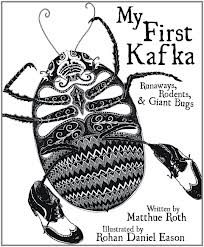
Matthue Roth’s fancifully illustrated and elegant, poetic adaptation of three of Kafka’s short works , My First Kafka, was released this month, and to a series of high-profile and sweepingly positive reviews, receptions, and readings. Most recently, bits from Roth’s work were read on the BBC the morning of June 25, 2013 as part of a feature piece on the disturbing and uncanny elements generic to children’s literature. Likewise, The New Yorker’s book blog Page Turner offered a brief but flattering review on June 19, 2013; in it, Kelsey Osgood employed Roth’s work as a site to similarly interrogate the dark complexity of children’s literature in general and the comfort with which children negotiate the uncanny elements of their early lives a la Freud and Sendak. While characterizing Roth’s adaptation as paradigmatic of the genre, Osgood distinguishes  Roth’s pithy verse as “smooth”, “naturally eerie and imaginative”, and even Seussian; he sees the work’s accompanying black-and-white illustrations (by the very talented Rohan Daniel Eason) as a “cross between Edward Gorey and a dichromatic ‘Yellow Submarine’”.

As a father of young children, high school teacher of literature, and doctoral student of literary modernism, I wondered, too, about Kafka’s relevance to and reception by younger minds. Having read Roth’s book myself this past spring to both my own four-year-old son as part of his bedtime routine and to my sixteen-year-old students as part of their unit on Kafka’s original work, I was surprised by the various receptions and responses. Child and adolescent alike took great pleasure in the absurd premise of the work, as they were likewise sympathetic for Gregor Samsa’s alienating plight and bothered by Gregor’s father’s cruelty.

What’s most interesting, however, were the different registers in reading—the sorts of questions related to representation and even morality that children come to expect when reading, more generally, but which are foiled—or at least complicated—by Kafka’s work.

I’ll start with the following, perhaps disputable assertion. Kafka’s work is quite accessible to even the most challenged readers and critical thinkers, and here’s why: first and foremost, it is a work that demands to be taken literally, and so superficially, it is a simple tale that is tragic, comic, and direct in its telling. For a four-year old who believes, instinctively, in the magic of fairy tales, this isn’t much of a mental hurdle. But for students who have been taught, year after year, to read fiction for its symbolic richness, figurative language character development, plot conflict, and various other familiar forms, The Metamorphosis can be off-putting.

In fact, Kafka’s work is most challenging in the figurative register because it, on no uncertain terms, literalizes what students have been trained to recognize as a metaphor. Generally speaking, high school students’ first reactions to the work—either following a first read or having heard of the work from others—immediately move to the symbolic realm: the “monstrous vermin” into which Gregor Samsa has transformed seems to carry with it a tremendous amount of cultural baggage (and indeed, the German ungezeifer was later used by Hitler to depict the verminous Jew)—and so such a transformation must be a dream, a self-image, a self-inflicted punishment, or some other symbolic means to depict the abject (perhaps the Czech, the Jew, the newly Secular). And ethically speaking, to a certain degree this is a kind and compassionate reading—students have been taught to recognize and redeem, to the best of their ability, the downtrodden.

And yet, Kafka’s work plays on the surface, as it were: it demands that we read a tale, from the very start, about an already-transformed Gregor, his alienation within his own home, his general neglect by his own family, and his final demise through festering wounds triggered by miscommunications and reactions of violence. It is a fantasy made reality of an industrious worker who is at once enslaved by providing for his family but retains his family’s disabled state through their complacent irrelevance. In turn, through his abjection, the family transforms into an industrious and productive unit. Indeed, the true transformation (Kafka’s German title Die Verwandlung is closer to “transformation” than  “metamorphosis”) is enjoyed by Gregor’s family as they flourish in his absence.

In this regard, Roth’s telling of the story does a fantastic job retaining Kafka’s rich literality, while amplifying some of the empathic elements that might be most evocative to children. Roth’s first stanza incorporates the nonchalant shock of Kafka’s original—“As Gregor Samsa awoke one morning from uneasy dreams, he found himself transformed in his bed into a gigantic insect-like creature”, but with a slight preface:

“Gregor Samsa always had bad dreams. /One morning he awoke to find / He’d become a giant bug”.

Here, Roth allows the child to know—and the adult to recognize—that Gregor’s disturbance precedes his transformation; that we should pity Gregor, too, goes unsaid, but is very much a significant sentiment in Roth’s iteration of the character that extends through Gregor’s final moments in part three in which he euphemistically passes as “his head sank down /and he watched the dawn.”

A distinguished slam poet, memoirist, and fiction writer  in his own right, Roth’s precise use of line break and stanza break and deep sensitivity to metered verse informs the pacing of such a reading as much as it influences the reader’s organization of meaning. The first line cited above is neatly trochaic, almost Poe-like; the final two aforementioned perform as elegant Iambs.

And yet. Despite the work’s literal ease—and the way in which such an aesthetic is enhanced by Roth’s elegant lines and Eason’s illustrations–Kafka himself demanded, in a  1916 letter to the Kurt Wolff Publishing Company, that his literalized metaphor never be illustrated on the book’s cover or otherwise: “…The insect itself cannot be drawn. It cannot even be shown at a distance.” Perhaps there’s some insistence here of the sacrosanct Word—from a post-structuralist point of view, it would be heretical to depict a signifier as anything other than other signifiers; from a theological perspective, making an image of the holy Word would be to make a fixed fetish out of the dynamic Becoming of God.

Regardless, here’s where the really complicated twist lies: while Kafka’s work demands to be read literally and nearly without a moral—almost as a sequence of events, without fully developed characters, and without a clear conflict and climax—it also resists the clarity that might accompany such literality. This is manifest in both the linguistic and visual registers.

Visually, not only must the vermin never be illustrated, for Kafka, but it is clear that the vermin is not obviously classified. The word itself—Ungeziefer—translates colloquially as vermin, bug, or insect, but means in formal German “unfit for sacrifice”. While many render Gregor’s creature-self as an ambiguously roach-like figure (R. Crumb’s visual rendition of Gregor in his Introducing Kafka approximates that of a giant roach; Peter Kuper’s surreal and complete graphic novel The Metamorphosis likewise maintains a human head, though on a roach’s body), Nabokov famously rejected such a possibility given the creature’s capacity to turn its head and its short legs. Instead, he suggests, on zoological grounds, that Gregor approximates a beetle. For the experimental reader but textual purist, the Metamorphosis Ipad app, illustrated and designed by Joel Golombeck of Rocket Chair Media, retains the dynamic movement of Kafka’s text through focused, paneled reading, even as it offers an abstract, watercolor illustrations, which illuminate, but not depict, the text and its characters. In Roth’s edition, however, Eason’s illustrations of Gregor attempt a balance that is at once psychedelic and concrete: elaborate designs that seem to shift over the course of the work and mimic butterfly wings, peacock feathers, and what seems like Rorschach Ink blots adorn Gregor’s definitive beetle shell. Such designs constellate new faces on Gregor’s creaturely body and seem to suggest the opacity of Gregor’s undefinable image—or at least as one that contains the possibility for many.

Textually, Roth’s writing reads easily to a four year old, but Roth retains Kafka’s ambivalent and indeterminate narrating voice. It is in the narrating voice in Kafka’s text, I suggest, through which the reader of this masterwork apprehends his or her own uncertainty about the “moral of the story” or a proper empathic reaction to the characters’ tragedies. On the one hand, both Kafka’s and Roth’s narrating voice seems to possess a privileged perspective into Gregor’s mind alone; we learn, for example, that “Gregor realized that nobody understood him” and that when “he could no longer move / at all”, “it was a nice feeling.” On the other hand, this third person narrator retains a certain distance that forbids the reader certain guidance regarding how he/she could—or should—react. Kafka does this magnificently well, and Roth retains this distance in his pithy prose poem. Take, as a lucid example, three of the six final stanzas of the work:

In the morning / they discovered / that Gregor could not move.

“Look how thin he was,” / said Gregor’s sister./ “He hadn’t eaten / in so long.”

The three of them / left the house together / (something they hadn’t done / for months)

Here, what goes unsaid breathes between the lines of Roth’s careful verse. Gregor’s immobility displaces the non-event of his passing, and Gregor’s family is content to literally sweep his dead carcass under the rug, with only a single but casual query of what seems an unconcerned sister. The final stanza depicting their subsequent departure screams of injustice as they celebrate their triad (threes, in Kafka’s work, are everywhere—and seem to indicate an impenetrable structure to which Gregor is the abject fourth).

Walter Benjamin famously wrote that Kafka “could grasp some things always only in gesture. And this gesture, which he did not understand, forms the cloudy spot of his parables.” Here, the gesture is that which, within Kafka’s parabolic language, resists an easy movement of meaning making. Put even better, Werner Hamacher writes the following about Benjamin’s reading of Kafka:

In the text of the parable, the cloudy spot about which Benjamin speaks is the

dark moment that remains opaque to doctrine. The cloud does not present doctrine but rather conceals it. At best, it distorts doctrine and disavows the task of exemplary, instructive narrative: to make one aware of its moral without delay and without obfuscation.

Thus, the challenge of reading, teaching, translating and adapting Kafka (even for children) is retaining both its parabolic sense—its sense that it demands a symbolic or even moralistic reading—and its resistance to being read in any other way but literally. In turn, a literal rendition of Kafka’s work must retain this very opacity—this cloudy spot or gesture—that continues to keep Kafka’s work alive through its very impenetrability. Roth’s work, in this regard, is a welcome addition to the long tradition of retelling Kafka’s Metamorphosis: it is elegant and accessible in its understated and literal tone, and it challenges the reader with the very same textual and visual impasses evoked by Kafka’s original. What Roth knows is that children luxuriate in the literal—in all of its complexity and irrationality, and the sensibility of the Schliemel, too (as has been explored in these very pages), retains this tension of the relationally textual—and playful—surface.

Hillel Broder is a doctoral student of English at the CUNY Graduate Center–where he specializes in twentieth-century modernism and cognitive cultural studies–and a high school teacher of English at SAR High School in Riverdale, NY.  This is his second guest post for Schlemiel-in-Theory.  His first was on Walter Benjamin, Franz Kafka and Gesture.

Do you Hear Me? A Schlemiel’s Stuttering Elaboration of the Messianic in “Conversation in the Mountains” – Part I

images-2

The great thing about conversation is that, from time to time, we stumble across things that are transformational.  In the midst of all our babbling, something comes through.  The point is to listen closely for these moments.  And to find the moment we need to, so to speak, follow the movement.

In my last blog entry, I traced these movements which are, in Celan’s prose piece, repetitive.  In a Talmudic sense, all things must be repeated so as to understand where the lacunae (gaps) are in this or that phrase or expression.  For in looking at it again, we can see something or hear something we may have missed “at first glance.”  And, as I noted with respect to Celan’s “Conversation in the Mountains,” these repetitions are situated in conversation.

Between Klein and Gross, between the narrator and you, and between he and them, we hear many different voices.  Of the voices, the most important was the voice that distinguished the Jew from nature.  This voice points out a heterogeneity between them.  It also points out a difference between the Jew and the mystic who yearns for communion.  Celan is acutely aware of the fact that the mystic destroys language to arrive at some form of communion.  Celan, however, puts a limit on this by way of the stuttering between Klein and Gross.  And, nodding toward Jewishness, Celan points out when a Jew meets another Jew they can’t keep “quiet for long.”

After pointing out their acute relation to time as it relates to Klein and Gross’s alienation from nature (“have been and still are, even today, even here”), the narrator describes how things are simply next-to- each-other.  This description, itself, is repetitive and shows us a lack of one-ness between them and nature.  And this teaches us that the narrator errs on the side of Jewishness:

So there they are, the cousins.  ON the left, the turk’s-cap lily blooms, blooms wild, blooms, like nowhere else.  And on the right, corn-salad, and dianthus superbus, the maiden-pink, not far off.  But, they, those cousins, have no eyes, alas.  Or, more exactly: they have, even they have eyes, but with a veil hanging in front of them, no, not in front, behind them, a moveable veil.  (18)

But, more importantly, the narrator notes their blindness, which is a key feature of the schlemiel.  Everything they see is mediated by “the veil”; it spins “itself around the image and begets a child, half image, half veil.”  In other words, everything they see and say is childish (“half image, half veil”).

The narrator gives us a sense of how the reader may look at these schlemiels.  He likens them to these oddly named flowers: “poor lily, poor corn salad”(19).  He then goes on to note their language as, in some way, lacking:

No word has come to an end and no phrase, it is nothing but a pause, an empty space between words, a blank – you see the syllables stand around, waiting.  They are all tongue and mouth…(19)

It seems as if the narrator has a very negative reading of the way schlemiels “babble.”  He exclaims: “The windbags!  Even now, when their tongues scramble dumbly against their teeth.”  However, he notes that “they have something to say to each other.”  In other words, in the midst of all their babble, these schlemiels can show us or direct us toward something meaningful.  And that “something” is messianic.

The first words we hear from them work on two levels.  On the one hand, they are what we would expect of two Jews meeting in the mountains; on the other hand, it hints at something messianic:

‘You’ve come a long way, have come all the way here….’  

‘I have. I’ve come, like you.’

‘I know’

They have both come, in a messianic sense.  As is well known, the Messianic begins with the announcement of the Messiahs’s arrival.  It is announced by Eliyahu the Prophet.  The language used to describe the Messianic include much mention of his “coming” and “arrival.” Read in this sense, Celan seems to telling us that these are Schlemiels who announce themselves as Messiahs. But, in a veiled manner, they don’t quite understand what their “arrival” means.

What Celan does with this arrival is fascinating.  As I pointed out in the last blog, the conversation between Klein and Gross is characterized as repetitive in a Talmudic manner.  This is exactly what we see here.  Klein recounts to Gross what he sees of the earth and where he and Gross are at this moment and concludes that the earth is not for either he or Gross (it speaks an “alien” language) ; rather, they are for each other:

You know.  You know and see. The earth folded up here, folded once and twice and three times, and opened in the middle, and in the middle there is water, and the water is green…that this is the language that counts here…a language not for you or me – because, I ask you, for whom is it meant, the earth, not for you, I say, it meant, and not for me – a language, well, without I and without You, nothing but He, nothing but It, you understand…(20).

After saying this, something has been acknowledged and now the next step can be taken – a step toward the messianic coming (yet, within the context of alienated language and nature).  And, like many Jewish things, this comes in the form of a question:

‘I understand, I do.  After all, I’ve come a long way, I’ve come like you.’

‘I know.’

“You know and want to ask: And even so you’ve come all the way, come here, even so – why, and what for?’

To be sure, this question and its answer can and do serve as a marker distinguishing between Jews, Muslims, Christians, and Atheists.   But, for Celan, it distinguishes a Jewish poet; it is the mark of the schlemiel.

Why, and what for…Because I had to talk, maybe, to myself or to you, talk with my mouth and tongue, not just with my stick. Because to whom does it talk, my stick?  It talks to the stones, and the stones – to whom do they talk? (20).

The stones talk to “no-one” (niemand).  And this is a language that the Jewish poet doesn’t speak.  The schlemiel must speak with the other. This is the crux of the matter.  And this speech must recur over and over gain.  And the reason it must speak is because it gives the schlemiel a sense of who he or she is, what he or she is doing, and who she is speaking to.  Though seemingly simple, this gesture shows the deeply ethical and relational aspect of the schlemiel.  And this comes out in Klein’s words about God and hearing.

As we learn, the stick talks to “nobody and Nobody.” The latter Nobody troubles Klein the former (nature) does not.  He, that is Nobody, says: “Do you hear me?”  As a schlemiel, Klein responds to this voice and takes it on as his own.  And this brings us to the messianic moment, repeated and nuanced:

‘Do you hear me: he says – I know, cousin, I know… Do you hear me, he says, I’m here. I am here, I’ve come.  I’ve come with my stick, me and no other, me and not him, me with my hour, my undeserved hour, me who have been hit, who have not been hit, me with my memory, with my lack of memory, me, me, me’(20).

These lines are the testimony of a schlemiel who has come, but who can only say that he has come; and like Him, the schlemiel wants to be heard.  He echoes the “Do you hear me?” and he communicates it to Gross.

And this is the point.  He bears witness to the Gross (big) Other (with a big “O”), and to the (Klien) other (with the little “o”).  And he’s trying to figure out his relations to these others by way of repetition.  In this form, Celan gives a dignity to the schlemiel that the narrator notes, in the middle of the piece, is lacking.  He shows that the schlemiel is situated in an encounter with the other; and by putting the schlemiel in relation to the other, he, so to speak, revises the Messianic moment and the schlemiel.

In the next blog entry, I will look into Gross’s response to this testimony, this echo.  It repeats the messianic moment of coming which, for Celan, must be elaborated and re-elaborated.  And, here, this re-elaboration is unique for many reasons: it is not in poetry, it is tinged with the comic, and it is between schlemiels.

“Do you hear me?”