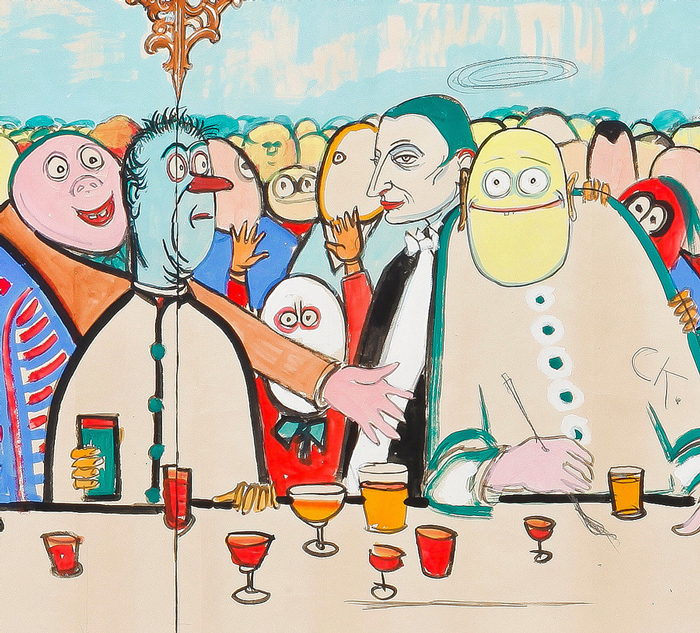
Come and visit the wonderful online journal, Berfrois today to read the first of a two part essay I wrote on Cynicism and Comedy. Enjoy!

Come and visit the wonderful online journal, Berfrois today to read the first of a two part essay I wrote on Cynicism and Comedy. Enjoy!
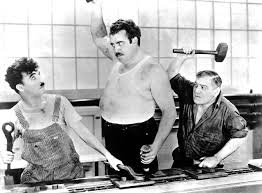
When things don’t work, we get frustrated. And when we can’t find work, we get even more frustrated. To be sure, work is a fundamental part of our lives. As for reflecting on the meaning of work, the American pragmatic tradition is interested in what kinds of concepts or words work and which do not. Many pragmatists, like Richard Rorty or William James, understand that we can all live a better and more peaceful life if we create things that “work” in accord with time and change. For this reason, a thinker like Richard Rorty is “anti-foundationalist.” He doesn’t think that absolutes – which serve as foundations for thought, politics, etc – work anymore. His search is for things that can expand our horizons, make us more tolerant, and more able to co-exist in a world that is becoming smaller and smaller every day. In his scholarship, Rorty often turns to literature since it is constantly exploring contingency and things that are relative to this or that situation or scene rather than absolute and unchanging. Regardless, he’s looking for what works. Parochialism doesn’t work; literature does.
In contrast, many European thinkers (from Maurice Blanchot and Georges Bataille to Martin Heidegger, Karl Marx, and Slavoj Zizek) are more interested in when things no longer work. Because when things fail, we can start thinking or changing the way things “are” or are thought-to-be. They are interested in the anxiety, madness, shock, trauma, and melancholy (depending on your experience of failure) that ensues in the wake of such failure since it spurs one to think differently.
Maurice Blanchot, in many of his books, discusses the notion of the “work” of art (“l’oeuvre”), purposeful activity or labor (“travail”), and unworking (“desoeuvrement”). In The Infinite Conversation, Blanchot discusses the relationship of what he calls the “detour” or “turn” away from the work. Instead of advancing forward by way of what works, he sees the “advance” in terms of what doesn’t work and solicits a “crisis”(32). He calls this turn the “critical turn.” What makes it critical is the fact that it turns toward what Blanchot calls “worklessness,” the “outside of speech,” “the absence of the work,” and “madness.”
I would even say that every important literary work is important to the extent that it puts more directly and more purely to work the meaning of the turn; a turning that, at the moment when it is about to emerge, makes the work pitch strangely. This is a work in which worklessness, as its always decentered center, holds sway: the absence of work.
-The absence of work that is the other name for madness.
-The absence of work in which discourse ceasing so that, outside speech, outside language, the movement of writing may come, under the attraction of the outside. (32)
Writing on worklessness, Ann Smock points out that instead of calling upon an author or person’s “strength” to work it “calls upon his weakness, the incapacity in him to achieve anything at all; it inspires in him a kind of numbness and stupefication”(13, The Space of Literature). All s/he knows is that there is a “demand” that rules over her to not work, that is overwhelming and exhausting. In other words, the writer cannot, if they are really a writer in Blanchot’s sense, create anything that works. A true writer is one who experiences weakness, powerlessness, and the madness that comes in the face of a demand, in effect, to fail.
In his book, Inner Experience, Georges Bataille, echoes Blanchot’s understanding of the failed work and impossibility of working. But while Blanchot does this in a very harsh and stoic manner, Blanchot does it in a humorous manner. He accepts his failure like a sad clown. He affirms that he – like most of humanity – is a joke. And his laughter at his failure “opens up an abyss”(91).
Laughter intuits the truth which the rupture at the summit lays bare: that our will to arrest being is damned. Laughter slips on the surface, the whole length of slight depressions: rupture opens the abyss. Abyss and depressions are together a same void: the inanity of being which we are. (91)
For Bataille, it is “through an ‘intimate cessation of all intellectual operations’ that the mind is laid bare”(13). It is through a mystical kind of exercise, which always seeks to break the system or frame down, that one can see things as they really are: as a chaotic, mad mess that un-works all and denounces work-as-such.
Bataille wrote these words in the 1950s. Over half a century later, Zizek writes, in his 2014 book Event: A Philosophical Journey Through a Concept, that the event “undermines every stable scheme”(7). And it is through the experience of this undermining that we can “experience something new.” But this unworking of the frame is not a joyful event. In fact, Zizek suggests that the melancholic gives us a model for how we should receive the new or, as he says citing Lacan, “the Real” (which Zizek associates with “the repellent forms of life” that we deny).
He cites the film producer Lars Von Trier’s words on this film Melancholia to describe melancholy:
The psychiatrist told him that depressive people tend to act more calmly than others under extreme pressure or the threat of catastrophe – they already expect bad things to happen. This fact offers another example of the split between reality – the so-called universe of established customs and opinions in which we dwell – and the traumatic meaningless brutality of the Real. (19)
Zizek tends toward melancholy since it suggests an attitude that things will never work. This is, so to speak, the preface for an experience of the Real. We see this, Zizek argues, in Von Trier’s film, which eschews fantasy in the name of a melancholic truth:
Justine really is melancholic, deprived of the fantasmatic gaze. This is to say, melancholy is, at is most radical, not the failure of the work of mourning, the persisting attachment to the lost object, but their very opposite: ‘melancholy offers the paradox of an intention to mourn that precedes and anticipates the loss of the object’. Therein resides the melancholic’s stratagem: the only way to posses an object that we never had, which was from the very outset lost, is to treat an object that we still fully possess as already lost. (23)
This is not just Jusine’s strategy, is also Zizek’s since, as goes on to say, it’s goal is to destroy the “frame as such.” By seeing everything as “already lost,” one can apprehend the Real without, so to speak, a filter (or as he says, a “frame”). We can experience the “event,” which is another way of saying, as Blanchot would put it, “worklessness.”
Zizek likes to tell jokes but, ultimately, he, like Bataille, is a melancholic comic. They aren’t interested in what works so much as using every “strategy” they can to make this or that project fail. However, as Zizek argues, the belief that something works is already a fantasy. That suggests that the only thing they are breaking is the illusion of the work or the illusion of work. In the end, perhaps we can say that neither Zizek nor Batialle worked a day in the their life.
Happy labor day!
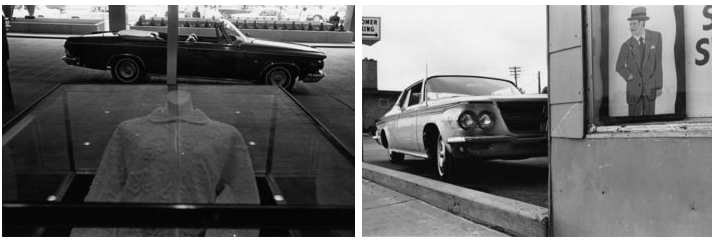
When one is living a meager existence, poetic and novelistic dystopias may have a passing appeal. After having lived – or rather dwelled – as an undergraduate in the Binghamton and Syracuse area, I can understand the appeal of a landscape that includes – in a contiguous manner – monuments to a prosperous past, empty factories, residential neighborhoods, beautiful parks, and strip malls. But what interested me most was not so much the buildings as the people who drifted in and out of these areas. Like them, I grew up in a rural New York setting. I was always wondering about how the hard working, everyday American would navigate through this mess. To my delight, I stumbled across a poet who lived in Syracuse and sought to address these very things: Hayden Carruth.
Reflecting on his poems today (which were originally written in 1983), I feel addressed by a simple question: are we, today, to read the odd orientations of people to the late-capitalist landscape in tragic or comic terms? But there are other questions that follow in its wake: Have we, today, got used to destitution to such an extent that it doesn’t matter what landscape we travel through just as long as we….travel through it and go elsewhere?
In the opening poem of his book Asphalt Georgics entitled “Names,” we bear witness to Sam. He is caught up in a series of movements and flows. He needs to return a broken coffee machine.
I had said improbable. I
always do, that being
who I am. Nevertheless it
stopped pouring. We could bring
the defective electric per-
collator back to where
we bought it, the K-Mart up in
Seneca Mall. So there
We drove, past Hiawatha Pla-
za, Wegman’s, Bayberry
Mall, with all the other pieces
of the strip strung in be-
tween. Friendly and Ponderosa
looked o.k., but Carvel
was dilapidated and Mis-
ter Donut had a hell
Of a big jagged hole through both
sides of its glass sign. I
saw the killdeer running that has
her nest next to the high-
way on the gravel strip between
Rite-Aid and Sunoco,
and I heard her cry in the gnash
of heat at my window
Sam is not an ordinary man. He is very reflective and notes a line from an Italian poet about the meaning of “once.” But Sam dismisses this as too academic “Once. Tra la.” He apologizes for the reflection and doesn’t want to get caught up into the depth it suggests. To be sure, he likes staying on the surface geography, amidst places, names, and spatial games:
The main reason for putting that
in is it was written
by a guy well up in his eight-
ies. He knows. In one sen-
tence, the past is nothing and we
are in love with it. Prag-
matically speaking we are
in love with nothing. Shag
me some more of these fungoes, boys,
before we quite. His name
is Eugenio, mine is Sam –
I like that name, that game
He drifts into thinking about baseball and eating food, about how this has something to do with being American.
Too, though utterly valueless,
The animal in us
Just sufficiently domestic-
ated, our venomous
American aggressiveness
Confined to balls and bats.
O.k. Back to the beginning
The saturated fats
In the midst of this, he drifts into a space in which everything seems to collapse and become odd. But instead of becoming indifferent himself, he tells us that “I found myself praying. It happens all the time.” Sam calls himself a “poor deracinated numbskull” since he calls on many different religious symbols…but he does so “without conviction.”
He is, like many Americans, wandering through landscapes (external and internal), playing games, but unable to have deep conviction. Nonetheless, he feels the desire for something holy but Sam doesn’t know what to do with it…in Syracuse, New York.
And what do you do with this
amorphous faith, desire,
wanting, let someone else figure,
why me? I was on fire,
so was Poll (his companion) next to me, so was
the whole world. To get through,
get to the K-Mart, probably
was all I asked. So who
cares who I asked? Does it have to
be Somebody? It’s better
not. The asking is what counts. Poll
says the same. She says her
mind is always praying these days….
Sam reflects more and realizes that just “getting through all that hot traffic to the K-Mart is good enough for prayer.” In other words, his prayers come to him as he and his companion, Poll, travel through the landscape of Syracuse, from one store or place to another. And as they do, they can sense that something is wrong and that the past and the world that they once knew has disappeared. It takes too much away from their day-to-day practical activities to think about it. And instead of praying a Church or a Synagogue, they pray in a car.
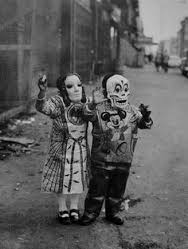
We can learn a lot of from a face. Writers, visual artists, and philosophers have been reading faces for centuries. But while some see the face as mask, others see it as our presence to the world. An acute difference can, for instance, be seen in the words on the face by Emmanuel Levinas and Louis-Ferdinand Celine.
Emmanuel Levinas is well known for the weight he gives to the “face” in his philosophy. In an essay entitled “Ethics as First Philosophy,” he writes: “The proximity of the other is the face’s meaning, and it means from the very start in a way that goes beyond those plastic forms which forever try to cover the face like a mask of their presence to perception”(82, Levinas Reader). In the face of the other “there is the nakedness and destitution of the expression as such, that is to say extreme exposure, defencelessness, vulnerability itself”(83). For Levinas, the face and the person who bears it to the world will always be exposed and vulnerable.
In contrast, Celine, in Journey to the End of the Night, shows us a face that, with more experience, changes, becomes ugly, and less vulnerable. Celine’s narrator introduces this theme through a character named Berbert who “had the greenish look of an apple that would never get ripe”(208). Berbert seems to be a friendly character. One day, he goes to say “good morning” to the doctor-narrator.
Before describing Bebert’s face in depth, the narrator laments that you can’t love grownups:
If you got to love something, you’ll be taking less of a chance with children than with grownups, you’ll at least have the excuse of hoping they won’t turn out as crummy as the rest of us. How are you to know? (209)
Bebert, it seems, is different:
I’ve never been able to forget the infinite little smile of pure affection that danced across his livid face. Enough gaiety to fill the universe. (209)
But this face is the exception, not the rule. After one hits a certain age, says Celine, his or her face changes for the worst. And that happens because the “world isn’t what we expected”:
Few people past twenty preserve any of that affection, the affection of animals. The world isn’t what we expected. So our looks change! And turned into a thorough stinker in next to no time! Past twenty it shows in our face! Our face is a mistake! (209)
For Celine, “our face is a mistake,” however Bebert’s is not. It gives Celine some respite from humanity. His ensuing description of Bebert portrays him as a sick, but charming animal. When they are separated by other people, Bebert tries to pop up in front of other people so he and Celine can exchange looks.
We couldn’t see each other anymore. Bebert jumped up and down, sneezing and shouting for joy. His haggard face, his greasy hair, his emaciated monkey legs, the whole of him danced convulsively at the end of his broom. (209)
In contrast, we have Bebert’s aunt. Celine treats her “free of charge,” because, as he sarcastically notes, “nobody paid me.” He helped them not because he was kind, however, but because he was “curious” about the nature of humanity. With Bebert’s aunt and all of “them” (the people he treats for free) he learns that people hide behind masks, lie, and sought to take advantage of him…because he did them a favor:
People avenge themselves for the favors done them. Bebert’s aunt took advantage of my lofty disinterestedness. In fact she imposed on me outrageously. I let things ride. I let them lie to me. I gave them what they wanted. My patients had me in their clutches. Every day they sniveled more, they had me at their mercy. And while they were at it they showed me all the ugliness they kept hidden behind the doors of their souls and exhibited to no one but me. The fee for witnessing such horrors can never be high enough. They slither through your fingers like slimy snakes. (210)
Bebert may be the exception, his face is not a mistake, but “ours” is. By saying ours, Celine includes himself with these people who appear to be – as Levinas would say – exposed, defenceless, and vulnerable, but are only appearing like this so they can control and manipulate the care-giver. Their faces are masks.
Celine’s cynical view suggests that very few people can “preserve” vulnerability and a child or animal-like honesty. In contrast, Levinas thinks that, regardless of what happens to us by way of loss, disappointments, etc, the face remains vulnerable and exposed. The face will continue to solicit me regardless of whether the subject is trying to manipulate me or not. But, for Celine (the character, author, and person), his curiosity about humans (his scientific experiment, so to speak) led him to be much more skeptical about the sick people he treats. His experience taught him otherwise.
Contrasting Levinas to Celine, we can ask ourselves a few questions. Are the faces we see in the street and in the mirror “mistakes”? Are we mistaken about what they appear to show? Isn’t every encounter with a face a risk? And should we write off most faces if we are deceived by a few? Celine remembers one face as good but sees many as masks of darker intentions. Levinas sees the face as exposed and vulnerable but, unlike Celine, he doesn’t turn the face into a mask. Both of them went trough war, but both of them decided to interpret the face in a different manner.

As we move more and more into the fluid world of social networking, we see more people inside of academia make claims that are daring and attention-grabbing. One such claim is made at the end of Adam Kotsko’s Awkwardness. After discussing different kinds of awkwardness that we see in popular culture in the first few chapters of his book, Kotsko turns to what he calls “Radical Awkwardness.” While the other chapters show how TV shows like The Office or Seinfeld or films like Knocked Up – which show us how, in the face of awkwardness, people can either give in to or sociopathologically reject the social order – this chapter deals with a kind of awkwardness that one, in Heidegger’s parlance, can “dwell in.” Kotsko’s claim, in that chapter, is that the best way to approach Larry David – who plays a Jewish character in the show – is by way of a Pauline framework that conceptually posits David as a reluctant convert to Judaism who is apprehensive about being a part of a religion (society) based on “law.” In the end, however, David decides against conversion. His awkwardness leads him elsewhere.
Although Kotsko’s reading is intriguing, why not read Larry David in terms of the comic tradition he emerges from; namely the Jewish tradition of the schlemiel? Why not read him by way of a Jewish framework that speaks to the awkward nature of the schlemiel vis-à-vis society? By making a Pauline reading, Kotsko is telling us more about his own interests and concerns than about how to read David’s awkwardness in terms of his predecessors and the current Jewish-American comedic scene. While I can appreciate that David’s awkwardness helps Kotsko to understand questions he has about Paul, I think it might be misleading to read David in this way. Awkwardness should not be subsumed by a Christian reading which pits law against spirit and the Jew (particularist) against the Christian (universalist). Portraying David as a “convert” to Judaism serves not just to grab attention but to also co-opt his comedy into a paradigm that is not befitting for the schlemiel. At stake is the meaning of Jewishness which need not be read in contradistinction to the reading of Judaism as “law” (a Pauline reading).
Putting this reading aside for a moment, I want to give credit where credit is due. Kotsko’s philosophical reflections on awkwardness open up a new field for thought and humor theory. This is promising. Referring to Heidegger in his last chapter, Kotsko points out how there is a pattern that we see in all of the above-mentioned shows and films which confirms his hypothesis (which is based on Heidegger): “that awkwardness logically precedes every social order and can never be eliminated – no matter what strategy is used, it keeps coming back”(67). The norm is created or called for as an attempt to stem the flow of awkwardness and the threat it poses to the social fabric.
Kotsko injects a utopian element to his reading of awkwardness by noting how, in the Judd Apatow universe, hope is associated with the “bonds among awkward overgrown adults.” But why, queries Kotsko, “should we have a social order at all?” This question is the preface to Kotsko’s reading of “radical awkwardness.” For Kotsko, the problem with the social order is its drive to prompt this or that “disturbing foreigner” to assimilate. As Kotsko suggests, assimilation is a social strategy that is and has been used with respect to awkwardness. It doesn’t, in a Heideggerian sense, let awkwardness be. He associates this strategy with the norm, and as we learn in this final chapter of his book, “the law.”
Kotsko initially justified his use of Curb Your Enthusiasm as an example of radical awkwardness through its main character, Larry David: “I have done this first of all because Larry’s travails at a New York Jew in Southern California illustrate very well the common-sense answer to the chapters question: the reason we need a cultural norm is that the situation of radical awkwardness is unbearable”(67-68).
In the show, Larry David’s wife in the show, a WASP (White Ango-Saxon Protestant) “acts as an enforcer of social norms.” David comes in to the space of California and his marriage in a radically awkward manner. He doesn’t fit in. But, lest we not forget, this is also the case with Alvy Singer – a prototypical American schlemiel – in Annie Hall. Kotsko foregrounds what he calls a “clash of civilizations” that is brought out by David’s inability to properly assimilate into California, upper-class white culture. But Kotsko’s goal is not simply to show that David brings out a radical awkwardness because he fails to assimilate, so much as making “the case that Larry David has independently discovered something that St. Paul was experimenting with in the first century: how to form a community directly grounded in awkwardness”(68).
The community that Kotsko is referring to is what he later calls a “community of exiles” who “dwell” in “awkwardness.” To call it a discovery of something that St. Paul was experimenting with is interesting, but it fails to take notice that the schlemiel was and has been a key character in a Jewish diasporic narrative and community that stretches back to Yiddish folklore and literature of the 19th century. The schlemiel’s awkwardness is in relation to world of the gentiles and it is shared with a readership that distinguished itself from the machinations of the world. One wonders what Kotsko would make of Singer’s Chelm or Aleichem’s Kasrilevke.
Kotsko makes the case – by way of Paul – that the community David appeals to is not Jewish so much as a cross-cultural and universalist. Both Jew and gentile can live, awkwardly, and in spite of, the “law,” which he associates with social norms that opt to assimilate all that is awkward and foreign. On this note, Kotsko points out that “Larry’s stubbornness makes him slow to adapt, admittedly, but it is clear that he faces an uphill battle in adapting to a culture that is exceptionally dense with unspoken rules”(73). Kotsko turns this stubbornness toward a Pauline understanding of law and community.
In contrast, the inability of the schlemiel to adapt is a theme that Saul Bellow discusses in his reading of Sholem Aleichem’s Motl. For Bellow, the resilience of Jewishness is to be found in the schlemiel’s stubbornness and “inability to adapt.”
Kotsko uses the insider/outsider distinction to deepen his Pauline reading of Larry David. Larry David may seem like a cultural insider but he is not. Every time he tries to be a cultural insider he, like a schlemiel, spills the soup. Insiders, such as his wife, Ted Danson, Ben Stiller, etc give him opportunities to be an insider, like they themselves, but he fails. For Kotsko, Larry David brings out the double standard: “Larry can’t do anything right, while the insiders can do nothing wrong”(74). Larry David fails the law because “the law directly causes its own violation”(74-75).
Kotsko, making reference to Paul’s missionary program in a key chapter of his writings, points out how Paul’s “mission in life: trying to figure out a way to create communities that crossed the biggest cultural line that he was aware of, that between Jews and Gentiles, with everyone participating as equals”(75). To this end, he introduces his reading of Paul: “I would propose the chapter in question actually refers to the struggle of a Gentile trying to become a Jew, a situation which he empathizes so strongly that he speaks in the first person on behalf of the Gentile convert”(75). It is the “Jewish law viewed from the perspective of the convert” that Kotsko sees as essential to Paul’s reading of community. And he takes this as his cue to make a reading of Larry David:
The convert obviously admires the culture he’s trying to join, but at the same time it seems to trip him up constantly. No matter how he tries, no matter how long he is a part of the new community, he will never be able to fulfill the law’s demands as easily and fluently as someone whose been a member since birth. (77)
Based on this passage, Larry is read as the “convert”: “his awkward stubbornness stems from his frustration at being constantly corrected and forced to apologize when he’s done nothing he considers wrong”(77). For this reason, Larry, like Paul’s frustrated convert, will turn to a Christian kind of “awkward community.” Larry: “and so we can perhaps dare to say that St. Paul was speaking to Larry David’s situation as well”(77).
The answer to Larry’s frustrations can be found in Paul. Create a new awkward community. Leave the “Law” behind but keep your cultural identity:
The solution Paul proposes, then, is to stop looking for a solution. No one should be forced to conform to the arbitrary social norms of others, and at the same time, everyone should feel free to maintain their cultural identity. (78)
In this scenario, one need not “convert” to this or that social norm. One can, as Kotsko suggests, co-exist with others who also have an awkward relationship to the law/social norms. For Kotsko, the “clearest example of a longer term community of awkwardness” is to be found in the sixth season of Curb Your Enthusiasm in which Larry’s wife decides to divorce him and “the additional plot” of “Cheryl’s insistence that they take in a family of African Americans from New Orleans who have lost their home in a fictionalized version of Hurricane Katrina”(84).
Kotsko points out how the relations between Larry and “the Blacks” are continually awkward but in a way that is not frustrating so much as new and liberating. Larry develops “strong bonds” with them in the process:
Larry and the Blacks become a kind of community of exiles, bound by their shared condition of being awkwardly thrown into a social milieu where they don’t belong, feeling each other to be themselves in an otherwise constraining and judgmental environment. (85).
This bond and the fantasy that ends the season is a premonition of utopia which is “an awkward place.” Since it is a “good place and no place at all,” utopia is awkward. But that “no place,” says Kotsko, is “where we already are”(87). But, because of the law and “social order,” we are taught to “escape” this awkwardness.
Kotsko’s appeal to the utopian is interesting and has a correlate in the schlemiel. The schlemiel speaks to a kind of utopian community as well, but it is based on something Jewish and is particular to a Jewish diaspora. The schlemiel is, as Ruth Wisse points out, a worldless kind of character. It brings Jews together in a kind of awkwardness that is always unsure about how, as the author Sheila Heti puts it in the title of her last novel, a person should be. The schlemiel – like the Jew –doesn’t fit and shouldn’t adapt. Its awkwardness is certainly a safeguard against assimilation and its hope is…for justice.
But the fact of the matter is that the American Jew is a creature of assimilation. Larry David embodies the last traces of the schlemiel and its Jewishness since he is and remains in nearly every episode the “odd one out.” There is much truth in Kotsko’s observations about Larry David and the Blacks – they do have a bond based on radical awkwardness. But that reading need not be framed within a Pauline framework. Larry David, without a doubt, is drawing on the tradition of the schlemiel. (Ruth Wisse, Sanford Pinsker, and Sidra Ezrahi do a fine job of explaining how this emerged in relation to the situation of Jews in the Pale of Settlement in the 19th century and their relationship to Jewishness and modernity.) His character need not be read in terms of the reluctant convert unless, that is, one wants to reframe the discourse of the schlemiel on a Pauline foundation.
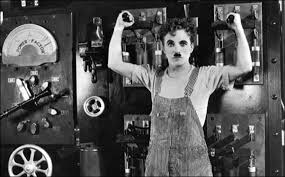
In 1984, Bernard Malamud gave an important talk at Bennington College – where he taught writing –which was entitled “Long Work, Short Life.” In the talk, he tells the audience that he began to write at an early age. He told stories “for praise.” But his inspiration didn’t come from within; it came from the “movies”(Talking Horse, 26). He remembers his first major encounter with film on a “wet Sunday.” And the film he saw was by Charlie Chaplin. Malamud tells the audience that the “comedy haunted my soul.” Out of his experience of Chaplin, he recalls how he would retell the movies to his “school friends.” This retelling of Chaplin’s “impossible tale” gave him great pleasure (26). Chaplin shares something with the schlemiel: they “live on air.” Malamud was familiar “with this kind of person from childhood”(82). The poor would dream big but, in the end, most of them – like many characters in Sholom Aliechem or I.L. Peretz – turned into peddlers (26). Notice that, for Malamud, the economic aspect of Chaplin’s comedy – as with the schlemiel – is foregrounded. But it is his survival through a variety of nuanced gestures that inspires him to become a writer and tell the “impossible tale.”
Speaking of Chaplin’s performance in Modern Times (1936) , Roland Barthes says that “no socialist work has yet succeeded in expressing the humiliated condition of the worker with so much violence and generosity.” For Barthes, Chaplain plays a “kind of primitive proletarian.”
Chaplin has always been the proletarian under the guise of the poor man: hence the broadly human force of his representations but also their political ambiguity. (Mythologies, 39)
According to Barthes, Chaplin is a few cards short of a Marxist reading of the proletarian. This is evident, claims Barthes, in the fact that with Chaplin we find the “proletarian still blind and mystified, defined by the immediate character of his needs, and his total alienation at the hands of his masters (the employees and the police)”(39). Chaplin plays the “hungry” proletarian and is “ensnared in his starvation,” but “Chaplin-Man is always just below political awareness”(39).
Chaplin-Man, according to Barthes, may rebel against machines, but he is “at a loss before strikes, fascinated by the problem of bread-winning….but as yet unable to reach a knowledge of political causes and an insistence of collective strategy”(39).
Barthes Marxist reading of Chaplin sees schlemiel comedy through the eyes of Bertolt Brecht:
Brecht alone, perhaps, has glimpsed the necessity, for socialist art, of always taking Man on the eve of Revolution, that is to say, alone, still blind, on the point of having his eyes opened to the revolutionary light by the ‘natural’ excess of his wretchedness. (40)
In other words, while Chaplin-Man is blind, we, the viewers, are not. We are exposed: “Chaplin, in conformity with Brecht’s idea, shows the public its blindness by presenting at the same time a man who is blind and what is in front of him”(40).
As in a “Punch and Judy show,” it is the “children who announce to Punch what he pretends to see”(40). Barthes’ Brechtian reading of the schlemiel turns it into a political figure that shows how not to see. But there is a twist that displaces this the negative Marxist reading and that is his act of defying the “ideal of the American petit-bourgeois”(40). He does this by not acting like they do; by being the odd one out, “the slightest ensnarements are made harmless, and the man who is poor is cut off from temptation”(40). The “temptation” Barthes refers to is the temptation of the petit-bourgeois ideal.
The impossible story that Malamud retold to his friends finds an interesting analogue in Barthes final words on Chaplin. Barthes tells us that, although Chaplin is a primitive proletarian, his anarchy makes for the “most efficient form of revolution in the realm of art.”
He escapes from everything, eschews any kind of sleeping partner, and never invests in man anything but man himself. His anarchy, politically open to discussion, perhaps represents the most efficient form of revolution in the realm of art. (40)
What matters most here, as in many a Buster Keaton film, is the art of escape. He frees himself of the very things that could trap him in the world. And although he is “blind,” a thinker like Walter Benjamin would see this not a political sense, as Barthes or Brecht would, but in a mystical sense. Chaplin’s blindness enables him to defy the world and suspend the political in the name of what Jacques Derrida would call politics to come. Schlemiel comedy – vis-à-vis Chaplin, Keaton, Aleichem, etc – comedy shows us something that is beyond even the Marxist framework which Brecht used to typify all art. Chaplin-Man is more than just a “primitive proletarian,” he is feeling toward another event; and, at each turn, meets with it by way of this or that unexpected turn of events. His “anarchy” is built into the fact that he faces the unexpected turn with a blind tenacity and hope for something better. But, contrary to Barthes and Brecht, the audience can’t see it either.

Religion, philosophy, literature, and the arts have, since time immemorial, been concerned with the meaning of death and suffering. All religions, books, or artworks do not, by any means, have the same approach to death and suffering. And the ability to know and tell the difference between one and another is, if anything, a formidable and rewarding task. But there is something more important than such an intellectual or scholarly enterprise. And that is the act of deciding on what approach is mine. One needs to ask what approach to death and suffering is most befitting of who or what I am or who I want to be. The answer to this question will prompt one to decide.
Besides religion and philosophy, literature does an exceptional job of staging a crisis with death or suffering, this question, and the decision made in relation to it. Saul Bellow’s Herzog, on the surface, seems to be a novel about the life and times of a modern schlemiel. When one thinks of Herzog – as when one thinks of many a schlemiel – one doesn’t think about death or suffering. To be sure, Sholem Aleichem’s penultimate schlemiel-character, Motl, who Saul Bellow knew very well, doesn’t seem to encounter death or suffering.
Motl’s schlemielkeit consists in the fact that he keeps on moving forward and retains a comic-optimistic view toward all he faces. And that, perhaps, is what makes his fiction Jewish. On other hand, one may argue that what makes Aleichem’s Motl so Jewish is not his optimism (or comic indifference) in the face of death and suffering so much as the juxtaposition between the readers who – at that time –were going through great suffering and Motl himself. It is the tension between the two that is of great interest to the Jewish reader.
Moses Herzog’s approach to death and suffering is different from Motl’s because Herzog is much more educated and is aware of how serious the encounter with death is for philosophers, writers, and artists of the Christian and Greek West. He cannot simply shrug it off. And this makes for a different kind of schlemiel.
Following Herzog’s harrowing experience at court of the perversity of justice – which led to his near-death experience – the narrator sets the tone for a schlemiel’s encounter with death and suffering:
He was in pain. And should be. Quite right. If only because he had required so many people to lie to him, many, many, beginning naturally with his mother. (232)
The last sentence is odd and requires a thoughtful engagement. It suggests, on the one hand, that he is in pain because he feels he has been lied to and betrayed. On the other hand, it suggests that he is the source of this desire to be lied to (“he required so many people to lie to him”). The lie is that comedy prevails and people are trustworthy. He wants – like I.B. Singer’s Gimpel the fool – to believe this.
The narrator tells us that Herzog “demanded” this from his mother because he was “melancholy.” But, as the narrator also notes, there was a point in her life where she could no longer keep the lie going; namely, when she was in her last days of life.
The narrator describes the “family look” so as to provide the reader with an acute sense of why Herzog would have such a demand. That look is the look of Jewish suffering and unhappiness juxtaposed with the “light of the eyes.” It is the latter that he wants to perpetuate, not the former:
The family look, the eyes, those eye-lights. And though he recalled his mother’s sad face with love, he couldn’t say, in his soul, that he wanted to see such sadness perpetuated. Yes, it reflected the deep experience of a race, its attitude toward happiness and mortality. This somber human case, this dark husk, these indurated lines of submission to the fate of being human, this splendid face showed the responses to his mother’s finest nerves to the greatness of life, rich in sorrow, and death. (232)
After this meditation, Herzog entertains the possibility that, in “coming to terms” with death “things would change”(232). The words used to describe this change, however, seem exaggerated and betray this belief as high idealistic. Notice the use of “we” in this following sentence and the emphasis on how we “look” in the face of death:
When we have come to terms with death, we’ll wear a different expression, we human beings. Our looks will change. When we come to terms! (232)
Herzog’s humanism – in facing death – is in retrospect. And it comes with him remembering the days before his mother’s death. But will this remembrance change his “looks”? Will people notice this? This, at least, is what he believes to be the greatest truth.
Herzog recalls a memory when he asked her, Sarah Herzog, a question about the Bible: “how Adam was created from the dust of the ground”(232). He was “six or seven” when he asked the question. He recalls how the mother went to the window, opened her hand and said, “Look carefully, now, and you’ll see what Adam was made of”(232). “She rubbed the palm of her hand with a finger, rubbed until something dark appeared on the deep-lined skin, a particle of what certainly looked to him like earth”(232). And she said, “You see? It’s true.”
Bellow than turns to Herzog, a “grown man….besides the colorless widow…Herzog did as he had done”(233). But now, when he rubs, he “smiles” and it “worked; a big of the same darkness began to form on his palm”(233). In other words, his face had changed (as it were, facing death) from a frown to a smile. He muses on the comic nature of this gesture and the lesson his mother taught him:
Maybe she offered me this proof partly in a spirit of comedy. The wit you can have only when you consider death very plainly, when you consider what a human being really is. (233)
Instead of having a tragic-absurd or pessimistic vision of mankind, based on what he saw in the courtroom, Herzog has a comic vision of humanity that emerges “when you consider what a human being really is.”
Herzog returns to the rift between pessimism and optimism (as well as sadness and wit) in the paragraphs following this realization. He remembers how he was reading the work of two very cynical and pessimistic writers – Schopenhauer and Spengler – at the time of his mother’s death. While his mother was in throes of death, he was “pouring over Spengler now. Struggling and drowning in the oceanic visions of that sinister Kraut”(233). He recalls coming across Spengler’s cynical anti-Semitism in the midst of his mother’s dying: “I had better resign myself to Destiny. A Jew, a relic as lizards are relics of the great age of reptiles, I might prosper by swindling the goy, the laboring cattle of civilization dwindled and done for”(234).
All of these hateful words about Jews, destiny, and history made Herzog “angry” and “sick with rage.” He wanted to write a book that would challenge Spengler’s cynicism. But when he “looked away form the dense print and its insidious pedantry,” he saw his mother enter the kitchen as a dying woman. Her message – or rather text – was clear: “My son, this is death.” But, Herzog tells us, “I chose not to read this text”(234).
And, as a part of the deception she used to keep him away from death, his mother chose not to tell him what her death-text said:
She only pitied me, her orphan, understood I was a gesture-maker, ambitions, a fool; thought I would need my eyesight and my strength on a certain day of reckoning. (234)
And that day, suggests Herzog, is today. And it is by way of memory that he sees the meaning of that moment he didn’t get to experience while a young man. Perhaps, now, he will no longer be a schlemiel, a “gesture-maker…a fool.”
Her disclosure of death is comic in the sense that it was indirect and that it planted a seed that would grow and flower at the right time…when her son was ready for the punch line.
His last memory of her was on her death bed when she had “begun to change to earth!”(234) Her death, in other words, was a proof for a Biblical question asked by a child. And it made him believe more in God. But now, in retrospect, he sees its darker meaning. Now, he can read the text. And although he saw the comic way his mother conveyed death, now he feels only bitterness.
Does this mean he will, now a mature man, give up on the schlemiel and these childhood memories of his mother’s dying and death? Or will comedy be retained, somehow? Will his frown turn back into a smile or will it remain? Will he become a harsh realist and cynic in the face of death or will he retrain his comical view of humanity?
These are the questions that are tested, as the novel goes on, by reality.

The experience of injustice can send one into deep reflection over the meaning and purpose of one’s life. And, depending on how meaningful the self-reflection is, such introspection may spur a will to change. This is especially the case if the subject of injustice feels as if he or she has been betrayed and – so to speak – destroyed by those around him or her.
When this experience happens to the schlemiel, as it does in Saul Bellow’s Herzog, this is thought-provoking. Herzog’s lawyer, Simkin, suggests that Herzog has been betrayed and – so to speak – “murdered” by his ex-wife, Madeline and his friend Valentine Gersbach. But it is the ensuing breakdown at court and the schlemiel’s near death experience that suggests the most intriguing possibilities. Namely, that a schlemiel – in the wake of a near death experiences – will stop, so to speak, being what he or she is or has been: humane. And that he or she will become, in the wake of a dying dream of a world in which good triumphs over evil, more “realistic.”
Is this simply a matter of “growing up” or is more at stake? Bellow seems to think that this is not simply a question of maturity. At stake is a question about whether the schlemiel and its humanity, trust, and goodness has a future in this world which is becoming – more and more – like a caricature of justice. As readers, we need to carefully watch this question unfold. We know where it starts. And we know how it develops and grows. But when does the question fully unfold?
After bearing witness to a courtroom full of perversity and inhumanity, Herzog has a near death experience. His heart (remember Herzog, in Yiddish means Heart Song) nearly fails him. And when he returns to life, the narrator spells out his new imperative and mission which is in response to a question posed by the possibility of his own death: “He must live. Complete his assignment, whatever that was”(231).
After the “burning in his chest subsided,” Herzog felt as if he had “swallowed a mouthful of poison”(231). But, on second thought, he realizes that “this poison rose from within. He knew in fact that it did”(231). At this point he starts thinking of where it originated and this brings him face to face with himself:
What produced it? Must he suppose that something once good in him had spoiled, gone bad? Or was it originally bad? His own evil? (231)
This reflection doesn’t satisfy him, so he turns to what bothers him most about what he just saw. However, this creates a conflict between what is outside him and what is inside him.
To see people in the hands of the law agitated him…But he was suspicious of his own reaction, too. (231)
The reason why he is suspicious is because Simkin (his lawyer), Edvig (his psychiatrist), and Himmelstein (a friend and lawyer, as well), “believed that in a way Herzog was rather simple, that his humane feelings were childish”(231). In other words, Herzog is entertaining the possibility that he is a schlemiel (who, as we know from Singer’s Gimpel, Aleichem’s Motl, or Sforim’s Senderl or Mendl, is a simpleton and humane yet regarded by the society as “childish”). He goes on to reflect on the metaphor – perhaps said by them – that we was like a “pet goose” who was “spared the axe” (of certain, schlemiel sentiments).
Moreover, he notes how Simkin likened Herzog to a “sickly innocent girl,” one of his “epileptic cousins” (keep in mind that Bellow is well aware that Dostoevsky’s Prince Myshkin – aka “The Idiot” – is an epileptic man-child character). Herzog reflects how he was raised, like many “Young Jews”(capitalized), on “moral principles.” And yet “I have come here today for a look at something different. That evidently is my purpose”(231). In other words, Herzog entertains the possibility that purpose of his existence is not to live a life that is “simple,” “moral,” “humane,” (which is code for “childish”) but to live the life of a realist who must face the harshness of reality as he had, that day, done in court.
Following this thought (or rather possibility), Herzog takes himself as the target and becomes the anti-schlemiel-slash-realist. Yet, in the midst of it, he experiences a moment of faith and oscillates between faith and skepticism:
I willfully misread my contract. I never was the principal, but only on loan to myself. Evidently, I continue to believe in God. Though never admitting it. But what else explains my conduct and my life?…My behavior implies that there is a barrier against which I have been pressing from the first, pressing all my life…Perhaps I can eventually pass through. I must always have had such an idea. Is it faith? Or is it simply childishness, expecting to be loved or doing your hidden task. (231)
The narrator jumps in and takes sides when he claims that “Herzog didn’t believe that the harshest or most niggardly explanation, following the law of parsimony, was necessarily the truest”(231). But what is true? The way of faith and morality? Or is that childish and schlemiel-like?
Following the narrator’s, Herzog continues to “beat” himself. Moreover, playing on the word “beating,” we learn from the narrator that he feels as if he is constantly beating against boundaries. And this gets him angry and turns “ecstatic love” into “evil”(232).
After such a dramatic sentence, one would expect that Herzog would do something rash. But instead of providing the reader with this expected plot element, the narrator turns to a scene in Herzog’s memory (or rather scene) of his mother’s death. And in this memory, he re-experiences the feeling of becoming an orphan. But, in the process, he also rediscovers who much love he has for his mother’s Jewishness and her encounter with death.
To be sure, the experience of being an orphan is central to Sholem Aleichem’s last novel – published after his death – Motl the Cantor’s Son. Motl – Aleichem’s best schlemiel character – goes to America in the wake of his father’s death. But, unlike Herzog, he doesn’t have the same deep understanding of his mother’s suffering. He seems to young or naïve to understand what has happened.
We cannot discount that fact that Bellow wrote a powerful review of Motl around the same time he wrote Herzog. Taking both books into account, the attentive reader can see how Herzog and Motl are in a kind of schlemiel-dialogue. That aside, we see in this moment how the argument for and against the schlemiel, as well as the question of whether or not to leave it behind, develops. The new question here, however, is whether this deep emotion for his mother and this memory will supersede his other, more “adult,” desires that arise in the wake of his near death experience. What, one wonders, is the meaning of maturity? And how does an adult’s relationship with events in the past relate to being or not being a schlemiel? Can a schlemiel’s relationship with the past or possible be the catalyst for a sea-change?
Harold Lloyd has his own answer, but it may differ slightly from Saul Bellow’s. Take a look:
On November 18, 1917 Franz Kafka wrote in one of his Octavio Notebooks the following meditation on good and evil: “Evil knows the Good, but Good does not know of Evil.” What Kafka was getting at is quite profound. If there is in fact something Good or someone Good, he,she, or it cannot know evil. The best modern example we have of this is not a saint so much as a schlemiel. The schlemiel cannot – in theory (so to speak) – know evil. But, as I have noted, Saul Bellow wants to take this premise to its limit by literally having Herzog – the main character of the novel by the same name – attempt to experience and know evil.
At the very least, Saul Bellow’s Herzog realizes that he has been duped by his close friend Gersbach. But even though he knows this, does he know Evil? Does he want to? It seems he doesn’t want to focus on it. But this may not be possible. Although he tries to think good thoughts about Gersbach, his lawyer, Simkin, prompts Herzog to slowly realize the grave injustice that has been done against him. Gersbach, Simkin insists, is a thief and a liar. Simkin goes so far as to call him a murderer so as to prompt Herzog to feel the wrong done to him and to seek out justice. But, since Herzog is so good-natured and only wants to see the good, he has a hard time seeing (or as Kafka would say, knowing) the injustice in front of his own face.
What Bellow seems to be telling us is that the schlemiel doesn’t look for injustice. He stumbles across it. And when he does, he has a hard time understanding what he is seeing because he only sees and knows the Good Herzog is a case in point. When he goes to visit Simkin in court, he is already worked up but, still, he doesn’t understand the nature of evil and injustice.
The narrator prefaces the scene of Herzog’s first encounter with injustice (in court) by way of a series of juxtapositions. They prompt a kind of sadness and a sense of loss:
He turned to face the vast gray court building. Dust swirled on the broad stairway, the stone was worn. Going up, Herzog found a bouquet of violets, dropped from the hand of a woman. Perhaps a bride. Little perfume remained in them…he gave them burial in a trashcan, hoping they had not dropped from a disappointed hand. (224)
The smell of beauty has gone away and now, by facing injustice, he, in a way, is facing death and failure. He is slowly experiencing Evil but he does this by way of feeling a sense of loss. The smell of the lost violets is dwindling but Herzog wants to imagine that they dropped from a hand that was joyful, not disappointed.
When he comes to sit in on a series courtroom trial, we see Herzog politely orienting himself not knowing what he is about to experience: “Herzog crossed his legs…and dark-eyed, attentive, averted his face slightly as he prepared to listen, a tendency inherited from his mother”(225).
The narrator, at this point, makes an interesting move: he lets the trial go on with little commentary from Herzog. This operates in such a manner as to register Herzog’s astonishment at the proceedings. He has never seen anything quite like this.
“…Dragged this man, drunk, off St. Nicholas Avenue, into the cellar of premises at – what is the exact address? With intention to rob…
“How much money did you have in your pocket?” “Sixty-eight cents, your honor,” the bandaged man said.
“And did he force you to enter the basement?”
“The defendant said, “No, suh.”
“I didn’t ask you. Now keep your mouth shut.” The magistrate was vexed. (225)
As the case unfolds, Herzog sees the court put together a story of how one man clobbered another in a basement for “sixty eight cents.” He was hit after having a drink with the man in a basement. The betrayal of trust, Herzog noticed, is something to which the court was accustomed. The whole process, the narrator notes, was a “dull routine.”
The narrator describes the scene in such a way as to bring out the shallowness and absurdity of it all and show how evil is, itself, stupid. And those who involve themselves with it are also a part of the stupid scene:
That is – his blood was well thinned with whisky as it dropped into the coal dust. Whisky-blood was bound to be shed in some such way. The criminal began to go, the same wolfish tension within his voluminous, ridiculous pants. The cop…lard faced…held the door open and sent him on his way with a pat on the shoulder. (226)
The “new group” that comes in after this trial goes deeper into depravity. It starts with a testimony of how “this man (name given) standing in the adjacent space (toilet) reached over and placed his hand upon my organ of sex at the same time saying….”(227). The offender, we learn, was a German intern at a hospital. If he were to “plea guilty” he would “never practice medicine in the USA”(227).
But before we can hear more of the case, the narrator shows a distracted Herzog who starts seeing the whole scene in a gross, physical manner. He sees their humanity but it is another kind of humanity. One that is more brutal and heartless:
That mass of flesh rising from the opening of the magistrate’s black cloth, nearly eyeless, or whale-eyed, was, after all, a human head. The hollow, ignorant voice, a human voice. You don’t destroy a man’s career because he yielded to an impulse in that ponderous stinking cavern below Grand Central, in the cloaca of the city, where no mind can be sure of stability, where policemen…tempt and trap poor souls. (227)
Herzog sees the depravity in the court. And this is intensified with each trial. But it comes to a head when a child is dragged in. Without a doubt, this hits hardest because Herzog, in many ways (and like all schlemiels), identifies with the child.
He opposed this perverse development in law enforcement. Sexual practices of any sort, provided they don’t disturb the peace, provided they didn’t injure minor children. Never children. There one must be strict. (227)
Immediately after noting this, he sees a boy brought in:
The prisoner was a boy; though his face was curiously lined, some of its grooves feminine, others masculine enough. He wore a soiled green shirt. His dyed hair was long, stiff, dirty. He had pale round eyes and he smiled with empty…cheerfulness. His voice…was high pitched, ice-cold, thoroughly drilled in its affections. (228)
As the description above suggests, the boy passes between the masculine and the feminine. And then, to Herzog’s shock, we learn that the boy is a boy for some and a girl for others depending on what the client wants: “Your honor, I’m a prostitute.”
He enjoys the “dirt”: “Filth makes it better, judge.” And Herzog notes that all the court relishes this oddity. He calls them all, including the boy, “actors”(228). The courtroom becomes a theater rather than a place of justice.
But then things get more odd when we learn that he wasn’t caught in an act of prostitution so much as a holdup of a store. He was subdued by the owner who hit him with a baseball bat.
But what astonishes Herzog is the fact that the boy feels no remorse. He is “cheerful.” For Herzog, this is a comedy of sorts – but a disturbing one, since the court is also involved:
He seemed to be giving the world comedy for comedy, joke for joke. With his dyed hair, like the winter beaten wool of a sheep, and his round eyes, traces of mascara around them, the tight provocative pants, and something sheeplike…he was a dream actor. With his bad fantasy he defied a bad reality, subliminally asserting to the magistrate, “Your authority and my degeneracy are one and the same.”(228)
What does Herzog take away from this? He sees everyone in the court as not just an actor but as a “whore.” This, he thinks, is what realism is all about. The idea of realism is “nastiness in the transcendent position.”
Someone must have told him that fellatio was the path to truth and honor. So this bruised, dyed Aleck also had an idea. He was purer, loftier than any square, did not lie….Realism. Nastiness in the transcendent position. (229)
But this is not a simple kind of meditation on Realism. It affects him deeply. As all of this goes on, Herzog starts feeling “something terrible, inflammatory, bitter, had been grated into his bloodstream and stung and burned his veins, his face, his heart. He knew that he was turning white, although his pulses beat violently in his head…He opened his color…The sweat broke of on his face”(230).
The narrator tells us that this court experience – which hit its zenith with the child prostitute and his comical-slash-defiant exchange with the court – brought him near to his death but it gives him a new outlook:
He must live. Complete his assignment, whatever that was. (231)
What ensues is not so much a reflection on injustice as a meditation on who Herzog thinks he is and what he must do. The narrator suggests that he must go through this internal process if he is to encounter injustice. This is his natural response to the courtroom circus with all its absurd comedy and perversity. His internal struggle is also a preface to his first real, heart-felt intimations of what evil and injustice are and have been done to him. After such knowing, Herzog must do something about it. Mere reflection will not do. But if he does something, will he continue to be a comic character…only knowing the Good but not knowing Evil?
…..to be continued

What happens when a schlemiel has been offended and made into a fool? When they are duped, I.B. Singer’s Gimpel doesn’t get heated up and neither does Aleichem’s Menachem Mendel or Motl. Mendel Mocher Sforim’s Benjamin the IIIrd and Senderl and I.L. Peretz’s Bontshe Shvayg opt out of action altogether and choose, in the face of this or that challenge, to wait for something else…or to simply move on.
But for Saul Bellow, who had a particular interest in the schlemiel as a writer and translator, this question gets a central place in his novel, Herzog. In the novel Herzog gets heated up about a man named Valentine Gersbach who, basically, stole his wife and child in front of his face. But it is his daughter that Herzog misses most. After a year of being away from her and upon visiting his lawyer, Herzog starts getting heated up and entertains the possibility of doing violence to Gersbach.
As readers, we wonder about whether Herzog can do something rash? Since the schlemiel is such a kind, good-hearted character, (Ruth Wisse suggests that this goodness is “existential”) this possibility is hard for us to imagine. What makes Herzog’s anger unique – and unlike any schlemiel before him – is the fact that it shows us how the schlemiel and his goodness are put to the test in a society that has become more and more violent and confusing. A lot is at stake in his anger because it shows us what this character and its future preservation must face: harsh reality.
Words have a powerful way of spurring the mind to think in a deeper manner about this or that possibility. Moses Herzog let’s himself loose with his lawyer, Simkin. He starts talking about things he usually doesn’t talk about such as violence, revolution, and ecstasy. But, as a schlemiel, Herzog knows that he “must stop this” or he will “crack”:
Herzog knew very well when he talked like this that he was again in the grip of that eccentric, dangerous force that had been capturing him. It was at work now, and he felt himself bending. At any moment he might hear a crack. He must stop this. (216)
Herzog has a hard time speaking about Gersbach (who is also a father, husband, and a “family man”). The reader can see that he is fighting with his desire to speak bad of him. His fault, one could argue, is that he found the man who duped him charming. Even though the line between hating him and admiring him is effaced the more Herzog talks, he always seems to slip back into admiration:
I only meant to say that Gersbach won’t let anything go, he tries everything on. For instance, if he took away my wife, did he have to suffer agony for me, too? Because he could even do better? And if he’s such a tragic-love figure, practically a demigod in his own eyes, does he have to be also the greatest of fathers and family men? His wife says he’s an ideal husband. Her only complaint is that he was so horny. (216)
Herzog notes how Gersbach, after Herzog’s divorce from his wife, Madeline, sent him “reports” about his daughter. And Herzog tells us that he wrote them “faithfully, with real kindness”(216). This went on and on until “I found out he gave me the grief he was consoling me for”(216).
When Simkin asks him what he did when he found out, Herzog tells him that he “looked all over Chicago for him.” But when he couldn’t find him, he sent him a telegram that coded his desire to kill Gersbach:
I wanted to say that I’d kill him on sight. But Western Union doesn’t accept such messages. So I wired give words – Dirt Enters At The Heart. The first letters spell death. (216)
Egging him on, Simkin tells Herzog that Gersbach probably “bowled over by the threat”(216). But Herzog says, “with a smile,” that he “doesn’t know.” And then he, once again, slips into thinking nicely about him. It seems as if these types of threats and feelings don’t or rather can’t stick.
Simkin, however, wants Herzog to feel and take ownership of his anger so he says that Gersbach is not a family man or a unique guy so much as “a psychopath on the make, boastful and exhibitionistic…One of those noisy crooks with a booming voice”(217).
Simkin’s words spur Herzog to be slightly mocking of Gersbach’s ability to dupe “literate people.” He calls Gersbach, who has a “head like a flaming furnace, a voice like a bowling alley, and the wooden leg drumming the stage,” a “Mongolian idiot singing Aida”(217). This is what a worked-up schlemiel sounds like.
After he leaves Simkin, he starts sweating. He goes to the bathroom, turns on the tap, and washes his face. He “sighs with shock and then pleasure.” And he “was shivering with the extreme violence of thought and feeling”(218).
The metaphor of washing is powerful since it suggests, here, that even though he washes himself, he can’t get rid of these violent thoughts and feelings as he used to do whenever he came in contact with them. Something has changed.
His body, it seems, is pushing him to entertain this violence. He looks into the mirror of the bathroom and is disgusted with himself after the thought crosses her mind that she, his ex, “loves that actor.” How can Herzog look at himself in the same way after realizing that she and he himself have been duped?
Oneself is simply grotesque! Herzog stated it impulsively, though with pain, and his mind immediately looking for formal stability…catching at ideas. (220)
But he can’t distract himself from his dark thoughts that lead him to a deep desire for some kind of justice. And even when this comes out, he fights with himself:
Now what is it?….What really is on my mind? Probably this: shall I put those two on the stand under oath, torture them, hold a blowtorch to their feet? Why? They have a right to each other; they even seem to belong together. Why, let them alone. But what about justice? – Justice! Look who wants justice! Most of mankind has lived and died without – totally without it. People by the billions and for ages sweated, gypped, enslaved, suffocated, bled to death, buried with no more justice than cattle. But Moses E. Herzog, at the top of his lungs, bellowing with pain and anger, has to have justice. It’s his quid pro quo, in return for all he has suppressed, his right as an Innocent Party. (220)
From this flight of ideas, we can see that the narrator agrees: Herzog must have justice. This leads to a series of fascinating scenes where we see a schlemiel’s experiences of injustice as if for the first time. The revelations of injustice are all the more powerful since they are, for Herzog, unique. They add to the suffering of injustice which is at the core of the schlemiel character. Herzog’s desire for justice brings him to the limit of this character’s identity since it exposes the schlemiel to harsh realism.
….to be continued
 Schlemiel Theory