The Comical Scientist: On Michele Besso, Albert Einstein, and the Schlemiel

Unknown

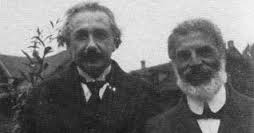
As a term, the word “schlemiel” (“der schlemihl”) had both negative and positive valances in the 19th, and 20th centuries depending on whether  one was in Central or in Eastern Europe and on the intent of the author.   While  many Zionists and Jewish Enlighteners (Maskilim) in Germany and other German speaking countries often used the term in a negative sense,  they sometimes used it in a positive sense.  For instance, while Hannah Arendt notes that Rahel Varnhagen (1771-1833) has a negative sense of the term, she argues, with respect to Heinrich Heine (1797-1856) – who occasioned Varnhagen’s Salon in Berlin – that the schlemiel had a positive meaning – since he read it as a figure of the modern poet and the pariah.    In Eastern Europe, the use of the term by storied Yiddish writers like I.L. Peretz and Shalom Aleichem were also divergent.  While it was often used in a biting satirical sense, the term – as used by Aleichem, Heine, and many folklorists – was also used in an endearing sense.    This can also be seen in its everyday usage.  One fascinating and telling instances of this usage, which I have come across, can be found in Albert Einstein’s description of one of his closest friends and colleagues, Michele Besso.

Einstein met Besso when he studied at the Polytechnic Institute in Zurich from 1896-1900.  There they became very good friends and confidants. They frequently corresponded with each other from 1903 to 1955.   In his exceptional biography on Einstein (Einstein: His Life and Universe), Walter Isaacson notes that Einstein was having a hard time finding work after leaving Zurich.  In a letter to his friend (who he later married in 1903 and divorced in 1919) Mileva Maric, Einstein claimed that the reason he couldn’t find a job in German speaking countries was because of anti-Semitism.   This led him, according to Isaacson, to find work in Italy and enlist the help of Besso, a Sephardic Jew.  Their closeness is illustrated in a letter that Einstein wrote to Besso in which he insists that “nobody else is so close to me, nobody knows me so well, nobody is so kindly disposed to me as you are.”

Isaacson notes that while “Besso had a delightful intellect,” he “lacked focus, drive, and diligence.”   Like Einstein, he also had problems in high school.  And, to be sure, Einstein saw him as a kind of twin or double.  He described Besso as an “awful weakling…who cannot rouse himself to any action or scientific creation, but who has an extraordinarily fine mind whose working, though disorderly, I watch with great delight.”   To illustrate this comical kind of disorder, Isaacson retells a schlemiel tale of how, before Einstein caught up with him, Besso had “been asked by his boss to inspect a power station, and he decided to leave the night before to make sure that he arrived on time. But he missed the train, then failed to get there the next day, and finally arrived on the third day.”  Einstein recalls how “to his horror (he) realizes that he has forgotten what he’s supposed to do.”  So what did he do?  “He sent a postcard back to the office asking them to resent his instructions.  It was the boss’s assessment that Besso was ‘completely useless and almost unbalanced.”

Echoing these reflections, Einstein, in a letter to Maric, called Besso an “awful schlemiel.”  But one should not be distracted by the term “awful,” since Einstein means it in the most endearing sense.  He doesn’t correct or chastise his friend for being a schlemiel, as some Jewish German Enlighteners might.  Rather, he loves him and his company.  He enjoys the time he spent speaking and listening to him.   Einstein’s conversations with his dear friend often dipped into science.  Isaacson goes so far as to suggest a link between the discovery of the Theory of Telativity and a conversation that they had.  He points out how, four years before the discovery, the two had spent “almost four hours talking about science, including the properties of the mysterious ether and the ‘definition of absolute rest.’”   To Maric, Einstein noted that Besso is “interested in our research.”  Although he “often misses the big picture by worrying about petty considerations” he had connections that are useful.

Einstein’s long standing relationship with Besso and his characterization of him as a schlemiel demonstrate not only a more endearing usage of the term by a German Jew, but also an important idea.  Even though a schlemiel may be seen as useless to some (as we see in the story above about Besso missing his train, etc), he may actually be much more useful than any of us could ever imagine.  In fact, Besso – a comic scientist of sorts – may even have taken part in the birth of one of the most important ideas of the 20th century.    Einstein, in his brilliance, knew this and threw his lot in with the schlemiel.  In many ways, Einstein’s close relationship with Besso shows us that he was in many ways a schlemiel himself.   His delight in Besso is not contempt; in fact, it shows some kind of affinity.  (To be sure, it would be wrong to think of a schlemiel as lacking in intelligence.  On that note, take a look at Saul Bellow’s Herzog character.)  Perhaps this is one of Einstein’s best kept secrets.  Perhaps it was an open secret.   After all, Einstein, saw himself as a dreamer and had a penchant for the comical.  It all depends on how you read the schlemiel.


Rabbis and Schlemiels: On Reading Diaspora, Jewishness, and Survival

images

Joseph Chaim Brenner’s writings on Zionism in the early 20th century are of great interest to scholars of early Zionist ideology.  As I have noted elsewhere, Brenner took a strong stance against the schlemiel character.    In his essay entitled “Self-Criticism” he takes the Yiddish writer Mendel Mocher Sforim and the schlemiel character to task.  He points out that even though the schlemiel characters in The Tales and Adventures of Benjamin the Third survive, this survival is incomplete:

The skeptics and rebels who have just recently appeared in literature say: What? The Jews have survived? Yes, it is true they have survived. But, my friends, survival alone is not yet a virtue. Certainly, it is better for any man, any people, any organism to be than not to be….but existence in itself is no evidence of an estimable character.

Echoing Heinrich Heine, who says that Jews, during the week, are like dogs, Brenner argues that “we survive like dogs and ants” and not like human beings.   “True self-criticism,” according to Brenner, will yield the insight that always being on the run from the Nations is a half-life.    While the schlemiel is a dreamer, her form of survival is not dignified.

In saying this, Brenner is not simply challenging the schlemiel.  Drawing on Daniel Boyarin and Jonathan Boyarin’s book, The Powers of Diaspora, one can argue that Brenner is challenging the Rabbis of the Second Temple period and the diasporic Judaism they advocated.  Both of them see the strategy of survival employed by the Rabbis – which includes appeasement, hiding, and obfuscation – as the best (and the most Jewish) strategy Jews can take today.  For them, the appeal to Masada instead of Yavne (where the first Yeshiva was based) is more Roman and masculinist than Jewish.  The “foundation of the rabbinic value system is the obverse of ‘manly’ Roman values on the Masada foundation myth of Jewish heroism,” which Josephus gave life to in his famous account (52).  For the Boyarins this difference is fundamental:

The Babylonian Talmud’s Rabbi Yohanan prefers life and the possibility to serve God through the study of Torah over everything else.  He is willing to abase himself, pretend to be dead (as the story goes, he pretended to be dead in order to avoid being killed by the Romans) – a virtual parody of the Masada suicide? – make peace with the Romans over/against the Jewish zealots, even to sacrifice Jerusalem, in order that Jewish life and Torah might continue.  Where the Josephan zealots proved themselves “real men” by preferring death at their own hands to slavery, the Rabbis prefer slavery to death.  (52)

Survival, according to the reading of the Rabbinic tradition by the Boyarins, is directly related to a policy of appeasement.  To support this claim, they cite the Talmud Yerushalmi Shabbat 1:3, 3c which reports the following about Rabbi Hiyya:

How does Rabbi Hiyya the Great explain the verse: “You shall buy food from them for money and eat”? – If you feed him, you have bought and broken him, for if he is harsh with you, buy/break him with food, and if (that does) not (work), then defeat him with money.

They say: That is how Rabbi Yonatan behaved.  When he saw a powerful personage come into his city, he used to send him expensive things.  What did he think?  If he comes to judge an orphan or a widow, we will find him propitious towards them.  (55)

Commenting on this, the Boyarins argue that Rabbi Hiyya developed a “whole political philosophy of Jewish-gentile interaction” from this verse which comes from Deuteronomy 2:6-8 (55).   This verse makes specific reference to the previous verse 2:4-6 which is in reference to the “descendants of Esau,” Jacob’s brother (who, as we learn from the Hebrew Bible, wanted to kill his brother out of spite for stealing his birthright).  The Rabbis, elsewhere, recognize these descendants as the Edomites (who are the Romans):

And charge the people as follows: You will be passing through the territory of your kinsman, the descendants of Esau, who live in Seir. Though they will be afraid of you be careful not to provoke them.

The Boyarins explain that “an alternative to provoking them is also offered by the verse, which Rabbi Hiyya understands in a way that takes it out of its immediate biblical historical context and gives it new cultural power”(55).  In other words, the Boyarins are arguing that Rabbi Hiyya is creating a cultural principle to deal with the Romans and all possible enemies:

He reads it as a suggestion to use gifts to turn the rulers’ hearts favorably to they Jewish subjects.  This is derived from the verse by typically clever midrashic punning, in addition to the mobilization of the foundational inter-text: the story of the original Jacob and Esau.  (55)

The Boyarins, using quotation marks, point out how there is, in Rabbi Hiyya’s reading of the passage from the Hebrew Bible (and perhaps even the passage itself), “an obvious allusion to the situation within which the weak ‘feminine’ Jacob bought the favor of the ‘virile’, dominant  Esau by giving him food….we will be observing how various ‘dishonest’ practices, deceptions, are valorized by the rabbinic and other colonial peoples in direct opposition to the ‘manly’ arts of violent resistance”(55).

Drawing on JC Scott’s book Domination and the Arts of Resistance, they argue that this valorization is something shared with other colonized peoples:

We must also tactfully disguise and hide, as necessary, our true aims and intentions from our social adversaries.  To recommend it is not to encourage falsehood but only to be tactical in order to survive. (55)

As one can see, the Boyarins have a much different reading on survival than Brenner and the early Zionists.  One can surmise that they would see the survival of the Jewish people in the diasporic mode – as one can see with the schlemiel character in many different instances – draws on a more ancient tradition of diasporic survival, which is found in the rabbinic writings.   Brenner’s “self-criticism,” in their view, would be a criticism based on a masculinist Roman way of thinking (which they associate with colonialism) as opposed to a Jewish way of thinking which works by appeasement and obfuscation rather than through power and strength.   Instead of leaving the schlemiel behind, as Brenner suggests, they would likely – as they would with their turn to the rabbis of the Talmud – valorize the character.    There are questions, however.   How is one to deal with the claim that the schlemiel character is “feminized”?  And is the biological survival of the Jewish people the right frame to use when reading this character or when reading the Rabbis?  Is the schlemiel character born out of a survival tactic?

Ruth Wisse argues that the schlemiel character comes out of and responds to the “weakness” of Jews in diaspora.  Its comic victories, so to speak, are ironic.  As the title of her book makes explicit, he is the “modern hero.”   However, in her later writings she rejects this position and sees Zionism as superseding the diasporic character. Wisse takes on a position more in turn with Brenner’s “self-criticism.”    While she originally saw the schlemiel’s cunning as a mark of “Jewishness,” Wisse sees Zionism as its most important feature, today. Why should Jews remain powerless and take on the tactics that the Boyarins refer to when they no longer need to do so?   The Boyarins obviously disagree with Wisse and see the turn away from the Rabbis and their diasporic strategies as a form of betrayal.  Moreover, they would likely see the rejection of the schlemiel as a masculine form of critique.   The only difference, however, is that while the Rabbis of the Talmud period were truly a subaltern culture that had to survive by virtue of its wits, Jews of North America are not.  The need for appeasement is no longer necessary.

Nonetheless, writers like Michael Chabon, Gary Shteyngart, Shalom Auslander, and many others, see the schlemiel character and its diasporic antics in terms of its cultural meaning.  The character – today – doesn’t relate to survival so much as American-Jewish identity (American first, Jewish second).   Survival is not a frame of reference and neither is the dialectic between power and powerlessness.  In America, schlemiel humor, with its penchant for self-mockery and self-deprecation, has become iconic.    One wonders, given this situation, what it would mean for a Jew to be, as Brenner once said, self-critical.  American Jews don’t see their kind of existence in terms of merely surviving or surviving as “dogs or ants.”  That said, the tension between the schlemiel and the Israeli sabra may no longer hold; unless, that is, the power of self-mockery and self-deprecation loses its iconic status, anti-Semitism rises, and American Jews return to the survival mode.   The schlemiel, if that happens, can offer an “ironic victory.”   And if this arises, once again, one will have to ask whether Brenner’s self-criticism or the Boyarins recovery of the rabbinic approach of appeasement and trickery is more appealing.   Until that happens, the schlemiel lives on in an America where survival is simply not an issue.  It lives on in what some thinkers would call a post-diasporic mode of existence.    Larry David’s schlemiel – and so many others – seem to dwell in this comic space of existence.


An American Prayer: On the Performance of Race & Class in a Don Rickles Comedy Routine

images-1

After learning that Don Rickles had passed away, I spent a few hours watching videos of his comedic routines.  One of the most striking acts I found was a clip from his “Las Vegas Special” in 1975.   During this act, he does something unexpected: he brings three movie stars and an African American from the audience together on stage to perform a public prayer that, because it plays on Native American stereotypes that manages to bring a diverse group of Americans together, comes across as an American prayer.   It may be comedic and offensive, but it is, nonetheless, an attempt to create unity out of a disunity – in terms of class, race, and religion – that Rickles, through his insulting humor, brings to the surface.

Rickles begins his routine by calling up three Oscar nominated actors: Elliot Gould, James Caan, and Michael Caine.  (Only Caine, a non-American actor, received Oscars; six in fact.)  As one can expect, Rickles insults each one of them.  In doing so, he brings them down a notch.  He reduces their status as a class above the rest of Americans by way of his humor.  Caan’s clothes are cheap, Caine is English, Gould is a little slow.   But what makes this act so fascinating the inclusion of an African American audience member named Mitch Mitchells who Rickles calls up after making a joke about blacks.

What is so fascinating about including him in the act is that it shows us that Rickles, an American Jew, has some tension with African Americans.  (In the early 70s, relations between Jewish Americans and the African American community was much more strained than today.)  But he is not alone.  Most of the audience also laughs nervously when Rickles makes jokes about how big and powerful he is.  (When he tells In comparison to him, Rickles’s comes across as a schlemiel.  In the spirit of the schlemiel, he switches – on two occasions – to the mode of self-deprecation.  But he then uses this to his benefit when he drops the note that he, as a Jew, and the African-American audience member, Mitch Mitchells, have a lot in common in the sense that they are different from Gould, Caan, and Caine.  They aren’t “white.”  They are the underdogs in a WASP culture.  This sets up a tension of sorts between race and class.

But Rickels manages to suture all of the gaps between them through asking Gould, Caan, Caine, and Mitchells to perform a prayer, which is, more or less, a stereotypical improvisation of a Native American prayer.   Rickles adds a simulated “peace pipe” to the routine and makes sounds and gestures that are supposed to be signs of smoke coming from the pipe (there is an overlapping with taking a drag from it, however, which set up a ridiculous kind of sinage).   Rickles initiates the prayer and has each of the actor follow his lead. After they make their prayer, they all bow down, in unison to the ground (it comes across more as an Islamic form of prayer than a Native American form).  And this creates a kind of collective sense of submission to something higher.    But since it is all done in jest, it comes across in a way that is nuanced.

The last person to pray is Mitch Mitchells. Before he prays, Rickels gives him a few comical quips. He takes the mike away from him and gives it back. And when Mitch Mitchells imitates the smoking pipe – in a very creative manner, even more so that any of the famous actors – Rickles gives him one of his looks and makes an offhand comment.  Nonetheless, when he performs, Rickles shows the audience, in response to Mitchell’s improvised prayer, that it is the most pleasing one.  He does this before they all bow down and perform prayer.    In this moment, not only the tension between Jewish Americans and African Americans is temporarily suspended, but also the tension between the Hollywood elite and the everyman.

What is most amazing about this act is not that they are brought together through prayer, but that they are brought together through the comical performance of a prayer.  Rickles acts as the Rabbi, so to speak, and brings everyone together. But he does this through an American medium and through American stereotypes.  He uses them against themselves, emphasizing division while at the same time, brining everyone together through sharing the performance of an (improvised) American prayer.

While most people who enjoy Rickles’ humor focus on the insults, what many people might miss is how these insults are used.  In this comic routine, we can see how the insult – much like monotheistic religion – has a humbling effect.   It brings everyone down to earth and challenges their ego.  The irony is that this comic routine literally gave not only this a comic figuration but it also accomplished something astounding.  Through an improvised American prayer, it used insult to bring everyone together and share a unique act of (comically) performing a prayer which, in the end, they all share since they all bow down together.   The lesson is that if most of us in America can’t take prayer seriously, perhaps we can take it comically.  Perhaps Rickles is showing Americans that comedy can mark out our differences while, at the same times, performing our (fragile) union.    In truth, after the prayer is done, the stereotypes will likely remain but the hope in the act is that , by the end of the act, they have lost much of their power.    Perhaps that’s the best way to understand the unique power of insult that is employed by (Rabbi) Don Rickles in his improvised American prayer.


You Look Ridiculous: Don Rickles, Jewish American Anxiety, and Insult Comedy

images

Don Rickles was the master of insult comedy.  But what was coupled with that insult was a kind of anxiety that turned a new page for Jewish American comedy.  It showed another side of being a Jew in America.   It registered a different stance of American Jews toward the America, one that was less self-deprecating and more assertive.  Lawrence Epstein, in his book The Haunted Smile, points out that it is a “rare performer who can make it insult comedy”(162).  And, for Lawrence, there were only three great Jewish comedians who fit that bill: “Fat Jack Leonard,” Don Rickles, and Rodney Dangerfield.   Dangerfield was, like Rickles, full of insults and incredibly anxious.  But while Dangerfield “turned his anxieties inward, Don Rickels turned them outward, attacking those who caused him grief, pushing into the territory of insult humor explored earlier by Fat Jack Leonard”(223).

While “Rodney Dangerfield was the American Jewish psyche blaming itself for its troubles, Rickles was the American Jewish people blaming everyone else.  He was the Jewish hostility to anti-Semitism finally allowed to speak and doing so with a barely controlled anger and a barking outrage”(223).   Instead of talking to his audience, like most stand-up comedians do, “Rickles changed the nature of the dialogue.  He was working in strip joints, and the tough audience liked it when he began to yell at them.”   Rickles didn’t hold back from insulting everyone.  No matter how great the stars were, he insulted them.  Here he is insulting Frank Sinatra on The Johnny Carson Show (1:30 seconds in).

But the kind of insult that rose Rickles to fame, according to Epstein, was his ethnic humor and his personal insults.   No ethnicity was free of being insulted.

Rickles got away with these kinds of jokes, according to Epstein, because his audience “knew he was kidding and meant no harm, the words themselves cut deeply”(224).   This was unique because “most Jewish comedians would not follow Rickles footsteps.” They prefer, instead, being “neurotics, satirists, or observers”(224).  Only Richard Belzer, argues Epstein, tried to take on Rickles’ legacy. But, argues Epstein, he failed and his ethnic jokes came across as offensive.

Phil Berger, in his book The Last Laugh, points out that Don, unlike many other stand-up comics, did incredibly well on TV (167).  While “TV-minded comics took no chances,” Rickles did.  Rickles gave rage and insult a public forum on TV.  He touched an American nerve while, at the same time, showing a new kind of Jewishness that was brash and fun, a kind of Jewishness that looked back at the person instead of looking away.  He showed that self-deprecation and neurosis were not the only Jewish comic mode.  He showed us that the comedian should not just be fearless when it comes to taboo words and ideas, she must also be fearless when it comes to facing the other with a sense of humor.

We need this today, especially, in a world that has been inundated with politically correct ways of speaking and acting.  Rickles taught us that we need to look this in the face and insult it – yet, in such way that we can all laugh at how we “look” or show ourselves in the world.   His way of deflating the ego – whether it was the ego of Frank Sinatra, Johnny Carson, or an audience member – though insulting, was always humbling.

Don Rickles passing will be felt by many.  His insults raised the bar for American comedy and touched on something profoundly American.  He was able to take ethnic comedy and insult comedy and give it a human face.  He taught us that American comedy should always aim at the face, yet, in such a way as to break it open and expose how ridiculous it is that we “pass” ourselves off the way we do in the world.  The anxiety that comes with passing is a distinctly American anxiety, and it is certainly a Jewish American one.

But when Jews are kvetching together, passing can be laid aside.  To be sure, there is something distinctly Jewish about his kvetching and complaining.  One can see this when he is kvetching with Larry King.   But this kvetching is comedic; it’s not mean-spirited.  The anxiety that exists between these two famous Jews is a familiar one.   The insults are delightful.   I’ll end on that note because, for Jews, kvetching makes life, and all its ridiculousness, easier.  There’s always something to complain about in this world.  But to look it in the face, to look you in the face and say, “you look ridiculous,” is something else.  Rest in Peace, Don.

Philosophy is a Literary Art: A Note on Harold Bloom’s Literary Reading of Plato

Unknown-1

Although I have always enjoyed discussing Plato’s dialogues in classes I’ve taught over the years, what I loved most about them was their dramaturgy.  Socrates is, to be sure, a character in Plato’s dialogues.   Plato portrayed Homer respectfully yet, at the same time, as an opponent.  The irony of his dramatic dialogues, according to Harold Bloom, is that they demonstrate, through the “character” of Socrates, the opposite of what Plato says.  Bloom calls Plato a “strong poet,” not a philosopher.   Socrates, Plato’s literary creation, belongs to the history of literature:

Plato, never a warrior, took Socrates as his heroic father, and gave Socrates immortality as a literary character, yet the Homeric irony in this is that Plato achieved a poetic immortality as a dialogical dramatist and mythmaker.  (Where Shall Wisdom to be Found?, 58)

Homer and not Socrates was Plato’s real teacher!   This ironic reading is an inversion of the stated meaning in Plato’s Republic about Homer.   The secret of the text is that it lies.  And it is the reader who is duped.   Philosophy is not greater, for Plato, than poetry.  Bloom illustrates this further by describing, detail for detail, the likeness between Socrates, Odysseus, and Achilles:

When Odysseus disguised himself as a beggar, he influenced the actual Socrates, the Eros who Daytime, wise woman of the Symposium, called poor, filthy, barefoot.  Socrates is not exactly a Platonic Form, visually speaking, though Plato found in him the Form-of-Forms.  Both a mortal and a daemon, Socrates is half a good, like Achilles, and a resourceful deceiver, as cunning as Odysseus. (59).

Socrates, the literary character, “half a god” is the literary creation of a “strong poet” since “Plato’s shrewdness is that of strong poets throughout the ages: creatively misinterpret the dominant poetic forerunner, to clear imaginative space for yourself” (59).  Bloom argues that Plato’s writings on Socrates “set the pattern,” which Bloom translates into the fact that “philosophy is a literary art” (59).  Philosophy as literature, Bloom goes on to say, is “conversation sharpened and refined.”

No other philosopher, argues Bloom, has “been so major a literary artist” as Plato.   Socrates, as an exemplary literary figure (in Bloom’s terms),” incarnates the art of Eros.”  Bloom suggests that standard of the philosopher as fiction writer would be attained through a Socrates-like character that is an incarnation of Eros, a hero.

On this note, one wonders what Bloom would say of philosophical literary characters who aren’t heroes so much as anti-hero’s or schlemiels.  Think, for instance, of Saul Bellow’s Moses Herzog, one of his most celebrated and exemplary characters.   In Herzog, Moses Herzog is portrayed as a cuckold.  He can’t stand up and be a “man” against a character who steals his wife behind his back; his best friend Valentine Gershbach.  Moses Herzog isn’t Odysseus.  He isn’t cunning in the least.  He is a dreamer.  He’s an academic and a lover of ideas.   And like Gimpel the Fool, most likely his schlemiel prototype, Moses Herzog trusts people.  He has a good heart; as we see in his name “Hertz” (“heart”) Zug (“speech” or as another theorist translates it “song”).

In a 1991 interview with The Paris Review, Harold Bloom is asked about Saul Bellow.  Bloom lashes out at Bellow and puts Philip Roth up as the better of the two Jewish American writers. But, as anyone who closely reads Bloom knows, the act of artistic jealousy is an aspect of the “strong poet.”  There are strong readers and strong writers.  Both, as Bloom conveys with his admiring and yet jealous wink, are revisionary and bold.

I’ll leave the reader with Bloom’s words because, as one can see for oneself, Bellow and his character might even be his precursor – and that would mean that the schlemiel may be the precursor for the Jewish poet/philosopher. And if that were the case what would it mean for Jewish philosophy, through the schlemiel, to be a “literary act” ?  Saul Bellow would have created that figure in the comings and goings of his exemplary schlemiel, Moses Herzog.  Bloom doesn’t like that (perhaps because Bellow’s schlemiel character, Moses Herzog, hits too close to Bloom’s Jewish-Aemrican home).

I’ll end with Bloom’s jealousy and the fact that Bellow may actually inform his own ideas and writing!  And if that is the case, perhaps Bloom is also the creator of a schlemiel character in his attempt to act as if he’s a philosopher in a Homeric sense; maybe the sense that goes along with Bloom sounds more like Kafka while it acts like Odysseus:

He’s (Saul Bellow’s) an enormous pleasure but he does not make things difficult enough for himself or for us. Like many others, I would commend him for the almost Dickensian exuberance of his minor male characters who have carried every one of his books. The central protagonist, always being some version of himself, even in Henderson, is invariably an absurd failure, and the women, as we all know, are absurdities; they are third-rate pipe dreams. The narrative line is of no interest. His secular opinions are worthy of Allan Bloom, who seems to derive from them. And I’m not an admirer of the “other Bloom,” as is well known. In general, Bellow seems to me an immensely wasted talent though he certainly would not appreciate my saying so. I would oppose to him a most extraordinary talent—Philip Roth. It does seem to me that Philip Roth goes from strength to strength and is at the moment startlingly unappreciated. 


Gong(ed): Chuck Barris (Charles Hirsch) Has Left the Stage

Unknown-1

Like many people growing up in America, I recall watching many reruns of the Gong Show.  Neither the contestants nor the judges drew me before the tube to watch, however. And I didn’t like seeing one act after another which was, to be sure, an absurd failure from the start.   It was Chuck Barris.  On the one hand – because I lived in Upstate New York and most of the fellow Jews I knew were either relatives or the few people who were Jewish in my school and tiny Jewish community – the few Jews I saw were on Television.  Looking back to my childhood, I recall identifying with him.  He looked like a Jew.  But did he act like one? Was the world he shared with me one I wanted to share with him?  Who would want to share a world that was inundated with absurd and yet entertaining odd acts and failures?

Absurdity and cheap thrills aside, what I loved most about Chuck Barris was his spontaneous kind of humor.  I loved how, out of nowhere, he would hear the musical cue, and then break out into a dance with “Gene Gene the Dancing Machine.”   More often than not, he would pull down his hat and, with Gene, dance up a storm.  This was the cue for everyone else to join in and dance like a fool.  His Yiddishkeit, it seemed, was channeled into these sudden dance numbers.  The world of rules was momentarily suspended.  Dance for no reason save for that it’s now time to dance.  And while you dance, you can sustain a blow or two from this or that hurling object.  It didn’t matter.

But there was another, more disturbing, part of his act which, I suppose, I chose to forgot: the awkward and humiliating part.  In one essay I came across today, the author claimed that Barris invented the “Reality Genre of Humiliation as TV Entertainment.”  Although he doesn’t explain why this is the case, I took a look at a few videos and what I liked least came back to haunt me.  The other side of his act, the one that took up the rest of the show, was his endless humiliation of contestants and judges.  With the gong, of course, came humiliation.  And all parties were involved.  But one always knew that someone would be laughed at.   Every act was another target.  And when one laughs, as Henri Bergson, Charles Baudeliare, and Thomas Hobbes once argued, one has a feeling of power.  But this kind of power, experienced at the expense of foolish acts and judges, was a little nauseating.  I didn’t enjoy it.  It felt wrong.

Here is an act which, because it is erotic and evokes rude hecklers in the audience, is awkward and, in so many ways, is wrong.  The response to it, as one can expect, should be humiliation. But it’s not.  No one, in fact, is humiliated.  Chuck tells the “rude kids” to get off the stage but he does so with a wink.  We can accept this, in other words, as normal fun.    And this act, in that gesture moving them off the stage, is (or rather was) our world. This was good old fun, American style.  But was it mine?

Now that he’s gone and as I reflect on the fact that he is gone for good, that mixture of identification and awkwardness, which I felt when I watched his show, it all comes back.   And it makes me wonder.  What I felt awkward about wasn’t so much what I saw, but about what I should do in response to it: should I accept this odd comical world and share it with them?   This was a world unto itself, a reality if you will.  But it didn’t seem to be mine. My only connection to the world of the Gong Show was Chuck Barris.     It was a partial identification.

What Chuck Barris did give me is a sense of how there can be existential decisions that have to do with American entertainment.  My Jewishness, at one point of my life, found a mixed identification with Chuck – that is, Charles Hirsch.  And, for some reason, my view of not just what it meant to be Jewish but also my view of America as comical world was mixed into my reception of The Gong Show. In this America schlemiels – with their odd acts – were the targets.  But, ultimately, every American who stepped on that stage was “gonged.” Failure was pronounced with a bang, not a whimper.  But we can laugh about how rotten these acts are because we knew that when the cue came, we got to dance. And Barris could, momentarily, suspect the nausea I felt about having to decide.  But now I remember what that dance displaced.

Thanks for that memory, Chuck Hirsch.  Rest in Peace.

Women Can Be Schlemiels? Reflecting on Contemporary Schlemiels of the “Opposite Sex”

Unknown-3

An important and often neglected subject of schlemiel theory is the female schlemiel who, since she hasn’t been discussed as much as the male schlemiel, needs a discourse.  The already existing discourse on her has found its beginnings not in the work of Ruth Wisse or Sanford Pinsker (the two most important schlemiel theorists in schlemiel theory in the twentieth century) but in the work of David Biale: Eros and the Jews.   His reading suggests that Philp Roth’s Portnoy’s Complaint and most of Woody Allen’s early films – all the way up to Annie Hall (1976) – provide us with a definition of the female schlemiel.  As Biale suggests, she is defined by the schlemiel of the “opposite sex.”    But before he arrives at this definition, he defines Woody Allen’s “sexual schlemiel.”  He is impotent but Biale argues that this is not any mere impotence.  And, as he suggests, we read this in relation to the female schlemiel who is “mirror image” of the male schlemiel.

Woody Allen’s male schlemiels are “not, however, merely impotent; they are also highly erotic.  Jews have the libidinal energy to win over gentile women from their desiccated WASP culture, but they can never consummate their conquests – the hormones are willing, but the psyche is ambivalent”(206).   Although the “hypersexual” Jew was a stock anti-Semitic image, Biale argues that Woody Allen’s sexual schlemiel “neutralized” it.  Biale goes on to decipher the intention of this neutralization: “the Jew does not corrupt gentile America by his hypersexuality so much as he de-eroticizes it with his comic fumbling”(207).

This argument about the sexual schlemiel’s neutralization of the anti-Semitic stereotype lays the groundwork for Biale’s definition of the female schlemiel:

In some of Allen’s movies the Jew’s sexual ambivalence infects the gentile women and turns them into mirror image of himself: even gentile women become “Jewish.”  The hidden agenda is to identify America with Jewish culture by generalizing Jewish sexuality and creating a safe, unthreatening space for the schlemiel as American anti-hero. (207)

This reading of the female schlemiel suggests that whoever she is paired with the schlemiel becomes “Jewish” because she is the “mirror image” of the male schlemiel (who has already crafted a space in America for Jewishness).    Jewishness becomes synonymous with being an American.  Biale’s reading suggests that it is gendered.   It seems as if a woman is to become a sexual schlemiel she is just an imitation of the male schlemiel.  Is that true?

In another section of the book, Biale suggests another take on the female schlemiel.  He notes how Eric Jong, in her second novel, Any Woman’s Blues, creates a female sexual schlemiel character, named Lela Sand, who is a lot like Roth’s Alexander Portnoy.  But she is a little more sexually active than Portnoy, who spends most of his sexual time alone, masturbating.  Leila has sex with many WASP men, celebrates her conquests, but, as Biale notes, she is “confused and frustrated sexually.”  The only child she has is not with a gentile, however; it is with a Jewish man.  She doesn’t know who she is or what she wants:

Leila Sand has no more resolved her sexoholism by the end of the novel than does Portnoy at the end of his complaint or than do Allen’s characters after nearly two decades of films.  Jong’s answer to the male stereotypes is a female version of the same syndrome.  (225-226)

In Biale’s reading, there is no such thing as a healthy female sexual schlemiel.  After all, she is a “female version of the same syndrome.”  All have  “big libidos and little egos.”  Biale’s clinical take on the sexual schlemiel suggests that it is a sick character.   No matter how sexually hyper they are or how impotent, the female schlemiel can only “mirror” the male, sexual schlemiel.    Biale’s negative valuation of the female schlemiel should be reflected on in light of new films that feature a female schlemiel character.

On the one hand, there is Noah Baumbach, who has cast Gretta Gerwig as a female schlemiel.  In Greenberg (2010), we have a schlemiel couple played by Ben Stiller and Gretta Gerwig.  But, before they met each other, they were both schlemiels.  When they come together we see this become a “possible” schlemiel romance:

In Mistress America (2015) and in Frances Ha (2013) she plays out different variations of the female schlemiel:

It seems that Gretta Gerwig, through her acting and Baumbach, through his writing, has turned it into something iconic and ironic.  Instead of being something stereotypical, they seem to be giving us something more existential and visceral.  Gerwig’s awkwardness is  painful and comic; its complex. But make no mistake she is a female schlemiel.  But Gerwig isn’t Jewish.

How do we read Gerwig in comparison to another female schlemiel, but who is Jewish?  How do we read Gerwig against Amy Shumer?  Are they both drawing on a stereotype of the female schlemiel which has, as Biale would say, become American?   Is Shumer doing something more stereotypical? What is the difference? Are both of them doomed to be a “mirror image” of male schlemiel?  Are Gretta Gerwig and Amy Shumer haunted by the ghost of Woody Allen’s Alvy Singer (from Annie Hall)?

I’ll leave you with a trailer from a new film that will be released in the summer: Snatched (2017).  She plays the schlemiel daughter of a Jewish mother played by Godie Hawn.  They both go on a journey.   It has much in common with another film Barbara Streisand did with Seth Rogen, who also go on a journey together: The Guilt Trip (2012). They both seem to mirror each other.  Perhaps Amy Schumer is the other side of the female schlemiel coin?  On the other hand, she seems like a paradigmatic example of a female sexual schlemiel.  She is sexually frustrated in most her performances.

But would you agree with David Biale’s observation that a female schlemiel like Amy Schumer is a “female version of the same syndrome”? Or is the clinical frame the wrong one?  What frame fits for the female schlemiel? Is she more than a male schlemiel’s mirror? I’ll let Amy Schumer speak for herself.  You can decide whether her Jewish identity is defined by having a big libido and a little ego, if some other psychological ailment is at hand, or if there is a better way to see her.

While Schumer’s comic journey may follow a similar pattern and although she never fails to fumble, in the film she does save her mother from death and becomes an ironic kind of female schlemiel hero (one we find in many Judd Apatow films starring a male schlemiel, Seth Rogen; A.O. Scott sees Rogen as caught up in what he calls “perpetual adolescence”).

But the comical heroism is not her’s alone.  It is shared.  Two female schlemiels save each other from the jaws of disaster.  The mother/daughter bond between schlemiels surpasses the comical-erotic aspects of a female “sexual schlemiel.” Perhaps this kind of female schlemiel can displace what Biale might call a “sexual schlemiel syndrome.” We have not even begun to scratch the surface.   There is much research yet to be done on this topic which may smash the (male) mirror image that Biale suggests is always before the female schlemiel.

Was Job a Schlemiel? On Pynchon’s “V” & Wiesel’s Revision of the “Book of Job”

Unknown

Near the middle of V, the main character of Thomas Pynchon’s first novel, Benny Profane, enters into a dialogue with a character named Mafia.  Profane, throughout the novel, is dubbed a schlemiel by the narrator (Pynchon spells it “schlemihl”).  And as the novel unfolds we see how that is the case.  Mafia is astonished that he is “half-Jewish and half-Italian”(241).  Playing on Shakespeare’s Merchant of Venice, she tells him that he has “an amusing role.   Like Shylock, non a vero, ha ha”(241).  After having her fun, Mafia gets serious and says that Profane has an “aristocracy of the soul” and that he “may be the descendent of kings”(242).  In reality, the novel tells the reader that Profane is a child of humble origins.  He was born during the Depression and lived a difficult life.  In response to her query, Profane posits a genealogy.  Rather than being a descendent of kings, “I am a descendent of schlemihls, Job founded my line”(242).   What does Job – who is noted for his horrible suffering, argument with God, and resignation  – have to do with a comic character who is often prone to endless fumbling  constant bad luck?

The end of the Book of Job has been called a fairy tale ending.  After all the suffering Job goes through, after his quarrel with God, and after his refusal of comfort, it doesn’t seem to fit.  But in terms of the schlemiel, the Book of Job reads like many schlemiel stories that end comically rather than tragically. Although the schlemiel stumbles and falls by the work of his own hand, in many tales and stories he still gets away with the shirt on his back.  But is this what Pynchon is getting at when he has Profane insist that Job founded his line?   Is this enough to call the Book of Job a schlemiel narrative?  Was it the ending that defines the story arc of the schlemiel, which includes suffering and even rebellion but ends comically?

In his reading of Job, Eli Wiesel posits an alternate ending which suggests something other than a schlemiel narrative.  Wiesel argues that Job, “the fighter,” has “turned into a lamb”(247, Messengers of God).   The “true ending” of the story has been lost (247).    The true ending would be different because, in it, Job would not repent and would not humiliate himself, that he would succumb to his grief as an “uncompromising and whole man”(247).  Wiesel doesn’t stop there.  He writes his own ending:

I was offended by his surrender in the text. Job’s resignation as a man was an insult to man.  He should not have given in so easily.  He should have continued to protest, to refuse the handouts.  He should have said to God: Very well, I forgive You, I forgive You to the extent of my sorrow, my anguish. But what about my dead children, do they forgive You?  What right have I to speak on their behalf?  Do I have the moral, the human right to accept an ending, a solution to the story, in which they have played roles that You imposed on them, not because of them, but because of me?  By not accepting Your inequities, do I knot become Your accomplice?  Not it is my turn to choose between You and my children.  I refuse to repudiate them.  I demand that justice be down to them, if not to me, and that the trial continue…Yes, that is what he should have said.  Only he did not.  He agreed to go back to living as before.  Therein lay God’s true victory: He forced Job to welcome happiness.  (248)

Wiesel could end his words here. However, he does otherwise.  Following this, Wiesel inverts his proposed ending and argues that Job, “by repenting sins he did not commit, by justifying sorrow he did not deserve, he communicates to us that he did not believe in his own confessions; they were decoys”(248).  In other words, it seems “as if” Job is choosing resignation, but in reality he hasn’t.   He still sought for justice: “Thanks to him, we know that it is given to man to transform divine injustice into human justice and compassion”(248).   Job is the personification of “man’s eternal quest for justice and truth” because he “pretends to abdicate before he even engaged in his battle”(248).

This reading of Job is thought-provoking and unexpected.  It speaks, in some way, to Ruth Wisse’s reading of Gimpel – I.B. Singer’s emblematic schlemiel character in his story, “Gimpel the Fool.”  Wisse argues that he knows full well that, in trusting people, that they will lie to him and even betray him. But Gimpel acts “as if” he doesn’t know because he wants to preserve the good.   Put another way, Gimpel, in his capacity as a schlemiel, is seeking truth and justice.  He does so by playing the fool.

While we don’t know if Pynchon read Wiesel’s essay on Job, this reading has resonance with his own schlemiel character.  Although Profane suffers by virtue of being dealt a bad hand, by virtue of his own foibles, and because he happens to always “be in the way of things,” he acts as if he has chosen a life of resignation when, in fact, he doesn’t stop trying to re-engage with the world that seems to have cast him aside.  For Pynchon as for many others, there is a goodness in this persistent desire to re-engage with a world that, based on what the reader can see, has done him wrong. The schlemiel may stumble through this world and, along the way, he may mess up one opportunity after another; but in acting as if it is alright and by continuing to move on, his desire to find truth and justice is disclosed (albeit in the most ironic and human manner).  Although the suffering of Job is much much worse than the suffering of Benny Profane or Gimpel (and he can certainly be called a schlimazel), these characters may be seen, given the reading of Wiesel, as the “descendants of Job.”*


*Take note that Wiesel is more interested in Job’s response to God – that is, in his freedom.  He pays less attention to Job as victim/schlimazel.  And that is a major point that distinguishes the schlemiel from the schlimazel. The latter is, as Ruth Wisse notes, a victim of circumstance.  In contrast, the schlemiel is more of a free agent who brings things on by his own doing; or alternatively, who acts “as if” he is a fool.  While the schlemiel and the schlimazel sometimes overlap – which is something both Ruth Wisse and Sanford Pinsker agree on – they are not the same.  This reading is making a possible case for such an overlap.  Nonetheless, as I note above, Gimpel and Profane’s suffering is miles apart from Job’s.  The relation of tragedy to comedy as well as the relation of being a victim to being a comic agent is the point of convergence and overlap.

Here (in America) Purim Comes Every Day: Sholem Aleichem’s Insider Joke

images-1

Motl the Cantor’s Son is Sholem Aleichem’s last novel.  Though unfinished,it  is substantial. It tells the story of Motl – the orphan of a Cantor who died back in Europe (in fact, on the same day as the Baal Shem Tov was said to have tied – the second day of Shavuot) – and his family’s journey to America.   Motl is the child narrator and, as Sidrah DeKoven-Ezrahi argues, he is a schlemiel.  While his perspective is steeped in the religious life of Eastern Europe, he thinks constantly of moving to America.  And once he goes on the journey he can’t stop imagining what it will be like.  His imagination is comical.  Nearly every thought he gives over has a punch line.  His wild imaginings of America are full of punch lines:

I don’t care what I become in America – just let me get there.  (I’m so eager to get there!) I promise myself that in America I’ll learn how to do three things – swim, write, and smoke cigars.  I can do all those things right now, but not as well as they can in America.  I know I could be an expert swimmer, but at home we had nowhere to swim.  In our pond it was impossible…In America, they say, there’s an ocean. There, if you lie down in the water on a tube, the water will cary you as far as the eye can see. (249)

What makes Motl’s account so interesting is that, through him, Sholem Aleichem suggests that this text – Motl’s story – is more like an image, a drawing, than a text.  Since he draws (writes) in a slow manner, he is able to show us things about America and his journey that we, American readers,  may miss because we are, as Motl imagines, always in a hurry.  For this reason, his writing becomes image (it is itself and other than itself, as the thinker and literary critics Maurice Blanchot would say):

I can write too, though no one has taught me.  I copy the letters from the prayer book. The letters I copy are hard to recognize.  I don’t really write – I draw.  I’d love to write fast, but I don’t know how.  In America, they say, they wrote fast.  Everything is done quickly, in a hurry.  Americans have no time.  (249)

When Motl arrives in America with his family, they are all in a hurry to catch up with Americans and make a living.  Motl is not melancholic about how his imaginings don’t totally match with reality.  He is excited.

But what happens to Motl’s Jewishness when he comes to America?  How does he draw out the new state of affairs?

In one scene, the Jewish holiday of Purim comes up indirectly, by way of a description of his friend Hershl.  One of the most brilliant aspects of this passage is that it outlines the doubleness of being a Jew in America.  It provides the Jewish reader with an “insider joke” since only a Jew would know what these names, which emerge out of the Jewish tradition and Jewish life, mean.  (Vashti is the name of a character in the Purim story and Hershl is a Yiddish name; and calling Hershl, a male, by the name, Vashti, there is yet another doubleness.)   As the Motl “drawing” shows us, Americans don’t know these names and practices; but “we” do:

Even my friend Hershl earns money, the one with the birthmark on his forehead who we call Vashti.  Here he isn’t called Hershl or Vashti but Harry, and he’s going to school.  The outer half of each day after school he spend at a pushcart on Rivington Street….There isn’t much work for Vashti, or Harry to do.  He just has to keep an eye on people to see they don’t filch anything …But he himself will sample the sweets.  Vast has no secrets from me.  He admitted that he once snacked on so many raisins, he had a bellyache for three days afterward.  He doesn’t get paid for his work aside from tips, a cent or two…At home (in Eastern Europe) Vashti never laid eyes on a kopek even in his dreams, except for distributing chalk-mones, Purim sweets.  (318)

The punch line involves the difference between Purim in the “old country” and Purim in America: “But Purim comes only once a year.  Here Purim comes every day, and every day he earns money”(318).

In America Purim – as it has in Jewish tradition – has a new meaning which has little to do with the old one save for the sweets that one used to get, once a year, when exchanging presents.  Aleichem is telling his readers that in America, Jewish time and space are altered. Names are forgotten. And all jokes that he shares with his readers are insider jokes since, after all, he knew that the Judaism of Eastern Europe would not find a strong anchor in America.

After saying that every day in America is Purim, we hear the voice of Motl’s friend Pinni who praises Columbus – not Abraham, Isaac, or Jacob…or God: “Columbus! You are worth your weight in gold!” In the wake of his celebratory exclamation honoring Columbus, he buys candy from “Vashti”and gives him a “tip”(318).  In America, the wealth is spread widely.  Even so, the reader is left with a Purim Shpiel (play) of sorts.   After all, we know that Vashti gets a tip, while, to everyone else, Harry does.  Sweetness and forgetfulness go hand-in-hand.   As Paul Celan says in one poem about forgetfulness it was “all sweetness and light.” But, at the very least, a reader, with some knowledge of Judaism, can remember that Harry is really Hershl and Hershl, he’s Vashti.  Motl, in this story, remembers.  But he was the last remnant of a generation that was, as we all know, to perish during the Holocaust.

Happy Purim!

The Schlemiel as Prophet, or Ezekiel as “Little Man”? On James Kugel’s Translation of Ezekiel

www-St-Takla-org--Bible-Slides-ezekiel-1502

How can a schlemiel be a prophetic figure?  One could argue, by way of the Talmud (Baba Batra 12B) that after prophesy ended it went to fools.  But how could one argue that a prophet is a schlemiel which is  – as is suggested in an interview with I.B. Singer and in many other places in literature, film, television, and schlemiel theory –  best described as the “little man.”   In his book, The Schlemiel as Metaphor: Studies in Yiddish and American Jewish Fiction Sanford Pinscher argues that we can read I.B. Singer’s schlemiel’s in terms of the prophetic: he reads schlemiel in the Hebrew, in terms of two words, shelah (sent) and m’el (from God). He draws this reading from The Jewish Encyclopedia, which, apparently, is the only source that makes this powerful claim (58-58).

Pinsker’s novel move is to take note that the Encyclopedia and many others (writers, artists, etc) only focus on one possible meaning: that being “sent (shelah) from God (m’el) which suggests that the Prophet is a symbol of Exile from God, a God-less state.  On the other hand, “it is the more likely translation for the phrase “sent from God” – in the sense of the Biblical Messenger” (58).  Pinsker’s reading suggests that the schlemiel is a Prophetic figure who conveys – like Samuel, Isaiah, Eliyahu, Jeremiah, and Ezekiel – the message of God.

The implication: like the prophet, the schlemiel is sent to communicate some message from God.  But Pinsker doesn’t argue that one meaning – the more spiritual one – is more essential than the other.  Instead, Pinsker takes both senses as possible and argues that there is an “ambivalence”(58).  He applies this to Singer’s most important schlemiels: Gimpel of “Gimpel the Fool” and Yasha of The Magician of Lublin.   He sees both characters as ambiguous schlemiels – they could be either prophets, with some connection to God (being His “messenger”), or none at all (being sent away from God, into exile).  This is what the reader must come to terms with. This would suggest a crisis of faith.  But Pisnker doesn’t spell that out.  He leaves it to the reader to figure it out, perhaps as Maimonides did for his student Joseph in The Guide to the Perplexed.  But that would be granting too much.

Pinsker’s reading of the schlemiel as a prophetic or exilic figure has yet to be given its due.  It needs further development if it is to become a major point of query in schlemiel theory.  What, one needs to ask, is the message of the schlemiel prophet and prophets?  Is it singular? Or does it vary from story to story?

Both trajectories need to be thought in relation to the other.  But to do that, they must both be clarified.  While the exiled schlemiel has been given much more coverage, the prophetic schlemiel has not been addressed at all save by Pinsker in his important book.  What I’d like to do, along that trajectory, is to give more thought to the prophetic aspect of the schlemiel and to a prophet who is like a schlemiel and a figure of Exile.

I would like to suggest that Ezekiel could be read as embodying both ambiguous aspects of the schlemiel.  James Kugel’s translation of Ezekiel 2:1-3:3 suggests that this is a possibility not simply for fiction but for the Bible as well: in Ezekiel.   According to Kugel, one should translate the term “ben-adam” as “little man.”  In doing so, Kugel suggests a relationship between God and Ezekiel which can be seen as being the relationship of a prophetic schlemiel to God.  He is a man-child before God.  From a Freudian perspective of the schlemiel of schlemiel theory, this can be read as a kind of infantilizing before God’s greatness. It is beautiful and, at the same time, shameful.   Ezekiel regresses in a way that is tragic but also comic.   Ezekiel’s mortality is presented, in Kugel’s translation as comical and as tragic. I am going to cite the passage – in full – to give the reader a sense of this childlike “littleness.” Kugel’s translation is markedly different from the JPS Translation in translation and in tone:

He said to me: “Little man, stand up on your feet so I can speak to you.  Then a spirit entered me while He was talking and stood me up on my feet, and I heard someone speaking to me, saying to me: Little man! I am sending you to the people of Israel, to the rebellious ones who have rebelled against Me; they and their fathers have Disobeyed Me all along, to this very day. In fact, the sons – those to whom I am sending you – are impudent…As for you, little man, do not be afraid of their words, and to not lose your courage, for they are a rebellious house…And you little man, listen now to what I am telling you….”  As I watched, a hand was stretched out to me holding a written scroll.  He opened it in front of me; it was written on both the front side and the back, and written on it were written words of lamentation and mourning and woe.

 Then He said to me: “Little man, eat what is given to you; eat the scroll, and then go, speak to the House of Israel.” So, I opened my mouth, and He gave me the scroll to eat.  He said to me: “Little man, eat the scroll that I give to you and fill your stomach with it.” So, I ate it; and in my mouth, it turned as sweet as honey (Ezek. 2:1-3:3)

One thought I’d like to end with is that “the little man” deals with a transfer of affect – from visual bitterness to a tactile experience of sweetness  Like a baby, Ezekiel has to swallow a scroll which, to the eye, looks sad and bitter because, on it, are “written words of lamentation and morning and woe.”  But when he swallows it, the visual is displaced by the tactile.. the bitter tastes sweet.  Parsing the term “little man,” we can say that the schlemiel may have swallowed something bitter (the text of mourning, tragedy, and suffering); but the bitterness of this death and suffering – things that the melancholic and the mourner, each differently, knows well –  become sweet in the act of accepting God’s wishes.

Alternatively, the way this mode of acceptance is accomplished, via Kugel’s translation, is not only tactile; it is also comical.  The mortal, the man – Ezekiel, the prophet – must become a “little man” and, like a baby taking medicine, the prophet must swallow the scroll.   (This reading suggests that there is something more than “internalizing” the text; which is how Maimonides and many contemporaries read this passage of Ezekiel.)   Perhaps this becoming small is another aspect of the ambiguity.  Ezekiel is not simply sent.  In being sent, he becomes little, he becomes small.  And this is something that happens will all schlemiels.  It’s a comedy of scale.  Every schlemiel feels some form of comical humiliation, after all.  (Think of Woody Allen,  Jerry Lewis, or Larry David’s characters. Think of Shalom Auslander or Kafka.)  Nonetheless, he seems to live in a Godless world.  In one sense, it can be said to be prophetic.   Ezekiel is the odd one out.  Perhaps becoming small is a part of the prophetic message that is being sent.  Perhaps it is the message.


To be continued…..