Imperative or Description? On Roland Barthes’ Notion of The Neutral in Minimalist Art and Ethical Minimalism


Unknown

I can’t seem to get smallness out of my mind.  It’s not simply an obsession.  The Kabbalists of Safed and also Kafka knew that.  The notion of “tsimtsum” (also spelled “tzimtzum”), in particular, addresses smallness and contraction in terms of a dynamic (a movement from one state to another).  It emerges in JS Foer’s recent novel, Here I Am.  Like Jacob, the main character of the novel and also the narrator of that novel, I can’t help but notice how while things around us seem to be getting larger and larger, they are in fact getting smaller and smaller.  They are not simply infinite in number; they are also becoming infinitesimal.   They seem to be coming close and yet, at the same time, moving away.

We too seem to be shrinking on a daily basis.

Social Media – on the one hand – makes things more minute and multiple.  We can’t possibly read every post or learn from everything (clickable).

It’s overwhelming.

We are so small in comparison to this endless flow of information.  There is a kind of passion.  We can’t stop clicking.  We can’t click enough.  But each click makes us smaller.  Each little link seems to matter to us, but there are too many.   This is what I would call a description of smallness, a phenomenology – if you will.  In light of this reflection on smallness,  I have been wondering if “smallness” is an ethical imperative – the imperative to become small – or is it only an aesthetic description?  Or is smallness an experience?

Kenneth Goldsmith’s recent book, Wasting Time on the Internet, suggests that smallness may be an existential choice   The individuality of the “digital flaneur” exists.  It is a tangible.  We can “experience it.”  But it is the browsing – of the digital flanuer – which seems to be an ethical imperative.  Goldsmith associates this browsing with Roland Barthes notion of “the Neutral” which he illustrates through Marcel Duchamp’s seemingly aesthetic but purely sensory notion of “the infrathin.”

If we take Goldmith’s illustration to heart, I would argue than Duchamp’s word suggests an aesthetic figure for something that is also ethical.   There is an ethical choice – by the artist or thinker- to record the feelings or affects of different sensations that are, what he says elsewhere, “pure minimalism.”   “Browsing” as read in terms of a sense of the digital flanuer, is the act of someone who – through a choice to withdraw a certain relation to the world that doesn’t know how to browse – drifts through existence to feel and record the alteration of states: from feeling the sliding of silk on a pant leg to hearing – as Goldsmith translates it into current parlance – the sound of an email whooshing away.

Today, there are countless different experiences of alteration – of one small thing to another –  which can give us the freedom to drift.  This freedom is not simply a gift from the neutral, it is an action.  As I argued in my last essay on Goldsmith’s interest in smallness, one’s attentiveness – in the spirt of Paul Celan’s reading of Kafka and Kafka’s reading of Malebranche – is the “silent prayer of the soul.”  To know this is to know the secret –  it seems – to Goldsmith’s reading of Roland Barthes explanation of the Neutral.

I went back to a book of lecture notes that Roland Barthes created and used in his courses in Morocco – before his death – in 1976 and 1977 to see what Roland Barthes would say about two subjects that Goldsmith reads vis-a-vis the Neutral: the aesthetic and ethical smallness.   These extensive and beautiful lecture notes are in a collection entitled…The Neutral.   

I discovered something fascinating.

Barthes compares and contrasts an aesthetic and an ethical reading of “the Neutral” and argues that one form of minimalism – in modern art – is false while the other one, which he beautifully describes, is true because it is the true “style of behavior.” It is not merely a description.  Minimalism is also a way of being in the world.  It is ethics and it is an aesthetic.

What would Barthes say of Duchamp’s minimalist art?

Helen Molesworth has argued that Duchamp’s “ready-mades” articulate an “avoidance of work” in the world, that is, a kind of flaunuer whose small life drifts though existence.  The work of art – in the spirit of the flanuer – is an action against the world.  Browsing through states of the neutral, the making small of one’s attentiveness through a dedicated attention to smallness, is an avoidance of the world, which characterizes – for also Barthes and Maurice Blanchot – “the avoidance of work.”  Avoidance, in other words, is an action that participates in the neutral.  The avoidance of the world – which we find with the drifting of the Flanuer from one altered state to another –  is true because it – as I will show below – can’t even be doubted by a skeptic.

Although Duchamp would seem to work perfectly, minimal art, suggests Barthes, may present a “false image” of “the Neutral.”

False image of the Neutral as minimalist:  “Minimalist Art,” New York, 1960s: artists opposed to the overflow of the abstract expressionism of action painting; shaving off all the extra-visual connotations (literature, symbolism): the object must be presented in a plain obviousness, with the clarity of an irrefutable reality > depersonalized and even mechanized fracture > “to neutralize form and color: to banish all emotion, all anecdote > From my point of view, the assimilation of the Neutral with the minimal is a misinterpretation (1) because the Neutral doesn’t erase the affect but only  processes it, formats its “manifestations” (2) because the minimalist neutral has nothing to do with aesthetics, but only with ethics.  (The Neutral, 199)

Barthes – in this reading – indirectly suggests that there is a “minimalist neutral” that informs an ethics.  And it is his reading of the relationship between “the minimalist neutral” and “The Neutral” (with a capital “N” and a definite article “the”) that discloses a way of life that, for Barthes, provides the subject for the best and the most compelling description and imperative – that he can imagine – for the good life.  He calls it the “minimalist thought of the Neutral.”

In fact, there could be a minimalist thought of the Neutral; such a minimalism would be as follows: a style of behavior that tends to minimalize the subjects interface with the world’s arrogance…but not with the world, not with affects, with love, etc.” it that sense, there could be an ethical minimalism but in no way an aesthetic or affective one.  (200)

The “right minimalist ethic” would “help bring harmony between the maximum internal intensity (i.e. hyperconsciousness”) and the minimum external” (200).  Barthes argues that this harmonization is found in what he calls Tao minimalism.  He contrasts it to Hegel’s expansionist philosophy -which is a “process leading toward the flowering of absolute knowledge, celebration of the more – with Tao minimalism:

With Lao Tzu, the treatment of negation (in each and everything its negative) is mystical: return to the non-distinct, celebration of the less > Lao Tzu tends to the apologia of the minimal image. (200)

Barthes suggests that it spurred his interest in the meaning of epoch for the skeptic.  It is also a kind of minimalism but marks a “suspension of judgment.”   The “thought of the Neutral” must take the skeptic’s epoche to heart.   The skeptic doesn’t “put sensation or perception in doubt but only the judgment that ordinarily accompanies the feeling” (201).   His reading of smallness via the minimalist ethics of Lao Tzu is associated with the meaning of the skeptic’s relationship to “intensities.” Rupture, epoch, could in fact be a good thing that makes one “happy.”

Skepticism: not an “abdication” from intensities: “he keeps life as a guide” (beautiful formula) (2) Epoch has an ethical dimension (aims at a “happiness”, at a “rightness.” (202)

In other words, skepticism is a “suspension of judgement” and experience of “intensities” which also has “an ethical dimension.”   It seems as if he is suggestion that there can’t be an ethical and aesthetic relation to the Neutral.  The skeptical epoche relates to sensation, but this is deemed ethical.   What do we make, then, of the rendering of this relationship?  Isn’t this aesthetic and ethical?  Can the exposure to “intensities” and smallness be articulated in poetry or art?  Isn’t that what Barthes, himself, is doing?  Perhaps this is the irony.

Through Charles Baudelaire, Barthes suggests that the poet can render the experience of the Neutral in terms of becoming small.  Baudelaire “raised the problem” of the “confrontation between my intensity and external intensities (of others, of the other)” in terms of his poetic reflections on the epochal experience of radical alteration:

Many social, worldly experiences, where suddenly the subject feels himself desynchronized, “thrown off level,” “disharmonized” …derealized in relation to the others who seem to him excessive, emphatic, excited, false > reflex of retreating, of shrinking, not letting oneself be seen and not letting it be seen that one does not want to be seen: pure minimalism.  (200)

This is what Baudelaire means when he writes of the “difference between pitch and level.”  The words articulate not simply a reflex but also an act of “pure minimalism.”  This experience, he suggests, should be the subject of art because it reflects what – as he argues in relation to the “epoche of the Skeptic” – can’t be doubted.  This is marked by Barthes’ threefold reflection on the Neutral (“the thought of the Neutral”) in terms of sensation as minimalism, minimalism as ethics, and “pure minimalism” as the subject of the poet’s reflection.

For Barthes smallness can be read, as Goldsmith has, in terms of the “digital flanuer.”  In could certainly be read in these terms.  But I would suggest that in his book Wasting Time on the Internet,  Goldsmith’s reflection on the Neutral and its illustration, through Duchamp’s notion of the “infrathin,” can’t be understood as an ethical and aesthetic model of smallness without reading Barthes.   Taken together, we can see what the importance of addressing smallness is: today, it is the ultimate subject of art, ethics, and experience.

Smallness runs throughout Barthes’ notes for his courses in Morocco in the 1970s, it dots the pages of Walter Benjamin’s “illuminations” and “reflections,” and it leaps out at us in Goldsmith’s reading of the “digital flanuer.”  Reading smallness in terms of the Neutral  should give us pause.  These readings insist that the experience of shock is coextensive with truth and happiness and that the sensation of alteration is the most important subject of aesthetics and the source the “rightness” of action” and a “minimalist ethics.” This would suggest that smallness is and should be a guide for action, a thing of reflection, and the basis of all true art.  If it’s to be true, perhaps it should be any one or else all of these at the same time.  After all, the thought of smallness (of the minimal) for all of them could be called the Thought – not of Being (as Heidegger might say) but – of the Neutral.



Chronicles of Smallness, or Becoming “Infrathin” in the Digital World

images-1

Translating Charles Baudelaire and Walter Benjamin’s notion of the flaneur into the language of the digital world, Kenneth Goldsmith argues that the flaneur “is hardwired into the ethos of the Internet”(65, Wasting Time on the Internet).    We are, like the flanuer, constantly “browsing.” But as we do we become smaller and less noticeable.   Goldsmith, drawing on Marcel Duchamp, calls this a state of becoming “infrathin.”

Goldsmith juxtaposes the flaneur to the zombie:

Much of the web itself has been colonized by zombies that automatically churn pages, entice us to click them, sometimes phishing for passwords, other times accumulating passwords, other times accumulating page views to generate ad revenue.  At the same time, spiders – another kind of zombie –crawl the web and consume all they can, indiscriminately sucking up files.  Casting the widest net possible, they trawl data, passwords, media that are warehoused in distant servers with the hopes of salvaging something of value, ultimately to be resold by yet more zombies….Truly, our online lives – intersections of flesh and machine –are daily feasts of extreme digital consumption. (61)

The difference between them is – as I would argue – that between the dynamic of expansion and the dynamic of contraction.  While the zombie gorges itself on media, the flaneur loses weight and drifts:

Like a deriviste (the situationists also claimed the flanuer as a predecessor), he roamed the city alone, allowing himself to be pulled by the flows of crowds on the grand boulevards.     With no goal in mind, he was a spectator of the urban landscape, viewing the goings on from the shadowy sidelines.  Whereas the zombie was obsessed with consuming, the flanuer assiduously avoided it, feeling that to buy something would be too participatory….His was a stance of studied ambivalence.  (64)

This stance, argues Goldmith, “exemplifies” a position that Roland Barthes called “the neutral” wherein “one places oneself in a state of uncertainty or indecision – living in a state between states – like sleepwalkers, ghosts, vampires, androids, and androgynous persons”(64).  The flanuer has no interest in power, consumption, or expansion as does the zombie.  “Neutrality was at the heart of the flanuer’s resistance; fiercely individualistic”(64).

How does the flanuer relate to the internet?

Goldsmith – in an ironic twist – argues that the “digital flanuer” is “hardwired into the ethos of the internet.”  It allows us to “browse” as we “voyeuristically lurk from the sidelines”(64).  Like the flanuer, we have all become small, invisible:

He (the digital flanuer) is a peripatetic digital wanderer, pulled by tugs and flows of his feeds, carelessly clicking from one spectacle to the next.  Instagram is his Louvre, Youtube his Ziegeld.  (66).

Goldsmith seems to efface the radical individualism of the digital flanuer, however, when he argues that he is “infrathin.”  His reading reduces the digital flanuer to a series of small affects and a “state between states”:

He is the embodiment of Marcel Duchamp’s concept of the infrathin – a state between states. When asked to define infrathin, Duchamp claimed it couldn’t be defined, only described: “the warmth of a seat (which has just been left)” or “Velvet trousers/ their whistling sound (in walking) by/ brushing of the 2 legs is an/ infrathin separation signaled/ by sound.”  The infrathin is the lingering warmth of a piece of paper just after it emerges from the laser printer or the chiming start-up sound the computer makes, signifying its transition from death to life.  (66)

These small experiences – which are barely noticeable – that move from one state to another are, argues Goldsmith, built into our daily digital wanderings:

The whooshing sound my e-mail program makes when I hit Send or the click of the shutter my smartphone makes when I take picture are similarly displaced infrathin moments.  These noises are signifiers of an event that in some ways happened and in some other ways didn’t happen.  My mail was sent, silently and invisibly, and my photo was taken, but not in the way that I heard it.  These series of contradictory events happening simultaneously – compatible and disjunctive, logical and absurd, present and absent, real and artificial – are evidence of ways in which the infrathin permeates our lives.  (66)

When he becomes a “zombie” and clicks endlessly out of boredom to accumulate more information, this experience of the infrathin, suggests Goldsmith, leaves one feeling a “nostalgic sadness” for the loss of the “digital flanuer.”  If these are the only two states left to us today, what does this suggest? Is the feeling of smallness, of the infrathin, the last sense of existing today…in the digital world?  Aren’t these feelings of alteration the kinds of states that – as Walter Benjamin said so often – belong to the memory or experience of childhood?

As a reader of Goldsmith’s reflection, I can’t help but look at his reflections on online life (and his justifications) as both tragic and comic.  To be sure, the digital flanuer is a comical kind of character.  He is absent-minded, distracted.  But he is also tragic because he can’t live in the world.  He can only pass from state-to-state. The infrathin is a state of worldlessness.  It belongs to a dynamic of contraction.  There are – however – millions more zombies in the world. The tragic realization is that Goldmith may have lost his digital flanuer to the zombie.  He may have lost his free flowing desire to drift and browse to the desire to gorge or else the indifference of doing nothing.

I find I do less wandering than I used to. The web is now riddled with zombies and their foul culture – clickbait, spam, ads – that I need to return to the few sites I know and trust. And even when I do, say, click to site from a Facebook link, I find myself closing the window and returning to Facebook to seek another for fear that I, too, might become contaminated.  Years ago, I might’ve hung around, exploring that site…but today, the lure of social media draws me in over and over again, filling me with nostalgic sadness to witness my digital flanuer hovering on the edge of extinction.  (66)

The implication is that although it is built in to the internet, the digital browser may have been replaced with a zombie.  He isn’t so much a schlemiel because this comedy seems to be underwritten by a sad fate.  Digital death and afterlife as a norm.  After all, what are you doing online all the time?  Are you experiencing the infrathin or are you just gorging yourself, clicking away, expanding?   In the digital age, what will you write in your chronicle of smallness?  Are you a zombie, a digital flanuer, or somewhere in between? Do you treasure the infrathin? Does smallness matter to you? Why? And what kind of existence or affirmation of existence happens in smallness? Is such attention to smallness our last hope, as Goldsmith suggests, or is this a tragic reflection?

Paul Celan – as I  have noted in other places – argues that, for Kafka, “attention is the silent prayer of the soul.”  It seems that for poets and writers the attention to smallness is the only hope left to humankind.   Without it, as Goldsmith seems to suggest,the zombies will take over and expand.   The dynamic of expansion will displace the dynamic of contraction.  And today, in a digital world where everyone fears that they won’t be seen, the digital flanuer does seem to have left the room.   People embrace visibility not smallness.  Such are the tragic kinds of reflection I emerged with after I read Goldsmith’s book.  And this is my chronicle of smallness.

Freedom, Comedy, and the Inversion of Fate: Passing Reflections on the Schlemiel

Unknown-2

Why would anyone be interested in the schlemiel?  In a moment of auto-biographical reflection, I find myself wondering about my own interest.  What do I have invested in this character?  After all, one takes interest in an investment.   The question, however, is not whether I invest it or not (as if it were a matter of projection), but why it is invested?   Why do so many American Jewish writers, filmmakers, graphic novelists, and comedians –  John Updike, for instance, has written on the schlemiel, every other sitcom has a schlemiel character, and Forest Gump has gone so far as to Americanize it) – invest this character which iconic status?   What can Americans learn about themselves through the schlemiel? What speculum does this character shine on us?

Coming back to oneself in a comic manner is much different from coming back to oneself in a tragic manner.  We can see this not just in much Jewish folklore, but also in the Talmud and in the prophets.  Judaism does see itself through a comic speculum because comedy is an openness to the countervention of fate.  It is the comic surprise of Gidon, of Ezekiel, and of Jonah, that discloses justice.  They are simpletons.  They cannot believe that they are called. Before God, they become comical and childlike.   God is portrayed – as per James Kugel – as treating Ezekiel like a “little man.”  Ezekiel becomes childlike as God feeds him a scroll of honey. But it is the countervention of fate – and not just the prophets calling – that is the greatest surprise of all.  This is the crux of freedom.

Since the schlemiel is invested with this comical freedom, her most surprised comical moments are really a release from the grip of fate and the tragic.  Although many surprises can be shocking and even traumatic, the schlemiel suggests the possibility of a pleasant, comical surprise.  As readers, viewers, or audience goes, we bear witness to this open secret.   It is this, I think, that has a draw for me.  It is this interest that I draw from the investment.

Because I know that, even though human kind is ridiculous, sometimes the worse things can – for some reason – be averted.  There is a release from fate.  With the schlemiel we know that, somehow, we can get by with our shirts on our backs.  Since the schlemiel  usually stumbles across this, it is not totally of her doing.  But then again, it is – since the schlemiel is, as Hannah Arendt says of Charlie Chaplin, a “suspect” who is always on the run.   Her charm is that, although she is unlucky, she is free and is ultimately more lucky than her pursuants.  They are the ones who aren’t free.  And only we know the secret.  The secret of chance is the secret of justice.   Despite it all the little man squeezes through and retains her humility, unlike the hero who has pride in her deeds.

After all, do Chaplin’s characters, Singer’s Gimpel, Shalom Aleichem’s Motl, or Saul Bellow’s Moses Herzog, have any sense of greatness?  Humility is their lot because they all know that they just squeeze by.    All of their characters may see much bad luck, but they are the only characters who see a little good luck as the ticket to their freedom.  They know that one moment can change everything.   And that is the key to justice and  the inversion of fate.

A Note on Smallness, Memory & Comedy in Walter Benjamin’s “Berlin Childhood” and Stuart Ross’s “Snowball, Dragonfly, Jew”

Unknown-1

At the outset of Berlin Childhood around 1900, Walter Benjamin suggests that something out of his past was calling to him and that he had decided to surrender himself to it.  His memory has a narcotic affect.  But it is teaching him something.  Peter Szondi argues that, for Benjamin, the “search for time past is the disappearance of time as such.”  If that is so, the narcotic and educational affect of the past on Benjamin was a kind of exposure to what he, elsewhere, calls “now-time.”   Benjamin’s words suggest that this endeavor of venturing into the past, however, might be fraught with danger and even sickness:

Several times in my inner life, I had already experienced the process of inoculation as something salutary.  In this situation, too, I resolved to follow suit, and I deliberately called to mind those images which, in exile, are most apt to waken homesickness: images of childhood.    My assumption was that the feeling of longing would no more gain mastery over my spirt than a vaccine does over a healthy body.  I sought to limit its effect through insight into the irretrievability…of the past.  (37)

But as we read through his book of memory, we see that Benjamin, in remembering, is overtaken.  He becomes small.  He enters into what I have, elsewhere, called the “comedy of scale.”  In this becoming, the world becomes animated and all little things speak to the little person.  And in this advent, everything seems new and unique.  Each thing he sees – in his smallness – has a new story to tell.  The world around the little one is an open book with no beginning, middle, or end.  This is what draws Benjamin into his past.  A kind of yearning for smallness is evident in these lines:

The book lay on the table that was much too high. While reading, I could cover my ears.  Hadn’t I already listened to stories in silence like this? Not told by my father, of course.  But sometimes in winter, when I stood by the window in the warm little room, the snowstorm outside told me stories no less mutely.  What it told, to be sure, I could never quite grasp, for always something new and unremittingly dense was breaking through the familiar.  Hardly had a I allied myself, as intimately as possible, to one band of snowflakes, than I realized they had been obliged to yield me up to another which had suddenly entered their midst.  But now the moment had come to follow, in the flurry of letters, the stories that had eluded me at the window.  (59)

I have recently come across a writer who shares this sensibility.  His name is Stuart Ross.  The first book I came across is Snowball, Dragonfly, Jew.  Nearly every page is captivated with smallness.  But this smallness touches on – from the outset – a trauma.

The book starts with a chapter entitled “The Dream.”  In the opening scene, the narrator recalls a moment when his mother – who has lost many family members to the Holocaust and is, herself, a refuge of that world – fired a bullet at a Nazi who lives in Canada.  There is a plot of vengeance in this novel – to be sure – but the child’s world doesn’t dwell in it so much as around it.  The child dwells in small things.  Even the memory of the shooting is small, comical, as it were.  It is caught up in slow moments and in the poetry of detail:

To its surprise, the bullet sailed out of the gun my mother clutched unsteadily in both hands, and a moment later the big man’s yellow hard hat leapt from his thick head, into the air….We gazed up at the hard hat, then down at the man, then back up at the hard hat. From behind the plate-glass window of the hardware store, a stubby guy with a withered left arm and bushy black eyebrows gazed with us.  A pencil poked out from behind his ear. I wondered if he was the same guy with a pencil behind his ear from when I was a kid.

My mother slowly lowered her hands, chewing her bottom lip, as if she were thinking really hard.  Then she carefully placed the gun in the paper Dominion grocery bag by her feet, among the cartons of milk, the bananas, the celery, the cornflakes, the little boxes of powdered Jello-O, the packet of farfel, the length of Chicago 59 salami, and the kosher steaks wrapped in a leaking brown paper.  We had Worcestershire sauce in the fridge at home.  (2)

The dead man – like the narrator – seems to be dreaming:  “His eyes were gently shut, a trickle of black blood leaking neatly from his blue temple.  He lay motionless there, in front of the hardware store in Bathurst Manor Plaza, dreaming of a white, white world”(3).  These lines remind me of Paul Celan’s invocation of snow throughout his book Schneepart (Snowpart) in terms of a world of little things that speak a muted kind of language.  The child’s vision, his memory, is comical because the death is displaced by little things that he sees around him.  Smallness predominates and displaces all moral affect.  It slows everything down.  And as Ross’s narrator points out, it is the child’s proximity to the mother that offers a kind of shelter from the world even if she shoots someone.  Nothing seems real, even the death.  But it does seem new.     There is something at once comic and tragic about all this.  The narrator’s schlemiel character is based on this displacement into smallness.


…to be continued


Three Possibilities: On Fackenheim’s Reading of Spinoza, Emasculation & Zionism

Unknown

Fackenheim’s revision of Franz Rosenzweig suggests that, after the Holocaust, the reading of Judaism in terms of the “dynamic of contraction” – what Rosenzweig associates with the “Jewish people as (eternal) remnant” – is and must be displaced by the “dynamic of expansion.”  Fackenheim suggests that the establishment of a Jewish State situates this displacement.  However, it must also be completed by us.    Since the “Jewish State requires a dynamic of ingathering, and this in turn requires a dynamic of expansion”(To Mend the World, 92).    This, he argues, is a necessity since, if the Jews are to return to history, then the Jewish people must actively negate the “dynamic of contraction” and the Jewish turn to humility and smallness.

Fackenheim argues that Baruch Spinoza would agree with him on this note.  The rhetoric he uses in his argument suggests that Spinoza had a masculinist view of power and statehood and that the only possibility worthy of self-respect – in the Spinozistic sense – is the support of Israel and Zionism:

In his own time, Spinoza expected all enlightened men to become men-in-general.  Today this is expected of no one but Jews.  In the Soviet Union, Russians, Ukranians, and even Germans are allowed their own language and culture; to Jews they are denied.  In the West enlightened men can be Englishmen, Frenchmen, or Americans; to Israelis this is not readily granted.  And whereas it is considered natural that black Americans identify with Black Africa, Jews are zealots if they identify (or identify too much) with Israel.  During the Holocaust, Jews were murdered by their enemies as Jews.  When their friends came to liberate the survivors they recognized their Jewish identity reluctantly or not at all…For if the first Spinozistic virtue is self-preservation, the highest self-respect, and this for a Jewish man-in-general is unattainable in our time.  When at Auschwitz Jews had no choice but death, Jews elsewhere had no honorable choice but to use every means of coming to their aid.  When Israelis today have no choice but to fight for their life, Jews elsewhere have no honorable choice but to support their struggle…Anti- or non-Zionism remains a possibility for Jews today.  But it is not a possibility without self-respect. (97)

Fackenheim drives this home by using a rhetoric that suggests that any other possibility is self-emasculating.  He argues that Spinoza would concur and would be surprised by those who turned away from this possibility:

Doubtless Spinoza today would be surprised by these turns of events, less so, however, then by yet another: the Jewish religion, in its most authentic forms, no longer emasculates.  If in his own time Spinoza hated Judaism, the essential reason was that, as he saw it, religion had come to seek refuge from life in impotent prayer and self-abasing humility; that it considered passive waiting as a duty and resolute action as a sin. This was so in his time.  Hence, when considering religious Zionism of our time, Spinoza today – for him true piety and religion are bound up with “courage and high-mindedness” – could hate Judaism no more.  He might not love it, but by his own principles, he would be bound to respect it. (97)

After the Holocaust and the establishment of the Jewish State, Fackenheim suggests that what was Judaism – which he also associates with “self-abasing humility” and inaction – is no more.  But it still hinges on a choice.   Which possibility will one embrace?  In his view, if a Jew is to choose anti-Zionism he or she would be considered backward by Spinoza.  His move forward also suggests that all forms of self-abasement and humility – which is something we often find in the schlemiel character – belong to another Judaism.  However, as he notes, both are possibilities.

On the other hand, one can argue that the humility and self-deprecation we find in the schlemiel mark another possibility; namely, the possibility of both dynamics (of expansion and contraction).  Jonathan Safran Foer, in his book Here I Am, tried to bridge both by having Jacob, a schlemiel, go off to Israel to fight as the country goes to war.  Foer maintains the bridge by virtue of Jacob’s dynamics.  He acts and fails to act.  Jacob identifies with his Israeli cousin and relatives, but he knows he is different.  And in the end of the novel, he returns to America.  He contracts.  The American Jew, Foer seems to be telling us, embraces both possibilities.    I call this the possibility of Tzimtzum.

Would Fackenheim, with his either/or logic, accept this as a possibility (a third possibility)? Or would he see Foer’s Jacob character as, ultimately, a non-Zionist failure or a fictional possibility?

On Emil Fackenheim’s Re-vision of Rosenzweig, Jewishness &the Dynamic of Contraction

Unknown

The schlemiel character is constantly expanding and contracting.  But in the end she always becomes small.  She always seems to be caught up in a comedy of scale.   In their dreams schlemiels are, as Hannah Arendt said of Heinrich Heine’s schlemiel, “lords.”  But they are, in reality, quite small.  They are – as Arendt would say – worldless.  Whether it is Woody Allen, Seth Rogen, or Gretta Gerwig playing the schlemiel, the self-deprecation we see with the schlemiel has become something of a norm.  One expects smallness from this character.   The schlemiel shrinks before some things, but expands before others.    However, in the end, there is always a kind of shoulder shrug or smallness that predominates.

The comedy of scale we find in much schlemiel comedy articulates a Jewishness in terms of contraction.   This notion has its source in the Kabbalah.  In other entries – on Franz Kafka, Gershom Scholem, Michael Wyschogrod, Jonathan Safran Foer, and others – I associate smallness with the Kabbalistic notion of Tzimtum, which, as both Scholem and Wyschogrod point out, is dynamic.  Tzimtzum is a movement of withdrawal (contraction, distance) and beckoning (of nearness, expansion).   Jonathan Safran Foer beautifully illustrates this in his latest novel.  He shows how Tzimtzum relates to the relationship between his two main characters: Jacob and Julia Bloch.  Foer’s use of Tzimtum as a figure in this novel demonstrates that revelation has personal and narrational aspects.  And Jacob, the main character who discovers the meaning of Tzimtzum, is a schlemiel.

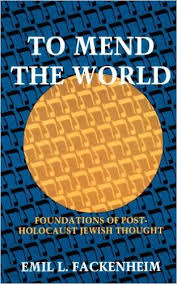
Emil Fackenheim dedicates one third of To Mend the World: Foundations of Post-Holocaust Jewish Thought to the tension between Baruch Spinoza and Franz Rosenzweig.  Of the two modern Jewish thinkers, Fackenheim leans more toward Rosenzweig.   He finds that Rosenzweig’s notion of the “new thinking” must be taken to heart by post-Holocaust Jewish thought.  Considering this, he insists that the tradition of Medieval Jewish thought must be reassessed in terms of the new thinking.  What is “old” and in need of revision?  Fackenheim tells us that it is the notion of revelation.

Instead of taking to Saadia Gaon’s claim – which is repeated by Judah HaLevi and Maimoindes – that millions of Jews witnessed the revelation of the giving of the Torah, Fackenheim argues that Rosenzweig called for a different kind of experience of revelation; namely, what he calls “radical empiricism.”  This latter notion suggests the importance of the present moment as a moment of “verification” rather than in terms of a past moment that was witnessed by millions of people.  Revelation is encounter with God which happens now.  It can be verified, now.

This is what Fackenheim, echoing Rosenzweig, calls a “non-fanatical” relation to revelation:

Note well: the concept of revelation.   The “new thinking” cannot wait until it turns into Sinai or Golgatha…Rosenzweig states that whereas the old thinking had “set up for itself the problem of whether God is transcendent or immanent,” the new thinking “narrates how and when the far God becomes near, and the near God far.” (73)

What is the meaning of this narrating which is “not fanatical”?

In part 2 of the Star philosophy becomes “narrating.: the narrating, however, is yet, as it were, an abstract narrating. It is confined to the “far” and “near” God as such and in general.  Only in such abstract generality can the philosophico-theological narration of revelation point backward to Creation as its own presupposition (thus doing justice to paganism); point forward to redemption as its own goal.  (73)

Fackenheim takes note of the “bold invasion of narration into metaphysics” and argues that while “Creation” narrates what “has been” and “Redemption” narrates what will be, Revelation “narrates what always is: in contrast to recovery or anticipation, it is present experience” (75).  This “narration” of revelation is the “heart” of the whole because it “does nothing less than reaffirm in one grand sweep the age-old Jewish commitment to God’s presence in history” (75).

Rosenzweig’s move is to “affirm the love between God and man as reflected in The Song of Songs.  The Rabbi’s reading of the book – like Rosenzweig’s – is not Biblical but is “a deep and bold act of rabbinic Judaism” (76).  This love is particular and universal.  It belongs to someone and to everyone.

But when Rosenzweig relates Judaism to Christianity and Redemption, he de-emphasizes the bold act of love and notes how, in relation to Christianity, the movement of revelation in Judaism is contraction while in Christianity it is expansion:

All secular history deals with expansion.  Power is the basic concept of history because in Christianity revelation began to spread around the world, and thus every expansionist urge, even that which consciously was purely secular, became the unconscious servant of the expansionist movement.   But Judaism, and it alone in all the world, maintains itself by subtraction, by contraction, by the formation of ever new remnants. (Star, 327)

In the end, contraction is the central feature, not love.     However, without narration (which has, at the outset, to do with near and far and then with time), contraction would not be possible.   In relation to revelation, Judaism’s modality is smallness, is the remnant.   The love between the Jewish people and God is more private.  And the Jewish people are a testimony – notes Fackenheim – of the survival of the remnant.  It is a modest kind of survival, however.  The issue of survival, however, is not an issue for Christianity since it is merged with history.  Only the beings outside of history and expansion contract and become small.

In response to this “dynamic” of contraction, Fackenheim argues that Rosenzweig’s identification of Jewishness with a kind of contracting revelation is “overrun by events” (92).  And by events he is alluding to the Holocaust.  It “destroyed” the idea of “the holy remnant” (92) that Rosenzweig extols at the end of The Star of Redemption:

As for the “contracting” dynamic of the Star of Redemption, this is overrun by events; indeed, it is imperative that it be reversed. 

The idea of reversing the “contracting” dynamic of Jewish existence is barely glimpsed yet in the sphere of thought.  It is already actual, however, in the sphere of Jewish life.  In response to the great catastrophe, the Jewish people took one collective step that was able to avert wholesale despair: it restored a Jewish state.  (92)

Instead of “contraction,” the new dynamic is “ingathering”: “The Jewish state requires a dynamic of ingathering, and this in turn requires a dynamic of expansion” (92). Now the dynamic of contraction appears to be a dynamic that must be left behind.   Without expansion, suggests Fackenheim, the Jewish people will disappear.  In other words, smallness doesn’t have a place in the present.  This is “an obvious socio-political necessity” that has been caused by the Holocaust.

After what has occurred, it (expansion) is also a moral imperative and an act of faith. In his own time, Franz Rosenzweig gave the most profound modern account of the Jewish people as a remnant, of this remnant as an “eternal people,” and of this people as eternal because it was in history but not of it.  In our time, we would have to recognize that – for better or for worse but in any case, inevitably and irrevocably – this people has returned to history.  (92)

All of these dynamics fit under the umbrella of what Rosenzweig calls narration.   The dynamic of Tzimtzum is, as Scholem argues, a movement between contraction and expansion.  In Fackenheim, however, one dynamic displaces the other.   The movement of Revelation, for Fackenheim, during our time is one of ingathering and expansion.  The other movement is not something that must be negated; it was negated by virtue of the Holocaust and the establishment of a Jewish state.  In this scenario, one wonders what kind of statement is made through the schlemiel.  In Fackenheim’s paradigm, this character – like Kafka’s “Josephine the mouse singer” – is of the past.  Smallness – in this scenario – is equated with death and a retreat from history.   It is a reaction.

But if the schlemiel is read in terms of the Tzimtzum – which is what JS Foer does in his latest novel – we have a different kind of narration.  What survives with the schlemiel is love.   It may be outside of history and worldless – as Hannah Arendt suggests, elsewhere – but the tzimtzum narrative, which, for Foer, is synonymous with the schlemiel narrative, brings contraction and expansion together into a dynamic that touches all Jews.     The only problem, as many a schlemiel knows, is that sometimes, when revelation is contracted, she forgets her beloved and can’t hear her – as The Song of Songs says – knocking.  As one can see in Foer’s novel (and as in Saul Bellow’s Herzog), the schlemiel can get distracted and – literally and metaphorically – end up separated, alone.

But with the dynamic of Tzimtzum, the schlemiel is not bound by fate. She has a chance for change.  This dynamic – as the Kabbalists knew – is never finished.    However, Fackenheim rejects the dynamic of contraction – which is a part of this dynamic – because he sees a new kind of Jewishness, a new Jewish dynamic – a new thinking – as displacing the old.  The new thinking – consistent with history rather than against history – affirms the dynamic of expansion.  And this leaves us with a few questions.  Which choice is the right one? Does one displace the other?  Has the Holocaust and the establishment of the State of Israel already made the choice for us and is it a matter of listening and adhering to this new historical narrative? If expansion is historically necessary while contraction is unnecessary (because it is ahistorical), does this mean that the schlemiel character has no place in Judaism?  This is only the case if the case for smallness and the schlemiel is no longer being made.   But, echoing Fackenheim, one can say that the fact the schlemiel lives on (and has, in fact, become an American icon) shows us that the Jewish people have not let go of contraction and smallness and that the Holocaust has not destroyed it.  To be sure, it lives on in America and perhaps even in Israel today.


Magical Jews, Great Actresses, and Paranoid Anti-Semitism: On Greta Garbo and Her “Hypnotic” Jewish Agent

images-1


Martin Luther – in one of his least friendly moments toward Jews – said that a “Jew is full of idolatry and sorcery as nine cows have hair on their backs, that is: without number and without end.”   Joshua Trachtenberg, in his book The Devil and the Jews: The Medieval Conception of the Jews and its Relation to Modern Anti-Semitism, argues that this belief still existed – during the 1940s, when he wrote this book – in the “backwards regions of Europe” where the Jew “continues to figure as a sorcerer in fables and nursery rhymes”(57).  According to one source that Trachtenberg cites, Jews are said to have  “some secret power which enabled them to suspend, or at least to interfere in, the normal processes of nature”(57).   Trachtenberg argues that Luther was not the first to come up with this notion of Jewish magic.  It is evidenced in “Hellenistic magical papyri” and in the Roman poet, Juvenal who wrote “The Jews sell at cut prices as many dreams as you wish.”   Origen, the early Christian theologian, argued that “magic was a specifically Jewish pursuit”(58).   And this trend took the hold of countless Christians in the Middle Ages who went so far as to claim that Jewish sorcerers “operated through the agency of Satan.  ‘The Master of diabolical art’”(66).   To be sure, the accusation that Jews were magicians was not based on “observed acts of Jews.” On the contrary, argues Trachtenberg, it was an integral part of the medieval conception of the Jews…the magic which Christendom laid at the door of the Jew…was a reflection of beliefs and practices current about Christians”(59).

When I recently came over a reflection on the 1932 MGM film, The Grand Hotel, by Douglas Messerli, I became very interested in the place of Greta Garbo in this film.  She plays an “aging ballerina who wants to be alone.”    In the signature Hollywood scene of her alone in her hotel room, we see a woman who hates herself and can’t play for people anymore.

As the viewer can see, she is stalked.  When he comes out of the shadows and tries to show his love for her, she has no interest.  She wants to be alone and, as the subtext suggests, die alone. And of all places to die, why not in the Grand Hotel in Berlin?

To be sure, Garbo had a mystical kind of presence.  Where did she get this from?

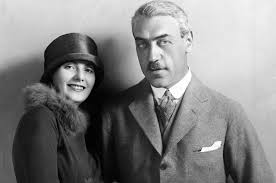
Garbo was Scandanavian.  Sven Hugo Borg, who was her translator, speculated on what the source of her magnetism was.  Drawing on this long history of paranoid projection on Jews, Borg claims that the man who “discovered” Garbo, Mauritz Stiller – a Finnish-Swedish film director of the early 20th century – was a Jewish magician of sorts who hypnotized people.   In his biography of Garbo, he makes this explicit in his description of Stiller:

Stiller was a strange man, an intelligent, cultured gentleman of exotic tastes and artistic passions. In his veins flowed a mixture of Nordic-Slav-Jewish-Magvar blood — a chemical mixture sufficient to create almost any sort of explosion. Von Sternberg is also a strange racial mixture. The two men were very much alike. 

Stiller was ugly, almost hideous in physical appearances. His body was ungainly, his features heavy, lined, gnome-like. His feet were so enormous as to be almost deformed, and his hands, huge, prehensile paws, fitted for the plough. Yet beneath this repellent exterior was hidden a soul both beautiful and artistic. 

The Swedish director searched for a beautiful puppet through whom to express his own artistic self, as did von Sternberg. It was common knowledge in Stockholm for years before he found Garbo. Even the story of that discovery, told in so very many versions, was in itself dramatic.

Garbo was, in other words, the puppet of the Jewish-magician-artist.  He had a “hypnotic influence” over Garbo and the implication is clear: her fame satisfied his desires and he accomplished through a kind of magic.   His description, above, makes it clear that Borg fantasizes Stiller through an anti-Semitic lens.  However, he does note that beneath his grotesque, “gnome-like” features was “hidden a soul both beautiful and artistic.”  This is a mixed reception.  It shares much with James Joyce’s reading of Leopold Bloom who – like Stiller – is depicted as very immersed in the body and materiality while at the same time possessing an artistic soul.  His consciousness – as Joyce’s novel, Ulysses illustrates – is beautiful.

Borg can’t understand Stiller.  He is a “strange man.”  Borg notes this at the end of a reflection he has with Garbo about how people thought she and Stiller were lovers:

”Borg, people say that I am in love with Mauritz, don’t they? That is not true. Borg, I have never been anything to any man, not even Mauritz. I do not love him that way, nor he me. I am afraid of him and I think we are finished as it has been before, although I shall always think he is the greatest man in the world. 

“You have seen me, Borg, sit on his lap and smoke with bins the same cigarette. You have seen him hold me like a child. It is so good when his arms are around me, for sometimes I am afraid. But it is not love, Borg.” And, in spite of all that has been said of Garbo’s love for Stiller, I believe her, for I have seen them often together. ,later, when Garbo and John Gilbert were “going places “ together, Stiller would cail me. 

“Borg,” his low, deep voice would rumble, have you seen Greta?” ”I have not, Mr. Stiller,” I would reply. Is there any message?” ”No,” he would rumble, “ except to tell her to remember what I have taught her never to let life hurt her.”  He knew that she was going about with Gilbert, and his attitude was not that of a jealous man, but of a father who would shield his daughter from hurt Stiller was a strange man. His artistic soul loved the finer, more subtle forms of passion, and it is doubtful if he ever loved a woman—any woman.

Borg can concede that Mauritz loves Garbo like a father and that he was not a jealous man, but he cannot imagine that he loves any women because “his artistic soul loved the finer, more subtle forms of passion.”

What was this strange passion?  Is it metaphyscial?  How could it be greater than any woman, especially Garbo?  This, reflects the anti-Semitic Garbo translator, gives Stiller an other-worldly status.  Jews, it suggests, can’t love.  They can only enjoy the experience of “finer, more subtle forms of passion.”  Here, the modern artist who creates Hollywood is conflated with the Medieval Jewish magician.   His magic, for Borg, has dark roots.  Borg insists it must have something to do with his Jewishness.

This stereotype has had a long life.  It is the anti-thesis of the schlemiel stereotype because it gives the agent power.  However, this power is diabolical. Here what is most diabolical and powerful is art itself.   The 19th century symbolist poet, Charles Baudeliare thought the same thing of the modern artist who, in his essay on laughter, is a magician.   Contrast this to Freud’s reading of the artist – which speaks to the schlemiel character –  as the “day dreamer.”  One is dangerous, the other, is comical.   Borg saw Stiller – and his Jewishness – in a more tragic sense.    While the anti-Semite can fantasize Stiller as a magician who is in control of everything, a schlemiel cannot, as Sander Gilman notes, control the world or himself.    These anti-Semetic fantasies of Jewish power have deep roots and they didn’t die with Borg’s commentary.   Perhaps the schlemiel can remind us how  ridiculous this fantasy is?

Here’s a Wonderful Essay by Jewish Philosophy Place on the new Joseph Cedar Film, “Norman” (With a Schlemiel Theory Cameo)

Riffing gently off the title of Pasolini’s essay “Cinema of Poetry,” let’s call Joseph Cedar’s most recent release an exercise in the “cinema of Talmud.” To be sure, Norman has to be viewed with an eye towards the narrative arc. But it’s the form of the film that matters. What makes a film Talmudic in […]

via (Cinema of Talmud) Norman: The Moderate Rise and Tragic Fall of a New York Fixer (Joseph Cedar) — jewish philosophy place

She Made Herself Smaller: On Israel, the Schlemiel & Tzimtzum in JS Foer’s “Here I Am”

Image32

Anyone who has attempted to read Jonathan Safran Foer’s Here I Am knows that it is an arduous task.   To finish it and understand the novel, one has to connect a lot of threads.  The book explores the family dynamics of the Bloch family and situates it within multiple contexts that span the Holocaust, a war in Israel, and Jewish American family life in the age of social networking and virtual reality.  At the center of the novel is Jacob Bloch, a schlemiel character who, because of his inability to properly understand and communicate with his wife, Julia, loses touch with her.   As Harold Bloom would say, Jacob’s understanding of what has happened to his relationship is belated.    And this realization comes to him – more often than not – not from himself but from other people around him.    His failure, arguably, has not only to do with his lack of understanding of his wife and himself, but it also has a lot to do with a confused or indifferent understanding of the meaning and place of Jewishness in his family.   Jacob takes a passive role and for that reason he pays a major price.  Each generation, it seems, is farther away from the source, which can be traced back to Jacob’s great-grandfather, a Rabbi from Eastern Europe, and his grandfather, Isaac, who passes away in the midst of the novel.    The funeral brings up questions about what it means to be Jewish.

But before the encounter with losing Jewishness through the death of a beloved family member occurs, these questions start arising when Jacob and Julia discuss how they will share the bad news of their break-up to their family.   This discussion leads Jacob to reflect on something his son, Sam – who is “supposed to be” Bar Mitzvahed and isn’t because of Jacob’s negligence – asks him about God.     This prompts Jacob to reflect on the meaning of Tzimtzum.   The discovery of this concept fits within the context of his absent mindedness and in the midst of a war that irrupts over an earthquake in Israel which Jacob is unable to properly digest.  His relationship with his wife and son – as well as his belated reflection on Tzimtzum – is situated within this context.

The narrator tells us that when the Bloch family receives the news of Israel’s tragedy, they over-react and repress the feelings that emerge in its wake.  And this, in some way, reflects the dysfunctionality of the post-Holocaust American Jewish family, which has much to do with an inability to communicate with itself in an affective manner.  They are, as it were, too shocked to know what to do.  They are anxious and unable to act, which leads, consequently, to repression and denial.  And this – suggests he narrator – is a pattern in post-Holocaust American Jewish history:

News that reached America was scattershot, unreliable, and alarming.  The Bloch’s did what they did best: balanced overreaction with repression.  If in their hearts they believe they were safe, they overworried, talked and talked, whipped themselves, and one another, into forms of anguish….It was a game whose unreal danger was to be talked up and savored, so long as the outcome was fixed.  But if there was an inkling of any real danger, if the shit started to thicken – as it was soon to do – they dug until the blades of their shovels threw sparks.  It’ll be fine, it’s nothing.  (312)

Tamir, Jacob’s Israeli cousin (who is on a visit while this goes down), ignores what is going on.  He doesn’t even talk about it: “to Jacob’s amazement, he still wanted to sightsee.”  Like Philip Roth’s Alexander Portnoy, Jacob sees in the Israeli a dark mirror: “It was so easy for Jacob to see in Tamir what he couldn’t see in himself:  a refusal to acknowledge reality. He sightsaw so he wouldn’t have to look”(312).  Jacob, meanwhile, watched the TV report with a glazed look in his eye.   In the midst of this, Julia “shakes her hand in front of Jacob’s face” to remind him that the greater crisis, the one that he is ignoring and repressing, is the demise of their marriage:  “I realize they Middle East is collapsing, and that the entire world will get sucked into the vortex, but this is actually more important now”(313).

Following this, he discusses who in the family they should tell first.  Julia suggests that they gather them all together and tell them. That way they can all “cry together”(313).  In response, Jacob suggests that they tell Sam first because he will “have the strongest reaction” and will also be “the most able to process it”(313).    In response, Julia asks a question that beckons for a response: “What if I cry?” she asked. But Jacob fails to act on what is suggested by the question.  The narrator characterizes how he thinks the right thought but distracts himself with other thoughts (about Israel, the kids, etc) thereby leaving her alone, once again:

The question embodied Jacob, made him want to touch her – grasp her shoulder, press his palm to her cheek, feel the ridges and the valleys of her fingertips align –  but he didn’t know if that was acceptable anymore.  His stillness throughout the conversation didn’t feel standoffish, but it did create a space around her.  What if she cried?  They would all cry. They’d wail.  It would be horrible.  The kids’ lives would be ruined.  Tens of thousands of people would die. (314).

This missed encounter engenders a memory of Sam who, on a visit to his religious grandfather Isaac – who passes away and prompts Jacob to reflect, later in the novel on the meaning of Jewishness – asked Jacob if “God is everywhere?”   The question “came out of nowhere” and, in his surprise, Jacob answered that “that’s what people who believe in God tend to think, yes.”  In saying this, Jacob excludes himself from belief in God.  This doesn’t stop Sam from asking questions:

“So here’s what I can’t figure out,” he said, watching the early moon follow them as they drove.  “If God is everywhere, where did He put the world when He made it?”(314)

Jacob  is unable to answer the question.

That night, after putting Sam to bed, Jacob does some research and discovers the notion of tzimtum.  It answers this question:

Sam’s question had inspired volumes of thought over thousands of years, and that the most prevalent response was the kabbalistic notion of tzimtzum. Basically, God was everywhere, and as Sam surmised, when He wanted to create the world, there was nowhere to put it.  So He made Himself smaller. Some referred to an act of contraction, others a concealment.  Creation demanded self-erasure, and to Jacob, it was the most extreme humility, the purest generosity.  (314)

Reflecting  on this, Jacob discovers that tzimtzum can be used to read Julia’s question: What if I cry?  But it is too late:

Sitting with her now, rehearsing the horrible conversation, Jacob wondered if maybe, all those years, he had misunderstood the spaces surrounding Juila: her quiet, her steps back.   Maybe they weren’t buffers of defense, but of the most extreme humility, the purest generosity. What if she wasn’t withdrawing, but beckoning?  Or both at the same time? Withdrawing and beckoning?  And more to the point: making a world for their children, even for Jacob. (314)

For the reader, it is obvious that this question is rhetorical. It is not a mere musing.  But Jacob, even after thinking it, utters the opposite to her:  “‘You won’t cry,’ he told her trying to enter the space”(315).  The passage goes on and when she says “you’re probably right,” he thinks he has done something right but in truth he has failed.  He missed an opportunity to give her love.  She was beckoning him to touch and console her.

What happens following this is telling.  He misinterprets the tzimtzum as an opportunity for himself to shine  and emote rather than love Julia.    Jacob tells her that “even if you don’t see me crying.  I’ll be crying”(316).   The emphasis, in other words, is on himself.  This turns into a “feeling,” namely, that Julia “believed she had a stronger emotional connection with the children, that being a mother, or a woman, or simply herself, crated a bond that a father, a man, or Jacob was incapable of.  She’d subtly suggest it all the time”(316).    This feeling is none other than the feeling of jealousy.  His response to the love she gives is competitive.  He wants to show her that he can also cry and love the children in a way that is even better.

Foer’s version of the schlemiel shows us that the blindspot has to do with the inability to love the other.  And even though he, for a moment, understands the true meaning of the tzimtzum, he doesn’t follow through.  He turns it back onto himself as if Julia is sacrificing herself so that he can love the kids but not her.  It’s as if God withdraws from the world but doesn’t beckon man to love him back.    It’s as if God withdraws in order for humankind – in utter jealousy – to compete with God and leave God behind.  Smallness has deeper meaning.  But the irony is that this God is not a paternal figure.  God is a maternal figure.   She made herself smaller in order to beckon man.  She didn’t simply withdraw.  And this, perhaps, gives the reader a window into Jacob’s problem with God and Jewishness.  It has a lot to do with his inability to act on the love that is communicated by the other’s withdrawal and smallness which is, if anything, a beckoning to return instead of a call to pull away.

Perhaps, Foer suggests, this blindspot can also be applied to Israel whose God seems to be withdrawn but is actually beckoning the Jewish people to return.  All of this, as the novel suggests, comes to the fore as Israel and Jacob Bloch’s relationship with his wife teeters on the brink of total destruction.  It all depends – as this allegorical figure suggests – on how we read tzimtzum.     How do we respond when she – the God of Israel and our beloved – makes herself small?  What is the schlemiel’s answer?  What is the reader’s answer?   If one overlooks Jacob’s (mis)understanding of tzimtzum, one will not be able to answer this question let alone understand the central motif of this large and difficult novel.  Exegesis, after all, must ask these questions if it is to understand the hidden meaning of the text and apply it to real life.  By paying close attention to how Foer’s schlemiel, Jacob Bloch interprets the tzimtzum and how it relates to his life and its problems, perhaps this can happen.