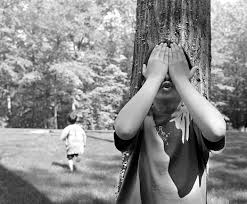
Hide and Seek: Walter Benjamin’s Reading of Children and Childhood – Take 2

DownloadedFile-6

Yesterday’s blog ended with several questions which puzzled over why Walter Benjamin or Georges Bataille would be so interested in “returning to childhood” or describing the “true child.”

Before going to sleep last night, I thought about these questions.  But instead of simply thinking about them, I thought about myself.  After all, I am as intrigued with childhood and the fool as they were.  But was I fascinated for the same reasons?

In thinking about this, I turned to a blog entry I wrote earlier this week entitled “Damaged Childhood: Fools, Self-Destruction, and Reclaming Youth,” There, I pointed out how Walter Benjamin, in his essay of Fyodor Dostoevsky’s The Idiot, argued that Dostoevsky’s book was a response to the “failure of the youth movement” and a “damaged childhood.”

I noted how Benjamin goes on to claim, after writing on failure, that a “return to childhood” – a return to “childlike simplicity” – promises “unlimited healing powers.”  But then it hit me: if the youth movement already failed, and if the purpose of that youth movement was to “return to childhood,” why was he insisting that we try again?

At this point, I realized that Benjamin (and Dostoevsky, as Benjamin reads him) were involved in what Freud would call a “repetition compulsion.”  According to Freud, in his book Beyond the Pleasure Principle, the repetition compulsion is a response to trauma, that is, a response to a damaged childhood.  Benjamin is repeating the failure to return to childhood by insisting on doing it again.

Although he believes that this must be done, because a return to “childlike simplicity” has “unlimited” healing powers, he also admits, in the same essay, that it is desperate and pathetic.  We see this, Benjamin says, in the novel’s characters.

The Idiot, in effect, is not simply the illustration of a desire to return to childhood; it is a displacement of failure.

Its astonishing how Benjamin’s writing on children, in many ways, parallels that of Dostoevsky’s The Idiot.  It seems that, in the face of this political, secular messianist failure of the “youth movement,” Benjamin, in his own work, displaced his failure and turned to the micro-worlds of children.  In these worlds we see a “childlike simplicity.” We see micro-worlds that exist within the world of adults.  This retreat into micro-worlds may not only be seen as a response to a “damaged childhood” but it can also be seen as a response to a failed (or incomplete) political project whose goal is to “return to childhood.”

We see much evidence of this in Benjamin’s book One Way Street.    Even though Benjamin does address the political on and off throughout the piece (this is the part that many Benjamin scholars and Theodor Adorno focus on, in fact) he has an entire section on children.   It consists of several aphorisms.  The subtitles of each are the following: Child Reading, Belated Child, Pilfering Child, Child on Carousel, Untidy Child, and Child Hiding.

I would love to discuss all of them over the span of several blog entries.  For now, I just want to note a one (preliminary) thing and relate it to my own personal interest in the schlemiel and childhood.

Since I am a lover and practitioner of literary interpretation and exegesis, the first thing I did when I glanced over this section was to notice and think about the first and last entries.  The first entry is entitled “Child Reading” while the last one is entitled “Child Hiding.”

This, for me, states something meaningful about Benjamin and his response to a “damaged childhood.”  His reading, the reading of a child, is a way of hiding in a micro-world.  And, as Benjamin says at the end of that section, he is hiding from a “demon” and the places he finds to hide in are “magical.”  Reading, exploring space, and constructing micro-worlds (hiding places), are his “magical” way of avoiding terror (“the demon”).  To be sure, the entire section on childhood is prefaced by a line which gives us a clue of this response to trauma: “To be happy is to be able to become aware of oneself without fright.”

Indeed, Benjamin’s self-awareness, his awareness of his, so to speak, childhood demon, is terrifying.  But Benjamin, like the child, has found a reading strategy, a way of hiding that enables him, like a child, to becomes “happy” without fright.  Seeing himself as this child, the child in the text that he writes of, he finds a way to address trauma.   In his reading spaces he is hidden and sheltered from trauma.  To be sure, he seems to be alluding to this throughout his section on childhood.

To be sure, Benjamin, like a child, is more intrigued with his hiding spaces, his mirco-worlds, than with the world.  He goes to these places out of terror.  A schlemiel does this as well.  A man-child dwells and travels through spaces within the world, spaces that are unfamiliar to the world and its preoccupations.  Ultimately, these journeys through space that the schlemiel-slash-man-child takes are responses to something hidden, something he can’t understand.  The schlemiel, in his “childlike simplicity” just moves on.  He doesn’t notice the disaster, perhaps, because it would destroy him.

Growing up with a father who had a wild imagination, loved politics, liked to travel, tell stories, and often confused dreams and reality, I often felt like Sancho Panza following Don Quixote through space and time.  I inherited my father’s response to his own trauma, which, as I learned, is to find and create micro-worlds where one can hide.  The key, however, to such childish games is to know not simply how to read but how to tell stories.

Growing up, I felt that I had to listen to and interpret these stories. Each story, as it were, was what I would call a “traumatic imperative.”  But these stories were not simply told.   They were written over various spaces, people, and time.  My father’s micro-worlds were not in a book; they were found in this or that pocket of reality.  My (as Benjamin might say) “self-awareness” was caught up in these spaces.

When dream and reality overlap, reality becomes a book.  It comes to life.  However, its meaning, because it is confused, is unclear and, as Benjamin knew and my father always reminded me, terror seems to be waiting around each corner.  Like Benjamin, my father taught me that if you are to return to childhood, if you are going to live out your schlemiel-hood through time and space, you must know how to play hide and seek.

Its the game that every failed messiah – that is, every man-child who comes out of a damaged childhood – plays.
To Which Childhood Shall We Return? Walter Benjamin’s Child versus Georges Bataille’s “True Child” (Take 1)

DownloadedFile-5

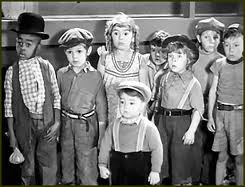
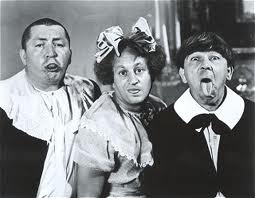
The schlemiel is a man-child.  The character presupposes a man who has not grown up or a child who has not matured to become a man.   The schlemiel lives in the world of people but is in his own world because he doesn’t know how to live in that world.  He lives in a world of dreams and in dreams every little ‘thing’ matters and holds deeper significance.  Everything has a secret.  This interest in little things distracts the schlemiel from “the big picture.”  It distracts him from the world.  The little things makes him absent-minded.

To be sure, Sidrah DeKoven Ezrahi characterizes Sholom Aleichem’s Motl in this manner.  He is a character who gets caught up with things; and, as a result, Motl can’t understand his mothers suffering, his life situation, the death of his father, the disaster unfolding around him.   Near the end of Motl, The Cantor’s Son, Motl is optimistic and excited about the fact that he is going to America and will come into contact with more things!  Ezrahi, at one point, briefly evokes Walter Benjamin and his fascination with things to illustrate.  Unfortunately, she doesn’t pursue it further.

I would like to suggest that we contrast two types of men-children which have, most recently, entered the Schlemiel Theory blog space: Georges Bataille’s child and Walter Benjamin’s.

What we have seen thus far is that Georges Bataille wanted, like Walter Benjamin (in his essay on Dostoevsky’s The Idiot) to “return to childhood.”  Both thinkers noted that the return to childhood would not, by any means, be without disaster.  Since the world has rejected youth and childhood, and since the project of writers who supported the “youth movement” has failed, the return of childhood, Benjamin tells us, can only come in the aftermath of an “implosion.”

Echoing Nietzsche, Bataille envisioned a KINDERLAND to come.  He also saw it in the aftermath of a disaster.   But, based on what we have seen so far, we can say that while Benjamin didn’t describe childhood and disaster in depth, Bataille did.

More to the point, Bataille seems to have gone further than Benjamin in describing what kind of child he wanted to be and what kind of disaster this implied. Indeed, Bataille distinguished between the “true child” and the false one.  The true child, for Batialle, is a child who experiences shame, terror, and powerlessness.  The true child, in other words, is passionate; s/he knows, in the depths of her existence, that the “serious exists.”  And this knowledge is disasterous and tragic.

Even though Bataille renounced all projects, he didn’t regard his “spiritual exercise” of becoming a child or stupid as a project.  However, when and if his pursuit of becoming a child does become a project (that is, when and if it becomes too obsessed with a goal), the true child (which Bataille aspires to be) would – Bataille avers – “laugh” at his seriousness.   This laughter frees the “true child” from the serious project.  Yet, this laughter does nothing to mitigate the true child’s powerlessness, shame, and terror.  All laughter does is lighten the weight of shame and powerlessness.  But in doing so laughter embraces stupidity.  Bataille’s “true child” revels in it.   The true child is Bataille’s description of a real and an ideal child; the child he wants to be and can become only through humiliating himself.

Batialle’s model of the “true” child is far removed from the schlemiel.  By contrasting the two, we can have a better idea of what makes the schlemiel unique. 

I suggested this contrast yesterday. The schlemiel gets caught up in dreams and all the little details of life.  The schlemiel gets distracted by things.  The schlemiel isn’t passionate.  He doesn’t experience shame, terror, and powerlessness.  The schlemiel doesn’t know that seriousness exists or, if he knows, it really doesn’t matter to him or her.  He can’t laugh at his passion because, quite simply, he isn’t passionate.

You couldn’t find a greater contrast between one man-child and another than between Bataille’s “true child” and the schlemiel.

Benjamin’s child is different: his “true child” has more in common with the schlemiel than with the passionate “true child” that Bataille aspired to.

In a piece entitled “Old Forgotten Children’s Books,” which was published in 1924 in Illustrierte Zeitung, Benjamin describes the child in a different manner:

For children are fond of haunting any site where things are visibly being worked on.  They are irresistibly drawn by the detritus generated by building, gardening, housework, tailoring, and carpentry.  In waste products they recognize the face that he world of things turns directly and solely from them.  In using the thing, they do not so much imitate the works of adults as bring together, in the artifact produced in play, materials of widely differing kinds in a new, intuitive relationship. Children thus produce their own small world of things within the greater one.  

What I would like to suggest is a little different from what I suggested at the outset with Sidrah DeKoven Ezrahi.  The main thing about Benjamin’s “true child” is not his or her passion, and not his obsession with things, so much as her relationship to “waste products” and “things worked on.”   All the things that Benjamin’s true child is interested in are partial.

This child is distracted from the “world of things.” However, children “produce their own small world of things within the greater one.”  This small world was a world that Benjamin was attracted to.

What I wonder is if the child’s world of waste and the child’s miniature world are intimations of what Benjamin would call the world of childhood that lays in the future.  This world of childhood is in the aftermath of disaster.  But, if we look again, we can notice that in this world-to-come the child plays in ruins.  He doesn’t care about the disaster so much as how he can relate one fragmented thing to another.  Perhaps this is the dream of a schlemiel: to live in the garbage and to play in the garbage while not seeing the disaster around him.

In contrast to Bataille’s man-child, Benjamin’s lacks passion but doesn’t lack a love for garbage.  What this implies is that Benjamin didn’t see the path to childhood as passing through humiliation and shame, as Bataille did, he saw the path of childhood as passing through the garbage dump.  Benjamin’s schlemiel turns to broken things – not to passions. He does not know that “seriousness exists.”  And, in this, it seems there is no violence or self-destruction.

If this is the case, then how can we understand Benjamin’s Apocalyptic warnings in his essay on The Idiot?  Such warnings and premonitions puzzled Benjamin’s closest friend – the Kabbalah scholar, Gershom Scholem. He could understand Benjamin’s interest in garbage, partial things, and micro-worlds, but he couldn’t understand Benjamin’s interest in the daemonic  “destructive element.” To be sure, sometimes Benjamin would turn to the destructive child, but, as we shall see, this only happened when Benjamin, personally, had to face failure.

And when that happened, his man-child, his schlemiel, went from being a child that plays with fragments to a shameful creature.

While Bataille’s true child passionately embraced failure, stupidity, and shame, Benjamin’s did not.   His child doesn’t get those things.  When he’s at play in the ruins nothing else matters.  But when he fails, it seems as if his child becomes a shameful figure – a reminder of how ridiculous and tragic things are.

At this point, you might be wondering why such intelligent men like Walter Benjamin and Georges Bataille would want to return to childhood?  What would drive them to envision the child of the future, the “true” child?  Why would they spend so much time reflecting on such things?  Did they do so because they realized that maturity was a joke and that modernity had lost what gave it life; that is, childhood?   How would living out childhood as an adult – how would becoming a man-child – be redemptive?  Why were they so desperate for childhood?

We’ll leave these questions for our next blog entry….

On Georges Bataille – Childishness, Stupidity, and Salvation

images

What does it mean to make “a fool out of oneself” or to act “childish?”  Both terms suggest that imitating a child or acting like a fool is shameful.  Now, imagine that the very thing that society despises most is designated as a spiritual practice.

In our last blog entry, we pointed out that Georges Bataille took Nietzsche’s notion of KINDERLAND and identified it with the future.  As we pointed out, one would have to destroy oneself if one were to get there.  The paradox is that by going backwards to childhood, one can go forwards, to the future, to KINDERLAND.

But, as with many spiritual practices, one needs to know what to do if one is to reach this sacred land of childhood.    Bataille was interested in describing these practices.  As one can imagine, Bataille relished the idea that acting like a child or becoming a fool was hated by civil society. In his book Inner Experience, he not only provides spiritual exercies of childishness, he also describes childishness and foolishness in great depth.

Bataille associates “childishness” with salvation.

The only challenge to becoming childish is not to turn it into a “project,” which would give it a meaning within a coherent totality.  Nonetheless, he insists that becoming a “true child” is the way to “deliverance.”  This path is, necessarily, shameful and self-destructive.  The task for Bataille, was to, so to speak, enact it, without turning it into a project.   The spiritual experience of the movement of the adult to childishness and shame, he believed, would be sufficient to destroy “the project.”  And open us up to a messianic “taste,” so to speak, of the promised land: KINDERLAND.

In Part II of his book, in a section entitled “Torment,” Bataille provides his reader-slash-disciple with intimate (yet intellectual) experiences of childhood and self-destruction.  By refusing to grow up and by returning to childhood, he, in effect, is not entering into the project.  In literary form, he describes or rather “dramatizes” his childhood and his struggle with maturity.

To be sure, Bataille, at the beginning of his book, notes that dramatization is a spiritual exercise: “If we did not know how to dramatize, we wouldn’t be able to leave ourselves…From this way of dramatizing – often forced – emerges an element of comedy, of foolishness which turns into laughter”(11).

Dramatization, for Bataille, distances us from tradition and reduces us to powerlessness. It is another name for acting out ones renunciation of maturity; that is, the project.

Dramatization brings one to an awareness of his or her childishness.

I will cite several lines which describe Bataille’s coming to consciousness that he is a child and the realization that he is, ultimately, “stupid.”  In grand mythic style, Bataille tells us that to return to childhood is to return to one’s origins.  The problem is that “grown ups” don’t get it:

To grasp the extent of knowledge, I go back to the source. First a small child, in every way similar to the madmen (the absent ones) I play with today.  The miniature “absent ones” are not in contact with the world, if not through the channel of grown-ups: the result of an intervention on the part of grown-ups is childishness, a fabrication.  Grown ups clearly reduce being coming into the world, which we are at first, to the level of trinkets.  This seems to me to be important: that the passage to the state of nature (from birth) to our state of reason should necessarily take place through the route of childishness.   It is strange on our part to attribute to the child itself the responsibility for childishness, which would be the character proper to children.  Childishness is the state which we put naïve being….When we laugh at infantile absurdity, laughter disguises shame, seeing to what we reduce life emerging from Nothingness. (42)

Bataille’s lesson to adults, who become children, is the following:

1) Children need to divest themselves from their parents: “The error of children: to derive truth from grown-ups.”

2) Children should not be laughed at.

Laughing at childish behavior is a “grown up” activity which, in his view, belongs to a project.  Rather than laugh at them, we should – seriously – imitate them.  But, Batialle goes beyond such advice.

In the midst of becoming childish, Bataille describes how he, and one who becomes childish, will feel shame and powerlessness.

To be sure, Bataille, craftily, alternates his reflections on childishness with reflections on shame, self-destruction, and salvation.  And this juxtaposition creates the breakdown he desires: “the idea of salvation comes, I believe, from one whom suffering breaks apart.  He who masters it, on the contrary, needs to be broken, to proceed on the path towards rapture.”

Besides being a “spiritual practice” and an “inner experience,” this alternation clearly suggests a link between childishness, self-destruction, and salvation.

Bataille dramatizes this link by shamefully confessing his passion of childishness. But, in doing so, he realizes that taking this childishness seriously may present an obstacle:

Childishness, knowing itself to be such, is deliverance, but taking itself seriously, it is enmired.”  And this “taking itself seriously” is an obstacle to “deliverance.”  To eliminate this obstacle, to dramatize it, one must laugh at it: “The search for the extreme limit can in its turn become a habit, dependent of childishness: one must laugh at it, unless, by chance, one has a heavy heart: then ecstasy and madness are within reach. (44)

As we saw above, Bataille says that one should not laugh at childishness.  But if one takes it too seriously, then Batialle tells us that one must laugh at it!  Because seriousness is too mature and is part and parcel of “the project.”  But isn’t a spiritual exercise too serious?  Should Bataille think it to be ridiculous?

Batialle avoids this reflection.  Instead, he creates a rule, because he sees an opportunity in this kind of laughter: if childishness becomes a “habit,” laugh at it so one can, through despair (a heavy heart), “reach” ecstasy and madness.

Ok, so let’s sum it up.  There are two possibilities for one to be saved from the project and “grown ups”- two, so to speak, KINDERLAND possibilities: 1) salvation through childishness or 2) salvation through the rejection of a “serious” and “habitual” childishness.

After describing these possibilities, Bataille, strangely enough, argues that to be a child one must “know” that “seriousness exists” and if one doesn’t one isn’t a “true child” : “The most serious seem to me to be children, who don’t know they are children: they separate me from true children who know it and laugh at being. But to be a child, one must know that the serious exists…if not, the child could no longer laugh nor know anguish”(44, my emphasis).

This conclusion brings us to the schlemiel and helps us to distinguish Bataille’s man-child the “true child” – from the false one, which, given what we know about this character, is the schlemiel.

“True” children are not schlemiels, since they “know” they are children.  They can “laugh” at being.  To be a child, one must “know” that “the serious exists.”  If they know this, children can laugh and know anguish.   Children cannot laugh or know anguish if they don’t know that the “serious exists.”

This implies that a schlemiel, who doesn’t understand seriousness, is not a “true” child.  A true child suffers and laughs.

But, then again, Bataille turns this around when he writes about stupidity.  Children may know that the serious exists, but they cannot be saved if they don’t “perceive a greater stupidity.”

“My privilege is to be humiliated by my profound stupidity and, no doubt, through others, I perceive greater stupidity.”

The more stupidity, the better.  We see this early on in his book as well: “The great derision: a multitude of little contradicting “everythings,” intelligence surpassing itself, culminating in multivocal, discordant, indiscrete idiocy”(25).

Bataille’s passion is for childhood and stupidity.  His desire is to be the “true child” who knows seriousness, suffers, and laughs.

To become the true child, Bataille confesses that he must dramatize the descent into idiocy.   This will return him to childhood. And it will save him.

But this is not a total loss of the mind.  As he says, the man who becomes a child “knows” as a child does that “the serious exists.”  This is a tragic vision of childhood or becoming-a-child.  He is aware of his stupidity as much as he is aware of seriousness.  He is also aware of what a “true” as opposed to a “false” child is.

Compared to the childishness of I.B. Singer’s Gimpel or Sholom Aleichem’s Motl’s childishness, Bataille’s dramatization of childishness is focused on the spiritual practice of self-destruction as revelation. The schlemiel is absent minded, but Bataille’s child is not.

And the tension between good and evil, between hope and skepticism, which the schlemiel looks to preserve, is effaced by Bataille’s “spiritual exercise” in which life, mad life, childish and idiotic life, ultimately triumphs and laughs at itself in its utter shameful Dionysian stupidity.

The way to KINDERLAND is through becoming a suffering-powerless-idiot-child.  This act of the will greatly contrasts to the simplicity of the schlemiel – the man-child – that we often see in Yiddish or Jewish American literature.  There is no passion of the schlemiel, but for Bataille there is a passion of the man-child.  The schlemiel can’t save himself, Bataille’s man-child can.

And perhaps this is the key: Judaism puts salvation outside of man’s efforts.  In Judaism, man cannot redeem or save himself.  Redemption is in the future.  The schlemiel stands, unredeemed, in relation to the future.  He can’t redeem himself through his foolishness.  (At the end of “Gimpel the Fool,” he simply moves on.  Gimpel has not changed; he is still an unredeemed schlemiel in, and this is the point, an unredeemed world.) Bataille, however, believes that through this “spiritual exercise” he (and perhaps his childish community) can be “delivered” to the KINDERLAND of the future.   A place where we can all make fools of ourselves all the time…a place where we can know, finally, that we are, shamefully, “true children!”

And this is only possible because we know, in the midst of shame and humiliation, that “the serious exists.”

So, here’s my question, is it worth passionately becoming fools and childish if we are to come to this conclusion and the consciousness that we are “true children”?  Or is this, quite simply, stupid?  Is this the point of, as Bataille might say, the “useless” exercise-slash-dramatization of “true” childhood?

Would Bataille regard this scene from John Water’s Pink Flamingos (1972) to be a spiritual exercise in becoming a child?  And does John Waters, who put the film together, know what “true children” are and that “seriousness exists?”  What do we make of these “dramatizations” of childishness?  Are they…and we saved? After all, the daughter who is quelling her mother-in-the-crib is named Divine. Is this where we are going? Is John Waters giving us a prophetic glimpse at the future? A glimpse of KINDERLAND?

KINDERLAND or Chelm?

DownloadedFile-4

Chelm is a real place in Poland that some say has existed since the 9th century.  It is also a mythological place where, legend has it, all the Jews are schlemiels.

From the YIVO encyclopedia, we learn that Chelm-like stories have existed, in print, since 1597.  But the legend itself may go back further.  And as the encyclopedia points out, many Yiddish writers either cited these stories, retold them, or modeled their own mythic schlemiel cities on Chelm.

In America, the most well-known Chelm stories, The Fools of Chelm and Their History, come to us by way of I.B. Singer.  When I was a child, my Rabbi – who presided in a conservative synagogue in a small town in the Adirondacks named Knesseth Israel – used to read them to us every Saturday so as to inspire us before we had the “children’s minyan.”  (He would gather the children around him and either read these stories or a variety of fun Hasidic stories.  I liked these best, however; we all did.  I can remember giggling with my friends as he told them.  Imagine that, I used to think, a town of fools and led by fools!)

I mention the fools of Chelm in this blog entry because this land of Schlemiels relates, however obliquely, to what Benjamin and Dostoevsky (apparently wanted): namely, a KINDERLAND (a land of children) which I discussed in yesterday’s blog.

The term KINDERLAND actually comes from Nietzsche but it became a key word for Georges Bataille, a good friend of Walter Benjamin.

It is well-known that Benjamin and Georges Bataille were friends.  To be sure, Benjamin’s archival material, much of which we have today, was left with Bataille.  (As J.M. Coetzee notes in his 2001 essay on Benjamin for The New York Review of Books,  Bataille hid and preserved the Arcades Project manuscript.)

The two may have spoken of this vision of a land of children.  But we can have no doubt that they discussed their utopian visions as the Nazi spectre hung over Europe and crisis loomed on the horizon.

Bataille takes to the word KINDERLAND in a piece entitled the “Nietzschian Chronicle.” There, he writes (in capital letters) of a Nietzschean KINDERLAND which challenges “every man’s VATERLAND.”

According to Bataille, this KINDERLAND was something of a prophesy which was expressed by none other than DIONYSOS:

The very first sentences come from ‘realms of dream and intoxication’.   The entire message is expressed in one name: DIONYSOS.  When Nietzsche made DIONYSOS (in other words, the destructive exuberance of life) the symbol of the will to power, he expressed in that way a resolution to deny to a faddish and debilitating romanticism the force that must be held sacred.

This prophesy, says Bataille, is wrapped up in the future.  And it bespeaks the renewal of life.  And, like Benjamin, he notes that KINDERLAND will only come about through destruction and “decomposition.”

Elsewhere, in an essay entitled “The Sorcerer’s Apprentice,” Bataille notes that “action alone proposes to transform the world, make it similar to dreams.”  This language of dreams, youth, and action is familiar to this blog.

As I noted in an earlier blog entry, Schlemiels and “Messianic activists” share the same problem: they confuse dreams with reality.  Here, Bataille insists, in the name of Nietzsche and his prophet DIONYSOS, that action will transform the world into a KINDERLAND.

In his “Nietzschian Chronicle” he suggests that this Land would be “without a head.”  This has striking resonance when one thinks about the “Wise Fools of Chelm” who lead the land.  Their judgments are foolish and childlike in nature.  They lead “without a head.”  (But, in I.B. Singer’s version, this is laughable.  Its not real.  And, more importantly, there doesn’t seem to be anything destructive about this.)

When I was a kid, the fools of Chelm used to make me laugh aloud.  But I could never imagine a KINDERLAND in reality.  And perhaps this is the trick.

Although I would dream of such a land as a child, I’m not so sure I would do so as an adult.  This land of children they envision couldn’t be Chelm.  Or could it?  Would there be any fools in the KINDERLAND?

What exactly did Benjamin and Batialle mean when they (and apparently Dostoevsky) imagined a land of children?  Did they share the same vision of this KINDERLAND or differing visions?

We can hear their call for life, which resonates with the tones of vitalism, but can we imagine the land?  What, after all, would a KINDERLAND look like? If we can’t imagine a KINDERLAND in reality, perhaps we can say that KINDERLAND is a text?  Is it the Derridian text where everything is play or in play?  Is this a land without a head?  A land without a center?  Or is it….Chelm?

And must we destroy the land (and ourselves) to redeem the land, as Bataille and Benjamin suggest we should when the land is lacking “youth”?  Is this the only way to the future KINDERLAND?

(I’ll leave this post, as Paul Celan says with respect to the Other, an ‘open question.’  Celan says that the poem is going toward the other, toward the future, but does this mean we are going towards Chelm, KINDERLAND, or “?”)

But….perhaps the interchange between Dwayne and Alvy Singer bears a clue of where we’re going?

Damaged Childhood: Fools, Self-Destruction, and Reclaiming Youth

DownloadedFile-2

The destructive elements of the American schlemiel cannot be understood apart from the innocent aspects of this character – its childishness.   Likewise, one cannot understand the “destructive element” in Walter Benjamin without understanding its relationship to innocence, childhood, and youth.   Benjamin’s intense interest in childhood and in the daemonic from early on in his life bears evidence of this link.

As I would like to argue, here, and in future blog entries, Benjamin was a schlemiel of sorts and had much interest in comic failures.  He was a man-child.  And, as we see from his work on Kafka, he identified with the comic failure.  However, unlike many Yiddish writers, who saw their task in a more ameliorative light, he understood his obsession with youth and childhood to be a response to a damaged childhood; a response that was, ultimately, destructive.  Nonetheless, he felt it was necessary for himself and for Europe.

When Benjamin was 29 years old, he wrote an essay on Fyodor Dostoevsky’s The Idiot.  In this essay, published in 1921, Benjamin says, quite explicitly, that the “pure word for immortality is ‘youth’.”  And by this he means that it, in a poetic sense, is a dangerous word.  The concept of the “pure word” comes from the German poet Friedrich Holderlin.

In his book on Paul Celan’s poetry entitled Poetry and Experience, Phillip Lacoue-Labarthe likens the “pure word” to a “spasm” and a suspension of meaning. “Poetry is the spasm or syncope of language. Hölderlin called the caesura ‘the pure word’” (49)   But this “spasm” of language cannot be spoken, Benjamin tells us, because the youth have failed.

He notes that Dostoevsky’s “great lamentation in this novel is for the failure of the youth movement.”  The problem, the reason for the movement’s failure, has to do with Russia’s inability to “keep a hold on, or absorb into itself, its own immortality.”  According to Benjamin, this failure explains “why the author of the novel believes that the only salvation for young people and their nation lies in childhood.”  The proof for this, claims Benjamin, can be found in the fact that there are many “childlike figures” in The Idiot.  The novel clings to them, so to speak, out of desperation.

However, according to Benjamin, this turn to childhood, while desperate, is necessary.   Turning back to “childlike simplicity” brings with it “unlimited healing powers.”  This healing was necessary because “this young generation suffers from a damaged childhood: the damaged childhood of the Russian country and people has paralyzed their energies.”  From here, Benjamin ventures a thesis about the “spirit of childhood”; namely, that without this spirit, “noble life” will not develop.

This implies that one must return to this childhood spirit – one must, in effect, return to the schlemiel – if one is to “grow” and become “noble.”  But, Benjamin notes, there is a fundamental problem with the child.  In fact, there is a disaster: it can’t speak.

“The child’s inability to express itself continues to have a crippling effect on the speech of Dostoevsky’s characters in general and an overwrought yearning for childhood….consumes the women in the novel.”

Benjamin saw this “overwrought yearning for childhood” and this “inability to speak” to be signs of disaster.

Benjamin likens the cumulative affect of such speechlessness and such yearning for childhood, compounded by all the childish characters in the book, to a natural disaster; it “resembles the implosion of a gigantic crater.”

Benjamin explains the meaning of this figure: “Because nature and childhood are absent, humanity can only be arrived at via a catastrophic process of self-destruction”(my emphasis).

Much of what Benjamin writes about others is autobiographical and mimetic.  We can see this in his writings on authors he admires such as Franz Kafka and Robert Walser.  We can also see this in his words about Dostoevsky.  Dostoevsky’s failure and damaged childhood are his.  The characters who desperately yearn for childhood reflect Benjamin’s own yearning.  Their inability to express themselves is his.

What does this all lead to?

Benjamin argues that their “overwrought yearning,” which is based on a “damaged childhood,” leads to a “catastrophic process of self-destruction.”

His obsession with his childhood, with the past, and with comic characters, which we will turn to in a few future blog entries, is the obsession of a self-destructive kind of schlemiel.  Benjamin sees such obsessions as self-destructive but he justifies self-destruction because “nature and childhood” are absent from humanity.  To be sure, he says that childhood (“youth”) can only be arrived at through self-destruction.

If he doesn’t do this, Benjamin is telling us that he will not be able to live a “noble life.”   Indeed, a noble life is an innocent life.  And that is what he, like Dostoevsky’s characters in The Idiot, desperately yearns.  But, as Benjamin knows, this innocence, though yearned for, is damaged.

Unlike the traditional, Yiddish schlemiel, his hope for a “noble life” doesn’t seem to be in tension with despair.  He knows he must go through self-destruction if he is to rescue youth.  However, he also notes that it may come of itself.  He likens this disclosure of youth to an explosion.

Perhaps the kinetics of schlemiel comedy is based on a kind of chemical breakdown and explosion of new energy.  Perhaps the yearning for innocence and youth, which comes out of a response to a damaged childhood, will lead us to an eruption or breakdown.   One thinks of the eruptions of self-destructive schlemiels like Andy Kaufmann or Lenny Bruce.

Gershom Scholem and Walter Benjamin, to be sure, were both interested in likening modern breakdowns to natural disasters. Scholem likens the Sabbatinan disaster to an exploding volcano.  While Benjamin likens the self-destruction of a culture yearning for youth to the “implosion of a gigantic crater.”

Regardless of the metaphors, both Scholem and Benjamin see something self-destructive in the schlemiel’s actions.  More importantly, this self-destruction, this chemical-slash-comic breakdown of the schlemiel, comes out of a “damaged childhood” and the “failure” of writers, artists, and youth to recover “youth.”

In light of Benjamin’s insight, how do we read this Marx Brothers clip?  Does the breakdown they stage through their comic-kinetics show us an obsession with youth which is based on failure?  Are they paving the road from self-destruction to the “noble life?”   Or are these schlemiels simply….destructive?  What breakdowns do they articulate?:

The Destructive Element in Comedy (Take 1)

DownloadedFile

Something happened in the schlemiel’s journey from Eastern Europe to America.  One of the most striking – yet unrecognized – shifts in humor is that while the Eastern European schlemiel tends to be simple, humble, innocent, and generally harmless, the American schlemiel tends – from time to time – to be much more violent, aggressive, and (self)destructive.  American Schlemiels are more physical and intense.  One need only think of The Three Stooges, Zero Mostel, Groucho Marx, Lenny Bruce, Phillip Roth, Andy Kaufmann or even Larry David to understand that sometimes the schlemiel is far from harmless.

As we see in this segment from Mel Brooks’ The Producers, two schlemiels, Zero Mostel and Gene Wilder, are caught up in an intense form of miscommunication.

Each move closer drives these schlemiels father apart.   Their relationship is innocent and violent.

How do we understand the kinetics between them? Is there an element of destruction and violence between them? How do we read this?

Perhaps there is a destructive element inherent in all irony and comedy.   There certainly is a kinetics in comedy; say, for instance, in slapstick comedy.   But how does this relate to the schlemiel?  Are kinetics and play necessarily destructive?  And are they intimately related to the character of the schlemiel?

The blog entries I have done on Scholem and Benjamin point me in this direction since both of them cannot avoid the question of disaster and destruction when they talk about hope.  There seems to be a subtle relationship between hope and disaster.  And the schlemiel, as a character, cannot be separated from hope and disaster.

Gershom Scholem suggested that the intense hope for redemption that we find in the Kabbalah and in the Sabbatinians was a response to disaster.   But in the Sabbatinian case, it not only came out of disater, it created it.   Scholem suggests that Benjamin, like the Sabbatinians, went down the road to disaster when he confused religion and politics.  And, as I suggested in the last blog, the schlemiels confusion of dream and reality often leads to some kind of disaster – even though the schlemiel may, in fact, be unaware that this is the case.  After all, the schlemiel is absent minded.

But there is a problem.  Although absent-mindedness can give us hope, it can also make us melancholic.   In a story like I.B. Singer’s “Gimpel the Fool,” for instance, the constant lying to Gimpel seems to be natural to society.  It seems as if his naïve trust in others will never make headway.  Each time he trusts people, the hope of the reader or of the audience, is challenged.  And this can be disasterous.  But, as I suggested in the last blog, the fool suspends such disaster and holds it in a tension with hope.  Nonetheless, disaster is present in nearly every moment of the story.  Our laughter at Gimpel, the foolish schlemiel, is mitigated by this tension.  Its really not so funny when you really think about what’s happening to him.

In her book, The Schlemiel as Modern Hero, Ruth Wisse, much like Scholem, argued that the schlemiel grew out of historical disaster.  The schlemiel is a “modern hero” insofar as he comically responds to disaster.  His humor, in a sense, negates the fact that Jews were ruined and rendered powerless by the forces of history and Exile.   Her theory closely parallels Scholem’s reading of Kabbalah’s origins since the schlemiel, like the Kabbalah, offers the Jews hope in bad times.  However, with the schlemiel, this hope is not intense; it is tempered by a destructive element; namely, skepticism.  The Kabbalah on the other hand, once it enters history, has nothing to temper it.  And this, for Scholem, is the disaster.  It is the same disaster, he argues, which secular messianic political movements face.

The question for us is whether this reading is sufficient for us to understand aggressive schlemiels.

While Scholem and Wisse turn to history to understand the dialectic of destruction and creativity, Walter Benjamin argues that the violent elements of comedy have a deeper root.  For this reason, he, like the Romantics before him, turns to irony and the imagination for an answer.  And what he finds there, however, is not a mental capacity so much as a material one.  Like children, there is something innocent and natural about destruction which Benjamin wanted to employ in his own criticism and writing.   His understanding of the relationship of children, the imagination, and irony to disaster is very instructive.

I would like to suggest that we follow, in the next blog (or two) Walter Benjamin’s investigation into this matter.   His observations can give us a sense of what a criticism of the schlemiel would look like if it were to adhere to Benjamin’s understanding of the destructive element (in contrast to the understanding held by Wisse or Scholem regarding the dialectic of history and creativity).

Can the Wisdom of the Fool Do Humanity Any Good?

images-2

In my last blog-  https://schlemielintheory.wordpress.com/2013/03/01/messianic-schlemiels-and-messianic-activism-bound-to-failure/ – I argued that the “messianic activist,” as Scholem understood him, could be read as a “schlemiel activist.”  Both the traditional schlemiel (“the man of faith”) and the schlemiel activist are caught up in dreams.  But the difference is that the dreams of one do not affect reality while the dreams of the latter, schlemiel activist, do.  The former schlemiel is not in history; the latter is.

Scholem goes so far as to say that the messianic activist’s attempt to make her utopian dreams a reality is “impossible.”  And in saying this he, inadvertently, equates him with the schlemiel – the “lord of dreams.”

Dreams are seemingly harmless, but the fact of the matter is that, for Scholem, the actions of the “schlemiel activist” are dangerous, potentially nihilistic, and destructive.

There is something else besides the dream that the schlemiel and the messianic activist share: the schlemiel activist, like any given schlemiel in Yiddish literature, is bound to fail.  But the schlemiel’s failures do not necessarily lead to nihilism.

In Yiddish literature, the reader can understand that the schlemiel, an innocent, simple fool, is not at fault; society is.  His failures foreground the tension between hope for evil one day disappearing and skepticism knowing that human beings are generally bad and will never change. The schlemiel’s goodness, dreams, and failures are, for the skeptic completely meaningless.  The literary schlemiel keeps these two extremes in check.

This tension suspends nihilism.

In contrast: the messianic-schlemiel-activist fails; but her failures are disastrous.

Is there any way to avoid this disaster? More to the point, how does one avoid the dangers of secular messianism?

For Scholem, the secular messianic/utopian movements in 20th century politics continued the tradition of the “messianic activist” that began with Sabbatai Zevi (the false, Jewish Messiah of the 17th century) and the “Sabbatinians” who followed in his footsteps.  The secular messianic movement, which his brother actively participated in, perplexed Scholem.  He understood that the problem with this movement was that it confused religious and political concepts.  It was this confusion which could lead to nihilism and disaster.

The confusion of concepts is the hallmark of the schlemiel.   A schlemiel is known for confusing his dreams with reality.  This confusion of concepts finds a striking analogue in Scholem’s understanding of his dear friend Walter Benjamin.

He provides a diagnosis of such a confusion in a 1975 interview with Sdeemot: Literary Digest of the Kibbutz Movement.  The interview was with Muki Tsur, Sdeemot’s Managing editor.  Tsur asked Gerschom Scholem the following two questions about Walter Benjamin:

Muki:  Could you speak of your connection with Walter Benjamin?…Was the closeness and the tension between you and Walter Benjamin a kind of reenactment of your relations with your brother and with the secular messianic movement?

Scholem immediately hits on the fact that Benjamin confused “religious and political concepts.”  And that this “mix-up becomes a destructive element.”

This is even in his last writings. There were times when he knew the distinction very well and was careful about it, and was not prepared to discuss matters of history in terms of redemption.

But the times were few and far between:

The debate with a thinker like Benjamin was conducted on an altogether different plane from the one which I argued with my brother (regarding secular messianism).  My brother was much less profound and dialectical than Benjamin.  My brother did not at all believe in the possibility of utter rout.  He didn’t take it seriously.  A man like Benjamin took this seriously. Toward the end of his life he fell into total despair – as is evident in his published last letters.

In these last letters, Benjamin, however, is not simply caught up in despair by the fact that redemption would not come through secular politics in his lifetime.  Benjamin also drifts into meditations on the fool and comedy.  It is Benjamin’s reflection on the topic that brings out an admixture of hope and skepticism.  And I would argue that his appeal to the fool and comedy works, to some extent, to suspend nihilism.

(I will only touch on one of these letters.  In future blog entries, I will address others.)

In June 12, 1938, Benjamin addresses one of his last letters to Scholem.  This letter included a key mediation on Kafka.  After writing, with respect to Kafka, that wisdom is gone and that “only the products of decay remain,” we may certainly think that Scholem was right: Benjamin is in despair at the fact that his “messianic activism” has failed.  His confusion of religious and political concepts has led to this bleak reflection.

However, Benjamin turns things around when he notes that “Folly lies at the heart of Kafka’s favorites – from Don Quixote via the assistants to the animals….This much Kafka was absolutely sure of: first, that someone must be a fool if he is to help; second, only a fools held is a real help.  The only uncertain thing is whether such help can still do humanity any good.”

In the end, Benjamin’s mixing of categories still remains, but it remains, this time, as a question.  Can foolishness do humanity any good?  Can the wisdom of the schlemiel, of the fool, do humanity any good?

With this question, Benjamin seems to be standing, at the end of his life, between hope and skepticism.  And, after waking from his dream, he seems to no longer be confusing religious and political concepts.

Regardless, the question stands, for Benjamin, Scholem, and this blog: Can the wisdom of the fool do humanity any good?

Messianic Schlemiels and Messianic Activism: Bound to Failure

DownloadedFile-2

In Yiddish literature, schlemiels are usually harmless.  The dreams that these Jewish fools live by spur them to be absent-minded. And, though they do collide with reality from time to time, these absent-minded dreams don’t harm it.  Rather, reality often harms the schlemiel.

The term Luftmensch, which means a person who “lives on air,” on dreams, is often associated with the schlemiel.  With her big ideas about how s/he is going to make a living, the schlemiel lives on air.  They often fail to realize their dreams in reality, but this doesn’t stop them from dreaming again.  Regardless, these types of schlemiels are characterized by their dreams and their failures.

But what happens when a schlemiel’s dreams collide with reality and force reality to conform to these dreams?

In an essay entitled “Toward an Understanding of a Messianic Idea,” Gershom Scholem argues that those who “press for the End” are bound to fail.

His wording is striking as it contrasts the “man of faith” to the Kabbalistic “activist.”  To understand his contrast, I’d like to suggest a distinction that is based on a standard understanding of the schlemiel.

In many of his stories, the Hasidic Rabbi, Rabbi Nachman of Breslav, considers the man of faith to be simpleton and a schlemiel.  In his simple faith, he waits and prays for redemption.  He doesn’t push for the end.  His foolishness is a matter of perspective.  For the person who relies on his intellect and deeds to get him through life, the “man of faith” is a schlemiel.  But, for the reader of these Hasidic tales, it’s the other way around.  The real fool is the man who relies on his intellect and will power.

Gershom Scholem tells us that, for the “man of faith,” there is an “essential lack of relation between human history and the redemption.”  But, Scholem argues, this attitude was “again and again in danger of being overrun by the apocalyptic certainty that the End had begun and all that was still required was the call to ingathering.”

This “call,” so to speak, is read by Scholem as a call to action.  He calls it “messianic activism.”

“Even and again the revolutionary opinion that this attitude deserves to be overrun breaks through in the Messianic actions of individuals or entire movements.”

This “enticement to action…is inherent in this projection of the best in man upon his future.”

It would seem that this utopian and revolutionary action is contrary to the schlemiel.  But Scholem notes that “the enticement to Messianic action” is an “enticement that is bound to fail because no one is capable of such action.”

Scholem goes so far as to say that such action is so impossible “it must be done by magic, and it must fail for just this reason.”

To be sure, even though the Messianic activist has little interest in the schlemiel (that is, the man of faith), Scholem characterizes him, to be sure, as a luftmensch who will always fail “because no one is capable of such action.”

In other words, Scholem sees all secular humanists with utopian aspirations as schlemiels.  He sees their Utopian Kabbalist precursors, some who resorted to magic, also as schlemiels.

The actions of these dreamers, he notes, are dangerous. Once they fail, they can lead to nihilism on a large scale.

What can we learn about the schlemiel from Scholem’s characterizations of “messianic activism”?  If the schlemiel’s actions remain within the shtetl or within the space of fiction, they are harmless, but if they enter history, then the schlemiel’s actions are dangerous.

Even though Scholem never uses the word schlemiel to characterize the “messianic activist,” it should be clear, based on what we have said, that he would.

Entering history with a utopian dream, thinking that one can redeem it through their actions, will, for Scholem, always lead to failure.

The action, Scholem says, is impossible.  Nonetheless, it has been done not just by Shabbatai Zevi, the false messiah who Scholem has written on extensively, it has also been done by political utopians (whether on the left of right such as Hitler, Mao, Stalin, and many many others whose messianic activism has, as Scholem might say, torn a hole in reality).

Scholem sees the origin of Modernity in this Messianic kind of activism, but this doesn’t mean he looks upon it in a positive way.  From his rhetoric, we can surmise that he might agree that there are schlemiels that dream of the messianic age and don’t do anything to bring it (the “men of faith” – schlemiel’s who don’t act) and there are schlemiel who act on their Messianic dreams and aspirations.

As we saw above, there is, for the man of faith, an “essential lack of relation between human history and redemption.”  While for the Messianic activist, there is.

And, lest we not forget, Scholem is speaking about Jews entering history.  He understood this movement to be dangerous as it was saturated with the aspirations of utopian schlemiel activists.

One wonders if Scholem would call the Israelis who took Israel in 1948 schlemiels. For on that day, they entered history and did, what he would think, is impossible.  But, as we see now, things are far from redeemed.  And, unfortunately, some damage has been done.  And nihilism is on the horizon.

This is wholly ironic because, as Sidrah DeKoven Ezrahi argues in Booking Passage: Exile and Homecoming in the Modern Jewish Imagination, which we mentioned in our blog on Purim (https://schlemielintheory.wordpress.com/2013/02/24/here-in-america-everyday-is-purim/), Israeli’s have had little to no interest in the schlemiel.  “Israel is Real, “says Ezrahi; its not a dream (like America).  Nonetheless, the act that brought it into reality was utopian; it was the act of a schlemiel.

It was impossible.  Nonetheless, this should give us a lot to think about.  In America, in Europe, and around the world the “messianic activism” of at least one variety of schlemiel lives on.  And if we were to follow Scholem, we would see the danger that looms around their actions is the danger of nihilism.

Perhaps Scholem wanted to fare somewhere in the middle.  Somewhere between one schlemiel and another; for, as the main character Stephen Daedelus says in James Joyce’s Ulysses: “history is a nightmare from which I’m trying to awake.”

Perhaps history is the dream, and all of the messianic activists on the stage of history are really schlemiels?  But, unlike Stephen Daedelus, the schlemiel usually doesn’t know she is dreaming.   And if you don’t know you’re dreaming, how can you awake from your dreams?

Ask the Great Dictator: