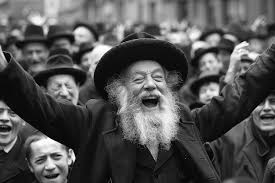
On the Hasidic and Kabbalistic Meaning of Laughter – by Joseph Rosenfeld

I want to apologize to all of my subscribers for being off the blog for such a long time. I was literally locked out of my account because my password recovery email changed. After some time and back and forth with WordPress, everything worked out. Here I am! Hi’neni!

For my first post in a year and change, I’d like to share a reflection on laughter by Joseph Rosenfeld a friend of mine who is a master of Hasidic, Midrashic, and Kabblalistic texts. He also happens to be a fan of Schlemiel Theory! His reflection on laughter – something near and dear to this blog and blogger – shows how deep and important laughter is to Judaism, spiritually and intellectually.

We all know that Hasidim love to dance, sing, and tell stories. Joy, as the Baal Shem Tov (Father of the Hasidic movement), breaks all boundaries. It makes it possible for God’s light to break through into darkness. What is the deeper meaning of humor? Why is laughter so key to understanding Judaism?

Take a look:

Joseph Rosenfeld: “The Root of the Dispute Between Rebbe Nachman and the Shpoler Zeide and the Secret of Laughter”

The root of the dispute lies in the sublime laughter referenced in the verse “she laughs at the last day” (Proverbs 31:25), which is revealed precisely through the reversal associated with Binah (understanding).

The essential secret of the dispute between the Zeide and Rebbe Nachman, of blessed memory, is alluded to in Rebbe Nachman’s terse words regarding opposition, where he said that in the future it will be “a fine laughter.” That is, the entire matter of opposition and the darkness it brought about will all be transformed into the secret of future laughter. This follows the teaching of the Rebbe shlit”a, that this laughter is the laughter of the Leviathan, which arises from the cosmic battle between the Leviathan and the Wild Ox (Shor HaBar). Just as the ox represents revealed tzaddikim (righteous individuals) associated with Chokhmah (wisdom), the Leviathan symbolizes hidden tzaddikim rooted in Binah.

All opposition between tzaddikim is, in truth, rooted in the mystical opposition between Chokhmah and Binah, which is essentially the tension between ayin (nothingness) and yesh (being). Chokhmah points to the ayin of Atzilut (the highest world), while Binah relates to the “I” of Beriah, Yetzirah, and Asiyah (the lower worlds).

These two revelations are, by nature, diametrically opposed—like day and night, the sun and the moon, the “two great lights.” Therefore, they argue over the path by which two opposites can be united. The only way is through bitishah (collision), which is the secret of unity and peace within the dispute itself, in the aspect of “He makes peace in His heights”—which is an acronym for eisev (grass), as explained in Likutey Moharan I:39. This relates to the unification between Chokhmah, represented by the Divine Name AB (72), and Binah, associated with the Divine Name Elokim in its full spelling with yuds, which equals 300, alluding to the acronym AS”V.

Through dispute and collision, this wondrous unification is revealed—the secret of “a help opposite him.” For it is known that laughter emerges from gevurot (judgments) sweetened at their root, through Binah, where the secret of reversal is held, as in “v’nahafoch hu” (“and it was turned around”), with “hu” hinting to Binah.

Laughter is the ability to flip the path from what was expected to what was never imagined. As the sages say: “On the contrary, the opposite seems more correct” (adraba, ipcha mistabra)—an expression rooted in Binah, the mother. What we thought with our external intellect would lead to a known outcome is suddenly reversed. This astonishing movement of reversal is the inner sense of the joining of opposites, achieved specifically through reversal—or, as R. Aharon HaLevi of blessed memory put it, “unity from opposites.”

Laughter does not arise merely from change, but from the profound realization that what I had taken as obvious and certain was, in truth, only possible and doubtful. When a person realizes that what he assumed he had grasped remains merely hypothetical, a deep existential question emerges regarding how we perceive and interpret reality. When one sees that his previous understanding was merely a “hava amina” (preliminary assumption), his heart opens to see that he truly knows nothing. “I said I would acquire wisdom, but it is far from me.”

At the moment this awareness arises—that all prior knowledge was only a possibility—every calculation of knowledge collapses, and one enters a higher plane: the world of emunah (faith). Normally, a person navigates the world—this night-like realm—using wisdom and understanding: the mind and heart. But when these fail through sudden revelation (“my father and mother have forsaken me”), he must sink deeper into the soul’s core, the realm of Keter (crown), which transcends both Chokhmah and Binah, as in “but the Lord gathers me in.” Where Chokhmah and Binah end, there begins the power of wonder—Keter, the seat of emunah.

Only through emunah can a person withstand contradictions that defy reason. Emunah gives the capacity to hold two opposites in one subject, and through this, laughter is revealed—rooted in the union of opposites, as in “I saw an upside-down world.” This world of reversal is the realm of emunah, where the saying “on the contrary, the opposite seems correct” comes to life: the ability to discard outdated intellect and receive new insight from a higher place—the lights of Keter, the root of laughter.

The secret of laughter is the revelation of Binah as it is rooted in Keter, in the innermost dimension of Binah, which is the inner dimension of Atik, known as Radla (Reisha d’lo Ityada – the Unknowable Head).

The essence is that the root of laughter is found in Keter, as in “your God shall rejoice over you” (yasis, same gematria as Keter). There, the entirety of lower existence is rooted in the supreme yesh (being), in the necessity of existence—the true yesh—which exists only in Keter. Only Keter can hold opposites within one reality. It rules over the paradox of “above and below simultaneously,” like Moses’s unknown grave—appearing above to the lower and below to the higher—these are the consciousness of the “world of reversal.”

As long as the lights of Keter shine in the world, there is a revelation of the Infinite Light (Or Ein Sof)—for schok (laughter) equals “Infinite Light” in gematria. This is the new vitality descending from the heights into the world to sustain existence. Prior to laughter, there was a form of death—a breakdown of mind and heart—“my father and mother abandoned me.” Precisely there, in the death of intellect, is where the new revelation must emerge—from the heights of Radla. Since this revelation arises precisely from the death of intellect and heart, the new consciousness must carry within it the power to unify opposites, for the very cause of the breakdown was the encounter with paradox.

The revelation of a gap between the old and new understanding evokes a crisis of contradiction. This cannot be resolved with ordinary intellect—it has shattered. A light higher than mind and heart is required: the light of Keter, which includes both the “I” of perception and the “nothingness” of its negation. From there a new power arises—Keter, the wonder-working unifier of opposites. The core of the breakdown lies in their opposition, and the repair lies in their union—an astonishing unity at the heart of Keter’s joy: “He shall rejoice over you.”

Thus, Radla is the power of containing opposites, and through it laughter is revealed—a new understanding that what I thought I knew, I truly did not. As it says, “no one knows his burial place.” Laughter is the descent of Keter into the opposition between what was known and now unknown—this is the path to unite Chokhmah and Binah. True laughter does not unify by merging parts into something new through mutual cancellation. That method still cannot tolerate opposites.

Laughter, by contrast, allows both to exist simultaneously, even without fusing them. Its root reveals the wondrous power of linking through separation—each stands fully intact, and still, they connect. “Mem and Samech stood miraculously” (Talmud, Shabbat 104a). Their coexistence amid contradiction is inexplicable, yet functional.

This unification is not a frontal embrace (panim el panim), but a back-to-back (achor b’achor) union—each maintaining its identity, without surrendering to the other. Still, they are joined, through distance itself, in the high realm of Atik, where masculine and feminine are connected achor b’achor, like a floating tower in air, with no ground. Here, the only path to unity is through laughter, which breaks old frameworks and invites emunah into a world of new combinations beyond prior logic.

Only by breaking the strong vessels of old intellect can one enter the world of laughter, “a fine laughter, refined to the finest degree.” Through this breaking, one enters the gates of joy, where even contradiction becomes unity.

Thus, the “fine laughter” that will arise in the future from the dispute between the Zeide and Rebbe Nachman is not only a description of what will be, but reflects the very nature of the dispute—itself a form of redemptive laughter. It arises from a union forged through bitishah (crushing), an acronym for bitachon, tov, schok—trust, goodness, and laughter. This unity is possible only in the hidden realm of Radla, where the light of paradox reigns and unites opposites within contradiction itself.

Chokhmah and Binah are truly inseparable companions (trein re’in d’lo mitparshin), and thus both are needed, in the secret of “I and nothingness simultaneously,” revealed through Radla, in the unity-through-crushing (bitishah)—a mystery of “reaching and not reaching” that will be explained further, God willing.

Ultimately, the laughter that will arise from this dispute is an extended revelation of the true laughter that flows from the innermost depths of Keter—Radla. It is the path to perfect repair, revealing how both Chokhmah (ayin) and Binah (ani) work together to disclose the sublime light of Radla, the da’at (knowing) of peace.”

Kierkegaard’s “Happy” Birthday: “Repetition’s Love is the Only Happy Love”

download-4

Circa 1843, Soren Kierkegaard published a book called Repetition.   When one thinks of Kierkegaard, one usually thinks of anxiety, impossible existential dilemmas, and binding of Isaac.  These things, by and large, don’t evoke the image of happiness. However, in Repetition, he entertains the possibility of happiness through the idea of repetition.

Today is Kierkegaard’s birthday.   Since one usually wishes another a happy birthday, I thought it would be opportune to briefly think about what that would mean for Kierkegaard.

At the outset of his inquiry into repetition, Kierkegaard creates a dialectical contrast between recollection and repetition.  Which of the two yields true happiness?

Recollection’s love is the only happy love, according to one author. He is absolutely right about this if one also remembers that it first makes a person unhappy.  Repetition’s love is in truth the only happy love.  Like recollection, it is not disturbed by hope nor by the marvelous anxiety of discovery, neither, however doesn’t have the sorrow of recollection.  It has instead the blissful security of the moment.  Hope is new attire, stiff and starched and splendid.  Still, since it as not yet been tried on, one does not know whether it will suit one, or whether it will fit.  Recollection is discarded clothing which, however lovely it might be, no longer suits one because one has outgrown it.  Repetition is clothing that never becomes worn, that fits snugly and comfortably, that never pulls nor hangs too loosely.

Based on this reflection, it would be fair to say that Kierkegaard’s birthday would present a dilemma.   On the one hand, it repeats over and over; and in that sense it is the source of happiness. On the other hand, every year one has a birthday one recollects the one’s before.  Its both recollection and repetition.

This kind of dilemma reminds me of Larry David in Woody Allen’s film Whatever Works, singing Happy Birthday to himself.   Too be sure, as David demonstrates, it’s also a schlemiel’s dilemma.


In contrast, how would Forrest Gump say “Happy Birthday Jenny?”  Jenny, the name repeated throughout this film by another, less grumpy, American schlemiel character, evokes happiness and sorrow.

With that, I want to suggest that you take a look at several other posts by Schlemiel Theory on Kierkegaard as a way of….celebrating his birthday.

Why not?

If you want to read more, check these out:

Boredom, Laughter, and Kierkegaard’s Rotating Kata-Strophe (Take 1)

Boredom, Laughter, and Kierkegaard’s Rotating Kata-Strophe (Take 2)

Do We Ever Stop Laughing? Kierkegaard, Laughter, and Religion (Part 1)

Do We Ever Stop Laughing? Kierkegaard, Laughter, and Religion (Part 2)

Kafka and Kierkegaard’s Abrahams or the Knight of Faith versus the Schlemiel – Take 1

Kafka and Kierkegaard’s Abrahams or the Knight of Faith versus the Schlemiel – Take 2


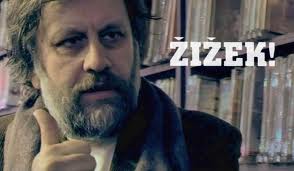
Zizek’s Comic Dilemma: Kynicism or Cynicism?

images-2

I ended yesterday’s blog with a reflection on President Obama’s last words on trust and cynicism. Here are the President’s last words:

And so, these men and women should inspire all of us in this room to live up to those same standards; to be worthy of their trust; to do our jobs with the same fidelity, and the same integrity, and the same sense of purpose, and the same love of country.  Because if we’re only focused on profits or ratings or polls, then we’re contributing to the cynicism that so many people feel right now.

How, I wondered, was the President’s comic routine related to this crisis in trust and the “cynicism that so many people feel right now?”  In yesterday’s blog, I argued that the schlemiel was used, in effect, to regain trust.  But let’s be clear here.  The humor used by the self-deprecating schlemiel has nothing to do with satire or sarcasm.  To be sure, much of what the President was doing was self-deprecating.   This kind of humor doesn’t cause cynicism.  On the contrary, it does its best to challenge cynicism and to recover some kind of hope (however bleak it may be).  The schlemiel evokes a belief in goodness, innocence, and simplicity while, at the same time, juxtaposing it against dishonesty, deception, and violence.  Because the Schlemiel (at least in its traditional variety) evokes some kind of hope (however little it may be) in the midst of depravity, it makes sense why the President and his writers would turn to the schlemiel.   The schlemiel preserves a kind of naivite.

In contrast to the humor of the schlemiel, however, there are other forms of humor which, to be sure, look to exacerbate cynicism.  Slovoj Zizek, who, in academia and beyond it, is thought of as an ‘academic rock star’ of sorts, is well known for his delight in humor.  He is less known, however, for his explorations of humor and cynicism.

In his book, The Sublime Object of Ideology, Slovoj Zizek pits cynicism against what the German philosopher Peter Sloterdijk calls kynicism. Zizek’s reading of cynicism is much different from President Obama’s.  And his privileging of kynicism over cynicism brings this out.  Hope is not an option; kynicism is.

Writing on Umberto Eco’s The Name of the Rose, Zizek notes that “what is really disturbing” is the “underlying belief in the liberating, anti-totalitarian force of laughter, of ironic distance.”  In other words, the emancipatory aspect of sarcasm, for Zizek, is disturbing because “in contemporary societies, democratic or totalitarian, that cynical distance, laughter, irony, are, so to speak, part of the game.  The ruling ideology is not to be taken seriously or literally”(28).   On the other hand, taking ideology literally, and not laughing, is “tragic.”  In this scenario, Zizek seems to be in a double bind as laughter and sarcasm are too ideological for him.  Yet, on the other hand, he prefers laughter to taking ideology seriously.

But there is a problem, since even laughter and sarcasm are ensnared by ideology, they are guilty of being naive.  Zizek cites Marx who says that “the very concept of ideology implies a kind of basic, constitutive naivite: the misrecognition of its own presuppositions, of its own effective conditions, a distance, a divergence between so-called social reality and our distorted representations, our false consciousness of it”(28).

But, contrary to Marx, Zizek claims that the point is not to unmask ideology – so as to see reality “as it really is.”  Rather, “the main point is to see how the reality itself cannot reproduce itself without this so-called ideological mystification.  The mask is not simply hiding the real state of things; the ideological distortion is written into its very essence”(28).

Following this insight, Zizek asks: “Does the concept of ideology as naïve consciousness still apply to today’s world?”

His answer, of course, is no.  Ideology is no longer to be thought of as naïve. Zizek argues that it knows it is lying.  It is deceptive.  But, more importantly, “ideological distortion” is not separate from reality; it is “written into its very essence.”

Citing Peter Sloterdijk, Zizek argues that “ideology’s dominant mode of functioning is cynical, which renders impossible…the classic critical-ideological procedure.  The cynical subject is quite aware of the distance between the ideological mask and the social reality, but he none the less insists on the mask.”

In other words, things have, literally, changed.  Ideology is no longer innocent or naïve.  It is deliberate. And it cannot be unmasked since it is “written into the very essence” of reality.  Paraphrasing Sloterdijk, Zizek says that “they know very well what they are doing, but still, they are doing it.”  In other words, if everything is ideology, everyone is lying.  No one believes in ideology, yet they act as if they do while knowing full well they don’t.

Taking into consideration what Zizek is saying, we would have to say that our assessment of cynicism is wrong.  Cynicism is not based on distrust of the government.  No.  For Zizek, cynicism is knowing that you are lying while acting “as if” you are telling the truth.  This masking operation, for Zizek, discloses a near universal dishonesty that touches everything that advances freedom, justice, equality, etc.  According to his logic, we act as if these ideals, principles, etc are real when, in fact, we know they are not.

In a surprising turn Zizek excludes himself from the all-encompassing cynicism that touches all reality by aligning himself with what Sloterdijk calls kynicism: “Kynicism represents popular, plebian rejection of the official culture by means of irony and sarcasm: the classical kynical procedure is to confront the pathetic phrases of the ruling official ideology – its solemn, grave tonality – with everyday banality and to hold them up to ridicule, thus exposing behind the subtle noblesse of ideological phrases the egotistical interests, the violence, the brutal claims to power”(29).

Zizek notes that the kynical procedure does not play according to the rules of logic.  It is “more pragmatic than argumentative: it subverts the official proposition by confronting it with the situation of its enunciation; It proceeds ad hominem”(29).

Zizek notes that what we have today is a battle between cynicism and kynicism: “Cynicism is the answer of the ruling culture to this kynical subversion: it recognizes, it takes into account, the particular interest behind the ideological universality, the distance between the ideological mask and the reality, but it still finds reasons to retain the mask”(29).

Given this “logic,” Zizek would say that upholding “individuality,” “freedom,” “justice,” and even “rights” by the “ruling culture” is cynical.  It is a mask.  Zizek would say that they all don’t really believe in these things but act “as if” they do.  And for his reason, they are all cynical: “the model of cynical wisdom is to conceive probity, integrity, as a superior form of dishonesty, and morals a supreme form of profligacy, and truth as the most effective form of a lie”(30).

The kynical person, in contrast, discards the “mask.” Moroever, the kynical person laughs.  But, somehow, this laughter is pure of ideology. This is odd, since, at the beginning of this section (as we note above) Zizek says that emancipatory laughter and sarcasm (which sounds a lot like kynic laughter) are wholly ideological.  Here, somehow, sarcasm (as kynicism) is not.

On the one hand, laughter, satire, and sarcasm are a “part of the game.” On the other hand, they are the epitome of popular revolt.  Can we say that neither cynicsm nor kynicism are naïve?  Wouldn’t it be naïve, according to Zizek’s standards, to think one can simply throw off the ideological mask and escape cynicism?  Isn’t it the case that they both know that what they are doing is a lie but do it anyway?  To be sure, isn’t Zizek saying that all ideology today is dishonest and nothing escapes it?  Wouldn’t that also include kynicism?  Or is kynicism beyond ideology and dishonesty?

If kynicism goes by way of the ad hominem and not by way of argument, is it beyond ideology?

To be sure, Zizek explicitly notes kynicism’s dishonesty when he says that kynicism deliberately uses ad hominem arguments to mock the ‘ruling culture’ (which includes the culture of the Enlightenment).  Kynicism doesn’t argue.  It attacks and it knowingly tells lies.  But, and here is the question, does it do so while holding up a mask?  Do the kynics sarcastically mock the ruling ideology while acting “as if” they are “right,” “true,” and “just”?  If they do, then they are also wearing a mask and they too are cynical.

So, what is the meaning of all this dishonesty?  And, given what the President said the other night at the Correspondents’ Dinner, is there any way to end cynicism if both sides are engaged in some sort of deception – knowing that they don’t believe in justice, rights, truth, etc but act ‘as if’ they do?

To be sure, given his love for sarcasm, it seems as if Zizek prefers kynicism over cynicism.  But isn’t Zizek caught in the lie of ideology, too?  Didn’t he say that sarcasm plays the same game?  Zizek certainly celebrates mockery in his work and encourages satire, but a close reading of The Sublime Object of Ideology shows us that he also recognizes the sarcasm may not be free of ideology.

This recognition is fundamental to understanding what is at stake.  The truth of the matter is that Zizek’s appeal to kynicism is an attempt to leave the Enlightenment and its rhetoric of emancipation behind.   To do this, he looks for a kind of sarcasm that is free of emancipation or any enlightenment ideal.  How is this possible?  Is the sarcasm he affirms simply a violent force that denies all truth and no longer acts ‘as if’ it is anything?  A “naked” kind of sarcasm free of any Enlightenment ideal?

In the introduction to his book Philosophy and Law, Leo Strauss argues that the Enlightenment’s main weapon against orthodoxy is humor. And in many ways, Strauss agrees with Zizek:

As Lessing, who was in a position to know, put it, they attempted by means of mockery to ‘laugh’ orthodoxy out of a position from which it could not be dislodged by any proofs supplied by Scripture or even by reason.  Thus the Enlightenment’s mockery of the teachings of the tradition is not the successor of a prior refutation of these teachings; it does not bring to expression the amazement of unprejudiced men at the power of manifestly absurd premises; but it is the refutation: it is in mockery that the liberation from ‘prejudices’ that had supposedly been cast off is first accomplished; at the very least, the mockery is the admittedly supplementary but still decisive legitimation of liberty acquired by whatever means (30).

Were the Enlighteners kynical, did they really (cynically) believe in freedom and rights, or did they naively believe in freedom and rights?  After all, Strauss claims that they knew they had no real argument with Orthodoxy but preferred, instead, to mock it.  Strauss’s reading implies that the Enlightenment doesn’t really have a full grasp of its principles but acts “as if” it does for purely pragmatic reasons.  Like the kynics that Zizek writes of, Strauss’s Enlighteners also use ad hominem arguments and sarcasm to challenge the “ruling ideology.”  But there is one difference: they do so in the name of “liberty.”

In effect, Zizek is telling us that all forms of political humor battle cynicism with kynicism.  Kynicsm is not interested in self-deprecating humor, which looks to re-instill trust.  And if we take Zizek’s words on ideology seriously, we would have to say that, in the end, it’s the same result.  Cynicism and kynicism are both caught up in ideology, but an ideology that is not simply naïve but rather dishonest.

For Zizek, no one really believes in the truth anymore.  We only act “as if” we do.  Zizek suggests that “the people” are all kynical.  He suggests that their sarcastic rebellion against the ruling culture, which acts “as if” truth, justice, freedom, etc exist (and defend it), is somehow pure.  But, wait, doesn’t this rebellion act as if it is just?  Aren’t many latter day rebels naïve?  Or are they just acting “as if” they believe in justice?  Perhaps we’re all being duped?

By not looking into it deeply, Zizek implies that all popular sarcasm directed against any group in power is just.  But isn’t the act of speaking truth to power an act that is based on Enlightenment ideals?  And how can one justify activism that is supported by kynicism?  Is that activism…random?

Is the difference between kynicism and cynicism the fact that cynicism acts “as if” truth, justice, etc are real while kynicism doesn’t waste its time with such self-deceptions?

What I find most interesting is Zizek’s brief moment of reflection on subversive laughter and its possible destructiveness.  His hesitation is ultimately left behind for the revolution.  His laughter is a laugh that is, seemingly, not based on any truth.  Nonetheless, the appeals for justice and truth made my many kynics disclose some form of ideology.  So, what is it?  Is kynicism deceiving itself or not?  Is its only purpose to sarcastically destroy any ruling ideology in the name of noting save…destruction.  Or does it act “as if” it challenges the ruling ideology in the name of progress, justice, etc?  Zizek’s laugh, it seems, is unsure of whether or not it is based on truth or deception.  It originates in a humor that is not seeking to end cynicism so much as exacerbate it.  For if ideology is inescapable, so is the impulse to act “as if” justice, truth, and freedom exist when one “knows” that they don’t.  If we take Zizek to the end of his thought on sarcasm, this is the conclusion.

And with this, I return to my original concern regarding the use of comedy in the political sphere to battle cynicism.  Will the political use of comedy produce trust or dissolve it?    For Zizek, sarcasm, not self-deprecation, is the choicest of all comic weapons.  His strategy is completely different from President Obama’s insofar as the President played the schlemiel while Zizek plays the kynical comic.

Guest Post by Professor Jeffrey Bernstein: “Schlemiel, Schlemazel . . . Augenblick in-corpor-ated?”

DownloadedFile-1

Lately I have been wondering about Menachem’s earlier posts regarding the prophetic (possibly messianic?) potentiality of the schlemiel.  In a post on Benjamin and Strauss, he gave a nod to the secretive ‘wink, wink’ capacity of the schlemiel’s humor which the spectator gets, but which the schlemiel may not.  Menachem writes:  “Winking is not a straightforward gesture.  It is oblique.  And it is immediate, like a blink of the eye.”  This characterization immediately strikes me; given that he juxtaposed the phrase ‘blink of an eye’ with the figure of Benjamin, I am put in the mind of the figures of the ‘augenblick’ (which means  both ‘blink/twinkling of an eye’ and ‘instant/moment’) and the ‘jetztzeit’ (‘now-time’).  I am lead to wonder:  what is the ‘time’ of the schlemiel?  And if there is a schlemielich temporality, is it well-characterized by these terms?

Just for laughs, let’s characterize the situation in which we might engage this question:  as the old saying goes, the schlemiel is the one who spills his soup and the schelmazel is the one’s who gets the soup spilled on him.   To my mind, it looks something like this:

Schlemiel:  (in cafeteria, walking with tray of soup, speaking to Schlemazel) So I says to him ‘Hey, whadda you talkin’?  As if Spinoza knew anything about the Geonim!’  I (trips)—whoa, whoa, whoops!!!!! (spills soup on Schlemazel)

Schlemazel:  Ow!  Vey iz mir!  That soup’s hot!  Look what you did!

Schlemiel:  Oy! Look what I did!

There doesn’t appear to be any prophetic aspect to this caricature—but of course, the littlest things contain the deepest truths.  Soup is hot; we make messes; we burn—such is life.  And what can we do except scratch our foreheads and say ‘Oy! Look what I did!’  This may be the adult secret contained in many of our childhood experiences.

But strangely enough, this appears not to resemble the arc of thought contained in the terms ‘augenblick’ and ‘jetztzeit’.  So a brief, and somewhat circumambulatory, consideration is in order:  In the Weimar Germany of the 1920’s, in the aftermath of the massive physical, psychological, cultural, and ideological destruction of the First World War, many different thinkers (sensing a fictitious quality to the narrative of ‘Enlightenment historical progress’) tried to find a way of speaking about the perceived crisis in which Europe was then involved.  Figures such as Barth, Heidegger, Rosenzweig, Lukacs, Benjamin, Kafka, Schmitt, Adorno, Schoenberg, Kandinsky, and Bloch all (in vastly different ways and for vastly different reasons) attempted to articulate the sense that if historical change is to happen, it will do so instantaneously and non-teleologically; it will come, as it were, like a thief in the night.  In doing so, they made witting or unwitting use of the idea of kairos  as it came to be articulated in Paul.  For Paul, kairos names the eschatologically charged instant in which the encounter with God and the acknowledgment of messianic time occurs.  It is always thought in opposition to chronos—i.e, profane time.   Augustine takes up this thought in his discussion of  ‘the present’ (in Confessions) as that which grants substantiality to the past (as recollection) and the future (as anticipation) by virtue of its being a divine(-ish) capacity of the human soul; if it were not for the creaturely replication of the present as nunc stans, time would consign humans to mortal oblivion.

Centuries later, as Luther studiously worked on his vernacular translation of the New Testament, he encountered the Pauline phrase ‘in the twinkling of an eye’ (in 1 Corinthians) and translates it with ‘augenblick’.  The ‘blink/glance/twinking of an eye’ is now understood not as one moment of ‘homogeneous empty time’ (Benjamin) or interval of ‘clock time’ (Heidegger) among others—it is precisely now understood in opposition to such mechanistic conceptions of temporality.  For the Weimar bunch, it becomes synonymous with authentic lived experiential time.  And though Heidegger calls ‘off-sides’ on Kierkegaard’s punt, the latter makes an important admission when he states (in The Concept of Anxiety) that “It is only with Christianity that sensuousness, temporality, and the moment can be properly understood, because only with Christianity does eternity become essential.”  True, Aristotle had also made use of the word kairos in the Nicomachean Ethics, but there it only meant the ‘opportune moment’ for action—like providing medicine or going to war.   It wasn’t essentially different from his characterization of the present (in the Physics) as a vanishing point—a pure limit between the ‘no longer’ and the ‘not yet’.

According to Agamben (oy!), Benjamin uses the term ‘jetztzeit’ (in his Theses on the Philosophy of History) to translate Paul’s ho nyn kairos (‘the of now time’) in Romans.  In this context, one might suggest that Benjamin is taking up the Aristotelian understanding (and its example of military battle) in holding that the ‘jetztzeit’ is that revolutionary moment which ‘blasts a hole’ in the ideology of ‘homogenous, empty time’.  But in viewing the ‘now-time’ over and against the normalizing, ideological conception, Benjamin simultaneously rejects the Aristotelian topos of the ‘opportune moment’ in favor of the Pauline one.  Certainly, Heidegger critiques the Aristotelian notion along similar lines (in Basic Problems of Phenomenology):   “The instant is a primal phenomenon of original temporality, whereas the [conventionally construed] now is merely a phenomenon of derivative time.  Aristotle already saw the phenomenon of the instant, the kairos, and he defined it in the sixth book of his Nicomachean Ethics; but . . . he did it in such a way that he failed to bring the specific time character of the kairos into connection with what he otherwise knows as time.”   In drawing the connection between kairos and ‘augenblick’ in his early readings of Paul, Heidegger thus simply makes explicit (on the theological level) what he will later phenomenologically describe as the suddenness of authentic temporality—i.e., that it happens as kairos and not as chronos.

I’m not trying to simply peg the terms ‘augenblick’ and ‘jetztzeit’ as Christian and thus inappropriate as descriptions of the schlemiel (well, ok, a bissel I am).  Rather, I want to suggest that—despite the Jews that adhere to these descriptors and the Christians who don’t—these terms fail to accurately describe the authentic temporality of the schlemiel.  This for two reasons:  (1) ‘augenblick’ and ‘jetztzeit’ (understood as sudden and arresting) are both set over against a conception of time as homogenous, empty, identical and simply quantitative, and (2) as such, both terms are markers for a presence which the schlemiel  always seems to refuse (or, perhaps, fails to attain).  Whether it be the ‘negative presence’ of the absent, absolute and unattainable future, the ‘eternal present’ of the nunc stans, or the ‘revolutionary and shocking momentary present’ of eschatological realization, ‘augenblick/jetztseit’ is always indexed to a point of stability.  The meaning and signification of the moment/instant—be it eternal, futural, or sudden—is infused, embodied, literally in-corpor-ated (even in-carnated), in an otherwise purely quantitative and empty temporal flow.  This is why, even in the mode of anxiety or transience, the moment/instant is still (on the formal level) the source of a radiant serenity.  Put differently, ‘augenblick/jetztzeit’ bears witness to a religious tradition and context that is poetic.

Are there any resources in ‘prosaic’ religious traditions (to adopt the terminology of Yeshayahu Leibowitz) for thinking the temporality of the schlemiel?  You guessed it—the answer is yes!  So now, a much shorter consideration of this ‘other’ tradition:  Amos Oz and Fania Oz-Salzberger (in Jews and Words) note that Biblical Hebrew points to a different understanding of time than what we get in the Western conception (i.e., the qualitative moment/instant vs. the quantitative flow from past to future or vice versa).   The word kedem denotes ‘ancient times’ but its derivative kadima means “ ‘frontward’ or ‘forward’ “.  Similarly, the word lefanim means both ‘a long time ago’ and ‘in front of/to the face’.  Finally, achreinu means ‘after us’ both in the sense of ‘behind us’ and ‘in future’.  Put differently, Oz and Oz-Salzberger (following the work of Adin Steinsaltz and Shulamith Harven) hold that “When we speak Hebrew, we literally stand in flow of time with our backs to the future and our faces toward the past.  Our very posture is different from the Western view of time . . . The Hebrew speaker literally looks frontward to the past.”  Sound familiar, oh theorists of the Continent?  It recalls not only Benjamin’s reading of Klee’s Angelus Novus (whose face is turned toward the past while he is blown uncontrollably into the future); it also bears some resemblance to Arendt’s reading of Kafka’s “He”, where ‘he’ stands in between the two antagonists (the past and the future) who are both battling him and each other.  Arendt’s interpretation is itself a struggle between the Weimar conception of moment (for Arendt, ‘he’ is the present understood as nunc stans) and the Hebrew one (‘he’ enlists the help of both the past and the future in ‘his’ battle with one another).  Insofar as it rejects the static distinction between the qualitative, lived, in-corpor-ated moment and quantitative but empty clock time, it remains in proximity to Benjamin’s Klee-interpretation.

What does it mean to look frontward to the past?  How can a prophet assume this posture and still ‘prophesy’?  Clearly, the schlemiel does not utter phrases like “And I say unto thee…”  If the schlemiel is prophetic, s/he is so retrospectively—i.e., “Oy!  Look, what I did!  Such is life!”  The schlemiel does not so much prophesy as ‘register prophetically’ what has already happened as what will always already continue to have been happening (oy, look what I did).  This retrospection, this belatedness, this reactivation of the past in the (present of the) future, has been characterized by Freud (with a little help from Rav Lacan) as nachtraeglichkeit and by Adorno (with a little help from Rebbe Said) as ‘late style’.  The schlemiel is always ‘late to the party’, always noticing things ‘after the fact’.  The signature phrase of the schlemiel’s wisdom is not ‘AHAH!’ but ‘OH . . . YEAH!’  And the schlemiel never ceases to register his/her insights too late for anything to be done about them.  Hence, as Janouch’s Kafka (as mediated through Benjamin) tells us, there’s an infinite amount of hope—just not for us schlemiels.  The moment of realization never happens by means of anticipation.  In the words of that other great theorist of the schlemiel, Carole King, ‘Its TOO LATE, baby, now its too late’.  If life were characterized by great poetry, we might at this point despairingly quote T. S. Eliot:  “After such knowledge, what forgiveness?”  But if life is ultimately prosaic, what else is there to do but laugh?  Incipit schlemiel!

Jeffrey Bernstein is an Associate Professor of Philosophy at the College of the Holy Cross. He works in the areas of Spinoza, German philosophy and Jewish thought.

After Purim, Whither Prophesy? The Legacy of the “Hidden Tradition” (And a New Schlemiel-Anniversary)

In the blog entry entitled “The Schlemiel as Prophet (Take 1),” I cited a passage from the Talmudic tractate Baba Batra (12b). The Midrashic passage made the claim that prophesy passed on from the prophets to children and fools. What I didn’t note is the date that prophesy ended: it ended on Purim. Yesterday. This means that today is the anniversary of the first day after the end-of-prophesy.

But what begins after the end of prophesy?

The answer to this question is not so simple. The Midrash from Baba Batra says that after prophesy ends it passes on to fools and children, but Talmud Yoma 39a says that end of prophesy is the beginning of the Oral Tradition.

Here is the passage:

Why is Esther compared to the dawn? To teach you that just like the dawn is the end of the night, so to is Esther likened to the end of all Miracles. But what about Hanukkah? We are talking about miracles mentioned in the prophets. (My translation)

Here, miracles are linked to prophesy. And the reason why Hanukkah is not included within the purview of prophesy is because the Book of Esther is the last recorded prophetic book in the cannon of the written Torah (the book of Prophets – Neveim). The miracles of Hanukkah, which happened chronologically after Purim, are not a part of that cannon and prophetic lineage.

In one of his reflections on Purim, the 18h century Hasidic Rabbi Levi-Yitzchak of Berdichev, who the Kabbalah scholar Gershom Scholem regarded as one of the most important Hasidic mystics, addresses the future of prophesy after Purim.

In this reflection, he begins by citing the line which says that the Jewish people “fulfilled and received”(Esther 9:26) the Torah on Purim. In a Midrash from Tractate Shabbath 88a, we learn that this passage marks a distinction between the acceptance of the Torah through Moses and its acceptance and fulfillment during Purim.

Upon receiving the Torah in Exodus 24:7, the Jews said “we will do and we will understand”(Na’sah v’nishma). In contrast, the Book of Esther says that the Jewish people “fulfilled and received it.” The obvious question is why is the acceptance of the Torah on Purim different? The answer some Rabbis give is that this reception, on Purim, is out of love while the first reception of the Torah was out of fear.

To illustrate, one of the Midrashim in Shabbath 88a details how God turned the mountain over the Jewish people “like a tub” and said if you do not accept it “here will be your grave.”

Rabbi Levi-Yitzchak of Berdichev reads “fulfilled and received” differently:

Mordechai was the last of the prophets as it says in the Talmud (Yoma 29a). We find that until Mordehcai the light of the Written Torah shined. From Mordechai on, prophesy stopped and the light of the Oral Torah began to shine. From Mordechai on begins the Knesseth G’dolah and the canonization of the prayer book. And this is the meaning of “they fulfilled and received” (the Torah): they received and accepted amongst themselves the Oral Torah from Mordechai onwards. Prophesy had ended and the oral tradition began because, in truth, all the time that there was prophesy, that prophesy was written down. When prophesy ended, it was no longer written down and the light of the Oral Torah took precedence. (D’roosh Purim; my translation)

What I find so fascinating about Rabbi Levi Yitzchak’s reading is that he, a mystic, would not mention anything about the “other” new beginning of prophesy; namely, that it is now taken on by children and fools. Moreover, many Hasidim see Purim as a holiday which is all about “turning the world over,” a holiday where foolishness is deemed, to some extent, prophetic. Nonetheless, he bears no mention of this other post-prophetic beginning.

By doing this, he is, in effect, teaching us that this tradition of passing prophesy on to fools and children is either not important or it is a “hidden tradition.” It is, to some extent, esoteric.

The term “hidden tradition” is an expression used by Hannah Arendt to describe the history of pariahs and schlemiels which, for her, starts with Heinrich Heine, in Germany (not in Eastern Europe, with the Hasidim or with Yiddish folklore and literature and not in the pre-modern period). I’d argue that Arendt could have gone back much further so as to understand the beginning of this “hidden tradition” of the schlemiel; namely, to the passage from Baba Batra I cited in “The Prophet as Schlemiel (Take 1).”

The question of what begins after the end of prophesy seems to have two answers that lead us in two different directions. The first answer, the one cited in Talmud Yoma and reiterated by Rabbi Levi Yitzchak of Berdichev, is that after prophesy ends the oral tradition (the Talmud) begins. Now, Revelation (not prophesy, which is based on Revelation) is confined to learning and, as it says in the Talmud, the “four cubits of Halacha”(Jewish law). The other answer is that after prophesy ends a new type of prophesy arises, one that is given to fools, children, and, as I noted in previous blogs, the man-child, the schlemiel.

Perhaps we can offer a third answer and say that Rabbi Levi Yitzchak of Berdichev was hinting at this other answer? After all, what is an Oral tradition? If the Hasidim took the Kabbalah to be the Oral tradition, why wouldn’t they include, within that category, the prophesy of fools, children, and schlemiels? Don’t Hasidim record them in many of their stories? Is the schlemiel – in real life – and in its fictional life participating in this hidden tradition? Are Hasidic stories on the schlemiel parts of this hidden tradition? Were they meant to be esoteric?

The answers to these questions are thought-provoking since schlemiels were well-known to all Hasidim and to all non-Hasidim in Eastern Europe. They weren’t esoteric. However, their legacy, their secret, so to speak, is. It is a “hidden tradition” of sorts.

What new tradition begins today, then, the end of Purim? What new tradition should we celebrate on this anniversary?

On the Schlemiel Theory blog, let’s do something foolish. Let’s follow the Midrash in Talmud Yoma and declare the day after Purim to be the end of one kind of prophesy and the beginning of another! This can be the anniversary of the schlemiel’s birth into the Jewish prophetic tradition – the prophetic tradition of exile and the oblique, comic prophet. Today can be the anniversary of the “hidden tradition.”

Happy schlemiel-anniversary!