The Possibility of Laughter: Animals, Laughing Creatures, and Fecundity in Dara Horn’s “In the Image” – Part II

images

Let’s face it. Many of us would like to believe that potential is something one either has or doesn’t have within oneself. One is given, so to speak, the potential to use one’s capabilities to be a success or failure. One can use one’s mind, one’s experiences, one’s imagination, etc to get ahead. Although this idea is as ancient as the hills (and has a Greek source – think of Aristotle’s notion of capability), there is another idea that also deals with potentiality that has been given short shrift; namely the notion that potentiality is not something internal but something shared.     And unlike the seriousness associated with potentiality, sometimes potentiality – when it is shared – has its comic aspects.   Moreover, it is the fact that a meeting (an event) – since it is oftentimes a surprise or an irruption into the world of otherwise atomistic individuals – is comical that we see this potentiality released.

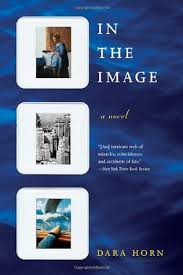
As I recently pointed out, the power of potentiality (as something that is based in an event or relation) is something that Levinas and Derrida suggest in their reflections on fecundity and laughter. But, as I have noted, the two reflections need to be brought together and they can be brought together by way of a reflection on Dara Horn’s first book, In the Image. Although Dara Horn paints her Jewish main characters as inheriting a tragic reality and history from their ancestors who came over from Eastern Europe, she gives them a kind of comic potentiality which is able to change this tragic reality, perhaps, for the better.

In a journalistic assignment, which is related to questions about Jewishness, God, chance, and the past of a stranger named Bill Landsman (who is older than her, an immigrant, and a survivor) who irrupted into her life, the main character, Leora, stumbles across a Spinoza scholar named Jake in Amsterdam.   But this meeting is the result of many “coincidences.”

Leora was doing a perfunctory fact-check on an article at her magazine that mentioned, in an off-the-cuff kind of way, the philosopher Benedict Spinoza. He job consisted of looking up Spinoza in an online biographical encyclopedia to make sure his name was spelled correctly. (115)

In her search for information about Spinoza, she starts thinking about his understanding of God.

Spinoza believed in God, but the God he believed in resembled the God of the Hebrews only in passing. He deduced that the entire universe was formed from one type of matter, which one could call God….and that the whole world was an extension of God. This meant that God couldn’t interact with creations…since God and the world were one and the same. (116)

She finds Spinoza’s God to be a “magic potion” and wonders at the implications:

The world remained alive, inhabited, pulsing and breathing, yet there were no loose ends anymore. If people got killed crossing the street, or if they took their lives, or if cats turned into lions, you could still believe in God, but you didn’t have to blame God for anything. Everything was simply one, the hems of the world stitched complete. (116)

For Horn, Spinoza, in effect, poses a novelistic question. Do all of the happenstance events in her book – as well as the suicides, deaths, and betrayals – prove or challenge Spinoza’s claims? Is the world “stitched complete” or is the narrative weave – so to speak – torn? How do memory, history, and emotion tear the garment? Can one, quite simply, leave God out of the “picture.” Is God, as title of her book suggests, “in the image”? (It should be noted, here, that Spinoza, like Descartes, rejected the image and the imagination as befuddling the intellect. The image, for him, was an obstacle to proper reasoning and geometric logic.)

When Leora sees a poster at Columbia University about a lecture in Amsterdam, she decides that something (God, the universe, her Jewishness, etc) is telling her to go to Amsterdam:

Leora stared at the poster and found herself seized by a certain passion that she hadn’t experienced since she moved to New York. The word “Amsterdam,” italicized near the bottom of the page, seemed to waver back and forth, like a swaying finger beckoning her, asking her, If not now, when? (117)

Unlike Spinoza, Leora follows a “passion” which emerges when she is “seized” by seeing a word.   The passion taps into something inside her, perhaps a question about what it means to be a Jew who emerges out of the past, perhaps a question about Bill Landsman, perhaps the fact that who she is has to do with who she is. There are many possibilities that this passion taps into and these possibilities are things that Spinoza would find misleading.

When Leora arrives in Amsterdam, she goes to the lecture and sees that Jake, a professor from Columbia University who specializes in a historical approach to Spinoza and his excommunication from the Amsterdam community, is giving the lecture.   He was different from the other lecturers who had a “faith in the importance of Spinoza the way Leora’s nighttime addicts had faith in drugs”(120). They were too self-assured. He was different because he was more interested in Spinoza in a historical context. He was, in other words, more simple in his openness to possibilities while these other scholars had taken to what Spinoza would call necessity.   He is more interested in history and memory which dwell in the realm of possibility.

After asking around about what to do, Leora goes to the Rijksmuseum. (This a place where – as Horn shows in a very long section – Bill (Wilhelm) Landsman went one day before the Holocaust when his father (who suffered from PTSD) hit him and sent him into flight from the home. He left without his coat with a Jewish symbol on it. “Jews and dogs” where not allowed in public places. But since Wilhelm was without this coat he wanted to see if it was possible for him to go to the museum and act “as if” he was a non-Jew. It worked and he saw works of art he had never seen before.)   While there she notices that the professor from Columbia is also there. His name is “Jake.”. She approaches him and they talk. This is the beginning of a long relationship which eventually leads to a wedding engagement.

The single most important moment of their relationship is comical and leads to a kind of knowing that prompts them to experience a shared potentiality.

In this moment, Horn depicts Jake in a comical manner so as to set the tone for this comical event. The original joke hints directly at the theme of history, memory, and potentiality:

Before he met her, Jake used to feel like the butt of that old joke describing a Rhodes Scholar: a bright young man with a brilliant future behind him. Ha ha. She was the first person in years who didn’t see him that way. (214)

Even though she sees his future ahead of him, Horn still depicts a comic scene that is replete with animality and Jewishness (animals are, as I have argued elsewhere, can be used as comical figures for Jewishness).   Although Leora keeps the Sabbath, she has a ritual of watching movies on Friday not after her Sabbath meal. The movie that evening is The Planet of the Apes.   That evening, the movie was a prelude to possible sexual encounter. But it fails:

After aping the apes, along with the human among them lost on his own planet, they took off their clothes, but not all of them. Jake asked her once more, but Leora couldn’t help him. (214)

Leora, it seems, is not interested in sex. Jake is comically frustrated. And this leads to a comical dialogue: “Oh, so I’m the kind of boy you don’t sleep with.” “Yes, that’s right,” Leora answered. “You’re very Leorable, you know.” He said “after a moment of trying to decide whether or not to say what was on his mind.” He explains that Leorable is the “opposite of adorable,” she throws a pillow at him and she “cowered in the corner of the bed, aping the human captured by the apes, until they started communicating in ape noises again. Growling the words in her nearly incomprehensible ape voice, she grunted, “Would you put my pajamas on for me, and then I’ll send you home?”(214)

The experience, though comical, is humbling: “Fighting his own fire with all his might, he turned back around to where she was sitting half-naked on the bed…He made a face like a crazed alien ape and put the pajama pants over her head”(215). The fact that the moment of self-defeat is not tragic but comic is telling. It suggests an interesting reading of Rabbi Joseph Soloveichik’s reading of man’s “self-defeat” as, on the one hand, an articulation of “tragic reality,” and on the other an “image of God.”   (It is highly likely that Horn may have read his work The Lonely Man of Faith where he articulates this idea.)

Jake’s comical self-defeat as animalic and yet very human and even “in the image” of God. It suggests what Rabbi Joseph Solveichik would call tzim-tzum (withdrawal). But this withdrawal is comical and suggests a new possibility that is announced by laughter.   Horn notes this:

Leora started laughing from inside the pants, so hard that he had to pull them back off her head so that she wouldn’t suffocate. But when the elastic waist stretched around the crown of her head….she looked at him with a gaping smile he had never seen before. (215)

Leora’s laugh is of a laughing creature. And this smile is – so to speak – revelatory. It is “in the image” of God. And Jake notices it:

Jake saw that smile and knew, as if he had seen her face projected in a giant image on a bare wall with a voice in the background reading a caption, exactly what she was thinking.   That thought made him forget about feeling insulted for flattered, made him forget about how much he wanted her, because he suddenly understood that she was going to be his. (215)

This moment of revelation – beyond desire and self-consciousness – is a comical event that is the prelude to marriage and what Levinas would call fecundity.

Someday, he heard a voice reciting the thought written across her beautiful forehead, you’ll be taking our daughter into bed, and you’ll put her pajama pants over her head and make her laugh so loud, and I’ll be standing before the doorway waiting tor you to drink in my smile, unable to believe how lucky I am. (215)

What Jake experiences is something Spinoza would regard as arbitrary. But for Levinas and Horn it is central: it is a moment of potentiality and freedom. It is a future that pardons that past and makes room for the other. It is a source of joy and hope and it is central to Jewishness. Being in the image, for Horn, has to do with a shared sense of purpose that is linked to children and the future. Fecundity is, as Levinas says, pardon. It is also, as Derrida briefly suggests with respect to Sara, an irruption of the possible. But, most importantly, this possibility is announced in a laugh and a smile. And it can be articulated in fiction which is able to show – by way of its lacunae – how the threads of the past can find a knot in the potentiality of a future which takes the past into account. It suggests that reality need not be tragic (as Rabbi Soloveichik suggests) and that humility (self-defeat) may have a comic rejoinder. But that rejoinder can only be made in view of the possibility of new life. And it can only be made by a “laughing creature” whose laughter is “in the image.”


The Possibility of Laughter: Laughing Creatures and Fecundity in Levinas, Derrida, and Dara Horn’s “In the Image” – Part I

images

Laughter is an ambiguous thing. It can either exclude one or include the other. And, in relation to time, one might think it relates solely to the present moment. Laughter is all about the new. Henri Bergson associated it with progress and “Creative Evolution.” And Leo Strauss argued that laughter was the key element of modernity since it was able to advocate the notion of progress by mocking tradition. For Strauss, mockery seems to be the means by which the present triumphs over the past. But this need not be the case. Laughter can create a bridge between the past and the future.

From the Torah, we learn that the matriarch, Sara, laughed when she was told that – at her late age – she would have a child. It didn’t seem possible. The link between laughter and the possibility of having a child  suggested by the Torah is not by any means arbitrary.  It speaks to something phenomenological, temporal, and existential.

Emmanuel Levinas, in his book Totality and Infinity, uses the word “fecundity” to describe the relationship between the child and possibility.

Citing Isaiah 49, Levinas notes that:

My child is a stranger, but a stranger who is not only mine, for he is me.   He is me a stranger to myself….No anticipation represents him nor, as is said today, projects him….the encounter with the Other as feminine is required in order that the future of the child come to pass from beyond the possible, beyond projects. (267)

Fecundity is about what is to come and Levinas writes about it with great joy. It has a kind of messianic element to it. Fecundity opens one up to the possible since what is fecund is what he calls “entirely pardoned” and free. It is beyond aging and triumphs over time and history.  (As Hannah Arendt also points out forgiveness is able to change the past.  Likewise, she also sees birth in terms of a “new beginning” which can change history.)  The “pardon” that fecundity offers – the pardoning of the past by way of the possibility of the future – is given to me through my child:

The discontinuous time of fecundity makes possible an absolute youth and recommencement…and in a free interpretation and free choice, in an existence that is entirely pardoned. The recommencement of the instant, this triumph of the time of fecundity over the becoming of mortal and aging being, is a pardon, the very work of time.   Pardon in its immediate sense is connected with the moral phenomenon of fault. (282-283)

Sara’s laugh goes from incredulous to miraculous when Isaac (which means “he will laugh” in Hebrew) is born. It is his birth that makes her laugh a kind of laughter that is born out of the “time of fecundity.”

In a session on hospitality on January 8, 1997, Jacques Derrida takes not that he has spent a lot of time – in the last session – talking about the relationship of mourning to hospitality. And one would think that, given his lecture, hospitality had more to do with tears and less to do with their opposite, laughter:

We have not yet encountered this strange possibility, regarding hospitality, the possibility of laughter.     We have encountered tears (those, for example, of the women who, during Tupinamba ceremonies of hospitality and ‘when they receive friends who go visit them,’ they begin to cry as a sign of welcome…). We have spoken of mourning, of hospitality as mourning….But we have not evoked laughter. (358, Acts of Religion)

For Derrida, laughter relates to “what awaits us” since the “question of hospitality is also the question of waiting, of the time of waiting and of waiting beyond time.”    Derrida tells us that the host is waiting for and welcomes the “unexpected guest.” This, to be sure, was Abraham’s greatest hope. He wanted to be surprised by a strange guest.

Speaking of Abraham, Derrida points out how, in the wake of childlessness, G-d visits Abraham. And he does this by way of noting the “apparition” of the stranger: “This unexpected apparition by an uninvited visitor who makes himself seen, who shows himself, who comes (“shows up”), the non-awaited irruption is, in itself, already a visitation”(372).

The only problem with Derrida’s readings is that although he suggest that he will talk about the laughter in terms of the unexpected, he keeps on returning to a kind of irruption that is closer to tears and mourning than to laughter. It’s as if he can’t laugh.

And although he suggests that the unexpected child is related to Sara’s laughter, he sees laughter as a challenge to the notion of pardon and fecundity to what we saw above:

Yes, laughter denies. It is mad, this demented laughter, and it denies lying.   This laughter is, like every laughter, a kind of degeneration of lying which lies still while denying lying or while avowing lying. (396)

Laughter is synonymous to saying “something else than what I want to say, through my body, my history, the economy of my existence, of my life or of my relation to death. And here is another lie to be forgiven”(396).   Laughter, it seems, has nothing to do with pardon. And if it needs to be forgiven, how could it have anything to do with what is to come?

Derrida doesn’t answer this question. He suggests that it may have something to do with what is to come. But what he misses is that the laughter at the “non-awaited irruption” is a comical visitation. Laughter can open one up to the other – whether that other is a child or another person. Laughter can say yes to what is to come. While Derrida doesn’t note this here, he does articulate this – elsewhere – in relation to the yes-saying in Joyce’s Ulysses. Yes laughter has an “eschatological tone” since it is “of a gift without debt, light affirmation, almost amnesic, of a gift or abandoned event”(Acts of Literature, 294).     Derrida refers to “Elijah” (who in Judaism is seen often as a prophet or angel disguised as a stranger and is also the harbinger of the Messiah) in relation to the eschatological aspect of laughter.     Does this suggest a laughter about what is to come?

In the essay on Ulysses, Derrida finishes by telling the reader that there are two kinds of laughter that emerge out of the “yes” (307): one is, as we have seen above, “amnesic” and negating while the other affirms the other and memory.

I would like to suggest that this discussion – which his strangely missing from Derrida’s texts – has to do with a kind of laughter that is in relation to fecundity. It establishes a link between the past and the future (which in the form of the child, is other, is pardoned, etc).

Dara Horn, in a key chapter in her novel, In the Image, shows how the yes of laughter has to do with fecundity. It not only brings together male and female, it also brings together man and animal, as well as the past and the possible future.   And, as Dara Horn also shows, laughter has to do with the trust that comes with sharing a life with the other who one watches over. The apparitions of laughter – as Derrida would call them – are “in the image.” And, since the laughter Horn is talking about is shared, it prompts us to take a risk in relation to what is to come for…us.

If laughter is – as Derrida says – to be seen in terms of irruption, vision, and time, laughter  requires us to look at what appears in its wake.   But, as Horn would say, we need not look to closely at the dazzling presence of the other. The laughter of fecundity prompts a kind of look that accepts imperfection and shared contingency.  And it is a look that is shared with the other vis-a-vis the future possibly of….children.  Of a stranger coming into one’s life….who, unlike us, is pardoned.   The possibility of laughter hinges on irruption.   But the question is…what kind of rupture are we talking about.  After all, Derrida had a problem with abrupt humor and the laughter it evoked.


To be continued…..


Object Anti-Semitism (BDS & More Steven Salaita)

What’s wrong with Sasha Baron Cohen?! Props to Jewish Philosophy Place for this piece!

zjb's avatarjewish philosophy place

borat

More from the department of BDS and anti-Zionism. Yes, the Dictator was and remains dumb and offensive, and yes, a racist movie. But why dredge it up now as if it’s “the latest” thing that we need to be talking about? What has Baron-Cohen done lately to pull this kind of animus.

The timing and the key to this rant by Steven Salaita, which you can read here,  is how Salaita is posing the question, “What is Baron Cohen?” The “descriptors” include “potty-mouthed prankster, a religious zealot, a white male,” a “Zionist,” and finally, at the end, “an apparatchik of Hollywood.”

Alongside the caricature of a caricaturist,  its’ the question that sticks. Not a who, but a what is Baron Cohen. The very form of the question indicates the way movement-BDS leaders like Salaita “dehumanize” “the enemy.” The actor is not a subject or a person, but a “what” or an…

View original post 73 more words

Millennials & The Smelly End of Literature

Unknown

Why do books smell like old people? These words were the Facebook title of an essay for The New Yorker by David Denby entitled “Do Teens Read Seriously Anymore?” In this bitingly cynical piece, Denby describes – in a literary and even phenomenological manner – the most common scene today with youth:

A common sight in malls, in pizza parlors, in Starbucks, and wherever else American teens hang out: three or four kids, hooded, gathered around a table, leaning over like monks or druids, their eyes fastened to the smartphones held in front of them. The phones, converging at the center of the table, come close to touching.

After making this description, Denby turns the eye of his critical consciousness back on himself to take note of how he feels about what he sees.

The teens are making a communion of a sort. Looking at them, you can envy their happiness. You can also find yourself wishing them immersed in a different kind of happiness—in a superb book or a series of books, in the reading obsession itself! You should probably keep on wishing.

Astonished, he notes that the teens – the youth – are having a kind of communion.   He envies them “for their happiness.” But he is torn. The older, wiser part of the critic looks at them and finds something missing: “You can also find yourself wishing them immersed in a different kind of happiness.” This “different kind of happiness” happens when one is “immersed” in a “superb book or a series of books.” But it is not this or that book. No. The happiness that “comes with the reading obsession itself!” is what matters. However, in a moment of comical wakefulness, he realized that his “wish” cannot come true: “you should probably keep on wishing.”

In the rest of the essay, Denby points out that although they read more words than they ever have, teens today read in scraps. They don’t read long passages or finish books.   They get distracted by this or that thing.

But that is only the tip of the iceberg. Things are even worse with the teens. There is noting to envy. Denby tells us that teens are afraid of making eye contact with the other. This, says Denby has created a “loss of self” and a “peculiar boredom” that has been “produced by the act of constantly fleeing boredom.”

As the article progresses, Denby becomes more and more cynical about the prospect of youth deriving any happiness from reading a text in a deep and close manner. Reading, he says, is a chore for most of them. Millennials find the reading and books to be repulsive.

Denby recalls how he heard a student at Yale say that “books smell like old people.” And this recalls me to a passage in Gary Shteyngart’s Super Sad True Love Story.   In the novel, the main character’s girlfriend, Grace (“Eunice”), a Korean-American millennial, reflects on her older boyfriend, Lenny Abromov’s books. Like him (he is over 40), his books are old and smelly:

Anyway, what kind of freaked me out was that I saw Len reading a book. (No, it didn’t SMELL. He uses Pine-Sol on them.) And I don’t mean scanning a text like we did in Euro Classics with that Chatterhouse of Parma I mean seriously READING. He had this ruler out and he was moving it down the page very slowly and jut like whispering little things to himself, like trying to understand every part of it…..I just stood there and watched him read which lasted for like HALF AN HOUR, and finally he put the book down and I pretended like nothing happened….I thought Ben was really smart because I saw him streaming the Chronicles of Narnia in the café in Rome, but this Tolstoy was a thousand pages long BOOK. (143)

This perspective – parodied by Shteyngart – gives David Denby’s article some fictional flesh. Grace – like Denby’s millennial – thinks books “smell” and can’t understand how anyone can read a book for “HALF AN HOUR” or even read….a “BOOK.” While it doesn’t make sense for her, it does make sense for Denby that millennials find no joy reading literature. It seems that literature is over. Gone. Dead.

Within the article, Denby tries to find some hope, but its not easy. He can’t remain a curmudgeon. That’s not right:

You don’t want to become a crank. After all, reading technologies have changed in the past; television altered consciousness and social patterns sixty years ago, and kids survived and became adults. Literature will survive, too, somehow. Or so we would like to think. (I’m not so sure: the personal gratification provided by constant feedback doesn’t wither as one gets older.) Some of this indifference may be caused by rueful self-acknowledgment on the part of adults. Many of us are looking at screens all the time, too. Even the book lovers, carrying some tome on an airplane, or listening to an audiobook in the car, turn on their phones as soon as they can.

Even though he was witnessed a flourishing of literature and reading in his lifetime, and finds not much to hope for. He avers that his task – of making reading important –   is “awkward, square headed, emotionally difficult.”   He feels like a fool when he speaks on behalf of deeper reading.   For Denby, a teaching can do a better job. And perhaps it is the high school teachers who can influence a teen to read “at least for a few vital hours.”

Even though he ends on this positive note, the fact of the matter is that his article – like Gary Shteyngart’s portrayal of Grace’s repulsion of books – is cynical and very uncertain. One of the things he points out, which certifies this cynicism, is the fact that STEM is the new thing in Universities. And it is growing.

The only places left for literature may no longer be in “smelly books.” They may be online. Blogs and magazines like Berfrois, LitHub, The Millions, LARB, 3AM Magazine, etc etc may be the last, most popular spaces for literature and literary criticism of any depth or value which millennials can access the joys of reading.

But, yes, Denby is right. There is a loss. The loss of smell is the appropriate metaphor for this loss because, with smell, comes memory. We see this in Baudelaire, Proust, and even in some mystical books (such as the Zohar).   Freud believed the distance from smell was a sign of progress away from the material and animalic.   The movement away from materiality and reading is an interesting development because it may take us far away from remembering not only about who we were but who we are. As Freud always noted, we are who we were.   Without reading, perhaps we will forget. But no matter what we do – and as every great novelist knows – the smell of death brings reflection and oftentimes a reminder of why we write or think.   But, no matter how you look at it, the smelly death of literature hangs over our heads.


Umberto Eco’s Last Laugh: On Theology, Philosophy, and The Laughing Creature

images-1

Umberto Eco’s passing gives us a lot to think about. His explorations of language, fiction, and thought spanned post-structuralism, deconstruction, and philosophy. Umberto Eco was a philosopher, a linguist, and a semiotician. He was fascinated with the relationship of thought to writing (and textuality). But, as one can see in his most famous works of fiction – such as Foucault’s Pendulum and The Name of the Rose – Eco was also very interested in the relationship of thought and language to religion.  But when he addressed this relationship, he brought in something few people would associate with religion: laughter.

In The Name of the Rose, Eco prompts the reader to think about how powerful a foe laughter is, who has the last laugh, and why laughter was, during the Middle Ages, censored by the Church.  Because Eco puts a purported work by Aristotle on laughter at the center of the novel’s murder mystery, he suggests that this censorship has a deeper source in the work of Aristotle (which was, in the Middle Ages translated from the Arabic into the Latin and had a major influence on not only Islamic Philosophy, but also Jewish Philosophy – pace Maimonides – and Christian Theology – pace St. Thomas Aquinas and many others).   By way of this query into Aristotle’s thoughts on laughter, Eco’s novel suggests an unusual nexus for philosophy and theology that is not in God or Being so much as in…comedy.   Since man may be defined in terms of reason or faith by thought or religion, the way the laugher and laughter appears in and to the world are a troubling concern for philosophy and theology. Laughter puts their foundational definitions of man into quotation marks.

Plato had a love/hate relationship with laughter. For him laughter is dangerous when it is excessive. In The Republic, he suggests that the laughter can even lead to violence.   When a citizen becomes a “buffoon,” he can affect the community and create dissent. As Barry Sanders notes in his book, Laughter as Subversive History Plato didn’t think of laughter as challenging the gods so much as challenging “public appearances”(90) that normalize the polis.   On the other hand, Plato thought that ridicule (Republic 5.4520) can be used “effectively against wrongheaded and disruptive new ideas”(90).   In other words, laughter – at its best – maintains the status quo:

We must not fear jests of wit which are directed against this sort of innovation.

But in the Laws (Book 11, 934-36), Plato gives strict fines to those who cause damage to others through laughter.   However, Sanders suggests that Socrates embodies Plato’s ambiguous attitude toward laughter since he tells “serious stories with a wry sense of humor”(93). Socrates is a “gullible, innocent, and somewhat ignorant character, who always manages to ask precisely the right disingenuous questions…Socrates engages others as a kind of disarming and ancient Israelite, whom we suspect of knowing much more that he speaks”(93). Plato characterizes Socrates as having a “pretended self-deprecation or affected ignorance”(93). And this is the basis for calling Socrates “eiron” (ironic).

The key to Socrates’ humor, and what makes it more acceptable, is that “Socrates never laughs aloud”(93).   Socrates, in other words, may “seem” like a buffoon but, in truth, he is really a wise man. He contains his laughter. And this irony leads the reader to make a distinction between outer appearance (Becoming) and inner reality (Being). This was a distinction made by Parmenides and perfected by Plato, who distinguishes, in many places, between doxa (which refers to opinion, appearance, and Becoming) and eidos (which refers to ideas, Being, which transcends appearance).  For Plato, materiality was associated with appearance and becoming.   Through this distinction, Plato was able to distinguish between a “lower” kind of humor (which keeps one trapped in the world of Becoming and materiality) and a “higher” kind of humor (which leads one toward Being and Wisdom).     The higher kind of humor really isn’t humor; it appears to be comical, but in reality it masks seriousness.

Strangely enough, however, it is not Plato whose works were primarily translated by the Muslims as they swept threw Northern Africa and parts of Europe. Rather, it was the work of Aristotle that took on greater interest to them and then to the scholastics and Jewish philosophy.   Unlike Plato, Aristotle’s views on comedy were lesser known. Umberto Eco plays on this lack and even suggests a hidden treatise on Aristotle’s work that was not translated for the masses.   Eco’s move is interesting because, as per history, he is correct: Aristotle has a greater affect on theology and philosophy in the Middle Ages than Plato.  Nonetheless, what we do have from Aristotle is very revealing and can help us to understand what Eco is doing in his book.

In The Poetics, Aristotle associates laughter with an “imitation of inferior people” and with a “species that is disgraceful.”   He also notes that the “comic mask is ugly.” Laughter, in other words, can make the human into an animal. Laughter brings humanity into greater materiality and draws them away from what makes man special: the intellect. (This notion of laughter as distortion was taken on not only by the Church but also by the famous symbolist poet Charles Baudelaire in his celebrated essay, “The Essence of Laughter.).

Nonetheless, there is an ambiguity at the heart of Aristotle’s reflections on laughter as it relates to animal life. He argues elsewhere – in his writings on biology – that a child becomes human through laughter.   Man is a “Homo Ridens,” a “creature who laughs.”   This notion, it seems, was displaced by Aristotle’s reading of man as a rational animal, a social/political animal, or an animal that uses language (a description that was of great interest to Martin Heidegger in his later work).   This Aristotelian interpretation of man as a laughing animal was, so to speak, lost in translation.

While philosophy and theology in the Middle Ages found no use for this notion of Homo Ridens, literature did. Toward the end of the Middle Ages, the writer Rabelais – who, according to Milan Kundera, is the father of Modern Literature (because, for him, modern literature is founded on a kind of humor) – called man, in his novel, Gargantua and Pantagruel, the “laughing animal.”   Montaigne also took note of this when he wrote that not only is man “Homo Ridens,” he is also “Homo Risibilus”(a laughable creature): “our own specific property is to be equally laughable and able to laugh.”   Henri Bergson, in his famous essay on laughter, takes note of this as well. And, in his recent book on humor, On Humor, Simon Critchley, takes this as a central hypothesis.

What Eco does in The Name of the Rose is to suggest, through the blind old monk character, Jorge de Burgos (a play on Jorge Luis Borges), an imperative: that man should not see himself as a “laughing animal.” The main premise of the scholastic argument is put forth: if man is made in the image of the Christian God, who he imitates, then he cannot laugh. He claims that, based on Scripture, one can clearly see that “Christ did not laugh.” Laughter is beneath him. It is too physical, animalic, and sinful.

The images of men as half-animals in the illuminated manuscript discussed in this clip – which is based on the book – suggest that the lapse between man and animal affected by laughter is an open secret that the Church sought – so to speak – to murder.     Instead of becoming human though laughter, one becomes an animal. And since the separation between man and animal must be maintained, laughter is a threat to that binary. When one laughs, one appears…different.

The seriousness of philosophy and theology are compromised by laughter.   One loses one’s serious face. Moreover, as a poet like Baudelaire would suggest, knowledge of this descent into materiality shouldn’t bring one joy (laughter as joy) so much as endless torment (laughter as a reminder of “fallenness”).   It is an irony that tortures him. Baudelaire’s interest in ugliness and animality – which we also see expressed in Eco’s novel and throughout this film clip – is based on what he calls “spleen.” It is not laughable – in a good sense. The laughter is Satanic and apocalyptic.   For Eco’s Burgos, it is also apocalyptic.

For Eco, the last laugh may be God’s but in the sense that he laughs the world into materiality rather than out of it. At the end of the Name of the Rose, Eco suggests this alternate reading of Creation:

The moment God laughed seven gods were born who governed the world, the moment he burst out laughing light appeared, at his second laugh appeared water, and on the seventh day of his laughing appeared the soul. (467)

The soul is made – so to speak – in the image of laughter.   Unlike Aristotle, we have a neo-Aristotelian – so to speak – interpretation of laughter. Instead of man laughing himself into humanity (from animality), God laughs man into being. And instead of being a “laughing animal,” with this quasi-theological interpretation we have a “laughing creature.”

The main irony, however, is that this account doesn’t come from Moses; it comes from a fiction writer. But instead of making the writer into the demiurge (which is what we see in much modernist fiction), we should see the writer as engaged in a reading of Creation in terms of a comical kind of materiality.   By returning to the sources – whether to Aristotle’s laughing animal or to a more “personal” and embodied reading of the Torah/Bible (as the Jewish Theologian Michael Wyschogrod suggests) – we, along with Umberto Eco, can address what much of the Western philosophical and religious tradition has left out.

Materiality, animal life, and humor have all been relegated to an inferior status for millennia.   Eco’s audacious novel shows us that now it’s time to return to the sources and give them their due. And rather than simply see laughter only as a rebellion against the tradition (which it is), we should also see laughter as an opportunity to understand the meaning of God’s presence in the world rather than beyond it.   The text should lead us to the possibility of what the Rabbis (and Jacques Derrida) might call a “laughter to come,” which they associated with the messianic. I would suggest that this laughter is closely tied to a return to a rejected materiality and otherness that has been deemed ugly and satanic. Only by doing this can we become more aware of people rather than texts (and inter-texts).   Instead of seeking out the Logos of the text, we can seek out the face and the person who laughs and is laughable.   Most importantly, laughter alerts us to something that is pre-linguistic and shared amongst humans. In Eco’s version of Creation, laughter comes before language and it brings us closer rather than farther away from Creation.

For the author of The Name of the Rose, man is laughed into existence and his defining trait – which puts him contact with the Creator – is not reason or spirit; it is laughter. Although we are very close to animals in terms of empathy, play, and even happiness, Eco argues, in one interview, that the one thing we have (and that they do not) are “comic feelings” and a “sense” of humor. This sensibility comes to the fore in death. Since Eco suggests that humor is the “quintessential reaction to death,” humans don’t have the last word. Rather, they can have the last laugh.

But that possibility all depends on how developed one’s sense of humor is. And perhaps this also depends on the “laughing creature’s” faith in the Creator. The question, however, is whether the same Creator who laughs one’s soul into existence laughs it out of existence or whether the creature does. In other words, who has the last laugh?  When it comes to death, can only the Creator laugh?  And if that Creator – in a modernist sense – is a fiction writer, what does it mean that he finds his creations and the world he/she has created risible?


A New Article for Berfrois: “Derrida, Seinfeld, and Pop Tarts”

images

I recently wrote an essay for Berfrois that addresses the disparaging comments of Jacques Derrida – the  “father of deconstruction” – on Seinfeld.   Bringing together a Seinfeld joke about Pop Tarts and Derrida’s comments on things American, I show that Derrida’s problem with Seinfeld has deeper roots.   The “pop” – of Pop Tarts – may have been to “abrupt” for him…like many other American “actions.”

For the article – entitled “Derrida, Seinfeld, and Pop Tarts” – click here.


Pop-Up Judaism and Millennial Jews

A great piece. Is the “pop up”…..a figure of “post-Judaism?”

zjb's avatarjewish philosophy place

Pop-Up-Shabbat-Facebookpop-up judaismPop-Up-Shabbat-Facebook

With a traditional pop-up book, a three dimensional figure or scene leaps off the space of the two-dimensional page. Intended to surprise and delight, the contemporary usage of the term “pop-up” more broadly refers to temporary, ad hoc, and event-particular ventures that appear in unlikely venues at which people and things are mingled into unexpected combinations. Associated with supper-clubs, “pop-up restaurants,” in particular, are a relatively new trend among the hip, young and millennial. In the same spirit, “Pop-Up Judaism” would refer to Jewish events in which informality takes pride of place. It appears where you don’t expect to find them, outside the synagogue and family table, in bars or on rooftops, Shabbat supper-clubs in an intimate living space meant to invite strangers. About pop-up, you can read more here. Pop-up Judaism is sort of “post-Jewish.”

Debra Nussbaum Cohen writes about it here at the Forward. With a…

View original post 759 more words

A New Essay for Berfrois: “Bewildered and Bewildering: Animal Life and Jewishness in James Joyce, Franz Kafka and Shalom Auslander”

Unknown

This morning Berfrois published a piece I wrote entitled

“Bewildered and Bewildering: Animal Life and Jewishness in James Joyce, Franz Kafka and Shalom Auslander”

As one can see from the article it addresses “animal life” – a term borrowed from the philosopher GWF Hegel but used by Girogio Agamben and a tradition that threads its way through Greek thought, Christian Theology, and literature) – and its relation to “consciousness,” “conscience,” and “Jewishness.”  (I put all in “scare quotes” because I look into what their definitions are premised on and put them into question.)

To see the article, click here.

Enjoy!

Menachem Feuer


Charles Baudelaire, “My Little Melancholy Monkey”

Unknown-1

In a journal entry in the spring of 1856, Charles Baudelaire wrote at the top of his journal page the following title: “Self-Purification and Anti-Humanity.”   Directly under this title, he writes that “in the act of love,” there is “a great resemblance to torture or a surgical operation.”   In the spirit of irony and contradiction that Baudelaire revels in, he follows up this dark and counter-intuitive claim with an erotic reflection: “Presently he asked permission to kiss her leg, and, profiting by the occasion, he kissed that beautiful limb in such a position that her figure was sharply outlined against the setting sun!”   Baudelaire translates his conflicted understanding of sexuality into a series of animal nicknames that affirms an erotic-slash-poetic sensibility:

“Pussy, kitten, catkin, my cat, my wolf, my little monkey, big monkey, great big serpent, my little melancholy monkey.”

However, after reveling in these names, Baudelaire claims that “such excessive use of animal nicknames testifies to a satanic aspect of love. Have not demons the forms of beasts? The camel of Cazotte – camel, devil, and woman.”   Since Baudelaire suggests that the use of such erotic language (a blurring of lines between man and animal) is satanic, he seems to be negating them. However, as we can see from the title of this entry, Baudelaire also suggests that these animal nicknames and their negation while suggesting “anti-humanity,” have something to do with “self-purification.”   The affirmation and negation of the animal nickname is the affirmation and negation of eroticism.

In lieu of this exercise, Baudelaire sets forth a poetic principle: “When I have inspired universal horror and disgust, I shall have conquered solitude.” In other words, he sees his reflections on the nexus of eroticism and animal life as inspiring “horror and disgust” while, at the same time, enabling him, through negation, to “conquer solitude” and become a true artist. By becoming double (by affirming and negating eroticism), he becomes a modern artist.   Even though he negates the man animals, he knows he is a man animal.   This is – apparently – the secret of Baudelaire’s poetic consciousness.  And this secret sets him apart.

Even though he has negated the nickname, he still sees himself as a “little melancholy monkey.”  His use of “horror” doesn’t make him angelic or simply “anti-human.” It doesn’t purify him either.  The animal challenges his desire to conquer solitude. By being a “little melancholy monkey,” he can only experience solitude. He can’t – like everyone else – be fully human. He can only attempt to purify himself and this is what makes him melancholic. He is, sadly, bound to the “little monkey.”   He is vulnerable (little) and cannot escape animal life (monkey). But he must hide this shameful truth by way of negation.   He knows, however, that his negation is not real.

But there is more.  And this comes out with the word “my.”  Despite his “mastery of solitude,” he is still loved by someone. He is not alone and perhaps, for that reason, he isn’t – according to his definition – a real artist. Despite his irony, he belongs – like an animal of sorts – to the other.  Most likely, it was his Haitian born mistress, Jeanne Duval, who said that he is “my little melancholy monkey.”   And it is only his bitterness about her possession of him – which he also loves – that gives him a melancholic sense of self which he cannot separate….from animal life.  His solitude and his pain…which comes with being human is…interrupted by animal life and the love that attends it.

On Screened and Unscreened Death, Jewish Bodies, and “The Son of Saul”

Unknown

Like many of his early films, Quentin Tarantino’s The Hateful Eight includes countless scenes of bodies being blown to pieces. Nearly all of his plots satisfy a desire for revenge. But what I, like many others, find is that his films leave me with an empty feeling. Although some of his plots have a historical referent (such as the Holocaust – Inglorious Basterds (2009) – or slavery – Django Unchained (2012), one isn’t struck by the evil of history.   There are endless dead and wounded bodies that parade in front of the viewer but they are detached from history. We are struck by something visceral but empty.   These deaths are screened.

I found the opposite to be the case in the recent Holocaust film, The Son of Saul (2015)   In the film, the relation of the dead bodies we see on the screen with the evils of real history is prescient and unscreened. But more importantly for me, as a Jew, was the relation of these bodies to what Michael Wyschogrod would characterize as the Jewish body and its theological meaning.   For Wyschogrod, violence against the Jewish body has theological significance and in The Son of Saul violence against the Jewish body was at the forefront of the entire film.  Seeing the multiplication of dead Jewish bodies – at the beginning of the film the pace of dead bodies being created is preponderant and returns throughout the film – struck deeply at my sense of being a Jew in history and how that existence is deeply precarious and threatened.

To understand what is at stake, we need to have a deeper understanding of what the Jewish body means for Jews and for Jewish theology.   For the Jewish tradition, the Jewish body is not merely a cultural product or accident. According to the 20th century Jewish theologian Michael Wyschogrod – in contrast to a Medieval Jewish thinker like Moses Maimoindes who saw Judaism more in terms of beliefs and doctrine – one cannot think about God without thinking about the body of the Jewish people. The “being” of the Jewish people is not metaphysical; it is embodied:

The being of Israel is embodied being. Jewish theology can therefore never become pure self-consciousness…Only the Jewish people in its totality (as opposed to this or that individualized mystical experience of being – my note) is the essence of the Jewish people, and that includes not only its understanding segments but also the mute and heavy masses who have suffered for the covenant with a minimum of understanding….whose significance is understood very little.(26, Body of Faith)

Wyschogrod notes how some people may deride “delicatessen Jewishness,” since “there are those for whom their Jewishness means gefilte fish, bagels with lox and cream cheese, or the smell of chicken simmering in broth”(ibid). But “those who think such things with derision do not understand Jewish existence as embodied existence.”   Wyschogrod asks Jews to pay close attention to the Jewish body and Jewish mannerisms. Even though “there is no small significance of those who hate the people of Israel and hate the particular physique of the Jewish people, whose characteristics they caricature,” we should not lose sight of the embodiment of Jewishness.

Wyschogrod points out how, as a result of anti-Semitism and millennia of exile, some Jewish writers (who he calls “self-hating”) have caricatured the Jewish body making it appear weak or effeminate. He associates this kind of caricature with pathology and suggests that we go beyond it in our search for the “truth” of the Jewish body. He associates this truth with a “theology of the Jewish body”:

But caricature often points to otherwise unperceived truths and pathology is often rooted in reality, which pathology distorts but also reflects. The truth we seek is the theology of the Jewish body.   (28)

He sees the truth of the Jewish body in terms of the covenants in the Bible:

We are entitled to speak of such a theology because the divine covenant is with a biological people, the seed of Abraham, Isaac, and Jacob. The biological being of this people therefore comes first. Whatever truth arises out of the covenant between God and Israel it is not a disembodied truth. (ibid)

Reading this, I wonder, does Wyschogrod see the destruction of the Jewish body as a challenge to an “embodied” faith?   In the face of death, he argues that the majority of the Jewish people – historically – have chosen neither nihilism nor fantasy.   Nonetheless, the Jew is haunted by the anti-Semite’s view – which is expressed most clearly in the violence against the Jewish body – that the Jew is not loved by God and that his body is not elected:

Israel…knows that it is loved, and it is this awareness that has enabled it to survive thousands of years of persecution without internalizing the anti-Semite’s view of the Jews. Self-hatred is not absent from Jewish consciousness. No group can totally avoid some degree of internalization when it is hated for so long and so profoundly. But Jews suffer much less than other persecuted groups, with the degree of self-hatred of Jews being often proportional to the degree of alienation from the Jewish tradition. (12)

This insight speaks to what I saw in the film.

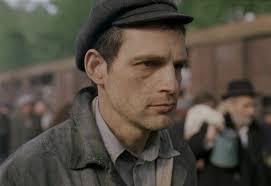
Throughout the film, the main character, Saul, was looking for a Rabbi to say Kaddish over a boy who, apparently, was his son.   In the very beginning of the film, after we see countless bodies against a recurring blurriness that goes in and out of focus (a brilliant device which evinces the struggle to see the dead Jewish body). Amidst all of the dead bodies that are gassed (a scene never disclose in Holocaust cinema until now), the body of the boy is heard, coughing. Saul sees this and notices how the body of the boy is dragged to the side and is choked to death by a Nazi doctor. Following this, Saul goes on a journey from place to place, to find a Rabbi to bless his son after he gives him a proper burial.

The twist of the film is that the Rabbi he finds isn’t really a Rabbi and he never gets to bury his son (whose body, in the latter half of the film, is in a bag, concealed). He loses the bag with his son’s body near the end of the film (while he is being chased after escaping the camp). However, in the very end, he finally smiles when he sees a boy who he takes – according to one reading – to be a sign that his “son” has been received by God.   This is a delusion. However, it shows us that Saul – despite all the madness – keeps to his tradition and wants to give the dead body the respect the Jewish tradition gives to the dead.   The body may be his “son’s” or it may be a symbol. Either way, it evokes the question of tradition as a question of embodiment.

Although one may be distraught by the fact that he didn’t respect the body of every single Jew he saw, the fact of the matter is that his preferential love for his son speaks to the tradition that Wyschogrod writes about. In The Body of Faith, Wyschogrod notes that the election of Abraham is authentic because it is preferential.   While the love of all humanity is abstract, the love for Abraham, Isaac, and Jacob is concrete and embodied. Blaise Pascal knew this when he wrote that his god is the God of Abraham, Isaac, and Jacob.   In this sense, while The Son of Saul was a horrific film which gave the viewer an unscreened experience of death and history by way of an endless display of dead Jewish bodies, it also demonstrated what Wsychogrod sees as the embodied faith of the Jewish people.   Since Saul’s passion was to clean his son’s body, find a Rabbi to say Kaddish over it, and to bury it in the earth, his love for this specific Jewish child expressed his love for the Jewish people – the people who he had to witness being killed on a daily basis.   The film isn’t redeemed by his passion to bury his son’s body in a proper, traditional manner; but it does shows us how any commitment to Judaism after the Holocaust must countenance the death of Jewish bodies. It must rethink the meaning of the Jewish body in the assault against Judaism.

While Eli Weisel figured the “death of God,” with the (texted) image hung body of the Jew in his novel Night, The Son of Saul suggests a visualization of the Jewish body that is much more visceral and compelling. It shows us that post-Holocaust Judaism is not simply a set of doctrines that must be affirmed in the wake of the Holocaust or that we should, as Emil Fackenheim suggests, commit ourselves to a 614 commandment and continue the Jewish tradition despite Hitler’s efforts to destroy Judaism. Rather, it suggests that Judaism starts and ends with the Jewish body.   It also suggests, like Michael Wyschogrod, that the “truth” of the Jewish body – though visualized on the screen – may only be discovered through a Jewish theology.

(That, at least, is how I read it. Because, I, like Wyschogrod, see Judaism as embodied and not disembodied, all of those dead bodies on the screen are not the bodies I see in this or that Tarantino film. Those bodies remind me that my history and my life are tied to the bodies of a people, my people. And I realize that the question of my faith is not tied to this or that doctrine alone; it is fundamentally tied to the Jewish body.)