Gabriel Josipovici on Disenchantment, the Death of the Storyteller, and the Birth of the Novelist

Unknown

Do we still look at and judge ourselves by virtue of a tradition or by virtue of our own private experiences? Perhaps we are too far away from the point in time where we can distinguish between having or not having a tradition? But this all depends on how we conceive of the word “we.” To be sure, millions of people around the globe are struggling with modernity and in doing so their traditions are put to the test by the ultimate modern measuring stick: experience.   Traditions still matter. But what I experience, as a person, defines “me” not “us” if and only if I no longer have a tradition to measure myself against.

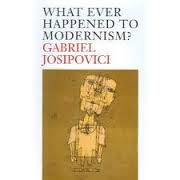
In his book What Ever Happened to Modernism? Gabriel Josipovici argues that, in the face of disenchantment (by virtue of the loss of “tradition” in the European and Christian West), the modernist writer or thinker will have to address the possibility that man may, as Protagoras once said, be the “measure of all things.”   There are two options: humor or despair.   It all depends on how one understands the new relationship between the author and the reader which is based on sharing an experience. Without the “traditional sacraments”(36), we must ask ourselves, as Cervantes did with Don Quixote, what the “art of narrative,” the “most mysterious of arts,” means.   And this will require us to map out and discuss the death of the storyteller and the birth of the novelist.

Citing Marthe Robert, Josipovici argues that the “author” of Don Quixote is “not, like the Homeric bard, a central component of an organization where each one is, by virtue of tradition, both the protégé and the protector of order, but a solitary individual, answerable to no-one but himself, without any faith other than his experience, without any guide other than his intuition”(37).

In other words, the novelist draws on his or her own experience not on tradition. However, Walter Benjamin, in his “Storyteller” essay, points out that the experiences and the goals of the storyteller are different from the novelist. While the storyteller “makes” his experience “the experience of those who are listening to his tale,” the novelist “has isolated himself. The birthplace of the novel is the solitary individual, who is no longer capable to express himself by giving examples of his most important concerns, is himself uncounseled, and cannot counsel others.”

The relationship of the novelist to the reader is more precarious than the relationship of the storyteller to his or her listeners. The community of the story teller is entirely different from the community of the novelist and his readers. To be sure, Don Quixote and his readers do not have a stable community and the reader cannot live their lives by the kind of “counsel” he offers. If they did, their lives would be mired in dreams, delusions, and distractions.

However, that may already be the case.

Even though the reader may distinguish him or herself from Quixote and even thought Quixote recognizes his folly at the end of the novel, the fact of the matter is that we readers went along with him on his journey.   The adventure of experience – in the wake of tradition – does in fact provide some kind of measure and it does offer us some kind of counsel.

Josipovici explains – like Michel Serres – that the point of the book is to keep things moving and that, itself, is a kind of counsel. But, more importantly, is the fact that we – the author and the reader – are moving together on a comical kind of journey:

The real protagonists…are the wrier and the reader, who both undergo adventures enough to last them a lifetime, even if neither ever quite understands what these are. (38)

And this is the main point. Even though we might not know “what” these literary adventures are, we still must go on them for in doing so we can find the only counsel worthy of our attention. In a world in which tradition is challenged, the new communities we form are based on the journeys that we take.   But the best community of all is mired in what Jean-Luc Nancy calls the “inoperative community” which thrives on “literary communism.” What Nancy doesn’t note, however, is that this community, which is based on a kind of comic literary journey, shares the measure that defines it and that measure can only be arrived at by way of taking cognizance of what is happening…as it happens.   But this taking note is always plagued by what is not noticed. And the discovery of these blindspots heightens our sense of what passes us by in each experience. This, I’d argue, is the literary event.

Josipovici correctly notes that despite what the reader thinks of Don Quixote’s foolishness, he or she is complicit.   For in being complicit, one can enchant a world that has been disenchanted. But this enchantment is not magical, mythical, or religious; it is secular and comical.   In the modern world, we delight in the blindspots only because “we” are immersed in experience not tradition.

But for those of us who are immersed in both experience and this or that religious tradition, the novel offers us a way to map out the blindspots that tradition encounters with modernity…and vice versa.   And it is this journey which is even more interesting since religious experience today – in the world of social networking – has the potential of modifying religious tradition.   In this situation, the novelist shares the stage with the storyteller. We have seen such a predicament in the work of Yiddish writers such as Sholem Aliechem and Mendel Mocher Sforim.  But instead of Don Quixote bringing the storyteller-slash-novelist into a relationship with the reader, it is the schlemiel. And while the former is born out of the novelist, the latter is born out of a storyteller who has become a novelist. The question – whether we are talking about Aleichem or Quixote – is how far they are from the tradition.  That distance or proximity will determine the kinds of shared experiences we find in this or that comic novel. But it is the fool who is the medium not the tragic-hero and that is the case because the fool is a creature of experience and tradition.

No End in Sight: Michel Serres on Harlequin, the Errant “Philosopher-Writer”

Unknown

One picks things up as one goes along. And although one may forget this or that thing, he or she may have something fascinating right there in front of his or her face. By working with what one sees, by writing about it, coloring it, in short, interacting with it, something unknown is breached. It is this excitement of interaction with things – seen, touched, heard, read, or written – that the writer and thinker Michel Serres focuses on in his book The Troubadour of Knowledge.   For writers, reading Serres is inspiring since it gives the writer a sense of what s/he is doing, in a philosophical sense, when s/he writes.

The writer, for Serres, “experiences, experiments. He tests, he assays”(79).   The experiments done on language by the “philosopher-writer” are based on the “construction” or combination of words and letters. The philosopher writer is, says Serres, like a (al)chemist. S/he looks for affect. But this experimentation “carries a risk” which is “aleatory, the unknown.” In other words, the philosopher-writer may become dumbfounded. More importantly, Serres says that in experiencing the unknown, the “philosopher-writer” becomes “exposed,” “fragile,” and “naked.” However, in what he calls “unmaking” (or what one might call “deconstruction”) one is “never wrong.”

One exposes oneself when one makes, one imposes oneself when one unmakes. When one unmakes, one is never wrong, in effect. I know of no better way to be always right. I do not believe I know, on the other hand, a better definition of man that the old adage errare humanum est, to which I saw, Whoever makes mistakes is human. At least he tried. (79)

The model for Serres book, which he discusses in the preface is a clown: Harlequin.   After he lies to the audience about the things he has found on his “travels” around the world, Harlequin takes off all his clothes. Each layer of clothing, however, speaks the truth; namely, there is a diversity of color and form in each garment. And when he strips down to his naked body…there are tattoos and his sexuality is ambiguous. His flesh, in the end, is his coat. It is a surface which has taken in many different things over time:

What could the current, tattooed, ambidextrous monster, hermaphrodite and half-breed, make us see now under his skin? Yes, flesh and blood….flesh…Life throws the dice or plays cards. Harlequin discovers, in the end, his flesh. (xvi)

According to Serres, the “miracle of tolerance” is to act “as if” all the things one has become over time don’t change the fact that Harlequin is Harlequin.   And it is this humility and naivite which Serres sees central to being a “philosopher-writer.”

He can “miss, make mistakes, or lose himself,” but that is what happens when one experiments or moves from one thing to the next. Taking risks, one “experiences the pain and courage of wandering in order to pay for newness”(80). Against the dictates of experiences, the “philosopher-writer” must greet every experience as if it were his or her first and experiment with each making suppositions. He doesn’t – like Harlequin doesn’t – care about mistakes. And he will lie just to get things “going.” Whatever it takes, do it. Just move. But there is one rule: “don’t copy.”

He never knows who will enter on the next page. Never mind the fall, he tests! If he loses he will not have done anything wrong, and if he wins he will rejoice. To hell with the mistakes, he essays…Leave, go….Take off your clothes, go down to the field, paly. Criticism is easy, art difficult…Enough said, let’s have acts…..In any case, try. If not, you lie. You will lie, even if you tell the truth, supposing that you are content with talking. Live, taste, leave, do, play, don’t copy. (80)

If we keep moving, traveling over unknown spaces (whether on the page or in reality), and testing what we see, we can become “troubadours of knowledge.” And that, for Serres, is greater than being a scientist.

Although Serres’s enthusiasm for experience, experimentation, and knowledge is inspiring, there is something missing. What seems to be missing is a sense of evil and the ethical imperative that relates to addressing evil. The wandering, aleatory mind that the deconstructionists celebrated misses what Levinas knew so well: the ethical. Levinas’s reading of Don Quixote is interesting in this regard since it is, in his view, the “hunger of the other man” that brings Quixote out of his endless journey.

The Other Side of the Sexual Revolution: Sex, Violence, and History in Michel Houellebecq’s “The Elementary Particles”

images

In Civilization and its Discontents, Sigmund Freud asks his readers to think about the relationship of two drives that are completely opposed: Eros (life) and Thanatos (death).   When one thinks of death one does not think of sexuality and vice versa. To be sure, the act of thinking sexuality in terms of violence is disturbing. The coinciding of the two contradicts the culture we live in and its celebration of consensual sexuality. And it suggests a type of sexuality that is forced or, on the other hand, masochism or sadism.   Just like Freud in his book Beyond the Pleasure Principle, we resist the thought because it is hard for us to understand how anyone can derive pleasure from pain. This phenomenon must be “beyond” the Pleasure Principle (which is based on the avoidance of pain and the maximization of pleasure).   However, Freud’s most important insight, in Civilization and its Discontents, is that even though we don’t want to think about such things, the era we live in forces us to give this relationship some thought.   History, Freud muses, can change how we experience the relationship of sex to violence.   War and revolution make things possible that, in the past, were not.

We live in a different era. Freud wrote Civilization and its Discontents in the wake of World War I and amidst new, dawning awareness of sexuality in Europe (which he helped to spur).   I was born in the wake of a number of different revolutions in the 1960s.   One of the legacies I received from my parents’ generation was the power of peace and love to overcome any obstacle. The slogan, “Make Love Not War,” comes to mind. The 60s also opened us up to political movements that supported gay rights and celebrated all forms of sexuality. But what I seldom heard about was one of the darkest legacies of the sexual revolution and the sixties generation: its experimentation with sex and violence. And I’m not just talking about masochism or sadism but something more disturbing.

French writers, poets, and artists are familiar with the topic of sex and violence.   Read a random passage from Marquis deSade, Charles Baudelaire, or Jean Genet and one will likely come across a reflection on this theme. Michel Houellebecq can be added to this list. In the work of the above-mentioned writers there is a literary, philosophical, and psychological reflection on sex and violence, but in Houellebecq’s The Elementary Particles, there is more of a focus on how an era may have affected the relationship of sex to violence. It opens up possibilities that, before then, didn’t exist.

Bruno, one of the main characters of the novel, is directly implicated by both legacies. His mother was involved in a cult that spread from France to California (and vice versa).   He and his brother Michel had the same mother and father but, since she left for California (only to return later in her life), they were raised by different relatives (Bruno was raised by the grandmother while Michel was raised by the father).   While Bruno is oversexed, Michel is not.   Bruno is in seek of truth and meaning by way of sexuality while Michel is interested in science. He has no interest in the truths that may be discovered by way of sex or love; Michel wants knowledge. These are two differing responses to their mother’s – and their era’s – aberrant and free flowing sexuality.   But there is another dimension to the sexual revolution that the narrator of the novel foreshadows earlier in the book: the violent one.

Throughout the novel, we see that Bruno is sexually frustrated in his middle-age. He is perverted and seems unable to go beyond fantasizing and masturbating. However, near the end of the novel, Bruno meets a middle-aged woman (Christine) who, like himself, loves sex and finds meaning through sex. Regardless, the narrator tells us that the meaning of sexuality must compete with Bruno’s cynicism.

Over the years he had developed a cynical, hard-bitten, typically masculine view of life. The universe was a battle zone, teeming and bestial, the whole thing enclosed within a hard, fixed landscape – clearly perceptible, but inaccessible: the landscape of the moral law. It was written, however, that love contains and perfects this law.   (170)

But there is a twist. This reflection on cynicism emerges out of a reflection on an era. When Bruno discovers that Christine was also exposed to the cult, they discuss the last days of the cult. When the leader of the cult, David Di Meola is near death, Christine’s parents have her visit him:

My idiotic parents were part of the same liberal, vaguely beatnik movement as your mom was in the last fifties. They probably knew each other.   I have nothing but contempt for them, in fact I hate them. They’re evil – everything they’ve done is evil, and believe me I know what I’m talking about…Two weeks after I got there, he took poison, something mild that took hours to work, and than asked to see everyone on the estate one by one….When my turn came (to see the dying cult leader) I was very moved, but he asked me to unbutton my blouse. He looked at my breasts and he tried to say something I couldn’t make out…Suddenly he reached up to touch my breasts. But I didn’t stop him…the only thing I could see in his eyes was fear. (169)

Christine goes on to note how, David Di Meola – the son of the sexual cult leader -burnt the body of his father after he dies. Her recollection of the experience is hard to read.   She notes how “everyone starts to dance” around the burning body and “everyone took off their clothes”(169).   Christine tries to run off from this mad sexual scene of celebrating death but is taken by the shoulders and dragged back to the fire to look at “what was left of the body”(170).

In response to hearing this, we learn that Bruno is fascinated with what happened to David Di Meola. For four pages, he discusses the “trial in Los Angeles” of Di Meola who had become a Satanist, was involved in countless violent acts of sexuality and murder, and had created violent home videos recording his violence:

The video showed to the jury was of the ordeal of an old woman, Mary McNallahan, with her granddaughter, an infant. Di Meola dismembered the baby in front of the grandmother with a pair of clippers, than ripped out of one of the woman’s eyes with his fingers and masturbated into the bleeding socket. He had a remote control camera in his other hand and used it to zoom right in on her face. (170-71)

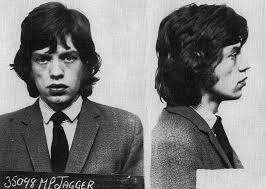
Bruno then cites a book entitled From Lust to Murder: A Generation, to illustrate the new historical possibilities that were opened up by David Di Meola’s violent sexuality.   The book notes how David Di Meola, a rock musician, had taken after Mick Jagger and Brian Jones of the Rolling Stones (171).   He was a part of a larger historical trend – that grew amidst war and the sexual revolution – that was looking to experiment with violence and sexuality:

Jagger was the biggest rock star in the world: rich, adored, cynical – he was everything David longed to be. To be seductive, he had to personify evil, to be its perfect embodiment – and what the masses adored above everything was the image of evil unpunished. (171)

The book (within a book) discusses how Brian “knew” that Mick Jagger “sacrificed” (murdered) Brian Jones in order to lead the band: “David was convinced that man’s greatest achievements were based on murder, and by the end of 1976 he was ready to push as many people as he had to into swimming pools as he could find in order to succeed”(171).

We also learn that David became a Satanist, experimented with sex, violence, and murder, and met with Charles Manson. He “sought” Satanic cults out. After discussing “abortion parties,” in which the people at the party would eat a “ground up fetus,” the narrator describes the Satanists as “pure materialists.”   At a certain point, they leave Satanism and its symbols behind for the act of evil itself.

Like him, they were pure materialists who quickly abandoned all the ritualistic kitsch of pentagrams, candles and long black robes, trappings which were mostly there to help initiates to overcome their moral inhibitions. (172)

It is this violent “pure materialism” that the narrator tries to situate in a historical context.

Like their master the Marquis de Sade, they were pure materialists – libertines forever in search of new and more violent sensations.   According to Macmillan (the author of the book), the progressive destruction of moral values in the sixties, seventies, eighties and nineties was a logical, inevitable process. Having exhausted the possibilities of sexual pleasure, it was reasonable that individuals, liberated from the ordinary constraints of ordinary morality, should turn their attentions to the wider pleasures of cruelty. (174)

He concludes that “actionists, beatniks, hippies, and serial killers were all pure libertarians who affirmed the rights of the individual against social norms and against what they believed was the hypocrisy of morality, sentiment, justice and pity”(175). With this in mind, Bruno cynically notes that “Charles Manson was not some monstrous aberration in the hippie movement, but its logical conclusion; and what David di Meola had done was nothing more than to extend and put into practice the principles of individual freedom advocated by his father”(175)

The narrator tells us that Christine had “listened closely” to Bruno’s reading of history and the legacy of the sixties generation.   Her “silence,” however, “was pained.” And the reader can only assume that it was pained because it hit something deep inside her that she knew was painful…but true. The last words of the chapter tell us the decision that she and Bruno are now making. They are not taking on the legacy of the 60s and its “pure-materialism” which came to its “logical conclusion” in Charles Manson and David de Meola: “It was time to return to simple pleasures”(176).

While Freud’s Civilization and its Discontents should prompt us to think about the relationship of sexuality to violence, Houllebecq’s Elementary Particles should spur us to think about what historically has become possible vis-à-vis the confluence of sexuality, violence, materialism, and freedom.   It also prompts us to think about whether we, like Christine and Bruno, should “return to the simple pleasures” or whether we will be condemned to repeat the same conclusions. Moreover, what is implied by such a turn? Is it spiritual or cautionary? Is it done out of exhaustion or insight? What is at stake?

A Priest and a Schlemiel Get on the Slowpoke Express: On Sholem Aleichem’s “The Miracle of Hoshana Rabbah”

Unknown

In the United States and Europe, the advent of the train and long distance travel prompted many artists, storytellers, and thinkers to turn the train into a metaphor.   Sometimes the images are exciting and feed utopian visions and cause happiness, other times they feed sadness at the loss of what was and cynicism. Think for instance of Freud who, in Civilization and its Discontents, writes the following:

If there were no railway to make light of distances, my child would never have left home, and I should not need the telephone to hear his voice. If there were no vessels crossing the ocean, my friend would never have embarked on his voyage, and I should not need the telegraph to relieve my anxiety about him. What is the use of reducing the mortality of children, when it is precisely this reduction which imposes the greatest moderation on us in begetting them, so that taken all round we do not rear more children than in the days before the reign of hygiene, while at the same time we have created difficult conditions for sexual life in marriage and probably counteracted the beneficial effects of natural selection? And what do we gain by a long life when it is full of hardship and starved of joys and so wretched that we can only welcome death as our deliverer?

On the other hand, one of the most celebrated images of trains in the early 20th century can be found in Buster Keaton’s film The Goat (1921) where he escapes the police by way of unhitching a train and drifting away.

The train can be the schlemiel’s best friend. Ten years before Buster Keaton put out his film, Sholem Aleichem put out the Railroad Stories (1911). In his story, “The Miracle of Hoshana Rabbah,” the main character, a schlemiel named Berl Vinegar – much like Buster Keaton – averts a disaster by way of a train. But he doesn’t do so by way of his will so much as by virtue of…chance.

Sholem Aleichem prefaces this story with a chapter entitled “The Slowpoke Express.”   This train, Aleichem tells us, is built for the type of speed that Eastern European Jews (before the Holocaust) or rather schlemiels like to travel into modernity – slowly.

Would you like to know what the best train of all is? The best, the quietist, the most restful?

It’s the Slowpoke Express. (Tevye the Dairyman and Railroad Stories, 184)

Like Mendel Mocher Sforim’s Benjamin the IIIrd and Sendrl, the train doesn’t often reach its destination and is never on time. It’s a schlemiel-train:

The Slowpoke Express is no ordinary train. In the first place, you needn’t ever worry about missing it: whenever you arrive at the station, its still there….I’ve been riding the Slowpoke Express for several weeks now, and I’m still practically in the same place. I tell you, it’s magic! Don’t think I’m complaining, either. (184)

Regarding this train, the Jews in the town (the Bohopolians, Aleichem calls them) feel that the train is so much better than other trains because “there’s no danger of the accidents that occur on other lines. The slower the safer, they say”(185).

Playing on this claim, Aleichem, the narrator, makes his own. Namely, that he has it, “on good faith,” that “the Slowpoke was indeed involved in an accident, a veritable catastrophe that sowed panic up and down the line and set the who district by the ears.   The incident was caused by a Jew and – of all people – a Russian priest”(186).

Aleichem tells us that the “great train accident” happened on Hoshana Rabbah.   The holiday marks the end of a span of time in which the Jewish people can plea for a good new year (which spans Rosh Ha’shanna – the Jewish New Year – Yom Kippur – the Day of Atonement – and Sukkoth – the festival of the tabernacles). On Hoshanna Rabba one puts in one’s final kvitel (a final, personal note to God for mercy and a good year).

Aleichem tells us that after praying at synagogue and putting in his kvitel, “a Jew” went to stand by an “unchained locomotive.” He was simply curious and wanted to see if anyone would go to the Slowpoke Express that morning. But, what, the narrator wonders, does he expect to see?

Just what does he hope to see that’s so exciting – another Jew like himself from Teplik? Or a Jewess from Obodivke? Or a priest from Golovonyevsk? Jewish pleasures! But it was the custom to go, and go this Jew did. And in those days, don’t you know. The railroad was new; we weren’t used to the Slowpoke yet and were were still curious about it. (188)

At the station, the Jew runs into a “Russian priest from Golonovnyevsk.”   The priest insults the Jew by calling him “Yudko” and asking him what he’s looking at. The Jew “retorts angrily” and tells him that his name is Yudko, its Berko (a nickname).

This comical exchange leads to the topic of how a train works. Since “Berko” is a schlemiel of the luftmensch variety (he makes a sells vinegar but has no formal education) he acts “as if” he knows how the train works (because, after all, he knows how to make vinegar).   The priest insults Berko again and says that he doesn’t know anything about the train. He forgets the Jews name again, but Berko reminds him and this prompts him to be more bold in his assertion of knowledge.

Berko then proceeds to get on to the train with the priest and show him that he knows what he’s talking about.   After tinkering with a few switches, the train starts moving. The schlemiel, excited, thinks he has pulled one over on the Priest. Meanwhile, the onlookers are astonished that the Slowpoke Express is actually moving:

I hardly need to tell you what pandemonium broke out among the passengers in Sobolivke station when they saw the uncoupled locomotive mysteriously take off on its own. (189)

The whole won panics. Meanwhile, the Priest and Berko (“Berl Vinegar”) realize that Berko doesn’t know how to operate the train and can’t stop it from hurtling itself to disaster.

To bring out the difference between perspectives as a topic in the story, Aleichem notes how the people imagine the worst and make up stories about its disaster or what was going on inside of it…while it was still traveling along the tracks!

That’s when the real shindig started. What could be the meaning of it? A Jew and a priest in a runaway locomotive? Where were they running away to? And why? And who could the Jew be? (191)

When they learn that it is Berl in the train, they take the schlemiel for a shlimazel and see a tragic rather than a comic ending. However, what happens flips their tragic expectations on its head.

As they near their impending death, an argument between the Priest and Berl over death and judgment.   Berl has the last word by arguing that on Hohsana Rabbah he accepts whatever God decides.   He prays for the best to happen but…it may not happen if God so decides.

After saying this, a miracle happens: the train runs out of steam.

Berl takes this miracle as a lesson about man: “If he doesn’t get anything to eat…” he “runs out of steam and kaput”(194).   But that seems to be the wrong lesson. If the train didn’t run out of steam the schlemiel and the priest would be dead.   His insight may be off, but it shows us what matters.

The schlemiel’s happiness is contingent on chance; and more often than not, he averts disaster and gets lucky.   And like many a schlemiel, Berl got himself into this mess by thinking that he knew better.   Even so, since he is a good, simple soul, who lives a life based on chance, he survived.     But the real issue is the outcome. The people expected a disaster and the priest looked down on the Jew and his lack of intelligence. In the end, goodness and not negativity and tragedy win.

On this note, Aleichem tricked his reader by announcing – at the outset of the story – that there was a train disaster. He lied because he knows that people are more naturally interested in tragedy than comedy.   The point, for Aleichem, is not to increase our natural cynicism but to challenge it. That way, we can experience the wonder of possibility.   In any situation, something good can always happen and that, in a world full of tragedy (remember Aleichem was writing when the Pogroms were in full swing and Jews were fleeing Eastern Europe for America and other destinations), its harder to entertain this possibility since its not the way of things. Nonetheless, that’s were salvation (hoshana) comes in.   For Aleichem, it’s “Jewish” to believe that good things can happen…despite the fact that reality – like a predator – looks back at you with contempt.

Lest we not forget, all of this happens on a train, on the Slow Poke express.  The irony is that schlemiel – and not a well-trained conductor – gets the train going.  Perhaps that’s what Aleichem dreamed of…a schlemiel at the head of the train. But that dream, it seems, can only come true in fiction….unless we are schlemiels like Berl. If so, perhaps we also get lucky because…the train is speeding fast into the future and it doesn’t seem like it will lose steam. A schlemiel can’t stop the train.   Perhaps, nothing short of a miracle can save us from crashing.  But why imagine the worst? That’s too easy.

Cynical, Middle-Aged, Oversexed, and Alone After the Sexual Revolution: On Michel Houellebecq’s “The Elementary Particles” – Part II

Unknown

I love seeing new faces whether they are real or, as in reading a novel, virtual. What interests me most – in both reading faces and reading literature – is when glances are exchanged. When someone or something looks at you how do you look back? And what happens when the person you’re looking at, as in a dream, seems a lot like you and yet a lot different?  Do you confront the gaze or do you walk away in fear?

Reading Michel Houellebeq’s Elementary Particles, I feel as if the book is looking back at me like a strange animal. I partially identify with this or that aspect of the two main characters Bruno (a middle aged retired French literature teacher) and Michel, his brother (a middle aged microbiologist). The two characters are so different from each other and from me.   However, there are things that I identify with such as: the crisis of identity that comes with growing older, with the aging body, with the changing attitudes toward sexuality, and with the meaning of life in the face of death and decay.

Although there are many points of identification, Houellebecq prompts his reader to draw the line with sexuality and perversion. This technique creates a complicated identification with the character which echoes, in many ways, what we see in Dostoevsky’s Crime and Punishment.   I contend that we draw the line through reading the text in a way that at one and the same emphathizes with the character and is repulsed by it.

Houllebecq is a lot like Charles Baudelaire, who, in 1848 wrote in his journal that “when I have inspired universal horror and disgust (through poetry and fiction), I will have conquered solitude.”     By experiencing disgust at Bruno’s sexual frustration and desperation, Houllebecq is not simply “conquering solitude,” he is also creating solitude for his reader since, by moving away from the character, the reader has a deeper sense of difference and solitude.  He or she becomes – like an elementary particle – atomized.

For this reason, Houellebecq explicitly notes how Bruno, who is looking to have sex with younger women, is surrounded – in the refuge for those in search of enlightenment and sex, the Lieu du Changement – by other 40 year olds. This frustrates him to no end because it painfully reminds him that he is alone and desperate like the others. They have too much in common!

Many of the people who went to the Lieu du Changement were, like Bruno, over forty, and many, also like him, worked in the public sector or in education and were safeguarded from poverty by their status as civil servants.   Most of them would have put themselves on the political left; most of them lived alone, usually as the result of divorce. He was, therefore, a pretty typical visitor.   (106)

The narrator tells us that he was so frustrated with actually meeting a younger woman and having sex with her (after all, he is, as I noted elsewhere, a pervert) that he gives up on his fantasies and accepts these older women.

After a few days he noticed that he felt somewhat less bad than usual. The women were tolerable at breakfast but by cocktail hour the mystical tarts were hopelessly vying with younger women once again. Death is the great leveler. (106)

After accepting his mortality in such a crude manner, he meets “Catherine, a fifty year old who had been a feminist of the old school. She was tanned, with dark, curly hair; she must have been very attractive when she was twenty”(106). While she is talking about “Egyptian symbolism” to someone, “Bruno lowered his boxer shorts; he decided she probably wouldn’t be offended by his erection and that they might become friends”(107).   This ridiculous fantasy is comically shattered when he realizes that “unfortunately, the erection didn’t appear.” And, to make things worse, the narrator adds insult to injury by noting her body’s response to his: “She had rolls of fat between her thighs, which remained closed. They parted on less than friendly terms”(106).

Following this embarrassing moment, things only seem to get worse for Bruno. We can have no doubt that Houellebecq brings one mad event after another upon Bruno because he, like Baudelaire, is trying to inspire “universal horror and disgust.” And this preponderance drives us to feel compassion and repulsion at Bruno’s situation and character.

In the midst of his sexual frustration and existential alienation, Bruno meets “Pierre-Louis…a math teacher.” Pierre-Louis is awkward looking: he “usually wore a sun hat. He was at least six foot four and skinny, but he had a bit of a paunch and made a curious sight walking along the diving board with his fat little belly. He was probably about forty-five”(107). Pierre-Louis has a corny sense of humor and many people feel sorry for him. He is a worse wreck than Bruno, who wants to stay away from him: “In the days that followed, Bruno had managed to avoid him on several occasions” (107).

But at a certain point the two end up sitting at the same table. Bruno’s irritation at this proximity, as described by the narrator, is meant to prompt the reader to feel repulsion of Pierre-Louis’s character. The narrator conveys the experience of shock (not the character) at seeing Pierre come out of the fray to sit with Bruno. And this creates an odd kind of (mis)identification with the reader:

Pierre-Louis appeared at the far end of the row of tables; he beamed when he noticed a vacant chair opposite Bruno. He had been talking for some time before Bruno noticed, partly because he had a rather bad stammer, and partly because of the shrill nattering of imbeciles next to them…The meal was beginning to get on his (Bruno’s) nerves; he got up to go out for a cigarette. Unfortunately, at precisely that moment the symbolists (a mocking expression for the people talking about Egyptian symbolism) left, hips swinging, without so much as a glance in their direction. This probably is what triggered the incident. (107)

When the narrator writes, “the incident,” the reader, as in a reader of horror, understands that something traumatic is about to be disclosed. And it does.

The narrator tells us that Pierre-Louis, now alone on the table with Bruno, has a mental breakdown:

Pierre-Louis was red-faced, his fists balled; from a standing start, he leapt onto the table with both feet. He took a deep breath and the wheezing from his chest stopped. He started to pace up and down the table, thumping himself on the head with his fist as the glasses and plates danced around him. He kicked out at everything with reach screaming, “You can’t do this! You can’t treat me like this!” For once he didn’t stutter. It took five people to calm him down. He was admitted to the psychiatric ward of the hospital…that evening. (108)

It is in the wake of this breakdown that Bruno starts his descent into nothingness. This is all the more powerful because Pierre-Louis speaks some kind of truth to Bruno; he is, in many ways, his double. But now he is gone. What will happen to Bruno? Will he also go mad?

The narrator recounts the internal battle Bruno has with himself with respect to why he went to the retreat and how unsuccessful he has been. His fantasy, it seems, has been smashed.

The circumstances were very different now: he had chosen to come to the Lieu; chosen to take part in its activities…All around him human beings were living, breathing, striving for pleasure or trying to develop their personal potential. On every floor, human beings were improving, or trying to improve. (108)

The implication of these words is that Bruno has chosen to go there but he is alone; he doesn’t feel like they do, he isn’t striving to become better. And instead of making him angry, this reflection only makes him “sleepy”(108). The narrator tells us why this thought has exhausted Bruno; but, according to the narrator, Bruno’s alienation brought him a kind of happiness.

He had stopped wishing, he had stopped wanting, he was nowhere. Slowly, by degrees, his spirit filled to state of nothingness, the sheer joy that comes of not being part of the world. For the first time since he was thirteen, Bruno was almost happy. (109).

“Almost” is the operative word. The next day Bruno awakes a feels sexual frustration once again. His separation from the world, as a separation from the opposite sex, makes him feel horrible.   It makes him more cynical and misanthropic.

The gaze that looks back at the reader is one that comes from “the incident” and Bruno’s frustration prompts the reader to feel empathy and repulsion by Bruno’s experiences of someone else’s mental breakdown and his unbearable situation.

Houllebecq wants us to ask ourselves how we should respond to the gaze of the text. He prompts his reader to think in doubles and by way of possibilities. If Bruno were, like his brother, the microbiologist (Michel), would he able to separate from the world and study it on a scientific level? Would Bruno, if he were like Michel, suffer? These questions are challenged at the end of the novel when Michel watches a woman he had known since childhood and had met again later in life goes through a horrible experience.  Although he doesn’t totally understand love, he agrees to live with her and have a child with her.  But the child miscarries and, as a result of the attempt, she dies.  He ends up intimately experiencing the suffering and death of someone close and, for the first time, starts to experience emotions.

Bruno seemingly has a better end. After being brought to the edge of self-destruction (because of sexual frustration), Bruno is saved by Catherine who, as we saw above, was turned off when he flashed her.     They end up becoming sexual intimate and Bruno becomes less and less frustrated.

However, Houellebecq, like Baudelaire, usually gives cynicism the last word. For this reason, Houellebecq also has Bruno suffer in the end.  We bare witness to Bruno as he learns, watches, and experiences Catherine’s death after he decides – with her – that they should move in together and start a new life.

Both Bruno and Michel had an opportunity to start a new, different life. But in the end they are both robbed not just of women they loved (or tried to love) but of the world. And it is this loss that Hollebecq amplifies throughout the novel by way of his crude descriptions of aging, sexuality, failure, and frustration.   In the end, all the characters are unhappy and in pain.

The gaze that looks back at us in Elementary Particles is that of a dog.   It is the gaze of cynicism. And it has weight. The question we need to ask ourselves is…how do we look back?  Like these characters, the reader looks back at the text and feels as if s/he has, in its gaze, become….atomized.

Do I Know You? I Can’t Remember: Zizek on Autism, Alzheimers, Psychosis and Post-Traumatic Birth

Unknown

What can we learn from madness? And what does it imply when thinkers, writers, or artists suggest that we go mad or look to the mad for truth or insight? Many Continental writers, artists, and thinkers have found madness a source of thought and reflecting. Think of Antonin Artaud, Friedrich Nietzsche, or George Bataille. Think of Michel Foucault’s History of Madness, Gilles Deleuze’s schizo-analysis, or Maurice Blanchot’s essays on madness.   Slavoj Zizek has also ventured into this territory. In his book, The Event: A Philosophical Journey Through a Concept, Zizek suggests that we pay close attention to the “birth” that emerges in the wake of psychosis, autism, and alzheimers.   This birth, in the wake of mental destruction or trauma, is an example of what he calls “the event.”

Using Lacanian language, Zizek turns to psychosis as giving the subject “passage” from the Real to the Symbolic:

The true point of “madness” is thus not the pure excess of the “night of the world,” but the madness of the passage to the Symbolic itself, of imposing a symbolic order on to the chaos of the Real. (Freud, in his analysis of the paranoiac judge Daniel Paul Schreber, points out how the paranoiac ‘system’ is not madness, but a desperate attempt to escape madness – the disintegration of the symbolic universe – through an ersatz universe of meaning.) If madness is constituative, than every system of meaning is minimally paranoiac, ‘mad.’….What is the madness caused by the loss of reason when compared to the madness of reason itself? (85)

Building on this, Zizek argues that we are daily beset by trauma:

First, there is external physical violence: terror attacks like 9/11, the U.S. ‘shock and awe’ bombing of Iraq, street violence, rapes, etc, but also natural catastrophes such as earthquakes, etc (85)

He also lists diseases and brain tumors such as Alzehimers, organic cerebral lesions, etc side by side with “social-symbolic violence through social exclusion.” All of these forms of trauma give birth to the post-traumatic subject who, as he argues (in a Hegelian manner), survives its death.

A post-traumatic subject is…a victim who, as it were, survives its own death: all different forms of traumatic encounters, independent of their specific nature (social, natural, biological, symbolic), lead to the same result: a new subject emerges which survives death (erasure) of its symbolic identity. There is no continuity between this new post-traumatic subject (the victim of Alzheimer’s, say) and its old identity: after the shock, a new subject emerges. (86)

Zizek describes this subject as Zombie-like:

It features a lack of emotional engagement, profound indifference and detachment; it is a subject who is no longer ‘in-the-world’ in the Heideggerian sense of engaged embodied existence. The subject lives death as a form of life. (86)

While this post-traumatic zombie may seem monstrous for many a reader, Zizek celebrates the post-traumatic subject as a “new birth” and as “living proof” that a “subject cannot be identified” with the “stories it is telling itself about itself.” The subject of Alzheimer’s is what Zizek is alluding to here as the clearest example of this new birth. What remains, according to Zizek, is the “pure subject.” And it is the “erasure of content,” especially in a living person with autism or Alzheimers – that for Zizek is terrifying for “us” since we see a “living-dead” subject.   When we look at an autistic person or someone suffering from Alzheimers, says Zizek, we have a sense that “nobody is home.”   And this feeling exposes us to a process that is far away from the world which bases itself on maintaining stories about itself and identity.

But what do we learn from this “new birth”? Zizek indirectly suggests that by exposing ourselves to this worldless post-traumatic subject that our “frameworks”(based on technology, culture, ideology, etc) will rupture and that we too may go through this journey.   The problem, however, is that in doing so our “memory” will be erased. To be born anew, means that the previous narrative we lived by must be destroyed. We must feel a vertigo of sorts, but this must be at the expense of history.

And this is troubling.

What would Zizek say about people or groups that develop narratives from out of the past? Even though a narrative may challenge a dominant narrative, will it completely or should it completely erase that past narrative? And isn’t a new narrative being created? Will that new narrative – regardless of what subaltern space it emerges from – also need to be destroyed if it is to become “pure subjectivity?” More importantly, how can people relate to each other if they are without a narrative or if they have lost all memory?  They would look at each other, scratch their heads, and wonder: Do I know you? I Can’t remember.

Gastronomic Blasphemy: Yom Kippur on Broad City and Yidlife Crisis

Unknown

It’s hard to know what to make of Ilana Glazer and Abbi Jacobson’s latest video-clip on Yom Kippur.   On the one hand, I am somewhat-astonished that they would portray themselves as even keeping Yom Kippur. (Somewhat because…nothing on the show is really meant to astonish anyone. The comedy is centered around their half conscious indifference toward just about everything. And their petty first-world-problems in New York City, which they take as meaningful, make me – and many others – feel cynical.) On the other hand, the fact that they even try to do Yom Kippur – because it is “Jewish” – is not astonishing at all and hits on a transgressive theme we find in some Jewish comedy.

The sacrifice they make in this episode is – of course – ironic. For one day, they won’t simply fast; rather, they won’t eat their bacon, egg, and cheese sandwiches which are, throughout the clip, within the viewers frame and are within their reach.

Both Ilana and Abbi are endearing.  When they recount their bad deeds (Ilana calls that act a “Jewish” thing) we can see that they are comically naive.  They are, like children, a little naughty.  (Think of the tradition popularized by Mark Twain of the good little bad-boy.)  The “worst” thing done – at least for the moment – is Ilana’s trick on Abbi. While Ilana distracts her by asking Abbi about her Oprah poster, she sneaks a bite from a granola bar.

The conversation turns toward a discussion of blow jobs because Abbi said she “wishes she had something in her mouth.” Ilana distracts her a second time and takes a shot of whip-cream in her mouth. Abbi catches her.

But it’s too much, says Ilana. She’s dying. She can’t fast any more, so she and Abbi come up with a comical “loop hole” of sorts. If they don’t eat their ham-and-cheese sandwiches, they may be doing something deeply wrong. To kill the guilt and fear they just concocted, they quckly eat their sandwiches.

They feel good after doing it. And that’s really what its all about on Broad City: feeling good about what you do, whatever that is, even though that feeling is, like all else on the show, a passing amusement.

Rather than read this as simple blasphemy – what, after all, is worse than eating on Yom Kippur? – we can read in their gestures as indicative of a kind of Jewishness that is based on something American: always doing what one wants. After all, American Jews are free and…not just Jewish. This theme is nothing new.   Yid Life Crisis plays with the theme of eating on Yom Kippur in its first episode.

The difference – it seems – is Jewish literacy. While Abbi plays a foil to Ilana, in the end she gives in. And they share in the “deed.” In Yid Life crisis, the same thing happens. But, at the very least, they are speaking Yiddish. Either way you roll it, the jokes “edginess” is based on a kind of blasphemy. But one is more indifferent and illiterate than the other.

The kind of Jewishness that has the upper hand is “gastronomic.”  On this note, Ted Merwin, a scholar who just published a book entitled Pastrami on Rye: an Overstuffed History of the Jewish Deli, thinks that the “gastronomic” type of Jewishness is having its last gasps.     Jewishness, he thinks, needs to turn elsewhere if it is to survive.

What’s fascinating about both of these clips is the fact that instead of eating Jewish food, all the characters eat treif.   But can the celebration of treif and the transgression of Yom Kippur spell out the survival of Jewishness? Can turning transgression of food taboos, ironically, give life to a new kind of “edgy” and comical Jewishness?   And what does it imply that the survival of Jewishness must be at the expense of Judaism which it should continuously mock?

The practice of mocking Judaism is nothing new. The indifference to things that are Jewish by American Jews, however, is.   And while Yid Life crisis pitches all of its shows to Jews with a strong sense of Jewishness, Broad City has a wider audience. And its Yom Kippur episode is a drop in the American bucket.   In the end, it seems more and more obvious that happiness is greater for many American Jews than Yiddishkeit. (The millennial generation, which is appealed to by Broad Street, is after all the audience.)  With this in mind, I can, in fact, say that I am surprised by that Broad Street would even stage this Yom Kippur transgression.  Perhaps there is still hope.

If people still keep something Jewish, then there can be a punch line. If they don’t, I wouldn’t expect Broad City, Seth Rogen, Judd Apatow, et al to tell any Jewish jokes in the near future.   One wonders, like Noah Baumbach, whether many millennials even care.

Wrestling, the Spectacle, Politics, and the Desire for Justice

Unknown

Nearly every day, one can find an article discussing Donald Trump as a political spectacle. This morning, I saw a tweet by Salon.com likening the appeal of his political campaign to “Reality TV.” And just yesterday, I saw an article that evoked Roland Barthes celebrated reading of wrestling – in his book Mythologies – as a way of understanding Donald Trump’s political appeal. The reading, by Judd Legum, hit on some important points made my Barthes that do, in many ways, explain why Trump is so popular. He does this, especially, by noting Barthes distinction between the Boxer and the Wrestler.  I’d like to make a more detailed reading.

The key to the distinction between the Boxer and the Wrestler deals with the effacement of narrative and narrative time by the spectacle. Since what matters for the public is not “what it thinks but what is sees,” the public wants to leap over narrative. It wants the immediacy of the embodied spectacle. It is something which everyone understands. It appeals, so to speak, to “common sense.”

This public knows very well the distinction between wrestling and boxing; it knows that boxing is a Jansenist sport, based on a demonstration of excellence. One can bet on the outcome of a boxing-match: with wrestling, it would make no sense. A boxing- match is a story which is constructed before the eyes of the spectator; in wrestling, on the contrary, it is each moment which is intelligible, not the passage of time… The logical conclusion of the contest does not interest the wrestling-fan, while on the contrary a boxing-match always implies a science of the future. In other words, wrestling is a sum of spectacles, of which no single one is a function: each moment imposes the total knowledge of a passion which rises erect and alone, without ever extending to the crowning moment of a result. (18)

The passion and immediacy, notes Barthes, comes out of what Charles Baudelaire calls the “grandiloquence of gesture.” The focus is not on narrative and not on intellectual content; it is on the body. Barthes points out that the body of the wrestler signifies immediately.   He describes the body of “the salaud, the bastard,” which appears repugnant.

Not only is ugliness used here to signify baseness, but in addition ugliness is wholly gathered into a particularly repulsive quality of matter: the palid collapse of dead flesh. (17)

The physique of the wrestler is, as Barthes notes, “preemptive.” It makes people shout out for something to be done to the body. The body is not about quality; it is about intensity and quantity. And the gestures of the wrestler are, as Barthes suggests, “diacritical.”

Wrestling is like diacritic writing: above the fundamental meaning of his body, the wrestler arranges comments which are episodic but always opportune, and constantly help the reading of the fight by means of gestures, attitudes, and mimicry which make the intention utterly obvious. (18)

Barthes is fascinated with this obviousness because it brings out things that are otherwise complicated, like evil, and makes them available to all viewers. And wrestling does so in an excessive manner:

What is displayed for the public is the great spectacle of Suffering, Defeat, and Justice. Wrestling presents man’s suffering with all the amplification of tragic masks. The wrestler who suffers in a hold which is reputedly cruel (an arm-lock, a twisted leg) offers an excessive portrayal of suffering. (19)

Moreover, Barthes argues that the wrestler shows the audience the “conditions of suffering,” which, were they to be articulated in a narrative, would be more obscure.   More importantly, these conditions are displayed on a body. And when they are shown, they do not appear as a “conventional sign” so much as a “duration”(21). And in being a duration, Barthes tells us that the hits inflicted on the body call for “justice.”

But that justice differs in France and in America.

According to Barthes, the fight is more “ethical” in France, while being “political” in America. In America there is a “sort of mythological fight between Good and Evil (of a quasi-political nature, the ‘bad’ wrestler always being supposed to be Red). The process of creating heroes in French wrestling is very different, being based on ethics not politics”(23). In other words, the blows dealt to the “bastard’s body ” differ based on the location of the wrestling match and the country’s interests.

But whether it is America or France, Barthes suggests that the appeal to justice is an appeal to common sense:

In wrestling, nothing exists except in the absolute, there is no symbol, no allusion, everything is presented exhaustively.   Leaving nothing in the shade, each action discards all parasitic meanings and ceremonially offers to the public a pure and full signification, rounded like Nature. This grandiloquence is nothing but the age-old image of the perfect intelligibility of reality. (25)

In this sense, religion is like myth since everything: good and evil, right and wrong, is visible to the viewer. When wrestling comes into the ring of politics, we have what Walter Benjamin would call the “aestheticization of politics.”   This common sense, so to speak, is focused on the body and the theater is measured or quantified by blows and gestures.

On this note, it is a fascinating to see how the blows to the body are also made into a major theme by Ta-Nehisi Coates in his book Between the World and Me (one can read a major part of the book here). But in his book as opposed to wrestling as  portrayed by Barthes, the black body doesn’t receive justice; it just gets beaten.  For Coates, the “dream” (read, the myth) obscures the fact that the black body has not received justice.  He wants his son – and the reader – to see that the match is rigged.   This is common sense to “me” (to an African American  named Te-Nehisi Coates) but it is not common sense to what Coates calls “the (white) world.” This shows that what may be common sense for some, may not be for others. Regardless, it is the body which is the focus and the image of justice that is desired.

But it is the complicated nature of Evil and justice which is not seen in all its true cruelty. And that, suggests Coates, has to do with the fact that America cannot let go of its “divine narrative” and “innocence.” Wrestling, it seems, wants to preserve it and so, it seems, does a certain variant of politics that we are seeing these days. After all, we would all love good and evil to be given immediate form and to know what is what and which is which. Without this desire, what meaning would the spectacle have for Americans?

Cynical, Middle-Aged, Oversexed, and Alone After the Sexual Revolution: On Michel Houellebecq’s “The Elementary Particles” – Part I

Unknown-2

Many cultural critics and artists have taken to the subject of what has happened to American culture (and Western culture) in the wake of the sexual and feminist revolution of the 1960s.   One of the most interesting – and recent – encounters with this topic can be found in a piece by A.O. Scott for The New York Times Magazine entitled the “The Death of Adulthood in American Culture.”   In that essay, Scott suggests that, with the sexual and feminist revolution of the sixties, American men have, over time, lost a sense of how to engage in a mature relationship with women.  While women have become more powerful and have many role models, male sexuality has been diminished.  Male ideals and norms have been effaced, as evidenced by shows like Madmen, The Sopranos, and even, as Scott argues, Breaking Bad.   In the wake of this destruction of masculinity, there is a new phenomenon which Scott calls “perpetual adolescence.” Scott finds abundant evidence. Why, after all, are films by and starring Judd Apatow, Seth Rogen, Ben Stiller, and Adam Sandler so popular today? Why are a large majority of people who read Harry Potter readers between the ages of 30 and 50? Scott sees the ascendance of what I would call a schlemiel as an “unintended consequence” of the sexual and feminist revolution.  With this in mind, Scott ends his essay in a cynical manner; namely, be calling for an end to this kind of culture that perpetuates childhood rather than calling for a new kind of maturity. He cynically tells the perpetual adolescents to “get off his lawn.”

While Scott may appear cynical, he is not by any means as despondent as Michel Houellebecq, in his novel The Elementary Particles.  Written in 2000, this novel is deeply interested in what has happened in the wake of the sexual and feminist revolution.   One could argue that Houellebecq’s novel is a kind of antidote to all of the Apatow and Rogen films we see year after year. However, the pill Houellebecq is asking his readers to swallow may be too bitter for the American reader.   It may prompt the reader to think about the “other” unintended consequences which will, inevitably, give birth to an increased sense of cynicism.

There are two primary characters in Houellebecq’s novel. They are brothers from the same mother but a different father.   Both are completely different from each other, too.   Their mother is a product of the sexual revolution. She is a good looking woman who decides to leave her children behind and run off to California to join the revolution.   She eventually returns but as a middle aged woman. One of her sons, Michel, is a microbiologist. He is good looking and has sexual opportunities as a child, but he turns them down. He is more interested in science and less interested in emotions. Michel’s interest in the body is more scientific that sexual. In contrast, Bruno is not good looking, has not had a healthy experience with sexuality, and is obsessed with sex.

Although we see Bruno age and change over time, we see that he, too, is a kind of (to use A.O. Scott’s term) “perpetual adolescent.” But of all the ages we could focus on, Houellebecq chooses to focus on Bruno in his 40s. And he does this for good reason: he portrays Bruno as middle aged, cynical, and oversexed so as to give us a negative sense of what has happened in the wake of the sexual revolution.    But he does this within the context of a retreat center which has taken the values of the 60s and capitalized on them.

One of the longest chapters in the book situates Bruno at Lieu du Changment, a resort for New Agers and people interested in exploring the body, spirituality, and sexuality.   As a cynic, Bruno sticks out in this new age establishment. He doesn’t go for spiritual reasons; he goes there because he is alone and sexually desperate.

Houellebecq, using a cynical and sharp narrator, points out how Lieu du Changement went from being a hippie kind of commune to a money making operation in order to survive in the 90s. It, like Bruno, “ran into the problem of aging.”

There were theater workshops and message therapy, but it was basically a campsite; the accommodations and facilities were not up to resort standards. Apart from that the anarchic spirit of the place made it difficult to control access and collect payments; its finances, which were precarious, became even more problematic. (85)

For this reason, they have a “business meeting” and decide that it was a business and a part of the “leisure industry.”

Why not invest that experience (of Zen meditation, Gestalt Therapy, TM, yoga, etc) in developing a series of residential courses aimed at businesses? After fierce debate, the proposal was adopted….The founders organized an extensive mailing list, targeting human resources directors at multinational companies. Some of the more left wing founders found this transition difficult to accept. (86)

Bruno decides to visit the new and corporately improved Lieu du Changement. Because of his sexual drive, age, and cynicism, he doesn’t fit in:

Bruno woke up with a crippling headache and no illusions. He had heard about the place from a secretary who had been on a “Personal Development – Positive Thinking” course at five thousand francs a day….Friendly, open-minded, liberal; he got the picture. But one statistic at the bottom of the page (of a brochure he saw) attracted his attention: in July-August of the previous year, sixty-three percent of the visitors to the Lieu du Changement were female.   That was almost two women to every man. (86)

He decides to go, fantasizing that he, a middle aged man, will find a young woman and have sex. But he is too cynical to completely buy in to this fantasy; but, in the end, he does: “Of course, he could guess what sort of women went there: deranged old lefties who were probably HIV-positive. But still, with two women to every man, he stood a chance; if he worked it properly, he might even bag two”(86).

The narration that ensues is pretty gross and pornographic, but it gets across the point that Bruno loves to masturbate and fantasize about women he will never talk to or address. He has all the makings of a pervert:

He lifted himself on his elbow and poured himself his first whiskey. The copy of Swing was still open at the same page. A guy who kept his socks on – his name was Herve – was thrusting his cock toward the camera with visible effort.   Not my thing, thought Bruno, not at all. He put on a pair of boxer shorts and walked toward the shower block….Bruno had always liked jerking off between a girl’s tits, but whores didn’t really go for it. Was it the fact that you came in their faces and that turned them off?….He arrived at the shower block, Body Space 8. He had more or less resigned himself to the women being old and decrepit and was taken aback to see teenagers. (87)

Nothing happens in this encounter save for him, in the end, feeling old and sexually despondent. The narrator reflects on the world which has resulted in the wake of the sexual revolution – twenty years later; it has no fantasies about sex at any age; it emulates youth while despising aging. For the middle-aged men and women at the retreat, one can expect only cynical things:

Dedicated exclusively to sexual liberation and the expression of desire, the Lieu du Changement naturally became a place of depression and bitterness. Farewell to limbs entwined in a clearly under the full moon! Farewell to the quasi-Dionysian spectacle of oiled bodies glistening under the midday sun. That, at least, is what the forty-somethings muttered as they regarded their flaccid pricks and rolls of fat. (90)

The closest American correlate to Bruno’s kind of character and his cynical predicament can be found in Philip Seymour Hoffman’s performance – as Allan – in Happiness (1998).  I’ll end on this cynical, sexual note.   To be continued…..

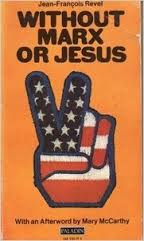
Is this a Joke? On Mary McCarthy’s Afterword to Jean-Francois Revel’s Radical Book/Pamphlet, “Without Marx or Jesus: The New American Revolution”

Unknown

I always felt like I was born a generation too late. My reception of 60s and 70s radicalism was, if anything, belated. It was the legacy of my parent’s and uncle’s generation. My generation was certainly affected by it but it didn’t “transform” us as it did them. To be sure, as an American growing up in the 80s and 90s, I always wished I had such an opportunity. Instead, I lived in the Regan and Clinton Era. Things were rather stable and status quo. And for me, books with radical content always made me wonder if there was any trace of that transformation left. I wondered if, by reading this or that book, I would get it.   But oftentimes instead of getting “it,” I got something else that I didn’t expect. And that’s great because I love surprises.

For this reason, I love stumbling across rare or out of print books which, years ago, moved the hearts and minds of another generation. As I turned (and turn) the pages of these books, I try (and have tried) to imagine what went through the heads of people who first read Allen Ginsberg’s Howl or set their eyes on an experimental novel like Thomas Pynchon’s Crying of Lot 49. On one of my digressive excursions into the bowels of my favorite used bookstore in Saratoga, New York, I ran across a “radical” book published in 1971.   It’s title struck my eye, immediately: Without Marx or Jesus: The New American Revolution.   The book was authored by Jean-Francois Revel – a popular writer in France. He was well known for being a socialist and a radical journalist. Curious about the book and its contents, I bought it and brought it back home with me.

The book was translated from the French into the English. However, one can imagine that he wanted it to be translated since, on the one hand, it is meant to 1) shock Frenchmen and women out of their anti-Americanism and 2) suggest that the Marxism that they adopted and drew from Stalin and Mao was way off in its predictions about where “the revolution” would begin. Instead of taking a foothold in the Third World or in Europe, it would begin in America.   This is a shock for them, but it would, I imagine, be a thrill for those American youth at the time (the early 70s) who were eager for a “revolution.”

I was surprised to see how Mary McCarthy, the celebrated writer for The New Yorker (who was close with Hannah Arendt) characterized the book in the first pages of her Afterword. She imagines how an intelligent American at that time would receive the book. Her style and tone bespeaks a certain kind of way of being an American which is skeptical about things European and, at the same time, it suggests how shocking this book is to the French:

Listen to the first sentence. “The revolution of the twentieth century will take place in the United States.” Pow!!! The French reader is already seeing stars when the second sentence hits him. “It can take place nowhere else.” Americans may feel bewildered, skeptical, glad or sorry to hear the news, curious to know more. But you have to be French to get the full impact, the “visceral reaction.” Every since you could count up to ten or spell c-h-a-t, you have been secure in the thought that the U.S. is the citadel of imperialism, racism, vulgarity, conformism, and now a Frenchmen returns from a voyage of discovery to say it is a hotbed of revolution. (212)

McCarthy asks you, the reader, “Is it joke?” Can Americans take this book seriously?

No and yes. It may have started out as a hardy quip or demolishing retort, and somewhere behind these pages Jean-Francois is still suppressing an inadvertent smile. We, his readers, not required to school our features, laugh out loud in delight. (212)

The delight we take in this book is comical.   Americans laugh, says McCarthy, because we can imagine the reaction it will have on the French who are being “shaken, jostled, disarrayed, like a matron in some old slapstick”(212). But he’s not the only person we will laugh at. We will also laugh at the author:

That expressionless comedian, swinging from a precipice, teetering on a tightrope. We laugh at his imperturbability in the presence of immanent danger, at his reckless aplomb in courting ridicule – the reverse of sympathetic chuckles. He is serious, he protests: “Why are you laughing? (212)

McCarthy goes on to call his books “cliff hangers” and “heresies.” She caricatures him and imagines the French culture and its Catholicism which gave birth to his desire to break the rules.   “His anti-clerical nostrils are quick to detect the slightest smell of incense, and misfortune – or good luck…he has passed most of his life among the devout”(213). And now he wants to write things in rebellion against them.

Should we join him in his rebellion? This is a question which McCarthy seriously entertains. She notes that he is, without a doubt, biased. But “there is something wonderfully disinterested about Revel’s biases, a joy in the bias itself as an artistic form, embracing hyperbole and conducing, finally, to laughter”(213-214, my emphasis).

This moment in her afterword is fascinating. It suggests that a bias can be “disinterested,” enjoyable, and hilarious in its cruelty.   In addition, she thinks that – even though it may be personal and not be rationally justified – it is still…justified:

If he has a personal grievance, it is a long-standing, deeply nurtured one against the immovable forces of entrenched beliefs that insult his sense of the self-evident. (214)

This observation or rather hypothetical syllogism is the basis of McCarthy’s vindication of the book. There is a “dizzying” joy to going against the status quo and if it is personal and biased it is all the more revolutionary and just. As an American, McCarthy suggests that this “pamphlet” – like those of the French Revolution – is a work of agit prop. It includes “provocation, surprise attack, deftness, rapidity, polemical sparkle” but it is not a premonition of a real revolution in America (or as McCarthy says, “a Second Coming…materializing in the California desert”).   Rather, the book should be read as a satire (223).   He posits revolution in America only because it has failed in France. In other words, he wrote this book in order to cajole them.

He addresses serious things no less which are, by no means, a laughing matter. For instance, there are discussions in the book about the necessity of violence in a revolution.   And against many of those who look to violence as a means (such as Georges Sorel and his book Reflections on Violence), he, at one point, suggests that the insistence on the relationship of revolution to violence is an “error”(103).   He notes, however, that the lines between violence and non-violence are not clear:

Real revolutionary activity consists in transforming reality, in making reality conform more closely to one’s ideal, one’s point of view. That transformation can be achieved only through revolutionary means. Sometimes, that means is violence; sometimes, it is not. In any case, violence, as a means, does not signify the same thing. (104)

The question of violence, to be sure, is hard to satirize. And, in reading McCarthy’s Afterword against these reflections, it dawned on me that many people who picked up his translated book in the United States may have had a different reaction. Perhaps they didn’t take it as a satire but as a handbook of sorts. But that may be the twist: McCarthy was worried that people would take the most violent aspects of a new “American” revolution seriously.   Perhaps she agreed with the Europeans who, as Revel notes often (when writing about “anti-Americanism”), regarded American’s as “idiots.”

Regardless, it is interesting to see that McCarthy allows for these rants and sees them justified but, ultimately, sees the advantage of seeing them from a detached comic perspective. She, herself, may understand it but she doesn’t want to participate in it. She lets it happen but prefers to take on the comic perspective. It was, for her, in the early 1970s, the best route. For if she didn’t, she, too, would be taken in by what she considers a great work of “agit-prop.”

Reflecting on this book, today, in September 2015, I wonder, how would I react? Would I side with McCarthy’s comic reading or would I, like many American youth of the early 70s, be eager for something more serious? The fact of the matter is that in hard times, when violence is raging and tension is high, people are less interested in humor than in something more political and serious. Perhaps these times are with us today. But instead of using satire or comedy to get some distance, I realize, today, that comedy can and has been used for agit prop.   Satire can and has been used to spur people to become more serious about political issues: take a look at your Twitter feed or your Facebook feed for evidence of that.   What McCarthy does is to show how polemics can be exciting by way of being personal and even biased but what she leaves out of her reflections is the other side of humor, the violent one.

I’ll end on that note.