The Schlemiel and Schlemiel Theory Appear in “Wordplay: The Crossword Blog of The New York Times”

Unknown-2

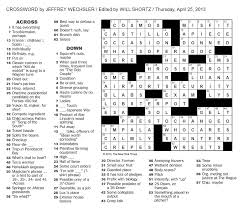
On January 13th Wordplay: The Crossword Blog of the New York Times brought up the schlemiel and hyperlinked “who else might cause a spill at the cafeteria” to this blog post on Schlemiel Theory.   The article is entitled “Fire Suppressing Compound” and subtitled “Jeffrey Wechsler gets tripped up.”   The author of the article, Deb Amlen, points out how Jeffrey Wechsler, who constructed the last New York Times crossword, gave a clue that made her think of the schlemiel:

Jeffrey Wechsler returns with a set of spoonerized versions of BEATLES songs, and they are funny. I didn’t catch on at first, and tried to fit SCHLEMIEL into 18 Across, because who else might cause a spill at a cafeteria? Fortunately for us, the answer is TRAY DIPPER, reversed from “Day Tripper.”

The irony that Amlen articulates in the subtitle is that, in theory, the schlemiel is the one who “might cause a spill at a cafeteria” (based on the celebrated joke of the schlemiel who spills soup on the schlimazel).   The right word, “tray dipper,” is a “spoonerized” version of the Beatles song (“day tripper”).   But she’s really the one who “tripped up” insofar as she missed the clue.  (I would, too.)

What I love most about the subtitle is that it also suggests – at least for me – that the schlemiel should have been in the crossword. He tripped up by not having it there and is, in the end, a schlemiel!   But, ironically, the word and the link to Schlemiel Theory (on the “Essentially…Existential” schlemiel) made it into the commentary of the crossword.   I find it amusing that it ends up in the commentary. After all, the Jewish tradition loves commentary. And the schlemiel is often in the margins. Even so, when the schlemiel trips he must fall somewhere and I’m very happy to see that he fell into the New York Times “Wordplay” blog!


* On a personal note, my dad will be proud of this slip-and-fall. He’s been doing the New York Times crossword since I was in diapers.

On the Schlemiel, Max Weber’s Notion of the Ethical Effect of Religion, and the Charisma of Goodness

Unknown-1

Goodness is an important aspect of the schlemiel’s character. In The Schlemiel as Modern Hero, Ruth Wisse argues that the schlemiel is a simpleton who clings to goodness and humility; and in the incarnation of the schlemiel we find in secular writers, such as I.B. Singer, Wisse tells us that the trace of the religious schlemiel can be found in the fact that the schlemiel, like I.B. Singer’s Gimpel, acts “as if” the good exists.     The root of the schlemiel’s secular goodness is religious since it was, according to Wisse, first found in the stories of Rabbi Nachman of Bratslav. They provided the first literary treatment of the schlemiel. And according to Ruth Wisse and David Roskies, this influenced the Yiddish writers.

The religious aspect of goodness is something that was of great interest to Max Weber. In a chapter entitled “The Different Roads to Salvation,” from his book The Sociology of Religion, Max Weber argues that, in religion, the “occasional devotion induced by ritual” can be “escalated into a continuing piety.” The “effort is made, “ by the religious subject, to “incorporate this piety into everyday living.” And when it does, it “readily takes on a mystical character”(152).   But the “disposition to mysticism” is unique since it is an “individual charisma.”   What interests Weber most is how this kind of piety, which results in a “disposition to mysticism,” “ultimately leads away from rational activity”(152). We find this in “mystery cults.” We also find this, argues Weber, in Christianity.

The only religion to pursue goodness without totally fleeing from rational activity is Judaism.   The “ritual activity” of Judaism has a different “ethical effect” because it requires that “participants be specially schooled.”

The fulfillment of ritual commandments required of the laity some active ritual behavior….became so systematized into a comprehensive body of law that adequate understanding of it required special schooling….Even in antiquity, pious Jews had been led to equate persons unschooled in the law with the godless. (154)

The “social achievement” of “the works of salvation,” here learning, are “primarily social achievements” since they prompted the average Jew to be educated if he or she was to be observant.

For Weber, goodness needs to be demonstrated. Weber, turning to Judaism and Christianity, argues that a “charisma of goodness” occurs when a person’s actions of “love for one’s fellow man” is “demonstrated.” This demonstration is not possible without “ethical systemization.”   He associates the demonstration of such goodness with “a religious total personality.” It may be regarded as a “divine gift.” But it can also “be acquired through training in goodness.” And this is informed by a “rationalized, methodical direction of the their pattern of life, not an accumulation of single, unrelated actions.”

All charismatic goodness is based on a ritualistic system. Weber argues that the monotheistic system is based on the “transcendence of particular desires and emotions of raw human nature which had not hitherto been controlled by religion.” The task of the sociologist of religion is to “determine for each particular religion whether it regarded cowardice, brutality, selfishness, sensuality, or some natural drive as the one most prone to divert the individual from his charismatic character”(163).

This is what Weber calls the “ethic of the virtuosi.”   And “like magical charisma, it also needs demonstration by the virtuosi.” It is not “demonstrated” by the majority of the observant. After listing several different kinds of virtuosi – ranging from those found in the monks of Christianity, Buddhism, or in Islam – he writes the greatest novelty of demonstration: “this holds true of the legalism of the Pharasaic Jew and the aconomistic goodness of such persons as St. Frances.”

The “certainty of sanctification” is supported by the “upholding of religious and ethical standards.” And “salvation may be viewed as a distinctive gift of active ethical behavior performed in the awareness that god directs his behavior, i.e. the actor is an instrument of god”(164).

What is fascinating about this charisma of goodness, for Weber, is that it would not exist were it not for the fact that is rationalized in a ritualistic system. One wonders what he would say about the piety that is associated with the Hasidic notion of simplicity and smallness. Does the schlemiel – just like the Rebbe or righteous Jew – “demonstrate” goodness? What does it mean that the schlemiel doesn’t know if God is directing his behavior? What does it mean that, against the Pharsaic Jew that Weber talks about (who shares much in common with the Mitnagdim; meaning, “those against: the Hasidic movement,” which was thought by many Mitnagdim to be heretical in its purported rejection of halacha – Jewish law) –the Hasidic Jew does not find his primary way to god through education?

The schlemiel’s simplicity seems to go against the grain of Judaism. He would be regarded by the Mitnagdim as an “am ha’aretz” (or “idiot,” the Rabbinic figure of the unlearned person)(163). As Rabbi Nachman of Bratslav well knew, the simpleton-slash- schlemiel marks a Hasidic challenge to the rationalist Rabbinic correlation of learnedness and goodness.   Nonetheless, there is still a “charisma of goodness” that attends the schlemiel. And it has a popular affect because it is so common. It also finds its way into Kafka’s fiction. As Hannah Arendt notes, there is a simplicity in his characters who are “common men” who have “good will.”   Unfortunately, the man of good will – the simpleton – cannot find a place in a world which is obsessed with functionality and the proper.

The schlemiel and its “charisma of goodness” have broken through of the boundaries set up by what Max Weber would call the “system of ritual” and “education” – which is germane to Judaism. The schlemiel has been secularized and Americanized. It has found its way into popular culture. As learning and ritual have – in large part – passed away from the daily life of the everyday Jew, we can understand how this trait of goodness, which has a Hasidic root, lives on in the secular schlemiel. Whether the schlemiel is played by Ben Stiller, Adam Sandler, Seth Rogen, Amy Shumer, ethical charisma lives on. However, this goodness is related more to being an American Jew than to Judaism. But, over time, the ethical goodness of the schlemiel has become more about being an American.

The only thing missing from this kind of sociological analysis is the fact that no thought is given to the possibility that goodness is not merely a sociological affect. Weber’s analysis lacks a philosophical sense of why or goodness can work – as it does with the schlemiel – despite ritual or the demonstration of a religious system. The possibility of faith or hope is made possible  for many in our socially mediated culture  by the schlemiel.  Its charisma of goodness – if that is the right word – is actually something much more comedic.

I’ll leave you with this question. Would you call Seth Rogen’s goodness charismatic? Is he inspiring people to do good? And does the trace of goodness, which we find in his work and has traveled far from its source, originate in the Hasidic schlemiel? Does it inspire something salvic? Does it prompt one to have hope? Does Seth Rogen, as Ruth Wisse might say, act “as if” good exists in a world that has become cynical?  Has Jewish comedy – by way of the schlemiel – produced what Max Weber calls a “breakthrough”(made in reference to Paul’s revision of the messianic in the name of Christianity, p259)  insofar as it has transformed  a religious kind of goodness into a secular one?  Or does a religious figure lose its charisma when it is secularized?  Either way, Rogen comes across as a somewhat endearing “bro” character whose goodness, however, is not associated with any religious system.


Becoming Smaller: Notes on Smallness in Kabbalah, Hasidic Thought, and Kafka

Unknown

Small people can be found throughout the folklore, religion, and literature of the west.   But what is more interesting is not that there are small people but why or how they become small and what this becoming means. One may be made small by reality (which crushes one to a pulp), one can make oneself small, or one can be made and make oneself small.

Smallness is a persistent theme in the Torah and in the literature of Franz Kafka, Paul Celan, Shalom Aliechem, I.B. Singer, and even modern Jewish American writers like Gary Shteyngart, Shalom Auslander, Cynthia Ozick, and Dara Horn (to name just a handful of Jewish writers who span continents, time periods, and languages).   There is also a deep meditation on smallness in Hasidic, mystical thought and in the Kabbalah of the Ari (Rabbi Isaac Luria).   Despite the fact that some scholars have addressed the mystical aspects of Celan and Kafka’s work, few, however, have looked into the relationship between the Jewish mystical tradition of becoming small and the motifs we find in their texts. Moreover, few have looked into how this relates to the smallest and most simple comic character of all (which we find in Kafka, Aleichem, Singer, Shteyngart (et al) and even Celan): the schlemiel. Since it can open up new convergences of literature, religion, mysticism, and Jewish philosophy, this is a task for schlemiel theory.     (In these notes I will take a brief look at the link between smallness – in Jewish mysticism and in Kafka’s “Josephine the Singer, or the Mouse Folk.”)

We find a recurring meditation on becoming small with either the zaddik (righteous Jew) coming close to God or, in Hasidic thought, bringing Torah to simple folk. In Mysticism and Madness: The Religious Thought of Rabbi Nachman of Bratslav, Zvi Mark lays this out in terms of three basic types of smallness which speak to being made small or making oneself small (of fate and volition):

  1. Not even a great person is able to cleave to God continuously. He must relax his intensity in order to continue to exist in the physical world. States of ‘smallness’ provide rest and renewal of strength before an impending ascent.
  2. The descent of the zaddik enables him to come close to the people (“the common man”) for the sake of their advancement and ascent. In this sense, he is obligated to descend of his own volition to a state of smallness in order to raise op the masses.
  3. The descent of the zaddik to a state of ‘smallness’ is due to his generation, whose spiritual condition affects his own spiritual world. In such an instance, the zaddik’s descent occurs against his will and not volitionally. The zaddik’s ‘smallness’ is expressed in his actions, which are like those of the normal person not being disposed to cleaving to God – i.e., engagement in everyday speech, in business and in other mundane affairs. Only at the time of his descent can the zaddik come in contact with the members of his community… (186)

Mark goes on to note how Gershom Scholem, in his essay “Deveikut,” states that the “use of concepts of ‘smallness’ and ‘greatness’ represent a completely novel redaction of the kabbalah of the Ari.” And, building on the work of the Kabblistic master, the Baal Shem Tov “transfers these concepts to the realm of the human and gives new meaning to theosophical ideas.” But, notes Scholem, the transference made by the Baal Shem Tov puts a “new emphasis on psychology instead of theosophy.”   (Also see what I have written on Scholem’s reading of simplicity and smallness with respect to Marranos, Sabbatians, and Hasidim.)

Putting Scholem’s claims to the side – which speak directly to his claim that the Hasidim have “neutralized the Messianic idea” that Sabbatai Zevi had brought into reality and turned it inward – there is much to say about how the theosophic dimension of smallness finds a place in the storytelling of Rabbi Nachman of Breslav and in the stories of Franz Kafka. What’s even more interesting is how smallness – in a theosophic sense – finds its way into these stories by way of comedy and literary figurations of childishness.

One Kafka story that delves into smallness is “Josephine the Singer, or the Mouse Folk.” Kafka’s title juxtaposes Josephine and the people, a distinction that has resonances in the Torah (as between Moses and the Jewish people) and in Hasidic thought (the zaddik and the common people).   This is confirmed by the fact that although Josephine is a leader and helps lift the people up by “song,” she is no bigger than any of them. And, like them, she is a mouse and is crushed and made small by reality. Despite this, she seems to somehow appeal to something big:

Our singer is called Josephine. Anyone who has not heard her does not know that power of song. There is no one but is carried away by her singing, a tribute the greater as we are not in general a music-loving race. Tranquil peace is the music we love best; our life is hard, we are no longer able, even on occasions when we have tried to shake off the cares of daily life, to rise to anything high and remote from our usual routine as music. But we do not much lament that; we do not even get so far….Josephine is the sole exception…she is the only one; when she dies, music – who knows for how long – will vanish from our lives. (360, Kafka: The Complete Stories)

After stating this praise of Josephine, the narrator of the story corrects himself and makes himself and Josephine small by noting that he doesn’t know if she or they sing so much as “pipe.” And this piping, since it isn’t an art, is just something that is common, small, and simple:

So is it singing at all? Is it not perhaps just a piping? And piping is something we all know about, it is the real artistic accomplishment of our people, or rather no mere accomplishment but a characteristic expression of our life. We all pipe, but of course no one dreams of making out that our piping is an art, we pipe without thinking of it, indeed without noticing it, and there are even among us who are quite unaware that piping is one of our characteristics. (361)

The smallness of this people – according to the narrator – comes out through the children (who can’t even pipe). While the children can only “lisp” and “chirp,” the adults feel a lament that they aren’t children. Even this piping is too much of an assertion of power for them. Nonetheless, the narrator comically laments that all the mice people can’t escape children, being childish, small minded, and foolish:

We have no schools, but from our race come pouring at the briefest intervals the innumerable swarms of our children, merely lisping or chirping so long at they cannot yet pipe, rolling and tumbling along by sheer impetus so long as they cannot run, clumsily carrying everything before them by mass weight so long as they cannot yet see, our children! And not the same children, as in those schools, no, always new children again and again without end, without break…Truly, however….we cannot give a real childhood to our children. And that has its consequences.   A kind of unexpended ineradicable childishness pervades our people; in direct opposition to what is best in us, our infallible practical common sense, we often behave with the utmost foolishness, with exactly the same foolishness as children. (369)

Becoming like a child, they are able to receive the song (or “piping”) of Josephine. Her piping isn’t that of “practical common sense.” It is, rather, the common language. But what Josephine does with it is liberating.

Piping is our people’s daily speech, only many a one pipes his whole life long and does not know it, where here piping is set free from the fetters of daily life and it sets us free too for a little while. We certainly should not want to do without these performances. (370)

And in making herself like them and trying to communicate with them in their language, she, like a zaddik (as understood by the Hasidic idea of becoming small) gives the mouse people a sense of something larger, more intimate, and liberating. But this something is common to all of them; it is shared.   And because it is small and speaks to smallness, her piping doesn’t purport to elevate itself above the childishness and schlemielkiet of the people.   The lament of the narrator at the people’s childishness is displaced when she pipes because it makes them forget and prompts them to let go of their practical and skeptical sense of their smallness.


….to be continued…..

Profiting off of American Losers: Leslie Fiedler On Power, Guilt & Failure in American and Jewish-American Literature

Unknown

Near the end of his life, Leslie Fiedler, the celebrated (or is it notorious – Irving Howe – one of the greatest voices in post-WWII literary criticism – thought of Fiedler as a charlatan) Jewish-American literary critic decided to write a book that spoke to his guilt for having been complicit in power.   In What Was Literature: Class Culture and Mass Society, he makes claims about American culture, authorship, and criticism that suggest that in order to get where you are you have to throw someone under the bus.

As Fiedler explains, a whole generation of writers amassed wealth by profiting off of losers. This is not simply a fault that can be found in human nature – it has to do with the nature of American culture. And, as an American literary critic-slash-writer nearing the end of his life, he admits his guilt.   The meaning of this guilt is telling since it suggests that – in not being alone – many American writers (or filmmakers – think of Seth Rogen, Judd Apatow, Woody Allen, Adam Sandler, Ben Stiller, etc) are also profiting off of losers. But, in his estimation, he is better than most because he is willing to admit it.

The first line of his book admits to a kind of guilt, but it is displaced because, although it seems personal, it is really academic; namely, the distinction between high and low culture:

After more than forty years in the classroom talking about books, I find myself asking whether the profession I practice does not help perpetuate an unfortunate distinction, a separation of song and story into High Literature and low or as some prefer to say, into literature proper and or sub- or para-literature.

But when the reader juxtaposes this sentence to the title of the chapter “Who Was Leslie A. Fiedler,” one will see that his guilt is in question. If we are looking into who Leslie Fiedler “was” – vis-à-vis his view on the high-low literary distinction – what can we say about who he “is”?

Based on this first sentence and its relationship to the title, the obvious assumption made by the reader is that the Leslie Fiedler of the past made distinctions between high and low literature while the present Leslie Fiedler does not.

Fiedler admits that – as a literary critic and teacher of “my generation” – it is “shameful or regressive to respond similarly” to low literature as one would to high literature.   Yet, he says, that is what his “generation of literary critics and teachers of English was expected to do.” And when he started putting the two on the same level, he felt guilty. Although it sounds sincere, there is something odd about his testimony.

Fiedler argues that, initially, he was (since the age of seven) a writer not a literary critic. And instead of accepting his pieces of fiction, the people he sent material to wanted literary criticism:

I am not sure even now what prompted them to make such requests beyond a vague sense of guilt at having to say no (to his fictional pieces) over and over again to one so desperately in need of some kind of yes. But in any case, I did not pass up the chance. (14)

In other words, Fiedler was desperate. He wanted “some kind of yes” and he found that being a literary critic, which, for him, meant tossing his standards to the wayside, was fine. He didn’t mind lying about what he really felt, and he became…someone else. The new Leslie Fiedler, in other words, is a liar. But, for him, since one needs “some kind of yes”from the American public, one must become a liar

But, as Fiedler reveals, there is more to the story of duplicity in America.   It does some good. He, like many, did it for the money. And the contracts he agreed to made him into a public figure who, from time to time, appeared on TV. But these appearances were, for him, more relevant because they “return” to the “’archaic’ public lecture, the Chautauqua”(19).     This gave him a “connection” to a non-academic audience which he felt was more important than the small audience he had in this or that university English course or academic lecture.

Somehow television came closer to giving me the sense of connection with a responsive nonacademic audience that I had experienced for the first time when someone in a heterogeneous group of listeners (it was in a park, as I recall, on the South Side of Chicago) screamed, “Now you’re preachin’, brother. Go right on preachin’.”(19)

But, says Feidler, television “ran out for him” and he admits that he was a “victim of vestigial elitism.”   Nonetheless, he had not “escaped ‘show biz’ and went on a lecture circuit. While this was going on, he had, by 1963, written a “novel called The Second Stone.”   In the novel, Fiedler casts the main character as “an expatriate American loser, a writer who does not write”(20). This “American Loser” disrupts a “World Congress on Love held in Rome under American auspices” because the main character becomes the love infatuation of the “wife of a theologian-organizer.” He situates this character amidst “the deliberations of the assembled critics, poets, shrinks, and gurus are drowned out by the shouts of demonstrators, convinced by the Italian Communist Party that the whole thing is a CIA plot”(20).

Fiedler’s decision to cast himself as the “American loser” – as a “writer who does not write” – is telling because he sees this trend as disclosing a kind of American duplicity. In America, writes Fiedler, there is a belief that the public feels powerful and guilty for the death of great authors like Poe and Fitzgerald. It wasn’t booze that killed them. According to the American public, it was power. The mixture of power and guilt is a “potent emotional mix for all true Americans”(31). When he writes this line, Fiedler includes himself as a “true American.”   But the guilt he has, as a critic and a writer, is profiting off of their failure:

It is, for instance, Mark Twain’s final loneliness and melancholia (that) we prefer to dwell on, or his many failures along the way. Yet, though Twain went bankrupt as often as any other capitalist entrepreneur in the Gilded Age, at the end he was able to support a splendiferous house and a set of expensive bad habits. (31)

The irony, writer Fiedler, is that Twain’s fortune was “based on the continuing success of Huckleberry Finn, which is to say, the classic version of the American anti-success story”(31).   Twain’s life as a child was the opposite of Tom Sawyer’s. He “would not allow Tom” to “grow up,” while he, himself, did. Twain “stayed home.”   He didn’t go on a journey. In other words, Twain profited off of the American loser and in doing so he lied. This, suggests Fiedler, is the price one must pay if one is to be a popular writer or critic.

Fiedler goes even farther and suggests this was the case for a whole generation of Jewish American writers who, as American losers, a writer like Saul Bellow profited off in his book Humboldt’s Gift.   According to Fiedler, the poete maudit is “reborn this time as a failed New York intellectual – a super-articulate, self-defeating Luftmensch who has died abandoned and penniless before the action of the novel begins”(32).

Citing other critics of Bellow’s book, Fiedler notes that the model of the book was Delmore Schwartz, “who had indeed come to a shabby end”(32).   For Fiedler, Schwartz is:

The portrait not of any single individual but of a whole generation of Jewish-American losers: including, surely, Bellow’s one-time guru and lifelong friend, Isaac Rosenfeld, also dead before reaching forty, his handful of stories and essays remembered by a shrinking coterie of aging admirers; and perhaps Lenny Bruce as well, that hipster and stand-up comedian who O.D.’d in 1966. Reading Humboldt’s fate, I cannot, in any case, help thinking of all those mad, bright, young Jewish-Americans, still caught up in the obsolescent myth of the Artist as Victim, and dead before they had lived long enough to realize, like Bellow, that in prosperous America it was no longer necessary to end as a Beautiful Loser. (32)

Fiedler argues that the ultimate beneficiary of the loser in Bellow’s book is the narrator, Charlie Citrine (the “not-so-beautiful Winner”). He is the “real hero,” not Humbolt (32).   He feels a kind of power for surviving the character’s death; however, his “own survival is an occasion for guilt – the guilt we have long been trained to think of as the inevitable accompaniment of making it”(33). By writing this, Feidler suggest that he has also felt this power and guilt. He is a survivor – a “not-so-beautiful Winner” – who has taken advantage of the American loser, too.

One way of assuaging this guilt, according to Fiedler, is by believing that the loser died so that you could win. And their death leaves us with a “heritage not empty regrets but a salable story: his story once, our story now, the book we are reading”(33).

The story of the American loser can – “if properly exploited” – be made into a film or earn an author (such as Bellow) a Nobel Prize.   The survivor can pay the bills. But Fiedler’s portrayal of the survivor and winner is sad and discloses his guilt which he is trying to hide:

And if we weep a little, remembering those others whom we loved and betrayed and by whose death we profited, we can (as the old saying has it) cry all the way to the bank. (33)

All ends on this note because this is not who Fiedler (or perhaps any American literary critic) “was” so much as who he has become. In order to make it, he, like Saul Bellow or Mark Twain, had to profit on the American loser. Both American and Jewish American literature and their power – in his estimation – are guilty of this. The implication is that Jewish American – as much as American literature – needs its losers, Luftmensches, and schlemiels if it is to live on and tell the tale, but this survival is a kind of betrayal.

It’s Also a Memory Machine: On Kafka’s American Desk

images-2

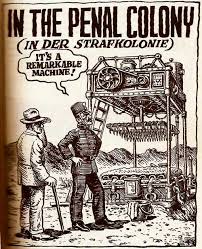
Kafka is well known for his fictional machines.   Sometimes the purpose and the meaning of the machine are clearly laid out; sometimes they are vague. The most well-known is “the Harrow” in his short story “The Penal Colony.” The purpose of the machine is to slowly write the sentence on the body of “The Condemned Man.” The “traveler” – who knows nothing about the machine – asks the “officer” about it.

“Yes, the Harrow,” said the Officer. “The name fits. The needles are arranged as in a harrow, and the whole thing is driven like a harrow, although it stays in one place and is, in principle, much more artistic. Anyway, you’ll understand in a moment. The condemned is laid out here on the Bed. I’ll describe the apparatus first and only then let the procedure perform on its own. That way you’ll be able to follow it better. Also a gear wheel in the Inscriber is excessively worn. It really squeaks; when it’s in motion one can hardly make oneself understood. Unfortunately replacement parts are difficult to come by in this place. So, here is the Bed, as I said. The whole thing is completely covered with a layer of cotton wool, the purpose of which you’ll find out in a moment. The condemned man is laid out on his stomach on this cotton wool—naked, of course. There are straps for the hands here, for the feet here, and for the throat here, to tie him in securely. At the head of the Bed here, where the man, as I have mentioned, first lies face down, is this small protruding lump of felt, which can easily be adjusted so that it presses right into the man’s mouth. Its purpose is to prevent him screaming and biting his tongue to pieces. Of course, the man has to let the felt in his mouth—otherwise the straps around his throat will break his neck.” 

The Harrow has the “job of carrying out the sentence.”   But when traveler wants to know what is written on the body of the Condemned Man, the officer hesitates to tell him:

“What is the sentence?” the Traveler asked. “You don’t even know that?” asked the Officer in astonishment and bit his lip. “Forgive me if my explanations are perhaps confused. I really do beg your pardon. Previously it was the Commandant’s habit to provide such explanations. But the New Commandant has excused himself from this honorable duty. However, the fact that with such an eminent visitor”—the Traveler tried to deflect the honor with both hands, but the Officer insisted on the expression—“that with such an eminent visitor he didn’t even once make him aware of the form of our sentencing is yet again something new, which.…” He had a curse on his lips, but controlled himself and said merely: “I was not informed about it. It’s not my fault. In any case, I am certainly the person best able to explain our style of sentencing, for here I am carrying”—he patted his breast pocket—“the relevant diagrams drawn by the previous Commandant.”

The only person who knows the sentence is the Condemned Man.   But he doesn’t learn what it is until it is inscribed on his body:

The Traveler wanted to raise various questions, but after looking at the Condemned Man he merely asked, “Does he know his sentence?” “No,” said the Officer. He wished to get on with his explanation right away, but the Traveler interrupted him: “He doesn’t know his own sentence?” “No,” said the Officer once more. He then paused for a moment, as if he were requesting from the Traveler a more detailed reason for his question, and said, “It would be useless to give him that information. He experiences it on his own body.”

In contrast to this machine, which has prompted much discussion (especially with Foucaultians who are interested in “disciplinary mechanisms”), is the desk in Kafka’s America.   The desk is mentioned only once in the novel, but it is worthy of our consideration for a few different reasons.

First of all, there are two things that give Karl Rossmann “pleasure” when he comes to America.   His first pleasure, which his uncle says is unhealthy and unproductive, is to look off his balcony and stare at the New York City traffic. When he does he becomes fascinated with the destruction of perception and experience:

A narrow balcony ran along the full length of his room. In his native city it would surely have been the highest lookout, yet here it offered little more than the view of a single street that ran in a straight line between two rows of veritably truncated buildings and therefore seemed to flee into the distance, where the outlines of a cathedral loomed monstrously out of the great haze. In the morning and in the evening and at night in his dreams, this street was filled with constantly bustling traffic, which seen from above seemed like a continually self-replenishing mixture of distorted figures and of the roofs of all sorts of vehicles, constantly scattered by new arrivals…avidly refracted by the mass objects that made such a physical impression on one’s dazzled eye that is seemed as if a glass pane, hanging over the street and covering everything, were being smashed again and again with the utmost force

In contrast to this, his other great pleasure is in a machine: his desk.

In his room stood an America desk of the finest kind, such as his father had wanted for years and had sought to buy at a reasonable price at all kinds of auctions…Of course there was no comparison between this desk here and those supposedly American desks that made the rounds at European actions. (37)

This desk had a “hundred drawers of all sizes” and a “regulator on the side, so that by simply turning the handle one could move about and rearrange the drawers in all sorts of combinations to suit one’s every need and whim”(37).   In other words, the desk could, with one turn of the crank, be rearranged to fit the desires and fantasies of the user. But, like any device, it could also be turned into a game of sorts:

Even after a single winding, the base looked completely different, and depending on the speed at which one turned the handle, everything moved slowly or at a crazy pace. (37)

But instead of appealing to his present desires, the machine, in Karl’s hands, evokes memories of his childhood:

Though it was a most recent invention, it vividly reminded Karl of the nativity scenes at home that were shown to gaping children at the Christmas market, and Karl too had often stood before it, bundled up in his winter clothes, continually comparing the revolutions of the crank…with the unfolding of a nativity scene, the faltering progress of the three holy kings, the sudden illumination of the star, the cramped life in a nativity manger. (37-38)

Rossmann then remembers how, while he did, his mother did not pay “sufficient heed to all of the movements.” Rossmann wants to pay attention to the movements of the diorama and not the images that circulate.   Even though he “could feel her body pressing against his back,” and their bodies are close, they are separate. And this troubles Rossmann.   He remembers how, as a child, he made efforts to become one with her vis-à-vis his attention to movements and nuanced figures; however, he remembers how she stops him from talking and falls into her “prior inattentiveness.”

The narrator reflects on how the machine, with Rossmann, creates a memory affect. The fact that they he has them, however, is not uncommon in the “history of inventions”:

True, the desk had not been manufactured for the purpose of stirring such memoires, yet throughout the history of inventions people made associations that were just as indistinct as Karl’s recollections.   (38)

Karl’s uncle – who takes him in when Rossmann arrives in America – doesn’t like the affect the machine has on Karl.   So he tells him that excessive use of the machine may ruin the machine and it was “expensive to repair.”   However, the narrator tells the reader that it “wasn’t hard to see that the comments were merely excuses.”

To take his mind off the desk-machine, the uncle buys Karl a piano. The uncle’s American agenda starts to take shape. The point is to take Karl’s focus away from the destruction of experience (staring off the balcony) and lapsing into memory and gestural awareness. The uncle wants Karl to become pragmatic not absent minded.

The function of the desk-machine is to create a space within which Karl can work. And looking off the balcony distracts Karl from action. Kafka seems to be telling us that the problem, for the American, is to manage distraction. American pragmatics has no room for the misuse of the machine and vision.   If work is to be done, one cannot be locked into memories of childhood and its movements or into the astonishment that comes with the destruction of perception. Nonetheless, Kafka, throughout the novel, pays close attention to movements in and out of spaces. He shows how chance determines much of one’s life rather than calculated action.   What Karl gradually learns is how to stem the flow of these movements.

Karl Rossmann is thrown into one situation after another.   His decision to stay or leave is always the question; however, sometimes he is kicked out and forced to move. The consciousness that emerges out of this is a spatial consciousness which is concerned with differing modes of awareness and attention. Does Rossmann need to serve others and let them guide his attention or will he guide his own? Does our dawning awareness of differing kinds of attentiveness determine our sense of self? How does this desk, which has become a memory machine, remind Rossmann of how individuation is connected to his awareness that his mother doesn’t care to share his fascination with movement?   Is it that crucial?  And what does it mean that his uncle also doesn’t care and ultimately distances himself from Karl because Karl can’t act in the manner that he deems productive?

Kafka seems to be telling us that in an age of machines, attentiveness to movement is a key trait of self-hood and experience. But machines are not merely mechanical; for Kafka, they are also to be read in terms of social spaces and relationships. The relationship to machines – whether actual or social – displaces the relationship to family and (as the novel shows us) even “friends” (namely, Robinson and Delmarche).

When Rossmann stumbles upon people who seem to be potential allies, he is duped when he learns that the social machine they plugged him into was a hoax. He is also duped by another machine he hooks up with (a hotel) when he leaves them behind. (At the hotel, he operates an elevator.) When one of them (Robinson) comes back to see him, in the second half of the novel, and gets him ejected form the hotel-machine, they look to plug him into another kind of machine. That machine is a kind of sado-masochistic slavery machine that is centered around a woman named “Brunelda.”     While Robinson and Delmarche take to the Brunelda machine, because it gives them food and shelter, Rossmann – near the end of the novel – wants to leave.

What astonishes one throughout these displacements is the lack of awareness – either on his part or on the part of others – that is behind the mechanical alterations of fate that Rossmann is subject to. His only freedom is to flee these machines.   But that possibility only happens outside the novel, in a fragment of Kafka’s on the “Oklahoma Natural Theater.”

In the novel, Rossmann realizes that, in order to survive, he must work in one social group or another. But Kafka leaves open the possibility that one need not be stuck in one social-mechanism or another.   However, the fact that it – the Oklahoma Natural Theater” – didn’t make it into his novel is what needs to be thought through.   Even though the novel was unfinished and was never published, the fact that he left it a fragment suggests an attempt to think about the possibility of freedom – of a space that is not constantly threatened by violence and sado-masochism as the result of one mechanism or another being effaced. In that space, attentiveness to movement has a wholly other meaning.

….to be continued….


Men in Cars (Barack Obama & Jerry Seinfeld)

zjb's avatarjewish philosophy place

obama car

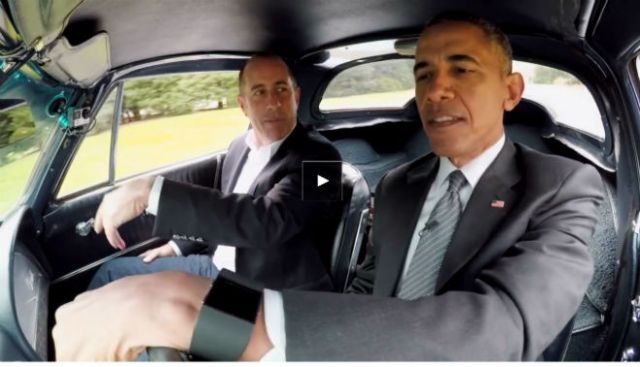
You can see them here kibbitzing, President Barack Obama and comedian Jerry Seinfeld are two incredibly powerful men, one more so than the other, and one very rich, driving around in a very cool car, a 1963 Corvette. They then sit down together to talk in what looks like the White House canteen. Both men demonstrate a liquid intelligence, a complete and fluid facility with language and physical gesture, exposing different kinds of excellence as they talk about people and power and craft in this neat little portrait of powerful men in sharp suits and pressed shirts. Elegant human beings, they are not like the rest of us. Even Obama’s wristwatch is cool.

In the concluding scene of the main body of the segment, the two men pretend to try to drive out and leave the White House grounds, but to no avail, not on their own, the Secret Service won’t…

View original post 89 more words

Reading, Madness, and Forgetting: A Wandering Thought on Don Quixote and Paul Celan

images-1

At the outset of a reflection on Don Quixote, Carlos Fuentes cites Michel Foucault’s claim that Don Quixote is a “symbol of the modern divorce between the word and object”(This I Believe: An A to Z of a Life, 203).   The subject of Quixote’s movement (pilgrimage) is the “search for similarities” and “Foucault observes how Don Quixote rapidly recruits the weakest analogies: for him, everything is a latent sign that must be awakened to speak and to demonstrate the identity of words and objects.” Despite the fact that there is a gap, there is still a task. Fuentes argues that the “orphan of the universe” must “achieve unity without sacrificing diversity” and “fill the abyss between words and things through the divorce between analogy and difference.” This, it seems, is an impossible task. But what captures Fuentes’ attention – and seems to offer the greatest modern resolution – is the thematic of movement and displacement (a theme that was of great interest to Franz Kafka as well). It is the main theme of Cervantes and the modern novel:

The modern novel, a perpetual invitation to leave oneself and see oneself and the world as unfinished problem, implies a kind of displacement similar to that of Don Quixote, although we may venture to say that no other novel – not even the most experimental – has been able to propose radical displacements as radical as those of Cervantes.

The “novel is the art of displacement.” It is a displacement of “genres” and “authorities.” But it is the recipients of the “verbal fact,” the readers, that grant the “novel an open destiny, forever unfinished.” The biggest displacement speaks to these readers. It is– which Walter Benjamin also points out in his essay “The Storyteller” – “from the normal residual tradition of oral, tavern oriented storytelling to the full Cervantine awareness that the novel is to be read by a reader and printed at a printing press.”

Don Quixote is a reader. He is “mad about books” and “transforms his reading into madness and, possessed by both, wishes to take things he reads about and turns them into reality.”   He sees “giants where there are windmills” and “armies where there are only sheep” because “the things he has read have told him to see them that way. His reading is his madness.” His authority is to be found in language, not reality. And, as readers, we share this madness. By simply reading, we displace and are displaced.

Although Cervantes, building on Foucault, sees this as a foray into modern uncertainty and equates it with a kind of wandering anxiety, it is also comical. Moreover, what Fuentes doesn’t note is the fact that readers only read modern novels because they desire displacement and movement.   We may be “orphans of the universe,” but we like to move.

However, what might be forgotten is the relationship between the word, the eye, movement, and authority. Although we may like to move, the reader needs to come to terms with the fact that one is led by the text. And where Don Quixote goes, we go as well. This displacement may not always be pleasant. What we need to do is reflect on the implications.

Paul Celan captures this sense of being led and displaced in a poem entitled “Below.” And he links it to a social exchange between the “slow eyes” (“langsamen Augen”) of the reader, the writer, and the poem (“Gast-Gesprach”). The poem tells us that, as a result of this (social) exchange of reading, we are “led home into oblivion” of “forgetfulness” (vergessen).

BELOW

Led home into oblivion

the sociable talk of our slow eyes.


Led home, syllable after syllable, shared

out among the dayblind dice, for which

the playing hand reaches out, large,

awakening.


And the too much of my speaking:

heaped up around the little

crystal dressed in the style of your silence.

This poem and its displacements evoke several questions. Is the poem written for all the eyes that see and all the mouths that speak? And whose hand throws the dice? Is it my reading? Or is it your writing?

To be sure, this poem may speaks to every social situation. Perhaps, when we listen or read, our “slow eyes” lead us “home into oblivion” or, better “forgetfulness” because we are displaced from our position.   Perhaps the “dayblind dice” are thrown whenever there is a reading or a conversation.

The forgetfulness (“vergessen”) we experience can be read in a comic sense as a kind of absent-mindedness.   But, on the other hand, it can be read in a tragic sense because it suggests that when we listen we are separate and are…not really communicating.   Perhaps Celan is suggesting that reading may be the problem.   This spurs a few questions: When we read or when we speak, how do we remember? If reading spurs us to be “led home to forgetfulness,” how do we leave home in order to remember?

Perhaps this is a problem shared with Don Quixote. If Quixote is constantly forgetting, by virtue of this or that displacement, what does he need and what does the reader need? Do we need to simply revel in this displacement of reality, this madness?

Kafka in his parable, “The Truth of Sancho Panza,” suggests that what Quixote forgot about was not reality; it was Sancho Panza.   In other words, the madness of reading may displace the friend. The irony is that this madness can only be confronted if we think about what happens when we read and why we would desire to read. Perhaps reading stages a battle with forgetfulness and the meaning of relation (or relationship)?  Regardless, displacement spurs forgetfulness and, at the same time, can prompt memory. It call also recall us, as Emmanuel Levinas might say, to the other.  (And, on this note, his reading of Don Quixote is similar to Kafka’s.)  The lesson: modern literature and poetry – whether by Cervantes, Kafka, or Celan – can touch on the experience of memory, displacement, and relation.

Verbing in Yinglish: If One Can Now Be Schlonged, Can One Also Be Schlemieled?

Unknown-2

Last week, Donald Trump’s use of the Yiddish word “schlong” prompted countless articles and news pieces on the meaning of the word.   The Washington Post put out several interesting and even comical articles on the topic. On December 22, three pieces were published. Philip Bump of The Washington Post exclaimed that Trump “ruined Christmas” since there were more Google searches for the word “schlong” than there were for words like “stocking,” “tinsel,” or “gift wrap.”   And Dana Milbank, playing on this wave of discussion, wrote an opinion piece entitled “Oy Vey! Enough of Trump.” In the article, he employs a bevy of Yiddish slang terms to express his opinion of Trump, Lindsay Graham, and the Republican political field.   Like many editorialists, he sees Trump as a clown who must be challenged by a more serious candidate.

But of the three articles written on the word, Justin Moyer’s “Donald Trump’s ‘schlonged’: A linguistic investigation,” was the most informative.   Moyer cites an email to The Washington Post by Harvard linguist Steven Pinker which clears everything up:

Many goyim are confused by the large number of Yiddish terms beginning with ‘schl’ or ‘schm’ (schlemiel, schlemazzle, schmeggegge, schlub, schlock, schlep, schmutz, schnook), and use them incorrectly or interchangeably,” he wrote. “And headline writers often ransack the language for onomatopoeic synonyms for ‘defeat’ such as drub, whomp, thump, wallop, whack, trounce, clobber, smash, trample, and Obama’s own favorite, shellac (which in fact sounds a bit like schlong). So an alternative explanation is that Trump reached for what he thought was a Yinglish word for ‘beat’ and inadvertently coined an obscene one.

In other words, Trump seemingly created a word mixing English and Yiddish (“Yinglish”) which turned a noun (“schlong”) into a verb.  Moyer notes a few other uses of the noun as a verb. And citing the Oxford University Press blog essay, entitled “Do you Salad or Sandwich? The Verbing of English,” he notes how the transformation of nouns into verbs is not atypical.

“This conversion of nouns to verbs is known as ‘verbing’ and it has been around for as long as the English language itself,” Oxford University Press noted in 2013. “Ancient verbs such as rain and thunder and more recent conversions such as access, chair, debut, highlight and impact were all originally used only as nouns before they became verbs.”

Perhaps anticipating Trump’s use of “schlonged,” the Press also noted: “Verbing exists essentially to make what we say shorter and snappier. It can also give a more dynamic sense to ideas.”

With all of this talk about nouns being transformed into verbs, I wonder whether a schlemiel can be “verbed.” In other words, can a person be schlemieled?

To be schlemieled would suggest that through this or that act or circumstance, one can become a schlemiel.   While this may work with a shlimazel, who is the subject of bad luck, it may not be possible for the schlemiel.

Ruth Wisse, in her opus, The Schlemiel as Modern Hero, argues that the schlemiel is not a character born out of this or that circumstance. The schlemiel is, in her words, existential. As I have noted elsewhere, by way of the famous joke about the schlemiel, the shlimazel, and the nudik, the schlemiel spills the soup, the shlimazel gets spilled on, and the nudnik asks the shlimazel what kind of soup was spilled.   Regarding this joke and in an effort to define the schlemiel Wisse tells us that the “schlemiel’s misfortune is his character. It is not accidental, but essential. Whereas comedy involving the shlimazel tends to be situational, the schlemiel’s comedy is existential, deriving from his very nature in it’s confrontation with reality”(14).

For Wisse, the schlemiel’s comedic way of being is existential in the sense of being ontological: one can’t become a schlemiel (by virtue of this or that comedic situation); one is a schlemiel.  And if the schlemiel were to be “verbed” in Yinglish, it would suggest something contrary to her definition. Nonetheless, this wouldn’t keep Trump or anyone in the political field from calling another candidate a schlemiel and using the term as an insult.

Regardless of how it is used, we should keep in mind that while the schlemiel has historically been in two extremely divergent ways.   It has been used by some as an insult, but it has also been used in ways that are endearing and even moral.   (See for instance, the use of the schlemiel by writers like Sholem Aleichem or I.B. Singer or the depiction of the schlemiel in the majority of films by Woody Allen, Judd Apatow, or Seth Rogen; alternatively, a thinker like Hannah Arendt has used both kinds of meanings or the battle between cultural and political Zionists over the meaning and use of this term.) But since our culture is more apt to the insult and because this is the political season, this other definition will most likely be overlooked.   Who knows? Perhaps the schlemiel will make the news. And if it does, Schlemiel Theory will be there.

I’ll end with Larry David’s portrayal of Bernie Sanders as a schlemiel.  This performance, however, is not meant to be an insult.  It’s endearing and funny.


Seeing Things Differently: Vision, Judgment, and Being(Re)Born in Kafka’s America


Unknown

Kafka never went to America. But he, like many Europeans, imagined what it would be like to emigrate there and how different it was from Europe.   These imagined differences are not only cultural. For Kafka, they are also physical, spatial, and temporal.   And through close attention to these differences, which come out in his detailed descriptions of characters, gestures, and spatial orientations, Kafka provides the reader with an experience of language and being that is original.   But, as Kafka – a lover of parable who well understood the Midrashic task of addressing the textual gap – knew, this experience can only be arrived at through a kind of reading that is attentive to each and every difference. Kafka suggests that in coming to America, Karl Rossmann, the main character of Amerika, must efface who he was and be, so to speak, born again.   But this need not be something that is experienced by Rossmann alone; it can also be experienced by the reader if she is attentive to the nuances of Kafka’s imagined America. Although the reader may resist it, she must, like a child, allow herself to be surprised by the text.   And that takes effort which appeals not just to how we read but also to how we see and judge what we see.  In fact, Kafka equates this rebirth with a change in how we see things on the street (so to speak).

At the outset of the novel, Kafka tells us that Karl is only 17 years old. He is incredibly naïve and distracted. And unlike many an immigrant to America, he doesn’t seem to have a deep desire He doesn’t quite know why he is there, who he is supposed to see, or where he is going.  It is we the readers who are (or should be) surprised by Rossmann’s lack of understanding and awkwardness.   Rossmann happens to stumble across his uncle (the “senator”) who, we learn, came to the ship to pick him up.

Rossman, unlike many an immigrant, doesn’t have to worry about immediately being thrown into poverty and the unknown upon arrival. His uncle is wealthy and successful.   But he is much different from Karl and Karl needs, so to speak, to catch up. His uncle brings him to his home in New York City. And Karl must accustom himself to a new circumstances, new spaces, and new speeds:

In his uncle’s house Karl soon become accustomed to his new circumstances. His uncle always obliged him even in trifling maters, and Karl therefore did not have to wait to learn from those bad experiences that so often embitter the early days of one’s life abroad. (35)

This gives Karl a little time to think about America:

For one could not hope for pity here in this country, and the things that Karl had read about America in that regard were quite true; here it was only those who were fortunate who truly seemed to enjoy their good fortune amid the indifferent faces on all sides. (35)

In America, it is luck rather than fate which is primary.   One’s circumstances can change at any moment. (This is an observation that Siegfried Kracauer made in his distinction between German film and American comic film and the audiences that consumed them.)  But what initially fascinates Rossmann (and the narrator) are not circumstances so much as the new urban space and the perceptions it offered. The space is what fascinates.

A narrow balcony ran along the full length of his room. In his native city it would surely have been the highest lookout, yet here it offered little more than the view of a single street that ran in a straight line between two rows of veritably truncated buildings and therefore seemed to flee into the distance, where the outlines of a cathedral loomed monstrously out of the great haze. In the morning and in the evening and at night in his dreams, this street was filled with constantly bustling traffic, which seen from above seemed like a continually self-replenishing mixture of distorted figures and of the roofs of all sorts of vehicles, constantly scattered by new arrivals…avidly refracted by the mass objects that made such a physical impression on one’s dazzled eye that is seemed as if a glass pane, hanging over the street and covering everything, were being smashed again and again with the utmost force. (36)

While Karl is fascinated with this endless destruction of vision (“as if a glass pane, hanging over the street and covering everything, were being smashed again and again with the utmost force”), the uncle advises him not look at things in this manner. Look, but in a different way.

While he should take at a look at everything and always examine matters carefully, he should not let anything beguile him. (36)

Karl’s uncle wants him to distance himself from his perceptions and immediate judgments. He wants him to look closely but not too close. That way, he can be reborn as an American.

Indeed, the first days of a European in America could certainly be likened to a birth, he said, and then he added – so Karl would not have any unnecessary fear – that even though one adapted more quickly here than if one were entering the world of man from the hereafter, one should also keep in mind that one’s first judgment was always quite shaky and that maybe one should not allow it to upset all future judgments that one would need to make if one wanted to go on living in this country. (36)

These words can be applied to Karl’s experiences throughout the novel and can be used as a criteria of sorts. They can also be applied to the reader. In the novel, Karl and the reader are faced with many unexpected situations. The question – regarding each of these situations – is about how Karl (or the reader) sees the situation and how that affects his (or the reader’s) understanding and evaluation of the text.   However, as I have pointed out elsewhere, the judgments of the reader may differ from those of Rossmann if they are to be effective.   We need to pay attention to these differences since, as the uncle suggests, Rossmann’s “first days” in America “could certainly be likened to a birth.”   The reader also needs to pay close attention to the situations, circumstances, and spaces that prompt Rossmann to make such judgments.

Karl’s uncle is troubled by people who “stood about on their balconies for days on end gazing down at the street like lost sheep.   It could only lead to confusing! All that solitary idleness, that wasteful staring out on a bustling New York day”(36). And when he sees Karl staring out at the traffic from his balcony – startled by the destruction of perception – he grimaces “with irritation.” Karl learns a lesson from his uncles’ face:

Karl soon noticed this grimace and consequently, insofar as possible, denied himself the pleasure of standing on the balcony. (37)

But, as readers, we know that, for Karl, such staring is not pleasurable; unless, that is, the destruction of perception is pleasurable. But – if anything is to be done and if any judgment is to be made, as Karl’s uncle suggests – one can’t look too long from the urban balcony (with this in mind, think of Facebook). It’s all a matter of how you look at things. In Kafka’s America, distraction, vision, and judgment are always at stake.


Son of Saul (Art At Auschwitz)

Check out this important reflection on a new post-Holocaust film (in particular) and the reception of post-holocaust film – today (in general).

zjb's avatarjewish philosophy place

son of saul

Who cares about the Holocaust anymore? Who goes to see a Holocaust movie and what does one want from it? These were my thoughts going in to see Laszlo Nemes’ Son of Saul this afternoon. For some time now, so many critical flags have been thrown down regarding the Holocaust, art and film about the Holocaust, allegedly mystifying claims made about the inability to represent much less “comprehend” the Holocaust, the politics of Holocaust memory, and so on. It would be obvious to say that the star of Hannah Arendt has defined much of the discourse in critical-left academic circles. That kitsch has saturated so much, if not all of the genre since Steven Spielberg’s Schindler’s List adds fuel to the critical fire. Jewish power today is now something actively resented by so many people, that one barely knows how to bring up the Holocaust in polite company.

I.

It…

View original post 1,595 more words