Schlemiels Don’t Adapt: Saul Bellow on Sholem Aleichem’s Characters

DownloadedFile-2

Citing the traditional joke about the schlemiel who spills the soup on the schlimazel, Ruth Wisse, in The Schlemiel as Modern Hero, argues that the schlimazel “happens upon mischance” and “has a penchant for lucklessness”(14).  But “the unhappy circumstances remain outside him”(14).  In other words, the schlimazel’s comedy is situational.  The schlemiel, however, is different since his “misfortune is his character.  It is not accidental, but essential.”  After saying this, Wisse substitutes the word “existential” for the word “essential”: “the “schlemiel’s comedy is existential, deriving his very nature in its confrontation with reality”(15).    After writing this, Wisse inserts a footnote that explains that there is “some discussion of the derivation of this term (“existential”) and some attempt at definition” in a book by B.J. Bialostotski on Jewish humor.   In this book, Wisse makes reference to only two pages.  To be sure, dubbing the schlemiel an “existential” character needs more than two pages let alone a footnote reference.   Regardless, I applaud Wisse for making this claim.  There is a lot of truth to this observation.   However, as Wisse suggests indirectly, it needs more discussion (not just “some” discussion). I have, to be sure, dealing with existential interpretations of the schlemiel in my blog – mostly by way of Emmanuel Levinas and Walter Benjamin, amongst others.  But I have never read the schlemiel in terms of this specific distinction made by Wisse.  For this reason, I was happy to have stumbled across a 1953 book review of a Sholem Aleichem novel – The Adventures of Mottel the Cantor’s Son – by Saul Bellow entitled “Laughter in the Ghetto.”  In the review, he suggests something of an existential reading of the schlemiel.

1953 is an important year for Yiddish literature and for Bellow as it’s American translator.  Ruth Wisse points out that Irving Howe published Bellow’s translation of I.B. Singer’s “Gimpel the Fool” from the Yiddish in The Partisan Review in 1953.   And Sidrah DeKoven Ezrahi convincingly argues that Bellow’s translation was a landmark moment in the revival of Yiddish literature in America.  She goes so far as to argue that Bellow, Howe, and Leslie Feidler, looked to create a “virtual ghetto” by way of popularizing the work of I.B. Singer, Aleichem, and others who were translated into English.

Bellow’s review, so to speak, comes right on time since it coincides with the publication of “Gimpel the Fool.”  In this review, Bellow reflects on Yiddish literature in general and Aleichem in particular.   But the real focus of the review is Mottel, the main character of Aleichem’s final novel.  And Mottel, for all intents and purposes, is a schlemiel.

Bellow begins his review by defining Yiddish literature against Hebrew literature: “Hebrew was the language of serious literature among the Jews of the Pale (of Settlement): Yiddish the secular language and the language of comedy.”  But even though Yiddish is the “language of comedy,” Bellow points out that Aleichem turned it to serious concerns thus bridging the gap between “serious literature” and a language that was essentially comic.  But, as Bellow argues, built into Yiddish is an “ironic genius”: Aleichem “was a great ironist – the Yiddish language has an ironic genius – and he was a writer in whom the profoundly sad, bitter spirit of the ghetto laughed at itself and thereby transcended itself.”

Like Bellow, Irving Howe and Ruth Wisse were very interested in the relationship of laughter to tears.   I have written several blog entries on this topic which speak directly to the existential condition.   Bellow’s reading – and the title of his piece – seem to suggest that he saw the ghetto’s laughing at itself as a form of existential self-transcendence.  To explain this better, Bellow notes how the existential condition of the Jews was itself ironic:

The Jews of the ghetto found themselves involved in an immense joke.  They were divinely designated to be great and yet they were like mice.  History was something that happened to them: they did not make it.  The nations made it, while they, the Jews, suffered.

Bellow goes on to argue that the countless references to “all times and all greatness” in Yiddish conversation and Jewish study contributed, “because of poverty and powerlessness of the Chosen, to the ghetto’s sense of the ridiculous.”  In other words, the historical reality of Jews – given their history and greatness – was ironic for Jews who lived in the Pale.  It didn’t make sense and was laughable.  And in this situation, argues Bellow, “powerlessness appears to force people to have recourse to words.”

This suggests that history forced Jews to be comical.  But this isn’t the existential part.  The existential part has to do with not giving in to the judgment of history and the refusal to adapt.

When Bellow turns to the novel he points out how Mottel, the main character of the Aleichem novel, is always happy: “almost nothing can take place which he is unable to make into a occasion of happiness: with boundless resilience he tells, after his father’s death, how quickly he learns the prayer for the dead, how well everyone treats him now that he is an orphan.”  Mottel has “an inexhaustible power of enjoyment and cannot be affected….He declines to suffer the penalties the world imposes on him.”

Bellow sees this aloofness of the schlemiel as fundamental to a Jewish condition. This comes out in his comparison of Aleichem to Gogol.  In his comparison, he notes that while “Gogol’s humor is wilder, more inventive and lavish, Aleichem’s is drier and more sad.”  But, more importantly, Aleichem’s characters have the “immediate problem of survival.”  And they “must survive, but not by adapting themselves; adaptation is forbidden and they must remain what they are.”

This, to my mind, suggests an existential condition and it also suggests an “imperative”: they must “remain what they are.”  In other words, the schlemiel must remain a schlemiel.  After all, Mottel doesn’t adapt yet, somehow, he manages to survives.   Bellow calls this a kind of balancing act: “Mottel learns early in life to perform difficult feats of equilibrium.”

Mottel’s schlemiel-performance is an existential decision.   Mottel is not a victim of circumstance; his comedy is not situational.  He is not a schlimazel.  Mottel is a schlemiel and, according to Bellow, he must be. And this is what makes him so important to Aleichem and the Jewish people.  In order to survive, the schlemiel doesn’t adapt.  He doesn’t give in to history. And that is the schlemiel’s decision and perhaps, most importantly, what makes the schlemiel a Jewish comic character.
Irony, Humility, and the Community of the Question: Leo Strauss on Platonic Irony and Being Literary

images-3

One of the things I love about the work of Leo Strauss is his suggestion that we read philosophers or religious thinkers like Plato or Maimonides as one would read a good novel.  One of Strauss’s most important essays is entitled the “Literary Character of The Guide to the Perplexed.”     And the core of his literary method is to make very close readings of the text so as to listen for contradictions and allusions to something other than what is said on the surface.  In other words, he looks for the esoteric by way of paying close attention to the exoteric aspects of the texts.  To be sure, the cracks on the surface always suggests deeper meanings.  And when these deeper meanings compete with the philosophical or religious meanings of the text, the reader is forced to consider which meaning is more important for the author.   Strauss, in truth, believes that true intelligence is to be found in a text that prompts the reader to ask the right questions.   He claims that the person who responds to these prompts in the text becomes a part of a “community.”    And for Strauss the literary device that prompts the most intelligent questions and fosters community is irony.  His reading of irony, to be sure, has us pay close attention to not just what irony is but what it does.  And in doing so, it also makes us play closer attention to his own text with all of its ironies and allusions.  By exposing us to such ironies, he exposes us to a world of rich textual and intellectual possibilities.

A text that demonstrates Strauss’s approach to irony is his essay “On Plato’s Republic,” which appears in his book The City of Man.  At the outset of the essay, Strauss plays the ironist by playing out the question of how one should read Plato.  First he makes a claim, then he negates it; but after doing this, he brings up the claim again, and negates it once again. This process does much to put our assumptions about Plato into question:

Whereas reading the Politics we hear Aristotle all the time, in reading the Republic we hear Plato never.  In none of his dialogues does Plato ever say anything. Hence, we cannot know from them what Plato thought…But this is a silly remark: everyone knows that Plato speaks through the mouth..of his Socrates, his Eleatic stranger, his Timaeus, and his Athenian stranger….But why does he use a variety of spokesmen? He does not tell us; no one knows the reason. (50)

After saying all this, Strauss plays on the reality of how he sounds in front of other scholars and he simply gives up.   He acts as if it makes sense to accept the assumption that Socrates is Plato’s spokesperson when we can clearly see that he is in conflict with this.  And this comes out in the sentence following his decision to conform:

We do not wish to appear more ignorant than every child and shall therefore repeat with childlike docility that the spokesperson for Plato is Socrates.  But it is one of Socrates’ peculiarities that he was the master of irony.  (50)

This “but” changes everything since it suggests that whatever Socrates says is not what appears to be.  So to with our reading of Plato: perhaps Socrates is teaching us is that although he appears to be Plato’s spokesman he’s really not.  Perhaps, Strauss muses, Plato didn’t have “a teaching” and never really “asserted anything”?   But, following this, he says that this can’t be the case.  It is “absurd” to think this.

However, the question lingers even after he states this.

The next paragraph, hinting at this lingering question, is all about irony.  Strauss defines it immediately: “Irony is a kind of dissimulation, or untruthfulness.  Aristotle therefore treats the habit of irony primarily as a vice”(51).  But Strauss doesn’t think that Aristotle is right:

Yet irony is the dissembling, not of evil actions or of vices, but rather of good actions or of virtues; the ironic man, in opposition to the boaster, understates his worth.  If irony is a vice, it is a graceful vice.  Properly used, it is not a vice at all.  (51)

Strauss’s qualification of Aristotle is telling.  It suggests that irony is a neutral term and that it has a “proper” use.   Citing Aristotle against Aristotle,  Strauss argues that “irony is…the noble dissimulation of one’s worth, one’s superiority”(51).  In other words, humility and irony do not contradict each other; in fact, they aid each other.

Strauss goes so far as to equate wisdom with irony and to argue that “it is humanity peculiar to the superior man”(51).  Moreover, irony is selective.  It speaks “differently to different kinds of people”(51).  And, at its best, it evokes questions rather than answers.  However, not everyone is prompted by this or that irony to ask questions; hence, it speaks differently to different people.

For this reason, Strauss suggests that we read Plato’s dialogues not in terms of their philosophical content, alone; rather, one should also read them in terms of who was being spoken to and who was not being spoken to in this or that irony:

One must postpone one’s concern with the most serious questions (the philosophical questions) in order to become engrossed in the study of merely a literary question.  (52)

And by doing this, we realize that there is a deep connection between what he calls the “literary question and the philosophical question”(52).  In other words, literature and philosophy can be brought together by way of the questions evoked by irony.

Strauss goes even further and argues that the “literary question, the question of presentation, is concerned with a kind of communication”(52).  And this communication, through irony, is a “means of living together.”  In other words, irony creates a kind of community of the question (to play on Derrida’s opening to his famous essay on Levinas, “Violence and Metaphysics”).

However, instead of taking this to the next level, Strauss keeps it within academia: “The study of the literary question is therefore an important part of the study of society”(52).  He goes on to argue that this is more than a simple literary question: it is a “quest for truth, a common quest, a quest taking place through communication.”  This suggests that literature and philosophy have a “common quest” for truth.  However Strauss redirects this by arguing that the “literary question properly understood is the question of the relation between society and philosophy.”

This redirection is telling since it suggests that by reading for irony in philosophy we can better address the “question of relation of society and philosophy.”   For Strauss, this implies that there is something about irony that is related to the question of community and truth.

What, in fact, is the true kind of community?

Strauss’s reading of irony suggests that by reading for irony and communicating this irony to others we create a kind of ironic community.  Although he doesn’t use these terms his work suggests a community of the question which is based on a “common quest for truth.”  Moreover, as we saw above, if done “properly,” this community will evince a kind of humility instead of a kind of a snarky kind of arrogance.

What I love about this meditation is the fact that it gives great weight to being a close reader of the text.  To be sure, Strauss gives the act of literary criticism vis-à-vis the religious or philosophical text the highest value possible since it is, for him, the basis of creating a community of the question based on the “common quest for truth.”

I think many of my colleagues and readers should take this lesson to heart since I have never seen a greater vindication of irony and its meaning in any text I have read.  (However, if I am missing something, please do let me know.)   And this bodes well for Schlemiel Theory since the readers of the schlemiel will understand that the ironies of this comic character also seem to be going in the same direction.  To be sure, we don’t read novels, stories, and poems on the schlemiel – with all of their ironies -because they are funny; we read them because we are in search of truth and we are looking to create a community of the question.

An American-Post-Holocaust Schlemiel: Another Note on Bernard Malamud’s “The Lady of the Lake”

amudDavidLeesCorbis476

Woody Allen’s Zelig traces the path of a character (of the same name) that, Irving Howe suggests (in one segment of Allen’s film), is based on the passionate drive of American Jews in the early 20th century to assimilate into American society.  Zelig, to be sure, is a schlemiel. But he is what I would call a post-historical-American schlemiel.  His Jewishness or his past is not his primary feature; his drive to assimilate is.  To assimilate, Jews – like many immigrant groups fresh to America – would act “as if” they were not Jews.  Instead, many Jews would act as if they were Americans. The act of hiding Jewishness and “passing” is nothing new.  Sander Gilman and Steven Aschheim, amongst other scholars, have drawn up historical documents from the 18th, 19th, and early 20th centuries to show how prevalent this was in Europe.   In a book entitled Jewish Self-Hatred: Anti-Semitism and the Secret Language of the Jews, Gilman dedicates a chapter to Jews who acted as if they were German but who ultimately failed to be accepted.  He entitled this chapter “Living Schlemiels.”  Indeed, for Gilman, a “living schlemiel” is a person who tries his utmost to be accepted but in reality cannot.  In Allen’s film, Zelig is accepted wherever he goes, but, in contrast, many of the “living schlemiels” that Gilman discusses were not.   They learned the hard way.  Even though Woody Allen’s Zelig suggests that assimilation is something all American’s celebrate and that it doesn’t matter whether Zelig is Jewish since, ultimately, he is the everyman (a man, literally, of all occasions), Bernard Malamud suggests that a Jew can still try to pass and fail.

But there is more to the story.  In the “Lady of the Lake,” Bernard Malamud, shows us that what will (or perhaps should) trip a Jew up when he or she tries to pass is history.  To be sure, it is the memory of the Holocaust.  This is a lesson that Allen doesn’t take into consideration in Zelig since, quite simply, Zelig seems to have no history.  He just happens to live in the Jazz Era.  Malamud, in contrast, suggests we situate the schlemiel after the Holocaust. For Malamud, the post-Holocaust-American-schlemiel learns a lesson about what it means to be Jewish.

In the last blog entry, I introduced and discussed the basic plot of Bernard Malamud’s “The Lady of the Lake.”  As I noted, Henry Levin changes his name (and identity) to Henry R. Freeman.  After receiving in an inheritance, he leaves for Europe in pursuit of Romance. As a New York Jew, Romance is a European and a non-Jewish experience since Romance is not a central trope of Judaism. (In fact, as Daniel Boyarin points out in his book Unheroic Conduct, humility, hard work, and diligent study are the greatest traits, not pride, power, and masculinity, which go hand-in-hand with Romance and what he calls, following a medieval tradition, “Goyim Naches”).

When he arrives in Europe, he experiences beauty and mystery.  He is taken into what the theologian Will Herberg, in his book Judaism and Modern Man, thinks is antithetical to a tradition that eschews mystical fusion and forgetfulness.  When he meets a mysterious woman named Isabella, he does his utmost to win her over. But, as I pointed out in the last blog, she seems to see through his ruse when she asks him, immediately upon meeting him, if he is Jewish.

He denies his Jewishness and hides his secret.  But right when he is about to kiss her, he is accosted by a tour guide who likes like a “sad clown” and carries a “rapier.”  This is a key interruption since he hits Freeman in the crotch and says that what he is doing is a “transgression.” To be sure, what makes the story meaningful are these interruptions since they, apparently, disclose a tension between the Jew and the non-Jew.  To be truly free, Freeman believes that he must eliminate the tension.  He cannot stand being a “stranger” any longer.  And this incident “embarrasses” him.

This prompts Freeman to think about how different her history is from his:

And she was different too….Not only in her looks and background, but of course different as regards past…Her past he could see boiling in her all the way back to knights of old, and then some; his own history was something else again, but men were malleable, and he wasn’t afraid of attempting to create daring combinations: Isabella and Henry Freedman. (102)

As one can see from this passage, he respects her history and tradition and sees it “boiling in her all the way back to knights of old.”  It is a stable history that lives on and, apparently, doesn’t change too much.  As for his own history, he sees it as something that is “malleable.”  He doesn’t wish to keep it so much as change it and make a new, “daring combination.”  This is his main thought.  He will conceal his Jewishness to accomplish this experiment of sorts.

After sending a letter requesting to see her again, he is ecstatic to see that she wishes the same.  But before he goes, he is told that her family is known for “trickery.”  Following this, the theme of concealment and trickery comes more and more to the fore.

To be sure, Freeman, though exuberant and confident that he will trick her, sees more and more signs that something is amiss.  When he arrives on the island where she lives, she tells him that all of the paintings that he sees on the walls are copies (109) and this “slightly depresses him.”  This suggests that he wants something original and sees himself as a “copy” of sorts; after all, he is trying to copy a gentile.

Immediately after feeling this disappointment, he notices an image of a leper that catches his attention.  Freeman asks why the leper “deserved his fate?” Isabella’s answer hits at the main theme: “He falsely said he could fly”(110).  In response, Freeman asks, quizzically, “And for that you go to hell?”  She, however, doesn’t reply.  To be sure, she leaves him to ruminate on the lie.  Did Freeman also claim he could fly when, in fact, he couldn’t?  In other words, was Freeman really free?

What follows is a series of scenes that show Freeman on the edge wondering whether or not he should tell her the truth; that he is a Jew.  His excitement about her is interrupted by the lie he has kept to himself about his identity.  All of this annunciated by one word: “no”:

If Isabella loved him, as he now felt she did or would before long; with the strength of this love they would conquer problems as they arose….No, the worry that troubled him most was the lie he had told her, that he wasn’t a Jew.  He could, of course, confess, say she knew Levin, not Freeman, man of adventure, but that might ruin all, since it was quite clear she wanted nothing to do with a Jew, or why, at first sight, had she asked so searching a question? (112)

This worry and his interpretation of her earlier question stay with him to the very end of the story.  But it all begins to break down when, traveling into the alps, she asks Freeman whether the peaks “those seven – look like a Menorah?”

Hearing this, he thinks that she has called his bluff.  He is in shock, but he tries his utmost to cover it up, thinking he will pass a test:

“Like a what?” Freeman politely inquired. He had a sudden frightening remembrance of her seeing him naked as he came out of the lake and felt constrained to tell her that circumcision was de rigueur in stateside hospitals; but he didn’t’ dare.  She may not have noticed.  (115)

Following this, he narrowly averts questions regarding Jewishness. However, at this point, she reveals to him that she has tricked him: she is not nobility, she doesn’t come from a noble line; rather, she is the daughter of a caretaker.  The island that Freeman went to was not owned by her family.

After saying this, she was hoping he too would confess to some kind of trick.  However, Freeman still insists on being quiet about his Jewish identity:

“I’m not hiding anything,” he said. He wanted to say more but warned himself not to.”

In response she says, “That’s what I was afraid of.”  Her reply is odd; however, he doesn’t notice, all he can think about is how Italian she looks: “She was a natural-born queen, whether by del Dongo or any other name. So she lied to him, but so had he to her”(116).  However, he is avoiding the one fact: he didn’t tell her the truth.

To be sure, he only sees her as an Italian he can have a romance and a “future” with. When, near the end of the story, he sees her all in white, he imagines her as his bride.  He fails to notice, however, that she is now more hesitant toward him than ever.

In the final scene he kisses her, but she “whispers Goodbye” to him.  In response he says, “To whom goodbye?…I have come to marry you”(117).  Upon hearing this, she asks, once again, the question that pains him the most: “Are you a Jew?”

Although his mind tells him not to lie, he overcomes this and says: “How many no’s make never?  Why do you persist with such foolish questions?”

Her reply discloses the fact that Freeman’s denial of Jewishness – in order to experience romance and start a “new life” – was his downfall:

“Because I hoped you were.”

Malamud then brings the clincher. When she opens up her top, he sees, written on her breasts, “a bluish line of distorted numbers.”  In other words, she is a survivor of the concentration camps who had been marked by the Nazis for extermination.  She cannot deny her Jewish identity and, in fact, was looking to marry a Jew and thought that Freeman was, in fact, a Levin:

“I can’t marry you. We are Jews.  My past is meaningful to me.  I treasure what I suffered for.”

As she goes away, he says that he is really Jewish and grasps at her breasts.  She disappears and he feels as if he is grasping at a “moonlit stone” (a “lady of the lake”).  In other words, he was duped.  He is a schlemiel, in this scenario, because he lets his freedom get the best of him.  Malamud’s lesson is that Levin brought his bad luck on through his masquerade.  At the end of the story, we learn that Levin is, without a doubt, not a schlemiel like Zelig.

To be sure, Malamud would like to let his readers know that there is no reward for the Zelig-like denial of history and Jewish identity.  The Jew, for him, is not a freeman.  The post-Holocaust-American Jew is bound by history, suffering, and memory.  But, as the story notes, the European Jew has a better understanding of this while the American Jew doesn’t.  For Malamud the American-Jew is a schlemiel who is more interested in an improvised, free, and new life than a historical one.   He is, as Hannah Arendt would say, the “lord of dreams.”  But these dreams, in this story, are the dreams of someone who cares more for freedom and romance than history and Jewish identity.

A Jew Hiding Behind a Free-man: A Note on Bernard Malamud’s “The Lady of the Lake” (Part I)

images-1

Several critics have discussed Bernard Malamud’s interest in Jewishness.  My interest in his work, however, is not based solely on the topic of Jewishness in Malamud’s work; rather, it is also based on looking into how Malamud often addresses Jewishness by way of the schlemiel.  Ruth Wisse has made important efforts in this direction in her opus The Schlemiel as Modern HeroSanford Pinsker has also made efforts to address the schlemiel in Malamud’s work in his book The Schlemiel as Metaphor.  To be sure, these two works are the best scholarly accounts of the schlemiel available to us today.   But both of them were written in the early 1970s.  And though they provide great insights into Malamud’s work as it relates to the schlemiel, I feel that these insights can be built on by a scholar from our own time.  To be sure, my reflections on Malamud’s work mark a gap: I am not from their generation of critics (to be sure, I was a baby in diapers when they wrote their books) and I am writing this commentary on the schlemiel in Malamud’s work four decades later.   My insights, at least in this blog entry, look to find something relevant in Malamud’s work.  Does it still speak to us? Does he touch on themes that are still of interest today?  Or are we in a “post-assimilation” era which has “progressed” beyond the themes he once wrote on?

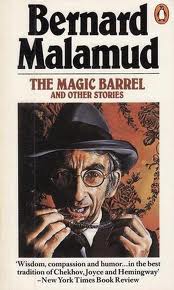
Malamud’s story, “The Lady of the Lake” – which appears in The Magic Barrel -presents us with a good test-case.  To be sure, the story hits on themes that still speak to us, today.  Malamud’s articulation of Jewishness, in this story, bring us into the consciousness of a Jewish character who would like to find out, for himself, if he is really a “free man” or a man bound by history (Jewish history).   This test, to be sure, is played out by a schlemiel since, for Malamud, this kind of a schlemiel is…a schlemiel because he tries to outwit history.  His desire to escape his Jewish history makes him into a schlemiel. To do this, he plays a masquerade which, in the end, fails to cover up his true identity.

The main character of “The Lady of the Lake” is Henry Levin:

Henry Levin, an ambitious, handsome thirty.

He receives an inheritance and decides to leave New York City for Paris “seeking romance.”  And the reason he goes is because he is “tired of the past – tired of the limitations it imposed on him”(94).   At the outset, the reader has no idea whether this “past” is personal, familial, or tribal.

Immediately after noting this problem with the past, Malamud notes that Henry Levin, when abroad, changes his identity.  At the hotel register, he signs his name as “Henry R. Freeman.”  His name introduces his challenge.  Like a modernist artist, he wants to create a “new” life and invent himself anew.  To do this, he goes under an alias. As the story goes on, however, this alias is tested.

To be sure, he so badly yearns to be free that he moves restlessly through Europe and ends up in Italy.  This process of movement makes him feel as if he is a real man (and not a nebbish).  To illustrate, Malamud includes a scene where Levin takes a rowboat out and braves the waters:

He kept rowing though he felt risk.  However, the waves were not too bad and he discovered the trick of letting them hit the prow head-on.  Although he handled his oars awkwardly, Freeman, to his surprise, made good time. (97).

The reader will notice that Levin, now Freeman, is not a total schlemiel (of the nebbish variety).  Although he “handled his oars awkwardly,” he does display skill and perseverance.  And this shows that the narrator sees this change as exemplary of some kind of transformation as Freeman pursues an adventure whose end is romance.

Upon docking on an island, Freeman experience an untold of beauty and although he feels blissful he also has a sad memory:

By now the place was bathed in mist, and despite the thickening sense of awe and beauty he had felt upon first beholding the islands.  At the same time he recalled a sad memory of unlived life, his own. (97)

In the midst of these sad thoughts, he notices, for the first time, a mysterious woman on the edge of his vision.  She disappears and is left with a sense of mystery and romance. This set’s up the plot since the woman he sees takes on reality and represents his biggest challenge: to fall in love with her and have her fall in love with him.  But, to do this, he has to hide his past.

The next day, he goes back to the island and notices that the tour guide and a tour are there.  He describes the tour guide as a “sad-looking clown” who stabs with a “jaunty cane.” This comic figure is by no means arbitrary.

After Freeman, once again, experiences beauty and has a mixed feeling (based on his memory of his “personal poverty), he encounters the “lady of the lake.”  His epiphany displaces his dis-ease:

When he glanced up, a girl in a white bathing suit was coming up the steps out of the water.  Freeman stared as she sloshed up the shore, her wet skin glistening in the sunlight.  (100).

Malamud’s poetic-prose follows up on this moment and articulates the image of an Italian goddess.   However, Malamud follows this up by describing Freeman’s body and the fact that he is a New Yorker. In sizing him up and contrasting his body to hers, the narrator, points out Freeman’s anxiety, yet gives him a pass:

Although he feared this moment, partly because of all he hungered for from life, and partly because of the uncountable obstacles existing between stragers, may the word forever perish. (100)

In contrast, she has no fear.  But when they come into close quarters, she asks him if he is Jewish:

The girl studied him for a full minute, then hesitatingly asked: “Are you Jewish?”

In response, Malamud tells us that Freeman “suppressed a groan” and was “secretly shocked” by the “unexpected question.”  Yet, as the narrator points out, “he did not look Jewish and could pass as not – had”(101).  So, “without batting an eyelash, he said, no, he wasn’t”(101). This moment is central to the text.  He feels exposed but wants to hide this, as he wants to hide his Jewishness so as to find romance.

But right when they are about to kiss, the guide, the “sad-faced” clown appears out of nowhere: “He gazed at them with astonishment, then let out a yell and ran down the stairs, waving his cane like a rapier”(102).  He looks at Freeman and yells “transgressor,” yanked him away, and “whacked him across the seat of the pants”(102).

The narrator notes that this “departure from the island was an embarrassment.”

Malamud’s decision to cast the figure of the “sad-clown” as a character who breaks the moment of bliss up is telling.  It suggests a deeper motif that has to do with Jewishness. The sad-clown with a rapier parries Moses with his staff.  He separates the Jew from Romance and Beauty.  Freeman’s embarrassment is a testimony to the shame he feels.   He feels as if he has lost.

However, the “sad clown” doesn’t return.  But, to be sure, one wonders, following this, if Freeman is the sad clown who doesn’t want to be a sad-clown.  The next day, Freeman does his utmost to make amends and sends the woman, whose name is Isabella (think of Queen Isabella of Spain – who prompted the Inquisition), a letter.

She agrees to meet.  What ensues is a ruse.  The whole time they are together, the narrator points out that she hesitates with Freeman.  She seems to be hiding something?  Is this because of his Jewishness?  Does she distrust him and does she despise Jews? Why would she, immediately, ask if he is Jewish.  This, to be sure, is the lingering question.

In the next blog entry, I will address this question and what happens to Freeman at the end of the story.  As I hope to show, his attempt to defy history (and be a truly “free man”) makes him a schlemiel and this conveys a lesson which should be of interest to Jews today; that is, if history and Jewish identity still matter to post-assimilated Jews…

Walking Like Charlie Chaplin and His Orphan Sister: On Delmore Schwartz’s Poem “Time’s Dedication”

DownloadedFile

The poet Charles Baudelaire has written several poems in which the poetic voice or the narrator (of many prose pieces from Paris Spleen) wages a battle with TIME.  He wages his fight in the name of Timelessness and intoxication; however, many of those battles ring out with the sound of despair.  To be sure, Baudelaire was very pained by the fact that he had to constantly battle with time.  And, more importantly, he was all alone in this fight against Time.

Delmore Schwartz, no doubt, read Baudelaire.  And in many ways, he also struggled with Time.  However, he didn’t do it all alone.  In his poem “Time’s Dedication,” he calls on “you” the implied reader or some other to join him in this battle.  And, unlike Baudelaire, the battle doesn’t end in despair or tragedy.  Rather, it has a comic ending which includes a key reference to Charlie Chaplin (who, lest we not forget, Hannah Arendt saw as the last schlemiel of what she calls the ‘hidden tradition’).  Schwartz’s comic ending does what Baudelaire can’t: it redeems time by way of taking it away from the trajectory of death and realigns it with what Emmanuel Levinas would call the “time of the other.”  And what makes this so novel is that the poem is “time’s dedication” – not his.

“Time’s Dedication” starts off with a meditation on the self and its bout with the Time:

My heart beating, my blood running

The light brimming,

My mind moving, the ground turning,

My eyes blinking, the air flowing,

The clock’s quick-ticking

Time moving, time dying,

Time perpetually perishing!

Time is farewell! Time is farewell!

To be sure, the last words of this stanza bespeak the relation of time to death: Time will kill the poet.  However, the next stanza asks that an implied “you” stay with the voice of the poem and “stand still”:

Abide with me: do not go away,

But not as the dead who do not walk…

Quit the dance from which is flowing

Your blood and beauty: stand with me. 

But then the voice of the first stanza returns and insists that “we cannot stand still” because “time is dying” and “we are dying.”  This all translates into the same last words of the first stanza: “Time is farewell!”

In the face of this voice, the last stanza counters and insists that the voice obsessed with death and time to “wait for me”:

Stay then, stay! Wait now for me,

Deliberately, with care and circumspection,

Deliberately

Stop. 

This countering voice suggests that what “we” need to focus on, with deliberation, is “walking together.”  And this walking should be in a comic manner “like Chaplin and his orphan sister”:

Walking together,

Controlling our pace before we get old,

Walking together on the receding road,

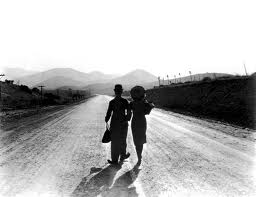
Like Chaplin and his orphan sister,

Moving together through time to all good.

The last stanza suggests that “walking together” like “Chaplin and his orphan sister” – with their odd walk – is a manner of  “moving together through time to all good.”  Moving toward the good together is something we find in Mendel Mocher Sforim’s The Travels and Adventures of Benjamin III.  We also see it in Gimpel the fool who, it seems, is always walking toward the good even though it doesn’t seem to be in sight.  These characters, it seems, are not affected by a fatalistic approach to death.  They avoid it by way of trusting the other and the good.

The idea that one is moving toward the good, as the future, appears in Emmanuel Levinas’s work.  To be sure, he ends his book Totality and Infinity with a section entitled “Being as Goodness – The I – Pluralism – Peace.”

Goodness does not radiate over the anonymity of a collectivity presenting itself panoramically, to be absorbed into it.  It concerns a being which is revealed in a face, but thus it does not have eternity without commencement.  (305)

The word “commencement” is interesting as it suggest a meeting and a movement of two people.  Levinas goes on to describe goodness as an “absolute adventure” which is “transcendence itself.”  But this is the not the transcendence of an isolated “I.”  Rather, “transcendence or goodness is produced as pluralism” and it “proceeds” from me to you.   Elsewhere, Levinas calls this relation of goodness the “time of the other.”

What I like about Schwartz’s poem is the fact that it is “time’s dedication.”  The poem is dedicated to the poet by the time of the other.  And it ends with that time rather than dedicating it to the time of the self and death.  Most importantly, this dedication is translated into a comedic kind of walking down the road.  It isn’t exactly “heroic” in the Heideggarian sense of being-toward-death; rather, it is innocent and naïve.

This poem suggests that Schwartz would rather you “wait” for the poet than rush off to death.  And once you arrive, we can walk off together “like Chaplin and his orphan sister through time…toward the good.”