
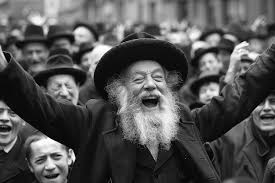
I want to apologize to all of my subscribers for being off the blog for such a long time. I was literally locked out of my account because my password recovery email changed. After some time and back and forth with WordPress, everything worked out. Here I am! Hi’neni!
For my first post in a year and change, I’d like to share a reflection on laughter by Joseph Rosenfeld a friend of mine who is a master of Hasidic, Midrashic, and Kabblalistic texts. He also happens to be a fan of Schlemiel Theory! His reflection on laughter – something near and dear to this blog and blogger – shows how deep and important laughter is to Judaism, spiritually and intellectually.
We all know that Hasidim love to dance, sing, and tell stories. Joy, as the Baal Shem Tov (Father of the Hasidic movement), breaks all boundaries. It makes it possible for God’s light to break through into darkness. What is the deeper meaning of humor? Why is laughter so key to understanding Judaism?
Take a look:
Joseph Rosenfeld: “The Root of the Dispute Between Rebbe Nachman and the Shpoler Zeide and the Secret of Laughter”
The root of the dispute lies in the sublime laughter referenced in the verse “she laughs at the last day” (Proverbs 31:25), which is revealed precisely through the reversal associated with Binah (understanding).
The essential secret of the dispute between the Zeide and Rebbe Nachman, of blessed memory, is alluded to in Rebbe Nachman’s terse words regarding opposition, where he said that in the future it will be “a fine laughter.” That is, the entire matter of opposition and the darkness it brought about will all be transformed into the secret of future laughter. This follows the teaching of the Rebbe shlit”a, that this laughter is the laughter of the Leviathan, which arises from the cosmic battle between the Leviathan and the Wild Ox (Shor HaBar). Just as the ox represents revealed tzaddikim (righteous individuals) associated with Chokhmah (wisdom), the Leviathan symbolizes hidden tzaddikim rooted in Binah.
All opposition between tzaddikim is, in truth, rooted in the mystical opposition between Chokhmah and Binah, which is essentially the tension between ayin (nothingness) and yesh (being). Chokhmah points to the ayin of Atzilut (the highest world), while Binah relates to the “I” of Beriah, Yetzirah, and Asiyah (the lower worlds).
These two revelations are, by nature, diametrically opposed—like day and night, the sun and the moon, the “two great lights.” Therefore, they argue over the path by which two opposites can be united. The only way is through bitishah (collision), which is the secret of unity and peace within the dispute itself, in the aspect of “He makes peace in His heights”—which is an acronym for eisev (grass), as explained in Likutey Moharan I:39. This relates to the unification between Chokhmah, represented by the Divine Name AB (72), and Binah, associated with the Divine Name Elokim in its full spelling with yuds, which equals 300, alluding to the acronym AS”V.
Through dispute and collision, this wondrous unification is revealed—the secret of “a help opposite him.” For it is known that laughter emerges from gevurot (judgments) sweetened at their root, through Binah, where the secret of reversal is held, as in “v’nahafoch hu” (“and it was turned around”), with “hu” hinting to Binah.
Laughter is the ability to flip the path from what was expected to what was never imagined. As the sages say: “On the contrary, the opposite seems more correct” (adraba, ipcha mistabra)—an expression rooted in Binah, the mother. What we thought with our external intellect would lead to a known outcome is suddenly reversed. This astonishing movement of reversal is the inner sense of the joining of opposites, achieved specifically through reversal—or, as R. Aharon HaLevi of blessed memory put it, “unity from opposites.”
Laughter does not arise merely from change, but from the profound realization that what I had taken as obvious and certain was, in truth, only possible and doubtful. When a person realizes that what he assumed he had grasped remains merely hypothetical, a deep existential question emerges regarding how we perceive and interpret reality. When one sees that his previous understanding was merely a “hava amina” (preliminary assumption), his heart opens to see that he truly knows nothing. “I said I would acquire wisdom, but it is far from me.”
At the moment this awareness arises—that all prior knowledge was only a possibility—every calculation of knowledge collapses, and one enters a higher plane: the world of emunah (faith). Normally, a person navigates the world—this night-like realm—using wisdom and understanding: the mind and heart. But when these fail through sudden revelation (“my father and mother have forsaken me”), he must sink deeper into the soul’s core, the realm of Keter (crown), which transcends both Chokhmah and Binah, as in “but the Lord gathers me in.” Where Chokhmah and Binah end, there begins the power of wonder—Keter, the seat of emunah.
Only through emunah can a person withstand contradictions that defy reason. Emunah gives the capacity to hold two opposites in one subject, and through this, laughter is revealed—rooted in the union of opposites, as in “I saw an upside-down world.” This world of reversal is the realm of emunah, where the saying “on the contrary, the opposite seems correct” comes to life: the ability to discard outdated intellect and receive new insight from a higher place—the lights of Keter, the root of laughter.
The secret of laughter is the revelation of Binah as it is rooted in Keter, in the innermost dimension of Binah, which is the inner dimension of Atik, known as Radla (Reisha d’lo Ityada – the Unknowable Head).
The essence is that the root of laughter is found in Keter, as in “your God shall rejoice over you” (yasis, same gematria as Keter). There, the entirety of lower existence is rooted in the supreme yesh (being), in the necessity of existence—the true yesh—which exists only in Keter. Only Keter can hold opposites within one reality. It rules over the paradox of “above and below simultaneously,” like Moses’s unknown grave—appearing above to the lower and below to the higher—these are the consciousness of the “world of reversal.”
As long as the lights of Keter shine in the world, there is a revelation of the Infinite Light (Or Ein Sof)—for schok (laughter) equals “Infinite Light” in gematria. This is the new vitality descending from the heights into the world to sustain existence. Prior to laughter, there was a form of death—a breakdown of mind and heart—“my father and mother abandoned me.” Precisely there, in the death of intellect, is where the new revelation must emerge—from the heights of Radla. Since this revelation arises precisely from the death of intellect and heart, the new consciousness must carry within it the power to unify opposites, for the very cause of the breakdown was the encounter with paradox.
The revelation of a gap between the old and new understanding evokes a crisis of contradiction. This cannot be resolved with ordinary intellect—it has shattered. A light higher than mind and heart is required: the light of Keter, which includes both the “I” of perception and the “nothingness” of its negation. From there a new power arises—Keter, the wonder-working unifier of opposites. The core of the breakdown lies in their opposition, and the repair lies in their union—an astonishing unity at the heart of Keter’s joy: “He shall rejoice over you.”
Thus, Radla is the power of containing opposites, and through it laughter is revealed—a new understanding that what I thought I knew, I truly did not. As it says, “no one knows his burial place.” Laughter is the descent of Keter into the opposition between what was known and now unknown—this is the path to unite Chokhmah and Binah. True laughter does not unify by merging parts into something new through mutual cancellation. That method still cannot tolerate opposites.
Laughter, by contrast, allows both to exist simultaneously, even without fusing them. Its root reveals the wondrous power of linking through separation—each stands fully intact, and still, they connect. “Mem and Samech stood miraculously” (Talmud, Shabbat 104a). Their coexistence amid contradiction is inexplicable, yet functional.
This unification is not a frontal embrace (panim el panim), but a back-to-back (achor b’achor) union—each maintaining its identity, without surrendering to the other. Still, they are joined, through distance itself, in the high realm of Atik, where masculine and feminine are connected achor b’achor, like a floating tower in air, with no ground. Here, the only path to unity is through laughter, which breaks old frameworks and invites emunah into a world of new combinations beyond prior logic.
Only by breaking the strong vessels of old intellect can one enter the world of laughter, “a fine laughter, refined to the finest degree.” Through this breaking, one enters the gates of joy, where even contradiction becomes unity.
Thus, the “fine laughter” that will arise in the future from the dispute between the Zeide and Rebbe Nachman is not only a description of what will be, but reflects the very nature of the dispute—itself a form of redemptive laughter. It arises from a union forged through bitishah (crushing), an acronym for bitachon, tov, schok—trust, goodness, and laughter. This unity is possible only in the hidden realm of Radla, where the light of paradox reigns and unites opposites within contradiction itself.
Chokhmah and Binah are truly inseparable companions (trein re’in d’lo mitparshin), and thus both are needed, in the secret of “I and nothingness simultaneously,” revealed through Radla, in the unity-through-crushing (bitishah)—a mystery of “reaching and not reaching” that will be explained further, God willing.
Ultimately, the laughter that will arise from this dispute is an extended revelation of the true laughter that flows from the innermost depths of Keter—Radla. It is the path to perfect repair, revealing how both Chokhmah (ayin) and Binah (ani) work together to disclose the sublime light of Radla, the da’at (knowing) of peace.”

 Schlemiel Theory