Chaplin’s Fork Dance: Modernity, Disenchantment, and Re-enchatment Through Smallness

Unknown-2

The schlemiel character often stumbles over the smallest things.  While most of us would never pay attention to or miss such little things, they are the cause of his or her bad luck. The response to these little things is what gives the schlemiel its childlike, small character. These little stammer-ings and stumbl-ings are what make the many schlemiels played by Woody Allen, Adam Sandler, Seth Rogen, Gretta Gerwig, or Amy Schumer so – as Arendt said of Chaplin’s schlemiel – “charming.” These little stammering and stumblings – because they are so absent minded – redeem the schlemiel character.

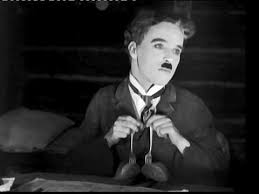
Recently I saw a Chaplin clip that, to my mind, gave a comic figuration that illustrates the aesthetic redemption smallness. In Goldrush (1925), and in so many of his films. He turned small stumblings and stammerings into a dance – a fork dance.

https://www.youtube.com/watch?v=ww5pb-z0o0I

His comedy redeems more than something personal; however.

As Aubrey Glazer, notes, in his recent book on Leonard Cohen, Tangle of Matter and Ghost: Leonard Cohen’s Post-secular Songbook Mysticism(s) Jewish and Beyond: if spirituality is to matter any more it must address the disenchantment of modernity. He cites the philosopher Charles Taylor – the foremost thinker of “post-secularism” to explain what is at stake with modern disenchantment:

In “Disenchantment- Reenchantment,” Taylor draws out the distinctions between existence in the enchanted world that precedes modernity and the disenchanted world that lies at the core of modernity and how it has indelibly shaped the modern mind….Yet amid all of the remarkable discoveries and insights that mark modernity, it is still accurate to claim that the demarcating line “between personal agency and impersonal force” has led to the complete elimination of the unimagiable depths of the cosmos? Perhaps not.

…What appears to be emerging from the depths of secularism is what Taylor sees as a rapproachement, albiet somewhat unconscious at this juncture, between the religious and the materialist. (208-209)

How is this possible? What prompts this rapprochement? Glazer sites a passage from that essay that suggests smallness is the way of rapprochement. I’ll site a part of the Taylor passage to illustrate:

The new cosmic imaginary adds a further dimension to (this buffered identity). Having coming to sense how vast the universe in time and space, how deep the micro-constitution goes into the infinitesimal, and feel ing thus both our insignificance and fragility, we also see what a remarkable thing it is that out of this immense purposeless machine, life and then feeling and thought emerge. (209)

Glazer reads this passage in terms of an awe that emerges through marking the “difference between personal agency and impersonal force” which is at the “precipice of the infintesmial”(201). Glazer reads this difference in relation to Leonard Cohen, prophesy, and poetry.

One of the main tasks of Glazer’s book is to suggest that the “bard” (the poet) has replaced the prophet. According to Glazer, we see this illustrated in Cohen’s poems: especially his song/poems: “Story of Issac.”

And the “Window.” Both songs/poems traverse Judaism and Chrisiantiy through a “syncretism” of Jewish and Christian elements. They bring the individual up and then down into matter and a collective fallen community of “post secular” fallen angels – in a “new Jerusalem” (up there) and an “runied one” (down here). Its a reversal of directions into a spiritual kind of dialectical materiality :

This reading of the difference that is prompted by the infintesimal focuses more on poetry as redemptive by pronouncing the awesome divide between individual freedom and spiritual transcendence and collective ruin in Jerusalem. The meaning of this collective Jerusalem needs to be understood as an imaginal figuration of spirituality in the post-secular age. This is a brilliant reading of Leonard Cohen and it is a reading that Glazer suggests – like Elliot Wolfson and James Diamond – a subject of Jewish philosophy.

What I’d like to do – building on Glazer and Charles Taylor’s reading of re-enchantment – is to suggest that smallness is a figure for Jewish philosophy. It prompts not just the “bard” but the comedian and the comic figuration of the schlemiel. The schlemiel turns us to the imaginal space of small things that are redemptive. Chaplin shows us that the schlemiel can turn the small things into a fork dance.

Chaplin brought us closer not so much to these little machines, than the schlemiel’s response to them. They animate smallness; they become smallness.

As we jettison into the future, things are getting even smaller. And so are we.

The more apps we have, the more questions we have answered by google (“hello google”), we are going to feel the need for comedy and Chaplin’s “dance of the forks.” Without it, what spirit is left? To be sure, smallness seems to have the key. The imaginal figure of the schlemiel may be the last thing that can bring us down to earth with its stammerings and stumblings. Who knows? The schlemiel knows. He’s dancing with forks to make you smile about smallness.

American Schlemiels: On Gomer Pyle and Forrest Gump

Unknown

After learning that Jim Nabors died yesterday, a flood of impressions I held within me – from many years watching re-runs of The Andy Griffith Show – washed over me. Like many Americans, I used to come home and watch reruns of shows that had comic figures – ranging from Leave it to Beaver, Little Rascals and The Three Stooges to Gilligan’s Island and…The Andy Griffith Show (11Alive – the New York station that came to me in my small Upstate New York town – filled my after-school-afternoons with these re-runs). With all of these shows – save for Gilligan’s Island – I felt as if I were living in a different post-WWII America. I loved the slapstick comedy of the Three Stooges more than any show. To be sure, I felt something very similar to my own life. After all, it had a schlemiel, a schlimazel, and a nudnik in every show and that, to be sure, comes not only out of Jewish humor but also out of Jewish life. My family had this trio of bad luck and comic antics, as did the families of many of my Jewish friends. However, it was shows like Leave it to Beaver and The Andy Griffith Show that made me think more about the meaning of American humor. What, I wondered, is the difference between the schlemiel character and the American variety of the fool? Are there any similarities? Was the innocence or the comic antics of the American fool different?

Daniel Itzkovitz – in an essay entitled “They All Are Jews” – argued that with films like Forrest Gump (1994), the schlemiel character was Americanized. It became a part of the American mainstream and, at that point, the schlemiel became the American everyman. It was no longer unique to Woody Allen or Philip Roth, etc. However, last night, after watching several episodes of The Andy Griffith Show, it struck me that, long before Forrest Gump, Jim Nabors was already Americanizing the schlemiel through his Gomer Pyle character.

https://www.youtube.com/watch?v=dZt_G9t7_1A

I looked through several videos, but this one – entitled “Gomer the House Guest” – really struck me as a good case for the Americanization of the schlemiel character. What I love about this episode is the fact that it’s comical plot is based on the hypothetical question: What happens when a homeless schlemiel becomes a house guest? The answer to this question is obvious for anyone familiar with the character: the house will become a mess and everything will be thrown off kilter. And that is exactly what happens. But what makes it comical is the fact that the schlemiel character – he played by Gomer Pyle – can’t see how what he is doing is wrong. He has good intentions. But he is worldless and doesn’t understand how “normal” people live.

Gomer – in one scene after another – is too loud, stays up too late, and has no sense of what Andy Griffith feels. What is interesting about this version of the schlemiel is that, Nabors plays a man-child who is given a lesson. Andy lets him know that although he has good intentions, Gomer’s actions are disturbing the host. But this doesn’t stop it from happening. It goes on. Griffith and the viewer find his innocence and stupidity charming because Gomer – at his core- is happy with his lot – much like Rabbi Nachman of Breslau’s simpleton (who Ruth Wisse and David Roskies call a schlemiel character). Gomer – also like Rabbi Nachman’s schlemiel character – is always happy and seldom down.

But what differentiates the schlemiel from Gomer’s character may be this. Ruth Wisse argues that the eponymous simpleton in I.B. Singer’s “Gimpel the Fool” knows that people are taking advantage of him but he gives them a second chance to prove their humanity. They never do. But the point is not so much for Gimpel as for us. The fact that he knows he is being duped is not the central point; it is the fact that society doesn’t become any better. In the Andy Griffith Show, Gomer doesn’t seem to ever know that he is being duped or that he is a dupe. Even so, Andy Griffith, unlike any of I.B. Singer’s characters in his story, does the opposite. He opens his home and his life to Gomer. And in doing so, we see American society as friendly and kind to the innocent.

Singer’s goal was to show – in the wake of the Holocaust – the cruelty of humanity. And he did this through the schlemiel character, Gimpel. The Andy Griffith show conceives of a different kind of schlemiel character. The community embraces him. He is one of the family despite the fact that he can’t function in society. In fact, his innocence gives him a kind of freedom that he lacks because the Griffith character is – after all – the sheriff in town. He needs to maintain law and order. Griffith needs to be the adult. But he is the kind of adult who doesn’t scold the man-child. He gives him a chance and makes a space for absent-mindedness and what a film critic like A.O. Scott would call something uniquely American: “perpetual adolescence” and the “end of adulthood.”

Today’s schlemiel characters – ranging from Seth Rogen to Lil Dicky – are caught up in this perpetual adolescence, it seems. But at its root is a kind of faith and love for the Gomer Pyle/Forrest Gump kind of character which may have its origins in American folklore or Mark Twain. In this character, there is a rejection of English formality and adulthood. It’s not just that stupidity is a challenge; it is also an affirmation of something distinctly American. However, that affirmation – in this show at least – would be null if it weren’t for the relationship between Gomer Pyle and Andy Griffith. The relationship is oddly reminiscent of Sancho Panza and Don Quixote since one character is more in the world than the other. But what is most important is their relationship. In America the message is that the Americanized schlemiel has a seat at the family table; despite how much he upsets the house he stays. And in this there is something similar to the original schlemiel character who – despite his absent-mindedness – will always be a part of the (Jewish) family.

Rest in Peace – Jim Nabors. Your character, Gomer Pyle, prompted me to think about what comedy and national identity. It demonstrated that in America the schlemiel character – or a variant of it, rather – though homeless, as Gomer in this episode, has a home.

Theodor Adorno’s Force Fields and Camille Paglia’s Killing Fields

Unknown

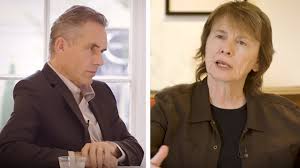
The majority of people don’t go around every day thinking about what art is. Few think about why the definition of art may change not only the way we think but also the way we act in the world.   Today, I was surprised to hear, in a discussion between two very controversial voices in contemporary North American culture – Camille Paglia and Jordon Peterson – that what “post-modernists” and “post-structuralists” have done is destroy the meaning of art by turning it into “text” or dissecting it (9:37).  The “true” meaning of art, says Paglia, has been distorted by the academy because it is populist, not elitist. 

For Paglia, not only post-modern artists but also academics (who she calls “academe” – suggesting something snobby and elitist), who go “hand in hand” with the artists – are a “fraud” because they believe that opposition to history and culture (via the avant garde) is alive when it is – post-Warhol – dead.  They act “as if” they are like these avant garde heroes, but they are really “infantile.”  Paglia suggests that the real art and left politics is populist and – together with Peterson – attacks the postmodern academy.  All of this name calling, note, is done over the meaning of art and leftism.  Art is not, rages Paglia, superior to the people.  It’s the other way around.  Postmodern art, which for Paglia also implies the academy, is the problem.  Paglia suggests, in her rhetoric, that it must be exposed as a fraud by the voices of the people (such as Paglia, herself, and Jordan Peterson):

It’s madness…teaching that everything is mediated by language…even gender….it’s absolute madness.  I am teaching people whose majors are ceramics, are dance…who understand the world in terms of the body…sensory activation…Everything about Andy Warhol was ‘wow’ it was about admiration.  What happened immediately after that, in the 70s was a collapse into a snide sort of postmodernism….this happened in the art world…there was an  utter misunderstanding of culture in the art world…Oppositional art in my view is dead.   What postmodernism is…is a pathetic attempt to continue the heroism of the avant garde.  The avant garde was genuinely heroic…Pop art killed the avant garde…It (the postmodern art world) feels it must attack, attack, attack the simplistic beliefs of the hoi polloi.  From the moment Andy Warhol….embraced the popular media – instead of having the opposition to it, which the serious arts had – that was the end of oppositional art….So we have been going on like this for 50 years….Postmodernism and academe going hand in hand with the stupidity and infantilism that masquerades as important art in galleries everywhere….With this idea that the art world has a superior view on reality. Authentic leftism is populist.  It is based in working class style, working class language, working class direct emotion…in an openness and brusqueness of speech.  Ok.  Not this fancy contorted jargon of this leftism of academe who are frauds.

 When Paglia takes aim at postmodernism, it seems like she is also taking aim at the 20th century European thinker, Theodor Adorno’s reading of art and culture.  After all, he sees art as going against the grain of history and culture. It is different and, for him, better because it is a form of critique (albeit momentary) when it doesn’t proclaim itself as art but something other.

In his book Aesthetic Theory, Adorno argues that “art is no fixed set of boundaries but rather a momentary and fragile balance, comparable to the dynamic balance between the ego and the id in the psychological sphere.  But artworks become bad only because they objectively raise the claim of being art”(300).    According to Adorno, surrealism had potential but it failed because it was rejected by “an anti-art deportment that never achieved its goal of becoming a political force.”  He suggests that the rejection of surrealism by this anti-art deportment was a mistake because it, itself, failed to become a political force.

The “force field” – created by art – is something to be reckoned with. The immanence of art, its totality, creates a force-field.:

All the same, origin is not radically external to the work.  It is an implicit part of the artworks that they are artifacts.  The configurations sedimented in each address the context from which it is issued.    In each its likeness to its origins is thrown into relief by what it became.  The antithetic is essential to its content.  Its immanent dynamic crystallizes the dynamo external to it and indeed dow so by virtue of its aporetic character.  Regardless of their individual endowments and contrary to them, if artworks are unable to achieve their monadological unity, they succumb to real historical pressure; it becomes the force that inwardly dislocates them.  This is not the least of the reasons why an artwork is adequately perceived as a process. If however the individual artwork is a force field, a dynamic configuration of its elements, this holds no less for art itself as a whole.  Therefore art cannot be understood all at once, but only in terms of elements, in a mediated fashion.   One of these elements is that by which artworks contrast with what is not art; the attitude toward objectivity changes.  (301)

The force field is inherent in this “dynamic configuration of its elements,” and this dynamic is what contrasts with what is not art.   If, on the other hand, it “succumbs to real historical pressure,” than the force of history “inwardly dislocates it.”  In other words, the force of history can destroy the force field of art.

And perhaps that is what distinguishes Adorno from Paglia.  He would argue that it is only through the opposition to history that art can be a force field – that is, a true force, with a dynamic of it own.  But the anti-art movement, which fails to become political, suggests that the killing field wants to destroy the force field.   The people – history – can and, as Paglia suggests, should dislodge it.  Because art – and by implication – academia have become a negative force that goes against the grain of true leftist history, which is populist, it must be derided and destroyed.

What Paglia suggests is that since postmodern art is not from the people but from the elite, it must be exposed as a fraud.   Only true art, in other words, comes from the people not from academics or artists. But will the people produce a force field that goes against the grain of history or will history (synonymous with the people) – embodied in, as Paglia says, in the “working class style, working class language, working class direct emotion…in an openness and brusqueness of speech” – destroy “art”?  Will the killing fields destroy the force fields?

Questions: Food for Thought

Has art – as Adorno understood – now become impossible after Warhol?  Is it really dead?  Are we living in an age when it must be killed because it is taking us from who we “really” are, as Paglia suggests?  Why is this struggle of forces over the meaning of art, as the meaning of the academy, so important today?  Will the academy be forced to address these claims made by Peterson and Paglia simply because they are so popular (this video, itself, has nearly 700,000 views and Peterson has recently scared the University of Toronto by suggesting that a website be built which designates which classes are “postmodern,” which means, as we see here, contrary to the people)?  Is this the contrast – the dynamic – that Adorno was looking for or is it something he wouldn’t expect?


Larry David, the Schlemiel, and Holocaust Humor

Unknown

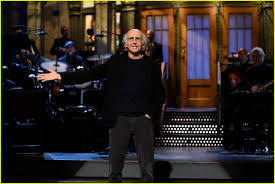
Larry David’s opening monologue for SNL – which included a joke about picking up girls in Concentration Camps – was contested by many on Twitter and elsewhere.  The harshest criticism came from Thane Rosenbaum in his piece for the Los Angeles Journal entitled “Larry David Goes One Cringe Too Far.”   Reading some of these articles I wondered about what kinds of distinctions were being made with respect to the schlemiel character.  To be sure, when it comes to the schlemiel, it’s hard to classify Larry David and his humor.   His skits on Bernie Sanders were in the classic schlemiel mold, but other things he has done point to something else.

(If you are in Canada clicking this video, go here.)

Ruth Wisse, in her last book on comedy, No Joke, argues that Larry David’s schlemiel is different form anything we have ever seen in the Jewish tradition:

He is now the Jew with influence, thoughtlessly rich.  The transformation of this character from harmless to hurtful demonstrates the adjustment of Jewish humor to altered conditions of power and prosperity.  Puncturing political correctness in liberal democracies is hardly as dangerous as defying Hitlerism and Stalinism in Europe, which may be why American Jewish comic heroes and no longer (like Charlie Chaplin, many Sholem Aleichem, or I.B. Singer schlemiel characters) necessarily winsome or charming.  The man who drives the slickest car on the road can’t claim the naiveté of an eastern European Jew in his wagon, and the owner of the biggest house on the block can’t garner the affection reserved for Molly Goldberg yoo-hooing out of her cramped apartment window (238-39).

In an article entitled “Larry David’s SNL Jokes Moved Jews Haters to Laughter and Holocaust Survivors to Tears,” Varda Spiegel draws on Ruth Wisse’s kind of language and argues that Larry David is different from the traditional schlemiel and fails to hit the mark:

Perhaps, Larry, you were going for a classically Jewish, Chaplinesque, and self-deprecating laugh through tears. If so, I appreciate the shout-out to Woody Allen and Hershele Ostopolyer. But I expected better of you, Larry, and better of SNL, than moving tweeters to tweet, anti-Semites to laugh, and Holocaust survivors to cry.

Spiegel argues – like Ruth Wisse, Irving Howe, and Saul Bellow – that what makes the schlemiel such a great character is that it prompts laughter through tears.    What we get here, instead, is laughter for the anti-Semites and tears for the survivors.   This suggests that what David is doing is actually anti-thetical to the traditional schlemiel.

Thane Rosenbaum, in his essay for the Jewish Journal, substitutes the word “nebbish” for schlemiel when characterizing Larry David (perhaps in an effort to save the schlemiel from being contaminated by David’s Holocaust humor):

Appalling, but perhaps not surprising.  David has been flirting with the Holocaust for many years.  And he keeps coming back, not taking no for an answer, a nebbish with a libido for bad taste.  Except the Holocaust is not a love interest.  It is an unsightly atrocity, incapable of attraction of any kind, and on any human scale.

This is the same man who conceived a Seinfeld episode in which Jerry was making out with a girl during a screening of Schindler’s List.  And another in which a disagreeable fast-food proprietor was renamed “The Soup Nazi.”  An episode of Curb Your Enthusiasm riffed on the Reality TV show, The Survivor, in which a winning contestant squared off at a dinner party with an actual survivor of a death camp, comparing their relative suffering.  In still yet another, a man with numbers tattooed on his forearm turns out not to be a Holocaust survivor, but rather just someone who temporarily inks his lotto ticket number each week so as not to forget.

So much for Never Again.

Rosenbaum’s wording is interesting because David Biale, in his book Eros and the Jews, characterizes Woody Allen’s schlemiels as “sexual schlemiels” and says that they have a “small ego and a big libido.”

Rosenbaum finds words to describe what David had done with not only his own schlemiel character, but with George Constanza:

Yes, David’s entire act is predicated on projecting discomfort in his audience, forcing them to watch characters disgraced beyond redemption.  George Costanza, David’s doppelganger, was an enduring fool of humiliation, placed in recurring, squirming situations.  David took the Borsht Belt and twisted it into a straightjacket of Jewish self-loathing.  

The new schlemiel is one who is “disgraced beyond redemption,” or an “enduring fool of humiliation.”   In other words, he is different from the traditional schlemiel which is a redemptive character.    While it is true that Larry David – in his very SNL dialogue – sees himself as the master of self-deprecation, there are many questions left about this comedy act in particular and how it relates to the schlemiel in general.

Larry David touched on the worst aspects of the sexual schlemiel – which can be read, as they were by Mark Oppenheimer – as a pervert. We see this in Roth’s Alexander Portnoy character and in many of Roth’s later novels.   Unfortunately, this stereotype did get new life in the skit.  He tried to deflate it but there was no “laughter through tears.”    Perhaps we can better understand this through the fact that, few Yiddish writers wanted to cast a sexual schlemiel character.  This is certainly an American creation.  But what is the best way to address this without failing to hit the mark and effacing the schlemiel character?

And if Ruth Wisse thought that I.B. Singer’s Gimpel the Fool was the most fitting character for post-Holocaust literature (also see Nathan Englander’s “The Tummlers”), this suggests that the sexual schlemiel  is not the best character to use when approaching the Holocaust.   Their take on the character in relation to the Holocaust, makes us pause and think about the meaning of humanity.  This joke didn’t do that.   It did something else.  Perhaps it did separate laughter and tears.

Since we are witnessing so much judgment these days, I’m going to with-hold my judgment with this word perhaps.  I’ll let you decide.  All I can say is that Larry David is more like a schlemiel, a schlimazel, and a nudnik – altogether, at the same time.  And that’s simultaneously funny, sad, and offensive.


“The Alpha-Pussy” – On Marc Maron’s Reframing of the American Schlemiel

images

The events of last week with Harvey Weinstein have prompted many powerful articles (good, in terms of prompting awareness of violent sexual actions that were an “open secret” in Hollywood, and really bad, in terms of prompting anti-Semitic remarks and insane conspiracy theories).   After reading Mark Oppenheimer’s controversial Op-Ed piece for Tablet, entitled “The Specifically Jewy Perviness of Harvey Weinstein,” I was shocked to see that Oppenheimer – an editor at Tablet and the person beyond the (Un)orthodox Podcast – threw Philip Roth’s main schlemiel character, Alexander Portnoy into a toxic relationship with Harvey Weinstein.

Oppenheimer not only suggested a seamless relationship between Roth’s fictional caricature and a real pervert, he also suggested that these two are representative figures of baby-boomer Jewish-American urban life.  Little did Oppenheimer know (and he later apologized for it), but this association gave fuel to the anti-Semitic fire which associates Jews with perversion.

(To be sure, the Nazis drew a lot of their anti-Semetic ire out of this horrible stereotype of the male Jew as a threat to “their” women.  Hitler incorporated this fear into his Nuremberg Laws which forbid young German women from working under Jewish men.  Sadly, Oppenheimer’s article was praised and retweeted by the alt-right ideologue Richard Spenser as a “powerful essay”.)

This association has leveled a devastating blow against what David Biale – in his book, Eros and the Jews – would call the “sexual schlemiel.”   It also levels a devastating blow against the schlemiel’s anti-thesis, embodied in the comedy of Lenny Bruce.   As Biale argues, the “sexual schlemiel” is a character with a “big libido and a small ego.”   What is most interesting, however, is that although Biale mentions Roth at the outset (as the anti-thesis of the Sabra, who acts on his or her sexual desires and is powerful), he spends most of his time discussing Woody Allen.

Allen’s schlemiel chraacters, in comparison to Roth’s Portnoy, are tame.  Portnoy is a sexually aggressive schlemiel.  He has violent fantasies that – while comical – suggest that he is going to take “revenge” on the goyim. This idea overshadows the comedy of Portnoy’s powerlessness.  He could never accomplish this. But the thought that comes out –  in the wake of Roth’s other books and his own words – is that Roth leaves the schlemiel character for the characters who act on their fantasies (as in his novel Sabbath’s Theater).

In the wake of the link made by Oppenheimer, the sexual schlemiel has been challenged. Now fantasy about sex with “goyim” has been transformed into violence.   Although there was historically a divide between Jews and non-Jews that was sexualized by Jewish American writers and comedians in the 60s, 70s, 80s, and 90s, any mention of sexual desire for “shiksas” (which is something Lenny Bruce also explicitly talked about), is now taboo because it is food for the anti-Semitic fire and, in the wake of Weinstein, is shown to be misogynist.

Even so, the fact of the matter is that what we often see with the  schlemiel who doesn’t get to consummate his desire is that someone else does.  He is often the “cuckold.”  To be sure, the viewer or reader – whether of this or that Lil Dicky video, Seth Rogen film, or Woody Allen film – can’t imagine these characters becoming alpha-males and acting on their desires.  Moreover, they aren’t anywhere as “perverted” or vindictive as Roth’s character.  It would now – in the wake of this – be a mistake to put them into the same category. For this reason, it would be optimal to revise Biale’s category and differentiate between an aggressive and a passive sexual schlemiel.   For instance, compare Roth’s Portnoy to Bruce Jay Friedman’s Stern character (of the same era).  Both are sexual schlemiels, but one is much more aggressive and perverted than the other.

Thinking about this issue, I came across a line from a recent Netflix special by the stand-up comedian Marc Maron (famous for his WTF podcast).   In truth, Maron often casts himself as a schlemiel character.    What is unique about his recent special is that he seems to have reframed the discussion of the “sexual schlemiel” by calling himself an “alpha pussy” (see 20 seconds in to this trailer).

“I’m not the most courageous guy.  I’m an alpha pussy.  There’s the classic alpha male, meat head, rage filled…Raahhhh.  And then there is the alpha pussy who makes fun of that guy.”      As Ruth Wisse once noted, the schlemiel character always wins an “ironic victory.”  And s/he does so through the power of her words, through language.  The “alpha pussy” displaces the sexual schlemiel by returning this power to language because – in Maron’s formulation of the character and in the context of his show – he is making fun of unintelligent Trump supporters and alpha males in general.  This gives the schlemiel a resentful political role and de-emphasizes the sexual fantasy aspect of the character.

Maron’s failure to be an alpha male is turned into a kind of power.  By calling himself an “alpha pussy” he gives the schlemiel a kind of linguistic or intellectual power (defined by wit). The irony is that Roth’s Portnoy is also a kind of “alpha pussy” who is constantly using language to take revenge on the alpha males and females.   The difference, however, is that Maron’s stand-up character is not a misogynist while Roth’s Portnoy is.  He tries – at the end of the novel – to defeat a Sabra woman and make her sleep with him and fails.  But this kind of situation is not to be found in Maron’s comedy.   If anything, what we find in this special called “Too Real” is an endless reflection on how he is aging, forgetting things, etc and is one step closer to death every day.  His schlemiel comedy is that of self-deprecation.

While Roth’s schlemiel character is called self-depricating by the Sabra in his novel Portnoy’s Complaint, Maron’s schlemiel character is much more self-deprecating.   Because he constantly reflects on his aging and on his distaste for alpha-males, Maron’s “alpha pussy” shows us that he is not obsessed with sex.  He is far from perverted.  He is too old for that.   To be sure, we will likely be seeing less of the sexual schlemiel of the Portnoy variety.  Maron’s “pussy schlemiel” or else the Cuckold schlemiel we find in Rogen, Lil Dicky, and Ben Stiller, in contrast, will live on.  This – most likely – has to do with the rise of feminism in American society which sees any form of male sexual fantasy (big libidos and small egos) as a possible prompt to real violence.

Sexual failure, however, in the sexual schlemiel variety we see in Louis CK  (which is coupled with middle age, heavy self-loathing, and powerlessness) presents a borderline case.   Louis CK doesn’t hide his perversions.   But in this scenario, it seems really too late and pathetic for any sexual fantasy he presents to come true or affect anyone in real life.   Only time will tell.   Between Marc Maron’s aging schlemiel and Louis CK’s, which schlemiel will survive?  Will sexual schlemiels become a thing of the past or will they only become more pathetic and self-deprecating (as we see in Louis CK) or passive (as we see in Seth Rogen or Lil Dicky)?  Or will female schlemiels – like Gretta Gerwig or Amy Shumer (because they are not male or misogynist and take sexual failure as a central motif) – become the new sexual schlemiels?

A Priest and a Schlemiel Get on the Slowpoke Express: On Sholem Aleichem’s “The Miracle of Hoshana Rabbah”

A post on the archive which winks at today’s Jewish holiday –

Menachem Feuer's avatarSchlemiel Theory

Unknown

In the United States and Europe, the advent of the train and long distance travel prompted many artists, storytellers, and thinkers to turn the train into a metaphor.   Sometimes the images are exciting and feed utopian visions and cause happiness, other times they feed sadness at the loss of what was and cynicism. Think for instance of Freud who, in Civilization and its Discontents, writes the following:

If there were no railway to make light of distances, my child would never have left home, and I should not need the telephone to hear his voice. If there were no vessels crossing the ocean, my friend would never have embarked on his voyage, and I should not need the telegraph to relieve my anxiety about him. What is the use of reducing the mortality of children, when it is precisely this reduction which imposes the greatest moderation on us in begetting…

View original post 1,473 more words

The Sad Fate of a Hasidic Schlemiel: On “Menashe” (2017)

Unknown

Most films I have seen on Hasidim – save for the film Ushpizin (2004) – are utterly serious and often tragic.  Think, for instance, of The Jazz Singer (1927, 1980), The Chosen (1981) or Amos Gitai’s Kadosh (1999).

We rarely see comic films on or about Hasidim.  (Woody Allen’s little quips in Bananas (1971) or Annie Hall (1977) are mere asides; while his film Fading Gigolo (2013) does address Hasidim, it does so only tangentially.)  Menashe (2017) is different.  It is a tragic-comic film (spoken all in Yiddish, with English subtitles) that takes a Hasid named Menashe and his relationship with his son, his community, and his job as its subject.  Menasche is cast as a schlemiel (comic) and a schlimazel (tragic) character.     What interests me most about this schlemiel character is how it casts a new light on the fate of a contemporary schlemiel in the American Hasidic  (real and fictional) community.

There are two main ways of approaching the schlemiel in American cinema and literature which both fit on the same spectrum.  On the one hand, the schlemiel can be cast as a charming (although, for Jewish American writers, ragged and troubled) character – which is something we see stretching from the Yiddish fiction of Sholem Aleichem and Mendel Mocher Sforim to the Jewish American fiction of I.B. Singer, Saul Bellow, and Jonathan Safran Foer.    We see this as well in cinema and in television (from Charlie Chaplin and Jerry Lewis to Adam Sandler and Seth Rogen).    But in the fiction of Bruce Jay Friedman and Philp Roth or in the cinema of Noah Baumbach and the Coen Brothers we see a schlemiel that is more tragic and pathetic than charming.     The Menasche character exists between these extremes.  And the critique he levels is similar to that of Gimpel in I.B. Singer’s celebrated short story, “Gimpel the Fool.”

Menashe is close to the American everyman.

He has a simple job (he works in a grocery store); and unlike his Hasidic companions, he has a simple understanding of Judaism.  Menashe is more a man of the heart than of the head.    (This film depicts the responses of other characters – save his son and, for a slight moment, the Rabbi – to Menashe and the schlemiel character in a negative light.  This is ironic because Hasidim are often more oriented toward the schlemiel character which his simple understanding of God and the world.)

The plot is heartbreaking.

We meet Menasche in the wake of his wife’s untimely death.  He is left with a child who he loves but, because he can’t – in the community’s eyes – make a good living and because he doesn’t have a wife, he is told – by his Rabbi and his wife’s brother – to give the child over to his brother-in-law to raise.  This breaks his heart.  And it breaks the viewers heart as well.

Menashe has our empathy.

Menashe is a charming character.  His childlike (schlemiel-ish) approach to life, his job, and his son are heart-warming.  Menashe is able to relate to his child in ways that neither his Rabbi nor his brother-in-law or sister-in-law can.

The symbol of the innocence that they share – something an adult schlemiel (father) can share with his child – is a baby chicken.  He buys it for his son when he is given a chance to take care of him (after profuse begging before the Rabbi and to the chagrin of the brother-in-law, who is a successful realtor in Brooklyn as opposed to Menashe, who can barely keep his job in the grocery).   This discloses the comic, endearing aspect of the schlemiel.

When Menashe insists on making a special meal in his place – to mark the one year anniversary of his wife’s death (her Yahrzeit) – everything starts to go wrong.   He starts, so to speak, spilling soup everywhere.

When delivering fish, Menasche accidentally forgets to close the door and spills hundreds of dollars-worth of Gefilte Fish across the streets of Brooklyn.  He is chastised by his boss.  In the wake of this mess, Menashe begs his boss for a little money (a loan) for the Yahrzeit.  He gives him a loan, but he can’t take care of his son if he takes it (he will be working overtime, after-hours, moping floors.)

When, on the day of the Yahrzeit (when he visits his wife’s grave with the Rabbi, his brother-in-law, son, and family) Menasha tries to bake a noodle kugel (noodle dish), he forgets that he left it baking in the oven.  The moment of his discovery of the burning kugel marks the time when things start becoming more…tragic.

When he comes home with the Rabbi and the entourage, his apartment and the apartment house are filled with smoke.  The bird is dead.  Even so, he makes the best out of it.   When everyone complains of frozen taste of the kugel, the Rabbi sheds some light by noting that it tastes ok.

But that doesn’t change a thing.

Menashe loses his child; he cannot have him back until he can find a new wife.  However, since this happens at the end of the film, the viewer has no idea as to what will happen next.  Can the schlemiel find a new wife?  Does the schlemiel want to?

The last scenes of the movie are of Menashe dunking in a ritual bath, a Mikveh, juxtaposed to him working in the grocery.   This symbolizes a new beginning of sorts.  But what is that new beginning?

Is he – and are we – realizing the cruelty of the society around him? Do we empathize – as we do with I.B. Singer’s Gimpel – with the schlemiel and his predicament?

At a few points in the film, we are given hints of Menashe’s falling away from the community.  One day, he sleeps too late.  He forgets to wash his hands in the morning.  He also asks about – at one point – why a person without a family is considered a heretic by his community.  Even so, Menashe doesn’t change the way he dresses and he still prays.

When Menashe studies Torah (the Bible and oral tradition with his son) he makes noises that echo a verse from the Psalms.  He is – like Sholem Aleichem’s Motl – closer to animals than to his community.

Put theoretically, Menashe is a child-like schlemiel who is closer to nature than to culture.  As Hannah Arendt said of the schlemiel (vis-à-vis Heinrich Heine), his freedom comes from critiquing the status-quo and his closeness to nature and innocence.  Menashe, in his humanity, by his very nature and his predicament as child-like defies norms; but he is alone.

While this is all fine and good and while we find his innocence charming, Menashe doesn’t seem to have a place with his community and we are unsure whether he wants one. The only thing that seems to keep him in there is his child.    We want to see them together.  But what makes this so fascinating is that the family (and not monotheism) – as the scholar Michael Wyschogrod in this book, The Body of Faith notes – is truly the basis of Judaism.

The schlemiel, it seems, is pit up against this fundamental structure of Judaism.  While he has already raised a child, if Menashe doesn’t immediately get remarried, his child may not have the nurturing that only a Jewish mother (according to the tradition and the Bible itself) can provide. The child will become – like Sholem Aleichem’s Motl – an orphan of sorts.

But in that novel, Motl the Cantor’s Son, Motl loses his father, not his mother.  Perhaps this is the tragic note.  Without a father but with a mother, the schlemiel’s life is nurtured. Without a mother, however, it is more tragic.  Judaism – without mothers  – cannot survive.

For this reason, Menashe is a tragic-comic character.   Gimpel levels a critique against the community (for the reader) because while he trusts them and believes in their goodness, they lie to him.  Here Menashe is punished by a community because he cannot raise his son in the traditional manner.

The schlemiel prompts the question: will the community change?  Will it accept the innocent character who falls on the margins?  Or does it leave no room for the schlemiel?  The irony is that the first sighting of the schlemiel character – as a literary kind of character – was in the stories of Rabbi Nachman of Breslav.  The schlemiel is a figure of simplicity and of hope.  When the community squashes that – even if it is in the name of family – what does that imply?

These are the questions I had and still have after seeing Menashe – a film that spans the schlemiel spectrum and prompts its viewers to consider the sad fate of a Hasidic schlemiel.

(No bliss) Can Occur in Mass Culture: On Roland Barthes and the (Dark) Schlemiel

images-3

Who doesn’t love mass culture today?  Millions of people watch Netflix, surf the internet, and occasion Facebook and Twitter to experience a daily dose of mass culture.   But not all artists agree. While an artist like Andy Warhol embraced mass culture and turned to pop art for meaning, many other artists felt that any turn to mass culture was a form of betrayal.   Recently, when I picked up Roland Barthes’ Pleasure of the Text, I found two aphorisms that speak to a unique relationship and experience he has with language, one that mass culture cannot experience.   In language, Barthes finds pleasure and bliss.   Would he distinguish, then, between a Charlie Chaplin and a Seth Rogen – between one schlemiel and another?  Aren’t they both products of mass culture or is Charlie Chaplin closer to language than Rogen?  After all, Barthes, Benjamin, and Arendt found something blissful and “new” in Chaplin.

I am intersted in language because it wounds and seduces me.  Can that be a class eroticism?  What class? The bourgeoisie?  The bourgeoisie has no relish for language, which it no longer regards even as a luxury, an element of the art of living (death of “great” literature), but merely as an instrument of decor (phraseology).  The People? Here all the magical or poetical activity disappears, the party’s over, no more games with words: an end to metaphors, reign of the stereotypes imposed by petit bourgeoisie culture.  (38).

But in the midst of all this, language remains: “An islet remains: the text.  Delights of caste…pleasure, perhaps; bliss, no”(38).   People’s pleasures, in other words, are based on fake things, on stereotypes, not literature.  The pleasure in literature, on the other hand, can produce bliss.

Barthes nails this distinction down by offering more negative words about mass culture:

No significance (no bliss) can occur, I am convinced, in mass culture (to be distinguished, like fire from water, from the culture of the masses), for the model of this culture is petit bourgeoise.  It is characteristic of our (historical) contradiction that significance (bliss) has taken refuge in an excessive alternative….in an utopian idea (the idea of future culture, resulting from a radical, unheard of, predictable revolution, abut which anyone writing today nows only one thing: that, like Moses, he will not cross over into it. (39)

The utopian idea has an apocalyptic – and not simply a utopian – ring to it.   Barthes explains that what makes bliss bliss is the radical disruption of the social:

The asocial character of bliss: it is the abrupt loss of sociality, and yet there follows no recurrence of the subject (subjectivity), the person, solitude: everything is lost, integrally. Extremity of the clandestine, darkness of the motion-picture theater.  (39)

In a Heideggarian sense, one experiences the “nihilation of the nothing.”  Literature used to unsettle people; it still can.  And if that happens the experience of bliss – which is really an experience of shock, for Barthes – is possible.  Bliss, he writes, may only come “with the absolutely new, for only the new disturbs (weakens) consciousness”(40).  The loss of one’s sense of self and the experience of solitude is the optimal state – for Barthes – of the writer/artist and the reader/viewer.

This suggests that all of the affect one experiences on Facebook and on “twitchy” media may be pleasurable but it is not bliss.  Barthes is more interested in an apocalyptic kind of rupture.  To be sure, as a reader and a writer, that is what he is looking for while we are looking for something else.   The higher pleasure, in his reading, is something we can’t understand unless we learn how to read.

In Mythologies, Barthes makes a mass cultural exception: Charlie Chaplin.  As I have noted elsewhere, what Barthes finds special about him is that – in a film like Modern Times – his character’s comical, radical alienation and blinds him and makes him an asocial character.  He is not a part of the machine.  The schlemiel’s life opens up the possibility of bliss for us, the viewers, because it can dislodge us from the social.   It can if and only if we know how to read, in the Barthesian sense.  Does the schlemiel-text -so to speak – wound and seduce me?  Does it leave me feeling torn from the social fabric, radically alone, as it were, in a dark movie theater (after the Chaplin flick has ended)?

Reading this, I wonder about what I wrote about recently: namely the twitter exchange between Seth Rogen and Nicki Minaj over a line she dropped – with Seth Rogen’s name (“Seth Ro”) – in a song.  What happened, as I noted, was to be found “between the emojis.”  It was – to be sure – an exchange of what Barthes would call stereotypes.  Yes, there is a “pleasure” in this, but it is not bliss. There is noting “new” in this exchange.  We can find the same things in TV and filmic depictions of the schlemiel as cuckhold.   Lil Dicky, to be sure, has made an industry of this with videos that have tens of millions of views.

These are cheap thrills and they don’t leave us….solitary . The schlemiel can accomplish this – as Barthes himself notes by way of his reading of Charlie Chaplin – but, today, that schlemiel may only be found on the pages of novels by – for instance – Shalom Auslander or Jonathan Safran Foer.   However, of all the filmmakers out there, Noah Baumbach suggests a different, more dark version of the schlemiel.  Perhaps this is the only means to “bliss” today (via the schlemiel) because as Auslander and Foer know – one (dark) schlemiel must counter the other because the other one is too pleasurable and light.   As Barthes might say, something needs to happen if we are to pause in the empty theater.   Because the world we are in is inundated by schlemiels played by Seth Rogen, Amy Schumer, Adam Sandler, and Ben Stiller (who have created the schlemiel norm), perhaps it makes perfect sense as to why Baumbach – and filmmakers like the Coen brothers – have taken a liking to a darker shade of the schlemiel (one we don’t expect or even want to see).  See for instance how Baumbach casts Ben Stiller in films like Greenberg (2010) and While We’re Young (2015).  Perhaps we need something more than just Larry David’s attempt to curb our enthusiasm, that is, if Barthes is in fact correct.  It all depends on what you think of pleasure and mass cult.

Between the Emojis: Nicki Minaj’s Response to Seth Rogen

images-1

Within minutes of me  posting Seth Rogen’s response to discovering that he was in a Nicki Minaj song, she tweeted him back, “Seth You’re My Hero!!!”

The emojis around Minaj’s calling Rogen her hero tell an interesting story about her regard for Rogen.  They can – because he likes to efface the line between his life and his comic characters – be read in terms of an ambiguous relationship between the schlemiel and the beloved that we see (time and time again) in many a schlemiel routine.  The schlemiel – as many American versions of the character tell us – is either a cuckhold or a nice guy (but not a lover).  See, for instance, this video by Lil Dicky (someone who works in the same circles of Minaj), which shows this idea is alive in 2017.

Nicki’s tweet begins with an emoji that suggests that she is laughing so hard that she is crying.  And after she says “Seth, you’re my hero!!!” she punctures with one emoji that expresses utter sadness (that this is true) and an emoji with a wink.

In other words the message to Rogen’s “losing it” (as one zine says it) is mixed.  (His tweet – as a side note – had 200,000 more likes than Minaj’s.)

The mixed message is for the schlemiel the two expressions basically say,  “Your not my real Hero” but we are friends.  I’m not really dissing you but I am.  Its the charm of the schlemiel that makes him a friend…not a lover and not a hero.  His heroism is – as Ruth Wisse says at the outset of her book The Schlemiel as Modern Hero – ironic.     The irony is that he’s not a real man.  Not one that Minaj would call a hero.  But he’s a nice man, a funny guy, she can share a laugh with and have some fun.

Playing on the spoof interview show by Zack Galifiianakis, “Between the Ferns,” I’d say that the message to the schlemiel, from one of the most desired women in the world today, is between the emojis.