A New Essay for Berfrois on Sarah Silverman and Lena Dunham: “Body-to-Body: On Sarah Silverman and Lena Dunham’s Differing Comedic Treatments of Gendered Bodies, (Sexual) Identity, and Relationships”

Funny-ladies-Lena-Dunham-Sarah-Silverman-got-close

I wrote a new essay on Lena Dunham and Sara Silverman for the wonderful journal, Berfrois, entitled:

Body-to-Body: On Sarah Silverman and Lena Dunham’s Differing Comedic Treatments of Gendered Bodies, (Sexual) Identity and Relationships

Take a Look:

Menachem Feuer on Sarah Silverman and Lena Dunham

Enjoy, Menachem

Poetic Faith and Stupidity in the Face of Disaster – On Paul Celan’s “Twelve Years”

images

I am a(n) (c)academic (as the post-Holocaust writer Raymond Federman used to quip).

One of the things that I am astonished by is the pride some of my colleagues take in showing how intelligent they are. Few of them will admit to “becoming” or “being” stupid. But I would suggest that with people like NYU professor Avital Ronell there is hope. Her study of stupidity is brilliant and opens up a whole new field.  She subtly performs stupidity, while academically discussing it:

As Pierre Bordieu might say, religion is a habitus, a way of life that defines the world. But the Enlightenment takes a different kind of habitus. In the spirit of Spinoza, the enlightened must always seem intelligent…and not stupid.

This is not theory. To be sure, humility and stupiduty are not norms for the more enlightented. Intelligence is. And still, for many, stupidity is often synonymous with “religion.” Bill Maher rides on the claim:

Religion is neither necessary nor possible unless it is the worship of intelligence. But, perhaps, that’s what makes poetry unique. Reading it, sometimes, we can experience something that is religious and dumb, yet, in a way that isn’t stupid but possibly transformational and even redemptive.

humility and stupiduty are not a norm. And still, for many, stupidity is synonymous with “religion.”

Speaking of intelligence and stupidity, the poet Paul Celan comes to mind. He brings his readers to think of language in relationship to the schlemiel and the “ascription” of the “line” – which “remains” – to the other.

One of the most overlooked things I have seen in the reception of Paul Celan is that there us little attention to how his poetry is sometimes concerned with becoming “dumb.” Many of my colleagues who read him think of him and themselves as intelligent and have not, as Celan would have wished, been or are not capable of being transformed by what Lacoue-Labarthe calls the “experience of language.” That is because many of them look at language and faith as may Enlighteners do: as arbitrary and unncesarry.

Poetry teaches us that language can expose a close reader to the “experience of language” as the “experience of stupidity.”

Celan’s poems are stupid in the sense that they are obsessed with the question of salvation and experience of truth. Celan, to be sure, situates stupidity at the heart of many of his poems and this can take on many different shades of meaning.

The worst kind of stupidity happens, for him, when people hurt themselves and others.

The best kind of stupidity is experienced in the face of the incomprehensible.

And the experience of stupidity can be found in his poetry. We may undergo an experience of language as an experience. But if we are too smart, if we are too academic, we may not.

Poetry teaches us that language can expose a close reader to the “experience of language” as the “experience of stupidity.”

In Paul Celan’s Die Niemandrose (the Nobody’s Rose, 1963) there is a poem entitled, “Twelve Years.” It gets to the heart of the matter and shows us the internal tension between stupidity and intelligence. It shows us the way of poetic faith in the wake of disaster. And, as John Felstiner suggests, Celan was thinking about “luftmenshen.” There is a mix of faith and comedy:

The eye, dark:

As tabernacle window. It gathers

What was world, remains world: the wanders –

East, the

Hovering ones, the

Humans-and-Jews,

The people-of-the-clouds

Writing on this, Felstiner avers: “Yiddish speaks benignly of luftmenschen, job drifters with their heads in the clouds”(192). Yet he juxtoposes it with a entirely different idea:

Writing to Margul-Sperber at the time, Celan recollected how Mensch “(human being”) during Nazi-time seemed “a rhymeless word calling for rhyme.”

What is the meaning of this? Felstiner’s third sentence gives the answer:

His compound “humans-and-Jews” provides the rhyme (192).

In other words naming the schlemiel, the lumtentsch, “humans-and-Jews,” the word mensch is redeemed! The problem with what Felstinter says is not that it is improperly described. Rather, Felstiner’s work lacks insights into these moments of redemption because they are not directly named or described by the critic.

I will give it a try: for Celan the word “humans-and-Jews” is a remnant of the luftmensche, schelmiel. It gives the schlemiel new life through a kind of stupidity that comes with survival but is rooted in the holy fool.

And the holy fool is rooted in “an experience of language which is…an “experience of stupidity.”

In the first stanza, the narrator makes the case for the truth of language, the line. It survives, it remains…after the Holocaust:

The line

That remained, that

Became true:…your

House in Paris – become

The altarpiece of your hands. (165, Paul Celan: Collected Poems)

The words Celan chooses are his own. But they are also from a surreal image of the Christian tradition of faith and mysticism. The alterpiece of one’s hands. It makes sense to note that, for at least one thread of the Kabblastic tradition, the hands are read as a spiritual channel of the soul.

naming the schlemiel, the lumtentsch: “humans-and-Jews,” the word mensch is redeemed!

According to the Zohar, he soul leaves the body when one sleeps and returns to the soul every day. And this is tied to the first blessing of the day: “modeh ani’ lefanecha” (“I admit before you”) melachai v’kayam (“my living king”) sh’chezartah b’ee nishmat’ee (“who has returned my soul to me”).

Celan tells us that the return of the soul is to the hands and language (which is kabbalistic). But he grafts it with  a Christian tradition by using the word, “thrice”…in two rhythmic lines:

Breathed through thrice,

Shone through thrice. (165)

The mysticism of three. There is nothing stupid in these lines save for foolish belief in language, mysticism, and history because it is all that remains: “the line that remained.”

Is that “remaining line” “human-Jews” or some other word?

But the next lines tell us that we are losing vision, become dumb. We are losing trust in language and its power:

It’s turning dumb, turning deaf

Behind our eyes.

I see the poison flower.

It all manner of words and shapes.

The line has not just become “dumb” and “deaf”; it has seen in terms of a “poison flower” which the voice sees in “in all manner of words and shapes.”

In other words, the poison has its language, its form.

This suggests that there is no word, but the last lines tell us, or rather, command us to turn away from this turning by turning to the other:

Go. Come.

Love blots out its name: to

You it ascribes itself.

The last lines shows us that this is not the name of love is the name of redemption; it tell us to “Go. Come” It commands us. Yet, in the process it “blots out its name.” It effaces itself.

But when it is blotted out, it doesn’t go nowhere, it goes to you: “to you it ascribes itself.”

It is a religious kind of ascription.

But it also makes you in to a luftmensch, that is a “human-Jew.” That line “remains” (survives). Its stupid because its doesn’t rhyme and its looking…to the other…to rhyme.

That might be when the “the experience of language” is the experience of a certain kind of stupidity that we find in the name that survives. Since “to you it ascribes itself.” “Human-Jew” is your word. It returns…to “you.”

Psalm

No one kneads us again out of earth and clay,

no one incants our dust.

No one.


Blessèd art thou, No One.

In thy sight would

we bloom.

In thy

spite.


A Nothing

we were, are now, and ever

shall be, blooming:

the Nothing-, the

No-One’s-Rose.


With

our pistil soul-bright,

our stamen heaven-waste,

our corona red

from the purpleword we sang

over, O over

the thorn.

“He’s a schlemiel…And proud of it: Upstate New York native overwhelmed by hometown support” by Brian Moskowitz

images

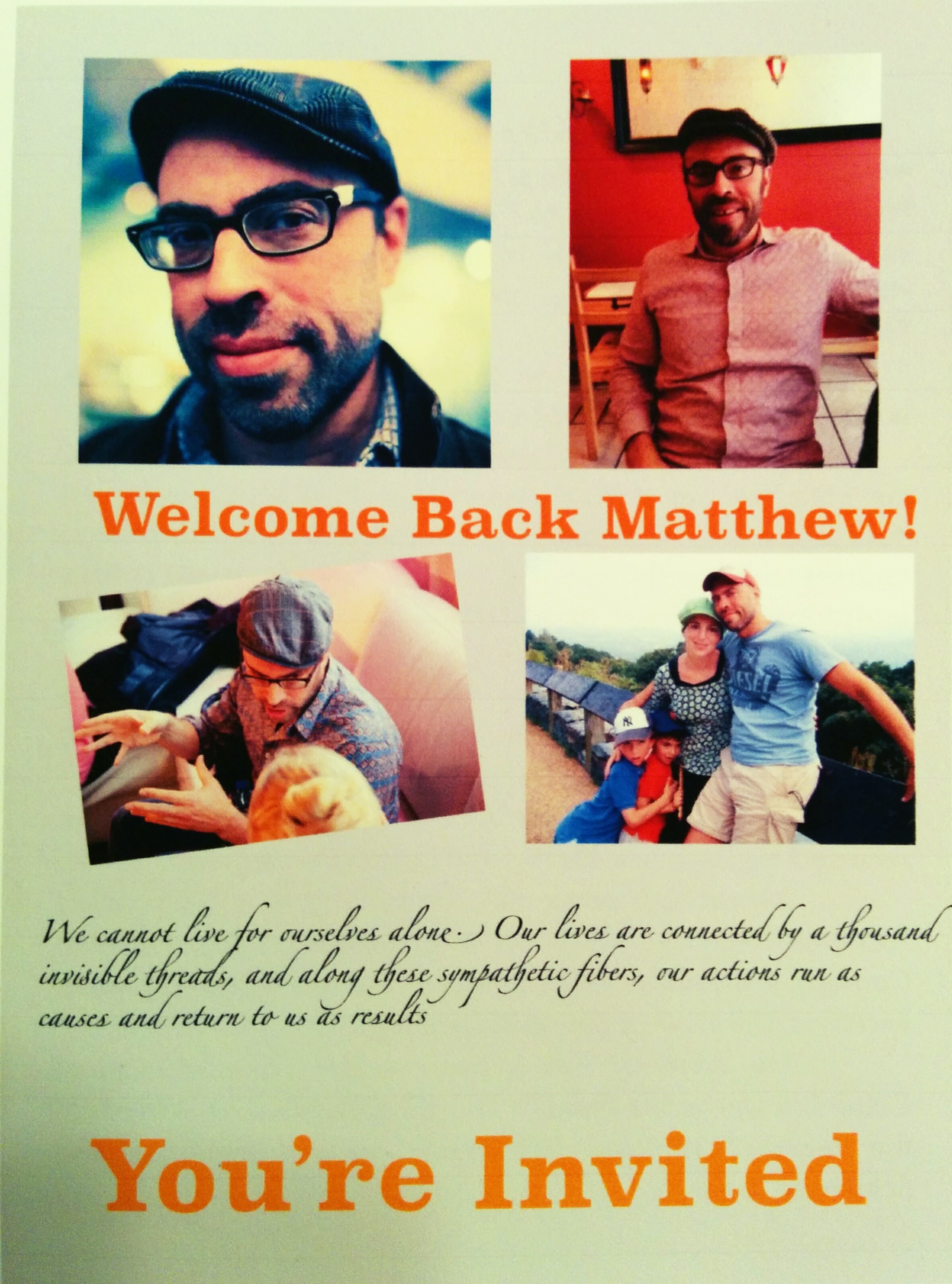
Last Sunday (May 3), I spoke at Knesseth Israel Synagogue which is located in my hometown: Gloversville, New York.  I talked about the Schlemiel, being an American and a Jew, and my family’s path to and in America.

The following is an article written by Brian Moskowitz, a freelance journalist and copywriter currently based in Toronto.  He reported on the event.  (For more on Gloversville and the schlemiel see this.)

Enjoy!

He’s a schlemiel…And proud of it

Upstate New York native overwhelmed by hometown support

By Brian Moskowitz

As a professor, blogger, musician and schlemiel theorist, Menachem Feuer is the pride of his hometown.

“The schlemiel brings warmth to cold hearts,” the York University professor of Jewish Studies told an esteemed audience of 50 people at Gloversville, New York’s Knesseth Israel Synagogue, on May 3.

Feuer, who currently lives in the predominantly Jewish suburb of Thornhill, Ontario, was invited to speak about his work on the comedic Jewish character that originated in Europe, and to celebrate his accomplishments and deep personal connection to Gloversville. Along with local Jews and non-Jews curious about Judaism and its relationship to comedy, a New York state Supreme Court Justice and a frontrunner for Fulton County Sheriff, were also in attendance.

The self-described “schlemiel from Upstate New York”, explained how the schlemiel uses comedy to triumph over adversity; and how this seemingly awkward character who inevitably “spills the soup” when attempting to serve it, has found new expression in American culture through the films of Woody Allen and the writings of Saul Bellow, among other artists.

“Two of the schlemiel’s main characteristics are his humility and simplicity, and this town has shown me how people are at their best when they stick to these modes of being, despite whatever hardships they may be facing,” said Feuer, alluding to the town’s twenty-five per cent unemployment rate.

“I’ve known Menachem since he was in diapers and it’s wonderful to have one of our own be successful as he is today and come back and share his experiences with us,” said Ron Olinsky, past president and Chair of United Jewish Federation programming at Knesseth Israel.

An avid reader of Feuer’s blog, SchlemielinTheory.com, Olinsky explained that Feuer’s program is the beginning of an effort to highlight the achievements of community members who have moved away from the town’s Jewish community, which has decreased from roughly 250 families to approximately 40.

Invite_Gloversville

Feuer’s paternal Austrian zaida, Menkis Feuer, immigrated to Gloversville in 1921 and helped establish the pastoral upstate New York town as the deer skin capital of the world.

Designed by Edgar Tafel, a protégé of architect Frank Lloyd Wright, Knesseth Israel Synagogue stands together with the local library built by Andrew Carnegie and the Glove Theater, purchased by Jewish immigrants Louis and J. Myer Schine in 1920, as testaments to the heights of affluence once reached by the former leather goods mecca.

“This place has a very rich culture made up of Italians, Jews, Poles and Germans who did their best to make Gloversville the best it could be,” said Richard Giardino, currently running for Fulton County Sheriff.

The 44-year-old Feuer moved to Toronto in 2000, after marrying Kinneret Dubowitz, a yoga teacher who started a Yoga Alliance certified teacher’s training course for women in Toronto, Israel and the U.S. in 2006. Dubowitz and the couple’s sons were in Montreal where their 11-year-old, Shalom, was participating in the Chidon Hatanach Canada Bible contest.

“He’s one of our own, and it’s wonderful for our community to have somebody who goes out to the world and accomplishes great things,” said New York State Supreme Court Justice, Richard Aulisi.

A long-time friend of Feuer’s father, Aulisi added that he experiences a distinct personal pleasure listening to Feuer’s scholarship and thinks that it is “wonderful” when Gloversville natives return home to share their experiences with the community.

Gloversville Knesseth Family

Because of his eclectic mix of literary erudition, Torah learning and appreciation for the Grateful Dead, Feuer became the focus of a 2011 documentary entitled Shlemiel, by filmmaker Chad Derrick. The documentary, currently available for free online at shlemiel.net, explores Feuer’s relationship to Hasidism, his family and his musical aspirations with his band, Men with Babies.

“Sholem Aleichem’s greatest schlemiel character, Motel, had an intimate relationship with the forests and animals of Eastern Europe. These find an American home in the rustic settings of Upstate New York,” said Feuer. “Gloversville is my ‘Yechupetsville’, my Anatevka, my Kasrilevke…and your trusting, encouraging, hopeful schlemielkeit, brings me home,” he told the audience.

Missing Saul Bellow’s Legacy: On Gary Shteyngart’s Tepid Reading of Bellow for “The New York Review of Books”

images-2

One of the main tasks of the introduction is to make the work of an author relevant for contemporary readers. But sometimes book publishers choose the wrong people to write introductions for books of dead authors. And what happens is that the legacy that this or that writer wished to pass on – if indeed they had one – is lost.

Such is the case with Gary Shteyngart’s essay for The New York Review of Books, entitled “Bellow After Death.” This was not a special essay for NYRB so much – as the blurb at the end of the article tells us – as the “new introduction to Saul Bellow’s Ravelstein, to be published in May 12th.”

The introductory essay doesn’t spell out a legacy so much as its death. Throughout the article Shteyngart takes on what Leo Strauss, an intellectual deeply respected and followed by Bellow, would call a modern “historicist” or “progressivist” reading of a past text. Strauss made this comment in relation to how modern thinkers – such as Julius Guttman or Herman Cohen – would read Moses Maimonides and Medieval Jewish philosophy.   Instead of allowing oneself (and the modern reader) to learn from the legacy of Maimonides or Medieval philosophy, it judges it to be a thing of the past. Our reading of it, rather than its own intrinsic meaning, matters. Strauss called the opposite approach to the text “immanent criticism.” In this modality, we have to let the text teach us, not the other way around.

And for Strauss, modernity has a lot to learn about how certain questions have not been resolved and remain for modernity. And these questions involve questions about the relationship between faith and reason.   In his introduction to Philosophy and Law: Contributions to the Understanding of Maimonides and his Predecessors, Strauss argues that many modern Enlightenment thinkers thought they decide on and won the argument simply because the Medievals were ridiculous. But, as Strauss reminds us, one doesn’t end an argument or kill a legacy by virtue of mockery (29-30).

Building on what Strauss says, I would argue that the same can be said for Shteyngart’s treatment of Bellow. He historicizes him in such a way as to argue that he is in the dustbin of history (even while seemingly praising him). He suggests that we mock him and put his claims to rest as they are all dated. On the one hand, we seem to lack the intellectual rigor for his texts, but, on the other, its dated and simply not worth it. And the latter wins out over the former. And this pronounces the death sentence to Bellow’s legacy; hence, the ironic title, “Bellow After Death” which is contrary to what one would think. He doesn’t live on after death; he dies. And that’s that. There is no legacy and there is nothing to learn except that…that what happened in Bellow’s novels…was something that had an appeal…at one time…but not today.

I’d like to briefly show how the deracinating of Bellow’s legacy works in each part of Shteyngart’s essay.

In the beginning of the essay, Shteyngart associates Bellow with Allan Bloom’s The Closing of the American Mind. The quote suggests that his books – like Maimondies’ Guide for the Perplexed – will be “hard to read” and, as the “illiteracy of the public increases,” will become “harder.” Shteyngart’s addition is to suggest that it will be impossible. He uses himself as a modern example:

As I try to read the first pages of Ravelstein, my iPhone pings and squawks with increasing distress. The delicate intellectual thread gets lost. Macaulay. Ping! Antony and Cleopatra. Zing! Keynes. Marimba! And I’m on just pages 5 and 6 of the novel. How is a contemporary person supposed to read 201 pages? It requires nothing less than performing brain surgery on oneself. Rewiring the organ so that the neurons revisit the haunts they once knew, hanging out with Macaulay and Keynes, much as they did in 2000, before encounters with both were reduced to brief digital run-ins on some highbrow content-provider’s blog, back when knowledge was actually something to be enjoyed instead of simply being ingested in small career-sustaining bursts.

If Shteyngart, a novelist can’t read, how much more so will the average reader not be able to get anything from Bellow. For Shteyngart, Philip Roth’s Portnoy rather than Bellow’s Herzog (a character from his earlier and most popular novel of a schlemiel) is more relevant. Portnoy, in all his vulgarity and rude wit, speaks to “low” culture, today. While Bellow’s Herzog oscillates between “high and low” culture – an oscillation which, apparently, modern people don’t get since they are too distracted by iphones etc to be affected by this movement.

But Shteyngart’s characterization of Bellow’s novels suggest that his novels are filled only with high cultural kinds of characters. And the language they use is outdated:

Or perhaps it’s just Bellow’s formative haunts—the stables filled with poets, thinkers, and novelists—that have lost some of their appeal, not to mention their hay. Where academia and literature intersect today, you will find a bunch of dudes in Converse and dudettes in skinny jeans grimly discussing their health care premiums in an overlit conference hall just outside Minneapolis or Denver. Few would turn to one another and say, like Ravelstein: “But can you explain what Nature does for you—a Jewish city type?” And yes, that’s Nature with a capital N.

No one talks about Nature anymore, apparently. I find this interesting because, as a Professor (Shteyngart notes he is also a teacher) I find many students interested in discussing these very issues.   In fact, they want to know. They aren’t all historicists as he suggests. Or perhaps I have the wrong students.

Although, in this part, the historicism is evident in Shteyngart’s reading, it is most evident in how he characterizes Bellow’s Jews versus Jews today:

“As a Jew you are also an American, but somehow also not,” Chick muses. I could well hear these words emerge from my father’s mouth, and from others of his generation, and for a few bunkered-in Jewish stalwarts of my own. But how I disagree, generationally and experientially, with that line of thinking. In post-Seinfeldian, post–Larry-Davidian America, the very opposite could be inferred: “As an American you are also a Jew, but somehow also not.” The fantasies of being pogrommed out of New Hampshire by an anti-Semitic militia nonetheless serve as a useful reminder of what post-Holocaust life was like for a generation of Jews who believed the ashes of the crematoria could one day fall upon the Berkshires.

Shteyngart’s distinction makes a mockery of those Jews from the past. We, in our “post-Seinfeldian, post-Larry-Davidian America,” can’t understand the “post-Holocaust” life. It is not our legacy. It may “nonetheless serve as a useful reminder of what post-Holocaust life was for a generation of Jews, etc.” In other words, it’s for the dustbin of history and need not affect Jewish readers today. Today, we are Americans first and maybe…Jews second. These generalizations reek of fatalism and assumptions about “post-assimilation” American Jews. Should the reader see him or herself in this way, they may approach the book as yet another relic of Jewishness that is unattainable; namely, a Jewishness informed by history. Some of my students, actually, have a contrary drive. What about them? Has the question of what it means to be a Jew disappeared from our horizon? Are all American Jews comfortable with being Americans?

The only thing Shteyngart finds relevant is the remainder of history for Jews, our only legacy, is materialism and anxiety. Jews need to critique it and make fun of it:

What remains relevant more than ever is Bellow’s take on our hyper-materialistic, luxury-goods-loving society. If this were an Updike novel, it might be titled Ravelstein Is Rich. “It was wonderful to be so public about the private, about the living creature and its needs.” Chick thinks of the French, and the novel positively luxuriates in Ravelstein’s newly minted millions. There’s an exquisite description of the purchase of a BMW (“With extras, the car would cost eighty thousand bucks”) that lasts for two entire pages. There are Lanvin jackets “advertised in Vanity Fair and the other fashion slicks, and they’re usually modeled by unshaven toughs with the look of rough trade or downright rapists.” There’s the appearance of the then-exotic Visa Gold card on which you could slap $4,500. And then there’s also the comedy of physicality and decline, as Ravelstein’s third espresso serré finally puts an end to the reign of the aforementioned Lanvin jacket. “I tried to interest him in bow ties,” the narrator tells us of his efforts to rescue Ravelstein’s multitudes of Zegna neckties from similar fates, a sentence I would also crown as One of the Best Examples of Jewish Thought in the Twentieth Century. By which I mean it’s funny, tender, menschy. It’s all about trembling fingers and hot beverages; it’s about anxiety, desire, and death.

Nothing else remains, apparently.

The last paragraphs of Shteyngart’s essay are sheer mockery. He suggests that Bellow wanted to live on in “pictures” of the past. Shteyngart identifies with the writers interest in childhood and its juxtaposition with death – he says that it is a topic he revisits in his own fiction. But in the last lines he also suggests that Bellow’s obsession with his childhood and the past marked his death sentence. And it’s a wonder that his work had an after life of “eighty more years.”

It never hurts a writer to nearly die in the first decade of his life, as Bellow did. But how exceptionally kind was the universe in that it allowed him eighty more years of existence.

But what Shteyngart misses, especially in a novel like Herzog, is that Bellow turns back to his past continually so as to relate it to his present. In fact, this is what Jewishness does; it is the legacy of Jewishness to do this. But Shteyngart does the opposite. He mocks it and situates his Jewish childhood and Jewishness in the dustbin of history.

Bellow’s movement to the past, which put the present into question, was a gesture that he shared not just with Allan Bloom but also with Leo Strauss and Irving Howe. Without doing so, we pronounce the past as posing no questions to the present. And for Bellow’s Herzog, these questions had to do with morality and faith and their tension with modern brutality and evil.

In an important criticism of Leslie Feidler, Irving Howe suggested that Fiedler must be called out as a “crank.”

In American literary life, the crank is by now a familiar figure. He is a man who believes he has found a total and thereby solacing explanation for the chaos and multiplicity of existence…There has been a similar development in literary criticism….What can one say about such books except that they are sincere, often ingenious, and quite batty?

Shteyngart should also be called out in this way since he is also speaking about the legacy of Bellow in such broad brushstrokes. He is not bothered by Bellow’s Herzog. And in not being bothered, Howe would likely say he lacks a literary and historical conscience. I’ll end with Howe’s words on the role of the critic, words which can and should be applied in relation to Shteyngart who hasn’t let the text put him and his Jewishness into question. It would, to be sure, silence his mockery and self-congratulatory hip-historicism. The better introduction would suggest – to Bellow’s new and future readers – that everything is or can be at stake when we read:

Mr. Fiedler lacks the one gift – I think it is gift of character – which is essential to the critic: the willingness to subordinate his schemes and preconceptions to the actualities of a particular novel or poem. (154)

Jewish Mothers – Schlemiel Children

Happy Mother’s Day from Schlemiel in Theory

Menachem Feuer's avatarSchlemiel Theory

images-1

Growing up, I was always surprised by the representations of Jewish mothers I would see in films, TV shows, and books.  I was, in particular, floored when I first read Philip Roth’s Portnoy’s Complaint when I was an undergrad.  I read my father’s autographed copy of the novel and knew, well before reading it, that it was an important book for another generation (the baby boomers); and I wondered if it would speak to me.  But something about the representation of Portnoy’s mother didn’t resonate.

Perhaps I was surprised by the representation of Portnoy’s mother because I was raised in upstate New York by a mother whose Long Island upbringing didn’t include all of the urban, immigrant, or post-immigrant fears that many Jewish mothers are “supposed” to have.  I did in fact have some very aggressive New Yorkers in my family, but they seemed tame in comparison to Philip Roth’s…

View original post 1,267 more words

On Harsh Realism, Ethical Hope, and the Meaning(s) of Jewishness in Saul Bellow’s Herzog – Part II

images-2

The schlemiel is a moral figure. In Yiddish literature, there are many examples of the schlemiel’s generosity and kindness to others. However, even though the schlemiel is kind he or she is often laughed at. Think, for example, of the famous schlemiel joke about the schlemiel, the schlimazel, and the nudnik. The schlemiel is the one who wants to feed the schlimazal but, right when he is about to give him soup, he spills it on him. And in the schlemiel classic, I.B. Singer’s “Gimpel the Fool,” the main character, Gimpel, is a very kind character. He trusts people. And even though they repeatedly betray him, he keeps on trusting them. Although this blindness to their betrayal (Ruth Wisse, however, does not think it is blind) may seem foolish and comical, it underscores the importance of the schlemiel’s goodness.

Unlike any Jewish-American writer at his time, Bellow, in his novel Herzog, was the first to give an extensive genealogy of a schlemiel’s moral character.   To this end, Bellow includes a large section on Herzog’s mother, father, and brothers. This section follows in the wake of a section on his childhood friend, Nachman.   As I pointed out in the last blog entry, Nachman is a troubled man who cannot come to terms with his father, a Rabbi, and his upbringing. He intentionally forgets it all and when he sees Herzog he is painfully reminded of it. For this reason, he “runs away.” By way of Herzog, Bellow suggests that the reason why he is so reactionary is because he didn’t grow up with a family that was good to the downtrodden. His father is more bitter and cynical than caring and optimistic.

Although Nachman runs away from his past and Herzog’s memory, he does remember that Herzog may be “blind” (to how bad things are) but he is “good.” Nachman remembers the schlemiel’s moral quality and he does this by way of remembering how good Herzog’s mother was to him and how kind his mother and father were to his “Uncle Ravitch,” a “drunkard”(134).   It’s because of these deeds that Nachman says that he “prays” for “her” and for “Moses.” In other words, goodness is contagious and can pierce through even Nachman’s trenchant cynicism and alienation.

After saying this to Herzog, Nachman gets on a bus and leaves him. They never speak again. And Herzog is left with their memories, which oppress him: “But I, with my memory – all the dead and the mad are in my custody, and I am the nemesis of the would-be forgotten. I bind others to my feelings”(134).

Herzog learned this practice of binding “others” to his feelings from his parents. He suggests this when he reflects on “Uncle Ravitch” and how his parents helped the drunkard:

He drank his pay – a shicker. No one judged himself more harshly. When he came out of the saloon he stood wavering in the street, directing traffic, falling among horses and trucks and slush. The police were tired of throwing him in the drunk tank. They brought him home, to Herzog’s hallway, and pushed him in. Ravitch, late at night, sang on the freezing states in a sobbing voice.


            “Alein, alien, alien, alein

            Elend vie a shtein

            Mit die tzen finger – alein”(135)


            (“Alone, alone, alone, alone

            Solitary as a stone

            With my ten fingers – alone”)


After hearing this song, the narrator tells us that “Jonah Herzog,” Moses Herzog’s father, “got out of bed and turned on the light in the kitchen, listening”(135). All of his children, including Moses, watch the father as he listens to the song and moves to act. Herzog’s mother urges the father to help the drunkard:

Mother Herzog spoke from her room, “Yonah – help him in.” (135)

The narrator details all of the movements and hesitations that go on before he helps “Uncle Ravitch.” And the children witness this. It has a great affect on them, especially Moses Herzog, the schlemiel:

It amused the boys to hear how their father coaxed drunken Ravitch to get on his feet. It was family theater. “Nu, landtsman.” Can you walk? It’s freezing. Now, get your crooked feet on the step – schneller, schneller.” He laughed with his bare breath…The boys pressed together in the cold, smiling. (136)

Following this, the narrator points out how, in Russia, “father Herzog had been a gentleman” and wealthy.   Now he was reduced to poverty and taking care of a drunkard in the middle of the night.   None of that mattered in this moment.

The narrator goes on to tell us how Yonah Herzog’s life became the life of what Hannah Arendt – in her essay “The Jew as Pariah” – would call the “schlemiel as suspect.” To support his family, he would run alcohol in an age of prohibition:

He sold a bottle here and there and waited for his main chance. American rum-runners would buy the stuff from you at the border (of Canada), any amount, spot cash, if you could get it there. Meanwhile he smoked cigarettes on the cold platform of streetcars. The Revenue was trying to catch up with him. Spotters were after him. On the roads to the border were hijackers. (138)

Herzog recalls his childhood poverty and the dirtiness and crime around him. At the same time, he recalls how, in the midst of all this, he and his brothers prayed and his parents persisted despite the circumstances. And with all this, they still felt it was necessary to help out others such as “Uncle Ravitch.”

The chapter ends with the children bearing witness to Zipporah, Yonah Herzog’s successful sister, berating him – in from of Moses Herzog and his family – about working with criminal types:

“You think you can make a fortune out of swindlers, thieves, and gangsters. You? You’re a gentle creature. I don’t know why you didn’t stay in Yeshiva. You wanted to be a gilded little gentleman…You can never keep up with these teamsters and butchers. Can you shoot a man?” (145)

To be sure, there are many schlemiel jokes about how the Jew can’t be violent (or, rather, doesn’t know how to). The schlemiel is a humanist. But this is the question. The sister keeps on asking Yonah whether he can be violent. Yonah’s wife goes along with his sister.

Herzog admits that he is “no weakling” but, says the narrator, “all his violence went into the drama of his life, into family strife, and sentiment”(146). He can not hurt others in order to survive.

This all comes to a head when Moses Herzog recalls how his father, one night, came home beaten up:

We were all there. It was a gloomy March…It was like a cavern. We were like cave dwellers. “Sara!” he said. “Children!” He showed his cut face. He spread his arms so we could see his tatters…Then he turned his pockets inside out – empty. As he did this, he began to cry, and the children standing about him all cried. It was more than I could bear that anyone should lay violent hands on him – a father, a sacred being, a king. Yes he was a king to us. (147)

The reduction and humiliation of Moses Herzog’s father have a deep impression on him of the kind of evil that exists in the world. But at the very end of the chapter, Herzog notes that his father’s suffering, after the Holocaust, is not exceptional:

What happened during the War abolished Father Herzog’s claim to exceptional suffering. We are on a more brutal standard now, a new terminal standard, indifferent to persons. Part of the program of destruction into which the human spirit has poured itself with energy, even with joy. (148)

Given the long sections on Nachman, the reader can see that Herzog is now faced with a choice between being or not being a cynic.   And this is where Bellow gives his reading of Jewishness and its relationship to comedy and suffering the stage:

Personalities are good only for comic relief. But I am still a slave to Papa’s pain. The way Father Herzog spoke of himself! That could make one laugh. His I had such dignity. (149)

Irving Howe was very attracted to Bellow’s reading of humor. In the midst of suffering (tears), there is laughter and a sense of self remains…despite all of the humiliation.   Moses Herzog recalls the “two figures” of his father: one beaten and humiliated and the other self-mocking and dignified. He acknowledges the dead and the suffering and at the same time remembers how…there is still hope.

And that is what informs the schlemiel’s genealogy. His hope, suggests Bellow, is not born in a vacuum but out of Jewish history and in response to violence and needless suffering. The moral quality stands out against this backdrop. And the schlemiel carries all of this with him in all of his interactions.

Without comic relief, Herzog would become a cynical and self-destructive Nachman.

On Harsh Realism, Ethical Hope, and the Meaning(s) of Jewishness in Saul Bellow’s Herzog – Part I

images

The tension between Eastern European and Western European Jews (before the Holocaust and not long after) can be understood in many different ways. One of the most interesting ways to approach this tension can be found in their approach to life itself. Growing up I bore constant witness to a good friend of my father who saw Jewishness, like many American Jews of Eastern European descent, in terms of community, language, and moral goodness. He contrasted Eastern European approach (which he called “Yiddish”) to that of many German or Austrian-American Jews (which he called “Goyish”) who, he believed, were lacking all of these and who, in becoming Germans or Austrians, abandoned their Eastern European ways.

Daniel Boyarin, in his book Unheroic Conduct, echoes these views when he contrasts Sigmund Freud to his Eastern European father. The latter, in Boyarin’s view, is the paradigm of the traditional moral Jew while Freud is a paradigm of the more militant and “Goyish” “new Jew.” (Boyarin entitled a key chapter of his book, which illustrates this contrast, “Goyishe Nachas.”)  According to Boyarin, the latter, “new Jew” is foreign because s/he is more German, masculinist, and Romantic than Jewish, traditional, and pre-masculinist. Another way of looking at this tension is by way of the contrast between harsh realism and optimism which, according to Ruth Wisse, informs the Eastern European schlemiel character. While the German-Jewish skeptic scoffs at the schlemiel for not being realistic and being blind to the world, the Eastern European Jew finds a point of identification with the schlemiel’s heart-felt, and optimistic way of life.   Despite the fact that the world is evil, the schlemiel maintains some glimmering of ethical hope and moral dignity.

In Saul Bellow’s Herzog, we see this kind of contrast by way of his characterization of Nachman, an old friend of Moses Herzog, and his view of life to Herzog’s family and way of life. The differences between them give us a strong sense of what, according to Bellow, informs the life of the schlemiel in general and Moses Herzog in particular. The comic character, as Bellow constructs him, provides American readers with an ethical post-Holocaust schlemiel. He shows us that this character is not some absent-minded fool but a caring, reflective, and relevant individual who, though comical, comes from a good place.

In the midst of an angry letter full of satire and invective to a scholar he vehemently disagreed with, Herzog reflects on something closer to home. He goes from self-conscious wit to compassion when he remembers his childhood friend “Nachman.”

When we first meet Nachman, we see a ragged person who is stumbling through the streets of New York. When he sees Herzog, he runs away:

In a beatnik cap, on the razzle dazzle street of lion bearded homosexuals wearing green eye paint, there, suddenly, was Herzog’s childhood playmate. A heavy nose, hair white, thick unclean glasses. The stooped poet took one look at Moses and ran away. (129-130)

From Nachman’s name, one can guess that, before he was a poet, he was raised as a religious Jew. The narrator starts in the present and moves his way backwards to his religious roots. He describes a moment when the poet he knocked on Herzog’s door in Paris, where Herzog was researching and writing a book. Nachman is “wrinkled and dirty, his nose red from weeping, his creased face the face of a dying man”(130).

Nachman tells Herzog that the father of his girlfriend, Laura, had been taken away from him by her father in New York. And now he needs money: “Lend me dough or I’m ruined. You’re my only friend in Paris”(130).

Reflecting on this, Herzog starts differentiating central Europe from America and notes that Nachman and Laura read Rilke and Rimbaud and accustomed themselves to sickness, absurdity, and poverty.   Then, reflecting on himself, he wonders how “altruistic” he appears or if he has lost this quality of kindness. This brings him back to his memory of Nachman as a religious boy and Nachman’s father, Reb Shika, who was Herzog’s Torah teacher:

Reb Shika had a yellow color, Mongolian, a tiny handsome man. He wore a black skullcap, a mustache like Lennin’s…The Bible lay open on the course table cover. Moses clearly saw the Hebrew characters – DMAI OCHICHO – the blood of thy brother. Yes, that was it. God speaking to Cain. Thy brother’s blood cries out to me from the earth. (131)

This scene, which he reflects on, is of the harshest realism. In it, we find the theme of betrayal and murder; and what’s worse, it is the most unlikely kind of murder, which goes against nature: the murder of one brother by the other.

However, Herzog doesn’t stay on this theme (which returns later in the chapter). He turns, instead, to a memory of Reb Shika’s harshness. The Rabbi was tough with Herzog:

You watch your step, Herzog, Moses. Your mother thinks you’ll be a great lamden – a rabbi. But I know you, how lazy you are. Mothers’ hearts are broken by mamzeirim like you! Eh! Do I know you, Herzog? Through and through. (131)

Herzog remembers how this harshness spurred him to run away. But Herzog didn’t run away like Nachman did. While Herzog retained the memory, his Jewishness, and his questions about its meaning, Nachman did not.   Nachman stayed away from Herzog most of his life because Herzog “remembers” their shared past. Nachman wanted, like many Jews who left the ghetto behind, to start anew and without any memory.   Herzog, in contrast, “persecuted” everyone with his memory (131).

By using these terms in a witty manner, Bellow is suggesting that the schlemiel’s memory keeps him thinking about Jewishness. The narrator points out how, without memory, Nachman destroys himself and so does his girlfriend, Laura (who attempts suicide and ends up in a mental asylum).   He points out she brings her “French literature” into the institution with her and talks “only” of it (132).   Meanwhile, Nachman becomes more and more paranoid and angry. He suggests that his cynical view is based on the harsh realism of power and its designs. He speaks of it in a poetic manner and romanticizes his suffering and Laura’s captivity in a mental institution. His descriptions of Laura echo descriptions one might find of Swede’s daughter, Merry, in Philip Roth’s American Pastoral:

The persecution of her family. What do you think? The bourgeois world of Westchester! Wedding announcements, linens, charge accounts, that was what her mother and father expected out of her. But this is a pure soul that understands only pure things. She is a stranger here…In New York we were wanderers too. (133)

Herzog’s reflections on Nachman’s ranting show us that he finds this romanticism and harsh realism to be “unreal, fervent, and dull”(133).   In one of these rants, we see that Nachman would rather die (he capitalizes “Death” as something desirable) than be subjected to American “meanness.”

After this reactionary tirade, Herzog says “It isn’t as bad as you make out, Nachman…Most people are unpoetical, and you consider this a betrayal”(134). Nachman tells Herzog that he has “visions of judgment” while Herzog has “learned to accept a mixed condition of life”(134). He calls Herzog “blind” for not seeing how bad reality is.   And at this point, the reader can see two distinctly different views of life: one cynical, the other less so.

However, immediately after condemning Herzog, Nachman has a change of heart and remembers the good that Herzog’s mother did for him when he was down. Herzog may be “blind,” but because of his mother he is a blind “but a good man.”

“But a good man, Moses. Rooted in yourself. But a good heart. Like your mother. A gentle spirit. You got it from her. I was hungry and she fed me. She washed my hands and sat me at the table. That I remember. She was the only one who was kind to my Uncle Ravitch, the drunkard. I sometimes say a prayer for her.” (134)

Bellow suggests that the memory of goodness – and Herzog’s goodness – help to bring Nachman back to his senses. And since goodness is, for Bellow, the key quality of the schlemiel, one can see how it is also a challenge to a bleak European view of life.

Herzog goes on to remember Nachman’s drunken uncle and how his mother and father cared for him when no one else did. And all of these memories, taken together, remind Herzog of why it matters most in life to be kind to those who are rejected and downtrodden. He associates Jewishness more with this than with the harshness he experienced with Nachman’s father.

…to be continued….

A Schlemiel Surprise: A Review of Noah Baumbach’s “While We’re Young”

images-2

Comedy is full of surprises. But that’s not always the case. More often than not, we get the same types of stock characters who do what…they always do.   However, sometimes a stock comic character may surprise us.   And since Hollywood is full of actors who play the same types of comic roles, the same can be said for the actors who become more banal with each performance.   One such comic character, which has been cycled and recycled by Hollywood for nearly a century, is the schlemiel and one of the most popular comic actors to play him/her is Ben Stiller.   Stiller has received a reputation as a schlemiel by way of the Ben Stiller Show (1992) and films like The Royal Tannenbaums (2001), Zoolander (2001), Meet the Fockers (2004), and Tropic Thunder (2008). In the wake of these schlemiel performances, it was Noah Baumbach who looked to cast Stiller as a different kind of schlemiel in his film Greenberg (2010). However, that film was not a pleasant surprise. In fact, it received harsh criticism which found Baumbach guilty of sacrificing comedy for bleakness. And in the process, the schlemiel became a complete schlimazel.

In response to this negative reception, Baumbach has decided to give the schlemiel and Stiller another chance in his recently released film, While We’re Young (2015). And, unlike Greenberg, this film has a few (not many) pleasant surprises.   But, as far as the subject of the middling schlemiel goes, it has a lot in common with Greenberg. The banal fact of aging should prompt us to ask what is being suggested when filmmakers like Noah Baumbach and Judd Apatow – This is Forty (2012) – actors like Seth RogenNeighbors (2014) and Woody AllenAnnie Hall (1976) and Anything Else (2001) – and writers like Gary Shteyngart (Super Sad True Love Story) and Saul Bellow (Herzog) use age – or the aging Jewish body – to anchor the schlemiel in reality.

Noah Baumbach is particularly interested in casting Ben Stiller as the middling schlemiel and he shows us two entirely different approaches to how we view the schlemiel and its meaning.   To be sure, Greenberg is a character who makes us feel pity for the aging schlemiel since, in that film, he is without a job, a home, or any clear direction. In addition, he has major relationship problems with a female schlemiel in the film named Florence (who is played by Gretta Gerwig).   Nothing seems to be going right with him and age is used to distance the character from the viewer and seal his sad solitary fate. Ian Parker and Richard Brody have only negative things to say of Greenberg. And of all the critics at The New Yorker, only David Denby claims that, at the very least, Greenberg “learns something along the way.”   Although Greenberg’s aging is sad to behold, its negative effects are surprising since, through Baumbach’s script, direction, and cinematography, he goes from being a character touched by bad luck to one destroyed by it.

While Greenberg uses the aging schlemiel and surprises us with its negativity, While We’re Young also uses the aging schlemiel but it surprises us with its mitigated negativity.   Baumbach uses this mitigated negativity to help us distinguish between two different generations of people and their hopes. The schlemiel – played by Stiller – belongs to Generation X while the ironic and shrewd hipster – who dupes him – belongs to the millennials.

This it seems is the surprise.  But there are many more that give the film meaning and scope.

Ben Stiller plays a character named Josh who is married to Cornelia, who is played by Naomi Watts. She is the daughter of a successful filmmaker, Leslie (played by Charles Grodin). Stiller plays the double to Leslie. He is the schlemiel filmmaker who has been working on a documentary film for ten years. Like Woody Allen’s character Cliff Stern, of Crimes and Misdemeanors (1989), Josh can’t finish a film which is – like all documentaries – based on life. The metaphor speaks to the schlemiel character who, as always, has a hard time making progress and becoming an “adult.”   But the contrasts don’t end here. Josh has another double.

Josh meets Jamie (Adam Driver) and Darbie (Amanda Seyfried) – a young hipster couple – after he finishes teaching his “continuing education” class (he is a failed schlemiel academic, too). Jamie acts as if he is enthused with Josh’s work, Josh is surprised, and, out of spontaneous joy, he decides to surprise his wife by introducing Jamie and Darbie (who just happen to be eating at the same Chinese restaurant for dinner).

The surprises don’t stop there.

The more the two couples hang out, the more surprises there are. As this happens, we see Cornelia and Josh gradually separate from friends their age, Marina and Fletcher (played by Maria Dizzia and former Beastie Boy, Adam Horowitz). The more they hang out with Jamie and Darbie, the more Josh and Cornelia find the lifestyle of Marina and Fletcher to be banal and typical of aging people. At one point, Josh says that what makes life with the hipster couple so great is the fact that it is so “surprising” and that these surprises are the source of a new kind of life (a better life). Cornelia goes along with him and, in doing so, alienates herself and Josh from their old friends.

But once this happens, they stumble across an unexpected surprise that turns everything on its head.

When Josh learns that Jamie has approached his father in law to help him in his film and that one apparently spontaneous experience was staged for the sake of filming a scene, Josh connects the dots and is surprised to learn that he has been duped. Since the very beginning, Jamie lied to Josh in order to make him feel as if he was special. This was all for the sake of meeting and working with Josh’s father in law and become famous. Unlike Josh, Jamie makes his film over a few months (not ten years) by way of lying and tricking people while he films them. He is shrewd and this, to be sure, is what Cornelia’s father slights Josh for not being. The lesson: only a shrewd realist – and not a schlemiel purist – will make it in the film industry.

To be sure, the negative experience (surprise) of being duped is common to schlemiel fiction. I recently wrote on this vis-à-vis Saul Bellow’s, Herzog.   However, as I noted over there, just because a schlemiel learns he or she is duped doesn’t mean that he or she will stop being a schlemiel. They may just move on.

And this is what happens in While We’re Young. But there is a major difference. In Herzog or in Woody Allen’s Annie Hall, the surprised schlemiel characters go away alone (Herzog goes back to the Berkshires from Chicago and Alvy Singer goes back to New York from LA).   In While We’re Young, Josh goes back to Cornelia and they both decide, at the end of the movie, to adopt a baby from Haiti. The last scene they are in transit to see the baby they are adopting and start, as Bernard Malamud said of his schlemiel S. Levin, a new life.

Regarding the surprise, the viewer also leaves the film learning something new. Baumbach uses the negative surprise to show how, in contrast to the hipsters, Generation X’ers like Josh and Cornelia are more moral. They have a sense of history and see film as a vehicle for justice. To be sure, Josh’s film – which took ten years to make – looked to document economic injustice and genocide. But, as Josh’s father-in-law says, “it’s too long…and boring.” People today are more interested in exciting documentaries and films and less interested in having an academic understanding of injustice. That’s the message which is articulated through the schlemiel’s failure to succeed.

However, the important thing to remember is that it is surprise that got him into this mess with Jamie and surprise which gets him out of it. Although it is negative, it gives this film weight. But, more importantly, this surprise gives the schlemiel’s middling age (and belatedness) a weight and moral purpose that it lacks in Seth Rogen’s latest film and in Gary Shteyngart’s latest novel and memoir.   (And unlike Woody Allen’s Anything Else, Baumbach doesn’t want to part with the schlemiel’s sense of astonishment.)

It shows us that the schlemiel is a moral figure, which is something we learn from Yiddish and Jewish American writers like Sholem Aleichem, I.B. Singer, and Saul Bellow. But what Baumbach shows us, today, is that the schlemiel’s failure can be used in a historical sense which can remind us what is at stake today in a world that is becoming more and more amoral. If wit and shrewd irony replace humility and hope (which are traits of the schlemiel), then we are in trouble. And, more importantly, if the surprised and astonished aspect of the schlemiel is exchanged for this kind of irony, one wonders how morality can be wed to comedy in the near future. Since sarcasm and satire, though effective, are often shrewd (and sometimes cruel), they make no room for the schlemiel.   These comic modalities privilege cold intelligence and political heft rather than the heart, innocence, and trust.

I’m glad Baumbach has refined the schlemiel in this way since, given all of the films on the schlemiel that are in vogue today, most of what we see are caricatures. Josh is not. His failures should mean something to us. And the fact that he and his wife can share a life, despite these failures, and decide to raise a child, is noteworthy. Unlike Saul Bellow’s Herzog, who wants to raise his child but can’t (because of a nasty divorce), and Alvy Singer who goes home alone, Josh and Cordelia can. And that…is a pleasant surprise since it suggests a relationship between the schlemiel, continuity, and fecundity.*

—–

*Cynthia Ozick, in her essay “Innovation and Redemption: What Literature Means,” associates “continuity” with morality in art and Emmanuel Levinas, in Totality and Infinity, associates “fecundity” with ethics.

Martin Buber and “Bogus Grandeur” – A Note on Saul Bellow’s Literary Treatment of Buber in “Herzog”

images

A book – or at least an essay or two – should be written on the treatment of Martin Buber in Jewish-American fiction. Perhaps I will write it (or them). His book I and Thou gained a lot of attention in America when it was first translated. And although it was praised by many in the Jewish-American community (and outside of it), there were several critics, thinkers, and writers who found it to be flawed. The most interesting critiques, to my mind, are not to be found in books of philosophy or on the pages of this or that academic journal; they are to be found in fiction.

With respect to Jewish-American fiction, I am very interested in the treatment of Buber by Bernard Malamud and Saul Bellow. Since he names the main character (parodistically) Morris Bober, Malamud provides a deeply engaging treatment of Buber. What we get, with Bober, is a failure of the I-Thou. Malamud shows how, as a schlemiel, Bober is duped countless times by Frank Alpine. Alpine is a straggler who Bober trusts and treats as a thou but Alpine, to be sure, doesn’t return the favor. He lies to Bober and deceives him. This prompts Alpine to, eventually, realize his wrongs, repent, and even convert to Judaism (at the end of the novel).   Nonetheless, there is no parity in their relationship (while both are alive). There are attempts to communicate and enter the I-Thou relationship, but they all fall flat and show it to be something unreal or impossible when it comes to the relationship between Jews and non-Jews in the 1950s. As his novel demonstrates, Malamud thinks of the I-Thou as unrealistic, delusional, and even harmful. The attempt is there, but reality contradicts Bober’s attempts to give the other (“you”) an attempt to be on the same level. In the end, there is a fundamental asymmetry that Malamud finds incompatible with what Buber would call the I-Thou.  (This asymmetry, in fact, is closer to Emmanuel Levinas than Buber.)

Saul Bellow’s schlemiel, Herzog, also evokes Buber. But Herzog does so in relation to a friend who betrays him by sleeping with his wife. And that friend’s name is Valentine Gersbach. Bellow’s situation of Buber vis-à-vis Gersbach is worth noting in a careful manner since it discloses’ how Buber, for Bellow, is antithetical to what he values most in the schlemiel character.

Gersbach, for Herzog, is an important, though ambiguous, figure. When Herzog finds the responses of his psychoanalyst – Edvig – to his marriage crisis (which is also a conversion crisis – his second wife converts from Judaism to Catholicism), “unsatisfactory,” because they lack emotion, he turns to Gersbach:

When he needed a feeling reaction, Herzog had to get it from Valentine Gersbach. Accordingly, he took his troubles to him. (58)

But when he rings Gersbach’s door, Phoebe, Gersbach’s wife answers the door. She is, it seems, the anti-thesis of her husband:

She was looking very gaunt, dry, pale, strained. (58)

And the reason for this is because “Phoebe knew her husband was sleeping with Madeline. And Phoebe had only one business in life, one aim, to keep her husband and protect her child”(58). How, one wonders, can the reader identify with Gersbach after reading this?   And, building on this, one wonders how Herzog could turn to him for support. The man, though “feeling,” seems like a real creep.

The narrator acknowledges Herzog’s foolishness for going to see Valentine; after all, Valentine was sleeping with his wife.  Phoebe, Valentine’s wife, answers the door:

Answering the bell, she opened the door on foolish, feeling, suffering Herzog. He had come to see his friend. (58)

But…how could this man be “his friend?”

The narrator suggests that the difference between Herzog and Phoebe is that he could live with irony but she could not, and that drains the life out of her:

Phoebe was not strong; her energy was limited; she must have been past the point of irony. And as for pity, what would she have pitied him for? Non – adultery – that was too common to be taken seriously by either of them. (58)

The problem, as the narrator comically suggests, is that Phoebe has become indifferent to her husband’s adultery and that she doesn’t want to draw on the frission of irony. Herzog, it seems, does. The narrator notes that she “might have” pitied Herzog’s “suffering” and “absent mindedness,” but the fact is that she doesn’t. And the reason that the narrator provides us with has to do with her limited emotional resources, on the one hand, and Herzog’s encouragement of Valentine to becoming a high minded “cultural figure.” And this is where Buber comes into the picture:

But she probably had only enough feeling for the conduct of her own life, and no more. Moses was sure that she blamed him for aggravating Valentine’s ambitions – Gersbach the public figure, Gersbach the poet, the television intellectual, lecturing at the Hadassah on Martin Buber. (58)

The narrator focuses on Buber as a figure of deception. While Gersbach praises Buber and speaks with major flourishes, he treats his wife and best friend like objects.   The narrator puts Gersbach on a pedestal so as to give the reader a painful sense of the trick he plays on Herzog and how Herzog foolishly takes the bait:

Dealing with Valentine was like dealing with a king. He had a thick grip. He might have held a scepter. He was a king, an emotional king, and the depth of his heart was his kingdom. He appropriated all the emotions about him, as if by divine or spiritual right. He could do more with them, and therefore he simply took them over. He was a big man, too big for anything but the truth. (Again, the truth!) Herzog had a weakness for grandeur, and even bogus grandeur (was it ever entirely bogus?). (61)

In the last pages of this chapter, the narrator is Herzog and he talks about how Gersbach, his wife Madeline (who fooled around with each other), and Edvig, his psychoanalyst, used religion to dupe everyone. He does this in a letter to his psychoanalyst:

Somehow I got into a religious competition.   You and Madeline and Valentine Gersbach all talking religion to me – so I tried it out. To see how it would feel to act with humility. As though such idiotic passivity or masochistic crawling or cowardice were humility, or obedience, not terrible decadence. Loathsome! (64)

But it was Gersbach who pushed the Buber on Herzog and insisted that he learn it as one would learn the Bible – in search of “truth.”

He brought me books (by Martin Buber). He commanded me to study them. I sat reading I and Thou, Between God and Man, The Prophetic Faith in nervous fever. Then we discussed them. (64)

Herzog explains Buber to his psychoanalyst. And, near the end of the letter, Herzog, by way of a parody of Buber, admits that he was duped by Gersbach’s use of high mindedness and empathy to get what he wanted:

I’m sure you know the views of Buber. It is wrong to turn a man (a subject) into a thing (an object). By means of spiritual dialogue, the I-It relationship becomes an I-Thou relationship. God comes and goes in man’s soul. And men come and go in each other’s souls. Sometimes they come and go in each other’s beds, too. You have to dialogue with a man. You have intercourse with his wife. You hold the poor fellow’s hand. You look into his eyes. You give him consolation. All the while, you rearrange his life….You deprive him of his daughter (after the two separate, Gersbach and Madeline take Herzog’s child). And somehow it is all mysteriously translated into religious depth. And finally your suffering is greater than his, too, because you are the greater sinner. (64)

The point Bellow is trying to make is that Herzog was taken in by the “bogus grandeur” of not just Gersbach…but Buber as well.   But, more importantly, Bellow is showing us how the schlemiel can be employed in a literary kind of critique of Buber’s philosophy and the religious way-of-life his books seem to suggest.

Saul Bellow’s Moses Herzog: A Literary Treatment of the Traveling Schlemiel (Part II)

images

Since he is in constant motion, Saul Bellow’s schlemiel, Moses Herzog can’t hold on to things. He moves from place to place, from memory to memory, and from slow motion to speed. His narrative can turn on a dime.

Things move through him, too:

With me, money is not a medium. It passes through me – taxes, insurance, mortgage, child support, rent, legal fees. (31)

After mentioning these flows, he notes that his cab is stuck in traffic, in the “garment district,” the hub of business in NYC.

But in this sedentary state, he is overwhelmed by movement coming from outside of him, in: “electric machines” that “thundered in the lofts.” Their power makes the “whole street quiver.”   And the “street was plunged, drowned in the waves of thunder.”

His world, inside and out, is a series of flows or what Gilles Deleuze and Felix Guattari call “lines of flight” – these lines “describes a smooth space.”

A line that delimits nothing, the describes no contour, that no longer goes form one point to another but instead passes between points, that is always declining from the horizontal and the vertical and deviating from the diagonal, that is constantly changing direction, a mutant line of this kind that is without outside or inside, form or background, beginning or end that is as alive as a continuous variation – such a line is truly an abstract line, and describes a smooth space. (A Thousand Plateaus, 489)

Smooth Spaces are urban, like the NYC that Herzog travels through and like the money that “passes through” him. And, in these movements, Deleuze and Guittari would say that the city and Herzog, in their alternating movements, are “reconstructing” a smooth space.

Even the most striated city gives rise to smooth space: to live in the city as a nomad, or as a cave dweller.   Movements, speed and slowness, are sometimes enough to reconstruct a smooth space. (500)

But just because one is in a smooth space doesn’t mean, for them, that one is liberated. In fact, one might, like Herzog, get stuck.

Of course, smooth spaces are not in themselves liberatory. But the struggle is changed or displaced in them, and life reconstitutes its stakes, confronts new obstacles, invents new paces, switches adversaries. Never believe that smooth space will suffice to save us. (500)

The final warning, here, opens up a discussion which can to be found in Bellow’s novel. Can traveling through space be salvic? Will it “suffice to save us?” Here, Deleuze and Guittari would suggest that we remain skeptical about this possibility. However, everything they write about the nomadic line and smooth space seems to suggest something hopeful and full of life. Their practices create a kind of optimism about traveling through space which is almost…as they suggest salvational.

Can the nomad, or a Jewish schlemiel like Herzog, be saved through diaspora? This is something George Stiener seems to be suggesting in his famous essay, on diasporic text as his “homeland.”   Nonetheless, Deleuze and Guattari suggest we don’t believe in such “smooth spaces.” There may be “obstacles.” And, to be sure, we see such obstacles tossed in front of Herzog throughout his journeys from space to space, letter to letter, and city to city. Besides an exposure to noise, the thundering streets of New York promise many different things for the schlemiel.

Regardless, Herzog, like the cab, must move on. Herzog will have to leave the street he is in just like he will have to leave the station. But as the narrator tells us, Herzog can’t think about what he has left behind too much as Herzog believed the “acute memories are probably symptoms of disaster. To him, perpetual thought of death was a sin. Drive your cart and your plow over the bones of the dead”(32).

At the same time as he moves forward, he can, in the midst of Grand Central Station, feel “it all slipping away from him in the subterranean road of engines, voices, and feet and in the galleries with lights like drops of fat in yellow broth and the strong suffocating fragrance of underground New York”(33).

His life seems to be slipping away from him into this…smooth space…It seems liberating…but it’s not.  Or is it? In New York…anything is possible.