“Is Franz Here?” Kafka’s Revision and Personalization of Rabbi Nachman of Bratslav’s Schlemiel Narrative

images

Kafka read the Hasidic masters by way of Martin Buber’s translations. And of the Hasidic masters he read, Rabbi Nachman of Bratslav was, without a doubt, the most literary.   As Ruth Wisse and David Roskies point out, he made the Hasidic story (or parable) into something literary rather than something merely anecdotal.   To be sure, they both argue that Rabbi Nachman of Bratslav had a major influence on Yiddish literature (especially in his figuration of the schlemiel.) He turned storytelling into a more religious activity and used it as a medium to address modern struggles and philosophical (and not just religious) questions.

Unlike any other writer, Rodger Kaminetz has looked into the relationship of Rabbi Nachman of Breslav to Franz Kafka. But Burnt Books: Rabbi Nachman of Bratslav and Franz Kafka is more than an academic investigation; it is a rendering of Kaminetz’s personal relationship to these writers and his own spiritual journey. One would think that these two writers – one secular and assimilated, the other a Hasidic Rebbe – have nothing in common with each other. But Kaminetz shows, in a deeply personal way, that there are many common points of interest with respect to the tensions between despair and faith.

Like Kaminetz, I am interested in the relationship of Kafka and Rabbi Nachman of Bratslav. However, I am most interested in how they share a deep interest in the schlemiel.   For both Kafka and Rabbi Nachman of Breslav, simplicity is a key trait of many of their characters.   And it is a key trait of the schlemiel.   Rabbi Nachman’s most important story on the schlemiel – which casts him as a simpleton – is “The Sophisticate and the Simpleton” (the “Hakham and the Tam”).   In this story the schlemiel is figured as a second rate cobbler who’s life is transformed when he is asked to visit the king. While he accepts the offer, the “sophisticate” finds every reason to doubt the same offer that is made to him. He insists that “the king doesn’t exist,” and even convinces the master (and several others) that if they haven’t experienced the king why would they continue to believe that he exists?

Kafka, no doubt, read this story and created his own version. He also went so far as to personalize it by putting himself in the shoes of the schlemiel.

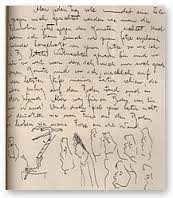
On July 29th, 1917 Kafka titles his entry: “Court jester. Essay on court gestures.” Before writing a parable, Kafka notes that the “great days of the court jesters are probably gone never to return. Everything points in another direction, it cannot be denied.” However, Kafka preserves the spirit of the jester and the kind in a parable. He describes “our King” in terms that are contrary to the way royalty is described. Kafka’s King is – like Rabbi Nachman of Bratslav’s (in another narrative) – “humble” and poorly dressed:

Our King made no display of pomp; anyone who did not know him from his pictures would never have recognized him as the King. His clothes were badly made, not in our shop, however, of a skimpy material, his coat forever unbuttoned, flapping and wrinkled, his hat crumpled, heavy boots.

Kafka describes his body as having a “strong face with a large, straight, masculine nose, a short mustache, dark somewhat too sharp eyes, a powerful, well shaped neck.” But the “movements of his arms” are “careless.” (I have noted, in another place, how, for Kafka, movement taps into a deeper level of reflection for Kafka.) Taken together, these movements and the attire of the King, suggest a kind of Midrashic reading of God’s presence (the shechina) which is “in the dust” and in “exile” with the Jews.

At the end of the parable, Kafka sees himself in relation to the King who calls on him by his first name.   The schlemiel, apparently, can help the king:

Once he stopped in passing in the doorway of our shop, put his right hand up against the lintel of the door, and asked, “Is Franz here?” He knew everyone by name. I came out of my dark corner and made my way through the journeymen. “Come along,” he said, after briefly glancing at me. “He’s moving into the castle,” he said to the master.

Kafka’s parable is a revision and personalization of Rabbi Nachman of Bratslav’s schlemiel narrative. The implication is clear.   The schlemiel, for Kafka, is a kind of court jester. But he is not a fool – as many a court jester is – he is a simpleton and a cobbler. His job is to make garments. And, as the Zohar and Hasiduth often relate, a garment is a metaphor for a way of apprehending God and is posited as a medium through which one “clothes” holiness.

Although the schlemiel may be second-rate cobbler, the King wants him to live in the castle. In Kafka’s parable, he calls on “Franz” to “come along” and be – like a jester – closest to the humble king.   The interesting thing is that this figuration of the King is much different from the one we see with respect to Abraham – who is also called on. That call inspires “fear and trembling.” This call does not.   After all, in this parable the only sacrifice “Franz” has to make is to leave his fellow “journeymen” behind.

But in Rabbi Nachman’s narrative there is a greater sacrifice and this prompts a question with respect to Kafka’s parable. In his story, the “sophisticate” is left behind because he can’t believe that he would be called on by an actual king. Its all make believe. The simpleton doesn’t think that way.   With this in mind, does Kafka also renounce the sophisticate? Kaminetz struggles with this in his book since he sees Kafka’s “irony” as getting in the way of his faith. But in this parable there is no irony.

In this parable, Kafka’s personal god has a family resemblance to Rabbi Nachman’s.   It is the god of the schlemiel. And at any moment, the humble King can walk into the shop and call on the cobbler to come near.   But he can’t be called on unless he cobbles together garments (narratives) with the utmost humility. In this sense, not only the subject but also the writer is a simpleton. But this call can only be heard if the author renounces the sophisticated ironist.   The irony of this renunciation is that – in the end – this act seems to be comedic.

Since Kafka is so touched by modernity, isn’t he acting “as if” he is a simpleton? As Ruth Wisse suggests, the secular schlemiel acts “as if” the good exists in order to redeem what is best about humanity.  Did Kafka do this? Or did he sincerely think that by becoming a schlemiel he would be called on and drawn near to the humble king? Perhaps Kafka was taking his chances with the schlemiel and its relationship to God by revising and personalizing Rabbi Nachman’s parable?

I’ll let the question stand….as Kafka himself phrased it:

Is Franz here?

“The Top Seven Schlemiels of 2015”

Unknown

I was recently asked to give a list of who I consider the “Top The Seven Schlemiels of the Year” for Queen Mob’s Teahouse’s “Review of 2015.”  Should you be interested, here it is:

Top Seven Schlemiels of 2015

  1. Larry David has for several years been the most celebrated and recognized schlemiel in visual culture. New York Magazine sees him as the next in the schlemiel-line after Woody Allen. This year he entered himself into the fray with his caricature of Democratic Presidential nominee, Bernie Sanders. David’s imitation on SNL reminds us that what makes the schlemiel unique – for many Americans – is a kind of Jewishness that emerges out of New York City (and the Borsht Belt) that has its roots in the immigrant experience.
  2. Ever since Knocked Up, Seth Rogen has become one of many new comedians who have taken up the torch of the schlemiel.   His film Neighbors was an important moment in this trajectory. But his performance in The Interview this year was also memorable.   Like his other films – and in many a Judd Apatow film – we see a moral moment toward the end of the film that seems to redeem all of his absent-mindedness.
  3. Ben Stiller’s performance in While We’re Young was also memorable and shows us how – as Noah Baumbach does in several of his films – a schlemiel ages and becomes more cognizant of how he or she has been duped. But this time, the schlemiel is duped by a millennial. Gretta Gerwig, in her film Mistress America (another Noah Baumbach film), also plays a schlemiel and ties for third.   Her blindspots are endearing but they are ultimately unsettling. Once again, we see Baumbach’s attempt to render a sad, aging kind of schlemiel. This, of course, is the counter to the schlemiels we see played in many Apatow’s films but also to many schlemiels we see on this or that comedic TV series.
  4. Speaking of schlemiels on TV, schlemiel number four goes to Amy Poehler for her performance in Parks and Recreation.   What Poehler gives us is a schlemiel who is defined by awkwardness. This schlemiel is a lot different from Baumbach’s in the sense that although she may be shamed by this or that situation her shame lacks any tragic element. She is, in truth, rather endearing and is extremely popular these days. We see this kind of awkward charm with nearly all characters on Parks and Recreation. They are, in some way or other, modeled on the recent emergence of the “awkward schlemiel.”
  5. Broad City’s Abbi Jacobson gets the five spot. In contrast to the more cunning and mischievous Ilana Glazer, she plays a schlemiel character who is often defined by her absent mindedness, belatedness, and lack of awareness when it comes to daily life in New York City. She is endearing in many ways. But she also reminds us that there is a growing culture in America of schlemiels who can buy coffee, live in apartments, and fill empty days with any number of distractions.   Unlike the classical schlemiel that we see in Sholem Aleichem, I.L. Peretz, or Mendel Mocher Sforim, there is a lack of abject poverty and an overabundance of silly humor. This silliness somehow makes the viewer feel that he or she is not alone in feeling that he or she is going nowhere economically or socially. Like many who watch Broad City, Abbi doesn’t really have any anxiety about it. She has other things to worry about.
  6. Eli Batalion Of Yid Life Crisis – a Youtube series, which also, just this year, was released as a film – gets the six-spot. Of all the schlemiels, he and Jamie Elman – who plays the chochem (intelligent character who is skeptical about nearly everything) and the nudnik (a person who tends to aggravate situations) – by way of their conversational humor, give us something closer to the traditional schlemiel. Most importantly, they give us the original tone and language of the schlemiel since they speak in Yiddish. (And we – who, by and large, have no knowledge of Yiddish whatsoever – get the English subtitles.)    Although Yiddish is almost a dead language (in the sense that the majority of Jews do not know it, speak it, or live through it), they give it life by way of their humor. His schlemiel character can help us to better understand and appreciate contemporary schlemiels in literature, film, TV, and stand-up comedy.
  7. Last, but certainly not least, is the stand-up comedian David Heti.     His schlemiel humor is powerful since it tests the limits of contemporary humor by saying things that may be deemed offensive.   This is sorely needed today since – with the omnipresence of politics on and off campus, Facebook, Twitter, etc – we are tending, more and more, to take ourselves too seriously. His comedy album, It Was Ok (2015) is very entertaining and insightful. It shows us how comedy – Jewish and not so Jewish – can also lead us back to the unhappy source of all humor.   At the end of many of his jokes, there is often an awkward silence in the room. But this is because his jokes touch on this source of humor and, in many ways, bring us not just back to his own particular history and existence, but also to our own. He is, like many a schlemiel, the odd one out. But his oddity reminds us of something we all know today: that sometimes things don’t always go as we expect them, and in a world where failure is the norm sudden victories are (or is it, “were?” after all, so many of his jokes are in the past tense)…“ok.”   Sometimes sadness has its comical moments.  And, as Walter Benjamin well knew (and as Slavoj Zizek, in his wake knows), melancholy can be the source of insight and reflection.  And it is for this reason that I think sometimes the last schlemiel of all – like many a schlemiel – may actually be the most important. You decide.

Happy New Year from Schlemiel Theory!  Larry David for President!


Isn’t that Awkward? On What’s Missing in Franz Kafka’s “Amerika”

Unknown

There are (and have been) countless television shows which make it obvious to the viewer that a character – in this or that situation – has done something awkward. Think, for instance, of Parks and Recreation, Workaholics,  Curb Your Enthusiasm, or The Office. Saturday Night Live makes it a staple, and just about every Judd Apatow or Seth Rogen film follows suit.   The point of such staged awkward situations is to show how – despite our identification with this or that comic character who says the wrong thing, does the wrong thing, or misses the cue – the social context predominates over every situation.

In American life, social cues have become all important.   While this indicates that Hollywood writers want Americans to be more socially conscious of what they say and do, it also suggests something more problematic; namely, the fact that what is or is not socially acceptable is already interpreted. The camera shots at faces of onlookers – in the wake of this or that faux pas – indicate to the viewer that something awkward has just happened and that we, as intelligent, socially aware viewers, should take on a position of superiority.   Although the excluded comic character is endearing, the process of exclusion – though comical – is the focus.

In contrast to television sit-coms, we are fortunate to have a literature which gives the reader the option of freely deciding what is or is not awkward and an opportunity to think about what that decision means. Franz Kafka’s novel, Amerika is a case in point.   His main character Karl Rossmann offers the reader such an option and gives the reader a moment to think about what is at stake with the presence or the absence of awkwardness.

Unfortunately, many of us don’t know how to read literature anymore and when we are faced with such an opportunity, we pass it by. I would suggest that today, more than ever, we need to take such an opportunity up. We need to question this preponderance of awkwardness and its implications. Is awkwardness something that should be seen as moral or ethical? Is our laughter at the awkward a form of social exclusion? Or is awkwardness a more somber kind of experience or mood?

The first chapter of Amerika comes from a story that Kafka worked, reworked, and published while he was alive: “The Stoker.” What is so fascinating about this chapter is the fact that, as a reader, I cannot but be surprised to notice Kafka’s decision to leave his character undeveloped and unmotivated. Moreover, I am also astonished by the fact that the narrator also seems to be lacking a clear understanding of things while, at the same time, acting as if he does. In other words, Kafka wrote this text in order for the reader to ask serious questions not only about the character but about the narration.

The first thing that should strike the reader is the fact that when Karl Rossmann arrives on the shores of America and should be excited to leave he remembers that he has forgot his umbrella.   His absent mindedness predominates and he goes on a wild search for his umbrella.   On his search, he stumbles across “the Stoker.” The Stoker treats Rossmann like a friend, shares his woes with him, and enlists him in his cause which is against a “Romanian” named Schubal (the Stoker is German). Rossmann gladly accepts the charge and wants to help this hospitable stranger. While the situation is unusual, we still partially identify with the kindness of these characters and Rossmann’s willingness. However, the identification is partial because it is ridiculous. How could Rossmann be so trusting or naïve? And shouldn’t he be more concerned or excited about arriving in America instead of defending someone he never met?

Awkwardness can happen between two people, but, for it to be really effective, it requires the presence of more than two.   The scene in which Rossmann appears in front of the ship’s crew members to defend the Stoker is awkward.

When Karl enters the scene, he doesn’t even get to make any case. All he says is, “Yes, I know, I know…You’re quite right, I never had the slightest doubt about it”(19).   About what? The context is missing and the men are “indifferent,” they don’t seem to feel that there is anything like a trial going on. Before he can fill in any blanks, he is immediately asked a question: “So what’s your name?”

Right when he’s about to answer the question, a knock comes at the door. It’s Schubal.

The narrator is more responsive than Karl. She makes the situation more awkward because she takes this ridiculous situation and its possible consequences seriously while Karl does not. It is obvious that Karl Rossmann is blind to so many things, but the narrator makes it seem possible that he could have acted differently:

Why had Karl not foreseen something so easily foreseen, namely, that Schubal would finally be obliged to come, if not of his own initiative then on a summons from the captain? Why hadn’t he devised a precise battle plan as he walked over with the stoker instead of mercilessly unprepared simply because there was a door there? Could the stoker still speak, say yes and no, as he would be required to do in the cross examination that would take place only if everything turned out for the best. The stoker stood there, legs apart, knees slightly bowed, head raised slightly, and the air went in and out of his open mouth as if he had no lungs left inside to handle his breathing. (21)

The reduction of the whole scene to the Stoker breathing “as if he had no lungs left” indicates the gross lack of intelligence in this scene. The fact of the matter is that Karl is just moving around with the Stoker and standing in the midst of what he imagines is a trial but, in reality, is just a bunch of people in a room.

To make things more awkward, while the narrator notes that “Still, Karl felt stronger and more alert than he had perhaps ever felt at home,” s/he is anxious and asks a series of questions:

Would they change their mind about him? Set him down between them and praise him? And then, only once, take a look into these eyes, eyes that were so devoted to them? What uncertain questions and what an inappropriate moment to be asking them! (21)

The obvious irony is that the narrator feels awkward, not the character.

And although Karl feels “stronger and more alert,” Schubal makes the case and speaks in a clear, articulate manner. The narrator, not Karl, gets frustrated and attempts to criticize the words of Schubal but the attentive reader can see that such criticisms are desperate.   The narrator – breaking narrative convention – wants her character to “get moving” and get involved:

All this was very clear and indeed that is how Schubal had presented it, quite against his will, but one had to tell the story to the gentlemen in a different way, even more explicitly. They had to be given a jolt. So get moving, Karl, and at least take advantage of the time before the witnesses enter and inundate everything. (22)

Immediately after the narrator’s wishful thinking on behalf of her character, something happens which displaces the whole “trial.” The captain speaks to “Mr. Jakob,” the “man with the bamboo stick,” and who is also called “the senator” and seems to be a part of the crew. Mr. Jakob turns to Karl and asks, once again, “So what’s your name?” After Karl tells him, everyone in the crew is “astonished”(23). It seems as if something awkward is about to happen.

Mr. Jakob repeats the word “But” twice and says “But then I am indeed your uncle Jacob, and you are my beloved nephew. Just what I expected all along”(23).   At this moment, the entire scene changes and all the narrator’s expectations are dashed. Karl realizes that he “does have an uncle Jakob in America.” The fact that he realizes this is also astonishing. Doesn’t he have a relative who is supposed to be meeting him when he arrives? Shouldn’t he know his name?

The most awkward thing of all is the Uncle’s retelling of Karl Rossmann’s story. It seems as if Karl is unable to say it himself. He is spoken for. Moreover, it is an awkward story because it gives too many details of things that need not be said in public. Recalling Karl’s sexual encounter which, apparently, is the reason why his parents sent him away, the narrator recounts why Karl was innocent but uses too much detail acting as if he was there when all this happened:

“Karl, oh my Karl,” she cried, as if she could see him and was confirming that she now had possession of him, whereas he could see nothing and felt uncomfortable under the many warm bedclothes that she had evidently heaped up especially for him. Then she lay down beside him and wanted him to tell her secrets, but he had none to tell, and she became annoyed, whether jokingly or in earnest, shook him, listened to his heart, offered him her breast so that he too could listen but did not induce Karl to do so, pressed her naked belly against his body…it felt as if she were a part of him. (27)

Karl, strangely enough, doesn’t feel awkward at all. And neither does the narrator.   The fascinating thing for the modern reader is to experience the lack of awkwardness.   It confronts the reader with a question: aren’t there times when a person should feel awkward – in this case both the narrator and the character, Karl Rossmann?

The question, it seems, is rhetorical. The answer to this question and our desire to see such awkwardness indicate one of two things and this, I think, is what Kafka was after.   The sense of guilt or shame that comes with awkwardness are a valuable thing because they alert us to something important about being human. The mood of awkwardness goes hand in hand with the desire we have, as readers, to speak out and tell the Uncle to stop or to tell the narrator to say something. Their silence is, in a way, dehumanizing.   It may all seem comical, but the truth of the matter is that sometimes awkwardness is not – as it is in so many TV shows and films – a formula for getting higher ratings or ticket sales. And it should not be used to affirm a regime of social control.

Rather, awkwardness, as articulated in Kafka’s Amerika – by virtue of its absence – provides the reader with a sense of humanity and of the power literature has to evoke morality. But this can only be discovered if we become more critical readers. Without questioning narrators and characters, we lose out on a great opportunity to learn how awkwardness truly matters.    And without doing this, our awkwardness is scripted and decided on – for us – by this or that TV show.   Reading Kafka in a critical manner, you, the reader can take the initiative by deciding on the meaning of awkwardness for humanity.   As Walter Benjamin once said to Gerschom Scholem in a letter written near his death, Kafka was “certain” about only one thing; “that a fool can help.”  The “question, however, is whether a fool can do humanity any good.”  That is the awkward question that may be missing from Kafka’s Amerika only because we must ask it.


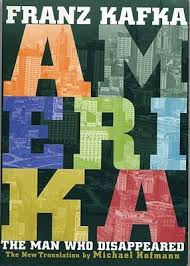
On Innocence, Forgetfulness, and Reading in Kafka’s “Amerika: The Man Who Disappeared”

Unknown

Kafka was fascinated with the meaning of innocence and guilt.   His characters are often portrayed as both innocent and guilty.   But the confluence of the two appeals not so much to a theological theme so much as to the reader’s relationship with Kafka’s characters. It seems as if Kafka created a situation where the reader is prompted to judge the main character’s actions: is the character’s innocence good or bad? And must I, as a reader, fight against the cynical tendency I or my culture has to judge innocence as stupidity or a failure to act and think properly? And this prompts a deeper literary question: What is the purpose of comedy? Do we learn, from such innocent characters, what not to be? Or do we, rather, gain insight into who we are? When it comes to comedy, is action or reflection primary? What is the basis for such a decision? And should that decision be based on an evaluation of the consequences?

Kafka’s Karl Rossmann, the main character of his novel Amerika: The Missing Person (and his short story “The Stoker”) provides the reader with an opportunity to address these questions. They all emerge when the reader is prompted to assess Karl Rossmann’s innocence and forgetfulness in terms of his character and situation.

At the outset of the novel, we learn that Karl Rossmann is “entering” New York Harbor on a “slow-moving” ship.   We also learn that he is “17 years old” and that his parents “sent him to America” because a “servant girl had seduced him” and “borne a child by him.” These circumstances suggest that Rossmann’s journey to America is not something he thought deeply about; it is circumstantial. And he did so because his parents sent him away from a situation in which he, apparently, did nothing wrong. Apparently, he is innocent.

But the reader cannot but wonder about what really happened and about what it means that his “parents” sent him away. Is Karl Rossmann really innocent? Or did he do something to the “servant girl?” In addition, the fact that his parents sent him away suggests that he is still a child – even though he is at an age of maturity. All of these factors alter our identification with Rossmann. Should we identify with a character that is so questionable?

Looking at the “Statue of Liberty,” Rossmann says two words “So high.” His observation is disjointed because the words that follow it suggest that he doesn’t say it as a person who has high hopes for a new life. Apparently, he didn’t think too much about leaving Europe:

“So high,” he said to himself, and although he still had not thoughts of leaving, he found himself being pushed gradually toward the rail by an ever-swelling throng of porters. (3)

Rossmann’s life, it seems, is accidental. He gets “pushed” from one place to another.   He doesn’t seem to know or care about where he is going. Rossmann is simply an innocent 17 year old who is going along with the current.

When asked by an excited passenger if he is ready to “get off” the ship, Rossmann acts as if he’s excited: “Oh, I’m ready all right,” said Karl with a laugh, and in his exuberance, sturdy lad that he was, he lifted his trunk up on his shoulders.” But in his “exuberant” attempt to act as if he is a man with a purpose, Rossmann realizes that he had “forgotten his umbrella below deck.”   In other words, Rossmann makes a schlemiel move.   His forgetfulness prompts him to interrupt his act.   And lose his direction. Now Kafka creates a divided consciousness: Rossmann leaves his trunk behind in order to get his umbrella down below.

Rossmann’s descent “down below” to get his umbrella throws him into a labyrinth in which he gets lost. He can no longer act as if he knows where he is going:

Downstairs he was disappointed to find a passageway that would have certainly shortened his path blocked off for the first time…and was obliged to make his way laboriously through numerous small rooms, corridors that constantly turned off, many short stairs in rapid succession and an empty room with an abandoned desk…he had quite lost his way. (4)

Now, Rossmann panics and “in his uncertainty” he starts “knocking at random on a little door before which he had halted.” The theme of being stuck before doors and unable to more is a constant in Kafka’s work. And, oftentimes, the person who is stuck is innocent.   However, in many of these cases where Kafka’s characters get stuck, the reader is prompted to ask whether or not this should have happened. Although Rossmann is innocent, perhaps he shouldn’t have shown any concern from his umbrella and just moved on – acting as if he had somewhere to go.

Nonetheless, sometimes surprises can be life-altering and luck can subvert proper decision making. The person who answers the door is the “Stoker.”

“It’s open,” cried a voice within and, sighing with general relief, Karl stepped into the cabin. “Why do you have to bang on the door like a madman?” a huge man asked, almost without looking at Karl. (4)

By letting him in, the Stoker alters Rossmann’s life. He gives Rossmann new possibilities.   The possibilities suggest something religious. Rossmann says he “lost his way.”   The Stoker is hospitable and invites Rossmann in to his home/cabin.   As readers, we can see that this character, despite that fact that he is friendly, is over-talkative and has no problem bringing a complete stranger into his life. Rossmann, however, has no problem with this:

“Lie down on the bed, that’ll give you more room,” said the man. Karl crawled in as best he could, laughing loudly at his initially futile attempt to swing himself ont to eh bed. No sooner was he lying down on than he cried: “Oh, my goodness, I forgot about my trunk.” (5)

What is astonishing is how much Rossmann, in his innocence, trusts this stranger and takes to him as if the Stoker will help him in some way. Rossmann’s forgetfulness – coupled with his trust – adds to his schlemiel character:

Perhaps I should stick with this man – thought Karl – for where else could I find a better friend just now? (5)

Besides his trust, the Stoken jokingly complements Rossmann who says that he “believes” that his trunk is still on deck with the man he trusted: “‘Blessed are those who believe,’ said the man.”   The blessing indicates that Rossman’s trust has something religious about it.

But while it is the case that in a Sholem Aleichem story, the innocent character is endearing (think, for instance, of Aleichem’s Motl or Tevye), here, this is not so much the case.   Aleichem’s schlemiel is different from Kafka’s because Kafka’s Rossmann prompts the reader to think more critically about the people he is meeting along the way and the decisions he makes.

Like many a schlemiel, Rossmann’s absent-mindedness can get him in trouble. However, Kafka creates reasons for the reader to be suspicious of Rossmann and though his innocence and trust may be endearing they can also be read as stupid and even infantile. This is what Heinz Politzer claims in his book, Franz Kafka: Parable and Paradox.

That aside, what the Stoker does is give Rossmann an opportunity to defend him to the Captain of the ship (since the Stoker is in a difficult situation by virtue of a woman he fooled around with and a Hungarian – the Stoker is German – who has a problem with him).   This opportunity puts the schlemiel in the position of a defense attorney.   There is a question and a problem here which Kafka is testing: Can a schlemiel, who has no knowledge of the situation save for what he learned at that moment, profess the innocence of a man who is most likely not innocent?

This question and the problem make it difficult for the reader to identify with Rossmann’s innocence – in particular – and innocence in general. Kafka has, in effect, used literature to pose deep questions about the meaning of the schlemiel and innocence. While Aleichem preserves our belief in the schlemiel and in the power of innocence, Kafka, with these characters and situations, puts it into question.   Kafka, it seems, was weighing these questions and knew that, for him (just like for a Midrashist or Talmudist), the meaning of innocence depends on how or whether the reader identifies with a character and his actions.

Innocence, for Kafka, is a spiritual pre-requisite. However, as he well knew it may go nowhere.   Even if a character is able to pass the gate or make a friend, his innocence does not preserve him from a tragic-comic conclusion. Rossmann’s laughter indicates this double-edged aspect of innocence. Sometimes acting “as if” something is true or good may only lead to problems. However, as Kafka well knew, the alternative is bitterness and cynicism.  Kafka laid out these possibilities in this novel and gave them to the reader.


….to be continued.

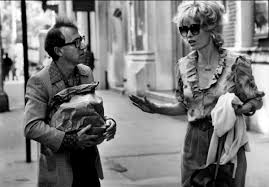
Oh, Have I Got a Deal For You! On Woody Allen’s Comedic Myth-Busting

images

In comedy there are no sacred cows. And when it comes to mythology, comedy doesn’t hesitate to smash this or that myth.   Jewish comedy is well known for its iconoclasm. And perhaps this has a root in Judaism’s resistance to mythology and idolatry as well as its prohibition of images. It may also have to do with Judaism’s interest in textual interpretation which shows that this or that story poses questions or is linked to another narrative (something we often see in Midrash).   Both Franz Kafka and Woody Allen are, without a doubt, Jewish iconoclasts.  They parody myth by way of their own revisions, but they differ in terms of the insights that they offer to the reader.   While Kafka gives the reader deeper insights into faith, self-doubt, existence, and consciousness with his parodic revisions of myth, Allen gives his readers or viewers a sense of how a New Yorker has better things to do than get caught up in this or that ridiculous myth.   In these comedic revisions, Woody Allen is out to sell a way of life not prompt deep reflection.

In a piece entitled, “Fabulous Tales and Mythical Beasts,” Allen takes aim at several different kinds of mythological creatures, fantastic places, and myth itself. Like any joke, he starts with a serious reflection, but ends with an ironic punch line:

A wise man in India bet a magician that he could not fool him, whereupon the magician tapped the wise man on the head and changed him into a dove. The dove flew out the window to Madagascar and had his luggage forwarded.

…The magician said that in order to learn the trick one must journey to the four corners of the earth, but that one should go in the off-season, as three corners are usually booked. (178, The Insanity Defense)

In another mythological rewrite, Allen takes aim at an imaginary place called “Quelm,” (which sounds like, Chelm, a place populated by schlemiels).   It is “so distant from Earth that a man traveling the speed of light would take a million years to get there, although they are planning a new express route that will cut two hours off the trip”(178).

In each punch line, Allen looks to ground the listener in the here and now of the New York Jewish attitude toward the hardships of life and getting by:

In addition to these obstacles on Quelm, there is no oxygen to support life as we know it, and what creatures do exist find it hard to ear a living without holding down two jobs. (179)

While Allen’s iconoclasm is funny and grounds us in the here and now, it can be construed in a negative manner since it doesn’t take myth as a basis of reflection. It rejects it wholeheartedly. The problem with iconoclasm is that when it is not done with a proper sense of humility, it could possibly come across (to some) as self-serving or even dishonest. Citing Aristotle, Leo Strauss argues that “irony is a kind of dissimulation, or untruthfulness.  Aristotle therefore treats the habit of irony primarily as a vice”(51).

But, as I note elsewhere, Strauss doesn’t think that Aristotle is right:

Yet irony is the dissembling, not of evil actions or of vices, but rather of good actions or of virtues; the ironic man, in opposition to the boaster, understates his worth.  If irony is a vice, it is a graceful vice.  Properly used, it is not a vice at all.  (51)

Strauss’s qualification of Aristotle is telling.  It suggests that irony is a neutral term and that it has a “proper” use.   Citing Aristotle against Aristotle, Strauss argues that “irony is…the noble dissimulation of one’s worth, one’s superiority”(51).  In other words, humility and irony do not contradict each other; in fact, they aid each other.

Reflecting on this, one can argue that even though Woody Allen isn’t using irony like Kafka (in order to tap into this or that depth while effacing a myth), he is also making a “proper” use of irony since the punch line dissimulates the superiority of myth.   His punch lines convey the humility of the New York everyman who is just trying to survive. The “speaker” in these pieces is the “ironic man” and his “noble dissimulation” conveys his only virtue which is to be a New Yorker.   But let’s not fool ourselves: each punch line is a sales pitch for a way of life which lives in the wake of myth and perhaps even philosophy. After all, both are interested in origins. (As Aristotle also notes in “The Metaphysics,” philosophy and myth start with wonder.)

I’ll leave the reader with a Woody Allen joke that takes both myth and philosophy as its target. Allen’s joke suggests that, in the world of the New Yorker, the philosopher (as much as the myth-lover) doesn’t exist:

Legend has it…that many billions of years ago the environment was not quite so horrible – or ate least no worse than Pittsburgh – and that human life existed.   These humans – resembling men in every way except for a large head of lettuce where the nose normally is – were to a man philosophers.   As philosophers they relied heavily on logic and felt that if life existed, somebody must have caused it, and they went looking for a dark-haired man with a tattoo who was wearing a Navy pea jacket.

When nothing materialized, they abandoned philosophy and went into the mail-order business, but post rates went up and they perished. (179)


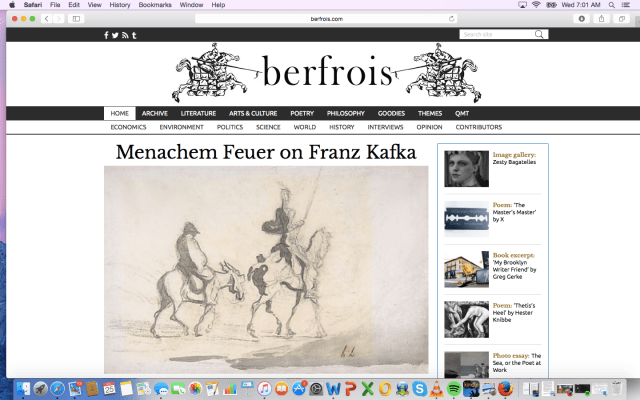
An Essay on Kafka for Berfrois

Screen Shot 2015-11-25 at 7.01.29 AM

Today, an essay I wrote on Kafka was published by Berfrois (an outstanding and popular online zine based in London, England).

Here’s a snippet:

Franz Kafka loved to stay on the move. He traveled and kept a travel diary. From his travel diaries, we also learn that Kafka went to spas; he liked to exercise and move his body. Like many European Jews in his generation, he wanted to be healthy and happy. But when it came to his life, his faith, and his future, Kafka didn’t feel like he was making any progress.

Kafka felt he was failing to move in the right direction. Sometimes he felt he wasn’t moving at all. In order to understand whether or how he could move, Kafka turned the question of movement into parable. By way of his fiction, he encountered the possibilities of movement. Kafka wondered whether fiction would enable him to move or if it suspended movement? Was Kafka, as he says in one journal entry, “stuck to this spot,” or could fiction, as we see in a few of his parables and fictions, help him to transcend his location and go… elsewhere?

These parable-based meditations on movement brought Kafka face to face with failure and the possibility of madness. They prompted him to reflect and decide on whether or not to make a “bargain,” as he says, with madness. This bargain necessarily affected his movement and prompted Kafka to, as he says in his journals, “cultivate” failure.

And here’s the link: http://www.berfrois.com/2015/11/menachem-feuer-on-franz-kafka/ 

Enjoy!

Menachem Feuer

PS: You can follow Berfrois on Twitter and/or “like” them on Facebook


Jews, 1931: Wittgenstein’s Marginalia on Jews, Jewishness, and “Reproductive” Jewish Thought

images

Some of the most interesting things that come out of our lives can be found in the margins. Freud – like a good detective – took marginalia seriously. An occasional or out-of-the-ordinary slip can disclose a lot more than a narrative. In fact, the hidden secret of a narrative can be found by way of focusing in on these small things in the margins.  Writing, like a microscope, can reveal these small things; reading can amplify them.   You and I can get a whiff of what Wittgenstein* thought about what it means to be a Jewish thinker.

Reading Ludwig Wittgenstein’s marginalia from 1914 to 1950 – collected under the title Culture and Value – I was surprised to find a series of telling ontological reflections about Jews, Jewishness, and Jewish thought. Wittgenstein had a Jewish parent, and, as David Stern notes in his essay “Was Wittgenstein a Jew?” Wittgenstein wrote a lot about Jewishness in the 1930s.   Stern argues that Wittgenstein’s “notion of being a Jew, of Jewishness, is ambiguous and problematic”(238).   Stern points out how Brian McGuinness, in his biography of Wittgenstein, argued that Wittgenstein “did not think of himself as Jewish and neither should we.”

Wittgenstein, as both Stern and McGuiness note, was influenced by the “self-hating” Jew, Otto Weinninger who conceived of Jews as abnormal: Jews, in his negative view, were not nor could not be autonomous since heteronomy is built into Jewishness; Jewish males, for this reason, are more effeminate. Weinnenger wondered if this “Jewish character” could be changed if it was biological.   He associated Jews with “reproduction” as opposed to non-Jewish “originality.” For McGuinness, Wittgenstein was influenced deeply by these ideas and thought of himself as only being “reproductive.”

Reading over Stern’s essay, I noticed there are more secondary sources than primary. With this in mind, I took a look through Wittgenstein’s marginalia in order to, on the one hand, subject his reflection to a, so to speak, Weinnenger test; on the other hand, I wanted to look into how, in the margins, Wittgenstein is disclosing struggles that he kept off the page.

Before Wittgenstein discusses Jewishness in a series of notes, he writes: “A confession has to be a part of your new life.” One wonders: what confession is he about to make?  And how is this confession related to his “new life?”

Following this, Wittgenstein becomes incredibly self-conscious about worries about properly articulating this confession:

I never more than half succeed in expressing what I want to express. Actually not as much as that, but by no more than a tenth. This is still worth something. Often my writing is nothing but “stuttering.” (18e)

The next notes speaks directly about Jews and Jewishness. And, most importantly, it evinces an urgent reflection that Wittgenstein has of himself:

Amongst Jews “genius” is found only in the holy man. Even the greatest of Jewish thinkers is no more than talented. (Myself for instance.)

I think there is some truth in my idea that I really only think reproductively. I don’t believe I have ever invented a line of thinking. I have always taken one over from someone else. I have simply straightaway seized on it with enthusiasm form y work of clarification. That is how Bolzmann, Hertz, Schopenhauer, Frege, Russell, Kraus, Loos, Weinninger, Spengler, Sraffa have influenced me. Can one take the case of Breuer and Freud as an example of Jewish reproducitiveness? – What I even are new similies. (19e)

As this passage makes clear, he passes the Weinninger test. But he is not ashamed of this (contrary to Weinninger, who was ashamed of Jewish thinking and committed suicide over it). He sees “clarification” as the task of the Jewish thinker:

What I do think essential is carrying out the work of clarification with COURAGE: otherwise it becomes just a clever game.

Sounding a lot like Paul Celan in his celebrated “Conversation in the Mountains” piece, Wittgenstein sees the Jew as having “nothing that is peculiarly his.”

It is much harder to accept poverty willingly when you have to be poor than when you might also be rich.

The fact that Wittgenstein underlines the word “have” suggests that he saw his Jewishness in terms of a necessary impoverishment. But his “courage,” which he capitalizes (“COURAGE”), is to accept this.  By doing this he can take on his cultural and philosophical task of clarification.  It is ethical.

Wittgenstein doesn’t mind that Jews aren’t “original.” He sees the Jewish task of clarification as necessary for the world.  The Jews can let everyone know that “everything is all right.” This, for Wittgenstiein, is the essential Jewish task.

Its way (the Jewish way) is rather to make a drawing of the flower or blade of grass that has grown in the soil of another’s mind and to put it into a comprehensive picture. We aren’t pointing to a fault when we say this and everything is all right as long as what is being done is quite clear. It is only when the nature of Jewish work is confused with that of a non-Jewish work that there is danger, especially when the author of the Jewish work falls into the confusion himself, as he so easily may. (19e)

In other words, Jews shouldn’t try to be “original.”  Wittgenstein is fine with this arrangement. He doesn’t want to “confuse” cultural roles. The Jews task is to disclose meanings that may have been hidden from the “non-Jewish” author:

It is typical for a Jewish mind to understand someone else’s work better than he understands it himself.

When Wittgenstein notes how, in the years 1913-14, he had some “thoughts of his own,” he reflects and wonders if that was actually possible:

I mean I have the impression that at that time I brought into life new movements of thinking (but perhaps I am mistaken).   Whereas now I seem just to apply old ones. (20e)

These words, coming from one of the greatest minds of the 20th century, who actually did introduce a “new movement of thinking,” should make one pause. He was not immune to racial thinking and even thought of himself and his own work in terms of it. Because of this influence, he doubted the fact that he could be or even was original.

Since he knows his task as a Jewish thinker is to clarify with “COURAGE,” one would think that the act of clarification gives him the most pleasure. But in his last marginal note of 1931, Wittgenstein tells us that he derives pleasure elsewhere.

The delight I take in my thoughts is delight in my own strange life. Is this joy of living? (22c)

His “strange life” is the source of his thoughts. Is that life the life of an Austrian Jew in 1931?   And why would this reflection bring joy? The oddity of this reflection is that while Weininger didn’t take any joy in his strangeness, Wittgenstein does.   Perhaps this has to do with the fact that Wittgenstein enjoys the possibility that he – a “Jewish” thinker whose task is to “clarify” – may have had an original thought!   Clarifying this possibility is a means of tapping into the strange life of a 42 year old Jew named Ludwig Wittgenstein.  He lived in 1931, which was one year before Hitler took power.

The terrible historical irony is that Hitler had no need for Jewish “clarification.”  His “original” thought took aim at the “fact” that Jews had nothing to offer Europe: since Jews can only “reproduce” European originality, they don’t have a culture of their own; and, for this reason, Hitler – like many an anti-Semite – thought Jews, Jewish artists, and Jewish thinkers are parasites.  In retrospect we know, quite clearly in fact, that this racist and anti-Semitic thought about originality had devastating consequences. Even though Wittgenstein tried to turn Jewish thought toward its noble and ethical task (“clarification”), nothing, it seems, could have redeemed (or as Nietzsche might say, “transvaluated”) the distinction between “originality” and “reproduction”  from its racist and anti-Semitic roots.


—–

*Wittgenstein was born in 1889 and died in 1951.


Leo Shestov on Heinrich Heine’s Self-Mockery and Cynical Laughter

Unknown

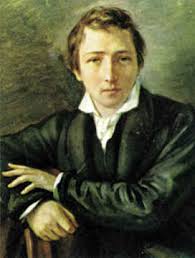
Heinrich Heine was a daring poet. Friedrich Nietzsche adored his boldness.   But by virtue of the positions he took in his poetry, Heine, as a modern Jew, was internally divided. His humor, found in many of his poems, is cynical and biting. Not only does it take a shot at the German public (“the philistines”) it also shoots back at the speaker.

Leo Shestov takes note of Heine’s split identity and acerbic humor in an essay on German and Russian writers and thinkers entitled “Penultimate Words.”   What makes Shestov’s criticism of Heine so compelling is the fact that he looks at Heine’s poems in terms of their philosophical and personal implications.   Shestov looks into what Heine’s self-mocking humor makes possible or…impossible.

When, in one of Heine’s poems, he passionately asserts that “I seek the body, the body, the young and tender body – I myself have soul enough,” Shestov comments that one can detect (“hear”) a “sharp and nervous laugh”(123, Chekhov and Other Essays). The irony is that Heine does and doesn’t seek the body over the soul. He is divided. The poem is an “expression of the divided soul, as a mockery of himself.”

Shestov describes this laughter as “misplaced,” “indecent,” and “uselessly disconcerting.” And, as I note elsewhere, Shestov puts Heine’s “sincerity” in scare quotes.   Doing so, Shestov alerts us that Heine’s poetry trashes the possibility of sincerity and puts into question the power of affirmation.

To understand the root of this self-mockery and self-division, Shestov points out how Heine was surprised by something that ran through his soul and “split asunder the unity of his former emotions.”    In an interesting move, Shestov explains the implications of this sudden shift and the resulting self-mockery and self-division by way of King David’s Psalms.

Shestov argues that although David’s “soul was…divided,” he was “able to preserve a sequence. When he wept, he could not and did not want to rejoice; when he repented, he was far from sin; when he prayed, he did not scoff; when he believed, he did not doubt”(124). However, “the Germans” (by which he means the German Romantic writers and thinkers) in contrast to the Hebrews, “thought these things were impossible and ought never to be possible. They submitted the succession of different, and even more contradictory spiritual conditions.”   In other words, the Germans, in his view, swayed Heine (despite the fact that he challenged them) with their belief that what David went through – vis-à-vis- his sticking to sequence despite division – was impossible.

It seemed to them that everything which formerly existed as separate, had become confused, that the place of stringent harmony had been usurped by absurdity and chaos. (124)

Heine was affected by this idea; however, he turned to a cynical kind of humor to cope with it.   As Heine lay on his death bed, Shestov tells us that “his sarcasms every day became more ruthless, more poisonous, more refined”(125). Seeing this, muses Shestov, one might think that all that was left to Heine was to “acknowledge his defeat and commit himself utterly to the magnanimity of the victor”(125). But who is the victor? Death or God?

Shestov tells us that “in the weak flesh a strong spirit lived. All his thoughts were turned toward God, the power of whose right hand, like every dying man, he could not but feel upon him.”   In the past, notes Shestov, Heine “has neither prayer nor praise. His poems are permeated with a charming and gracious cynicism, peculiar and proper to himself alone.”

The question: will Heine, on his deathbed, turn into David?

According to Shestov, Heine

knew as well as any one that according to the doctrine of philosophy, ethics, and religion, repentance and humility are the condition of the soul’s salvation, the readiness even with the last breath of life to renounce sinful desires. Nevertheless, with his last breath he does not want to own the power over himself of the age-old authorities of the world. (126)

Instead of “repentance and humility,” “Heine laughs at mortality, at philosophy, at existing religions”(126). Nonetheless, there is contradiction: Heine acknowledges that “his painful and terrible illness was the direct effect of his manner of life”(127).   Heine is, to his last days, divided in his laughter. Although his crushed spirit doesn’t matter to an indifferent God, Shestov suggests – in the most optimistic sense –it should matter to us.   But, if, Shestov comically muses, there really is another world which caters to those who cynically mock all claims to truth (a kind of Neietzschean heaven): “there the stubborn and the inflexible are valued above all the others, and that the secret is hidden from the mortals lest the weak and compliant should take it into their heads to pretend to be stubborn.”

But this heaven obviously doesn’t exist.   The cynic has nothing to hope for and must, as Shestov suggests, be sarcastic and bitter to the very end. However, his laugh – just like his soul – is divided…to the very end not because he is above it all, but because the cynical Heine knows (as Shestov suggests, indirectly) that it is possible that he is wrong and David is right.

The stubbornness of cynical laughter may taunt the metaphysicians, the philosophers, and the Rabbis but – for Shestov – it finds its limit at death.   In the face of death possibility – not certainty or cynical laughter – is the master.


Chained To This Spot: On Kafka’s Hesitation, Unhappiness, and the Possibility of Writing

Unknown

In Kafka’s diaries and in stories such as “The Metamorphosis,” there is a struggle to move from the spot one is located in. Kafka wonders if he can move, if he wants to move, and whether he would be happy if he did. Meanwhile, he – like Gregor Samsa stuck in his room –  doesn’t go anywhere.

On January 24, 1922, Kafka, drawing on a Kabbalistic notion of the transmigration of souls (and reincarnation) imagines his “hesitation before birth.”   “If there is a transmigration of souls then I am not yet on the bottom rung.   My life is a hesitation before birth.” Kafka is not excited about being born into a new body; he would rather hesitate than be reborn. And, given the notion of movement and cycling, this suggests that he doesn’t want to move and start again.   He doesn’t want to develop; however, he tells himself that he wants to change his place. The punch line is that he wants to be on another planet:

I don’t want to pursue any particular course of development, I want to change my place in the world entirely, which actually means I want to go to another planet; it would be enough if I could exist alongside myself, it would be enough if I could consider the spot on which I stand as some other spot.

Kafka wonders if simply “considering” his “spot” to be a spot on another planet would be sufficient. This suggests that Kafka wants to imagine movement.   He is “steadfast” in not moving but this inertia creates desire.

But Kafka, it seems, wants to be discontented. He wants to be unhappy about the fact that he is not going anywhere:

While I was still contented, I wanted to be discontented, and with all the means that my time and tradition gave me, plunged into discontent – and then wanted do turn back again.

Kafka admits that this is a “childish game” and is astonished at how “make believe, in engaged in systematically enough, can change into reality.” But this reality, created my his make-believe games, is unhappy. He has, as I mentioned in elsewhere, cultivated failure.

And these childish games, claims Kafka, “marked the beginning of my intellectual decline.” Kafka posits two possibilities regarding his unhappiness, inability to move, and his misfortune. Either he forced misfortune upon himself by playing “childish games” that get him nowhere, or it was forced on him:

If it is possible so as to force misfortune upon myself, it is possible to force anything upon oneself….I cannot grant that the first beginnings of my unhappiness were inwardly necessitated; they (the beginnings of his unhappiness) may have indeed been a necessity, but not an inward one – they swarmed on me like flies and could have been easily driven off.

But now they cannot and he hesitates. But he is actually happy that he hasn’t moved anywhere: “My unhappiness on the other shore would have been as great, greater probably (thanks to my weakness).” In other words, no matter where he moves, he will still be unhappy because the “first beginnings of his unhappiness” are a part of his being.   He sees himself as “put here as a child” and is “chained to the spot.” This knowledge, that is too late, informs his sadness. He can’t move.

Sad, and with reason. My sadness depends on this reason. How easy it was the first time, how difficult now! How helplessly the tyrant looks at me: “Is that where you are taking me!…When other people approached this boundary – event to have approached it is pitiful enough – they turned back; I cannot.   It seems to me as if I had not come by myself but had been pushed here as a child and then chained to this spot; the consciousness of my misfortune only gradually dawned on me, my misfortune was already complete; it needed not a prophetic but a merely penetrating eye to see it.

Kafka is stuck on the threshold (the boundary). And consciousness keeps him there. And he tells us, at the end of his passage that he has a “right” to despair over his situation of being abandoned at the boundary and unable to move from the spot.

However, the next day, he dreams of rising above this situation which is the situation of a schlemiel:

I must be above such mixtures of bad luck and clumsiness on my own part as the mistake with the sled, the broken trunk, the rickety table, the poor light, the impossibility of having quite….Such superiority cannot be got by not caring, for one cannot remain indifferent to such things; it can only be got by summoning strength.

Kafka’s hope, his strength, is that “surprises” can still happen – “this the most despairing person will allow; experience proves that something can come out of nothing, the coachman can crawl out of the tumble-down pigpen.”

But one cannot “make a life for oneself” out of chance or, as Kafka says, “as a tumbler makes a headstand.” Rather, the “strange, mysterious, perhaps dangerous, perhaps saving comfort that there is in writing: it is a leap out of a leap out of murderer’s row; it is a seeing of what is really taking place.”

And that seeing – which his writing – may be of his childish games and the fact that he can’t move. Writing about failure may be his leap of faith, but then again he may still go nowhere and be “chained to this spot.” Kafka – out of desperation – is willing to take this risk.  If this is a leap, then it could outwits his  wager with madness – which, as a “cultivating of failure,” keeps him from moving.  Then again, he may not have the strength to leap out of his chains.  Perhaps he will remain “chained to this spot” which is….in front of the page.   But, still, as Kafka notes, surprises happen and every unhappy person must accept that possibility.


On Failure and Happiness: Kafka, 1921

Unknown

We have all experienced some degree of failure in our lives. But most of us would rather not reflect on it as it will most likely cause depression and self-loathing. On the other hand, when writers reflect on failure they can, somehow, find a way to make the reflection meaningful.

In a well known letter to Gershom Scholem and in his essay on Kafka, Walter Benjamin argues that the “beauty” of Kafka’s fiction is the “beauty of failure.” This expression doesn’t make sense. Failure is ugly, not beautiful. It’s painful. How could it, like beauty, make one happy?

Kafka’s diary entries show us something that his novels and short stories sometimes disclose; namely, his struggles with failure and his desire for happiness.   In an entry on “crows,” which I addressed recently, Kafka points out how he sees himself as a bird who can sometimes float to the heights and “waver” over the abyss of eternity.   In that entry, Kafka points out that although he has no “help” in the heights, his friends offer him help in the lower realms (when he falls from the heights). Kafka says the same thing in his short story “The Investigations of a Dog.” Both the bird (of the entry) and the dog (of that story) are alone and feel alienated and unhappy. That is the price of being spiritual; however, both the bird and the dog admit that friends “help” one to feel happy.

As in these stories, Kafka often associates the literary experience (and dreaming) with unhappiness and failure while he associates happiness with friendship.   In his February 2nd diary entry, Kafka notes the “happiness of being with people.” The next day, Kafka tells us that it is “impossible to sleep; plagued by dreams, as if they were being scratched on me, on a stubborn material.”

Immediately following this, Kafka reflects on the meaning of failure and tries to pinpoint failure as the source of his affliction (in dreams and reality).   Like his dog character, he “investigates.” He uses a language to describe failure that is oddly Cartesian. He literally tries to perceive failing as such:

There is a certain failing, a lack in me, that is clear and distinct enough but difficult to describe: it is a compound of timidity, reserve, talkativeness, and halfheartedness; by this I intend to characterize something specific, a group of failings that under a certain aspect constitute one clearly defined failing…This failing keeps me from going mad, but also from making any headway.

Kafka’s description of failure, like Benjamin’s, is ironic. Failure keeps him sane. It protects him from madness! But, on the other hand, it also keeps him (like Gregor Samsa in his room) from “making any headway.” Nonetheless, Kafka feels that he must “cultivate” failure because if he doesn’t he will lose his mind. The word cultivation suggests that failure – for Kafka – is an artform.

Kafka must write late at night to keep from going mad. In this “bargain,” he “shall certainly be a loser.”   But, at the very least, his failure will be beautiful. The problem is that he will not, as I noted above, move anywhere. Kafka is stuck and he is not happy.

When Kafka, on March 5th, is confined to this bed for three days because of an “attack,” his friends come to his bedside. He feels a “sudden reversal. Flight. Complete surrender. These world shaking events going on within four walls.” On March 6, Kafka tells us that everything has changed: he experiences a “new seriousness and weariness.”

Kafka now wonders if he will die, if he would “choke to death” on himself? He fears that the “pressure of introspection” will diminish and that he will no longer be able to reflect on his failure (or anything for that matter). He will, as he said before, succumb to madness. He can no longer wage the battle against it….by “cultivating” failure.

Kafka, apparently for the first time in his life, wants to take a different approach to madness and death. He wants to move ahead instead of going nowhere and dying:

Mount your attacker’s horse and ride it yourself. The only possibility.   But what strength and skill that requires! And how late it is already!

Kafka now wants to be happy. And while he thought, before this, that cultivating failure was the “only possibility,” he seems to have changed his mind.  Now he reflects on nature and feels “jealous” of its happiness. Kafka rethinks the meaning of happiness and realizes how desperately he needs help.

In the past, when I had a pain and it passed away, I was happy; now I am merely relieved, while there is this bitter feeling in me…Somewhere help is waiting and the beaters are driving me there.

Eight days later Kafka seems to have found help. He tells us that he has a “pure feeling” and a “certainty of what has caused it.” Kafka saw “children.”

One girl especially (erect carriage, short black hair), and another (blonde; indefinite features, indefinite smile); the rousing music, the marching feet.

He then identifies himself as a “one in distress who sees help coming but does not rejoice in his rescue.” Nonetheless, he is happy because of the “arrival of fresh young people imbued with confidence and ready to take up the fight; ignorant, indeed, of what awaits them but an ignorance that inspires not hopelessness but admiration and joy to the onlooker and brings tears to his eyes.”

In other words, Kafka’s help is found in seeing children who are simple and innocent. They are “ignorant.” But he doesn’t say this as a self-congratulatory intellectual who looks down on the ignorant so much as someone who realizes that simplicity of life is redemptive. The fact that he allows himself to be affected by the children helps him to survive.   In his vision, failure is not cultivated.

Nonetheless, Kafka notes how, three days later, “the attacks, my fear, rats that tear at me and whom my eyes multiply” still afflict him. And now madness seems to set in as well as a kind of happiness. His fear of death – apparently – allows madness to break in:

March 19. Hysteria making me surprisingly and unaccountably happy.

Kafka doesn’t give up; but he realizes that even if he “moves, “ he will still have to return to his death room:

April 4. How long the road is from my inner anguish to a scene like that in the yard (of children playing) – and how short the road back. And since one has now reached one’s home, there is no leaving it again.

Kafka wants to leave and move but he realizes that he has to go back “home” and die alone. His failure seems to keep him from moving, again. The cowardly option – it seems – is to fight, alone, against madness through pondering and cultivating failure. It is the short road and it leads to unhappiness (or slight glimpses of the “beauty of failure”). But the long road leads him back to humanity.

Kafka is caught up in this dialectical movement (to and fro) in his stories and in his diaries.

For Kafka, it seems, literature is the space of failure (not just life); while life itself – like the ignorant children he sees in the yard -is about happiness and movement (outward). But as an intellectual and a reflective man, he must address his private failures. He may take the long road to see his friends and be inspired by children to plow forward, ignorant of what is to come; but he can also take the short road and cultivate failure so that he can deal with the anguish that eats him up inside. Either way, Kafka was always looking for what helps. The question for Kafka and perhaps ourselves is….what help is the most important and why? If it is “cultivated,” failure may be beautiful; but, without friends to help or to read to, failure may only lead to deep humiliation and pain not relief.

Perhaps, as Rabbi Nachman of Breslav (who Kafka read) might say, the Clever Man needs the Simpleton (the schlemiel) who – like the children Kafka admired – has no idea of what is to come but goes toward it with happiness.  Perhaps Kafka, a Clever Man, needs the schlemiel most when, in the face of death, the cultivation of failure is no longer the “only possibility.” That seems to be Kafka’s realization in 1921.