A Jewish-American Story of the Loss and Recovery of Faith in Joseph Roth’s “Job: The Story of a Simple Man”

images

There is a long history of films, books, and plays that depict the assimilation of Jews into America.  Many of these works include scenes that articulate the loss of faith which can lead to either a good or a bad ending.    On the one hand, think of The Jazz Singer (1927), a film that puts the heat on: the son of a cantor must make a choice between keeping his father’s traditions and going into show business.

It has a good ending.

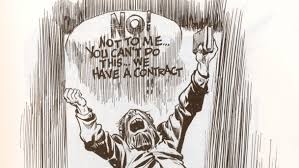
On the other hand, think of Will Eisner’s A Contract With God, a graphic novel which depicts a religious Hasidic Jew, Frimme Hersh’s loss of faith and dispute with God.   He, like Job, takes up an argument with God over not living up to his side of the “contract” (covenant) when his daughter is tragically taken away from him.   His suffering breaks him since he sees that a life of faith doesn’t give the rewards that it promises.  In anger and resentment, Frimme rejects his faith.  He is a broken man.

images

But his brokenness turns into a drive to sin.  Eisner depicts this as a movement from an emasculated masculinity (which he associates with the humility of faith) to male aggressivity.  America seems to bring out something from the Jew that simply didn’t exist in Europe.  He goes from being Job to being his opposite. But then, at a certain point, he experiences an emptiness.

d298b1db2fa01cbabd903963626fb2cf

In the end, he wants a new contract with God to fill the emptiness of his new, American life.  He’s willing to give faith a second chance.  However, before the new contract is drawn up, he dies.  He doesn’t get to live a new kind of Jewish life in America.  He dies, naked, secular, and alienated.

In my last post on Joseph Roth’s Job: The Story of a Simple Man, I briefly touched on Mendel’s loss of faith and the final miracle at the end of the book (with not only the return of his son Menuchim, but also the miracle of the photograph, which opens his eyes to his newly discovered daughter-in-law and grandchildren).

Here, I’d like to take a much closer look into what fomented Mendel’s breakdown of faith as well as his return to life by way of a miracle.  What he experiences presents a different kind of possibility for the Jewish immigrant than we see in either the Jazz Singer or Eisner’s Contract With God.   Roth suggests, on the one hand, the family and group of friends (and not just technology – I will return to this) as a saving grace, and on the other, the possibility of miracles in America.   His promise is, as Levinas might say, in the future, in fecundity.  Without that, his faith would remain broken.

Before introducing the major turn of events in Mendel’s life, Roth depicts the American scene for Mendel, his wife, and children as one of health and excitement.  Mendel wants to stay up all night and partake in its life-giving energy:  “They spoke of the theater, of society, of politics.  He listened and dozed.  When Deborah called, he opened his eyes.  ‘I wasn’t asleep,’ he would assure them.  Mac laughed, Sam smiled, Miriam and Deborah whispered together.  Mendel would stay awake a while, and then nod again”(150).

When he dreams, we see an American dream take shape which is, more or less, like a circus. But it is briefly interrupted by the memory of Mendel’s crippled son,Menuchim, who he left behind in Europe:

He dreamt of events at home, and things which he had only heard about in America: theaters, acrobats and dancers in red and gold, the President of the United States, the White House, the millionaire Vanderbilt, and ever and ever again – Menuchim.  The little cripple was mixed up with his dreams of prima donnas in red and gold.   (150)

Following the dream, the narrator sums up America in one long sentence:

Americans were healthy, their women pretty, sport was important, time was money, poverty was a crime, riches a service, virtue was half of success, and belief in oneself the whole of it, dancing was hygenic, roller-skating a duty, charity was an investment, strikers were enemies of mankind, agitators instruments of the Devil, modern machinery a gift of God, Edison world’s great genius.  (151)

America is the anti-thesis of the Europe he came from with his family.   Thinking of the future grandchild of his son Sam (Sam is the child who left Europe and brought his family to America), he experiences a new kind of hope: “The world will be very beautiful, thought Mendel.  How lucky my grandchild is! He will live through it all!” (151).  However, this hope is overshadowed. He thinks he will die before he has a grandchild.

But, at that moment, another hope comes to him: “But he had one hope left: to see Menuchim. Sam or Mac would go over to fetch him.  Perhaps Deborah would go to”(151).   In other words, he can’t live his American future – no matter how bright – without coming to terms with the past.   He defied the Rabbi by leaving Menuchim behind.  That is the secret thought in the back of his head and it may, at this moment in the novel, be his last remnant of faith.

When Mendel thinks about his wife while she is sleeping, he wonders why they are together.  He sees his desire for her as faded into the past and seems to see their relationship in practical terms.  He then turns to the Bible for vindication: “It is written, it is not good for man to be alone.  Thus we live together”(153).   He doesn’t quite understand why it is more than something practical.  It all comes to him when he loses his dearest family members one by one.

It all starts with Sam going off to fight in World War I.  Sam, convinced that “America isn’t Russia,” takes up the cause of the War and believes that he would be one of the “high officers” who would survive.  Mendel disagreed since he had already lost “one son” (Jonas)  to the war (although no one, to the very end of the novel knows if he is dead or alive).  Mendel couldn’t stop him.  As Sam leaves, Mendel reflects: “Perhaps America was a real fatherland, war a duty, cowardice shameful, and death – when one was attached to the regimental staff – out of the question”(161).    But then he thinks that he “should have said” stay because he finally had some good fortune: why experience more misfortune…if Sam were to die.

His worst fears come true.

Roth depicts the news as being transmitted in the context of a family moment at the table in the winter.  After sitting together for a while at a table – following some time while Sam was away – Mendel, being so familiar with misfortune (a Russian Jew, as Roth puts it) “knew…what was coming.”  His daughter, Miriam, was hiding a secret:

Silence reigned for a few seconds.  Miriam did not speak.   It was as though she hoped that her mother or father would free her, by a question, from announcing her news.  She stood still, and was silent.  None of the three moved. (164)

When Miriam speaks, the damn breaks loose and Deborah, her mother and Mendel’s wife, breaks down.  Her body changes.  She starts pulling her hair out.  Miriam “sank to her knees.”  Deborah’s hands “were like a pale, fleshy, five-footed animals, feeding themselves on hair”(165).  Deborah goes insane and starts singing.   She dies out of shock: “All of a sudden a suppressed scream came from Deborah’s breast.  It sounded like the rest of the melody which she had been singing, a broken bursted note.  Then she fell from her chair”(166).

Mendel speaks to his dead wife as if she was alive and his words reflect his loss of faith and total alienation. He loses his identity and much else…because of America:

“You are well off, Deborah,” he said to her.  “It is only sad that you have no son left to mourn you (as he thinks both Jonas and Menuchim are dead).  I myself must say the prayer for the dead, but I will soon die, and no one will weep for us.  Like two tiny specks of dust, we shall be scattered…I have begotten children, your womb has born them, death has taken them.  Meaningless and full of poverty was your life….You are dead and buried.  Towards me He shows no pity. For I am dead, and yet live.  If you can, pray for me, that I shall be stricken from the book of the living….I eat and drink, pray and breath.  But my blood congeals, my hands are limp, my heart is empty.  I am no longer Mendel Singer, I am but the remains of Mendel Singer. America has killed us. America is a real fatherland, indeed, but a death dealing fatherland. What was life, with us, is death here….You are buried in America, Deborah, and I, too, will be buried in America”(170-171)

Following this, we learn that Miriam has lost her mind (172).     And like Job, Mendel’s life worsens and his faith becomes thinner and thinner:

They left him. Mendel went to the window and watched them (his son’s friend Mac, and Sam’s wife, Vega) get into the car.  It seemed to him that he must bless them, as though they were children who start out on a journey which may be hard or may be very happy.  I shall never see them again, he though; then – I shall not give them my blessing, either.  My blessing might be a curse, coming from me it could only harm them.  (177)

Now he lets go of the weight that comes with faith:

He felt light, lighter than ever in all his years….He was alone – alone.  Wife and children had surrounded him and had hindered him from bearing his pain…..Now, at last, he indulged his misery in triumph!   There was only one relationship still to be broken.  He had prepared to do it. (178)

But then he does the deed.

He gathers up all of his religious objects and burns them (178).  As Eisner might say, he tears up his contract with God and becomes one with the Biblical Job character:

“It is over, all over; it is the end of Mendel Singer!” he cried, and his feet stamped in time to the tune, so that the floor-boards rumbled and the pots on the wall began to rattle.  “He has no son, he has no daughter, he has no wife, he has no country, he has no money! God said: I have punished Mendel Singer! For what has he punished him?” (179).

When his neighbors come up to see what’s going, we have a scene that we could find in Job; namely, different opinions about God and faith by his friends.

Mendel concludes, at the outset, that religion is more or less masochistic and God is sadistic: “God is cruel, and the more one obeys Him the more brutally He treats one…The weakness of man tempts His strength, and obedience awakens His scorn”(181).

And, ironically, when he is told that his case is similar to Job, he disagrees because he hasn’t seen any miracles (in the end) and doubts they will come.  No one, he says, will be resurrected and he doubts he will see either Jonas or Menuchim.  He insists (without knowing for certain) that they are dead (183).

Reflecting on Menuchim, he thinks that Menuchim was sick because “it showed that God was wroth with me.  It was the first blow, which I didn’t deserve”(183).   Even so, one of the neighbors, Menkes, argues that it is possible that a miracle can happen: maybe Menuchim is alive, Jonah is in prison, and Miriam can be cured from her madness.

He is not convinced that no miracles are possible anymore. In his rejection of God, he says that the “Devil is kinder than God”(185).  He seems to have washed his hands of God, completely.  There would be no happy ending because, to his mind, God is a sadist.  Tragedy, not comedy, is the lot of the man of faith.

As a part of his refusal, Roth shows Mendel in the midst of the month of Elul (before high holy days).  The community comes to his building and even makes a synagogue in his room.   He lets them but he doesn’t participate in the prayers.   They pray at his home on Yom Kippur.  But “Mendel Singer stood, black and silent, in his everyday clothes, in the background, near the door, unmoving. His lips were closed, and his heart was a stone.  The song of Kol-Nidre rose like a hot wind.  Mendel Singer’s lips remained closed, and his heart a stone”(192).

Silence reigns. But after the war ends, “the festive sound of a happy world” returns (196).  Roth takes up the phonograph as a technology that (partially) breaks the stone heart of Mendel.  He brings it to his home and listens every day.  He listens to all kinds of music (196).  He is astonished by the miracle of technology and this gives him some hope (197).   When he discovers a song called “Menuchim’s song,” he becomes dour yet, at the same time, he starts thinking of Menuchim and how the boy, who only spoke one word, “mama,” may get to sing and he may hear it someday.  The important thing is that the miraculous is conveyed through technology and it makes him entertain the possibility of something he has long denied as a result of his suffering and affliction – something he let go of when he deemed God a sadist and faith masochism.

The miracle happens on the night of Passover.   The influence of music is apparent when, throughout the ceremony, Mendel “sways” to the “music of others”:

And even Mendel became milder towards Heaven, which four thousand years ago had generously lavished such marvelous miracles, and it was though, because of God’s love for his whole people, Mendel cold almost be reconciled with his own fate. He still did not participate in the song, but his body swung backwards and forwards, cradled in the song of the others.  (214)

When a stranger from Russia joins them, who the narrator calls a Kossak, Mendel has the courage to start asking questions about his home, about Jonas and Menuchim.  Like Joseph in the Bible, the stranger conceals his identity, he is really Menuchim.  But Mendel doesn’t know until, at the very end, he reveals his identity.

Menuchim tells of how he was cured of his illness by a medical institute in Russia and was taken in by a doctor who took a liking to him.   We also learn that he is – like the last name of his father and his own name – a “singer.”  When he reveals that he is the singer of “Menuchim’s song,” which, as we saw earlier, enlivens Mendel to recall his missing son, everything shifts.   Mendel tells him that his wife (Menuchim’s mother) has died, but he still shies away from asking about Menuchim.  Roth portrays Mendel’s inner struggle over whether or not he should say the words.   But it is Menuchim who says the words “Menuchim is alive!”

Mendel laughs and weeps as one would expect in the pronouncement of a miracle (as one sees at the end of the Joseph episode when Jacob realizes that Joseph is still alive).    And now we see another breakdown of Mendel’s body.  Menuchim prompts it when he whispers the words of his deceased wife to Mendel so as to remind him that the words of the Rabbis are true: “Pain will make him wise, ugliness good, bitterness mild, and sickness strong!”(227).   The neighbors all witness the miracle and Menkes, “the most thoughtful of all of them,” sums up the entire journey of brokenness and faith: “We tried to comfort you, but we knew it was in vain.  Now you in the flesh experience a miracle! As we mourned with you, so we rejoice with you now.  Great are the wonders of the Eternal, today, as they were a thousand years ago! Praise His name!”(228)

Mendel repents.   His life is different now.  Menuchim takes care of him.  And he tries to come back to life although he is near death.   The circle is completed when he sees the photo.  It like the phonograph brings him closer to life.   In the photo he sees that he has not only a daughter in law but real grandchildren.  He has a future.  And this is what completes his faith.

What is so fascinating about this process is that a phonograph and a picture help him to live and return to faith.  Modern medicine does as well, since it cures Menuchim.  Faith, Roth seems to be telling us, is a process of breakdown and recovery; and, in America, in the modern world, it takes on a new form as the miraculous is a part of our everyday life.  But, more importantly, it is the community (Mendel’s larger family) that Mendel stays in proximity to, although he doesn’t share their faith.  It is the miracle of being-together during morning, Yom Kippur, and Passover that is the condition for the possibility of Mendel’s process of breakdown and recovery.   And it is the community that gives him the phonograph.  Without them and their kindness, he could no longer hear the sounds of life and the joys of world; without them these sounds of hope would not exist.   Technology is a part of this organic whole; it transmits the sensory; it facilitates healing.

Roth’s story works on many levels.  But, unlike Eisner’s Contract With God or the Jazz Singer it shows an organic process of the deterioration and renewal of faith.  These two stories – one of assimilation – and the other of broken faith lack these elements.  And while Eisner’s stops short, Roth does not.  He suggests that without community and hope, Jewish life in America (for the immigrant) is a tragedy.   The simple man, as his subtitle suggests, may be ruined but he holds on to a small thread.  His humility and his desire to not shock others may be his saving grace.  And it may, as Roth suggests, be the key to faith for a hyphenated Jew who, like Mendel Singer and Job, may – despite endless misfortune – be in for a surprise or two.  That’s a story – a comedy – that found its expression, as well, in Charlie Chaplin.  Perhaps, because of its comic turns and twists of fate and stokes of luck, Roth is telling us that were it to be a European story and not an American one the ending would be tragic not comic.  After all, he saw pogroms and the rise of Hitler and knew, like Shalom Aliechem, that life for Jews in Europe was coming to an abrupt end.

The Other Side of the Hyphen: On Joseph Roth’s Portrayal of a Jewish Family and its Passage to America in “Job: The Story of a Simple Man”

unknown-2

Like many American Jews, I am curious about the life of my grandparents and great grandparents.  On one side of my family, both of my grandparents were born in Europe but my father and his brothers were all born and raised in New York City.  My grandparents on the other side of my family, however, were both born in the United States (in New York and New Jersey).  I was the first child in my family to be raised in Upstate New York (which, although it is only three hours from New York City, is worlds apart).

Looking back on my upbringing, I identified more with the American side of my hyphenated identity than my Jewish side.  I had little choice because I was the only Jew in my elementary school (besides my brother) and when I was in high school (which I had to transfer to because of an anti-Semitic experience) I was only one of three in my grade.   We did have a small Hebrew School, a Jewish Community Center, and a Synagogue in Gloversville, New York.  I learned enough Hebrew to say my Haftorah at my Bar Mitzvah. But my sense of Jewishness was not solid.  My parents and my relatives gave me a vague cultural sense of Jewishness.  And when I left high school for university, I wanted to find out more about the other side of the hyphen.  Over time, I became a Jewish detective inquiring into my historical and cultural roots. And, as Freud might say, my self-analysis has become interminable.

For years, I have been reading historical accounts and novels about Jewish life in America and Europe.  The ones that touch me most deeply, however, had a lot to do with questions I have about my grandfather who was a proud Viennese (Austrian) Jew.  He died before I was born and this left me with a huge experiential and knowledge gap.   And since my father got in a spat with his family in which one side of the family basically disowned the other (my side), I was only able to meet my grandmother once (when I was sixteen years old) before she died.  I had so many questions for her but she was too busy apologizing for the lost years to tell me anything about my missing grandfather.

What do I know?  I have gathered that my grandfather was raised in Kalusz, not Vienna.  His father was a Rabbi. But when he came of age, he traveled to Vienna, developed his German to high proficiency, went to University there, joined the military, and rose in the ranks.  He was a young corporal of a platoon of Jewish-Polish soldiers during WWI.  He came to America after the war, in the 1920s, met my grandmother (who was of German and Sephardic descent), married, started a big family (my father was the youngest of four children), and created one of the largest leather companies in the world in upstate New York.     What, I wondered, was life like for him when he grew up in Europe? How did he go from being a religious boy in Eastern Europe to a businessman in America? What happened? And, most importantly, how was I to imagine this?

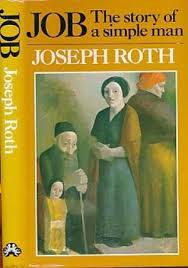
My attraction to the literature and philosophical works of Austrian-Jewish and German-Jewish writers and thinkers can be understood from my need to know what life was like for my grandfather.  Many of these books were helpful and gave me a sense of the high level of thinking and culture an Austrian-Jew would have.  Their work also gave me a sense of their struggles with being Jewish in a society that was more interested in their contributions as Austrians or Germans than as Jews.  But it was only recently when I came across Joseph Roth’s Job: The Story of a Simple Man that I felt that I had finally come across a novel that spoke to my desire to see the process of a man and a family that leaves a life of religious piety in Eastern Europe for America depicted in a deeply symbolic and meaningful manner.

The main character of Roth’s novel is Mendel Singer.  He is a humble man.  He, like his father and grandfather, was a Torah (Bible) teacher for children:

Many years ago there lived in Zuchnow in Russia, a man named Mendel Singer.  He was pious, God fearing, and ordinary, an entire commonplace Jew.  He practiced the simple profession of a teacher.  In his house, which was merely a roomy kitchen, he instructed children in the knowledge of the Bible.  He taught with honorable zeal and without notable success.  Hundreds and thousands before him had lived and taught as he did.  (3)

Although the main character is situated in Russia, the writer of the tale was, like my grandfather, an Austrian Jew who had made the pilgrimage from Galacia to the city and beyond.  His depictions of Mendel and his family have a lot to say about what he left behind and what he wants to leave behind; but it also shows us what he wants to hold close.

While Roth finds something endearing in his utter simplicity, he also finds something very sickly about Singer.  To be sure, Roth, like Kafka (in “The Country Doctor”) and many other Austrian writers is fascinated with health and sickness.  Many small details are painted with sickness or health throughout the novel.  Things are tight and restricted.  They don’t grow.  And it weighs him and his family down:

His body was stuck into the customary half-long Jewish caftan of the country, the skirts of which flapped when Mendel Singer hurried through the street and stuck with a regular tact like the beat of wings against the shafts of his high leather boots.(4)

The setting around Mendel’s family diminishes as he ages.  There is an acute sense of finitude:

When the students grew older they would go to other, wiser teachers.  Living became dearer from year to year.  The crops were always poorer and poorer. The carrots diminished, the eggs were hollow, the potatoes froze, the soup was watery, the carp thin, the pike short, the ducks lean…and the chickens amounted to nothing.  (5)

His wife, Deborah, however, is much stronger than he.  She wants a better life.  She is a symbol of vitality under duress:

On Friday she scrubbed the floor until it was yellow as saffron.  Her broad shoulders bobbed up and down in an even rhythm; her strong hands rubbed the length and breadth of each single board…She crept through the bare blue-whitewashed room like a broad, mighty, and moveable mountain. (5)

All of Mendel’s children, save one, are healthy. One goes off to join the military, the other leaves for America, while his daughter fools around with Cossacks.  In other words, he has failed to produce yet another generation of Bible teachers.  His last child, his last hope, is Menuchim.  We see his birth at the beginning of the novel. But unlike all the other children, he is very sick.  Roth’s depicts Menuchim as a monstrosity:

In the thirteenth month of his life he began to make faces and to groan like an animal, to breathe hastily and to gasp in an extraordinary fashion.  His great skull hung heavy as a pumpkin on his thin neck.  His broad brow was criss-crossed with folds and wrinkles like a crumpled parchment.  His legs were crooked and lifeless, like two wooden bows.  His meager little arms twitched and fidgeted.  His mouth stammered ridiculous noises.  (8)

Mendel and his wife pray for the child to be healed, but nothing changes.  When given an opportunity to send him to a Russian doctor, the father refuses for fear of them taking his baby away and raising him outside of a Jewish home and into a Russian one.  Deborah wants him to go and be cured.  Mendel refuses (10).   She then goes in search of a miracle for her son:

Deborah undertook pilgrimages to the cemetery; she called upon the bones of her ancestors to plead her cause to the Almighty.  Thus would Menuchim become well and no epilectic.  (10)

Meanwhile, “the older children grew and grew; their healthiness sounded an evil warning in the ears of the mother as though it were inimical to Menuchim.  It was as though the healthy children drew strength from the sickly one, and Deborah hated their noisiness, their  red cheeks, their straight limbs.  She pilgrimaged to the cemetery in rain and shine….She called upon the dead whose quiet comforting answer she thought she heard”(11).

Deborah goes on to a Rabbi who tells her than she must stay with Menuchin and that her love commitment to the child will eventually yield a miracle.   Throughout the novel, things get no better.  It reaches a breaking point when their son, Sam, leaves for America and becomes successful.  They must choose to go or stay behind with the child.

They decide to go.  They leave Menuchim behind with friends.  And in America things transform.  America is associated with life, health, and abundance.  Mendel is overwhelmed when he arrives.  It is a physical, sensory overload:

All the smells united in a hot vapour, together with the noise which filled his ears and threatened to split his skull.  Soon he no longer knew whether he was hearing, seeing, smelling.  He went on smiling and nodding.  America pressed down on him; America broke him; America shattered him. After a few minutes he become unconscious.  (128)

When he comes to and sees himself in a mirror, surrounded by his family, he feels embarrassed. But his son and his friend Mac – their physical presence – revives him.  It has the effect of good luck:

With difficulty he opened his lips and begged his son’s pardon.  Mac grasped his hand and shook it, as though he congratulated Mendel on a successful trick or on a bet he had won.  The iron clamp of the smile again settled around Mendel’s lips, and the unknown power again moved his head so that it seemed Mendel nodded.  (128)

What is most astonishing is the physical transformation of Mendel by virtue of being in America.   He and his wife become healthier and seem to have more luck.  The possibility of success looms large around them.  But as the health grows, so does the memory of Menuchin and his sickness.   Deborah, especially, remembers that Menuchin could only utter the word “mama” and this memory truly pains her.

Roth sets up this dialectic between America and the old country by virtue of the health motif.  They want to bring Menuchim to America and feel he can become healthy there.   When they hear, in a letter, than Menuchim said a few more words (other than “mama”), their hopes are stirred and their desire to return and bring him back is stoked.  Could a miracle have occurred?

Mendel returns to his prayerbook and now his worship becomes full of life and vigor:

From the trunk, he fetched his old prayerbook, so familiar to his hand.  He opened it immediately to the Pslams, and sang one after another.  He had experienced grace and joy.  God’s broad, wide, kindly hand arched protectingly over him, too…His heart rejoiced, and his body had to dance.  (148)

But in the chapter immediately following this, his health takes a turn for the worse.  He becomes sickly again.  He no longer “cared” about life his “beard was white; his eyes weak.  His back bent; his hands trembled”(149).   He becomes small, unrecognizable.  While he sees and acknowledges America as a land of miracles (150) he can’t stop thinking about Menuchim and the world he left behind.  His nostalgia is unhealthy.   And things get worse for him in America.

He and his wife are surrounded by others who – because of their ties to the old country – become sick while living in America.  When Menuchin comes back to visit, near the end of the novel, Mendel, like Job is to spent and warn down to enjoy the return and the fact that, miraculously, Menuchim can not only speak but has lived a good life.   But there are other problems for Mendel.  Where is Jonas? Is he alive?   And is it too late?  Isn’t Mendel on the cusp of death?  And what is he to do now that his wife has passed away?  At this moment, Roth has Mendel sink into the must profane moment of exposure and this, suggests Roth, is enlivening:

He himself, Mendel Singer, would have a good death, after many years, surrounded by grandchildren, “old and full of days,” as was written of Job.  He felt a curious and forbidden desire to lay aside his old cap of silk rep, and feel the sun upon his skull.  And for the first time in his life, Mendel Singer voluntarily uncovered his head, as he had only done in public offices, and in his bath.  The few kinky hairs upon his bald head were moved by a gentle spring wind as though they had been rare and tender plants. (236)

Then Mendel asks to see a photograph on the wall with a healthy woman walking through the spring and in the midst of a sweet wind and with children.   When he looks out the window he takes the picture up again and realizes that it is the picture of his daughter-in-law (Menuchim’s wife) and his grandchildren.   At this point he remembers how, when he was young, his wife Deborah looked, her warmth, her body.  It is the photograph which helps him to open his eyes not only to his son and his life but also to his wife who has passed away.  These are his last moments before he dies and Roth tells us this is the “greatness of a miracle.”

Mendel’s misfortune had partially blinded him.  It had affected his body.  But it is a photograph (a secular miracle) that brings him his final revelation and gives him life, not his prayer book.  It gives him back the world around him moments before he dies.

Reading this novel, I wonder if vitalism is the right frame for Jewishness.  Life in America is certainly vital for the Jew. But I am on the other side of the hyphen.  While Mendel knew a lot about what it means to be Jewish, he knew little about what it means to be American. When he found out he got his life back, albeit for a moment in time in which life and death became one.  I, on the other hand, lived a full American life and I have, for several years, decided to cross the threshold into the realm of Jewishness.  The question, for me, is where I can find a Jewish life that is vital and embodied.   Perhaps the hyphen between Jewishness and Americanness is that vitality.  It’s the threshold that I must pass.   Like Kafka’s “man from the country” in his story “Before the Law” and like Job, I am a simple man with a desire to know and experience the truth.  And like them I must pass through if I am to – as Franz Rosenzweig says – step into life (not death).

Groping for Small Things: Robert Walser’s Portrait of the Philosopher

unknown-1

Recently, a friend of mine who happens to be a philosophy professor and a fellow lover of Robert Walser referred me to Walser’s reflection on “the philosopher” (written in 1919).  I was struck by Walser’s portrait because it shows that he, as a writer, also identifies in some way with the thinker.  However, he does draw a line in terms of writing and the relationship to people.  But before doing so, Walser says many things that suggest that the thinker and the writer share a childlike fascination with small things.  They are both into what Theodor Adorno would call “micrology”: namely, that the only way to a bigger picture of things is through a careful attention to small things. This is something he may have learned from his mentor and friend, Walter Benjamin.

What makes Walser’s reflection on the philosopher and his obsession with smallness even more interesting is the fact, by looking at him from a perspective that identifies with him and another that criticizes him, we seem to move from a micrology to a macrology of the philosopher and his relation to the social.

The first line of Walser’s piece tells us that “the philosopher” is “constantly watching and waiting,” he “stands as still as a portrait” and “gropes for things gossamer-thin.”  And once he finds things, he “loses” them because they are “far too flimsy.” Nonetheless, to even hold these small things one must “exercise a patience verging on the stupendous.”

While these comments show some kind of deep respect, the voice of the piece suggests that the philosopher is also acerbic and bitter.  But this is because no one appreciates his obsession with smallness.  Even so, the narrator seems to side with the common person’s desire to give him a “few kicks just to scare him out of his contemplativeness.”

Taking this note to heart, he likens this obsession to a prison.  It traps him and, since it doesn’t lead to much writing, its unproductive.  Much like many of Kafka’s characters – who Walter Benjamin tells us often study too much – he makes “no progress.”

Something is a little off and comical about the way the philosopher keeps himself. The philosopher laughs and smiles but his laugh is short and his smile is “crooked.”  Nonetheless, it has a certain beauty to it.  And although his suit is threadbare, it is clean.   Like Walter Benjamin, he doesn’t like to throw anything away.  He finds a treasure in the trash.

And even though his “pacing” back and forth makes him look old, he is motivated by a “strange childishness.” But even though he is motivated by a kind of childishness, he is still very orderly.  While he “gladly putters around little objects” of thought, the narrator tells us – once again drawing on the common person’s perspective – that the philosopher would be better off as a craftsman.  The philosopher is a schlemiel of sorts because he “lollygags” in a small room while wanting to do things and “make a good use of his day.”  He’s stuck and his desire to do something – because he can only think when he is still – seems futile.

The only thing he can do – in repose to this tension – is leave the room.  Walser betrays his identification with the philosopher not only by pointing out that he is obsessed with small things but also in the fact that he takes note of how the philosopher likes to go on walks.

When the philosopher looks out the window, takes notice of the small things “out there,” like the rustling of the trees in the wind, the “cheerful smoke over the rooftops,” and the people in the street, he becomes deeply self-conscious of some kind of error.   He is only “listening,” the narrator tells us, he isn’t thinking.  But isn’t the point of the thinking to be receptive to small things? What is Walser trying to say?  Is the philosopher upset because he realizes that being receptive (“listening”) is not productive?

The final lines of the narrative demonstrate the pity of the narrator for the thinker.  He seems to take on a Marxist take on things that it is better to change the world than to think about it.  The philosopher can’t “be a part of progress” and can’t “step onto the stage.”  The worst pity of all is that because he has spent so much time thinking he has lost “so many things.”

But is that true?  And what about the writer? Isn’t he in the same boat?  Isn’t Walser, although he produced many works of writing, also not “stepping on the stage” of history and progress?  Didn’t he also struggle with the futility of sitting at a desk, writing, and reading?

Walter Benjamin believed that Kafka (and he himself) struggled with this issue.  We can see this in his journals about his meetings with Bertolt Brecht. Benjamin valued the time he spent reading and listening to Kafka’s work.  He points out that both he and Kafka know that”attention is the silent prayer of the soul.”  And that silent prayer is to be found in paying close attention to words on the page.  The scholastic, the philosopher, and the modern writer seem to share this understanding.

To be sure, Karl Marx wouldn’t enjoy reading Kafka or Walser.  His favorite writer was Charles Dickens.  His writing spoke to and reflected on historical events.  He was not interested in small things.  Dickens had bigger literary fish to fry: historical fish.  Perhaps the narrator is too much on the side of Dickens and Marx.  Receptivity may have no place in the world and, as Walter Benjamin said of Kafka’s interest in the literary fool, it may “help” the individual but will it do any good for humanity?  The philosopher and the writer may get up in small things, but shouldn’t they (if they believe in higher things) be thinking about history and politics (the bigger things)? Perhaps salvation is the issue.   Perhaps the little things can help one to get by…but they may not help others or change the course of history.  But can we expect fiction or a word from a philosopher to do that, today?  It’s up to the reader to decide.

Americans, Slow Learners, Schlemiels: On Thomas Pynchon’s Comical Figurations of Slowness & Sloth

unknown

In his book 24/7, Jonathan Crary suggests that our “24/7” society of endless social networking is taking over our lives.  We are endlessly checking and updating our Facebook pages and, as things speed up, we barely get any sleep.  Strangely enough, for Crary, the only way to resist this negative insomnia is to sleep.   But there is another way to resist a society that calls for constant interaction with this or that interface.

Thomas Pynchon – years before the advent of Facebook or Twitter – suggests that the best way to resist society is through slowness and sloth.  He brings this out in his fiction – through characters, plot, language, and dialogue, – and in his non-fiction.  And in the recent film production of his book, Inherent Vice, Joaquin Phoenix is, appropriately, cast as the lead because he is, throughout the film, slow and slothful.  It takes him a while to wake up or show up to any event.   And, as we see throughout the film, things slowly dawn on him.  Phoenix’s portrayal of Doc suggests that, for Pynchon, it’s better to let things slowly and organically happen than to attack them (as we see with the alter-ego of Doc in the film and book, Bigfoot).   Doc, in effect, is a slow learner.  And in being slow he is able to avoid the speed driven LA culture of the 70s, which links power to speed.  Slow people, as Pynchon suggests, are free.

But this is the latest appearance of slowness.  Slowness and sloth go way back with Pynchon to his first stories and his novels.  I’ll take brief note of a few sites of slowness and sloth.   These reflections will inform a larger study of this trope which is, to be sure, comical and not tragic.

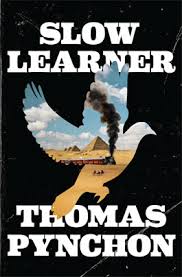
In the introduction to Pynchon’s short story collection, Slow Learner, Pynchon reflects on his first short stories.  Throughout his reflections, he takes note of how slow he is to learn and get things right.  Like a schlemiel of sorts (Pynchon dubs the main character of his first novel, Benny Profane, a “schlemiel detective” who just happens to be half Jewish), Pynchon takes note of how things seem to happen to him as he goes a long and slowly learns how to become writer (but this slowness doesn’t go away, and perhaps that’s the point).

Writing in the 80s and looking back at the short stories he wrote in the 50s, Pynchon humbly admits that he dupes himself with “one of those episodes of middle-aged tranquility, in which I now pretend to have reached a level of clarity about the young writer I was back then.  I mean I can’t very well just 86 this guy from my life”(5, Slow Learner).

When he imagines what it would be like to meet himself, today, he points out how awkward that would make him feel: “If through some as yet undeveloped technology I were to run into him today, how uncomfortable I would feel about lending him money, or for that matter even stepping down the street to have a beer and talk over old times?”(ibid).

After noting this, Pynchon profusely apologizes to his readers for all the flaws in his writing.   When he describes his first short story, “The Small Rain” – which I recently wrote on in terms of Jewishness and fatness, two central motifs in the story – he takes note of the existential issue of facing death in the story.  He says that the characters do not “seriously” face death.  Rather, they come across as comical:

In “The Small Rain” characters are found dealing with death in pre-adult ways. They evade: they sleep late, they seek euphemisms.  When they do mention death they try to make with the jokes.  Worst of all, they hook it up with sex.  You’ll notice that toward the end of the story, some kind of sexual encounter appears to take place, though you’d never know it from the text.  (8)

These comments are telling because the same features of a comical encounter with death remain not only in his later novels but also in his last novel, Immanent Vice.  The comical aspect comes through in the belated and slothful relation to death- in the slow awareness of the characters who are usually overwhelmed by too much information and who happen to stumble upon connections (in the most happenstance manner).    “Lardass Levine,” in this story, is a slow character.  He does things in his own time and not in the time of the other GIs in the story.    And, more importantly, although he is physically a big guy, he is slow to act.  The sexual act, to be sure, doesn’t seem to happen.  He and the woman he runs into lay side-by-side in the “little rain.”  Levine is like a “little boy.”  He can’t be a man like the rest and he doesn’t want to be – although he does come across as masculine.

Later in the introduction, Pynchon notes how many people in the 80s – influenced by entrepreneurism of the Regan Era – may look like mature and powerful upwardly mobile but they are “incredible as it sounds, still small boys inside”(12). His characters, he suggests, are like this too.   Charcters may talk or act big on the outside, but we can all see that they are – through their deeds or failures – really small.   And this comes out in their change of speed.

At the end of the introduction, Pynchon suggests that he “elves must have snuck in” and “had a crack at his writing.”  He sees the small people as speaking through his novels.  He talks about his “small attachment” to his past and waves his hand, to so speak, saying that he – in the 80s – is just like (as Zappa put it), a “bunch of old guys playing rock’n’roll.”    Younger people, he fears, will pity him and even find him nostalgic. But what sticks out in this final description of himself in a different time is that he doesn’t fit in temporally; even so, readers in the 80s (and, of course, today) can humor him as an old guy pretending he is young.  What this amounts to is nothing more nor less than a schlemiel character.  Think for instance of Noah Baumbach’s casting of Ben Stiller in his film, While We’re Young.

Stiller is slow, out of rhythm, and belated, although he acts as if he’s young.  The theme of slowness and belatedness is what we find in Saul Bellow’s Herzog, as well.

In his book Gravity’s Rainbow, Pynchon introduces his main character “Slothrop” in the midst of things that require time to deal with.  His “desk is messy” and so is the prose that surrounds it. The eye of the narrator slowly wanders over everything she sees:

There must be cubicles like this all over the ETO: only the three dingy scuffed-cream fiberboard walls and no ceiling of its own. Tantivy shares it when an American colleague, Lt. Tyrone Slothrop.  Their desks are at right angles, so there’s no eye contact but by squeaking around some 90 degrees.   Tantivy’s desk is neat, Slothrop’s is a godawful mess. It hasn’t been cleaned own to the original wood surface since 1942. Things have fallen roughly through the layers, over a base of bureaucratic smegma that sifts steadily to the bottom, mad up of millions of tiny read and brown curls of rubber eraser, pencil shavings, dried tea or coffee stains, traces of sugar and household milk, much cigarette ash, very fine black debris picked and flung form typewriter ribbons, decomposing library paste, broken aspirins ground to  powder. (18)

The attention to small detail slows the reader down.  It’s so overwhelming that the character and the reader get stuck in the mess.     Sloth and slowness, it seems, are built into the novel.  One is belated because one can sense that, through all the detail, there is simply too much to catch up with and we are, like the narrator and Slothrop, slow learners.  To be sure, he’s always catching up with this leads in the book – much like Doc in Inherent Vice or Benny Profane in V.  The schlemiel detective will always be slow collecting the leads and this may have to do with smallness on a temporal and spatial sense.

I’ll end my brief reflection on slowness in Pynchon, by taking note of a comical article he wrote for the New York Times in 1993 entitled, “The Deadly Sins/Sloth; Nearer, my Couch, to Thee.”    Pynchon starts off the article by citing the Christian Theologian Thomas Aquinas who sees sloth as a “capital sin.”  This is the sin the Pynchon, to be sure, celebrates.  All writers are guilty of sloth:

Writers of course are considered the mavens of Sloth. They are approached all the time on the subject, not only for free advice, but also to speak at Sloth Symposia, head up Sloth Task Forces, testify as expert witnesses at Sloth Hearings. The stereotype arises in part from our conspicuous presence in jobs where pay is by the word, and deadlines are tight and final — we are presumed to know from piecework and the convertibility of time and money. In addition, there is all the glamorous folklore surrounding writer’s block, an affliction known sometimes to resolve itself dramatically and without warning, much like constipation, and (hence?) finding wide sympathy among readers.

Pynchon tells us that, today, Sloth has lost its “religious reverberations” since it has become a part of our culture.  Who doesn’t waste time, he reflects, watching TV, sitting on one’s couch, flipping channels, eating food?  Pynchon ups that ante- back in the 90s by comically suggesting putting up a few more TV sets. But, he asks, is this really Sloth?

“There’s nothing I like more than sitting around with a six-pack of beer, some chips and a remote control. . . . The TV station even featured me in a town parade. They went into my house, got my couch and put it on a float. I sat on the couch in my bathrobe and rode in the parade!’ “

Sure, but is it Sloth? The fourth television set at work, the fact that twice, the Tuber in question mentions sitting and not reclining, suggest something different here. Channel-surfing and VCR-jockeying may require a more nonlinear awareness than may be entirely compatible with the venerable sin of Sloth — some inner alertness or tension, as of someone sitting in a yoga posture, or in Zen meditation. Is Sloth once more about to be, somehow, transcended? Another possibility of course is that we have not passed beyond acedia at all, but that it has only retreated from its long-familiar venue, television, and is seeking other, more shadowy environments — who knows? computer games, cult religions, obscure trading floors in faraway cities — ready to pop up again in some new form to offer us cosmic despair on the cheap.

 Unless the state of our souls becomes once more a subject of serious concern, there is little question that Sloth will continue to evolve away from its origins in the long-ago age of faith and miracle, when daily life really was the Holy Ghost visibly at work and time was a story, with a beginning, middle and end. Belief was intense, engagement deep and fatal. The Christian God was near. Felt. Sloth — defiant sorrow in the face of God’s good intentions — was a deadly sin.

Perhaps the future of Sloth will lie in sinning against what now seems increasingly to define us — technology. Persisting in Luddite sorrow, despite technology’s good intentions, there we’ll sit with our heads in virtual reality, glumly refusing to be absorbed in its idle, disposable fantasies, even those about superheroes of Sloth back in Sloth’s good old days, full of leisurely but lethal misadventures with the ruthless villains of the Acedia Squad.

In other words, Sloth is our condition and is more of a comical concern than a serious one.  It is evolving.  And the more things there are the slower we will be and the more apt we will be at wasting time.  Pynchon seems to have noticed that sloth overtakes everyone, not only the writer.  Perhaps the difference is that the writer cultivates slowness and dwells in it while the average “couch potato” and pot smoker with munchies doesn’t cultivate anything.  Sloth is sloth, Pynchon seems to be the bottom line.  And if that is the case, what is the difference?

Pynchon didn’t foresee Facebook or the burgeoning of the internet in 1993, but he does seem to think – despite the visions of his 93’ prose piece of the NYT – that the cultivation of slowness may be a hedge against the 24/7 culture.

Although the old person trying to rock out may seem comical, perhaps Pynchon is suggesting that we are all becoming schlemiels.  In the midst of all these changes, aren’t we all belated and out of joint (just like the time that Hamlet found in the wake of trauma)?   To answer the question, Pynchon would suggest finding a schlemiel detective (wink, wink).   She may be a slow learner but, who knows, maybe she can figure out what’s going on?   And who knows, maybe that detective – like Slothrop, Benny Profane, or Lardass Levine – is an American version of the schlemiel?  All of Pynchon’s arrows seem to be slowly pointing in that direction even if it is….too late.

It’s Not Just Me, Then: Fiction, Comedy and the Cl*****.

Schlemiel Theory gets honorable mention in a recent post by the blog InfiniteCoincidence. Take a look at this insightful post which covers a lot of contemporary cultural ground with a philosophical edge.

Rich Will's avatarInfinite Coincidence

What I’m trying to do on this site is make links between things I haven’t seen connected together elsewhere*. Hence the links themselves are usually more important than what I have to say about them. In the last couple of days I have come across three things which I think vindicate (albeit, inevitably, in an infinitely more coherent and detailed fashion, one based on research and careful thought rather than guesswork and ‘affect’) the thoughts I’ve been trying to articulate over the past few weeks. First there is an article by Carole Cadwalldr which details the ways in which right-wing trolls have been able to infiltrate the algorithms of Google and Facebook in order to create their own reality, one which is increasingly conditioning ours:

The technology that was supposed to set us free may well have helped Trump to power, or covertly helped swing votes for Brexit. It has…

View original post 1,490 more words

Fat Jews: On Fat Jew and Thomas Pynchon’s Depiction of Nathan “Lardass” Levine

fatjewishhhhhh

Thomas Pynchon published a short story – while an undergrad at Cornell University in the late 1950s – entitled “The Small Rain” whose main character is Nathan “Lardass” Levine.  Pynchon makes him an endearing character who is not without his faults.  Pynchon brings out his unique character by situating him within the context of military service and a mild skirmish or two with an anti-Semetic Lieutenant named “Twinkletoes” Dugan.  It’s interesting that Pynchon doesn’t represent Levine as a weak or effeminate schlemiel type of character.  He can fend for himself.   Pynchon’s description of how Levine assimilates into the non-Jewish military crowd, however, shows that he is the “odd one out” (but not in the same way a schlemiel is since Levine is more masculine).  Pynchon mixes tropes that suggest that Jews and Blacks in America share common physical and cultural ground:

Levine…was not quite ordinary.   He was one of the few men outside of those bucking for section eight who actually liked it at Ft. Roach.  He had quaintly and unobtrusively gone native: the angular edges of his Bronx accent had been dulled and softened into a modified drawl; he had found that white lightning…was in its way agreeable as scotch on the rocks; he now listened to hillbilly groups in bars in the neighboring towns as replete as he had once dug Lester Young or Gary Mulligan at Birdland. He was well over six feet and loose-jointed, but what certain coeds at City once described as a plowboy physique, rawboned, and taut-musceled, had run flab after three years of avoiding work details.  He had a fine beer belly now, in which he maintained a certain pride, and a large behind which he was not so proud of, which earned him his nickname.  (Slow Learner, 28)

When “Twinkletoes” Dugan, the anti-Semitic Lieutenant, comes in to the barracks, Pynchon situates Levine on a bed reading a trashy novel entitled Swamp Wench.  Levine slowly gets up once he hears that Dugan wants to speak to him: “Levine turned another page and started reading.  ‘Hey’, the company clerk said.  Levine smiled vaguely”(29).

Pynchon describes Dugan in a satirical manner and illustrates why he and Levine don’t get along:

There were a lot of…nice things about Dugan.  He held as self-evident truths, for example, that the NAACP was a Communist cabal dedicated to 100% intermarriage of White and Negro race, and that the Virginia gentleman was in reality the Ubermensch, come at last, prevented from fulfilling his high destiny only by the malevolent plotting of the New York Jews.  Mainly on account of the latter he and Levine did not get along well.  (29)

Pynchon valorizes Levine’s fatness and his slowness in repose to Dugan and the military context (this depiction is similar to the slowness we find with Pynchon’s stoner schlemiel character, Doc in Inherent Vice):

Levine closed the book, folded it in half, rolled over and stuck it in his back pocket.  He lay there for a minute or so within a cockroach follow some private maze across the floor.  Finally, he yawned and dragged himself off the bunk, dumped the butts and ashes onto the floor and put the helmet liner on his head, canted down his eyes. (30)

Toward the end of the story, Levine leaves the barracks to go to a bar and meet a woman. The scene – in some way – seems to allude to James Joyce’s depicition of Bloom walking through the streets of Dublin:

He started walking, hands in pockets, whistling, heading in the general direction of the bar he had been in the night before.  There were no stars and the air felt like rain.  He walked through the street lit shadows of big ugly pines, listening to the voices of girls, the purr of cars, wondering what the hell he was doing here….and wherever he went he would be wondering this.  (49)

This mediation turns into an odd reflection on being a fat American Jew without an identity:

He had a momentary, ludicrous vision of himself, Lardass Levine the Wandering Jew, debating on weekday evenings in strange nameless towns with other wandering Jews the essential problems of identity – not of the self so much as the identity of place and what right you really had to be anyplace.(49)

Even though these thoughts fall into the backdrop when he meets up with a girl in a bar, he becomes out of sorts when he is alone and naked with her in a bed.   Levine sees her response – as Kafka’s female ape in “A Report to the Academy” – as reflecting his estrangement.   They both lay in the bed – body to body –  “not touching”(50).

The next day, Levine is told that he can leave now, he’s an “extra body.”  He puts his sack on his shoulder and drives into the rain.   Pynchon makes “Lardass Levine” into a lonely figure.  In the end of the story, he is a big Jew who walks into the “small rain.”  His body – an emblem of his partially assimilated American Jewishness – sets him apart.   But the weather – and his sense of otherness – makes him small.  His body can’t mitigate the sense of otherness that is, so to speak, in the atmosphere.  Perhaps Pynchon is suggesting that the “small rain” reminds him of his Jewishness.

Reading this story, I thought a lot about the relationship of Jewishness to weight, today.  It seems a little different.  Seth Rogen Josh Ostrovsky play, aka”Fat Jew,” come to mind. They throw their weight into the public image of Jewishness.  (I have written about Rogen and Fat Jew’s use of the body before – see here and here.)

It is astonishing how Fat Jew has become over the last few years.   He has 9.2 million followers on Instagram, nearly a million likes on Facebook, and 296 thousand followers on Twitter.   When he first started rising to celebrity, The New York Times ran a 2014 essay on him and while it noted his major accomplishments, it retained a little skepticism:

Given that Mr. Ostrovsky’s main oeuvre is a social media feed for which he mostly finds funny pictures or tweets on the web and reposts them with his own captions, his abilities as a live-action entertainer are untested. It’s an obstacle he is doing little to overcome. Mr. Ostrovsky refuses to join the stand-up circuit. “Why would I do that when I can roll myself into a giant burrito, take a picture and get paid?” he said.

One year later, he sunk into a controversy in which he was accused of stealing jokes (cutting and pasting them through his own portals).  The Atlantic points out how this issue has evolved.

The debate over Twitter joke theft has escalated in recent years as people find more and more ways to monetize their feeds. Ostrovsky’s joke “curation” on Instagram (and Twitter, where he has 255,000 followers) might seem harmless, but he reportedly makes thousands of dollars anytime he endorses a product online, a smaller-scale version of the endorsement empire created by celebrities such as Kim Kardashian. Simply by taking a screenshot of whatever jokes were trending any given day, Ostrovsky somehow parlayed his way into a pilot development deal with Comedy Central, although Splitsider reported that the deal has fizzled out after huge protest from other comics.

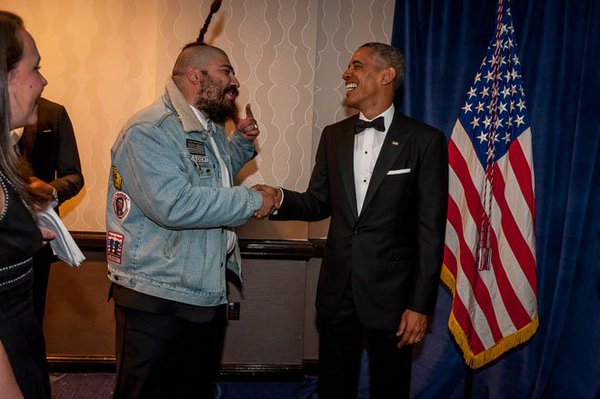
The popularity of Rogen and Ostrovsky – by way of their bodies – is not an emblem of otherness.  It is endearing.  And it has a kind of ironic smallness to it.  It is bound to make us smile.   The President seems to find it funny, too.

chfqtcjwmaaiuqj

While, with Pynchon, fatness and Jewishness has literary resonance, with them it has none.   That aside, now even Fat Jew is getting in on storytelling (albeit in a more popular cultural sense).  It’s appeals to socially symbolic and popular figures is a little different from what we find in Pynchon. Even so, today, we know much more about Fat Jew than we know about “Fatass Levine.”   Fat Jew puts out a unique kind of male Jewish body in public space and  by doing so opens up different ways for identifying Jewish (making it “hip”).*


* What seems to be missing, however, in all these deceptions is a discussion of “Fat Jews” in terms of gender.  How do Amy Shumer and Lena Dunham – who put their voluptuous bodies in the public eye – fit? Would they find offense in being called a “Fat Jew”?  Lena Dunham doesn’t seem to find any problem with the display of the body in a manner that may offend some people. But is her display comical and affirmative in the same way that Fat Jew’s is?  Would Dunham – like Fat Jew – find her identity as a Jew in her body or is it elsewhere?  And wouldn’t the stereotypes be more in play with them?  Since so many artists, writers, and filmmakers today, play on and try to transvaluate the Jewish body, this is a question worthy of more reflection.

The Epic Schlemiel (Self Mocking, Humorous Clown) of $TWTR, @Nymag’s @jessesingal.

A good word for Schlemiel Theory from the “Wandering Poet”

Wanderin Poet's avatarWanderinPoet

WordPress blogger Menachem Feuer has a wonderful blog on Jewish humor, The Home of Schlemiel Theory.

It is my contention that Jesse Singal, fake news (self admitted!) writer for New York Mag is a Schlemiel.

What else could he be?

He admits to having taken part in the production of fake news.  Yet he was an editor at prestigious New York Magazine.

As a classical liberal opposed to censorship I think it’s Jack Dorsey that is dumb, but Jesse is ok with “Dumb Twitter.”

He is ok with a revolution, as long as he profits.  This seems somewhat anti revolutionary doesn’t it?

He’s basically Castro’s Lieutenant hoping he doesn’t get shot by firing squad.

Jesse, ostensibly a science writer, thought people NOT communicating was a great way to make change.

Basically Jesse Singal was instrumental in electing Donald Trump.  I bet he can’t figure out how though.

Is Jesse a…

View original post 81 more words

On Jews, Aryan Bikers, and a Stoner Schlemiel Detective in Thomas Pynchon’s “Inherent Vice”

images

Usually, I read the book before seeing the movie.  This time, things happened differently.   Although I have had Thomas Pynchon’s 2010 novel, Inherent Vice on my book shelf for a few years, I gave up and decided to just see the movie first and then read the book.   I was really curious what a Pynchon novel would look like on the screen.  Besides that, I really like Joaquin Phoenix’s acting.  He has the ability to turn every gesture or shrug into a moment for reflection about what it means to be human – at this moment – in America’s history.   How should one live today? Is it better to be aloof but aware?  Or is it better to be radical, hyper aware,  emotional and active (a demeanor we see in many films and documentaries, but satirized in Woody Allen’s Crisis in Six Scenes)?   There are characters for each of these dispositions in many Pynchon novels.  This one is no different.

While my wife wasn’t so into the film, I was transfixed by many things: the comical detective narrative, the foggy atmosphere, the odd pacing of this film, and its plot, which involved Aryans, Jews and a stoner schlemiel detective, who doesn’t have a Jewish name: “Sportello.” (Note: Pynchon uses the schlemiel detective motif in his novel, V and in The Crying of Lot 49).   He is nicknamed “Doc” (Phoenix plays Doc in the film).   It seemed as if Pynchon – in this later novel – was interested in recasting the schlemiel detective; while in V, he (Benny Profane) is half-Jewish and half-Catholic,  this time he is not.  And, strangely enough, Pynchon situates the schlemiel detective into a case that involves an arch villain who is Jewish.  His name is Micky Wolfmann and, as one informant in the film suggests, he loves things German and wants to be a Nazi:

“Westside Hochsdeutch mafia, biggest of the big, construction, savings and loans, untaxed billions stashed under an Alp someplace, technically Jewish but wants to be a Nazi, becomes exercised often to the point of violence at those who forget to spell his name with two n’s.”(7)

Wolfmann surrounds himself with members of the “Aryan Brotherhood.”  And Doc gets drawn into his life and this situation because an old fling of his named Shasta drifts into his home at the outset of the novel:

She came along the alley and up the back steps the way she always used to. Doc hand’t seen her for a year.  Nobody had.  Back then it was always sandals, bottom half of a flower-print bikini, faded Country Joe & the Fish T-shirt.  Tonight she was all flatland gear, her a lot shorter than he remembered, looking just like she swore she’d never look.  (1)

Shasta and the hippie motif she represents are juxtaposed to two scenes: one, the Wolfmann scene, in which, we learn, she was involved with him in an affair; the second, a “money situation” – now that Wolfmann’s wife knows about the affair, Shasta wants Doc’s help.  The take away: Shasta seems to be hooked into a bad scene which involves a “Jew” who “wants to be a Nazi” and she needs a schlemiel detective’s help to save  her from being sucked into this mess.

Shasta outlines the scene to Doc while he teases details out.  The subtext is fascinating because it deals passes through questions of Good and Evil and loyalty to arrive at the economic bottom line:

“Is, they want me in on it,” she said. “They think I’m the one who can reach him when he’s vulnerable, or as much as he ever gets.”

“Bareass and asleep.”

“I knew you’d understand.”

“You’re still trying to figure out if it’s right or wrong, Shasta?”

“Worse than that.” She drilled him with that gaze he remembered so well.  When he remembered.  “How much loyalty I owe him.”

“I hope you’re not asking me.  Beyond the usual boilerplate people own anybody they’re fucking steady –“

“Thanks, Dear Abby said about the same thing.”

“Groovy.  Emotions aside, then, let’s look at the money.  How much rent has he been picking up?”(3)

Doc may be a schlemiel detective but, as one can see from the above passage, he has very realistic views.  The only thing is that he numbs himself to their implications (perhaps because he smokes pot a lot) and, as we see throughout the book, he suddenly remembers things and usually stumbles over things he missed.  His detective method is a blend of intelligence and happenstance.

Ultimately, its not the drugs that keep him aloof.  Doc has an existential stake.  He doesn’t want to focus too much on existence.  And perhaps that gives him the blurry feel that we bear witness to not only in the book but throughout the movie.  His constant pot-smoking and odd hours of sleeping make all things hard to see and hear (for the reader and viewer).  But it also serves as a motif because he has momentary instances of clarity when things – all of a sudden  – come together.

But things aren’t so blurry in terms of the plot: the read on Wolfmann – as the main Jewish villain who pays the bills – is quite clear.  Pynchon plays on the motif of the Self-Hating and powerful Jew who wants to situate himself amongst the Aryan Brotherhood, a biker gang that protects him.  Doc is on the outside of this. He’s just trying to help Shasta out by finding Wolfmann.   In truth, Doc is really just the small guy who stumbles upon clues and somehow puts things other.   The Jewish character is – on the other hand – the symbol of power, greeed, and corruption.  He leaves his Jewishness behind for evil and power.  (An anti-Semitic theme, no doubt. And there is much to discuss here about the drive for assimilation and the desire to become the other.  I will discuss these in future posts.)

What leads Doc to Wolfmann is heroin, which, in this book, is associated with rotting teeth and what I would call eroding one’s bite on life.  Doc smokes pot, while all of Wolfmann’s clients and people (including Shasta, before she visits Doc) shoots dope.  Wolfmann is the peddler of dope and he gets everyone under his power.   Doc wants nothing to do with power.  Wolfmann takes their teeth away from them and gives them a fake bite.   Doc has all his teeth.   His bite is real.  But he only eats on the go.

To be continued…..

Nostalgia is Irrefutable: A Note on Mark Lilla’s “The Shipwrecked Mind”

unknown-1

Whenever I reflect on the celebrated modern writer, Marcel Proust the thought always comes to me – seemingly out of nowhere – that his appeal to childhood memory, to his bed, is sheer nostalgia.  He is telling us that the past is always better than the present.  And if we put this in a temporal perspective, we can see that it suggests that the past is also better than the future and that nostalgia is an even greater force than hope! How could this be? What kind of world could give birth to such a passionate form of nostalgia?

Mark Lilla’s Query

unknown-2

In The Shipwrecked Mind: On Political Reaction, Mark Lilla tells us, at the very outset, that he is bewildered by the fact that proper “theories about reaction” – as opposed to theories of revolution, that are covered in every which way – are lacking:

We have theories about why revolution happens, what makes it succeed, and why, eventually, it consumes the young.  We have no such theories about reaction, just the self-satisfied condition that it is rooted in ignorance and intransigence, if not darker motives.  This is bewildering.  (ix)

He is bewildered because he can’t see why anyone misses the fact that reaction may in fact be more powerful than revolution. He thinks that it’s “spirit…may have died out.”   And it is reaction that “rose to meet it” and “has survived and is proving to be as potent a historical force.”  After all, says Lilla, it is currently on the rise in the “Middle East” and “Middle America.”   He calls those who refuse to see this, smug, because they regard this irony (since one would or even should – as Lilla suggests may be behind this blindspot – think it is the other way around) with another irony:

It arouses a kind of smug outrage that then gives way to despair.  (x)

And with that despair comes a striking realization in a era when all “others” are embraced:

The reactionary is the last remaining “other” consigned to the margins of respectable intellectual inquiry.  We do not know him.  (x)

Lilla’s task is to introduce “him” to us and to make it respectable if not imperative to think about reaction.  He defends this proposition.  To this end, he starts by giving us  a genealogy of the use of “reaction” and “reactionary” after the French Revolution. And, as we can see, it has a very “negate moral connotation” which “still retains today”(xi).

After saying this, Lilla says something that – because of this negative moral connotation –  doesn’t fit within “our” frame of reference:

Reactionaries are not conservatives.   This is the first thing that should be understood about them.  They are, in their way, just as radical as revolutionaries and just as firmly in the grip of historical imaginings.  Millennial expectations of a redemptive new social order and rejuvenated human beings inspire the revolutionary; apocalyptic fears of a new dark age haunt the reactionary.  (xii)

To see something and be deeply affected by time and history, is to be, as Lilla puts it, “shipwrecked.”  He dedicates this book to understanding the “shipwrecked mind.”

The reactionary mind is a shipwrecked mind. Where others see the river of time flowing as it always has, the reactionary see the debris of paradise driving past his eyes. (xiii)

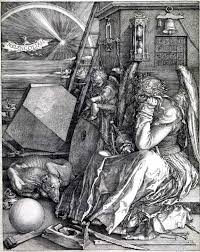
Reading this, I immediately think of Walter Benjamin and Albrecht Durer’s interest in the figure of Melancholy who is surrounded by the ruins of history.

unknown-3

And, as a result of being shipwrecked, the reactionary mind turns to the past:

The reactionary, immune to modern lies, sees the past in all its splendor and he too is electrified  (xiii)

The nostalgia of the reactionary can be “militant ” and this is what makes him a “distinctly modern figure, not a traditional one”(xiii).   Lilla delves into the conditions for the possibility of such a passion for the past, for nostalgia.  He argues- by way of Marx – that it has to do with the experience of constant revolution and change, when “all that is solid melts into air.”  This creates an “anxiety” and it this anxiety is by and large greater than we could ever have imagined: it is “universal.”

It is so strong that Lilla claims that reactionaries – of our time – have discovered that nostalgia may “perhaps” be “more powerful (a more powerful motivator) than hope.”   And this leads him to the conclusion that: “Hopes can be disappointed.  Nostalgia is irrefutable.”

These last lines not only make me think about Walter Benjamin’s struggle against the tide.  It also reminds me of his favorite writer, who he wrote an essay on which took him nearly ten years to complete.  He noted that all of Kafka’s characters like to go backwards. They seem to be primordial as they turn against the flow of time we know as progress and development.

One story which puts this into perspective is Kafka’s “A Report to the Academy.”  At the end of the story, the ape, who is the first person narrator of the story, reflects on all he has gone through to become more civilized and…human.  Although he seems inspired and hopeful, he is actually really quite bored.  And when he thinks about the “half-trained little chimpanzee” he comes “home to late at night,” who he takes “comfort from” as “most apes do,” he recalls how he “can’t bare to see her”(259, Kafka: Collected Stories).

Why?

When he sees her he takes notice of her “insane look of the bewildered half broken animal in her eye.”  In other words, he sees himself.  He is a reactionary and, as Lilla would say, his mind is “shipwrecked.”

Strangely enough, after mentioning this, he covers up the fact that he sees the marks of his past life on his ape’s face….and acts “as if” everything is all right (and human), as he finishes his “report to the academy.”

In any case, I am not appealing to any man’s verdict, I am only imparting knowledge, I am only making a report.  (259)

The question we need to ask about this report is the same one Lilla poses.  What does it mean that the knowledge he is imparting is the knowledge of a  shipwrecked mind which acts as if it is not?  Who are we?  Are we in denial?  Are we trying to hide the fact that we are shipwrecked on the shores of time and that nostalgia might be greater…than hope?

You Got a Friend in Me: On Randy Newman’s Little Americans, Sailing Away & Friendship

unknown

Words that touch the heart and sounds that make us tap our feet guide many Americans through life.  They give us hope to carry on.  This is especially the case in American religion and popular culture. Both bring liturgy and melody together in a way that it becomes one with experience and infuses it with a kind of magic that is, for lack of a better word, common.  Artists such as Ray Charles, Gladys Knight, and Ella Fitzgerald – to name only a few, there are many, many more – were able to bring gospel into the secular realm.   They smuggled it in and gave American music a spiritual charge and a sense of liberation that changed the direction of music not just in America but around the world.

I can personally attest to this.  Listening to their music I always felt a kind of non-denominational, popular spirit or what Harold Bloom might call an expression of “American religion.”   One of my favorite American composers – who always manages to evoke a popular spiritual message while retaining touches of melancholy – is Randy Newman.    His voice has echoes of Ray Charles and Van Morrison.  And his lyrics suggest something that every American can identify with since they touch on what makes Americans American – vis-à-vis individualism, simplicity, and the animal joys that come with having ample food to eat, a family, and a strong sense of security.

Randy Newman has been writing music since the early sixties for TV shows – such as the Carol Burnett Show, Sesame Street, the Muppet Show, and Saturday Night Live – and for major films such as Toy Story (1999) and Monsters INC (2001).  He has also written some wonderful songs – some of which were hits.  Many of these songs speak to something endearing and sweet that all Americans share.  But there are other songs that present more of an ambiguity (albeit with a sugar coating).

Of all the songs from my youth, the one that stuck most was Randy Newman’s “Short People.”  It stuck because I was astonished that a song could be so unabashedly cruel and loving at the same time.  Unlike a song by Bruce Springsteen or Michael Jackson, it presented a challenge each time I listened to it.  Dancing to the song wasn’t so easy.  I always recall the lyric that, “short people have no reason to live.”  How could the melody be so charming and cheerful? There was something about this song that showed me a part of America that was deeply familiar and unfamiliar to me.  I couldn’t figure out what it means, and that’s why it stayed with me.

Reflecting on the song, recently, I went on Youtube and gave it my full attention.  What is it all about? Was Newman singing a song at the expense of “short people”?

After listening to the song several times, I discovered that, as a kid, I chose to only listen to part of the tune.  I only heard the voice of a bully; I missed the chorus which turned the voice inside out.

Short people got no reason

Short people got no reason

Short people got no reason to live…


They got little hands

And little eyes

And they walk around

Tellin’ great big lies

They got little noses

And tiny little teeth

They wear platform shoes

On their nasty little feet

Well, I don’t want no short people

Don’t want no short people

Don’t want no short people

Round here

The song is about the dialectic about a bully and the voice of conscience.   In the second part of the song we see that the singer realizes that the “short people have nobody to love” because so many people are hated so much.  He slowly realizes that short people are “just like you.” This comes out in the chorus.

Short people are just the same

As you and I

(A fool such as I)

All men are brothers

Until the day they die

(It’s a wonderful world)

Short people got nobody

Short people got nobody

Short people got nobody

To love


They got little baby legs

And they stand so low

You got to pick ’em up

Just to say hello

They got little cars

That go beep, beep, beep

They got little voices

Goin’ peep, peep, peep

They got grubby little fingers

And dirty little minds

They’re gonna get you every time

Well, I don’t want no Short People

Don’t want no Short People

Don’t want no Short People

‘Round here

The message: Americans are all one: E Plurbus Unim.  The twist is that we may all be small people, but we have a hard time coming to terms with it. And this divides us.  There is always someone who thinks s/he is taller (in terms of money, power, identity, intelligence, education, etc) than someone else – and, to be sure, Newman tells us that “short people are just the same as you and I.”  We are all culpable, to some extent.  No American escapes unless they are, literally, small people:

Short people are just the same

As you and I

(A fool such as I)

All men are brothers

Until the day they die

(It’s a wonderful world)

The message, restated: America is small people and I, the singer of this song who doesn’t want “small people down here,” admit that I am a fool and that small people are “the same as you and I.”   The “wonderful world” – as Disney would say – is a small world…after all.

Randy Newman’s genius is to sing a song that really hits on what makes us special as Americans.  We are divided and united not just by and through small people, but also, and perhaps more importantly, by a kind of sarcasm that transforms into empathy and love.  We are, as Newman suggests, a family.  And although any family will fight and make fun of each other, in the end, we are all a part of the same family.  And that realization – which comes through realizing I’m a fool – is translated into a joyful sense that the world is “wonderful.”  Through becoming small, wonder makes its debut.

His song “Sail Away” tells a different story.   He hits on the basic, simple common denominator at the beginning of the song.  “Here in America, we got food to eat.”  We live in a land of  plenty.

In America you’ll get food to eat

Won’t have to run through the jungle

And scuff up your feet

You’ll just sing about Jesus and drink wine all day

It’s great to be an American


Like in a Disney film, we are all happy animals.


Ain’t no lions or tigers

Ain’t no mamba snake

Just the sweet watermelon and the buckwheat cake

Ev’rybody is as happy as a man can be

Climb aboard, little wog

Sail away with me

Our joy, however, because of the way he sings the song and his use of an American horn section, tells us that our satiety leads us to “sail away.”  In the most proud American sense, we are sailing through the Charleston (North Carolina) bay.  But we aren’t really sailing “across the ocean.”  Rather, there is a sense of home and homecoming.   This is our chorus.

Sail away

Sail away

We will cross the mighty ocean into Charleston Bay

Sail away

Sail away

We will cross the mighty ocean into Charleston Bay

But, as Newman notes, we come back to are American animal happiness.  We are as happy as a monkey in a monkey tree.

In America every man is free

To take care of his home and his family

You’ll be as happy as a monkey in a monkey tree

You’re all gonna be an American

But there is trouble in paradise because our journey is really not from sea to sea but across the Charleston Bay. We can’t see it, however.  Because we are so blinded by being…at home and happy.

Our journey seems to be at end, suggests Newman.  Although he last musical line on the piano is a beautiful American March and suggests a redemptive theme, it is really suggesting that we Americans – in our ship of fools – are really going nowhere…just drifting and dreaming (“across the Charleston Bay”).  Sailing away may suggest that we are sailing away from the world and are deciding that it’s time to relax and be happy.

But in a recent video by Newman – released in September – he talks about how, in Europe, he experienced an anti-Americanism that really bothered him.  After saying this he shares a new song he wrote about what makes America special and different entitled “A Few Words in Defense of our Country.”


Newman talks about how America – in comparison to the rest of the world – isn’t so bad.  And that Americans shouldn’t cower down to these criticism and think of themselves as horrible people.

But, as the song goes on, while we learn about what Americans want from the rest of the world, we also hear what Newman thinks has befallen America:

We don’t want their love

Respect, at this point, is kinda outa the question

In times like these, we sure could use a friend.

 Hitler, Stalin, Men who need no introduction,

King Leopold of Belgium

Everyone thinks he’s so great

He went down to the Congo

He took the diamonds, he took the gold

You know what he left them with

Malaria


You know a President once said,

“The only thing we have to fear is fear itself.”

Now it seems like we’re supposed to be afraid.

It’s Patriotic in fact.

It’s color coated.

What are we supposed to be afraid of?

Why…being afraid.

That’s what terror means.

That’s what it used to mean.

 …..

 The end of an Empire is messy at best

And this Empire’s ending, like all the rest.

Like the Spanish Armada, adrift at sea.

We’re drifting home of the Brave and land of the Free.

Good bye…Good bye….Good bye.

In other words, Newman is telling us, right now, that we are truly adrift at sea and that his America – the spiritual one – has drifted away and has lost its anchor in the Land of the Free.   Nonetheless, as he tells his little listeners in Toy Story, he’s not going away: “You got a friend in me.”  And that’s where it all begins and, if we’re lucky, this will bring the ship back from being adrift at Sea.  Short people have nobody to love….but that’s a challenge…not a statement of fact.  But here’s the rejoinder (which is, more or less, an assurance).  Let’s hope it has the last word: