Comic Exposure to Targeting: A Levinasian Reading of Andy Kaufmann and Phillip Roth’s Portnoy (Part III)

DownloadedFile-3

The last two targeting theories I’d like to look at, before I address Emmauel Levinas, Philip Roth, and Andy Kaufman come from Charles Baudelaire and Paul deMan who, apparently, follows in Baudelaire’s comic footsteps.   (I have written several blogs on Baudelaire and deMan’s reading of comedy.  What I look to do here is to summarize their views and to distinguish their approaches to a Levinas-ian one.)

Like many of the other theorists we have seen so far, the 19th century French Symbolist poet Charles Baudeliare, in his “The Essence of Laughter,” associated what he called “essential laughter” with Satanic superiority and human fallen-ness.  The target of this laughter is innocence and the result of this laughter is a kind of double consciousness of oneself in terms of otherness.  The consciousness of the Satanic – double consciousness – is sufficient to overcome and use the Satanic for social progress because, for Baudelaire, it marks a superiority over nature (one’s one and the world’s). However, in laughing at the fallen, one also feels a loss.  Both are incorporated into one’s consciousness and, taken together, they are for Baudeliare part and parcel of being modern.  The best examples Baudelaire gives come from the world of mime and the comic/horrific world of ETA Hoffman.

The element of blindness and naivite, which is found in the subject of any comic routine, act, joke, or passage, is the key to understanding the Satanic.  With respect to the mime, Baudelaire sees the movements of the mime as bringing out a blindness and a disregard for the civil (but this disregard is blind). We laugh at this disregard for the world and, at the same time, its falleness.  We identify with the excessive and odd gesturing of the mime, yet, at the same time, by laughing at the mime’s gestures we are indicating that we are superior.  And this marks our identification and dis-identification, our double consciousness that one is and one is not caught up in a kind of gestural fallen-ness.

But the fact that Baudeliare turns to the example of fallen-ness that comes to us by way of the German writer ETA Hoffman (as the final example) indicates that something is missing in the mime example.  What’s missing is a greater appreciation of how innocence and its loss play the main role in essential laughter.  The story that interests Baudelaire involves the laughter at a little girl’s shock at learning that the soldiers she has idealized are, ultimately, animal-like.  It is her father, a “magician,” who brings her to this profane revelation.  Her shock at fallen-ness and our laughter at it illustrate, for Baudelaire, our Satanic sensibility.  He calls it a kind of madness, a vertigo at this or that loss.  However, as Baudelaire argues, this madness is followed by a moral awareness of how laughter can be used for progress.  We go into the world with a, so to speak, tainted understanding of our “superiority.”  It is far from perfect and works by way of shocking the innocent.  Nonetheless, without such superiority over nature man would have no meaning.

Further to this last point, Baudelaire’s prose piece, “A Heroic Death,” shows us that laughter is far from progressive and positive; it also creates a wedge between the real artist and the artist of consumption.  The cynical conclusion of this piece is that the consumer, so to speak, has the last laugh while we, the readers, lose our innocence as we are exposed to the cruel truth that power is greater than “real” art (in this case the art of a comic mime).

In “A Heroic Death,” it is the Prince, a being in the position of the power, who embodies the Satanic-comic life.   He is the ultimate consumer.   After he learns that the comic mime (jester) has plotted to kill him with other nobles, he puts him into a test where the Mime has to make the performance of a lifetime.  When he, as Baudelaire notes, becomes one with the symbol and effaces the line between himself and what he is performing, he gives the audience something of a revelation.  They are all enraptured and “intoxicated” with what they see.

However, the Prince is troubled because he loses all of the attention of the people.  The comic mime wins their attention and, in effect, robs the Prince of his power.  In response, he laughs at the true artist who steals his power and this, in effect, leads to the mime’s pathetic (not heroic death).  To be sure, it is the artist and the correlation of acting and symbolism that are the target of modern Satanic laughter.  And we can have no doubt that Baudelaire identified with the comic mime who, in the end, although bearing the truth by way of comedy, is the target of power.  The “real artist” loses, while the artist-as-consumer wins.  The death of the mime is something of a premonition of reality TV since the Prince sees the mime’s acting under duress as a form of entertainment.  As the narrator of “A Heroic Death” tells us the prince turns to entertainment to eliminate his worst enemy: Boredom.  The murder of the artist – by way of Satanic laughter – is in the name of amusement.  It has entertainment value.  This disturbing conclusion shows that, for Baudelaire, the target of humor in the modern world is the artist.  Even s/he cannot escape the daemonic.  S/he becomes its target.

Paul DeMan’s challenge to us, today, is to argue that irony and comedy turn the target back on oneself.  Reading Baudealire, deMan sees humor as leading to madness.   But the madness he looks at is not simply the madness that the girl in the ETA Hoffman story experiences or the madness we witness at the failure of the mime’s art in “A Heroic Death.”  According to deMan, we don’t discover the Satanic in what Baudelaire called “essential laughter” so much as the nothingness of oneself.   Comedy shares nothing inter-subjective with the other.  It has no meaning save the destruction of meaning.  That is what DeMan calls the “irony of ironies.”  Meaning, the self, and the inter-subjective are, for deMan, the targets of irony.

For deMan, what we find in the wake of the Prince’s Satanic laughter, so to speak, is the abyss.  The best things humanity has to emulate – innocence, hope, and art – are the targets.   And the elimination of these targets leaves one alone, abandoned, speechless, and cynical.

I would like to suggest that Levinas’s interest in the relation to the other can be understood as a challenge to deMan and to the tradition of comic judgment and targeting.   As Levinas notes in several of his texts, the notion of the isolated consciousness and “essance” – which deMan and the other comic theorists we have discussed, return us to by way of laughter – are challenged by way of the other.  In relation to the other, I am vulnerable, exposed.  I cannot separate my consciousness from the other.  Using hyperbole, Levinas argues that we must use an “amphiblology” when speaking of our relation to the other because we are assymetically related to the other.  Our words cannot approximate our relation to the other; they fall short of what he, elsewhere, calls infinity.   Our signification in relation to the other is Saying.  And, as I would argue, it is comical.  In relation to the other, we are comical but we are not alone.  The comedy is in the relation and not in the act of targeting.

We risk ourselves when we relate to the other who can accept or reject our love or care.  We are, as Levinas says, “traumatized” and “inspired” by the other.   Although Levinas sees this as a very serious affair, the fact of the matter is that comedy can expose us to vulnerability. More importantly, it can expose the audience to its violence against the other.  Through comedy, we can bear witness to being traumatized and inspired by the other.  But, as I’d like to show in the next few blog entries, this witnessing can invert the targeting that is, as we have seen above, part and parcel of nearly every theory of comedy from Aristotle to deMan.

We can see the oscillation of the comic target in relation to what Phillip Roth would call the tradition of “sit down” comedy and to Andy Kaufmann’s “stand-up” comedy.   In the next blog entries, I’d like to contrast the two so as to show how the schlemiel, as a comic character, can be read in terms of traditional theories of comedy which lay emphasis on targets and superiority and to a Levinasian way of reading comedy – one which looks to show how the comic target is inverted by the other.

Comic Exposure to Targeting: A Levinasian Reading of Andy Kaufman and Phillip Roth’s Portnoy (Part II)

images-1

The reflection on and implementation of comic targeting has a long history which stretches back to the origins of Greek philosophy.   The reflection on the target is of utmost importance for thinkers who wish to establish this or that kind of hierarchy or agonistics between appearance and reality, the mind and the body, being and becoming, and other topics germane to Western philosophy.

For Socrates, the role of irony was to create a sense that things are not always as they seem: he looked to separate appearance from reality, being from becoming, and truth from untruth in his ironies.  We see a good example of this in the Symposium where Alicabades, fully intoxicated, bursts into the Symposium and accuses Socrates of being a seducer.  In his drunkenness, Alciabades publicly accuses Socrates of lying about his quest for truth.  For Alciabades, Socrates acted ‘as if’ he thought physical was inferior to the love of wisdom.  It was a front that he used to seduce young men.  The irony is that Socrates “seems” to be into the former and is seducing young boys, but in actuality he is brining them closer to the truth.  His irony is that of a philosophical trickster. In the end, Alciabades claims that Socrates wears that mask of Silenius, the cohort of Dionysus.  He seems to be a seducer but, ultimately, he’s not.  He is committed to truth and being. And the target of his ironies is always what seems to be true: becoming.

In his book On Masochism, Gilles Deleuze argues that Socrates destroys this or that target in the name of this or that principle.  Irony has a philosophical use: it makes one distinguish and judge the difference between appearance and reality.  In contrast to irony, Deleuze, citing Sacher Masoch’s Venus in Furs, posits humor; for Deleuze humor doesn’t aim at destroying a target and establishing a principle so much as elaborating what he calls a contract which reduces absolutes to finite terms and relations.   In Delueze’s model, there isn’t a hierarchy so much as a lateral tension between beings which is not ironic so much as humorous.

In The Poetics (5:14) and The Rhetoric, Aristotle saw humor as introducing the “incongruous.”  The joke surprises the listener by offering something he or she did not expect in this or that series.  This laughter or surprise is another way of saying that what is laughed at is not beautiful or harmonious.  Humor is a distortion of proper mimesis and is, for this reason, a target.  Aristotle notes this in the poetics, Chapter 4:

Comedy, as I said, a mimesis of people worse than are found in the world – ‘worse’ in the particular sense of ‘uglier’, as the ridiculous is a species of ugliness; for what we find funny is a blunder that does no serious damage or an ugliness that does not imply pain, the funny face, for instance, being one that is ugly and distorted…

For Thomas Hobbes, the author of the classic on political philosophy, Leviathan, humor was wedded to power.  As Sander Gilman points out in an essay on post-Holocaust humor, for Hobbes humor was either aimed at people who had less or more than oneself.  And when one laughs, Hobbes tells us that one feels “superiority” and “sudden glory.”  It is this feeling that one strives for as it makes one feel “as if” one is a god and beyond it all.  One sees the other stumble and laughs by virtue of their not falling.  This feeling cannot be attained without the destruction or decline of this or that target.  One, so to speak, becomes free from the target once one wounds it.    Hobbes states it plainly in his opus, Leviathan:

Men experience the passion of a sudden glory by some sudden act of their own, that pleaseth them; or by apprehension of some deformed thing in another, by comparison whereof they suddenly applaud themselves (33)

For Immanuel Kant, comedy is also surprising.  And like Aristotle, he thinks it has a critical function. But for Kant laughter also has an ameliorative function.   Its target, like that of Aristotle, is that which causes tension and perplexity.

Simon Critchley, in his book, On Humor, notes that in Kant’s Critique of Judgment, Kant sees humor as offering “comic relief” to this or that tension.  Here’s Kant’s joke which, as Critchley notes, has racist overtones:

An Englishman at an Indian’s table in Surat saw a bottle of ale being opened, and all the beer, turned to froth, rushed out. The Indian, by repeated exclamations, showed his great amazement. – Well, what’s so amazing in that? asked the Englishman. – Oh, but I’m not amazed at its coming out, replied the Indian, but how you managed to get it all in. – This makes us laugh, and it gives us a hearty pleasure. This is not because, say, we think we are smarter than this ignorant man, nor are we laughing at anything else here that it is our liking and that we noticed through our understanding. It is rather that we had a tense expectation that suddenly vanished…

In this joke, the comic relief corresponds not simply to the structural tension presented by the joke but ethnic relations and tensions.   Regardless, what we find is that perplexity is the target and it is perplexity which creates the tension.  The surprise (that is the punch line) here is much like the surprise discussed by Hobbes: it grants one a sense of superiority which, ultimately, is based on realizing that what we thought was perplexing or worthy of serious concern really isn’t.

Comic relief happens when the target is eliminated; strangely enough, this happens when one learns that the target (the perplexity) is not a target (or perplexing).   It only “appeared” to be so.  Comedy, like perplexity, may make one fell uneasy, but in the end it is supplanted by knowledge.  To be sure, this process of experiencing wonder/perplexity (and unease) and the displacement of it is rooted in Aristotle’s approach to wonder and philosophy in The Metaphysics.   Indeed, Aristotle saw happiness in terms of relieving the tension one feels in the face of wonder (that is, not knowing).  In the wake of perplexity, knowledge is relief; just as in the joke, as Kant understands it, the knowledge that the perplexity was a ruse also grants relief.

One can be assured, that there is no tension.  It was just a joke. And in learning this, one feels superior rather than subordinate to this or that perplexity.

Even for the Romantics, comedy has a target. Irony looks to play with and destroy things.  It is violent.  Wit is, as Novalis says, a Menstruum Universale,  a chemical substance.  It targets thinks and breaks them down.  And what we laugh at, like children, is the fragmentary remains (or the process of this breakdown).  Wit demonstrates one’s ability to break things down and, in the process, one elevates oneself (one’s tactical, practical sensibility) over these things.  Instead of the reign of reason, as with Kant, we have the reign of play and tact.  Regardless, there is a kind of superiority – either of play, humanism, or reason – at work which is based on overcoming this or that target.

As I have pointed out in various blog entries, Kierkegaard saw irony as a challenge to the world and all our mental machinations. Irony can make one into a god of sorts.  As Kierkegaard points out in his book Either/Or, humor seems to come out of nowhere to rescue one from despair.  In a section of the book entitled “Rotations,” Kierkegaard sees humor in relation to what he calls rotation.  In the aesthetic (as opposed to the religious or the ethical) one moves from one thing to another – from melancholy to comedy. Although humor “saves,” it does so by taking the world as its target.  It rotates from being brought down by the world to lifting oneself above it, like a god.  But, ultimately, Kierkegaard sees humor as subservient to faith.  Irony divests oneself of the mind, world, etc.  But it is fear and trembling which, for him, supercedes humor.  Regardless, the theme is, still, about targeting and elevation.

Like Kierkegaard, Henri Bergson, in his “Essay on Laughter,” also has a distinct target.  He argues that laughter takes the mechanical gesture as its target.  For Bergson, it targets the mechanical because laughter is connected to becoming, change, and life – to what he calls élan vital – while the mechanical is connected to stasis.  Laughter is a part of what he calls “creative evolution.”  To illustrate this, Bergson talks about different toys that children find funny: like the Jack-in-the-Box, a toy that mechanically repeats the same “surprising” mechanical gesture.  The same goes for mimes or clowns who repetitively repeat this or that action.  We laugh at it because we want to identify with and yet exclude this behavior from society as society. For Bergson, humor is based on “creative evolution” and becoming not repetition.     We laugh because we want to grow and that requires that we target that which keeps us from being free and becoming.

The surprise we feel is, for Bergson, connected to the fact that what we see is repetitive.  It is ultimately transcended by the desire for change which is surprised by that which can change but does not.  It finds these things that repeat over and over again surprising as they go against becoming which Bergson finds germane to humanity.  Here, the surprise is not wonder so much as an articulation of the superiority of élan vital which cannot tolerate the mechanical, which is below life.

In the next blog entry I will discuss Paul deMan’s targeting as the culmination of all of these targeting theories and, from there, I will relate this to Emmanuel Levinas, Phillip Roth, and Andy Kaufman who either extend or challenge this reflection on targeting.  The point of all this reflection on targeting is to show how deeply entrenched this tradition is and to think about whether or not Levinas, Roth, and Kaufman present an alternate route.

Comic Exposure to Targeting: A Levinasian Reading of Andy Kaufmann and Phillip Roth’s Portnoy (Part I)

images

“Eternal nothingness is O.K. if you’re dressed for it.” (Woody Allen)

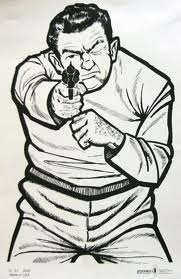
Comedy is inseparable from targeting.  Take a look at any joke and you will notice that it most likely has a target.  And, sometimes, the comedian or author may make him or herself into a target.  Whether one targets oneself or a target other than oneself, the target spurs those who laugh (in the audience) to feel or bear witness to some kind of superiority.  To be sure, the philosophy of comedy translates targeting into theory.  From Immanuel Kant and Thomas Hobbes to Henri Bergson and Charles Baudelaire we see the same gesture which posits a subject who (or which) is superior to the person or idea which is the target of this or that joke.

Even dialogical forms of comedy work on a similar premise of targeting and overturning – inter-subjectively and dialogically – this or that idea or object by way of inversion.  We see this, for instance, in Mikhail Bahktin’s theory of the carnivalesque in which low culture dialogically subverts high or dominant culture by way of comic parody.  And even when a theorist like Paul deMan argues, in his essay “The Rhetoric of Temporality,” that the “irony of ironies” short-circuits both inter-subjectivity and subjectivity, the fact remains that both inter-subjectivity and subjectivity are, for deMan, the true targets of comedy.  For him and, as he claims, for Charles Baudelaire, “essential laughter” makes one “mad.”   It makes one experience a kind of subjective vertigo which occurs in the wake of nihilation wherein no meaning remains (whether that meaning was shared and inter-subjective, a concept, or the elevation of reason over its target).  Comic (or is it tragic) madness takes meaning and the self as its ultimate targets.  And in its wake, nothing save anxiety, despair, and dizziness remain.

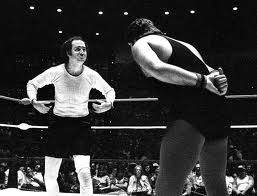
Instead of seeing comedy as destroying one target or another, I would like to suggest a reading of comedy that is based on being, as the philosopher Emmanuel Levinas might say, traumatized and inspired by the (other) comedian.  In the reading I would like to suggest, the comedian effaces the target and turns the act of targeting back on the audience.  (He doesn’t target them so much as expose them to targeting as such.)  To explore this notion I would like to address two particular kinds of comedy: Phillip Roth’s “sit-down” comedy (articulated through Portnoy of Portnoy’s Complaint) and the “stand-up” comedy of Andy Kaufman.  In the comedy they put forth, the audience and the reader may become uneasy and uncertain of themselves and their subject. They may not be sure if the comic subject needs their help and if they have anything to do with his or her humiliation.  The audience or reader, in short, is comically called into an ethical relation with an otherness that exposes them to relations of force.  And this gives them an acute sense of responsibility since they are caught up in this web of relations.  Their humor, to be sure, has high stakes.  

However, as I look to show, Roth and Kaufman fundamentally differ in the sense that in Roth the targeting doesn’t go far enough and may fall into what Levinas calls the “meanwhile” while in Kaufman the target is inverted.

Since the position of the comedian is one that includes ridicule and rejection, the audience’s responsibility is faced with the question of what it means to be implicated in an act of (comic) violence and what one can do about it.  But can one really do anything save bear witness?

The audience is exposed to the targeting that aims at the comedian.  Ultimately, there is a “madness” that comes with this brand of comedy but it is not, as deMan held, private and deeply subjective; it is shared publicly and, in a Levinasian sense, asymmetrically between the comedian and the audience.  And this madness, which is comic, marks one’s ability to respond. The madness of comedy is not, as deMan would hold, a private madness which is devoid of any relation anything remotely ethical; on the contrary, the madness of comedy is a “madness of responsibility.”

I would suggest – by way of Roth and Kaufman – that this general kind of comic responsibility is particular to the schlemiel – the Jewish fool.   Both Roth and Kaufman are, without a doubt, drawing on this character albeit in different ways.  The schlemiel, for some Jewish writers, is a comic target that must be ridiculed and left behind; for still others, it should not be left behind since it has an ethical effect, it inverts the comic target and awakens the asymmetrical relation between the comedian and audience.

On the one hand, we see the target a challenged form in Phillip Roth’s Portnoy and, on the other, we see it vindicated by Andy Kaufman.  Because both are targeted and because they deflect this targeting on the reader or audience, their comedy gives special attention to the target.  And this creates a kind of madness.  Comic responsibility is mad because it includes laughter, ridicule, and exposure to the other.  It marks the inversion of the target and opens up a new way of understanding comedy, philosophically.

Before we can understand the inversion of the comic target (in a Levinasian sense), we first need to understand how the comic target has been theorized.  To this end, I will make a brief survey of the philosophical theories of comedy from Socrates and Aristotle to Henri Bergson and Paul deMan.  Each of them understood the target of comedy in terms of one superiority or another: “élan vital,” Culture, Reason, consciousness, congruity, beauty, madness, etc.  To be sure, upon close reading, we can see that, in the philosophy of comedy, there is a common thread which spans the classical-Greek philosophers, the European Enlightenment, and European modernist.  And that thread is held together by the fact that all of them understand comedy in terms of this or that target.

In my next blog entry, I will address these positions.