Coming Out of a Daze (A Reflection on Melancholy, Poetry, and You)

Unknown-3

Things these days change so rapidly and they fall away without giving notice. The world – from time to time (and for some, moment to moment) – disappears and relationships lose their vitality.   When one’s fantasies or dreams are crushed, this speeds up the process of real estrangement and loss.   And then the option to mourn is there before us. The bitterness toward this loss evokes the thought that what was…was a fantasy.   Slavoj Zizek calls the dissolution of fantasy – which he sees active in every relationship – melancholy.   Melancholia is a preface to what he calls – following Jacques Lacan – the Real.

But is the Real always in the wake of loss?

Julia Kristeva calls the person who goes through this state of loss the “blank subject.”

A blank subject…at the dump for non-objects….For he is not mad, he through whom the abject exists. Out of the daze that has petrified him before the untouchable, impossible, absent body of the mother, a daze that has cut off his impulses from their objects.

The problem is that the blank subject, for Kristeva, can’t seem to come out of his daze. He has no desire since his daze has “cut off his impulses from their objects.”

It is out of this state that one of my favorite poets, Paul Celan writes. He lost his family in the Holocaust and struggled with melancholia. He seemed to be in a perpetual state of mourning.   But his poetry looks to leave the “daze” that Kristeva writes of behind. His poems often seek for relation.

By seeing himself amidst relations, he is able to think through and recover his desire.   The object of his desire, in many of his poems, is “you.” This you could be the reader, his soul, his mother, or God.   In a poem called “Largo,” from the book Snow Part (Shneepart), one can hear Celan’s voice in conversation with you. He is always already involved with you…but the relation comes out of a daze.

Sameways, you, hearthfaring near one:

Larger

Than

Death we lie

Together, the autumn

Crocus swarms

Under your breathing lids


Celan notes the world around “us” and near “you.”


The ouzel (blackbird) pair hang

Beside us, under

The height of our white, fellow –

Traveling


Meta-

Stases.

The world around us and the black birds “hanging” besides us are “under” the height of “our” “white, fellow traveling,” spreading diseases. The relationality, here, is at once redemptive and melancholic. One of the relations, above, spreads death. Although it is deemed a “fellow traveling” it is not friendly; it is deadly.     This “fellow traveler” is contrasted to the space “we” share which is “larger than death.”  Take note that the fellow traveler is “ours,” which suggest that its presence relates not to me or you but us.  However, although the space “we” share is larger it is not un-related to and it does not negate death.   The other traveler awakens me to “you” and what “we” share. It brings me out of the daze and into the real relation with death. But, at the very least, there is desire.  And the relation to death, in this poem, is something that is shared, though singular.

This kind of poem and this kind of message is inspiring in the sense that it shows that one need not remain a “blank subject” in the “dump for non-objects.”   It also shows us that this intimacy (between me and you) and this relation to “meta-stasis,” isn’t a fantasy.   Your “lids” are “breathing.” They are alive, and they are near; while “meta-stasis” is “above” us and the pair of black birds (perhaps a sign of melancholia) is near us.

Melancholia may certainly wipe us out and make us blank (or black/dark) subjects but what poetry can do, what the other can do, if we are willing to go to her, is fill in the blank and end the daze of lost relations. Celan turned toward language because he wanted to come out of the daze and live again. And he knew that this language was toward the other.

His poetry gives this hope to the reader. And today, when things are so insecure and unpredictable, when Facebook and Twitter make us glaze over, more and more of us are becoming blank and dazed subjects.   The language we use, the reflections we partake in, only increase the waste that piles up before us. Only by turning our language toward “you “ – whoever or whatever you are – can there be the hope of recovering desire and relation. Without this hope, we become not just a blank subject; we become one of the non-objects in the dump. In the dump there are no fantasies and there is also no hope.

Reading this poem helped me to see that. And I hope others can as well because you or I can barely see the “traveling metastasis” that is with “us” if we are not together (not just on the page, but in reality).   Like the voice of the poem, I am looking and speaking to you, the “hearthfaring near one.” I must.

Celan insists “you” aren’t a fantasy and that we desire to be close to each other.  Near you, I am home (or at least until our “fellow traveler” reaches us).


Taking Risks or Eliminating Them: On Bullies, Sophists, and Philosopher-Writers

Unknown-2

Throughout the Platonic dialogues, Socrates takes aim at Sophists and writers.     The problem Socrates has with the Sophists is that they may sound good but, in truth, they don’t know what they are talking about.   They are masters of language, not thought.   By way of analogy, Socrates suggests that to follow a Sophist is to follow a blind man (the blind are leading the blind). In contrast, the thinker can see what is in front of him by virtue of a kind of dialectic or logic that transcends language and writing.

Like the German philosopher, Friedrich Nietzsche, Michel Serres argues that writing and rhetoric are spoken for in the Platonic dialogues.   Writing can’t speak for itself. Plato turns the Sophist into a puppet or straw man who is, from the start to finish, immolated by the bull, Socrates.   Socrates plays the analyst to the Sophist writer. He bullies him:

Socrates, the analyst, demands short speeches. He interrupts rhetoricians and rhapsodies, he barks, makes fun of them. His questions cut up the expose into brief phrases of dialogue, and dichotomy brings the proposition back to the minimal length, that of a word. (81)

Serres likens him to a “myopic bull” that refuses to be affected by writing:

The myopic bull, neck lowered on the ochre sand, throws his tons and his works, in rectilinear orbit….Bull Socrates, globular eyes, bald forehead, fawn’s muffle, ugly to the point of being scary, unseats with one blow of his head the disarticulated Sophist puppet. (83)

Serres sees Socrates’ battle as “senseless.” He suggests that the philosopher learn from rather than bully or destroy the writer.   He calls this person “philosopher-writer.” He “tries things out, he essays.”

He experiences, experiments. He tests, he assays: the two ancient chemistry, of alchemy even, that has returned to common usage…The philosopher writer experiments on language by constructing it, just as the gesture of the artisan continues, prolongs the lineage of his art, musical staff or line of meaning, and as much as it can, advances. (79)

In contrast, the “analyst (philosopher) stops, breaks theorizes” while the writer “pursues connections, fabricates, because he believes that one knows nothing of what one has not practiced professionally. Cant produces a sterile knowledge of dead things. To know language, one must make it, too.   One must test or assay it”(79).

Challenging the rationalist conception of the essay, Serres suggests a different kind of essay that may have a “nonsensical result” because it, since it assays, takes risks that expose one to the unknown:

A faithful assay or essay sometimes, often, produces a negative, opposed, nonsensical result. Objects take revenge just as language does, just as the earth does once one no longer works it. They reserve the unexpected, do not react as foreseen. Experimentation carries a risk – of the aleatory, the unknown. (79)

Serres suggests that the philosophy-writer needs to expose himself to creation rather than elevate him or herself above it.   Writing is exposure, vulnerability, and risk:

One exposes oneself when one makes, one imposes oneself when one unmakes. When one unmakes, one is never wrong, in effect. I know of no better way to always be right….Fragile, naked, precariously balanced, the writer relies only on talent that never has the solidity of method: with no school to protect him by means of dialogue and a fixed position in the group, without imitator or master, he explores alone. He can thus miss, make mistakes, or lose himself. He bears this possible error and this potential to fall like wounds on the flank of his work. The pain and courage of wandering in order to pay for newness…..He never knows who will enter the next page. Never mind the fall, he tests! If he loses he will not have done anything wrong, and if he wins he will rejoice. (80)

Instead of having Socrates battle with or bully the Sophists, he suggests that philosopher learn from the writer.   He likes the unity of the two to a comic couple that many scholars think gave birth to modern literature: Don Quixote and Sancho Panza.

In other words, we need to picture the relationship between the writer and philosopher in terms other than war. Comedy helps us to have this vision:

An old savage philosophy where peace cannot intervene except between a derisory Socrates seated on his ass and a beautiful, discomfited Plato perched on his mare, running after pure ideas – Don Quixote and Sancho Panza. (85)

There can be “no philosophy without this appeased pair, laughing about useless battles that have simply become rituals, through commemoration”(85).     Serres is spot on. The philosopher must learn to love writing and learn from writing in stead of warring with the writer. The philosopher must be willing to become a “philosopher-writer” who takes risks and exposes himself to failure, the aleatory, and the unknown.   That is the risk of assaying (essaying) language and reality.   One may discover things that are surprising. On the other hand, one can also fall into the darkness.

If the philosopher cannot deal with the risk posed by writing (creation), then he may become a bully and repeat a senseless battle.   Instead of doing this, the philosopher must be willing to learn from the writer.   Serres adds that the philosopher must be willing to learn from language with love and ask for its support.   Although this move seems stupid and naïve to the philosopher, Serres suggests that it is necessary if the “adventure” of knowledge is to truly begin.   It can only begin if the philosopher takes the risk and entrusts him or herself to the experience of language. It can only begin if the thinker is willing to take risks rather than eliminate them.

The interesting thing about all of this is that Kierkegaard suggests that, despite his bullying tendencies, Socrates took a risk when he made an assertion. He stated it as a hypothesis worth risking oneself over rather than something self-evident and true.   (i.e: If immortality exists…).    This would suggest a different kind of Socrates.

But, still, Socrates didn’t write; Kierkegaard did. The latter’s risks were tied more to language than to ideas. Kierkegaard, as a writer, therefore, had a harder time bullying the Sophist.  While he took risks in life, anyone who reads him will know how some of his greatest risks were discovered through writing.  He knew that wisdom also comes with taking risks, not eliminating them.  If he or she is to think (albeit not in a Socratic sense), the “philosopher-writer” should be willing to take these risks.   Although this may seem like a tragic decision to give up on an ancient battle, it is in fact a comic victory and what Serres would call a “faithful assay.”


Like a Complete Unknown: On Michel Serres’ Reading of the “Third,” “Nohbdy” and Rebirth

Unknown

It goes without saying that dialogue is a symbol of progress and understanding in the West.   Whether it is the Martin Buber or Emmanuel Levinas, the principle players in the discourse are “I” and “you” (or “me” and the “other”). For Buber, the task is not to turn the other into an “it.”   In the spirit of Immanuel Kant, Buber sees the highest achievement for humanity – and perhaps the gateway for what Kant would call “perpetual peace” – to be the treatment of the other as an “end in itself.”   While this is an understandably noble act, what we may overlook is that the world that Enlightenment thinkers like Kant or existential thinkers like Buber reflect on is occupied by only a few positions that are of interest: I, you, we, and us. The impersonal (the “it”) is excluded because it is not…personal. “It” falls outside the realm of rational discourse and humanity because it is seen as an obstacle or incidental.   To put it bluntly, while you, I, or us are large and shape the world, the “it” is small and inconsequential.   But, on the contrary, what may be regarded as an “it” with little to no value may in fact have more of a role than “we” think.

Michel Serres, in The Troubadour of Knowledge, calls the impersonal “the third.”     And he argues that it is excluded from discourse. The third comes in…last place:

In the course of dialogue, he or she, that or they, outsiders, designate the exclusion or the exterior of the closed group of our conversation, the state of not belonging to our communication, therefore a third place. (46)

However, the last may go from the excluded to becoming a being that encompasses discourse. The third is a part of what he calls the transformation. The third can be a breakthrough. It can become the “milieu of everything” and can disturb and overtake our discourse:

Nothing can become everything, which can drown in nothingness. The third person, excluded, badly placed on the edge of mid-place, rarely bears the name of the person, because he borrows his own name from a demonstrative, but can become the milieu of everything, and, in particular, of us – we who are given over to language, that objective and inter-subjective milieu in which our tongues have always been immersed. (46)

Through the third’s transformation, Serres says we can understand the relation of “nothing to everything” as well as the “secret of begetting” and the “becoming of time.”

Serres uses several actual and literary examples to show how the third – neither you, nor me, nor us – transforms from nothing to everything.   Serres brings up Snow White who “encounters old dwarfs” in the forest. He notes how the dwarf is a transitional character. Dwarves are “old, but children in size, a quasi equality (between Snow White the Dwarves)…permits her to remain protected while becoming a protector, still a child, already mature; mother quickly, and child still. She will thus be reborn, from herself, from them, from the forest, in her self and otherwise, a daughter who is mother of herself”(49). Serres suggests that in this juxtaposition of small and big, old and young, there is a gateway for the third to move from nothing to something.

But this is no mere fairy tale.   Serres moves from Snow White to the slave who experiences pain and nothingness: “Other and experiencing alterity painfully, the slave is familiar with the exterior.” Like a slave, the person who transforms from small to big feels the pain of the impersonal. It is, for Serres, a prerequisite to what he calls “instruction” and knowledge:

Thus the world enters the body and the soul of the greenhorn: impersonal time and also the strangeness of the excluded, iste, the derided slave, and soon that of the master, ille, still far away, at the end of the voyage. Before arriving, he is no longer the same, reborn. The first person becomes the third person before entering the school door. (49)

In school we learn of universals, but science doesn’t understand suffering, otherness, and evil like literature does (hence, literature and the pain it takes note of and reflects on, as well as the movement from nothing to everything is, for Serres, a prerequisite). While science speaks to the truth of the global, literature speaks to the pain of the local:

Literature has cried misery and suffering since its birth. Science has not yet learned the language of this sob. In this tragic place begins the reason of the third-instructed.   Suffering and misfortune, pain injustice, and hunger are found at the point where the global touches the local, the universal the singular, power weakness, knowledge blindness. (70)

A great example of how becoming nothing can become a transitional point can be found in Homer’s Odyssey. While Theodor Adrono sees Odysseus (the main character of Homer’s Odyssey) as the example of the cunning mind that elevates reason and the will to power over mythology, Serres sees Odysseus as challenging the power of speech and reason by becoming “Nohbdy” (the spelling marks his exclusion).   This marks a moment in the text when Odysseus has to confront Polyphemous, the Cyclops.

Odysseus – at the point in the narrative – has lost nearly all of his power. Serres contrasts this to the all-powerful Cyclops whose “eye” is like a “laser beam” – it sees more and better (seeing = power):

Who will cauterize this implacable light?…A man named Nohbdy. A man who has wandered for such a long time, by sea and outside islands, that he has lost everything, that is vessels and his sandals, his tunic, his plans, even his own name still forsake him today. He is no longer counted. (66)

In contrast to him is Polyphemous, “that means: the one who speaks a lot, the one of whom one often speaks a lot….He counts a lot. All of his glory emanates from his eye”(66).   Serres calls Polyphemous an “encyclopediest” who has “a one hundred thousand striking or rigorous words at his disposal.”

When Odysseus manages to “cauterize the giant gaze, in the center, with his pointed sword, he blinds himself”(67). Serres, in other words, sees this act as an act of self-abasement and becoming invisible (becoming nothing and “nohbdy”):

He effaces Polyphemous, his own pen name, his beautiful, renowned last name, not in order to adopt a new moniker, but to renounce all: here he is, invisible, Nohbdy. He leaves the glory and the power….and flees from the den in the belly of a wooly ram, not taken, not seen. Nobody sees him reborn from the black hole of the grotto, by means of an invisible and animal birth. (67)

In other words, Nohbdy is “reborn” (nohbdy becomes an “author”) by way of becoming other, becoming animal.   The nothing –the third – becomes the milieu through which communication and reflection is possible.     This is what goes on before Odysseus returns home or before he crosses the threshold and enters the school.   Serres suggests, here, how literature can take us through the paradox of nothing becoming something. But ultimately, this process is not tragic. Rebirth is comic. The movement from nothing to something is a movement through pain. It tells us the story of how one goes from a complete unknown, to becoming, as Bob Dylan would say, a “rolling stone.”


“Before the Soup (After Kafka)” by Gary Barwin

Chaplin How He Does It (photoplayvolume11112chic_1253)

Before the Soup (After Kafka)

by Gary Barwin


A gatekeeper sits before the gate. As always, it stands open. A traveller asks to be let in.       “No.”

“Later?”

“Maybe,” the gatekeeper says. “But understand that though I am powerful, I am only the most lowly gatekeeper. Before each of the many gates, one after the other, there are other gatekeepers, each more powerful than the next. For instance, I can’t manage even one look at the third.”

“I understand,” the traveller says. “But you look hungry. Have some soup.” The traveller takes a bowl and spoon from his greatcoat and offers some to the gatekeeper. As he does, he trips, and trying to not to spill the soup, stumbles through the gate. He staggers past the first gatekeeper and, still balancing the soup, staggers past the second gatekeeper and the second gate, and as he stumbles through the third gate, he spills soup on the third gatekeeper, so terrible to behold,

“Sorry, sorry,” he says as continues to stumble, now past the fourth gatekeeper, more terrible still, and the fourth gate.

The traveller continues to stagger. He continues to stumble past both gates and gatekeepers, spilling soup on many. He may be stumbling still. It is a mystery not easily understood and he has left his bowl and spoon on the outside.


gary barwin headshot

Gary Barwin is a writer, composer, multimedia artist and the author of twenty books of poetry, fiction and books for children. His recent books include the national bestselling novel, Yiddish for Pirates (Random House Canada) and the short fiction collection, I, Dr. Greenblatt, Orthodontist, 251-1457. A new poetry collection, No TV for Woodpeckers (Wolsak & Wynn) will appear next year. A PhD in music composition, Barwin has been Writer-in-Residence at Western University and Young Voices E-Writer-in-Residence at the Toronto Public Library, and has taught creative writing at a number of colleges and universities. Currently, he is writer-in-residence at several shelters/custody facilities with ArtForms’ “Writers in the House” program for at-risk youth. He lives in Hamilton, Ontario where he hopes one day to translate Kafka into Klingon.

On Literary Pain: Comic and Tragic (From John Updike and Franz Kafka to Louis CK)

images

The feeling of pain (what Emmanuel Levinas calls the “little death”) and the existential onset of death are the most private experiences. It goes without saying that nobody can feel my pain or experience my death for me. Even though someone can take notice of pain and say, “I feel you.” He or she really can’t.   My pain – and not just my freedom – is what makes me a separate individual. It can be argued that pain gives one a sense of selfhood.   What narrative – as opposed to myth – can do is make the reader aware of pain and that all pain is not necessary.   The innocent suffer.  It can give us a view into the character’s private pain and contrast it to a public which cannot or refuses to see it. A thinker named Rene Girard argues that this perspective is what distinguishes monotheism from paganism.

It is plausible to argue that this perspective on pain is a key ingredient of modern literature. The more we can see the literary pain of a fictional character in contrast to his surroundings or people, the more valuable a piece of literature can be for us. It can help us to understand the relationship of pain to selfhood and the world. However, there is another side to this coin. This perspective is tragic, not comic. Comedy isn’t interested in pain so much as in what Freud would call the release of tension (for Freud the psyche feels pleasure when it releases such tension).   In modern literature, we also experience such a release from pain. It may not be complete, but its release does make things better.  It may not be as deep but it means a lot to us.  When we laugh at ourselves, we can live better.  (To put it simply: pain is heavy; comedy is light.)

John Updike is an interesting Pulitzer Prize winning writer. He tends more toward a fiction that is about pain and sharing that pain as a kind of secret with his audience. I find his theology of pain interesting. His obsession with pain is affected by his belief that suffering has a religious quality (perhaps in a sense similar to Kierkegaard).  In his novel, The Centaur, he takes a Kafkaesque premise (of a human turning into a creature) but instead of having the character turn into a bug he has the main character turn into a centaur.   And instead of having this happen in the privacy of the home and within the space of the family, Updike has it happen in the midst of the public sphere (in front of a class).   The subject is – immediately – a kind of Christ figure who is publically ridiculed when he “turns.”

Caldwell turned and as he turned his ankle received an arrow. The class burst into laughter. The pain scaled the slender core of his shin, whirled in the complexities of his knee, and swollen broader, more thunderous, mounted into his bowels. (9)

Updike moves back and forth between his private pain and his public ridicule (laughter, here, is not comic; it is a cruel kind of laughter – what the poet, Charles Baudelaire, would call Satanic laughter):

The laughter of the class, graduating from the first shrill bark of surprise into a deliberately aimed hooting, seemed to crowd against him, to crush the privacy that he so much desired, a privacy in which he could be alone with his pain, gauging its strength, estimating its duration, inspecting its anatomy. (9)

The contrast is explicit.   Updike’s narrator is telling his reader about how significant private pain is and how the inability to feel one’s own pain – as a result of humiliation – marks the “crush(ing)” of selfhood.

Updike’s close descriptions of the pain suggest that it is not merely a private affair. Its description takes on a kind of religious aura:

The pain seemed to be displacing with its own hairy segments his heart and lungs; as its gripped swelled in his throat he felt he was holding his brain like a morsel on a platter high out of hungry reach. (9)

The following sentences note how Caldwell is overwhelmed by external sensory stimuli. He leaves the classroom to flee it and only comes across more noise as he passes through the hall of the public school.

The narrator suggests that his pain helps Caldwell to grow and mature. He now feels – since he is a Centaur – a split between his lower and upper parts of his body:

His top half felt all afloat in the starry firmament of ideals and young voices singing; the rest of his self was heavily sunk in a swamp where it must, inevitably, drown. (10)

His top and bottom suggest a mind/body dualism. But it is his body and its pain that make him aware of his selfhood.   But Updike suggests something interesting about the relationship of pain to the world. While the boys in school ridicule him and force him into himself, the space of nature does the opposite:

Outdoors, in the face of spatial grandeur, his pain seemed abashed. Dwarfed, it retreated into his ankle, became hard and sullen and contemptible.. Caldwell’s strange silhouette took on dignity; his shoulders – a little narrow for so large a creature – straightened, and he moved, if not at a prance, yet with such a pressured stoic grace that the limp was enrolled in his stride. (11)

From here, Updike has him turn toward his home (which, as we can see here, he approaches with a kind of strength). The contrast with Kafka’s bug is suggestive. Updike seems to be exploring a different kind of selfhood. While the Centaur’s pain is shared with you, the reader; we also see that he has a unique relationship with nature. Kafka’s bug has no such relationship. He is confined to a house and lives, suffers, and dies in a house (or to be more specific, in his bedroom).   Kafka’s story, it seems, is more tragic. The fate of the soul – apparently, for Kafka – is to suffer privately and to be discarded by his family and the world.

While Kafka’s Gregor Samsa “turns” into a bug sometime while he is asleep, Updike’s Caldwell turns in front of the class. His shame is more public.   But he can leave them. He can live his solitude in the world.   There is nothing comical about either Updike or Kafka’s creatures.   They are tragic.

Is this the secret of literature? Do we need to deepen our sense of pain? Is Updike associating comedy and laughter with ridicule and crushing the soul? Is that fair? Can’t comedy also be associated with selfhood? How does comedy – in literature – create another kind of solidarity? Doesn’t that solidarity also include aspects of the body and pain –albeit a kind of relief from pain?

Or is it the case that comedy – like that of Louis CK – reminds us that pain is something that we can and perhaps should laugh at because…it won’t just go away? With age, it only increases.   And a good deed, as we see in this clip, can always devolve into a bad one. However, this devolution may also give us something to laugh about since we all know what’s it’s like to screw up. Perhaps it’s the event that sticks out in comedy and the private anguish of this or that character.   Louis CK brings both into play and brings it all to the surface.


What Am I Next? Tsimsum, Soul & Traversing Space in Michel Serres’ “The Troubadour of Knowledge”

Unknown

Language can take us places. It can create an opportunity for us to leave ourselves and go somewhere we have never been. But the only way for that kind of displacement to happen is for us to identify with the text and its movements. However, not all texts will do.   A good writer has an acute sense of movement and change. This sensibility is reflected in a kind of writing that not only moves us but also gives us a kind of knowing that Shunryu Suzuki – the famous Zen master – associates with readiness (“It is the readiness of the mind that is wisdom”).     For each line to be moving, one must be ready for what Michel Serres calls “exposure” or what Jean Luc Nancy would call surprise. In Serres’ The Troubadour of Knowledge, exposure marks a sudden movement from contraction to expansion. I would aver that this articulation of movement is a figuration for the dynamic process of tsimtsum.   By articulating exposure, contraction, and expansion, Serres takes the reader through what I would call a “theology of smallness.”

In The Troubadour of Knowledge, Serres tells his reader to get ready:

Be on the alert! Watch out! A given event, this mood, a project or thought passes, requires, solicits: in this way a gap arises. (28)

The gap that occurs resonates with the notion of tsimtsum because it suggests a withdrawal and an opening that occurs between God and man.

Precisely the divergence of walking: the child goes to seek its fortune in the world, launches one foot in relation to the other foot that is set down, rooted, a root directed toward the center of the Earth even though it covers a locality. The disequilibrium free of cares, with no guarantees, with an inchoate disquiet, laughing and risky, being has just dumped the there. It is exposed. It abandons abasement and rises up. Grows and launches its branch. Jumps. It leaves what is stable and moves way. Walks, runs. It leaves the shore and takes off. Swims. It abandons habit to experiment. It evolves. Offers. Loves. Passes the ball.   Forgets its own home, climbs, travels, wanders, gets to know, looks, invents, thinks. (28)

For Serres, the “there” is the “position” of being (it is a contracted point) and there is a distance or “gap” between this position and what he calls “exposure.”   This third thing – this gap between position and exposure – invents a place that is exposed. It is not my place but the space of otherness, expansion, and life. Through this exposure, I am no longer the same being occupying the same position:

Who am I? First this stable position that cannot be uprooted. Tree or vegetable, some kind of green. What am I next? I am no longer there, I am not me, I expose myself: I am that exposure. I am toward the other step, no longer in rootedness, but at the extremities, made mobile by the wind, at the branchings, on the summit of the mountain, at the other end of the world from which I depart, in animal movements, crawling, flight, running….(30)

What, Serres asks, am I “as a whole?” He answers that I am the “totality of the volume between being-there and the exposed point, between the position set down in this place, a thesis that is often low, and exposure”(30). He calls the distance between the “low” position and exposure – which is a part of a whole or totality and he calls the “large dimension” – the soul.

The two points between position and exposure can also be understood in terms of contraction and expansion: “the low and stable point of the place or the there positioned, set down, on the one hand, and the high point, the nonplace or enlargement of the soul, the risk or liberation, explosion”(30).

An interesting counterpoint to Serres can be found in Jean Luc Nancy who sees presence – qua laughter – as an explosion of presence but fails to note that this explosion returns to a point of contraction.   Serres likens the contraction to humility and earth and the expansion to God: “God magnifies my soul; my soul magnifies God; the separation between nothing and everything – magnitude makes God and my soul”(31).

A telling thing about Serres’ reading is that in writing this way, he like Nancy, seems to only focus on the movement toward expansion and God. God, it seems, is not to be found in the contraction. Rather, for Serres, position, earth, and death seem to be synonymous. While he is right to note the space between position and exposure, he is averse to maintaining the tension. Perhaps this is because he wants to measure the “space” between one and the other so as to experience joy.

The humblest experience of joy confirms that the soul fills the glory of the skies with its song or the world with its nothingness. And the same for time: beatitude runs from generation to generation, so that the devout inhabits the unfurled omnitude of space and history.  

Accompanied by joy, experience opens this space – which goes from there to elsewhere and can go from Earth to God – for the construction or dilation of the soul, by opening up or piercing a passage, a threshold, a door, a port through which to reach one of these exposed places.   (31)

Experience “traverses these spaces.” But it comes to end in ecstasy and “creates a differential in time”(31).   Experience is – by its very nature – expansive. It goes beyond the “bestial instinct” which is “positioned” and is a “being there.”   While Serres sees the human in terms of experiences venture away from the position, his reading of humility puts it closer to death and locality.

This reading is fascinating insofar as Rabbi Joseph Soloveichik in his Lonely Man of Faith argues that there are “two Adams” – one that contracts and one that expands. Serres, it seems is more into the second Adam which, according to Soloveichik, is a figure for humanities desire to experience, know, and move more. The second Adam experiences joy but also frustration at limitations while the first Adam is local, closer to death and humility. Judaism – for Soloveichik – exists between these poles. One balances out the other and the tsimtsum creates this tension. Serres doesn’t see God in the contraction so much as in the expansion.

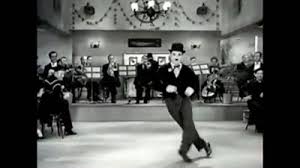
The schlemiel character exists between the two. The schlemiel is a small character. But while he is small in the realm of experience, he is large in the realm of goodness. The soul of the schlemiel is measured by his distance from the second Adam. Nonetheless, Sholem Aleichem’s schlemiels (Motl and Menachem Mendl) both set out for America and I.B. Singer’s Gimpel is on the move. They aren’t looking for more knowledge and experience, however. They are looking for goodness and trust. They are exposed to all types of accidents and lies but they keep on the move.   Much like Charlie Chaplin who doesn’t seem to stop moving, the schlemiel’s experience of God, so to speak, is in his narrow escape from this or that fate (on this note, Hannah Arendt calls the Chaplanesque schlemiel “the suspect”). His joy is on the run and, playing on Serres, I’d argue that it measures the space between position and exposure. His life is one non-stop tsimtsum, a theology of smallness.

When I look at Chaplin or when I read Aleichem’s Motl’s, I can’t help but hear Serres in my ear….with a comical twist:

What am I next? I am no longer there, I am not me, I expose myself: I am that exposure. I am toward the other step, no longer in rootedness, but at the extremities, made mobile by the wind, at the branchings, on the summit of the mountain, at the other end of the world from which I depart, in animal movements, crawling, flight, running


Sleeplessness, Insomnia, and Ambien: On Jonathan Crary’s “24/7”

Unknown-1

Unlike ever before, the possibility that we are living in a culture that never sleeps is becoming a reality.   Whether it’s the constant need (or is it demand?) to check one’s email, post on Facebook, or go through Twitter feeds, none of us can escape being implicated in what the art historian and critical theorist Jonathan Crary would call 24/7.   His book, 24/7: Late Capitalism and the Ends of Sleep offers a very pessimistic prognosis of the reality we are in and argues that the only way to battle it is, strangely enough, through sleep. No form of “awakening” or resistance can dislodge or disrupt 24/7.   All forms of resistance that we have turned to in the past are ineffective against it: art, literature, protests, violence, etc.   And this includes the theoretical possibilities of resistance posed by such great thinkers as Emmanuel Levinas, Jacques Derrida, and Hannah Arendt.

Crary argues that “24/7 steadily undermines distinctions between day and night, between light and dark, and between action and repose”(17). Like Walter Benjamin and Giorgio Agamben, he thinks that “experience” is no longer possible. But he has a different explanation as to why this is the case. It is 24/7 which is the culprit not speed or technology.   It is a “zone of insensibility, of amnesia.”   Crary draws on Maurice Blanchot’s book, The Writing of the Disaster, to explain:

It (24/7) is both of and after the disaster, characterized by the empty sky, in which no star or sign is visible, in which one’s bearings are lost and orientation is impossible.   More concretely, it is like a state of emergency, when a bank of floodlights are suddenly switched on in the middle of the night, seemingly as a response to some extreme circumstances, but which never get turned off and become domesticated into a permanent condition. (17)

The planet, says Crary, becomes a “non-stop work site or an always open shopping mall with infinite choices, tasks, selections, and digressions.” There is nowhere we can stop and think or have repose.     All of this is “hastening the exhaustion of life and the depletion of resources.”

The only “natural barrier” against the “full realization of 24/7 capitalism” is sleep. Nonetheless, it can be “wrecked.”   To explain, Crary points out how – as of a study in 2010 – around 50 million people in the USA are taking Ambien or Lunesta.   Today, that figure is likely much higher.   It would be a mistake, argues Crary, to think that they would totally eliminate insomnia: “insomnia is now inseperable from many other forms of dispossession and social ruin occurring globally”(18).   In other words, the mass experience of insomnia in the USA is “continuous with a generalized condition of worldlessness” and it isn’t going to get any better (regardless of how good the sleeping pills are).   24/7 is a global phenomenon and no first world country is exempt.

Citing Emmanuel Levinas’s reading of insomnia in terms of ethics – as a state of ethical vigilance in the face of “catastrophes of our era” – Crary argues that one form of insomnia may overtake another:

Insomnia corresponds to the necessity of vigilance, to a refusal to overlook the horror and injustice that pervades the world.   It is the disquiet of the effort to avoid inattention to the torment of the other.   But its disquiet is also the frustrating inefficacy of an ethic of watchfulness; the act of witnessing and its monotony can become a mere enduring of the night, the disaster….For Levinas, insomnia always hovers between self-absorption and a radical depersonalization; it does not exclude a concern for the other, but it provides no clear sense of a space for the other’s presence. It is where we face the near impossibility of living humanely. (19)

Playing on Jacques Derrida’s notion of the specter and Walter Benjamin’s mediations on the return of the (historically) repressed, Crary argues that the 24/7 world eradicates “shadows and obscurity and alternate temporalities”(19).   It is a “world identical to itself, a world with the shallowest of pasts, and thus in principle without specters”(19). Moreover, it seems to eliminate the wellsprings of both philosophy and religion (as per Aristotle, Heidegger, and AJ Heschel): wonder. 24/7 puts forth a “fraudulent brightness that presumes to extend everywhere and to preempt any mystery or unknowablility”(19). In the space of 24/7 nothing can truly come to light – no mystery, no awakening, no self-discovery that comes out of the darkness. Crary argues that 24/7 can “neutralize or absorb many dislocating experiences of return (or the past, specters) that could potentially undermine the substantiality and identity of the present and its apparent self-sufficiency”(20).

Although Hannah Arendt’s work is celebrated by Judith Butler and many others as offering a possibility for radical change and a “political life”(bios politicos). Crary disagrees. Drawing on her work that distinguishes the private from the public realm, he argues that for this distinction to work there needs to be a clear distinction (as she notes) between light and dark:

Over many years, she used figures of light and visibility in her accounts of what was necessary for there to be any substantive political life. For an individual to have political effectiveness, there needed to be balance, a movement between the bright, even harsh exposure of public activity and the protected, shielded sphere of domestic or private life, of what she calls the “darkness of sheltered existence. (21)

But without the space or time for privacy (away from what Arendt calls the “implacable bright light of constant presence of others on the public scene”), avers Crary, there “could be no possibility of the nurturing of the singularity of the self”(21).   Crary, echoing Arednt, says that only this kind of self could make a contribution to the public good. But…what happens when that kind of self is no longer possible because of….24/7?

The rhetoric of political or spiritual awakenings whether through Paul, Jewish mysticism, or the Communists, so as to recover some kind of sleeping authenticity, has no effect in 24/7. Playing on Carl Schmidt, Walter Benjamin, and Giorgio Agamben, Crary argues that “awakening” as a “form of decisionism” in which “the experience of a redemptive moment that seems to disrupt historical time, in which an individual undergoes a self-transforming encounter with a previously unknown future” is “incongruous” with the “global system that never sleeps”(24).

The only thing left, argues Crary, is (to) sleep:

The larger thrust of my argument is that, in the context of our own present, sleep can stand for the durability of the social, and the sleep might be analogous to other thresholds could defend or protect itself. As the most private, most vulnerable state common to all, sleep is crucially dependent on society in order to be sustained. (25)

The obvious question is how sleep can change the world. This proposal doesn’t make any sense and, given the excitement over the word “revolution” in the present American political campaign, it seems counterintuitive. But, as Crary would argue, any claim to changing the system would still be under the domination of 24/7. For Crary, sleeplessness makes all these activities seem trivial and even nostalgic.

Regardless of what you think, all you of have to do is take note of how many times you felt the urgent need to check Facebook, update a status, or Tweet something in order to seem relevant and alive (while at same time feeling exhausted and depleted) to know that 24/7 is not simply a concept…it’s a reality.   The question we need to ask is whether – as James Joyce wrote in his epic novel Ulysses, we can “awake” from “the nightmare of history.” Or will we just have to accept it? Will literature, art, or poetry no longer provide us with shelter from the storm?

What are the implications of 24/7? If the metaphor of awaking and starting something new and authentic is foreclosed by 24/7, perhaps the only metaphor left is sleep. If all the ghosts of history are, so to speak, busted by the endless light of 24/7, what is left to shake history? Can we be vigilant anymore when insomnia is endemic and violence is constantly reabsorbed into the media? Can we nurture our singularity in the darkness of our private spaces when there the private space has been effaced by 24/7? Can we hope for a spiritual or political awakening when we are always awake?

As you can see, I have many questions for Crary.   All of these questions must address his pessimistic claim that all previous models of resistance seem to have been foreclosed by 24/7. Is he correct? I think it is imperative that we answer this question. Otherwise, most of us who posit this or that thing as a form of resistance are willing to ignore the elephant in the room.  As we upload our next status update…like everyone else…we should try to pause and take notice of how restless we have become.   It seems as if you or I don’t have much time to keep up. But if you or I don’t, we have nothing to worry about.   Simply abstain from taking your Ambien and you’ll have time..you just won’t have sleep.

A Theology of Smallness? A Wild Take on the Schlemiel’s Smallness & Tsimsum

images-2

Recently, I have been engaged in a fascinating conversation with a colleague about the concept of tsimtsum.   After suggesting that I think about the tsimtsum in terms of contraction and expansion, he asked me a personal question. Would I, at this very moment, prefer expanding or contracting? After thinking about it, it struck me that he was aligning the schlemiel with only one of these possibilities: contraction.   A person who does not want to expand is a schlemiel. For this reason, it seems illogical that a person who, by a certain definition, desires to live and expand, would want to contract.   He told me that what a person desires most, according to this way of thinking, is to expand, be free, and be joyful.

I am astonished at the implications of what he was saying. Yes, I desired those things. If I do, does that mean that I am not a schlemiel? Does the schlemiel, if it is identified with contraction, suggest the opposite? Does the schlemiel desire to be small, limited, and sad? If this is a choice, than wouldn’t deciding to be a schlemiel be equated with self-sabotage?

Intuitively, no, I can’t believe it. It can’t be true. A schlemiel doesn’t always sabotage himself. There are times when a schlemiel actually gets lucky and stumbles over things….and then into things that take him or her to another level. Perhaps becoming a schlemiel is a different choice or…no choice at all.

To riff on Jacques Derrida, if we are always already small, than what choice do we have but to find joy instead of sadness in smallness?     And why can’t contraction also be expansion? Why do they have opposite value? Perhaps in becoming small one grows.   The experience of smallness gives the schlemiel a certain kind of vitality which is born out of the relationship to the other. I am very interested in how one can see this not only in secular texts but also in Hasidic texts, which have a religious intent.

In researching what I call a “theology of smallness,” I have sought for a literary figuration of smallness by a Hasidic rabbi. For in doing that, I am researching what I call a religious schlemiel.     According to Ruth Wisse, the religious schlemiel can be found in Rabbi Nachman of Breslav’s tale, “The Tam (Simpleton) and the Chakham (Sophisticate).” She argues the Rabbi Nachman of Breslav’s 19th century version of the schlemiel is a prototype for the early Yiddish writers of the late 19th century who drew on it constantly.

What I find most interesting about the tale is that the main character, a Tam (for now on, Simpleton), is already small and remains so throughout the tale. His smallness inheres, fundamentally, in his difference from his old time friend, the Chakham (sophisticate).

The schlemiel-slash-simpleton’s smallness inheres in the fact that he stays in the same town – while the Chakham goes abroad – he works on one craft all his life, cobbling – while the Chakham learns many trades – and he looks at people in a simple, kind way and trusts humanity – while the Chakham does not. His smallness is also, therefore, intellectual. What makes him unique is that, in his simplicity, in his lack of intellectual expansion, he is happy – while the Chakham is angry and bitter because he sees the world as foolish and gullible.

It is the simpleton who, by no work of his own, is somehow discovered by the King.   But so is the Chakham (the fact that they are friends and are living together is actually astonishing for the king).   Two different messengers – matching the nature of the Simpelton and the Chakham While the simpleton takes the invitation and believes the messenger, the Chakham does not. He cannot believe that 1) he would be desired by the king and 2) there is a king. The narrative goes on to show that the simpleton meets the king and becomes the leader over a province – within which lives the Chakham.

One day the Chakham is brought to him – for judgment – because he created havoc over a “baal shem tov” (a healer). When the Chakham stumbles across the threshold and looks up to see the Simpleton, he is astonished. How could it be that you, a small man, should be come the big leader of a province? The answer is that the king gave him this position, but the Chakham refuses to believe this because, as he had always insisted, no one has ever experienced the king: the king is a myth. To play on Nietzsche, the God he and everyone serves is dead (he was never alive).

The irony is the Chakham becomes small (out of self-sabotage, if you will) while the Simpleton happens to become “big.” However, the Simpleton’s bigness hasn’t changed his smallness. What makes him small is the fact that he is not only close to the king, but is also not far away from his own people. We can identify with the schlemiel.

Rabbi Nachman’s religious schlemiel is, as Hannah Arendt said of the schlemiel in “The Jew as Pariah,” a “man of the people.”   The people love and desire the schlemiel because he doesn’t become distant from people when he becomes their leader. This gives birth to another political question: how could it be that a schlemiel could be a leader? This is absurd.

However, this is what we see Charlie Chaplin doing at the end of his film, The Great Dictator. His bigness (expansion, literally, playing with the globe) is really small because he appeals to our natural sense of right and wrong through humor. But what Chaplin did was to secularize this kind of smallness and to show that if we are to expand, we must contract.

But in the desire to watch Chaplin’s smallness as he stumbles from one thing to another, perhaps one can say that we expand. Since Chaplin falls with grace, he redeems smallness from the jaws of tragedy. And this gives birth to hope.

This is how I would answer if anyone asked me whether I desire contraction or expansion. What I – like millions of people – desire is a kind of contraction that creates a larger life and freedom.   That’s the irony of the religious schlemiel.   If it is seen as stumbling and small, since his falling is done with a certain kind of grace and freedom, Chaplin’s performance shows the schlemiel to be a character who may be chased down or on the run (Hannah Arendt calls Chaplin the “suspect”). But, ultimately, will likely get away by the tips of his shoes.

But when he stumbles into safety, he creates a new kind of life or hope in life’s growth and expansion.   The schlemiel can tell us that there will – somehow – be a better life. That trust is found not only in Rabbi Nachman’s tale but in Charlie Chaplin’s stumblings through film. Without the element of trust in somehow getting through, smallness would be a tragedy rather than a comedy. It would be equated with death, not life.

This leads to a few final questions that I need to think more about. In accepting a certain kind of contraction, perhaps I am really accepting another kind of expansion?   But if this certain kind of contraction is taken (in a Kiergegaardian sense) to be aesthetic and not ethical, I can understand that identification of the schlemiel has nothing to do with life or, rather, it sabotages it. If I identify with the schlemiel I identify with an aesthetic kind of smallness. Is this smallness ethical or aesthetic? Can it be both?   Is it, as Kierkegaard might say, religious?

Yes.  Here’s a wild possibility: perhaps the identification of the schlemiel can be ethical, aesthetic, and religious at the same time.

But it is only “yes” if this comedy leads to more life and more trust.   The expansion that comes with the identification with the schlemiel is ethical, aesthetic, and vital (in a physical and spiritual sense). It is, ultimately, a vindication of humanity and the possibly…of God.   This is the possibility that is posed by a theology of smallness.*    It is desirable.  However, as Gershom Scholem said about tsimtsum, the relation of the God to the world (like the relationship of the schlemiel to the audience) should be thought of in terms of a relation to a “living organism” with a “Janus Faced Character.” The desire for smallness, in this sense, may bring contraction or it may bring expansion. But…we can only hope for the best even though that may change, as the French poet Mallarme would say, with a “throw of the dice.” Perhaps, in this sense, faith is tied to chance.


* The possibility poses, for me, two final questions regarding the meaning of one’s desire for seeing both religious and secular schlemiels: 1) Does one decide on taking the schlemiel’s way of life by virtue of desiring it and is this choice real or virtual? And 2) What are the aesthetics and ethics of such a desire?


The Stranger, Uninvited: Maurice Blanchot on Tsimtsum, the Other & the “God of Isaac Luria”

images-1

Maurice Blanchot’s writing is difficult and often opaque, but at least it’s consistent.   We see this throughout his books. To read Blanchot, is to ask the right questions. The task of the reader is to figure out what the problems and paradoxes Blanchot is pondering are and to figure out what his approach to them suggests. Of the topics Blanchot writes about, one of the most interesting is the relationship of writing to what he calls “the disaster.”   In a surprising aside, Blanchot suggests that the view of God and His creation of the world, as proposed by the 16th century Kabbalist, Isaac Luria (the Ari), provide a model for understanding writing and art.   What is most fascinating about Blanchot’s reading is that the primary movement of Tsimtsum – the movement of withdrawal from the world – can be read as the condition for the possibility of art, creation, and writing.   However, unlike Blanchot, we need to ask whether his reading of withdrawal presupposes the total absence of God or the writer from the artwork or…something else, something smaller, something…other.

In the opening pages of The Writing of the Disaster, Blanchot tells us that the desire to write is “absurd” because “writing is the decay of the will, just as it is the loss of power, and the fall of the regular fall of the beat, the disaster again”(11).     The more one writes, the less one wills and the less power one has. In effect, the writer and his or her assumed power is ruined by writing.   Writing has a disasterous affect. It reduces the will but it doesn’t annihilate it.   It makes one small. Instead of expanding my world, it shrinks it.

On the other hand, Blanchot tells us that the attempt to not write, so that one can “write out of failure,” puts one in “fellowship with the disaster.” Blanchot suggests that the writer should stop seeing writing as a form of salvation or a means to success.   This, of course, goes against the grain of what most writers truly believe. It is counter-intuitive; but the presumption here is that acting “as if” it is true may (perhaps) yield something unexpected. Writing may…happen, but not because I have willed it to happen:

May words cease to be arms; means of action, means of salvation. Let us count, rather, on disarray….whether it happens or not; it is the writing of the disaster. (12)

After noting this, Blanchot contradicts what he said above regarding “writing out of failure” and says that we “should not entrust ourselves to failure. That would only be to indulge in the nostalgia for success.”

What should we do, then? How is it possible for a writer to write out of neither success nor failure? Blanchot suggests that we, rather, “seek out” that “which out-plays (the way the disaster de-scribes)….it is what by chance befalls, and I fall beneath it, having always fallen already”(12).   Failure – in other words – is something that happens outside of us: we don’t start from a position of failure; rather, we may or may not “fall beneath” chance and, when we do, we will discover that we have “always fallen already.”   It is not a choice. This is what he calls the “thought of disaster,” which “dismisses all ideas of failure and success.”   This “thought” produces what he calls a “separate silence,” a space where the “other, keeping still, announces himself”(13).

As a reader, one may – at this point – be rightfully confused. Blanchot wants us to imagine a world and a creative space in which the will and all desire for success or the experience of failure have nothing to do with “me.”   This, he claims, is the “thought of disaster.” But, in the wake of this thought, I realize that I am not alone; I can experience a “separate silence” which is not mine; it is the other’s silence. In this space, “the other, keeping still, announces himself.” What Blanchot is doing, by way of reducing the self, its power, and its expansiveness, is not only making room for the “announcement” of the other; it is also creating a kind of Creation myth.   This is evident in the next aphorism, where he evokes Isaac Luria and his creation myth, which Luria calls “tsimtsum.”

Withdrawal and not expansion. Such would be art, in the manner of the God of Isaac Luria, who creates by excluding himself. (13)

Writing on tsimsum, Gershom Scholem tells us that there are two phases: one of withdrawal and the other of birth.   Since they are so different, Scholem says that these two phases have a “Janus character.”   Although Blanchot only focuses on withdrawal, he indirectly suggests that by withdrawing ourselves from what we do (by becoming small), we, like God, create. But , in truth,this creation is more or less a disclosure (or discovery) of the other. What Blanchot leaves unsaid in this aphorism is what he mentioned in the aphorism before; namely, that the withdrawal makes room for the announcement of the other. The other is, so to speak, born (announced) out of that withdrawal.

Scholem also points out that, since the Ari is a “theistic mystic” (rather than a pantheistic mystic), things are left separate (“with a reality of their own” so as not to dissolve in the Panthesitic “All”). This does not mean, however, that they are in total separation and Exile since there is what Scholem calls – following the Ari – the reshimu (the trace of God). Scholem argues that there is a dynamism between God and Creation (“steaming back” and flowing “outward”). For this reason, he likens God to a “living organism” who approaches and withdraws.  This means that withdrawal (or the “disaster,” as Blanchot would say) is not total.

Building on Blanchot, I would add that in withdrawing from Creation there is also the possibility of the other’s approach. We fall under the sway of chance, but this has to do with the blinkering (or as Michael Wyschogrod would say, “dark”) relation between man and God. What Blanchot calls the “thought of the disaster” is not a total disaster (man is not annihilated). Rather, disaster is a making small. God’s withdrawal and approach work on the micro not the macro level.

This relation is beyond success and failure because it only, in part, has to do with me. It also involves the other. Moreover, the approach and withdrawal – qua tsimtsum – are (as Scholem notes in his reading of he Ari) always happening. We may or may not merit disclosure or a hearing of the “announcement,” but we cannot merit anything if we are not made small by the “thought of disaster.” This thought opens one up to the possibility that, in the face of disaster, God hides his face. To be sure, this experience of concealment is a possibility of this thought. To think of total concealment as the necessity, however, would be a mistake (regarding what the Ari is suggesting). To think of a withdrawal without any possibility of revelation, is to take Blanchot to be articulating the truth of creation as total exile and withdrawal.   It would suggest that there is no dynamic or rhythm between God and man.

I would suggest, with a wink toward Martin Heidegger’s notion of “nihilation” (in his essay “What is Metaphysics?”) that while the world or the self may be nihilated and made strange, the self and the world are not annihilated by the nothing or the disaster. Both remain. But the self and the world are smaller than they were before it had this thought. Even so – in contrast to Heidegger and with a wink toward Emmanuel Levinas – I would argue (as Blanchot suggests) that in the wake of disaster the other “announces himself.”   In this creation myth, disaster – in making us small – is the condition for the possibility of a birth and the experience of the other.   The disaster comes and goes, as Blanchot suggests, like a rhythm just like the other comes and goes. The reason it does so – and reduces us and our world – has to do with the fact that we are always expanding and tend to forget how small we are not only in relation to the other but also in relation to God. We can only meet the other or God when we are small. But this smallness is not something we can simply decide on. Like the “thought of disaster,” it happens.

Blanchot – like the Ari – is asking us to envision a different kind of creation.   But instead of the “thought of disaster” being nihilistic, it is affirmative. By becoming small, writing (and creation) can make room for the other (creature) whose withdrawal and approach give meaning to my little – nihilated – and creaturely existence.

But this approach should not simply to be thought of in terms of what Blanchot suggests: sound and silence.   The other’s silence, as Paul Celan notes in one poem entitled “ABOVE SOUNDLESS,” is conveyed by presence. Celan figures the appearance of the other – out of nothing – in terms of a stranger coming in from the rain, on the threshold, with a tear in his eye. His time with us – like the numbers he counts – is limited. He comes and goes but he “betokens insight.” To appreciate this, one must become small and take the lines of the poem to be suggesting that “our” relation to the stranger makes “us” small and his stay (and our time with him) short.


The stranger, uninvited, from where,

The guest.

His dripping clothes.

His dripping eye.

 ….

His clothes-and-yes, like us

He is filled with night, he betokens

Insight, he counts now,

Like us, up to ten

And no farther.

The Janus Character of God and Existence: Gershom Scholem on the Implications of Tsimtsum

Unknown

One of the most interesting questions that the Kabbalah addresses deals with how one is to imagine God’s relationship to Creation.   The models that were sketched out to address this question have affected how Kabbalists have envisioned not just God but their experience of God in the world.   Is the relationship straightforward and simple or is it complex?

Writing on the Kabbalist Isaac Luria (the Ari), Gershom Scholem, in his Trends in Jewish Mysticism, tells us that, in comparison to the Zohar, “his cosmogony is both more original and more elaborate.”   Scholem finds the earlier, Neoplatonic conception of God’s relation to creation to be simple since it “begins with an act in which God projects His creative power out of His own self into space.”   And “every new act is a further stage in the process of externalization, which unfolds, in accordance with the emanationist doctrine of Neoplatonism, in a straight line downwards”(260).

In contrast to the Zohar’s emenationist perspective, Scholem says that Isaac Luria’s notion of Tsimtsum is complex.   Moreover, Scholem argues that it was “one of the most amazing and far reaching conceptions ever put forward in the whole history of Kabbalism.” Scholem, in the most economic language, explains that Tsimtsum “originally means ‘concentration’ or ‘contraction’ but if used in the Kabbalistic parlance it is best translated as ‘withdrawal’ or ‘retreat.’”(260).

Contrasting these two translations, Scholem takes note that while the Midrash explains that God “concentrates” himself into “one point” in one place (the Holy of Holies in the Temple), Tsimtsum suggests a “retreat away from the point.” To explain what this means and what it implies, Scholem first warns us that one should not simply think that this is the “withdrawal of God into his own Being in terms of Exile.”

Rather than do that, Scholem suggests that we think of Tsimtsum in terms of two “acts”:

The first act of all is not an act of revelation but one of limitation. Only in the second act does God send out a ray of His light and begin his revelation, or rather his unfolding as God the Creator, and the primordial space of His own creation. More than that, every new act of emanation and manifestation is preceded by one of concentration and retraction. (261)

Instead of being a simple process of emanation, this process is what Scholem calls a “double strain” since it includes light which “streams back into God and flows out of Him.”   This “perpetual tension” and “repeated effort” is the condition for the possibility of the world’s existence. Moshe Idel calls this “dynamism.”   It is the best attempt there is, says Scholem, to explain the Creation out of Nothing.   But it leads to a “theosophical mystery.”

For Scholem, the mystery emerges out of a tension between pantheism, which he associates with the emenation theory we find in the Zohar, and theism, which he associates with Tsimtsum.   While suggesting that there is a “residue” of “divine manifestation in every being,” Tsimtsum also suggests that “every being…acquires a reality of its own which guards it against the danger of dissolution into the non-individual being of the divine ‘all in all’”(262).  For this reason, Scholem calls the Ari a “theistic mystic.”

Scholem argues that from the period of European Renaissance onwards there was a clash between the Ari’s reading of Tsimtsum and those who clung to the pantheistic emanation theory we find in the Zohar.   Scholem’s brilliant move is to locate this tension in the interpretation of the Tsimtsum as literal or metaphorical.

If the Tsimtsum is interpreted metaphorically, than it is “only a veil which separate the individual consciousness from God in such a way as to give it the illusion of self-consciousness, in which it knows itself to be different from God”(262). In that case, “all it takes is an imperceptible change” so that “the heart may perceive the unity of divine subsistence in all that exists”(262). In other words, this “imperceptible change” will make room for the mystical experience that the Tsimtsum is an illusion and that all is God.

Scholem says in another essay (“The Messianic Idea in Judaism”) that, based on the literal reading of the Tsimtsum, we can understand how all things (in contrast to how the theory of emanation sees things) have “this basic Janus character – the limiting force and the emanating force, retreat and propagation. Only the concurrence of the two disparate motifs can produce being.”

The reading of God in terms of “limitation” changes how we see God and the world. Scholem, in this essay, calls this idea “paradoxical” and says it “has vitality” because “it expresses the notion of a living God – a God thought of as a living organism.”  What is so fascinating about Scholem’s claim is that, after making it, he doesn’t explain what it means that God is – in terms of Tsimtsum – a “living organism.” Rather, he discusses other ideas of the Ari (such as the “shattering of the vessels” or the notion of “tikkun”) which build on the notion of Tsimtsum. But in doing so, he refers to what he just explained – in terms of God as a “living organism”- as a “process.”

How does one merge the “Janus character” of God with a “living organism” and a “process”?   Is Scholem suggesting that a living organism – which retreats and propagates – is a process? And that this process is God?

What is fascinating about this reading is that Scholem differentiates it from emanationism and pantheism, which one can also call a process of God’s revealing himself. This process, however, is different because it is dynamic and includes a kind of blinkering that is uneven. God’s revelation – like that of an organism which propagates itself by giving birth to something new – is mixed with darkness and limitation. While the reading of tsimtsum in a figural manner is mystical, Scholem suggests – through this kind of approach – that the literal reading tends to not only be more theistic but also more biological.

Perhaps, in making such a reading, Scholem is moving along a trajectory mapped out by Michael Wyschogrod, which sees God in vital (yet not pantheistic) terms.   After all, the personal God that Wyschogrod takes to heart (like Martin Buber) is seen in terms of a God who comes and goes. As Wyschogrod notes in his book, The Body of Faith, God dwells and withdraws from the Jewish people. And like a living being, God loves and is vulnerable in this approach and withdrawal.

To bring this abstraction closer to earth, I’ll end with a fragment of a Paul Celan poem called “The Straightening.” It speaks to this coming and going – this dynamic tsimtsum of sorts – that has a “Janus character.” The poem dramatizes a play of light, darkness, and movement; advance and withdrawal, disclosure and concealment.   It suggests that God – in his relation to man and history – has a Janus Character and it calls for Him to “go to the eye” that is crying because of His concealment, perhaps during the Holocaust. (Note: Celan read Scholem’s Kabbalah scholarship and often brought Kabbalistic ideas into his poetry.)


Covered it

Up – who?


Came, came.

Came a word, came,

Came through the night,

Wanted to shine, wanted to shine.


Ash.

Ash, ash.

Night.

Night-and-night. – Go

To the eye, the moist one.


Go

To the eye,

The moist one –