The Circumcised Jew in The Interview: On Zac Efron and Seth Rogen’s Appearance on “Workaholics”

images

While they were making Neighbors, last spring, Zac Efron and Seth Rogen stopped by the Workoholics set and did a take with them hashtagged – with an obvious wink to Rogen’s film – #cubicleneighbors.   Although the show, in itself, never caught my eye, the confluence of the Workaholics cast with Rogen and Efron made me think twice about the show and its potential vis-à-vis the comic character that I am most interested in understanding: the schlemiel.   He is the odd one out. Rogen’s appeal to Jewishness in the episode – and his contrast with the hyper-masculine and sexy Zac Efron who also, in this episode, claims to be Jewish – seems to revive the schlemiel for modern audiences.   But it does so in a way that contrasts the muscle Jew to the less potent schlemiel. What’s missing in this contrast, however, is the dichotomy between the Israeli and the American Jew. Now it is one American Jew versus another; one Jewish body versus another. But is this bodily difference just another caricature that speaks to a population that needs to laugh at someone who is worse off and laughable than themselves? Is Seth Rogen’s body, juxtaposed to Efron’s, the final, schlemiel frontier?

Workaholics, a show starring Adam Devine, Blake Anderson, and Anders Holm, has been on TV since its debut in 2011. The comedy speaks to our time insofar as it does what the office does: it gathers a group of recent college-graduate-slacker-types who, in search of work, find each other in a telemarketing job. Their work puts them in comic situations which show that, like many slackers, they don’t take their job seriously. There doesn’t seem to be any separation between their day-to-day lives and their work. And as in any Apatow or Seth Rogen film, we see how they, despite there petty, ridiculous spats, remain bros.   But is this comedy worthy of our attention? Is it, as many scholarly film critics might say, too status quo and normative?   Does it merely reaffirm white, male heterosexist stereotypes and norms? Is it, like American Pie or Knocked Up, simply juvenile, or what film critic A.O. Scott would consider to be an example of how Hollywood is more interested in “perpetual adolescence?” Or is something else going on?

In a 2012 article for the Huffington Post, Joe Winkler argues that it is the “funniest show on TV.”   But it is all intelligent; albeit in the most tricky manner. Bringing the two together, Winkler claims that what makes it special is the fact that it “retains the highest laugh per minute ratio, all in a deceptively genius manner.”

Initially, people dismissed Workaholics as wholly derivative, not expecting it to last for more than half a season. Now, in the middle of season three, the show not only does well in the ratings departments, but monopolizes that time slot for the 18-34 male demographic. Here goes the stereotype about this show: “Dudes/Bros” love it, most people don’t care, and others see it as puerile, eroding the quality of TV, or a testament to the morally reprehensible world of TV. I feel like I need to defend the first of these assertions not because of its presumptuousness, but because we can’t fathom that a “dirty” show deserves to be spoken about in the same category as “intelligent” comedies, especially in the Golden Age of TV. In a way, the onslaught of intelligence has spoiled us to different forms of intelligent humor. Workaholics is hands down the funniest, least predictable, most exciting comedy on TV right now. Not the most important, or the wittiest or the most politically relevant, but it retains the highest laugh per minute ratio, all in a deceptively genius manner.  

Watching the show, one can obviously see how it could be criticized as “dirty” or unintelligent. But, on the other hand, I can see where the “deceptively genius manner” might fit in. But I didn’t see it until I saw Seth Rogen and Zak Efron with them on set for an episode hashtagged #cubicleneighbors.

As it progresses, we see that Rogen is the odd one out. In comparison to Zac Efron, he is deemed to be older, less attractive, and less sexy by Adam, Blake, and Anders.   After telling him his age, they all huddle and consider his case. Rogen can see that they are not in any way interested in sharing a cubicle with him.

When they make their “mid-point assessment,” Rogen’s humiliation is almost at its breaking point. Efron takes it to the edge when he looks at and gives detailed compliments to Adam, Blake, and Anders making them all feel unique and beloved. Rogen, trailing behind, says “I also think you’re cool” and so forth, but is hushed up several times.

When we see that he is downcast and on the verge of crying, Rogen calls Efron names such as “kiss ass.” But Efron keeps on going and all of them nod in agreement when he says that he thinks they can all “work well together.”

At this moment, when Rogen seems to have totally failed, he pulls a Jewish joke (three minutes in): “I think if you had a Jewish person, you could probably be more edgy because you have a minority in your group.” This works and they pause. But Efron steals Rogen’s Jewish wind when he says, “Here’s a bombshell, ‘I’m Jewish’.”

At this comment, they are all astonished. They are excited by this even more than Rogen’s proposal because here we have a Jew who is young and goodlooking (as opposed to Rogen). But Rogen retorts, playing on the Jewish stereotype that he, Seth Rogen, apparently, embodies: “You don’t look Jewish.”

Seeing that this isn’t working, Rogen demands to see if Efron is circumcised: “Let me see your dick…If you’re really Jewish, you will show me your dick”(4min in). Adam, Blake, and Anders echo the request and the Jewish test by saying, together, while clapping, “we’ve got…to see that dick.” In this moment, we slip into homoeroticism, which Rogen appeals to a lot in his latest film, The Interview. As in that film, homoeroticism is the thin line between being a “bro” (and getting into the cubicle with Adam, Blake, and Anders) and being “gay.”

When Efron pulls it out, they all marvel at how big it is and that it is also circumcised. Rogen joins in and says that its “gorgeous” and asks if “Leonardo DeVinci circumcised” Efron.   Following this rhetorical question, Rogen exclaims, “it’s beautiful.”

This gets everyone excited; but, at a certain point during the excitement, Rogen realizes he has lost and yells at Efron to put it away. He then realizes that what just went down was wrong.   In a last ditch attempt to beat Efron, he pleas with Adam, Blake, and Anders: “you don’t want his dick overshadowing yours.”

To finish his argument, he courageously (?) tells them that his dick, not Efron’s, is the one they should want in their cubicle. The response to seeing Rogen’s member is shock and fear (by Efron) and some of them which then turns in to jokes one would say to a “little baby.”   It is “cute, cool, and funny.” Which “dick do you want to share the cubicle with,” asks Rogen.

But, in the end, they argue that Rogen fails because his “personality is still dogshit.” Rogen is clearly humiliated and saddened. He is now, officially, the odd one out. They want the “Jew” with the “good vibe” and the “big dick” not Rogen.

Efron is not the Israeli but the stereotype that is being drawn on – of the muscle Jew – is.   (Although there is a tumblr page that suggests he is in its title.) Rogen seems to be playing with the idea that the anxiety about being or not being a good looking and attractive male now internal to being a Jewish-American. However, even though the idea itself, as in the film Neighbors (with Zack Efron), is shown to be silly, there is a utopian kind of wish that lingers in all of Rogen’s films. It is the desire to be and remain a bro regardless of differences in age, body type, and personality. But can we say that these differences, in being caricatured, are diffused? Or is it, rather, the case that the sexual schlemiel, as depicted by Rogen, will always be the odd one out…even in a space which is occupied by slackers?   Rogen, as schlemiel, isn’t desired; the other Jew is.

Rogen is not alone in using this strategy. It was also recently used by Gary Shteyngart in a clip he did with James Franco to advance his memoir. And, it seems, it will be used again when Ben Stiller turns Shteyngart’s book, Super Sad True Love Story into a TV series for Netflix.

But, in an episode of Naked and Afraid, starring Rogen and Franco, Rogen jokingly says that although he is afraid of being naked on camera, he wants to overcome this fear. He believes that being comfortable with his nakedness on camera will enable him to be more comfortable with himself…and his schlemiel body.

This, I would argue, is a half-truth and not just a joke. To be sure, Rogen, in countless TV and film appearances, puts himself out naked or half naked in front of a camera. This suggests that his main comic task is to come to terms with his body in distinction to people like Zac Efron and James Franco.   This is at once ridiculous and serious. Could this really be Rogen’s main comedic interest? And does it have anything to teach us about the schlemiel’s future vocation?  Or is this just a ridiculous issue?  Will the schlemiel, regardless of his relationship with his body or age, always be, as Shteyngart would say, a “little failure?” Will he always still be the guy, as Rogen suggests in his Workaholic’s episode, the “little dick?” And will he, as Shteyngart and Rogen both seem to suggest, always be caught up between being a bro and being gay?
“Sweetness is the Final Word of Skepticism”: Roland Barthes on Skepticism, Sweetness, and Stupidity

images-2

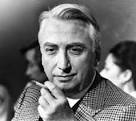
When I first ask my students about the meaning of skepticism, they often give me answers that confuse it with pessimism, bitterness, and negativity. Roland Barthes argues the contrary: that skepticism has nothing to do with bitterness. According to Diogenes Laertius, the 3rd century biographer of Greek philosophers, “sweetness is the final word of skepticism.” And the state that attends skepticism – which informs its “sweetness” – is “insensitivity” (“apatheia”) or “gentleness” (“praotes”).   Drawing on Laertius, Barthes creates a nuanced reading of skepticism which should appeal to us today and help us to go beyond a metaphysics based on what he calls a “balance” of opposites. Instead of focusing on balance and the concern with truth, Barthes calls for what he calls “drifting” and this modality is the way to sweetness, happiness, and apatheia.   Barthes reflections on these aspects of skepticism suggest that he sees the skeptic as a kind of artist who lives outside of the realm of judgment and truth. The artist is a daydreamer in the sense that s/he is apathetic and is more concerned with perception than in its meaning.

According to Barthes, “epoche” is the “key concept of Greek skepticism.” He defines it as the “suspension of judgment.” When the mind is suspended, it “neither affirms nor denies anything.” And although judgment is suspended, the “skeptic stays in touch with what he feels, with what he believes he feels.” He doesn’t try to judge or understand what he feels in a “dogmatic away.” Rather, he just “announces his impressions.”

Instead of “abdicating” from “intensities,” the skeptic keeps “life as a guide” and this, says Barthes, is the “ethical dimension” of skepticism.   Letting life be a guide is equivalent to allowing one self to drift into and out of “intensities.” This drifting aims at “happiness” and “rightness.” But for this to happen, one need s to set things in opposition. However, one does so in a way that doesn’t look to “balance” the opposites. He calls balance a “myth.”

To the mythical image of balance, we can oppose another image: that of the drift: an opposition (conflict/paradigm) can be “neutralized” by a balanced blockage of forces…but also by parrying, drifting away from the antagonistic binarism. (202, The Neutral)

According to Barthes, what is at stake in the rift between “balance” and “drift” is “security.” One can either cling to “balance” and “truth,” and be secure, or one can cling to “drift” and abandon all security. This suggests that in drifting one may experience the unsettling nature of drives and trauma (Freud) or reactions (Deleuze). Nonetheless, in doing this, Barthes suggests, by way of ancient skeptics, that there will be a happy (“sweet”) state of indifference (“apatheia”).

This state, says Barthes, “presents the most affinity with Neutral.” It evinces what he calls a “gentleness.” This comes with passing tactfully (not strategically) and gently from one state to another. He calls it a “neutral awakening” from sleep into a state between sleep and dreams, a kind of daydream state.   It has a kind of timing that is abberant, a kairos which Barthes calls a “kind of hunger for contingency.”   And the goal of this hunger is to be found in writing which looks to “outstrip the world.”

A whole work (of writing) is needed for worldliness to be outstripped and outclassed by writing: it’s a revelation that is only brought about at the very end: writing drives out worldliness…but over the course of a long initiation, of a drama complete with episodes. (172).

The neutral, which the skeptic experiences, “listens to contingency, it doesn’t submit to it.” It’s hunger, in other words, is continual. Sweetness consists in dodging the system and by following the span of kairos as it moves from one state or scene to another. Only the truth, in the skeptics view, is bound to time and fate.

This dodging reminds me of Buster Keaton who, it seems, might be considered a figure of the skeptic, as understood by Barthes. He is innocent, tactful, and caught up in a drift. He is constantly thrown out of balance and drifts from one state to another. His time is not the time of fate; it is the time of chance. But, in the end, he gets by and gives a model for comedy.

What one might miss in all this is that even though Barthes suggest “tact” as a part of being skeptical. There is also a kind of “stupidity” that comes with drifting and with the “suspension of judgment” (epoche). In his autobiography, Roland Barthes by Roland Barthes, he writes lovingly about stupidity:

What is it? A spectacle, an aesthetic fiction, perhaps a hallucination? Perhaps we want to put ourselves in the picture? It’s lovely, it takes your breath away, it’s strange; and about stupidity, I am entitled to say no more than this: that it fascinates me. Fascination is the correct feeling stupidity must inspire me with…it grips me (it is intractable, nothing prevails over it, it takes you in an endless hand-over-hand race). (51)

In passages like these, we can see that Barthes is associating perception and drift with a kind of stupidity that is “intractable” and “prevails.” But instead of giving it a negative valance as many philosophers would do, regarding perception as such, Barthes calls it lovely and embraces it. After all, the suspension of judgment, which comes on one out of nowhere, prompts an experience of stupidity. It is not an experience in which everything comes together so much as an experience of how things drift apart. But instead of seeing it in a tragic or comic manner, doesn’t Barthes, in associating all of this with stupidity, give us a sense of how skepticism is not bitter but sweet and…comical? Or is skepticism…fatal…since it “grips me” and “prevails over me”…stripping me of my freedom….taking me on an “endless hand-over-hand race?”

Mystical Burlesque (Reading Zohar with Gershom Scholem)

Please take a look at this wonderful blog-essay on Gerschom Scholem’s reading of the mystical vis-a-vis the words he used which combine the ridiculous and the religous. Brilliant reading! Enjoy!

zjb's avatarjewish philosophy place

Burlesque

Re-reading Gershom Scholem’s Major Trends in Jewish Mysticism (1941) perhaps more systemically than I did many years ago when I read it for the first time. While most of the main lines of argument have been assimilated and critically sifted in Jewish Studies-Jewish thought and culture, what I’m noting for the first time about Scholem’s study relates to Kabbalah as an aesthetic artifact. I’m restring my comments here to his first chapter on the Zohar, although I will note that about Lurianic Kabbalah, he calls “the architecture” of its “mystical structure” “baroque” (p.271).

About the Zohar, I would draw attention to Scholem’s use of the word “fancy,” which appears twice (pp.157, 169) when talking about the Zohar as a “mystical” novel and narrative figures. The term is associated with “delight” and skillful working, and elaborate detail (p.157).

What a weird elaboration. As a platform, Scholem notes how the Zohar builds…

View original post 379 more words

Martin Buber on Wombs, Babies, Child Development, and the “Longing for Relation”

images-1

Many great thinkers and writers of the 20th century were interested in children and in the experience of becoming childlike. One need only think of Freud and his obsession with the child’s development. Walter Benjamin wrote of childhood throughout his career, Kafka wrote of characters who had child-like sensibilities, nearly every story by Robert Walser has children or childlike narrators, James Joyce’s Bloom is a man-child who gets lost in experience, and Fyodor Dostoevsky was obsessed, in his novel, The Idiot, with Prince Myshkin’s childlike sensibility. And in his novel, Ferdydurke, Witold Gombrowicz has a narrator and children whose childishness evokes deep questions about the meaning of humanity. There are many other examples of childhood exploration by modernist writers and thinkers. And one need not look farther than thinkers like Jean-Francois Lyotard, Giorgio Agamben, Emmanuel Levinas, or Jean-Luc Nancy to see how fascinated they are with the meaning of “infancy” or what Lyotard calls the “debt to childhood.”

What one needs to keep in mind, however, is what these writers and thinkers were trying to explore or demonstrate in their writings on infancy and childhood. One very interesting exploration of childhood can be found in Martin Buber’s most famous book, I and Thou.   In search of the most primal experience of the “you” and relationality, Buber addresses the child in the womb and outside the womb as a kind of model or as evidence for the ontological roots of relationality and the I-thou encounter:

The pre-natal life of a child is a pure natural association, a flowing toward each other, a bodily reciprocity; and the life horizon of the developing being appears uniquely inscribed, and yet also not inscribed, in that of the being that carries it; for the womb in which it dwells is not solely that of the human mother. (76)

Buber, misreading a famous Midrash about a baby in the womb (who, according to the actual Midrash, remembers the entire Torah before birth), argues that the baby has a relation to the cosmos which, at birth, is forgotten:

This association is so cosmic that it seems like the imperfect deciphering of a primeval inscription when we are told in the language of Jewish myth that in his mother’s womb a man knows the universe and forgets it at birth. (76)

What remains with us, according to Buber, is “this association” which he calls “the secret image of a wish.” Buber warns us that it is not a wish to return to the womb so much as a desire to relate.   The words he uses to describe this relation – which retains difference – are poetic and ambiguous: “What this longing aims for is the cosmic association of the being that has burst into spirit with its true You”(76).

From here, Buber talks about the child outside the womb that “detaches itself to enter a personal life.” He focuses on the meaning of this “detachment” by pointing out that it is “not sudden and catastrophic like that from the bodily mother.” So…the metaphor, it seems, stops here. Rather, says Buber, “the human child is grated some time to exchange the natural association with the world that is slipping away for a spiritual association – a relationship”(77). In other words, the desire for relation, which must relate to “detachment” at some point of development, is not traumatic (contrary to someone like Emmanuel Levinas who, in his book Otherwise than Being, notes that we are “traumatized by the other”). For Buber, one eases in to this relationship. We “step into” the “cool and light creation” out of the “glowing chaos.” We are not “thrown,” as Martin Heidegger would say, and we are not “exposed” as Levinas would say. We “step” in to relationality.

Although this is a step, Buber notes that there is still, regardless, a “longing for relation”(77). That is there from the primal womb stages to our detachment. As evidence of this “longing for relation,” he describes how babies look and try desperately to find focus:

Before any particulars can be perceived, dull glances push into unclear space toward the indefinite; and at times when there is obviously no desire for nourishment, soft projections of the hands reach, aimlessly to all appearances, into the empty air toward the indefinite. (77)

This “longing for relation” eventually finds an object. And it is “primary.” The metaphor Buber uses to describe this turns the I-You experience, which is prior to language, into something infantile:

The longing for relation is primary, the cupped hand into which that being that confronts us nestles; and the relation to that, which is a wordless anticipation of saying You, comes second. (78)

Language, the first word, “you,” is born out of a longing to relate. It “comes second,” the desire comes first. Out of this, Buber crafts his own Biblical kind of declaration. Relation, basically, is the basis of everything (philosophy, religion, psychology, etc):

In the beginning is the relation – as the category of being, as readiness, as a form that reaches out to be filled, as a model of the soul; the a priori of relation; the innate You. (78)

And the “innate You” is “realized” in the “You we encounter.” For Buber, this realization is the goal. Children, however, go through a stage of “craving” and “disappointment” before they can experience it:

The development of the child’s soul is connected indissolubly with his craving for the You, with the fulfillments and disappointments of this craving, with the play of his experiments and his tragic seriousness when he feels at a total loss. (79)

His hope, one can surmise, is that the mature adult relation to the You is one that grows up and leaves behind these “cravings” and this “tragic seriousness” that goes along with “experiments” and “disappointments.”   One will be satisfied, eventually, with the desire to relate and relation as such. This, it seems, is the joy of what Buber thinks may be attained not just in the I-thou experience but in the philosophical-religious acceptance and understanding of….relation. But, as Buber suggests, this acceptance and understanding has to do with an apprehension of the infant and its primal, secret longing for relation. It has to with relation, not language, which comes “second.”

Dostoevsky’s Two Idiots – Part II

images

In the midst of Prince Myshkin’s epileptic fit, everything becomes double. And this doubleness brings out Dostoevsky’s approach to the fool-as-mystic. If one is to understand what is at stake with the fool, one must, for Dostoevsky understand the tension of opposites: namely, the struggle between good and evil.   This struggle occasions and weights down on “the idiot.”

Prince Myshkin’s mystical state, as I noted in the last blog entry, is punctured by thoughts that run contrary to this mystical state. There is a juxtaposition of the physical and the metaphysical. In one second, he experiences bliss, in the next moment, however, he experiences fear and confusion. The narrator of The Idiot depicts this fluctuation by a kind of writing that leaps back and forth between one thing and another. It pits one second in time against another:

His reasoning, that is, his evaluation of this moment, undoubtedly contained an error, but all the same he was somewhat perplexed by the actuality of the sensation. What, in fact, was he to do with this actuality?   Because it had happened, he had succeeded in saying to himself in that very second, in its boundless happiness, which he fully experienced, might be worth his whole life. “At that moment,” as he once said to Rogozhin in Moscow, when they got together there, “at that moment I was somehow able to understand the extraordinary phrase time shall be now more. Probably,” headed smiling, “it’s the same second in which the jug of water overturned by the epileptic Muhammad did not have time to spell, while he had time during the same second to survey all the dwellings of Allah.” (227)

But in the next paragraph, Dostoevsky suggests the opposite of light and revelation: darkness. Prince Myshkin sits alone in a bench in the darkness. A “thunderstorm” seems to be lingering. Meanwhile, the Prince tries to “forget something present, essential.” What could it be?

Dostoevsky tells us that it is the idea of murder: “an extremely strange recent murder, which had caused much noise and talk.” It is this thought – or rather, memory – of murder which marks a second odd moment; one which devours his mystical experience: “as soon as he remembered it, something peculiar happened to him again.”

At this moment, a “new, sudden idea came into his head…” This idea is one that is contrary to murder and malevolence; namely, the idea of innocence.   The Prince associates the idea with Lebedev, a foolish acquaintance (who is obsessed with John’s Revelations) and his nephew who is young…and innocent. He walks in that direction so as to reach the nephew and be saved from…the other idea…the one about murder. But what ends up happening is that, as in the mystical-slash-epileptic experience, he loses a sense of where he is and where he is going.

The “sudden idea” spurs the Prince to “peer into everything his eyes lighted upon, he looked at the sky, at the Neva. He addressed a little child he met.” As he does this, the narrator wonders if the Prince’s “epileptic state was intensifying more and more.” At this point, the narrator drifts away from a character who, it seems, has lost control and is looking to seize the “sudden” idea of innocence in reality so as to save himself from the other idea…of death.

But the two ideas clash. As he “recalls Lebedev’s nephew,” the “strange thing was that he kept coming to his mind as the murderer Lebedev had mentioned when introducing the nephew to him.”   At this point, the narrator suggests that, in Basil, Switzerland the Prince didn’t have to think about murderers. He could live a simple, innocent and carefree life. But in Russia, his idea of innocence was muddied. In Russia, the Idiot is troubled:

He had heard a great deal about such things (as murderers) since his arrival in Russia; he followed them persistently. And earlier he had even become much too interested in his conversation with the waiter about the murder of the Zhemarins. (228)

Since the Prince started “to believe passionately in the Russian soul,” he started thinking what these murders meant. This leads him to think of Rogozhin who, he knows, is malicious and dangerous. To be sure, his mystical-epileptic state occurred after leaving Rogozhin who, upon leaving, made a pact of friendship with the Prince. They had exchanged Crosses and shook hands as a sign of trust. But, even then, we can see that the trust is tainted with deep uncertainty:

The prince took off his tin cross, Parfyon (Rogozhin) his gold one, and they exchanged them. Parfyon was silent. With painful astonishment the prince noticed that the former mistrust, the former bitter and almost derisive smile still did not seem to leave the face of his adopted brother – at least it showed very strongly at moments. Finally Rogozhin silently took the prince’s hand and stood for a while, as if undecided about something; in the end he suddenly drew the prince after him, saying in a barely audible voice: “Come on.”(222)

Rogozhin brings the Prince to his old mother who smiles at the Prince and blesses him. They leave and Rogozhin asks the Prince to embrace him. But, right before doing it, Rogozhin puts his arms down: “He could not resolve to do it; he turned away so as not to look at the prince. He did not want to embrace him. (223)

This ambivalent love comes back to haunt the Prince when he thinks about the “Russian soul.”   He thinks about the Russian other after he thinks about himself and his discoveries. He wonders if he can trust someone like Rogozhin, an exemplar of the “Russian soul.” This soul is not clear like his own; it is “murky”:

Oh, he had endured so much, so much that was quite new to him in those six months, and unlooked-for, and unheard-of, and unexpected! But another man’s soul is murky, and the Russian soul is murky…Here he had long been getting together with Rogozhin, close together, in a “brotherly” way – but did he know Rogozhin? (228)

In the midst of this reflection, which is obviously troubling, he tries to distract himself with the idea that there is an innocent Russian other: Levedev’s nephew. The narrator calls this distraction a “reverie.” But it is interrupted, and the epileptic fit starts coming closer once the reverie is pierced with the idea of murder. And the ideas, once again, clash:

Was it he who killed those six beings, those six people? I seem to be mixing things up…how strange it is! My head is spinning…But what a sympathetic, what a sweet face Lebedev’s elder daughter has, the one who stood there with the baby, what an innocent, what an almost childlike expression, and what almost childlike laughter! (228)

The narrator finds it “strange” that the Prince had “almost forgotten that face and remembered it only now.” It is strange because the narrator, like the innocent Idiot Prince in the first part of the book, remembered the faces of the innocent and turned to them for inspiration and faith in humanity. To be sure, the narrator seems to be suggesting that the memory of such faces – in their utmost simplicity and innocence – is necessary if one is to do away with the complexity and murkiness of the Russian soul that we see with murderers and characters like Rogozhin.

However, this simple faith can’t compete with evil. The narrator demonstrates this by going hysterical over the thought that Rogozhin will kill the prince yet…he “won’t kill in a disorderly way. There won’t be chaos.”   These thoughts, apparently, echo those of the prince who, after thinking about all the things that Rogozhin did to show he was a “brother” and “faithful” (including the blessing by the mother) were a lie: “meanness”(229). This realization seems to destroy the prince’s innocence: “Despair and suffering seized his whole soul.” And he loses what Dostoevsky calls “the special idea” that suddenly came upon him. This idea is the idea – and the image/face – of innocence.

However, Dostoevsky decides to retain the trace of this idea and demonstrate the struggle that the Idiot must go through in order to save it, and the hope for humanity, from destruction. The doubleness, here, shows us that the fool, for Dostoevsky, must, at some point, struggle with cynicism. No mystical experience can shelter him from the deception and misdeeds of humankind.  It is this “reality” that defies the trust that should be the defining feature of humanity – the trust is the trait of innocence, the holy fool, and the child  – rather than “murkiness.”

…..to be continued

Dostoevsky’s Two Idiots: The Charming, Naïve, and Friendly Idiot and…the Deep, Mystical, and Epileptic One (Part I)

images-1

When it came to the fool Fyodor Dostoevsky, it seems, was of two minds.  After fleeing from Russia and the outpouring of his first novel, Crime and Punishment, Dostoevsky set out for Basil, Switzerland.   Dostoeveky decided that, after writing a novel that was full of depth, complexity, bleakness, and evil, he wanted to write a comic novel that, as he wrote to his niece, would be even more comic than Miguel Cervantes’ Don Quixote.

But Don Quixote is no common fool. As Dostoevsky also said to his niece, he thought that the true model for Cervantes, and by implication, his own fool was Jesus. For Dostoevsky, he is the true model for his novel, the Idiot. Dostoevsky tells his niece that Christ is “beautiful” because he is “already a miracle”:

There is only one perfectly beautiful person – Christ – so that the appearance of this immeasurably, infinitely beautiful person is, of course, already a miracle.

However, as I noted in another blog entry, Dostoevsky doesn’t model his character totally on Christ. Rather, he turns to the most beautiful character in what he calls “Christian literature”: “Don Quixote.” But, reflects Dostoevsky, he “is beautiful solely because he is at the same time ridiculous.”

For Dostoevsky, what makes the fool Christlike is her ability to gain our sympathy. That, he claims, is the “secret of humor”:

Compassion is shown for the beautiful that is ridiculed and does not know its own worth – and so sympathy appears in the readers. This arousing sympathy is the secret of humor.  

When beauty is ridiculed we don’t simply laugh; we also feel sympathy. In other words, there is something painful that is tied to “beauty” in this world. In The Idiot, Prince Myshkin is not simply ridiculed in each of his encounters. In fact, the first part of the book show how he, in his simplicity, was loved by children and befriended most of strangers. Myshkin is light, not deep. His comedy is to be found in his naïve trust of others and his optimistic way of greeting the future. He lives on the surface and it seems he has no depth or complexity.

He obviously doesn’t fit into Russian high society. But it is the men who he really doesn’t fit in with. He connects with the women and children more than the men. It is the jealousy of men and their murderous nature that one can see slightly foreshadowed in the first section. The leitmotif of this section is foolish trust and hope. As Dostoevsky would claim, we should sympathize with Prince Myshkin because, though he is a kind of holy fool, he is ultimately thought of as an outsider.   But he doesn’t feel like or even care about whether he is.   Although Prince Myshkin isn’t a fervent worshipper, his life, like Christ’s, is what Edith Wyshchogrod, drawing on saintly narrative (hagiography) would call a “saintly sample.” Myshkin is a folkloric kind of holy fool because he trusts people and only wants them to be happy.

However, this “sample” of the Holy Fool has another dimension.

There are moments when he is mesmerized with the image of evil. And I say image because Prince Myshkin loved to see and draw faces. The moments when he faces death suggest that the Prince may have depth and is grazed by evil. We see this in his witnessing of a beheading.   We also see this in his confrontation, later in the novel with Rogozhin who, out of jealousy, follows him and attempts to kill him. The limit between one kind of fool and the other – the buffer zone Dostoevsky puts between them – can be found in the experience of “epilepsy.” Dostoevsky sees the experience, which Prince Myshkin undergoes in the midst of his flight from Rogozhin, as mystical.

As far as experiences go, it is much different from his foolish relations to others since it is not social and external but deeply internal and complex. Dostoevsky’s writing, in this section, differs from the writing we find throughout the book which is mostly interested in Prince Myshkin’s social relations. Dostoevsky’s portrayal of the other idiot, the epileptic one (please note that Dostoevsky tests the meaning of the name “idiot” as it works on a medical register, a social register, and a mystical register).

When the Prince leaves an intense face-to-face encounter with Rogozhin, who is desperate, angry, and jealous and blames the Prince for taking away his fiancé, Kolya, (which simply isn’t true), he goes to the station to take a train. He feels radically alone and in pain. Because he is from Moscow and not St. Petersburg, he is unfamiliar with the city and what ensues resonates a lot with Edgar Allen Poe’s “Man of the Crowd”:

He was little acquainted with the city. He stopped occasionally at street corners in front of some houses, on the squares, on the bridges; once he stopped at a pastry shop to rest…He was tormentingly tense and uneasy, and at the same time felt an extraordinary need for solitude. He wanted to be alone and give himself over to all of this suffering tension completely passively, without looking for the least way out. He was loath to resolve the questions that overflowed his soul and heart. “What, then, am I to blame for it all?” He murmured to himself, almost unaware of his words. (223-224)

As time passes, the Prince gets more and more anxious and dissociates himself from reality as he is occasioned by a series of unexpected feelings and occurrences. He loses track of time and has a hard time locating things (and himself) in space:

He suddenly forced to catch himself consciously doing something that had been going on for a long time but which he had not noticed till that minute….he had begun now and then suddenly searching fro something around him. And he would forget about it, even for a long time, half an hour, and then suddenly turn again uneasily and search for something. (224)

In the midst of this confusion, the Prince starts having recollections about his location in time and space:

He recalled that at the moment when he had noticed that he kept searching around for something, he was standing on the sidewalk outside a shop window and looking with great curiosity at the goods displayed in the window. He now wanted to make absolutely sure: had he really been standing in front of that shopwindow just now, perhaps only five minutes ago, had he not imagined it or confused something? Did that shop and these goods really exist? (224)

As one can see, Dostoevsky has the Prince wax philosophical in this passage. To be sure, Dostoevesky, unlike anywhere in the novel, shows how the Prince has depth and is complex. In these moments, the Prince goes from being an ordinary “idiot” to a philosophical, or rather, a mystical-slash-epileptic “idiot.”   Like a mystic, he becomes “extraordinarily absentminded,” grows “morbid” and “anxious,” and confuses “objects and persons”(225).   These states of dissociation increase as a realizes that he can’t know for certain that things are what there are and where they are; in addition, as we can see above, he loses track of when or even if he experienced a sensation, memory, or thought in relation to them.

When he actually “discovers” the shop, he “laughs hysterically.” But then he is reminded of Rogozhin’s “eyes fixed on him” and he sinks back into anxiety.   At that moment he realizes that “something absolutely real had happened to him, which was absolutely connected with all his earlier uneasiness”(225). This real experience, which Rogozhin’s anger, jealousy, and intimated threats, is a kind of wake up call. (Since, after all, the idiot in Cervantes’ sense is caught up in the ideal, not the real, this is a wake up call.)

Although this is a pressing thought which pits one idiot (the deep, real, solitary, and complex one) against the other (which is superficial, charming, and friendly), the narrator tells us that the Prince focuses more on his “epileptic condition.” He realizes that what he was experiencing is the “stage just before the fit itself….when suddenly, amidst the sadness, the darkness of the soul, the pressure, his brain would momentarily catch fire, as it were, and all his life’s forces would be strained at once in an extraordinary impulse”(225).

The terms used to describe this state, however, are not physical; they are, rather, drawn from the register of mysticism.   The narrator points out that in these moments of the fit there is a sublime “flash” like “lightening” when everything is illuminated and becomes one. Through this state, he feels joy and hope and, like a mystic, perceives the “ultimate cause”:

His mind, his heart were lit up with an extraordinary light; all his agitation, all his doubts, all his worries were as if placated at once, resolved in a sort of sublime tranquility, filled with serene, harmonious joy, and hope, filled with reason and ultimate cause. (225-226)

Dostoevsky backs up, however, and points out that the moment before this great revelation is a “second moment” which is “unbearable.” When he reflects on this second moment, from a healthy state after the fit, he realizes that perhaps the “highest being” were “nothing but an illness, a violation of a normal state.” And that the “highest state…should be counted as the very lowest.” Faced with this dilemma about how to read the relationship of the two moments, the Prince comes to what the narrator calls the “paradoxical conclusion”:

“So what if it is an illness?” he finally decided. “Who cares that it’s an abnormal strain, if the result itself, if the moment of the sensation, remembered and examined in a healthy state, turns out to be the highest degree of harmony, beauty, gives a hitherto unheard-of and unknown feeling of fullness, measure, reconciliation, and an ecstatic, prayerful merging with the highest synthesis of life?”

These words, without a doubt, don’t disclose a simpleton-slash-idiot so much as a deep thinker who is seeking a serious mystical experience. Although the narrator calls these “vague expressions,” they demonstrate a kind of certainty that we seldom find in fool.   Moreover, the experience is deeply solitary and asocial. In this kind of reflection and experience, we see a fine line being drawn between one idiot and another.

….to be continued….

Honey Dicked and Honey Potted? A Reflection on Seth Rogen, James Franco, and a Few Motifs in “The Interview”

images

The title and the recent review of American Sniper by Matt Taibbi for Rolling Stone suggest that the film, “American Sniper is “Almost Too Dumb to Criticize.” In the article, Taibbi suggests that the person who would enjoy such a film has a lot in common with the character Forrest Gump:

The message of Forrest Gump was that if you think about the hard stuff too much, you’ll either get AIDS or lose your legs. Meanwhile, the hero is the idiot who just shrugs and says “Whatever!” whenever his country asks him to do something crazy.

Forrest Gump pulled in over half a billion and won Best Picture. So what exactly should we have expected from American Sniper?

Not much. But even by the low low standards of this business, it still manages to sink to a new depth or two.

The message is clear: not only are films today based on “low low standards,” but so are the viewers. Hollywood is catering to the “American idiot” who, like Forrest Gump, isn’t interested in looking to closely at him or herself or history for fear of what might happen to him or her.

Reading this review against The Rolling Stone review for Seth Rogen’s film, The Interview, I was a bit surprised. If anything, I would think that this title and these words might be more apt for Rogen’s film.   Although the other Rolling Stone review took some shots at Rogen and suggested that he has been doing adolescent films for much too long, it also suggested that, in the latest film, he is “at a crossroads” and is moving into the sphere of more serious films. These words, to be sure, suggest that the latest film is actually worthy of our interest. But, ultimately, I’d like to point out that the words applied to American Sniper can also be applied to the Rogen film.   The Interview is “almost too stupid to dumb to criticize.” Like Taibbi I would argue that Hollywood has taken on “low low standards” in this film. However, I’m not so sure I would argue that people who watch it, like the film itself, are American idiots.

I’d like to discuss a few motifs in the film because I think it is “almost” too dumb to criticize. There are a few motifs and phrases in the film that suggest that Evan Goldberg, Seth Rogen, and SONY Pictures believe, or rather assume, are most representative of how American youth – in general – represent…themselves. I think some of these assumptions are dumb while others are not.

One of the recurrent phrases in the film is the notion of being “honey dicked” or “honey potted” by someone. I started looking into the term “honeydicking” first. After looking the term up on urban dictionary, I was surprised to see that two definitions (and one t-shirt ad with the terms on it) came up which were put there after The Interview went public.   Here’s the definition:

When a person is getting took. Somebody finding your ass out, figuring out what you like, telling you what you want to hear, to get what they want out of you. Honeydicking is refers to when a male does this act. Honeypotting refers to when a female does this act.

After looking up “honeypotting,” I found a similar definition but applied to women doing the act. This definition, in contrast, relates to pornography and goes back to 2010:

To good-naturedly insert one’s finger into a partner’s anus during doggystyle sex and subsequently lick it. Usually performed several times during the same sitting.

As one can see from the initial urbandictionary defintion, the term is reinterpreted in the film and made into yet another neologism which means that one is duped by a woman who acts sweet but only wants you to do something for her.

The act of deceiving someone through sex is found throughout the film. The question, however, is whether this is good or bad. Both Rogen and Franco’s characters struggle with the possibility, throughout the film, that they have been “honey potted” by men (such as Kim Jong-un) or women (the CIA operative).

While Franco and Rogen’s characters are both “honey potted,” only Franco’s character is “honey dicked.”   Franco’s “honey dicking” by Kim Jong-un is the most interesting because we learn that the honey dicking has its greatest appeal on Franco he learns that he and Jong-un have similar problems: they both bond on the fact that they were hurt by their fathers who wanted them to be “men” and suppress their more “effeminate” emotions. In the process of speaking with each other, they become bros, party together, share secrets, and, as a result, Franco’s character, Skylark, decides that it would be wrong to kill Jong-un. He’s a bro, after all. He can’t be “honey dicking” him. Rogen’s character disagrees.

As a result, Skylark confronts the CIA agent and claims that she has been “honey potting” him. Rogen, meanwhile, learns that Jong-un’s secretary was not “honey potting” him. She is on their side.

Regardless, this motif, changes in the film when, toward the end, all of them realize that no one is deceiving anyone for any negative reason. This is just what bros do; however, Jung-un has an anger management problem (sound familiar, think of Adam Sandler). Skylark doesn’t. He has learned to control the anger his father may have bestowed on him and since Jong-un’s anger will result in killing millions of innocent people, Skylark decides to save the day and kill his bro.

The ambiguities in the film circle around the meaning of honey potting, honey dicking, and bros. We see all of this emblematized in the handshake. Can we trust the handshake or is it an act of deception? In the end, Rogen and Goldberg decided to have the handshake trump all other motifs. The bros, in the end, remain. However, the question we need to ask is what underlines this bro-hood and how does it evince a kind of stupidity.

At the outset of the film, Eminem is on screen confessing he is gay. The media control room goes crazy as if it’s a revelation that will trump all others in the modern era. Then we see Rob Lowe take off his wig to reveal his hidden (bald) identity. All of this is grist for the media mill and, as we see in the outset of the film, its not deemed serious. But, as we see throughout the film, nothing is really serious. Despite Skylark’s killing of his bro, Jong-un, the film suggests that if we can all be bros and if we were we would live in peace.

Moreover, it also suggests that the limit between bros and homosexuality – from being “honey potted” to being “honey dicked” (both, in the film, get positive valences) – is the limit of being modern, secular, and western. To be sure, these are the motifs behind the film and seem to spell out that, in addition to free speech, democracy, and communicating through Skype, this is the final frontier.   To be sure, the pornographic motifs and the handshaking, taken together, suggest this.

Is this the case? Is the limit between the bro and homosexuality the greatest thing that Americans can turn to when they reflect on themselves? This is what Rogen, Goldberg, and SONY suggest.   Does this motif speak to what Americans are in ways that are more truthful than, say, a film like American Sniper?   I put the two up against each other not only because Seth Rogen in his latest news-grabbing Tweet suggested we think his work against Eastwood’s film; but also because the two films present two different views of what is important to Americans and who they look at themselves.

And this suggests a few questions: Does the bro displace the patriot? Would we all rather be “honey dipped” or “honey dicked” in the positive sense than be fighting in wars? Will be saved by a person who realizes that sometimes bros aren’t bros when they want to get angry and kill everyone? What is the frontier? How do we draw the line? And what is at stake?

Given my work on the schlemiel – in this blog, in essay, in book collections, etc – I would argue that Franco and Rogen are playing characters that are derivatives of the schlemiel. Ruth Wisse argues, at the beginning of her book, The Schlemiel as Modern Hero, that there were, in the early 20th and late 19th century, many jokes about schlemiels who go to war. In nearly all of the jokes, there is a failure to fight. But Wisse says something very interesting about this. It’s not that these characters are “anti-war” it’s that they simply don’t know how to do war.

Watching The Interview, one can see that this may apply. But, to be sure, Rogen – and not just him, but Judd Apatow – is replacing the word “schlemiel” with “bro.” The bro doesn’t know how to do war but acts “as if” he does. We see this with all the characters and even Jong-un. He acts as if he does. And when he tries, Skylark takes his chances and shoots a tank missile at him and succeeds. This is, of course, a drastic measure.   We know this because, after this scene, we see Franco and Rogen’s characters have a bro reflection about what went wrong. The conversation gives their secret away: namely, that the latter day schlemiel not only doesn’t not want to or know how to engage in war but she or he would rather be hanging out with the bros or get honey potted….or honey dicked. (Or at least travel the limit between playing with it, wanting it, and actually getting it. After all, schlemielish sexuality is not laden with pathos or fate. As this and many other schlemiel films show us, such as Neighbors, Knocked Up, etc, sex just happens.)

Perhaps, even if both of these two films are “almost too dumb to criticize,” they have points that are worthy of discussion.  This has a lot to do with how Americans may or may not want to think of who they are and what they do best. Between these two films, we see this kind of tension and can get a sense that, perhaps, the bro and the American warrior are, as the one Rolling Stone writer said of Rogen’s film, at a “crossroads.” Alternatively, we may just have two films that are, still, “almost too stupid to criticize” no matter how you look at it. The latter option would suggest that what film critics really want to see may not be shown to a large American audience as long as there is a market for bro-comedy or patriotic action films.


A Guest Post by Jenny Caplan: “On Nebbishes – Part II”

images-2

In my previous post I laid out some of my general thoughts about the nebbish; where he comes from, how he behaves, and why he has had such longevity. The nebbish is a deceptively complex figure, and the persistence of the type in comedy indicates deep resonances, especially within the Jewish community, with the nebbish. In this post I will add some thoughts about gender to the mix. Thinking about the possibility of a female nebbish raises the eternal question: “just because you can, should you?” Is opening up the type to women a stride for equality, or is the more socially progressive move to refuse to portray women as self-sacrificing victims and to give them more agency?

How, then, does this relate to the question of the female nebbish? Although gender equality is certainly something we should continue to strive for, if the nebbish is a negative image do we want to be able to apply it to women? Given the historic treatment of women, can a perpetual victim, an abused, overlooked figure who follows meekly behind a more dominant person tidying up their messes actually be anything but horrifying when reimagined as a woman? We can laugh at Uncle David on the Goldbergs when he flutters around the apartment in a frilly apron, cooking and cleaning for the family, but when Fanny Brice sang in “My Man”

Oh, my man I love him so/ He’ll never know
All my life is just despair/ But I don’t care
When he takes me in his arms/ The world is bright, all right
What’s the diff’rence if I say/ I’ll go away, When I know
I’ll come back on my knees some day?
For whatever my man is/ I am his forever more!/ Oh, my man I love him

It was a pitiable, but not also risible performance of codependency and loss of self-worth in the face of the dominant other.

Combine those problems, then, with the Ugly Duckling issue. Traditionally Jewish women have had three stock types of their own, at least in American Jewish culture. Older Jewish women become the Jewish Mother, domineering, controlling, doting on her son in particular, and reducing her husband into a nebbish at best, a total non-entity at worst. Younger women had two options, both equally awful. The first is the more well-known Jewish American Princess. She is vapid and spoiled, frigid and self-centered. The second option is the Ugly Duckling. She has been the female equivalent to the nebbish for some time already. In her book Intolerance: The Parameters of Oppression Lise Noel points out that throughout literature and film Jewish men have typically “not idealized Jewish women,” depicting them through the story of “’The Jewish Ugly Duckling’ or ‘The Jewish American Princess.’” The Ugly Duckling is sometimes the JAPs younger sister (think Dirty Dancing), sometimes her best friend (think Kissing Jessica Stein), sometimes just her project (think Clueless). So if she is for women what the nebbish has been for men, is she also being reinvented?

Letty Cottin Pogrebin thinks so. She sees the Ugly Duckling, which she terms the “Jewish Big Mouth,” as a feminist icon. She claims that, “the character of the clever, outspoken Jewish girl has become a film convention that empowers all women. Most important, films portraying the Ugly Duckling who rises above her appearance have assured girls with big noses and frizzy hair that they too can invent their own kind of terrific and leave Miss America in the dust.” The Ugly Duckling can get her man, but then what? If she truly has aspects of the nebbish in her personality are we back to Fanny Brice pining after her lying, cheating, unemployed, gadabout man? Just because she gets the prince, does she live happily ever after?

This is where I find the gender divide is still at its widest. The modern male nebbish exists in a state of dramatic irony, where the audience knows things the other characters do not, and we view him therefore with both pity and respect at various points. The female nebbish or the reclaimed Ugly Duckling’s success still seems fleeting, as if her gains are tinged with the specter of future failure. There is, perhaps, dramatic irony at play here as well, but instead of seeing the power behind the nebbish, the Superman underneath the Clark Kent exterior we see the future unraveling that she fails to realize in her moment of happiness. She evokes pathos instead of a strange pride. To illustrate this I am going to turn to a non-Jewish Ugly Duckling: Peggy Olson from Mad Men.

Peggy spent the entire run of Man Men in the shadow of the men of Sterling Cooper. Though she is bright, talented, determined, and vocal about her displeasure at the double standard she sees in the treatment of men and women in advertising, she is never able to rise the way she would like. It is not for nothing, I would say, that this show is a period piece. We as the audience already know how history worked out, and we know that this woman is never going to become the boss, because that wasn’t the lot of women in the industry in the early 60s. So we can applaud Peggy’s successes, while also cringing because we know somehow, some way, it is going to unravel. Even when she goes with Don Draper to start their own firm, eventually becoming his right hand woman, it isn’t ever her name on the company. And when she bounces from firm to firm, always trying to find the place where she can really be herself and let her talent shine, the audience senses that she will never truly find that place. And, of course, she doesn’t. She ends up back with Don again, never able to fully escape his gravity. Her greatest career achievement even gets overshadowed when the announcement of her winning a CLIO award is preempted to announce the assassination of Martin Luther King Jr. To which the audience responds, “well of course.” That is Peggy’s lot in life, poor thing. We don’t root for her because we know it isn’t going to work out in the end. We like her, we wish it were otherwise, but we know it’s not. Funny, isn’t it, that she shares her last name with another, more traditional nebbish, Jimmy Olson. Jimmy Olson, in fact, is often what makes the Clark Kent Effect work. Precisely because we can see that Clark and Jimmy are so different, we can have pride in Clark that we can’t in Jimmy. Jimmy is the unreclaimed nebbish as Peggy is the Ugly Duckling after the ball, in the cold light of day.

So then where does that leave us with the nebbish? With work to be done, I would say, although much has been done already. Let’s return, for a moment, to Rachel Shukert’s nebbish typology. She writes of “the Hipster Nebbish (crumpled tweed jackets and phobic hand-wringing of early Woody Allen); the Slacker Nebbish (one of Judd Apatow’s sheepish heroes, with bong in one hand and an Xbox controller in the other); the Toxic Nebbish (see George Costanza, the most irately Jewish son of Tuscany ever committed to film). There’s the Nebbish Who Never Gets Laid, the Nebbish Who Screws Up Getting Laid, the Nebbish Who Is Inexplicably Laid by Gorgeous and Understanding Shiksa, also known as Wish Fulfillment Nebbish.” Because the nebbish is so unrelentingly male, and because, in Shukert’s eyes, he persists because of the ongoing and perpetual victim mentality of contemporary Jews, there is not much good to be found in his continued existence.

But as I have argued, perhaps there is something of value in his defiance of traditional anti-Semitic negativity, and his ability to evoke not only pity but also pride. If we continue to be presented with complex nebbishes, with Clark Kents that we as an audience also know are Superman, then maybe the nebbish can be a subversive and unlikely cultural hero. Maybe he is less victim, and more biding his time, or choosing his moment to shine. But as long as we continue to struggle with how to give women the same multi-faceted backstory then the nebbish can never really be a symbol for all Jews. Jewish women on screen and on the page need to be able to provoke pity and pride in equal measure as well. The Ugly Duckling may be able to become a feminist icon, a figure of empowerment to unattractive women everywhere, but that isn’t enough. Because too often we still get stories in which the Ugly Duckling’s second act results in abandonment, abuse, or tragedy. She still ends up as a victim far too often, and that is keeping her from being able to reap the benefits of being reclaimed as cultural hero.

I have argued that one of the hallmarks of the modern nebbish is that he is complex, and that is why I think increasingly he is someone with whom people can and do identify. The Hipster, The Slacker, the George Costanza, the McLovin, they all seem like people we could spend an afternoon with, and maybe even people we wouldn’t mind being, at least for a while. That, to me, is the strongest argument against seeing the nebbish as a perennial victim. No one wants to be a victim, but to a lot of us being Superman seems sort of exhausting too. Given those options, maybe being Clark Kent isn’t so bad after all.

Jenny Caplan is currently a Visiting Instructor of Religious Studies at Western Illinois University. She is a PhD candidate at Syracuse University, and should be defending her dissertation “All Joking Aside: the role of religion in American Jewish Satire” any moment now. She works primarily on American religion and popular culture, especially as relates to post-War American Judaism.

A Note on Harold Lloyd and Buster Keaton: Silent Film, Comic Gestures, and Fate

images-1

In Jean-Claude Carriere’s book, The Secret Language of Film he points out how films were “born silent” and continue to “love silence.” But he makes a major distinction. He argues that, in its beginnings, silent film “wildly gesticulated.” But “over the past sixty years” since its inception, we have something different; namely, the “present inscrutability of faces.” Carriere argues that, today, the face and the gesture are much more sophisticated and meaningful than they ever were:

Nowadays, simply from the demeanor or expression of particular actors, we pick up a clear message, depending on our mood of the moment, on the day, on the theater we happen to be in, or in the spectators around us…But we also glean nothing specific, noting identifiable, nothing definable. A new bend in the road can be suddenly revealed by a glance or a shrug, a bend of which we can say nothing, for it is something we have no words for, and yet we sense that it contains something meaningful. (31)

This reading of gesture in film suggests that the gesture, by way of film, is enigmatic and mysterious. A single gesture can change everything in a film and, at the same time, one may have “no words for” it. The problem with this kind of reading is that it leans toward a reading of gesture that has no interest in the comedic. To be sure, all of the examples that Carriere brings to illustrate this – drawn from Bergman, Bunuel, and Kurosowa (amongst others) – are not comedic. The silence that surrounds the gestures of these characters is profound.

In contrast to this kind of reading, I would like to suggest that comedic gesture, the kind we find in silent films by Harold Lloyd or Buster Keaton is not simply “wildly gesticulated.” To be sure, in my last blog entry on Siegfried Kracauer’s reading of American comic films in Germany, I pointed out how Kracauer believed that comic gesture, which we find in films by Lloyd and Keaton, presented a major challenge to the German habits of viewing and their ideology. As I noted, the gestures in these films emulated freedom and chance:

Whether or not they indulged in slapstick, they invariably exposed their hero to all kinds of pitfalls and dangers, so that he depended upon one lucky accident after another to escape.   When he crossed the railroad, a train would approach, threatening to crush him, and only in the last very moment would his life be spared as the train switched over to a track hitherto invisible. The hero – a sweet, rather helpless individual who would never harm anyone – pulled through in a world governed by chance.

In contrast, in Germany the reigning ideology was more interested in fate (even its humor was oriented toward fate):

That such comedy founded on chance and a naïve desire for happiness should prove inaccessible to the Germans arises form their traditional ideology, which tends to discredit the notion of luck in favor of that of fate.

This suggests that Lloyd and Keaton, in contrast to “the Germans,” are not “wildly gesticulating” in their films.

As one can see in these clips, the unexpected happens. Fate can be reversed in the turn of a hat. This brings us closer to the belief that, in the midst of chance happenings, the little man may get lucky and things can change for the better if he maintains his faith in the triumph of the goodness and happiness.

The silence that surrounds Lloyd’s gestures is not enigmatic in the same way it is in Bergman or Kuriosawa because the gestures we see in their films focus more on fate than on comedy. The enigmas we see deal more with death, failure, and misperception rather than with the possibility of hope. Perhaps these kinds of films – and the gestures they evoke, in all their complexity – speak more to Carriere because, ultimately, he is more interested in the meaning of gesture than its ethical impact on the viewer who relates his or her body to a situation that may lead to success or failure, happiness or sorrow. It is in these simple gestures that Walter Benjamin and Siegfried Kracauer saw revolutionary potential since they opened up a sphere of freedom rather than of fate and myth.   The fixation on gesture-as-mystery, however, risks falling in to this trap.

In his essay “Fate and Character,” Walter Benjamin associates character with freedom and fate with myth: “where there is character there will, with certainty, not be fate, and in the area of character there will, with certainty, not be fate.” Moreover, character is “placed in the ethical, fate in a religious context.” Benjamin sees character in relation to comedy and argues that “there is no relation of fate to innocence.” Rather, we find that in comedy. Innocence, writes Benjamin, relates to “good fortune” and “happiness.” And what makes the deeds of the “comic character” interesting is that they are simple. In comedy, “complication becomes simplicity, fate freedom.” This all comes through character which is all about…gesture.

Fortunately, the gestures of Buster Keaton, Harold Lloyd, or Charlie Chaplin teach us that comedic movements can take us into a different relationship with the world, our tenuous place in it, and the possibility of happiness.   And they do this by being framed in silence.

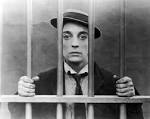
In this 1921 film, “The Goat,” Keaton can’t apply for a job because he’s waiting behind manikins; but when he figures this out it’s too late. He can’t apply. He finds a horseshow, a sign of good luck; but before he gets to it, somebody else finds it and gets the good luck. He desperately looks for it, finds it, but when he throws it backwards, it is hits a cop. Now he’s on the run.

This goes on and on. But so does his search for good luck and a lucky break. He is what Hannah Arendt, in her reading of Charlie Chaplin in the “Jew as Pariah,” called “the suspect.”   In the midst of all this, he saves a woman from an altercation with a man who accidentally trips on a dog leash. However, as we see later in the film, he imagines that he is wanted for killing the man (he left him in the street because he was being chased by the police).   He runs into a man who falls into paint and comes out of a room near him; he mistakes him for a ghost. But then he sees that a photo was accidentally taken of him which, ultimately, was supposed to be of a real criminal.

He is a (scape)goat; he is innocent. But this is not tragic or fatal as it is in many a passion play. Keaton is not like Prince Myshkin in Dostoevsky’s The Idiot. His innocence is not laughed at and slowly destroyed as it is in that novel. It is not, as Benjamin said of fate or as Carrierre would say of film, complicated. Rather, each of Keaton’s comic gestures evince a simple, free, and vital relationship with accidents. Informing each of his comic and erratic gestures is a search for a situation that will, finally, be good. But, contrary to Carriere, they are not “wild gesticulations.” Each gesticulation is intimately related to the possibility of good luck and a better world. There is nothing enigmatic or mysterious about these gestures…framed in silence. In these films, we see how a simple gesture…in the right situation…can change everything. There’s nothing complex or enigmatic about that.

Simplicity of character is something Yiddish writers of the schlemiel, which emerged out of Eastern Europe, knew very well. If read against what we see in these early silent films, we can better understand how the schlemiels we find in the novels or short stories of Yiddish writers like Sholom Aleichem or I.B. Singer find a safe haven in America. Since they live in a world of chance, narrowly avert disaster, and, still remain innocent and happy, Motl and Gimpel have a lot in common with Keaton, Lloyd, and Chaplin. Walter Benjamin was right on this account: where there is freedom (America) there can be no fate. And where there is freedom, there must be comedy. And contrary to Carriere, the gestures of these characters are not “wild” and lacking enigmatic depth; they are the best challenge we have to fate and mythology.

images-1

And what “The Goat” film teaches us is that the image of Buster Keaton behind bars, the image of his fate, is the false one. Fate is narrowly averted by the simple genius of comedy and comic gesture.

A Guest Post by Jenny Caplan: “On Nebbishes – Part I”

images

A nebbish, a schlemiel, and a schnorrer walk into a bar. The schnorrer makes a bee line for the free pretzels while the schlemiel makes his way through the crowd to an empty table, obliviously knocking over chairs and stepping on people’s jackets as he does so. The nebbish, on the other hand, follows along behind the schlemiel, picking the chairs back up and apologizing as he tries to keep up with his friend. The Yiddish stock types all exist in the same world, so they all relate to each other in different ways. But in some ways the nebbish is the most difficult to pin down because he (and I am using masculine pronouns for now, but the image of the nebbish as male is something I will be discussing this afternoon) is only defined in relation to others. If you’re familiar with the musical Chicago, he is Mr. Cellophane: you can look right through me, walk right by me, and never know I’m there.

In his now seminal The Joys of Yiddish, Leo Rosten called the nebbish, “an innocuous, ineffectual, weak, helpless or hapless unfortunate. A Sad Sack. A loser.” Elsewhere, as I alluded to above, Rosten described the relationship between the nebbish and the schlemiel as one where the nebbish has to constantly pick up what the schlemiel knocks over. Unlike the schlemiel/schlimazel relationship where the schlemiel spills his soup on the schlimazel, the nebbish is subservient in the relationship; overlooked, taken for granted, part of the furniture. I do not intend, here this afternoon, to revolutionize or rehabilitate the reputation of the nebbish. But what I would like to propose and discuss are a couple of points: why does the nebbish have the characteristics he does? Who is the contemporary nebbish, and what is his role in society? And, finally, why must the nebbish always be “he?” Can women not be nebbishes?

Let me begin, then, by offering some classic examples of nebbishes so that we may examine a bit more closely what makes a nebbish. Early Woody Allen and Seinfeld’s George Costanza come up frequently in conversations about easily identifiable nebbishes. Woody Allen’s character in Crimes and Misdemeanors may be his most nebbishy; not only does he not end up with the girl at the end, but he loses her his much-loathed brother in law. His brother in law is slick and witty and successful and attractive, while Allen’s character toils away over a documentary no one will ever watch and bemoans his constantly being overlooked. George’s function on Seinfeld, especially in the first few seasons is similar. Jerry is the star, the good-looking one. Elaine is the woman. Kramer is insane. But what is George? Who is George? Eventually, I suppose, he is the angry one, but he is also just the “other one.” The one who is there because he needs to be.

If we look at bit more carefully at some of the adjectives Rosten used to define the nebbish he is “innocuous, ineffectual, weak, helpless or hapless.” Traditionally this has played out with his being somewhere between entirely asexual and interested in women (because in addition to being male, he is almost invariably straight) but unable to hang on to one. What is interesting in the case of the nebbish though, is thinking about where and how the stereotype arose. So much of what goes into the Yiddish stock characters, as my colleagues here may mention in greater detail, is the overall stereotyping of European Jewish masculinity. So many of these types involve the Jewish man being shifty, untrustworthy, lascivious, or otherwise outside society’s boundaries. According to etymologist Evan Morris one of the things that separates the schlemiel from the nebbish is that the schlemiel, as a misfit, can be liked or disliked. He can be someone the audience boos. Wile E. Coyote, for example. The nebbish on the other hand must be pitied. He obviously cannot be the hero, but neither can he be the villain. He can only be the one you feel sorry for.

Why, then, does he persist? Do we need pitiable characters in our movies, television, and literature? Pity isn’t generally the goal of anti-Semitic propaganda. It would be pretty poor propaganda anyway if all it did was make the audience feel sorry for the poor Jews. So the longevity and proliferation of the nebbish as a type is probably not as driven by external social expectations and forces as, say, the gonif (who we’re not discussing today, but I kind of wish we were). It seems, therefore, that the impetus to keep the nebbish alive must be coming from within; there must be something inside the Jewish community that responds to that character, or needs him to exist. He is a strange figure to keep alive, however, as to be overlooked and also maintained or upheld would seem to be a contradiction.

Rachel Shukert wrote an article for Tablet magazine in which see sees the Holocaust as the driving force behind the prolonged existence of the nebbish in American Jewish culture, and she sees this as a primarily negative thing. She argued that, “World War II was a transformational event [for Jewish American men], a chance to unimpeachably cement their American identities by fighting for their country. Their children and grandchildren, however—the future Nebbish Generations—would view the war overwhelmingly through the lens of the Holocaust and its primacy in Jewish education, which in its single-minded focus on Auschwitz as the definitive image of the Jewish wartime experience has virtually drowned any narrative of Jewish heroism in the vast sea of Jewish helplessness.” So as far as Shukert is concerned, American Jewish education has created generations of Jews who, in viewing themselves and their people as consummate victims, have gravitated towards the nebbish as the character that most aptly embodies that victimhood. And even better, because he is so innocuous, we feel sorry for him instead of blaming him for his own impotence!

Certainly, Shukert has a point that American Jewish education has been reduced to “The Holocaust and Israel” in a lot of circles, which does place a potentially disproportionate focus on Jew-as-victim. So the evidence would suggest that that has a role in the resurgence of the nebbish character in the post-war years, through Woody Allen and Nathan Zuckerman and even George Costanza as, potentially, a last gasp of that generation’s feelings about their own identity. But that does not explain why the nebbish has been not only retained, but now morphed and changed in the last 10-15 years. If it was simply about Jew-as-victim, why have those future Nebbish Generations, as Shukert calls them, not only kept that narrative alive but also validated it, exalted it, and even gloried in it in some cases? Why does the modern nebbish exist, and what makes him, or her, different?

With all things stereotype, “reclaiming” is generally the easiest answer as to why a particular stock type persists, especially when it seems to do so with the blessing or even active efforts of the group being stereotyped. I disagree with Shukert (and others, I am not trying to make a straw man out of here; her essay is just the one that most clearly articulates some of these issues), however, that it is necessarily the ongoing victim mentality perpetuated by generations of Holocaust-focused Jewish education that has allowed the nebbish to survive and even thrive. I look at the nebbish-as-alter-ego effect as being another reason why we have seen this pitiable figure live on; I call it The Clark Kent Effect. Clark Kent is a classic nebbish; he is mild-mannered, overlooked, and taken advantage of. He pines after Lois Lane while she only has eyes for Superman. Superman is everyone’s favorite, but who pays the bills? Whose grind at the Daily Planet keeps Superman in tights and pomade? Because of characters like Clark Kent there is something still pitiable, but also noble about the nebbish, and there is a sense that perhaps the nebbish has a secret. Perhaps she or he is simply biding their time.

Actor Bob Balaban may be one of the best examples of someone who portrays this contemporary version of the nebbish that I am proposing. With a career stretching back to the 1960s he is one of those actors who, if you don’t recognize his name you would recognize him if you saw him (which in and of itself is a hallmark of the nebbish, no?). Though he always seems to be showing up, both in movies and on TV, in recent years he has become popular as part of Christopher Guest’s cadre of performers in his “mockumentaries” such as Waiting for Guffman or Best in Show. It is in these films that I think Balaban expresses his nebbishood best, and of all the films in this oeuvre A Mighty Wind could be his masterpiece. He plays the woefully uncharismatic son of recently deceased folk music impresario Irving Steinbloom. To honor his father Balaban arranges a grand reunion of the best folk acts from his father’s heyday. Throughout the film he shows he knows nothing about show business, is generally underfoot and asking the wrong questions, is dreadful at addressing either the artists or the audience, and in general is an annoyance to the performers who they’d prefer just went away and let them do their thing.

What is important here, though, is that while he is a nuisance to those in the film, the audience has a different experience of him. We get to see flashbacks to his childhood and to understand some of how he became what he is. We realize that, inept though he may be, he is arranging this concert out of a sincere desire to honor his father’s legacy. And finally (and perhaps most importantly), despite himself, he is a success. The lead-up to the concert is crisis after crisis after crisis he is ill-equipped to handle. But the end result is what everyone hoped and more (after all, we even got the actual Kiss At the End of the Rainbow!) and so we, the audience, get to celebrate the fact that Steinbloom pulled it off, against all odds. He is a nebbish par excellence, but in the end he is also a success. This “winner nebbish” is what I see as the modern take on the Clark Kent nebbish. The nebbish has his own alter ego, in a sense, because the audience knows and sees things that those around him don’t see, which is why we not only continue to pity the nebbish, but also now cheer for him.

Jenny Caplan is currently a Visiting Instructor of Religious Studies at Western Illinois University. She is a PhD candidate at Syracuse University, and should be defending her dissertation “All Joking Aside: the role of religion in American Jewish Satire” any moment now. She works primarily on American religion and popular culture, especially as relates to post-War American Judaism.